Medical Gases
Mr. Harshad Khade
MSc. Medical Technology (OTA)
Symbiosis International university, Pune.
• Medical gas supply system in hospitals and
other healthcare facilities are utilized to supply
specialized gases and gas mixtures to various
parts of the facility .
Medical Gas Cylinders
• Supply of Medical Gases:
• From:
• Cylinders (Manifold)
• PIPED gas system
• Medical gases commonly
used:
• Oxygen
• Nitrous oxide
• Air
• Nitrogen
• Carbon Dioxide
Cylinder
• A gas cylinder or tank is a pressure vessel used to store gases at
high pressure. Gases stored this way are called bottled gases.
• Components:
• Made of Molybdenum steel in which gases and vapours are
stored under pressure, e.g.13700 kPa for oxygen and 4400 kPa
for Nitrous oxide.
• Shape & colour of plastic disc around the neck of cylinder
indicates the year of last examination.
Medical Gas Cylinders
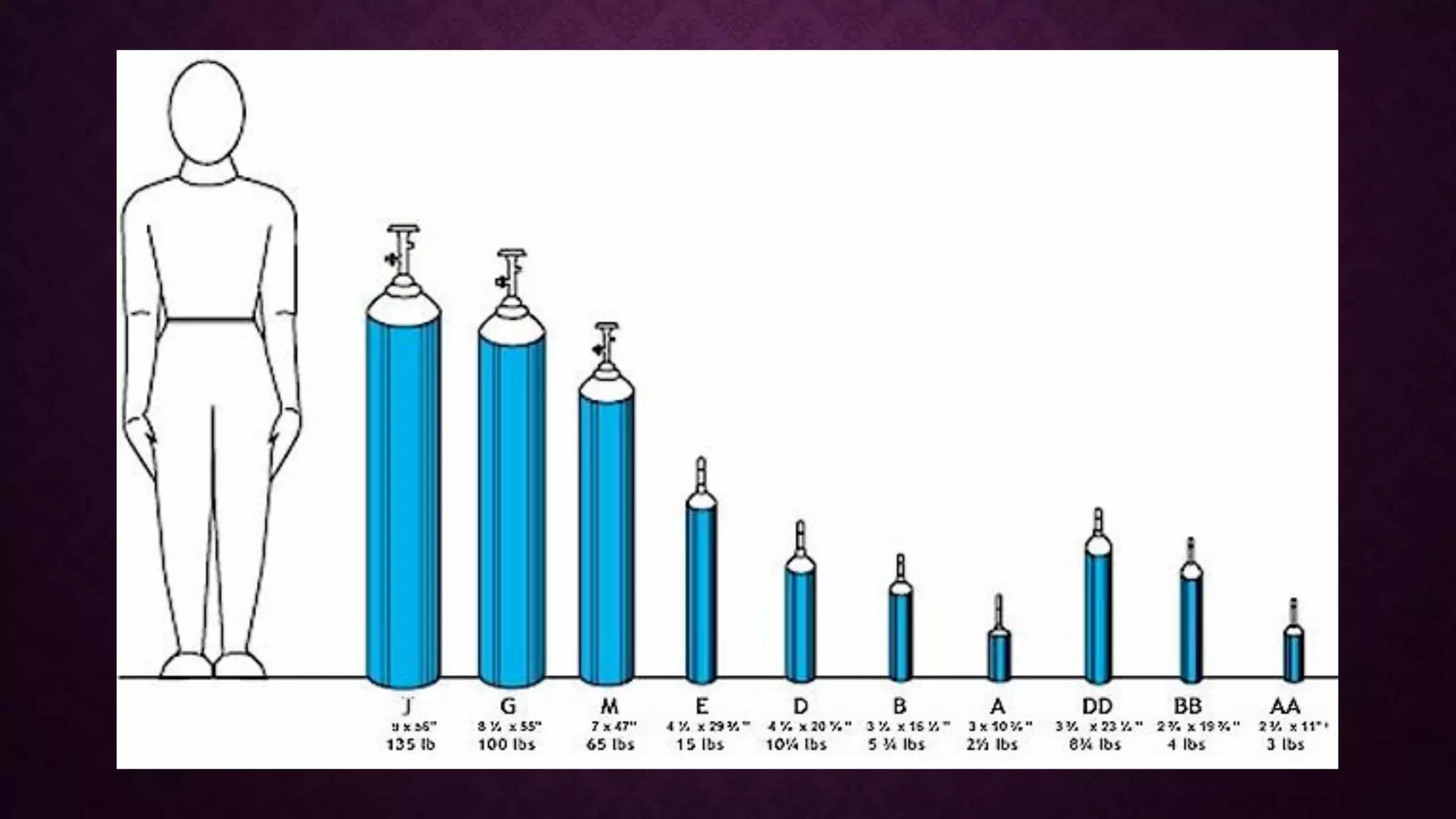
Cylinder Size D AF E F G J
Approx dimension(mm) 490 x 102 760 x 173 830 x 102 890 x 140 1290 x
178
1600 x
230
Approx Weight Empty
(kg)
3.8 11.4 6.6 13 30.6 68.7
Valve Type Pin-Index Bullnose Pin-Index Bullnose Bullnose Pin-Index
Gaseous Litres 0.34
(340)
1.36
(1360)
0.68 (680) 1.36 (1360) 3.4 (3400) 10.6
(10600)
Components
• They are manufactured in different sizes (A to J).
• Size E cylinders are used on the antiesthetic machine.
• Oxygen cylinders contain gas.
• Nitrous oxide cylinders contain a mixture of liquid and
vapour. 75% liquid N2O
• Light weight for homes & Transportation made of
aluminum alloy.
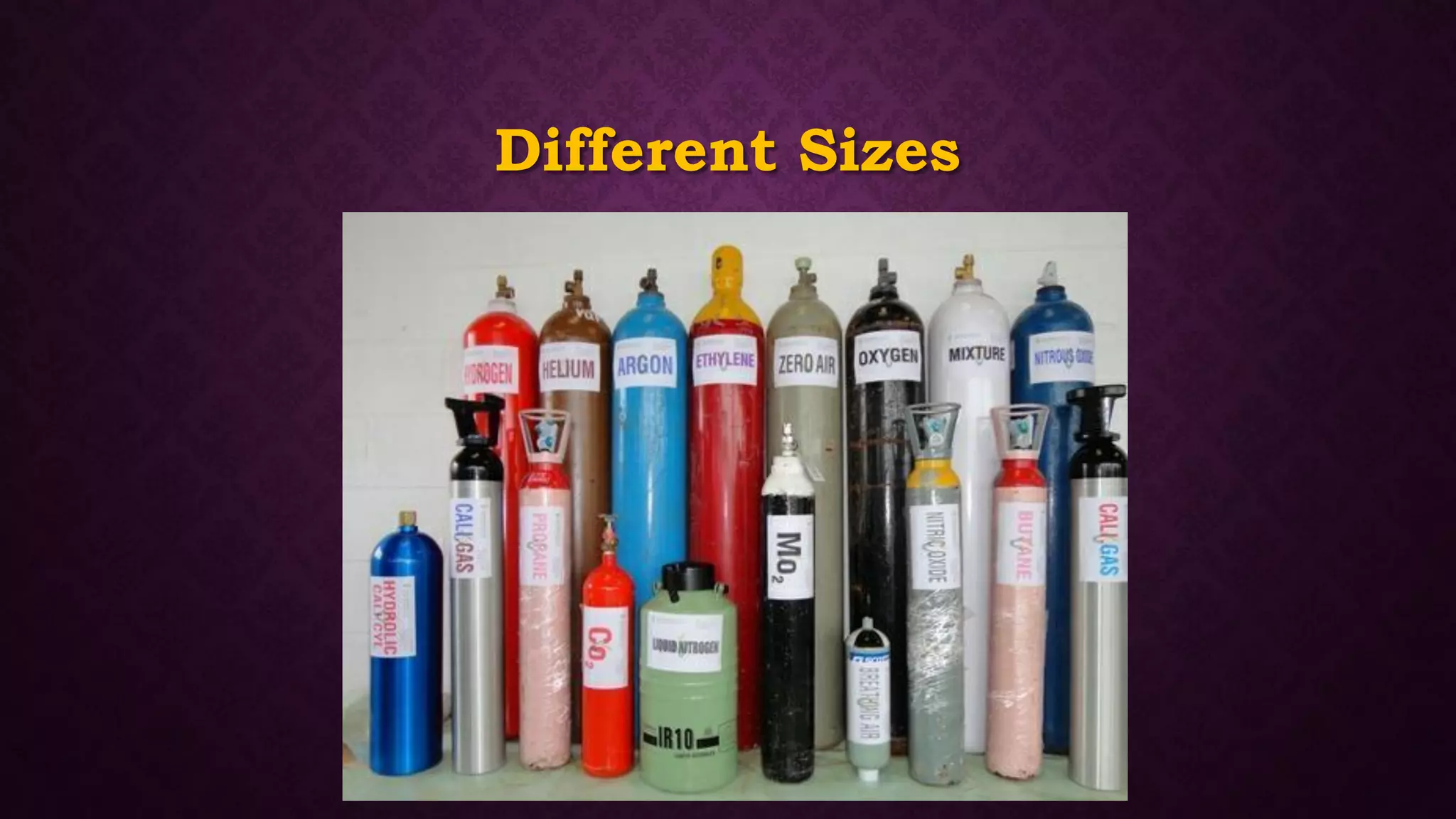
Different Sizes
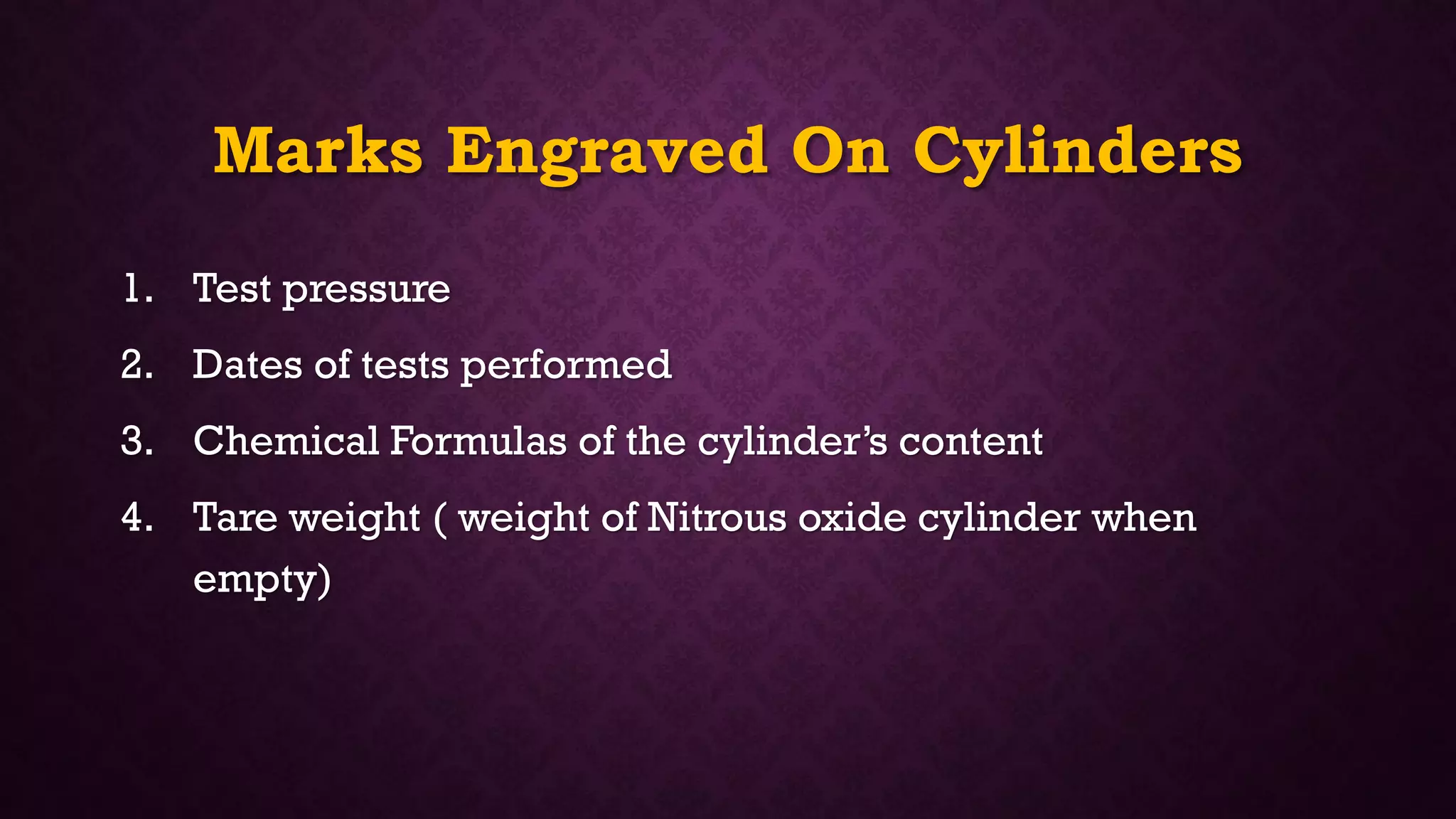
Marks Engraved On Cylinders
1. Test pressure
2. Dates of tests performed
3. Chemical Formulas of the cylinder’s content
4. Tare weight ( weight of Nitrous oxide cylinder when
empty)
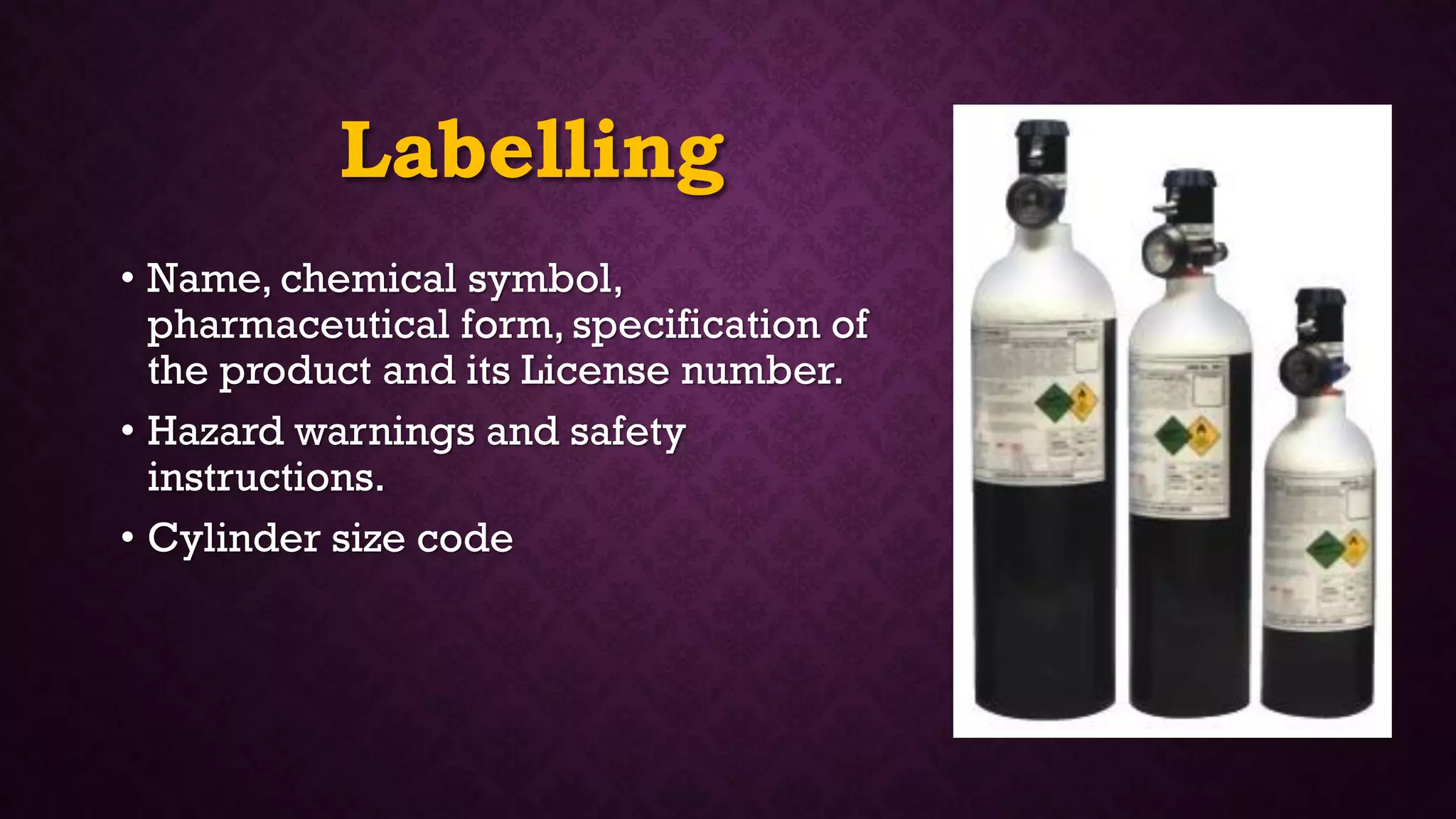
Labelling
• Name, chemical symbol,
pharmaceutical form, specification of
the product and its License number.
• Hazard warnings and safety
instructions.
• Cylinder size code
Labelling
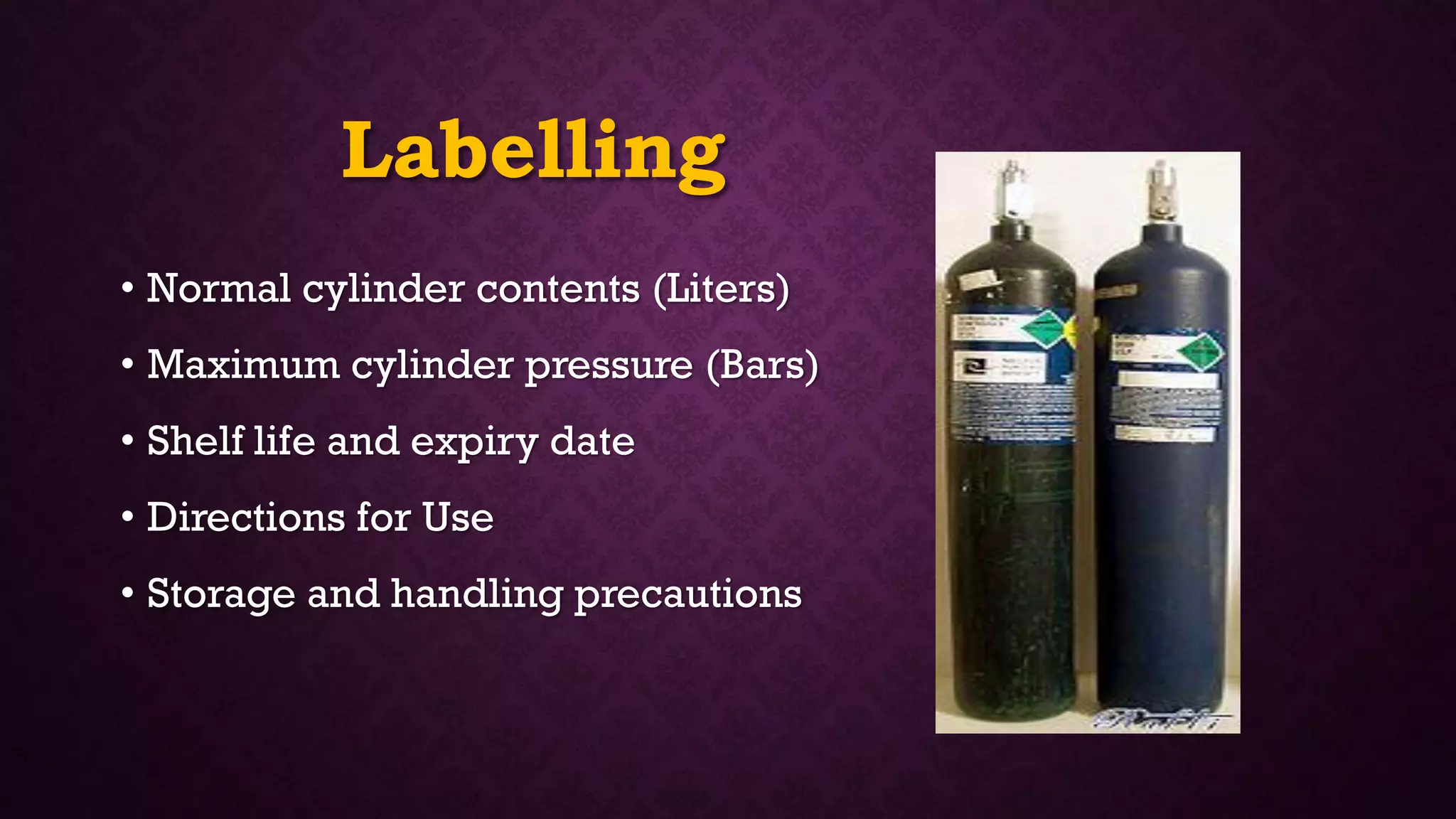
• Normal cylinder contents (Liters)
• Maximum cylinder pressure (Bars)
• Shelf life and expiry date
• Directions for Use
• Storage and handling precautions
Storage
• Purpose built, dry, well-ventilated and fire proof room, preferably inside and
not subjected to extremes of heat.
• Not be stored near flammables
• Not be exposed to dampness, corrosive chemicals or fumes. Leads to
corrosion of cylinders and valves
• To avoid accidents, full cylinders should be stored separately from empty
ones
• F, G and J size cylinders are stored upright to avoid damage to the valves.
• C, D and E size cylinders can be stored horizontally on shelves.
• Overpressurized cylinders are hazardous and should be reported to
manufacturer.
Safety Features
• The Gases and vapors should be free of water vapors when
stored in cylinders.
• Water vapor freezes and blocks the exit port when the
temperature of the cylinder decreases on the opening.
Pin-index
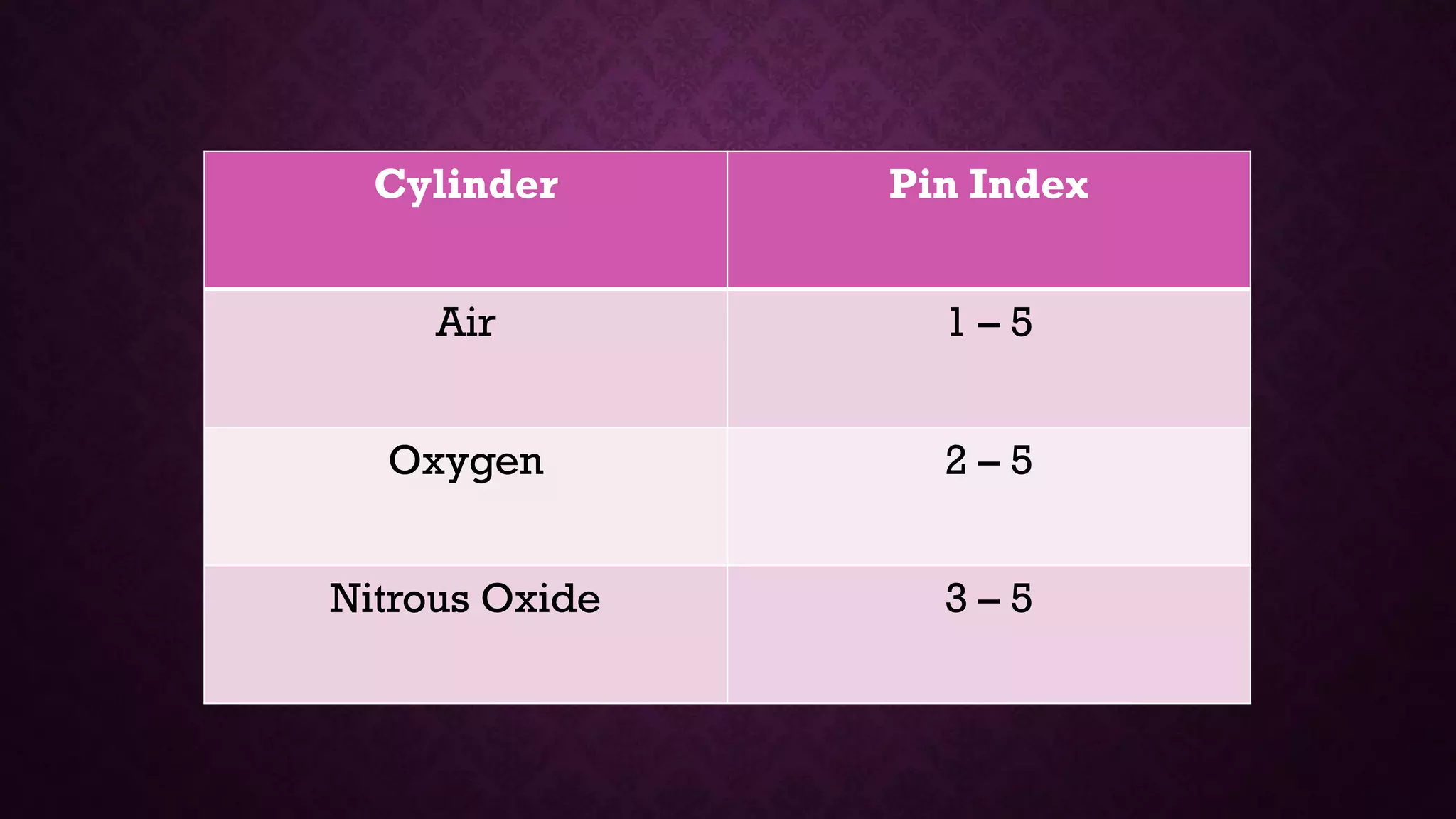
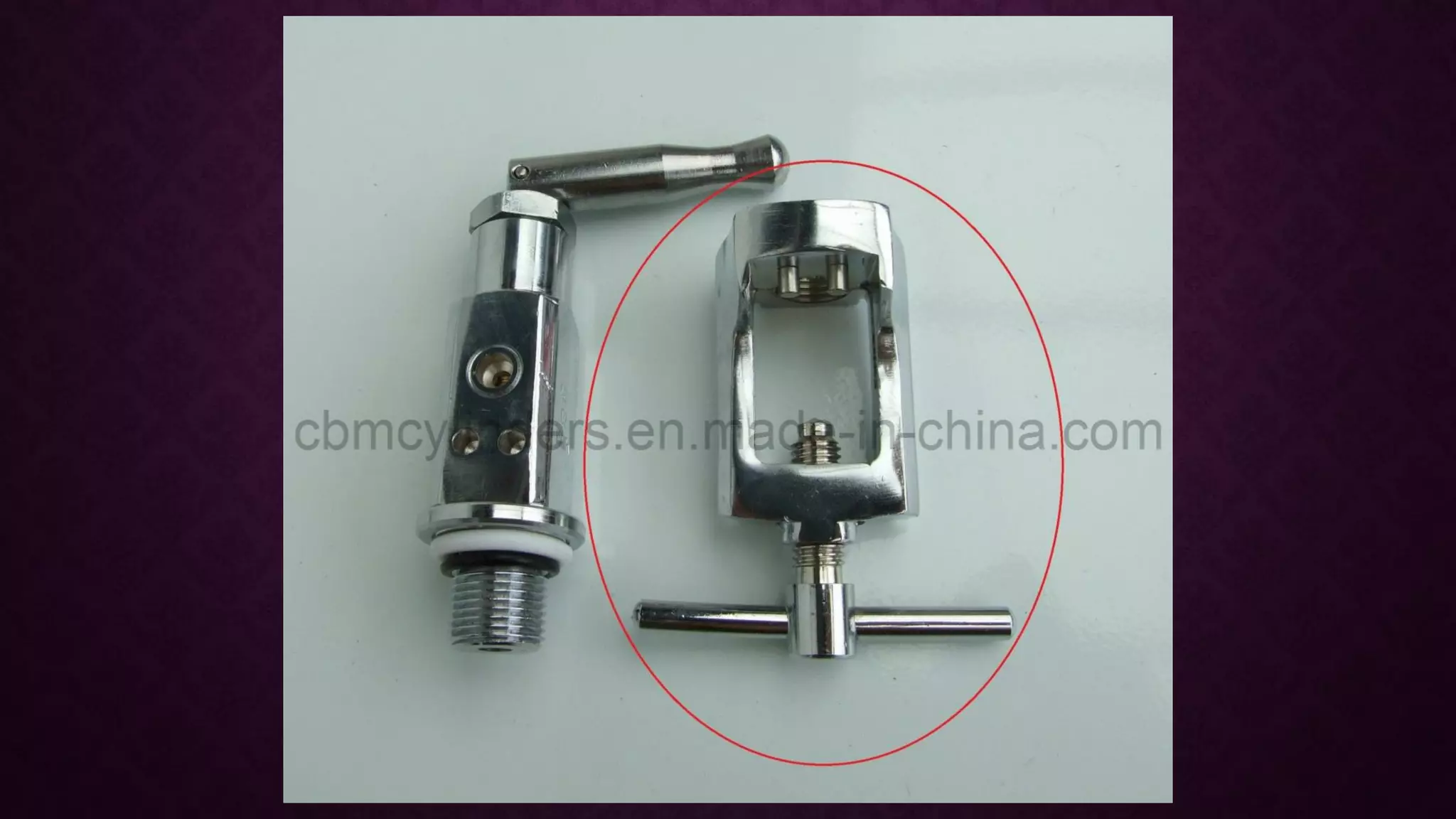
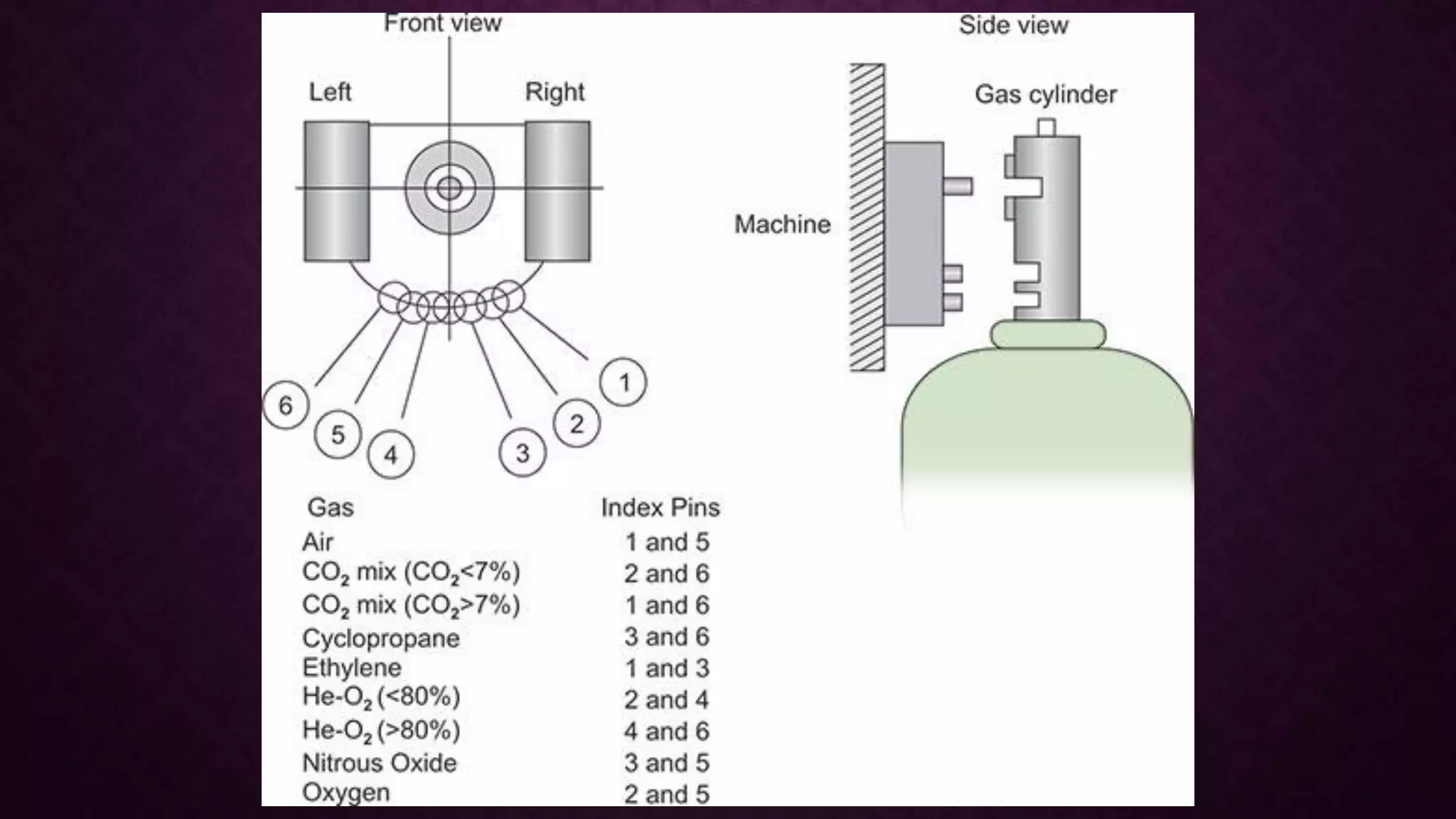
• The outlet valve uses the pin-index system to
make it almost impossible to connect a cylinder
to the wrong yoke.
• The identifying code consists of a specific
combination of two holes in the face of the valve
into which connecting pins for a particular type
of gas must fit in perfect alignment. For example,
the index hole position for a cylinder of oxygen
is 2-5, for nitrous oxide it is 3-5, and so on.
Cylinder Pin Index
Air 1 – 5
Oxygen 2 – 5
Nitrous Oxide 3 – 5
Color Coding
• Cylinders are color
coded to reduce
accidental use of the
wrong gas or vapor.
Body Colour Shoulder Colour Pressure, kPa
(room T)
Oxygen Black White 13700
Nitrous oxide Blue Blue 4400
Carbon dioxide Grey Grey 5000
Air Grey White/ Black quarters 13700
Entonox Blue White/ Blue quarters 13700
Oxygen/ helium Black White/ Brown
quarters
13700
Cylinder Valves
• Introduction:
• Cylinder Valves seal the cylinder contents.
• The chemical formula of the particular gas is engraved on the
valve.
• They are mounted on the neck of cylinder.
• They act as an on/off device for the discharge of cylinder
contents.
• A pin-index system prevents cylinder identification errors.
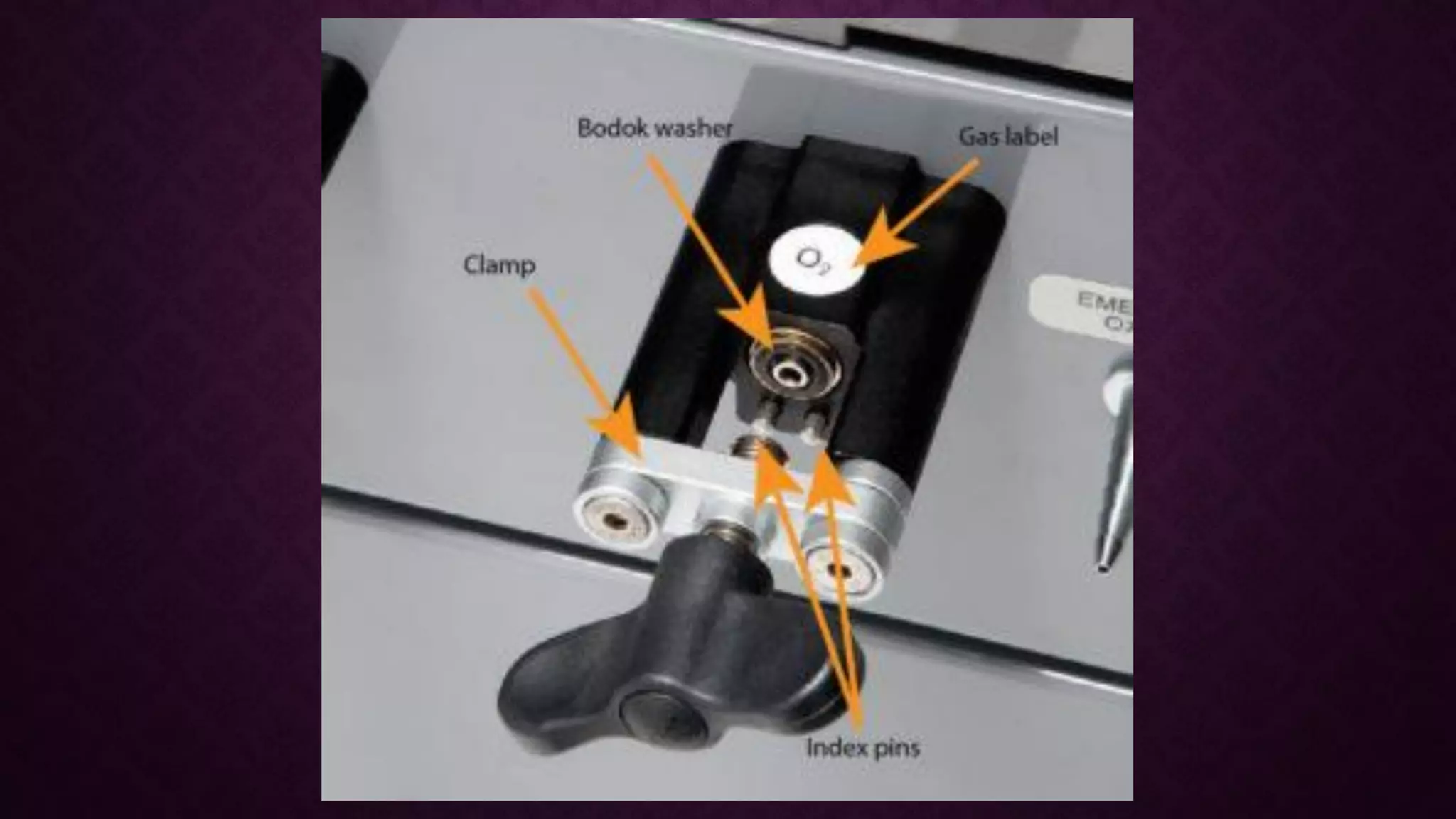
• A Bodock sealing washer must be
placed between the valve and the
yoke of the anesthetic machine.
• A newly designed valve allows
keyless manual turning on and off.
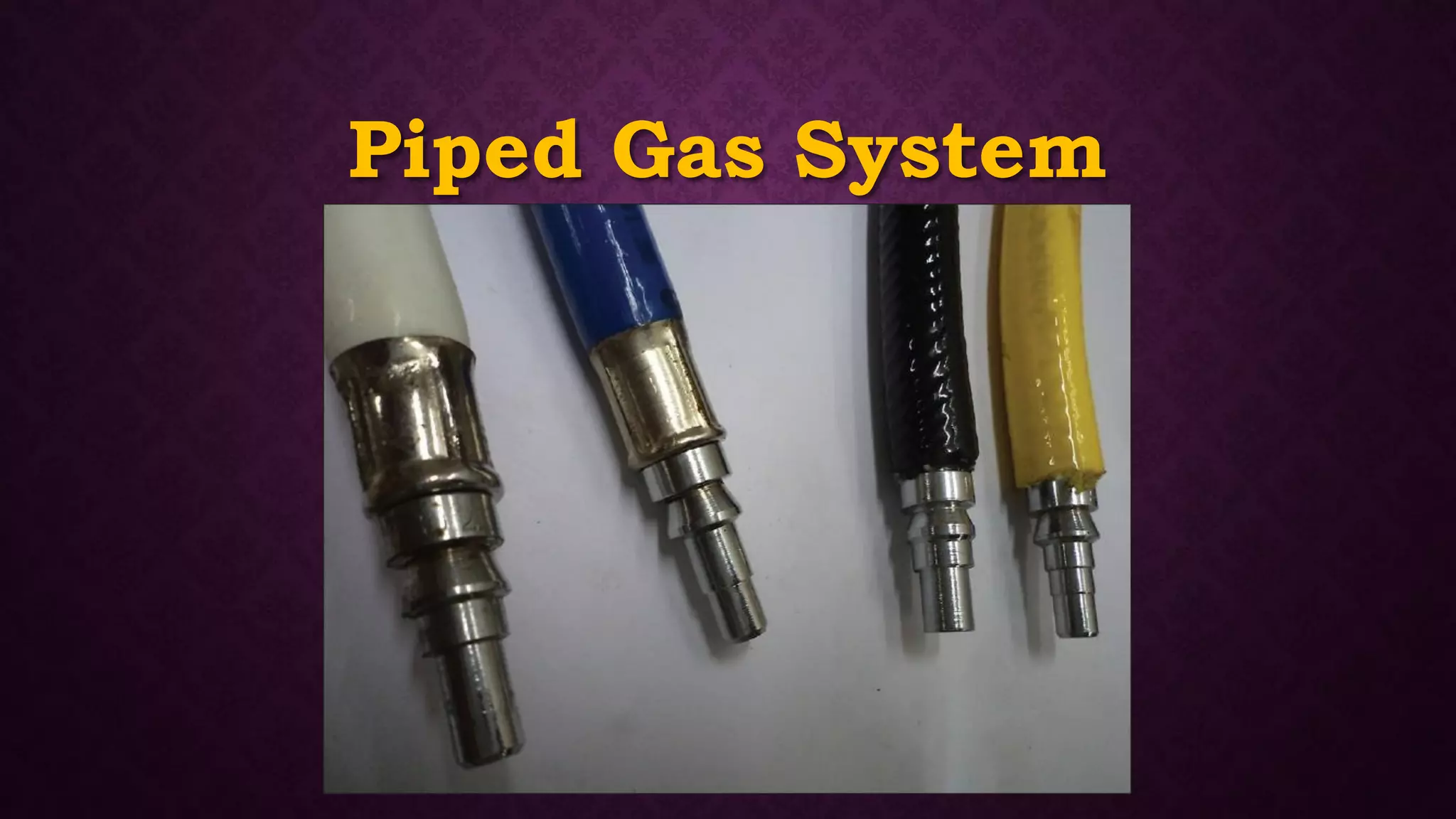
Piped Gas System
Piped Gas System
• Introduction:
• Piped gas supply ( piped Medical Gas and Vacuum PMGV)
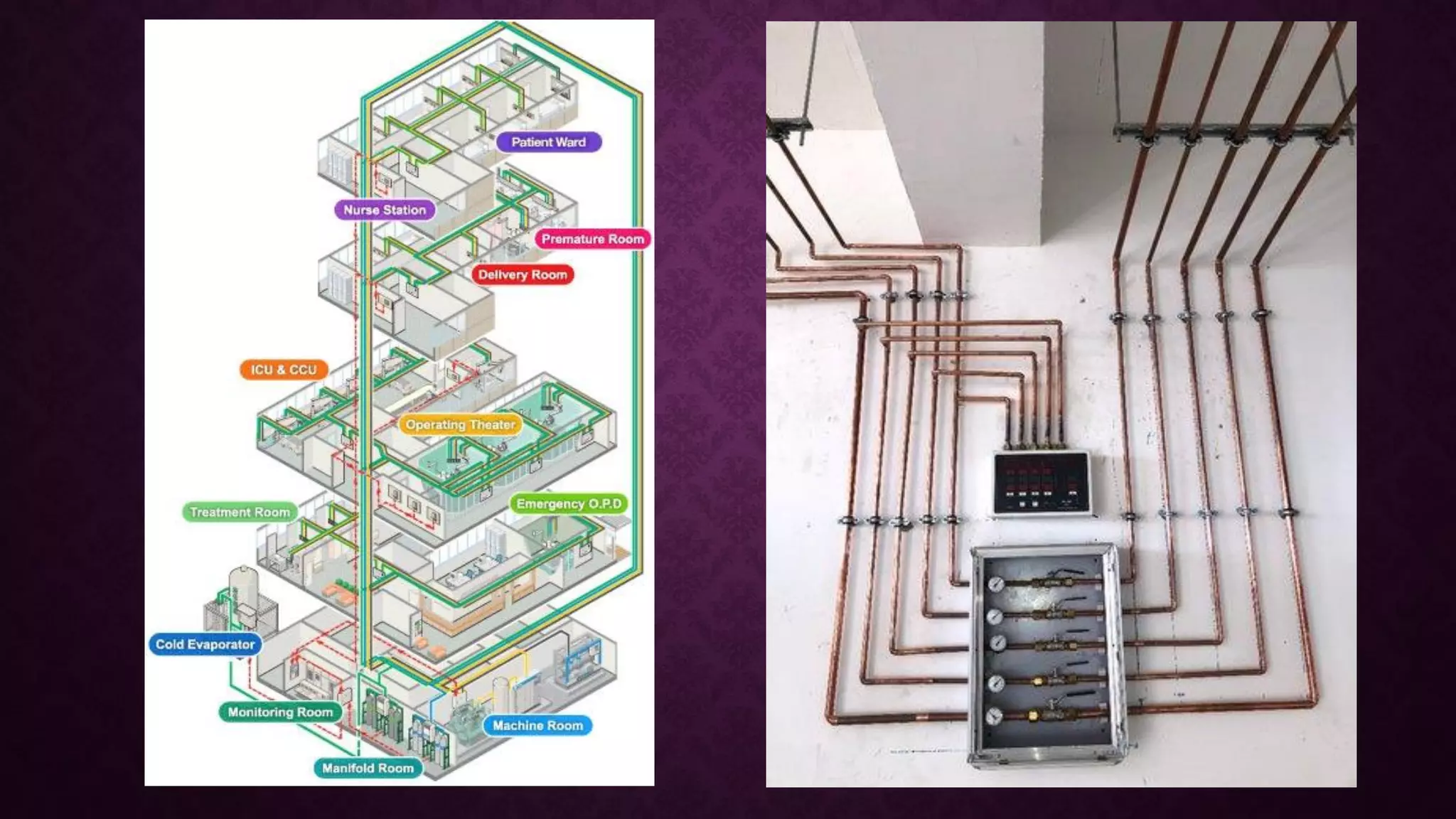
• PMGV system delivers gases from central supply points to different
sites in a hospital at a pressure of about 400 kPa.
• Special outlet valves supply the various needs throughout the hospital.
• Oxygen, nitrous oxide, Entonox, compressed air and medical vacuum
are commonly supplied through the pipeline system.
Components
• Central supply points
• Cylinder banks.
• Liquid oxygen storage tank.
• Pipework made of special high quality copper with bacteriostatic
properties.
• Outlets identified by gas color coding, gas name and shape.
• Matching quick connect/ disconnect probes
• Network of pipelines throughout a hospital from central supply
• Outlets are color- and shape-coded
• Flexible and color-coded pipelines runs from the anesthetic machine
to outlets
Safety Features
• Reserve bank of cylinders
• Low pressure alarms
• Single hose test, cross-connection
• Tug test, miss-connection
• Regular PGMV installation, repair and modification
Sources Of Gas Supply
•Cylinder Manifold
•Liquid oxygen storage tank
•Oxygen concentrator
Cylinder Manifold
• Introduction:
• Manifolds are used to supply,
Oxygen, Nitrous oxide and Entonox.
Components
• Large cylinders (e.g. Size J) are divided into 2 groups,
primary & secondary.
• The 2 groups alternate in supplying the pipelines.
• All cylinders in each group are connected through non
return valves to a common pipe.
• In turn connected to pipeline.
Mechanism Of Action
• In either group all cylinder valves are open to allow
simultaneously empting.
• The supply is automatically changed to the secondary group
when the primary group is nearly empty.
• This changeover is achieved by a pressure sensitive device.
• Alarm is activated to alert staff
Safety Features
• Manifold should be housed in a well – ventilated room built
of fire proof material away from the main hospital building.
• Manifold room should not be used as a general cylinder
store.
• Empty cylinders should be immediately removed from the
manifold room.
Liquid Oxygen
• Vacuum-insulated evaporator.
• Components:
• Thermally insulated vessel where vacuum is used as insulation
• Pressure regulator allows gas to enter pipelines & maintain
pressure of 400 kPa.
• Safety valve opens at 1700 kPa
• Control valve opens for excessive demand.
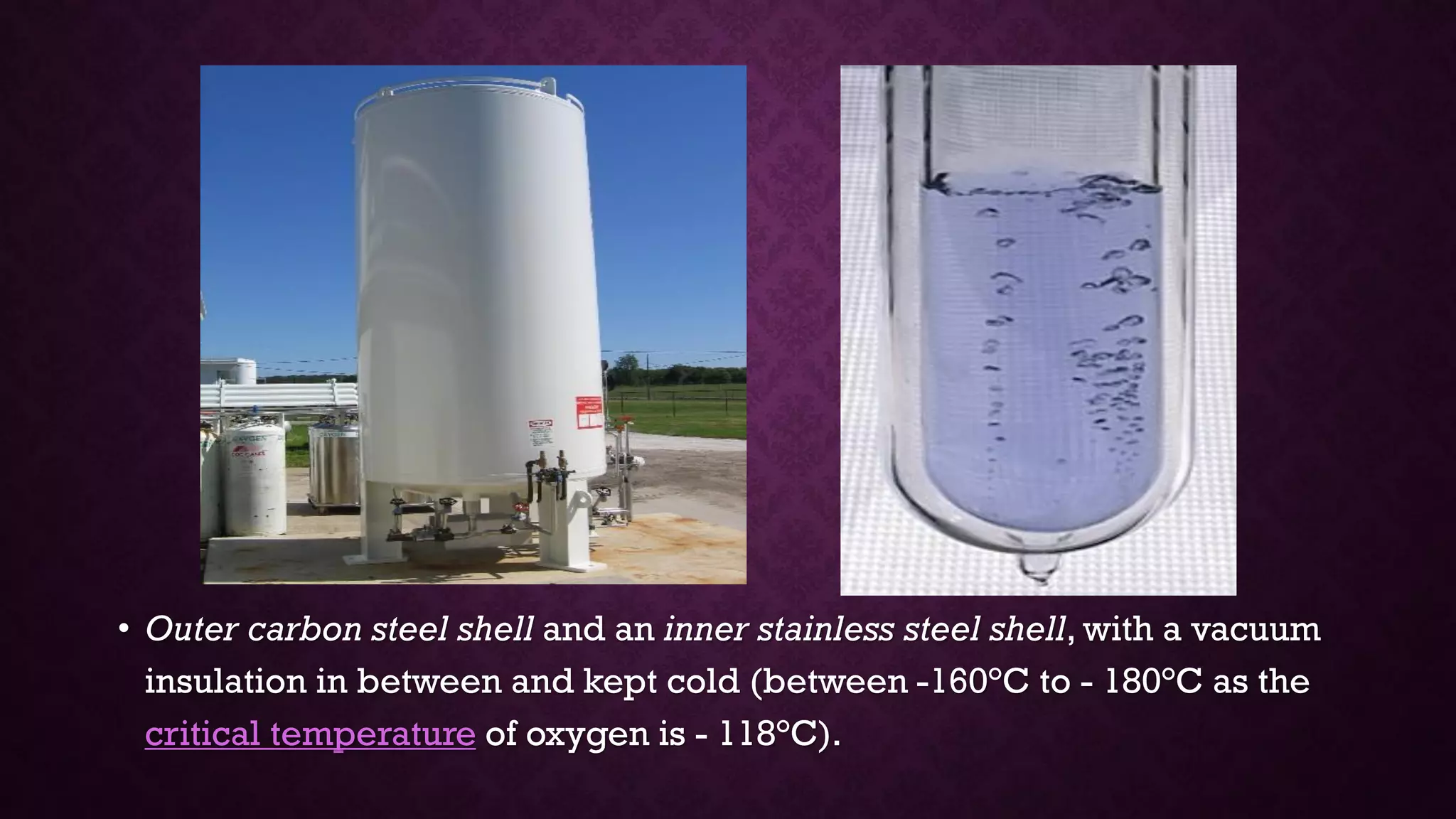
• Outer carbon steel shell and an inner stainless steel shell, with a vacuum
insulation in between and kept cold (between -160°C to - 180°C as the
critical temperature of oxygen is - 118°C).
OXYGEN CONCENTRATOR
Entonox
• Compressed gas mixture of 50% oxygen & 50% nitrous oxide by
volume.
• Used in casualty & labour wards for analgesia.
• A two-stage pressure demand regulator is attached to the
entonox cylinder.
• Entonox is administered by inhalation from a cylinder at a
pressure of 137 bar (in the UK) or from a pipeline supply.
Compressed Air
• Medical air is supplied in hospitals for clinical uses or to
drive power tools.
• 400 kPa
• 700 kPa
• Can be supplied by cylinder manifolds or by compressor
“
”
Thank You

Medical gas Cylinder

  • 1.
    Medical Gases Mr. HarshadKhade MSc. Medical Technology (OTA) Symbiosis International university, Pune.
  • 2.
    • Medical gassupply system in hospitals and other healthcare facilities are utilized to supply specialized gases and gas mixtures to various parts of the facility .
  • 3.
    Medical Gas Cylinders •Supply of Medical Gases: • From: • Cylinders (Manifold) • PIPED gas system • Medical gases commonly used: • Oxygen • Nitrous oxide • Air • Nitrogen • Carbon Dioxide
  • 4.
    Cylinder • A gascylinder or tank is a pressure vessel used to store gases at high pressure. Gases stored this way are called bottled gases. • Components: • Made of Molybdenum steel in which gases and vapours are stored under pressure, e.g.13700 kPa for oxygen and 4400 kPa for Nitrous oxide. • Shape & colour of plastic disc around the neck of cylinder indicates the year of last examination.
  • 5.
    Medical Gas Cylinders CylinderSize D AF E F G J Approx dimension(mm) 490 x 102 760 x 173 830 x 102 890 x 140 1290 x 178 1600 x 230 Approx Weight Empty (kg) 3.8 11.4 6.6 13 30.6 68.7 Valve Type Pin-Index Bullnose Pin-Index Bullnose Bullnose Pin-Index Gaseous Litres 0.34 (340) 1.36 (1360) 0.68 (680) 1.36 (1360) 3.4 (3400) 10.6 (10600)
  • 7.
    Components • They aremanufactured in different sizes (A to J). • Size E cylinders are used on the antiesthetic machine. • Oxygen cylinders contain gas. • Nitrous oxide cylinders contain a mixture of liquid and vapour. 75% liquid N2O • Light weight for homes & Transportation made of aluminum alloy.
  • 8.
  • 9.
    Marks Engraved OnCylinders 1. Test pressure 2. Dates of tests performed 3. Chemical Formulas of the cylinder’s content 4. Tare weight ( weight of Nitrous oxide cylinder when empty)
  • 10.
    Labelling • Name, chemicalsymbol, pharmaceutical form, specification of the product and its License number. • Hazard warnings and safety instructions. • Cylinder size code
  • 11.
    Labelling • Normal cylindercontents (Liters) • Maximum cylinder pressure (Bars) • Shelf life and expiry date • Directions for Use • Storage and handling precautions
  • 12.
    Storage • Purpose built,dry, well-ventilated and fire proof room, preferably inside and not subjected to extremes of heat. • Not be stored near flammables • Not be exposed to dampness, corrosive chemicals or fumes. Leads to corrosion of cylinders and valves • To avoid accidents, full cylinders should be stored separately from empty ones • F, G and J size cylinders are stored upright to avoid damage to the valves. • C, D and E size cylinders can be stored horizontally on shelves. • Overpressurized cylinders are hazardous and should be reported to manufacturer.
  • 13.
    Safety Features • TheGases and vapors should be free of water vapors when stored in cylinders. • Water vapor freezes and blocks the exit port when the temperature of the cylinder decreases on the opening.
  • 14.
    Pin-index • The outletvalve uses the pin-index system to make it almost impossible to connect a cylinder to the wrong yoke. • The identifying code consists of a specific combination of two holes in the face of the valve into which connecting pins for a particular type of gas must fit in perfect alignment. For example, the index hole position for a cylinder of oxygen is 2-5, for nitrous oxide it is 3-5, and so on.
  • 15.
    Cylinder Pin Index Air1 – 5 Oxygen 2 – 5 Nitrous Oxide 3 – 5
  • 19.
    Color Coding • Cylindersare color coded to reduce accidental use of the wrong gas or vapor.
  • 20.
    Body Colour ShoulderColour Pressure, kPa (room T) Oxygen Black White 13700 Nitrous oxide Blue Blue 4400 Carbon dioxide Grey Grey 5000 Air Grey White/ Black quarters 13700 Entonox Blue White/ Blue quarters 13700 Oxygen/ helium Black White/ Brown quarters 13700
  • 22.
    Cylinder Valves • Introduction: •Cylinder Valves seal the cylinder contents. • The chemical formula of the particular gas is engraved on the valve. • They are mounted on the neck of cylinder. • They act as an on/off device for the discharge of cylinder contents. • A pin-index system prevents cylinder identification errors.
  • 23.
    • A Bodocksealing washer must be placed between the valve and the yoke of the anesthetic machine. • A newly designed valve allows keyless manual turning on and off.
  • 24.
  • 25.
    Piped Gas System •Introduction: • Piped gas supply ( piped Medical Gas and Vacuum PMGV) • PMGV system delivers gases from central supply points to different sites in a hospital at a pressure of about 400 kPa. • Special outlet valves supply the various needs throughout the hospital. • Oxygen, nitrous oxide, Entonox, compressed air and medical vacuum are commonly supplied through the pipeline system.
  • 27.
    Components • Central supplypoints • Cylinder banks. • Liquid oxygen storage tank. • Pipework made of special high quality copper with bacteriostatic properties. • Outlets identified by gas color coding, gas name and shape. • Matching quick connect/ disconnect probes • Network of pipelines throughout a hospital from central supply • Outlets are color- and shape-coded • Flexible and color-coded pipelines runs from the anesthetic machine to outlets
  • 29.
    Safety Features • Reservebank of cylinders • Low pressure alarms • Single hose test, cross-connection • Tug test, miss-connection • Regular PGMV installation, repair and modification
  • 30.
    Sources Of GasSupply •Cylinder Manifold •Liquid oxygen storage tank •Oxygen concentrator
  • 31.
    Cylinder Manifold • Introduction: •Manifolds are used to supply, Oxygen, Nitrous oxide and Entonox.
  • 32.
    Components • Large cylinders(e.g. Size J) are divided into 2 groups, primary & secondary. • The 2 groups alternate in supplying the pipelines. • All cylinders in each group are connected through non return valves to a common pipe. • In turn connected to pipeline.
  • 34.
    Mechanism Of Action •In either group all cylinder valves are open to allow simultaneously empting. • The supply is automatically changed to the secondary group when the primary group is nearly empty. • This changeover is achieved by a pressure sensitive device. • Alarm is activated to alert staff
  • 35.
    Safety Features • Manifoldshould be housed in a well – ventilated room built of fire proof material away from the main hospital building. • Manifold room should not be used as a general cylinder store. • Empty cylinders should be immediately removed from the manifold room.
  • 37.
    Liquid Oxygen • Vacuum-insulatedevaporator. • Components: • Thermally insulated vessel where vacuum is used as insulation • Pressure regulator allows gas to enter pipelines & maintain pressure of 400 kPa. • Safety valve opens at 1700 kPa • Control valve opens for excessive demand.
  • 38.
    • Outer carbonsteel shell and an inner stainless steel shell, with a vacuum insulation in between and kept cold (between -160°C to - 180°C as the critical temperature of oxygen is - 118°C).
  • 39.
  • 40.
    Entonox • Compressed gasmixture of 50% oxygen & 50% nitrous oxide by volume. • Used in casualty & labour wards for analgesia. • A two-stage pressure demand regulator is attached to the entonox cylinder. • Entonox is administered by inhalation from a cylinder at a pressure of 137 bar (in the UK) or from a pipeline supply.
  • 41.
    Compressed Air • Medicalair is supplied in hospitals for clinical uses or to drive power tools. • 400 kPa • 700 kPa • Can be supplied by cylinder manifolds or by compressor
  • 42.