HIGH PRESSURE SYSTEM
PRESENTER – DR ANJUL KUMAR SINGH
MODERATOR- DR ARVIND
• Anaesthesia work station is a device
which delivers a precisely known but
variable gas mixture, including
anaesthetizing and life sustaining gases.
Introduction
Anaesthesia Work Station
• Integrates most of the components necessary for administration
of anesthesia into single unit.
• Standard guidelines have been given to manufacturers for
minimum performance, design, characteristics and safety
requirements of machine.
SystemComponents
PNEUMATIC
Components of Pressure System
High pressure system
The high-pressure system receives gases from
cylinders at high, variable pressures and reduces
those pressures to lower, more constant pressure
suitable for use in the machine
1- Hanger yoke assembly
The hanger yoke orients and supports the cylinder, provides a gas-tight seal, and ensures a
unidirectional gas flow.
The workstation standard requires that there be at least one yoke for oxygen and nitrous oxide.
PARTS-
 BODY
 RETAINING SCREW
 NIPPLE
 INDEX PIN
 WASHER
 FILTER
 CHECK VALVE ASSEMBLY
BODY
 The body of the yoke is threaded into the frame of the
machine.
 It provides support for the cylinder(s).
 On the swinging gate (toggle handle, swivel gate)–type
yoke , the distal part is hinged.
 When a cylinder is being mounted onto or removed from
a yoke, the hinged part can be swung to the side
RETAINING SCREW
 The retaining screw (clamping device, retaining bar)
is threaded into the distal end of the yoke .
 Tightening the screw presses the cylinder valve
outlet against the washer and nipple so that a gas-
tight seal is achieved.
 The conical point of the retaining screw is shaped to
fit the conical depression on the cylinder valve
NIPPLE
 The nipple is the part of the yoke through
which the gas enters the machine.
 It projects from the yoke and fits into the port
on the cylinder valve.
 If the nipple is damaged, it may be impossible
to obtain a tight seal with the cylinder valve
PIN INDEX
 The Pin Index Safety System are below the
nipple .
 The holes into which the pins are fitted must
be of a specific depth.
 If they extend too far into the body of the
yoke, it may be possible to insert an incorrect
cylinder into the yoke.
Non Interchangeable safety system
PIN INDEX SAFETY SYSTEM
• It is a safety mechanism so that one
cylinder cannot be fitted at the others
position.
• It consists of holes on the
cylinder valve and 2 pins on the
yoke positioned to fit into these
holes.
• The port will seal only with proper
alignment of Pins and Holes
• Pins are 4mm diameter, 6mm long,
except Pin 7 which is slightly
thicker.
Limitations of Pin Index system
•A wrong cylinder can be placed in
the yoke, if
2 washers are placed.
Pins on the yoke are broken
Holes in the cylinder valve are
two deep
WASHER
 A washer (gasket) is placed around the nipple to produce a seal
between the cylinder valve and the yoke.
 A washer is usually supplied with each full cylinder.
FILTER
 The anesthesia workstation standard requires that a
filter be installed between the cylinder and pressure
regulator or flow control valve to prevent particulate
matter from entering the machine.
CHECK VALVE ASSEMBLY
 The check valve assembly allows gas from a cylinder to enter the machine
but prevents gas from exiting the machine when there is no cylinder in the
yoke.
 This allows an empty cylinder to be replaced with a full one without losing
gas.
 Prevents transfer of gas from a cylinder with high pressureto one with low
pressure if connected to double yoke and turned on simultaneously.
 Ayoke should not never be left vacant.
 After tightening a cylinder to yoke should look for leaks.
 After cylinder is attached valve should be closed.
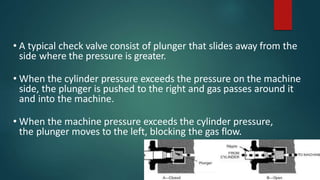
• A typical check valve consist of plunger that slides away from the
side where the pressure is greater.
• When the cylinder pressure exceeds the pressure on the machine
side, the plunger is pushed to the right and gas passes around it
and into the machine.
• When the machine pressure exceeds the cylinder pressure,
the plunger moves to the left, blocking the gas flow.
Safety device in yoke
•Woods alloy- fusible plug of bismuth, lead,
cadmium melts at 150-170 degree F, prevents
explosion
•Copper frangible disc- ruptures at very high
pressure.
Limitations of Check Valve assembly
• The check valves are not designed to act as
permanent seals for empty yokes.
• Small amounts of gases can escape if the yoke is
empty or an empty cylinder (or cylinder with low
pressure) and valve open is present in the yoke.
In order to minimize such losses –
• Yokes should not be left vacant for extended
periods.
• An empty cylinder should be replaced as soon as
possible , if not then,
• An yoke plug can be used to prevent gas leak
Or
• An empty cylinder can be left behind after
closing the valve.
•It is important that cylinder valves and
yokes not be contaminated with oil or
grease, because this could present a fire
hazard.
•Before a cylinder is mounted in place, the
yoke should be checked to make certain
that the two Pin Index safety pins are
present.
•A missing pin could allow the safety system
to be bypassed.
2-Cylinder pressure indicator
(Bourdon gauge)
 The anesthesia workstation standard requires that
there be a pressure indicator that displays the
cylinder pressure for each gas supplied by cylinders
(7).
 The indicator may be located near the cylinders or
on a panel on the front of the machine.
 The scale must be at least 33% greater than the
maximum filling pressure of the cylinder or the full
indication position
Bourdon Pressure Gauge
• It displays the cylinder pressure for each gas supplied by
cylinders.
• Hollow metal tube of copper alloy, bent into a curve,
sealed
and linked to a clock – like mechanism.
• Other end is connected to the gas source.
•Increase in gas pressure inside the tube
causes it to straighten.
•As the pressure falls, the tube
resumes its curved shape.
•These motions are transmitted to an
indicator which moves on a calibrated
scale through clock like mechanism.
•Gauages are required to be calibrated
in kilopascals (kPa)
Some electronic machines have light-emitting diodes (LEDs) to
indicate cylinder pressure
• If the cylinder valve is open and the pressure is adequate, the LED is
green.
• If the valve is open but the pressure is inadequate, the LED will
flash red.
• It will be dark if the cylinder valve is not open.
• These machines may also display the actual pressure for pipelines
and cylinders on a screen during the checkout.
• It can be available on demand or on a continuous basis.
Electronic Cylinder Pressure Indicator
Pressure Regulators
• The pressure in cylinder varies. To maintain
constant flow with changing supply pressure,
the anaesthesia machine is fitted with pressure
regulators
• A pressure regulator reduces the high and variable
pressure found in a cylinder to a lower, more
constant pressure suitable for use in anaesthesia
machine (40-45 Psig)
WORKING PRINCIPLE
 High pressure chamber with ON inlet
 Valve to low pressure chamber
 Low pressure chamber has diaphragm attached to spring
 Increase pressure of low pressure chamber lead to distention of diaphragm which is opposed by
tension in spring
 When sufficient increase in pressure diaphragm moves and valve close
 Gas is allowed to flow through outlet
 Lead to decrease pressure in low pressure chamber and valve open
Physical Principle
A large pressure acting over a small area is
balanced by a small pressure over a larger
area
SAFETY FEATURES!!
•Pressure regulators have safety relief valves
•If due to any reason there is build up of
pressure in pressure regulator then the
safety valve blow off at a set pressure of
525 k pa(70psi)
HIGH PRESSURE SYSTEM.pptx

HIGH PRESSURE SYSTEM.pptx

  • 1.
    HIGH PRESSURE SYSTEM PRESENTER– DR ANJUL KUMAR SINGH MODERATOR- DR ARVIND
  • 2.
    • Anaesthesia workstation is a device which delivers a precisely known but variable gas mixture, including anaesthetizing and life sustaining gases. Introduction
  • 3.
    Anaesthesia Work Station •Integrates most of the components necessary for administration of anesthesia into single unit. • Standard guidelines have been given to manufacturers for minimum performance, design, characteristics and safety requirements of machine.
  • 4.
  • 6.
  • 8.
    High pressure system Thehigh-pressure system receives gases from cylinders at high, variable pressures and reduces those pressures to lower, more constant pressure suitable for use in the machine
  • 9.
    1- Hanger yokeassembly The hanger yoke orients and supports the cylinder, provides a gas-tight seal, and ensures a unidirectional gas flow. The workstation standard requires that there be at least one yoke for oxygen and nitrous oxide. PARTS-  BODY  RETAINING SCREW  NIPPLE  INDEX PIN  WASHER  FILTER  CHECK VALVE ASSEMBLY
  • 10.
    BODY  The bodyof the yoke is threaded into the frame of the machine.  It provides support for the cylinder(s).  On the swinging gate (toggle handle, swivel gate)–type yoke , the distal part is hinged.  When a cylinder is being mounted onto or removed from a yoke, the hinged part can be swung to the side
  • 11.
    RETAINING SCREW  Theretaining screw (clamping device, retaining bar) is threaded into the distal end of the yoke .  Tightening the screw presses the cylinder valve outlet against the washer and nipple so that a gas- tight seal is achieved.  The conical point of the retaining screw is shaped to fit the conical depression on the cylinder valve
  • 12.
    NIPPLE  The nippleis the part of the yoke through which the gas enters the machine.  It projects from the yoke and fits into the port on the cylinder valve.  If the nipple is damaged, it may be impossible to obtain a tight seal with the cylinder valve
  • 13.
    PIN INDEX  ThePin Index Safety System are below the nipple .  The holes into which the pins are fitted must be of a specific depth.  If they extend too far into the body of the yoke, it may be possible to insert an incorrect cylinder into the yoke.
  • 14.
    Non Interchangeable safetysystem PIN INDEX SAFETY SYSTEM • It is a safety mechanism so that one cylinder cannot be fitted at the others position. • It consists of holes on the cylinder valve and 2 pins on the yoke positioned to fit into these holes. • The port will seal only with proper alignment of Pins and Holes • Pins are 4mm diameter, 6mm long, except Pin 7 which is slightly thicker.
  • 15.
    Limitations of PinIndex system •A wrong cylinder can be placed in the yoke, if 2 washers are placed. Pins on the yoke are broken Holes in the cylinder valve are two deep
  • 17.
    WASHER  A washer(gasket) is placed around the nipple to produce a seal between the cylinder valve and the yoke.  A washer is usually supplied with each full cylinder.
  • 18.
    FILTER  The anesthesiaworkstation standard requires that a filter be installed between the cylinder and pressure regulator or flow control valve to prevent particulate matter from entering the machine.
  • 19.
    CHECK VALVE ASSEMBLY The check valve assembly allows gas from a cylinder to enter the machine but prevents gas from exiting the machine when there is no cylinder in the yoke.  This allows an empty cylinder to be replaced with a full one without losing gas.  Prevents transfer of gas from a cylinder with high pressureto one with low pressure if connected to double yoke and turned on simultaneously.  Ayoke should not never be left vacant.  After tightening a cylinder to yoke should look for leaks.  After cylinder is attached valve should be closed.
  • 20.
    • A typicalcheck valve consist of plunger that slides away from the side where the pressure is greater. • When the cylinder pressure exceeds the pressure on the machine side, the plunger is pushed to the right and gas passes around it and into the machine. • When the machine pressure exceeds the cylinder pressure, the plunger moves to the left, blocking the gas flow.
  • 21.
    Safety device inyoke •Woods alloy- fusible plug of bismuth, lead, cadmium melts at 150-170 degree F, prevents explosion •Copper frangible disc- ruptures at very high pressure.
  • 22.
    Limitations of CheckValve assembly • The check valves are not designed to act as permanent seals for empty yokes. • Small amounts of gases can escape if the yoke is empty or an empty cylinder (or cylinder with low pressure) and valve open is present in the yoke.
  • 23.
    In order tominimize such losses – • Yokes should not be left vacant for extended periods. • An empty cylinder should be replaced as soon as possible , if not then, • An yoke plug can be used to prevent gas leak Or • An empty cylinder can be left behind after closing the valve.
  • 24.
    •It is importantthat cylinder valves and yokes not be contaminated with oil or grease, because this could present a fire hazard. •Before a cylinder is mounted in place, the yoke should be checked to make certain that the two Pin Index safety pins are present. •A missing pin could allow the safety system to be bypassed.
  • 25.
    2-Cylinder pressure indicator (Bourdongauge)  The anesthesia workstation standard requires that there be a pressure indicator that displays the cylinder pressure for each gas supplied by cylinders (7).  The indicator may be located near the cylinders or on a panel on the front of the machine.  The scale must be at least 33% greater than the maximum filling pressure of the cylinder or the full indication position
  • 26.
    Bourdon Pressure Gauge •It displays the cylinder pressure for each gas supplied by cylinders. • Hollow metal tube of copper alloy, bent into a curve, sealed and linked to a clock – like mechanism. • Other end is connected to the gas source.
  • 28.
    •Increase in gaspressure inside the tube causes it to straighten. •As the pressure falls, the tube resumes its curved shape. •These motions are transmitted to an indicator which moves on a calibrated scale through clock like mechanism. •Gauages are required to be calibrated in kilopascals (kPa)
  • 29.
    Some electronic machineshave light-emitting diodes (LEDs) to indicate cylinder pressure • If the cylinder valve is open and the pressure is adequate, the LED is green. • If the valve is open but the pressure is inadequate, the LED will flash red. • It will be dark if the cylinder valve is not open. • These machines may also display the actual pressure for pipelines and cylinders on a screen during the checkout. • It can be available on demand or on a continuous basis. Electronic Cylinder Pressure Indicator
  • 30.
    Pressure Regulators • Thepressure in cylinder varies. To maintain constant flow with changing supply pressure, the anaesthesia machine is fitted with pressure regulators • A pressure regulator reduces the high and variable pressure found in a cylinder to a lower, more constant pressure suitable for use in anaesthesia machine (40-45 Psig)
  • 31.
    WORKING PRINCIPLE  Highpressure chamber with ON inlet  Valve to low pressure chamber  Low pressure chamber has diaphragm attached to spring  Increase pressure of low pressure chamber lead to distention of diaphragm which is opposed by tension in spring  When sufficient increase in pressure diaphragm moves and valve close  Gas is allowed to flow through outlet  Lead to decrease pressure in low pressure chamber and valve open
  • 33.
    Physical Principle A largepressure acting over a small area is balanced by a small pressure over a larger area SAFETY FEATURES!! •Pressure regulators have safety relief valves •If due to any reason there is build up of pressure in pressure regulator then the safety valve blow off at a set pressure of 525 k pa(70psi)