Reaching Impact, Saturation, and
Epidemic Control (RISE):
Oxygen Cylinders
Date
Session 2: Components, Installation,
And Handling Of Oxygen Cylinder
REACHING IMPACT, SATURATION, AND EPIDEMIC CONTROL (RISE)
Types of Oxygen Storage
Devices
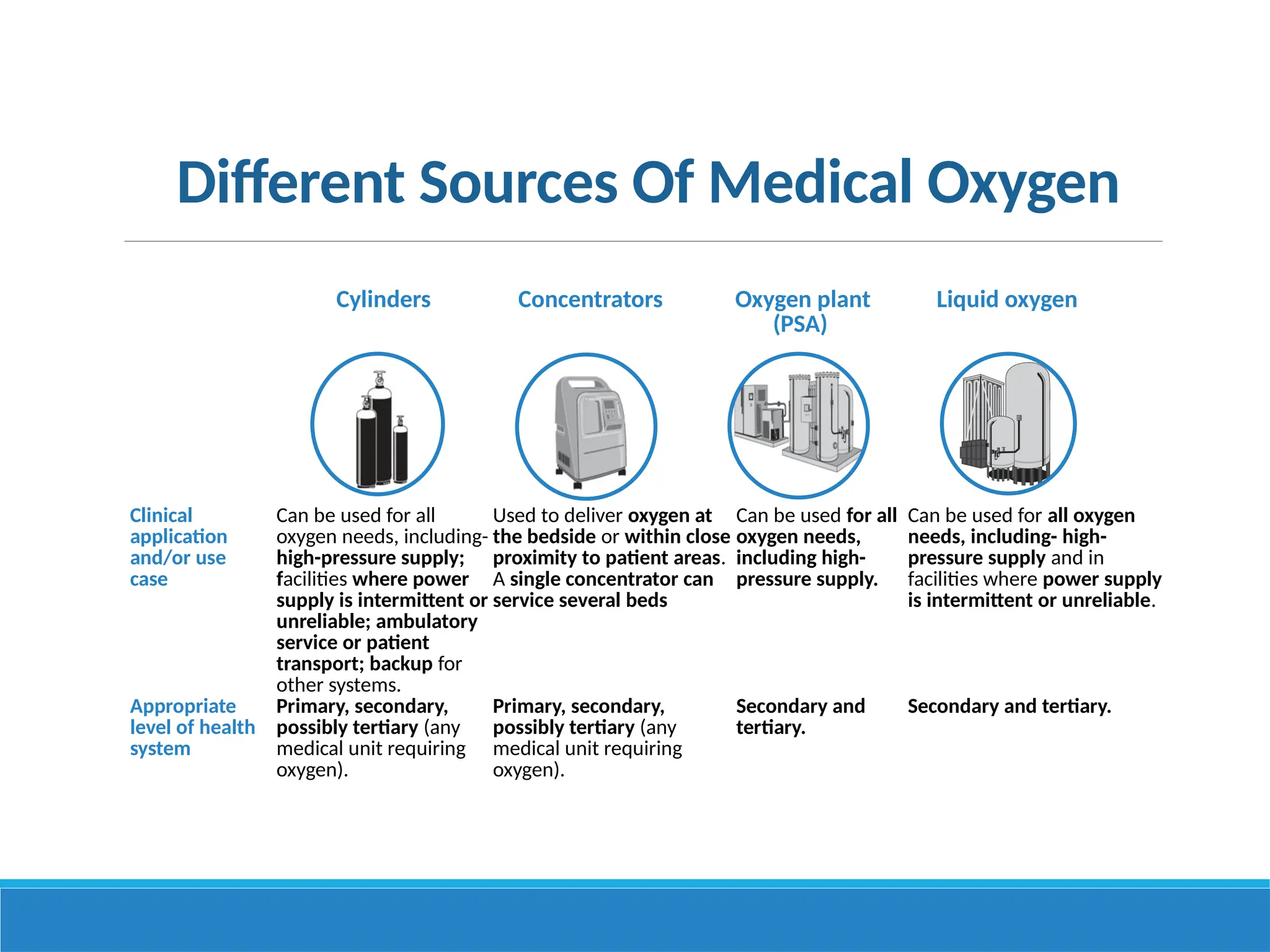
Different Sources Of Medical Oxygen
Clinical
application
and/or use
case
Can be used for all
oxygen needs, including-
high-pressure supply;
facilities where power
supply is intermittent or
unreliable; ambulatory
service or patient
transport; backup for
other systems.
Used to deliver oxygen at
the bedside or within close
proximity to patient areas.
A single concentrator can
service several beds
Can be used for all
oxygen needs,
including high-
pressure supply.
Can be used for all oxygen
needs, including- high-
pressure supply and in
facilities where power supply
is intermittent or unreliable.
Appropriate
level of health
system
Primary, secondary,
possibly tertiary (any
medical unit requiring
oxygen).
Primary, secondary,
possibly tertiary (any
medical unit requiring
oxygen).
Secondary and
tertiary.
Secondary and tertiary.
Cylinders Concentrators Oxygen plant
(PSA)
Liquid oxygen
Types of Oxygen Cylinders
B-Type Small Medical Oxygen Cylinder (1.5 CU.M.)
• B-type high pressure seamless cylinder for medical
oxygen gas, cylinder is ISI marked conforming to
IS:7285 part 2, certified by the Bureau of Indian
Standards (BIS) and approved by the chief
controller of explosive (CCOE) Government of
India.
• Cylinder made from manganese steel.
• 10.2 litre. Water capacity (40 cu.ft.).
• Valve made of brass and chrome plated.
• Working pressure 150 kg. F/cm at 15 deg. C.
• Hydraulic test pressure 250 kg. F/cm .
• Colour code of the cylinder should be as per IS:
3933-1966 with updating till date.
• Filled with medical oxygen gas of medical grade.
• Matching key cum spanner to release oxygen for
each cylinder separately.
• Minimum two years guarantee for cylinder.
Oxygen Cylinder Type B & D
D-Type Jumbo Medical Oxygen cylinder (7
CU.F.M.)
• Cylinder made from manganese steel.
• 46.7 Litre. water capacity (220 CU.FT.).
• Valve made of brass and chrome plated.
• Working pressure 150 Kg. f/cm at 15 deg. C.
• Hydraulic test pressure 250 Kg. f/cm .
• Filled with medical oxygen gas of medical
grade.
• Matching key cum spanner to release oxygen
for each cylinder separately.
• Minimum two years guarantee for cylinder.
B D
Oxygen Cylinder Types
Cylinders type
(Gaseous Medical
Oxygen)
Dura Cylinder
(Liquid Medical Oxygen)
Gaseous Oxygen
Cylinders
• Oxygen gas can be compressed and stored in
cylinders.
• These cylinders are filled at a gas manufacturing plant,
either via a cryogenic distillation/ASUs in liquid oxygen
form or a process known as pressure swing adsorption
(PSA) in gaseous oxygen form or by an LMO-based re-
filler and transported to health facilities to be
connected to manifold systems (groups of cylinders
linked in parallel) that are piped to areas of the health
facility; or cylinders can be used directly within patient
areas.
• Cylinders do not require electricity, but they do
require several accessories and fittings to deliver
oxygen, such as pressure gauges, regulators,
flowmeters, and, in some cases, humidifiers.
• Cylinders also require periodic maintenance,
commonly provided by gas suppliers at the point of
refilling.
Cryogenic Liquid
Cylinders
(Dura Cylinder)
• Cryogenic liquid cylinders are insulated,
vacuum-jacketed pressure vessel
• They are equipped with pressure relief
valves and rupture disks to protect the
cylinders from pressure buildup.
• Liquid containers operate at pressures in the
range of 100 psig to 350 psig (24 atm) and
have capacities between 80 and 450 liters of
liquid
• Oxygen may be withdrawn as a gas by
passing liquid through an internal vaporizer
or as a liquid under its own vapor pressure
Cylinder Naming &
Sizing
• Oxygen cylinders are of different sizes.
• Cylinder sizes for medical gases are named alphabetically,
unlike industrial cylinders which are numbered.
• In India most commonly used cylinders are D type (Jumbo)
and B type (Portable) cylinders which contains gaseous
oxygen. Dura cylinders with liquid oxygen are also used in
the region.
• Cylinders are fitted with customized valves (either pin index
or bullnose type) that are opened with valve keys, and with
valve guards for safety.
• The Pin Index Safety System (PISS) is designed to ensure the
correct gas is connected to the regulator or other
equipment.
• The arrangement of the pins is unique for each gas, and the
positions of the holes on the cylinder valve must correspond
with the pins to prevent the use of the wrong gas.
• Some cylinders have built-in, integral pressure regulators,
which do not require a separate pressure regulator to be
fitted to the cylinder valve before use.
Color Coding for Gases
All cylinders are marked by different colors based on the type of gas; it is
important to note that there are two parallel tank coloring systems in place (US
and ISO):
Color Coding For Gases
Cylinder Labelling
Cylinder Labelling
• Medical gas cylinders are required to be
labelled, as the primary means of identifying
the contents of the cylinder. The colors of the
cylinder is only a guide.
• Labels for gas cylinders can be reduced in size
and shape to the dimensions specified in ISO
7225 – Gas cylinders – Precautionary labels.
• The figure is an example of a typical label.
• Diamond hazard label: displaying the primary hazard
with additional hazard labels displaying any
subsidiary hazards. These labels will display the
dangerous goods classification number.
• UN number: preceded by the letters UN. The UN
number is a number assigned by the United Nations
Committee of Experts on the Transport of
Dangerous Goods. The UN number for compressed
oxygen is UN 1072.
• Proper shipping name.
• Product name (may be omitted if the proper
shipping name is identical).
• Signal word, hazard and precautionary statements.
• EC number (if applicable).
• Package size and pressure.
• Company name.
• Address of the gas company.
• Additional company information.
• Contact telephone number.
Pros and Cons of Oxygen
Cylinders
Oxygen Cylinder – Pros And Cons
Pros
• Installation does not
need permission from
any authority like
Petroleum and Explosives
Safety Organization
(PESO).
• Space accommodating as
construction is long and
linear.
• Easy setup, can also be
used bedside without
medical gas pipe system.
Cons
• Recommended as
primary source for small
size hospital up to 30
beds.
• Not recommended
(specially in current
pandemic) as primary
source to ICU's.
• Erratic supply chain.
• Chances of carrying
infection.
Precautions Handling
Oxygen Cylinders
General Handling
•Personal protective equipment should be worn when handling oxygen cylinder
•All compressed medical oxygen gas cylinder should be secured to racks, walls,
work benches or hand trolleys by a strong chain or strap
•Secure in an upright position
•Do not drop cylinders or allow sharp impacts on cylinders
•Cover the top of oxygen cylinder with the cap when not in use or when being
transported
•Set up the cylinder at a safe distance from the patient
General Handling
•Do not place cylinder on a patient’s bed
•Disconnect the cylinder from regulators or manifolds before moving the cylinder
by applying protective valve caps
•Cylinder should be moved only on a hand truck or other cart designed
•No more than one cylinder should be handled at a time
•All medical gas cylinders should be clearly labelled to identify the contents
•All defective gas cylinders or equipment should be reported immediately to the
supplier for correction or replacement
Storage
•Physically separate full and empty medical gas cylinders
•Ambulatory organizations can do using separate racks, physical barriers
or by colors coding the storage rack
•Label the cylinder clearly to avoid confusion and delay in selecting the
cylinders
•Store in well- ventilated, clean, dry conditions, not exposed to extreme
of heat or cold
•Do Not use oil or grease on the valve of cylinders or regulators/ gauges
•Never use a single use and/ or re-use an industrial gas cylinder for
refilling medical oxygen
When And How To Change A Cylinder
• Gas cylinders should only be transported with their protective metal cap in place,
using a cylinder trolley where available.
• Be sure that the cylinder contains the right gas.
• The tank valve must be closed and the pressure has to be released completely
before disconnecting the regulator.
• The valve must not be damaged and must be free of dirt, dust, and grease.
• When the regulator has an O-ring, check if it is correctly in place and not damaged.
• Do not use Teflon tape on the high pressure side.
• Use the right spanner key/ spanner to tighten/loosen the pressure regulator.
• Do not use too much force. Never use a longer lever or a hammer to tighten a
regulator. The regulator will tighten itself further under pressure.
• Open the cylinder valve slowly.
• Check for leaks around the regulator. Listen to hissing sounds. After closing the
cylinder valve, the pressure shown on the pressure gauge should remain stable.
Fire Safety
• Ensure appropriate fire extinguishers to be kept nearby and regularly
inspected
• Keep oxygen cylinder at least several meters from a heat source, open
flames, electrical devices or other possible source of ignition
• Put a “No Smoking” sign near oxygen sources in the hospital
• Check for electrical circuit breakers and devices are in safe working
condition and free from sparking to prevent a serious fire occurrence.
Precautions During Equipment Handling
• Handle cylinders carefully, move in
trolley
• Keep cylinders clamped or chained
to prevent from falling over
• Only store as many cylinders as
needed; return empties to
suppliers
• Open valves slowly and in correct
order
• Close valve when not in use
• Never insert an object into cap
openings
• Use an adjustable strap wrench to
remove over-tight or rusted caps
• Install valve- protection cap
• Store full and empty containers
separately
• Protect cylinder from physical
damage
• Never attempt to lift a cylinder by
its cap
• Use a first-in, first out inventory
system
Do’s Don’ts
 Ensure a regulator is fitted before use
 Ensure cylinder is firmly secured
 Ensure connections are tight and suitable
 Ensure cylinders are stored and used away from
sources of ignition (no smoking!)
 Store full and empty cylinders separately
 Ensure valve guards or caps are fitted when
cylinders are not in use
 Use mechanical assistance when handling
cylinders (e.g. trollies)
 Repaint a cylinder
 Change the markings on a cylinder
 Use oil or lubricants on cylinder valve
 Tamper with the gas cylinder test tag
 Tamper with or remove the barcode from a cylinder (if
applicable)
 Roll cylinders along the ground
 Attempt to fight a fire involving a gas cylinder
 Transport gas cylinders in the passenger compartment
of a vehicle
 Use a cylinder that shows evidence of damage or
corrosion
 Fill cylinders with any material
Cylinder Safety
REACHING IMPACT, SATURATION, AND EPIDEMIC CONTROL (RISE)
Duties Of Medical
Staff
REACHING IMPACT, SATURATION, AND EPIDEMIC CONTROL (RISE)
• Bodok seals – is a particular type of washer/seal that functions with the pin-
index system to ensures a gas-tight seal between the cylinder yoke and
regulator set.
• Normal rubber washers
• O-rings
• Keep all broken gauges or complete regulators in your workshop, as it is
often possible to make one functioning out of two damaged ones.
• Hoses – best quality, reinforced with fabric if possible. Rubber or plastic
tubes become brittle with age and develop cracks. Often it happens at the
ends of the hose where there is an adapter or fitting. This broken part can be
cut off and the part in good shape can be refitted.
Troubleshooting Of An Oxygen Cylinder
Oxygen Cylinder And Associated
Accessories (Common Problems And
Troubleshooting Guide)
In small groups, discuss how you would troubleshoot faulty cylinders and
flowmeters.
• No oxygen is flowing.
• Leakage from cylinder or flowmeter.
• Leakage cannot be located.
• Flowmeter ball not moving, yet oxygen is flowing
• Pressure gauge does not show pressure, yet oxygen is flowing.
• Outlet pressure slowly increasing, unable to close valve on pressure
regulator completely.
Please note what tools you would use for this PPM/ Troubleshooting
Practical Session – Troubleshooting
Oxygen Cylinders And Flowmeters
Medical Gas Rule, 2016
REACHING IMPACT, SATURATION, AND EPIDEMIC CONTROL (RISE)
Session: Oxygen Inventory Management
REACHING IMPACT, SATURATION, AND EPIDEMIC CONTROL (RISE)
Oxygen Calculation
• To understand the capacity of oxygen available in the facility
• To determine the total litre per minute requirement in given circumstances
• Helps understand complex conversion from Metric Ton to Kilo Litres, Kilo Litres
of liquid oxygen to gaseous state of oxygen.
Oxygen Calculation
1 CuM (m3
)= 1,000 litres (Gaseous O2)
1 Metric Ton (MT) = 770 CuM (m3
) = 7,70,000 liters (Gaseous O2)
1 Metric Ton (MT) = 876 litres of Liquid Oxygen
1 KL Liquid O2 = 877.8 CuM
1 Litre Liquid O2 = 861 litres of gaseous O2
Conversion Table
Calculating Oxygen
Requirement
Oxygen Requirement (Bed Strength)
Daily Oxygen Consumption
(Based On Active Cases)
As per the state trend/average total 12% of total active cases need medical oxygen support out of which 8% on O2 beds and 4% on ICU
beds. District/Facility can use the actual percentage as per their patient data on oxygen support requirement.
Calculating Oxygen Sources
Gaps To Be Addressed For Oxygen Supply
Gaps in O2 supply = Total oxygen required (X+Y) – Total availability (A+B+C+D+E) in m3
Daily Oxygen Calculations: Based on output sources
Devices
Daily Oxygen Calculations: Based on
Output Sources
Non- Rebreather mask
Daily Oxygen Calculations: Based on
Oxygen Storage
Operation Medical Gas Pipeline System
Thank You!
This presentation was made possible with support from the United States Agency for
International Development funded RISE program, under the terms of the cooperative
agreement 7200AA19CA00003. The contents are the responsibility of the RISE program
and do not necessarily reflect the views of USAID or the United States Government.​

Medical Oxygen Cylinder user trianing .pptx

  • 1.
    Reaching Impact, Saturation,and Epidemic Control (RISE): Oxygen Cylinders Date
  • 2.
    Session 2: Components,Installation, And Handling Of Oxygen Cylinder REACHING IMPACT, SATURATION, AND EPIDEMIC CONTROL (RISE)
  • 3.
    Types of OxygenStorage Devices
  • 4.
    Different Sources OfMedical Oxygen Clinical application and/or use case Can be used for all oxygen needs, including- high-pressure supply; facilities where power supply is intermittent or unreliable; ambulatory service or patient transport; backup for other systems. Used to deliver oxygen at the bedside or within close proximity to patient areas. A single concentrator can service several beds Can be used for all oxygen needs, including high- pressure supply. Can be used for all oxygen needs, including- high- pressure supply and in facilities where power supply is intermittent or unreliable. Appropriate level of health system Primary, secondary, possibly tertiary (any medical unit requiring oxygen). Primary, secondary, possibly tertiary (any medical unit requiring oxygen). Secondary and tertiary. Secondary and tertiary. Cylinders Concentrators Oxygen plant (PSA) Liquid oxygen
  • 5.
    Types of OxygenCylinders
  • 6.
    B-Type Small MedicalOxygen Cylinder (1.5 CU.M.) • B-type high pressure seamless cylinder for medical oxygen gas, cylinder is ISI marked conforming to IS:7285 part 2, certified by the Bureau of Indian Standards (BIS) and approved by the chief controller of explosive (CCOE) Government of India. • Cylinder made from manganese steel. • 10.2 litre. Water capacity (40 cu.ft.). • Valve made of brass and chrome plated. • Working pressure 150 kg. F/cm at 15 deg. C. • Hydraulic test pressure 250 kg. F/cm . • Colour code of the cylinder should be as per IS: 3933-1966 with updating till date. • Filled with medical oxygen gas of medical grade. • Matching key cum spanner to release oxygen for each cylinder separately. • Minimum two years guarantee for cylinder. Oxygen Cylinder Type B & D D-Type Jumbo Medical Oxygen cylinder (7 CU.F.M.) • Cylinder made from manganese steel. • 46.7 Litre. water capacity (220 CU.FT.). • Valve made of brass and chrome plated. • Working pressure 150 Kg. f/cm at 15 deg. C. • Hydraulic test pressure 250 Kg. f/cm . • Filled with medical oxygen gas of medical grade. • Matching key cum spanner to release oxygen for each cylinder separately. • Minimum two years guarantee for cylinder. B D
  • 7.
    Oxygen Cylinder Types Cylinderstype (Gaseous Medical Oxygen) Dura Cylinder (Liquid Medical Oxygen)
  • 8.
    Gaseous Oxygen Cylinders • Oxygengas can be compressed and stored in cylinders. • These cylinders are filled at a gas manufacturing plant, either via a cryogenic distillation/ASUs in liquid oxygen form or a process known as pressure swing adsorption (PSA) in gaseous oxygen form or by an LMO-based re- filler and transported to health facilities to be connected to manifold systems (groups of cylinders linked in parallel) that are piped to areas of the health facility; or cylinders can be used directly within patient areas. • Cylinders do not require electricity, but they do require several accessories and fittings to deliver oxygen, such as pressure gauges, regulators, flowmeters, and, in some cases, humidifiers. • Cylinders also require periodic maintenance, commonly provided by gas suppliers at the point of refilling.
  • 9.
    Cryogenic Liquid Cylinders (Dura Cylinder) •Cryogenic liquid cylinders are insulated, vacuum-jacketed pressure vessel • They are equipped with pressure relief valves and rupture disks to protect the cylinders from pressure buildup. • Liquid containers operate at pressures in the range of 100 psig to 350 psig (24 atm) and have capacities between 80 and 450 liters of liquid • Oxygen may be withdrawn as a gas by passing liquid through an internal vaporizer or as a liquid under its own vapor pressure
  • 10.
    Cylinder Naming & Sizing •Oxygen cylinders are of different sizes. • Cylinder sizes for medical gases are named alphabetically, unlike industrial cylinders which are numbered. • In India most commonly used cylinders are D type (Jumbo) and B type (Portable) cylinders which contains gaseous oxygen. Dura cylinders with liquid oxygen are also used in the region. • Cylinders are fitted with customized valves (either pin index or bullnose type) that are opened with valve keys, and with valve guards for safety. • The Pin Index Safety System (PISS) is designed to ensure the correct gas is connected to the regulator or other equipment. • The arrangement of the pins is unique for each gas, and the positions of the holes on the cylinder valve must correspond with the pins to prevent the use of the wrong gas. • Some cylinders have built-in, integral pressure regulators, which do not require a separate pressure regulator to be fitted to the cylinder valve before use.
  • 11.
  • 12.
    All cylinders aremarked by different colors based on the type of gas; it is important to note that there are two parallel tank coloring systems in place (US and ISO): Color Coding For Gases
  • 13.
  • 14.
    Cylinder Labelling • Medicalgas cylinders are required to be labelled, as the primary means of identifying the contents of the cylinder. The colors of the cylinder is only a guide. • Labels for gas cylinders can be reduced in size and shape to the dimensions specified in ISO 7225 – Gas cylinders – Precautionary labels. • The figure is an example of a typical label.
  • 15.
    • Diamond hazardlabel: displaying the primary hazard with additional hazard labels displaying any subsidiary hazards. These labels will display the dangerous goods classification number. • UN number: preceded by the letters UN. The UN number is a number assigned by the United Nations Committee of Experts on the Transport of Dangerous Goods. The UN number for compressed oxygen is UN 1072. • Proper shipping name. • Product name (may be omitted if the proper shipping name is identical). • Signal word, hazard and precautionary statements. • EC number (if applicable). • Package size and pressure. • Company name. • Address of the gas company. • Additional company information. • Contact telephone number.
  • 16.
    Pros and Consof Oxygen Cylinders
  • 17.
    Oxygen Cylinder –Pros And Cons Pros • Installation does not need permission from any authority like Petroleum and Explosives Safety Organization (PESO). • Space accommodating as construction is long and linear. • Easy setup, can also be used bedside without medical gas pipe system. Cons • Recommended as primary source for small size hospital up to 30 beds. • Not recommended (specially in current pandemic) as primary source to ICU's. • Erratic supply chain. • Chances of carrying infection.
  • 18.
  • 19.
    General Handling •Personal protectiveequipment should be worn when handling oxygen cylinder •All compressed medical oxygen gas cylinder should be secured to racks, walls, work benches or hand trolleys by a strong chain or strap •Secure in an upright position •Do not drop cylinders or allow sharp impacts on cylinders •Cover the top of oxygen cylinder with the cap when not in use or when being transported •Set up the cylinder at a safe distance from the patient
  • 20.
    General Handling •Do notplace cylinder on a patient’s bed •Disconnect the cylinder from regulators or manifolds before moving the cylinder by applying protective valve caps •Cylinder should be moved only on a hand truck or other cart designed •No more than one cylinder should be handled at a time •All medical gas cylinders should be clearly labelled to identify the contents •All defective gas cylinders or equipment should be reported immediately to the supplier for correction or replacement
  • 21.
    Storage •Physically separate fulland empty medical gas cylinders •Ambulatory organizations can do using separate racks, physical barriers or by colors coding the storage rack •Label the cylinder clearly to avoid confusion and delay in selecting the cylinders •Store in well- ventilated, clean, dry conditions, not exposed to extreme of heat or cold •Do Not use oil or grease on the valve of cylinders or regulators/ gauges •Never use a single use and/ or re-use an industrial gas cylinder for refilling medical oxygen
  • 22.
    When And HowTo Change A Cylinder • Gas cylinders should only be transported with their protective metal cap in place, using a cylinder trolley where available. • Be sure that the cylinder contains the right gas. • The tank valve must be closed and the pressure has to be released completely before disconnecting the regulator. • The valve must not be damaged and must be free of dirt, dust, and grease. • When the regulator has an O-ring, check if it is correctly in place and not damaged. • Do not use Teflon tape on the high pressure side. • Use the right spanner key/ spanner to tighten/loosen the pressure regulator. • Do not use too much force. Never use a longer lever or a hammer to tighten a regulator. The regulator will tighten itself further under pressure. • Open the cylinder valve slowly. • Check for leaks around the regulator. Listen to hissing sounds. After closing the cylinder valve, the pressure shown on the pressure gauge should remain stable.
  • 23.
    Fire Safety • Ensureappropriate fire extinguishers to be kept nearby and regularly inspected • Keep oxygen cylinder at least several meters from a heat source, open flames, electrical devices or other possible source of ignition • Put a “No Smoking” sign near oxygen sources in the hospital • Check for electrical circuit breakers and devices are in safe working condition and free from sparking to prevent a serious fire occurrence.
  • 24.
    Precautions During EquipmentHandling • Handle cylinders carefully, move in trolley • Keep cylinders clamped or chained to prevent from falling over • Only store as many cylinders as needed; return empties to suppliers • Open valves slowly and in correct order • Close valve when not in use • Never insert an object into cap openings • Use an adjustable strap wrench to remove over-tight or rusted caps • Install valve- protection cap • Store full and empty containers separately • Protect cylinder from physical damage • Never attempt to lift a cylinder by its cap • Use a first-in, first out inventory system
  • 25.
    Do’s Don’ts  Ensurea regulator is fitted before use  Ensure cylinder is firmly secured  Ensure connections are tight and suitable  Ensure cylinders are stored and used away from sources of ignition (no smoking!)  Store full and empty cylinders separately  Ensure valve guards or caps are fitted when cylinders are not in use  Use mechanical assistance when handling cylinders (e.g. trollies)  Repaint a cylinder  Change the markings on a cylinder  Use oil or lubricants on cylinder valve  Tamper with the gas cylinder test tag  Tamper with or remove the barcode from a cylinder (if applicable)  Roll cylinders along the ground  Attempt to fight a fire involving a gas cylinder  Transport gas cylinders in the passenger compartment of a vehicle  Use a cylinder that shows evidence of damage or corrosion  Fill cylinders with any material Cylinder Safety
  • 26.
    REACHING IMPACT, SATURATION,AND EPIDEMIC CONTROL (RISE) Duties Of Medical Staff
  • 27.
    REACHING IMPACT, SATURATION,AND EPIDEMIC CONTROL (RISE)
  • 28.
    • Bodok seals– is a particular type of washer/seal that functions with the pin- index system to ensures a gas-tight seal between the cylinder yoke and regulator set. • Normal rubber washers • O-rings • Keep all broken gauges or complete regulators in your workshop, as it is often possible to make one functioning out of two damaged ones. • Hoses – best quality, reinforced with fabric if possible. Rubber or plastic tubes become brittle with age and develop cracks. Often it happens at the ends of the hose where there is an adapter or fitting. This broken part can be cut off and the part in good shape can be refitted. Troubleshooting Of An Oxygen Cylinder
  • 29.
    Oxygen Cylinder AndAssociated Accessories (Common Problems And Troubleshooting Guide)
  • 31.
    In small groups,discuss how you would troubleshoot faulty cylinders and flowmeters. • No oxygen is flowing. • Leakage from cylinder or flowmeter. • Leakage cannot be located. • Flowmeter ball not moving, yet oxygen is flowing • Pressure gauge does not show pressure, yet oxygen is flowing. • Outlet pressure slowly increasing, unable to close valve on pressure regulator completely. Please note what tools you would use for this PPM/ Troubleshooting Practical Session – Troubleshooting Oxygen Cylinders And Flowmeters
  • 32.
  • 33.
    Medical Gas Rule,2016 REACHING IMPACT, SATURATION, AND EPIDEMIC CONTROL (RISE)
  • 34.
    Session: Oxygen InventoryManagement REACHING IMPACT, SATURATION, AND EPIDEMIC CONTROL (RISE)
  • 35.
  • 36.
    • To understandthe capacity of oxygen available in the facility • To determine the total litre per minute requirement in given circumstances • Helps understand complex conversion from Metric Ton to Kilo Litres, Kilo Litres of liquid oxygen to gaseous state of oxygen. Oxygen Calculation
  • 37.
    1 CuM (m3 )=1,000 litres (Gaseous O2) 1 Metric Ton (MT) = 770 CuM (m3 ) = 7,70,000 liters (Gaseous O2) 1 Metric Ton (MT) = 876 litres of Liquid Oxygen 1 KL Liquid O2 = 877.8 CuM 1 Litre Liquid O2 = 861 litres of gaseous O2 Conversion Table
  • 39.
  • 40.
  • 41.
    Daily Oxygen Consumption (BasedOn Active Cases) As per the state trend/average total 12% of total active cases need medical oxygen support out of which 8% on O2 beds and 4% on ICU beds. District/Facility can use the actual percentage as per their patient data on oxygen support requirement.
  • 42.
  • 43.
    Gaps To BeAddressed For Oxygen Supply Gaps in O2 supply = Total oxygen required (X+Y) – Total availability (A+B+C+D+E) in m3
  • 44.
    Daily Oxygen Calculations:Based on output sources Devices Daily Oxygen Calculations: Based on Output Sources Non- Rebreather mask
  • 45.
    Daily Oxygen Calculations:Based on Oxygen Storage
  • 46.
    Operation Medical GasPipeline System
  • 47.
    Thank You! This presentationwas made possible with support from the United States Agency for International Development funded RISE program, under the terms of the cooperative agreement 7200AA19CA00003. The contents are the responsibility of the RISE program and do not necessarily reflect the views of USAID or the United States Government.​

Editor's Notes

  • #1 May add the MOH logo if required/requested by host country government
  • #4 A single concentrator can service several beds with the use of a flowmeter stand to split output flow. 
  • #12 EXPLAIN to learners tank colors. That many gases are stored/ transported in cylinders, it is critical to be able to distinguish one from the next to avoid a potentially lethal situation by administering the wrong gas. Distinguishing between gas cylinders is primarily achieved by understanding the difference in tank colors, connection systems and cylinder nomenclature. ASK leaners for the different colors for oxygen and risks. With ISO-standards, the oxygen cylinder itself is either black (for industrial purposes), green (in the food industry) or white (for medical purposes) but the shoulders have different colors depending on the gases they contain. These colors can be seen on the ISO legend, where medical oxygen cylinders will always have a white top or white “shoulders”. In the USA, oxygen cylinders are completely green. EMPHASISE In either case, it is important to know which is being used by your facility/ distributor so that oxygen can be differentiated from other substances that are stored in similar containers.
  • #25 EXPLAIN - Gas cylinders have to be stored in a dry and well ventilated room that should be locked at all times. The room must not contain flammable materials like fuel or paints. Smoking and open flames are prohibited in and around this room. Warning signs in all local languages and with images should indicate this.
  • #28 EXPLAIN to learners that cylinders are low maintenance, there are issues that can arise especially with the accessories required for functionality. The following items are relatively inexpensive and should be present in every workshop:
  • #31 ASK learners to build small groups and work on the following issues. Discuss the cylinders and flowmeters faults and possible causes. What troubleshooting is required. Learners should take turns practicing and giving feedback. HANDOUT the ‘Troubleshooting oxygen cylinders and flowmeters” handout. ASK learners to compare their findings with the recommended Troubleshooting handout.