COMPRESSED
COMPRESSED
GAS CYLINDER
GAS CYLINDER
SAFETY
SAFETY
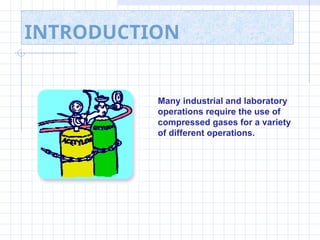
Many industrial and laboratory
operations require the use of
compressed gases for a variety
of different operations.
INTRODUCTION
INTRODUCTION
Compressed gases present a unique hazard. Depending on the
particular gas, there is a potential for simultaneous exposure to both
mechanical and chemical hazards. Gases may be:
•Flammable or combustible
•Explosive
•Corrosive
•Poisonous
•Inert
•or a combination of hazards
INTRODUCTION
If the gas is flammable, flash points lower than room
temperature compounded by high rates of diffusion present a
danger of fire or explosion.
Additional hazards of reactivity and toxicity of the gas, as
well as asphyxiation, can be caused by high
concentrations of even "harmless" gases such as
nitrogen.
Since the gases are contained in heavy, highly pressurized
metal containers, the large amount of potential energy
resulting from compression of the gas makes the cylinder a
potential rocket or fragmentation bomb.
INTRODUCTION
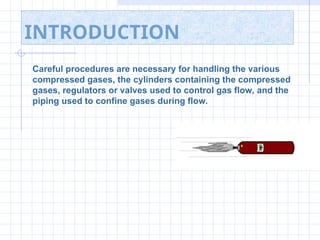
Careful procedures are necessary for handling the various
compressed gases, the cylinders containing the compressed
gases, regulators or valves used to control gas flow, and the
piping used to confine gases during flow.
IDENTIFICATION
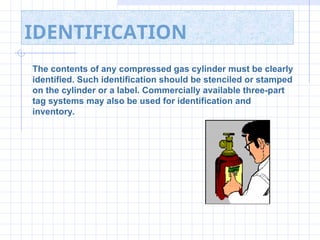
The contents of any compressed gas cylinder must be clearly
identified. Such identification should be stenciled or stamped
on the cylinder or a label. Commercially available three-part
tag systems may also be used for identification and
inventory.
IDENTIFICATION
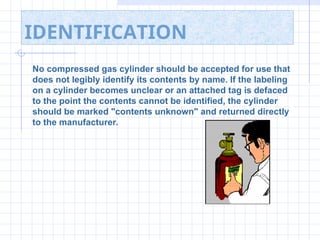
No compressed gas cylinder should be accepted for use that
does not legibly identify its contents by name. If the labeling
on a cylinder becomes unclear or an attached tag is defaced
to the point the contents cannot be identified, the cylinder
should be marked "contents unknown" and returned directly
to the manufacturer.
IDENTIFICATION
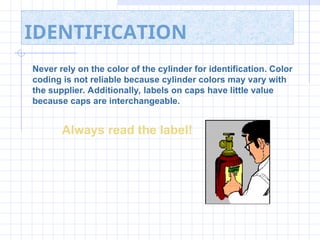
Never rely on the color of the cylinder for identification. Color
coding is not reliable because cylinder colors may vary with
the supplier. Additionally, labels on caps have little value
because caps are interchangeable.
Always read the label!
IDENTIFICATION
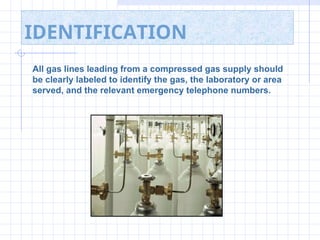
All gas lines leading from a compressed gas supply should
be clearly labeled to identify the gas, the laboratory or area
served, and the relevant emergency telephone numbers.
IDENTIFICATION
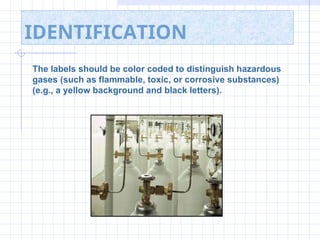
The labels should be color coded to distinguish hazardous
gases (such as flammable, toxic, or corrosive substances)
(e.g., a yellow background and black letters).
IDENTIFICATION
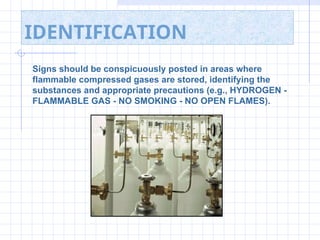
Signs should be conspicuously posted in areas where
flammable compressed gases are stored, identifying the
substances and appropriate precautions (e.g., HYDROGEN -
FLAMMABLE GAS - NO SMOKING - NO OPEN FLAMES).
HANDLING & USE
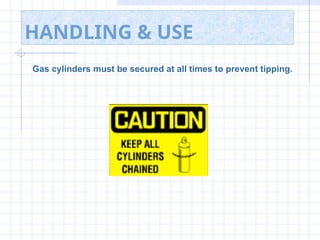
Gas cylinders must be secured at all times to prevent tipping.
HANDLING & USE
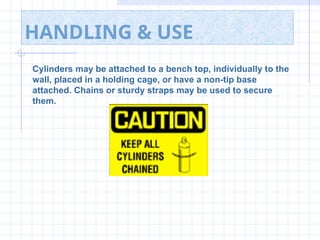
Cylinders may be attached to a bench top, individually to the
wall, placed in a holding cage, or have a non-tip base
attached. Chains or sturdy straps may be used to secure
them.
HANDLING & USE
If a leaking cylinder is discovered, move it to a safe place (if it
is safe to do so) and inform the Environmental Health &
Safety Department. You should also call the vendor as soon
as possible.
Under no circumstances
should any attempt be made to repair
a cylinder or valve.
HANDLING & USE
Standard cylinder-valve outlet connections have been
devised by the Compressed Gas Association (CGA) to
prevent mixing of incompatible gases.
The outlet threads used vary in diameter; some are
internal, some are external; some are right-handed,
some are left-handed.
In general, right-handed threads are used for non-fuel and
water-pumped gases, while left-handed threads are used for
fuel and oil-pump gases.
HANDLING & USE
To minimize undesirable connections, only CGA standard
combinations of valves and fittings should be used in
compressed gas installations; the assembly of miscellaneous
parts should be avoided.
The threads on cylinder valves, regulators and other
fittings should be examined to ensure they correspond
and are undamaged.
HANDLING & USE
Cylinders should be placed with the valve accessible at all
times. The main cylinder valve should be closed as soon as it
is no longer necessary that it be open (i.e., it should never be
left open when the equipment is unattended or not operating).
This is necessary not only for safety when the cylinder
is under pressure, but also to prevent the corrosion
and contamination resulting from diffusion of air and
moisture into the cylinder after it has been emptied.
HANDLING & USE
Cylinders are equipped with either a hand wheel or stem
valve. For cylinders equipped with a stem valve, the valve
spindle key should remain on the stem while the cylinder is in
service.
Only wrenches or tools provided by the cylinder
supplier should be used to open or close a valve. At no
time should pliers be used to open a cylinder valve.
Some valves may require washers; this should be checked
before the regulator is fitted.
HANDLING & USE
Cylinder valves should be opened slowly. Oxygen cylinder valves
should be opened all the way.
Open up the oxygen cylinder valve stem just a crack. Once
the needle on the high pressure gauge has stopped, open up
the valve all the way. This back-seats the valve.
Oxygen cylinders must have the valve opened up all the way
because of the high pressure in the cylinder. There is a back-
seating valve on the oxygen cylinder. This prevents the high-
pressure gas from leaking out through the threaded stem.
When opening the valve on a cylinder containing an irritating or
toxic gas, the user should position the cylinder with the valve
pointing away from them and warn those working nearby.
HANDLING & USE
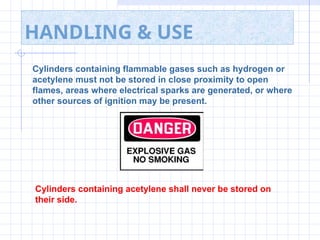
Cylinders containing flammable gases such as hydrogen or
acetylene must not be stored in close proximity to open
flames, areas where electrical sparks are generated, or where
other sources of ignition may be present.
Cylinders containing acetylene shall never be stored on
their side.
HANDLING & USE
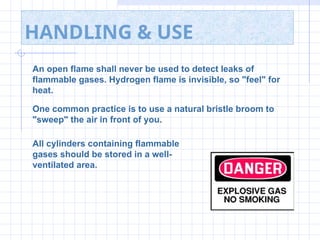
An open flame shall never be used to detect leaks of
flammable gases. Hydrogen flame is invisible, so "feel" for
heat.
One common practice is to use a natural bristle broom to
"sweep" the air in front of you.
All cylinders containing flammable
gases should be stored in a well-
ventilated area.
HANDLING & USE
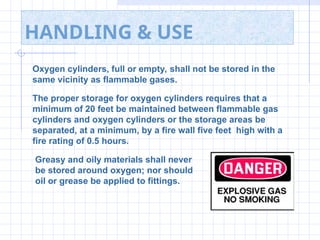
Oxygen cylinders, full or empty, shall not be stored in the
same vicinity as flammable gases.
The proper storage for oxygen cylinders requires that a
minimum of 20 feet be maintained between flammable gas
cylinders and oxygen cylinders or the storage areas be
separated, at a minimum, by a fire wall five feet high with a
fire rating of 0.5 hours.
Greasy and oily materials shall never
be stored around oxygen; nor should
oil or grease be applied to fittings.
HANDLING & USE
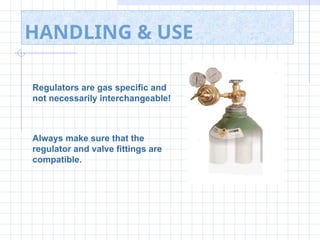
Regulators are gas specific and
not necessarily interchangeable!
Always make sure that the
regulator and valve fittings are
compatible.
HANDLING & USE
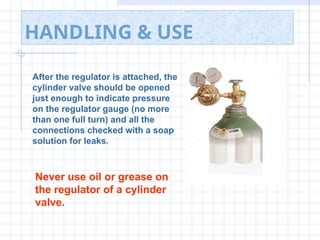
After the regulator is attached, the
cylinder valve should be opened
just enough to indicate pressure
on the regulator gauge (no more
than one full turn) and all the
connections checked with a soap
solution for leaks.
Never use oil or grease on
the regulator of a cylinder
valve.
HANDLING & USE
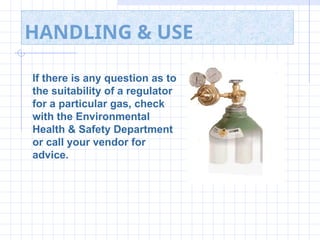
If there is any question as to
the suitability of a regulator
for a particular gas, check
with the Environmental
Health & Safety Department
or call your vendor for
advice.
HANDLING & USE
The following rules should always be followed in regards to
piping:
 Plastic piping shall not be used for any portion of a
high pressure system.
 Do not use cast iron pipe for chlorine.
 Do not conceal distribution lines where a high
concentration of a leaking hazardous gas can build up
and cause an accident.
 Copper piping shall not be used for acetylene.
HANDLING & USE
The following rules should always be followed in regards to
piping:
 Distribution lines and their outlets should be clearly
labeled as to the type of gas contained.
 Piping systems should be inspected for leaks on a
regular basis.
 Special attention should be given to fittings as well as
possible cracks that may have developed.
HANDLING & USE
A cylinder should never be emptied to a pressure lower than
172 kPa (25 psi/in2) (the residual contents may become
contaminated if the valve is left open).
When work involving a compressed gas is completed, the
cylinder must be turned off, and if possible, the lines bled.
HANDLING & USE
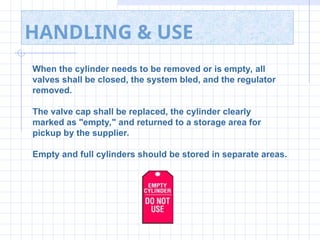
When the cylinder needs to be removed or is empty, all
valves shall be closed, the system bled, and the regulator
removed.
The valve cap shall be replaced, the cylinder clearly
marked as "empty," and returned to a storage area for
pickup by the supplier.
Empty and full cylinders should be stored in separate areas.
HANDLING & USE
Where the possibility of flow reversal exists, the cylinder
discharge lines should be equipped with approved check
valves to prevent inadvertent contamination of cylinders
connected to a closed system.
"Sucking back" is particularly troublesome where gases
are used as reactants in a closed system.
A cylinder in such a system should be shut off and removed
from the system when the pressure remaining in the cylinder
is at least 172 kPa (25 psi/in2).
If there is a possibility that the container has been
contaminated, it should be so labeled and returned to the
supplier.
HANDLING & USE
Liquid bulk cylinders may be used in laboratories where a
high volume of gas is needed.
These cylinders usually have a number of valves on the
top of the cylinder.
All valves should be clearly marked as to their function.
These cylinders will also vent their contents when a preset
internal pressure is reached, therefore, they should be
stored or placed in service where there is adequate
ventilation.
HANDLING & USE
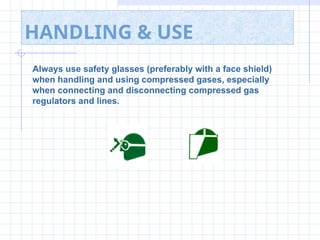
Always use safety glasses (preferably with a face shield)
when handling and using compressed gases, especially
when connecting and disconnecting compressed gas
regulators and lines.
HANDLING & USE
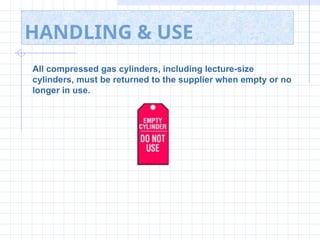
All compressed gas cylinders, including lecture-size
cylinders, must be returned to the supplier when empty or no
longer in use.
TRANSPORTATION OF
CYLINDERS
The cylinders that contain compressed gases are primarily
shipping containers and should not be subjected to rough
handling or abuse.
Such misuse can seriously weaken the cylinder and render
it unfit for further use or transform it into a rocket having
sufficient thrust to drive it through masonry walls.
TRANSPORTATION OF
CYLINDERS
1. To protect the valve during transportation, the cover cap
should be screwed on hand tight and remain on until the
cylinder is in place and ready for use.
2. Cylinders should never be rolled or dragged.
3. When moving large cylinders, they should be strapped to
a properly designed wheeled cart to ensure stability.
4. Only one cylinder should be handled (moved) at a time.

Compressed gas an interesting introduction

  • 1.
  • 2.
    Many industrial andlaboratory operations require the use of compressed gases for a variety of different operations. INTRODUCTION
  • 3.
    INTRODUCTION Compressed gases presenta unique hazard. Depending on the particular gas, there is a potential for simultaneous exposure to both mechanical and chemical hazards. Gases may be: •Flammable or combustible •Explosive •Corrosive •Poisonous •Inert •or a combination of hazards
  • 4.
    INTRODUCTION If the gasis flammable, flash points lower than room temperature compounded by high rates of diffusion present a danger of fire or explosion. Additional hazards of reactivity and toxicity of the gas, as well as asphyxiation, can be caused by high concentrations of even "harmless" gases such as nitrogen. Since the gases are contained in heavy, highly pressurized metal containers, the large amount of potential energy resulting from compression of the gas makes the cylinder a potential rocket or fragmentation bomb.
  • 5.
    INTRODUCTION Careful procedures arenecessary for handling the various compressed gases, the cylinders containing the compressed gases, regulators or valves used to control gas flow, and the piping used to confine gases during flow.
  • 6.
    IDENTIFICATION The contents ofany compressed gas cylinder must be clearly identified. Such identification should be stenciled or stamped on the cylinder or a label. Commercially available three-part tag systems may also be used for identification and inventory.
  • 7.
    IDENTIFICATION No compressed gascylinder should be accepted for use that does not legibly identify its contents by name. If the labeling on a cylinder becomes unclear or an attached tag is defaced to the point the contents cannot be identified, the cylinder should be marked "contents unknown" and returned directly to the manufacturer.
  • 8.
    IDENTIFICATION Never rely onthe color of the cylinder for identification. Color coding is not reliable because cylinder colors may vary with the supplier. Additionally, labels on caps have little value because caps are interchangeable. Always read the label!
  • 9.
    IDENTIFICATION All gas linesleading from a compressed gas supply should be clearly labeled to identify the gas, the laboratory or area served, and the relevant emergency telephone numbers.
  • 10.
    IDENTIFICATION The labels shouldbe color coded to distinguish hazardous gases (such as flammable, toxic, or corrosive substances) (e.g., a yellow background and black letters).
  • 11.
    IDENTIFICATION Signs should beconspicuously posted in areas where flammable compressed gases are stored, identifying the substances and appropriate precautions (e.g., HYDROGEN - FLAMMABLE GAS - NO SMOKING - NO OPEN FLAMES).
  • 12.
    HANDLING & USE Gascylinders must be secured at all times to prevent tipping.
  • 13.
    HANDLING & USE Cylindersmay be attached to a bench top, individually to the wall, placed in a holding cage, or have a non-tip base attached. Chains or sturdy straps may be used to secure them.
  • 14.
    HANDLING & USE Ifa leaking cylinder is discovered, move it to a safe place (if it is safe to do so) and inform the Environmental Health & Safety Department. You should also call the vendor as soon as possible. Under no circumstances should any attempt be made to repair a cylinder or valve.
  • 15.
    HANDLING & USE Standardcylinder-valve outlet connections have been devised by the Compressed Gas Association (CGA) to prevent mixing of incompatible gases. The outlet threads used vary in diameter; some are internal, some are external; some are right-handed, some are left-handed. In general, right-handed threads are used for non-fuel and water-pumped gases, while left-handed threads are used for fuel and oil-pump gases.
  • 16.
    HANDLING & USE Tominimize undesirable connections, only CGA standard combinations of valves and fittings should be used in compressed gas installations; the assembly of miscellaneous parts should be avoided. The threads on cylinder valves, regulators and other fittings should be examined to ensure they correspond and are undamaged.
  • 17.
    HANDLING & USE Cylindersshould be placed with the valve accessible at all times. The main cylinder valve should be closed as soon as it is no longer necessary that it be open (i.e., it should never be left open when the equipment is unattended or not operating). This is necessary not only for safety when the cylinder is under pressure, but also to prevent the corrosion and contamination resulting from diffusion of air and moisture into the cylinder after it has been emptied.
  • 18.
    HANDLING & USE Cylindersare equipped with either a hand wheel or stem valve. For cylinders equipped with a stem valve, the valve spindle key should remain on the stem while the cylinder is in service. Only wrenches or tools provided by the cylinder supplier should be used to open or close a valve. At no time should pliers be used to open a cylinder valve. Some valves may require washers; this should be checked before the regulator is fitted.
  • 19.
    HANDLING & USE Cylindervalves should be opened slowly. Oxygen cylinder valves should be opened all the way. Open up the oxygen cylinder valve stem just a crack. Once the needle on the high pressure gauge has stopped, open up the valve all the way. This back-seats the valve. Oxygen cylinders must have the valve opened up all the way because of the high pressure in the cylinder. There is a back- seating valve on the oxygen cylinder. This prevents the high- pressure gas from leaking out through the threaded stem. When opening the valve on a cylinder containing an irritating or toxic gas, the user should position the cylinder with the valve pointing away from them and warn those working nearby.
  • 20.
    HANDLING & USE Cylinderscontaining flammable gases such as hydrogen or acetylene must not be stored in close proximity to open flames, areas where electrical sparks are generated, or where other sources of ignition may be present. Cylinders containing acetylene shall never be stored on their side.
  • 21.
    HANDLING & USE Anopen flame shall never be used to detect leaks of flammable gases. Hydrogen flame is invisible, so "feel" for heat. One common practice is to use a natural bristle broom to "sweep" the air in front of you. All cylinders containing flammable gases should be stored in a well- ventilated area.
  • 22.
    HANDLING & USE Oxygencylinders, full or empty, shall not be stored in the same vicinity as flammable gases. The proper storage for oxygen cylinders requires that a minimum of 20 feet be maintained between flammable gas cylinders and oxygen cylinders or the storage areas be separated, at a minimum, by a fire wall five feet high with a fire rating of 0.5 hours. Greasy and oily materials shall never be stored around oxygen; nor should oil or grease be applied to fittings.
  • 23.
    HANDLING & USE Regulatorsare gas specific and not necessarily interchangeable! Always make sure that the regulator and valve fittings are compatible.
  • 24.
    HANDLING & USE Afterthe regulator is attached, the cylinder valve should be opened just enough to indicate pressure on the regulator gauge (no more than one full turn) and all the connections checked with a soap solution for leaks. Never use oil or grease on the regulator of a cylinder valve.
  • 25.
    HANDLING & USE Ifthere is any question as to the suitability of a regulator for a particular gas, check with the Environmental Health & Safety Department or call your vendor for advice.
  • 26.
    HANDLING & USE Thefollowing rules should always be followed in regards to piping:  Plastic piping shall not be used for any portion of a high pressure system.  Do not use cast iron pipe for chlorine.  Do not conceal distribution lines where a high concentration of a leaking hazardous gas can build up and cause an accident.  Copper piping shall not be used for acetylene.
  • 27.
    HANDLING & USE Thefollowing rules should always be followed in regards to piping:  Distribution lines and their outlets should be clearly labeled as to the type of gas contained.  Piping systems should be inspected for leaks on a regular basis.  Special attention should be given to fittings as well as possible cracks that may have developed.
  • 28.
    HANDLING & USE Acylinder should never be emptied to a pressure lower than 172 kPa (25 psi/in2) (the residual contents may become contaminated if the valve is left open). When work involving a compressed gas is completed, the cylinder must be turned off, and if possible, the lines bled.
  • 29.
    HANDLING & USE Whenthe cylinder needs to be removed or is empty, all valves shall be closed, the system bled, and the regulator removed. The valve cap shall be replaced, the cylinder clearly marked as "empty," and returned to a storage area for pickup by the supplier. Empty and full cylinders should be stored in separate areas.
  • 30.
    HANDLING & USE Wherethe possibility of flow reversal exists, the cylinder discharge lines should be equipped with approved check valves to prevent inadvertent contamination of cylinders connected to a closed system. "Sucking back" is particularly troublesome where gases are used as reactants in a closed system. A cylinder in such a system should be shut off and removed from the system when the pressure remaining in the cylinder is at least 172 kPa (25 psi/in2). If there is a possibility that the container has been contaminated, it should be so labeled and returned to the supplier.
  • 31.
    HANDLING & USE Liquidbulk cylinders may be used in laboratories where a high volume of gas is needed. These cylinders usually have a number of valves on the top of the cylinder. All valves should be clearly marked as to their function. These cylinders will also vent their contents when a preset internal pressure is reached, therefore, they should be stored or placed in service where there is adequate ventilation.
  • 32.
    HANDLING & USE Alwaysuse safety glasses (preferably with a face shield) when handling and using compressed gases, especially when connecting and disconnecting compressed gas regulators and lines.
  • 33.
    HANDLING & USE Allcompressed gas cylinders, including lecture-size cylinders, must be returned to the supplier when empty or no longer in use.
  • 34.
    TRANSPORTATION OF CYLINDERS The cylindersthat contain compressed gases are primarily shipping containers and should not be subjected to rough handling or abuse. Such misuse can seriously weaken the cylinder and render it unfit for further use or transform it into a rocket having sufficient thrust to drive it through masonry walls.
  • 35.
    TRANSPORTATION OF CYLINDERS 1. Toprotect the valve during transportation, the cover cap should be screwed on hand tight and remain on until the cylinder is in place and ready for use. 2. Cylinders should never be rolled or dragged. 3. When moving large cylinders, they should be strapped to a properly designed wheeled cart to ensure stability. 4. Only one cylinder should be handled (moved) at a time.