CNIT 141


Cryptography for Computer Networks
4. Block Ciphers
Updated 9-14-2022
Topics
• What is a Block Cipher


• How to Construct Block Ciphers


• The Advanced Encryption Standard (AES)


• Implementing AES


• Modes of Operation


• How Things Can Go Wrong
History
• US: Federal standard: DES (1979 - 2005)


• KGB: GOST 28147-89 (1990 - present)


• in 2000, NIST selected AES, developed in
Belgium


• They are all block ciphers
What is a Block Cipher
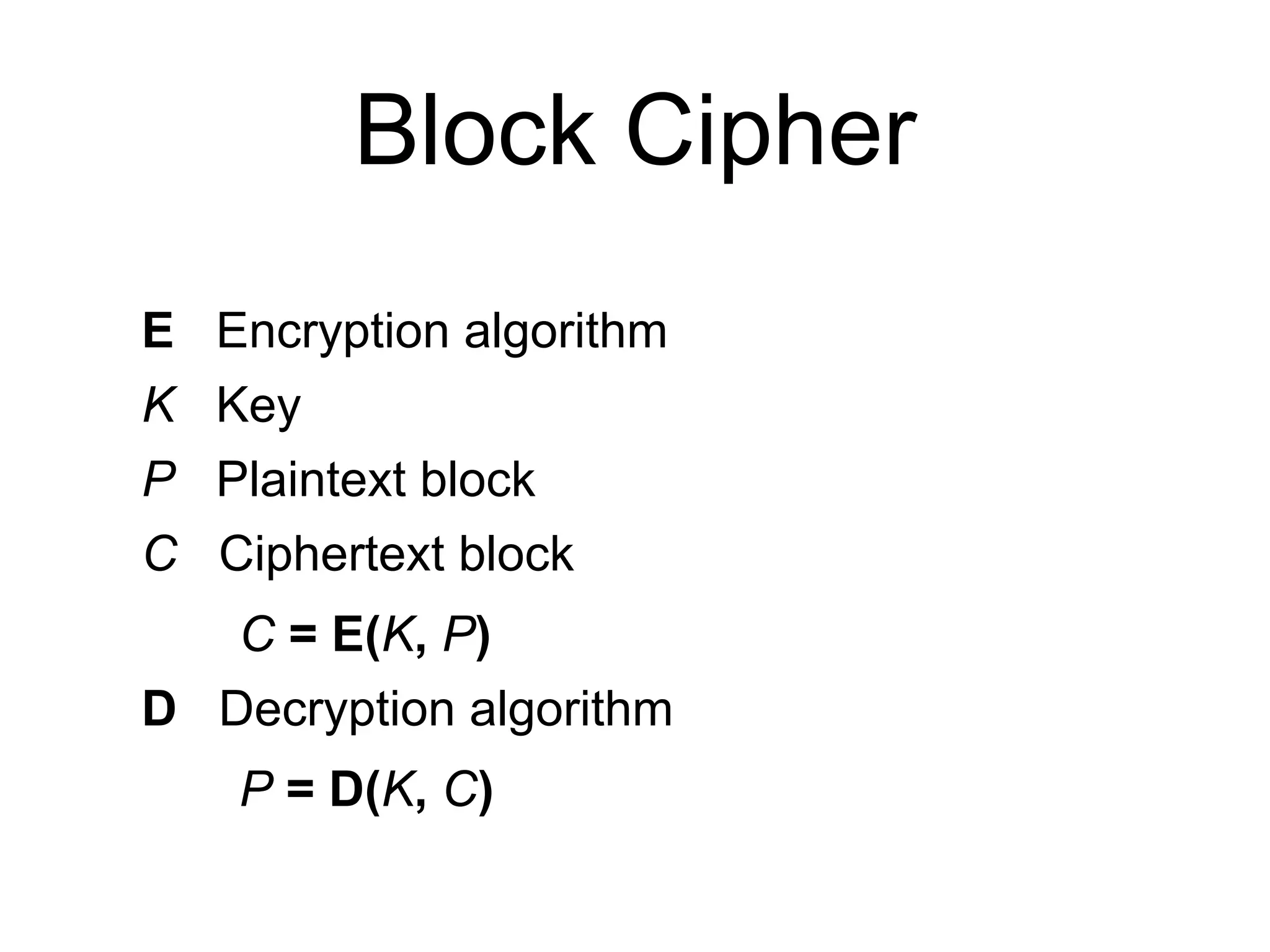
Block Cipher
E Encryption algorithm


K Key


P Plaintext block


C Ciphertext block


C = E(K, P)


D Decryption algorithm


P = D(K, C)
Security Goals
• Block cipher should be a pseudorandom
permutation (PRP)


• Attacker can't compute output without the
key


• Attackers should be unable to find patterns in
the inputs/output values


• The ciphertext should appear random
Block Size
• DES: 64 bit


• AES: 128 bit


• Chosen to fit into registers of CPUs for speed


• Block sizes below 64 are vulnerable to a
codebook attack
Codebook Attack
• Suppose you can encrypt arbitrary plaintext,
such as in a Wi-Fi network, but you don't know
the key


• Encrypt every possible plaintext, place in a
codebook


• Look up blocks of ciphertext in the codebook
Codebook Attack
• The codebook size depends on the block size


• Blocksize of 32 bits requires 2^32 entries


• 4 billion, easily achieved


• Blocksize of 64 bits requires 2^64 entries


• Impossible to achieve


• So blocksize should be 64 or larger
How to Construct Block
Ciphers
Two Techniques
• Substitution-permutation (AES)


• Feistel (DES)
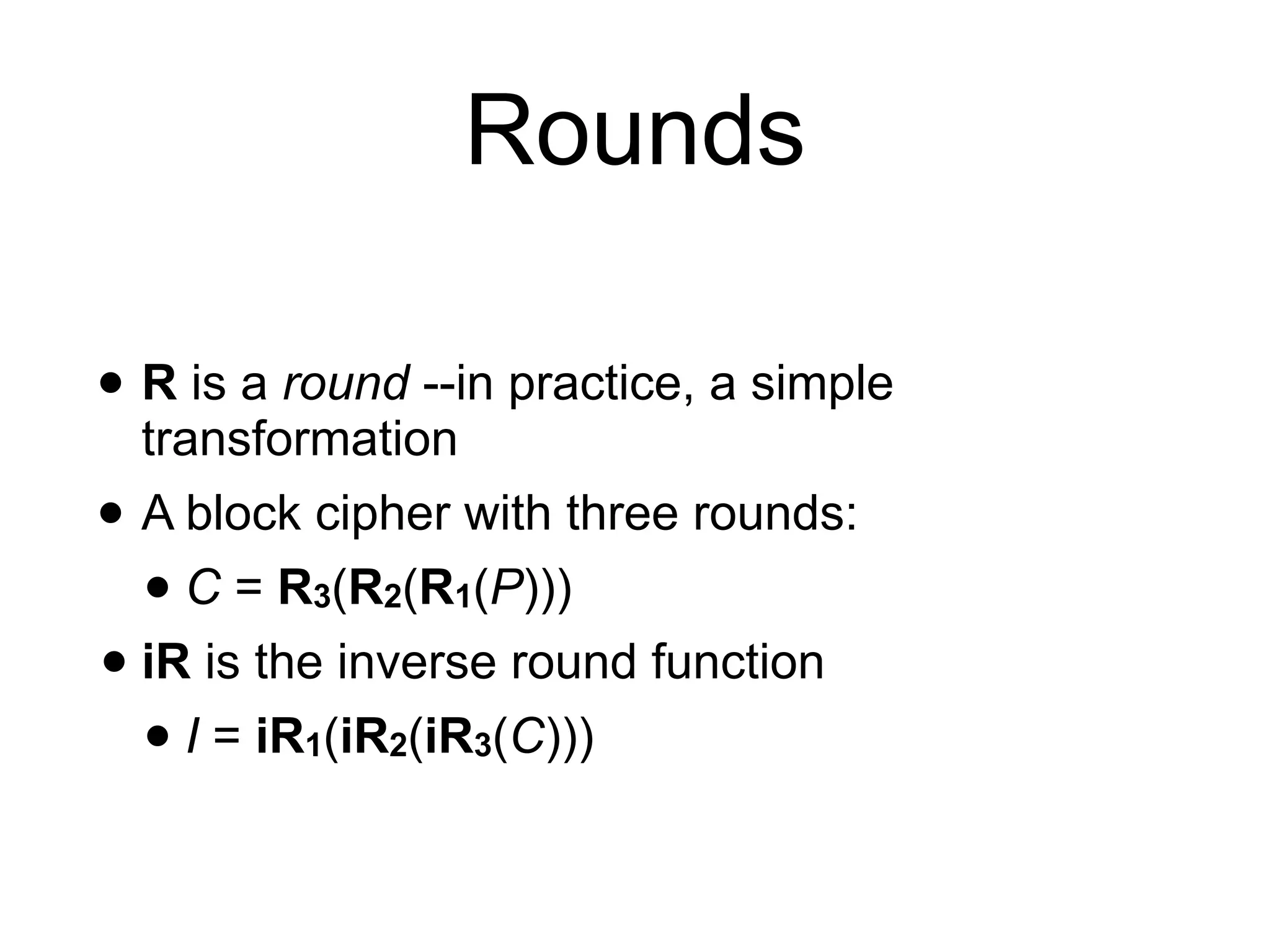
Rounds
• R is a round --in practice, a simple
transformation


• A block cipher with three rounds:


• C = R3(R2(R1(P)))


• iR is the inverse round function


• I = iR1(iR2(iR3(C)))
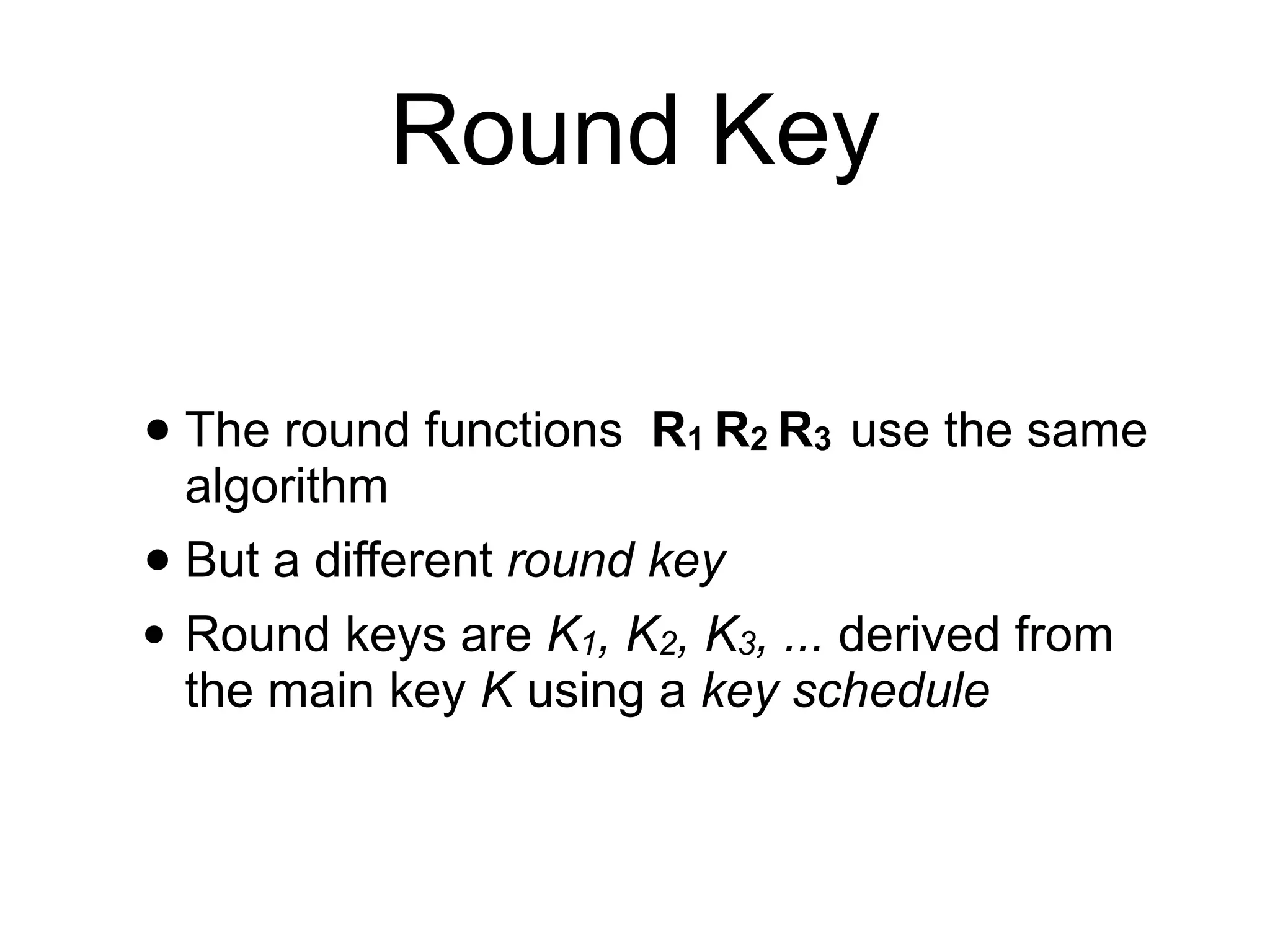
Round Key
• The round functions R1 R2 R3 use the same
algorithm


• But a different round key


• Round keys are K1, K2, K3, ... derived from
the main key K using a key schedule
The Slide Attack and Round Keys
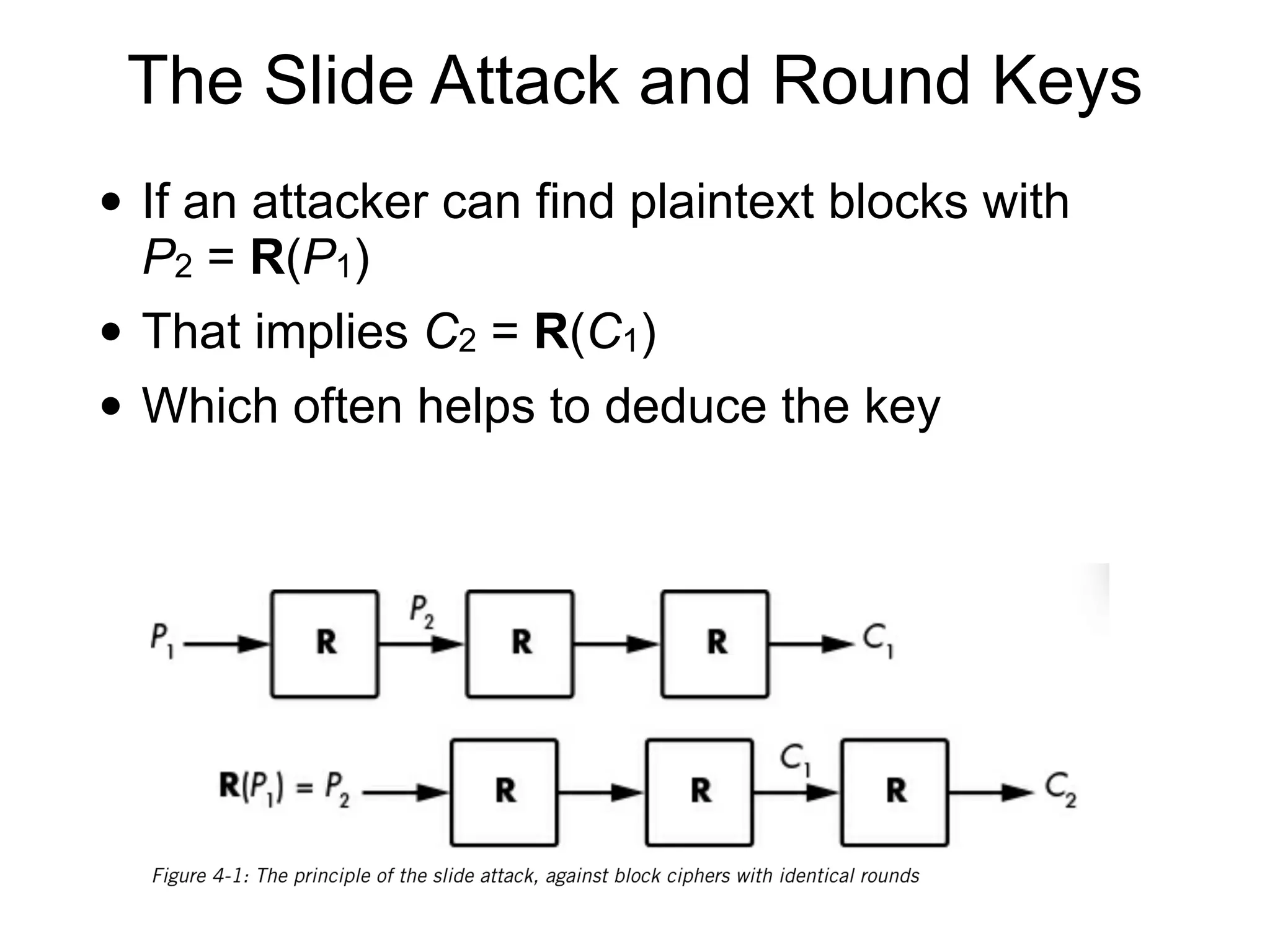
• Consider a block cipher with three rounds, and
with all the round keys identical
The Slide Attack and Round Keys
• If an attacker can find plaintext blocks with


P2 = R(P1)


• That implies C2 = R(C1)


• Which often helps to deduce the key
The Slide Attack and Round Keys
• The solution is to make all round keys different


• Note: the key schedule in AES is not one-way


• Attacker can compute K from any Ki
• This exposes it to side-channel attacks, like
measuring electromagnetic emanations
Substitution-Permutation
Networks
• Confusion means that each ciphertext bit
depends on several key bits


• Provided by substitution using S-boxes


• Diffusion means that changing a bit of
plaintext changes many bits in the ciphertext


• Provided by permutation
Feistel Schemes
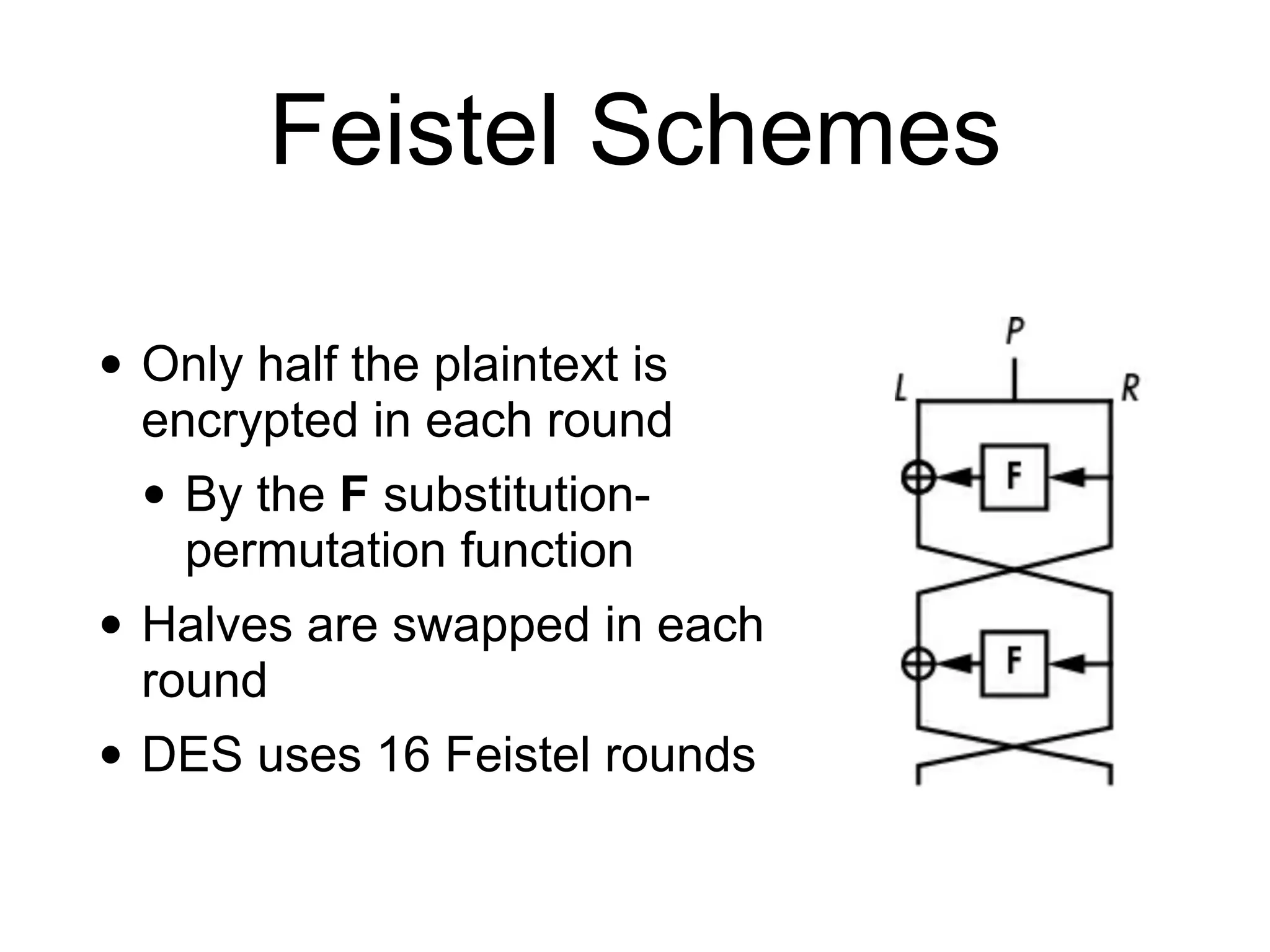
• Only half the plaintext is
encrypted in each round


• By the F substitution-
permutation function


• Halves are swapped in each
round


• DES uses 16 Feistel rounds
4a
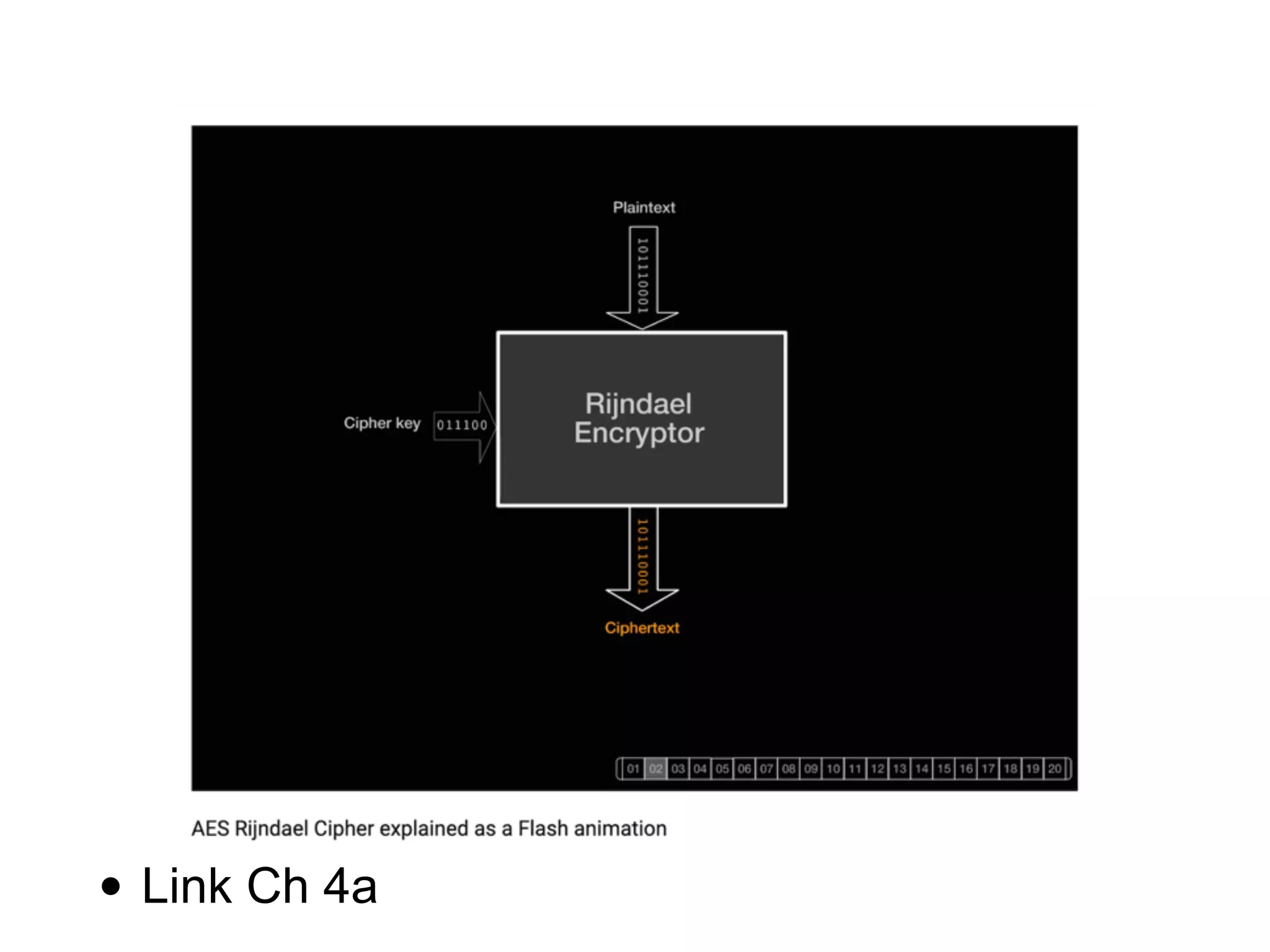
The Advanced Encryption
Standard (AES)
DES
• DES had a 56-bit key


• Cracked by brute force in 1997


• 3DES was a stronger version


• Still considered strong, but slower than AES


• AES approved as the NIST standard in 2000
• Link Ch 4a
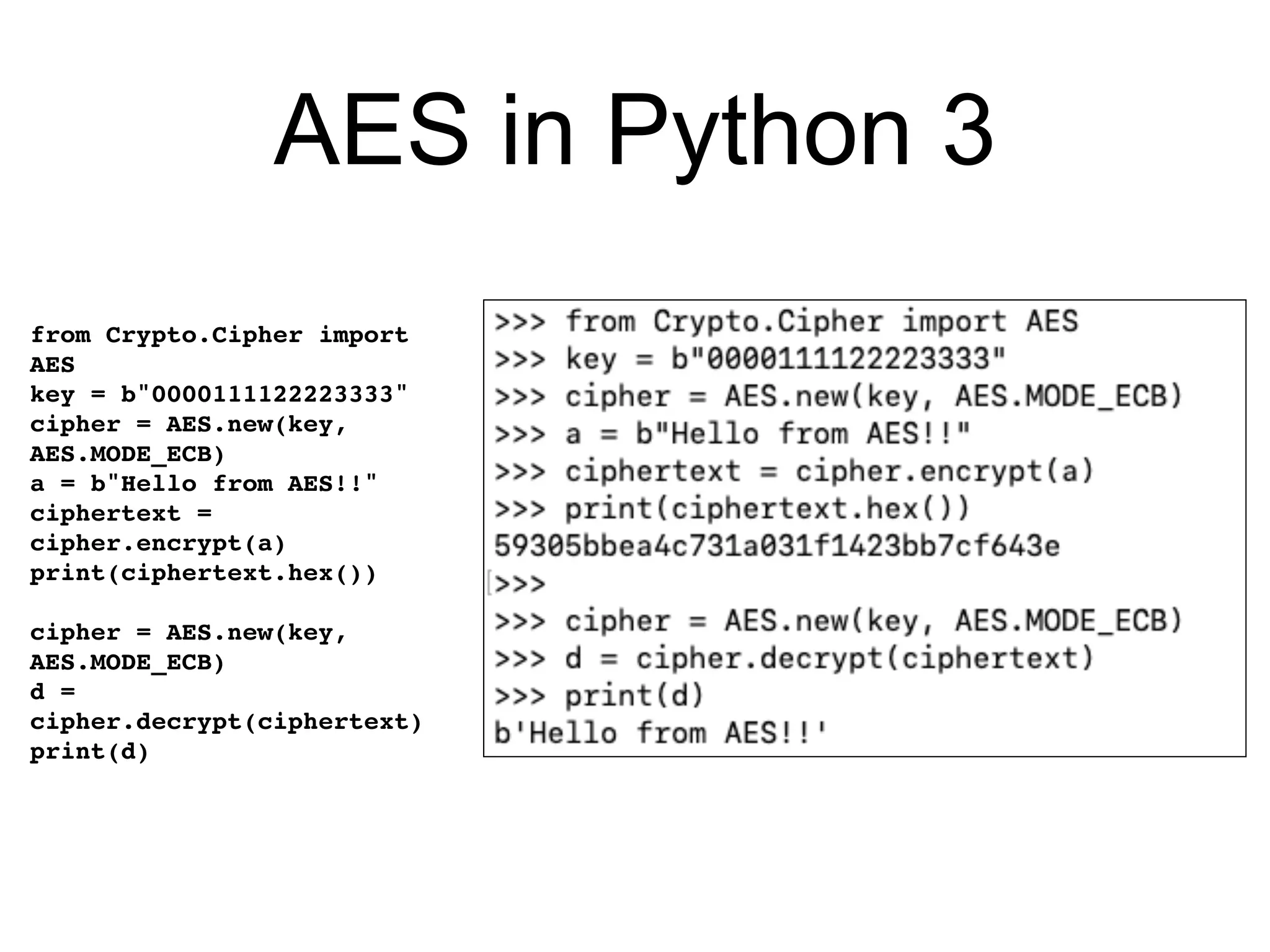
AES in Python 3
from Crypto.Cipher import
AE
S

key = b"0000111122223333
"

cipher = AES.new(key,
AES.MODE_ECB
)

a = b"Hello from AES!!
"

ciphertext =
cipher.encrypt(a
)

print(ciphertext.hex()
)

cipher = AES.new(key,
AES.MODE_ECB
)

d =
cipher.decrypt(ciphertext
)

print(d)
Implementing AES
Improving Efficiency
• Implementing each step
as a separate function
works, but it's slow


• Combining them with
"table-based
implementations" and
"native instructions" is
faster


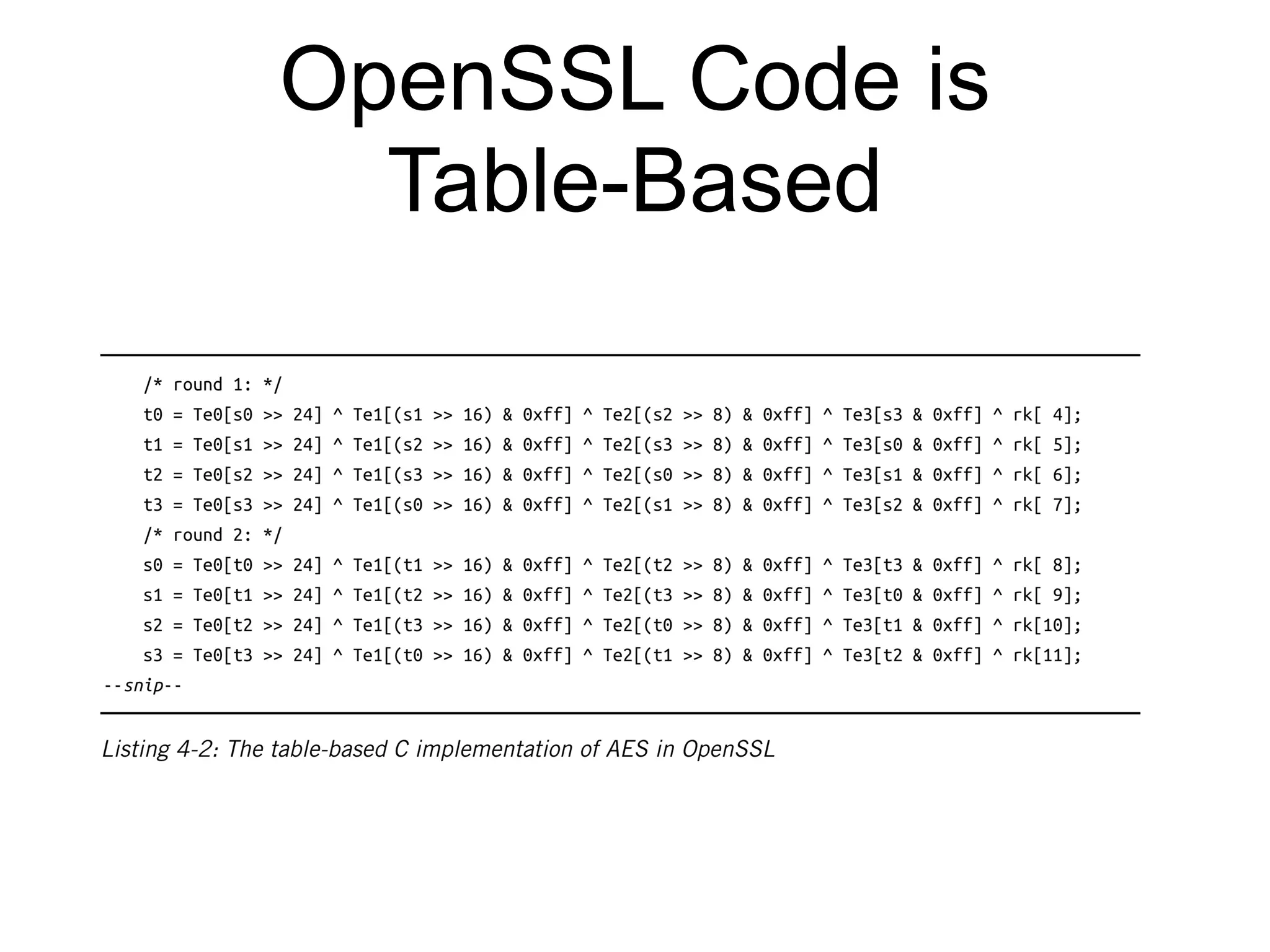
• Using XORs and table
lookups
OpenSSL Code is


Table-Based
Timing Attacks
• The time required for encryption depends on
the key


• Measuring timing leaks information about the
key


• This is a problem with any efficient coding


• You could use slow code that wastes time


• A better solution relies on hardware
Native Instructions
• AES-NI


• Processor provides
dedicated assembly
instructions that perform
AES


• Plaintext in register xmm0


• Round keys in xmm5 to
xmm15


• NI makes AES ten times
faster
Is AES Secure?
• AES implements many good design principles


• Proven to resist many classes of
cryptoanalytic attacks


• But no one can foresee all possible future
attacks


• So far, no significant weakness in AES-128
has been found
Modes of Operation
Electronic Code Book
(ECB)
• Each plaintext block is
encrypted the same
way


• Identical plaintext
blocks produce identical
ciphertext blocks
AES-ECB
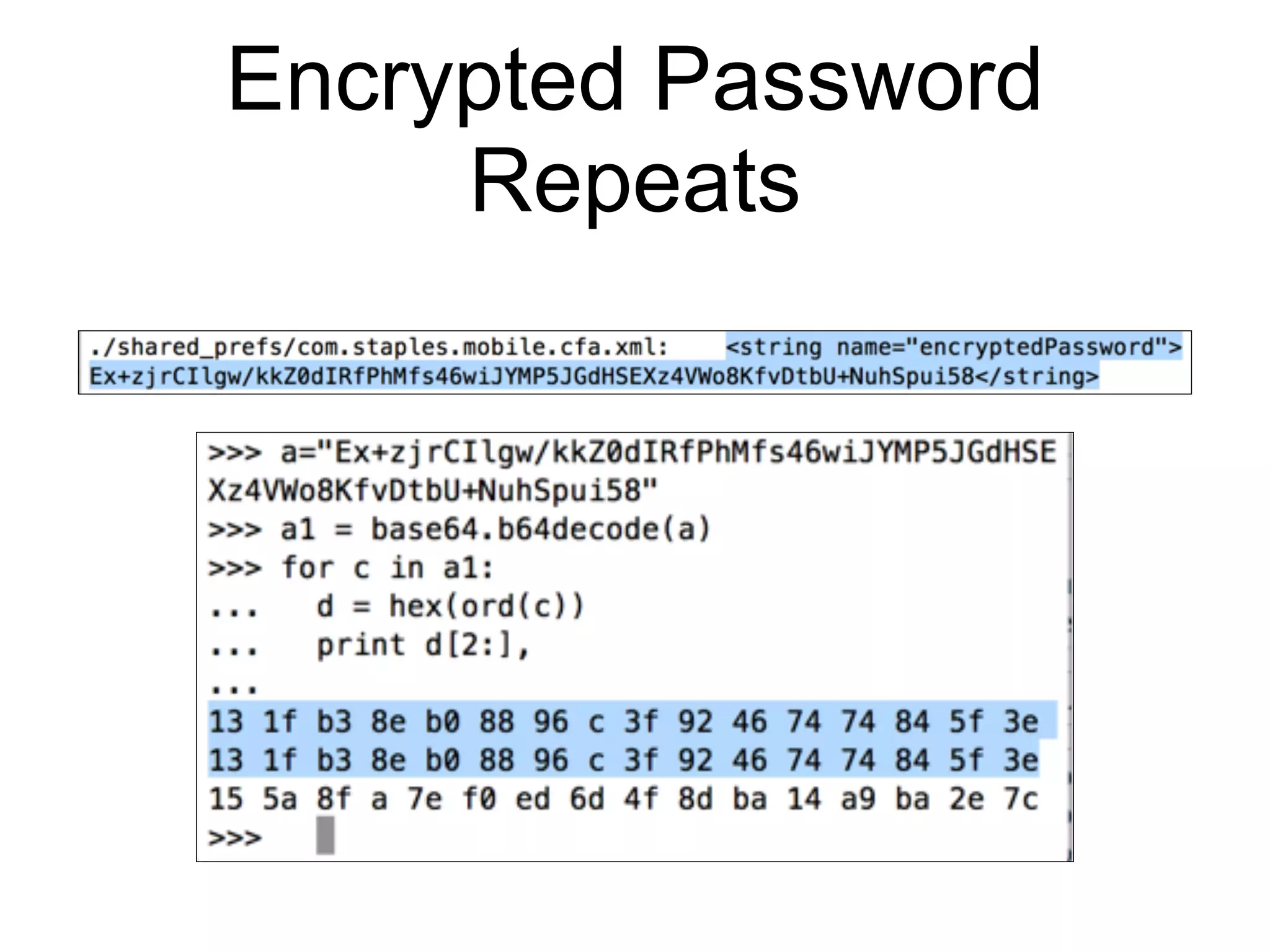
• If plaintext repeats, so does ciphertext


plaintext = b"DEAD MEN TELL NODEAD MEN TELL NO"


ciphertext = cipher.encrypt(plaintext)


ciphertext.hex()
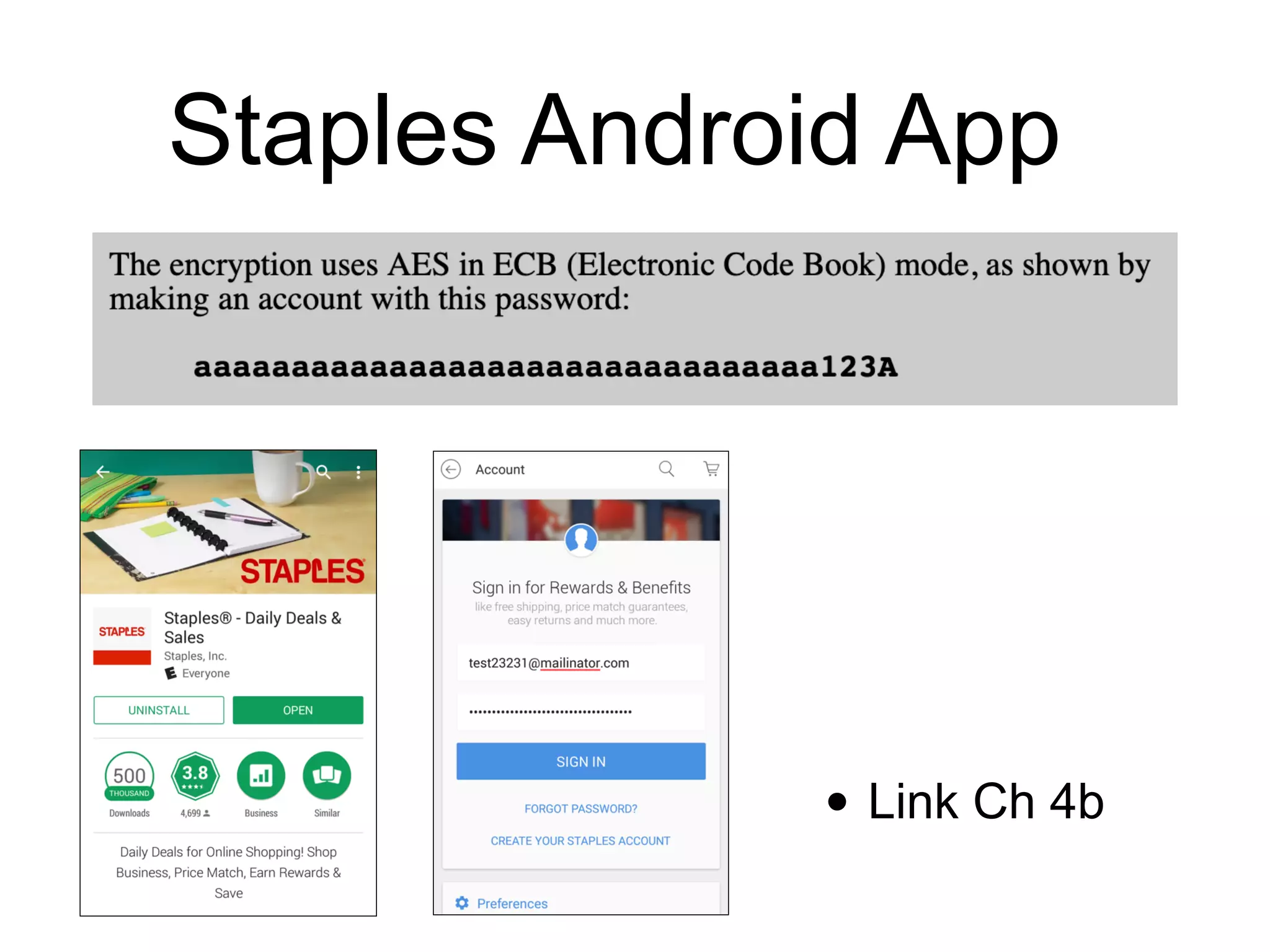
Staples Android App
• Link Ch 4b
Encrypted Password
Repeats
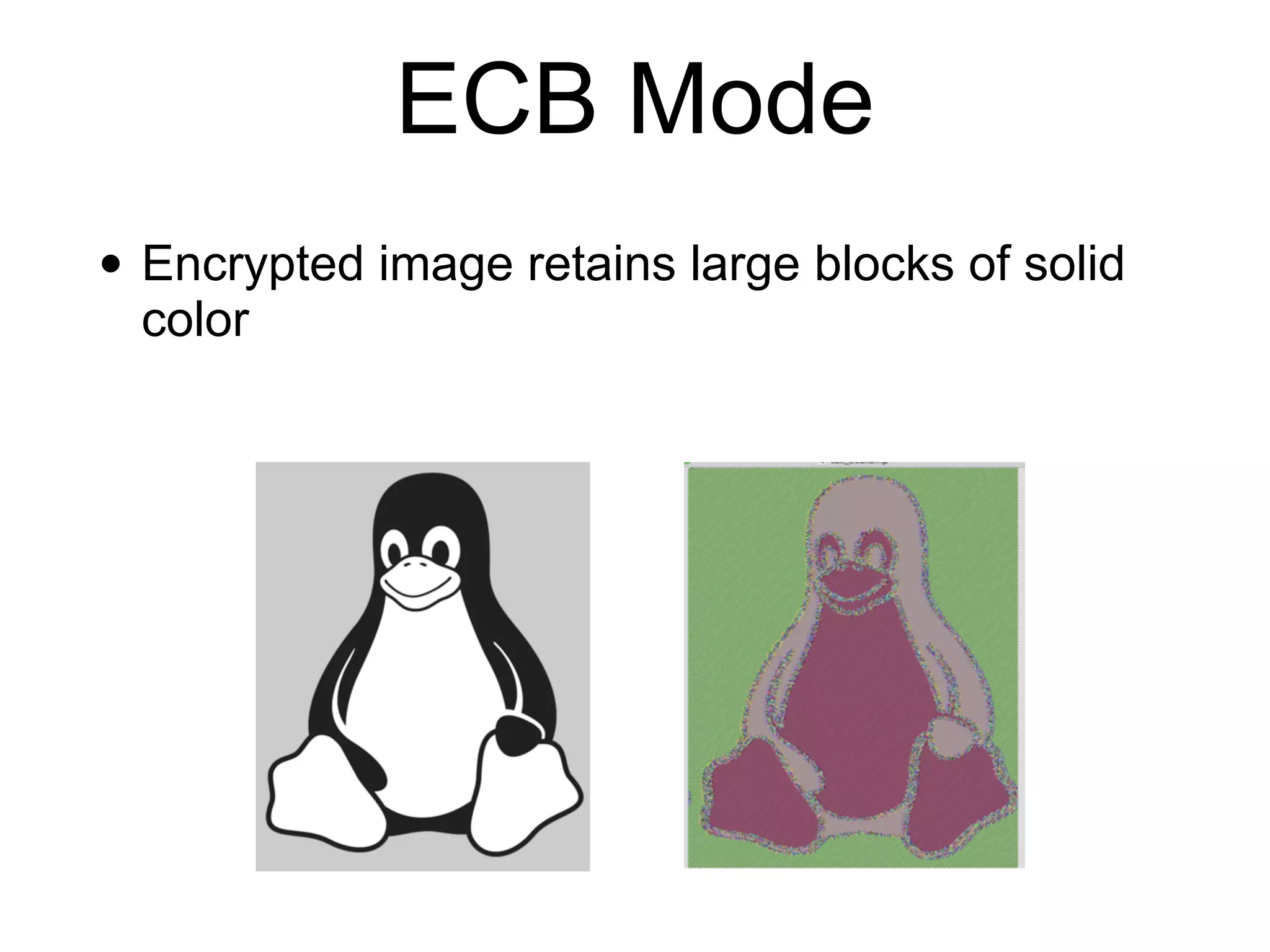
ECB Mode
• Encrypted image retains large blocks of solid
color
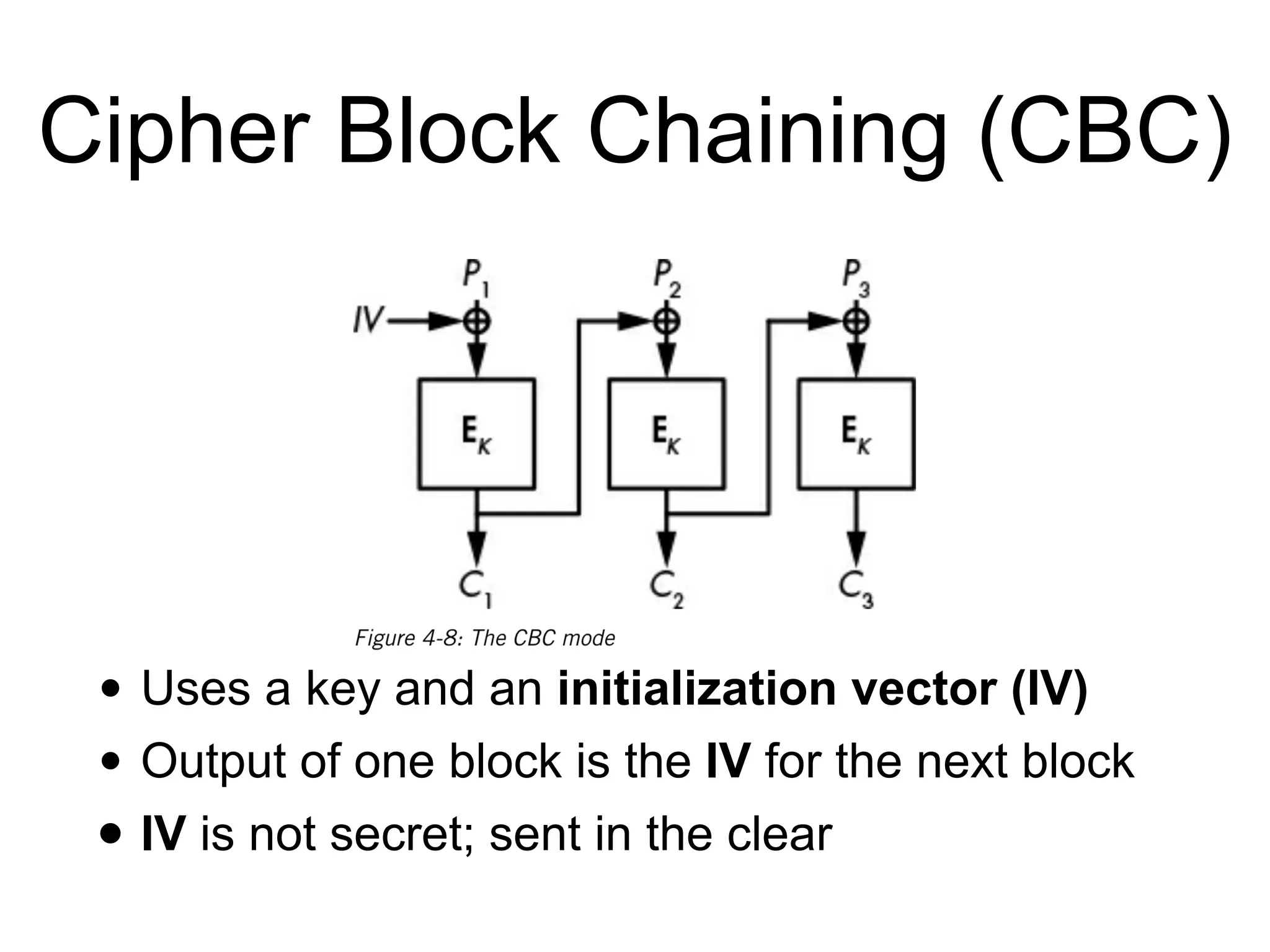
Cipher Block Chaining (CBC)
• Uses a key and an initialization vector (IV)


• Output of one block is the IV for the next block


• IV is not secret; sent in the clear
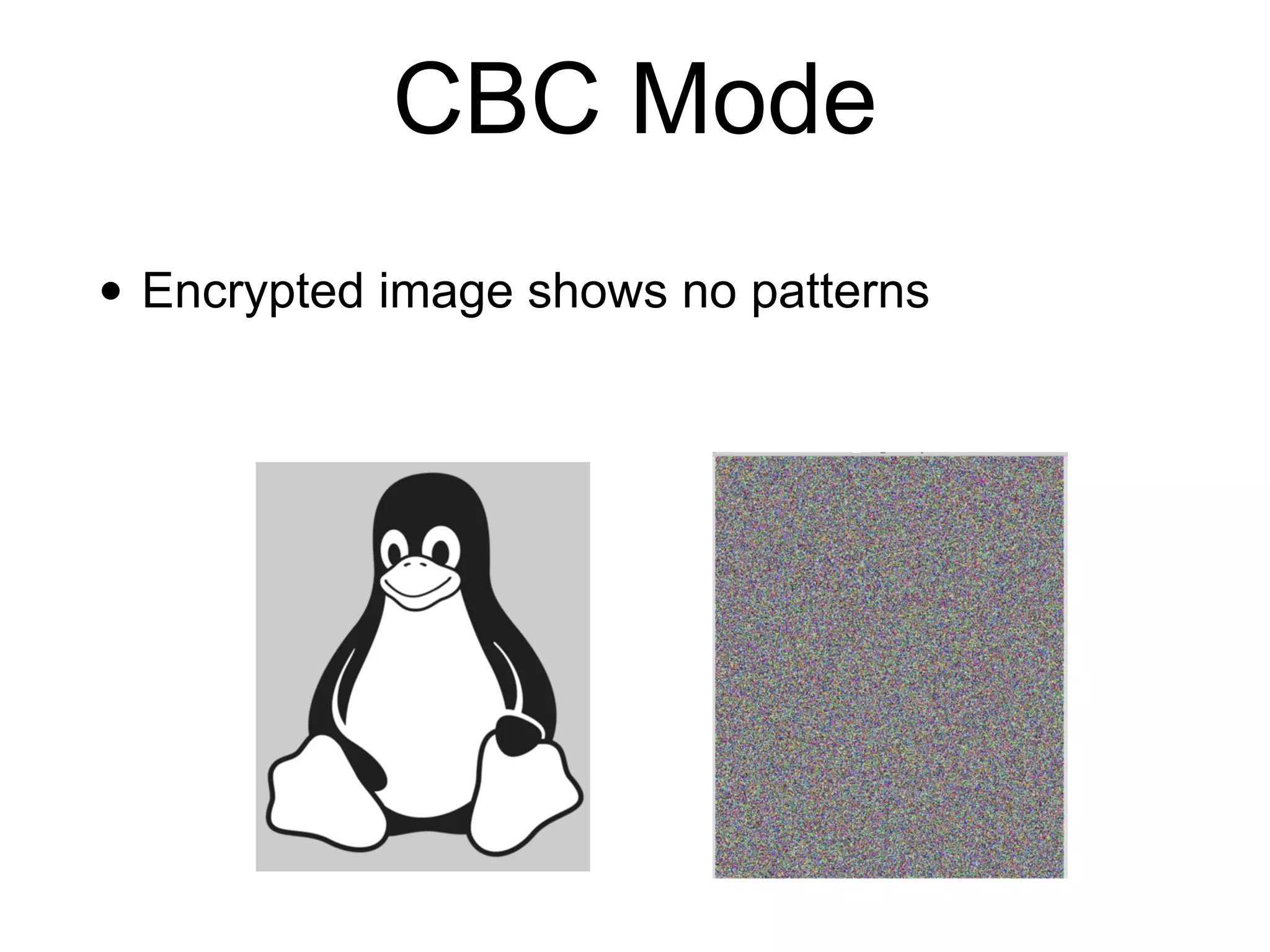
CBC Mode
• Encrypted image shows no patterns
Choosing IV
• If the same IV is used every time


• The first block is always encrypted the same
way


• Messages with the same first plaintext block
will have identical first ciphertext blocks
Parallelism
• ECB can be computed in parallel


• Each block is independent


• CBC requires serial processing


• Output of each block used to encrypt the
next block
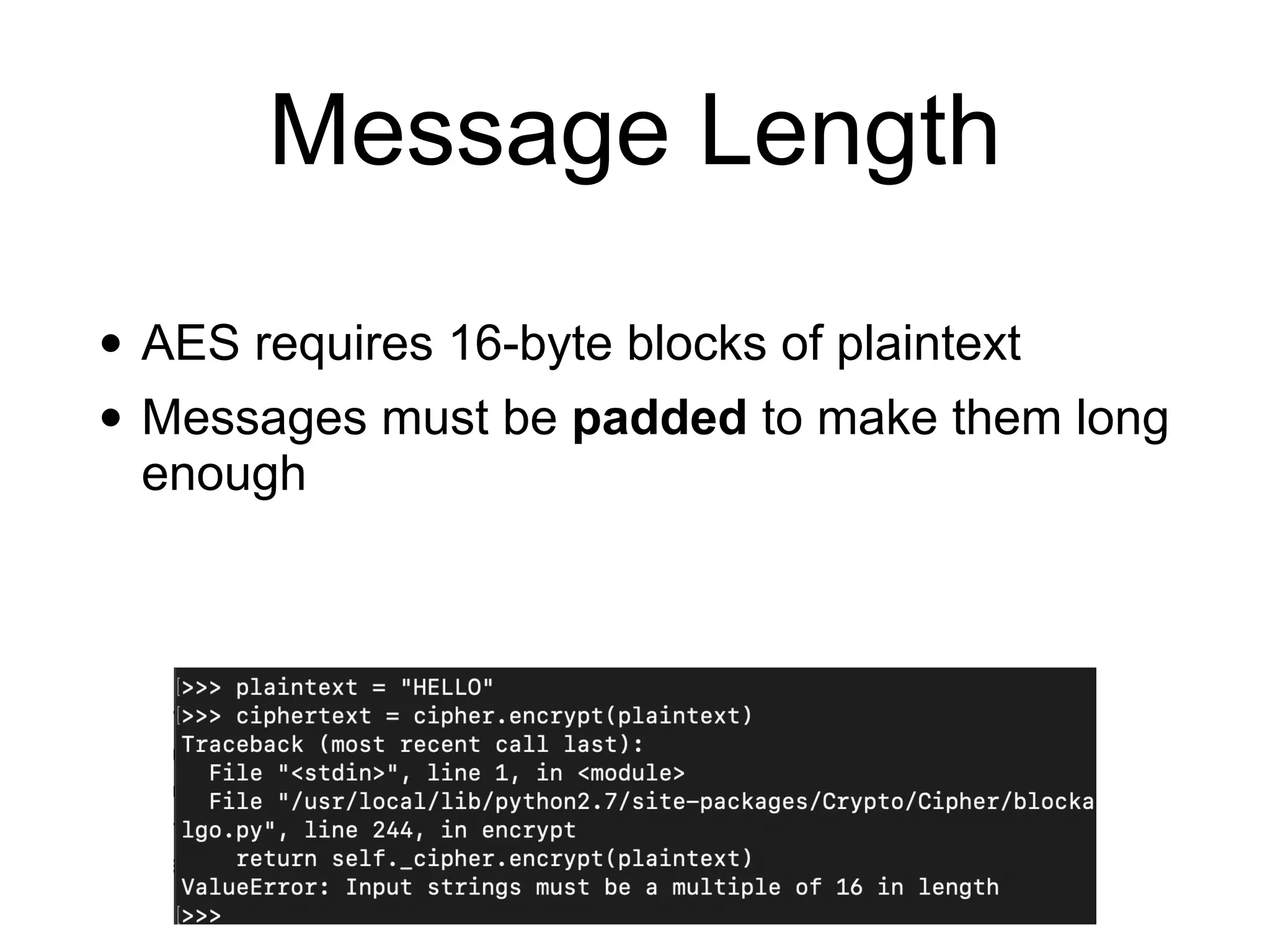
Message Length
• AES requires 16-byte blocks of plaintext


• Messages must be padded to make them long
enough
PKCS#7 Padding
• The last byte of the plaintext is always
between 'x00' and '10'


• Discard that many bytes to get original
plaintext
Padding Oracle Attack
• Almost everything uses PKCS#7 padding


• But if the system displays a "Padding Error"
message the whole system shatters like glass


• That message is sufficient side-channel
information to allow an attacker to forge
messages without the key
Ciphertext Stealing
• An alternative to padding


• Prevents padding oracle attacks


• Pad with zeroes


• Swap last two blocks of ciphertext


• Discard extra bytes at the end


• Images on next slides from Wikipedia
Ciphertext Stealing
Security of Ciphertext
Stealing
• No major problems


• Inelegant and difficult to get right


• NIST SP 800-38A specifies three different
ways to implement it


• Rarely used
Counter (CTR) Mode
• Produces a pseudorandom byte stream


• XOR with plaintext to encrypt
Nonce
• Nonce (N) used to produce C1, C2, C3, etc.


• C1 = N ^ 1


• C2 = N ^ 2


• C3 = N ^ 3


• etc.


• Use a different N for each message


• N is not secret, sent in the clear
Nonce Must not be
Reused
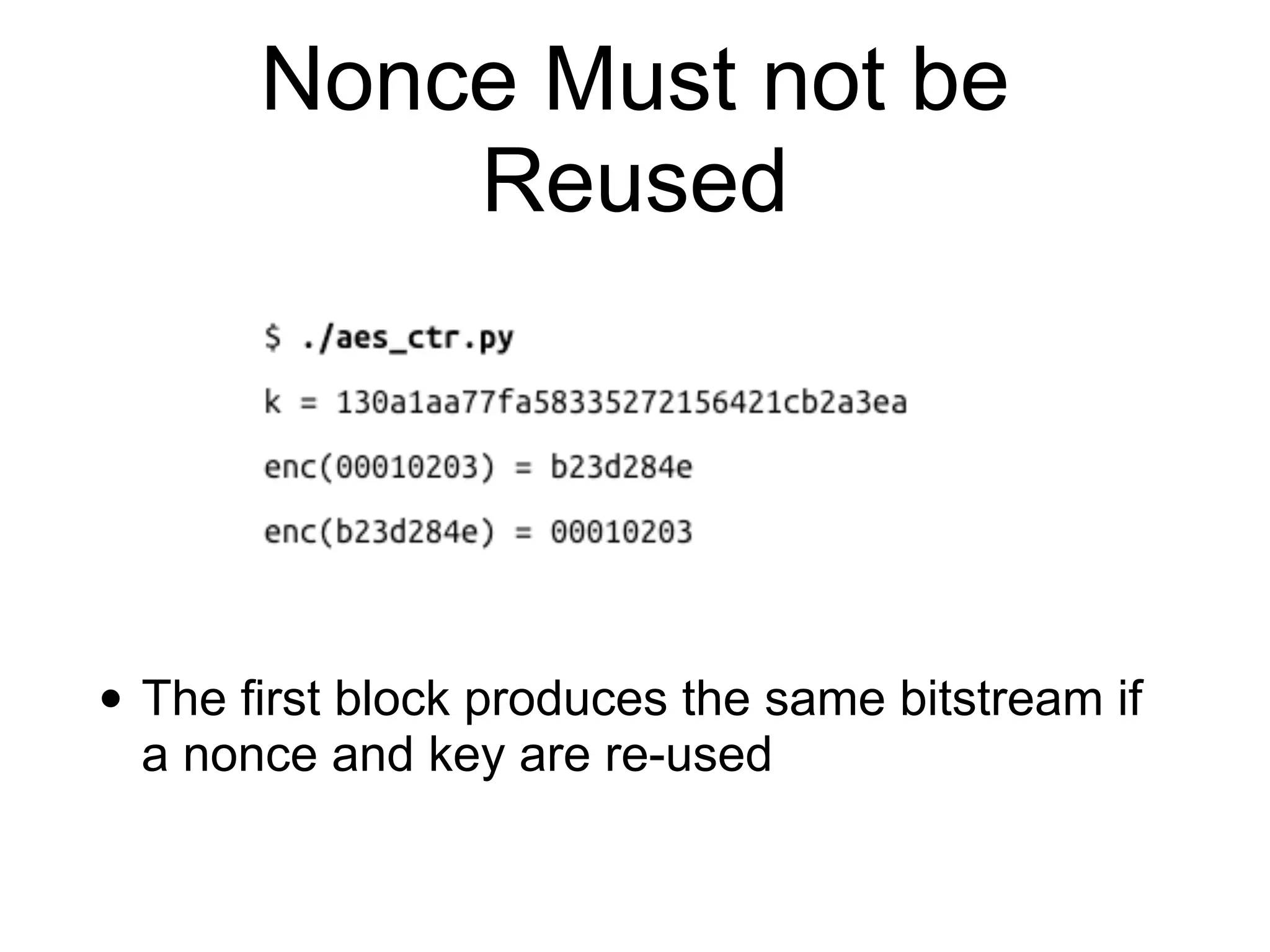
• The first block produces the same bitstream if
a nonce and key are re-used
No Padding
• CTR mode uses a block cipher to produce a
pseudorandom byte stream


• Creates a stream cipher


• Message can have any length


• No padding required
Parallelizing
• CTR is faster than any other mode


• Stream can be computed in advance, and in
parallel


• Before even knowing the plaintext
How Things Can Go
Wrong
Two Attacks
• Meet-in-the-middle


• Padding oracle
Meet-in-the-Middle Attacks
• 3DES does three rounds of DES


• Why not 2DES?
Attacking 2DES
• Two 56-bit keys, total 112 bits


• End-to-end brute force would take 2^112
calculations
Attacking 2DES
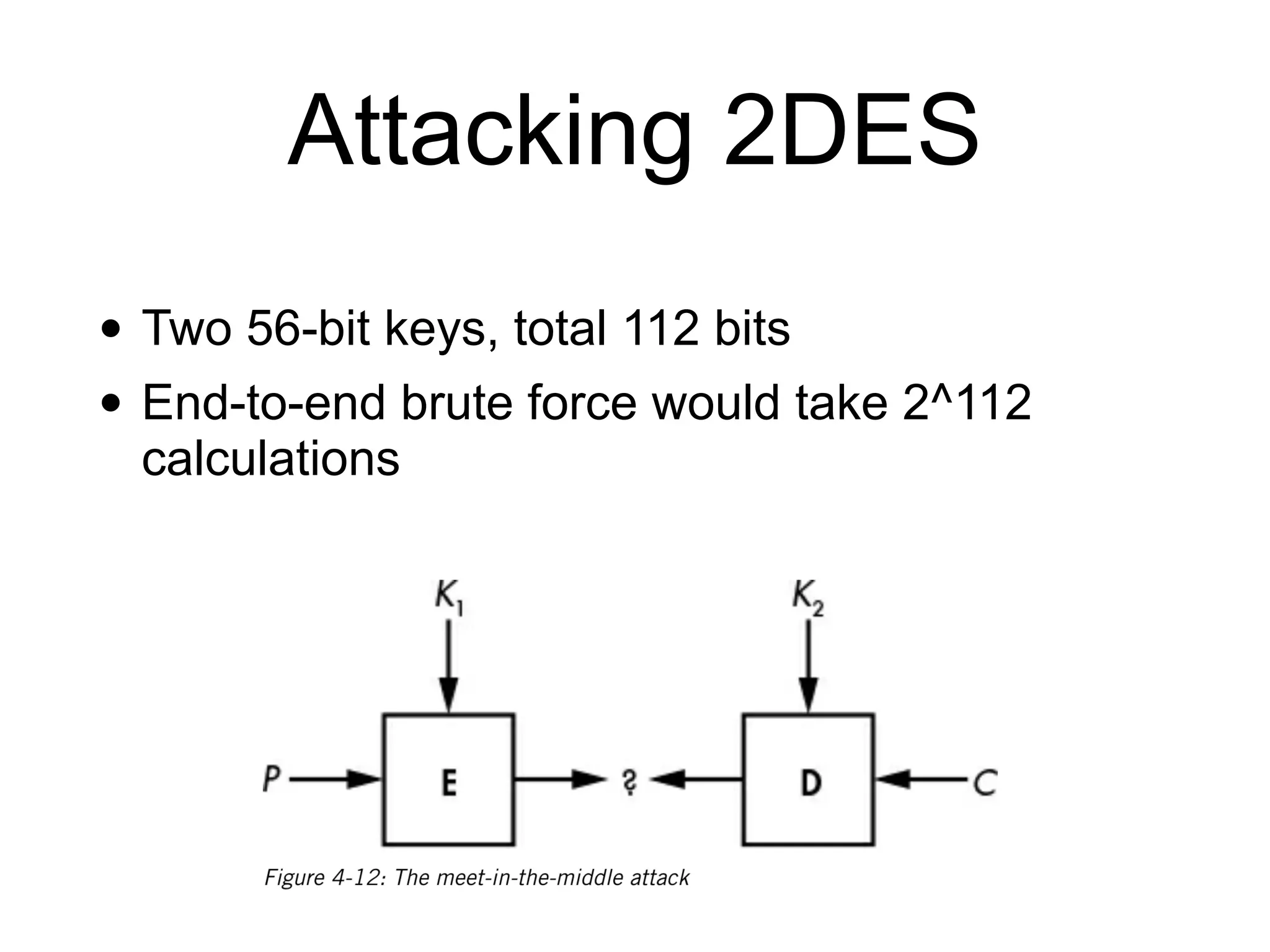
• Attacker inputs known P and gets C


• Wants to find K1, K2
Attacking 2DES
• Make a list of E(K1, P) for all 2^56 values of K1


• Make a list of D(K2, P) for all 2^56 values of K2


• Find the item with the same values in each list


• This finds K1 and K2 with 2^57 computations
Meet-in-the-Middle Attack
on 3DES
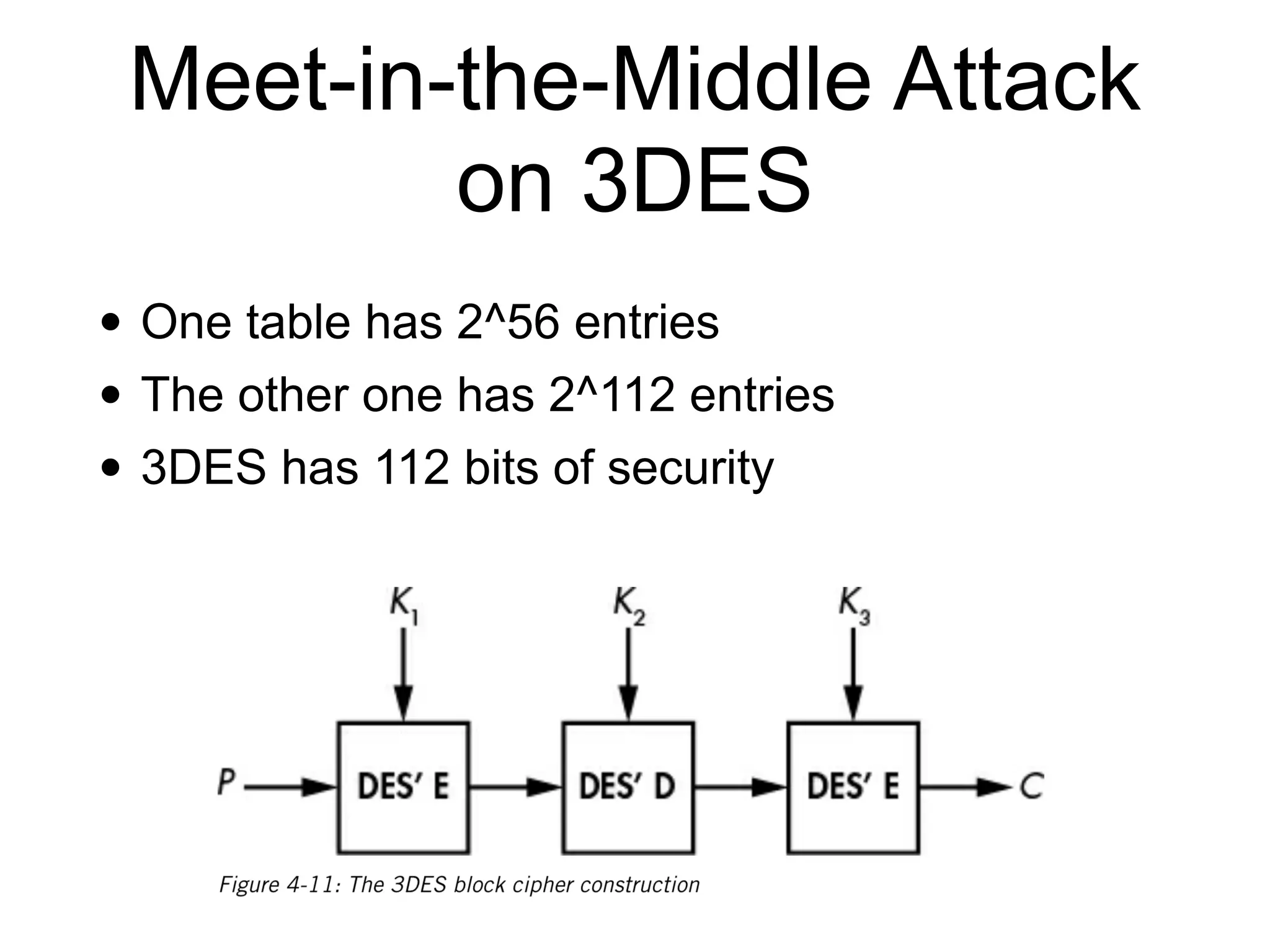
• One table has 2^56 entries


• The other one has 2^112 entries


• 3DES has 112 bits of security
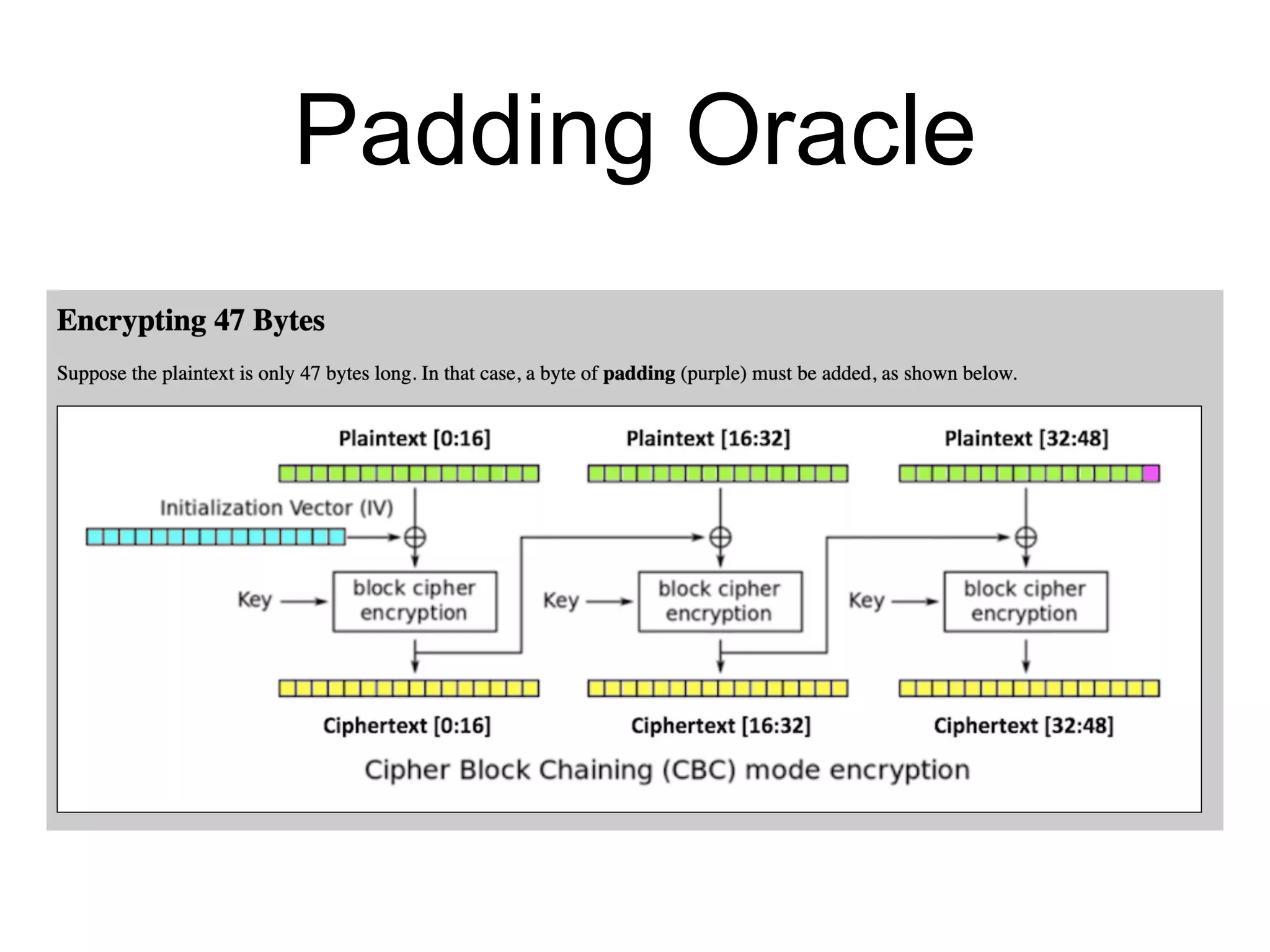
Padding Oracle
Padding Oracle
Padding Oracle
• Change the last byte in second block


• This changes the 17 bytes shown in red
Padding Oracle
• Try all 256 values of last byte in second block


• One of them has valid padding of 'x01'


• This determines the orange byte
Padding Oracle
• Continue, 256 guesses finds the next orange
byte
Padding Oracle
• Once the orange bytes are known


• Attacker can forge plaintext[32:48] to say
anything
4b

4. Block Ciphers

  • 1.
    CNIT 141 Cryptography forComputer Networks 4. Block Ciphers Updated 9-14-2022
  • 2.
    Topics • What isa Block Cipher • How to Construct Block Ciphers • The Advanced Encryption Standard (AES) • Implementing AES • Modes of Operation • How Things Can Go Wrong
  • 3.
    History • US: Federalstandard: DES (1979 - 2005) • KGB: GOST 28147-89 (1990 - present) • in 2000, NIST selected AES, developed in Belgium • They are all block ciphers
  • 4.
    What is aBlock Cipher
  • 5.
    Block Cipher E Encryptionalgorithm K Key P Plaintext block C Ciphertext block C = E(K, P) D Decryption algorithm P = D(K, C)
  • 6.
    Security Goals • Blockcipher should be a pseudorandom permutation (PRP) • Attacker can't compute output without the key • Attackers should be unable to find patterns in the inputs/output values • The ciphertext should appear random
  • 7.
    Block Size • DES:64 bit • AES: 128 bit • Chosen to fit into registers of CPUs for speed • Block sizes below 64 are vulnerable to a codebook attack
  • 8.
    Codebook Attack • Supposeyou can encrypt arbitrary plaintext, such as in a Wi-Fi network, but you don't know the key • Encrypt every possible plaintext, place in a codebook • Look up blocks of ciphertext in the codebook
  • 9.
    Codebook Attack • Thecodebook size depends on the block size • Blocksize of 32 bits requires 2^32 entries • 4 billion, easily achieved • Blocksize of 64 bits requires 2^64 entries • Impossible to achieve • So blocksize should be 64 or larger
  • 10.
    How to ConstructBlock Ciphers
  • 11.
  • 12.
    Rounds • R isa round --in practice, a simple transformation • A block cipher with three rounds: • C = R3(R2(R1(P))) • iR is the inverse round function • I = iR1(iR2(iR3(C)))
  • 13.
    Round Key • Theround functions R1 R2 R3 use the same algorithm • But a different round key • Round keys are K1, K2, K3, ... derived from the main key K using a key schedule
  • 14.
    The Slide Attackand Round Keys • Consider a block cipher with three rounds, and with all the round keys identical
  • 15.
    The Slide Attackand Round Keys • If an attacker can find plaintext blocks with 
 P2 = R(P1) • That implies C2 = R(C1) • Which often helps to deduce the key
  • 16.
    The Slide Attackand Round Keys • The solution is to make all round keys different • Note: the key schedule in AES is not one-way • Attacker can compute K from any Ki • This exposes it to side-channel attacks, like measuring electromagnetic emanations
  • 17.
    Substitution-Permutation Networks • Confusion meansthat each ciphertext bit depends on several key bits • Provided by substitution using S-boxes • Diffusion means that changing a bit of plaintext changes many bits in the ciphertext • Provided by permutation
  • 18.
    Feistel Schemes • Onlyhalf the plaintext is encrypted in each round • By the F substitution- permutation function • Halves are swapped in each round • DES uses 16 Feistel rounds
  • 19.
  • 20.
  • 21.
    DES • DES hada 56-bit key • Cracked by brute force in 1997 • 3DES was a stronger version • Still considered strong, but slower than AES • AES approved as the NIST standard in 2000
  • 22.
  • 26.
    AES in Python3 from Crypto.Cipher import AE S key = b"0000111122223333 " cipher = AES.new(key, AES.MODE_ECB ) a = b"Hello from AES!! " ciphertext = cipher.encrypt(a ) print(ciphertext.hex() ) cipher = AES.new(key, AES.MODE_ECB ) d = cipher.decrypt(ciphertext ) print(d)
  • 27.
  • 28.
    Improving Efficiency • Implementingeach step as a separate function works, but it's slow • Combining them with "table-based implementations" and "native instructions" is faster • Using XORs and table lookups
  • 29.
  • 30.
    Timing Attacks • Thetime required for encryption depends on the key • Measuring timing leaks information about the key • This is a problem with any efficient coding • You could use slow code that wastes time • A better solution relies on hardware
  • 31.
    Native Instructions • AES-NI •Processor provides dedicated assembly instructions that perform AES • Plaintext in register xmm0 • Round keys in xmm5 to xmm15 • NI makes AES ten times faster
  • 32.
    Is AES Secure? •AES implements many good design principles • Proven to resist many classes of cryptoanalytic attacks • But no one can foresee all possible future attacks • So far, no significant weakness in AES-128 has been found
  • 33.
  • 34.
    Electronic Code Book (ECB) •Each plaintext block is encrypted the same way • Identical plaintext blocks produce identical ciphertext blocks
  • 35.
    AES-ECB • If plaintextrepeats, so does ciphertext plaintext = b"DEAD MEN TELL NODEAD MEN TELL NO" ciphertext = cipher.encrypt(plaintext) ciphertext.hex()
  • 36.
  • 37.
  • 38.
    ECB Mode • Encryptedimage retains large blocks of solid color
  • 39.
    Cipher Block Chaining(CBC) • Uses a key and an initialization vector (IV) • Output of one block is the IV for the next block • IV is not secret; sent in the clear
  • 40.
    CBC Mode • Encryptedimage shows no patterns
  • 41.
    Choosing IV • Ifthe same IV is used every time • The first block is always encrypted the same way • Messages with the same first plaintext block will have identical first ciphertext blocks
  • 42.
    Parallelism • ECB canbe computed in parallel • Each block is independent • CBC requires serial processing • Output of each block used to encrypt the next block
  • 43.
    Message Length • AESrequires 16-byte blocks of plaintext • Messages must be padded to make them long enough
  • 44.
    PKCS#7 Padding • Thelast byte of the plaintext is always between 'x00' and '10' • Discard that many bytes to get original plaintext
  • 45.
    Padding Oracle Attack •Almost everything uses PKCS#7 padding • But if the system displays a "Padding Error" message the whole system shatters like glass • That message is sufficient side-channel information to allow an attacker to forge messages without the key
  • 46.
    Ciphertext Stealing • Analternative to padding • Prevents padding oracle attacks • Pad with zeroes • Swap last two blocks of ciphertext • Discard extra bytes at the end • Images on next slides from Wikipedia
  • 47.
  • 48.
    Security of Ciphertext Stealing •No major problems • Inelegant and difficult to get right • NIST SP 800-38A specifies three different ways to implement it • Rarely used
  • 49.
    Counter (CTR) Mode •Produces a pseudorandom byte stream • XOR with plaintext to encrypt
  • 50.
    Nonce • Nonce (N)used to produce C1, C2, C3, etc. • C1 = N ^ 1 • C2 = N ^ 2 • C3 = N ^ 3 • etc. • Use a different N for each message • N is not secret, sent in the clear
  • 51.
    Nonce Must notbe Reused • The first block produces the same bitstream if a nonce and key are re-used
  • 52.
    No Padding • CTRmode uses a block cipher to produce a pseudorandom byte stream • Creates a stream cipher • Message can have any length • No padding required
  • 53.
    Parallelizing • CTR isfaster than any other mode • Stream can be computed in advance, and in parallel • Before even knowing the plaintext
  • 54.
  • 55.
  • 56.
    Meet-in-the-Middle Attacks • 3DESdoes three rounds of DES • Why not 2DES?
  • 57.
    Attacking 2DES • Two56-bit keys, total 112 bits • End-to-end brute force would take 2^112 calculations
  • 58.
    Attacking 2DES • Attackerinputs known P and gets C • Wants to find K1, K2
  • 59.
    Attacking 2DES • Makea list of E(K1, P) for all 2^56 values of K1 • Make a list of D(K2, P) for all 2^56 values of K2 • Find the item with the same values in each list • This finds K1 and K2 with 2^57 computations
  • 60.
    Meet-in-the-Middle Attack on 3DES •One table has 2^56 entries • The other one has 2^112 entries • 3DES has 112 bits of security
  • 61.
  • 62.
  • 63.
    Padding Oracle • Changethe last byte in second block • This changes the 17 bytes shown in red
  • 64.
    Padding Oracle • Tryall 256 values of last byte in second block • One of them has valid padding of 'x01' • This determines the orange byte
  • 65.
    Padding Oracle • Continue,256 guesses finds the next orange byte
  • 66.
    Padding Oracle • Oncethe orange bytes are known • Attacker can forge plaintext[32:48] to say anything
  • 67.