CS8792 – Cryptography and Network
Security
Unit III - Key Management and
Distribution
~ S. Janani, AP/CSE, KCET
Key Management and Distribution
No Singhalese, whether man or woman, would venture out
of the house without a bunch of keys in his hand, for
without such a talisman he would fear that some devil
might take advantage of his weak state to slip into his
body.
—The Golden Bough, Sir James George Frazer
Introduction
 topics of cryptographic key management / key distribution
are complex
 cryptographic, protocol & management issues
 symmetric schemes require both parties to share a
common secret key
 public key schemes require parties to acquire valid public
keys
 have concerns with doing both
Contents
 symmetric key distribution using symmetric encryption
 symmetric key distribution using public-key encryption
 distribution of public keys
• announcement, directory, authority, CA
 X.509 authentication and certificates
 public key infrastructure (PKIX)
Key Distribution
Key Distribution
 symmetric schemes require both parties to share a
common secret key
 issue is how to securely distribute this key
 whilst protecting it from others
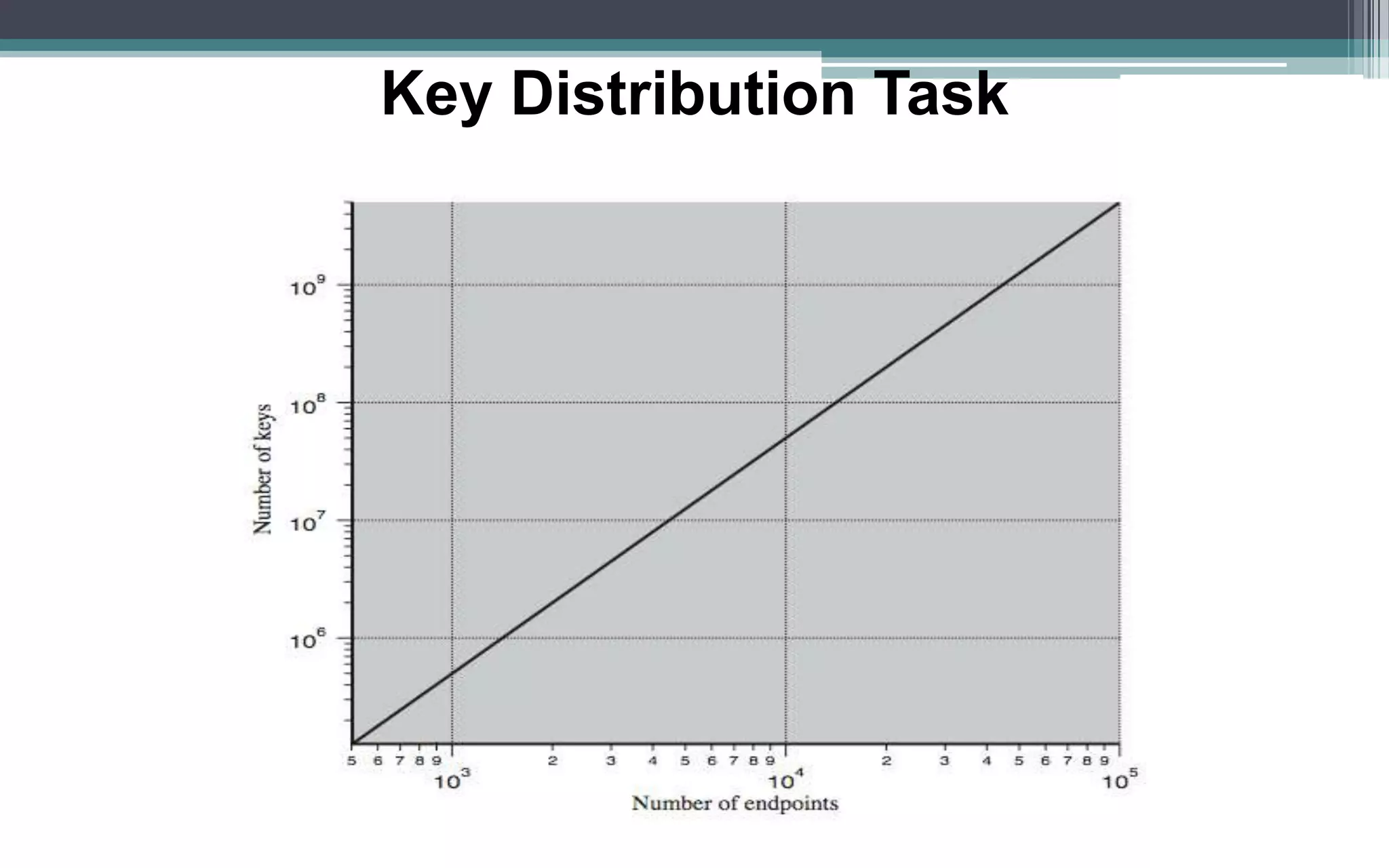
 frequent key changes can be desirable
 often secure system failure due to a break in the key
distribution scheme
Key Distribution
 given parties A and B have various key distribution
alternatives:
• A can select key and physically deliver to B
• third party can select & deliver key to A & B
• if A & B have communicated previously can use
previous key to encrypt a new key
• if A & B have secure communications with a third
party C, C can relay key between A & B
Key Distribution Task
Key Hierarchy
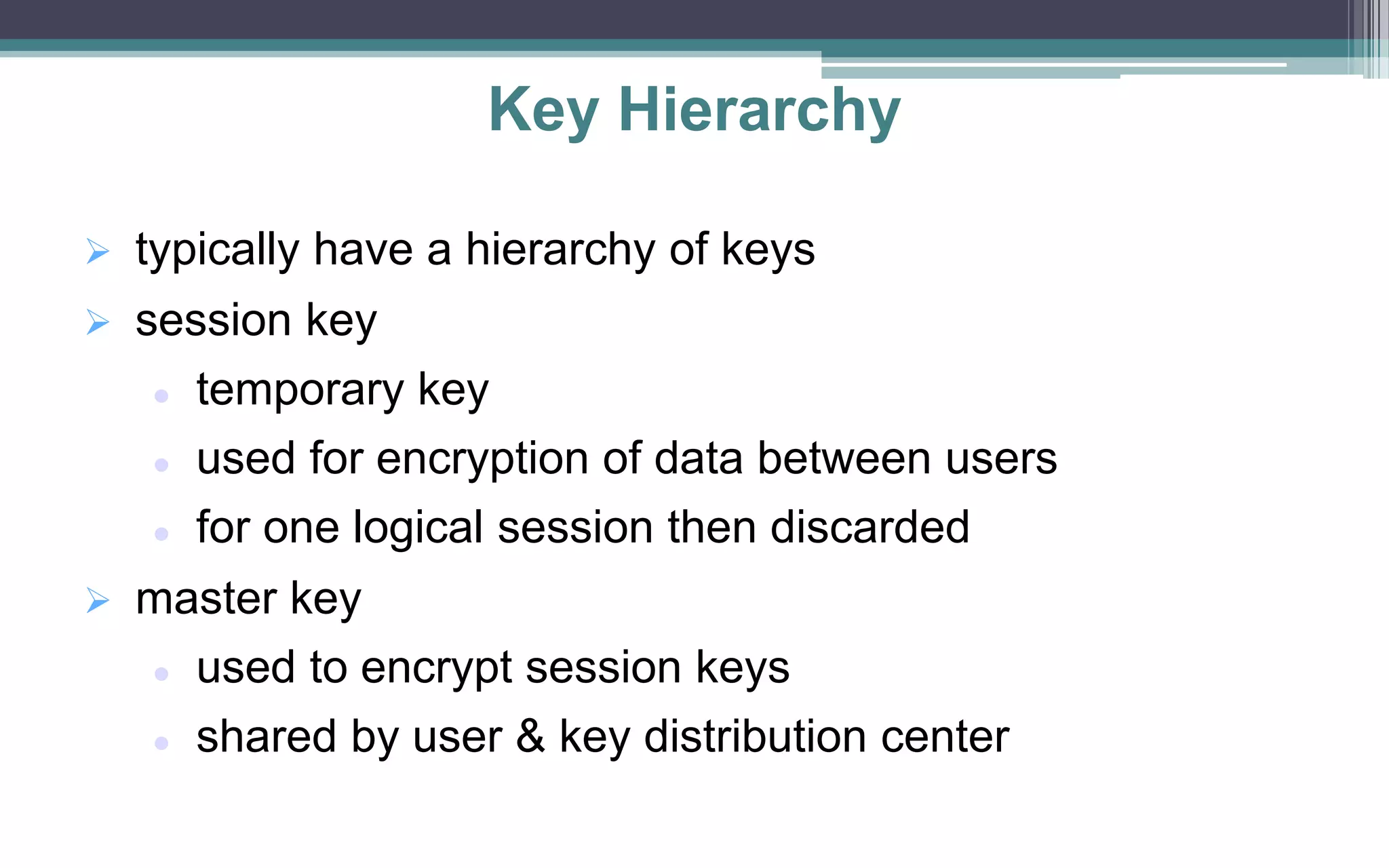
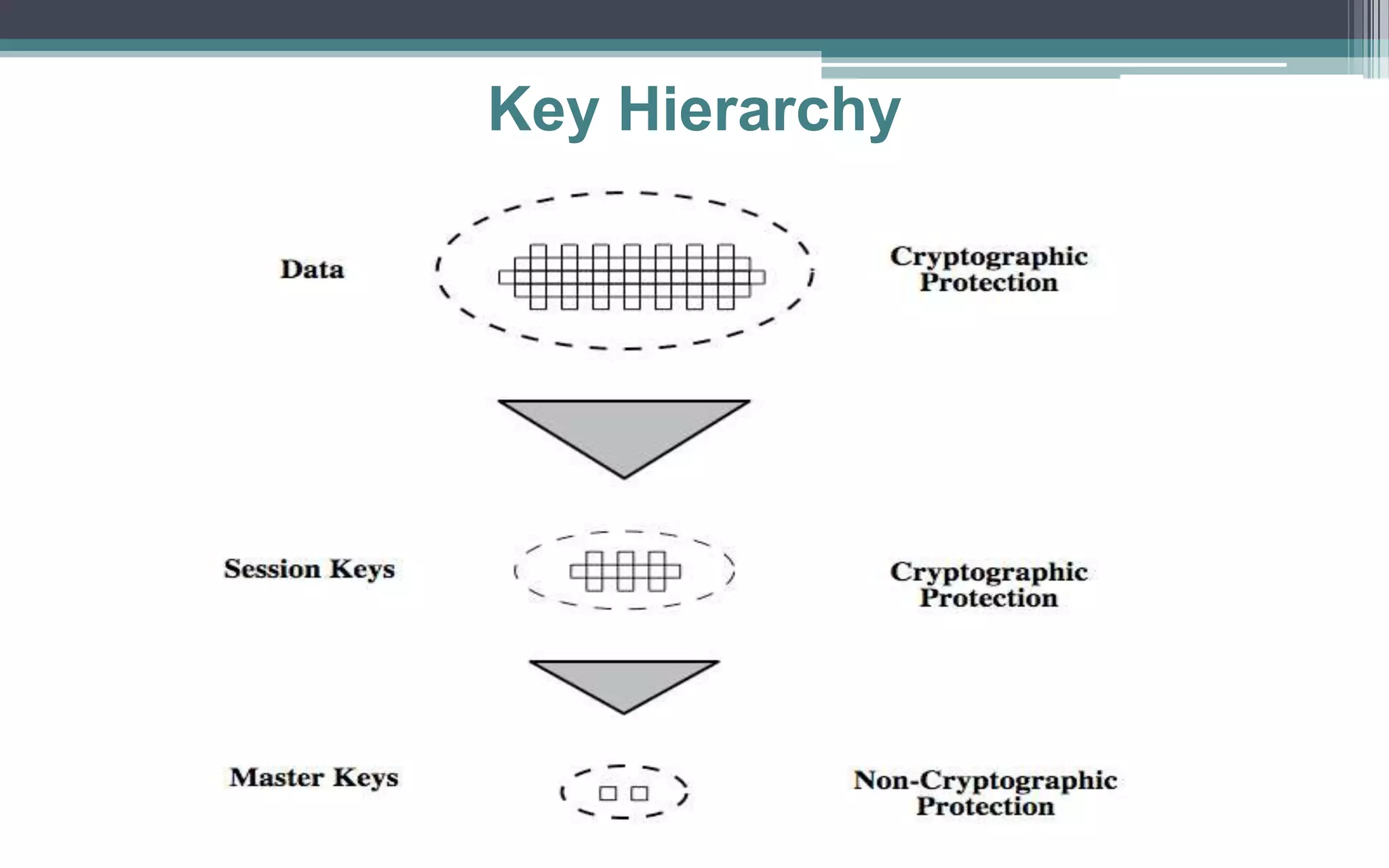
 typically have a hierarchy of keys
 session key
 temporary key
 used for encryption of data between users
 for one logical session then discarded
 master key
 used to encrypt session keys
 shared by user & key distribution center
Key Hierarchy
Key Distribution Scenario
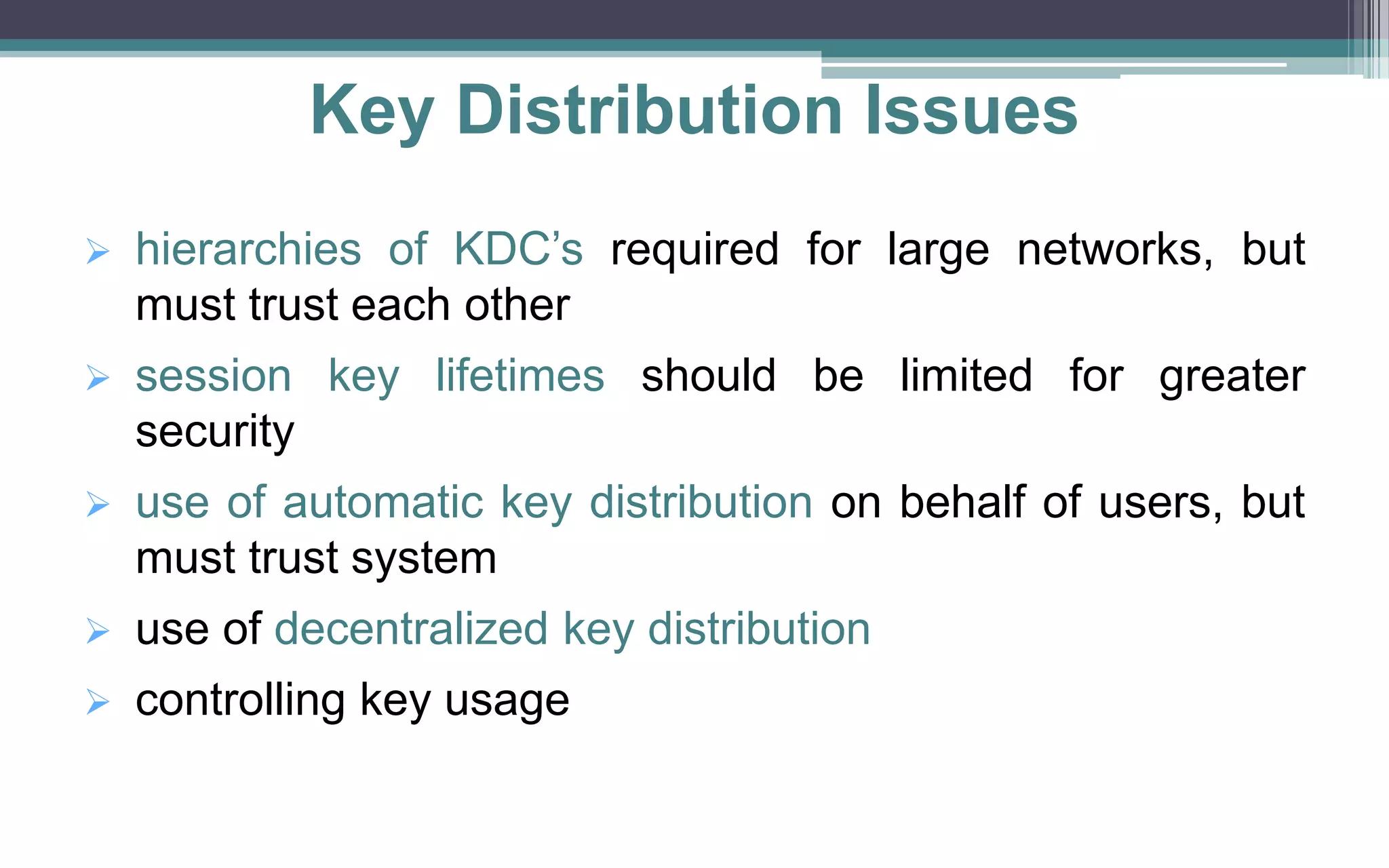
Key Distribution Issues
 hierarchies of KDC’s required for large networks, but
must trust each other
 session key lifetimes should be limited for greater
security
 use of automatic key distribution on behalf of users, but
must trust system
 use of decentralized key distribution
 controlling key usage
Symmetric Key Distribution Using Public Keys
 public key cryptosystems are inefficient
 so almost never use for direct data encryption
 rather use to encrypt secret keys for distribution
Simple Secret Key Distribution
 Merkle proposed this very simple scheme
 allows secure communications
 no keys before/after exist
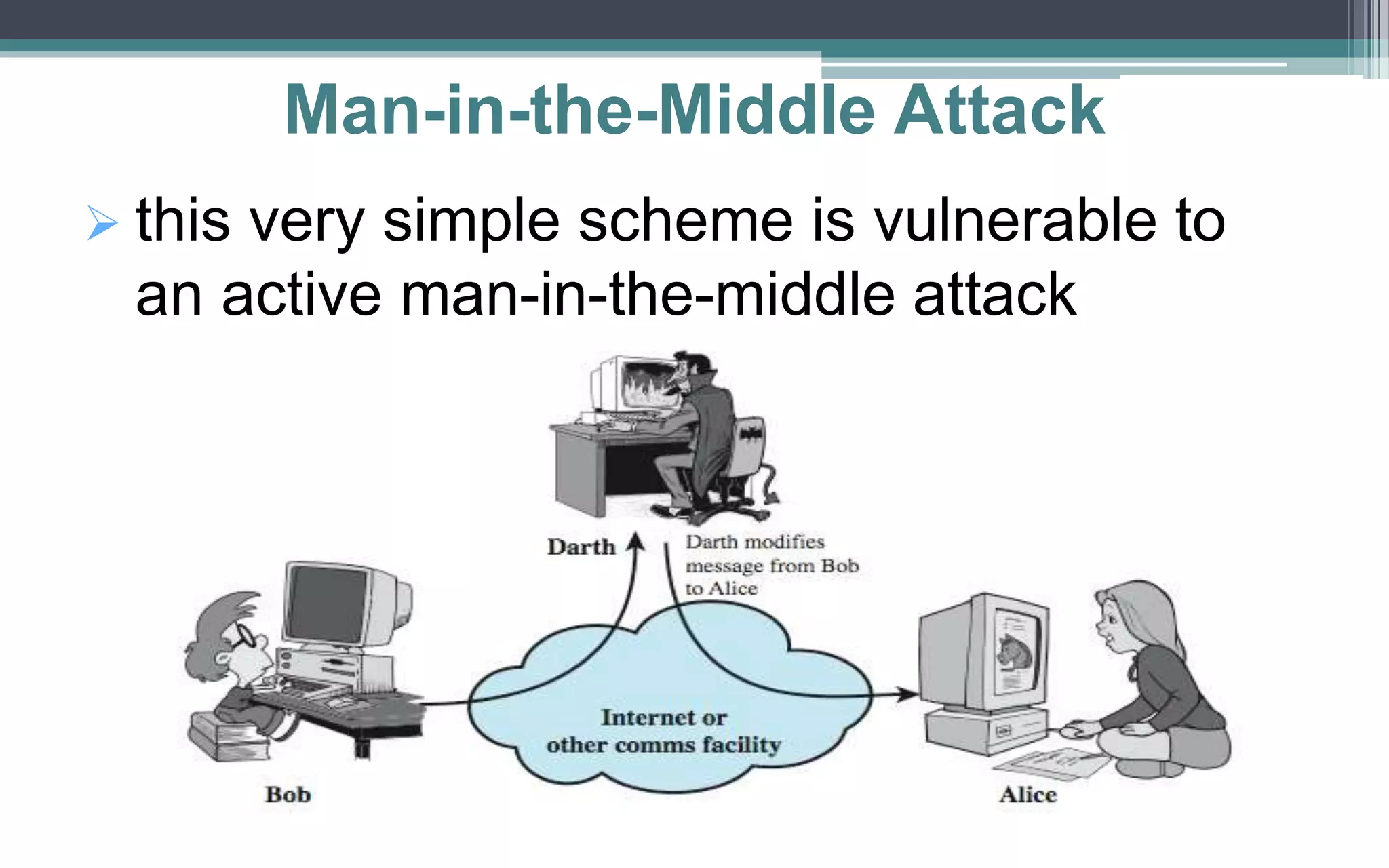
Man-in-the-Middle Attack
 this very simple scheme is vulnerable to
an active man-in-the-middle attack
Distribution of Public Keys
 can be considered as using one of:
 public announcement
 publicly available directory
 public-key authority
 public-key certificates
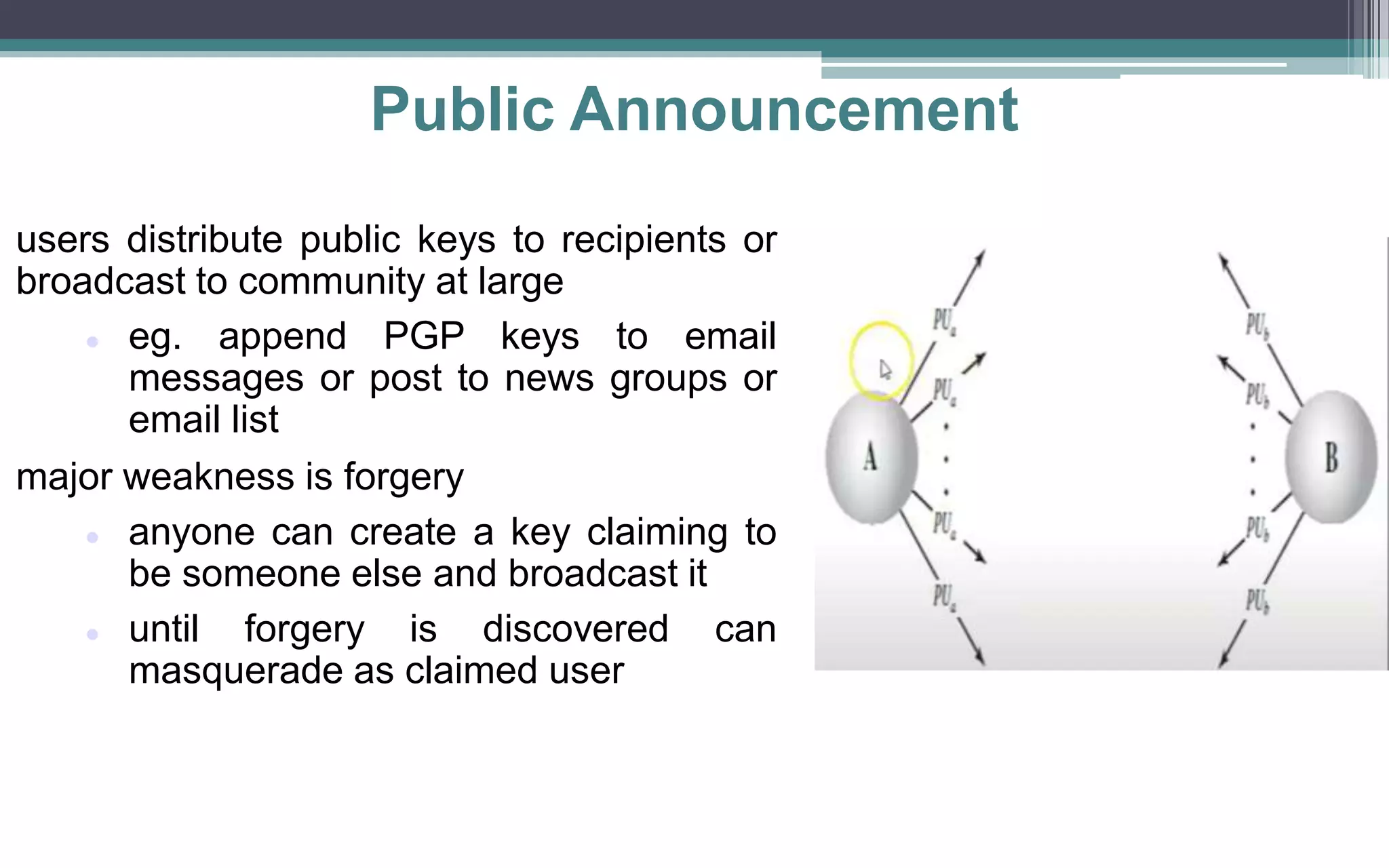
Public Announcement
users distribute public keys to recipients or
broadcast to community at large
 eg. append PGP keys to email
messages or post to news groups or
email list
major weakness is forgery
 anyone can create a key claiming to
be someone else and broadcast it
 until forgery is discovered can
masquerade as claimed user
Publicly Available Directory
 can obtain greater security by registering
keys with a public directory
 directory must be trusted with properties:
 contains {name,public-key} entries
 participants register securely with
directory
 participants can replace key at any
time
 directory is periodically published
 directory can be accessed
electronically
 still vulnerable to tampering or forgery
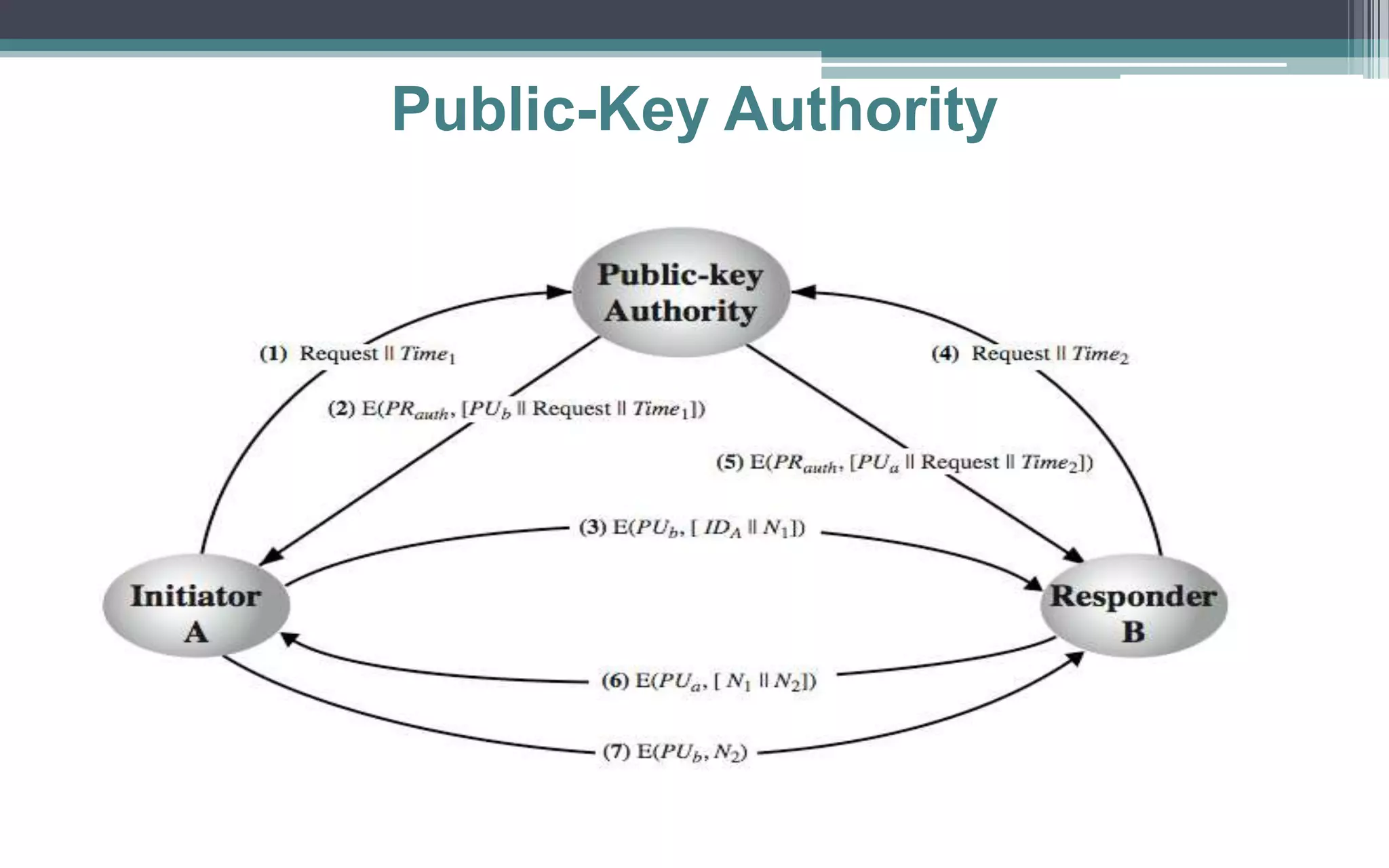
Public-Key Authority
 improve security by tightening control over distribution of keys
from directory
 has properties of directory
 and requires users to know public key for the directory
 then users interact with directory to obtain any desired public key
securely
 does require real-time access to directory when keys are
needed
 may be vulnerable to tampering
Public-Key Authority
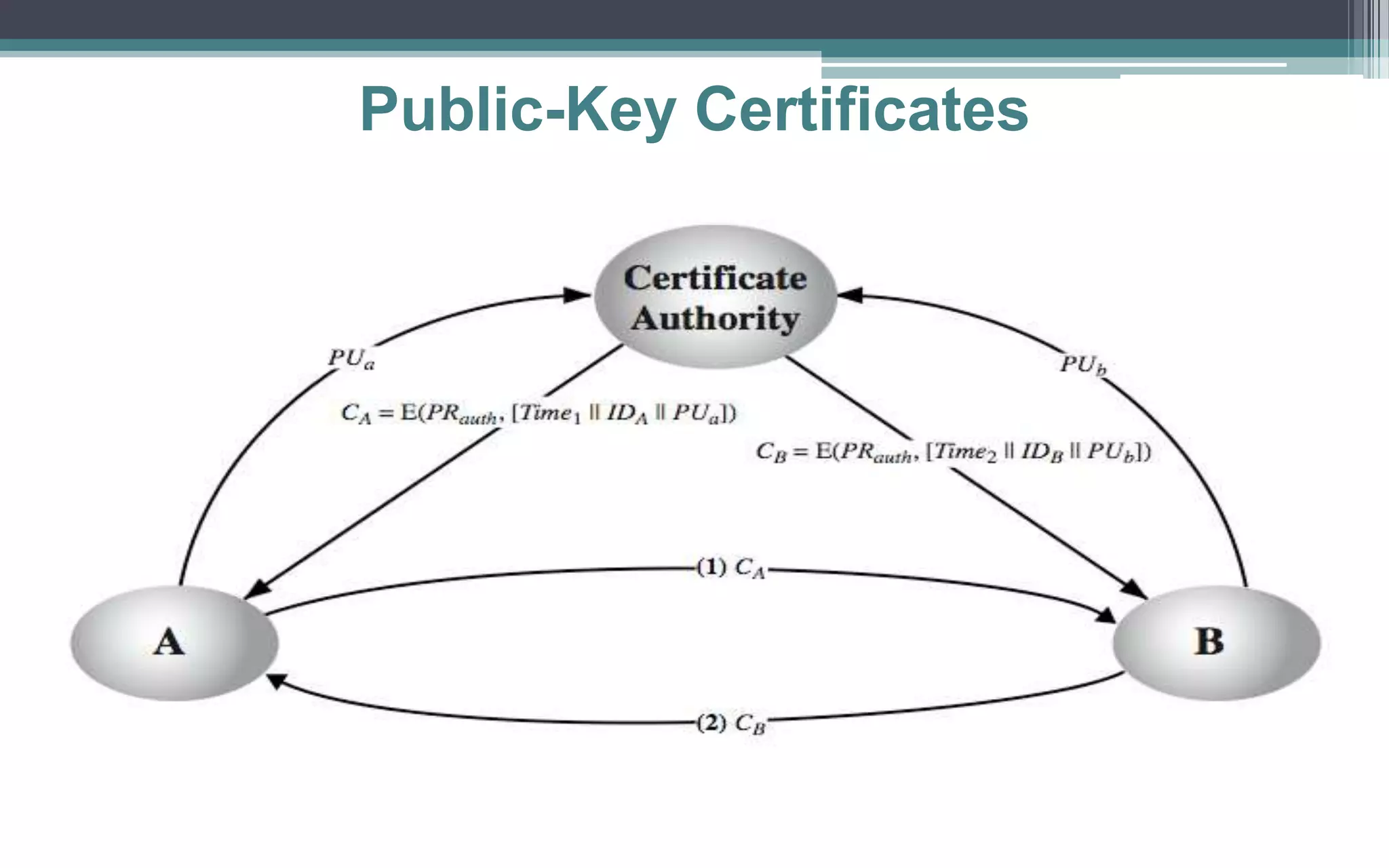
Public-Key Certificates
 certificates allow key exchange without real-time access to public-
key authority
 a certificate binds identity to public key
 usually with other info such as period of validity, rights of use etc
 with all contents signed by a trusted Public-Key or Certificate
Authority (CA)
 can be verified by anyone who knows the public-key authorities
public-key
Public-Key Certificates
Summary
 have considered:
 symmetric key distribution using symmetric encryption
 symmetric key distribution using public-key encryption
 distribution of public keys
• announcement, directory, authrority, CA

Key management.ppt

  • 1.
    CS8792 – Cryptographyand Network Security Unit III - Key Management and Distribution ~ S. Janani, AP/CSE, KCET
  • 2.
    Key Management andDistribution No Singhalese, whether man or woman, would venture out of the house without a bunch of keys in his hand, for without such a talisman he would fear that some devil might take advantage of his weak state to slip into his body. —The Golden Bough, Sir James George Frazer
  • 3.
    Introduction  topics ofcryptographic key management / key distribution are complex  cryptographic, protocol & management issues  symmetric schemes require both parties to share a common secret key  public key schemes require parties to acquire valid public keys  have concerns with doing both
  • 4.
    Contents  symmetric keydistribution using symmetric encryption  symmetric key distribution using public-key encryption  distribution of public keys • announcement, directory, authority, CA  X.509 authentication and certificates  public key infrastructure (PKIX)
  • 5.
  • 6.
    Key Distribution  symmetricschemes require both parties to share a common secret key  issue is how to securely distribute this key  whilst protecting it from others  frequent key changes can be desirable  often secure system failure due to a break in the key distribution scheme
  • 7.
    Key Distribution  givenparties A and B have various key distribution alternatives: • A can select key and physically deliver to B • third party can select & deliver key to A & B • if A & B have communicated previously can use previous key to encrypt a new key • if A & B have secure communications with a third party C, C can relay key between A & B
  • 8.
  • 9.
    Key Hierarchy  typicallyhave a hierarchy of keys  session key  temporary key  used for encryption of data between users  for one logical session then discarded  master key  used to encrypt session keys  shared by user & key distribution center
  • 10.
  • 11.
  • 12.
    Key Distribution Issues hierarchies of KDC’s required for large networks, but must trust each other  session key lifetimes should be limited for greater security  use of automatic key distribution on behalf of users, but must trust system  use of decentralized key distribution  controlling key usage
  • 13.
    Symmetric Key DistributionUsing Public Keys  public key cryptosystems are inefficient  so almost never use for direct data encryption  rather use to encrypt secret keys for distribution
  • 14.
    Simple Secret KeyDistribution  Merkle proposed this very simple scheme  allows secure communications  no keys before/after exist
  • 15.
    Man-in-the-Middle Attack  thisvery simple scheme is vulnerable to an active man-in-the-middle attack
  • 16.
    Distribution of PublicKeys  can be considered as using one of:  public announcement  publicly available directory  public-key authority  public-key certificates
  • 17.
    Public Announcement users distributepublic keys to recipients or broadcast to community at large  eg. append PGP keys to email messages or post to news groups or email list major weakness is forgery  anyone can create a key claiming to be someone else and broadcast it  until forgery is discovered can masquerade as claimed user
  • 18.
    Publicly Available Directory can obtain greater security by registering keys with a public directory  directory must be trusted with properties:  contains {name,public-key} entries  participants register securely with directory  participants can replace key at any time  directory is periodically published  directory can be accessed electronically  still vulnerable to tampering or forgery
  • 19.
    Public-Key Authority  improvesecurity by tightening control over distribution of keys from directory  has properties of directory  and requires users to know public key for the directory  then users interact with directory to obtain any desired public key securely  does require real-time access to directory when keys are needed  may be vulnerable to tampering
  • 20.
  • 21.
    Public-Key Certificates  certificatesallow key exchange without real-time access to public- key authority  a certificate binds identity to public key  usually with other info such as period of validity, rights of use etc  with all contents signed by a trusted Public-Key or Certificate Authority (CA)  can be verified by anyone who knows the public-key authorities public-key
  • 22.
  • 23.
    Summary  have considered: symmetric key distribution using symmetric encryption  symmetric key distribution using public-key encryption  distribution of public keys • announcement, directory, authrority, CA