Survey Research
(Special emphasis on Questionnaire)


      Naveed Iqbal Ch.
Surveys
         (A Thumbnail Introduction)

 “ A type of research to collect the data
  and facts bout some certain situation or
  issue from the target population existing
  in surroundings having relevance to the
  nature of study.”
 “ Survey research is the research
  strategy to study the relationships and
  characteristics.”
 “surveys are based on the desire to
 collect information (usually by
 questionnaire) about a well defined
 issue or situation (hypothesis) from the
 well defined population”

 Surveys are method of data collection
 in which information is gathered
 through oral or written questioning”
 “Data collection through survey involves
  persuasion of respondents and then on
  some level social interaction between
  the respondents and the research
  interviewer”
 A team effort of many people having
  diverse skills.
 surveys are now used in all areas of life.
   For example business, politics,
  agriculture, industry, education, media
  etc.
Why surveys? (Purpose & Uses)
 To provide someone with information
  (to describe the situations).
 To explain the situations (analytical
  surveys).
 Problem identification & solving.
 To measure the change.
 To study attitudes, behavior and habits.
 To examine the cause-effect
  relationship.
 To study the characteristics.
 To formulate a hypothesis.
 To test a hypothesis.
 Decision making.
Types Of Surveys:
           Descriptive Survey
“A descriptive survey attempts to picture or
   document current conditions or attitudes
     that is, to describe what exists at the
                    moment”
Examples:
 Audience survey to determine the program
  taste.
 To study the changing values, life style by the
  effect of some special type of program.
Analytical Surveys

 “An analytical survey attempts to describe
  and explain WHY certain situations exist.
  Here we examine two, or more variable to
  test our research hypothesis”

Examples:
 How life-style effects the t.v. viewing habits.
 Impact of war games on teenagers.
Some more types…

 1- Factual surveys.
     (respondents act as reporters).
 2- Opinion surveys.
     (respondents expresses his view point
  opinion).
 3-Interpretative surveys.
     (interpretation )
    Example: Why do you read newspapers?
Steps in the Process of
      Survey Research
Step 1:-
 Develop Hypotheses.
 Decide on type of survey (mail,
  interview, telephone).
 Write survey questions.
 Decide on response categories.
 Design layout.
Step 2:-
 Plan how to record data.
 Pilot test survey instrument.
 Revise the instrument.
Step 3:-
 Decide on target population.
 Get sampling frame.
 Decide on sampling size.
 Select sample.
Step 4:-
 Locate respondents.
 Conduct interviews.
 Carefully record data.
Step 5 :-
 Enter data into computers.
 Recheck all data.
 Perform statistical analysis on data.
Step 6:-
 Describe methods and findings in
  research report.
 Present findings to others for critique
  and evaluation.
Three Methods of survey


     Mailed
     questionnaire.

     Personal interview.


     Telephone interview.
The Mailed Questionnaire

 It is one of the most
  important data collection
  survey method.

 Mail survey involves
  sending a cover letter and a
  questionnaire to a specific
  person.
Advantages
 Low cost.
 Reduction in biasing errors.
 Greater anonymity.
 Accessibility.
 Less time & trained staff.
Disadvantages
 Requires simple questions.
 No probing opportunity.
 No control over WHO fills?
 Low response rate.
Personal Interviews
Interviewing is a form of
questioning characterized
by the fact that it employs
verbal questioning.
Together with the
questionnaire , interviews
make up the survey
method, which is one of the
most popular technique of
data collection.
Advantages
 Flexibility in questioning.
 Control over the interview situation.
 High response rate.
 Collection of supplement data.
Disadvantages
 Higher cost.
 Interviewer bias.
 Respondent’s hesitation on sensitive
  topics.
 Greater staff requirement.
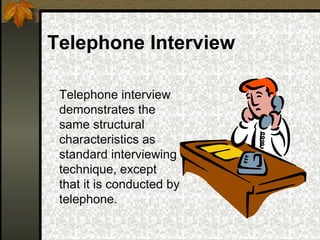
Telephone Interview

 Telephone interview
 demonstrates the
 same structural
 characteristics as
 standard interviewing
 technique, except
 that it is conducted by
 telephone.
Advantages
 Moderate cost.
 Less time consumption.
 Higher response rate.
 Quality ……(Supervision , Recording)
Disadvantages
 Hesitation to discuss sensitive topics.
 The “Broken-Off ”interviews.
 No supplement information.
Mailed Questionnaire
                   Introduction

    Mail survey involves sending a cover letter
    and a questionnaire to a specific person.

 The cover letter states the purpose sponsor
    instructions and time of return.

 The questionnaire---- totally self explanatory,
    clear and simple.
Advantages of Questionnaire
 Less expensive (no need of interviewers).
 Quick results.
 Less opportunity for bias and errors.
 Wide coverage
 Respondents may use personal records.
 Collection of data about sensitive topics.
 Less time consumption.
 High response rate.
Disadvantages

 Many factors effect on response rate
   Low education.
   Disliking to write.
   Disliking to read.
   No interest in the topic.
 No further explanations
 Lack of understanding of respondents.
 We receive minimum amount of in
    formations against open ended questions.
Disadvantages

 No probing and clarification.
 No identity of the respondent.(some
  one else can also fill).
 No supervision- partial responses.
When to design?
 1-The problem
      SOP
      PSM

 2-Literature review.
 3-Hypothesis (Variables, Operationalization)
 4-Literature review.
 5-Sampling.
 6-Questionnaire construction
Sampling
 “The process of choosing some
  representative members from the target
  population”

1- Probability Sampling.
2- Non-Probability Sampling.
Probability Sampling
 Simple random sampling.
 Systematic sampling.
 Cluster sampling.
 Stratified random sampling.
 Multi phase sampling.
 Multi stage sampling.
 Panel studies.
 Spatial sampling.
Non-Probability Sampling

 Accidental sampling.
 Purposive sampling.
 Quota sampling.
 Snow ball sampling
 Etc etc…
Structure of the Questionnaire

There are three main elements:
 The cover letter.
 The instructions.
 The main body.
The Cover Letter
    The cover letter must have the following
    details;

 The main objectives and social significance of
    the study;
   The research team and its sponsors;
   The reasons why the respondent should
    complete the questionnaire;
   Assurance of anonymity and confidentiality;
   Requirements for completion such as maximum
    time, conditions, etc;
   Issues related to ethics.
The Instructions
 How to fill the questionnaire?
 To remind the Ethics.
 To request the respondents not to
 please the researcher.
The Main Body
 It includes questions.
 Be careful with regard to;
 Content.
 Structure.
 Format.
 Wording.
 Flow.
Questionnaire Format
 It refers to the general model which
 provides guidelines on hoe the
 questions should be placed?

      Logical Order
      Transition and Flow
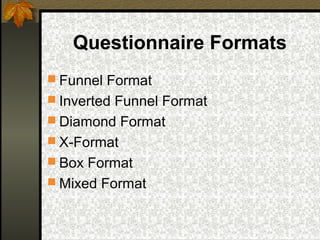
Questionnaire Formats
 Funnel Format
 Inverted Funnel Format
 Diamond Format
 X-Format
 Box Format
 Mixed Format
Steps in Questionnaire
          Construction
    The process of questionnaire construction
  goes through a number of interrelated steps
  as;

Step 1: Preparation:
 Decision for the most suitable type of
  questionnaire.
 Determine the way how it will be managed?
 Literature Review.
 Proper Guidance from the Experts.
Step 2:
      Constructing the First Draft:

 Formulation of the material.
 Implementation of decided method of
  questionnaire.
 Secondary and tertiary questions.
Step 3: Self Critique:

Testing of ;
      Relevance
      Symmetry
      Clarity
      Simplicity
      Accordance with the basic rules.
Step 4: External Scrutiny:

 Expert’s inspection And suggestions.
 Addition….
 Deletion….
 Changing…
Step 5:
    Re-examination & Revision:

 After changing …Re-examination by
  the experts.
 Implementation of the final changes.
Step 6: Pre-testing:

 Selection of the small sample.
 Filling up of the questionnaire.
 Analysis of the data.
Step 7: Revision:

 Revision of the minor changes by the
  researcher himself.
 Revision of the major changes by the
  help of experts.
Step 8: Second Pre-test:

 Revised questionnaire filling.
 Data analysis.
 Adjustments & revision.
Step 9: Final Draft Formulation:

 Editorial work.
 Checking for spelling mistakes.
 Legibility.
 Instructions.
 Space for responses.
 Scaling issues
 General presentation.
Types of Questions
 Primary Questions
   Directly   related, as
        “Who is boss in your home?”


 Secondary Questions
   Provides    info on secondary issues
Types of Questions
 Tertiary Questions
   Padding Questions (Breather)
   Probes (Stimulating)
 Direct Questions
   Do   you believe in god?
 Indirect Questions
    Do u think that ppl of ur age and status
     believe in god?
Types of Questions
 Suggestive Questions


 Filter and contingency Questions


 Fixed alternative & Open ended
Response Format…should be

        Accurate
        Exhaustive
        Mutually Exclusive
        Uni-dimensional
Response Sets
 Numerical Responses
 Verbal Scale
 Increasing length scale
 Graphic responses
 Graphic-Numerical Responses
 Thermometer Scale
 Face Scale
Response Sets
 Ladder Scale
 Likert Scale
 Multiple Choice Options
 Semantic Differential Scale
 Ranking Scale
 Fill in the blanks
 Etc…..
Rules of Questionnaire
          Construction
 Well presented, easy to follow.
 Good response categories
 Clear instructions
 Space for answers
 Relevancy
 Ambiguity
 What not to ask?
 The language
Rules of Questionnaire
         Construction
 Logical progression
 Professional appearance
 Print and colors
 The size
 Ethics
Interviews
Types of Interviews
 Structured vs Non-structured
 Standardized vs Non-standardized
 Other vs self-administrated
 Unique vs Panel
 Hard vs Soft
 Personal vs non-personal
Types of Interviews
 Oral vs written
 Open vs guided
 Problem centered
 Clinical
 Biographical
Interview: The process
 Seeking respondents
 Asking & recording questions
 Field supervision and checks
 Completion and interpretation
The Interviewer’s Tasks
 Approaching the respondents
 Arranging
 Performing
 Controlling & recording
 Avoiding bias
 Establishing +ve relations.
Telephone Interviews

 Intro
 Questions
 Recording
 Ethics

Survey research

  • 1.
    Survey Research (Special emphasison Questionnaire) Naveed Iqbal Ch.
  • 2.
    Surveys (A Thumbnail Introduction)  “ A type of research to collect the data and facts bout some certain situation or issue from the target population existing in surroundings having relevance to the nature of study.”  “ Survey research is the research strategy to study the relationships and characteristics.”
  • 3.
     “surveys arebased on the desire to collect information (usually by questionnaire) about a well defined issue or situation (hypothesis) from the well defined population”  Surveys are method of data collection in which information is gathered through oral or written questioning”
  • 4.
     “Data collectionthrough survey involves persuasion of respondents and then on some level social interaction between the respondents and the research interviewer”  A team effort of many people having diverse skills.  surveys are now used in all areas of life. For example business, politics, agriculture, industry, education, media etc.
  • 5.
    Why surveys? (Purpose& Uses)  To provide someone with information (to describe the situations).  To explain the situations (analytical surveys).  Problem identification & solving.  To measure the change.  To study attitudes, behavior and habits.
  • 6.
     To examinethe cause-effect relationship.  To study the characteristics.  To formulate a hypothesis.  To test a hypothesis.  Decision making.
  • 7.
    Types Of Surveys: Descriptive Survey “A descriptive survey attempts to picture or document current conditions or attitudes that is, to describe what exists at the moment” Examples:  Audience survey to determine the program taste.  To study the changing values, life style by the effect of some special type of program.
  • 8.
    Analytical Surveys “Ananalytical survey attempts to describe and explain WHY certain situations exist. Here we examine two, or more variable to test our research hypothesis” Examples:  How life-style effects the t.v. viewing habits.  Impact of war games on teenagers.
  • 9.
    Some more types… 1- Factual surveys. (respondents act as reporters).  2- Opinion surveys. (respondents expresses his view point opinion).  3-Interpretative surveys. (interpretation ) Example: Why do you read newspapers?
  • 10.
    Steps in theProcess of Survey Research Step 1:-  Develop Hypotheses.  Decide on type of survey (mail, interview, telephone).  Write survey questions.  Decide on response categories.  Design layout.
  • 11.
    Step 2:-  Planhow to record data.  Pilot test survey instrument.  Revise the instrument.
  • 12.
    Step 3:-  Decideon target population.  Get sampling frame.  Decide on sampling size.  Select sample.
  • 13.
    Step 4:-  Locaterespondents.  Conduct interviews.  Carefully record data.
  • 14.
    Step 5 :- Enter data into computers.  Recheck all data.  Perform statistical analysis on data.
  • 15.
    Step 6:-  Describemethods and findings in research report.  Present findings to others for critique and evaluation.
  • 16.
    Three Methods ofsurvey  Mailed questionnaire.  Personal interview.  Telephone interview.
  • 17.
    The Mailed Questionnaire It is one of the most important data collection survey method.  Mail survey involves sending a cover letter and a questionnaire to a specific person.
  • 18.
    Advantages  Low cost. Reduction in biasing errors.  Greater anonymity.  Accessibility.  Less time & trained staff.
  • 19.
    Disadvantages  Requires simplequestions.  No probing opportunity.  No control over WHO fills?  Low response rate.
  • 20.
    Personal Interviews Interviewing isa form of questioning characterized by the fact that it employs verbal questioning. Together with the questionnaire , interviews make up the survey method, which is one of the most popular technique of data collection.
  • 21.
    Advantages  Flexibility inquestioning.  Control over the interview situation.  High response rate.  Collection of supplement data.
  • 22.
    Disadvantages  Higher cost. Interviewer bias.  Respondent’s hesitation on sensitive topics.  Greater staff requirement.
  • 23.
    Telephone Interview Telephoneinterview demonstrates the same structural characteristics as standard interviewing technique, except that it is conducted by telephone.
  • 24.
    Advantages  Moderate cost. Less time consumption.  Higher response rate.  Quality ……(Supervision , Recording)
  • 25.
    Disadvantages  Hesitation todiscuss sensitive topics.  The “Broken-Off ”interviews.  No supplement information.
  • 26.
    Mailed Questionnaire Introduction  Mail survey involves sending a cover letter and a questionnaire to a specific person.  The cover letter states the purpose sponsor instructions and time of return.  The questionnaire---- totally self explanatory, clear and simple.
  • 27.
    Advantages of Questionnaire Less expensive (no need of interviewers).  Quick results.  Less opportunity for bias and errors.  Wide coverage  Respondents may use personal records.  Collection of data about sensitive topics.  Less time consumption.  High response rate.
  • 28.
    Disadvantages  Many factorseffect on response rate  Low education.  Disliking to write.  Disliking to read.  No interest in the topic.  No further explanations  Lack of understanding of respondents.  We receive minimum amount of in formations against open ended questions.
  • 29.
    Disadvantages  No probingand clarification.  No identity of the respondent.(some one else can also fill).  No supervision- partial responses.
  • 30.
    When to design? 1-The problem SOP PSM 2-Literature review. 3-Hypothesis (Variables, Operationalization) 4-Literature review. 5-Sampling. 6-Questionnaire construction
  • 31.
    Sampling “The processof choosing some representative members from the target population” 1- Probability Sampling. 2- Non-Probability Sampling.
  • 32.
    Probability Sampling  Simplerandom sampling.  Systematic sampling.  Cluster sampling.  Stratified random sampling.  Multi phase sampling.  Multi stage sampling.  Panel studies.  Spatial sampling.
  • 33.
    Non-Probability Sampling  Accidentalsampling.  Purposive sampling.  Quota sampling.  Snow ball sampling  Etc etc…
  • 34.
    Structure of theQuestionnaire There are three main elements:  The cover letter.  The instructions.  The main body.
  • 35.
    The Cover Letter The cover letter must have the following details;  The main objectives and social significance of the study;  The research team and its sponsors;  The reasons why the respondent should complete the questionnaire;  Assurance of anonymity and confidentiality;  Requirements for completion such as maximum time, conditions, etc;  Issues related to ethics.
  • 36.
    The Instructions  Howto fill the questionnaire?  To remind the Ethics.  To request the respondents not to please the researcher.
  • 37.
    The Main Body It includes questions.  Be careful with regard to;  Content.  Structure.  Format.  Wording.  Flow.
  • 38.
    Questionnaire Format  Itrefers to the general model which provides guidelines on hoe the questions should be placed?  Logical Order  Transition and Flow
  • 39.
    Questionnaire Formats  FunnelFormat  Inverted Funnel Format  Diamond Format  X-Format  Box Format  Mixed Format
  • 40.
    Steps in Questionnaire Construction The process of questionnaire construction goes through a number of interrelated steps as; Step 1: Preparation:  Decision for the most suitable type of questionnaire.  Determine the way how it will be managed?  Literature Review.  Proper Guidance from the Experts.
  • 41.
    Step 2: Constructing the First Draft:  Formulation of the material.  Implementation of decided method of questionnaire.  Secondary and tertiary questions.
  • 42.
    Step 3: SelfCritique: Testing of ;  Relevance  Symmetry  Clarity  Simplicity  Accordance with the basic rules.
  • 43.
    Step 4: ExternalScrutiny:  Expert’s inspection And suggestions.  Addition….  Deletion….  Changing…
  • 44.
    Step 5: Re-examination & Revision:  After changing …Re-examination by the experts.  Implementation of the final changes.
  • 45.
    Step 6: Pre-testing: Selection of the small sample.  Filling up of the questionnaire.  Analysis of the data.
  • 46.
    Step 7: Revision: Revision of the minor changes by the researcher himself.  Revision of the major changes by the help of experts.
  • 47.
    Step 8: SecondPre-test:  Revised questionnaire filling.  Data analysis.  Adjustments & revision.
  • 48.
    Step 9: FinalDraft Formulation:  Editorial work.  Checking for spelling mistakes.  Legibility.  Instructions.  Space for responses.  Scaling issues  General presentation.
  • 49.
    Types of Questions Primary Questions  Directly related, as  “Who is boss in your home?”  Secondary Questions  Provides info on secondary issues
  • 50.
    Types of Questions Tertiary Questions  Padding Questions (Breather)  Probes (Stimulating)  Direct Questions  Do you believe in god?  Indirect Questions  Do u think that ppl of ur age and status believe in god?
  • 51.
    Types of Questions Suggestive Questions  Filter and contingency Questions  Fixed alternative & Open ended
  • 52.
    Response Format…should be  Accurate  Exhaustive  Mutually Exclusive  Uni-dimensional
  • 53.
    Response Sets  NumericalResponses  Verbal Scale  Increasing length scale  Graphic responses  Graphic-Numerical Responses  Thermometer Scale  Face Scale
  • 54.
    Response Sets  LadderScale  Likert Scale  Multiple Choice Options  Semantic Differential Scale  Ranking Scale  Fill in the blanks  Etc…..
  • 55.
    Rules of Questionnaire Construction  Well presented, easy to follow.  Good response categories  Clear instructions  Space for answers  Relevancy  Ambiguity  What not to ask?  The language
  • 56.
    Rules of Questionnaire Construction  Logical progression  Professional appearance  Print and colors  The size  Ethics
  • 57.
  • 58.
    Types of Interviews Structured vs Non-structured  Standardized vs Non-standardized  Other vs self-administrated  Unique vs Panel  Hard vs Soft  Personal vs non-personal
  • 59.
    Types of Interviews Oral vs written  Open vs guided  Problem centered  Clinical  Biographical
  • 60.
    Interview: The process Seeking respondents  Asking & recording questions  Field supervision and checks  Completion and interpretation
  • 61.
    The Interviewer’s Tasks Approaching the respondents  Arranging  Performing  Controlling & recording  Avoiding bias  Establishing +ve relations.
  • 62.
    Telephone Interviews  Intro Questions  Recording  Ethics