Quantitative Research: Concepts, Operationalization and Measurement Or Getting Down to the Nitty Gritty
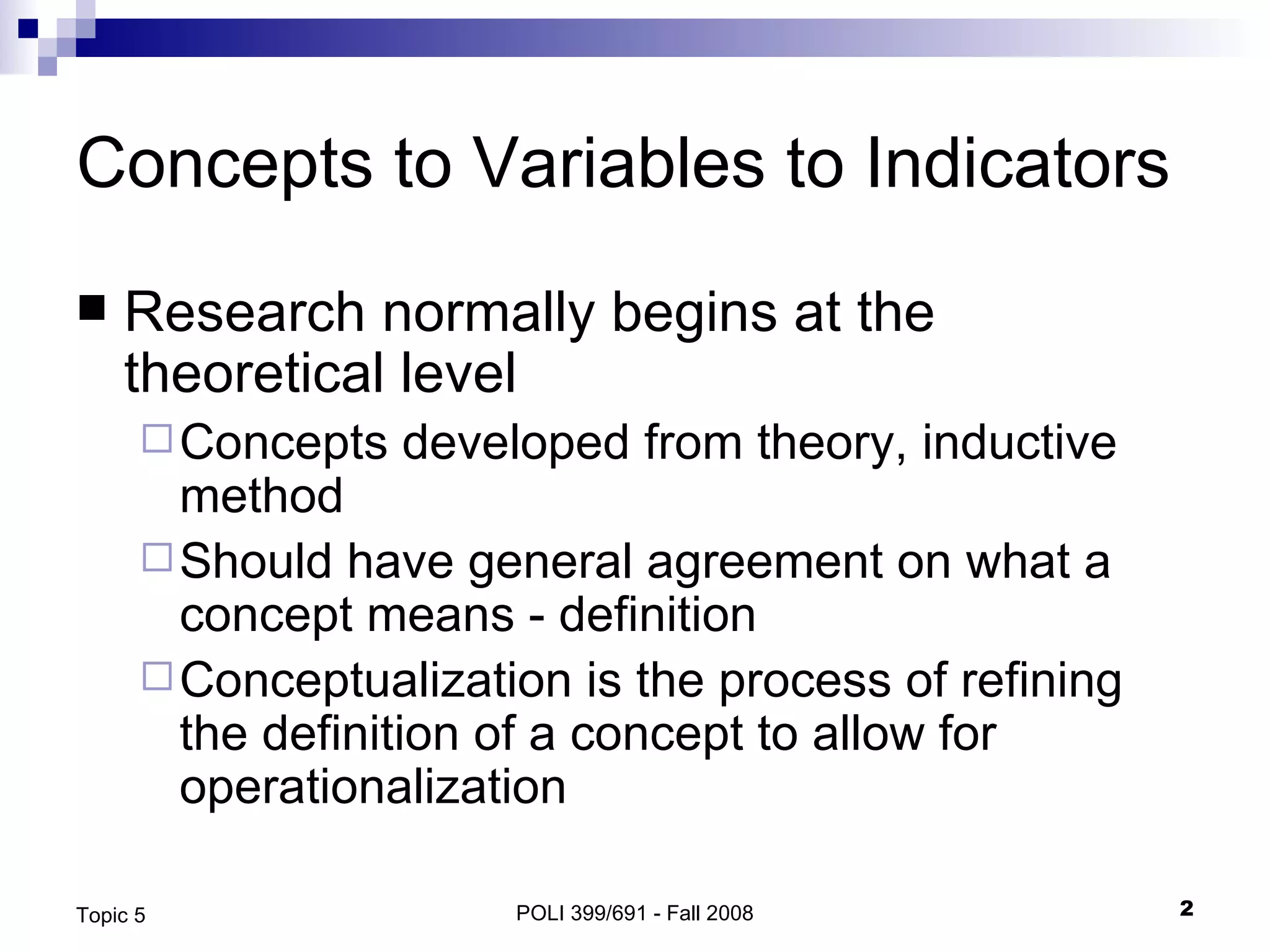
Concepts to Variables to Indicators Research normally begins at the theoretical level Concepts developed from theory, inductive method Should have general agreement on what a concept means - definition Conceptualization is the process of refining the definition of a concept to allow for operationalization POLI 399/691 - Fall 2008 Topic 5
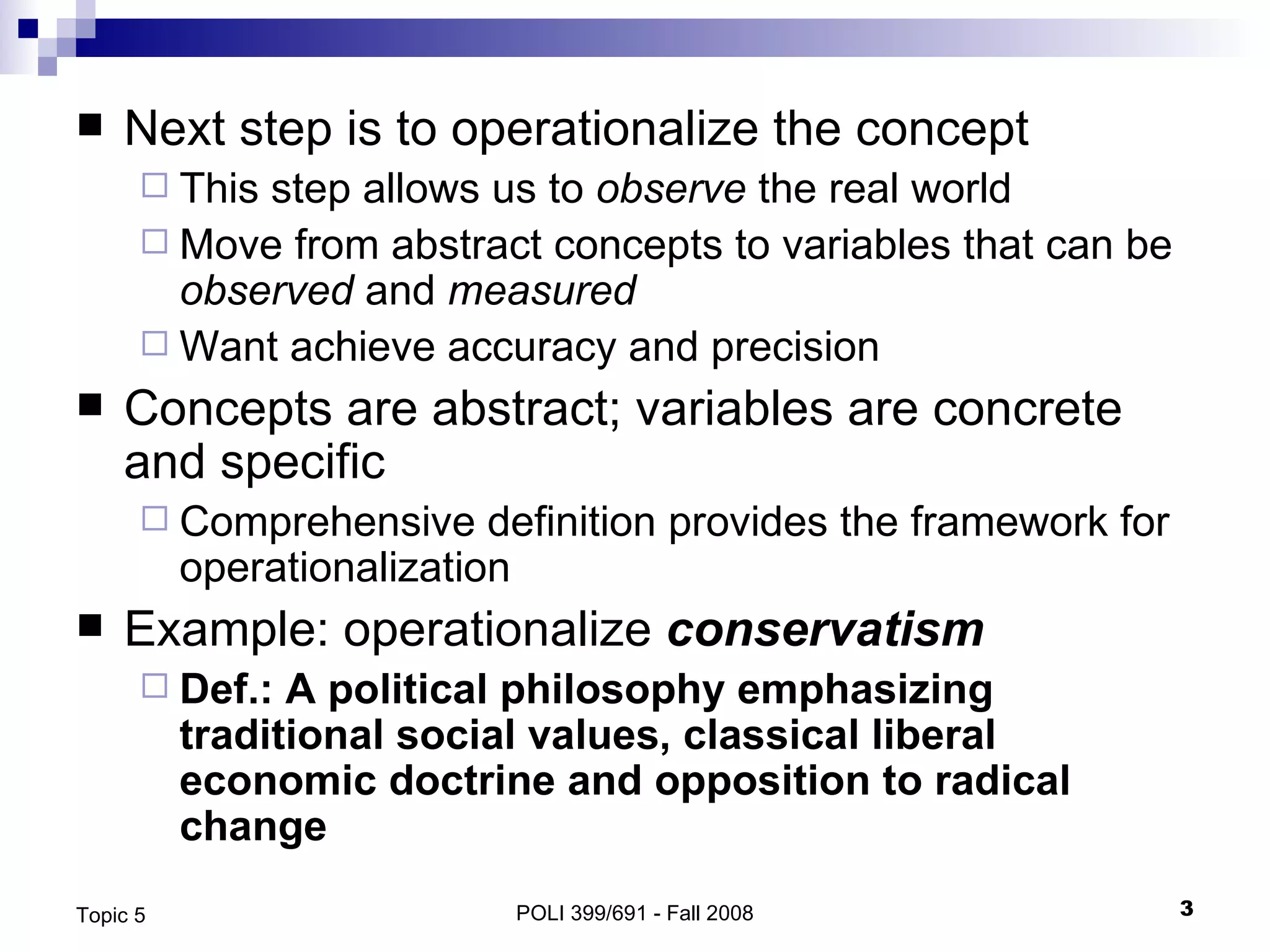
Next step is to operationalize the concept This step allows us to  observe  the real world Move from abstract concepts to variables that can be  observed  and  measured  Want achieve accuracy and precision Concepts are abstract; variables are concrete and specific Comprehensive definition provides the framework for operationalization Example: operationalize  conservatism Def.: A political philosophy emphasizing traditional social values, classical liberal economic doctrine and opposition to radical change POLI 399/691 - Fall 2008 Topic 5
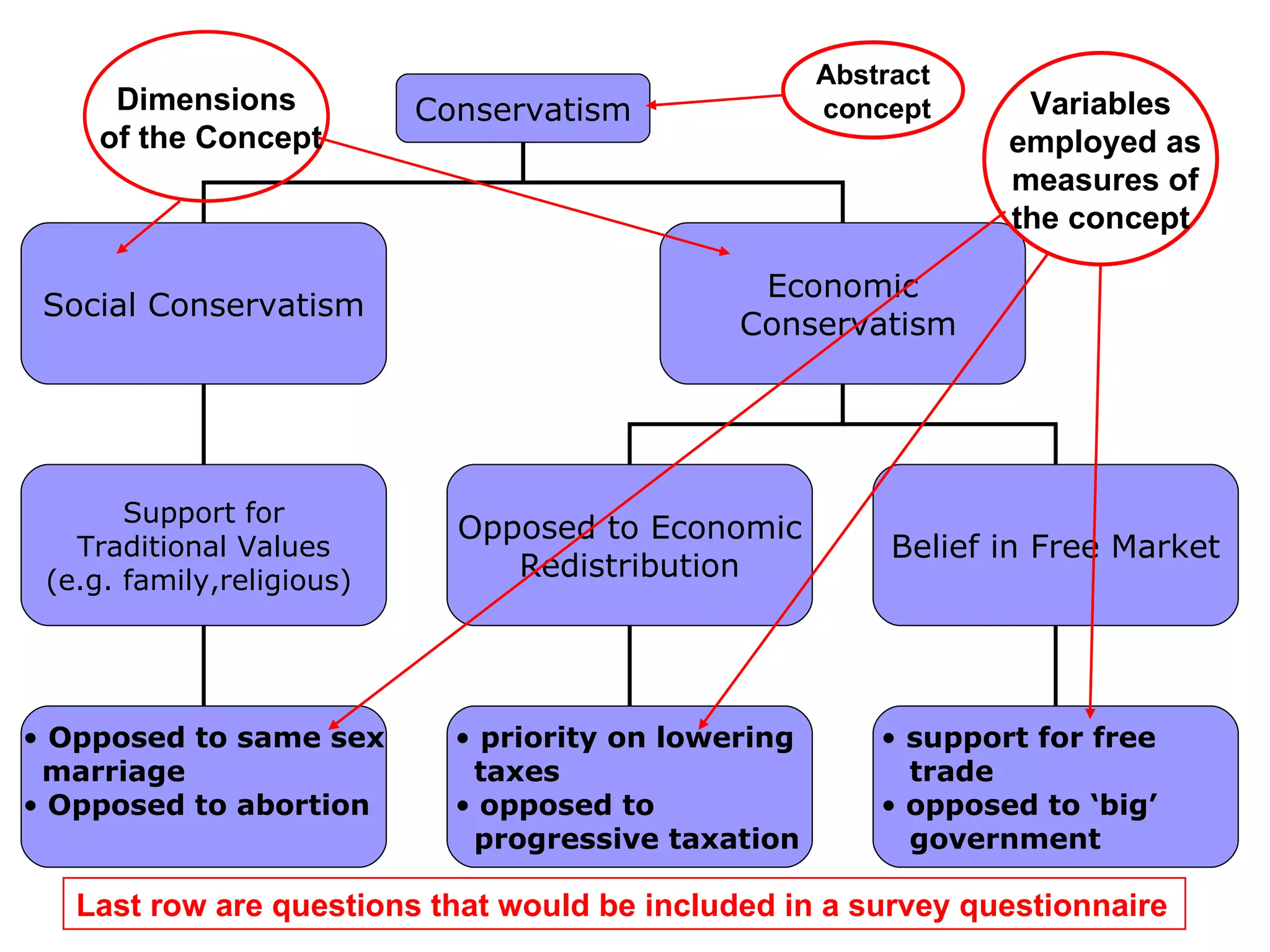
Abstract concept Variables employed as measures of the concept Last row are questions that would be included in a survey questionnaire Dimensions of the Concept Conservatism Social Conservatism Support for Traditional Values (e.g. family,religious)  Opposed to same sex marriage Opposed to abortion Economic Conservatism Opposed to Economic Redistribution Belief in Free Market priority on lowering taxes opposed to progressive taxation support for free trade opposed to ‘big’ government
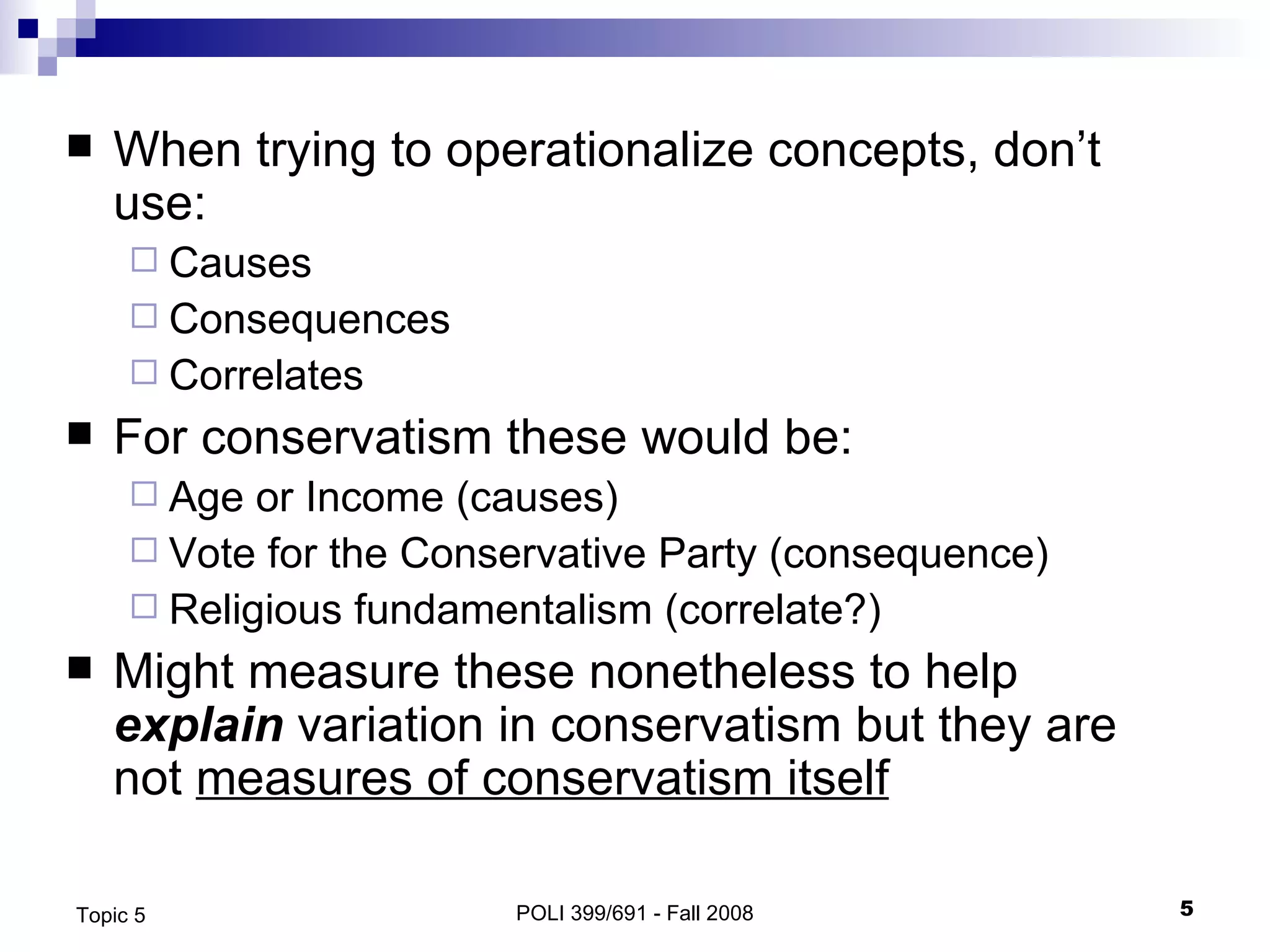
When trying to operationalize concepts, don’t use: Causes Consequences Correlates For conservatism these would be: Age or Income (causes) Vote for the Conservative Party (consequence) Religious fundamentalism (correlate?) Might measure these nonetheless to help  explain  variation in conservatism but they are  not  measures of conservatism itself POLI 399/691 - Fall 2008 Topic 5
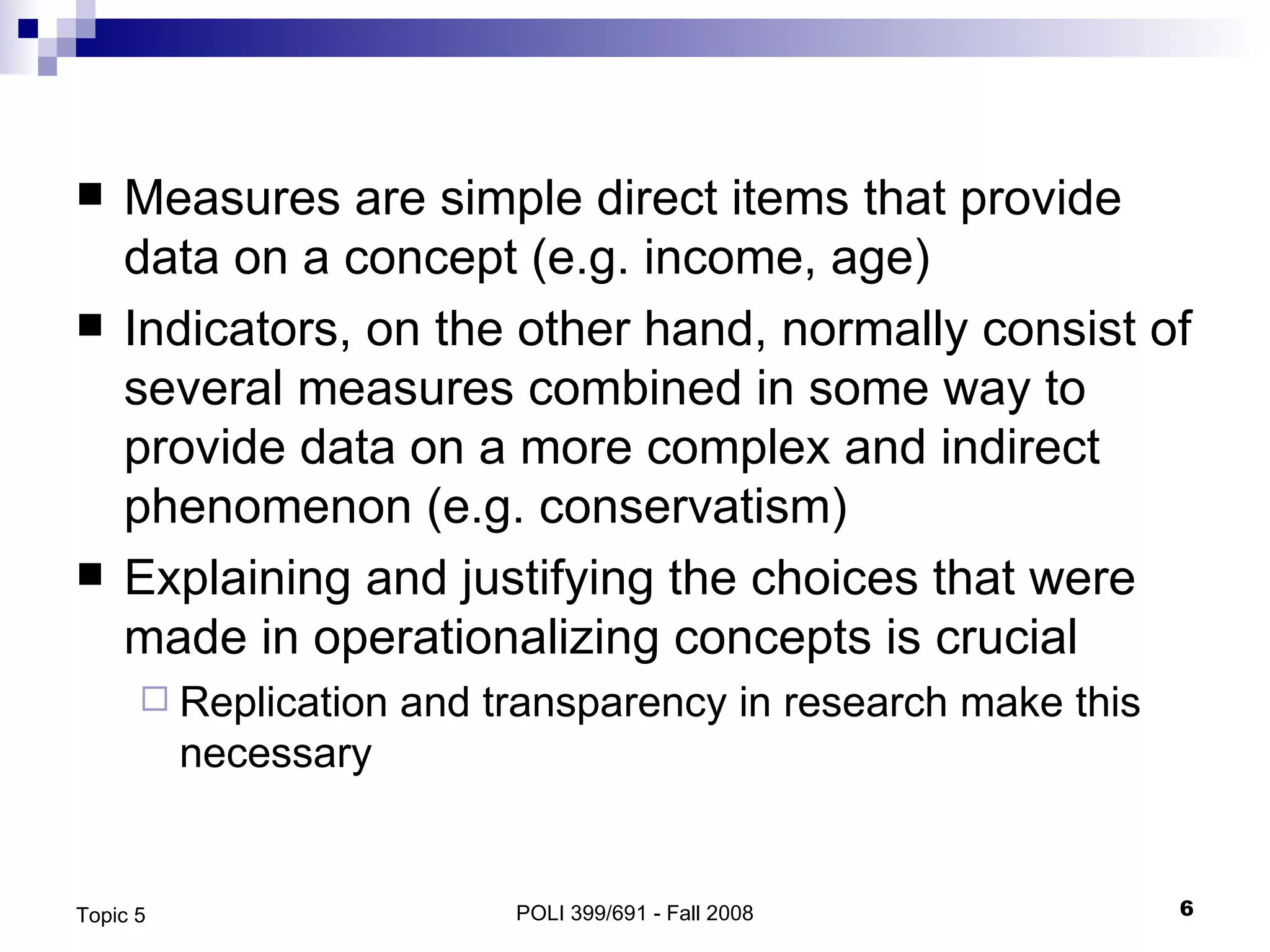
Measures are simple direct items that provide data on a concept (e.g. income, age) Indicators, on the other hand, normally consist of several measures combined in some way to provide data on a more complex and indirect phenomenon (e.g. conservatism) Explaining and justifying the choices that were made in operationalizing concepts is crucial Replication and transparency in research make this necessary POLI 399/691 - Fall 2008 Topic 5
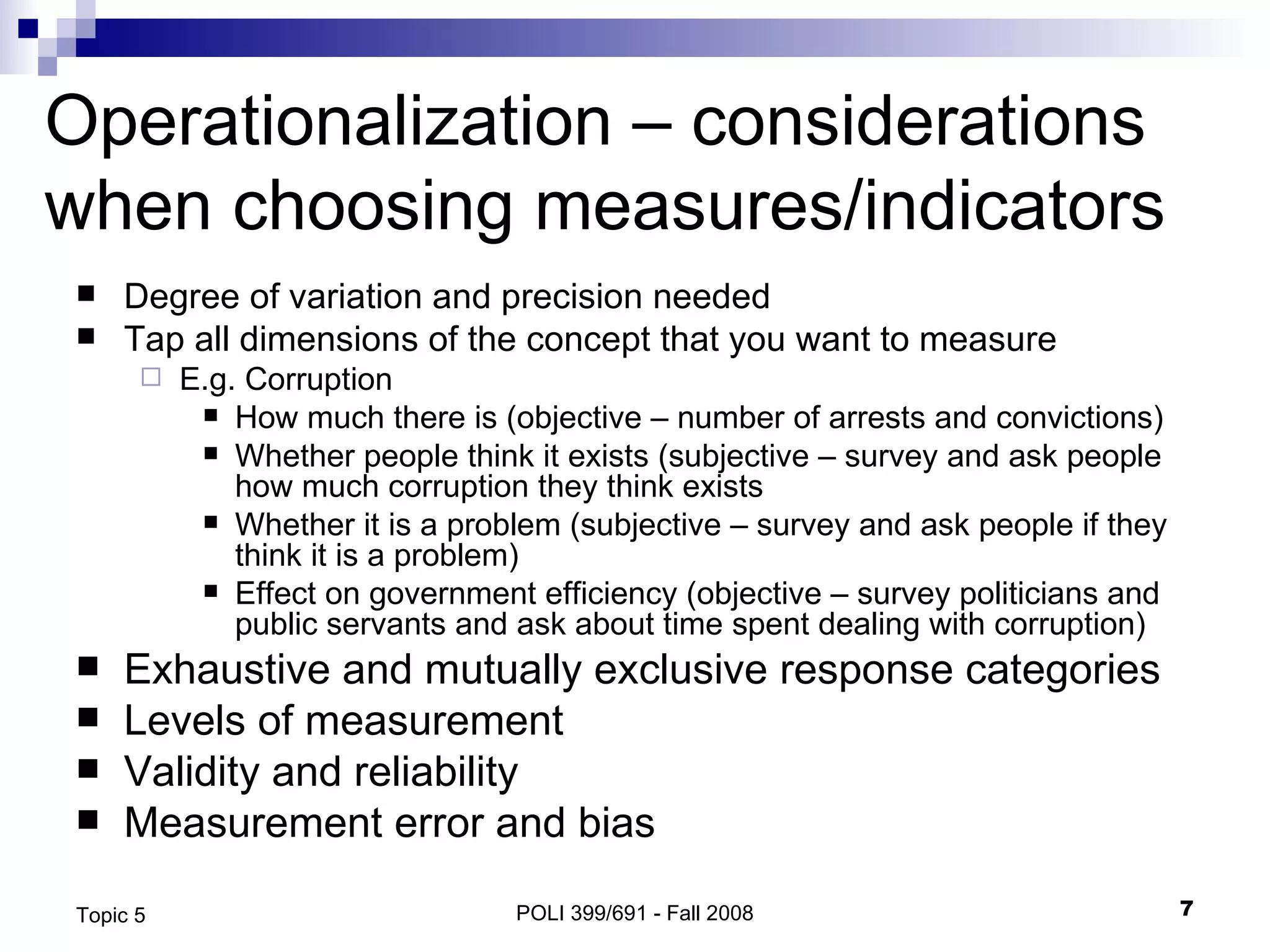
Operationalization – considerations when choosing measures/indicators Degree of variation and precision needed Tap all dimensions of the concept that you want to measure E.g. Corruption How much there is (objective – number of arrests and convictions) Whether people think it exists (subjective – survey and ask people how much corruption they think exists Whether it is a problem (subjective – survey and ask people if they think it is a problem) Effect on government efficiency (objective – survey politicians and public servants and ask about time spent dealing with corruption) Exhaustive and mutually exclusive response categories Levels of measurement Validity and reliability Measurement error and bias POLI 399/691 - Fall 2008 Topic 5
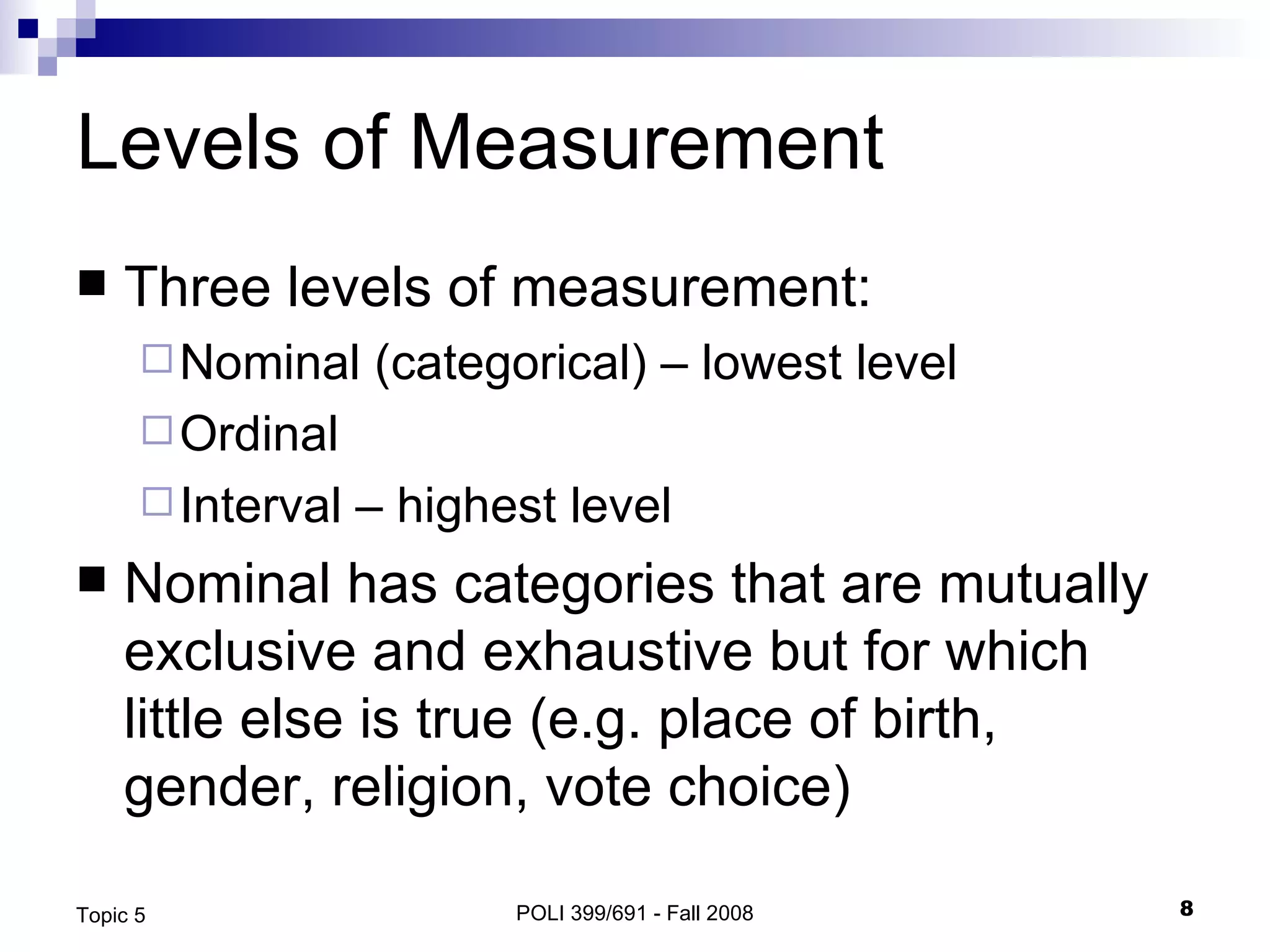
Levels of Measurement Three levels of measurement: Nominal (categorical) – lowest level Ordinal Interval – highest level Nominal has categories that are mutually exclusive and exhaustive but for which little else is true (e.g. place of birth, gender, religion, vote choice) POLI 399/691 - Fall 2008 Topic 5
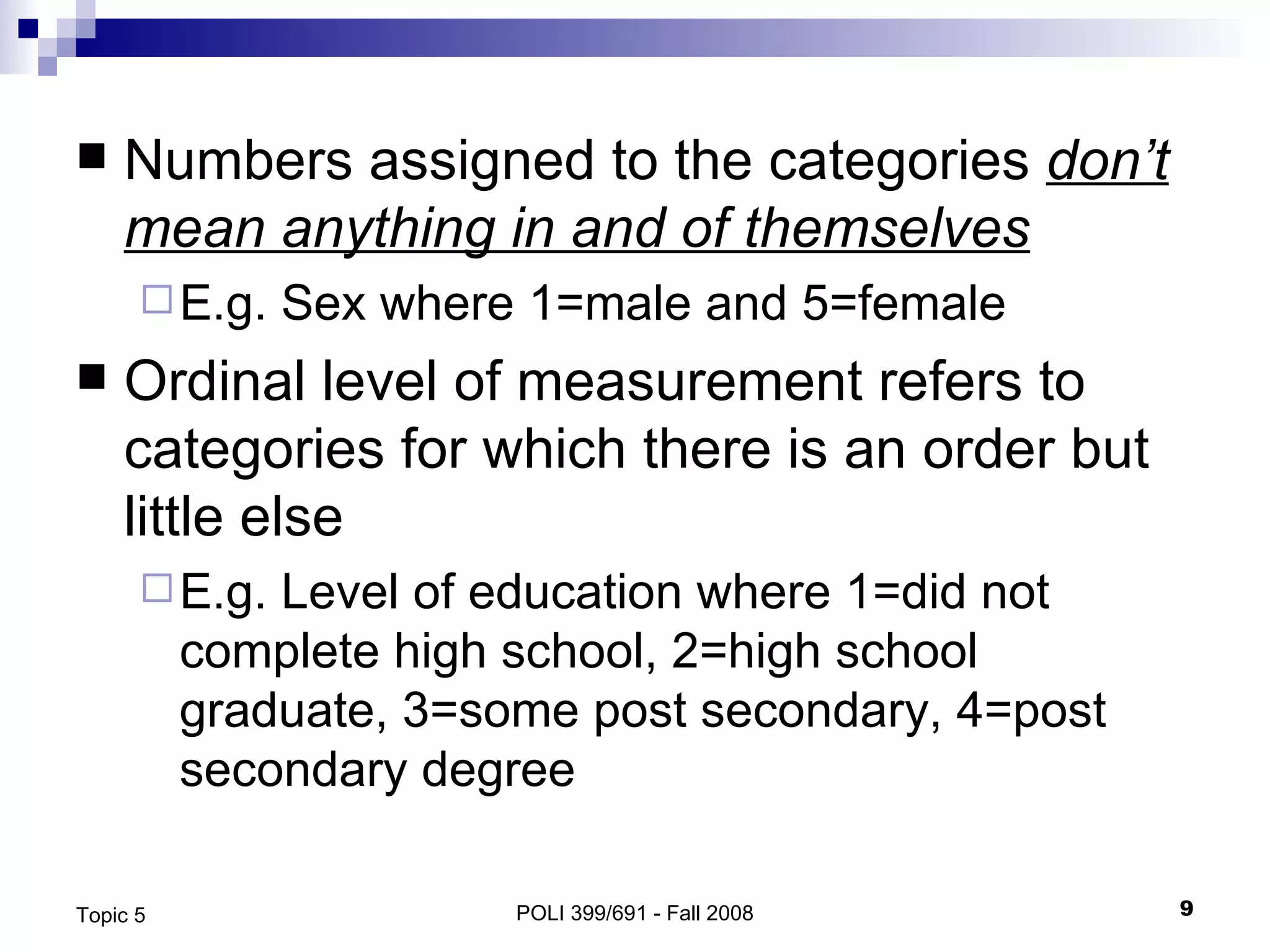
Numbers assigned to the categories  don’t mean anything in and of themselves E.g. Sex where 1=male and 5=female Ordinal level of measurement refers to categories for which there is an order but little else E.g. Level of education where 1=did not complete high school, 2=high school graduate, 3=some post secondary, 4=post secondary degree POLI 399/691 - Fall 2008 Topic 5
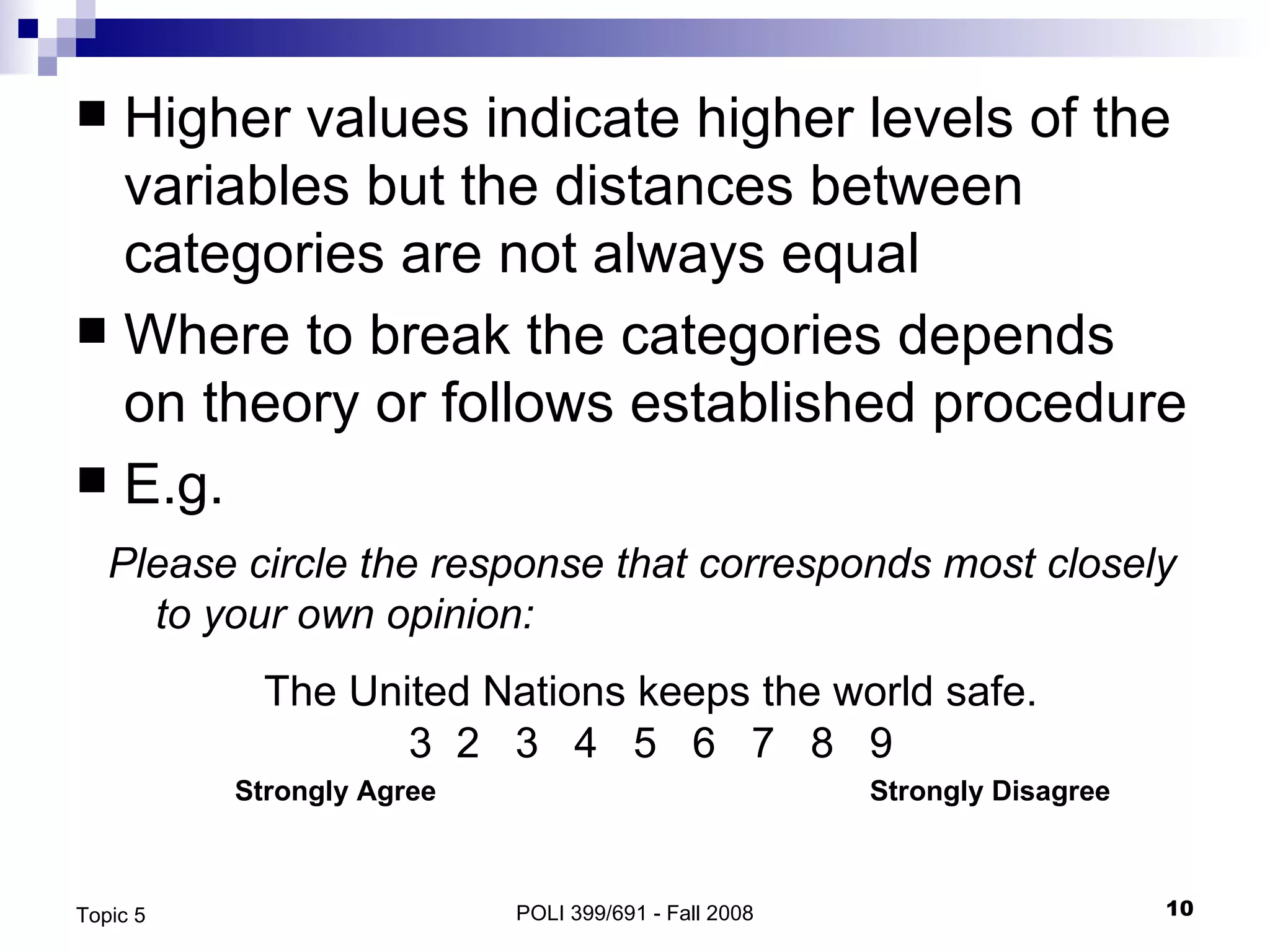
Higher values indicate higher levels of the variables but the distances between categories are not always equal Where to break the categories depends on theory or follows established procedure E.g. POLI 399/691 - Fall 2008 Topic 5 Please circle the response that corresponds most closely to your own opinion: The United Nations keeps the world safe. 2  3  4  5  6  7  8  9 Strongly Agree Strongly Disagree
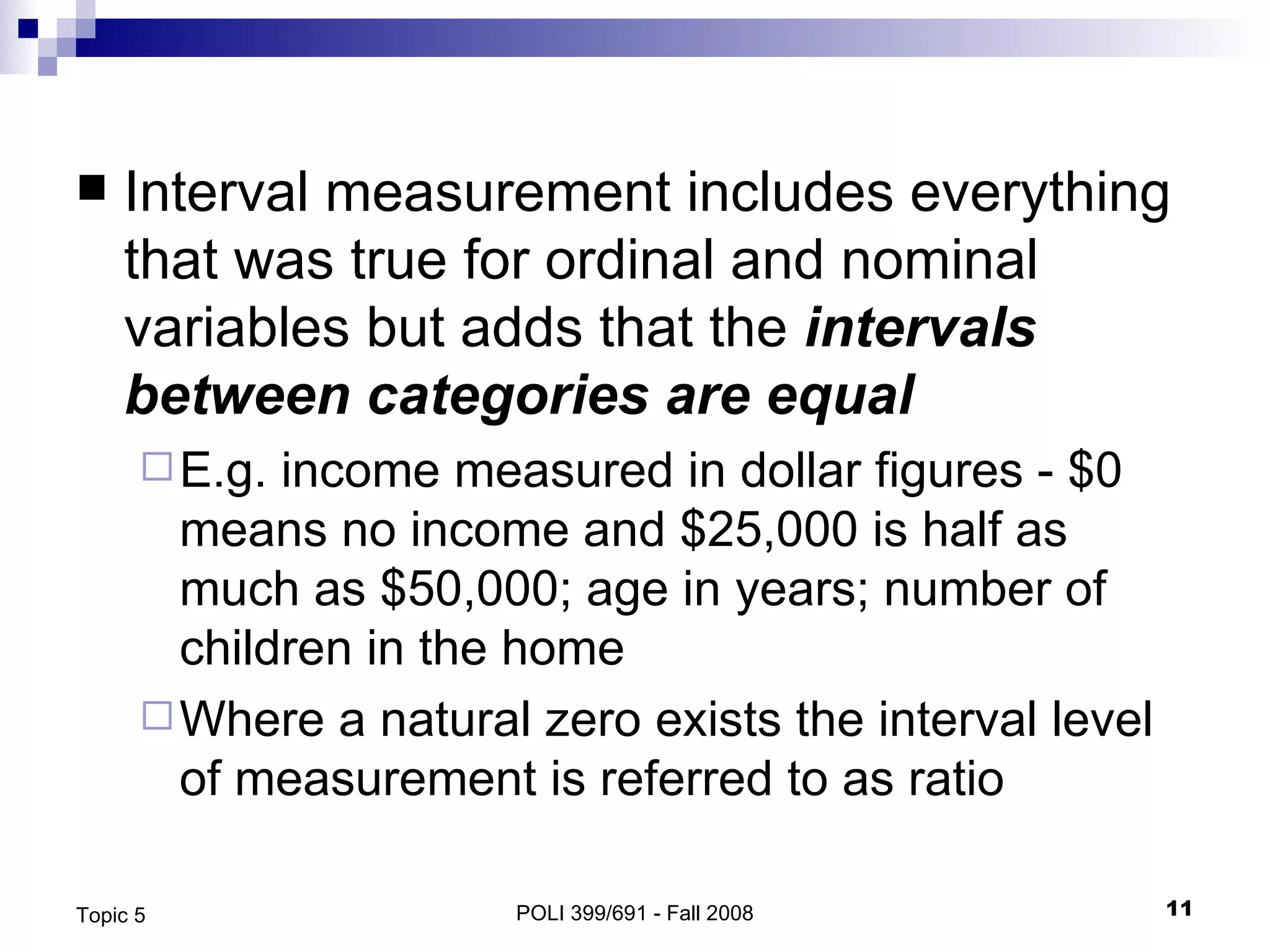
Interval measurement includes everything that was true for ordinal and nominal variables but adds that the  intervals between categories are equal  E.g. income measured in dollar figures - $0 means no income and $25,000 is half as much as $50,000; age in years; number of children in the home Where a natural zero exists the interval level of measurement is referred to as ratio POLI 399/691 - Fall 2008 Topic 5
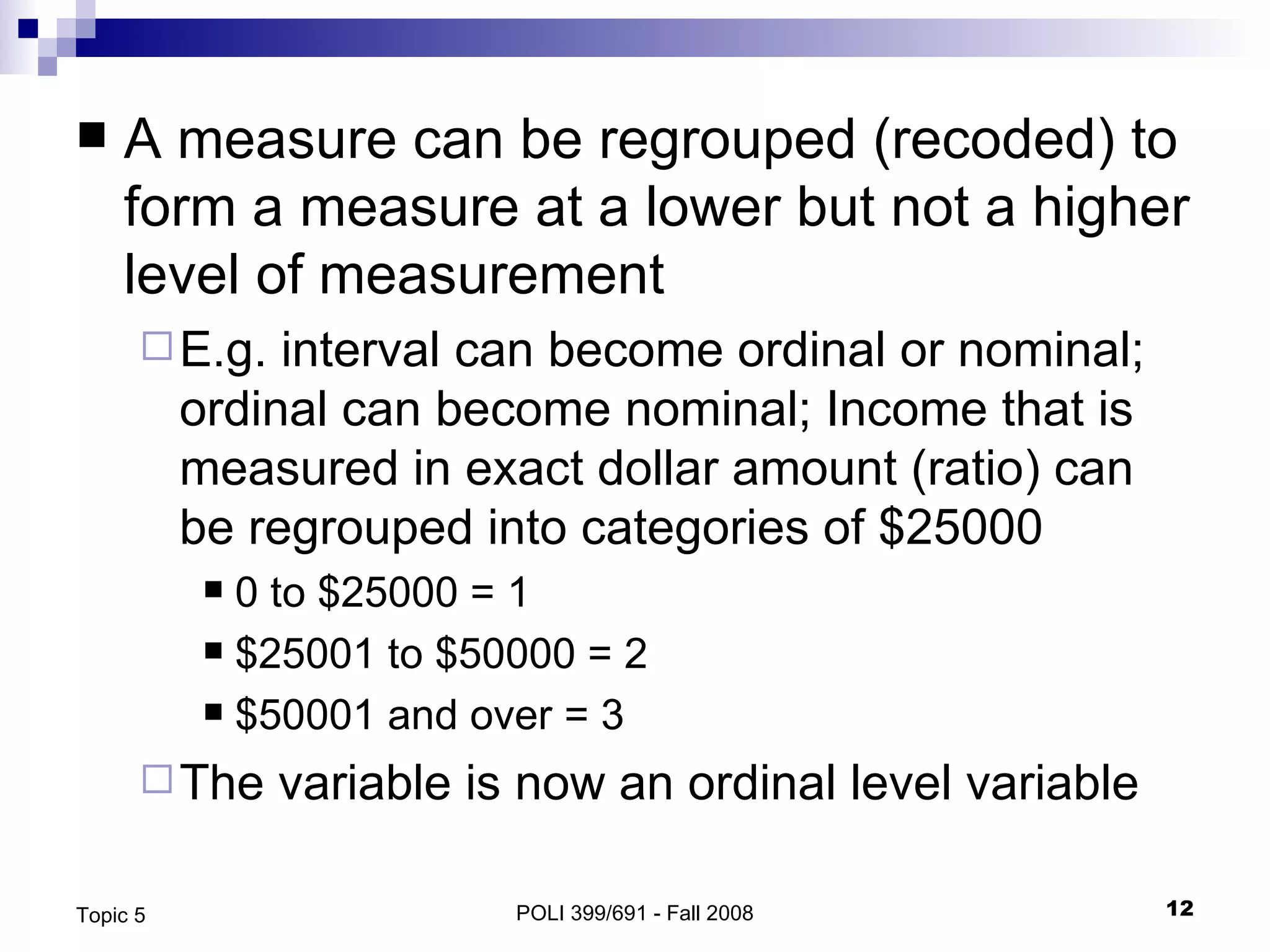
A measure can be regrouped (recoded) to form a measure at a lower but not a higher level of measurement E.g. interval can become ordinal or nominal; ordinal can become nominal; I ncome that is measured in exact dollar amount (ratio) can be regrouped into categories of $25000 0 to $25000 = 1 $25001 to $50000 = 2 $50001 and over = 3 The variable is now an ordinal level variable POLI 399/691 - Fall 2008 Topic 5
Validity and Reliability  Validity  in operationalization relates to: how well am I measuring the concept given commonly accepted definitions of it? (degree of fit, integrity) Reliability  relates to: how consistent or similar are my readings across repeated measures? Think of hitting a bull’s eye POLI 399/691 - Fall 2008 Topic 5
Validity Want measures that are  valid and complete (measurement validity) Valid means measuring what you hope to measure Complete means measuring all dimensions of a concept Validity also refers to research conclusions ( internal  and  external validity ) How can we assess validity? POLI 399/691 - Fall 2008 Topic 5
Assessing validity Face validity  exists if one can argue that there would be general agreement that the measure taps the concept/variable in question Content validity  exits if the measure reflects the multiple dimension of the concept Face and content validity refer to how you have operationalized your measure Construct validity  suggests that correctly measured concepts ought to relate in some theoretical way to other measures E.g. sense of duty ought to be positively related to vote turnout  POLI 399/691 - Fall 2008 Topic 5
Concurrent validity  exists if different indicators of the same theoretical concept/variable yield relatively similar results across cases tested at the same time E.g. most people who score high on one indicator of environmentalism should also score high on a second (that is, the scores should be positively correlated); for example, we could expect people who recycle at home to also recycle at work  Predictive validity  exists if the measure predicts an outcome at a later date according to expectations E.g. children whose family discusses politics often should score higher on measures of political participation as adults POLI 399/691 - Fall 2008 Topic 5
Construct, concurrent and predictive validity refer to whether the measure behaves the way you think it should (at least in a statistical sense) Validity is a quality – measures will be more or less valid but not either valid or invalid Using multiple indicators of a concept is always a good approach POLI 399/691 - Fall 2008 Topic 5
Reliability Reliability deals with consistency across repeated measures E.g.: it is more reliable to ask a person directly or to check their birth certificate when measuring age than it is to ask a friend or family member for this information Increasing the reliability of our measures  reduces the error in them POLI 399/691 - Fall 2008 Topic 5
How can we be certain that our measures are reliable? Retest and check for consistency across responses Verify through an external source – check reported age against birth certificate Reliability increases when measure has a consistent meaning across all members of a targeted group and it is delivered objectively POLI 399/691 - Fall 2008 Topic 5
Measurement Error When your measures deviate from the “true” value we have measurement error The less reliable a measure is – the more measurement error that we are likely to have Error can also come from less than valid indicators, respondents, interviewers, coders  POLI 399/691 - Fall 2008 Topic 5
The measurement that you get will consist of “true value” (depending on validity of the measure)+ systematic error (bias) + random error (noise) Goal is to try to minimize systematic and random error Random error differs across cases – e.g. some responses/measurements might be too high, others might be too low but there will not be a pattern in the errors POLI 399/691 - Fall 2008 Topic 5
Random error of less concern with large samples (averages out) Systematic error (bias) is error that is persistent and in a particular direction or way – e.g. either always high or low Not a concern if you only care about the relative order of cases; is a concern if you want to say something about the overall average POLI 399/691 - Fall 2008 Topic 5
Avoiding Measurement Error Take several measures and average out Use multiple indicators Employ random sampling Use sensitive measures (multiple response categories) Avoid confusion in wording and instructions (k.i.s.s.) Check data for errors POLI 399/691 - Fall 2008 Topic 5
Indexes and Scales Indexes and scales combine the responses to several measures into a single measure Better to capture many dimensions of multidimensional and complex concepts E.g nationalism, alienation, feminism, conservatism They provide  parsimony  – better & more information from one composite measure than from several individual ones (more variability) POLI 399/691 - Fall 2008 Topic 5
Use theory to guide variable selection Each variable should be discriminating Statistics can  help  to guide these choices  Correlation between items should be high (internal validity) Cronbach’s Alpha (measure based on strength of correlations) We will return to this once we cover correlations Likert scales sum the scores assigned to various questions together  Higher scores assigned to responses that are stronger indicators of the concept in question Responses range from strongly disagree to strongly agree, strongly approve to strongly disapprove POLI 399/691 - Fall 2008 Topic 5
Example: Index of political participation Start with several measures of political activity Ask people which of the following actions they have taken: written letter to a public official; signed a petition; given money to a political cause; campaigned for a party; voted; joined a protest 1 point awarded for each activity they have done; Index varies from 0 to 6  Level of political activity increases with higher scores Activities are not distinguished in any way POLI 399/691 - Fall 2008 Topic 5
Key Terms Concept Operationalization Causes Consequences Correlates Measures Indicators Exhaustive categories Mutually exclusive categories Nominal measures Ordinal measures Interval/ratio measures Researcher affect Objectivity Experimenter effect Expectancy Demand characteristics Socially desirable or undesirable behaviour Data massaging Publication bias Index Likert Scale Validity Measurement Face Construct Predictive Concurrent Internal External Reliability Measurement error Systematic Random  POLI 399/691 - Fall 2008 Topic 5

Concepts, Operationalization and Measurement

  • 1.
    Quantitative Research: Concepts,Operationalization and Measurement Or Getting Down to the Nitty Gritty
  • 2.
    Concepts to Variablesto Indicators Research normally begins at the theoretical level Concepts developed from theory, inductive method Should have general agreement on what a concept means - definition Conceptualization is the process of refining the definition of a concept to allow for operationalization POLI 399/691 - Fall 2008 Topic 5
  • 3.
    Next step isto operationalize the concept This step allows us to observe the real world Move from abstract concepts to variables that can be observed and measured Want achieve accuracy and precision Concepts are abstract; variables are concrete and specific Comprehensive definition provides the framework for operationalization Example: operationalize conservatism Def.: A political philosophy emphasizing traditional social values, classical liberal economic doctrine and opposition to radical change POLI 399/691 - Fall 2008 Topic 5
  • 4.
    Abstract concept Variablesemployed as measures of the concept Last row are questions that would be included in a survey questionnaire Dimensions of the Concept Conservatism Social Conservatism Support for Traditional Values (e.g. family,religious) Opposed to same sex marriage Opposed to abortion Economic Conservatism Opposed to Economic Redistribution Belief in Free Market priority on lowering taxes opposed to progressive taxation support for free trade opposed to ‘big’ government
  • 5.
    When trying tooperationalize concepts, don’t use: Causes Consequences Correlates For conservatism these would be: Age or Income (causes) Vote for the Conservative Party (consequence) Religious fundamentalism (correlate?) Might measure these nonetheless to help explain variation in conservatism but they are not measures of conservatism itself POLI 399/691 - Fall 2008 Topic 5
  • 6.
    Measures are simpledirect items that provide data on a concept (e.g. income, age) Indicators, on the other hand, normally consist of several measures combined in some way to provide data on a more complex and indirect phenomenon (e.g. conservatism) Explaining and justifying the choices that were made in operationalizing concepts is crucial Replication and transparency in research make this necessary POLI 399/691 - Fall 2008 Topic 5
  • 7.
    Operationalization – considerationswhen choosing measures/indicators Degree of variation and precision needed Tap all dimensions of the concept that you want to measure E.g. Corruption How much there is (objective – number of arrests and convictions) Whether people think it exists (subjective – survey and ask people how much corruption they think exists Whether it is a problem (subjective – survey and ask people if they think it is a problem) Effect on government efficiency (objective – survey politicians and public servants and ask about time spent dealing with corruption) Exhaustive and mutually exclusive response categories Levels of measurement Validity and reliability Measurement error and bias POLI 399/691 - Fall 2008 Topic 5
  • 8.
    Levels of MeasurementThree levels of measurement: Nominal (categorical) – lowest level Ordinal Interval – highest level Nominal has categories that are mutually exclusive and exhaustive but for which little else is true (e.g. place of birth, gender, religion, vote choice) POLI 399/691 - Fall 2008 Topic 5
  • 9.
    Numbers assigned tothe categories don’t mean anything in and of themselves E.g. Sex where 1=male and 5=female Ordinal level of measurement refers to categories for which there is an order but little else E.g. Level of education where 1=did not complete high school, 2=high school graduate, 3=some post secondary, 4=post secondary degree POLI 399/691 - Fall 2008 Topic 5
  • 10.
    Higher values indicatehigher levels of the variables but the distances between categories are not always equal Where to break the categories depends on theory or follows established procedure E.g. POLI 399/691 - Fall 2008 Topic 5 Please circle the response that corresponds most closely to your own opinion: The United Nations keeps the world safe. 2 3 4 5 6 7 8 9 Strongly Agree Strongly Disagree
  • 11.
    Interval measurement includeseverything that was true for ordinal and nominal variables but adds that the intervals between categories are equal E.g. income measured in dollar figures - $0 means no income and $25,000 is half as much as $50,000; age in years; number of children in the home Where a natural zero exists the interval level of measurement is referred to as ratio POLI 399/691 - Fall 2008 Topic 5
  • 12.
    A measure canbe regrouped (recoded) to form a measure at a lower but not a higher level of measurement E.g. interval can become ordinal or nominal; ordinal can become nominal; I ncome that is measured in exact dollar amount (ratio) can be regrouped into categories of $25000 0 to $25000 = 1 $25001 to $50000 = 2 $50001 and over = 3 The variable is now an ordinal level variable POLI 399/691 - Fall 2008 Topic 5
  • 13.
    Validity and Reliability Validity in operationalization relates to: how well am I measuring the concept given commonly accepted definitions of it? (degree of fit, integrity) Reliability relates to: how consistent or similar are my readings across repeated measures? Think of hitting a bull’s eye POLI 399/691 - Fall 2008 Topic 5
  • 14.
    Validity Want measuresthat are valid and complete (measurement validity) Valid means measuring what you hope to measure Complete means measuring all dimensions of a concept Validity also refers to research conclusions ( internal and external validity ) How can we assess validity? POLI 399/691 - Fall 2008 Topic 5
  • 15.
    Assessing validity Facevalidity exists if one can argue that there would be general agreement that the measure taps the concept/variable in question Content validity exits if the measure reflects the multiple dimension of the concept Face and content validity refer to how you have operationalized your measure Construct validity suggests that correctly measured concepts ought to relate in some theoretical way to other measures E.g. sense of duty ought to be positively related to vote turnout POLI 399/691 - Fall 2008 Topic 5
  • 16.
    Concurrent validity exists if different indicators of the same theoretical concept/variable yield relatively similar results across cases tested at the same time E.g. most people who score high on one indicator of environmentalism should also score high on a second (that is, the scores should be positively correlated); for example, we could expect people who recycle at home to also recycle at work Predictive validity exists if the measure predicts an outcome at a later date according to expectations E.g. children whose family discusses politics often should score higher on measures of political participation as adults POLI 399/691 - Fall 2008 Topic 5
  • 17.
    Construct, concurrent andpredictive validity refer to whether the measure behaves the way you think it should (at least in a statistical sense) Validity is a quality – measures will be more or less valid but not either valid or invalid Using multiple indicators of a concept is always a good approach POLI 399/691 - Fall 2008 Topic 5
  • 18.
    Reliability Reliability dealswith consistency across repeated measures E.g.: it is more reliable to ask a person directly or to check their birth certificate when measuring age than it is to ask a friend or family member for this information Increasing the reliability of our measures reduces the error in them POLI 399/691 - Fall 2008 Topic 5
  • 19.
    How can webe certain that our measures are reliable? Retest and check for consistency across responses Verify through an external source – check reported age against birth certificate Reliability increases when measure has a consistent meaning across all members of a targeted group and it is delivered objectively POLI 399/691 - Fall 2008 Topic 5
  • 20.
    Measurement Error Whenyour measures deviate from the “true” value we have measurement error The less reliable a measure is – the more measurement error that we are likely to have Error can also come from less than valid indicators, respondents, interviewers, coders POLI 399/691 - Fall 2008 Topic 5
  • 21.
    The measurement thatyou get will consist of “true value” (depending on validity of the measure)+ systematic error (bias) + random error (noise) Goal is to try to minimize systematic and random error Random error differs across cases – e.g. some responses/measurements might be too high, others might be too low but there will not be a pattern in the errors POLI 399/691 - Fall 2008 Topic 5
  • 22.
    Random error ofless concern with large samples (averages out) Systematic error (bias) is error that is persistent and in a particular direction or way – e.g. either always high or low Not a concern if you only care about the relative order of cases; is a concern if you want to say something about the overall average POLI 399/691 - Fall 2008 Topic 5
  • 23.
    Avoiding Measurement ErrorTake several measures and average out Use multiple indicators Employ random sampling Use sensitive measures (multiple response categories) Avoid confusion in wording and instructions (k.i.s.s.) Check data for errors POLI 399/691 - Fall 2008 Topic 5
  • 24.
    Indexes and ScalesIndexes and scales combine the responses to several measures into a single measure Better to capture many dimensions of multidimensional and complex concepts E.g nationalism, alienation, feminism, conservatism They provide parsimony – better & more information from one composite measure than from several individual ones (more variability) POLI 399/691 - Fall 2008 Topic 5
  • 25.
    Use theory toguide variable selection Each variable should be discriminating Statistics can help to guide these choices Correlation between items should be high (internal validity) Cronbach’s Alpha (measure based on strength of correlations) We will return to this once we cover correlations Likert scales sum the scores assigned to various questions together Higher scores assigned to responses that are stronger indicators of the concept in question Responses range from strongly disagree to strongly agree, strongly approve to strongly disapprove POLI 399/691 - Fall 2008 Topic 5
  • 26.
    Example: Index ofpolitical participation Start with several measures of political activity Ask people which of the following actions they have taken: written letter to a public official; signed a petition; given money to a political cause; campaigned for a party; voted; joined a protest 1 point awarded for each activity they have done; Index varies from 0 to 6 Level of political activity increases with higher scores Activities are not distinguished in any way POLI 399/691 - Fall 2008 Topic 5
  • 27.
    Key Terms ConceptOperationalization Causes Consequences Correlates Measures Indicators Exhaustive categories Mutually exclusive categories Nominal measures Ordinal measures Interval/ratio measures Researcher affect Objectivity Experimenter effect Expectancy Demand characteristics Socially desirable or undesirable behaviour Data massaging Publication bias Index Likert Scale Validity Measurement Face Construct Predictive Concurrent Internal External Reliability Measurement error Systematic Random POLI 399/691 - Fall 2008 Topic 5