Membrane lipids and types
(lecture # 2)
.
Learning objectives
• Organization of membrane system
• Properties of membrane lipids
• Classification of membrane lipids
• Structure of membrane lipids
• Structure and properties of :-
: Glycolipids
: Phospholipids
: Sterols
: Archaebacterial Ether Lipids
BiologicalMembrane
Biological membrane system.•
■ Membranes are two layers thick sheath likestructures
■ Formed by non-covalent assemblage of lipids and proteins
■ Mainly consists of Lipids, Proteins andCarbohydrates
■ Thickness of membrane: 60 A (6 nm) to 100 A (10 nm)
■ Membrane forms closed boundaries between different compartments
■ Act as barriers to the passage of polar molecules and ions
■ Bio-membranes are Asymmetric:
Components of two faces always differ from each other.
Membranelipids
■ Membrane lipids have hydrophilic (polar) &
hydrophobic (non-polar) parts
■ One end is hydrophilic and the other end is
hydrophobic
■ Their hydrophobic interactions with each other
and their hydrophilic interaction with water
direct the packing of lipids in themembrane
PolarRegion
LipidBilayer of Plasma teo‹bzaoe
LipidLayer2
Membrane lipids classification
 Membrane lipids are classified based on the properties of
‘head’ group
 Membrane lipids of Prokaryotes, Eukaryotes and
Archaebacteria are grouped into Four major categories:
1. Phospholipids (Glycero-phospholipids,
Sphingo-phospholipids)
2. Glycolipids (Galactolipids, sphingo-
glycolipids)
3. Sterols
4. Archoebacteriol ether lipids
MEMBRANE LIPIDS
(1). Phospholipids
• Glycerol-3-phosphate is the backbone of all phospholipids
• Here a polar head group is joined tothe hydrophobic moiety by a phosphodiester
linkage
• Other two —OH groups (C1 and C2) are esterified by fatty acids (R & R )
Phospholipids
(A). Glycerophospholipids•
■ Also called as phos cerides
■ Major lipid component of biological membrane
■ Consists of glycerol-3-phosphate,whose C1 & C2 esterified by fattyacids
■ The C3 is linked to a polar group - ’X’
■ In simplest glycero-phospholipid,the ’-X’ is - H, is called phosphatidic acid
Name of X-OH Formula of X Phospholipid name
Water —H Phosphatidicacid
Ethanolamine —CH2CH2NH3+ Phosphatidylethanolamine
Choline —CH2CH2N(CH3)3 Phosphatidylcholine[Lecithin)
Serine —CH2CH(NH3+)C00 Phosphatidylserine
Glycerol —CH2CH(0H)CH20H Phosphatidylglycerol
Phosphatidylglycerol
—CH2CH(0H)CH20H
diphosphatidylglycero
l (cardiolipin)
Phopholipids
Phospho-glycerolipids are of different fypes based on ’X’proup(table)
i›
Phospholipids
(1).Glycerophospholipids.•
• Cardiolipin: an important component of the inner mitochondrial membrane
• It constitutes 20% ofthe total lipids of inner mitochondrial membrane
• The only other place where cardiolipin can be found is in the membranes
of most bacteria
• Thus it is an evidence for endosymbiont theory
Phospholipids
(1 ).Glycerophospholipids.•
Plasmalogen:
 They are glycero-phospholipids in which the C1 of glycerol moiety is linked
via an α,𝛽-unsaturated ether linkage rather than an ester linkage
 Ethanolamine, choline & serine are the most common plasmalogen heads
 Function of plasmalogens are not wellunderstood
0
OH
Plasmalogen Backbone
Phospholipids
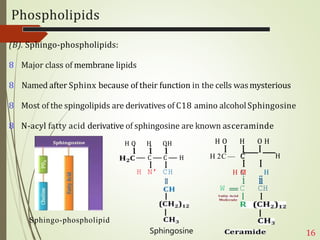
(B). Sphingo-phospholipids:
8 Major class of membrane lipids
8 Named after Sphinx because of their function in the cells wasmysterious
8 Most of the spingolipids are derivatives of C18 amino alcoholSphingosine
8 N-acyl fatty acid derivative of sphingosine are known asceraminde
Sphingo-phospholipid
H O H OH
i i iC C H
I I
H N’ CH
II
H O H O H
I I I
H 2C — CC H
I I
H CM H
W C CH
i ii
I I
16Sphingosine
Phospholipids
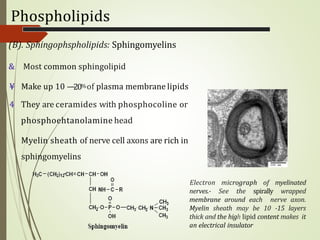
(B). Sphingophspholipids: Sphingomyelins
& Most common sphingolipid
¥ Make up 10 —20%of plasma membrane lipids
4 They are ceramides with phosphocoline or
phosphoehtanolamine head
Myelin sheath of nerve cell axons are rich in
sphingomyelins
Electron micrograph of myelinated
nerves.- See the spirally wrapped
membrane around each nerve axon.
Myelin sheath may be 10 -15 layers
thick and the high lipid content makes it
an electrical insulator
Membrane lipids
CH OH
HO
H OH
CH— 0— C
' I II
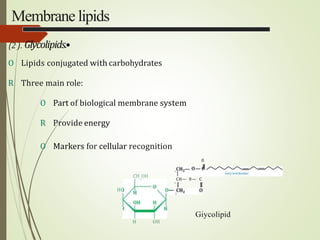
(2). Glycolipids.•
O Lipids conjugated with carbohydrates
R Three main role:
O Part of biological membrane system
R Provide energy
O Markers for cellular recognition
0
II
Giycolipid
Glycolipids
(2) Glycolipids.•
Different class of glycolipids are:
H (A). Glyceroglycolipids: Glycerole backbone with carbohydrates
a) Galactolipids
b) Sulfolipids
H (B). Sphingo-glycolipids: Sphingosine backbone with carbohydrates
a) Cerebrosides
b) Globosides
c) Gangliosides
Glycolipids
CH2OH
o O-CH2 O
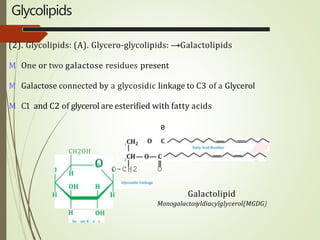
(2). Glycolipids: (A). Glycero-glycolipids: —+Galactolipids
M One or two galactose residues present
M Galactose connected by a glycosidic linkage to C3 of a Glycerol
M C1 and C2 of glycerol are esterified with fatty acids
0
Galactolipid
Monogalactosyldiacylglycerol(MGDG)
Glycolipids
(2). Glycolipids: (A). Glycero-glycolipids: —+Galactolipids
■ Galactolipids are predominant in plant cells
■ They are abundant in thylakoid membrane ofchloroplasts
■ They constitute 70%-80%of membrane lipids of vascular plants
■ Probably they are the most abundant membrane lipids in the biosphere
Glycolipids
I Galactolipids of chloroplasts•“
GM H
H
OH H
FI City
H N
.CH — O C
n Dialactoeyldiacylglycerol (ñ4GDG]
O — CHP
HO
OI3 H
DH
Monogalactosyldiacylglycerol
(MGDG)
Glycolipids
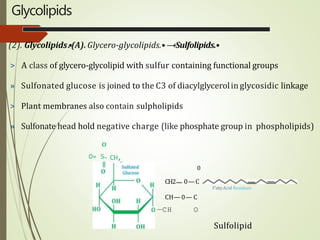
(2). Glycolipids.•(A). Glycero-glycolipids.•—+Sulfolipids.•
> A class of glycero-glycolipid with sulfur containing functional groups
» Sulfonated glucose is joined to the C3 of diacylglycerolinglycosidic linkage
> Plant membranes also contain sulpholipids
» Sulfonate head hold negative charge (like phosphate group in phospholipids)
O= S- CH,
0
CH2 0—C
F'attyAcid Residues
CH— 0— C
—CH O
Sulfolipid
Glycolipids
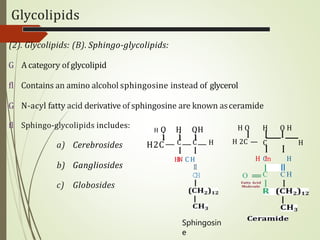
(2). Glycolipids: (B). Sphingo-glycolipids:
G A category of glycolipid
fl Contains an amino alcohol sphingosine instead of glycerol
G N-acyl fatty acid derivative of sphingosine are known asceramide
H O H OH
i i i
H2C
fl Sphingo-glycolipids includes:
a) Cerebrosides
b) Gangliosides
c) Globosides
C C H
I I
H3N’ C H
II
CH
H O H O H
C H
I I I
H 2C —
I I
H CI'm H
O C C H
I I
Sphingosin
e
Glycolipids
(2). Glycolipids.•(B). Sphingo-glycolipids.• a). Cerebrosides.•
■ It is a ceramide with single sugar residue at the Cl-hydroxyl moiety
■ Sugar residue can be either glucose orgalactose
■ Thus two categories: Glucocerebrosides,Galactocerebrosides
■ Cerebrosides lack phosphate groups and thus they are nonionic (no charge)
■ Abundant in animal muscle and nerve cell membranes
■ Galactocerebrosides are typically found innerves
■ Glucocerebrosidesare found in othertissues
,
I!
CH .OH
‹›j4 H
H oH
ft
I I
Glycolipids
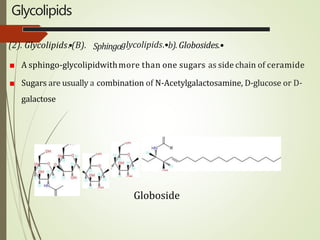
(2). Glycolipids.•(B). Sphingoglycolipids.•b).Globosides.•
■ A sphingo-glycolipidwithmore than one sugars as side chain of ceramide
■ Sugars are usually a combination of N-Acetylgalactosamine, D-glucose or D-
galactose
Globoside
Glycolipids
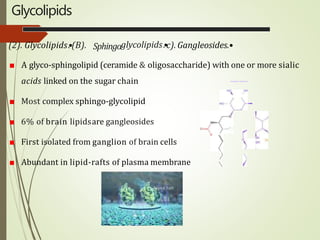
(2). Glycolipids.•(B). Sphingoglycolipids.•c). Gangleosides.•
■ A glyco-sphingolipid (ceramide & oligosaccharide) with one or more sialic
acids linked on the sugar chain ——
■ Most complex sphingo-glycolipid
■ 6% of brain lipidsare gangleosides
■ First isolated from ganglion of brain cells
■ Abundant in lipid-rafts of plasma membrane
MEMBRANELIPIDS
(2). Glycolipids•(B). Sphingoglycolipids.•c). Gangleosides.•
Physiological/Medical significance ofGangleosides:
■ Considerable physiological and medical significance
■ Act as specific receptors for glycoproteinhormones
■ Act as receptors for some bacterial protein toxins such as choleratoxin
■ Act as specific determinants of cell—cellrecognition (important in growth and
differentiationof tissues and in carcinogenesis)
■ Tay-Sachs disease is a hereditary disorder of ganglioside breakdown
leading to fatal neurological deterioration in the early childhood
MEMBRANE LIPIDS
 M Sterol consists of four fused carbon rings (A, B, C, D)
and an alkyl side chain
 M Alkyl chain is called 'hydrocarbon side chain’
 M Ring A, B and C are with six carbons and
Ring D is with five carbons M This fused ring is
called the Steroid Nucleus
 M Steroid nucleus is derived from
cyclopentanoperhydrophenanthrene
M Third major class of membrane lipids
M Usually present in the membranes of eukaryotic cells
opentanoperJdrephennnthreae
MEMBRANE
LIPIDS
M Cholesterol is a major sterol of animal membranes
M Constitute about 30-40% all membrane lipids inanimals
M Cholesterol is amphipathic with polar hydroxyl (-OH) ’head’ and non-
polar hydrocarbon ’tail’
M The —OH and the hydrocarbon chain are attached to the C3 and CI7 of
steroid nucleusrespectively
MEMBRANE LIPIDS
(3). Sterols.•
fl Cholesterol can esterify with long chain fatty acids to form cholesteryl
esters such as cholesteryl stearate
MEMBRANE LIPIDS
(3). Sterols.•
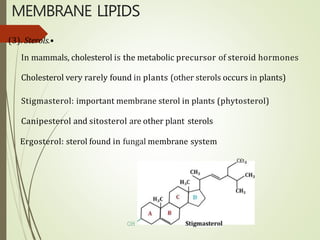
In mammals, cholesterol is the metabolic precursor of steroid hormones
Cholesterol very rarely found in plants (other sterols occurs in plants)
Stigmasterol: important membrane sterol in plants (phytosterol)
Canipesterol and sitosterol are other plant sterols
Ergosterol: sterol found in fungal membrane system
OH
C£t
MEMBRANE LIPIDS
 Bacteria cannot synthesize any sterol
 Thus bacterial membrane generally lacks sterol
 Some bacteria can incorporate exogenous sterol in to
their membrane
 Lanosterol: sterol precursor of animals andfungi
 Cycloartenol: sterol precursor of plants
 Both Lanosterol and Cycloartenol are derived from the
cyclization of triterpenoid squalene
MEMBRANE LIPIDS
(4). Archaebacterialether lipids.•
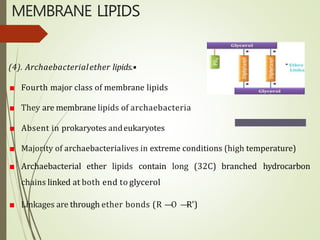
■ Fourth major class of membrane lipids
■ They are membrane lipids of archaebacteria
■ Absent in prokaryotes andeukaryotes
■ Majority of archaebacterialives in extreme conditions (high temperature)
■ Archaebacterial ether lipids contain long (32C) branched hydrocarbon
chains linked at both end to glycerol
■ Linkages are through ether bonds (R —O —R’)
MEMBRANE LIPIDS
3.Archaebacterial etherlipids.•
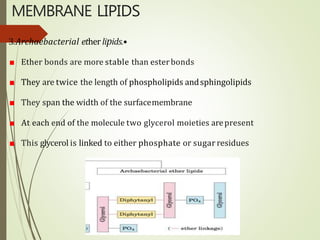
■ Ether bonds are more stable than esterbonds
■ They are twice the length of phospholipids andsphingolipids
■ They span the width of the surfacemembrane
■ At each end of the molecule two glycerol moieties arepresent
■ This glycerol is linked to either phosphate or sugar residues

membrane lipids & its types

  • 1.
    Membrane lipids andtypes (lecture # 2)
  • 2.
    . Learning objectives • Organizationof membrane system • Properties of membrane lipids • Classification of membrane lipids • Structure of membrane lipids • Structure and properties of :- : Glycolipids : Phospholipids : Sterols : Archaebacterial Ether Lipids
  • 3.
    BiologicalMembrane Biological membrane system.• ■Membranes are two layers thick sheath likestructures ■ Formed by non-covalent assemblage of lipids and proteins ■ Mainly consists of Lipids, Proteins andCarbohydrates ■ Thickness of membrane: 60 A (6 nm) to 100 A (10 nm) ■ Membrane forms closed boundaries between different compartments ■ Act as barriers to the passage of polar molecules and ions ■ Bio-membranes are Asymmetric: Components of two faces always differ from each other.
  • 4.
    Membranelipids ■ Membrane lipidshave hydrophilic (polar) & hydrophobic (non-polar) parts ■ One end is hydrophilic and the other end is hydrophobic ■ Their hydrophobic interactions with each other and their hydrophilic interaction with water direct the packing of lipids in themembrane PolarRegion LipidBilayer of Plasma teo‹bzaoe LipidLayer2
  • 5.
    Membrane lipids classification Membrane lipids are classified based on the properties of ‘head’ group  Membrane lipids of Prokaryotes, Eukaryotes and Archaebacteria are grouped into Four major categories: 1. Phospholipids (Glycero-phospholipids, Sphingo-phospholipids) 2. Glycolipids (Galactolipids, sphingo- glycolipids) 3. Sterols 4. Archoebacteriol ether lipids
  • 6.
    MEMBRANE LIPIDS (1). Phospholipids •Glycerol-3-phosphate is the backbone of all phospholipids • Here a polar head group is joined tothe hydrophobic moiety by a phosphodiester linkage • Other two —OH groups (C1 and C2) are esterified by fatty acids (R & R )
  • 7.
    Phospholipids (A). Glycerophospholipids• ■ Alsocalled as phos cerides ■ Major lipid component of biological membrane ■ Consists of glycerol-3-phosphate,whose C1 & C2 esterified by fattyacids ■ The C3 is linked to a polar group - ’X’ ■ In simplest glycero-phospholipid,the ’-X’ is - H, is called phosphatidic acid
  • 8.
    Name of X-OHFormula of X Phospholipid name Water —H Phosphatidicacid Ethanolamine —CH2CH2NH3+ Phosphatidylethanolamine Choline —CH2CH2N(CH3)3 Phosphatidylcholine[Lecithin) Serine —CH2CH(NH3+)C00 Phosphatidylserine Glycerol —CH2CH(0H)CH20H Phosphatidylglycerol Phosphatidylglycerol —CH2CH(0H)CH20H diphosphatidylglycero l (cardiolipin) Phopholipids Phospho-glycerolipids are of different fypes based on ’X’proup(table) i›
  • 9.
    Phospholipids (1).Glycerophospholipids.• • Cardiolipin: animportant component of the inner mitochondrial membrane • It constitutes 20% ofthe total lipids of inner mitochondrial membrane • The only other place where cardiolipin can be found is in the membranes of most bacteria • Thus it is an evidence for endosymbiont theory
  • 10.
    Phospholipids (1 ).Glycerophospholipids.• Plasmalogen:  Theyare glycero-phospholipids in which the C1 of glycerol moiety is linked via an α,𝛽-unsaturated ether linkage rather than an ester linkage  Ethanolamine, choline & serine are the most common plasmalogen heads  Function of plasmalogens are not wellunderstood 0 OH Plasmalogen Backbone
  • 11.
    Phospholipids (B). Sphingo-phospholipids: 8 Majorclass of membrane lipids 8 Named after Sphinx because of their function in the cells wasmysterious 8 Most of the spingolipids are derivatives of C18 amino alcoholSphingosine 8 N-acyl fatty acid derivative of sphingosine are known asceraminde Sphingo-phospholipid H O H OH i i iC C H I I H N’ CH II H O H O H I I I H 2C — CC H I I H CM H W C CH i ii I I 16Sphingosine
  • 12.
    Phospholipids (B). Sphingophspholipids: Sphingomyelins &Most common sphingolipid ¥ Make up 10 —20%of plasma membrane lipids 4 They are ceramides with phosphocoline or phosphoehtanolamine head Myelin sheath of nerve cell axons are rich in sphingomyelins Electron micrograph of myelinated nerves.- See the spirally wrapped membrane around each nerve axon. Myelin sheath may be 10 -15 layers thick and the high lipid content makes it an electrical insulator
  • 13.
    Membrane lipids CH OH HO HOH CH— 0— C ' I II (2). Glycolipids.• O Lipids conjugated with carbohydrates R Three main role: O Part of biological membrane system R Provide energy O Markers for cellular recognition 0 II Giycolipid
  • 14.
    Glycolipids (2) Glycolipids.• Different classof glycolipids are: H (A). Glyceroglycolipids: Glycerole backbone with carbohydrates a) Galactolipids b) Sulfolipids H (B). Sphingo-glycolipids: Sphingosine backbone with carbohydrates a) Cerebrosides b) Globosides c) Gangliosides
  • 15.
    Glycolipids CH2OH o O-CH2 O (2).Glycolipids: (A). Glycero-glycolipids: —+Galactolipids M One or two galactose residues present M Galactose connected by a glycosidic linkage to C3 of a Glycerol M C1 and C2 of glycerol are esterified with fatty acids 0 Galactolipid Monogalactosyldiacylglycerol(MGDG)
  • 16.
    Glycolipids (2). Glycolipids: (A).Glycero-glycolipids: —+Galactolipids ■ Galactolipids are predominant in plant cells ■ They are abundant in thylakoid membrane ofchloroplasts ■ They constitute 70%-80%of membrane lipids of vascular plants ■ Probably they are the most abundant membrane lipids in the biosphere
  • 17.
    Glycolipids I Galactolipids ofchloroplasts•“ GM H H OH H FI City H N .CH — O C n Dialactoeyldiacylglycerol (ñ4GDG] O — CHP HO OI3 H DH Monogalactosyldiacylglycerol (MGDG)
  • 18.
    Glycolipids (2). Glycolipids.•(A). Glycero-glycolipids.•—+Sulfolipids.• >A class of glycero-glycolipid with sulfur containing functional groups » Sulfonated glucose is joined to the C3 of diacylglycerolinglycosidic linkage > Plant membranes also contain sulpholipids » Sulfonate head hold negative charge (like phosphate group in phospholipids) O= S- CH, 0 CH2 0—C F'attyAcid Residues CH— 0— C —CH O Sulfolipid
  • 19.
    Glycolipids (2). Glycolipids: (B).Sphingo-glycolipids: G A category of glycolipid fl Contains an amino alcohol sphingosine instead of glycerol G N-acyl fatty acid derivative of sphingosine are known asceramide H O H OH i i i H2C fl Sphingo-glycolipids includes: a) Cerebrosides b) Gangliosides c) Globosides C C H I I H3N’ C H II CH H O H O H C H I I I H 2C — I I H CI'm H O C C H I I Sphingosin e
  • 20.
    Glycolipids (2). Glycolipids.•(B). Sphingo-glycolipids.•a). Cerebrosides.• ■ It is a ceramide with single sugar residue at the Cl-hydroxyl moiety ■ Sugar residue can be either glucose orgalactose ■ Thus two categories: Glucocerebrosides,Galactocerebrosides ■ Cerebrosides lack phosphate groups and thus they are nonionic (no charge) ■ Abundant in animal muscle and nerve cell membranes ■ Galactocerebrosides are typically found innerves ■ Glucocerebrosidesare found in othertissues , I! CH .OH ‹›j4 H H oH ft I I
  • 21.
    Glycolipids (2). Glycolipids.•(B). Sphingoglycolipids.•b).Globosides.• ■A sphingo-glycolipidwithmore than one sugars as side chain of ceramide ■ Sugars are usually a combination of N-Acetylgalactosamine, D-glucose or D- galactose Globoside
  • 22.
    Glycolipids (2). Glycolipids.•(B). Sphingoglycolipids.•c).Gangleosides.• ■ A glyco-sphingolipid (ceramide & oligosaccharide) with one or more sialic acids linked on the sugar chain —— ■ Most complex sphingo-glycolipid ■ 6% of brain lipidsare gangleosides ■ First isolated from ganglion of brain cells ■ Abundant in lipid-rafts of plasma membrane
  • 23.
    MEMBRANELIPIDS (2). Glycolipids•(B). Sphingoglycolipids.•c).Gangleosides.• Physiological/Medical significance ofGangleosides: ■ Considerable physiological and medical significance ■ Act as specific receptors for glycoproteinhormones ■ Act as receptors for some bacterial protein toxins such as choleratoxin ■ Act as specific determinants of cell—cellrecognition (important in growth and differentiationof tissues and in carcinogenesis) ■ Tay-Sachs disease is a hereditary disorder of ganglioside breakdown leading to fatal neurological deterioration in the early childhood
  • 24.
    MEMBRANE LIPIDS  MSterol consists of four fused carbon rings (A, B, C, D) and an alkyl side chain  M Alkyl chain is called 'hydrocarbon side chain’  M Ring A, B and C are with six carbons and Ring D is with five carbons M This fused ring is called the Steroid Nucleus  M Steroid nucleus is derived from cyclopentanoperhydrophenanthrene M Third major class of membrane lipids M Usually present in the membranes of eukaryotic cells opentanoperJdrephennnthreae
  • 25.
    MEMBRANE LIPIDS M Cholesterol isa major sterol of animal membranes M Constitute about 30-40% all membrane lipids inanimals M Cholesterol is amphipathic with polar hydroxyl (-OH) ’head’ and non- polar hydrocarbon ’tail’ M The —OH and the hydrocarbon chain are attached to the C3 and CI7 of steroid nucleusrespectively
  • 26.
    MEMBRANE LIPIDS (3). Sterols.• flCholesterol can esterify with long chain fatty acids to form cholesteryl esters such as cholesteryl stearate
  • 27.
    MEMBRANE LIPIDS (3). Sterols.• Inmammals, cholesterol is the metabolic precursor of steroid hormones Cholesterol very rarely found in plants (other sterols occurs in plants) Stigmasterol: important membrane sterol in plants (phytosterol) Canipesterol and sitosterol are other plant sterols Ergosterol: sterol found in fungal membrane system OH C£t
  • 28.
    MEMBRANE LIPIDS  Bacteriacannot synthesize any sterol  Thus bacterial membrane generally lacks sterol  Some bacteria can incorporate exogenous sterol in to their membrane  Lanosterol: sterol precursor of animals andfungi  Cycloartenol: sterol precursor of plants  Both Lanosterol and Cycloartenol are derived from the cyclization of triterpenoid squalene
  • 29.
    MEMBRANE LIPIDS (4). Archaebacterialetherlipids.• ■ Fourth major class of membrane lipids ■ They are membrane lipids of archaebacteria ■ Absent in prokaryotes andeukaryotes ■ Majority of archaebacterialives in extreme conditions (high temperature) ■ Archaebacterial ether lipids contain long (32C) branched hydrocarbon chains linked at both end to glycerol ■ Linkages are through ether bonds (R —O —R’)
  • 30.
    MEMBRANE LIPIDS 3.Archaebacterial etherlipids.• ■Ether bonds are more stable than esterbonds ■ They are twice the length of phospholipids andsphingolipids ■ They span the width of the surfacemembrane ■ At each end of the molecule two glycerol moieties arepresent ■ This glycerol is linked to either phosphate or sugar residues