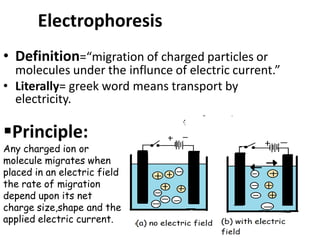
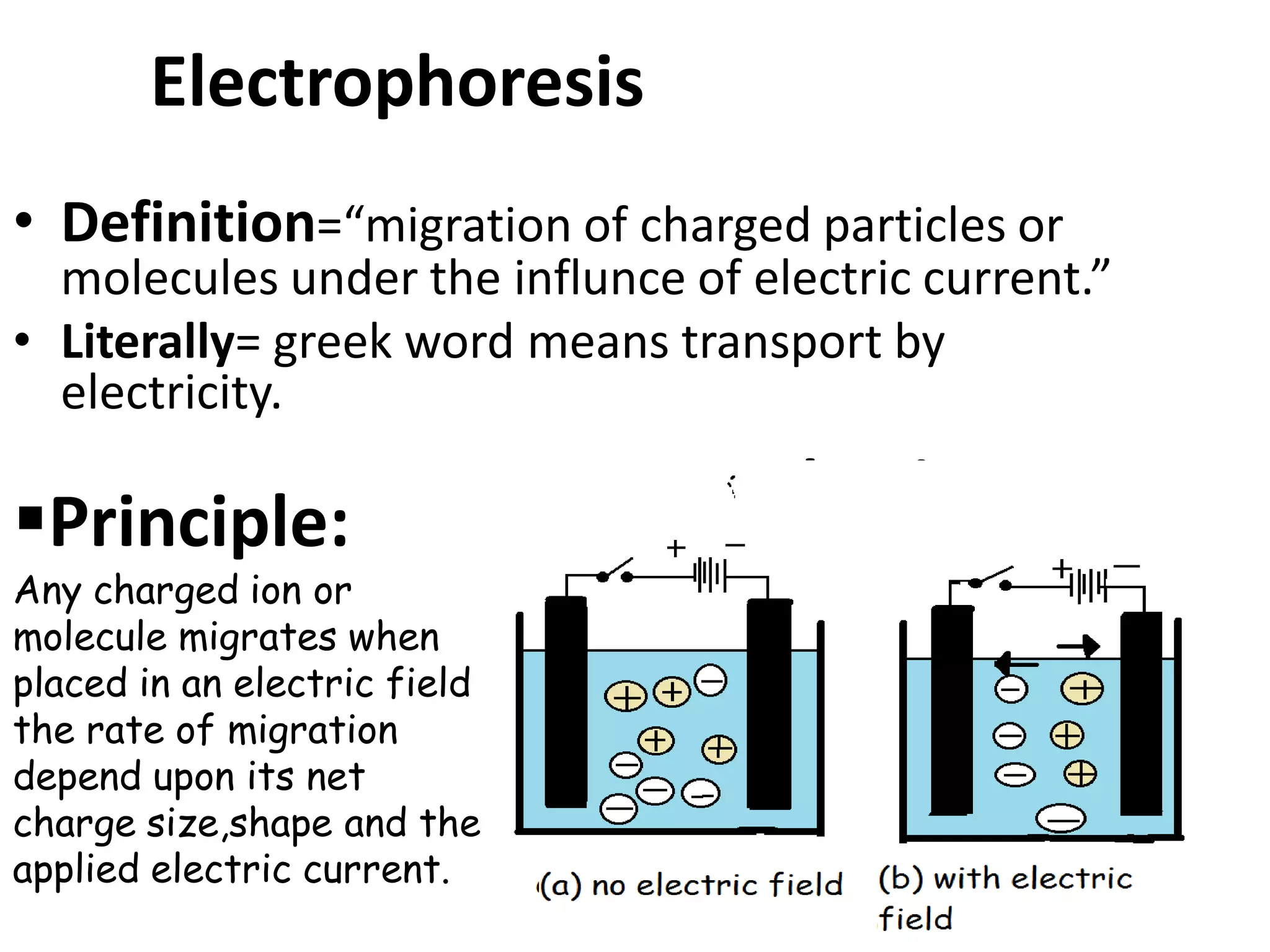
Principle:
Any charged ion or
molecule migrates when
placed in an electric field
the rate of migration
depend upon its net
charge size,shape and the
applied electric current.
 Mechanism:
• Definition=“migration of charged particles or
molecules under the influnce of electric current.”
• Literally= greek word means transport by
electricity.
Electrophoresis
Factors affecting the rate of ion
mobility
– Net charge of
molecule
– Size & shape of
molecule
– Electric field
strength
– Properties of
supporting medium
– Temperature
– pH of the buffer
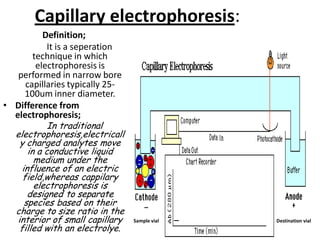
Capillary electrophoresis:
Sample vial Destination vial
Definition;
It is a seperation
technique in which
electrophoresis is
performed in narrow bore
capillaries typically 25-
100um inner diameter.
• Difference from
electrophoresis;
In traditional
electrophoresis,electricall
y charged analytes move
in a conductive liquid
medium under the
influence of an electric
field,whereas cappilary
electrophoresis is
designed to separate
species based on their
charge to size ratio in the
interior of small capillary
filled with an electrolye.
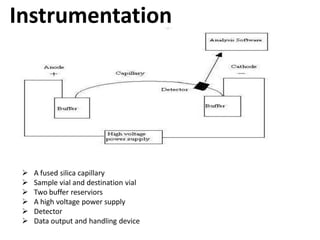
Instrumentation
 A fused silica capillary
 Sample vial and destination vial
 Two buffer reserviors
 A high voltage power supply
 Detector
 Data output and handling device
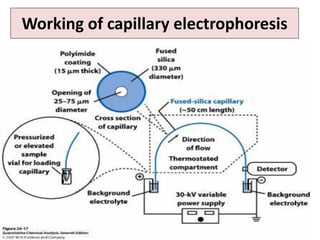
Working of capillary electrophoresis
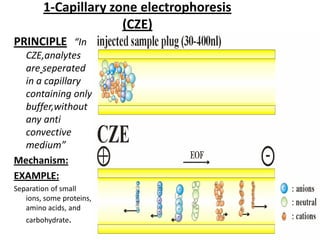
1-Capillary zone electrophoresis
(CZE)
PRINCIPLE “In
CZE,analytes
are seperated
in a capillary
containing only
buffer,without
any anti
convective
medium”
Mechanism:
EXAMPLE:
Separation of small
ions, some proteins,
amino acids, and
carbohydrate.
2-Capillary gel electrophoresis(CGE)
 Principle;
“seperation takes place
inside a capillary filled
with a gel which acts
as a molecular sieve”
Mechanism;
 Gels:
 linear noncrosslinked
polyacrylamide
(CH2=CH-CO-NH2) (C-
PAGE)
 dextran,
 agarose, and
 poly(ethyleneoxide)
• Gel matrix viscosity, density, and
pore size are all factors in
determining the ‘speed’ of
separation.
• Two types of separation can be done
using GE:
o Native: separation by size
and
o charge (charge/mass)
o Denaturing: separation by
size
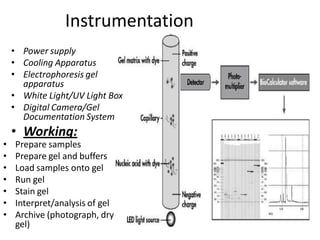
Instrumentation
• Power supply
• Cooling Apparatus
• Electrophoresis gel
apparatus
• White Light/UV Light Box
• Digital Camera/Gel
Documentation System
• Working:
• Prepare samples
• Prepare gel and buffers
• Load samples onto gel
• Run gel
• Stain gel
• Interpret/analysis of gel
• Archive (photograph, dry
gel)
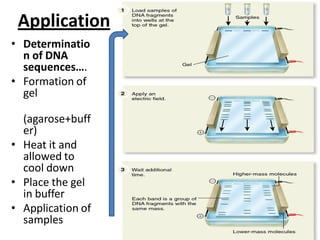
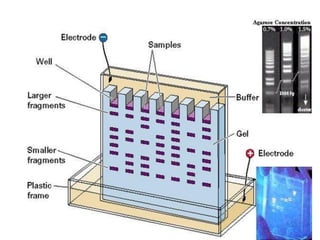
Application
• Determinatio
n of DNA
sequences….
• Formation of
gel
(agarose+buff
er)
• Heat it and
allowed to
cool down
• Place the gel
in buffer
• Application of
samples
Applications of capillary
electrophoresis
• Following are the fields in which electrophoresis play
important role:
• Pharmaceutics
• Forensic
• Foods
• Bioscience
• Agricultural field
• Pesticide analysis
• Surfactants analysis
• Transition metal analysis
• Organic compound analysis

Electrophoresis , principles and application

  • 1.
    Principle: Any charged ionor molecule migrates when placed in an electric field the rate of migration depend upon its net charge size,shape and the applied electric current.  Mechanism: • Definition=“migration of charged particles or molecules under the influnce of electric current.” • Literally= greek word means transport by electricity. Electrophoresis
  • 2.
    Factors affecting therate of ion mobility – Net charge of molecule – Size & shape of molecule – Electric field strength – Properties of supporting medium – Temperature – pH of the buffer
  • 3.
    Capillary electrophoresis: Sample vialDestination vial Definition; It is a seperation technique in which electrophoresis is performed in narrow bore capillaries typically 25- 100um inner diameter. • Difference from electrophoresis; In traditional electrophoresis,electricall y charged analytes move in a conductive liquid medium under the influence of an electric field,whereas cappilary electrophoresis is designed to separate species based on their charge to size ratio in the interior of small capillary filled with an electrolye.
  • 4.
    Instrumentation  A fusedsilica capillary  Sample vial and destination vial  Two buffer reserviors  A high voltage power supply  Detector  Data output and handling device
  • 5.
    Working of capillaryelectrophoresis
  • 6.
    1-Capillary zone electrophoresis (CZE) PRINCIPLE“In CZE,analytes are seperated in a capillary containing only buffer,without any anti convective medium” Mechanism: EXAMPLE: Separation of small ions, some proteins, amino acids, and carbohydrate.
  • 7.
    2-Capillary gel electrophoresis(CGE) Principle; “seperation takes place inside a capillary filled with a gel which acts as a molecular sieve” Mechanism;  Gels:  linear noncrosslinked polyacrylamide (CH2=CH-CO-NH2) (C- PAGE)  dextran,  agarose, and  poly(ethyleneoxide) • Gel matrix viscosity, density, and pore size are all factors in determining the ‘speed’ of separation. • Two types of separation can be done using GE: o Native: separation by size and o charge (charge/mass) o Denaturing: separation by size
  • 8.
    Instrumentation • Power supply •Cooling Apparatus • Electrophoresis gel apparatus • White Light/UV Light Box • Digital Camera/Gel Documentation System • Working: • Prepare samples • Prepare gel and buffers • Load samples onto gel • Run gel • Stain gel • Interpret/analysis of gel • Archive (photograph, dry gel)
  • 9.
    Application • Determinatio n ofDNA sequences…. • Formation of gel (agarose+buff er) • Heat it and allowed to cool down • Place the gel in buffer • Application of samples
  • 11.
    Applications of capillary electrophoresis •Following are the fields in which electrophoresis play important role: • Pharmaceutics • Forensic • Foods • Bioscience • Agricultural field • Pesticide analysis • Surfactants analysis • Transition metal analysis • Organic compound analysis