Presented by:
A. Sireesha Bai
M. Pharmacy (first year)
19HC1S0701
Department Of Pharmaceutical Analysis
Santhiram college of pharmacy
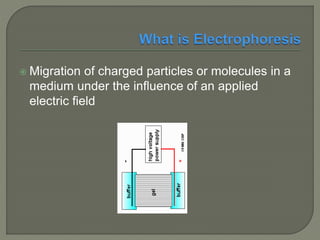
 Migration of charged particles or molecules in a
medium under the influence of an applied
electric field
 To determine number, amount and mobility
of components in a given sample or to
separate them.
 To obtain information about the electric
double layers surrounding the particles.
 Determination of molecular weight of
proteins and DNA sequences
Paper electrophoresis
Gel electrophoresis
Capillary electrophoresis
Iso- electric focusing electrophoresis
Thin layer electrophoresis
 It is relatively new separation technique
compared to the traditional agarose gel
electrophoresis
 Separation of analyte ions is performed in an
electrolyte solution present in a narrow
capillary
 one of the major advantage of CE over other
separation techniques is the ability to
separate both charged and non charged
molecules
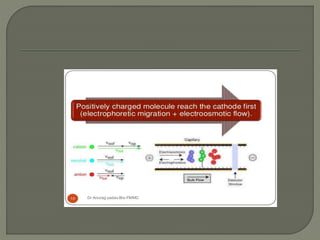
 CE is an analytical technique that separates
ions based on their electrophoretic mobility
and electrosmotic flow
 The rate at which the particles moves is
directly proportional to the applied electric
field
 Neutral species are not affected only ions
move with electric field
If 2 ions are of same size the one with
greater charge will move fastest. For the
ions of same charge, the smaller particles
has less friction and overall faster
migration rate.
CE is mostly used because it gives fast
results and provides high resolution
separation and has large range of
detection methods
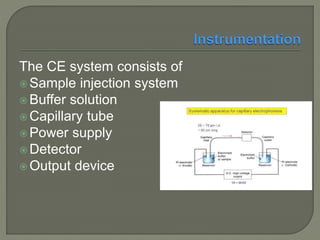
The CE system consists of
 Sample injection system
 Buffer solution
 Capillary tube
 Power supply
 Detector
 Output device
It is done by either one of the methods
Electro kinetic injection
The sample is introduced by inserting the anode end of the
capillary into the sample vial and then applying electric field
to the sample vial
Hydrodynamic injection
The sample is introduced by inserting the anode end of the
capillary into the sample vial and then applying pressure on
the vial
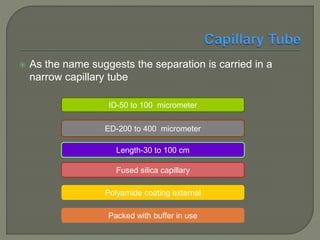
 As the name suggests the separation is carried in a
narrow capillary tube
Length-30 to 100 cm
Fused silica capillary
Polyamide coating external
ED-200 to 400 micrometer
ID-50 to 100 micrometer
Packed with buffer in use
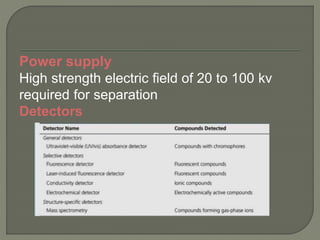
Power supply
High strength electric field of 20 to 100 kv
required for separation
Detectors
Advantages
 High separation
efficiency
 Short analysis time
 Low sample and
electrolyte
consumption
 Low waste generation
 Easy of operation
Disadvantages
 Due to small diameter of
the capillary tube heat is
dissipated that causes
increased diffusion
 Due to this the
resolution is not always
proper
Capillary Zone Electrophoresis
Capillary Gel Electrophoresis
Capillary Iso Electric Focusing
Capillary Isotachophoresis
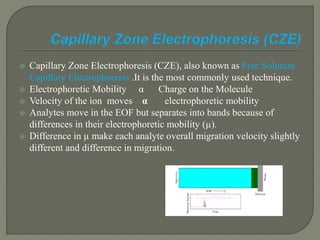
 Capillary Zone Electrophoresis (CZE), also known as Free Solution
Capillary Electrophoresis .It is the most commonly used technique.
 Electrophoretic Mobility α Charge on the Molecule
 Velocity of the ion moves α electrophoretic mobility
 Analytes move in the EOF but separates into bands because of
differences in their electrophoretic mobility (µ).
 Difference in µ make each analyte overall migration velocity slightly
different and difference in migration.
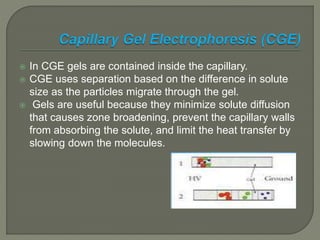
 In CGE gels are contained inside the capillary.
 CGE uses separation based on the difference in solute
size as the particles migrate through the gel.
 Gels are useful because they minimize solute diffusion
that causes zone broadening, prevent the capillary walls
from absorbing the solute, and limit the heat transfer by
slowing down the molecules.
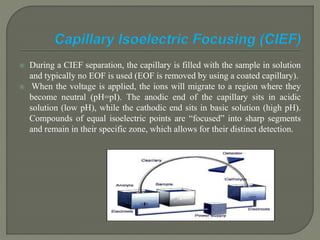
 During a CIEF separation, the capillary is filled with the sample in solution
and typically no EOF is used (EOF is removed by using a coated capillary).
 When the voltage is applied, the ions will migrate to a region where they
become neutral (pH=pI). The anodic end of the capillary sits in acidic
solution (low pH), while the cathodic end sits in basic solution (high pH).
Compounds of equal isoelectric points are “focused” into sharp segments
and remain in their specific zone, which allows for their distinct detection.
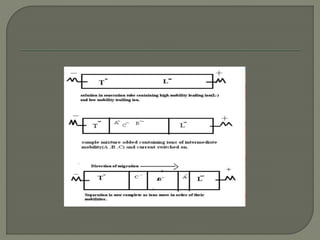
 CITP is the only method to be used in a discontinuous
system i.e., leading electrolyte and trailing electrolyte
 When the current is applied the leading ions will move
towards appropriate electrode.
 The sample ions will follow in order of their mobilites. The
trailing will follow the sample ions
 Once equilibrium is achieved ions will move at same
speed in discrete bands in order of their mobilities.
 The analyte migrates in consecutive zones and each
zone length can be measured to find the quantity of
sample present.
 Charge
 Mass and shape of the particle
 pH of the medium
 Strength of electric field
 Temperature
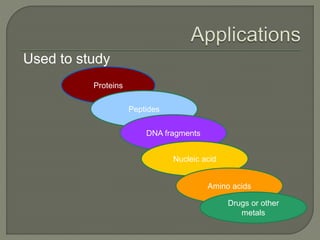
Proteins
Peptides
DNA fragments
Nucleic acid
Amino acids
Drugs or other
metals
Used to study
Thank you

Capillary electrophoresis

  • 1.
    Presented by: A. SireeshaBai M. Pharmacy (first year) 19HC1S0701 Department Of Pharmaceutical Analysis Santhiram college of pharmacy
  • 2.
     Migration ofcharged particles or molecules in a medium under the influence of an applied electric field
  • 3.
     To determinenumber, amount and mobility of components in a given sample or to separate them.  To obtain information about the electric double layers surrounding the particles.  Determination of molecular weight of proteins and DNA sequences
  • 4.
    Paper electrophoresis Gel electrophoresis Capillaryelectrophoresis Iso- electric focusing electrophoresis Thin layer electrophoresis
  • 5.
     It isrelatively new separation technique compared to the traditional agarose gel electrophoresis  Separation of analyte ions is performed in an electrolyte solution present in a narrow capillary  one of the major advantage of CE over other separation techniques is the ability to separate both charged and non charged molecules
  • 6.
     CE isan analytical technique that separates ions based on their electrophoretic mobility and electrosmotic flow  The rate at which the particles moves is directly proportional to the applied electric field  Neutral species are not affected only ions move with electric field
  • 7.
    If 2 ionsare of same size the one with greater charge will move fastest. For the ions of same charge, the smaller particles has less friction and overall faster migration rate. CE is mostly used because it gives fast results and provides high resolution separation and has large range of detection methods
  • 9.
    The CE systemconsists of  Sample injection system  Buffer solution  Capillary tube  Power supply  Detector  Output device
  • 10.
    It is doneby either one of the methods Electro kinetic injection The sample is introduced by inserting the anode end of the capillary into the sample vial and then applying electric field to the sample vial Hydrodynamic injection The sample is introduced by inserting the anode end of the capillary into the sample vial and then applying pressure on the vial
  • 11.
     As thename suggests the separation is carried in a narrow capillary tube Length-30 to 100 cm Fused silica capillary Polyamide coating external ED-200 to 400 micrometer ID-50 to 100 micrometer Packed with buffer in use
  • 12.
    Power supply High strengthelectric field of 20 to 100 kv required for separation Detectors
  • 13.
    Advantages  High separation efficiency Short analysis time  Low sample and electrolyte consumption  Low waste generation  Easy of operation Disadvantages  Due to small diameter of the capillary tube heat is dissipated that causes increased diffusion  Due to this the resolution is not always proper
  • 14.
    Capillary Zone Electrophoresis CapillaryGel Electrophoresis Capillary Iso Electric Focusing Capillary Isotachophoresis
  • 15.
     Capillary ZoneElectrophoresis (CZE), also known as Free Solution Capillary Electrophoresis .It is the most commonly used technique.  Electrophoretic Mobility α Charge on the Molecule  Velocity of the ion moves α electrophoretic mobility  Analytes move in the EOF but separates into bands because of differences in their electrophoretic mobility (µ).  Difference in µ make each analyte overall migration velocity slightly different and difference in migration.
  • 16.
     In CGEgels are contained inside the capillary.  CGE uses separation based on the difference in solute size as the particles migrate through the gel.  Gels are useful because they minimize solute diffusion that causes zone broadening, prevent the capillary walls from absorbing the solute, and limit the heat transfer by slowing down the molecules.
  • 17.
     During aCIEF separation, the capillary is filled with the sample in solution and typically no EOF is used (EOF is removed by using a coated capillary).  When the voltage is applied, the ions will migrate to a region where they become neutral (pH=pI). The anodic end of the capillary sits in acidic solution (low pH), while the cathodic end sits in basic solution (high pH). Compounds of equal isoelectric points are “focused” into sharp segments and remain in their specific zone, which allows for their distinct detection.
  • 18.
     CITP isthe only method to be used in a discontinuous system i.e., leading electrolyte and trailing electrolyte  When the current is applied the leading ions will move towards appropriate electrode.  The sample ions will follow in order of their mobilites. The trailing will follow the sample ions  Once equilibrium is achieved ions will move at same speed in discrete bands in order of their mobilities.  The analyte migrates in consecutive zones and each zone length can be measured to find the quantity of sample present.
  • 20.
     Charge  Massand shape of the particle  pH of the medium  Strength of electric field  Temperature
  • 21.
    Proteins Peptides DNA fragments Nucleic acid Aminoacids Drugs or other metals Used to study
  • 22.