By
Mr. Ravi Rai Dangi
Assistant Professor
MSc. Child Health Nursing
Refractive Error
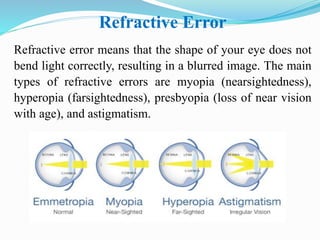
Refractive error means that the shape of your eye does not
bend light correctly, resulting in a blurred image. The main
types of refractive errors are myopia (nearsightedness),
hyperopia (farsightedness), presbyopia (loss of near vision
with age), and astigmatism.
Refraction Means
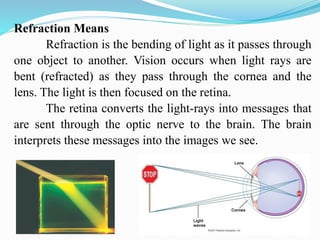
Refraction is the bending of light as it passes through
one object to another. Vision occurs when light rays are
bent (refracted) as they pass through the cornea and the
lens. The light is then focused on the retina.
The retina converts the light-rays into messages that
are sent through the optic nerve to the brain. The brain
interprets these messages into the images we see.
Signs and Symptoms
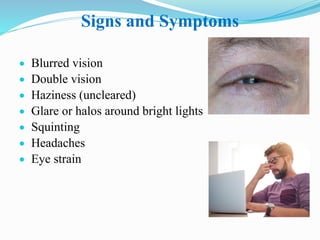
 Blurred vision
 Double vision
 Haziness (uncleared)
 Glare or halos around bright lights
 Squinting
 Headaches
 Eye strain
Risk factor / Etiology
Genetics
 Marfan syndrome
 X-linked disorders
Environmental
 Reading has also been found to be a predictor of
myopia in children.
 Socioeconomic status and higher levels of education
have also been reported to be a risk factor for
myopia.
Types
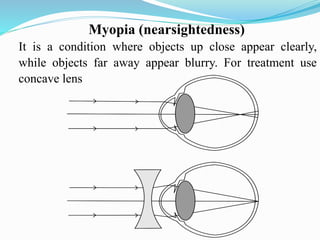
Myopia (nearsightedness)
It is a condition where objects up close appear clearly,
while objects far away appear blurry. For treatment use
concave lens
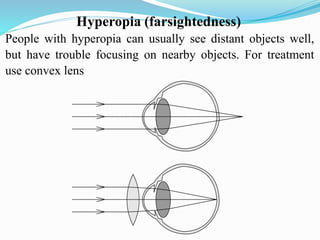
Hyperopia (farsightedness)
People with hyperopia can usually see distant objects well,
but have trouble focusing on nearby objects. For treatment
use convex lens
Astigmatism
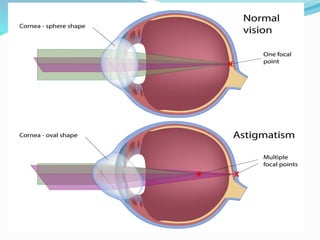
 It is a condition in which the eye does not focus light
evenly onto the retina, the light-sensitive tissue at the
back of the eye.
 This can cause images to appear blurry and stretched out.
 Cylindrical error occurs when the incoming light rays are
unable to reach a common focus within the eye.
 Astigmatism distorts or blurs vision for both near and far
objects.
Presbyopia
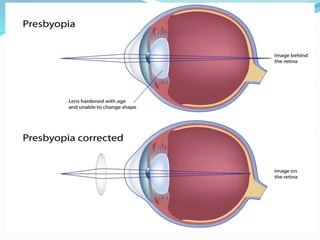
 It is an age-related condition in which the ability to focus
up close becomes more difficult.
 As the eye ages, the lens can no longer change shape
enough to allow the eye to focus close objects clearly.
When the flexibility of the lens declines, typically due to
age.
 The individual would experience difficulty in near vision,
often relieved by reading glasses, bifocal, or progressive
lenses
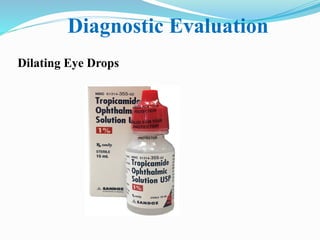
Diagnostic Evaluation
Dilating Eye Drops
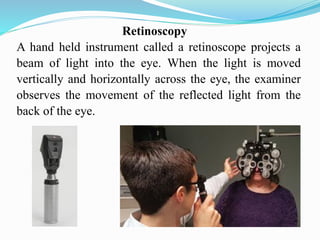
Retinoscopy
A hand held instrument called a retinoscope projects a
beam of light into the eye. When the light is moved
vertically and horizontally across the eye, the examiner
observes the movement of the reflected light from the
back of the eye.
 This reflection is called red reflex. The examiner then
introduces lenses in front of the eye and as the power
of the lenses changes, there is a corresponding change
in the direction and pattern of the reflection.
 The examiner keeps changing the lenses until reaching
a lens power that indicates the refractive error of the
patient.
Management
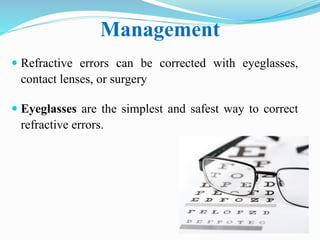
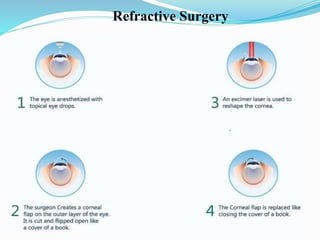
 Refractive errors can be corrected with eyeglasses,
contact lenses, or surgery
 Eyeglasses are the simplest and safest way to correct
refractive errors.
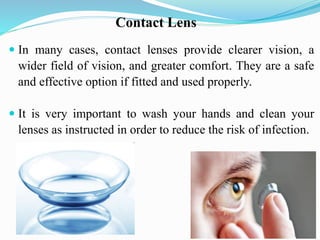
 In many cases, contact lenses provide clearer vision, a
wider field of vision, and greater comfort. They are a safe
and effective option if fitted and used properly.
 It is very important to wash your hands and clean your
lenses as instructed in order to reduce the risk of infection.
Contact Lens
Refractive Surgery

Refractive error

  • 1.
    By Mr. Ravi RaiDangi Assistant Professor MSc. Child Health Nursing
  • 2.
    Refractive Error Refractive errormeans that the shape of your eye does not bend light correctly, resulting in a blurred image. The main types of refractive errors are myopia (nearsightedness), hyperopia (farsightedness), presbyopia (loss of near vision with age), and astigmatism.
  • 3.
    Refraction Means Refraction isthe bending of light as it passes through one object to another. Vision occurs when light rays are bent (refracted) as they pass through the cornea and the lens. The light is then focused on the retina. The retina converts the light-rays into messages that are sent through the optic nerve to the brain. The brain interprets these messages into the images we see.
  • 4.
    Signs and Symptoms Blurred vision  Double vision  Haziness (uncleared)  Glare or halos around bright lights  Squinting  Headaches  Eye strain
  • 5.
    Risk factor /Etiology Genetics  Marfan syndrome  X-linked disorders Environmental  Reading has also been found to be a predictor of myopia in children.  Socioeconomic status and higher levels of education have also been reported to be a risk factor for myopia.
  • 6.
  • 7.
    Myopia (nearsightedness) It isa condition where objects up close appear clearly, while objects far away appear blurry. For treatment use concave lens
  • 8.
    Hyperopia (farsightedness) People withhyperopia can usually see distant objects well, but have trouble focusing on nearby objects. For treatment use convex lens
  • 9.
    Astigmatism  It isa condition in which the eye does not focus light evenly onto the retina, the light-sensitive tissue at the back of the eye.  This can cause images to appear blurry and stretched out.  Cylindrical error occurs when the incoming light rays are unable to reach a common focus within the eye.  Astigmatism distorts or blurs vision for both near and far objects.
  • 11.
    Presbyopia  It isan age-related condition in which the ability to focus up close becomes more difficult.  As the eye ages, the lens can no longer change shape enough to allow the eye to focus close objects clearly. When the flexibility of the lens declines, typically due to age.  The individual would experience difficulty in near vision, often relieved by reading glasses, bifocal, or progressive lenses
  • 13.
  • 14.
    Retinoscopy A hand heldinstrument called a retinoscope projects a beam of light into the eye. When the light is moved vertically and horizontally across the eye, the examiner observes the movement of the reflected light from the back of the eye.
  • 15.
     This reflectionis called red reflex. The examiner then introduces lenses in front of the eye and as the power of the lenses changes, there is a corresponding change in the direction and pattern of the reflection.  The examiner keeps changing the lenses until reaching a lens power that indicates the refractive error of the patient.
  • 16.
    Management  Refractive errorscan be corrected with eyeglasses, contact lenses, or surgery  Eyeglasses are the simplest and safest way to correct refractive errors.
  • 17.
     In manycases, contact lenses provide clearer vision, a wider field of vision, and greater comfort. They are a safe and effective option if fitted and used properly.  It is very important to wash your hands and clean your lenses as instructed in order to reduce the risk of infection. Contact Lens
  • 18.