Introduction to Differential
Calculus
 Basic differential calculus for algebra students who are
becoming familiar with the concept of the slopes of lines.
 Slides by Paul E. Roundy, November 29, 2015

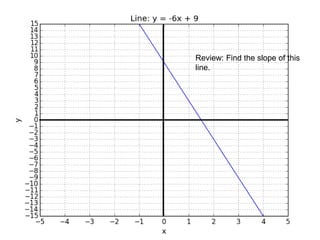
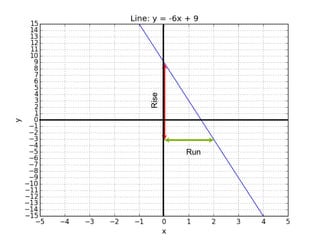
Review: Find the slope of this
line.

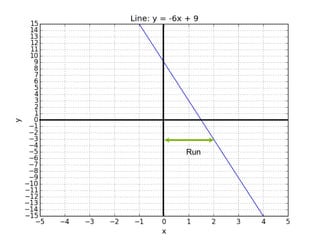
Run

RunRise

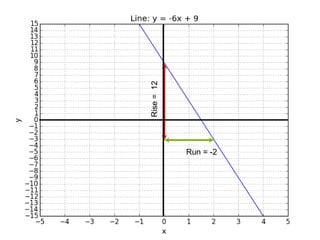
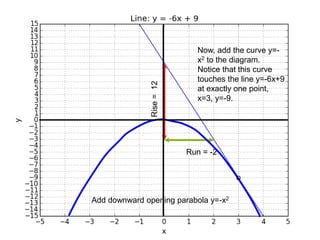
Run = -2Rise=12

Run = -2Rise=12
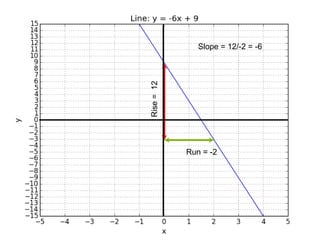
Slope = 12/-2 = -6

Run = -2Rise=12
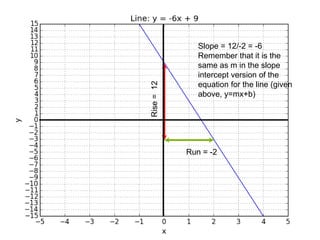
Slope = 12/-2 = -6
Remember that it is the
same as m in the slope
intercept version of the
equation for the line (given
above, y=mx+b)

Run = -2Rise=12
o
Add downward opening parabola y=-x2
Now, add the curve y=-
x2 to the diagram.
Notice that this curve
touches the line y=-6x+9
at exactly one point,
x=3, y=-9.
y = -x2
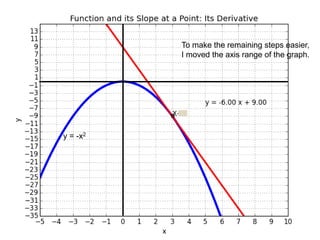
To make the remaining steps easier,
I moved the axis range of the graph.
y = -x2
x
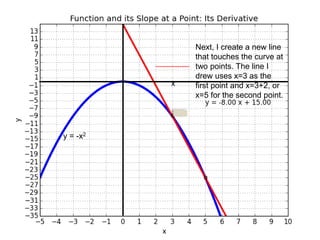
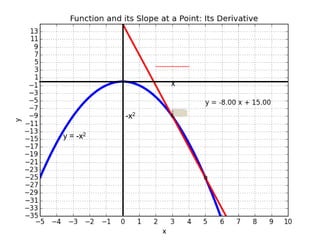
Next, I create a new line
that touches the curve at
two points. The line I
drew uses x=3 as the
first point and x=3+2, or
x=5 for the second point.
y = -x2
x
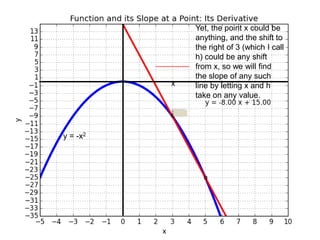
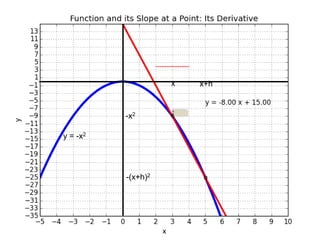
Yet, the point x could be
anything, and the shift to
the right of 3 (which I call
h) could be any shift
from x, so we will find
the slope of any such
line by letting x and h
take on any value.
y = -x2
x
-x2
y = -x2
x x+h
-x2
-(x+h)2
y = -x2
x x+h
-x2
-(x+h)2
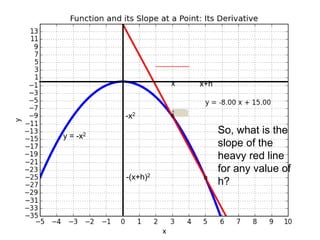
So, what is the
slope of the
heavy red line
for any value of
h?
y = -x2
x x+h
-x2
-(x+h)2
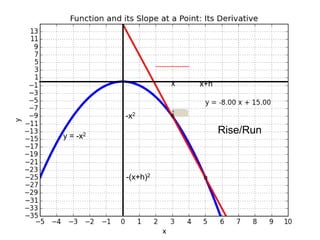
Rise/Run
y = -x2
x x+h
-x2
-(x+h)2
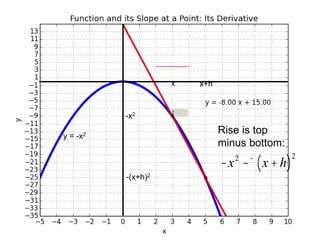
Rise is top
minus bottom:
-x2
--
x+h( )
2
y = -x2
x x+h
-x2
-(x+h)2
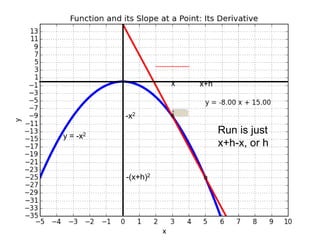
Run is just
x+h-x, or h
y = -x2
x x+h
-x2
-(x+h)2
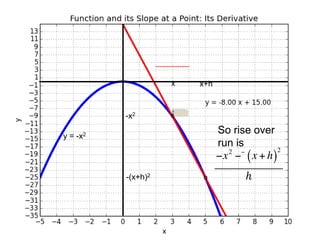
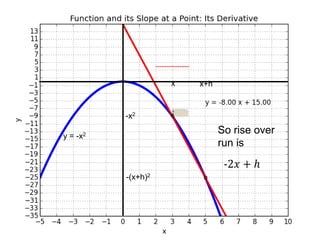
So rise over
run is
y = -x2
x x+h
-x2
-(x+h)2
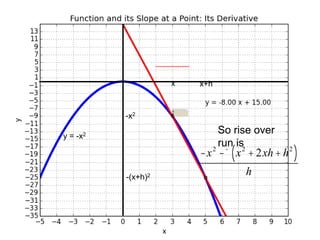
So rise over
run is
-x2
--
x2
+ 2xh+ h2
( )
h
y = -x2
x x+h
-x2
-(x+h)2
So rise over
run is
y = -x2
x x+h
-x2
-(x+h)2
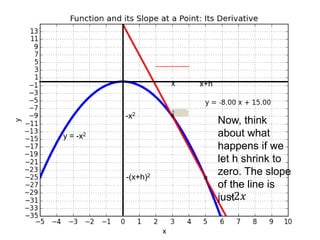
Now, think
about what
happens if we
let h shrink to
zero. The slope
of the line is
just
y = -x2
y = -x2
y = -x2
y = -x2
y = -x2
y = -x2
y = -x2
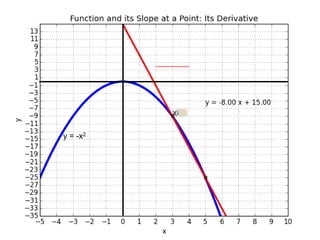
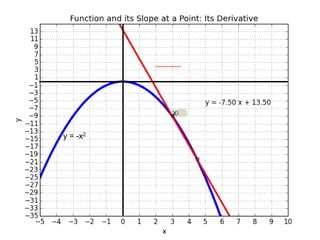
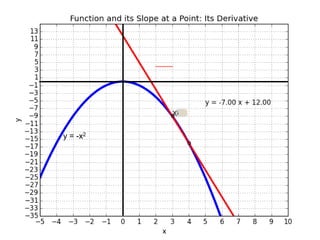
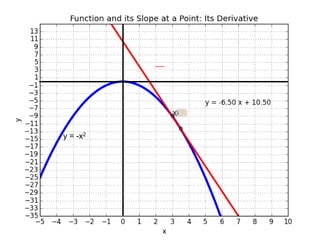
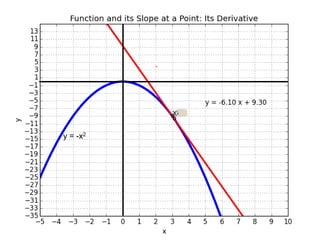
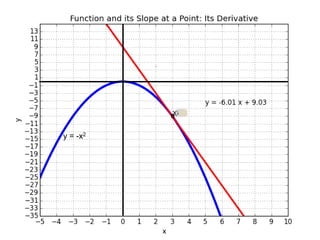
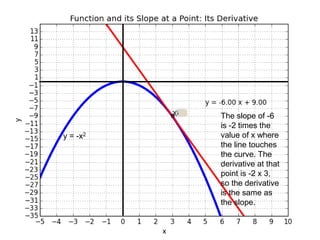
The slope of -6
is -2 times the
value of x where
the line touches
the curve. The
derivative at that
point is -2 x 3,
so the derivative
is the same as
the slope.
Congratulations!
 You have found the “derivative” of the curve y = -x2. It is -
2x. That means that no matter at what single point the
line touches the curve, its slope will be -2 times the value
of x at that point.
 Try the steps again for other functions, such as y = x3.
 The algebra will be more complicated, but the steps are the
same. The result for y=x3 is 3x2.

Derivativedemo

  • 1.
    Introduction to Differential Calculus Basic differential calculus for algebra students who are becoming familiar with the concept of the slopes of lines.  Slides by Paul E. Roundy, November 29, 2015
  • 2.
     Review: Find theslope of this line.
  • 3.
  • 4.
  • 5.
  • 6.
  • 7.
     Run = -2Rise=12 Slope= 12/-2 = -6 Remember that it is the same as m in the slope intercept version of the equation for the line (given above, y=mx+b)
  • 8.
     Run = -2Rise=12 o Adddownward opening parabola y=-x2 Now, add the curve y=- x2 to the diagram. Notice that this curve touches the line y=-6x+9 at exactly one point, x=3, y=-9.
  • 9.
    y = -x2 Tomake the remaining steps easier, I moved the axis range of the graph.
  • 10.
    y = -x2 x Next,I create a new line that touches the curve at two points. The line I drew uses x=3 as the first point and x=3+2, or x=5 for the second point.
  • 11.
    y = -x2 x Yet,the point x could be anything, and the shift to the right of 3 (which I call h) could be any shift from x, so we will find the slope of any such line by letting x and h take on any value.
  • 12.
  • 13.
    y = -x2 xx+h -x2 -(x+h)2
  • 14.
    y = -x2 xx+h -x2 -(x+h)2 So, what is the slope of the heavy red line for any value of h?
  • 15.
    y = -x2 xx+h -x2 -(x+h)2 Rise/Run
  • 16.
    y = -x2 xx+h -x2 -(x+h)2 Rise is top minus bottom: -x2 -- x+h( ) 2
  • 17.
    y = -x2 xx+h -x2 -(x+h)2 Run is just x+h-x, or h
  • 18.
    y = -x2 xx+h -x2 -(x+h)2 So rise over run is
  • 19.
    y = -x2 xx+h -x2 -(x+h)2 So rise over run is -x2 -- x2 + 2xh+ h2 ( ) h
  • 20.
    y = -x2 xx+h -x2 -(x+h)2 So rise over run is
  • 21.
    y = -x2 xx+h -x2 -(x+h)2 Now, think about what happens if we let h shrink to zero. The slope of the line is just
  • 22.
  • 23.
  • 24.
  • 25.
  • 26.
  • 27.
  • 28.
    y = -x2 Theslope of -6 is -2 times the value of x where the line touches the curve. The derivative at that point is -2 x 3, so the derivative is the same as the slope.
  • 29.
    Congratulations!  You havefound the “derivative” of the curve y = -x2. It is - 2x. That means that no matter at what single point the line touches the curve, its slope will be -2 times the value of x at that point.  Try the steps again for other functions, such as y = x3.  The algebra will be more complicated, but the steps are the same. The result for y=x3 is 3x2.