Review of slope from Algebra I
Graphing lines of a known slope and intercept
Slope Review from Algebra I
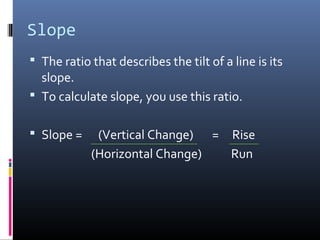
Slope
 The ratio that describes the tilt of a line is its
  slope.
 To calculate slope, you use this ratio.


 Slope =    (Vertical Change) = Rise
            (Horizontal Change)  Run
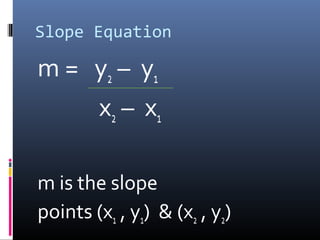
Slope Equation

m = y2 – y 1
    x 2 – x1

m is the slope
points (x1 , y1) & (x2 , y2)
Slope
 A positive slope rises to the right


 A negative slope falls to the right
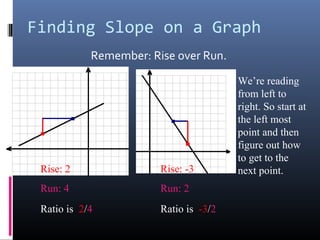
Finding Slope on a Graph
            Remember: Rise over Run.

                                        We’re reading
                                        from left to
                                        right. So start at
                                        the left most
                                        point and then
                                        figure out how
                                        to get to the
 Rise: 2                Rise: -3        next point.
 Run: 4                 Run: 2
 Ratio is 2/4           Ratio is -3/2
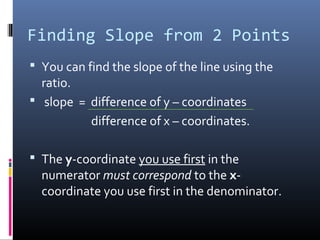
Finding Slope from 2 Points
 You can find the slope of the line using the
  ratio.
 slope = difference of y – coordinates
          difference of x – coordinates.

 The y-coordinate you use first in the
  numerator must correspond to the x-
  coordinate you use first in the denominator.
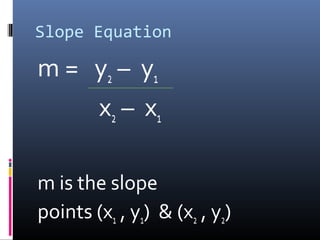
Slope Equation

m = y2 – y 1
    x 2 – x1

m is the slope
points (x1 , y1) & (x2 , y2)
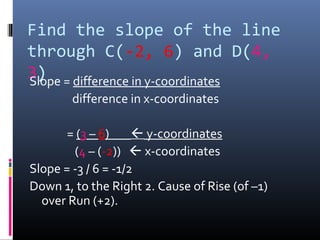
Find the slope of the line
through C(-2, 6) and D(4,
3) = difference in y-coordinates
Slope
        difference in x-coordinates

       = (3 – 6)      y-coordinates
        (4 – (-2))  x-coordinates
Slope = -3 / 6 = -1/2
Down 1, to the Right 2. Cause of Rise (of –1)
  over Run (+2).
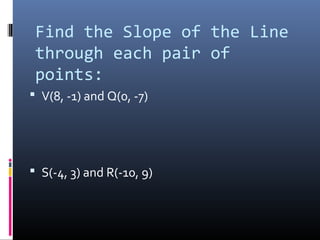
Find the Slope of the Line
 through each pair of
 points:
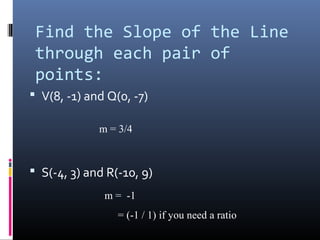
 V(8, -1) and Q(0, -7)


 S(-4, 3) and R(-10, 9)
Find the Slope of the Line
 through each pair of
 points:
 V(8, -1) and Q(0, -7)

             m = 3/4


 S(-4, 3) and R(-10, 9)
              m = -1
                 = (-1 / 1) if you need a ratio
Special Cases

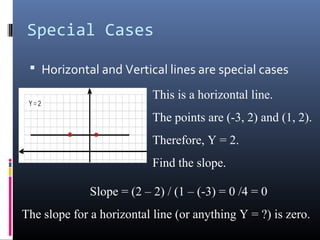
  Horizontal and Vertical lines are special cases

                           This is a horizontal line.
                           The points are (-3, 2) and (1, 2).
                           Therefore, Y = 2.
                           Find the slope.

              Slope = (2 – 2) / (1 – (-3) = 0 /4 = 0
The slope for a horizontal line (or anything Y = ?) is zero.
Special Cases
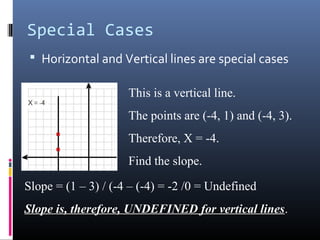
  Horizontal and Vertical lines are special cases

                     This is a vertical line.
                     The points are (-4, 1) and (-4, 3).
                     Therefore, X = -4.
                     Find the slope.

Slope = (1 – 3) / (-4 – (-4) = -2 /0 = Undefined
Slope is, therefore, UNDEFINED for vertical lines.
                                            lines
Finding the Equation of a Line
Formats for a Linear
 Equation
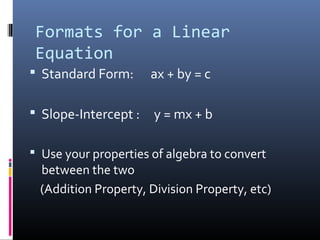
 Standard Form:      ax + by = c

 Slope-Intercept :   y = mx + b

 Use your properties of algebra to convert
 between the two
 (Addition Property, Division Property, etc)
Finding the Equation of a
Line
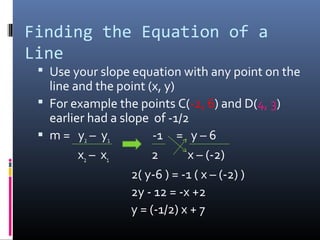
  Use your slope equation with any point on the
   line and the point (x, y)
  For example the points C(-2, 6) and D(4, 3)
   earlier had a slope of -1/2
  m = y2 – y1          -1 = y – 6
         x2 – x 1      2       x – (-2)
                   2( y-6 ) = -1 ( x – (-2) )
                   2y - 12 = -x +2
                   y = (-1/2) x + 7
Graphing Lines
Graphing Lines

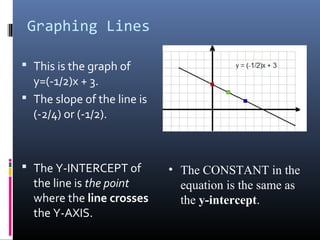
 This is the graph of
  y=(-1/2)x + 3.
 The slope of the line is
  (-2/4) or (-1/2).


 The Y-INTERCEPT of         • The CONSTANT in the
  the line is the point        equation is the same as
  where the line crosses       the y-intercept.
  the Y-AXIS.
Graphing Lines

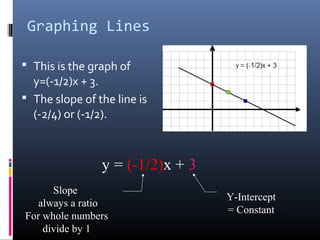
 This is the graph of
  y=(-1/2)x + 3.
 The slope of the line is
  (-2/4) or (-1/2).


                y = (-1/2)x + 3
      Slope
                                  Y-Intercept
   always a ratio
                                  = Constant
For whole numbers
    divide by 1
Using Slope-Intercept Form
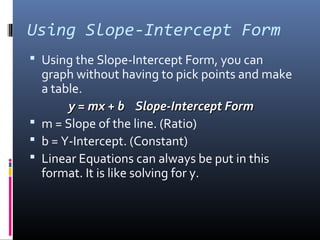
 Using the Slope-Intercept Form, you can
  graph without having to pick points and make
  a table.
       y = mx + b Slope-Intercept Form
 m = Slope of the line. (Ratio)
 b = Y-Intercept. (Constant)
 Linear Equations can always be put in this
  format. It is like solving for y.
To Graph with y = mx + b
1) Start with b. Since b is where the line of the
   equation hits the y-axis, its your first point.
   Point = (0, b)
2) Take the slope, or m. Starting at b, move
   along the RISE and RUN of the ratio.
3) Where you end up is your second point.
4) Connect the two dots with a line. (This is the
   graph of your linear equation).
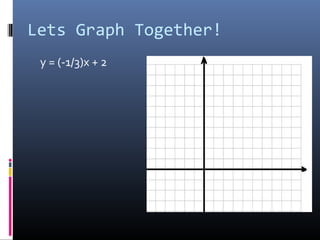
Lets Graph Together!
 y = (-1/3)x + 2
Lets Graph Together!
   y = (-1/3)x + 2
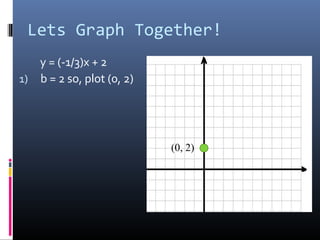
1) b = 2 so, plot (0, 2)


                           (0, 2)
Lets Graph Together!
   y = (-1/3)x + 2
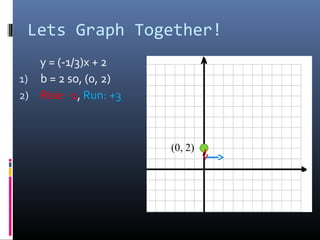
1) b = 2 so, (0, 2)
2) Rise: -1, Run: +3


                       (0, 2)
Lets Graph Together!
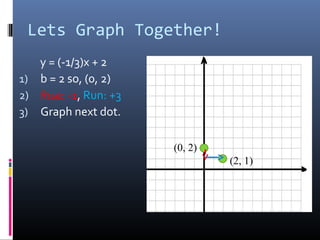
   y = (-1/3)x + 2
1) b = 2 so, (0, 2)
2) Rise: -1, Run: +3
3) Graph next dot.


                       (0, 2)
                                (2, 1)
Lets Graph Together!
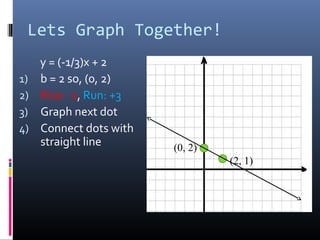
     y = (-1/3)x + 2
1)   b = 2 so, (0, 2)
2)   Rise: -1, Run: +3
3)   Graph next dot
4)   Connect dots with
     straight line       (0, 2)
                                  (2, 1)
Finding Parallel and
Perpendicular Lines
Parallel Lines

 Parallel lines have the same slope


 Find the equation using the same process we
  used above with the slope and the new point
Example of Parallel Line

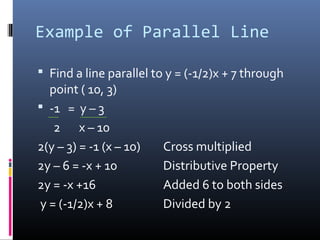
 Find a line parallel to y = (-1/2)x + 7 through
  point ( 10, 3)
 -1 = y – 3
   2 x – 10
2(y – 3) = -1 (x – 10)   Cross multiplied
2y – 6 = -x + 10         Distributive Property
2y = -x +16              Added 6 to both sides
y = (-1/2)x + 8          Divided by 2
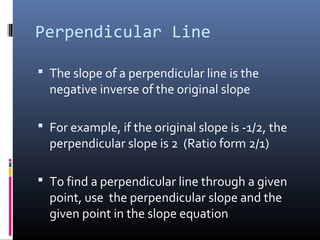
Perpendicular Line

 The slope of a perpendicular line is the
  negative inverse of the original slope

 For example, if the original slope is -1/2, the
  perpendicular slope is 2 (Ratio form 2/1)

 To find a perpendicular line through a given
  point, use the perpendicular slope and the
  given point in the slope equation
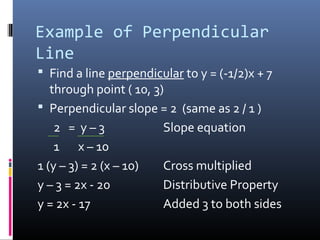
Example of Perpendicular
Line
 Find a line perpendicular to y = (-1/2)x + 7
   through point ( 10, 3)
 Perpendicular slope = 2 (same as 2 / 1 )
    2 = y–3              Slope equation
    1 x – 10
1 (y – 3) = 2 (x – 10)   Cross multiplied
y – 3 = 2x - 20          Distributive Property
y = 2x - 17              Added 3 to both sides
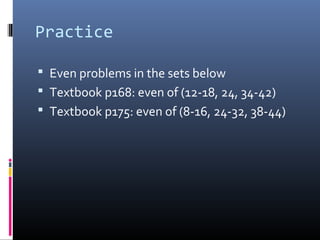
Practice

 Even problems in the sets below
 Textbook p168: even of (12-18, 24, 34-42)
 Textbook p175: even of (8-16, 24-32, 38-44)

Geo 3.6&7 slope

  • 1.
    Review of slopefrom Algebra I Graphing lines of a known slope and intercept
  • 2.
  • 3.
    Slope  The ratiothat describes the tilt of a line is its slope.  To calculate slope, you use this ratio.  Slope = (Vertical Change) = Rise (Horizontal Change) Run
  • 4.
    Slope Equation m =y2 – y 1 x 2 – x1 m is the slope points (x1 , y1) & (x2 , y2)
  • 5.
    Slope  A positiveslope rises to the right  A negative slope falls to the right
  • 6.
    Finding Slope ona Graph Remember: Rise over Run. We’re reading from left to right. So start at the left most point and then figure out how to get to the Rise: 2 Rise: -3 next point. Run: 4 Run: 2 Ratio is 2/4 Ratio is -3/2
  • 7.
    Finding Slope from2 Points  You can find the slope of the line using the ratio.  slope = difference of y – coordinates difference of x – coordinates.  The y-coordinate you use first in the numerator must correspond to the x- coordinate you use first in the denominator.
  • 8.
    Slope Equation m =y2 – y 1 x 2 – x1 m is the slope points (x1 , y1) & (x2 , y2)
  • 9.
    Find the slopeof the line through C(-2, 6) and D(4, 3) = difference in y-coordinates Slope difference in x-coordinates = (3 – 6)  y-coordinates (4 – (-2))  x-coordinates Slope = -3 / 6 = -1/2 Down 1, to the Right 2. Cause of Rise (of –1) over Run (+2).
  • 10.
    Find the Slopeof the Line through each pair of points:  V(8, -1) and Q(0, -7)  S(-4, 3) and R(-10, 9)
  • 11.
    Find the Slopeof the Line through each pair of points:  V(8, -1) and Q(0, -7) m = 3/4  S(-4, 3) and R(-10, 9) m = -1 = (-1 / 1) if you need a ratio
  • 12.
    Special Cases Horizontal and Vertical lines are special cases This is a horizontal line. The points are (-3, 2) and (1, 2). Therefore, Y = 2. Find the slope. Slope = (2 – 2) / (1 – (-3) = 0 /4 = 0 The slope for a horizontal line (or anything Y = ?) is zero.
  • 13.
    Special Cases Horizontal and Vertical lines are special cases This is a vertical line. The points are (-4, 1) and (-4, 3). Therefore, X = -4. Find the slope. Slope = (1 – 3) / (-4 – (-4) = -2 /0 = Undefined Slope is, therefore, UNDEFINED for vertical lines. lines
  • 14.
  • 15.
    Formats for aLinear Equation  Standard Form: ax + by = c  Slope-Intercept : y = mx + b  Use your properties of algebra to convert between the two (Addition Property, Division Property, etc)
  • 16.
    Finding the Equationof a Line  Use your slope equation with any point on the line and the point (x, y)  For example the points C(-2, 6) and D(4, 3) earlier had a slope of -1/2  m = y2 – y1 -1 = y – 6 x2 – x 1 2 x – (-2) 2( y-6 ) = -1 ( x – (-2) ) 2y - 12 = -x +2 y = (-1/2) x + 7
  • 17.
  • 18.
    Graphing Lines  Thisis the graph of y=(-1/2)x + 3.  The slope of the line is (-2/4) or (-1/2).  The Y-INTERCEPT of • The CONSTANT in the the line is the point equation is the same as where the line crosses the y-intercept. the Y-AXIS.
  • 19.
    Graphing Lines  Thisis the graph of y=(-1/2)x + 3.  The slope of the line is (-2/4) or (-1/2). y = (-1/2)x + 3 Slope Y-Intercept always a ratio = Constant For whole numbers divide by 1
  • 20.
    Using Slope-Intercept Form Using the Slope-Intercept Form, you can graph without having to pick points and make a table. y = mx + b Slope-Intercept Form  m = Slope of the line. (Ratio)  b = Y-Intercept. (Constant)  Linear Equations can always be put in this format. It is like solving for y.
  • 21.
    To Graph withy = mx + b 1) Start with b. Since b is where the line of the equation hits the y-axis, its your first point. Point = (0, b) 2) Take the slope, or m. Starting at b, move along the RISE and RUN of the ratio. 3) Where you end up is your second point. 4) Connect the two dots with a line. (This is the graph of your linear equation).
  • 22.
    Lets Graph Together! y = (-1/3)x + 2
  • 23.
    Lets Graph Together! y = (-1/3)x + 2 1) b = 2 so, plot (0, 2) (0, 2)
  • 24.
    Lets Graph Together! y = (-1/3)x + 2 1) b = 2 so, (0, 2) 2) Rise: -1, Run: +3 (0, 2)
  • 25.
    Lets Graph Together! y = (-1/3)x + 2 1) b = 2 so, (0, 2) 2) Rise: -1, Run: +3 3) Graph next dot. (0, 2) (2, 1)
  • 26.
    Lets Graph Together! y = (-1/3)x + 2 1) b = 2 so, (0, 2) 2) Rise: -1, Run: +3 3) Graph next dot 4) Connect dots with straight line (0, 2) (2, 1)
  • 27.
  • 28.
    Parallel Lines  Parallellines have the same slope  Find the equation using the same process we used above with the slope and the new point
  • 29.
    Example of ParallelLine  Find a line parallel to y = (-1/2)x + 7 through point ( 10, 3)  -1 = y – 3 2 x – 10 2(y – 3) = -1 (x – 10) Cross multiplied 2y – 6 = -x + 10 Distributive Property 2y = -x +16 Added 6 to both sides y = (-1/2)x + 8 Divided by 2
  • 30.
    Perpendicular Line  Theslope of a perpendicular line is the negative inverse of the original slope  For example, if the original slope is -1/2, the perpendicular slope is 2 (Ratio form 2/1)  To find a perpendicular line through a given point, use the perpendicular slope and the given point in the slope equation
  • 31.
    Example of Perpendicular Line Find a line perpendicular to y = (-1/2)x + 7 through point ( 10, 3)  Perpendicular slope = 2 (same as 2 / 1 ) 2 = y–3 Slope equation 1 x – 10 1 (y – 3) = 2 (x – 10) Cross multiplied y – 3 = 2x - 20 Distributive Property y = 2x - 17 Added 3 to both sides
  • 32.
    Practice  Even problemsin the sets below  Textbook p168: even of (12-18, 24, 34-42)  Textbook p175: even of (8-16, 24-32, 38-44)