Table of contents
Introduction……………………………………….1
Contents

Airspeed Indicator……………………………2

Attitude indicAtor……………………..3
Altimeter………………………….…….…..4
turn indicAtor ………………….…………………..5

Heading indicAtor…….…………………...6
verticAl Speed indicAtor………….7
modern flight inStrument………….8
Bibliography………………………………………9

0
INTRODUCTION
Flight I Instrument is an equipment in the aircraft that used for the purpose of
navigation & communication. There is 2 type of flight instrument that widely used
in aircraft that is basic flight instrument and modern flight instrument or Glass
Cockpit
Basic flight instrument
Airspeed Indicator
Attitude indicator
Altimeter
Turn Indicator
Heading Indicator
Vertical Speed Indicator
Modern flight instrument (Glass Cockpit)
An Electronic Flight Instrument System (EFIS) is a flight deck instrument display
system in which the display technology used is electronic rather than
electromechanical. EFIS normally consists of a primary flight display (PFD),
multi-function display (MFD) and Electronic Centralized Aircraft Monitoring
(ECAM) display.

1
Airspeed Indicator

Airspeed Indicator

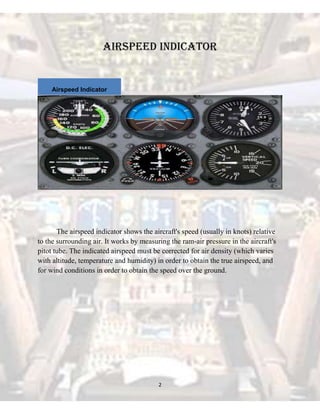
The airspeed indicator shows the aircraft's speed (usually in knots) relative
to the surrounding air. It works by measuring the ram-air pressure in the aircraft's
pitot tube. The indicated airspeed must be corrected for air density (which varies
with altitude, temperature and humidity) in order to obtain the true airspeed, and
for wind conditions in order to obtain the speed over the ground.

2
Attitude indicator

Attitude Indicator

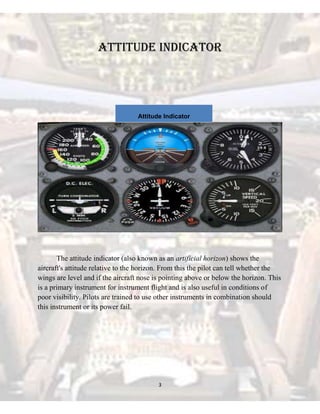
The attitude indicator (also known as an artificial horizon) shows the
aircraft's attitude relative to the horizon. From this the pilot can tell whether the
wings are level and if the aircraft nose is pointing above or below the horizon. This
is a primary instrument for instrument flight and is also useful in conditions of
poor visibility. Pilots are trained to use other instruments in combination should
this instrument or its power fail.

3
Altimeter

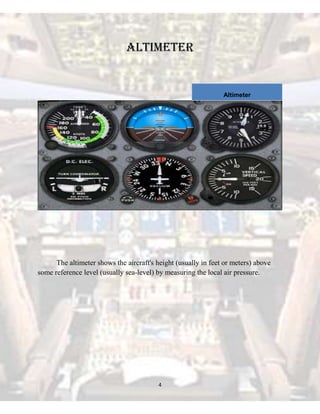
Altimeter

The altimeter shows the aircraft's height (usually in feet or meters) above
some reference level (usually sea-level) by measuring the local air pressure.

4
Turn Indicator

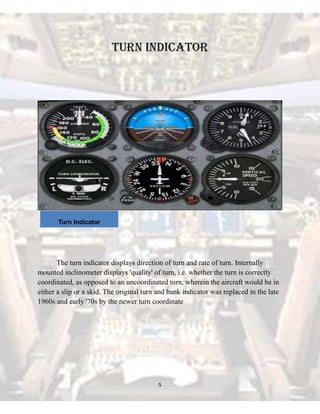
Turn Indicator

The turn indicator displays direction of turn and rate of turn. Internally
mounted inclinometer displays 'quality' of turn, i.e. whether the turn is correctly
coordinated, as opposed to an uncoordinated turn, wherein the aircraft would be in
either a slip or a skid. The original turn and bank indicator was replaced in the late
1960s and early '70s by the newer turn coordinate

5
Heading Indicator

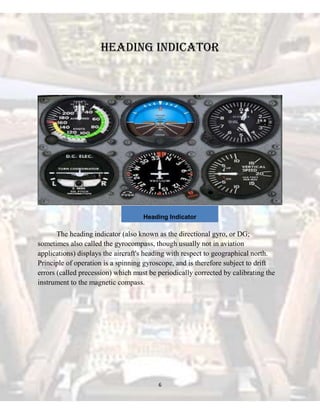
Heading Indicator

The heading indicator (also known as the directional gyro, or DG;
sometimes also called the gyrocompass, though usually not in aviation
applications) displays the aircraft's heading with respect to geographical north.
Principle of operation is a spinning gyroscope, and is therefore subject to drift
errors (called precession) which must be periodically corrected by calibrating the
instrument to the magnetic compass.

6
Vertical Speed Indicator

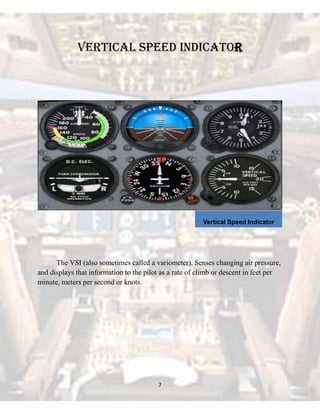
Vertical Speed Indicator

The VSI (also sometimes called a variometer). Senses changing air pressure,
and displays that information to the pilot as a rate of climb or descent in feet per
minute, meters per second or knots.

7
MODERN FLIGHT INSTRUMENt
(Glass Cockpit)

Primary Flight Display (PFD)
On the flight deck, the display units are the most obvious parts of an EFIS system, and are the
features which give rise to the name "glass cockpit". The display unit taking the place of the ADI
is called the primary flight display (PFD). If a separate display replaces the HSI, it is called the
navigation display. The PFD displays all information critical to flight, including calibrated
airspeed, altitude, heading, attitude, vertical speed and yaw.

Multi-Function Display (MFD) / Navigation Display (ND)
The MFD (Multi-Function Display) displays navigational and weather information from multiple
systems. where the aircrew can overlay different information over a map or chart. Examples of
MFD overlay information include the aircraft's current route plan, weather information from
either on-board radar or lightning detection sensors or ground-based sensors, e.g., restricted
airspace and aircraft traffic. The MFD can also be used to view other or calculated overlay-type
data, example radius of the aircraft, given current location over terrain, winds, and aircraft speed
and altitude.

Electronic Centralized Aircraft Monitoring (ECAM)
Displays information about the aircraft's systems, including its fuel, electrical and propulsion

8
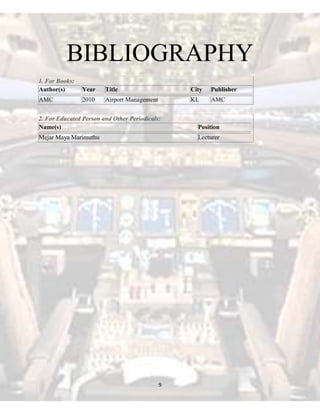
BIBLIOGRAPHY
1. For Books:
Author(s)

Year

Title

City

Publisher

AMC

2010

Airport Management

KL

AMC

2. For Educated Person and Other Periodicals:
Name(s)

Position

Mejar Maya Marimuthu

Lecturer

9

Flight Instrument .

  • 1.
    Table of contents Introduction……………………………………….1 Contents AirspeedIndicator……………………………2 Attitude indicAtor……………………..3 Altimeter………………………….…….…..4 turn indicAtor ………………….…………………..5 Heading indicAtor…….…………………...6 verticAl Speed indicAtor………….7 modern flight inStrument………….8 Bibliography………………………………………9 0
  • 2.
    INTRODUCTION Flight I Instrumentis an equipment in the aircraft that used for the purpose of navigation & communication. There is 2 type of flight instrument that widely used in aircraft that is basic flight instrument and modern flight instrument or Glass Cockpit Basic flight instrument Airspeed Indicator Attitude indicator Altimeter Turn Indicator Heading Indicator Vertical Speed Indicator Modern flight instrument (Glass Cockpit) An Electronic Flight Instrument System (EFIS) is a flight deck instrument display system in which the display technology used is electronic rather than electromechanical. EFIS normally consists of a primary flight display (PFD), multi-function display (MFD) and Electronic Centralized Aircraft Monitoring (ECAM) display. 1
  • 3.
    Airspeed Indicator Airspeed Indicator Theairspeed indicator shows the aircraft's speed (usually in knots) relative to the surrounding air. It works by measuring the ram-air pressure in the aircraft's pitot tube. The indicated airspeed must be corrected for air density (which varies with altitude, temperature and humidity) in order to obtain the true airspeed, and for wind conditions in order to obtain the speed over the ground. 2
  • 4.
    Attitude indicator Attitude Indicator Theattitude indicator (also known as an artificial horizon) shows the aircraft's attitude relative to the horizon. From this the pilot can tell whether the wings are level and if the aircraft nose is pointing above or below the horizon. This is a primary instrument for instrument flight and is also useful in conditions of poor visibility. Pilots are trained to use other instruments in combination should this instrument or its power fail. 3
  • 5.
    Altimeter Altimeter The altimeter showsthe aircraft's height (usually in feet or meters) above some reference level (usually sea-level) by measuring the local air pressure. 4
  • 6.
    Turn Indicator Turn Indicator Theturn indicator displays direction of turn and rate of turn. Internally mounted inclinometer displays 'quality' of turn, i.e. whether the turn is correctly coordinated, as opposed to an uncoordinated turn, wherein the aircraft would be in either a slip or a skid. The original turn and bank indicator was replaced in the late 1960s and early '70s by the newer turn coordinate 5
  • 7.
    Heading Indicator Heading Indicator Theheading indicator (also known as the directional gyro, or DG; sometimes also called the gyrocompass, though usually not in aviation applications) displays the aircraft's heading with respect to geographical north. Principle of operation is a spinning gyroscope, and is therefore subject to drift errors (called precession) which must be periodically corrected by calibrating the instrument to the magnetic compass. 6
  • 8.
    Vertical Speed Indicator VerticalSpeed Indicator The VSI (also sometimes called a variometer). Senses changing air pressure, and displays that information to the pilot as a rate of climb or descent in feet per minute, meters per second or knots. 7
  • 9.
    MODERN FLIGHT INSTRUMENt (GlassCockpit) Primary Flight Display (PFD) On the flight deck, the display units are the most obvious parts of an EFIS system, and are the features which give rise to the name "glass cockpit". The display unit taking the place of the ADI is called the primary flight display (PFD). If a separate display replaces the HSI, it is called the navigation display. The PFD displays all information critical to flight, including calibrated airspeed, altitude, heading, attitude, vertical speed and yaw. Multi-Function Display (MFD) / Navigation Display (ND) The MFD (Multi-Function Display) displays navigational and weather information from multiple systems. where the aircrew can overlay different information over a map or chart. Examples of MFD overlay information include the aircraft's current route plan, weather information from either on-board radar or lightning detection sensors or ground-based sensors, e.g., restricted airspace and aircraft traffic. The MFD can also be used to view other or calculated overlay-type data, example radius of the aircraft, given current location over terrain, winds, and aircraft speed and altitude. Electronic Centralized Aircraft Monitoring (ECAM) Displays information about the aircraft's systems, including its fuel, electrical and propulsion 8
  • 10.
    BIBLIOGRAPHY 1. For Books: Author(s) Year Title City Publisher AMC 2010 AirportManagement KL AMC 2. For Educated Person and Other Periodicals: Name(s) Position Mejar Maya Marimuthu Lecturer 9