Instrumentation


  9 February 2005
Instrumentation
 Pitot-static system
   Altimiter
   Vertical Speed Indicator
   Airspeed Indicator
 Gyroscopic Instruments
   Turn coordinator
   Artificial horizon
   Heading indicator
 Magnetic Compass
 OAT Gauge
Pitot-static system
 Operates in response to air pressure
 Two air pressures:
   Static pressure
     Taken from static vents, powers all three pitot-
       static system instruments (ASI, VSI, Altimeter)
   Impact pressure
      Powers airspeed
       indicator only
Static System & Altimetry
 Static system powers altimeter
 Altimeter operates as a barometer
 Set altimeter on the ground to local settings
 Air pressure decreases at a constant rate per
  foot increased in lower atmosphere
  (approximately 1000’ per 1” Hg)
 Nonstandard temperature and pressure affect
  altimeter
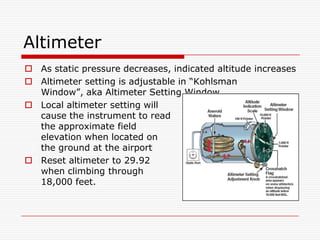
Altimeter
 As static pressure decreases, indicated altitude increases
 Altimeter setting is adjustable in “Kohlsman
  Window”, aka Altimeter Setting Window
 Local altimeter setting will
  cause the instrument to read
  the approximate field
  elevation when located on
  the ground at the airport
 Reset altimeter to 29.92
  when climbing through
  18,000 feet.
Altitude Terminology
 Indicated Altitude
      Altitude read on the altimeter when it is set to the current
       local altimeter setting
 Absolute altitude
      Height above the surface
 True altitude
      True height above Mean Sea Level (MSL)
 Pressure altitude
      Altitude indicated whenever the altimeter setting dial is set
       to 29.92 (Standard Datum Plane)
 Density altitude
      Pressure altitude corrected for non-standard temperature
       and/or pressure.
Altimetry
 Standard day
   29.92” Hg and +15 deg. C
   On a standard day at sea level, pressure
    altitude, true altitude, indicated
    altitude, and density altitude are all
    equal.
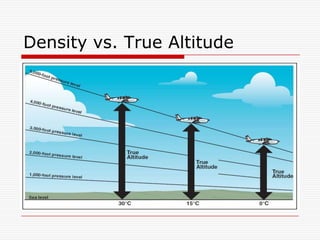
“High to low…look out below”
 When flying from an area of low
  pressure/low temperature to an area of
  higher pressure/higher temperature
  without adjusting the altimeter setting, the
  altimeter will indicate lower than the true
  altitude setting…and vice versa.
Density vs. True Altitude
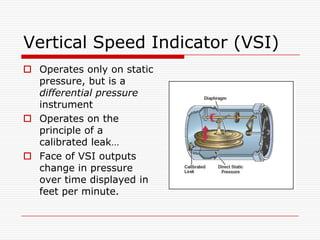
Vertical Speed Indicator (VSI)
 Operates only on static
  pressure, but is a
  differential pressure
  instrument
 Operates on the
  principle of a
  calibrated leak…
 Face of VSI outputs
  change in pressure
  over time displayed in
  feet per minute.
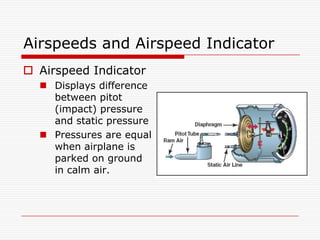
Airspeeds and Airspeed Indicator
 Airspeed Indicator
   Displays difference
    between pitot
    (impact) pressure
    and static pressure
   Pressures are equal
    when airplane is
    parked on ground
    in calm air.
Airspeeds
 Indicated airspeed (IAS)
    Uncorrected reading from the airspeed indicator
 Calibrated airspeed (CAS)
    Indicated airspeed corrected for installation and
     instrument error.
 True airspeed (TAS)
    Calibrated airspeed corrected for temperature and
     pressure variations.
 Groundspeed (GS)
    Actual speed of the airplane over the ground – this is
     the TAS adjusted for wind.
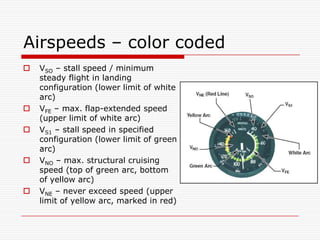
Airspeeds – color coded
   VSO – stall speed / minimum
    steady flight in landing
    configuration (lower limit of white
    arc)
   VFE – max. flap-extended speed
    (upper limit of white arc)
   VS1 – stall speed in specified
    configuration (lower limit of green
    arc)
   VNO – max. structural cruising
    speed (top of green arc, bottom
    of yellow arc)
   VNE – never exceed speed (upper
    limit of yellow arc, marked in red)
Airspeeds, others
 VLE – max. landing gear-extended speed.
 VA – design maneuvering speed (flown in
  rough air or turbulence to prevent
  overstressing airframe)
 VY – Best rate-of-climb airspeed (creates most
  altitude in a given period of time)
 VX – Best angle-of-climb speed (airspeed
  resulting in most altitude in a given distance.)
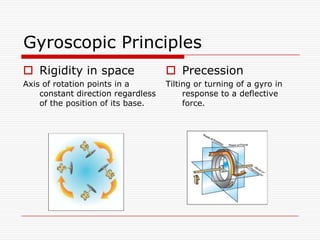
Gyroscopic Principles
 Rigidity in space                  Precession
Axis of rotation points in a        Tilting or turning of a gyro in
    constant direction regardless        response to a deflective
    of the position of its base.         force.
The Attitude Indicator
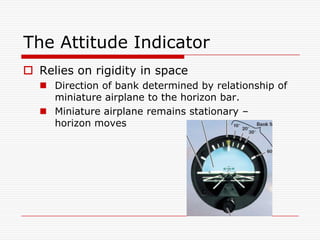
 Relies on rigidity in space
   Direction of bank determined by relationship of
    miniature airplane to the horizon bar.
   Miniature airplane remains stationary –
    horizon moves
Turn Coordinator
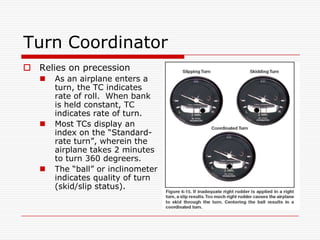
 Relies on precession
      As an airplane enters a
       turn, the TC indicates
       rate of roll. When bank
       is held constant, TC
       indicates rate of turn.
      Most TCs display an
       index on the “Standard-
       rate turn”, wherein the
       airplane takes 2 minutes
       to turn 360 degreers.
      The “ball” or inclinometer
       indicates quality of turn
       (skid/slip status).
Heading indicator
 “Gyroscopic compass”
   Magnetic compasses are difficult to read and suffer
    from errors; the heading indicator (also known as a
    directional gyro or DG)
   DGs suffer from precession due to bearing friction –
    the indicator must be realigned with the magnetic
    compass during straight-and-level, unaccelerated
    flight.
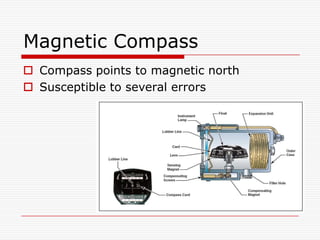
Magnetic Compass
 Compass points to magnetic north
 Susceptible to several errors
Compass Errors
 Variation
 Deviation
 Magnetic Dip
Dip errors
 Magnetic dip:
   When turning north from an easterly or westerly
    heading, the compass lags behind the actual
    aircraft heading. When a turn is initiated while
    on a northerly heading, the compass first
    indicates a turn in the opposite direction.
   When turning south from an easterly or westerly
    heading, the compass leads the actual heading.
    When a turn is initiated on a southerly
    heading, the compass immediately leads ahead.
   Mnemonic: UNOS – undershoot
    north, overshoot south
Dip errors continued
 Accelerating or decelerating while heading
  either east or west will also cause compass
  errors.
 When accelerating on an east or west
  heading, the compass indicates a turn to the
  north.
 When decelerating on an east or west
  heading, the compass indicates a turn to the
  south.
 Mnemonic: ANDS – accelerate
  north, decelerate south.
 Compass accurate only in S&L, unaccelerated
  flight.
Variation Errors
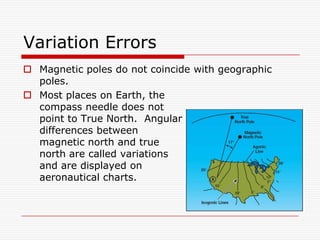
 Magnetic poles do not coincide with geographic
  poles.
 Most places on Earth, the
  compass needle does not
  point to True North. Angular
  differences between
  magnetic north and true
  north are called variations
  and are displayed on
  aeronautical charts.
Deviation Errors
 The metal, electrical systems, and
  operating engine all create magnetic
  fields from the aircraft.
 Aircraft manufacturers install
  compensatory magnets to prevent
  most errors. Remaining errors are
  called deviation.
 A card in the aircraft will list the
  deviation at various different compass
  points.
Next Week…
-   Regulations
    -   (FAR/AIM & Test Prep)

Intrumentation

  • 1.
    Instrumentation 9February 2005
  • 2.
    Instrumentation  Pitot-static system  Altimiter  Vertical Speed Indicator  Airspeed Indicator  Gyroscopic Instruments  Turn coordinator  Artificial horizon  Heading indicator  Magnetic Compass  OAT Gauge
  • 3.
    Pitot-static system  Operatesin response to air pressure  Two air pressures:  Static pressure  Taken from static vents, powers all three pitot- static system instruments (ASI, VSI, Altimeter)  Impact pressure  Powers airspeed indicator only
  • 4.
    Static System &Altimetry  Static system powers altimeter  Altimeter operates as a barometer  Set altimeter on the ground to local settings  Air pressure decreases at a constant rate per foot increased in lower atmosphere (approximately 1000’ per 1” Hg)  Nonstandard temperature and pressure affect altimeter
  • 5.
    Altimeter  As staticpressure decreases, indicated altitude increases  Altimeter setting is adjustable in “Kohlsman Window”, aka Altimeter Setting Window  Local altimeter setting will cause the instrument to read the approximate field elevation when located on the ground at the airport  Reset altimeter to 29.92 when climbing through 18,000 feet.
  • 6.
    Altitude Terminology  IndicatedAltitude  Altitude read on the altimeter when it is set to the current local altimeter setting  Absolute altitude  Height above the surface  True altitude  True height above Mean Sea Level (MSL)  Pressure altitude  Altitude indicated whenever the altimeter setting dial is set to 29.92 (Standard Datum Plane)  Density altitude  Pressure altitude corrected for non-standard temperature and/or pressure.
  • 7.
    Altimetry  Standard day  29.92” Hg and +15 deg. C  On a standard day at sea level, pressure altitude, true altitude, indicated altitude, and density altitude are all equal.
  • 8.
    “High to low…lookout below”  When flying from an area of low pressure/low temperature to an area of higher pressure/higher temperature without adjusting the altimeter setting, the altimeter will indicate lower than the true altitude setting…and vice versa.
  • 9.
  • 10.
    Vertical Speed Indicator(VSI)  Operates only on static pressure, but is a differential pressure instrument  Operates on the principle of a calibrated leak…  Face of VSI outputs change in pressure over time displayed in feet per minute.
  • 11.
    Airspeeds and AirspeedIndicator  Airspeed Indicator  Displays difference between pitot (impact) pressure and static pressure  Pressures are equal when airplane is parked on ground in calm air.
  • 12.
    Airspeeds  Indicated airspeed(IAS)  Uncorrected reading from the airspeed indicator  Calibrated airspeed (CAS)  Indicated airspeed corrected for installation and instrument error.  True airspeed (TAS)  Calibrated airspeed corrected for temperature and pressure variations.  Groundspeed (GS)  Actual speed of the airplane over the ground – this is the TAS adjusted for wind.
  • 13.
    Airspeeds – colorcoded  VSO – stall speed / minimum steady flight in landing configuration (lower limit of white arc)  VFE – max. flap-extended speed (upper limit of white arc)  VS1 – stall speed in specified configuration (lower limit of green arc)  VNO – max. structural cruising speed (top of green arc, bottom of yellow arc)  VNE – never exceed speed (upper limit of yellow arc, marked in red)
  • 14.
    Airspeeds, others  VLE– max. landing gear-extended speed.  VA – design maneuvering speed (flown in rough air or turbulence to prevent overstressing airframe)  VY – Best rate-of-climb airspeed (creates most altitude in a given period of time)  VX – Best angle-of-climb speed (airspeed resulting in most altitude in a given distance.)
  • 15.
    Gyroscopic Principles  Rigidityin space  Precession Axis of rotation points in a Tilting or turning of a gyro in constant direction regardless response to a deflective of the position of its base. force.
  • 16.
    The Attitude Indicator Relies on rigidity in space  Direction of bank determined by relationship of miniature airplane to the horizon bar.  Miniature airplane remains stationary – horizon moves
  • 17.
    Turn Coordinator  Relieson precession  As an airplane enters a turn, the TC indicates rate of roll. When bank is held constant, TC indicates rate of turn.  Most TCs display an index on the “Standard- rate turn”, wherein the airplane takes 2 minutes to turn 360 degreers.  The “ball” or inclinometer indicates quality of turn (skid/slip status).
  • 18.
    Heading indicator  “Gyroscopiccompass”  Magnetic compasses are difficult to read and suffer from errors; the heading indicator (also known as a directional gyro or DG)  DGs suffer from precession due to bearing friction – the indicator must be realigned with the magnetic compass during straight-and-level, unaccelerated flight.
  • 19.
    Magnetic Compass  Compasspoints to magnetic north  Susceptible to several errors
  • 20.
    Compass Errors  Variation Deviation  Magnetic Dip
  • 21.
    Dip errors  Magneticdip:  When turning north from an easterly or westerly heading, the compass lags behind the actual aircraft heading. When a turn is initiated while on a northerly heading, the compass first indicates a turn in the opposite direction.  When turning south from an easterly or westerly heading, the compass leads the actual heading. When a turn is initiated on a southerly heading, the compass immediately leads ahead.  Mnemonic: UNOS – undershoot north, overshoot south
  • 22.
    Dip errors continued Accelerating or decelerating while heading either east or west will also cause compass errors.  When accelerating on an east or west heading, the compass indicates a turn to the north.  When decelerating on an east or west heading, the compass indicates a turn to the south.  Mnemonic: ANDS – accelerate north, decelerate south.  Compass accurate only in S&L, unaccelerated flight.
  • 23.
    Variation Errors  Magneticpoles do not coincide with geographic poles.  Most places on Earth, the compass needle does not point to True North. Angular differences between magnetic north and true north are called variations and are displayed on aeronautical charts.
  • 24.
    Deviation Errors  Themetal, electrical systems, and operating engine all create magnetic fields from the aircraft.  Aircraft manufacturers install compensatory magnets to prevent most errors. Remaining errors are called deviation.  A card in the aircraft will list the deviation at various different compass points.
  • 25.
    Next Week… - Regulations - (FAR/AIM & Test Prep)