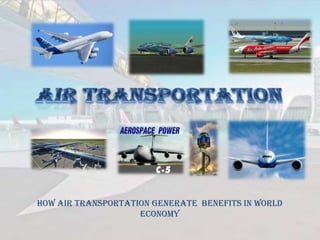
HOW AIR TRANSPORTATION GENERATE BENEFITS IN WORLD
ECONOMY
• Air transportation plays an
integral role in our way of life.
Commercial airlines allow
millions of Americans every
year to attend business
conventions, go home for the
holidays, take vacations
around the globe, or travel to
other important events. Air
transportation also represents
the fastest way to ship most
types of cargo over long
distances. Today I'm going to
present how Air
Transportation generate
benefit with world economy

INDEX
•

Regulators and Associations
–
–
–
–
–
–

•

Airliners
–
–
–
–

•

Boeing
Airbus
McDonnell Douglas
Airlines

Air Cargo
–
–

•
•
•
•

ICAO
IATA
DCA
CAB
FAA
NTSB

FedEx
DHL

Airlines Scheduling
How Air Transportation Generate World Economy
Conclusion
Bibliography
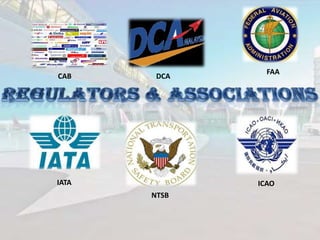
CAB

DCA

FAA

NTSB
IATA

ICAO
NTSB
•

•
•

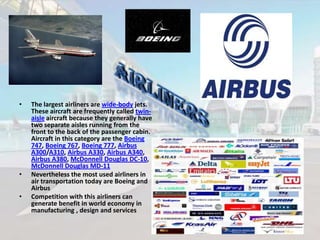
The largest airliners are wide-body jets.
These aircraft are frequently called twinaisle aircraft because they generally have
two separate aisles running from the
front to the back of the passenger cabin.
Aircraft in this category are the Boeing
747, Boeing 767, Boeing 777, Airbus
A300/A310, Airbus A330, Airbus A340,
Airbus A380, McDonnell Douglas DC-10,
McDonnell Douglas MD-11
Nevertheless the most used airliners in
air transportation today are Boeing and
Airbus
Competition with this airliners can
generate benefit in world economy in
manufacturing , design and services
•

•

•

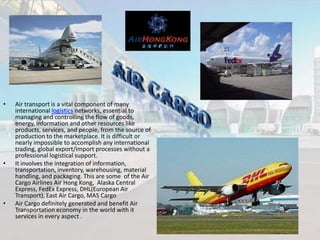
Air transport is a vital component of many
international logistics networks, essential to
managing and controlling the flow of goods,
energy, information and other resources like
products, services, and people, from the source of
production to the marketplace. It is difficult or
nearly impossible to accomplish any international
trading, global export/import processes without a
professional logistical support.
It involves the integration of information,
transportation, inventory, warehousing, material
handling, and packaging. This are some of the Air
Cargo Airlines Air Hong Kong, Alaska Central
Express, FedEx Express, DHL(European Air
Transport), East Air Cargo, MAS Cargo
Air Cargo definitely generated and benefit Air
Transportation economy in the world with it
services in every aspect .
• The public service and
economic aspects of
scheduling must be
balanced with other
factors, including these:
–
–
–
–
•

Equipment maintenance
Crews
Facilities
Marketing factors

• The following operational
factors are important in
schedule planning:
–
–
–
–

Airport runway lengths
Aircraft fuel capacity
Habitual adverse weather
Air traffic control and
routings
– Crew time limits
– Employee agreements

HUB-AND-SPOKE SCHEDULING
Deregulation has led to significant changes in the routings and schedule patterns of the carriers.
A catalyst for these changes has been the greatly increased emphasis on hub-and spoke
scheduling. Growth of the new 'hub and spoke' model, which filled planes and made it more
convenient for people to travel to more destinations .Exclusively a huge impact benefitted on Air
Transportation in the world.
• In Air Transportation a lot of aspect that generate
economy, one of it is Airlines Deregulation. Let
see the detail:
Airlines Deregulation
•
•

•

Refers to government ceding control over certain aspects of the air industry to
the airline corporations
CAB governed which airlines could serve which routes, determined which
airlines were certified to enter the market, and restricted mergers among
airline companies. Set the fare structure for the industry, determining the
routes each airline flew and overseeing the prices they charged
Turning point was the Airline Deregulation Act, -removed government in air
transportation means Airlines taking control their own operation- Showing
huge growth in Air Transportation economy
• Lower fares make people travel more
• New airlines sprung into life increase profit to
government and competition in economy
• Airlines set their own schedules
– Benefitted economy enormously
– Huge growth in air travel transportation

• Essential Air Service
– Airlines adding new routes -more flight
– Subsequent growth of regional carriers in the world
•
•

•

•
•

•

Impacts of deregulation on us are profound and positive. I've grouped the most
significant of them into 3 categories.
Result 1 : Airfares Dropped
– Airfares today are almost three times cheaper than they were in the late 1970s
Result 2 : Air Travel Increased
– Twice as many flights and three times as many people traveling, compared to the
1970s.
Airlines fly to more destinations
There is another dimension to the growth in air travel. Individual airlines could now
offer service to more places. For example, American Airlines flew to only 39
destinations prior to deregulation. Now it flies to 260 different locations - six times
more than before.

Result 3 : Frequent Flier Programs
– Acquired miles can be redeemed for free air travel; for other goods or
services; or for increased benefits, such as travel class upgrades, airport
lounge access or priority bookings.
– Next time you earn miles on your Visa card, and next time you redeem your
miles for an upgrade or a free ticket, ……………Thanks Deregulation
THIS 3 RESULT SHOW HOW DEREGULATION HELP GENERATE ECONOMY IN THE WORLD
THE ECONOMIC
BENEFITS OF AIR
TRANSPORT

• Air transport
generates
employment
and wealth.
• Air transport
generates a
total of 13.5
million
jobs(direct,
indirect). Of
these, 5
million are
direct jobs.

Direct impacts
•

These cover employment and activity within the air transport
industry including airline and airport operations, aircraft
maintenance, air traffic control and regulation, and activities
directly serving air passengers, such as check-in , baggage
handling

.
Indirect impacts

•

These include employment and activities of suppliers to the air
transport industry, for example, jobs linked to aviation fuel
suppliers; construction companies that build additional facilities;
the manufacture of goods sold in airport retail outlets, and a
wide variety of activities in the business services sector (call
centres, IT, accountancy, etc.).

•

Of the 5 million direct jobs generated by the air transport
industry worldwide, 4.3 million people are employed by the
airlines and airports (aviation sector)globally.
5.8 million indirect jobs are supported through purchases of
goods and services by companies in the air transport
industry.Examples include jobs in the energy sector generated
through the purchase of aircraft fuel;

•

• This totally generate the economic
benefits of Air Transportation in the world
BIBLIOGRAPHY
AIR Transportation
• http://en.wikipedia.org/wiki/Air_transport/

Lecturer
•

Mejar Maya Marimuthu

ENJOY

HAPPY
Air Transport
Air Transport

Air Transport

  • 2.
    HOW AIR TRANSPORTATIONGENERATE BENEFITS IN WORLD ECONOMY
  • 3.
    • Air transportationplays an integral role in our way of life. Commercial airlines allow millions of Americans every year to attend business conventions, go home for the holidays, take vacations around the globe, or travel to other important events. Air transportation also represents the fastest way to ship most types of cargo over long distances. Today I'm going to present how Air Transportation generate benefit with world economy INDEX • Regulators and Associations – – – – – – • Airliners – – – – • Boeing Airbus McDonnell Douglas Airlines Air Cargo – – • • • • ICAO IATA DCA CAB FAA NTSB FedEx DHL Airlines Scheduling How Air Transportation Generate World Economy Conclusion Bibliography
  • 4.
  • 5.
    • • • The largest airlinersare wide-body jets. These aircraft are frequently called twinaisle aircraft because they generally have two separate aisles running from the front to the back of the passenger cabin. Aircraft in this category are the Boeing 747, Boeing 767, Boeing 777, Airbus A300/A310, Airbus A330, Airbus A340, Airbus A380, McDonnell Douglas DC-10, McDonnell Douglas MD-11 Nevertheless the most used airliners in air transportation today are Boeing and Airbus Competition with this airliners can generate benefit in world economy in manufacturing , design and services
  • 6.
    • • • Air transport isa vital component of many international logistics networks, essential to managing and controlling the flow of goods, energy, information and other resources like products, services, and people, from the source of production to the marketplace. It is difficult or nearly impossible to accomplish any international trading, global export/import processes without a professional logistical support. It involves the integration of information, transportation, inventory, warehousing, material handling, and packaging. This are some of the Air Cargo Airlines Air Hong Kong, Alaska Central Express, FedEx Express, DHL(European Air Transport), East Air Cargo, MAS Cargo Air Cargo definitely generated and benefit Air Transportation economy in the world with it services in every aspect .
  • 7.
    • The publicservice and economic aspects of scheduling must be balanced with other factors, including these: – – – – • Equipment maintenance Crews Facilities Marketing factors • The following operational factors are important in schedule planning: – – – – Airport runway lengths Aircraft fuel capacity Habitual adverse weather Air traffic control and routings – Crew time limits – Employee agreements HUB-AND-SPOKE SCHEDULING Deregulation has led to significant changes in the routings and schedule patterns of the carriers. A catalyst for these changes has been the greatly increased emphasis on hub-and spoke scheduling. Growth of the new 'hub and spoke' model, which filled planes and made it more convenient for people to travel to more destinations .Exclusively a huge impact benefitted on Air Transportation in the world.
  • 8.
    • In AirTransportation a lot of aspect that generate economy, one of it is Airlines Deregulation. Let see the detail: Airlines Deregulation • • • Refers to government ceding control over certain aspects of the air industry to the airline corporations CAB governed which airlines could serve which routes, determined which airlines were certified to enter the market, and restricted mergers among airline companies. Set the fare structure for the industry, determining the routes each airline flew and overseeing the prices they charged Turning point was the Airline Deregulation Act, -removed government in air transportation means Airlines taking control their own operation- Showing huge growth in Air Transportation economy
  • 9.
    • Lower faresmake people travel more • New airlines sprung into life increase profit to government and competition in economy • Airlines set their own schedules – Benefitted economy enormously – Huge growth in air travel transportation • Essential Air Service – Airlines adding new routes -more flight – Subsequent growth of regional carriers in the world
  • 10.
    • • • • • • Impacts of deregulationon us are profound and positive. I've grouped the most significant of them into 3 categories. Result 1 : Airfares Dropped – Airfares today are almost three times cheaper than they were in the late 1970s Result 2 : Air Travel Increased – Twice as many flights and three times as many people traveling, compared to the 1970s. Airlines fly to more destinations There is another dimension to the growth in air travel. Individual airlines could now offer service to more places. For example, American Airlines flew to only 39 destinations prior to deregulation. Now it flies to 260 different locations - six times more than before. Result 3 : Frequent Flier Programs – Acquired miles can be redeemed for free air travel; for other goods or services; or for increased benefits, such as travel class upgrades, airport lounge access or priority bookings. – Next time you earn miles on your Visa card, and next time you redeem your miles for an upgrade or a free ticket, ……………Thanks Deregulation THIS 3 RESULT SHOW HOW DEREGULATION HELP GENERATE ECONOMY IN THE WORLD
  • 11.
    THE ECONOMIC BENEFITS OFAIR TRANSPORT • Air transport generates employment and wealth. • Air transport generates a total of 13.5 million jobs(direct, indirect). Of these, 5 million are direct jobs. Direct impacts • These cover employment and activity within the air transport industry including airline and airport operations, aircraft maintenance, air traffic control and regulation, and activities directly serving air passengers, such as check-in , baggage handling . Indirect impacts • These include employment and activities of suppliers to the air transport industry, for example, jobs linked to aviation fuel suppliers; construction companies that build additional facilities; the manufacture of goods sold in airport retail outlets, and a wide variety of activities in the business services sector (call centres, IT, accountancy, etc.). • Of the 5 million direct jobs generated by the air transport industry worldwide, 4.3 million people are employed by the airlines and airports (aviation sector)globally. 5.8 million indirect jobs are supported through purchases of goods and services by companies in the air transport industry.Examples include jobs in the energy sector generated through the purchase of aircraft fuel; • • This totally generate the economic benefits of Air Transportation in the world
  • 12.