Under the guidance of
Mr: Darshankumar Billur
Assistant Professor
Department of Electronics & Communication
KLECET, Chikodi
[Grab your reader’s attention with a great quote from the
document or use this space to emphasize a key point. To
place this text box anywhere on the page, just drag it.]
BY: UMESH
DADDE
• Introduction
CONTENTS
• Classification of UAV’s
• Unmanned aircraft system elements
• Case study of Predator C : Avenger
• Advantages and Dis-advantages of UAV’s
• Applications of UAV’s
•Conclusion
• References
Dept. of ECE,KLECET PAGE NO 1
INTRODUCTION
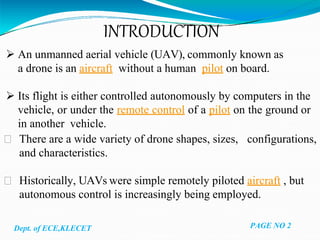
 An unmanned aerial vehicle (UAV), commonly known as
a drone is an aircraft without a human pilot on board.
 Its flight is either controlled autonomously by computers in the
vehicle, or under the remote control of a pilot on the ground or
in another vehicle.
There are a wide variety of drone shapes, sizes, configurations,
and characteristics.
Historically, UAVs were simple remotely piloted aircraft , but
autonomous control is increasingly being employed.
Dept. of ECE,KLECET PAGE NO 2
HISTORY
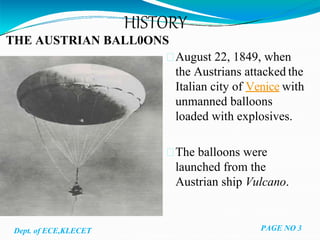
THE AUSTRIAN BALL0ONS
August 22, 1849, when
the Austrians attacked the
Italian city of Venice with
unmanned balloons
loaded with explosives.
The balloons were
launched from the
Austrian ship Vulcano.
Dept. of ECE,KLECET PAGE NO 3
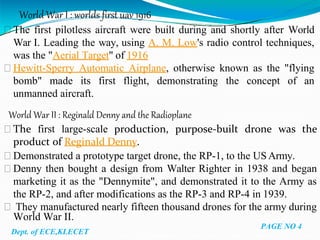
World War I : worlds first uav 1916
The first pilotless aircraft were built during and shortly after World
War I. Leading the way, using A. M. Low's radio control techniques,
was the "Aerial Target" of 1916
Hewitt-Sperry Automatic Airplane, otherwise known as the "flying
bomb" made its first flight, demonstrating the concept of an
unmanned aircraft.
World War II : Reginald Denny and the Radioplane
The first large-scale production, purpose-built drone was the
product of Reginald Denny.
Demonstrated a prototype target drone, the RP-1, to the US Army.
Denny then bought a design from Walter Righter in 1938 and began
marketing it as the "Dennymite", and demonstrated it to the Army as
the RP-2, and after modifications as the RP-3 and RP-4 in 1939.
They manufactured nearly fifteen thousand drones for the army during
World War II.
Dept. of ECE,KLECET
PAGE NO 4
Dept. of ECE,KLECET PAGE NO 5
CLASSIFICATION
OF UAV’S
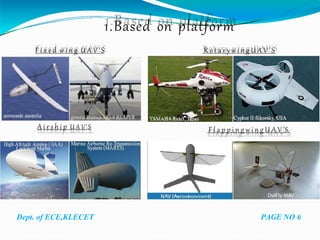
1.Based on platform
F i x e d w i n g U A V ’S R o t a r y w i n g U A V ’S
A i r s h i p U A V’ S F l a p p i n g w i n g U A V ’S
Dept. of ECE,KLECET PAGE NO 6
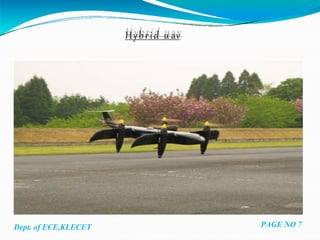
Hybrid u av
Dept. of ECE,KLECET PAGE NO 7
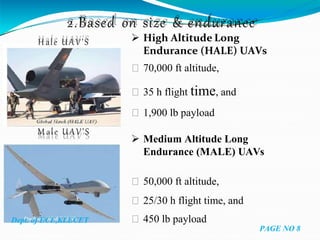
2.Based on size & endurance
H ale UAV’S
M ale UAV’S
Dept. of ECE,KLECET
 High Altitude Long
Endurance (HALE) UAVs
70,000 ft altitude,
35 h flight time, and
1,900 lb payload
 Medium Altitude Long
Endurance (MALE) UAVs
50,000 ft altitude,
25/30 h flight time, and
450 lb payload
PAGE NO 8
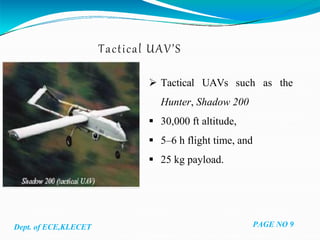
Tactical UAV’S
 Tactical UAVs such as the
Hunter, Shadow 200
 30,000 ft altitude,
 5–6 h flight time, and
 25 kg payload.
Dept. of ECE,KLECET PAGE NO 9
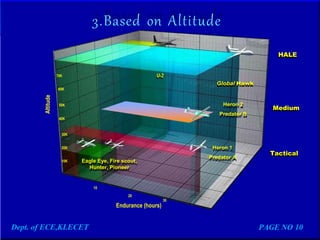
3.Based on Altitude
HALE
70K
60K
50K
40K
30K
20K
10K Eagle Eye, Fire scout,
Hunter, Pioneer
U-2
Global Hawk
Heron 2
Predator B
Heron 1
Predator A
Medium
Tactical
10
20
30
Endurance (hours)
Dept. of ECE,KLECET PAGE NO 10
Altitude
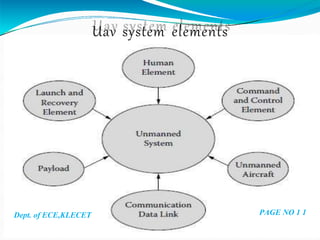
Uav system elements
Dept. of ECE,KLECET PAGE NO 1 1
An Unmanned Aircraft or Aerial System can be divided into three distinct
elements:
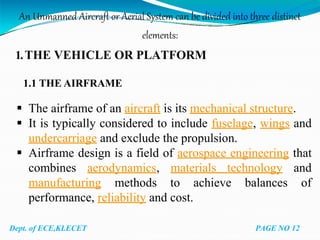
1.THE VEHICLE OR PLATFORM
1.1 THE AIRFRAME
 The airframe of an aircraft is its mechanical structure.
 It is typically considered to include fuselage, wings and
undercarriage and exclude the propulsion.
 Airframe design is a field of aerospace engineering that
combines aerodynamics, materials technology and
manufacturing methods to achieve balances of
performance, reliability and cost.
Dept. of ECE,KLECET PAGE NO 12
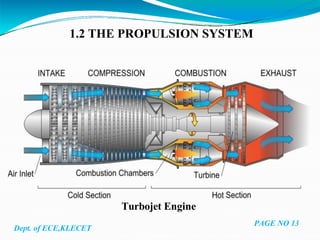
1.2 THE PROPULSION SYSTEM
Dept. of ECE,KLECET
Turbojet Engine
PAGE NO 13
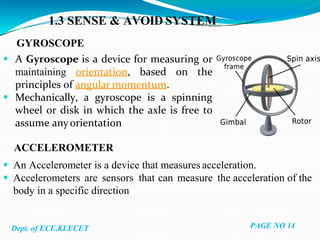
1.3 SENSE & AVOID SYSTEM
GYROSCOPE
 A Gyroscope is a device for measuring or
maintaining orientation, based on the
principles of angular momentum.
 Mechanically, a gyroscope is a spinning
wheel or disk in which the axle is free to
assume anyorientation
ACCELEROMETER
 An Accelerometer is a device that measures acceleration.
 Accelerometers are sensors that can measure the acceleration of the
body in a specific direction
Dept. of ECE,KLECET PAGE NO 14
2 .The Payload
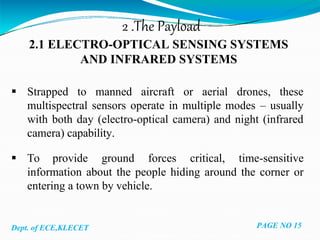
2.1 ELECTRO-OPTICAL SENSING SYSTEMS
AND INFRARED SYSTEMS
 Strapped to manned aircraft or aerial drones, these
multispectral sensors operate in multiple modes – usually
with both day (electro-optical camera) and night (infrared
camera) capability.
 To provide ground forces critical, time-sensitive
information about the people hiding around the corner or
entering a town by vehicle.
Dept. of ECE,KLECET PAGE NO 15
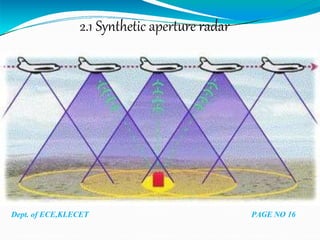
2.1 Synthetic aperture radar
Dept. of ECE,KLECET PAGE NO 16
2.2 Munitions
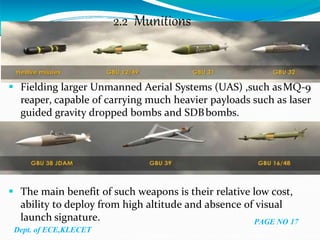
 Fielding larger Unmanned Aerial Systems (UAS) ,such asMQ-9
reaper, capable of carrying much heavier payloads such as laser
guided gravity dropped bombs and SDBbombs.
 The main benefit of such weapons is their relative low cost,
ability to deploy from high altitude and absence of visual
launch signature. PAGE NO 17
Dept. of ECE,KLECET
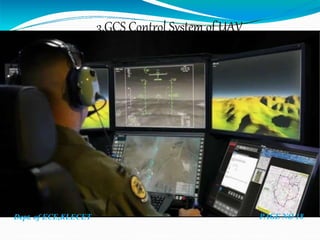
3.GCS Control System of UAV
Dept. of ECE,KLECET PAGE NO 18
CASE STUDY OF PREDATOR C: AVENGER
Dept. of ECE,KLECET
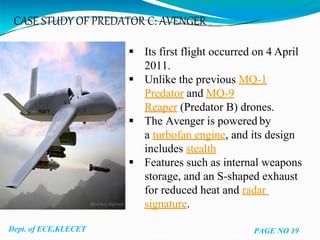
 Its first flight occurred on 4 April
2011.
 Unlike the previous MQ-1
Predator and MQ-9
Reaper (Predator B) drones.
 The Avenger is powered by
a turbofan engine, and its design
includes stealth
 Features such as internal weapons
storage, and an S-shaped exhaust
for reduced heat and radar
signature.
PAGE NO 19
SPECIFICATIONS
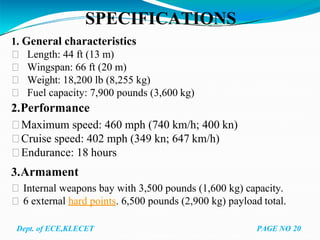
1. General characteristics
Length: 44 ft (13 m)
Wingspan: 66 ft (20 m)
Weight: 18,200 lb (8,255 kg)
Fuel capacity: 7,900 pounds (3,600 kg)
2.Performance
Maximum speed: 460 mph (740 km/h; 400 kn)
Cruise speed: 402 mph (349 kn; 647 km/h)
Endurance: 18 hours
3.Armament
Internal weapons bay with 3,500 pounds (1,600 kg) capacity.
6 external hard points. 6,500 pounds (2,900 kg) payload total.
Dept. of ECE,KLECET PAGE NO 20
Advantages of uav
 Doesn’t require a qualified pilot.
Can enter any environments.
Reduces exposure risk of the aircraft operator.
Can stay in the air for up to 30 hours.
Can be programmed to complete the mission
autonomously.
Dept. of ECE,KLECET PAGE NO 21
DIS-Advantages of uav
Costly compared to manned vehicles.
Limited Abilities.
More hardware complexity.
Dept. of ECE,KLECET PAGE NO 22
Applications of uav
 Remote Sensing
 Aerial Surveillance
 Transport
 Search&Rescue
 Armed Attacks
PAGE NO 23
CONCLUSION
With more research and technological advances, it is
possible that the UAV may well replace manned
combat aircraft in the future.
The advantages of UAV against manned aircraft are
numerous. First is the risk of being shot down.
Dept. of ECE,KLECET PAGE NO 24
REFERENCES
 Unmanned aerial vehicle (UAV)
Http://en.wikipedia.org/wiki/Unmanned_aerial_vehicle
 History of unmanned aerial vehicles
Http://en.wikipedia.org/wiki/History_of_unmanned_aerial_vehicles
 Autonomous Flying Robots
http://books.google.co.in/books?isbn=4431538569
 US Navy UAVs in Action
http://www.theuav.com/
 General Atomics Predator C Avenger
http://General_Atomics_Avenger
Dept. of ECE,KLECET PAGE NO 25
THANK YOU
queries..

Drone technology,UAV

  • 1.
    Under the guidanceof Mr: Darshankumar Billur Assistant Professor Department of Electronics & Communication KLECET, Chikodi [Grab your reader’s attention with a great quote from the document or use this space to emphasize a key point. To place this text box anywhere on the page, just drag it.] BY: UMESH DADDE
  • 2.
    • Introduction CONTENTS • Classificationof UAV’s • Unmanned aircraft system elements • Case study of Predator C : Avenger • Advantages and Dis-advantages of UAV’s • Applications of UAV’s •Conclusion • References Dept. of ECE,KLECET PAGE NO 1
  • 3.
    INTRODUCTION  An unmannedaerial vehicle (UAV), commonly known as a drone is an aircraft without a human pilot on board.  Its flight is either controlled autonomously by computers in the vehicle, or under the remote control of a pilot on the ground or in another vehicle. There are a wide variety of drone shapes, sizes, configurations, and characteristics. Historically, UAVs were simple remotely piloted aircraft , but autonomous control is increasingly being employed. Dept. of ECE,KLECET PAGE NO 2
  • 4.
    HISTORY THE AUSTRIAN BALL0ONS August22, 1849, when the Austrians attacked the Italian city of Venice with unmanned balloons loaded with explosives. The balloons were launched from the Austrian ship Vulcano. Dept. of ECE,KLECET PAGE NO 3
  • 5.
    World War I: worlds first uav 1916 The first pilotless aircraft were built during and shortly after World War I. Leading the way, using A. M. Low's radio control techniques, was the "Aerial Target" of 1916 Hewitt-Sperry Automatic Airplane, otherwise known as the "flying bomb" made its first flight, demonstrating the concept of an unmanned aircraft. World War II : Reginald Denny and the Radioplane The first large-scale production, purpose-built drone was the product of Reginald Denny. Demonstrated a prototype target drone, the RP-1, to the US Army. Denny then bought a design from Walter Righter in 1938 and began marketing it as the "Dennymite", and demonstrated it to the Army as the RP-2, and after modifications as the RP-3 and RP-4 in 1939. They manufactured nearly fifteen thousand drones for the army during World War II. Dept. of ECE,KLECET PAGE NO 4
  • 6.
    Dept. of ECE,KLECETPAGE NO 5 CLASSIFICATION OF UAV’S
  • 7.
    1.Based on platform Fi x e d w i n g U A V ’S R o t a r y w i n g U A V ’S A i r s h i p U A V’ S F l a p p i n g w i n g U A V ’S Dept. of ECE,KLECET PAGE NO 6
  • 8.
    Hybrid u av Dept.of ECE,KLECET PAGE NO 7
  • 9.
    2.Based on size& endurance H ale UAV’S M ale UAV’S Dept. of ECE,KLECET  High Altitude Long Endurance (HALE) UAVs 70,000 ft altitude, 35 h flight time, and 1,900 lb payload  Medium Altitude Long Endurance (MALE) UAVs 50,000 ft altitude, 25/30 h flight time, and 450 lb payload PAGE NO 8
  • 10.
    Tactical UAV’S  TacticalUAVs such as the Hunter, Shadow 200  30,000 ft altitude,  5–6 h flight time, and  25 kg payload. Dept. of ECE,KLECET PAGE NO 9
  • 11.
    3.Based on Altitude HALE 70K 60K 50K 40K 30K 20K 10KEagle Eye, Fire scout, Hunter, Pioneer U-2 Global Hawk Heron 2 Predator B Heron 1 Predator A Medium Tactical 10 20 30 Endurance (hours) Dept. of ECE,KLECET PAGE NO 10 Altitude
  • 12.
    Uav system elements Dept.of ECE,KLECET PAGE NO 1 1
  • 13.
    An Unmanned Aircraftor Aerial System can be divided into three distinct elements: 1.THE VEHICLE OR PLATFORM 1.1 THE AIRFRAME  The airframe of an aircraft is its mechanical structure.  It is typically considered to include fuselage, wings and undercarriage and exclude the propulsion.  Airframe design is a field of aerospace engineering that combines aerodynamics, materials technology and manufacturing methods to achieve balances of performance, reliability and cost. Dept. of ECE,KLECET PAGE NO 12
  • 14.
    1.2 THE PROPULSIONSYSTEM Dept. of ECE,KLECET Turbojet Engine PAGE NO 13
  • 15.
    1.3 SENSE &AVOID SYSTEM GYROSCOPE  A Gyroscope is a device for measuring or maintaining orientation, based on the principles of angular momentum.  Mechanically, a gyroscope is a spinning wheel or disk in which the axle is free to assume anyorientation ACCELEROMETER  An Accelerometer is a device that measures acceleration.  Accelerometers are sensors that can measure the acceleration of the body in a specific direction Dept. of ECE,KLECET PAGE NO 14
  • 16.
    2 .The Payload 2.1ELECTRO-OPTICAL SENSING SYSTEMS AND INFRARED SYSTEMS  Strapped to manned aircraft or aerial drones, these multispectral sensors operate in multiple modes – usually with both day (electro-optical camera) and night (infrared camera) capability.  To provide ground forces critical, time-sensitive information about the people hiding around the corner or entering a town by vehicle. Dept. of ECE,KLECET PAGE NO 15
  • 17.
    2.1 Synthetic apertureradar Dept. of ECE,KLECET PAGE NO 16
  • 18.
    2.2 Munitions  Fieldinglarger Unmanned Aerial Systems (UAS) ,such asMQ-9 reaper, capable of carrying much heavier payloads such as laser guided gravity dropped bombs and SDBbombs.  The main benefit of such weapons is their relative low cost, ability to deploy from high altitude and absence of visual launch signature. PAGE NO 17 Dept. of ECE,KLECET
  • 19.
    3.GCS Control Systemof UAV Dept. of ECE,KLECET PAGE NO 18
  • 20.
    CASE STUDY OFPREDATOR C: AVENGER Dept. of ECE,KLECET  Its first flight occurred on 4 April 2011.  Unlike the previous MQ-1 Predator and MQ-9 Reaper (Predator B) drones.  The Avenger is powered by a turbofan engine, and its design includes stealth  Features such as internal weapons storage, and an S-shaped exhaust for reduced heat and radar signature. PAGE NO 19
  • 21.
    SPECIFICATIONS 1. General characteristics Length:44 ft (13 m) Wingspan: 66 ft (20 m) Weight: 18,200 lb (8,255 kg) Fuel capacity: 7,900 pounds (3,600 kg) 2.Performance Maximum speed: 460 mph (740 km/h; 400 kn) Cruise speed: 402 mph (349 kn; 647 km/h) Endurance: 18 hours 3.Armament Internal weapons bay with 3,500 pounds (1,600 kg) capacity. 6 external hard points. 6,500 pounds (2,900 kg) payload total. Dept. of ECE,KLECET PAGE NO 20
  • 22.
    Advantages of uav Doesn’t require a qualified pilot. Can enter any environments. Reduces exposure risk of the aircraft operator. Can stay in the air for up to 30 hours. Can be programmed to complete the mission autonomously. Dept. of ECE,KLECET PAGE NO 21
  • 23.
    DIS-Advantages of uav Costlycompared to manned vehicles. Limited Abilities. More hardware complexity. Dept. of ECE,KLECET PAGE NO 22
  • 24.
    Applications of uav Remote Sensing  Aerial Surveillance  Transport  Search&Rescue  Armed Attacks PAGE NO 23
  • 25.
    CONCLUSION With more researchand technological advances, it is possible that the UAV may well replace manned combat aircraft in the future. The advantages of UAV against manned aircraft are numerous. First is the risk of being shot down. Dept. of ECE,KLECET PAGE NO 24
  • 26.
    REFERENCES  Unmanned aerialvehicle (UAV) Http://en.wikipedia.org/wiki/Unmanned_aerial_vehicle  History of unmanned aerial vehicles Http://en.wikipedia.org/wiki/History_of_unmanned_aerial_vehicles  Autonomous Flying Robots http://books.google.co.in/books?isbn=4431538569  US Navy UAVs in Action http://www.theuav.com/  General Atomics Predator C Avenger http://General_Atomics_Avenger Dept. of ECE,KLECET PAGE NO 25
  • 27.