Aircraft PerformanceAircraft Performance
Purpose of the study ofPurpose of the study of
performance is to optimiseperformance is to optimise
the payload and rangethe payload and range
ability of an aircraftability of an aircraft
according to a set ofaccording to a set of
physical and ambientphysical and ambient
limitationslimitations
Aircraft PerformanceAircraft Performance
Certification of aircraft weight andCertification of aircraft weight and
performanceperformance
 11stst
type- domestic certification undertype- domestic certification under
the jurisdiction of the state of design &the jurisdiction of the state of design &
manufacturemanufacture
22ndnd
type- involves the validation of thetype- involves the validation of the
basic aircraft certification by the local orbasic aircraft certification by the local or
national, authority of the country innational, authority of the country in
which aircraft will be operatedwhich aircraft will be operated
Aircraft PerformanceAircraft Performance
 Aircraft weight build-upAircraft weight build-up
Building the payload-Building the payload-
rangerange
Airfield performanceAirfield performance
analysisanalysis
En-Route performanceEn-Route performance
analysis
Aircraft weight build-upAircraft weight build-up
Manufacturer’s Weight EmptyManufacturer’s Weight Empty
(MWE)- weight of the aircraft as it(MWE)- weight of the aircraft as it
has been build by manufacturerhas been build by manufacturer
without seats, galleys, Pallets orwithout seats, galleys, Pallets or
containers, fuel, payload & othercontainers, fuel, payload & other
items necessary for actualitems necessary for actual
operation of the aircraftoperation of the aircraft
Aircraft weight build-upAircraft weight build-up
Operators itemsOperators items includesincludes
-Unusable fuel,-Unusable fuel,
-Oil for engine & APU (Auxiliary Power Unit),-Oil for engine & APU (Auxiliary Power Unit),
-Water for galley & toilets,-Water for galley & toilets,
-Fluid for toilets,-Fluid for toilets,
-A/C docs & kits,-A/C docs & kits,
-Seats & life Jackets,-Seats & life Jackets,
-Galleys,-Galleys,
-Passenger services items,-Passenger services items,
-Emergency equipment,-Emergency equipment,
-Crew & crew baggage-Crew & crew baggage
Aircraft weight build-upAircraft weight build-up
 Operating Weight Empty- This is theOperating Weight Empty- This is the
weight of the aircraft prepared forweight of the aircraft prepared for
services and it is composed of MWEservices and it is composed of MWE
plus operator’s items. It does not includeplus operator’s items. It does not include
any payload or fuelany payload or fuel
Maximum Zero-Fuel Weight (MZFW)-Maximum Zero-Fuel Weight (MZFW)-
weight of the aircraft with payloadweight of the aircraft with payload
added with OWE, but no fuel in theadded with OWE, but no fuel in the
tankstanks
Aircraft weight build-upAircraft weight build-up
Maximum Design Take-off Weight (MDTOW)-Maximum Design Take-off Weight (MDTOW)-
This the maximum certified weight at which theThis the maximum certified weight at which the
can take-off, as measured at brake release pointcan take-off, as measured at brake release point
on the runway. The simplified version of thison the runway. The simplified version of this
weight is known as Maximum Take-off Weightweight is known as Maximum Take-off Weight
(MTOW)(MTOW)
Maximum Landing Weight (MLW)- TheMaximum Landing Weight (MLW)- The
maximum certified weight at which an aircraftmaximum certified weight at which an aircraft
can land is determined by the loads that impactcan land is determined by the loads that impact
on the landing gear. The value consists of theon the landing gear. The value consists of the
OWE plus the payload and any reserve fuel notOWE plus the payload and any reserve fuel not
consumedconsumed
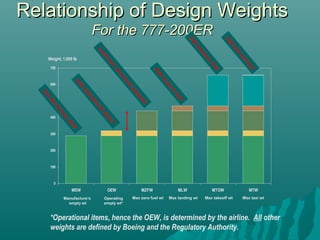
Relationship of Design WeightsRelationship of Design Weights
For the 777-200ERFor the 777-200ER
Weight, 1,000 lb
0
100
200
300
400
500
600
700
MEW OEW MZFW MLW MTOW MTW
Outthe
factory
doorAdd
operationalitem
s*
Load
m
ax
structuralpayload
Add
reserve
fuel
Add
taxi-outfuel
Add
m
ission
fuel
Manufacture’s
empty wt
Operating
empty wt*
Max zero fuel wt Max landing wt Max takeoff wt Max taxi wt
*Operational items, hence the OEW, is determined by the airline. All other
weights are defined by Boeing and the Regulatory Authority.
Aircraft weight build-upAircraft weight build-up
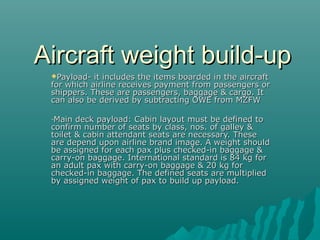
Payload- it includes the items boarded in the aircraftPayload- it includes the items boarded in the aircraft
for which airline receives payment from passengers orfor which airline receives payment from passengers or
shippers. These are passengers, baggage & cargo. Itshippers. These are passengers, baggage & cargo. It
can also be derived by subtracting OWE from MZFWcan also be derived by subtracting OWE from MZFW
-Main deck payload: Cabin layout must be defined toMain deck payload: Cabin layout must be defined to
confirm number of seats by class, nos. of galley &confirm number of seats by class, nos. of galley &
toilet & cabin attendant seats are necessary. Thesetoilet & cabin attendant seats are necessary. These
are depend upon airline brand image. A weight shouldare depend upon airline brand image. A weight should
be assigned for each pax plus checked-in baggage &be assigned for each pax plus checked-in baggage &
carry-on baggage. International standard is 84 kg forcarry-on baggage. International standard is 84 kg for
an adult pax with carry-on baggage & 20 kg foran adult pax with carry-on baggage & 20 kg for
checked-in baggage. The defined seats are multipliedchecked-in baggage. The defined seats are multiplied
by assigned weight of pax to build up payload.by assigned weight of pax to build up payload.
Aircraft weight build-upAircraft weight build-up
-Lower deck payload:-Lower deck payload:
This area is first used for loading pax checked-inThis area is first used for loading pax checked-in
baggage and then loaded with the availablebaggage and then loaded with the available
cargo. Arrangement must be decided whether tocargo. Arrangement must be decided whether to
accommodate pallets or containers or else underaccommodate pallets or containers or else under
floor pax facilities.floor pax facilities.
Baggage volume vary according to geographicalBaggage volume vary according to geographical
region, nature of services (scheduled or charterregion, nature of services (scheduled or charter
or Low Cost Carrier), distances of routes (shortor Low Cost Carrier), distances of routes (short
or long haul)or long haul)
Building the Payload-Building the Payload-
RangeRange
The maximum range of an given aircraft isThe maximum range of an given aircraft is
confirmed at the time of finalization of design.confirmed at the time of finalization of design.
The payload of a given aircraft can beThe payload of a given aircraft can be
determined once the OWE is confirmed and thedetermined once the OWE is confirmed and the
maximization of the weight of Payload is limitedmaximization of the weight of Payload is limited
by MDTOW.by MDTOW.
The combination of weight of payload & fuelThe combination of weight of payload & fuel
added beyond OWE will determine how far theadded beyond OWE will determine how far the
aircraft travel with how much payload and theaircraft travel with how much payload and the
payload-range combination is limited by MDTOW.payload-range combination is limited by MDTOW.
Building the Payload-Building the Payload-
RangeRange
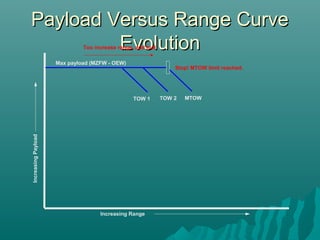
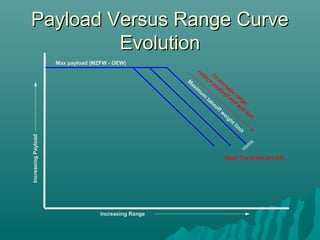
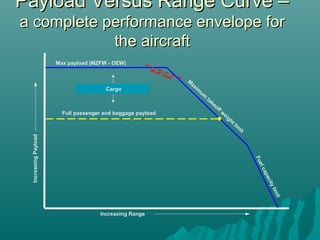
In order to continue to fly further, we need toIn order to continue to fly further, we need to
enforce a trade-off between weight of more fuelenforce a trade-off between weight of more fuel
in the tanks and a sacrifice of payload. Thein the tanks and a sacrifice of payload. The
straight-line relationship now continues until thestraight-line relationship now continues until the
fuel tanks, indeed, full.fuel tanks, indeed, full.
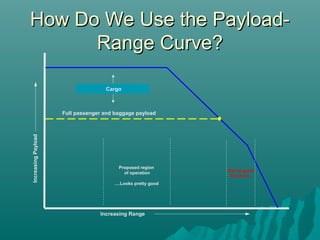
It is usual to indicate the range that could beIt is usual to indicate the range that could be
achieved with full load of pax & their baggage.achieved with full load of pax & their baggage.
This range, along with that achieved withThis range, along with that achieved with
maximum structural payload, is the most oftenmaximum structural payload, is the most often
quoted reference to indicate the ability of aquoted reference to indicate the ability of a
particular aircraftparticular aircraft
Payload Versus Range CurvePayload Versus Range Curve
EvolutionEvolution
Increasing Range
IncreasingPayload
Too increase range, add fuel
Stop! MTOW limit reached.
TOW 1 TOW 2 MTOW
Max payload (MZFW - OEW)
Payload Versus Range CurvePayload Versus Range Curve
EvolutionEvolution
M
axim
um
takeoff w
eight lim
it
Increasing Range
IncreasingPayload
To
increase
range,
reduce
payload
and
add
fuel.
Stop! The tanks are full
Max payload (MZFW - OEW)
Payload Versus Range CurvePayload Versus Range Curve
EvolutionEvolution
M
axim
um
takeoff w
eight lim
it
Fuelcapacitylimit
Increasing Range
IncreasingPayload
To
increaserange,
range,removemorepayload!
Max payload (MZFW - OEW)
Payload Versus Range Curve –Payload Versus Range Curve –
a complete performance envelope fora complete performance envelope for
the aircraftthe aircraft
M
axim
um
takeoff w
eight lim
it
Fuelcapacitylimit
Increasing Range
IncreasingPayload
MLW Limit
Full passenger and baggage payload
Cargo
Max payload (MZFW - OEW)
How Do We Use the Payload-How Do We Use the Payload-
Range Curve?Range Curve?
Increasing Range
IncreasingPayload
Full passenger and baggage payload
Cargo
Proposed region
of operation
….Looks pretty good
Not so good
Out here..
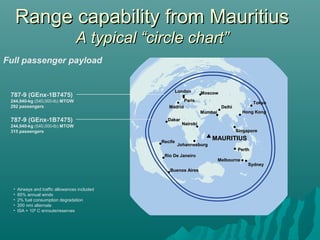
787-9 (GEnx-1B7475)
244,940-kg (540,000-lb) MTOW
292 passengers
• Airways and traffic allowances included
• 85% annual winds
• 2% fuel consumption degradation
• 200 nmi alternate
• ISA + 10º C enroute/reserves
787-9 (GEnx-1B7475)
244,940-kg (540,000-lb) MTOW
315 passengers
Full passenger payload
MAURITIUSMAURITIUS
Hong KongHong Kong
SydneySydney
LondonLondon
JohannesburgJohannesburg
TokyoTokyoParisParis
DelhiDelhi
PerthPerth
MelbourneMelbourne
NairobiNairobi
SingaporeSingapore
MumbaiMumbai
DakarDakar
MadridMadrid
MoscowMoscow
RecifeRecife
Rio De JaneiroRio De Janeiro
Buenos AiresBuenos Aires
Range capability from MauritiusRange capability from Mauritius
A typical “circle chart”A typical “circle chart”
Effect of design changes onEffect of design changes on
Payload-Range envelopePayload-Range envelope
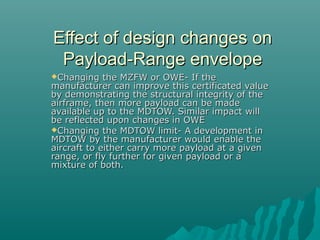
Changing the MZFW or OWE- If theChanging the MZFW or OWE- If the
manufacturer can improve this certificated valuemanufacturer can improve this certificated value
by demonstrating the structural integrity of theby demonstrating the structural integrity of the
airframe, then more payload can be madeairframe, then more payload can be made
available up to the MDTOW. Similar impact willavailable up to the MDTOW. Similar impact will
be reflected upon changes in OWEbe reflected upon changes in OWE
Changing the MDTOW limit- A development inChanging the MDTOW limit- A development in
MDTOW by the manufacturer would enable theMDTOW by the manufacturer would enable the
aircraft to either carry more payload at a givenaircraft to either carry more payload at a given
range, or fly further for given payload or arange, or fly further for given payload or a
mixture of both.mixture of both.
Effect of design changes onEffect of design changes on
Payload-Range envelopePayload-Range envelope
Changing the MFC (Maximum Fuel Capacity) limit-Changing the MFC (Maximum Fuel Capacity) limit-
The fuel capacity of an aircraft can be improved byThe fuel capacity of an aircraft can be improved by
installation of additional fuel tanks in the under floorinstallation of additional fuel tanks in the under floor
space. This improvement is done at the cost of:space. This improvement is done at the cost of:
-Cargo tanks take up space that might be used forCargo tanks take up space that might be used for
cargo or pax baggagecargo or pax baggage
-Weight of fuel tanks increases the MWE of theWeight of fuel tanks increases the MWE of the
aircraft, thereby reducing the available payload.aircraft, thereby reducing the available payload.
The most common uses for additional fuel tanks areThe most common uses for additional fuel tanks are
for corporate or VIP aircraftfor corporate or VIP aircraft
Changing the MLW limit- A MLW operational limitChanging the MLW limit- A MLW operational limit
occurs where the distance between the destinationoccurs where the distance between the destination
airfield and diversion airfield is relatively long,airfield and diversion airfield is relatively long,
necessitating a higher amount of reserve fuel.necessitating a higher amount of reserve fuel.

Aircraft performance

  • 1.
    Aircraft PerformanceAircraft Performance Purposeof the study ofPurpose of the study of performance is to optimiseperformance is to optimise the payload and rangethe payload and range ability of an aircraftability of an aircraft according to a set ofaccording to a set of physical and ambientphysical and ambient limitationslimitations
  • 2.
    Aircraft PerformanceAircraft Performance Certificationof aircraft weight andCertification of aircraft weight and performanceperformance  11stst type- domestic certification undertype- domestic certification under the jurisdiction of the state of design &the jurisdiction of the state of design & manufacturemanufacture 22ndnd type- involves the validation of thetype- involves the validation of the basic aircraft certification by the local orbasic aircraft certification by the local or national, authority of the country innational, authority of the country in which aircraft will be operatedwhich aircraft will be operated
  • 3.
    Aircraft PerformanceAircraft Performance Aircraft weight build-upAircraft weight build-up Building the payload-Building the payload- rangerange Airfield performanceAirfield performance analysisanalysis En-Route performanceEn-Route performance analysis
  • 4.
    Aircraft weight build-upAircraftweight build-up Manufacturer’s Weight EmptyManufacturer’s Weight Empty (MWE)- weight of the aircraft as it(MWE)- weight of the aircraft as it has been build by manufacturerhas been build by manufacturer without seats, galleys, Pallets orwithout seats, galleys, Pallets or containers, fuel, payload & othercontainers, fuel, payload & other items necessary for actualitems necessary for actual operation of the aircraftoperation of the aircraft
  • 5.
    Aircraft weight build-upAircraftweight build-up Operators itemsOperators items includesincludes -Unusable fuel,-Unusable fuel, -Oil for engine & APU (Auxiliary Power Unit),-Oil for engine & APU (Auxiliary Power Unit), -Water for galley & toilets,-Water for galley & toilets, -Fluid for toilets,-Fluid for toilets, -A/C docs & kits,-A/C docs & kits, -Seats & life Jackets,-Seats & life Jackets, -Galleys,-Galleys, -Passenger services items,-Passenger services items, -Emergency equipment,-Emergency equipment, -Crew & crew baggage-Crew & crew baggage
  • 6.
    Aircraft weight build-upAircraftweight build-up  Operating Weight Empty- This is theOperating Weight Empty- This is the weight of the aircraft prepared forweight of the aircraft prepared for services and it is composed of MWEservices and it is composed of MWE plus operator’s items. It does not includeplus operator’s items. It does not include any payload or fuelany payload or fuel Maximum Zero-Fuel Weight (MZFW)-Maximum Zero-Fuel Weight (MZFW)- weight of the aircraft with payloadweight of the aircraft with payload added with OWE, but no fuel in theadded with OWE, but no fuel in the tankstanks
  • 7.
    Aircraft weight build-upAircraftweight build-up Maximum Design Take-off Weight (MDTOW)-Maximum Design Take-off Weight (MDTOW)- This the maximum certified weight at which theThis the maximum certified weight at which the can take-off, as measured at brake release pointcan take-off, as measured at brake release point on the runway. The simplified version of thison the runway. The simplified version of this weight is known as Maximum Take-off Weightweight is known as Maximum Take-off Weight (MTOW)(MTOW) Maximum Landing Weight (MLW)- TheMaximum Landing Weight (MLW)- The maximum certified weight at which an aircraftmaximum certified weight at which an aircraft can land is determined by the loads that impactcan land is determined by the loads that impact on the landing gear. The value consists of theon the landing gear. The value consists of the OWE plus the payload and any reserve fuel notOWE plus the payload and any reserve fuel not consumedconsumed
  • 8.
    Relationship of DesignWeightsRelationship of Design Weights For the 777-200ERFor the 777-200ER Weight, 1,000 lb 0 100 200 300 400 500 600 700 MEW OEW MZFW MLW MTOW MTW Outthe factory doorAdd operationalitem s* Load m ax structuralpayload Add reserve fuel Add taxi-outfuel Add m ission fuel Manufacture’s empty wt Operating empty wt* Max zero fuel wt Max landing wt Max takeoff wt Max taxi wt *Operational items, hence the OEW, is determined by the airline. All other weights are defined by Boeing and the Regulatory Authority.
  • 9.
    Aircraft weight build-upAircraftweight build-up Payload- it includes the items boarded in the aircraftPayload- it includes the items boarded in the aircraft for which airline receives payment from passengers orfor which airline receives payment from passengers or shippers. These are passengers, baggage & cargo. Itshippers. These are passengers, baggage & cargo. It can also be derived by subtracting OWE from MZFWcan also be derived by subtracting OWE from MZFW -Main deck payload: Cabin layout must be defined toMain deck payload: Cabin layout must be defined to confirm number of seats by class, nos. of galley &confirm number of seats by class, nos. of galley & toilet & cabin attendant seats are necessary. Thesetoilet & cabin attendant seats are necessary. These are depend upon airline brand image. A weight shouldare depend upon airline brand image. A weight should be assigned for each pax plus checked-in baggage &be assigned for each pax plus checked-in baggage & carry-on baggage. International standard is 84 kg forcarry-on baggage. International standard is 84 kg for an adult pax with carry-on baggage & 20 kg foran adult pax with carry-on baggage & 20 kg for checked-in baggage. The defined seats are multipliedchecked-in baggage. The defined seats are multiplied by assigned weight of pax to build up payload.by assigned weight of pax to build up payload.
  • 10.
    Aircraft weight build-upAircraftweight build-up -Lower deck payload:-Lower deck payload: This area is first used for loading pax checked-inThis area is first used for loading pax checked-in baggage and then loaded with the availablebaggage and then loaded with the available cargo. Arrangement must be decided whether tocargo. Arrangement must be decided whether to accommodate pallets or containers or else underaccommodate pallets or containers or else under floor pax facilities.floor pax facilities. Baggage volume vary according to geographicalBaggage volume vary according to geographical region, nature of services (scheduled or charterregion, nature of services (scheduled or charter or Low Cost Carrier), distances of routes (shortor Low Cost Carrier), distances of routes (short or long haul)or long haul)
  • 11.
    Building the Payload-Buildingthe Payload- RangeRange The maximum range of an given aircraft isThe maximum range of an given aircraft is confirmed at the time of finalization of design.confirmed at the time of finalization of design. The payload of a given aircraft can beThe payload of a given aircraft can be determined once the OWE is confirmed and thedetermined once the OWE is confirmed and the maximization of the weight of Payload is limitedmaximization of the weight of Payload is limited by MDTOW.by MDTOW. The combination of weight of payload & fuelThe combination of weight of payload & fuel added beyond OWE will determine how far theadded beyond OWE will determine how far the aircraft travel with how much payload and theaircraft travel with how much payload and the payload-range combination is limited by MDTOW.payload-range combination is limited by MDTOW.
  • 12.
    Building the Payload-Buildingthe Payload- RangeRange In order to continue to fly further, we need toIn order to continue to fly further, we need to enforce a trade-off between weight of more fuelenforce a trade-off between weight of more fuel in the tanks and a sacrifice of payload. Thein the tanks and a sacrifice of payload. The straight-line relationship now continues until thestraight-line relationship now continues until the fuel tanks, indeed, full.fuel tanks, indeed, full. It is usual to indicate the range that could beIt is usual to indicate the range that could be achieved with full load of pax & their baggage.achieved with full load of pax & their baggage. This range, along with that achieved withThis range, along with that achieved with maximum structural payload, is the most oftenmaximum structural payload, is the most often quoted reference to indicate the ability of aquoted reference to indicate the ability of a particular aircraftparticular aircraft
  • 13.
    Payload Versus RangeCurvePayload Versus Range Curve EvolutionEvolution Increasing Range IncreasingPayload Too increase range, add fuel Stop! MTOW limit reached. TOW 1 TOW 2 MTOW Max payload (MZFW - OEW)
  • 14.
    Payload Versus RangeCurvePayload Versus Range Curve EvolutionEvolution M axim um takeoff w eight lim it Increasing Range IncreasingPayload To increase range, reduce payload and add fuel. Stop! The tanks are full Max payload (MZFW - OEW)
  • 15.
    Payload Versus RangeCurvePayload Versus Range Curve EvolutionEvolution M axim um takeoff w eight lim it Fuelcapacitylimit Increasing Range IncreasingPayload To increaserange, range,removemorepayload! Max payload (MZFW - OEW)
  • 16.
    Payload Versus RangeCurve –Payload Versus Range Curve – a complete performance envelope fora complete performance envelope for the aircraftthe aircraft M axim um takeoff w eight lim it Fuelcapacitylimit Increasing Range IncreasingPayload MLW Limit Full passenger and baggage payload Cargo Max payload (MZFW - OEW)
  • 17.
    How Do WeUse the Payload-How Do We Use the Payload- Range Curve?Range Curve? Increasing Range IncreasingPayload Full passenger and baggage payload Cargo Proposed region of operation ….Looks pretty good Not so good Out here..
  • 18.
    787-9 (GEnx-1B7475) 244,940-kg (540,000-lb)MTOW 292 passengers • Airways and traffic allowances included • 85% annual winds • 2% fuel consumption degradation • 200 nmi alternate • ISA + 10º C enroute/reserves 787-9 (GEnx-1B7475) 244,940-kg (540,000-lb) MTOW 315 passengers Full passenger payload MAURITIUSMAURITIUS Hong KongHong Kong SydneySydney LondonLondon JohannesburgJohannesburg TokyoTokyoParisParis DelhiDelhi PerthPerth MelbourneMelbourne NairobiNairobi SingaporeSingapore MumbaiMumbai DakarDakar MadridMadrid MoscowMoscow RecifeRecife Rio De JaneiroRio De Janeiro Buenos AiresBuenos Aires Range capability from MauritiusRange capability from Mauritius A typical “circle chart”A typical “circle chart”
  • 19.
    Effect of designchanges onEffect of design changes on Payload-Range envelopePayload-Range envelope Changing the MZFW or OWE- If theChanging the MZFW or OWE- If the manufacturer can improve this certificated valuemanufacturer can improve this certificated value by demonstrating the structural integrity of theby demonstrating the structural integrity of the airframe, then more payload can be madeairframe, then more payload can be made available up to the MDTOW. Similar impact willavailable up to the MDTOW. Similar impact will be reflected upon changes in OWEbe reflected upon changes in OWE Changing the MDTOW limit- A development inChanging the MDTOW limit- A development in MDTOW by the manufacturer would enable theMDTOW by the manufacturer would enable the aircraft to either carry more payload at a givenaircraft to either carry more payload at a given range, or fly further for given payload or arange, or fly further for given payload or a mixture of both.mixture of both.
  • 20.
    Effect of designchanges onEffect of design changes on Payload-Range envelopePayload-Range envelope Changing the MFC (Maximum Fuel Capacity) limit-Changing the MFC (Maximum Fuel Capacity) limit- The fuel capacity of an aircraft can be improved byThe fuel capacity of an aircraft can be improved by installation of additional fuel tanks in the under floorinstallation of additional fuel tanks in the under floor space. This improvement is done at the cost of:space. This improvement is done at the cost of: -Cargo tanks take up space that might be used forCargo tanks take up space that might be used for cargo or pax baggagecargo or pax baggage -Weight of fuel tanks increases the MWE of theWeight of fuel tanks increases the MWE of the aircraft, thereby reducing the available payload.aircraft, thereby reducing the available payload. The most common uses for additional fuel tanks areThe most common uses for additional fuel tanks are for corporate or VIP aircraftfor corporate or VIP aircraft Changing the MLW limit- A MLW operational limitChanging the MLW limit- A MLW operational limit occurs where the distance between the destinationoccurs where the distance between the destination airfield and diversion airfield is relatively long,airfield and diversion airfield is relatively long, necessitating a higher amount of reserve fuel.necessitating a higher amount of reserve fuel.

Editor's Notes

  • #9 <number> The relationship of the design weights for a 777-200 is shown above. The maximum structural payload capability is the large difference between operating empty weight (OEW) and maximum zero fuel weight (MZFW).
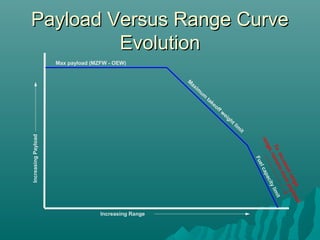
  • #14 <number> The ability of an aircraft to carry a given payload over a given range can be described in one curve which generally encompasses three different constraints. The maximum payload constraint of the payload-range curve appears as a horizontal line that outlines the top of the curve. The maximum payload may be a structural limit or a lower value such as a volume limit. As mentioned earlier, maximum payload can generally be carried until increasing fuel needs raise the takeoff weight to its maximum value. Once the airplane has reached maximum takeoff weight (maximum takeoff weight limit), then payload will decrease as fuel is added to fly farther. Once full fuel capacity is reached (fuel capacity limit), the slope of the line becomes dramatically steeper as payload must be rapidly decreased to accomplish a small increase in range.
  • #15 <number> The ability of an aircraft to carry a given payload over a given range can be described in one curve which generally encompasses three different constraints. The maximum payload constraint of the payload-range curve appears as a horizontal line that outlines the top of the curve. The maximum payload may be a structural limit or a lower value such as a volume limit. As mentioned earlier, maximum payload can generally be carried until increasing fuel needs raise the takeoff weight to its maximum value. Once the airplane has reached maximum takeoff weight (maximum takeoff weight limit), then payload will decrease as fuel is added to fly farther. Once full fuel capacity is reached (fuel capacity limit), the slope of the line becomes dramatically steeper as payload must be rapidly decreased to accomplish a small increase in range.
  • #16 <number> The ability of an aircraft to carry a given payload over a given range can be described in one curve which generally encompasses three different constraints. The maximum payload constraint of the payload-range curve appears as a horizontal line that outlines the top of the curve. The maximum payload may be a structural limit or a lower value such as a volume limit. As mentioned earlier, maximum payload can generally be carried until increasing fuel needs raise the takeoff weight to its maximum value. Once the airplane has reached maximum takeoff weight (maximum takeoff weight limit), then payload will decrease as fuel is added to fly farther. Once full fuel capacity is reached (fuel capacity limit), the slope of the line becomes dramatically steeper as payload must be rapidly decreased to accomplish a small increase in range.
  • #17 <number> The ability of an aircraft to carry a given payload over a given range can be described in one curve which generally encompasses three different constraints. The maximum payload constraint of the payload-range curve appears as a horizontal line that outlines the top of the curve. The maximum payload may be a structural limit or a lower value such as a volume limit. As mentioned earlier, maximum payload can generally be carried until increasing fuel needs raise the takeoff weight to its maximum value. Once the airplane has reached maximum takeoff weight (maximum takeoff weight limit), then payload will decrease as fuel is added to fly farther. Once full fuel capacity is reached (fuel capacity limit), the slope of the line becomes dramatically steeper as payload must be rapidly decreased to accomplish a small increase in range.
  • #18 <number> The ability of an aircraft to carry a given payload over a given range can be described in one curve which generally encompasses three different constraints. The maximum payload constraint of the payload-range curve appears as a horizontal line that outlines the top of the curve. The maximum payload may be a structural limit or a lower value such as a volume limit. As mentioned earlier, maximum payload can generally be carried until increasing fuel needs raise the takeoff weight to its maximum value. Once the airplane has reached maximum takeoff weight (maximum takeoff weight limit), then payload will decrease as fuel is added to fly farther. Once full fuel capacity is reached (fuel capacity limit), the slope of the line becomes dramatically steeper as payload must be rapidly decreased to accomplish a small increase in range.