3RD
YEAR 1ST
SEMESTER
INTEGRATED FLIGHT INSTRUMENT SYSTEM
Course code: 531107
Credits: 3
GYROSCOPE
A device for measuring or maintaining orientation, based on the principles of
conservation of angular momentum.
A mechanical gyroscope is essentially spinning wheel or disk whose axis is free to
take any orientation. This orientation changes much less in response to a given
external torque than it would without the large angular momentum associated with the
gyroscope’s high rate of spin.
A gyroscope consists of the following parts:
Spin axis
Gimbal
Rotor
Gyroscope frame
GYROSCOPE PROPERTIES
Two basic properties rigidity and precession
Rigidity: the axis of rotation (spin axis) of the gyro
wheel tends to remain in a fixed direction in space
if no force is applied to it.
Rigidity is dependent on three factors-
The mass of rotor.
The space of the rotation.
The distance of the mass from the center of the rotor.
Precession: the axis of rotation has a tendency to
turn at a right angle to the direction of applied
force.
The amount of rate of precession is dependent on three factors
The magnitude and direction of the applied force.
Moment of inertia of the rotor.
The angular velocity of the rotor.
GYRO DRIFT
Gyro drift term used to describe any movement of the gyro spin axis away from a chosen datum. Any
deviation of a horizontally aligned spin axis from its point of reference is known as gyro drift, or
wander. <The readings keep changing even when the device is stationary or the gyro sensor reports
random bad data>
Gyro drift is of two types, real drift and apparent drift.
Real drift: Describes a failure of the gyro to hold its space datum to friction in the gimbal bearings. If the
rotor, its spindle or a gimbal is not perfectly balanced the imbalance will apply a force to the rotor. This
force will cause precession, which will cause the spin axis of the gyro to deviate from its spatial
reference. The same effect can arise due to friction or wear in the rotor spindle bearings. The drift due
to the spatial deviation is known as real or random drift; it is usually very small and it cannot be
calculated, so it is impossible to produce correction charts for real drift.
Apparent drift: describes drift when comparing the direction of the gyro axis with a datum that is itself
not fixed. <An error in the directional gyro resulting from the effect of the earth's rotation and
longitudinal position.>
TRANSPORT WANDER
Transport wander can occur when a gyroscope is transported from one point on the
Earth to another. Any wander observed will be in addition to that caused by the
rotation of the Earth.
Since the earth rotates about its north-south axis at 15° per hour it follows that an
aircraft flying on a westerly heading, against the direction of earth rotation, will
experience a greater rate of longitude change and one flying on an easterly
heading a lesser rate.
To an observer on the aircraft, the spin axis of a horizontally aligned gyro would
appear to drift even though no change of latitude has occurred. This apparent drift is
known as transport drift.
GYRO DRIVES
The rotors of gyroscopic instruments must spin at high speed to give
the degree of rigidity needed and the motive power for them is
either pneumatic or electrical.
1- Pneumatic drive
The Air-driven gyro rotors are typically powered from the aircraft's vacuum system, air being drawn
through the instrument by an engine-driven vacuum pump that maintains approximately 4 in Hg of vacuum
in the system.
Pneumatically driven gyros in aircraft that operate at high altitude are usually supplied with air pressure
rather than vacuum, because of the difficulty in producing the requisite vacuum in a low-pressure
environment.
In either case the air entering the instrument is directed onto bucket-shaped indentations in the rim of the
gyro rotor, driving it as a simple turbine.
In some light aircraft the vacuum is produced by means of a venturi tube placed in the airflow. Because
the device only operates in flight at speeds in excess of 100 knots and is susceptible to icing, it is
unsuitable for use in aircraft where instrument flight may be required.
2- Electrical drive
Alternating current (A.C.) or direct current (D.C.) motors are also
used to drive gyroscopic instrument rotors, using power from the
aircraft electrical systems. As a general rule, A.C. motors are
preferred for attitude indicators and D.C. motors for turn indicators.
Simple direction indicators are usually air-driven, but those forming
part of a magnetic heading reference system, such as the slaved
gyro compass, are normally driven by electric motors. In some
aircraft the main panel instruments may be electrically driven and
the standby instruments air-driven.
Electrically powered gyros are necessary in aircraft intended for
high altitude flight. Because they are capable of much higher
rotational speeds than pneumatically powered instruments they
offer increased stability and lighter construction.
Advantages of electrically powered gyroscope
Self contained and therefore free of dust and moisture entering
the system reducing lifespan.
Does not require operation of engine.
Improved rigidity (higher inertial moment and RPM)
Does not rely of atmospheric pressure (reduced at high altitude)
Constant RPM – predictable rate of precession.
Vacuum pressure (suction) by a venturi tube
Some aircraft (typically older aircraft such as the tiger moth) have an
externally mounted venturi tube to provide vacuum power in place of the
engine driven vacuum pump.
When air flows through the venturi tube and speeds up due to the shape
of the venturi, the static pressure decreases (Bernoulli’s principle).
The low pressure area is connected to the pressure instruments to spin the
gyroscopes as in the engine driven system.
Disadvantages of this system include:
The requirement of sufficient aircraft speed to activate the venturi effect.
The time required to spin up the gyroscopes.
Parasite drag.
Susceptibility to icing.
DIRECTIONAL GYRO
The function of the directional gyro is to indicate the aircraft heading, utilizing the rigidity of a
spinning gyroscope.
The gyro spin axis is maintained horizontal and it can be set so that it is referenced to either
magnetic north or true north. A compass scale is attached to the outer gimbal of the gyroscope.
As a two-gimbal gyro, it has two degrees of freedom of precession.
The rotor of the directional gyro is mounted in an inner gimbal ring with its spin axis horizontal, so
that it is free to rotate in the vertical plane.
The inner gimbal is in turn pivoted to an outer gimbal, so that it is free to move about a horizontal
axis at right angles to the spin axis.
The outer gimbal is pivoted to the case of the instrument and is free to rotate about the vertical axis.
The rotor is normally driven by air drawn in through the aircraft's vacuum system and directed by a
nozzle onto buckets machined in the rim of the rotor.
The rotor typically rotates at about 12 000 rpm.
ATTITUDE INDICATOR (ARTIFICIAL HORIZON)
Principal of operation and construction
The vertical gyro rotates at about 15000 rpm and is contained within an inner gimbal. It is maintained
earth vertical, thus spinning in the earth horizontal plane.
The inner gimbal is pivoted to an outer gimbal with the pivot axis lying parallel to the aircraft lateral axis.
Outer gimbal is in turn pivoted to the instrument casing with the pivot axis lying parallel to the aircraft
longitudinal axis.
Attached to the outer gimbal is a sky plate, which is viewed through the face of the instrument.
Also attached to the outer gimbal by a pivoted spindle is a bar, which extends across the front of the sky
plate parallel to the dividing line. This bar, known as the horizon bar, is driven by a spindle attached to
the inner gimbal.
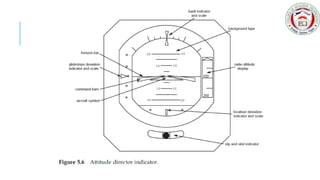
Printed on, or attached to, the glass cover of the instrument is a fixed symbol representing A/C.
The attitude indicator uses a vertical earth gyro that has freedom of movement about all three axes. The
gyro spin axis is maintained earth vertical.
The purpose of the instrument is to provide the pilot with an indication of the aircraft attitude in both pitch
and roll.
•If the aircraft is pitched nose-up, the outer gimbal will be pitched up with it, raising the
front of the gimbal relative to the gyro spin axis, which remains earth vertical.
•Because the horizon bar is pivoted to the forward end of the outer gimbal, that end of
the bar will rise and pivot about the actuating pin protruding from the inner gimbal. This
causes the horizon bar to move down relative to the aircraft symbol, indicating a climb.
•In a descent the reverse happens and the horizon bar moves up relative to the aircraft
symbol.
•When the aircraft is rolled to left or right, the bank indication is given by the position of
the horizon bar relative to the aircraft symbol.
•The aircraft symbol, on the glass face of the instrument, will have rolled with the aircraft
about the vertically referenced gyro spin axis, which has maintained the outer gimbal,
and therefore the horizon bar, earth horizontal.
•Typically, a pointer attached to the outer gimbal will indicate bank angle against a
scale printed on the glass face of the instrument.
TURN AND BANK INDICATOR (RATE GYRO)
The purpose of the turn and bank indicator is to measure and display the
aircraft rate of turn and to indicate whether the aircraft is correctly banked
for a coordinated turn with no slip or skid.
To measure the rate of turn, rate of movement about the yaw axis actually,
the instrument employs a rate gyro that is sensitive to movement about the
aircraft yaw axis only.
The gyro rotor is mounted in a gimbal with its spin axis aligned with the
lateral axis of the aircraft. The single gimbal is pivoted fore and aft in the
instrument casing, in line with the aircraft longitudinal axis.
Let the aircraft is turning to the left. This applies a torque force about the yaw
axis in an anti-clockwise direction viewed from above.
This is as though a linear force were applied to the front of the gyro rotor on the
right side in line with the spin axis.
The gyro will precess this force 90 degree in the direction of rotation, so that it
becomes torque acting in a clockwise direction about the longitudinal axis,
precessing the gyro so that the gimbal begins to tilt to the right.
As the spring is stretched it exerts a force on the gimbal opposing the precession.
When the two are in balance the gimbal is held at a tilt angle that is proportional
to the rate of turn, because the precession is equal to the rate of turn and the
angular momentum of the gyroscope.
BANK INDICATION
The bank indication given by the turn and bank indicator displays to the pilot whether
or not the aircraft is correctly banked for the turn being made.
If the aircraft is banked excessively it will tend to slip toward the centre of the turn,
whereas if it is underbanked it will skid outwards, away from the centre of the turn.
commonly known as the turn and slip indicator.
When the pilot is making a properly coordinated banked turn
the glass tube, which is attached to the instrument, will be banked
with the aircraft and the resultant of centrifugal force and
gravitational force will keep the ball in the center.
When aircraft is turning, but that the bank angle is greater than it should be, i.e. the aircraft is
overbanked. The centrifugal force acting on the ball is less than the gravitational force and the ball
falls into the lower part of the tube. This indicates to the pilot that the aircraft is slipping into the turn.
 If the aircraft is underbanked the centrifugal force acting on the
ball is greater than the gravitational force and the ball will be
moved into the upper part of the tube, indicating that the aircraft is
skidding out of the turn.
 The purpose of the instrument is to present the pilot with a display
that makes co-ordination of bank angle and turn rate as simple as
possible.
 When the pilot banks the aircraft to initiate a turn the aircraft
symbol on the display banks in the appropriate direction, since it is
actuated by the gyro precession exactly as previously described.
TURN COORDINATOR
The main constructional difference between this and the turn
and bank indicator is that the longitudinal axis of the gyro
gimbal is inclined at 30 degree to the horizontal, so that the
gyro will respond to banking as well as turning input force.
This will limit the instrument bank indication when turning
during ground taxiing.
ERECTION SYSTEM
During a change of heading an aircraft is turning about its vertical, or yaw, axis.
Whilst it is doing so the aircraft is, of course, banked and so the spin axis of the
directional gyro must also be tilted to keep it aircraft horizontal.
As we know, to move the spin axis of a gyro away from its fixed reference it is
necessary to precess the gyro, and this is achieved through the design of the nozzle
that directs air onto the rim of the rotor.
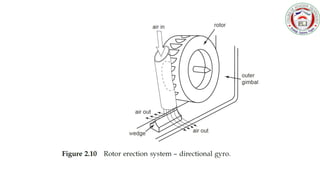
In later designs of air-driven directional gyros the air from the rotor is exhausted
onto a wedge attached to the outer gimbal, as shown in Figure 2.10. Whilst the spin
axis of the rotor remains aircraft horizontal the spin axis and the outer gimbal are
mutually perpendicular and the exhaust air strikes both sides of the wedge equally,
as seen in Figure 2.10.
When the aircraft begins to bank in a turn the outer gimbal banks
with it and the rotor axis is no longer at right angles to the outer
gimbal.
Exhaust air now strikes one side of the wedge more than the other.
This applies a force to the outer gimbal that is tending to rotate it
about the vertical axis, which is the same as applying a force to one
side of the gyro rotor.
That force is precessed by the rotor through 90 degree in the
direction of rotation, tilting it to keep its spin axis aircraft horizontal.
LEVELLING
In order to compute the speed, distance travelled and position of the aircraft, the INS
must first be referenced to north at the current aircraft position, which is fed into the
computer by the pilot from airfield information. The process of self-alignment is
performed in two distinct phases; first the platform must be levelled so that the
accelerometers are not influenced by gravity and then it must be aligned with true
north so that they only sense horizontal accelerations on the north-south and east-west
axes.
Levelling and alignment are initiated by switching the INS to STANDBY and inserting
the present position in terms of latitude and longitude, and then selecting ALIGN
mode.
Conventional systems reduce the time taken to level the platform by using gravity to
achieve coarse levelling, followed by fine levelling using the accelerometers.
Coarse levelling
During coarse levelling the pitch and roll gimbals are typically driven by the servo motors until they are
mutually perpendicular and the platform is brought to within about 1° of level using either gravity or
reference to the airframe.
Fine levelling
With the aircraft stationary and the platform level there should be no output from the accelerometers. If
there is an output from either or both accelerometers this indicates that the platform is not level and that
acceleration due to gravity is being sensed. The output signals from the accelerometers are used to torque
the north and east gyros, which in turn use the pitch and roll servo motors to drive the platform about the
pitch and roll axes until output from the accelerometers is zero.
However, it will be appreciated that a platform levelled to earth horizontal using spatial referenced
gyroscopes will not remain horizontal over an earth that is rotating. From Figure 3.8 it will be seen that a
level platform above the poles would suffer drift about the vertical axis at earth rate (15.04°/hr), and one
at the equator would suffer topple about the north-south axis at the same rate. At intermediate latitudes
the platform would drift and topple at a rate dependent upon the latitude. To correct for this the north gyro
is biased for topple at 15.04 X cos lat°/hr and the azimuth gyro is biased for drift at 15.04 X sin lat°/hr.
Consequently, the platform will only be level when the output of the east± west accelerometer is zero and
the output of the north-south accelerometer is also zero with the correct bias applied. The INS computer is
able to apply the correct bias, because current latitude is inserted before the levelling procedure begins.
Fine levelling typically brings the platform to within 6 seconds of arc of earth horizontal and takes about
1.5minutes.
GIMBAL ERROR
Gimbal error is when the gimbals of a gyroscope are not mutually perpendicular and the
gyroscope itself is displaced.
Briefly, the reason for these errors is because the spin axis of the DG(directional gyro) is
aligned with east-west on the instrument compass card. Thus, with the DG properly set, the
rotor spin axis will be at right angles to the aircraft longitudinal axis (and therefore the
outer gimbal) when the aircraft is on an east or west heading and aligned with it on a north
or south heading.
On these headings the DG will only suffer gimbal error if the aircraft is pitched and rolled
simultaneously. On other headings it may occur during either pitch or roll attitude changes.
The effect of gimbal error is that the instrument will give a false heading indication whilst the
maneuver is in progress, but it will normally indicate correctly once the aircraft is returned to
straight and level flight.
DRIFT CALCULATION
The apparent drift due to earth rotation for a gyro that has no random (real) drift and that is stationary on the
ground (i.e. not affected by transport drift) can be calculated given the latitude at which the gyro is located and the
hemisphere, north or south.
In the northern hemisphere a gyro that has been aligned with north will appear to drift at the rate of 15 X sin
latitude°/hr and the DG indication will decrease at that rate. Reference to Figure 2.11(a) will show why this is the
case.
Let us assume that the aircraft in which the DG is installed is stationary on the ground at latitude 50°N, that it is on a
westerly heading, and that the DG has been aligned with the local meridian and is indicating a heading of 270°.
This is the situation at point A in Figure 2.11(a). The gyro drift rate will be 15 X sin 50°/hr, which is 15 X 0.766 =
11.5°/hr. After one hour has elapsed the gyro has not moved, but the earth has rotated and the situation will be as
at point B. The gyro will appear to have drifted by 11.5° and its reading will have decreased by that amount,
because its space reference is now 11.5° to the east of the local meridian. Consequently, it will now be indicating
258.5°. Without adjustment the gyro indication would continue to decrease at the rate of -11.5°/hr.
In the southern hemisphere a similar situation occurs and this is illustrated in Figure 2.11(b). With the aircraft on the
ground at 50°S and the gyro indicating 270° at point C the apparent drift rate due to earth rotation will again be
11.5°/hr, but now the readings will be increasing at that rate. This is because, after one hour has elapsed, the gyro's
space reference will lie 11.5° to the west of the local meridian, in position D, and so the DG will indicate a heading
of 281.5°.
TERRESTRIAL MAGNETISM
The surface of the earth is surrounded by a weak magnetic field which culminates in two internal magnetic poles situated
near the North and South true or geographic poles.
That this is so is obvious from the fact that a magnet freely suspended at various parts of the earth's surface will be found to
settle in a definite direction, which varies with locality.
A plane passing through the magnet and the center of the earth would trace out on the earth's surface an imaginary line
called the magnetic meridian as shown in Fig. 3.1. It would thus appear that the earth's magnetic field is similar to that which
would be expected at the surface if a short but strongly magnetized bar magnet were located at the center.
This partly explains the fact that the magnetic poles are relatively large areas, due to the spreading out of the lines of
force, and it also gives a reason for the direction of the field being horizontal in the vicinity of the equator. The origin of the
earth's field is still not precisely known, but, for purposes of explanation, the supposition of a bar magnet at its center is
useful in visualizing the general form of the magnetic field as it is known to be.
The field differs from that of an ordinary magnet in several respects.
Its points of maximum intensity, or strength,. are not at the magnetic poles (theoretically they should be) but occur at four
other positions, two near each pole, known as magnetic foci. Moreover, the poles themselves are continually changing their
positions, and at any point on the earth's surface the field is not symmetrical and is subject to changes both periodic and
irregular.
MAGNETIC VARIATION
As we know that the earth's true and magnetic north poles are not co-incident and there
is, in fact, some considerable geographic distance between the two. At most locations
there will be an angular difference between the magnetic north and true north, and this
difference is known as magnetic variation. On the shortest distance line joining the true
and magnetic poles, variation at any point is theoretically 180°, whereas elsewhere on a
line joining the two, known as an agonic line, variation is zero.
At locations where magnetic north lies to the east of true north, variation is said to be
easterly. At points where magnetic north lies to the west of true north, variation is said to
be westerly. The concept is illustrated in Figure 2.25.
Magnetic variation at any point on the earth's surface can be plotted and is shown on
charts as a series of lines joining points of equal variation, known as isogonals. The
earth's magnetic field undergoes various changes which, in the long term, cause the
location of the magnetic poles to move. This movement is reasonably predictable and
usually appears on charts as annual changes to variation, e.g. annual change 5'W.
MAGNETIC DEVIATION
A compass needle will indicate the direction of magnetic north, provided that it is only influenced by the earth's magnetic field. In an
aircraft there are many influencing local magnetic fields caused by hard or soft iron or electrical circuits. These will deflect the compass
needle away from the direction of magnetic north. The angular difference between compass north and magnetic north is referred to as
deviation.
The strength of the aircraft's magnetic field is usually reasonably constant and its effect on the compass reading can be determined
during a procedure known as compass swinging. The aircraft is placed on a number of known magnetic headings and the compass
reading is compared with the aircraft heading, to find the angular difference between compass north and magnetic north. The compass
reading can be adjusted by means of a compensation device within the instrument until it agrees as nearly as possible with the aircraft
heading. It is usually impossible to adjust the compass so that it exactly agrees on all headings and the remaining small angular
difference is known as residual compass deviation.
Upon completion of the compass swing the residual compass deviation is recorded on a compass correction card, in either tabular or
graphic form, which is mounted in the cockpit. The correction card shows the deviation as positive (+) or negative (7), indicating how it
must be applied to the com- pass reading to obtain the correct magnetic heading.
When compass north lies to the east of magnetic north, deviation is said to be easterly; when it lies to the west of magnetic north,
deviation is said to be westerly. Deviation easterly is positive and deviation westerly is negative. Thus, if the correction card states that
the compass has -1° residual deviation on a heading of 180°(M), then the pilot must steer 181° (C) for the aircraft to actually be on a
heading of 180° (M). Alternatively, when the compass reads 180° (C) the aircraft's magnetic heading will be 179° (M). The concept is
illustrated in Figure 2.26. The maximum permissible value for residual deviation of a standby compass is ±10°.
MAGNETIC DIP
A freely suspended magnet will settle in a definite direction at any point on the earth's surface and will lie
parallel to the magnetic meridian at that point.
It will not, however, lie parallel to the earth's surface at all points for the reason that the lines of force
themselves are not horizontal, as may be seen from Fig. 3.2. These lines emerge vertically from the North
magnetic pole, bend over and descend vertically into the South magnetic pole; it is only at what is known
as the magnetic equator that they pass horizontally along the earth's surface.
If, therefore, a suspended magnet is carried along a meridian from north to south, it will be on end, red
end down, at the start, horizontal near the equator, and finish up again on end but with the blue end down.
The angle the lines of force make with the earth’s surface at any given place is called the angle of dip or
magnetic inclination, and varies from 0° at the magnetic equator to 90° at the magnetic poles. The angle
of dip at all places undergoes changes similar to those described for variation and is also shown on charts
of the world. Places on these charts having the same dip angle are joined by lines known as isoclinals, while
those at which the angle is zero are joined by a line known as the aclinic line or magnetic equator, of which
mention has already been made.
DIRECT READING COMPASS
It is located in the cockpit and affected by magnetic field.
Comprises a pivoted magnet able to align itself and remain aligned with the horizontal component of the earth’s
field.
It allows direct reading of heading.
Otherwise known as the standby compass.
It is normally used as a standby, because of serious limitations.
At high magnetic latitudes (above 70° N or S), it becomes unreliable because the angle of dip is so steep and the
directional force is so weak.
Primary navigation aid for most light aircraft.
Indirectly it indicates bank angle:
• Compass decreasing, left turn.
• Compass increasing, right turn.
It is susceptible to a number of errors.
ADVANTAGES OF DIRECT READING COMPASS
It have three advantages.
•It is very simple and therefore reliable.
•It is very cheap and lightweight.
•Does not require any form of power and so will continue to work
even after a total power failure in the aircraft.
COMPASS CONSTRUCTION
Direct-reading compasses have the following common principal features: a magnet system housed in a bowl; liquid
damping; liquid expansion compensation; and deviation compensation. The majority of compasses currently in use are
of the card type, and the construction of two examples is illustrated in Fig. 3.3.
The magnet system of the example shown at (a) comprises an annular cobalt-steel magnet to which is attached a light-
alloy card. graduated in increments of 10°, and referenced against a lubber line fixed to the interior of the bowl. The
system is pendulously suspended by an iridium-tipped pivot resting in a sapphire cup supported in a holder or stem.
The pivot point is above the centre of gravity of the magnet system which is balanced in such a way as to minimize the
effects of angle of dip over as wide a range of latitudes North and South as possible.
The bowl is of plastic and so molded that it has a magnifying effect on the card and its graduations. It is filled with a
silicone fluid to make the compass aperiodic, i.e. to ensure that after the magnet system has been deflected, it returns
to equilibrium directly without oscillating or overshooting.
The fluid also provides the system with a certain buoyancy, thereby reducing the weight on the pivot and so diminishing
the effects of friction and wear. Changes in volume of the fluid due to temperature changes, and their resulting effects
on damping efficiency, are compensated by a bellows type of expansion device secured to the rear of the bowl.
The compass shown at (b) of Fig. 3.3 is designed for direct mounting on a panel. Its magnet system is similar to the one
described earlier except that needle-type magnets are used. The bowl is in the form of a brass case which is sealed
by a front bezel plate. Changes in liquid volume are compensated by a capsule type of expansion device. A
permanent-magnet deviation compensator is located at the underside of the bowl, the coefficient 'B' and 'C' spindles
being accessible from the front of the compass. A small lamp is provided for illuminating the card of the magnet
system.
TYPICAL CARD COMPASSES
(B)
(A)
LOCATION CONSIDERATION
The location of a compass in any one type of aircraft is of importance, and is pre-
determined during the design stage by taking into account the effects which
mechanical and electrical equipment in cockpit or flight deck areas may have on
indications. In this connection it is usual to apply the compass safe distance rule which,
precisely defined, is 'the minimum distance at which equipment may be safely
positioned from a compass without specified design values of maximum deviation
being exceeded under all operating conditions'. The distance is measured from the
centre of a compass magnet system to the nearest point on the surface of equipment.
Values are quoted by manufacturers as part of the operating data appropriate to
their equipment.
ERRORS IN INDICATION
The pendulous suspension of a magnet system, although satisfactory from the point of
view of counteracting dip, is unfortunately a potential source of errors under in-flight
operating conditions in which certain force components are imposed on the system.
There are two main errors that result from such components, namely acceleration error
and turning error.
ACCELERATION ERROR
Figure 2.23(a) shows the compass viewed from above, with the CG displaced southward of the pivot
point and the compass card markings simplified to show only the cardinal points. In Figure 2.23(b) the
aircraft is accelerating on a westerly heading. Inertia causes the suspended magnet system to lag
and, because its CG is displaced from the pivot point the moment of inertia causes the compass card
to rotate anti-clockwise. To the pilot this presents a false indication of a turn toward north. If the
aircraft were to decelerate, the lag would be in the opposite direction and the compass would swing
to give a false indication of a turn toward south.
In Figure 2.23(c) the aircraft is accelerating on an easterly heading and the lag of the displaced CG
causes the compass card to swing in a clockwise direction. Once again, the effect as far as the pilot is
concerned is that the compass is falsely indicating a turn toward north. Deceleration on the same
heading would produce a false indication of a turn toward south.
Acceleration or deceleration on a northerly or southerly heading will not cause false indications, since
the CG and pivot point are aligned.
Summarising, in the northern hemisphere acceleration on an easterly or westerly heading will produce
a false indication of a turn toward north; deceleration on those headings will produce a false
indication of a turn toward south. In the southern hemisphere the errors are the opposite of the above.
TURNING ERRORS
Turning errors due to the displacement of the CG are maximum on a northerly or southerly
heading and are significant up to 358 on either side of those headings. Let us consider the
situation with an aircraft in the northern hemisphere and turning through a northerly heading.
Figure 2.24(a) illustrates the situation when a turn toward east is initiated.
As the aircraft turns, the centrifugal force acting upon the CG of the magnet system creates a
turning force on the compass card in the same direction as the turn. The card should not turn at
all, of course, but should remain aligned with the magnetic meridian. The effect of the turning
card is to cause the compass to underread during the turn. A turn through north toward west will
have the same effect, the card turning in the same direction as the aircraft turn and causing the
compass to underread the turn. This is illustrated in Figure 2.24(b).
Figure 2.24(c) shows the situation with the aircraft turning toward east through a southerly
heading. Now the centrifugal force acting on the dis- placed CG turns the compass card in the
opposite direction to the turn and the compass will overread during the turn. Exactly the same
will happen when a turn toward west is made through a southerly heading, as illustrated in
Figure 2.24(d).
DEVIATION AND COMPENSATION
In order to determine by what amount compass readings are affected by hard- and soft-iron
magnetism, a special calibration procedure known as 'swinging' is carried out so that
adjustments can be made to compensate for the deviations.
These adjustments are effected by compensator or corrector magnet devices which, in the
case of direct-reading compasses, always relate only to deviation coefficients B and C.
Adjustment for coefficient A is effected by repositioning the compass in its mounting by the
requisite number of degrees.
A compensator forms an integral part of a compass and in common with the majority of those
in current use it contains two pairs of permanent magnets which can be rotated through
gearing as shown in Fig. 3.8.
One pair of magnets is positioned laterally to provide a variable longitudinal, field, thereby
permitting adjustment for coefficient while the other pair is positioned longitudinally to
provide a variable lateral field and so permit adjustment for coefficient C. Thus, the fields
are effective in neutralizing the deviations on only the two cardinal headings appropriate to
each of the coefficients.
The manner in which compensation is carried out may be understood by considering the case of an adjustment having to
be made for coefficient B, as indicated in Fig. 3.9. When the appropriate compensator magnets are in the neutral
position, as shown at (a), the fields produced are equal and opposite, and if as also shown the aircraft is heading north,
then the total field is aligned with the earth's component H and the compass magnet system.
Variation of the field strength by rotating the magnets will, therefore, have no effect. This would also be the case if the
aircraft was heading south.
At (b) of Fig. 3.9, the aircraft is represented as heading east and, as before, the compensator magnets are in the
neutral position. The total field of the magnets, however, is now at right angles to the earth's component and the compass
magnet system, and so if the magnets are now rotated from the neutral position to the positions shown at (c), the
distance between poles N2 and S1 is smaller. Since tl1e intensity of a field varies in inverse proportion to the square of
the distance from its source, then in this case, a strong field will exist between the poles of the magnets. The north-
seeking pole of the compass magnet system will, therefore, experience a greater repulsive force, resulting in deflection
of the system through 'an appropriate number of degrees. If the magnets are rotated so as to strengthen the field
between poles N1 and S2, the compass magnet system will then, of course, be deflected in rhe opposite direction.
Deflection of the compass magnet system would be obtained in a similar manner with the aircraft heading west.
The coefficient C compensating magnets also produce similar effects but, as a study of diagrams (d) to (f) will show,
deflections of the compass magnet system are only obtainable when an aircraft is heading either north or south.
It will be apparent from the foregoing operating sequences that maximum compensation of deviation on either side of
cardinal headings is obtained when the magnets are in complete alignment.
The gears on which magnets are mounted are connected to operating heads which, depending on the type of compass,
are operated either by a key or by means of a screwdriver. Indication of the neutral position of magnets is given by
aligning datum marks, located typically on the ends of magnet-operating spindles and on the compensator casing.
SYNCHRONOUS TRANSMISSION
The principle of synchronous transmission was described in Chapter 2 under the direct reading
compass, but is repeated here as it applies to the measurement and transmission of engine oil
pressure, and as illustrated in Figure 7.3.
In the example, oil pressure is sensed in a capsule that expands against a spring to create linear
movement proportional to the measured pressure.
This movement is transmitted mechanically to a rotor upon which is wound a coil carrying alternating
current. The rotor is positioned centrally within a stator having three coils at 1208 spacing. The
electro-magnetic field created around the rotor induces a current flow in each of the stator coils, the
strength of the current in each coil being dependent upon the orientation of the rotor. These three
transmitter currents are fed to, and repeated in, an identical receiver stator system located behind
the cockpit instrument panel, where they create a magnetic field identical to that in the transmitter.
This field interacts with the A.C induced field surrounding the receiver rotor coil, causing the receiver
rotor to rotate and adopt an orientation corresponding to that of the transmitter rotor. The receiver
rotor is mechanically connected to the pointer of a pressure-indicating instrument.
CATEGORIES OF SYNCHRO SYSTEM
Synchro systems are divided into four main categories as follows
1. Torque: This is the simplest form of synchro, in which torque is derived solely from the input to its transmitting
element; no amplification of this torque takes place. Moderate torque only is developed at the output shaft of
the receiving element, and for this reason the system is used for data-indicating purposes, e.g. oil or fuel
pressure, and for the indication of the position of mechanical controlling devices, e.g. airflow control valves.
2. Control: This type of synchro normally forms part of a servomechanism to provide the requisite signals
which, after amplification, are used for the control of a drive motor.
3. Resolver: This is used where precise angular measurements are required. It converts voltages, which
represent the cartesian coordinates of a point, into a shaft position and a voltage which together represent
the polar coordinates of the point. They can also be used for conversion from polar to cartesian coordinates.
Typical applications are in analogue computers, remote-indicating compasses, and flight director systems.
4. Differential: This type of synchro is used where it is necessary to detect and transmit error signals
representative of two angular positions, and in such a manner that the difference or the sum of the angles can
be indicated. They can be utilized in conjunction with either torque, control or resolver synchro systems.
SLAVED GYRO COMPASS
•The slaved gyro compass, also known as a remote indicating compass or gyro-magnetic compass,
embodies the best features of the directional gyro and the direct reading compass.
•The direct reading compass suffers from a number of disadvantages, in particular its susceptibility
to acceleration and turning errors. Because it must be located at the position where it is to be
read, e.g. the cockpit, it is susceptible to aircraft magnetism and suffers from deviation.
•The directional gyro is subject to apparent drift when it is at any location other than that for which
it is adjusted and consequently requires constant re-setting
•The slaved gyro compass utilises the earth's magnetic field to sense magnetic north and this
magnetic flux is used to provide the constant correction required by the gyroscopic element of the
compass system to maintain a magnetic north reference. The gyroscopic stabilisation reduces the
turning and acceleration errors inherent in the magnetic sensing element and the device has the
further advantage of being capable of operating any number of remote compass indicators.
THE FLUXVALVE
The magnetic detecting element of the slaved gyro compass is a device known as a fluxvalve. This senses the direction of the
earth's magnetic field relative to the aircraft heading and converts this into an electrical signal. A simple fluxvalve comprises
two bars of highly permeable magnetic material that are laid parallel to each other, each surrounded by a coil of wire,
called a primary coil, supplied with alternating current and connected in series. Surrounding these is a secondary, pick-up
coil. The general arrangement is illustrated in Figure 2.27.
When a current is passed through a coil of wire a magnetic field is set up around the coil and, if the current is alternating
current, the field will be of continuously varying strength and polarity. Because the primary coils are wound in opposite
directions, the fields surrounding them are of opposite polarity and the permeable fluxvalve bars are magnetised with
opposite polarity by the primary fields. The alternating current is of sufficient strength that, at its peak value, both bars are
magnetically saturated. A variable magnetic flux field cutting through the windings of the sec- ondary coil would normally
induce a current flow in them, but because the primary fields are of opposite polarity and therefore self-cancelling, no
current is induced in the secondary coil.
However, if the fluxvalve is placed parallel to the earth's surface it will be subjected not only to the electro-magnetic field
due to the primary current flow, but also to the horizontal (H) component of the earth's magnetic field. This flux due to the
earth's magnetic field will saturate the bars of the fluxvalve before the alternating current supply to the primary coils
reaches peak value and will cause a varying strength of flux around the primary coils.
As this varying flux cuts through the windings of the secondary coil, it will induce a current flow in the secondary windings.
The strength of this current is directly proportional to the strength of flux in the fluxvalve bars due to earth magnetism. This
will depend upon the direction of the bars relative to the earth's magnetic field, which will be greatest when the bars lie
parallel to the earth's (H) field and weakest when they are at right angles to it. The output of the secondary coil can be used
to drive a remote indicating com- pass or, in the case of the slaved gyro compass, to apply corrections to the gyro unit.
DETECTOR UNIT
The detector unit contains the flux valve that senses the direction of the earth's
magnetic field relative to the aircraft heading. However, a simple flux valve of the
type described above would be inadequate, since it is prone to ambiguity in that it
will produce a signal of identical strength and polarity on different headings. In order
to overcome this anomaly an aircraft sensing unit consists of three simple flux valves
connected at a central point and spaced at 120° intervals, as shown in Figure 2.28.
Each flux valve has a collector horn attached to its outer end to improve collection of
the relatively weak earth flux. The assembly is pendulously suspended so that it will
remain horizontal regardless of aircraft attitude and is mounted where it will be least
affected by aircraft magnetism, typically at the wingtip or near the top of the fin
(vertical stabilizer).
REMOTE COMPASS INDICATION
The detector unit is mounted such that it remains essentially earth hor- izontal,
in order to best sense the H component of earth magnetism, and fixed so that
one `spoke' of the detector is permanently aligned with the aircraft's
longitudinal axis. Each spoke has its primary and secondary windings, and the
secondary windings are connected to the stator windings of a device called a
signal selsyn, as illustrated in Figure 2.29. The signal selsyn comprises three
stator windings, mounted at 120° to each other, surrounding a rotor upon
which is wound a further coil.
FIGURE 2.29: REMOTE COMPASS INDICATION
REMOTE COMPASS INDICATION
PRINCIPLE OF OPERATION
Let us suppose that the aircraft is on a heading of 000°M. Coil A of the detector unit is aligned with the earth H field and
therefore maximum current is induced in it. Coils B and C have weaker strength current induced in them and, because of the
direction of their windings, it is of opposite polarity. These currents are supplied to coils A, B and C of the signal selsyn and the
combination of their electro-magnetic fields reproduces a flux field identical to that sensed by the detector unit.
Assume for the moment that the rotor of the signal selsyn is aligned with this reproduced field. The lines of flux cutting through
the windings of the rotor coil will induce maximum voltage and current flow within the coil.
This current flow creates an electro-magnetic field, which will seek to align with the reproduced `earth' magnetic, causing the
rotor to rotate until it is at right angles to the reproduced field. When this is reached there will be no voltage induced in the rotor
coil and the motor will cease turning, with the compass pointer indicating the heading as sensed by the detector unit. This is known
as the null point of the signal selsyn rotor. Attached to the rotor is a compass pointer, indicating the aircraft magnetic heading.
Because the flux valves of the detector unit are at 120° to each other their combined secondary coil outputs are unique on every
heading. This ensures that the null-seeking rotor will always be at right angles to the selsyn reproduced `earth' magnetic field.
As aircraft heading changes, the relationship of the detector unit flux- valves to the earth's magnetic field will change with it. This
field will be reproduced in the signal selsyn and the rotor will turn to maintain itself at right angles to the field, moving the
compass pointer so that the heading indication changes with the heading change.
In the case of the slaved gyro compass a signal from the null-seeking rotor is used to precess a gyroscope to the correct magnetic
heading reference. A schematic diagram of a simple slaved gyro compass system is in Figure 2.30.
FIGURE 2.30:
SLAVED GYRO COMPASS SYSTEM SCHEMATIC
DIRECTIONAL GYRO UNIT (DGU)
This unit is located at a remote point in an aircraft (typically in an electronics equipment compartment), and
also designed to serve as a centralized source of heading data for use in the operation of flight director and
automatic flight control systems.
In a typical unit the gyroscope is based on a two phase induction motor operating from a 115 V ac power
source. The inner gimbal ring is fitted with hemispherical covers to totally enclose the motor, and this assembly
is filled with helium and hermetically sealed.
The rotors of the slaving/heading CX synchro, and the additional heading data CX synchro, are mounted on
the top of the outer gimbal ring; the stators are fixed to the frame supporting the gimbal ring. The slaving
torque motor is positioned on one side of the outer gimbal ring, and on the inner gimbal ring axis, to provide
precession of the outer gimbal ring appropriate to magnetic heading reference changes; the precession rate
is 1°-2°/min.
In order to control drift of the gyroscope its spin axis is maintained in the horizontal position by a liquid
levelling switch and torque motor system which operates in a similar manner to the erection system used in
electrically-operated gyro horizons. The levelling switch is mounted on the inner gimbal ring and is connected
to the control winding of the torque motor mounted on the lower part of the outer gimbal ring.
A speed-monitoring circuit system (sometimes called ·spin-down braking') is also
incorporated to prevent the oscillating effect, or nutation, of the gyroscope which can
occur when, at low rotational speeds, its gimbal ring axes are not mutually
perpendicular. The system holds the gimbal system steady for short periods during the
start-up and run-down stages of gyroscope operation. Circuits are also provided for
the monitoring of the slaving/heading synchro output signals, and the input signals
from the servo module of the system's amplifier. Should the signals from any one of
these monitoring circuits become invalid, a relay is energized to complete circuits
controlling warning flags in the RMI, and the HSI of a flight director system.
The complete gyroscope assembly is mounted on anti-vibration mountings contained in
a base which provides for attachment at the appropriate location in an aircraft. and
also for the connection of the relevant electrical circuits.
RADIO MAGNETIC INDICATOR (RMI)
This is a triple display type of indicator which derives its name from the fact that, in addition to magnetic heading data. it also
displays the magnetic bearing of an aircraft with respect to ground-based transmitting stations of radio navigation systems. The
systems concerned are: ADF (Automatic Direction Finding) and VOR (Very high-frequency Omnidirectional Range).
The display presentations of two examples of RMI are shown in Fig. 8.14. Magnetic heading data is displaced by the heading
card which is rotated relative to a fixed lubber line. Magnetic bearing indications are provided by two concentrically-mounted
pointers, one called a 'double-bar’ pointer and the other a ‘single-bar’ pointer. Both are referenced against the heading card,
and are positioned by synchros that are supplied with the appropriate bearing signals from the ADF and VOR navigation
receivers.
There are normally two ADF and VOR systems installed in an aircraft and by means of selector knobs shown, they can be
individually selected so that their output signals can operate the pointers in a corresponding manner.
For example, when the 'VOR-1/ADF-l' and 'VOR-2/ADF-2' selector knobs are each at the 'VOR' position, the single-bar pointer
and double-bar pointer synchro systems will, respectively, respond to bearing signals received from the No. 1 and No. 2 VOR
system receivers. A similar response will be obtained with both selector knobs at the ‘ADF’ position. Bearing information can also
be displayed with one selector knob set at 'ADF' and the other at 'VOR'.
The signals transmitted to the synchros are such that the pointers always point to the stations from which the signals are received.
This may be seen from Fig. 8.15, which is a representation of how the air position of an aircraft may be determined from the
display of magnetic bearings and magnetic heading.
MHRS OPERATING MODES
MHR(magnetic heading reference) systems provide for the selection of two modes of operation, namely slaved
and DG. The slaved mode is the one normally selected, and provides for operation in the manner already
described. When operating in this mode, however, the accuracy of a system is affected by the range of
latitudes over which an aircraft is flown. The reason for this is that the magnetic intensity of the earth's field
component H varies with latitude such that beyond 70° north or south of the equator, it becomes an unreliable
primary heading reference. Such a reference would also be obtained if, regardless of latitude, a
malfunctioning of heading reference signal circuits were to occur. Thus. as in the case of direct-reading
compasses and direction. an MHRS can also be selected to operate in the DG mode to obtain a short-term
stability reference irrespective of magnetic field variations. Once selected, the heading information displayed
must be frequently updated in order to maintain its integrity.
In a monitored gyroscope type of system, the selection of the DG mode disables the slaving control circuit in the
DGU so that its gyroscope then functions as a basic direction indicator for controlling the heading servo loop
coupled to the compass cards of the RMI. and the HSI of the flight director system. In an MHRS/INS integrated
system, the slaving control and stepper motor circuit in the compass coupler is similarly disabled, and the
heading setvo loop coupling the RMI and HSI compass cards is controlled solely by inertial platform heading
references established by the azimuth gyroscope and synchro.
DEVIATION COMPENSATION
Deviation is an error in heading indication that results from the effects of hard- and
soft-iron components of aircraft magnetism on the detector element of a compass.
Although the detector elements of MHR systems have the advantage over those of
direct-reading compasses, in that they are fixed in azimuth, and can be located at
specifically chosen remote points in an aircraft, they are not entirely immune from
extraneous fields that may be present in their vicinity.
The principal reason for this is that the element material has a high permeability and
so is very receptive to magnetic flux . Thus, any flux additional to that of the desired
earth's field component will displace the H axis of the material’s B/H curve to a false
datum, and thereby induce heading error signals. It is therefore necessary to
incorporate deviation compensation devices in an MHR system.
As far as compensation for the deviation coefficient A is concerned, it is normally the practice to utilize
detector elements of the preindexed type. In some early designs of detector element, compensation
was effected by rotating the element in its mounting by the requisite amount, and referencing it against
a scale and fixed datum mark. An electromagnetic method is normally adopted for the compensation
of deviation coefficients B and C, and this is illustrated in the basic circuit diagram of Fig. 8.20.
The potentiometers, which are incorporated in a remotely-located compensator unit, are connected to
the pick-off coils of the detector element. When rotated with respect to calibrated scales, they inject
very small de signals into the coils, so that the fields they produce are sufficient to oppose those causing
deviations. The output of the detector element is thereby modified to correct the readings of the RMI
via the synchronous transmission loop. In some types of electromagnetic compensator, provision is also
made for coefficient A adjustment. This is achieved by the inclusion of a differential synchro between
the detector element and the servo synchro within the RMI. When the position of the differential synchro
rotor is adjusted in the appropriate direction, it offsets the deviation by changing the magnitude of the
heading signals transmitted by the detector element.
ATMOSPHERE
Atmosphere is a protective layer of gases that shelters all life on Earth, keeping temperatures within a relatively small
range and blocking out harmful rays of sunlight. The atmosphere is important because of the following reasons:
It contains oxygen, which is vital for living organisms.
Ozone found in the atmosphere (which is made up of three oxygen atoms) protects living organisms from harmful UV radiation.
It has a role in warming the earth and making the temperature toleratable for organisms to live.
The warmth of the earth is credited to the greenhouse gases found in the atmosphere. The greenhouse gases include methane, carbon dioxide, and
water vapor.
The gases found in the atmosphere are important for many life processes, such as photosynthesis and respiration.
The atmosphere also plays a key role in the water cycle. The steps of the water cycle, such as precipitation and condensation, take place in the
atmosphere.
Features of the Atmosphere:
Helps retain the sun’s heat and prevents it from escaping back into space.
Protects life from harmful radiation from the sun.
Plays a major role in Earth’s water cycle.
Helps keep the climate on Earth moderate.
The atmosphere reaches more than 10,000 kilometers (6,200 miles) above the earth's surface. The atmosphere is comprised of
layers based on temperature. Five layers occupy those ten thousand kilometers.
Gas molecules are able to move freely and if they are uncontained, as they are in the atmosphere,
they can take up more or less space.
When gas molecules are cool, they are sluggish and do not take up as much space.
With the same number of molecules in less space, both air density and air pressure are higher.
When gas molecules are warm, they move vigorously and take up more space. Air density and air
pressure are lower.
Warmer, lighter air is more buoyant than the cooler air above it, so it rises. The cooler air then sinks
down, because it is denser than the air beneath it. The property that changes most strikingly with
altitude is air temperature. Unlike the change in pressure and density, which decrease with altitude,
changes in air temperature are not regular. A change in temperature with distance is called a
temperature gradient.
The atmosphere is divided into layers based on how the temperature in that layer changes with
altitude, the layer’s temperature gradient (Figure below). The temperature gradient of each layer is
different. In some layers, temperature increases with altitude and in others it decreases. The
temperature gradient in each layer is determined by the heat source of the layer
TEMPERATURE AND PRESSURE VARIATION WITHIN
THE ATMOSPHERE
TROPOSPHERE
The troposphere is the layer where organisms live. The photosynthesis and respiration processes depend
on the gases found in this layer. Almost all of the water vapor of Earth is found in the troposphere. This is
considered the lowest layer of the atmosphere, as it starts from the ground and reaches 14 kilometers up.
In the poles, it only reaches about eight kilometers up. Clouds, wind, and weather elements are found in
this layer. Evaporation of water, condensation of water vapor, and rain take place in the troposphere. In
this layer, the density of gases decreases when height increases. Additionally, the temperature decreases
with height. At the end of the troposphere layer, there is a boundary called tropopause, which separates
it from the next layer known as the stratosphere.
The temperature of the troposphere is highest near the surface of the Earth and decreases with altitude.
On average, the temperature gradient of the troposphere is 6.5°C per 1,000 m (3.6°F per 1,000 ft.) of
altitude. Earth’s surface is a major source of heat for the troposphere, although nearly all of that heat
comes from the Sun. Rock, soil, and water on Earth absorb the Sun’s light and radiate it back into the
atmosphere as heat. The temperature is also higher near the surface because of the greater density of
gases. The higher gravity causes the temperature to rise.
STRATOSPHERE
This extends upwards from the tropopause to about 50 km. It contains much of the ozone in the atmosphere.
The increase in temperature with height occurs because of absorption of ultraviolet (UV) radiation from the
sun by this ozone. Temperatures in the stratosphere are highest over the summer pole, and lowest over the
winter pole. By absorbing dangerous UV radiation, the ozone in the stratosphere protects us from skin
cancer and other health damage. However chemicals (called CFCs or freons, and halons) which were once
used in refrigerators, spray cans and fire extinguishers have reduced the amount of ozone in the
stratosphere, particularly at polar latitudes, leading to the so-called "Antarctic ozone hole". Now humans
have stopped making most of the harmful CFCs we expect the ozone hole will eventually recover over the
21st century, but this is a slow process.
Ash and gas from a large volcanic eruption may burst into the stratosphere, the layer above the
troposphere. Once in the stratosphere, it remains suspended there for many years because there is so little
mixing between the two layers. Pilots like to fly in the lower portions of the stratosphere because there is
little air turbulence. In the stratosphere, temperature increases with altitude. What is the heat source for the
stratosphere? The direct heat source for the stratosphere is the Sun. Air in the stratosphere is stable because
warmer, less dense air sits over cooler, denser air. As a result, there is little mixing of air within the layer.
MESOSPHERE
The region above the stratosphere is called the mesosphere. It is quite difficult for scientists to investigate
the mesosphere layer. What is interesting about this layer is that the gases are dense and meteors get
burned as they reach Earth. The top of the mesosphere layer is the coldest of Earth's atmosphere. The
temperature is lowered to -90 degrees Celsius. This layer extends from 50 to 85 kilometers above the
earth's surface. At the end of the mesosphere layer, there is a boundary called mesopause, which
separates it from the next layer: the thermosphere. The stratosphere and mesosphere together are
considered the middle part of the atmosphere.
Temperatures in the mesosphere decrease with altitude. Because there are few gas molecules in the
mesosphere to absorb the Sun’s radiation, the heat source is the stratosphere below. The mesosphere is
extremely cold, especially at its top, about -90°C (-130°F). The air in the mesosphere has extremely low
density: 99.9% of the mass of the atmosphere is below the mesosphere. As a result, air pressure is very
low (Figure below). A person traveling through the mesosphere would experience severe burns from
ultraviolet light since the ozone layer which provides UV protection is in the stratosphere below. There
would be almost no oxygen for breathing. Stranger yet, an unprotected traveler’s blood would boil at
normal body temperature because the pressure is so low.
THERMOSPHERE
The thermosphere extends from 85 to 600 kilometers from the earth's surface. The
thermosphere is called the upper layer of the atmosphere. This layer absorbs ultraviolet rays
and x-rays from the sun. The absorption of these rays results in an increase in temperature.
The temperature rises to 1.980 degrees Celsius. Although this layer is extremely hot, the
International Space Station orbits Aurora, which is celestial light found in the thermosphere.
There is also a line called Karmen found in the lower thermosphere. At the end of the
thermosphere layer, there is a boundary called thermopause, which separates it from the
next layer: the exosphere.
The International Space Station (ISS) orbits within the upper part of the thermosphere, at
about 320 to 380 km above the Earth.
The density of molecules is so low in the thermosphere that one gas molecule can go about 1
km before it collides with another molecule. Since so little energy is transferred, the air feels
very cold
EXOSPHERE
Exosphere is the final frontier of the Earth’s gaseous envelope.
The region above about 800-3000 km is called the exosphere. It
contains mainly oxygen and hydrogen atoms, but there are so few
of them that they rarely collide - they follow "ballistic" trajectories
under the influence of gravity, and some of them escape right out
into space.
The air in the exosphere is constantly but gradually leaking out of
the Earth’s atmosphere into outer space. There is no clear cut upper
boundary where the exosphere finally fades away into space.
PITOT PRESSURE
As an aircraft moves through the air it displaces the surrounding air. As it moves forward it
compresses the air and there is a pressure increase on the forward-facing parts of the
aircraft. This pressure is known as dynamic pressure.
Suppose a cup were to be placed on the front of an aircraft, with its open end facing
forward. When the aircraft is stationary the pressure inside the cup will be the same as the
surrounding air pressure. In other words it will be static pressure. When the aircraft begins to
move forward the air inside the cup will be compressed and dynamic pressure will be added
to the static pressure. The faster the aircraft moves, the greater the dynamic pressure will
become, but static pressure will always also be present.
The pressure measured on the forward-facing surfaces of an aircraft will be the sum of static
pressure and dynamic pressure. This is known as pitot pressure, or total pressure, which is
sensed by a forward-facing, open-ended tube called a pitot tube, or pitot head. Figure 1.1 is
a simplified diagram of a pitot head.
The pitot head comprises an aerodynamically shaped casing, usually mounted beneath one wing, or on the side of the
forward fuselage, clear of any turbulent airflow. Within the casing is a tube, the rear of which is connected to the pitot
system, which conveys pitot pressure to the pilot's instruments. An electrical heating element is fitted within the tube to
pre- vent the formation of ice, which could otherwise block the tube and render it useless. Drain holes are provided in
the bottom of the tube to allow water to escape. The dynamic element of pitot pressure is required to operate those air
data instruments that display speed relative to the surrounding air, the airspeed indicator and the mach meter. Pitot
and static pressure is supplied to the air data instruments through a system of tubes known as the pitot/static system. A
schematic layout of the pitot/static system for a light aircraft is shown in Figure 1.2. The static source is duplicated on
either side of the rear fuselage. This is to compensate for false readings that would occur if the aircraft were side-
slipping or in a crosswind. The pitot and static pressure supplies are connected to a duplicate set of instruments in
aircraft that have a pilot and co-pilot. In many aircraft the pitot and static sources are combined in the pitot head, as
illustrated in Figure 1.3. The static source consists of a number of small holes in the side of the pitot head, connected to
an annular chamber surrounding the pitot tube. This chamber is connected to the static system, which conveys static
pressure to the pilot's instruments. A separate pipe connects the pitot tube to the pitot system. As with the pitot head
shown in Figure 1.1, an electrical heating element is fitted to prevent blockage of the pitot and static sources due to
icing and water drain holes are provided in the bottom of the casing. In some aircraft this type of pitot head is
mounted on the fuselage near the nose and it may be duplicated, one each side, to compensate for crosswind effects.
STATIC PRESSURE ERROR
The static system of air pressure measurement will be incorrect if the airflow is
turbulent, if there is a crosswind, or if the aircraft is side-slipping. The effect of
turbulence is minimised by locating the static source clear of pro- tuberances and
disturbed airflow. To eliminate the effect of crosswind or side-slip the static source is
duplicated and this is known as static balancing. Despite all the measures taken by the
aircraft designer there is often some small error in the sensed static pressure, but this
can usually be measured and compensated for by a correction card or table. In many
aircraft the correction values will differ according to the position of flaps and/or
landing gear.
MALFUNCTION
Correct and reliable indications from the various air data instruments can only be achieved if the pitot and static sources are kept clear of any
blockages and the pitot/static system within the aircraft remains unda- maged and pressure-tight.
Blockage of the pitot or static source may occur due to icing, insects, dirt or dust. It is also not unknown for aircraft painters to forget to remove
masking tape from the perforated discs that form the static vents on the fuselage sides. Icing can be prevented by the use of heaters, but this
may affect the sensed pressure to some small extent. The effect of blockages is to render the instruments dangerously inaccurate or useless.
Blockage of the static sources will cause the altimeter reading to remain constant regardless of changing aircraft altitude, the vertical speed
indi- cator will not indicate rate of change of height and the airspeed indicator will be dangerously inaccurate.
Blockage of the pitot source will not affect the altimeter or vertical speed indicator, but it will render the airspeed indicator useless and the
mach meter grossly inaccurate.
Leakage in the piping of the pitot/static system will also seriously affect the accuracy and usefulness of the air data instruments. Loss of pitot
pressure due to leakage in the pitot pressure system will cause the air- speed indicator to underread.
Leakage in the static pressure system within the cabin of a pressurised aircraft is a serious problem, since the altimeter will register an altitude
equivalent to cabin altitude, which will almost certainly be much lower than aircraft altitude. The vertical speed indicator will not function at all
and the airspeed indicator will be inaccurate.
In unpressurised aircraft the effect of a static system leak is less serious, since internal pressure is much the same as external. However, it may
change at a slightly slower rate when the aircraft is climbing or des- cending and this would clearly affect the accuracy of the pressure
instruments during height changes.
ALTERNATE STATIC SOURCE
Blockage of the static source is a more probable hazard in flight and for this reason
many aircraft are fitted with an alternate static source. This may take pressure from
within the cabin in the case of unpressurised aircraft, or from a separate external
source. In either case there is likely to be a slight differ- ence in pressure compared
with that from the normal source. The aircraft flight manual usually contains correction
values to be used when the alternate static source has been selected. Changeover is
made by means of a selector cock easily accessible to the pilot. In light aircraft, not
fitted with an alternate static source, if the static source is blocked an alternative
source can be obtained by breaking the glass of the vertical speed indicator (VSI).
PRESSURE ALTIMETER
The function of the pressure altimeter is to indicate the aircraft height above a given pressure datum. It operates on
the principle of decreasing atmospheric pressure with increasing height and is, in fact, simply an aneroid barometer
that is calibrated to read pressure in terms of height. To do this, the manufacturer assumes that air pressure changes at
a given rate with change of height. The International Standard Atmosphere (ISA) values are the data used for this
assumption.
In the ISA the temperature at mean sea level is +15°C and the air pressure is 1013.25 hectopascals (hPa). The
temperature lapse rate (the rate at which the temperature will decrease with increase of height) is 1.98°C per 1000
ft (6.58C per kilometre) up to a height of 36 090 ft. Above that height the temperature is assumed to remain constant
at -56.5°C up to a height of 65 600 ft. Air is a fluid and it has mass, and therefore density. If we consider a column of
air, its mass exerts pressure at the base of the column; the taller the column the greater the pressure exerted at the
base. At any given height in the column the pressure exerted is proportional to the mass of air above that point and is
known as hydrostatic pressure. Atmospheric pressure is assumed to decrease at a rate of 1 hPa per 27 ft gain in
height at sea level, this rate decreases as height increases, so that at a height of say 5500 metres (18 000 ft) the
same 1 hPa change is equivalent to approximately 15 metres (50 ft) change in height. The pressure altimeter is
calibrated to read height above a selected pres- sure datum for any specific atmospheric pressure. The element of the
pressure altimeter that measures atmospheric pressure changes is a sealed capsule made from thin metal sheet. The
capsule is partially evacuated, so that the surrounding atmospheric pressure tends to compress the capsule.
SIMPLE ALTIMETER
The capsule is mounted in a sealed casing, connected to the static source. Increased static pressure will cause the capsule to be
compressed against the restraining force of the leaf spring, decreased static pressure will allow the leaf spring to expand the
capsule. The spring force ensures that the extent of compression or expansion is proportional to the static pressure being mea-
sured. This compression or expansion of the capsule is converted into rotary motion of a pointer against a calibrated scale by a
system of linkages and gears. A schematic diagram of a simple pressure altimeter is shown in Figure 1.5. Expansion of the
aneroid capsule will cause a lever to pivot about its attachment to the instrument casing. This lever is connected to a drum by
means of a chain and its pivoting motion causes the drum to rotate. The drum is attached to a pointer, which will consequently
rotate against a calibrated card scale. The setting of the height-indicating pointer can be adjusted by means of the pointer
setting knob. The purpose of this is to allow the pilot to set the altimeter so that it displays height above a chosen datum. For
example, if the pointer is set to read zero with the aircraft on the airfield the altimeter will thereafter indicate height above
the airfield. Alternatively if, when the air- craft is on the airfield, the pointer is set to read height above mean sea level it will
thereafter show height above mean sea level. In both these examples the surface pressure is assumed to remain constant. The
pressure altimeter is calibrated to read height in feet above the ISA mean sea level pressure of 1013.25 hPa. Some altimeters
of US manufacture use inches of mercury (in Hg) as the unit of calibration and the equivalent of 1013.25 hPa is 29.92 in Hg. To
convert inches Hg to hPa it is necessary to multiply by 33.8639. Conversely, to convert hPa to inches Hg it is necessary to
multiply by 0.02953. Some simple altimeters are calibrated on the assumption that static pressure reduces with increasing
height at a constant rate of 1 hPa per 30 ft. Whilst this is a reasonable approximation up to about 10 000 ft, the height
increase represented by 1 hPa decrease in pressure becomes progressively greater above this altitude.
In order to have a linear scale on the altimeter display it is necessary to compensate for this
non-linear distribution of atmospheric pressure. This is achieved during manufacture by careful
design of the capsules and the mechanical linkages. The simple altimeter is rarely used in
aircraft because it lacks sensitivity, furthermore the altitude scale is compressed and causes
confusion. More accurate height measurement is achieved with the sensitive altimeter.
ALTIMETER ERRORS
Pressure altimeters are prone to a number of errors, as listed below.
(1) Lag error. There is inevitably a delay between an atmospheric pressure change and the response of the aneroid capsules, with the result that the
movement of the instrument pointer lags behind a change in altitude. The magnitude of the error depends upon the rate of change of altitude and is
clearly unacceptable. In sensitive altimeters it is often reduced by means of a vibrator, or knocking, mechanism, which has the same effect as tapping
a barometer to make the pointer move after a small pressure change. In servo-assisted altimeters lag error is virtually eliminated by the reduction of
mechanical resistance.
(2) Blockage of static source. If the static source becomes blocked the altimeter will cease to indicate changes of static pressure, and therefore of
altitude. The effect will be that the altimeter will continue to indicate the reading at which the blockage occurred.
(3) Instrument error (IE). As with any mechanical device, the pressure altimeter is manufactured with small tolerances in its moving parts and these give
rise to small inaccuracies in its performance. They are usually insignificant, but in some cases a correction table may be supplied with the instrument.
(4) Position error (PE). The static source is positioned at a point on the airframe where disturbance to the airflow is minimal, so that the static pressure
measured is as close as possible to the undisturbed ambient static pressure. However, there is usually some small error due to the positioning of the
static source. Use of the alternate static source may also cause pressure error, since its siting is different to that of the normal source and thus subject
to different effects during manoeuvring. The PE for an aircraft type is determined during its initial flight tests and is supplied in tabular or graphical
format so that the pilot may make the appropriate corrections. In servo-assisted altimeters the correction is usually incorporated into the transducer
system.
Corrections to be applied to the altimeter reading for position error may be listed in the Aircraft Operating Manual (AOM). These are usually small
and take account of the effects of aircraft speed, weight, attitude and configuration, since all of these factors have some effect on airflow over the
static source. Corrections are also usually given for both the normal and alternate static source, since position error may not be the same for both. The
correction is applied as indicated in the AOM tables. For example, suppose the tables state that the correction to be applied with flaps at the
landing setting of 45° is +25 ft, then 25 ft must be added to the altimeter reading.
(5) Pressure error. Also known as barometric error and subscale-setting error, this occurs when the actual datum pressure
differs from that selected on the subscale setting of the altimeter. Suppose, for example, the subscale has been set for a
regional QNH of 1020 hPa, but the air- craft is now operating in an area where the mean sea level (msl) pres- sure is
1000 hPa. Let us assume that the aircraft is at an altitude where the ambient pressure is 920 hPa, so the altimeter will
indicate 3000 feet:
(1020 - 920 = 100 hPa X 30 ft/hPa = 3000 ft).
However, because of the lower msl pressure the actual height of the aircraft above msl is:
1000 - 920 = 80 hPa X 30 ft/hPa = 2400 feet.
(6) Temperature error. The altimeter is calibrated to assume a Standard Atmosphere temperature lapse rate of 1.98°C
per 1000 ft. Actual tem- peratures at any given altitude usually differ from this assumption and the altimeter will be in
error. In cold air the density is greater than in warm air and a given pressure will occur at a lower altitude than in warmer
air. Consequently, the altimeter will overread and, with QNH set, the aircraft will be lower than indicated, with the error
increasing from zero at msl to a significant amount at altitude. The AOM contains a table of corrections for this situation.
These corrections must be added to published or calculated heights/altitudes when temperature is less than ISA. A `rule of
thumb' calculation of altitude temperature error is that the error will be approximately 4% of indicated altitude for every
10°C temperature deviation from ISA.
AIRSPEED INDICATOR (ASI)
It is essential for the pilot of an aircraft to know its airspeed, because many critical factors depend upon the speed of
flight. For example, the pilot needs to know when the aircraft is moving fast enough for take-off, when it is flying close to
the stalling speed, when it has accelerated to the speed at which landing gear and flaps must be raised and when it is
approaching the maximum safe flying speed, to name but a few. This critical information is provided by the airspeed
indicator (ASI). The aircraft's speed relative to the surrounding air is proportional to the dynamic pressure that results from
the air being brought to rest on forward facing parts of the airframe. The airspeed indicator measures dynamic pressure
and converts this to an indication of airspeed. We have already seen that pitot pressure (P), as measured in the pitot tube,
is a combination of dynamic pressure (D) and static pressure (S), i.e. P = D + S. It therefore follows that dynamic pressure is
pitot pressure less static pressure, i.e. D = P - S. Thus, the function of the ASI is to remove the static pressure element of
pitot pressure and use the resulting dynamic pressure to move a pointer around a graduated scale.
The instrument comprises a sealed case connected to the static source and containing a capsule supplied with pitot
pressure. Hence, the static pressure element of pitot pressure inside the capsule is balanced by static pressure surrounding
the capsule. Consequently, the capsule will respond only to changes in the dynamic pressure element of pitot pressure. The
faster the aircraft flies through the atmosphere, the greater will be the resultant dynamic pressure and the capsule will
expand. This expansion is trans- mitted to a pointer by means of gearing and linkages.
A simple ASI typically uses a single pointer that moves around a scale calibrated in knots. More complex instruments may
be used in high-speed aircraft, incorporating an angle-of-attack indicator or a mach meter.
Clearly the airspeed indicator must be calibrated to some fixed datum, for the pilot must
be confident that an indication of, say, 90 knots is aerodynamically the same in all
conditions. The datum used is the air density when ISA mean sea level conditions prevail,
that is the density when the air temperature is +15°C and the air pressure is 1013 hPa.
Only when these conditions prevail will the ASI indicate the true airspeed.
Any point where air is brought to rest, such as in the pitot tube, is known as a stagnation
point. At this point the kinetic energy of the air is converted to pressure energy. The
pressure resulting is, of course, dynamic pressure and is denoted by the symbol Q. It can
be shown mathematically that
Q = ½ ρv2
, where ρ is the air density and V is the airspeed.
As the aircraft climbs the air density decreases and the airspeed indicator reading will
be lower than the true speed of the aircraft through the sur- rounding atmosphere. A
simplistic way of thinking of this is to consider that as the aircraft moves through the air it
is colliding with the air molecules; the faster it flies the more molecules it strikes in a given
time period. The ASI indication of airspeed is based on the dynamic pressure measured,
assuming an ISA mean sea level value of air density. Therefore, when the air density is
lower, as with an increase of altitude, a given dynamic pressure (and therefore indicated
airspeed) will only be achieved at a higher true airspeed.
Airspeed may be quoted in a number of ways and these are listed
below:
ASIR: Airspeed indicator reading.
IAS: Indicated airspeed (IAS) is the speed indicated by the simple
airspeed indicator reading (ASIR) corrected for errors due to
manufacturing tolerances in the instrument (instrument error), but not
corrected for static pressure errors occurring at the static source
(pressure error).
CAS: Calibrated airspeed (CAS) is the airspeed obtained when the
corrections for instrument error (IEC) and pressure error (PEC) have
been applied to IAS. These correction values are usually found in the
Aircraft Operating Manual and may be reproduced on a reference
card kept in the cockpit. CAS = IAS + PEC Calibrated airspeed used
to be referred to as rectified airspeed(RAS)
EAS: Because air is a compressible fluid it tends to become compressed as it is brought to rest.
At low to medium airspeeds the effect of compression is negligible, but above about 300
knots TAS the compression in the pitot tube is sufficient to cause the airspeed indicator to
overread significantly. The greater the airspeed above this threshold, the greater the error
due to com- pression. The effect is also increasingly noticeable at high altitude, where the
lower density air is more easily compressed. The error produced by this effect is known as
compressibility error.
Compressibility error correction (CEC) can be calculated and when applied to the calibrated
airspeed the result is known as equivalent airspeed (EAS). EAS = CAS + CEC.
TAS: The airspeed indicator only indicates true airspeed (TAS) when ISA mean sea level
conditions prevail; any change of air density from those conditions will cause the indicated
airspeed to differ from true airspeed. The greater the altitude, the lower will be air density
and therefore IAS (and consequently EAS) will be progressively lower than TAS.
The error due to the difference in density from ISA msl density can be calculated. When this
density error correction (DEC) is applied to EAS the result is the aircraft's true airspeed (TAS).
TAS = EAS + DEC. The compressibility error and density error corrections are embodied in the
circular slide rule (navigation computer), from which TAS can be found using CAS and the
appropriate altitude, speed and temperature settings.
AIR SPEED INDICATOR (ASI) ERRORS
(1) Instrument error. This is effectively the same as for the pressure alti- meter. It is the error
between the airspeed that the ASI should indicate and that which it actually does, due to
manufacturing tolerances and friction within the instrument.
(2) Position or pressure error. This is the error caused by pressure fluctuations at the static source.
These may be due to the position of the static source, hence the term position error. The error
can be determined over the speed range of the aircraft and recorded on a correction card.
Pressure error may also occur when the aircraft is at an unusual attitude or when flaps or
landing gear are extended, in which case it is known as manoeuvring error. An example of ASI
values with a normal static source in use, and the corrections to be applied when the alternate
source is in use, is shown in Table 1.2 below. These data are normally found in the AOM.
(3) Compressibility error. At true airspeeds above about 300 knots the air brought to rest in the
pitot tube is compressed to a pressure greater than dynamic pressure, causing the ASI to
overread. The effect increases with altitude, since less dense air is more readily compressed.
(4) Blocked pitot tube. A blocked pitot tube will mean that the pressure in the
pitot system will be unaffected by changes in airspeed. In level flight the ASI
will indicate a false airspeed, dependent upon the pres- sure locked in the
system, and will not indicate changes in airspeed. In the climb the decreasing
static pressure will cause the ASI capsule to expand and the instrument will
falsely indicate an increasing airspeed. In the descent the reverse will be the
case.
(5) Blocked static source. A blocked static source will cause the ASI to
underread as the aircraft climbs above the altitude at which the blockage
occurred, since the pressure trapped in the instrument case will be
progressively greater than ambient static pressure. In the des- cent the reverse
will happen and a hazardous condition arises, since the progressively
overreading ASI may cause the pilot to reduce power and airspeed may fall
below stalling speed. A blockage to the static source during level flight will not
be readily apparent, since the ASI indication will not change.
THE MACH METER
The speed at which sound travels through the air is known as the speed of sound, or
sonic speed. This speed varies with air temperature and therefore with location. The
speed of sound at any specific location is known as the local speed of sound (LSS).
Aircraft that are not designed to fly at supersonic speeds usually suffer both control
and structural problems when the airflow over the air- frame, particularly over the
wings, approaches the LSS. Consequently it is essential that pilots of such aircraft be
aware of the aircraft's speed relative to the LSS. This is especially important at high
altitude, since the speed of sound decreases with temperature, and air temperature
decreases with altitude in a normal atmosphere. Hence, the greater the altitude, the
lower the LSS.
The aircraft's speed relative to the LSS is measured against a scale in which the LSS is
assigned a value of 1. The limiting speed above which control problems may be
encountered is known as the critical mach speed and is assigned a value known as the
critical mach number.
Supposing that, for a particular aircraft, this speed happens to be 70% of the LSS, then the critical mach number
would be 0.7. The mach number (M) is the ratio of the aircraft's true airspeed (TAS) to the LSS. This may be
represented by the equation:
Thus, if an aircraft is flying at a TAS of 385 knots at an altitude where the LSS is 550 knots, the aircraft's
mach number is
385 ÷ 550 = 0.7. Clearly, if the aircraft were flying at a TAS of 550 knots in these conditions its mach
number would be 1.0 and it would be flying at sonic speed.
Since mach number is the ratio of TAS to LSS it follows that it is proportional to the ratio of EAS, CAS or
RAS to LSS, but the requisite corrections must be applied. Once again, the navigation computer, or circular
slide rule, is equipped to do this. The speed of sound in air is entirely dependent upon the air
temperature. The lower the air temperature, the lower the LSS, therefore LSS decreases with increasing
altitude in a normal atmosphere. The LSS can be calculated using the formula: LSS = 38.94√TK
where TK is the local air temperature in degrees kelvin.
The kelvin, or absolute temperature, scale is based upon absolute zero, which is equal to -273°C. Thus,
0°C is equal to 273K and an ISA mean sea level temperature of +15°C is equivalent to 273 + 15 =
288K. From this it can be shown that the local speed of sound at ISA mean sea level is: 38.94 √288 =
661knots
However, at 36090 ft in the standard atmosphere, where the ambient air temperature is -56.5°C
So LSS = 38.94 √273 – 56.5 = 38.94 √216.5 = 573knots.
The movement of the altitude and airspeed capsules is transmitted to the mach meter
pointer through a system of mechanical links and gears. The pointer rotates against a
dial calibrated to show the aircraft speed in terms of mach number.
As a pressure instrument the mach meter cannot measure the ratio of TAS to LSS, but it
satisfies the requirement by measuring the ratio of dynamic pressure (pitot - static) to
static pressure. This can be expressed as:
From the foregoing it follows that an increase in airspeed will raise the mach
number, bringing the aircraft's speed closer to the LSS. An increase in altitude
will reduce the LSS, also bringing the aircraft's speed closer to the LSS, raising
the mach number.
INCREASED AIRSPEED AT CONSTANT ALTITUDE
Movement of the airspeed capsule is transmitted to the instrument pointer
through a ratio arm, a ranging arm and gearing. Let us assume there is an
increase of airspeed in level flight. The consequent increase in dynamic
pressure causes the airspeed capsule to expand and the ratio arm rotates
to bear against the ranging arm. This in turn rotates a quadrant and pinion
gear system, which is connected to the instrument pointer. Thus, the
expansion of the airspeed capsule causes the pointer to move against a
calibrated scale, indicating an increased mach number.
A decrease in airspeed will cause the airspeed capsule to contract and the
above sequence will be reversed, resulting in a decreased mach number
indication.
INCREASED ALTITUDE AT CONSTANT AIRSPEED
An increase in altitude will cause the altitude capsule to
expand and the linear movement of the ratio arm against
the ranging arm will again rotate the ranging arm and its
associated quadrant and pinion to rotate the mach meter
pointer, indicating an increased mach number.
A decrease in altitude will cause the altitude capsule to
contract and the above sequence will be reversed,
resulting in a decreased mach number indication.
MACH/TAS CALCULATION
Calculation of mach number given TAS and LSS has already been
demonstrated. Clearly, by transposition of the formula, it is possible to
calculate TAS given mach number (M) and LSS.
TAS = M X LSS
LSS can be calculated if the ambient air temperature is
known and converted to kelvin.
MACH METER ERRORS
(1) Instrument error. In common with all pressure instruments the manufacturing tolerances
inevitably lead to small errors of measurement due to friction and lost motion in the
linkages and gearing. These are typically of the order of +0.1M over a range of 0.5M
to 1.0 M. Instrument error increases slightly with increasing speed and altitude. (
2) Pressure error. The mach meter is more sensitive than the ASI to errors in static
pressure measurement, since it uses the ratio of dynamic pressure (p-s) to static pressure,
whereas the ASI uses the ratio of pitot pressure to static pressure.
(3) Blockages. Blockage of either pressure source will cause the measured ratio to be
incorrect. If the static source is blocked, changes in altitude will not be sensed and the
instrument will underread in the climb. If the pitot source becomes blocked the instrument
will not respond to speed changes. The exact effect of a pitot blockage depends
largely upon what the aircraft is doing at the time and is therefore difficult to predict.
VERTICAL SPEED INDICATOR
The vertical speed of an aircraft is otherwise known as its rate of climb or descent
and the VSI is alternatively known as the rate of climb/descent indicator (RCDI). The
purpose of the VSI is to indicate to the pilot the aircraft's rate of climb or descent,
typically in feet per minute.
Since it is rate of change of height being indicated it is necessary to create a
pressure difference within the instrument whilst a height change is occurring, and to
arrange that the magnitude of the pressure difference is proportional to the rate of
change of height. This is achieved by a metering unit within the instrument, which is
illustrated in schematic form in Figure 1.13.
Static pressure is led directly to the inside of a capsule and also to the inside of the sealed
instrument casing via a metering orifice. The capsule is connected to a pointer through linkages
and a quadrant and pinion gear.
Whilst the aircraft is in level flight the pressure in the capsule is the same as that in the casing
and the pointer is in the horizontal, nine o'clock position indicating zero. When the aircraft
enters a climb, static pressure begins to fall and this is sensed virtually immediately within the
capsule. Pressure in the instrument casing is now greater than that in the capsule, since air can
only escape at a controlled rate through the restricted orifice of the metering unit. The pressure
difference causes the capsule to contract, driving the pointer in a clockwise direction to indicate
a rate of climb. The faster the aircraft's rate of climb, the greater will be the pressure
difference between capsule and casing and the greater the capsule compression, driving the
pointer further around the scale.
During a descent the increasing static pressure will be felt virtually instantly within the capsule,
but the pressure in the instrument casing will rise at a slower rate due to the effect of the
metering unit. Hence the capsule will expand, against a spring, driving the pointer in an anti-
clockwise direction to indicate a rate of descent proportional to the pressure difference, which is
in turn proportional to the rate of descent. When the aircraft levels out at a new altitude the
pressure in the instrument casing will equalize with that in the capsule and the pointer will return
to zero. A typical VSI presentation is shown in Figure 1.14. It should be noted that the scale
graduation is logarithmic, having greater spacing at lower rates of climb. This is deliberate, to
facilitate easy interpretation when small changes of height are being made.
INSTANTANEOUS VERTICAL SPEED INDICATOR (IVSI)
A disadvantage of the basic VSI described above is that there is an inherent time lag in
displaying climb or descent when either is initiated. This is due to the hysteresis of the capsule,
which needs a significant pressure differential before it begins to expand or contract. In aircraft
of moderate performance this is unimportant, but in higher performance aircraft an
instantaneous response to height change is necessary.
This is achieved by introducing a small cylinder connected to the static pressure supply to the
capsule, containing a lightly spring-loaded free pis- ton. This device is known as a dashpot
accelerometer. When a climb is initiated, inertia causes the piston to move down in the cylinder,
creating an instantaneous, but temporary, pressure drop in the capsule. The capsule immediately
contracts, causing the instrument to indicate immediately the commencement of a climb.
Thereafter, the decreasing static pressure due to the climb causes an indicated rate of climb.
When a descent is initiated, inertia causes the dashpot piston to rise in its cylinder, creating a
small instantaneous pressure rise in the capsule, sufficient to expand it and indicate the
commencement of descent.
A minor disadvantage of the IVSI is that, on entering a turn in level
flight, the centrifugal acceleration force is liable to displace the
dashpot piston and cause a temporary false indication of climb.
Upon exiting the turn the reverse will be the case. The IVSI is also
more sensitive to turbulence and is liable to give a fluctuating
indication in such conditions. This is usually damped out by the
inclusion of a restriction in the static connection to the capsule and
the metering unit.
An adjusting screw is provided below the face of the instrument, by
which the pointer can be set to read zero. The range of adjustment
available is, typically, between ±200 ft per minute and ±400 ft
per minute, depending upon the scale range of the instrument.
ERRORS OF VSI
(1) Instrument error: Manufacturing tolerances lead to small errors in the internal mechanism.
When these cause displacement of the pointer from the zero position with the aircraft stationary
on the ground it can be corrected with an adjusting screw on the front of the instrument.
(2) Pressure error: Disturbances at the static source may cause the instrument to display an
incorrect rate of change of height.
(3) Lag: A delay of a few seconds before a rate of change of height is indicated is normal with
the basic VSI. The IVSI virtually eliminates lag.
(4) Transonic jump: A transonic shock wave passing over the static source will cause the VSI
briefly to give a false indication.
(5) Blockage: Blockage of the static source will render the VSI useless, since it will permanently
give a zero indication.
Failure of the instrument will usually result in a fixed indication of zero rate of change of height.
AIR TEMPERATURE MEASUREMENT
The measurement of intake air temperature is important in piston engines to provide
warning of potential carburetor icing and in piston and gas turbine engines for the
determination of engine performance.
In the case of gas turbine performance, it is preferable that the measured temperature
should be the static air temperature (SAT) at the altitude at which the aircraft is
operating. But SAT cannot be directly measured because heating occurs due to
compression and friction.
The increased temperature due to this heating is known as the ram rise and the resultant
temperature as total air temperature (TAT). The ram rise can be calculated and the air
temperature gauge reading can be corrected, either automatically or from a chart, to
give SAT. The ability of a temperature sensor to measure the full extent of the ram rise
effect is known as its recovery factor and, in most modern sensors, is close to unity.
SAT (STATIC AIR TEMPERATURE)
Various types of sensor may be adopted for the sensing of air temperature. The simplest
type, and one which is used in some types of small low-speed aircraft for the indication
of SAT, is a directreading indicator which operates on the principle of expansion and
contraction of a bi-metallic element when subjected to temperature changes. This is the
temperature the air at the surface of the aircraft would be at if there were no
compression effects due to the aircraft's movement. At very low airspeeds these effects
are negligible, but for most transport aircraft normal flight speeds are such that the
direct measurement of SAT is virtually impossible. SAT is also known as outside air
temperature (OAT).
The element is arranged in the form of a helix anchored at one end of a metal sheath
or probe; the opposite, or free end of the helix, is attached to the spindle of a pointer.
As the helix expands or contracts, it winds or unwinds causing the pointer to rotate over
the scale of a dial fixed to the probe. The thermometer is secured through a fixing hole
in the side window of a cockpit, or in the wrap-around portion of a windscreen, so that
the probe protrudes into the airstream. An example of this thermometer and its
installation in one type of helicopter is shown in Fig. 2.32.
Total air temperature is the temperature of the air when it has been brought completely to rest, as in the pitot tube. The ram
rise, that is the temperature increase due to compression, can then be subtracted from TAT to give corrected outside air
temperature (COAT). The value of ram rise can be calculated for any given mach number, so clearly the air data computer
can be programmed to make this correction.
TAT sensors are more complex because they must, as far as possible, recover the temperature rise due to adiabatic
compression of the air as it is brought to rest; what is known as the `ram rise'. To do this it is necessary to use sophisticated
probes to capture and slow the air and then convert the air temperature to an electrical signal for transmission to the ADC.
The sensitivity of the probe in terms of the extent to which it truly achieves, or recovers, the full ram rise effect is known as its
recovery factor. For example, a probe that senses SAT plus 85% of the ram rise in temperature would be said to have a
recovery factor of 0.85.
TAT probes are typically contained within an aerodynamically shaped strut with an air intake mounted on the outer end, clear
of any boundary layer air. Air is drawn into the hollow strut, through the air intake, where it is brought virtually to rest. Its
temperature is sensed by a platinum resis- tance-type element mounted within the strut, which produces an electrical signal
proportional to the temperature. Most modern TAT probes have a very high recovery factor, usually very close to unity (1.0).
An alternative type of probe uses engine bleed air to create a reduction of pressure within the casing of the probe. This has
the effect of drawing air into the hollow strut at a higher rate, so that the de-icing heating element within the strut cannot
affect the sensed temperature of the indrawn air. Figure 1.17 is a diagram of an air temperature measurement probe.
TAT (TOTAL AIR TEMPERATURE)
AIRCRAFT SENSORS
Aircraft rely on sensors, not only as an integral part of their guidance system, but also for monitoring
internal conditions and measuring fluids like fuel. Safe and effective handling of aircraft requires feedback
on a wide range of flight conditions as well as the states of various flight equipment and systems. A diverse
assortment of sensors continuously monitor these conditions, feeding information to flight computers for
processing before being displayed to the pilot. Many types of sensors are used on aircraft.
The sensors installed in aircraft are for flight instruments. These include tachometers, engine temperature
gauges, fuel- and oil-quantity gauges, pressure gauges, altimeters, airspeed-measurement meters, vertical
speed indicators and others. Then, there are sensors for ground testing, flight testing, vibration, environment,
angle of attack and static. There are also doppler radars, lightning-detection radars, terrain radars, anti-
collision warning systems and stall warning systems. Many of these instruments and control sensors supply
additional signals to cockpit indicators, informing the pilots to take proper action and precaution, and
prevent any kind of disaster or accident. Aircraft computer systems receive data from various sensors,
including air temperature probes, angle-of-attack probes and pitot-static pressure systems. These computers
process inputs from these sensors, apply compensating factors and transmit information to the displays in the
cockpit. The pilots continuously monitor the status of the engine and environment from the cockpits.
TYPES OF SENSORS
Flow sensors: These are used to monitor the quantities of lubrication oil and liquid coolant fluid in fuel transfer and bleed
air systems. Firms like Esterline Corp. and Crane Aerospace & Electronics manufacture liquid sensors and fuel flow sensors.
+
Liquid level sensors monitor oil, fuel and coolant levels, as well as fluid levels in potable and gray (waste) water reservoirs,
collection sumps and hydraulic reservoirs.
Pressure sensors: Pressure sensors monitor the pressure in hydraulic systems, braking, raising and lowering landing gear,
engine oil, oxygen tanks, heating and coolant fluids. Firms like Esterline Corp. and Custom Control Sensors make pressure
sensors for aviation. Temperature sensors
Temperature sensors: monitor the conditions of hydraulic oils, fuels, refrigerants and environmental cooling systems. These
sensors include bi-metallic temperature gauges, thermometers, Wheatstone bridge indicators, ratiometers and
thermocouples.
Position sensors: Position sensors such as linear variable differential transformers (LVDTs) and rotary variable differential
transformers (RVDTs) sense the displacement of aircraft components. Companies that make such sensors include Magnetic
Sensors Corp., BEI Sensors and Active Sensors.
Tachometers: Tachometers indicate engine rpm. Tachometer probes are used in turbine engines. These sense the changes in
magnetic field flux density, as rotating gear wheels move at the same speed as compressor shafts travelling through the
probes’ magnetic field. Resulting voltage signals are directly proportional to engine speed. Other aircraft instruments
include aneroid barometers, direction indicators, artificial horizons, attitude indicators, laser sensors, sound sensors, IR and
RF sensors, among others.
Force and vibration sensors are also used on aircraft to measure the torque and force in braking and actuation systems as
well as in flight controls.
RPM INDICATOR
The measurement of engine revolutions per minute (rpm) is important in
unsupercharged piston engines, since it is an indication of the power being delivered
to the propeller. Similarly, in gas turbine engines, rpm is related to thrust, although it is
more common to measure this in terms of engine pressure ratio (EPR). In early single-
engine aircraft the pilot's rpm indicator, or tachometer as it is properly known, was
usually driven directly from the engine by means of a flexible drive and a system of
flyweights. As aircraft became more complex this method became impractical and
electrical transmission of the measured rpm to the pilot's instruments was developed.
ELECTRICAL TACHOMETER
The method commonly used to achieve electrical transmission of rpm in piston engines
is illustrated in Figure 7.12. A small three-phase a.c. generator is driven from the
engine accessories gearbox and its output is used to drive a synchronous motor, which
operates the pilot's engine tachometer. The a.c. frequency of the generator output will
vary directly with engine rpm, and it is the supply frequency that determines the
speed of rotation of an a.c. synchronous motor. Hence, the higher the engine rpm, the
greater the rotary speed of the tachometer motor.
The tachometer indicator is usually a conventional pointer moving through an arc
against a calibrated scale, so it is clear that the continuous rotary motion of the
synchronous motor must be converted into semi-rotary movement of the tachometer
pointer. This is achieved by means of a magnetic device called a drag cup. Mounted
on the rotor shaft of the synchro- nous motor is a permanent magnet which rotates
inside an aluminium cup. The rotating field of the permanent magnet sets up eddy
currents in the aluminium drag cup. These create electro-magnetic forces that react
with the rotating permanent magnetic field and create a rotary force on the drag
cup. The drag cup rotary movement is restrained by a coil spring attached to the
shaft connecting it to the tachometer pointer. Thus, its amount of deflection is
dependent upon the electro-magnetic force acting on the drag cup, which is in turn
dependent upon the speed of rotation of the permanent magnet. The degree of
pointer movement is therefore directly proportional to the engine rpm.
A typical piston engine rpm indicator is shown in Figure 7.13. It will be noted that the
actual engine rpm is indicated, as is normal with piston engines. Gas turbine engine
tachometers usually indicate rpm as a percentage, where 100% rpm is the optimum
engine rotary speed. In the case of piston engine tachometers, a green colored arc
may indicate the normal operating rpm range, with a red radial line or arc to
indicate maximum permissible rpm and time-limited operating rpm ranges.
ELECTRONIC TACHOMETER
A type of electronic tachometer sometimes used with piston engines converts the
impulses from the engine magneto into voltage, to drive an indicator pointer. Clearly,
the higher the engine rpm, the more impulses per minute from the magneto and the
higher the voltage from the conversion circuit. When supplied to a voltmeter
calibrated to read rpm, the amount of pointer deflection will be directly proportional
to engine rpm. The advantage of both this type of tachometer and the electrical type
is that they require no external electrical supply and will continue to operate in the
event of failure of normal aircraft electrical services. There is a more complex type of
magneto-driven electronic tachometer that requires a transistorized amplifier circuit
needing a 12V supply from the aircraft electrical system.
SERVO OPERATED TACHOMETER
Some gas turbine engine tachometers use a variation of the electrical tachometer
described above, in which the generator output is converted into a square waveform
by a solid-state circuit. A `square' pulse is formed each half-cycle of the generator
output, resulting in a pulse repetition frequency that is twice the A.C. generator output
frequency. The pulsed transmission produces direct current (D.C.) to drive a D.C. motor,
which operates the tachometer indicator pointer. The D.C. voltage, and therefore the
motor speed, is dependent upon the pulse repetition frequency, which is in turn
dependent upon engine rpm. This system is not independent of the aircraft electrical
system, since it includes an overspeed pointer mechanism, which requires an external
28V D.C. supply to reset it.
TACHO PROBE SYSTEM
This method of rpm measurement, illustrated in Figure 7.14, is commonly used with gas turbine
engines as it has a number of significant advantages. Not only is it electrically independent, but
its output can be used to supply flight data and auto throttle systems as well as to operate the
rpm indicator. A toothed wheel is mounted on a shaft, the rpm of which is to be measured. In gas
turbine engines this is usually the HP compressor/turbine shaft, but in many turbo-fan engines the
fan rpm is also measured. This wheel is known as a phonic wheel and it clearly rotates at the
same speed as the HP shaft or fan shaft. Mounted on the engine casing adjacent to the phonic
wheel is a probe unit comprising a permanent mag- net, two pole pieces that are spaced to
exactly match the spacing of the phonic wheel teeth and sensing coils in which electrical current
is generated.
When two of the phonic wheel teeth are exactly opposite the two pole pieces of the probe the
permanent magnetic field surrounding the coils is at maximum strength, as in Figure 7.14(a). As
the wheel rotates and the teeth are no longer co-incident with the pole pieces, as in Figure
7.14(b), the magnetic field strength surrounding the coils falls to near zero. This fluctuating field
strength through the coil windings induces voltage in the coils and an alternating current flows
through the associated output circuit. The frequency of the induced A.C. is directly proportional
to the rotary speed of the phonic wheel and is used to actuate the rpm indicator pointer to show
shaft speed as a percentage.
A typical gas turbine rpm indicator is shown in Figure 7.15. The large pointer shows
percentage rpm from 0% to 100% in 10% increments. The smaller scale and pointer
shows percentage rpm increments in unitary values from 0% to 10%. In the display
illustrated the gauge is indicating 94% of optimum rpm.
MEANING OF COLORED ARCS
Temperature gauges, especially those used in conjunction with piston engines, usually have colored arcs and
radial lines to indicate operating temperature ranges and limits.
Engine oil temperature: The piston engine lubricating oil temperature gauge is usually marked with a green
arc, typically between 60 ° C and 70 ° C, to indicate the normal operating temperature range. Red radial
lines indicate minimum and maximum safe operating temperatures and these are typically 408C and
1008C respectively.
Carburettor intake temperature: The carburetor air intake temperature gauge typically has three arcs
colored yellow, green and red. The yellow arc extends from -10 ° C to +15 ° C and indicates the
temperature range within which a carburetor icing hazard exists. The green arc extends from +15 ° C to
+40 ° C and indicates the normal operating temperature range. The red arc begins at +40 ° C and
indicates intake temperatures that are liable to cause detonation within the cylinders.
Exhaust gas temperature: Exhaust gas temperature gauges are usually marked with red colored arcs or a
red radial line to indicate maximum temperature ranges or limits.
Vapor pressure gauge: A few light aircraft still use a very simple form of temperature gauge that operates
on the Bourdon tube principle. The gauge is connected by capillary tube to a bulb filled with a highly
volatile liquid. The bulb is immersed in the medium to be sensed (e.g. the engine oil system) and the heat of
the medium vaporizes the liquid in the bulb. The pressure in the closed system of bulb and tube increases in
direct proportion to the medium temperature and acts upon the gauge Bourdon tube to move a pointer
against a scale graduated to indicate temperature.
FUEL CONSUMPTION GAUGE
It is important for the flight crew to be aware of the rate at which fuel is being consumed in flight in
order to calculate range, endurance and economy. This information is vital to the operation of
automated thrust and flight control systems. In large gas turbine powered transport aircraft the
measurement of fuel flow is made by relatively complex flow metering systems that are capable of
integrating the flow rate with time to compute and display both rate of fuel flow and the total fuel
consumed. In smaller, short range transports, particularly those powered by piston engines, it is usual
to measure only fuel flow rate using less sophisticated devices.
Fuel flow is ideally measured in terms of mass flow rather than volumetric flow, since it is the mass of
fuel consumed that determines the power output of an engine. Mass per unit volume varies with the
density of the fuel, which in turn varies with its temperature. Thus, if fuel flow is measured in terms of
volumetric rate (gallons or liters per hour) a further calculation is necessary, taking temperature into
account, in order to determine the mass flow rate. In short range aircraft this is less important, but in
long range transports the flowmeter calibration usually takes fuel temperature into account and
computes mass flow rates. Mass flow is usually measured in pounds (lb.) or kilograms (kg) per hour.
AIR DATA COMPUTER
An air data computer (ADC) is an essential avionics component found in aircraft. This computer, rather than
individual instruments, can determine the calibrated airspeed, Mach number, altitude, and altitude trend data from
an aircraft's Pitot Static System. In some very high speed aircraft equivalent airspeed is calculated instead of
calibrated airspeed. Air data computers usually also have an input of total air temperature. This enables
computation of static air temperature and true airspeed.
The air data computer receives pitot and static pressure from the normal and alternate sources and converts these
into electrical signals and transmits them to the various indicators and systems. As far as indicators are concerned,
this removes the need for bulky instruments that take up significant panel space and means that the information
can be presented in digital form if necessary. The centralized air data computer can also be programmed to
apply the necessary corrections for pressure error, barometric pressure changes and compressibility effects. With
the addition of air temperature data inputs, true airspeed can be calculated by the computer.
Apart -from causing additional weight problems, there could be others associated with maintenance. In order
therefore to minimize these problems the principle is adopted whereby the pressures are transmitted to a
centralized air data computer (ADC) unit, which then converts the data into electrical signals and transmits these
through cables or data busses to the dependent indicators and systems. Another advantage of an ADC is that
circuits may be integrated with their principal data modules in such a way that corrections for pressure error (PE),
barometric pressure changes, and compressibility effects can be automatically applied; in addition, provision can
also be made for the calculation of true airspeed (TAS) from air temperature data inputs.
ANALOGUE AND DIGITAL ADCS
Air data computers are usually of the digital type; that is, they transmit data in
digital format which is compatible with other computer-based systems. Analogue air
data computers, which transmit their output data to servo- operated devices, are less
common, although a few are still in existence. Figure 1.16 is a block diagram showing
the data inputs and outputs of a typical ADC. It will be seen that the data inputs are
pitot and static pressure and total air temperature (TAT). From these, electrical signals
are generated and transmitted as electronic data to operate the pilots' air data
instrument displays, plus TAS, TAT and SAT (static air temperature) displays.
Additionally, these signals are transmitted to the various flight management control
systems, listed in Figure 1.16. Loss of air data input activates a warning logic circuit
within the ADC, which causes warning flags to appear on the associated indicators
and annunciators to illuminate on the computer control panel.
FIGURE: 1.16
DATA INPUTS AND
OUTPUTS OF AN AIR
DATA COMPUTER
FAILURE WARNING
Each module of the ADC incorporates a warning logic circuit
network which activates a warning flag in the associated indicators
in the event of loss of the respective data signals. Annunciator lights
corresponding to each module are provided on the end panel of
the computer, and are also illuminated in the event of failures.
Once a warning circuit has been triggered it remains latched.
INDICATORS
The indicators that are used in conjunction with an ADC of the analog type just
described also contain servomechanisms, and when connected to the computer they
each form a complete servo loop with the respective modules of the computer. These
indicators may, in some applications, be of the combined pneumatic and servo type,
or they may be entirely servo-operated.
AIRSPEED INDICATORS
In the case of the indicator referred to above, its indicated (IAS) and maximum operating
speed pointers are operated by pressure-sensing capsules within the indicator, while a
servomechanism is used for driving a digital counter for the display of computed airspeed. The
servomechanism, which is illustrated in Fig. 7.4, operates in response to the signals supplied to
its CT synchro by the relevant module of the ADC. A failure monitor circuit is also incorporated
in the indicator and comes into operation in the event of loss of power, or data signal input
from the ADC, and also if excessive 'nulling' occurs in the digital counter servo loop. The circuit
controls a solenoid-operated flag such that it obscures the digital counter display. A check on
flag operation can be carried out by moving a computed airspeed switch to its 'off position,
thereby isolating the excitation circuit of the CT synchro. This indicator is also used in conjunction
with an auto throttle system, the purpose of which is to adjust the power settings of engines in
order to acquire, and then maintain, a commanded airspeed. The system is also integrated with
an aircraft's automatic flight control system (AFCS). Airspeed commands may be selected either
from the AFCS mode select panel, or by a command set knob in the airspeed indicator.
The command airspeed circuit arrangement within the indicator is shown in Fig. 7 .5, and from this it will be
noted that it consists of a CT synchro system, and a synchrotel mechanically connected with the command
speed set knob, a reference marker and a command speed indicator.
Under normal operating conditions of the auto throttle system and the AFCS, command airspeeds are set on
a digital counter display on the AFCS mode select panel. This setting also positions a CX synchro rotor so
that it can transmit equivalent signals to the indicator servomechanism for the purpose of positioning the
speed reference marker and command speed indicator. In order that it may do so, however, the clutch in the
drive must, of course, be disengaged by pulling out the command set knob; at the same time, a switch in the
CT synchro excitation circuit is held in the closed position.
The servomotor is also mechanically coupled to the synchrotel transmitter, its stator can also be rotated. The
rotor is mechanically positioned within the stator by the indicated airspeed pointer mechanism. The relative
positions of the two therefore produce an error signal output representing the difference between indicated
airspeed and commanded airspeed at any one instant. This output is then supplied to the auto throttle
system computer which then causes the power output of the engines to be automatically adjusted to attain
the commanded speed.
ALTIMETERS
The display presentation of one example of pneumatic/servo-operated altimeter, and the
basic arrangement of its mechanism, are shown in Fig. 7 .9. The pneumatic section consists
of two capsules which in responding to changes in static pressure admitted to the indicator
case drive the pointer and digital counter in a manner similar to that of a conventional
pneumatic altimeter. The pointer and counter are also driven by signals supplied to a CT
synchro from the altitude module of the ADC, and since these signals are of higher
resolution and accuracy, pointer and counter operation is predominantly controlled through
the servo drive. The pneumatic section, therefore, performs a standby role so that it can
provide altitude indications in the event of failures in the synchronous transmission loop. A
control knob, located at the front of the instrument, is provided for use in such cases, and
when moved from the 'CADC' position to 'STBY', it isolates the CT synchro signal circuit and
also electrically activates a red 'STBY' flag. The flag is also automatically operated by a
failure monitor circuit similar to that incorporated in Mach/airspeed indicators.
As in the case of pure pneumatically-operated altimeters, indicated altitudes are corrected to standard
pressure data by means of a barometric pressure setting knob and counter mechanism. In addition,
however, the mechanism also positions the CT synchro stator with respect to its rotor, thereby modifying
the input signal from the ADC altitude module. The resulting error signal voltage induced in the rotor
therefore drives the servomotor and, via the differential gearing, the altitude poi,1ter and counter are
driven to the required pressure altitude value. The servomotor also drives the CT synchro stator for
'nulling out' the error voltage signal. The barometric pressure setting knob also positions the stator of a
second CT synchro provided for the purpose of supplying equivalent pressure altitude signals to the
altitude selection facility and pitch control computer of an AFCS.
The internal arrangement and display presentation of a servo operated altimeter is shown in Fig. 7.10.
Although used principally with ADCs of the digital type, it may in some cases be interfaced with some
analog types of ADC.
Altitude signals designated as coarse and fine are transmitted from the ADC altitude module to the
stator windings of corresponding resolver synchros. The rotors are mechanically interconnected by a
I :27 ratio gear train, and their sine windings are connected to a solid-state switch referred to as a
speed switch. The purpose of the switch is to control the servomotor operation so that fine altitude
signals are supplied to its amplifier at altitudes below 1000 ft, while at altitudes above this value,
coarse altitude signals are supplied. The servomotor drives the altitude pointer and counter through a
clutch and gear train, and directly drives a tacho generator which provides rate feedback signals to
the amplifier. The reduction and 'nulling out' of altitude error signals is effected by driving the rotors of
the resolvers through a differential gear.
DIGITAL ADC
The modular arrangement and data signal flow of a typical computer processes that all the signals corresponding to the variables
measured are converted and transmitted in digital format. The pilot and static pressure sensors are of the piezoeiectric crystal type
and their frequency-modulated signals are supplied to the altitude, computed airspeed, and Mach calculation circuit modules via a
frequency-to-digital converter.
The analog inputs from the synchros of angle of attack (alpha) sensors, and altimeter barometric pressure setting controls, are
converted by means of synchro-to-digital converters. Outputs from all modules of the computer are supplied to an ARINC 429
transmitter connected to four data busses from which all interfacing systems requiring air data are then supplied. The purpose of the
discrete coder module is to monitor signals relating to the status and integrity of particular circuits, e.g. the heater circuits of TAT
probes, pitot probes, and angle of attack sensors, and to initiate appropriate warnings.
In order for the computer automatically to take into account the pressure error of the air data system of a particular type of aircraft,
and also its stall characteristics, it is 'matched' by programming the SSEC and angle of attack modules with the relevant data. The
indicators associated with a digital ADC are of the pure servo operated type. Data may be supplied from either of two ADCs as
selected by the triggering of a solid-state switch; the right ADC is shown.
Under changing altitude conditions the corresponding signals pass to a microprocessor, and from this unit they are transmitted to a
D/A converter which then provides the drive signals for operating the servomotor, and the altitude pointer and counter mechanisms. At
the same time the minor drives two CX synchros which supply coarse and fine analog inputs to an input multiplexer.
The output signals from this unit are then compared with those from the D/A converter, and the difference between them (as a result of
altitude change) is fed back into the microprocessor via an AID converter. The signals will 'nun out' when a constant altitude condition
has been attained. The setting of barometric pressures is done in the usual manner, i.e. by means of a set knob and digital counters,
and, as will be noted, the stators of two resolver synchros are also repositioned. These produce sine- and cosine-related signals which
are fed back to the corresponding synchro-to-digital converter in the computer. The change in the converter output signal is supplied
to the altimeter, via the relevant data bus, so that its servomotor will drive the pointer and counter mechanism to indicate the attitude
change corresponding to the barometric pressure setting.
FLIGHT DIRECTOR SYSTEM
A flight director system (FDS) is one in which the display of pitch and roll attitudes
and heading of an aircraft are integrated with such radio navigation systems as
automatic direction finding (ADF), very high-frequency omnidirectional range (VOR),
and instrument landing system (ILS) so as to perform a total directive command
function. It also provides for the transmission of attitude and navigational data to an
AFCS so that in combination they can operate as an effective flight guidance system.
The components comprising a typical FDS, their connections and signal interfacing with
the systems providing essential navigational data are shown in Fig. 9.1.
VERTICAL GYROSCOPE UNIT
This unit performs the same function as a gyro horizon, i.e. it establishes a stabilized reference about the pitch
and roll axes of an aircraft. Instead, however, of providing attitude displays by direct means, it is designed to
operate a synchro system which produces, and transmits, attitude-related signals to a computer (sometimes
referred to as a 'steering' computer) and to an amplifier unit.
After processing and amplification, the signals are then transmitted to servo-operated indicating elements
within a separate attitude director indicator (ADI). The synchro system also supplies attitude-related signals to
the appropriate control channels of an AFCS.
The gyroscope and its levelling switch and torque motor system is basically the same as that adopted in
electrically-operated gyro horizons. The synchro system referred to earlier senses changes in pitch and roil
attitudes by means of a CX synchro positioned on each corresponding axis of the gyroscope's gimbal system.
The stator of the roll synchro is secured to the frame of the unit, while its rotor is secured to the outer gimbal
ring.
The pitch synchro has its stator secured to the outer gimbal ring, and its rotor secured to the inner gimbal ring.
The stators supply attitude error signals to corresponding CT synchros in the ADI, and also to pitch and roll
circuit modules of the computer.
COMPUTER
This unit contains all the solid-state circuit module boards, or cards,
necessary for the processing of attitude reference and command
signals. Logic circuit boards are also provided for the purpose of
adjusting the scaling and gain values of signals appropriate to the
type of FDS and aircraft in which it is installed. In many cases it is
usual for a status code number to be quoted on the front panei of
a computer; this number relates to the required pre-adjusted
scaling and gain values which are listed in the form of charts in
maintenance and overhaul manuals.
ATTITUDE DIRECTOR INDICATORS (ADI)
The attitude director indicator display closely resembles that of the gyro attitude
indicator, but with vertical and lateral deviation indicators and a radio altitude
readout added. A fixed aircraft symbol, typically in the form of a flattened triangle,
is positioned centrally against a background tape that is able to scroll up or down to
indicate aircraft pitch attitude. The tape is colored to represent sky and ground, with
a horizontal dividing line representing the horizon. The tape is driven by a
servomotor, which receives signals from the pitch channel of the vertical gyro unit.
The background tape and its roller drive are mounted upon a ring gear and this is
rotated by a second servomotor that receives signals from the roll channel of the
vertical gyro unit, to indicate roll attitude. The tape has ±90° freedom of movement
in pitch and 360° in roll. Bank angle is indicated by a pointer attached to the ring
gear, which moves against a fixed scale on the instrument casing.
Deviation from the ILS localizer beam is indicated by a pointer and lateral deviation
scale at the bottom of the display. Below this is a conventional `ball and tube' slip and
skid indicator. Deviation from the glideslope is indicated at the left-hand side of the
display by a pointer and vertical deviation scale. A radio altitude readout of height
agl is displayed, typically during the last 200 ft of descent. This may take the form of
a scrolling digital readout, as in Figure 5.6, or a `rising runway' directly beneath the
fixed aircraft symbol.
It will be noted that the ADI includes command bars. These are driven in response to
signals from the flight director computer and they indicate pitch and roll commands to the
pilot. The two bars are not physically connected to each other, but they normally move as
a pair and the aircraft must then be flown to position the triangular aircraft symbol in the
`vee' formed by the bars, in order to satisfy the command. The principle is illustrated in
Figures 5.7 and 5.8.
In Figure 5.7 the command bars have moved to demand `fly up' and `fly left'. In order to
satisfy the flight director command the pilot must therefore pitch the aircraft up into a
climb and bank it to the left. Figure 5.8 illustrates the ADI display when these manoeuvres
have been carried out and the aircraft is satisfying the climbing left turn command. Some
ADIs are equipped with a pitch command facility with which the pilot can select a given
climb or descent in certain modes of operation of the flight director system. This will
position the command bars to indicate the required pitch attitude.
HORIZONTAL SITUATION INDICATOR (HSI)
The HSI presents a display of the lateral aircraft situation against a compass rose. The compass
rose is driven by a servomotor receiving signals from the aircraft magnetic heading reference
system. In aircraft fitted with an inertial navigation system the servomotor may also receive
signals from this, enabling either magnetic or true heading to be selected. Aircraft heading is
indicated by a fixed lubber line on the instrument casing.
The aircraft symbol, in the form of a miniature aircraft, is fixed at the centre of the display and
points toward the aircraft heading lubber line. Control knobs at the bottom of the display allow
a VOR/localiser course and a desired heading to be selected. Rotation of the course selection
knob rotates the course arrow to indicate the selected course on the compass rose. At the same
time, a digital course counter at the upper right of the display provides a readout of the
selected course. The centre section of the course arrow is a movable lateral deviation bar, which
is deflected left or right of the course arrow to indicate deviation from the selected VOR radial
or localiser centre line. It thus indicates fly left or right to intercept the localiser beam or VOR
radial and the command bars of the ADI will move to direct roll in the appropriate direction. A
to/from arrow indicates whether the selected course is to or from the VOR. The dots of the
deviation scale represent displacement of approximately ° and 2° from the localizer centre line
or approximately 5° and 10° from the VOR radial. Once a course is set, the course arrow
rotates with the compass rose as aircraft heading changes. In VOR mode of operation the
deviation bar begins to indicate when the air- craft reaches approximately 16° from the radial;
in ILS mode, movement of the bar begins at approximately 4° from the localizer beam centre.
The heading select knob, at the lower left side of the display, is used to set a desired heading.
When it is rotated, a triangular heading bug moves against the compass scale to indicate the
heading selected. In the heading mode of operation the ADI command bars will move to direct
roll in the appropriate direction until the desired heading is attained.
Vertical deviation from the selected ILS glideslope is indicated by a pointer moving against a
deviation scale. Range to a selected DME is displayed digitally at the upper left side of the HSI.
MODE CONTROLLER
A typical controller is shown in Fig. 9.12; it provides three principal control functions: (i) mode selection, (ii) altitude hold,
and (iii) manual pitch command.
Mode selection is done by means of a rotary selector switch which can be manually placed in any of the indicated
positions. In all positions except GA (go-around) a pin drops into a detent to maintain the switch in position. If the switch
is in either the 'AUTO APPR' or the 'MAN' position, and the GA manoeuvre has to be carried out (see page 227), the pins
are automatically retracted from their detents, and a spring returns the switch to the GA position.
The six positions of the switch and the system's response in each case are as follows:
GA: Causes the ADI command bars to display a pitch-up command and a wings-level attitude.
OFF: Disables the pitch and roll outputs from the computer causing the ADI command bars to be deflected out of view.
HDG: Allows selection of a magnetic heading which, as indicated earlier, is done by means of the selector knob on the
HSI. While in this mode, the computer pitch channel can be operated in the 'MANUAL PITCH' mode by means of the pitch
command selector, or the 'ALT HOLD' mode by attitude command signals generated and supplied by an ADC.
VOR/LOC: Allows selection of a VOR radial or a localizer beam for lateral guidance, so that input command signals can
be produced in the manner already described. The pitch channel of the computer can be operated in either the
'MANUAL PITCH' mode or the 'ALT HOLD' mode.
AUTO/ APPR: Allows the use of the ILS beams (LOC and GS) for lateral and vertical guidance during an automatic
approach. In the roll channel, the input commands are LOC deviation, course error and roll attitude. The pitch channel is
also armed for capture of the GS beam. Before capture of this beam, however, the pitch channel can be operated in
the 'MANUAL PITCH' or 'ALT HOLD' modes. At GS capture, both these modes are automatically cancelled, and pitch
command signals are generated within the computer by a combination of GS deviation and pitch attitude signals.
MAN/GS: This mode is selected for use under three different conditions: (i) to establish a fixed· intercept angle of
either a VOR or LOC beam; (ii) to force a GS beam capture condition when making an approach which is above the
beam; and (iii) to force a LOC or GS beam capture condition if it is known that the beam-sensing circuits of the
computer are inoperative.
The function of the 'ALT HOLD' switch is to establish a command signal that positions the ADI command bars in pitch so
that they are referenced to the altitude sensed by an ADC. The switch is held in the 'ON' position by a solenoid
provided valid signal conditions exist. If the switch is on at GS capture, it will automatically be returned to the 'OFF'
position by de-energizing of the solenoid. Further details of the altitude hold function will be given later.
As described earlier, the 'PITCH COMMAND' knob permits selection of a desired pitch attitude of an aircraft when tile
FDS computer is operating in the 'MAN PITCH' mode. In a typical system, a minimum of 15° of pitch-up command or
10° pitch-down command can be generated for the input to the pitch channel.
ELECTRONIC DISPLAYS
With the introduction of digital signal-processing technology into the field colloquially known
as 'avionics', and its application of micro-electronic circuit techniques, it became possible to
make drastic changes to both quantitative and qualitative data display methods. In fact, the
stage has already been reached whereby many of the conventional 'clock' type instruments
which, for so long, have performed a primary role in data display, can be replaced entirely
by a micro processing method of 'painting' equivalent data displays on the screens of cathode
ray tube (CRT) display units. In addition to CRT displays, electronic display techniques also
include those of light-emitting diode and liquid crystal elements. The operating mode of these
displays may be either active or passive, the definitions of which are as follows:
Active: a display using phenomena potentially capable of producing light when the display
elements are electrically activated.
Passive: a display which either transmits light from an auxiliary light source after modulation
by the device, or which produces a pattern viewed by reflected ambient light.
DISPLAY CONFIGURATION OF ELECTRONIC DISPLAY
Displays of the light-emitting diode and liquid crystal type are usually limited to
applications in which a single register of alphanumeric values is required, and are based
on what is termed a seven-segment matrix configuration or, in some cases, a dot matrix
configuration.
Figure l .12(a) illustrates the seven-segment configuration, the letters which conventionally
designate each of the segments, and the patterns generated for displaying each of the
decimal numbers 0-9. A segmented configuration may also be used for displaying
alphabetic characters as well as numbers, but this requires that the number of segments be
increased, typically from seven up to 13 and/or 16. Examples of these alphanumeric
displays are illustrated at (b) of Fig. 1.12. In a dot matrix display the patterns generated
for each individual character arc made up of a specific number of illuminated dots
arranged in columns and rows. In the example shown at (c) of Fig. l .12, the matrix is
designated as a 4 x 7 configuration, i.e. it comprises four columns and seven rows.
CATHODE RAY TUBE DISPLAYS (CRT)
Priciples: A CRT is a thermionic device, i.e. one in which electrons are liberated as a result of heat energy. As
may be seen from Fig. 11.3, it consists of an evacuated glass envelope, inside which are positioned an
electron 'gun' and beam-focusing and beam-deflection systems. The inside surface of the screen is coated
with a crystalline solid material known as a phosphor. The electron 'gun' consists of an indirectly-heated
cathode biased negatively with respect to the screen, a cylindrical grid surrounding the cathode, and two
(sometimes three) anodes. When the cathode is heated, electrons are liberated and in passing through the
anodes they are made to form a beam.
The grid is maintained at a negative potential, its purpose being to control the current and so modulate the
beam of electrons passing through the hole in the grid. The anodes are at. a positive potential with respect
to the cathode, and they accelerate the electrons to a high velocity until they strike the screen coating. The
anodes also provide a means of focusing, which, as will be noted from Fig. l l.3, happens in two stages.
The forces exerted by the field set up between the grid and the first anode bring the electrons into focus at
a point just in front of the anode, at which point they diverge, and are then brought to a second focal point
by the fields in. the region between the three anodes. A focus control is provided which by adjustment of
the potential at the third anode makes the focal point coincide with the position of the screen. When the
electrons impact on the screen coating, the phosphor material luminesces at the beam focal point, causing
emission of a spot of light on the face of the screen.
In order to 'trace out' a luminescent display, it is necessary for the spot of light to be deflected
about horizontal and vertical axes, and for this purpose a beam-deflection system is also provided.
Deflection systems can be either electrostatic or electromagnetic, the latter being used in the tubes
applied to the display units of aircraft systems.
The manner in which an electromagnetic field is able to deflect an electron beam is illustrated in Fig.
11.4. A moving electron constitutes an electric current, and so a magnetic field will exist around it in
the same way as a field around a current-carrying conductor. In the same way that a conductor will
experience a deflecting force when placed in a permanent magnetic field, so an electron beam can
be forced to move when subjected to electromagnetic fields acting across the space within the tube.
Coils are therefore provided around the neck of the tube, and are configured so that fields are
produced horizontally (X-axis fields) and vertically (Y-axis fields). The coils are connected to the
signal sources whose variables are to be displayed, and the electron beam can be deflected to the
left or right, up or down, or along some resultant direction depending on the polarities produced by
the coils, and on whether one alone is energized, or both are energized simultaneously.
COLOR CRT DISPLAYS
These are used in weather radar display units, and are the norm for those units designed for the
display of data associated with the systems installed in the types of aircraft referred to earlier.
In these display units weather data is also integrated with the other data displays, and since
there is a fundamental similarity between the methods through which they are implemented, the
operation of a weather radar display unit serves as a useful basis for study of the display
principles involved.
The video data received from a radar antenna is conventionally in what is termed rho-theta
form, corresponding to the 'sweeping' movement of the antenna as it is driven by its motor (see
Fig. 1 l.5(a). In a colour display indicator, the scanning of data is somewhat similar to that
adopted in the tube of a television receiver, i.e. raster scanning in horizontal lines. The received
data is still in rho-theta form, but in order for it to be displayed it must be converted into an X-Y
coordinate format as shown in Fig. 11.5(b). This format also permits the display of other data in
areas of the screen where weather data is not displayed. In addition it permits a doubling-up of
the number of data cells, as indicated by the dotted lines in the diagram.
Each time the radar transmitter transmits a pulse, the receiver begins receiving return
echoes from 'targets' at varying distances (rho) from the transmitter. This data is digitized
to provide output levels in binary-coded form, and is supplied to the indicator on two data
lines. The binary-coded data can represent four conditions corresponding to the level of
the return echoes which, in turn, are related to the weather conditions prevailing at the
range in nm preselected on the indicator. The data are stored in memories which, on being
addressed as the CRT is scanned, will at the proper time permit the weather condition to
be displayed. The four conditions are displayed as follows:
Blank screen: Zero or low-level returns.
Green: Low returns (lowest rainfall rate).
Yellow: Moderate returns (moderate rainfall rate).
Red: Strong returns (high-density rainfall rate).
ALPHANUMERIC DISPLAYS
The display of data in alphanumeric and in symbolic form is extremely wide-ranging. For example, in a weather
radar indicator it is usually only required for range information and indications of selected operating modes to be
displayed, while in systems designed to perform functions within the realm of flight management, a very much higher
proportion of information must be 'written' on the screens of the relevant display units. This is accomplished in a
manner similar to that adopted for the display of weather data, but additional memory circuits, decoders, and
character and symbol generator circuits are required.
Raster scanning is also used, but where datum marks, arcs or other cursive symbols are to be displayed, a stroke
pulse method of scanning is adopted. The position of each character on the screen is predetermined and stored in a
memory matrix, typically 5 x 7, and when the matrix is addressed, the character is formed within a corresponding
matrix of dots on the screen by video signal pulses produced as the lines are scanned.
Figure 11.11 illustrates how, for example, the letters 'WX' and the number '40' are formed. One line of dots is
written at a time for the area in which the characters are to be displayed, and so for a 5 x 7 matrix, seven image
lines are needed to write complete characters and/or row of characters. As will be noted from Fig. 11.9, the
characters are displayed in blue, so only the 'blue' electron gun is active in producing them. Spacing is necessary
between individual characters and also between rows of characters, and so extra line 'blanking bits', e.g. three, are
allocated to character display areas.
In the example of the weather radar indicator, the characters each have an allocation of eight bits (five
for the characters and three for the space following) on each of 21 lines (14 for the character and seven
for the space below). The increase in character depth to 14 lines is derived from an alphanumeric
address generator output that writes each line in a character twice during line scanning. The character
format in this case permits the display of 12 rows each of 32 characters.
The CRT display units of the more comprehensive electronic instrument systems (see Chapters 12 and 16)
operate on the same fundamental principles as those described, but in applying them, more extensive
micro processing circuit arrangements are required in order to display far greater amounts of changing
data in quantitative and qualitative form. The microprocessor processes information from the data
'highway' bus and, from the memory circuits, it is instructed to call up subprograms, each. of which
correspond to the individual sets of data that are required to be displayed. Signals are then generated
in the relevant binary format, and are supplied to a symbol generator unit. This unit, in turn, generates
and supplies signals to the beam deflection and color gun circuits of the CRT, such that its beams are
raster and stroke scanned, to present the data at the relevant parts of the screen, and in the required
color.
The displayed data is in two basic forms: fixed and moving. Fixed data relate in particular to such
presentations as symbols, scale markings, names of systems, datum marks, names of parameters being
measured, etc. Moving data are in the majority, of course, since they present changes occurring in the
measurement of all parameters essential for in-flight management. The changes are indicated by the
movement of symbolic pointers, index marks, digital counter presentations, and system status messages,
to name but a few.
LIQUID CRYSTAL DISPLAYS (LCDS)
The basic structure of a seven-segment LCD is shown in Fig:1.15. It consists of two glass plates coated
on their inner surfaces with a thin film of transparent conducting material (referred to as polarizing
film) such as indium oxide. The material on the front plate is etched to form the seven segments, each
of which forms an electrode. A mirror image is also etched into the oxide coating of the back glass
plate, but this is not segmented since it constitutes a common return for all segments. The space
between the plates is filled with a liquid crystal compound, and the complete assembly is hermetically
sealed with a special thermoplastic material to prevent contamination. When a low-voltage, low-
current signal is applied to the segments, the polarization of the compound is changed together with a
change in its optical appearance from transparent to reflective.
The magnitude of the optical change is basically a measure of the light reflected from, or transmitted
through, the segment area to the light reflected from the background area. Thus, unlike an LED, it does
not emit light, but merely acts on light passing through it. Depending on polarizing film orientation,
and also on whether the display is reflective or transmissive, the segments may appear dark on a light
background (as in the case of digital watches and pocket calculators) or light on a dark background.
ELECTRONIC FLIGHT INSTRUMENT SYSTEMS (EFIS)
The EFIS comprises two identical systems supplying the captain and first officer with navigational
information on two display screens each, mounted one above the other. The upper display screen
is an electronic attitude and direction indicator (EADI) and the lower screen display is an
electronic horizontal situation indicator (EHSI). Each pilot's display has its own control panel, and a
symbol generator from which the electronic representations on the screens are generated. A third
symbol generator acts as a standby unit and may supply either of the pilot's displays in case of
failure. Each symbol generator receives inputs from all navigational sources, both internal and
external, and interfaces between these inputs and the display screens to present the information
in a standard format. In addition, the symbol generators perform the monitoring and control
functions of the EFIS. A block diagram of the EFIS process is shown in Figure 4.1.
It will be seen from Figure 4.1 that both the captain's and first officer's displays are provided
with a control panel and a remote light sensor unit. The control panel is used to control the EADI
and EHSI displays and the remote light sensor automatically adjust the brightness of the screen
dis- plays according to the light level on the flight deck.
THE ELECTRONIC ATTITUDE AND DIRECTION
INDICATOR (EADI)
The EADI screen displays aircraft attitude in pitch and roll in the conventional format of an artificial
horizon divided horizontally, with the upper half colored blue and the lower half colored yellow (or
sand). The source data for the attitude indication are the aircraft inertial reference systems. The
display also includes flight director command bars, ILS glideslope and localiser deviation indications,
and deviation indication from a selected airspeed. Radio altitude, decision height and operating
modes of the automatic flight and auto throttle systems are also displayed on the EADI screen.
Between 1000 ft and 2500 ft, radio altitude is displayed in digital format only, but below 1000 ft
above ground level (agl) the display changes to include an analogue, circular scale display as well.
As height agl decreases the white circular scale segments are progressively removed in an anti-
clockwise direction. The decision height (DH) can be set by a control knob on the EFIS control panel
and the selected DH is digitally displayed on the EADI screen and a magenta colored marker
appears at the selected height on the circular scale. At 50 ft above DH an aural chime begins to
sound and its frequency increases until DH is reached. At this point the circular radio altitude scale
and the DH marker both change colour to amber (yellow) and flash for several seconds. This alert
can be cancelled by a push button on the EFIS control panel.
The display on both this and the EHSI screen is in colour and the colours used follow
conventions laid down in JAR Ops 25 as listed below:
Display features should be colour coded as follows:
Warnings Red
Flight envelopes and system limits Red
Cautions, abnormal sources Yellow/amber
Earth Tan/brown
Sky Cyan/blue
Engaged modes Green
ILS deviation pointer Magenta
Flight director bar Magenta/green
Specified display features should be allocated colours from one of the following
colour sets:
Set 1 Set 2 Fixed reference symbols White Yellow Current data, values White Green
Armed modes White Cyan Selected data, values Green Cyan Selected heading
Magenta Cyan Active route/flight plan Magenta White
The extensive use of yellow for other than caution/abnormal information is
discouraged
In colour set 1, magenta is intended to be associated with those analogue parameters
that constitute `fly to' or `keep centred' type information.
Set 1 Set 2
Fixed reference symbols White Yellow
Current data, values White Green
Armed modes White Cyan
Selected data, values Green Cyan
Selected heading Magenta Cyan
Active route/flight plan Magenta White
Precipitation and predicted turbulence areas should be colour coded as follows:
THE ELECTRONIC HORIZONTAL SITUATION
INDICATOR (EHSI)
The lower of the two EFIS screens, the EHSI, presents a display of flight navigational
information and progress in one of nine possible modes, selected from the HSI section of
the EFIS control panel. The modes available are as follows:
MAP. The display used for en-route navigational information and the one most commonly
selected in cruise flight. The display shows features ahead of the aircraft, with the
aircraft symbol appearing at the bottom of the display. This is illustrated in Figure 4.4.
CTR MAP. Essentially the same as MAP, but the display is centred upon the aircraft
current position, with an aircraft symbol in the centre of the display.
PLAN. This display shows the planned route with waypoints and is principally used when
entering waypoints into the flight management system (FMS) computer before flight or
when making changes to the planned route. It is illustrated in Figure 4.5.
FULL VOR/FULL ILS. These displays are basically identical and show a compass rose with
heading and deviation indications that follow conventional formats. They are used when
checking aircraft track against a VOR bearing or ILS localiser. The display with ILS selected is
shown in Figure 4.6. With VOR selected the display would be essentially the same, except that
the in-use VOR would be indicated in the lower left corner, where ILS appears in the diagram.
EXP VOR/ILS. In the expanded mode the information displayed is the same as in the full
mode, but is in semi-map format. Only the relevant segment of the compass rose is displayed
at the top of the screen, with a heading pointer. The aircraft's current (instantaneous) track is
shown as a solid line extending from the aircraft symbol to the compass arc. The bearing of
the selected radio aid, ILS or VOR, is shown as a solid line extending from the centre of the
deviation scale to the compass arc. The display with ILS selected is shown in Figure 4.7. Again,
the display with VOR selected is essentially the same. In either case the weather radar picture
can be superimposed upon the display, if required.
EXP NAV/FULL NAV. These two modes display lateral and vertical navigational information in
much the same format as a conventional HSI. Expanded NAV mode shows a compass arc,
whereas full NAV mode displays a full compass rose and does not permit the weather radar
dis- play to be superimposed, exactly as with the expanded and full VOR/ILS modes.
ENGINE INDICATING AND CREW ALERTING
SYSTEM (EICAS)
The EICAS system is an electronic display consisting of two CRT screens mounted vertically, one above the
other, and usually positioned centrally on the cockpit console, where they are easily visible to either pilot.
The displays are capable of presenting all the engine and system operating data traditionally displayed by
a mass of dials at a flight engineer's station, with facilities for displaying a great deal more information
besides.
The upper of the two screens, known as the primary display, normally shows only essential (i.e. primary)
engine information such as engine pressure ratio (EPR), turbine spool speed (N1) and exhaust gas
temperature (EGT).
The lower of the two screens, known as the secondary display, may be used to display less important
(secondary) information and details of abnormal engine or system operating conditions. The EICAS displays
are generated by two computers that are continuously receiving operating data from the engines and the
various aircraft systems. At any given time only one computer is operating the system, whilst the other
functions as a standby. A display selection panel enables the pilots to select one of two operating modes,
operational or status. A third mode, maintenance, is available on the ground, specifically for use by
maintenance personnel. A block schematic diagram of a typical EICAS is shown in Figure 4.8.
EICAS OPERATION
This is the mode in which the system is used throughout flight. In this mode the upper screen displays the
primary engine information listed above and the lower screen remains blank so long as all engine and
system operating parameters are normal. In the event of an abnormal condition developing an alert
message will appear on the upper screen and the lower screen will display details of the abnormal
condition in analogue and digital format. The EICAS display is colour coded, following the JAR Ops 25
codes previously listed for EFIS displays. When an abnormal engine or system operating condition develops,
an appropriate warning or cautionary message will appear on the left side of the upper screen together
with a row of pointers directing attention to the lower screen, where an analogue and digital display details
the nature of the failure or critical condition. The alert messages relating to abnormal conditions are
prioritised by the EICAS computer so that they appear in order of importance and degree of crew response
required. Warning messages, requiring immediate corrective action, appear at the top of the screen in red.
Cautionary messages, requiring immediate crew awareness and possible remedial action, appear below the
warning message(s) in yellow (amber). Both warning and cautionary messages are accompanied by an aural
alert, such as a fire bell or a repeated tone. Advisory messages, which only require crew awareness, are
indented on the display and also appear in amber. No aural alert accompanies these messages.
STATUS MODE
This mode is primarily for use during preparation of the aircraft for flight and shows
the status of aircraft systems and their readiness for flight. The information is allied to
the aircraft minimum equipment list. The display appears on the lower screen of the
EICAS and shows flying control surface positions in analogue format, with system status
information in digital message format. The quantity of information available is too
great for a single display and is available by selecting successive `pages'. The number
of the page being viewed is displayed on the screen.
This mode is available to maintenance engineers for diagnosis of operating faults. It
contains records of engine and system operating conditions and is only available with
the aircraft on the ground. A separate control panel is provided for the display of
maintenance data.
MAINTENANCE MODE
It has already been explained that, in the event of failure of one computer, the standby
computer will take over either automatically or by pilot selection. If the lower display screen
should fail whilst secondary information is being displayed, the information is transferred to
the lower half of the upper screen in abbreviated, digital format. This is known as a compact
display and is illustrated in Figure 4.13. Failure of one display screen inhibits use of status
mode. Should both display screens fail, a standby engine indicator displays essential engine
performance data in a liquid crystal diode (LCD) display, as illustrated in Figure 4.14. The
indicator has a two-position control switch. With this switch in the AUTO position the standby
indicator is functioning, but does not display any data unless the CRT displays are not
functioning. With the switch in the ON position the unit displays continuously. The test switch
has three positions and is used to test the alter- native power supplies to the indicator. Failure
of the display select panel is indicated on the upper EICAS screen, which continues to display
primary engine information. Secondary information still automatically appears on the lower
screen, but the panel control switches are inoperative.
SYSTEM FAILURES
Integrated flight instrument system presentation

Integrated flight instrument system presentation

  • 1.
    3RD YEAR 1ST SEMESTER INTEGRATED FLIGHTINSTRUMENT SYSTEM Course code: 531107 Credits: 3
  • 2.
    GYROSCOPE A device formeasuring or maintaining orientation, based on the principles of conservation of angular momentum. A mechanical gyroscope is essentially spinning wheel or disk whose axis is free to take any orientation. This orientation changes much less in response to a given external torque than it would without the large angular momentum associated with the gyroscope’s high rate of spin. A gyroscope consists of the following parts: Spin axis Gimbal Rotor Gyroscope frame
  • 3.
    GYROSCOPE PROPERTIES Two basicproperties rigidity and precession Rigidity: the axis of rotation (spin axis) of the gyro wheel tends to remain in a fixed direction in space if no force is applied to it. Rigidity is dependent on three factors- The mass of rotor. The space of the rotation. The distance of the mass from the center of the rotor.
  • 4.
    Precession: the axisof rotation has a tendency to turn at a right angle to the direction of applied force. The amount of rate of precession is dependent on three factors The magnitude and direction of the applied force. Moment of inertia of the rotor. The angular velocity of the rotor.
  • 5.
    GYRO DRIFT Gyro driftterm used to describe any movement of the gyro spin axis away from a chosen datum. Any deviation of a horizontally aligned spin axis from its point of reference is known as gyro drift, or wander. <The readings keep changing even when the device is stationary or the gyro sensor reports random bad data> Gyro drift is of two types, real drift and apparent drift. Real drift: Describes a failure of the gyro to hold its space datum to friction in the gimbal bearings. If the rotor, its spindle or a gimbal is not perfectly balanced the imbalance will apply a force to the rotor. This force will cause precession, which will cause the spin axis of the gyro to deviate from its spatial reference. The same effect can arise due to friction or wear in the rotor spindle bearings. The drift due to the spatial deviation is known as real or random drift; it is usually very small and it cannot be calculated, so it is impossible to produce correction charts for real drift. Apparent drift: describes drift when comparing the direction of the gyro axis with a datum that is itself not fixed. <An error in the directional gyro resulting from the effect of the earth's rotation and longitudinal position.>
  • 6.
    TRANSPORT WANDER Transport wandercan occur when a gyroscope is transported from one point on the Earth to another. Any wander observed will be in addition to that caused by the rotation of the Earth. Since the earth rotates about its north-south axis at 15° per hour it follows that an aircraft flying on a westerly heading, against the direction of earth rotation, will experience a greater rate of longitude change and one flying on an easterly heading a lesser rate. To an observer on the aircraft, the spin axis of a horizontally aligned gyro would appear to drift even though no change of latitude has occurred. This apparent drift is known as transport drift.
  • 7.
    GYRO DRIVES The rotorsof gyroscopic instruments must spin at high speed to give the degree of rigidity needed and the motive power for them is either pneumatic or electrical. 1- Pneumatic drive The Air-driven gyro rotors are typically powered from the aircraft's vacuum system, air being drawn through the instrument by an engine-driven vacuum pump that maintains approximately 4 in Hg of vacuum in the system. Pneumatically driven gyros in aircraft that operate at high altitude are usually supplied with air pressure rather than vacuum, because of the difficulty in producing the requisite vacuum in a low-pressure environment. In either case the air entering the instrument is directed onto bucket-shaped indentations in the rim of the gyro rotor, driving it as a simple turbine. In some light aircraft the vacuum is produced by means of a venturi tube placed in the airflow. Because the device only operates in flight at speeds in excess of 100 knots and is susceptible to icing, it is unsuitable for use in aircraft where instrument flight may be required.
  • 9.
    2- Electrical drive Alternatingcurrent (A.C.) or direct current (D.C.) motors are also used to drive gyroscopic instrument rotors, using power from the aircraft electrical systems. As a general rule, A.C. motors are preferred for attitude indicators and D.C. motors for turn indicators. Simple direction indicators are usually air-driven, but those forming part of a magnetic heading reference system, such as the slaved gyro compass, are normally driven by electric motors. In some aircraft the main panel instruments may be electrically driven and the standby instruments air-driven. Electrically powered gyros are necessary in aircraft intended for high altitude flight. Because they are capable of much higher rotational speeds than pneumatically powered instruments they offer increased stability and lighter construction.
  • 10.
    Advantages of electricallypowered gyroscope Self contained and therefore free of dust and moisture entering the system reducing lifespan. Does not require operation of engine. Improved rigidity (higher inertial moment and RPM) Does not rely of atmospheric pressure (reduced at high altitude) Constant RPM – predictable rate of precession.
  • 11.
    Vacuum pressure (suction)by a venturi tube Some aircraft (typically older aircraft such as the tiger moth) have an externally mounted venturi tube to provide vacuum power in place of the engine driven vacuum pump. When air flows through the venturi tube and speeds up due to the shape of the venturi, the static pressure decreases (Bernoulli’s principle). The low pressure area is connected to the pressure instruments to spin the gyroscopes as in the engine driven system. Disadvantages of this system include: The requirement of sufficient aircraft speed to activate the venturi effect. The time required to spin up the gyroscopes. Parasite drag. Susceptibility to icing.
  • 12.
    DIRECTIONAL GYRO The functionof the directional gyro is to indicate the aircraft heading, utilizing the rigidity of a spinning gyroscope. The gyro spin axis is maintained horizontal and it can be set so that it is referenced to either magnetic north or true north. A compass scale is attached to the outer gimbal of the gyroscope. As a two-gimbal gyro, it has two degrees of freedom of precession. The rotor of the directional gyro is mounted in an inner gimbal ring with its spin axis horizontal, so that it is free to rotate in the vertical plane. The inner gimbal is in turn pivoted to an outer gimbal, so that it is free to move about a horizontal axis at right angles to the spin axis. The outer gimbal is pivoted to the case of the instrument and is free to rotate about the vertical axis. The rotor is normally driven by air drawn in through the aircraft's vacuum system and directed by a nozzle onto buckets machined in the rim of the rotor. The rotor typically rotates at about 12 000 rpm.
  • 13.
    ATTITUDE INDICATOR (ARTIFICIALHORIZON) Principal of operation and construction The vertical gyro rotates at about 15000 rpm and is contained within an inner gimbal. It is maintained earth vertical, thus spinning in the earth horizontal plane. The inner gimbal is pivoted to an outer gimbal with the pivot axis lying parallel to the aircraft lateral axis. Outer gimbal is in turn pivoted to the instrument casing with the pivot axis lying parallel to the aircraft longitudinal axis. Attached to the outer gimbal is a sky plate, which is viewed through the face of the instrument. Also attached to the outer gimbal by a pivoted spindle is a bar, which extends across the front of the sky plate parallel to the dividing line. This bar, known as the horizon bar, is driven by a spindle attached to the inner gimbal. Printed on, or attached to, the glass cover of the instrument is a fixed symbol representing A/C. The attitude indicator uses a vertical earth gyro that has freedom of movement about all three axes. The gyro spin axis is maintained earth vertical. The purpose of the instrument is to provide the pilot with an indication of the aircraft attitude in both pitch and roll.
  • 15.
    •If the aircraftis pitched nose-up, the outer gimbal will be pitched up with it, raising the front of the gimbal relative to the gyro spin axis, which remains earth vertical. •Because the horizon bar is pivoted to the forward end of the outer gimbal, that end of the bar will rise and pivot about the actuating pin protruding from the inner gimbal. This causes the horizon bar to move down relative to the aircraft symbol, indicating a climb. •In a descent the reverse happens and the horizon bar moves up relative to the aircraft symbol. •When the aircraft is rolled to left or right, the bank indication is given by the position of the horizon bar relative to the aircraft symbol. •The aircraft symbol, on the glass face of the instrument, will have rolled with the aircraft about the vertically referenced gyro spin axis, which has maintained the outer gimbal, and therefore the horizon bar, earth horizontal. •Typically, a pointer attached to the outer gimbal will indicate bank angle against a scale printed on the glass face of the instrument.
  • 17.
    TURN AND BANKINDICATOR (RATE GYRO) The purpose of the turn and bank indicator is to measure and display the aircraft rate of turn and to indicate whether the aircraft is correctly banked for a coordinated turn with no slip or skid. To measure the rate of turn, rate of movement about the yaw axis actually, the instrument employs a rate gyro that is sensitive to movement about the aircraft yaw axis only. The gyro rotor is mounted in a gimbal with its spin axis aligned with the lateral axis of the aircraft. The single gimbal is pivoted fore and aft in the instrument casing, in line with the aircraft longitudinal axis.
  • 19.
    Let the aircraftis turning to the left. This applies a torque force about the yaw axis in an anti-clockwise direction viewed from above. This is as though a linear force were applied to the front of the gyro rotor on the right side in line with the spin axis. The gyro will precess this force 90 degree in the direction of rotation, so that it becomes torque acting in a clockwise direction about the longitudinal axis, precessing the gyro so that the gimbal begins to tilt to the right. As the spring is stretched it exerts a force on the gimbal opposing the precession. When the two are in balance the gimbal is held at a tilt angle that is proportional to the rate of turn, because the precession is equal to the rate of turn and the angular momentum of the gyroscope.
  • 20.
    BANK INDICATION The bankindication given by the turn and bank indicator displays to the pilot whether or not the aircraft is correctly banked for the turn being made. If the aircraft is banked excessively it will tend to slip toward the centre of the turn, whereas if it is underbanked it will skid outwards, away from the centre of the turn. commonly known as the turn and slip indicator. When the pilot is making a properly coordinated banked turn the glass tube, which is attached to the instrument, will be banked with the aircraft and the resultant of centrifugal force and gravitational force will keep the ball in the center.
  • 21.
    When aircraft isturning, but that the bank angle is greater than it should be, i.e. the aircraft is overbanked. The centrifugal force acting on the ball is less than the gravitational force and the ball falls into the lower part of the tube. This indicates to the pilot that the aircraft is slipping into the turn.  If the aircraft is underbanked the centrifugal force acting on the ball is greater than the gravitational force and the ball will be moved into the upper part of the tube, indicating that the aircraft is skidding out of the turn.  The purpose of the instrument is to present the pilot with a display that makes co-ordination of bank angle and turn rate as simple as possible.  When the pilot banks the aircraft to initiate a turn the aircraft symbol on the display banks in the appropriate direction, since it is actuated by the gyro precession exactly as previously described.
  • 22.
    TURN COORDINATOR The mainconstructional difference between this and the turn and bank indicator is that the longitudinal axis of the gyro gimbal is inclined at 30 degree to the horizontal, so that the gyro will respond to banking as well as turning input force. This will limit the instrument bank indication when turning during ground taxiing.
  • 23.
    ERECTION SYSTEM During achange of heading an aircraft is turning about its vertical, or yaw, axis. Whilst it is doing so the aircraft is, of course, banked and so the spin axis of the directional gyro must also be tilted to keep it aircraft horizontal. As we know, to move the spin axis of a gyro away from its fixed reference it is necessary to precess the gyro, and this is achieved through the design of the nozzle that directs air onto the rim of the rotor. In later designs of air-driven directional gyros the air from the rotor is exhausted onto a wedge attached to the outer gimbal, as shown in Figure 2.10. Whilst the spin axis of the rotor remains aircraft horizontal the spin axis and the outer gimbal are mutually perpendicular and the exhaust air strikes both sides of the wedge equally, as seen in Figure 2.10.
  • 24.
    When the aircraftbegins to bank in a turn the outer gimbal banks with it and the rotor axis is no longer at right angles to the outer gimbal. Exhaust air now strikes one side of the wedge more than the other. This applies a force to the outer gimbal that is tending to rotate it about the vertical axis, which is the same as applying a force to one side of the gyro rotor. That force is precessed by the rotor through 90 degree in the direction of rotation, tilting it to keep its spin axis aircraft horizontal.
  • 26.
    LEVELLING In order tocompute the speed, distance travelled and position of the aircraft, the INS must first be referenced to north at the current aircraft position, which is fed into the computer by the pilot from airfield information. The process of self-alignment is performed in two distinct phases; first the platform must be levelled so that the accelerometers are not influenced by gravity and then it must be aligned with true north so that they only sense horizontal accelerations on the north-south and east-west axes. Levelling and alignment are initiated by switching the INS to STANDBY and inserting the present position in terms of latitude and longitude, and then selecting ALIGN mode. Conventional systems reduce the time taken to level the platform by using gravity to achieve coarse levelling, followed by fine levelling using the accelerometers.
  • 27.
    Coarse levelling During coarselevelling the pitch and roll gimbals are typically driven by the servo motors until they are mutually perpendicular and the platform is brought to within about 1° of level using either gravity or reference to the airframe. Fine levelling With the aircraft stationary and the platform level there should be no output from the accelerometers. If there is an output from either or both accelerometers this indicates that the platform is not level and that acceleration due to gravity is being sensed. The output signals from the accelerometers are used to torque the north and east gyros, which in turn use the pitch and roll servo motors to drive the platform about the pitch and roll axes until output from the accelerometers is zero. However, it will be appreciated that a platform levelled to earth horizontal using spatial referenced gyroscopes will not remain horizontal over an earth that is rotating. From Figure 3.8 it will be seen that a level platform above the poles would suffer drift about the vertical axis at earth rate (15.04°/hr), and one at the equator would suffer topple about the north-south axis at the same rate. At intermediate latitudes the platform would drift and topple at a rate dependent upon the latitude. To correct for this the north gyro is biased for topple at 15.04 X cos lat°/hr and the azimuth gyro is biased for drift at 15.04 X sin lat°/hr. Consequently, the platform will only be level when the output of the east± west accelerometer is zero and the output of the north-south accelerometer is also zero with the correct bias applied. The INS computer is able to apply the correct bias, because current latitude is inserted before the levelling procedure begins. Fine levelling typically brings the platform to within 6 seconds of arc of earth horizontal and takes about 1.5minutes.
  • 29.
    GIMBAL ERROR Gimbal erroris when the gimbals of a gyroscope are not mutually perpendicular and the gyroscope itself is displaced. Briefly, the reason for these errors is because the spin axis of the DG(directional gyro) is aligned with east-west on the instrument compass card. Thus, with the DG properly set, the rotor spin axis will be at right angles to the aircraft longitudinal axis (and therefore the outer gimbal) when the aircraft is on an east or west heading and aligned with it on a north or south heading. On these headings the DG will only suffer gimbal error if the aircraft is pitched and rolled simultaneously. On other headings it may occur during either pitch or roll attitude changes. The effect of gimbal error is that the instrument will give a false heading indication whilst the maneuver is in progress, but it will normally indicate correctly once the aircraft is returned to straight and level flight.
  • 30.
    DRIFT CALCULATION The apparentdrift due to earth rotation for a gyro that has no random (real) drift and that is stationary on the ground (i.e. not affected by transport drift) can be calculated given the latitude at which the gyro is located and the hemisphere, north or south. In the northern hemisphere a gyro that has been aligned with north will appear to drift at the rate of 15 X sin latitude°/hr and the DG indication will decrease at that rate. Reference to Figure 2.11(a) will show why this is the case. Let us assume that the aircraft in which the DG is installed is stationary on the ground at latitude 50°N, that it is on a westerly heading, and that the DG has been aligned with the local meridian and is indicating a heading of 270°. This is the situation at point A in Figure 2.11(a). The gyro drift rate will be 15 X sin 50°/hr, which is 15 X 0.766 = 11.5°/hr. After one hour has elapsed the gyro has not moved, but the earth has rotated and the situation will be as at point B. The gyro will appear to have drifted by 11.5° and its reading will have decreased by that amount, because its space reference is now 11.5° to the east of the local meridian. Consequently, it will now be indicating 258.5°. Without adjustment the gyro indication would continue to decrease at the rate of -11.5°/hr. In the southern hemisphere a similar situation occurs and this is illustrated in Figure 2.11(b). With the aircraft on the ground at 50°S and the gyro indicating 270° at point C the apparent drift rate due to earth rotation will again be 11.5°/hr, but now the readings will be increasing at that rate. This is because, after one hour has elapsed, the gyro's space reference will lie 11.5° to the west of the local meridian, in position D, and so the DG will indicate a heading of 281.5°.
  • 32.
    TERRESTRIAL MAGNETISM The surfaceof the earth is surrounded by a weak magnetic field which culminates in two internal magnetic poles situated near the North and South true or geographic poles. That this is so is obvious from the fact that a magnet freely suspended at various parts of the earth's surface will be found to settle in a definite direction, which varies with locality. A plane passing through the magnet and the center of the earth would trace out on the earth's surface an imaginary line called the magnetic meridian as shown in Fig. 3.1. It would thus appear that the earth's magnetic field is similar to that which would be expected at the surface if a short but strongly magnetized bar magnet were located at the center. This partly explains the fact that the magnetic poles are relatively large areas, due to the spreading out of the lines of force, and it also gives a reason for the direction of the field being horizontal in the vicinity of the equator. The origin of the earth's field is still not precisely known, but, for purposes of explanation, the supposition of a bar magnet at its center is useful in visualizing the general form of the magnetic field as it is known to be. The field differs from that of an ordinary magnet in several respects. Its points of maximum intensity, or strength,. are not at the magnetic poles (theoretically they should be) but occur at four other positions, two near each pole, known as magnetic foci. Moreover, the poles themselves are continually changing their positions, and at any point on the earth's surface the field is not symmetrical and is subject to changes both periodic and irregular.
  • 34.
    MAGNETIC VARIATION As weknow that the earth's true and magnetic north poles are not co-incident and there is, in fact, some considerable geographic distance between the two. At most locations there will be an angular difference between the magnetic north and true north, and this difference is known as magnetic variation. On the shortest distance line joining the true and magnetic poles, variation at any point is theoretically 180°, whereas elsewhere on a line joining the two, known as an agonic line, variation is zero. At locations where magnetic north lies to the east of true north, variation is said to be easterly. At points where magnetic north lies to the west of true north, variation is said to be westerly. The concept is illustrated in Figure 2.25. Magnetic variation at any point on the earth's surface can be plotted and is shown on charts as a series of lines joining points of equal variation, known as isogonals. The earth's magnetic field undergoes various changes which, in the long term, cause the location of the magnetic poles to move. This movement is reasonably predictable and usually appears on charts as annual changes to variation, e.g. annual change 5'W.
  • 36.
    MAGNETIC DEVIATION A compassneedle will indicate the direction of magnetic north, provided that it is only influenced by the earth's magnetic field. In an aircraft there are many influencing local magnetic fields caused by hard or soft iron or electrical circuits. These will deflect the compass needle away from the direction of magnetic north. The angular difference between compass north and magnetic north is referred to as deviation. The strength of the aircraft's magnetic field is usually reasonably constant and its effect on the compass reading can be determined during a procedure known as compass swinging. The aircraft is placed on a number of known magnetic headings and the compass reading is compared with the aircraft heading, to find the angular difference between compass north and magnetic north. The compass reading can be adjusted by means of a compensation device within the instrument until it agrees as nearly as possible with the aircraft heading. It is usually impossible to adjust the compass so that it exactly agrees on all headings and the remaining small angular difference is known as residual compass deviation. Upon completion of the compass swing the residual compass deviation is recorded on a compass correction card, in either tabular or graphic form, which is mounted in the cockpit. The correction card shows the deviation as positive (+) or negative (7), indicating how it must be applied to the com- pass reading to obtain the correct magnetic heading. When compass north lies to the east of magnetic north, deviation is said to be easterly; when it lies to the west of magnetic north, deviation is said to be westerly. Deviation easterly is positive and deviation westerly is negative. Thus, if the correction card states that the compass has -1° residual deviation on a heading of 180°(M), then the pilot must steer 181° (C) for the aircraft to actually be on a heading of 180° (M). Alternatively, when the compass reads 180° (C) the aircraft's magnetic heading will be 179° (M). The concept is illustrated in Figure 2.26. The maximum permissible value for residual deviation of a standby compass is ±10°.
  • 38.
    MAGNETIC DIP A freelysuspended magnet will settle in a definite direction at any point on the earth's surface and will lie parallel to the magnetic meridian at that point. It will not, however, lie parallel to the earth's surface at all points for the reason that the lines of force themselves are not horizontal, as may be seen from Fig. 3.2. These lines emerge vertically from the North magnetic pole, bend over and descend vertically into the South magnetic pole; it is only at what is known as the magnetic equator that they pass horizontally along the earth's surface. If, therefore, a suspended magnet is carried along a meridian from north to south, it will be on end, red end down, at the start, horizontal near the equator, and finish up again on end but with the blue end down. The angle the lines of force make with the earth’s surface at any given place is called the angle of dip or magnetic inclination, and varies from 0° at the magnetic equator to 90° at the magnetic poles. The angle of dip at all places undergoes changes similar to those described for variation and is also shown on charts of the world. Places on these charts having the same dip angle are joined by lines known as isoclinals, while those at which the angle is zero are joined by a line known as the aclinic line or magnetic equator, of which mention has already been made.
  • 40.
    DIRECT READING COMPASS Itis located in the cockpit and affected by magnetic field. Comprises a pivoted magnet able to align itself and remain aligned with the horizontal component of the earth’s field. It allows direct reading of heading. Otherwise known as the standby compass. It is normally used as a standby, because of serious limitations. At high magnetic latitudes (above 70° N or S), it becomes unreliable because the angle of dip is so steep and the directional force is so weak. Primary navigation aid for most light aircraft. Indirectly it indicates bank angle: • Compass decreasing, left turn. • Compass increasing, right turn. It is susceptible to a number of errors.
  • 41.
    ADVANTAGES OF DIRECTREADING COMPASS It have three advantages. •It is very simple and therefore reliable. •It is very cheap and lightweight. •Does not require any form of power and so will continue to work even after a total power failure in the aircraft.
  • 42.
    COMPASS CONSTRUCTION Direct-reading compasseshave the following common principal features: a magnet system housed in a bowl; liquid damping; liquid expansion compensation; and deviation compensation. The majority of compasses currently in use are of the card type, and the construction of two examples is illustrated in Fig. 3.3. The magnet system of the example shown at (a) comprises an annular cobalt-steel magnet to which is attached a light- alloy card. graduated in increments of 10°, and referenced against a lubber line fixed to the interior of the bowl. The system is pendulously suspended by an iridium-tipped pivot resting in a sapphire cup supported in a holder or stem. The pivot point is above the centre of gravity of the magnet system which is balanced in such a way as to minimize the effects of angle of dip over as wide a range of latitudes North and South as possible. The bowl is of plastic and so molded that it has a magnifying effect on the card and its graduations. It is filled with a silicone fluid to make the compass aperiodic, i.e. to ensure that after the magnet system has been deflected, it returns to equilibrium directly without oscillating or overshooting. The fluid also provides the system with a certain buoyancy, thereby reducing the weight on the pivot and so diminishing the effects of friction and wear. Changes in volume of the fluid due to temperature changes, and their resulting effects on damping efficiency, are compensated by a bellows type of expansion device secured to the rear of the bowl. The compass shown at (b) of Fig. 3.3 is designed for direct mounting on a panel. Its magnet system is similar to the one described earlier except that needle-type magnets are used. The bowl is in the form of a brass case which is sealed by a front bezel plate. Changes in liquid volume are compensated by a capsule type of expansion device. A permanent-magnet deviation compensator is located at the underside of the bowl, the coefficient 'B' and 'C' spindles being accessible from the front of the compass. A small lamp is provided for illuminating the card of the magnet system.
  • 43.
  • 44.
    LOCATION CONSIDERATION The locationof a compass in any one type of aircraft is of importance, and is pre- determined during the design stage by taking into account the effects which mechanical and electrical equipment in cockpit or flight deck areas may have on indications. In this connection it is usual to apply the compass safe distance rule which, precisely defined, is 'the minimum distance at which equipment may be safely positioned from a compass without specified design values of maximum deviation being exceeded under all operating conditions'. The distance is measured from the centre of a compass magnet system to the nearest point on the surface of equipment. Values are quoted by manufacturers as part of the operating data appropriate to their equipment.
  • 45.
    ERRORS IN INDICATION Thependulous suspension of a magnet system, although satisfactory from the point of view of counteracting dip, is unfortunately a potential source of errors under in-flight operating conditions in which certain force components are imposed on the system. There are two main errors that result from such components, namely acceleration error and turning error.
  • 46.
    ACCELERATION ERROR Figure 2.23(a)shows the compass viewed from above, with the CG displaced southward of the pivot point and the compass card markings simplified to show only the cardinal points. In Figure 2.23(b) the aircraft is accelerating on a westerly heading. Inertia causes the suspended magnet system to lag and, because its CG is displaced from the pivot point the moment of inertia causes the compass card to rotate anti-clockwise. To the pilot this presents a false indication of a turn toward north. If the aircraft were to decelerate, the lag would be in the opposite direction and the compass would swing to give a false indication of a turn toward south. In Figure 2.23(c) the aircraft is accelerating on an easterly heading and the lag of the displaced CG causes the compass card to swing in a clockwise direction. Once again, the effect as far as the pilot is concerned is that the compass is falsely indicating a turn toward north. Deceleration on the same heading would produce a false indication of a turn toward south. Acceleration or deceleration on a northerly or southerly heading will not cause false indications, since the CG and pivot point are aligned. Summarising, in the northern hemisphere acceleration on an easterly or westerly heading will produce a false indication of a turn toward north; deceleration on those headings will produce a false indication of a turn toward south. In the southern hemisphere the errors are the opposite of the above.
  • 48.
    TURNING ERRORS Turning errorsdue to the displacement of the CG are maximum on a northerly or southerly heading and are significant up to 358 on either side of those headings. Let us consider the situation with an aircraft in the northern hemisphere and turning through a northerly heading. Figure 2.24(a) illustrates the situation when a turn toward east is initiated. As the aircraft turns, the centrifugal force acting upon the CG of the magnet system creates a turning force on the compass card in the same direction as the turn. The card should not turn at all, of course, but should remain aligned with the magnetic meridian. The effect of the turning card is to cause the compass to underread during the turn. A turn through north toward west will have the same effect, the card turning in the same direction as the aircraft turn and causing the compass to underread the turn. This is illustrated in Figure 2.24(b). Figure 2.24(c) shows the situation with the aircraft turning toward east through a southerly heading. Now the centrifugal force acting on the dis- placed CG turns the compass card in the opposite direction to the turn and the compass will overread during the turn. Exactly the same will happen when a turn toward west is made through a southerly heading, as illustrated in Figure 2.24(d).
  • 50.
    DEVIATION AND COMPENSATION Inorder to determine by what amount compass readings are affected by hard- and soft-iron magnetism, a special calibration procedure known as 'swinging' is carried out so that adjustments can be made to compensate for the deviations. These adjustments are effected by compensator or corrector magnet devices which, in the case of direct-reading compasses, always relate only to deviation coefficients B and C. Adjustment for coefficient A is effected by repositioning the compass in its mounting by the requisite number of degrees. A compensator forms an integral part of a compass and in common with the majority of those in current use it contains two pairs of permanent magnets which can be rotated through gearing as shown in Fig. 3.8. One pair of magnets is positioned laterally to provide a variable longitudinal, field, thereby permitting adjustment for coefficient while the other pair is positioned longitudinally to provide a variable lateral field and so permit adjustment for coefficient C. Thus, the fields are effective in neutralizing the deviations on only the two cardinal headings appropriate to each of the coefficients.
  • 52.
    The manner inwhich compensation is carried out may be understood by considering the case of an adjustment having to be made for coefficient B, as indicated in Fig. 3.9. When the appropriate compensator magnets are in the neutral position, as shown at (a), the fields produced are equal and opposite, and if as also shown the aircraft is heading north, then the total field is aligned with the earth's component H and the compass magnet system. Variation of the field strength by rotating the magnets will, therefore, have no effect. This would also be the case if the aircraft was heading south. At (b) of Fig. 3.9, the aircraft is represented as heading east and, as before, the compensator magnets are in the neutral position. The total field of the magnets, however, is now at right angles to the earth's component and the compass magnet system, and so if the magnets are now rotated from the neutral position to the positions shown at (c), the distance between poles N2 and S1 is smaller. Since tl1e intensity of a field varies in inverse proportion to the square of the distance from its source, then in this case, a strong field will exist between the poles of the magnets. The north- seeking pole of the compass magnet system will, therefore, experience a greater repulsive force, resulting in deflection of the system through 'an appropriate number of degrees. If the magnets are rotated so as to strengthen the field between poles N1 and S2, the compass magnet system will then, of course, be deflected in rhe opposite direction. Deflection of the compass magnet system would be obtained in a similar manner with the aircraft heading west. The coefficient C compensating magnets also produce similar effects but, as a study of diagrams (d) to (f) will show, deflections of the compass magnet system are only obtainable when an aircraft is heading either north or south. It will be apparent from the foregoing operating sequences that maximum compensation of deviation on either side of cardinal headings is obtained when the magnets are in complete alignment. The gears on which magnets are mounted are connected to operating heads which, depending on the type of compass, are operated either by a key or by means of a screwdriver. Indication of the neutral position of magnets is given by aligning datum marks, located typically on the ends of magnet-operating spindles and on the compensator casing.
  • 54.
    SYNCHRONOUS TRANSMISSION The principleof synchronous transmission was described in Chapter 2 under the direct reading compass, but is repeated here as it applies to the measurement and transmission of engine oil pressure, and as illustrated in Figure 7.3. In the example, oil pressure is sensed in a capsule that expands against a spring to create linear movement proportional to the measured pressure. This movement is transmitted mechanically to a rotor upon which is wound a coil carrying alternating current. The rotor is positioned centrally within a stator having three coils at 1208 spacing. The electro-magnetic field created around the rotor induces a current flow in each of the stator coils, the strength of the current in each coil being dependent upon the orientation of the rotor. These three transmitter currents are fed to, and repeated in, an identical receiver stator system located behind the cockpit instrument panel, where they create a magnetic field identical to that in the transmitter. This field interacts with the A.C induced field surrounding the receiver rotor coil, causing the receiver rotor to rotate and adopt an orientation corresponding to that of the transmitter rotor. The receiver rotor is mechanically connected to the pointer of a pressure-indicating instrument.
  • 56.
    CATEGORIES OF SYNCHROSYSTEM Synchro systems are divided into four main categories as follows 1. Torque: This is the simplest form of synchro, in which torque is derived solely from the input to its transmitting element; no amplification of this torque takes place. Moderate torque only is developed at the output shaft of the receiving element, and for this reason the system is used for data-indicating purposes, e.g. oil or fuel pressure, and for the indication of the position of mechanical controlling devices, e.g. airflow control valves. 2. Control: This type of synchro normally forms part of a servomechanism to provide the requisite signals which, after amplification, are used for the control of a drive motor. 3. Resolver: This is used where precise angular measurements are required. It converts voltages, which represent the cartesian coordinates of a point, into a shaft position and a voltage which together represent the polar coordinates of the point. They can also be used for conversion from polar to cartesian coordinates. Typical applications are in analogue computers, remote-indicating compasses, and flight director systems. 4. Differential: This type of synchro is used where it is necessary to detect and transmit error signals representative of two angular positions, and in such a manner that the difference or the sum of the angles can be indicated. They can be utilized in conjunction with either torque, control or resolver synchro systems.
  • 57.
    SLAVED GYRO COMPASS •Theslaved gyro compass, also known as a remote indicating compass or gyro-magnetic compass, embodies the best features of the directional gyro and the direct reading compass. •The direct reading compass suffers from a number of disadvantages, in particular its susceptibility to acceleration and turning errors. Because it must be located at the position where it is to be read, e.g. the cockpit, it is susceptible to aircraft magnetism and suffers from deviation. •The directional gyro is subject to apparent drift when it is at any location other than that for which it is adjusted and consequently requires constant re-setting •The slaved gyro compass utilises the earth's magnetic field to sense magnetic north and this magnetic flux is used to provide the constant correction required by the gyroscopic element of the compass system to maintain a magnetic north reference. The gyroscopic stabilisation reduces the turning and acceleration errors inherent in the magnetic sensing element and the device has the further advantage of being capable of operating any number of remote compass indicators.
  • 58.
    THE FLUXVALVE The magneticdetecting element of the slaved gyro compass is a device known as a fluxvalve. This senses the direction of the earth's magnetic field relative to the aircraft heading and converts this into an electrical signal. A simple fluxvalve comprises two bars of highly permeable magnetic material that are laid parallel to each other, each surrounded by a coil of wire, called a primary coil, supplied with alternating current and connected in series. Surrounding these is a secondary, pick-up coil. The general arrangement is illustrated in Figure 2.27. When a current is passed through a coil of wire a magnetic field is set up around the coil and, if the current is alternating current, the field will be of continuously varying strength and polarity. Because the primary coils are wound in opposite directions, the fields surrounding them are of opposite polarity and the permeable fluxvalve bars are magnetised with opposite polarity by the primary fields. The alternating current is of sufficient strength that, at its peak value, both bars are magnetically saturated. A variable magnetic flux field cutting through the windings of the sec- ondary coil would normally induce a current flow in them, but because the primary fields are of opposite polarity and therefore self-cancelling, no current is induced in the secondary coil. However, if the fluxvalve is placed parallel to the earth's surface it will be subjected not only to the electro-magnetic field due to the primary current flow, but also to the horizontal (H) component of the earth's magnetic field. This flux due to the earth's magnetic field will saturate the bars of the fluxvalve before the alternating current supply to the primary coils reaches peak value and will cause a varying strength of flux around the primary coils. As this varying flux cuts through the windings of the secondary coil, it will induce a current flow in the secondary windings. The strength of this current is directly proportional to the strength of flux in the fluxvalve bars due to earth magnetism. This will depend upon the direction of the bars relative to the earth's magnetic field, which will be greatest when the bars lie parallel to the earth's (H) field and weakest when they are at right angles to it. The output of the secondary coil can be used to drive a remote indicating com- pass or, in the case of the slaved gyro compass, to apply corrections to the gyro unit.
  • 60.
    DETECTOR UNIT The detectorunit contains the flux valve that senses the direction of the earth's magnetic field relative to the aircraft heading. However, a simple flux valve of the type described above would be inadequate, since it is prone to ambiguity in that it will produce a signal of identical strength and polarity on different headings. In order to overcome this anomaly an aircraft sensing unit consists of three simple flux valves connected at a central point and spaced at 120° intervals, as shown in Figure 2.28. Each flux valve has a collector horn attached to its outer end to improve collection of the relatively weak earth flux. The assembly is pendulously suspended so that it will remain horizontal regardless of aircraft attitude and is mounted where it will be least affected by aircraft magnetism, typically at the wingtip or near the top of the fin (vertical stabilizer).
  • 62.
    REMOTE COMPASS INDICATION Thedetector unit is mounted such that it remains essentially earth hor- izontal, in order to best sense the H component of earth magnetism, and fixed so that one `spoke' of the detector is permanently aligned with the aircraft's longitudinal axis. Each spoke has its primary and secondary windings, and the secondary windings are connected to the stator windings of a device called a signal selsyn, as illustrated in Figure 2.29. The signal selsyn comprises three stator windings, mounted at 120° to each other, surrounding a rotor upon which is wound a further coil.
  • 63.
    FIGURE 2.29: REMOTECOMPASS INDICATION
  • 64.
    REMOTE COMPASS INDICATION PRINCIPLEOF OPERATION Let us suppose that the aircraft is on a heading of 000°M. Coil A of the detector unit is aligned with the earth H field and therefore maximum current is induced in it. Coils B and C have weaker strength current induced in them and, because of the direction of their windings, it is of opposite polarity. These currents are supplied to coils A, B and C of the signal selsyn and the combination of their electro-magnetic fields reproduces a flux field identical to that sensed by the detector unit. Assume for the moment that the rotor of the signal selsyn is aligned with this reproduced field. The lines of flux cutting through the windings of the rotor coil will induce maximum voltage and current flow within the coil. This current flow creates an electro-magnetic field, which will seek to align with the reproduced `earth' magnetic, causing the rotor to rotate until it is at right angles to the reproduced field. When this is reached there will be no voltage induced in the rotor coil and the motor will cease turning, with the compass pointer indicating the heading as sensed by the detector unit. This is known as the null point of the signal selsyn rotor. Attached to the rotor is a compass pointer, indicating the aircraft magnetic heading. Because the flux valves of the detector unit are at 120° to each other their combined secondary coil outputs are unique on every heading. This ensures that the null-seeking rotor will always be at right angles to the selsyn reproduced `earth' magnetic field. As aircraft heading changes, the relationship of the detector unit flux- valves to the earth's magnetic field will change with it. This field will be reproduced in the signal selsyn and the rotor will turn to maintain itself at right angles to the field, moving the compass pointer so that the heading indication changes with the heading change. In the case of the slaved gyro compass a signal from the null-seeking rotor is used to precess a gyroscope to the correct magnetic heading reference. A schematic diagram of a simple slaved gyro compass system is in Figure 2.30.
  • 65.
    FIGURE 2.30: SLAVED GYROCOMPASS SYSTEM SCHEMATIC
  • 66.
    DIRECTIONAL GYRO UNIT(DGU) This unit is located at a remote point in an aircraft (typically in an electronics equipment compartment), and also designed to serve as a centralized source of heading data for use in the operation of flight director and automatic flight control systems. In a typical unit the gyroscope is based on a two phase induction motor operating from a 115 V ac power source. The inner gimbal ring is fitted with hemispherical covers to totally enclose the motor, and this assembly is filled with helium and hermetically sealed. The rotors of the slaving/heading CX synchro, and the additional heading data CX synchro, are mounted on the top of the outer gimbal ring; the stators are fixed to the frame supporting the gimbal ring. The slaving torque motor is positioned on one side of the outer gimbal ring, and on the inner gimbal ring axis, to provide precession of the outer gimbal ring appropriate to magnetic heading reference changes; the precession rate is 1°-2°/min. In order to control drift of the gyroscope its spin axis is maintained in the horizontal position by a liquid levelling switch and torque motor system which operates in a similar manner to the erection system used in electrically-operated gyro horizons. The levelling switch is mounted on the inner gimbal ring and is connected to the control winding of the torque motor mounted on the lower part of the outer gimbal ring.
  • 67.
    A speed-monitoring circuitsystem (sometimes called ·spin-down braking') is also incorporated to prevent the oscillating effect, or nutation, of the gyroscope which can occur when, at low rotational speeds, its gimbal ring axes are not mutually perpendicular. The system holds the gimbal system steady for short periods during the start-up and run-down stages of gyroscope operation. Circuits are also provided for the monitoring of the slaving/heading synchro output signals, and the input signals from the servo module of the system's amplifier. Should the signals from any one of these monitoring circuits become invalid, a relay is energized to complete circuits controlling warning flags in the RMI, and the HSI of a flight director system. The complete gyroscope assembly is mounted on anti-vibration mountings contained in a base which provides for attachment at the appropriate location in an aircraft. and also for the connection of the relevant electrical circuits.
  • 68.
    RADIO MAGNETIC INDICATOR(RMI) This is a triple display type of indicator which derives its name from the fact that, in addition to magnetic heading data. it also displays the magnetic bearing of an aircraft with respect to ground-based transmitting stations of radio navigation systems. The systems concerned are: ADF (Automatic Direction Finding) and VOR (Very high-frequency Omnidirectional Range). The display presentations of two examples of RMI are shown in Fig. 8.14. Magnetic heading data is displaced by the heading card which is rotated relative to a fixed lubber line. Magnetic bearing indications are provided by two concentrically-mounted pointers, one called a 'double-bar’ pointer and the other a ‘single-bar’ pointer. Both are referenced against the heading card, and are positioned by synchros that are supplied with the appropriate bearing signals from the ADF and VOR navigation receivers. There are normally two ADF and VOR systems installed in an aircraft and by means of selector knobs shown, they can be individually selected so that their output signals can operate the pointers in a corresponding manner. For example, when the 'VOR-1/ADF-l' and 'VOR-2/ADF-2' selector knobs are each at the 'VOR' position, the single-bar pointer and double-bar pointer synchro systems will, respectively, respond to bearing signals received from the No. 1 and No. 2 VOR system receivers. A similar response will be obtained with both selector knobs at the ‘ADF’ position. Bearing information can also be displayed with one selector knob set at 'ADF' and the other at 'VOR'. The signals transmitted to the synchros are such that the pointers always point to the stations from which the signals are received. This may be seen from Fig. 8.15, which is a representation of how the air position of an aircraft may be determined from the display of magnetic bearings and magnetic heading.
  • 70.
    MHRS OPERATING MODES MHR(magneticheading reference) systems provide for the selection of two modes of operation, namely slaved and DG. The slaved mode is the one normally selected, and provides for operation in the manner already described. When operating in this mode, however, the accuracy of a system is affected by the range of latitudes over which an aircraft is flown. The reason for this is that the magnetic intensity of the earth's field component H varies with latitude such that beyond 70° north or south of the equator, it becomes an unreliable primary heading reference. Such a reference would also be obtained if, regardless of latitude, a malfunctioning of heading reference signal circuits were to occur. Thus. as in the case of direct-reading compasses and direction. an MHRS can also be selected to operate in the DG mode to obtain a short-term stability reference irrespective of magnetic field variations. Once selected, the heading information displayed must be frequently updated in order to maintain its integrity. In a monitored gyroscope type of system, the selection of the DG mode disables the slaving control circuit in the DGU so that its gyroscope then functions as a basic direction indicator for controlling the heading servo loop coupled to the compass cards of the RMI. and the HSI of the flight director system. In an MHRS/INS integrated system, the slaving control and stepper motor circuit in the compass coupler is similarly disabled, and the heading setvo loop coupling the RMI and HSI compass cards is controlled solely by inertial platform heading references established by the azimuth gyroscope and synchro.
  • 71.
    DEVIATION COMPENSATION Deviation isan error in heading indication that results from the effects of hard- and soft-iron components of aircraft magnetism on the detector element of a compass. Although the detector elements of MHR systems have the advantage over those of direct-reading compasses, in that they are fixed in azimuth, and can be located at specifically chosen remote points in an aircraft, they are not entirely immune from extraneous fields that may be present in their vicinity. The principal reason for this is that the element material has a high permeability and so is very receptive to magnetic flux . Thus, any flux additional to that of the desired earth's field component will displace the H axis of the material’s B/H curve to a false datum, and thereby induce heading error signals. It is therefore necessary to incorporate deviation compensation devices in an MHR system.
  • 72.
    As far ascompensation for the deviation coefficient A is concerned, it is normally the practice to utilize detector elements of the preindexed type. In some early designs of detector element, compensation was effected by rotating the element in its mounting by the requisite amount, and referencing it against a scale and fixed datum mark. An electromagnetic method is normally adopted for the compensation of deviation coefficients B and C, and this is illustrated in the basic circuit diagram of Fig. 8.20. The potentiometers, which are incorporated in a remotely-located compensator unit, are connected to the pick-off coils of the detector element. When rotated with respect to calibrated scales, they inject very small de signals into the coils, so that the fields they produce are sufficient to oppose those causing deviations. The output of the detector element is thereby modified to correct the readings of the RMI via the synchronous transmission loop. In some types of electromagnetic compensator, provision is also made for coefficient A adjustment. This is achieved by the inclusion of a differential synchro between the detector element and the servo synchro within the RMI. When the position of the differential synchro rotor is adjusted in the appropriate direction, it offsets the deviation by changing the magnitude of the heading signals transmitted by the detector element.
  • 74.
    ATMOSPHERE Atmosphere is aprotective layer of gases that shelters all life on Earth, keeping temperatures within a relatively small range and blocking out harmful rays of sunlight. The atmosphere is important because of the following reasons: It contains oxygen, which is vital for living organisms. Ozone found in the atmosphere (which is made up of three oxygen atoms) protects living organisms from harmful UV radiation. It has a role in warming the earth and making the temperature toleratable for organisms to live. The warmth of the earth is credited to the greenhouse gases found in the atmosphere. The greenhouse gases include methane, carbon dioxide, and water vapor. The gases found in the atmosphere are important for many life processes, such as photosynthesis and respiration. The atmosphere also plays a key role in the water cycle. The steps of the water cycle, such as precipitation and condensation, take place in the atmosphere. Features of the Atmosphere: Helps retain the sun’s heat and prevents it from escaping back into space. Protects life from harmful radiation from the sun. Plays a major role in Earth’s water cycle. Helps keep the climate on Earth moderate. The atmosphere reaches more than 10,000 kilometers (6,200 miles) above the earth's surface. The atmosphere is comprised of layers based on temperature. Five layers occupy those ten thousand kilometers.
  • 75.
    Gas molecules areable to move freely and if they are uncontained, as they are in the atmosphere, they can take up more or less space. When gas molecules are cool, they are sluggish and do not take up as much space. With the same number of molecules in less space, both air density and air pressure are higher. When gas molecules are warm, they move vigorously and take up more space. Air density and air pressure are lower. Warmer, lighter air is more buoyant than the cooler air above it, so it rises. The cooler air then sinks down, because it is denser than the air beneath it. The property that changes most strikingly with altitude is air temperature. Unlike the change in pressure and density, which decrease with altitude, changes in air temperature are not regular. A change in temperature with distance is called a temperature gradient. The atmosphere is divided into layers based on how the temperature in that layer changes with altitude, the layer’s temperature gradient (Figure below). The temperature gradient of each layer is different. In some layers, temperature increases with altitude and in others it decreases. The temperature gradient in each layer is determined by the heat source of the layer TEMPERATURE AND PRESSURE VARIATION WITHIN THE ATMOSPHERE
  • 76.
    TROPOSPHERE The troposphere isthe layer where organisms live. The photosynthesis and respiration processes depend on the gases found in this layer. Almost all of the water vapor of Earth is found in the troposphere. This is considered the lowest layer of the atmosphere, as it starts from the ground and reaches 14 kilometers up. In the poles, it only reaches about eight kilometers up. Clouds, wind, and weather elements are found in this layer. Evaporation of water, condensation of water vapor, and rain take place in the troposphere. In this layer, the density of gases decreases when height increases. Additionally, the temperature decreases with height. At the end of the troposphere layer, there is a boundary called tropopause, which separates it from the next layer known as the stratosphere. The temperature of the troposphere is highest near the surface of the Earth and decreases with altitude. On average, the temperature gradient of the troposphere is 6.5°C per 1,000 m (3.6°F per 1,000 ft.) of altitude. Earth’s surface is a major source of heat for the troposphere, although nearly all of that heat comes from the Sun. Rock, soil, and water on Earth absorb the Sun’s light and radiate it back into the atmosphere as heat. The temperature is also higher near the surface because of the greater density of gases. The higher gravity causes the temperature to rise.
  • 77.
    STRATOSPHERE This extends upwardsfrom the tropopause to about 50 km. It contains much of the ozone in the atmosphere. The increase in temperature with height occurs because of absorption of ultraviolet (UV) radiation from the sun by this ozone. Temperatures in the stratosphere are highest over the summer pole, and lowest over the winter pole. By absorbing dangerous UV radiation, the ozone in the stratosphere protects us from skin cancer and other health damage. However chemicals (called CFCs or freons, and halons) which were once used in refrigerators, spray cans and fire extinguishers have reduced the amount of ozone in the stratosphere, particularly at polar latitudes, leading to the so-called "Antarctic ozone hole". Now humans have stopped making most of the harmful CFCs we expect the ozone hole will eventually recover over the 21st century, but this is a slow process. Ash and gas from a large volcanic eruption may burst into the stratosphere, the layer above the troposphere. Once in the stratosphere, it remains suspended there for many years because there is so little mixing between the two layers. Pilots like to fly in the lower portions of the stratosphere because there is little air turbulence. In the stratosphere, temperature increases with altitude. What is the heat source for the stratosphere? The direct heat source for the stratosphere is the Sun. Air in the stratosphere is stable because warmer, less dense air sits over cooler, denser air. As a result, there is little mixing of air within the layer.
  • 78.
    MESOSPHERE The region abovethe stratosphere is called the mesosphere. It is quite difficult for scientists to investigate the mesosphere layer. What is interesting about this layer is that the gases are dense and meteors get burned as they reach Earth. The top of the mesosphere layer is the coldest of Earth's atmosphere. The temperature is lowered to -90 degrees Celsius. This layer extends from 50 to 85 kilometers above the earth's surface. At the end of the mesosphere layer, there is a boundary called mesopause, which separates it from the next layer: the thermosphere. The stratosphere and mesosphere together are considered the middle part of the atmosphere. Temperatures in the mesosphere decrease with altitude. Because there are few gas molecules in the mesosphere to absorb the Sun’s radiation, the heat source is the stratosphere below. The mesosphere is extremely cold, especially at its top, about -90°C (-130°F). The air in the mesosphere has extremely low density: 99.9% of the mass of the atmosphere is below the mesosphere. As a result, air pressure is very low (Figure below). A person traveling through the mesosphere would experience severe burns from ultraviolet light since the ozone layer which provides UV protection is in the stratosphere below. There would be almost no oxygen for breathing. Stranger yet, an unprotected traveler’s blood would boil at normal body temperature because the pressure is so low.
  • 79.
    THERMOSPHERE The thermosphere extendsfrom 85 to 600 kilometers from the earth's surface. The thermosphere is called the upper layer of the atmosphere. This layer absorbs ultraviolet rays and x-rays from the sun. The absorption of these rays results in an increase in temperature. The temperature rises to 1.980 degrees Celsius. Although this layer is extremely hot, the International Space Station orbits Aurora, which is celestial light found in the thermosphere. There is also a line called Karmen found in the lower thermosphere. At the end of the thermosphere layer, there is a boundary called thermopause, which separates it from the next layer: the exosphere. The International Space Station (ISS) orbits within the upper part of the thermosphere, at about 320 to 380 km above the Earth. The density of molecules is so low in the thermosphere that one gas molecule can go about 1 km before it collides with another molecule. Since so little energy is transferred, the air feels very cold
  • 80.
    EXOSPHERE Exosphere is thefinal frontier of the Earth’s gaseous envelope. The region above about 800-3000 km is called the exosphere. It contains mainly oxygen and hydrogen atoms, but there are so few of them that they rarely collide - they follow "ballistic" trajectories under the influence of gravity, and some of them escape right out into space. The air in the exosphere is constantly but gradually leaking out of the Earth’s atmosphere into outer space. There is no clear cut upper boundary where the exosphere finally fades away into space.
  • 82.
    PITOT PRESSURE As anaircraft moves through the air it displaces the surrounding air. As it moves forward it compresses the air and there is a pressure increase on the forward-facing parts of the aircraft. This pressure is known as dynamic pressure. Suppose a cup were to be placed on the front of an aircraft, with its open end facing forward. When the aircraft is stationary the pressure inside the cup will be the same as the surrounding air pressure. In other words it will be static pressure. When the aircraft begins to move forward the air inside the cup will be compressed and dynamic pressure will be added to the static pressure. The faster the aircraft moves, the greater the dynamic pressure will become, but static pressure will always also be present. The pressure measured on the forward-facing surfaces of an aircraft will be the sum of static pressure and dynamic pressure. This is known as pitot pressure, or total pressure, which is sensed by a forward-facing, open-ended tube called a pitot tube, or pitot head. Figure 1.1 is a simplified diagram of a pitot head.
  • 84.
    The pitot headcomprises an aerodynamically shaped casing, usually mounted beneath one wing, or on the side of the forward fuselage, clear of any turbulent airflow. Within the casing is a tube, the rear of which is connected to the pitot system, which conveys pitot pressure to the pilot's instruments. An electrical heating element is fitted within the tube to pre- vent the formation of ice, which could otherwise block the tube and render it useless. Drain holes are provided in the bottom of the tube to allow water to escape. The dynamic element of pitot pressure is required to operate those air data instruments that display speed relative to the surrounding air, the airspeed indicator and the mach meter. Pitot and static pressure is supplied to the air data instruments through a system of tubes known as the pitot/static system. A schematic layout of the pitot/static system for a light aircraft is shown in Figure 1.2. The static source is duplicated on either side of the rear fuselage. This is to compensate for false readings that would occur if the aircraft were side- slipping or in a crosswind. The pitot and static pressure supplies are connected to a duplicate set of instruments in aircraft that have a pilot and co-pilot. In many aircraft the pitot and static sources are combined in the pitot head, as illustrated in Figure 1.3. The static source consists of a number of small holes in the side of the pitot head, connected to an annular chamber surrounding the pitot tube. This chamber is connected to the static system, which conveys static pressure to the pilot's instruments. A separate pipe connects the pitot tube to the pitot system. As with the pitot head shown in Figure 1.1, an electrical heating element is fitted to prevent blockage of the pitot and static sources due to icing and water drain holes are provided in the bottom of the casing. In some aircraft this type of pitot head is mounted on the fuselage near the nose and it may be duplicated, one each side, to compensate for crosswind effects.
  • 87.
    STATIC PRESSURE ERROR Thestatic system of air pressure measurement will be incorrect if the airflow is turbulent, if there is a crosswind, or if the aircraft is side-slipping. The effect of turbulence is minimised by locating the static source clear of pro- tuberances and disturbed airflow. To eliminate the effect of crosswind or side-slip the static source is duplicated and this is known as static balancing. Despite all the measures taken by the aircraft designer there is often some small error in the sensed static pressure, but this can usually be measured and compensated for by a correction card or table. In many aircraft the correction values will differ according to the position of flaps and/or landing gear.
  • 88.
    MALFUNCTION Correct and reliableindications from the various air data instruments can only be achieved if the pitot and static sources are kept clear of any blockages and the pitot/static system within the aircraft remains unda- maged and pressure-tight. Blockage of the pitot or static source may occur due to icing, insects, dirt or dust. It is also not unknown for aircraft painters to forget to remove masking tape from the perforated discs that form the static vents on the fuselage sides. Icing can be prevented by the use of heaters, but this may affect the sensed pressure to some small extent. The effect of blockages is to render the instruments dangerously inaccurate or useless. Blockage of the static sources will cause the altimeter reading to remain constant regardless of changing aircraft altitude, the vertical speed indi- cator will not indicate rate of change of height and the airspeed indicator will be dangerously inaccurate. Blockage of the pitot source will not affect the altimeter or vertical speed indicator, but it will render the airspeed indicator useless and the mach meter grossly inaccurate. Leakage in the piping of the pitot/static system will also seriously affect the accuracy and usefulness of the air data instruments. Loss of pitot pressure due to leakage in the pitot pressure system will cause the air- speed indicator to underread. Leakage in the static pressure system within the cabin of a pressurised aircraft is a serious problem, since the altimeter will register an altitude equivalent to cabin altitude, which will almost certainly be much lower than aircraft altitude. The vertical speed indicator will not function at all and the airspeed indicator will be inaccurate. In unpressurised aircraft the effect of a static system leak is less serious, since internal pressure is much the same as external. However, it may change at a slightly slower rate when the aircraft is climbing or des- cending and this would clearly affect the accuracy of the pressure instruments during height changes.
  • 89.
    ALTERNATE STATIC SOURCE Blockageof the static source is a more probable hazard in flight and for this reason many aircraft are fitted with an alternate static source. This may take pressure from within the cabin in the case of unpressurised aircraft, or from a separate external source. In either case there is likely to be a slight differ- ence in pressure compared with that from the normal source. The aircraft flight manual usually contains correction values to be used when the alternate static source has been selected. Changeover is made by means of a selector cock easily accessible to the pilot. In light aircraft, not fitted with an alternate static source, if the static source is blocked an alternative source can be obtained by breaking the glass of the vertical speed indicator (VSI).
  • 90.
    PRESSURE ALTIMETER The functionof the pressure altimeter is to indicate the aircraft height above a given pressure datum. It operates on the principle of decreasing atmospheric pressure with increasing height and is, in fact, simply an aneroid barometer that is calibrated to read pressure in terms of height. To do this, the manufacturer assumes that air pressure changes at a given rate with change of height. The International Standard Atmosphere (ISA) values are the data used for this assumption. In the ISA the temperature at mean sea level is +15°C and the air pressure is 1013.25 hectopascals (hPa). The temperature lapse rate (the rate at which the temperature will decrease with increase of height) is 1.98°C per 1000 ft (6.58C per kilometre) up to a height of 36 090 ft. Above that height the temperature is assumed to remain constant at -56.5°C up to a height of 65 600 ft. Air is a fluid and it has mass, and therefore density. If we consider a column of air, its mass exerts pressure at the base of the column; the taller the column the greater the pressure exerted at the base. At any given height in the column the pressure exerted is proportional to the mass of air above that point and is known as hydrostatic pressure. Atmospheric pressure is assumed to decrease at a rate of 1 hPa per 27 ft gain in height at sea level, this rate decreases as height increases, so that at a height of say 5500 metres (18 000 ft) the same 1 hPa change is equivalent to approximately 15 metres (50 ft) change in height. The pressure altimeter is calibrated to read height above a selected pres- sure datum for any specific atmospheric pressure. The element of the pressure altimeter that measures atmospheric pressure changes is a sealed capsule made from thin metal sheet. The capsule is partially evacuated, so that the surrounding atmospheric pressure tends to compress the capsule.
  • 91.
    SIMPLE ALTIMETER The capsuleis mounted in a sealed casing, connected to the static source. Increased static pressure will cause the capsule to be compressed against the restraining force of the leaf spring, decreased static pressure will allow the leaf spring to expand the capsule. The spring force ensures that the extent of compression or expansion is proportional to the static pressure being mea- sured. This compression or expansion of the capsule is converted into rotary motion of a pointer against a calibrated scale by a system of linkages and gears. A schematic diagram of a simple pressure altimeter is shown in Figure 1.5. Expansion of the aneroid capsule will cause a lever to pivot about its attachment to the instrument casing. This lever is connected to a drum by means of a chain and its pivoting motion causes the drum to rotate. The drum is attached to a pointer, which will consequently rotate against a calibrated card scale. The setting of the height-indicating pointer can be adjusted by means of the pointer setting knob. The purpose of this is to allow the pilot to set the altimeter so that it displays height above a chosen datum. For example, if the pointer is set to read zero with the aircraft on the airfield the altimeter will thereafter indicate height above the airfield. Alternatively if, when the air- craft is on the airfield, the pointer is set to read height above mean sea level it will thereafter show height above mean sea level. In both these examples the surface pressure is assumed to remain constant. The pressure altimeter is calibrated to read height in feet above the ISA mean sea level pressure of 1013.25 hPa. Some altimeters of US manufacture use inches of mercury (in Hg) as the unit of calibration and the equivalent of 1013.25 hPa is 29.92 in Hg. To convert inches Hg to hPa it is necessary to multiply by 33.8639. Conversely, to convert hPa to inches Hg it is necessary to multiply by 0.02953. Some simple altimeters are calibrated on the assumption that static pressure reduces with increasing height at a constant rate of 1 hPa per 30 ft. Whilst this is a reasonable approximation up to about 10 000 ft, the height increase represented by 1 hPa decrease in pressure becomes progressively greater above this altitude.
  • 93.
    In order tohave a linear scale on the altimeter display it is necessary to compensate for this non-linear distribution of atmospheric pressure. This is achieved during manufacture by careful design of the capsules and the mechanical linkages. The simple altimeter is rarely used in aircraft because it lacks sensitivity, furthermore the altitude scale is compressed and causes confusion. More accurate height measurement is achieved with the sensitive altimeter.
  • 94.
    ALTIMETER ERRORS Pressure altimetersare prone to a number of errors, as listed below. (1) Lag error. There is inevitably a delay between an atmospheric pressure change and the response of the aneroid capsules, with the result that the movement of the instrument pointer lags behind a change in altitude. The magnitude of the error depends upon the rate of change of altitude and is clearly unacceptable. In sensitive altimeters it is often reduced by means of a vibrator, or knocking, mechanism, which has the same effect as tapping a barometer to make the pointer move after a small pressure change. In servo-assisted altimeters lag error is virtually eliminated by the reduction of mechanical resistance. (2) Blockage of static source. If the static source becomes blocked the altimeter will cease to indicate changes of static pressure, and therefore of altitude. The effect will be that the altimeter will continue to indicate the reading at which the blockage occurred. (3) Instrument error (IE). As with any mechanical device, the pressure altimeter is manufactured with small tolerances in its moving parts and these give rise to small inaccuracies in its performance. They are usually insignificant, but in some cases a correction table may be supplied with the instrument. (4) Position error (PE). The static source is positioned at a point on the airframe where disturbance to the airflow is minimal, so that the static pressure measured is as close as possible to the undisturbed ambient static pressure. However, there is usually some small error due to the positioning of the static source. Use of the alternate static source may also cause pressure error, since its siting is different to that of the normal source and thus subject to different effects during manoeuvring. The PE for an aircraft type is determined during its initial flight tests and is supplied in tabular or graphical format so that the pilot may make the appropriate corrections. In servo-assisted altimeters the correction is usually incorporated into the transducer system. Corrections to be applied to the altimeter reading for position error may be listed in the Aircraft Operating Manual (AOM). These are usually small and take account of the effects of aircraft speed, weight, attitude and configuration, since all of these factors have some effect on airflow over the static source. Corrections are also usually given for both the normal and alternate static source, since position error may not be the same for both. The correction is applied as indicated in the AOM tables. For example, suppose the tables state that the correction to be applied with flaps at the landing setting of 45° is +25 ft, then 25 ft must be added to the altimeter reading.
  • 95.
    (5) Pressure error.Also known as barometric error and subscale-setting error, this occurs when the actual datum pressure differs from that selected on the subscale setting of the altimeter. Suppose, for example, the subscale has been set for a regional QNH of 1020 hPa, but the air- craft is now operating in an area where the mean sea level (msl) pres- sure is 1000 hPa. Let us assume that the aircraft is at an altitude where the ambient pressure is 920 hPa, so the altimeter will indicate 3000 feet: (1020 - 920 = 100 hPa X 30 ft/hPa = 3000 ft). However, because of the lower msl pressure the actual height of the aircraft above msl is: 1000 - 920 = 80 hPa X 30 ft/hPa = 2400 feet. (6) Temperature error. The altimeter is calibrated to assume a Standard Atmosphere temperature lapse rate of 1.98°C per 1000 ft. Actual tem- peratures at any given altitude usually differ from this assumption and the altimeter will be in error. In cold air the density is greater than in warm air and a given pressure will occur at a lower altitude than in warmer air. Consequently, the altimeter will overread and, with QNH set, the aircraft will be lower than indicated, with the error increasing from zero at msl to a significant amount at altitude. The AOM contains a table of corrections for this situation. These corrections must be added to published or calculated heights/altitudes when temperature is less than ISA. A `rule of thumb' calculation of altitude temperature error is that the error will be approximately 4% of indicated altitude for every 10°C temperature deviation from ISA.
  • 96.
    AIRSPEED INDICATOR (ASI) Itis essential for the pilot of an aircraft to know its airspeed, because many critical factors depend upon the speed of flight. For example, the pilot needs to know when the aircraft is moving fast enough for take-off, when it is flying close to the stalling speed, when it has accelerated to the speed at which landing gear and flaps must be raised and when it is approaching the maximum safe flying speed, to name but a few. This critical information is provided by the airspeed indicator (ASI). The aircraft's speed relative to the surrounding air is proportional to the dynamic pressure that results from the air being brought to rest on forward facing parts of the airframe. The airspeed indicator measures dynamic pressure and converts this to an indication of airspeed. We have already seen that pitot pressure (P), as measured in the pitot tube, is a combination of dynamic pressure (D) and static pressure (S), i.e. P = D + S. It therefore follows that dynamic pressure is pitot pressure less static pressure, i.e. D = P - S. Thus, the function of the ASI is to remove the static pressure element of pitot pressure and use the resulting dynamic pressure to move a pointer around a graduated scale. The instrument comprises a sealed case connected to the static source and containing a capsule supplied with pitot pressure. Hence, the static pressure element of pitot pressure inside the capsule is balanced by static pressure surrounding the capsule. Consequently, the capsule will respond only to changes in the dynamic pressure element of pitot pressure. The faster the aircraft flies through the atmosphere, the greater will be the resultant dynamic pressure and the capsule will expand. This expansion is trans- mitted to a pointer by means of gearing and linkages. A simple ASI typically uses a single pointer that moves around a scale calibrated in knots. More complex instruments may be used in high-speed aircraft, incorporating an angle-of-attack indicator or a mach meter.
  • 98.
    Clearly the airspeedindicator must be calibrated to some fixed datum, for the pilot must be confident that an indication of, say, 90 knots is aerodynamically the same in all conditions. The datum used is the air density when ISA mean sea level conditions prevail, that is the density when the air temperature is +15°C and the air pressure is 1013 hPa. Only when these conditions prevail will the ASI indicate the true airspeed. Any point where air is brought to rest, such as in the pitot tube, is known as a stagnation point. At this point the kinetic energy of the air is converted to pressure energy. The pressure resulting is, of course, dynamic pressure and is denoted by the symbol Q. It can be shown mathematically that Q = ½ ρv2 , where ρ is the air density and V is the airspeed. As the aircraft climbs the air density decreases and the airspeed indicator reading will be lower than the true speed of the aircraft through the sur- rounding atmosphere. A simplistic way of thinking of this is to consider that as the aircraft moves through the air it is colliding with the air molecules; the faster it flies the more molecules it strikes in a given time period. The ASI indication of airspeed is based on the dynamic pressure measured, assuming an ISA mean sea level value of air density. Therefore, when the air density is lower, as with an increase of altitude, a given dynamic pressure (and therefore indicated airspeed) will only be achieved at a higher true airspeed.
  • 99.
    Airspeed may bequoted in a number of ways and these are listed below: ASIR: Airspeed indicator reading. IAS: Indicated airspeed (IAS) is the speed indicated by the simple airspeed indicator reading (ASIR) corrected for errors due to manufacturing tolerances in the instrument (instrument error), but not corrected for static pressure errors occurring at the static source (pressure error). CAS: Calibrated airspeed (CAS) is the airspeed obtained when the corrections for instrument error (IEC) and pressure error (PEC) have been applied to IAS. These correction values are usually found in the Aircraft Operating Manual and may be reproduced on a reference card kept in the cockpit. CAS = IAS + PEC Calibrated airspeed used to be referred to as rectified airspeed(RAS)
  • 100.
    EAS: Because airis a compressible fluid it tends to become compressed as it is brought to rest. At low to medium airspeeds the effect of compression is negligible, but above about 300 knots TAS the compression in the pitot tube is sufficient to cause the airspeed indicator to overread significantly. The greater the airspeed above this threshold, the greater the error due to com- pression. The effect is also increasingly noticeable at high altitude, where the lower density air is more easily compressed. The error produced by this effect is known as compressibility error. Compressibility error correction (CEC) can be calculated and when applied to the calibrated airspeed the result is known as equivalent airspeed (EAS). EAS = CAS + CEC. TAS: The airspeed indicator only indicates true airspeed (TAS) when ISA mean sea level conditions prevail; any change of air density from those conditions will cause the indicated airspeed to differ from true airspeed. The greater the altitude, the lower will be air density and therefore IAS (and consequently EAS) will be progressively lower than TAS. The error due to the difference in density from ISA msl density can be calculated. When this density error correction (DEC) is applied to EAS the result is the aircraft's true airspeed (TAS). TAS = EAS + DEC. The compressibility error and density error corrections are embodied in the circular slide rule (navigation computer), from which TAS can be found using CAS and the appropriate altitude, speed and temperature settings.
  • 101.
    AIR SPEED INDICATOR(ASI) ERRORS (1) Instrument error. This is effectively the same as for the pressure alti- meter. It is the error between the airspeed that the ASI should indicate and that which it actually does, due to manufacturing tolerances and friction within the instrument. (2) Position or pressure error. This is the error caused by pressure fluctuations at the static source. These may be due to the position of the static source, hence the term position error. The error can be determined over the speed range of the aircraft and recorded on a correction card. Pressure error may also occur when the aircraft is at an unusual attitude or when flaps or landing gear are extended, in which case it is known as manoeuvring error. An example of ASI values with a normal static source in use, and the corrections to be applied when the alternate source is in use, is shown in Table 1.2 below. These data are normally found in the AOM. (3) Compressibility error. At true airspeeds above about 300 knots the air brought to rest in the pitot tube is compressed to a pressure greater than dynamic pressure, causing the ASI to overread. The effect increases with altitude, since less dense air is more readily compressed.
  • 102.
    (4) Blocked pitottube. A blocked pitot tube will mean that the pressure in the pitot system will be unaffected by changes in airspeed. In level flight the ASI will indicate a false airspeed, dependent upon the pres- sure locked in the system, and will not indicate changes in airspeed. In the climb the decreasing static pressure will cause the ASI capsule to expand and the instrument will falsely indicate an increasing airspeed. In the descent the reverse will be the case. (5) Blocked static source. A blocked static source will cause the ASI to underread as the aircraft climbs above the altitude at which the blockage occurred, since the pressure trapped in the instrument case will be progressively greater than ambient static pressure. In the des- cent the reverse will happen and a hazardous condition arises, since the progressively overreading ASI may cause the pilot to reduce power and airspeed may fall below stalling speed. A blockage to the static source during level flight will not be readily apparent, since the ASI indication will not change.
  • 103.
    THE MACH METER Thespeed at which sound travels through the air is known as the speed of sound, or sonic speed. This speed varies with air temperature and therefore with location. The speed of sound at any specific location is known as the local speed of sound (LSS). Aircraft that are not designed to fly at supersonic speeds usually suffer both control and structural problems when the airflow over the air- frame, particularly over the wings, approaches the LSS. Consequently it is essential that pilots of such aircraft be aware of the aircraft's speed relative to the LSS. This is especially important at high altitude, since the speed of sound decreases with temperature, and air temperature decreases with altitude in a normal atmosphere. Hence, the greater the altitude, the lower the LSS. The aircraft's speed relative to the LSS is measured against a scale in which the LSS is assigned a value of 1. The limiting speed above which control problems may be encountered is known as the critical mach speed and is assigned a value known as the critical mach number.
  • 104.
    Supposing that, fora particular aircraft, this speed happens to be 70% of the LSS, then the critical mach number would be 0.7. The mach number (M) is the ratio of the aircraft's true airspeed (TAS) to the LSS. This may be represented by the equation: Thus, if an aircraft is flying at a TAS of 385 knots at an altitude where the LSS is 550 knots, the aircraft's mach number is 385 ÷ 550 = 0.7. Clearly, if the aircraft were flying at a TAS of 550 knots in these conditions its mach number would be 1.0 and it would be flying at sonic speed. Since mach number is the ratio of TAS to LSS it follows that it is proportional to the ratio of EAS, CAS or RAS to LSS, but the requisite corrections must be applied. Once again, the navigation computer, or circular slide rule, is equipped to do this. The speed of sound in air is entirely dependent upon the air temperature. The lower the air temperature, the lower the LSS, therefore LSS decreases with increasing altitude in a normal atmosphere. The LSS can be calculated using the formula: LSS = 38.94√TK where TK is the local air temperature in degrees kelvin. The kelvin, or absolute temperature, scale is based upon absolute zero, which is equal to -273°C. Thus, 0°C is equal to 273K and an ISA mean sea level temperature of +15°C is equivalent to 273 + 15 = 288K. From this it can be shown that the local speed of sound at ISA mean sea level is: 38.94 √288 = 661knots However, at 36090 ft in the standard atmosphere, where the ambient air temperature is -56.5°C So LSS = 38.94 √273 – 56.5 = 38.94 √216.5 = 573knots.
  • 106.
    The movement ofthe altitude and airspeed capsules is transmitted to the mach meter pointer through a system of mechanical links and gears. The pointer rotates against a dial calibrated to show the aircraft speed in terms of mach number. As a pressure instrument the mach meter cannot measure the ratio of TAS to LSS, but it satisfies the requirement by measuring the ratio of dynamic pressure (pitot - static) to static pressure. This can be expressed as: From the foregoing it follows that an increase in airspeed will raise the mach number, bringing the aircraft's speed closer to the LSS. An increase in altitude will reduce the LSS, also bringing the aircraft's speed closer to the LSS, raising the mach number.
  • 107.
    INCREASED AIRSPEED ATCONSTANT ALTITUDE Movement of the airspeed capsule is transmitted to the instrument pointer through a ratio arm, a ranging arm and gearing. Let us assume there is an increase of airspeed in level flight. The consequent increase in dynamic pressure causes the airspeed capsule to expand and the ratio arm rotates to bear against the ranging arm. This in turn rotates a quadrant and pinion gear system, which is connected to the instrument pointer. Thus, the expansion of the airspeed capsule causes the pointer to move against a calibrated scale, indicating an increased mach number. A decrease in airspeed will cause the airspeed capsule to contract and the above sequence will be reversed, resulting in a decreased mach number indication.
  • 108.
    INCREASED ALTITUDE ATCONSTANT AIRSPEED An increase in altitude will cause the altitude capsule to expand and the linear movement of the ratio arm against the ranging arm will again rotate the ranging arm and its associated quadrant and pinion to rotate the mach meter pointer, indicating an increased mach number. A decrease in altitude will cause the altitude capsule to contract and the above sequence will be reversed, resulting in a decreased mach number indication.
  • 109.
    MACH/TAS CALCULATION Calculation ofmach number given TAS and LSS has already been demonstrated. Clearly, by transposition of the formula, it is possible to calculate TAS given mach number (M) and LSS. TAS = M X LSS LSS can be calculated if the ambient air temperature is known and converted to kelvin.
  • 110.
    MACH METER ERRORS (1)Instrument error. In common with all pressure instruments the manufacturing tolerances inevitably lead to small errors of measurement due to friction and lost motion in the linkages and gearing. These are typically of the order of +0.1M over a range of 0.5M to 1.0 M. Instrument error increases slightly with increasing speed and altitude. ( 2) Pressure error. The mach meter is more sensitive than the ASI to errors in static pressure measurement, since it uses the ratio of dynamic pressure (p-s) to static pressure, whereas the ASI uses the ratio of pitot pressure to static pressure. (3) Blockages. Blockage of either pressure source will cause the measured ratio to be incorrect. If the static source is blocked, changes in altitude will not be sensed and the instrument will underread in the climb. If the pitot source becomes blocked the instrument will not respond to speed changes. The exact effect of a pitot blockage depends largely upon what the aircraft is doing at the time and is therefore difficult to predict.
  • 111.
    VERTICAL SPEED INDICATOR Thevertical speed of an aircraft is otherwise known as its rate of climb or descent and the VSI is alternatively known as the rate of climb/descent indicator (RCDI). The purpose of the VSI is to indicate to the pilot the aircraft's rate of climb or descent, typically in feet per minute. Since it is rate of change of height being indicated it is necessary to create a pressure difference within the instrument whilst a height change is occurring, and to arrange that the magnitude of the pressure difference is proportional to the rate of change of height. This is achieved by a metering unit within the instrument, which is illustrated in schematic form in Figure 1.13.
  • 113.
    Static pressure isled directly to the inside of a capsule and also to the inside of the sealed instrument casing via a metering orifice. The capsule is connected to a pointer through linkages and a quadrant and pinion gear. Whilst the aircraft is in level flight the pressure in the capsule is the same as that in the casing and the pointer is in the horizontal, nine o'clock position indicating zero. When the aircraft enters a climb, static pressure begins to fall and this is sensed virtually immediately within the capsule. Pressure in the instrument casing is now greater than that in the capsule, since air can only escape at a controlled rate through the restricted orifice of the metering unit. The pressure difference causes the capsule to contract, driving the pointer in a clockwise direction to indicate a rate of climb. The faster the aircraft's rate of climb, the greater will be the pressure difference between capsule and casing and the greater the capsule compression, driving the pointer further around the scale. During a descent the increasing static pressure will be felt virtually instantly within the capsule, but the pressure in the instrument casing will rise at a slower rate due to the effect of the metering unit. Hence the capsule will expand, against a spring, driving the pointer in an anti- clockwise direction to indicate a rate of descent proportional to the pressure difference, which is in turn proportional to the rate of descent. When the aircraft levels out at a new altitude the pressure in the instrument casing will equalize with that in the capsule and the pointer will return to zero. A typical VSI presentation is shown in Figure 1.14. It should be noted that the scale graduation is logarithmic, having greater spacing at lower rates of climb. This is deliberate, to facilitate easy interpretation when small changes of height are being made.
  • 115.
    INSTANTANEOUS VERTICAL SPEEDINDICATOR (IVSI) A disadvantage of the basic VSI described above is that there is an inherent time lag in displaying climb or descent when either is initiated. This is due to the hysteresis of the capsule, which needs a significant pressure differential before it begins to expand or contract. In aircraft of moderate performance this is unimportant, but in higher performance aircraft an instantaneous response to height change is necessary. This is achieved by introducing a small cylinder connected to the static pressure supply to the capsule, containing a lightly spring-loaded free pis- ton. This device is known as a dashpot accelerometer. When a climb is initiated, inertia causes the piston to move down in the cylinder, creating an instantaneous, but temporary, pressure drop in the capsule. The capsule immediately contracts, causing the instrument to indicate immediately the commencement of a climb. Thereafter, the decreasing static pressure due to the climb causes an indicated rate of climb. When a descent is initiated, inertia causes the dashpot piston to rise in its cylinder, creating a small instantaneous pressure rise in the capsule, sufficient to expand it and indicate the commencement of descent.
  • 116.
    A minor disadvantageof the IVSI is that, on entering a turn in level flight, the centrifugal acceleration force is liable to displace the dashpot piston and cause a temporary false indication of climb. Upon exiting the turn the reverse will be the case. The IVSI is also more sensitive to turbulence and is liable to give a fluctuating indication in such conditions. This is usually damped out by the inclusion of a restriction in the static connection to the capsule and the metering unit. An adjusting screw is provided below the face of the instrument, by which the pointer can be set to read zero. The range of adjustment available is, typically, between ±200 ft per minute and ±400 ft per minute, depending upon the scale range of the instrument.
  • 117.
    ERRORS OF VSI (1)Instrument error: Manufacturing tolerances lead to small errors in the internal mechanism. When these cause displacement of the pointer from the zero position with the aircraft stationary on the ground it can be corrected with an adjusting screw on the front of the instrument. (2) Pressure error: Disturbances at the static source may cause the instrument to display an incorrect rate of change of height. (3) Lag: A delay of a few seconds before a rate of change of height is indicated is normal with the basic VSI. The IVSI virtually eliminates lag. (4) Transonic jump: A transonic shock wave passing over the static source will cause the VSI briefly to give a false indication. (5) Blockage: Blockage of the static source will render the VSI useless, since it will permanently give a zero indication. Failure of the instrument will usually result in a fixed indication of zero rate of change of height.
  • 118.
    AIR TEMPERATURE MEASUREMENT Themeasurement of intake air temperature is important in piston engines to provide warning of potential carburetor icing and in piston and gas turbine engines for the determination of engine performance. In the case of gas turbine performance, it is preferable that the measured temperature should be the static air temperature (SAT) at the altitude at which the aircraft is operating. But SAT cannot be directly measured because heating occurs due to compression and friction. The increased temperature due to this heating is known as the ram rise and the resultant temperature as total air temperature (TAT). The ram rise can be calculated and the air temperature gauge reading can be corrected, either automatically or from a chart, to give SAT. The ability of a temperature sensor to measure the full extent of the ram rise effect is known as its recovery factor and, in most modern sensors, is close to unity.
  • 119.
    SAT (STATIC AIRTEMPERATURE) Various types of sensor may be adopted for the sensing of air temperature. The simplest type, and one which is used in some types of small low-speed aircraft for the indication of SAT, is a directreading indicator which operates on the principle of expansion and contraction of a bi-metallic element when subjected to temperature changes. This is the temperature the air at the surface of the aircraft would be at if there were no compression effects due to the aircraft's movement. At very low airspeeds these effects are negligible, but for most transport aircraft normal flight speeds are such that the direct measurement of SAT is virtually impossible. SAT is also known as outside air temperature (OAT). The element is arranged in the form of a helix anchored at one end of a metal sheath or probe; the opposite, or free end of the helix, is attached to the spindle of a pointer. As the helix expands or contracts, it winds or unwinds causing the pointer to rotate over the scale of a dial fixed to the probe. The thermometer is secured through a fixing hole in the side window of a cockpit, or in the wrap-around portion of a windscreen, so that the probe protrudes into the airstream. An example of this thermometer and its installation in one type of helicopter is shown in Fig. 2.32.
  • 121.
    Total air temperatureis the temperature of the air when it has been brought completely to rest, as in the pitot tube. The ram rise, that is the temperature increase due to compression, can then be subtracted from TAT to give corrected outside air temperature (COAT). The value of ram rise can be calculated for any given mach number, so clearly the air data computer can be programmed to make this correction. TAT sensors are more complex because they must, as far as possible, recover the temperature rise due to adiabatic compression of the air as it is brought to rest; what is known as the `ram rise'. To do this it is necessary to use sophisticated probes to capture and slow the air and then convert the air temperature to an electrical signal for transmission to the ADC. The sensitivity of the probe in terms of the extent to which it truly achieves, or recovers, the full ram rise effect is known as its recovery factor. For example, a probe that senses SAT plus 85% of the ram rise in temperature would be said to have a recovery factor of 0.85. TAT probes are typically contained within an aerodynamically shaped strut with an air intake mounted on the outer end, clear of any boundary layer air. Air is drawn into the hollow strut, through the air intake, where it is brought virtually to rest. Its temperature is sensed by a platinum resis- tance-type element mounted within the strut, which produces an electrical signal proportional to the temperature. Most modern TAT probes have a very high recovery factor, usually very close to unity (1.0). An alternative type of probe uses engine bleed air to create a reduction of pressure within the casing of the probe. This has the effect of drawing air into the hollow strut at a higher rate, so that the de-icing heating element within the strut cannot affect the sensed temperature of the indrawn air. Figure 1.17 is a diagram of an air temperature measurement probe. TAT (TOTAL AIR TEMPERATURE)
  • 123.
    AIRCRAFT SENSORS Aircraft relyon sensors, not only as an integral part of their guidance system, but also for monitoring internal conditions and measuring fluids like fuel. Safe and effective handling of aircraft requires feedback on a wide range of flight conditions as well as the states of various flight equipment and systems. A diverse assortment of sensors continuously monitor these conditions, feeding information to flight computers for processing before being displayed to the pilot. Many types of sensors are used on aircraft. The sensors installed in aircraft are for flight instruments. These include tachometers, engine temperature gauges, fuel- and oil-quantity gauges, pressure gauges, altimeters, airspeed-measurement meters, vertical speed indicators and others. Then, there are sensors for ground testing, flight testing, vibration, environment, angle of attack and static. There are also doppler radars, lightning-detection radars, terrain radars, anti- collision warning systems and stall warning systems. Many of these instruments and control sensors supply additional signals to cockpit indicators, informing the pilots to take proper action and precaution, and prevent any kind of disaster or accident. Aircraft computer systems receive data from various sensors, including air temperature probes, angle-of-attack probes and pitot-static pressure systems. These computers process inputs from these sensors, apply compensating factors and transmit information to the displays in the cockpit. The pilots continuously monitor the status of the engine and environment from the cockpits.
  • 124.
    TYPES OF SENSORS Flowsensors: These are used to monitor the quantities of lubrication oil and liquid coolant fluid in fuel transfer and bleed air systems. Firms like Esterline Corp. and Crane Aerospace & Electronics manufacture liquid sensors and fuel flow sensors. + Liquid level sensors monitor oil, fuel and coolant levels, as well as fluid levels in potable and gray (waste) water reservoirs, collection sumps and hydraulic reservoirs. Pressure sensors: Pressure sensors monitor the pressure in hydraulic systems, braking, raising and lowering landing gear, engine oil, oxygen tanks, heating and coolant fluids. Firms like Esterline Corp. and Custom Control Sensors make pressure sensors for aviation. Temperature sensors Temperature sensors: monitor the conditions of hydraulic oils, fuels, refrigerants and environmental cooling systems. These sensors include bi-metallic temperature gauges, thermometers, Wheatstone bridge indicators, ratiometers and thermocouples. Position sensors: Position sensors such as linear variable differential transformers (LVDTs) and rotary variable differential transformers (RVDTs) sense the displacement of aircraft components. Companies that make such sensors include Magnetic Sensors Corp., BEI Sensors and Active Sensors. Tachometers: Tachometers indicate engine rpm. Tachometer probes are used in turbine engines. These sense the changes in magnetic field flux density, as rotating gear wheels move at the same speed as compressor shafts travelling through the probes’ magnetic field. Resulting voltage signals are directly proportional to engine speed. Other aircraft instruments include aneroid barometers, direction indicators, artificial horizons, attitude indicators, laser sensors, sound sensors, IR and RF sensors, among others. Force and vibration sensors are also used on aircraft to measure the torque and force in braking and actuation systems as well as in flight controls.
  • 125.
    RPM INDICATOR The measurementof engine revolutions per minute (rpm) is important in unsupercharged piston engines, since it is an indication of the power being delivered to the propeller. Similarly, in gas turbine engines, rpm is related to thrust, although it is more common to measure this in terms of engine pressure ratio (EPR). In early single- engine aircraft the pilot's rpm indicator, or tachometer as it is properly known, was usually driven directly from the engine by means of a flexible drive and a system of flyweights. As aircraft became more complex this method became impractical and electrical transmission of the measured rpm to the pilot's instruments was developed.
  • 126.
    ELECTRICAL TACHOMETER The methodcommonly used to achieve electrical transmission of rpm in piston engines is illustrated in Figure 7.12. A small three-phase a.c. generator is driven from the engine accessories gearbox and its output is used to drive a synchronous motor, which operates the pilot's engine tachometer. The a.c. frequency of the generator output will vary directly with engine rpm, and it is the supply frequency that determines the speed of rotation of an a.c. synchronous motor. Hence, the higher the engine rpm, the greater the rotary speed of the tachometer motor.
  • 127.
    The tachometer indicatoris usually a conventional pointer moving through an arc against a calibrated scale, so it is clear that the continuous rotary motion of the synchronous motor must be converted into semi-rotary movement of the tachometer pointer. This is achieved by means of a magnetic device called a drag cup. Mounted on the rotor shaft of the synchro- nous motor is a permanent magnet which rotates inside an aluminium cup. The rotating field of the permanent magnet sets up eddy currents in the aluminium drag cup. These create electro-magnetic forces that react with the rotating permanent magnetic field and create a rotary force on the drag cup. The drag cup rotary movement is restrained by a coil spring attached to the shaft connecting it to the tachometer pointer. Thus, its amount of deflection is dependent upon the electro-magnetic force acting on the drag cup, which is in turn dependent upon the speed of rotation of the permanent magnet. The degree of pointer movement is therefore directly proportional to the engine rpm. A typical piston engine rpm indicator is shown in Figure 7.13. It will be noted that the actual engine rpm is indicated, as is normal with piston engines. Gas turbine engine tachometers usually indicate rpm as a percentage, where 100% rpm is the optimum engine rotary speed. In the case of piston engine tachometers, a green colored arc may indicate the normal operating rpm range, with a red radial line or arc to indicate maximum permissible rpm and time-limited operating rpm ranges.
  • 128.
    ELECTRONIC TACHOMETER A typeof electronic tachometer sometimes used with piston engines converts the impulses from the engine magneto into voltage, to drive an indicator pointer. Clearly, the higher the engine rpm, the more impulses per minute from the magneto and the higher the voltage from the conversion circuit. When supplied to a voltmeter calibrated to read rpm, the amount of pointer deflection will be directly proportional to engine rpm. The advantage of both this type of tachometer and the electrical type is that they require no external electrical supply and will continue to operate in the event of failure of normal aircraft electrical services. There is a more complex type of magneto-driven electronic tachometer that requires a transistorized amplifier circuit needing a 12V supply from the aircraft electrical system.
  • 129.
    SERVO OPERATED TACHOMETER Somegas turbine engine tachometers use a variation of the electrical tachometer described above, in which the generator output is converted into a square waveform by a solid-state circuit. A `square' pulse is formed each half-cycle of the generator output, resulting in a pulse repetition frequency that is twice the A.C. generator output frequency. The pulsed transmission produces direct current (D.C.) to drive a D.C. motor, which operates the tachometer indicator pointer. The D.C. voltage, and therefore the motor speed, is dependent upon the pulse repetition frequency, which is in turn dependent upon engine rpm. This system is not independent of the aircraft electrical system, since it includes an overspeed pointer mechanism, which requires an external 28V D.C. supply to reset it.
  • 130.
    TACHO PROBE SYSTEM Thismethod of rpm measurement, illustrated in Figure 7.14, is commonly used with gas turbine engines as it has a number of significant advantages. Not only is it electrically independent, but its output can be used to supply flight data and auto throttle systems as well as to operate the rpm indicator. A toothed wheel is mounted on a shaft, the rpm of which is to be measured. In gas turbine engines this is usually the HP compressor/turbine shaft, but in many turbo-fan engines the fan rpm is also measured. This wheel is known as a phonic wheel and it clearly rotates at the same speed as the HP shaft or fan shaft. Mounted on the engine casing adjacent to the phonic wheel is a probe unit comprising a permanent mag- net, two pole pieces that are spaced to exactly match the spacing of the phonic wheel teeth and sensing coils in which electrical current is generated. When two of the phonic wheel teeth are exactly opposite the two pole pieces of the probe the permanent magnetic field surrounding the coils is at maximum strength, as in Figure 7.14(a). As the wheel rotates and the teeth are no longer co-incident with the pole pieces, as in Figure 7.14(b), the magnetic field strength surrounding the coils falls to near zero. This fluctuating field strength through the coil windings induces voltage in the coils and an alternating current flows through the associated output circuit. The frequency of the induced A.C. is directly proportional to the rotary speed of the phonic wheel and is used to actuate the rpm indicator pointer to show shaft speed as a percentage.
  • 132.
    A typical gasturbine rpm indicator is shown in Figure 7.15. The large pointer shows percentage rpm from 0% to 100% in 10% increments. The smaller scale and pointer shows percentage rpm increments in unitary values from 0% to 10%. In the display illustrated the gauge is indicating 94% of optimum rpm.
  • 133.
    MEANING OF COLOREDARCS Temperature gauges, especially those used in conjunction with piston engines, usually have colored arcs and radial lines to indicate operating temperature ranges and limits. Engine oil temperature: The piston engine lubricating oil temperature gauge is usually marked with a green arc, typically between 60 ° C and 70 ° C, to indicate the normal operating temperature range. Red radial lines indicate minimum and maximum safe operating temperatures and these are typically 408C and 1008C respectively. Carburettor intake temperature: The carburetor air intake temperature gauge typically has three arcs colored yellow, green and red. The yellow arc extends from -10 ° C to +15 ° C and indicates the temperature range within which a carburetor icing hazard exists. The green arc extends from +15 ° C to +40 ° C and indicates the normal operating temperature range. The red arc begins at +40 ° C and indicates intake temperatures that are liable to cause detonation within the cylinders. Exhaust gas temperature: Exhaust gas temperature gauges are usually marked with red colored arcs or a red radial line to indicate maximum temperature ranges or limits. Vapor pressure gauge: A few light aircraft still use a very simple form of temperature gauge that operates on the Bourdon tube principle. The gauge is connected by capillary tube to a bulb filled with a highly volatile liquid. The bulb is immersed in the medium to be sensed (e.g. the engine oil system) and the heat of the medium vaporizes the liquid in the bulb. The pressure in the closed system of bulb and tube increases in direct proportion to the medium temperature and acts upon the gauge Bourdon tube to move a pointer against a scale graduated to indicate temperature.
  • 134.
    FUEL CONSUMPTION GAUGE Itis important for the flight crew to be aware of the rate at which fuel is being consumed in flight in order to calculate range, endurance and economy. This information is vital to the operation of automated thrust and flight control systems. In large gas turbine powered transport aircraft the measurement of fuel flow is made by relatively complex flow metering systems that are capable of integrating the flow rate with time to compute and display both rate of fuel flow and the total fuel consumed. In smaller, short range transports, particularly those powered by piston engines, it is usual to measure only fuel flow rate using less sophisticated devices. Fuel flow is ideally measured in terms of mass flow rather than volumetric flow, since it is the mass of fuel consumed that determines the power output of an engine. Mass per unit volume varies with the density of the fuel, which in turn varies with its temperature. Thus, if fuel flow is measured in terms of volumetric rate (gallons or liters per hour) a further calculation is necessary, taking temperature into account, in order to determine the mass flow rate. In short range aircraft this is less important, but in long range transports the flowmeter calibration usually takes fuel temperature into account and computes mass flow rates. Mass flow is usually measured in pounds (lb.) or kilograms (kg) per hour.
  • 135.
    AIR DATA COMPUTER Anair data computer (ADC) is an essential avionics component found in aircraft. This computer, rather than individual instruments, can determine the calibrated airspeed, Mach number, altitude, and altitude trend data from an aircraft's Pitot Static System. In some very high speed aircraft equivalent airspeed is calculated instead of calibrated airspeed. Air data computers usually also have an input of total air temperature. This enables computation of static air temperature and true airspeed. The air data computer receives pitot and static pressure from the normal and alternate sources and converts these into electrical signals and transmits them to the various indicators and systems. As far as indicators are concerned, this removes the need for bulky instruments that take up significant panel space and means that the information can be presented in digital form if necessary. The centralized air data computer can also be programmed to apply the necessary corrections for pressure error, barometric pressure changes and compressibility effects. With the addition of air temperature data inputs, true airspeed can be calculated by the computer. Apart -from causing additional weight problems, there could be others associated with maintenance. In order therefore to minimize these problems the principle is adopted whereby the pressures are transmitted to a centralized air data computer (ADC) unit, which then converts the data into electrical signals and transmits these through cables or data busses to the dependent indicators and systems. Another advantage of an ADC is that circuits may be integrated with their principal data modules in such a way that corrections for pressure error (PE), barometric pressure changes, and compressibility effects can be automatically applied; in addition, provision can also be made for the calculation of true airspeed (TAS) from air temperature data inputs.
  • 136.
    ANALOGUE AND DIGITALADCS Air data computers are usually of the digital type; that is, they transmit data in digital format which is compatible with other computer-based systems. Analogue air data computers, which transmit their output data to servo- operated devices, are less common, although a few are still in existence. Figure 1.16 is a block diagram showing the data inputs and outputs of a typical ADC. It will be seen that the data inputs are pitot and static pressure and total air temperature (TAT). From these, electrical signals are generated and transmitted as electronic data to operate the pilots' air data instrument displays, plus TAS, TAT and SAT (static air temperature) displays. Additionally, these signals are transmitted to the various flight management control systems, listed in Figure 1.16. Loss of air data input activates a warning logic circuit within the ADC, which causes warning flags to appear on the associated indicators and annunciators to illuminate on the computer control panel.
  • 137.
    FIGURE: 1.16 DATA INPUTSAND OUTPUTS OF AN AIR DATA COMPUTER
  • 138.
    FAILURE WARNING Each moduleof the ADC incorporates a warning logic circuit network which activates a warning flag in the associated indicators in the event of loss of the respective data signals. Annunciator lights corresponding to each module are provided on the end panel of the computer, and are also illuminated in the event of failures. Once a warning circuit has been triggered it remains latched.
  • 139.
    INDICATORS The indicators thatare used in conjunction with an ADC of the analog type just described also contain servomechanisms, and when connected to the computer they each form a complete servo loop with the respective modules of the computer. These indicators may, in some applications, be of the combined pneumatic and servo type, or they may be entirely servo-operated.
  • 140.
    AIRSPEED INDICATORS In thecase of the indicator referred to above, its indicated (IAS) and maximum operating speed pointers are operated by pressure-sensing capsules within the indicator, while a servomechanism is used for driving a digital counter for the display of computed airspeed. The servomechanism, which is illustrated in Fig. 7.4, operates in response to the signals supplied to its CT synchro by the relevant module of the ADC. A failure monitor circuit is also incorporated in the indicator and comes into operation in the event of loss of power, or data signal input from the ADC, and also if excessive 'nulling' occurs in the digital counter servo loop. The circuit controls a solenoid-operated flag such that it obscures the digital counter display. A check on flag operation can be carried out by moving a computed airspeed switch to its 'off position, thereby isolating the excitation circuit of the CT synchro. This indicator is also used in conjunction with an auto throttle system, the purpose of which is to adjust the power settings of engines in order to acquire, and then maintain, a commanded airspeed. The system is also integrated with an aircraft's automatic flight control system (AFCS). Airspeed commands may be selected either from the AFCS mode select panel, or by a command set knob in the airspeed indicator.
  • 142.
    The command airspeedcircuit arrangement within the indicator is shown in Fig. 7 .5, and from this it will be noted that it consists of a CT synchro system, and a synchrotel mechanically connected with the command speed set knob, a reference marker and a command speed indicator. Under normal operating conditions of the auto throttle system and the AFCS, command airspeeds are set on a digital counter display on the AFCS mode select panel. This setting also positions a CX synchro rotor so that it can transmit equivalent signals to the indicator servomechanism for the purpose of positioning the speed reference marker and command speed indicator. In order that it may do so, however, the clutch in the drive must, of course, be disengaged by pulling out the command set knob; at the same time, a switch in the CT synchro excitation circuit is held in the closed position. The servomotor is also mechanically coupled to the synchrotel transmitter, its stator can also be rotated. The rotor is mechanically positioned within the stator by the indicated airspeed pointer mechanism. The relative positions of the two therefore produce an error signal output representing the difference between indicated airspeed and commanded airspeed at any one instant. This output is then supplied to the auto throttle system computer which then causes the power output of the engines to be automatically adjusted to attain the commanded speed.
  • 144.
    ALTIMETERS The display presentationof one example of pneumatic/servo-operated altimeter, and the basic arrangement of its mechanism, are shown in Fig. 7 .9. The pneumatic section consists of two capsules which in responding to changes in static pressure admitted to the indicator case drive the pointer and digital counter in a manner similar to that of a conventional pneumatic altimeter. The pointer and counter are also driven by signals supplied to a CT synchro from the altitude module of the ADC, and since these signals are of higher resolution and accuracy, pointer and counter operation is predominantly controlled through the servo drive. The pneumatic section, therefore, performs a standby role so that it can provide altitude indications in the event of failures in the synchronous transmission loop. A control knob, located at the front of the instrument, is provided for use in such cases, and when moved from the 'CADC' position to 'STBY', it isolates the CT synchro signal circuit and also electrically activates a red 'STBY' flag. The flag is also automatically operated by a failure monitor circuit similar to that incorporated in Mach/airspeed indicators.
  • 146.
    As in thecase of pure pneumatically-operated altimeters, indicated altitudes are corrected to standard pressure data by means of a barometric pressure setting knob and counter mechanism. In addition, however, the mechanism also positions the CT synchro stator with respect to its rotor, thereby modifying the input signal from the ADC altitude module. The resulting error signal voltage induced in the rotor therefore drives the servomotor and, via the differential gearing, the altitude poi,1ter and counter are driven to the required pressure altitude value. The servomotor also drives the CT synchro stator for 'nulling out' the error voltage signal. The barometric pressure setting knob also positions the stator of a second CT synchro provided for the purpose of supplying equivalent pressure altitude signals to the altitude selection facility and pitch control computer of an AFCS. The internal arrangement and display presentation of a servo operated altimeter is shown in Fig. 7.10. Although used principally with ADCs of the digital type, it may in some cases be interfaced with some analog types of ADC. Altitude signals designated as coarse and fine are transmitted from the ADC altitude module to the stator windings of corresponding resolver synchros. The rotors are mechanically interconnected by a I :27 ratio gear train, and their sine windings are connected to a solid-state switch referred to as a speed switch. The purpose of the switch is to control the servomotor operation so that fine altitude signals are supplied to its amplifier at altitudes below 1000 ft, while at altitudes above this value, coarse altitude signals are supplied. The servomotor drives the altitude pointer and counter through a clutch and gear train, and directly drives a tacho generator which provides rate feedback signals to the amplifier. The reduction and 'nulling out' of altitude error signals is effected by driving the rotors of the resolvers through a differential gear.
  • 148.
    DIGITAL ADC The modulararrangement and data signal flow of a typical computer processes that all the signals corresponding to the variables measured are converted and transmitted in digital format. The pilot and static pressure sensors are of the piezoeiectric crystal type and their frequency-modulated signals are supplied to the altitude, computed airspeed, and Mach calculation circuit modules via a frequency-to-digital converter. The analog inputs from the synchros of angle of attack (alpha) sensors, and altimeter barometric pressure setting controls, are converted by means of synchro-to-digital converters. Outputs from all modules of the computer are supplied to an ARINC 429 transmitter connected to four data busses from which all interfacing systems requiring air data are then supplied. The purpose of the discrete coder module is to monitor signals relating to the status and integrity of particular circuits, e.g. the heater circuits of TAT probes, pitot probes, and angle of attack sensors, and to initiate appropriate warnings. In order for the computer automatically to take into account the pressure error of the air data system of a particular type of aircraft, and also its stall characteristics, it is 'matched' by programming the SSEC and angle of attack modules with the relevant data. The indicators associated with a digital ADC are of the pure servo operated type. Data may be supplied from either of two ADCs as selected by the triggering of a solid-state switch; the right ADC is shown. Under changing altitude conditions the corresponding signals pass to a microprocessor, and from this unit they are transmitted to a D/A converter which then provides the drive signals for operating the servomotor, and the altitude pointer and counter mechanisms. At the same time the minor drives two CX synchros which supply coarse and fine analog inputs to an input multiplexer. The output signals from this unit are then compared with those from the D/A converter, and the difference between them (as a result of altitude change) is fed back into the microprocessor via an AID converter. The signals will 'nun out' when a constant altitude condition has been attained. The setting of barometric pressures is done in the usual manner, i.e. by means of a set knob and digital counters, and, as will be noted, the stators of two resolver synchros are also repositioned. These produce sine- and cosine-related signals which are fed back to the corresponding synchro-to-digital converter in the computer. The change in the converter output signal is supplied to the altimeter, via the relevant data bus, so that its servomotor will drive the pointer and counter mechanism to indicate the attitude change corresponding to the barometric pressure setting.
  • 149.
    FLIGHT DIRECTOR SYSTEM Aflight director system (FDS) is one in which the display of pitch and roll attitudes and heading of an aircraft are integrated with such radio navigation systems as automatic direction finding (ADF), very high-frequency omnidirectional range (VOR), and instrument landing system (ILS) so as to perform a total directive command function. It also provides for the transmission of attitude and navigational data to an AFCS so that in combination they can operate as an effective flight guidance system. The components comprising a typical FDS, their connections and signal interfacing with the systems providing essential navigational data are shown in Fig. 9.1.
  • 151.
    VERTICAL GYROSCOPE UNIT Thisunit performs the same function as a gyro horizon, i.e. it establishes a stabilized reference about the pitch and roll axes of an aircraft. Instead, however, of providing attitude displays by direct means, it is designed to operate a synchro system which produces, and transmits, attitude-related signals to a computer (sometimes referred to as a 'steering' computer) and to an amplifier unit. After processing and amplification, the signals are then transmitted to servo-operated indicating elements within a separate attitude director indicator (ADI). The synchro system also supplies attitude-related signals to the appropriate control channels of an AFCS. The gyroscope and its levelling switch and torque motor system is basically the same as that adopted in electrically-operated gyro horizons. The synchro system referred to earlier senses changes in pitch and roil attitudes by means of a CX synchro positioned on each corresponding axis of the gyroscope's gimbal system. The stator of the roll synchro is secured to the frame of the unit, while its rotor is secured to the outer gimbal ring. The pitch synchro has its stator secured to the outer gimbal ring, and its rotor secured to the inner gimbal ring. The stators supply attitude error signals to corresponding CT synchros in the ADI, and also to pitch and roll circuit modules of the computer.
  • 152.
    COMPUTER This unit containsall the solid-state circuit module boards, or cards, necessary for the processing of attitude reference and command signals. Logic circuit boards are also provided for the purpose of adjusting the scaling and gain values of signals appropriate to the type of FDS and aircraft in which it is installed. In many cases it is usual for a status code number to be quoted on the front panei of a computer; this number relates to the required pre-adjusted scaling and gain values which are listed in the form of charts in maintenance and overhaul manuals.
  • 153.
    ATTITUDE DIRECTOR INDICATORS(ADI) The attitude director indicator display closely resembles that of the gyro attitude indicator, but with vertical and lateral deviation indicators and a radio altitude readout added. A fixed aircraft symbol, typically in the form of a flattened triangle, is positioned centrally against a background tape that is able to scroll up or down to indicate aircraft pitch attitude. The tape is colored to represent sky and ground, with a horizontal dividing line representing the horizon. The tape is driven by a servomotor, which receives signals from the pitch channel of the vertical gyro unit. The background tape and its roller drive are mounted upon a ring gear and this is rotated by a second servomotor that receives signals from the roll channel of the vertical gyro unit, to indicate roll attitude. The tape has ±90° freedom of movement in pitch and 360° in roll. Bank angle is indicated by a pointer attached to the ring gear, which moves against a fixed scale on the instrument casing.
  • 155.
    Deviation from theILS localizer beam is indicated by a pointer and lateral deviation scale at the bottom of the display. Below this is a conventional `ball and tube' slip and skid indicator. Deviation from the glideslope is indicated at the left-hand side of the display by a pointer and vertical deviation scale. A radio altitude readout of height agl is displayed, typically during the last 200 ft of descent. This may take the form of a scrolling digital readout, as in Figure 5.6, or a `rising runway' directly beneath the fixed aircraft symbol.
  • 157.
    It will benoted that the ADI includes command bars. These are driven in response to signals from the flight director computer and they indicate pitch and roll commands to the pilot. The two bars are not physically connected to each other, but they normally move as a pair and the aircraft must then be flown to position the triangular aircraft symbol in the `vee' formed by the bars, in order to satisfy the command. The principle is illustrated in Figures 5.7 and 5.8. In Figure 5.7 the command bars have moved to demand `fly up' and `fly left'. In order to satisfy the flight director command the pilot must therefore pitch the aircraft up into a climb and bank it to the left. Figure 5.8 illustrates the ADI display when these manoeuvres have been carried out and the aircraft is satisfying the climbing left turn command. Some ADIs are equipped with a pitch command facility with which the pilot can select a given climb or descent in certain modes of operation of the flight director system. This will position the command bars to indicate the required pitch attitude.
  • 159.
    HORIZONTAL SITUATION INDICATOR(HSI) The HSI presents a display of the lateral aircraft situation against a compass rose. The compass rose is driven by a servomotor receiving signals from the aircraft magnetic heading reference system. In aircraft fitted with an inertial navigation system the servomotor may also receive signals from this, enabling either magnetic or true heading to be selected. Aircraft heading is indicated by a fixed lubber line on the instrument casing. The aircraft symbol, in the form of a miniature aircraft, is fixed at the centre of the display and points toward the aircraft heading lubber line. Control knobs at the bottom of the display allow a VOR/localiser course and a desired heading to be selected. Rotation of the course selection knob rotates the course arrow to indicate the selected course on the compass rose. At the same time, a digital course counter at the upper right of the display provides a readout of the selected course. The centre section of the course arrow is a movable lateral deviation bar, which is deflected left or right of the course arrow to indicate deviation from the selected VOR radial or localiser centre line. It thus indicates fly left or right to intercept the localiser beam or VOR
  • 160.
    radial and thecommand bars of the ADI will move to direct roll in the appropriate direction. A to/from arrow indicates whether the selected course is to or from the VOR. The dots of the deviation scale represent displacement of approximately ° and 2° from the localizer centre line or approximately 5° and 10° from the VOR radial. Once a course is set, the course arrow rotates with the compass rose as aircraft heading changes. In VOR mode of operation the deviation bar begins to indicate when the air- craft reaches approximately 16° from the radial; in ILS mode, movement of the bar begins at approximately 4° from the localizer beam centre. The heading select knob, at the lower left side of the display, is used to set a desired heading. When it is rotated, a triangular heading bug moves against the compass scale to indicate the heading selected. In the heading mode of operation the ADI command bars will move to direct roll in the appropriate direction until the desired heading is attained. Vertical deviation from the selected ILS glideslope is indicated by a pointer moving against a deviation scale. Range to a selected DME is displayed digitally at the upper left side of the HSI.
  • 162.
    MODE CONTROLLER A typicalcontroller is shown in Fig. 9.12; it provides three principal control functions: (i) mode selection, (ii) altitude hold, and (iii) manual pitch command. Mode selection is done by means of a rotary selector switch which can be manually placed in any of the indicated positions. In all positions except GA (go-around) a pin drops into a detent to maintain the switch in position. If the switch is in either the 'AUTO APPR' or the 'MAN' position, and the GA manoeuvre has to be carried out (see page 227), the pins are automatically retracted from their detents, and a spring returns the switch to the GA position. The six positions of the switch and the system's response in each case are as follows: GA: Causes the ADI command bars to display a pitch-up command and a wings-level attitude. OFF: Disables the pitch and roll outputs from the computer causing the ADI command bars to be deflected out of view. HDG: Allows selection of a magnetic heading which, as indicated earlier, is done by means of the selector knob on the HSI. While in this mode, the computer pitch channel can be operated in the 'MANUAL PITCH' mode by means of the pitch command selector, or the 'ALT HOLD' mode by attitude command signals generated and supplied by an ADC. VOR/LOC: Allows selection of a VOR radial or a localizer beam for lateral guidance, so that input command signals can be produced in the manner already described. The pitch channel of the computer can be operated in either the 'MANUAL PITCH' mode or the 'ALT HOLD' mode.
  • 163.
    AUTO/ APPR: Allowsthe use of the ILS beams (LOC and GS) for lateral and vertical guidance during an automatic approach. In the roll channel, the input commands are LOC deviation, course error and roll attitude. The pitch channel is also armed for capture of the GS beam. Before capture of this beam, however, the pitch channel can be operated in the 'MANUAL PITCH' or 'ALT HOLD' modes. At GS capture, both these modes are automatically cancelled, and pitch command signals are generated within the computer by a combination of GS deviation and pitch attitude signals. MAN/GS: This mode is selected for use under three different conditions: (i) to establish a fixed· intercept angle of either a VOR or LOC beam; (ii) to force a GS beam capture condition when making an approach which is above the beam; and (iii) to force a LOC or GS beam capture condition if it is known that the beam-sensing circuits of the computer are inoperative. The function of the 'ALT HOLD' switch is to establish a command signal that positions the ADI command bars in pitch so that they are referenced to the altitude sensed by an ADC. The switch is held in the 'ON' position by a solenoid provided valid signal conditions exist. If the switch is on at GS capture, it will automatically be returned to the 'OFF' position by de-energizing of the solenoid. Further details of the altitude hold function will be given later. As described earlier, the 'PITCH COMMAND' knob permits selection of a desired pitch attitude of an aircraft when tile FDS computer is operating in the 'MAN PITCH' mode. In a typical system, a minimum of 15° of pitch-up command or 10° pitch-down command can be generated for the input to the pitch channel.
  • 165.
    ELECTRONIC DISPLAYS With theintroduction of digital signal-processing technology into the field colloquially known as 'avionics', and its application of micro-electronic circuit techniques, it became possible to make drastic changes to both quantitative and qualitative data display methods. In fact, the stage has already been reached whereby many of the conventional 'clock' type instruments which, for so long, have performed a primary role in data display, can be replaced entirely by a micro processing method of 'painting' equivalent data displays on the screens of cathode ray tube (CRT) display units. In addition to CRT displays, electronic display techniques also include those of light-emitting diode and liquid crystal elements. The operating mode of these displays may be either active or passive, the definitions of which are as follows: Active: a display using phenomena potentially capable of producing light when the display elements are electrically activated. Passive: a display which either transmits light from an auxiliary light source after modulation by the device, or which produces a pattern viewed by reflected ambient light.
  • 166.
    DISPLAY CONFIGURATION OFELECTRONIC DISPLAY Displays of the light-emitting diode and liquid crystal type are usually limited to applications in which a single register of alphanumeric values is required, and are based on what is termed a seven-segment matrix configuration or, in some cases, a dot matrix configuration. Figure l .12(a) illustrates the seven-segment configuration, the letters which conventionally designate each of the segments, and the patterns generated for displaying each of the decimal numbers 0-9. A segmented configuration may also be used for displaying alphabetic characters as well as numbers, but this requires that the number of segments be increased, typically from seven up to 13 and/or 16. Examples of these alphanumeric displays are illustrated at (b) of Fig. 1.12. In a dot matrix display the patterns generated for each individual character arc made up of a specific number of illuminated dots arranged in columns and rows. In the example shown at (c) of Fig. l .12, the matrix is designated as a 4 x 7 configuration, i.e. it comprises four columns and seven rows.
  • 169.
    CATHODE RAY TUBEDISPLAYS (CRT) Priciples: A CRT is a thermionic device, i.e. one in which electrons are liberated as a result of heat energy. As may be seen from Fig. 11.3, it consists of an evacuated glass envelope, inside which are positioned an electron 'gun' and beam-focusing and beam-deflection systems. The inside surface of the screen is coated with a crystalline solid material known as a phosphor. The electron 'gun' consists of an indirectly-heated cathode biased negatively with respect to the screen, a cylindrical grid surrounding the cathode, and two (sometimes three) anodes. When the cathode is heated, electrons are liberated and in passing through the anodes they are made to form a beam. The grid is maintained at a negative potential, its purpose being to control the current and so modulate the beam of electrons passing through the hole in the grid. The anodes are at. a positive potential with respect to the cathode, and they accelerate the electrons to a high velocity until they strike the screen coating. The anodes also provide a means of focusing, which, as will be noted from Fig. l l.3, happens in two stages. The forces exerted by the field set up between the grid and the first anode bring the electrons into focus at a point just in front of the anode, at which point they diverge, and are then brought to a second focal point by the fields in. the region between the three anodes. A focus control is provided which by adjustment of the potential at the third anode makes the focal point coincide with the position of the screen. When the electrons impact on the screen coating, the phosphor material luminesces at the beam focal point, causing emission of a spot of light on the face of the screen.
  • 171.
    In order to'trace out' a luminescent display, it is necessary for the spot of light to be deflected about horizontal and vertical axes, and for this purpose a beam-deflection system is also provided. Deflection systems can be either electrostatic or electromagnetic, the latter being used in the tubes applied to the display units of aircraft systems. The manner in which an electromagnetic field is able to deflect an electron beam is illustrated in Fig. 11.4. A moving electron constitutes an electric current, and so a magnetic field will exist around it in the same way as a field around a current-carrying conductor. In the same way that a conductor will experience a deflecting force when placed in a permanent magnetic field, so an electron beam can be forced to move when subjected to electromagnetic fields acting across the space within the tube. Coils are therefore provided around the neck of the tube, and are configured so that fields are produced horizontally (X-axis fields) and vertically (Y-axis fields). The coils are connected to the signal sources whose variables are to be displayed, and the electron beam can be deflected to the left or right, up or down, or along some resultant direction depending on the polarities produced by the coils, and on whether one alone is energized, or both are energized simultaneously.
  • 173.
    COLOR CRT DISPLAYS Theseare used in weather radar display units, and are the norm for those units designed for the display of data associated with the systems installed in the types of aircraft referred to earlier. In these display units weather data is also integrated with the other data displays, and since there is a fundamental similarity between the methods through which they are implemented, the operation of a weather radar display unit serves as a useful basis for study of the display principles involved. The video data received from a radar antenna is conventionally in what is termed rho-theta form, corresponding to the 'sweeping' movement of the antenna as it is driven by its motor (see Fig. 1 l.5(a). In a colour display indicator, the scanning of data is somewhat similar to that adopted in the tube of a television receiver, i.e. raster scanning in horizontal lines. The received data is still in rho-theta form, but in order for it to be displayed it must be converted into an X-Y coordinate format as shown in Fig. 11.5(b). This format also permits the display of other data in areas of the screen where weather data is not displayed. In addition it permits a doubling-up of the number of data cells, as indicated by the dotted lines in the diagram.
  • 174.
    Each time theradar transmitter transmits a pulse, the receiver begins receiving return echoes from 'targets' at varying distances (rho) from the transmitter. This data is digitized to provide output levels in binary-coded form, and is supplied to the indicator on two data lines. The binary-coded data can represent four conditions corresponding to the level of the return echoes which, in turn, are related to the weather conditions prevailing at the range in nm preselected on the indicator. The data are stored in memories which, on being addressed as the CRT is scanned, will at the proper time permit the weather condition to be displayed. The four conditions are displayed as follows: Blank screen: Zero or low-level returns. Green: Low returns (lowest rainfall rate). Yellow: Moderate returns (moderate rainfall rate). Red: Strong returns (high-density rainfall rate).
  • 175.
    ALPHANUMERIC DISPLAYS The displayof data in alphanumeric and in symbolic form is extremely wide-ranging. For example, in a weather radar indicator it is usually only required for range information and indications of selected operating modes to be displayed, while in systems designed to perform functions within the realm of flight management, a very much higher proportion of information must be 'written' on the screens of the relevant display units. This is accomplished in a manner similar to that adopted for the display of weather data, but additional memory circuits, decoders, and character and symbol generator circuits are required. Raster scanning is also used, but where datum marks, arcs or other cursive symbols are to be displayed, a stroke pulse method of scanning is adopted. The position of each character on the screen is predetermined and stored in a memory matrix, typically 5 x 7, and when the matrix is addressed, the character is formed within a corresponding matrix of dots on the screen by video signal pulses produced as the lines are scanned. Figure 11.11 illustrates how, for example, the letters 'WX' and the number '40' are formed. One line of dots is written at a time for the area in which the characters are to be displayed, and so for a 5 x 7 matrix, seven image lines are needed to write complete characters and/or row of characters. As will be noted from Fig. 11.9, the characters are displayed in blue, so only the 'blue' electron gun is active in producing them. Spacing is necessary between individual characters and also between rows of characters, and so extra line 'blanking bits', e.g. three, are allocated to character display areas.
  • 176.
    In the exampleof the weather radar indicator, the characters each have an allocation of eight bits (five for the characters and three for the space following) on each of 21 lines (14 for the character and seven for the space below). The increase in character depth to 14 lines is derived from an alphanumeric address generator output that writes each line in a character twice during line scanning. The character format in this case permits the display of 12 rows each of 32 characters. The CRT display units of the more comprehensive electronic instrument systems (see Chapters 12 and 16) operate on the same fundamental principles as those described, but in applying them, more extensive micro processing circuit arrangements are required in order to display far greater amounts of changing data in quantitative and qualitative form. The microprocessor processes information from the data 'highway' bus and, from the memory circuits, it is instructed to call up subprograms, each. of which correspond to the individual sets of data that are required to be displayed. Signals are then generated in the relevant binary format, and are supplied to a symbol generator unit. This unit, in turn, generates and supplies signals to the beam deflection and color gun circuits of the CRT, such that its beams are raster and stroke scanned, to present the data at the relevant parts of the screen, and in the required color. The displayed data is in two basic forms: fixed and moving. Fixed data relate in particular to such presentations as symbols, scale markings, names of systems, datum marks, names of parameters being measured, etc. Moving data are in the majority, of course, since they present changes occurring in the measurement of all parameters essential for in-flight management. The changes are indicated by the movement of symbolic pointers, index marks, digital counter presentations, and system status messages, to name but a few.
  • 178.
    LIQUID CRYSTAL DISPLAYS(LCDS) The basic structure of a seven-segment LCD is shown in Fig:1.15. It consists of two glass plates coated on their inner surfaces with a thin film of transparent conducting material (referred to as polarizing film) such as indium oxide. The material on the front plate is etched to form the seven segments, each of which forms an electrode. A mirror image is also etched into the oxide coating of the back glass plate, but this is not segmented since it constitutes a common return for all segments. The space between the plates is filled with a liquid crystal compound, and the complete assembly is hermetically sealed with a special thermoplastic material to prevent contamination. When a low-voltage, low- current signal is applied to the segments, the polarization of the compound is changed together with a change in its optical appearance from transparent to reflective. The magnitude of the optical change is basically a measure of the light reflected from, or transmitted through, the segment area to the light reflected from the background area. Thus, unlike an LED, it does not emit light, but merely acts on light passing through it. Depending on polarizing film orientation, and also on whether the display is reflective or transmissive, the segments may appear dark on a light background (as in the case of digital watches and pocket calculators) or light on a dark background.
  • 180.
    ELECTRONIC FLIGHT INSTRUMENTSYSTEMS (EFIS) The EFIS comprises two identical systems supplying the captain and first officer with navigational information on two display screens each, mounted one above the other. The upper display screen is an electronic attitude and direction indicator (EADI) and the lower screen display is an electronic horizontal situation indicator (EHSI). Each pilot's display has its own control panel, and a symbol generator from which the electronic representations on the screens are generated. A third symbol generator acts as a standby unit and may supply either of the pilot's displays in case of failure. Each symbol generator receives inputs from all navigational sources, both internal and external, and interfaces between these inputs and the display screens to present the information in a standard format. In addition, the symbol generators perform the monitoring and control functions of the EFIS. A block diagram of the EFIS process is shown in Figure 4.1. It will be seen from Figure 4.1 that both the captain's and first officer's displays are provided with a control panel and a remote light sensor unit. The control panel is used to control the EADI and EHSI displays and the remote light sensor automatically adjust the brightness of the screen dis- plays according to the light level on the flight deck.
  • 183.
    THE ELECTRONIC ATTITUDEAND DIRECTION INDICATOR (EADI) The EADI screen displays aircraft attitude in pitch and roll in the conventional format of an artificial horizon divided horizontally, with the upper half colored blue and the lower half colored yellow (or sand). The source data for the attitude indication are the aircraft inertial reference systems. The display also includes flight director command bars, ILS glideslope and localiser deviation indications, and deviation indication from a selected airspeed. Radio altitude, decision height and operating modes of the automatic flight and auto throttle systems are also displayed on the EADI screen. Between 1000 ft and 2500 ft, radio altitude is displayed in digital format only, but below 1000 ft above ground level (agl) the display changes to include an analogue, circular scale display as well. As height agl decreases the white circular scale segments are progressively removed in an anti- clockwise direction. The decision height (DH) can be set by a control knob on the EFIS control panel and the selected DH is digitally displayed on the EADI screen and a magenta colored marker appears at the selected height on the circular scale. At 50 ft above DH an aural chime begins to sound and its frequency increases until DH is reached. At this point the circular radio altitude scale and the DH marker both change colour to amber (yellow) and flash for several seconds. This alert can be cancelled by a push button on the EFIS control panel.
  • 184.
    The display onboth this and the EHSI screen is in colour and the colours used follow conventions laid down in JAR Ops 25 as listed below: Display features should be colour coded as follows: Warnings Red Flight envelopes and system limits Red Cautions, abnormal sources Yellow/amber Earth Tan/brown Sky Cyan/blue Engaged modes Green ILS deviation pointer Magenta Flight director bar Magenta/green
  • 185.
    Specified display featuresshould be allocated colours from one of the following colour sets: Set 1 Set 2 Fixed reference symbols White Yellow Current data, values White Green Armed modes White Cyan Selected data, values Green Cyan Selected heading Magenta Cyan Active route/flight plan Magenta White The extensive use of yellow for other than caution/abnormal information is discouraged In colour set 1, magenta is intended to be associated with those analogue parameters that constitute `fly to' or `keep centred' type information. Set 1 Set 2 Fixed reference symbols White Yellow Current data, values White Green Armed modes White Cyan Selected data, values Green Cyan Selected heading Magenta Cyan Active route/flight plan Magenta White
  • 186.
    Precipitation and predictedturbulence areas should be colour coded as follows:
  • 188.
    THE ELECTRONIC HORIZONTALSITUATION INDICATOR (EHSI) The lower of the two EFIS screens, the EHSI, presents a display of flight navigational information and progress in one of nine possible modes, selected from the HSI section of the EFIS control panel. The modes available are as follows: MAP. The display used for en-route navigational information and the one most commonly selected in cruise flight. The display shows features ahead of the aircraft, with the aircraft symbol appearing at the bottom of the display. This is illustrated in Figure 4.4. CTR MAP. Essentially the same as MAP, but the display is centred upon the aircraft current position, with an aircraft symbol in the centre of the display. PLAN. This display shows the planned route with waypoints and is principally used when entering waypoints into the flight management system (FMS) computer before flight or when making changes to the planned route. It is illustrated in Figure 4.5.
  • 190.
    FULL VOR/FULL ILS.These displays are basically identical and show a compass rose with heading and deviation indications that follow conventional formats. They are used when checking aircraft track against a VOR bearing or ILS localiser. The display with ILS selected is shown in Figure 4.6. With VOR selected the display would be essentially the same, except that the in-use VOR would be indicated in the lower left corner, where ILS appears in the diagram. EXP VOR/ILS. In the expanded mode the information displayed is the same as in the full mode, but is in semi-map format. Only the relevant segment of the compass rose is displayed at the top of the screen, with a heading pointer. The aircraft's current (instantaneous) track is shown as a solid line extending from the aircraft symbol to the compass arc. The bearing of the selected radio aid, ILS or VOR, is shown as a solid line extending from the centre of the deviation scale to the compass arc. The display with ILS selected is shown in Figure 4.7. Again, the display with VOR selected is essentially the same. In either case the weather radar picture can be superimposed upon the display, if required. EXP NAV/FULL NAV. These two modes display lateral and vertical navigational information in much the same format as a conventional HSI. Expanded NAV mode shows a compass arc, whereas full NAV mode displays a full compass rose and does not permit the weather radar dis- play to be superimposed, exactly as with the expanded and full VOR/ILS modes.
  • 192.
    ENGINE INDICATING ANDCREW ALERTING SYSTEM (EICAS) The EICAS system is an electronic display consisting of two CRT screens mounted vertically, one above the other, and usually positioned centrally on the cockpit console, where they are easily visible to either pilot. The displays are capable of presenting all the engine and system operating data traditionally displayed by a mass of dials at a flight engineer's station, with facilities for displaying a great deal more information besides. The upper of the two screens, known as the primary display, normally shows only essential (i.e. primary) engine information such as engine pressure ratio (EPR), turbine spool speed (N1) and exhaust gas temperature (EGT). The lower of the two screens, known as the secondary display, may be used to display less important (secondary) information and details of abnormal engine or system operating conditions. The EICAS displays are generated by two computers that are continuously receiving operating data from the engines and the various aircraft systems. At any given time only one computer is operating the system, whilst the other functions as a standby. A display selection panel enables the pilots to select one of two operating modes, operational or status. A third mode, maintenance, is available on the ground, specifically for use by maintenance personnel. A block schematic diagram of a typical EICAS is shown in Figure 4.8.
  • 194.
    EICAS OPERATION This isthe mode in which the system is used throughout flight. In this mode the upper screen displays the primary engine information listed above and the lower screen remains blank so long as all engine and system operating parameters are normal. In the event of an abnormal condition developing an alert message will appear on the upper screen and the lower screen will display details of the abnormal condition in analogue and digital format. The EICAS display is colour coded, following the JAR Ops 25 codes previously listed for EFIS displays. When an abnormal engine or system operating condition develops, an appropriate warning or cautionary message will appear on the left side of the upper screen together with a row of pointers directing attention to the lower screen, where an analogue and digital display details the nature of the failure or critical condition. The alert messages relating to abnormal conditions are prioritised by the EICAS computer so that they appear in order of importance and degree of crew response required. Warning messages, requiring immediate corrective action, appear at the top of the screen in red. Cautionary messages, requiring immediate crew awareness and possible remedial action, appear below the warning message(s) in yellow (amber). Both warning and cautionary messages are accompanied by an aural alert, such as a fire bell or a repeated tone. Advisory messages, which only require crew awareness, are indented on the display and also appear in amber. No aural alert accompanies these messages.
  • 196.
    STATUS MODE This modeis primarily for use during preparation of the aircraft for flight and shows the status of aircraft systems and their readiness for flight. The information is allied to the aircraft minimum equipment list. The display appears on the lower screen of the EICAS and shows flying control surface positions in analogue format, with system status information in digital message format. The quantity of information available is too great for a single display and is available by selecting successive `pages'. The number of the page being viewed is displayed on the screen. This mode is available to maintenance engineers for diagnosis of operating faults. It contains records of engine and system operating conditions and is only available with the aircraft on the ground. A separate control panel is provided for the display of maintenance data. MAINTENANCE MODE
  • 197.
    It has alreadybeen explained that, in the event of failure of one computer, the standby computer will take over either automatically or by pilot selection. If the lower display screen should fail whilst secondary information is being displayed, the information is transferred to the lower half of the upper screen in abbreviated, digital format. This is known as a compact display and is illustrated in Figure 4.13. Failure of one display screen inhibits use of status mode. Should both display screens fail, a standby engine indicator displays essential engine performance data in a liquid crystal diode (LCD) display, as illustrated in Figure 4.14. The indicator has a two-position control switch. With this switch in the AUTO position the standby indicator is functioning, but does not display any data unless the CRT displays are not functioning. With the switch in the ON position the unit displays continuously. The test switch has three positions and is used to test the alter- native power supplies to the indicator. Failure of the display select panel is indicated on the upper EICAS screen, which continues to display primary engine information. Secondary information still automatically appears on the lower screen, but the panel control switches are inoperative. SYSTEM FAILURES