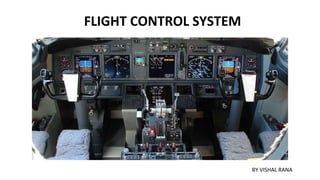
FLIGHT CONTROL SYSTEM
BY VISHAL RANA
Scope
• Aircraft Flight Control Systems
• Primary Flight Controls
• Secondary Flight Controls
• Auxiliary Flight Controls
• Autopilot
Aircraft Control Systems
Aircraft flight control systems consist of flight control surfaces, the respective cockpit
controls, connecting linkages, and the necessary operating mechanisms to control an
aircraft's direction in flight. Aircraft engine controls are also considered as flight controls as
they change speed. They can be divided into three main groups:
• Primary flight control
• Secondary flight control
• Auxilliary flight control
Primary flight control
• Elevator Control System
• Aileron Control System
• Rudder Control System
Elevator Control System
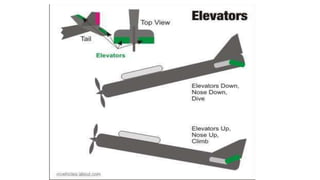
• An elevator is mounted on the back edge of the horizontal stabilizer.
• They move up and down together.
• When the pilot pulls the stick backward, the elevators go up. And
vice versa.
• This makes the wings fly at a higher angle of attack which generates
more lift and more drag.
• Pitch movement
Aileron Control System
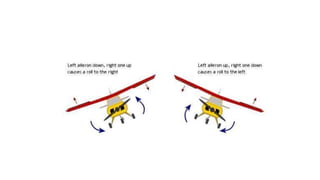
• Ailerons are mounted on the trailing edge of each wing.
• They move in opposite directions.
• When the pilot moves the stick left, the left aileron goes up and the right
aileron goes down.
• A raised aileron reduces lift on the upward aileron and a lowered one
increases lift
• Centering the stick returns the ailerons to neutral maintaining the bank
angle.
• The plane will continue to turn until opposite aileron motion returns the
bank angle to zero to fly straight.
• Longitudinal axis
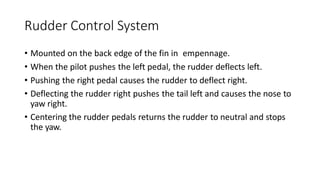
Rudder Control System
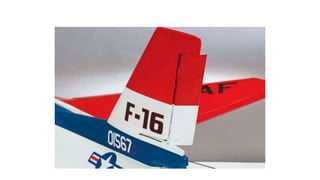
• Mounted on the back edge of the fin in empennage.
• When the pilot pushes the left pedal, the rudder deflects left.
• Pushing the right pedal causes the rudder to deflect right.
• Deflecting the rudder right pushes the tail left and causes the nose to
yaw right.
• Centering the rudder pedals returns the rudder to neutral and stops
the yaw.
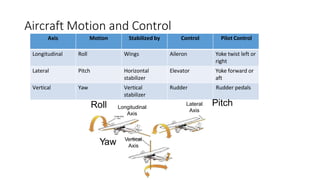
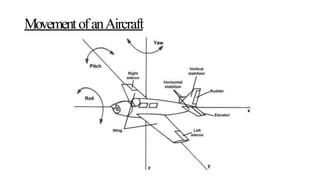
Aircraft Motion and Control
Axis Motion Stabilized by Control Pilot Control
Longitudinal Roll Wings Aileron Yoke twist left or
right
Lateral Pitch Horizontal
stabilizer
Elevator Yoke forward or
aft
Vertical Yaw Vertical
stabilizer
Rudder Rudder pedals
Longitudinal
Axis
Lateral
Axis
Vertical
Axis
Roll Pitch
Yaw
Secondary Flight Control
• Elevator Trim Tab System
• Rudder Trim Tab System
Elevator Trim Tab System
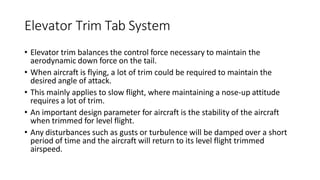
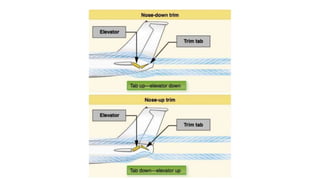
• Elevator trim balances the control force necessary to maintain the
aerodynamic down force on the tail.
• When aircraft is flying, a lot of trim could be required to maintain the
desired angle of attack.
• This mainly applies to slow flight, where maintaining a nose-up attitude
requires a lot of trim.
• An important design parameter for aircraft is the stability of the aircraft
when trimmed for level flight.
• Any disturbances such as gusts or turbulence will be damped over a short
period of time and the aircraft will return to its level flight trimmed
airspeed.
Rudder Trim Tab System
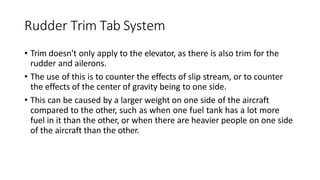
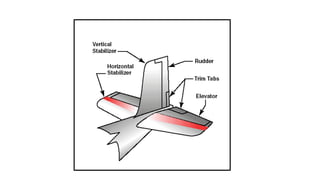
• Trim doesn't only apply to the elevator, as there is also trim for the
rudder and ailerons.
• The use of this is to counter the effects of slip stream, or to counter
the effects of the center of gravity being to one side.
• This can be caused by a larger weight on one side of the aircraft
compared to the other, such as when one fuel tank has a lot more
fuel in it than the other, or when there are heavier people on one side
of the aircraft than the other.
Auxilliary flight control
• Flap Control System
• High Lift Devices
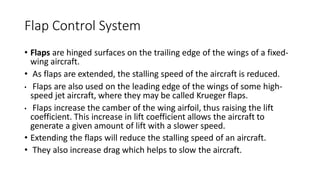
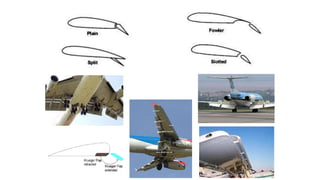
Flap Control System
• Flaps are hinged surfaces on the trailing edge of the wings of a fixed-
wing aircraft.
• As flaps are extended, the stalling speed of the aircraft is reduced.
• Flaps are also used on the leading edge of the wings of some high-
speed jet aircraft, where they may be called Krueger flaps.
• Flaps increase the camber of the wing airfoil, thus raising the lift
coefficient. This increase in lift coefficient allows the aircraft to
generate a given amount of lift with a slower speed.
• Extending the flaps will reduce the stalling speed of an aircraft.
• They also increase drag which helps to slow the aircraft.
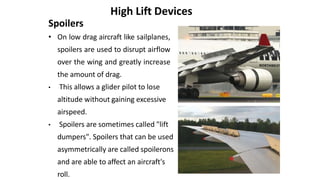
Spoilers
• On low drag aircraft like sailplanes,
spoilers are used to disrupt airflow
over the wing and greatly increase
the amount of drag.
• This allows a glider pilot to lose
altitude without gaining excessive
airspeed.
• Spoilers are sometimes called "lift
dumpers". Spoilers that can be used
asymmetrically are called spoilerons
and are able to affect an aircraft's
roll.
High Lift Devices
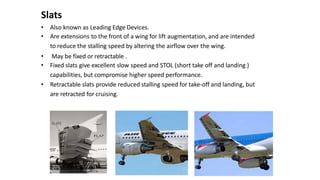
Slats
• Also known as Leading Edge Devices.
• Are extensions to the front of a wing for lift augmentation, and are intended
to reduce the stalling speed by altering the airflow over the wing.
• May be fixed or retractable .
• Fixed slats give excellent slow speed and STOL (short take off and landing )
capabilities, but compromise higher speed performance.
• Retractable slats provide reduced stalling speed for take-off and landing, but
are retracted for cruising.
Autopilot
• An autopilot is a mechanical, electrical, and hydraulic system
used to guide an aero plane without assistance from the pilot.
• The pilot is relieved of most of the physical & mental fatigue of
controlling an aircraft and is free to devote his attention to the
management and direction of progress of the flight.
• On newer aircrafts today, the Autopilot has evolved into a
complex feature encompassing microprocessors and decision
making systems which take over the complete control of an
aircraft from take-off to landing.
Input to system
1. Pilot commands
2. Sensors on exterior
3. Gyroscope
4. Accelerometer
5. Altimeter
6. GPS
7. ILS
Output from system
1. Servo motors
2. Actuators on exterior
3. Spoilers
4. Rudder
5. Elevator
6. Ailerons
7. Engines
PrincipleofOperation
MovementofanAircraft
Autopilot system manufacturers
• Garmin
• Thales
• Rockwell collins
• Honeywell
FLIGHT CONTROL SYSTEM.pptx

FLIGHT CONTROL SYSTEM.pptx

  • 1.
  • 2.
    Scope • Aircraft FlightControl Systems • Primary Flight Controls • Secondary Flight Controls • Auxiliary Flight Controls • Autopilot
  • 3.
    Aircraft Control Systems Aircraftflight control systems consist of flight control surfaces, the respective cockpit controls, connecting linkages, and the necessary operating mechanisms to control an aircraft's direction in flight. Aircraft engine controls are also considered as flight controls as they change speed. They can be divided into three main groups: • Primary flight control • Secondary flight control • Auxilliary flight control
  • 4.
    Primary flight control •Elevator Control System • Aileron Control System • Rudder Control System
  • 5.
    Elevator Control System •An elevator is mounted on the back edge of the horizontal stabilizer. • They move up and down together. • When the pilot pulls the stick backward, the elevators go up. And vice versa. • This makes the wings fly at a higher angle of attack which generates more lift and more drag. • Pitch movement
  • 7.
    Aileron Control System •Ailerons are mounted on the trailing edge of each wing. • They move in opposite directions. • When the pilot moves the stick left, the left aileron goes up and the right aileron goes down. • A raised aileron reduces lift on the upward aileron and a lowered one increases lift • Centering the stick returns the ailerons to neutral maintaining the bank angle. • The plane will continue to turn until opposite aileron motion returns the bank angle to zero to fly straight. • Longitudinal axis
  • 9.
    Rudder Control System •Mounted on the back edge of the fin in empennage. • When the pilot pushes the left pedal, the rudder deflects left. • Pushing the right pedal causes the rudder to deflect right. • Deflecting the rudder right pushes the tail left and causes the nose to yaw right. • Centering the rudder pedals returns the rudder to neutral and stops the yaw.
  • 11.
    Aircraft Motion andControl Axis Motion Stabilized by Control Pilot Control Longitudinal Roll Wings Aileron Yoke twist left or right Lateral Pitch Horizontal stabilizer Elevator Yoke forward or aft Vertical Yaw Vertical stabilizer Rudder Rudder pedals Longitudinal Axis Lateral Axis Vertical Axis Roll Pitch Yaw
  • 12.
    Secondary Flight Control •Elevator Trim Tab System • Rudder Trim Tab System
  • 13.
    Elevator Trim TabSystem • Elevator trim balances the control force necessary to maintain the aerodynamic down force on the tail. • When aircraft is flying, a lot of trim could be required to maintain the desired angle of attack. • This mainly applies to slow flight, where maintaining a nose-up attitude requires a lot of trim. • An important design parameter for aircraft is the stability of the aircraft when trimmed for level flight. • Any disturbances such as gusts or turbulence will be damped over a short period of time and the aircraft will return to its level flight trimmed airspeed.
  • 15.
    Rudder Trim TabSystem • Trim doesn't only apply to the elevator, as there is also trim for the rudder and ailerons. • The use of this is to counter the effects of slip stream, or to counter the effects of the center of gravity being to one side. • This can be caused by a larger weight on one side of the aircraft compared to the other, such as when one fuel tank has a lot more fuel in it than the other, or when there are heavier people on one side of the aircraft than the other.
  • 17.
    Auxilliary flight control •Flap Control System • High Lift Devices
  • 18.
    Flap Control System •Flaps are hinged surfaces on the trailing edge of the wings of a fixed- wing aircraft. • As flaps are extended, the stalling speed of the aircraft is reduced. • Flaps are also used on the leading edge of the wings of some high- speed jet aircraft, where they may be called Krueger flaps. • Flaps increase the camber of the wing airfoil, thus raising the lift coefficient. This increase in lift coefficient allows the aircraft to generate a given amount of lift with a slower speed. • Extending the flaps will reduce the stalling speed of an aircraft. • They also increase drag which helps to slow the aircraft.
  • 20.
    Spoilers • On lowdrag aircraft like sailplanes, spoilers are used to disrupt airflow over the wing and greatly increase the amount of drag. • This allows a glider pilot to lose altitude without gaining excessive airspeed. • Spoilers are sometimes called "lift dumpers". Spoilers that can be used asymmetrically are called spoilerons and are able to affect an aircraft's roll. High Lift Devices
  • 21.
    Slats • Also knownas Leading Edge Devices. • Are extensions to the front of a wing for lift augmentation, and are intended to reduce the stalling speed by altering the airflow over the wing. • May be fixed or retractable . • Fixed slats give excellent slow speed and STOL (short take off and landing ) capabilities, but compromise higher speed performance. • Retractable slats provide reduced stalling speed for take-off and landing, but are retracted for cruising.
  • 22.
    Autopilot • An autopilotis a mechanical, electrical, and hydraulic system used to guide an aero plane without assistance from the pilot. • The pilot is relieved of most of the physical & mental fatigue of controlling an aircraft and is free to devote his attention to the management and direction of progress of the flight. • On newer aircrafts today, the Autopilot has evolved into a complex feature encompassing microprocessors and decision making systems which take over the complete control of an aircraft from take-off to landing.
  • 23.
    Input to system 1.Pilot commands 2. Sensors on exterior 3. Gyroscope 4. Accelerometer 5. Altimeter 6. GPS 7. ILS Output from system 1. Servo motors 2. Actuators on exterior 3. Spoilers 4. Rudder 5. Elevator 6. Ailerons 7. Engines PrincipleofOperation
  • 24.
  • 25.
    Autopilot system manufacturers •Garmin • Thales • Rockwell collins • Honeywell