1
Instrument Transformers
• A transformer that is used in conjunction
with a measuring instrument
• It utilizes the current-transformation and
voltage transformation properties to
measure high ac current and voltage
• They also provide isolation
2
Where to use Instrument Transformers
• To measure high currents and high
Voltages
• Why can’t we use voltmeter with very
high series resistance and ammeter with
very low shunt resistance?
3
Disadvantages of Shunts & Multipliers
• Shunts
• Time constant should be same for
meter and shunt
• Power consumed increases
• Insulation problems (for high voltages)
• No Isolation
• Multipliers (Series resistance)
• Power consumption
• Leakage currents, so good insulators
used , hence costly
• No isolation
4
Types of Instrument Transformers
• Current transformer
• Potential (Voltage) transformer
5
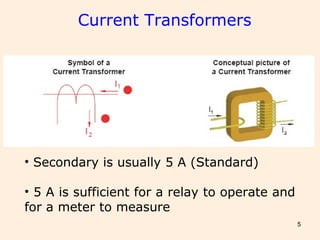
Current Transformers
• Secondary is usually 5 A (Standard)
• 5 A is sufficient for a relay to operate and
for a meter to measure
6
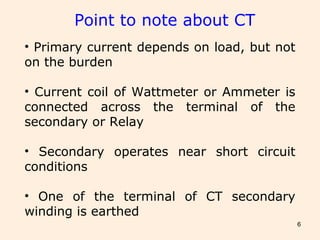
Point to note about CT
• Primary current depends on load, but not
on the burden
• Current coil of Wattmeter or Ammeter is
connected across the terminal of the
secondary or Relay
• Secondary operates near short circuit
conditions
• One of the terminal of CT secondary
winding is earthed
7
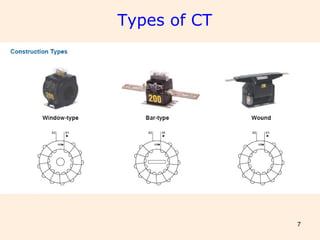
Types of CT
8
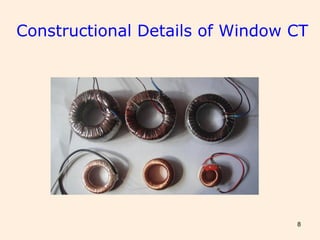
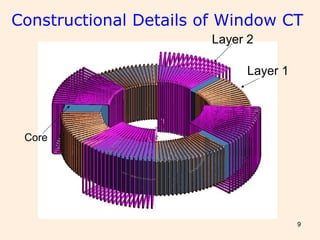
Constructional Details of Window CT
9
Layer 2
Layer 1
Core
Constructional Details of Window CT
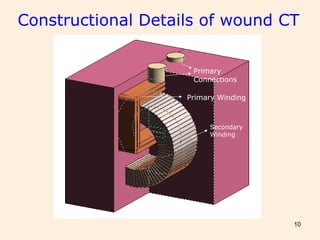
10
Primary Winding
Secondary
Winding
Primary
Connections
Constructional Details of wound CT
11
Care, while operating with CT
12
Usually current is measured in terms
of voltage across a standard resistor
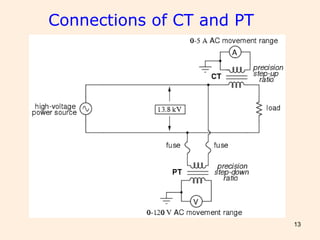
13
Connections of CT and PT
14
Potential Transformer
15
16
Points to note about PT
• Secondary is connected voltmeter or
Potential coil of the Wattmeter or Relay
• Design is similar to Power Transformer,
but Potential Transformers are lightly
loaded
• Secondary is usually rated for 110 V
• Should not be shorted
17
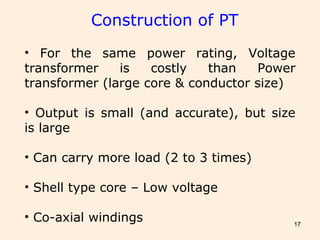
Construction of PT
• For the same power rating, Voltage
transformer is costly than Power
transformer (large core & conductor size)
• Output is small (and accurate), but size
is large
• Can carry more load (2 to 3 times)
• Shell type core – Low voltage
• Co-axial windings
18
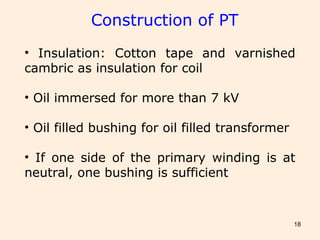
Construction of PT
• Insulation: Cotton tape and varnished
cambric as insulation for coil
• Oil immersed for more than 7 kV
• Oil filled bushing for oil filled transformer
• If one side of the primary winding is at
neutral, one bushing is sufficient
19

Instrument transformer CT & PT

  • 1.
    1 Instrument Transformers • Atransformer that is used in conjunction with a measuring instrument • It utilizes the current-transformation and voltage transformation properties to measure high ac current and voltage • They also provide isolation
  • 2.
    2 Where to useInstrument Transformers • To measure high currents and high Voltages • Why can’t we use voltmeter with very high series resistance and ammeter with very low shunt resistance?
  • 3.
    3 Disadvantages of Shunts& Multipliers • Shunts • Time constant should be same for meter and shunt • Power consumed increases • Insulation problems (for high voltages) • No Isolation • Multipliers (Series resistance) • Power consumption • Leakage currents, so good insulators used , hence costly • No isolation
  • 4.
    4 Types of InstrumentTransformers • Current transformer • Potential (Voltage) transformer
  • 5.
    5 Current Transformers • Secondaryis usually 5 A (Standard) • 5 A is sufficient for a relay to operate and for a meter to measure
  • 6.
    6 Point to noteabout CT • Primary current depends on load, but not on the burden • Current coil of Wattmeter or Ammeter is connected across the terminal of the secondary or Relay • Secondary operates near short circuit conditions • One of the terminal of CT secondary winding is earthed
  • 7.
  • 8.
  • 9.
  • 10.
  • 11.
  • 12.
    12 Usually current ismeasured in terms of voltage across a standard resistor
  • 13.
  • 14.
  • 15.
  • 16.
    16 Points to noteabout PT • Secondary is connected voltmeter or Potential coil of the Wattmeter or Relay • Design is similar to Power Transformer, but Potential Transformers are lightly loaded • Secondary is usually rated for 110 V • Should not be shorted
  • 17.
    17 Construction of PT •For the same power rating, Voltage transformer is costly than Power transformer (large core & conductor size) • Output is small (and accurate), but size is large • Can carry more load (2 to 3 times) • Shell type core – Low voltage • Co-axial windings
  • 18.
    18 Construction of PT •Insulation: Cotton tape and varnished cambric as insulation for coil • Oil immersed for more than 7 kV • Oil filled bushing for oil filled transformer • If one side of the primary winding is at neutral, one bushing is sufficient
  • 19.