Ch.8 Project Quality 
Management 
Pages 226 - 254 of PMBOK Guide 5th 
Edition
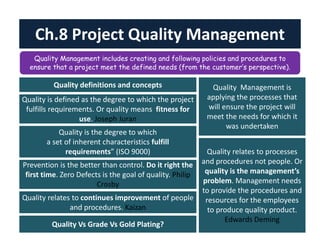
Ch.8 Project Quality Management 
Quality Management includes creating and following policies and procedures to 
ensure that a project meet the defined needs (from the customer’s perspective). 
QQuuaalliittyy ddeeffiinniittiioonnss aanndd ccoonncceeppttss 
Quality is defined as the degree to which the project 
fulfills requirements. Or quality means fitness for 
use. Joseph Juran 
Quality is the degree to which 
a set of inherent characteristics fulfill 
requirements” (ISO 9000) 
Prevention is the better than control. Do it right the 
first time. Zero Defects is the goal of quality. Philip 
Crosby 
Quality relates to continues improvement of people 
and procedures. Kaizan 
Quality Management is 
applying the processes that 
will ensure the project will 
meet the needs for which it 
was undertaken 
Quality relates to processes 
and procedures not people. Or 
quality is the management’s 
problem. Management needs 
to provide the procedures and 
resources for the employees 
to produce quality product. 
Edwards Deming 
QQuuaalliittyy VVss GGrraaddee VVss GGoolldd PPllaattiinngg??
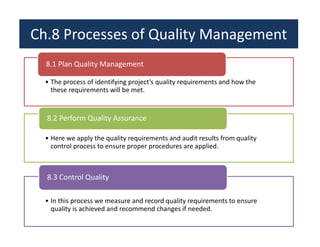
Ch.8 Processes of Quality Management 
8.1 Plan Quality Management 
• The process of identifying project’s quality requirements and how the 
these requirements will be met. 
8.2 Perform Quality Assurance 
• Here we apply the quality requirements and audit results from quality 
control process to ensure proper procedures are applied. 
8.3 Control Quality 
• In this process we measure and record quality requirements to ensure 
quality is achieved and recommend changes if needed.
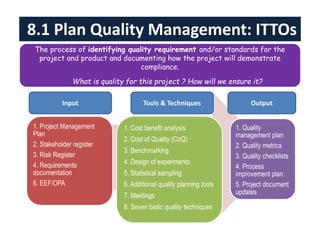
8.1 Plan Quality Management: ITTOs 
The process of identifying quality requirement and/or standards for the 
project and product and documenting how the project will demonstrate 
Input Tools & Techniques Output 
1. Project Management 
Plan 
2. Stakeholder register 
3. Risk Register 
4. Requirements 
documentation 
6. EEF/OPA 
1. Cost benefit analysis 
2. Cost of Quality (CoQ) 
3. Benchmarking 
4. Design of experiments 
5. Statistical sampling 
6. Additional quality planning tools 
7. Meetings 
8. Seven basic quality techniques 
1. Quality 
management plan 
2. Quality metrics 
3. Quality checklists 
4. Process 
improvement plan 
5. Project document 
updates 
compliance. 
What is quality for this project ? How will we ensure it?
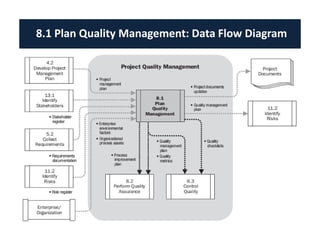
8.1 Plan Quality Management: Data Flow Diagram
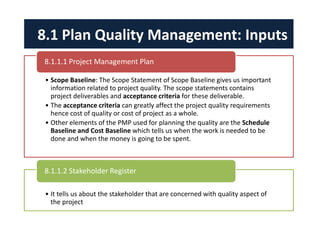
8.1 Plan Quality Management: Inputs 
8.1.1.1 Project Management Plan 
• Scope Baseline: The Scope Statement of Scope Baseline gives us important 
information related to project quality. The scope statements contains 
project deliverables and acceptance criteria for these deliverable. 
• The acceptance criteria can greatly affect the project quality requirements 
hence cost of quality or cost of project as a whole. 
• Other elements of the PMP used for planning the quality are the Schedule 
Baseline and Cost Baseline which tells us when the work is needed to be 
done and when the money is going to be spent. 
8.1.1.2 Stakeholder Register 
• It tells us about the stakeholder that are concerned with quality aspect of 
the project
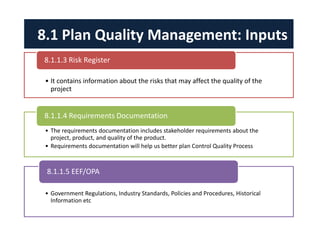
8.1 Plan Quality Management: Inputs 
8.1.1.3 Risk Register 
• It contains information about the risks that may affect the quality of the 
project 
8.1.1.4 Requirements Documentation 
• The requirements documentation includes stakeholder requirements about the 
project, product, and quality of the product. 
• Requirements documentation will help us better plan Control Quality Process 
8.1.1.5 EEF/OPA 
• Government Regulations, Industry Standards, Policies and Procedures, Historical 
Information etc
8.1.2 Plan Quality Management: T&Ts 
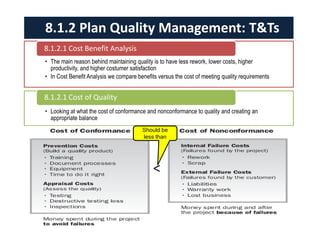
8.1.2.1 Cost Benefit Analysis 
• The main reason behind maintaining quality is to have less rework, lower costs, higher 
productivity, and higher costumer satisfaction 
• In Cost Benefit Analysis we compare benefits versus the cost of meeting quality requirements 
8.1.2.1 Cost of Quality 
• Looking at what the cost of conformance and nonconformance to quality and creating an 
appropriate balance 
Should be 
less than 
<
8.1.2 Plan Quality Management: T&Ts 
8.1.2.3 Seven basic quality tools 
• The 7QC tools as they are called, are used in within the context of Plan-Do- 
Check-Act (PDCA) cycle to solve quality related problems 
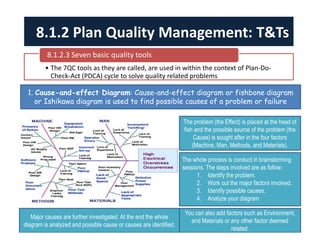
1. Cause-and-effect Diagram: Cause-and-effect diagram or fishbone diagram 
or Ishikawa diagram is used to find possible causes of a problem or failure 
The problem (the Effect) is placed at the head of 
fish and the possible source of the problem (the 
Cause) is sought after in the four factors 
(Machine, Man, Methods, and Materials). 
The whole process is conduct in brainstorming 
sessions. The steps involved are as follow: 
1. Identify the problem. 
2. Work out the major factors involved. 
3. Identify possible causes. 
4. Analyze your diagram 
You can also add factors such as Environment, 
and Materials or any other factor deemed 
related. 
Major causes are further investigated. At the end the whole 
diagram is analyzed and possible cause or causes are identified.
8.1.2 Plan Quality Management: T&Ts 
8.1.2.3 Seven basic quality tools 
• The 7QC tools as they are called, are used in within the context of Plan-Do-Check-Act (PDCA) 
cycle to solve quality related problems 
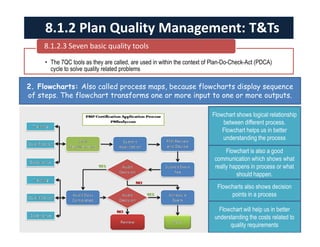
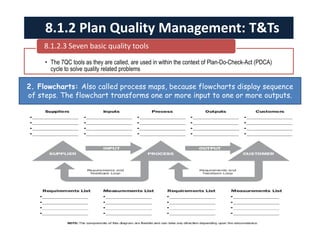
2. Flowcharts: Also called process maps, because flowcharts display sequence 
of steps. The flowchart transforms one or more input to one or more outputs. 
Flowchart shows logical relationship 
between different process. 
Flowchart helps us in better 
understanding the process 
Flowchart is also a good 
communication which shows what 
really happens in process or what 
should happen. 
Flowcharts also shows decision 
points in a process 
Flowchart will help us in better 
understanding the costs related to 
quality requirements
8.1.2 Plan Quality Management: T&Ts 
8.1.2.3 Seven basic quality tools 
• The 7QC tools as they are called, are used in within the context of Plan-Do-Check-Act (PDCA) 
cycle to solve quality related problems 
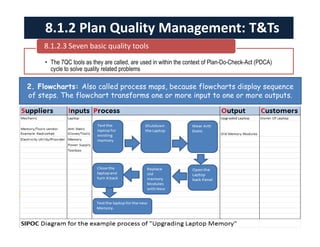
2. Flowcharts: Also called process maps, because flowcharts display sequence 
of steps. The flowchart transforms one or more input to one or more outputs.
8.1.2 Plan Quality Management: T&Ts 
8.1.2.3 Seven basic quality tools 
• The 7QC tools as they are called, are used in within the context of Plan-Do-Check-Act (PDCA) 
cycle to solve quality related problems 
2. Flowcharts: Also called process maps, because flowcharts display sequence 
of steps. The flowchart transforms one or more input to one or more outputs.
8.1.2 Plan Quality Management: T&Ts 
8.1.2.3 Seven basic quality tools 
• The 7QC tools as they are called, are used in within the context of Plan-Do-Check-Act (PDCA) 
cycle to solve quality related problems 
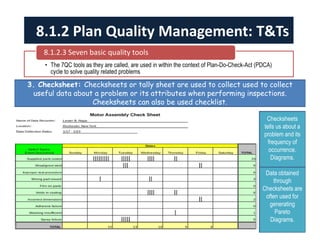
3. Checksheet: Checksheets or tally sheet are used to collect used to collect 
useful data about a problem or its attributes when performing inspections. 
Checksheets 
tells us about a 
problem and its 
frequency of 
occurrence. 
Diagrams. 
Data obtained 
through 
Checksheets are 
often used for 
generating 
Pareto 
Diagrams. 
Cheeksheets can also be used checklist.
8.1.2 Plan Quality Management: T&Ts 
8.1.2.3 Seven basic quality tools 
• The 7QC tools as they are called, are used in within the context of Plan-Do-Check-Act (PDCA) 
cycle to solve quality related problems 
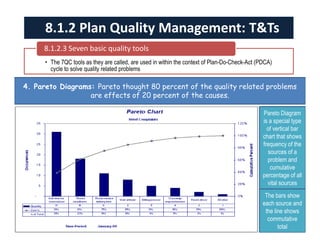
4. Pareto Diagrams: Pareto thought 80 percent of the quality related problems 
Pareto Diagram 
is a special type 
of vertical bar 
chart that shows 
frequency of the 
sources of a 
problem and 
cumulative 
percentage of all 
vital sources 
The bars show 
each source and 
the line shows 
commutative 
total 
are effects of 20 percent of the causes.
8.1.2 Plan Quality Management: T&Ts 
8.1.2.3 Seven basic quality tools 
• The 7QC tools as they are called, are used in within the context of Plan-Do-Check-Act (PDCA) 
cycle to solve quality related problems 
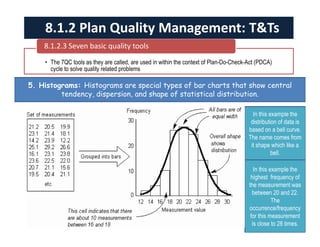
5. Histograms: Histograms are special types of bar charts that show central 
tendency, dispersion, and shape of statistical distribution. 
In this example the 
distribution of data is 
based on a bell curve. 
The name comes from 
it shape which like a 
bell. 
In this example the 
highest frequency of 
the measurement was 
between 20 and 22. 
The 
occurrence/frequency 
for this measurement 
is close to 28 times.
8.1.2 Plan Quality Management: T&Ts 
8.1.2.3 Seven basic quality tools 
• The 7QC tools as they are called, are used in within the context of Plan-Do-Check-Act (PDCA) 
cycle to solve quality related problems 
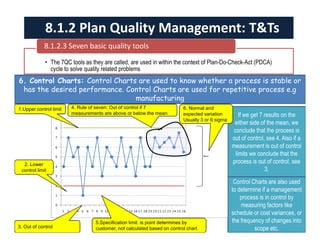
6. Control Charts: Control Charts are used to know whether a process is stable or 
has the desired performance. Control Charts are used for repetitive process e.g 
If we get 7 results on the 
either side of the mean, we 
conclude that the process is 
out of control, see 4. Also if a 
measurement is out of control 
limits we conclude that the 
process is out of control, see 
3. 
Control Charts are also used 
to determine if a management 
process is in control by 
measuring factors like 
schedule or cost variances, or 
the frequency of changes into 
scope etc. 
1.Upper control limit 
2. Lower 
control limit 
3. Out of control 
manufacturing 
4. Rule of seven: Out of control if 7 
measurements are above or below the mean 
6. Normal and 
expected variation 
Usually 3 or 6 sigma 
5.Specification limit: is point determines by 
customer, not calculated based on control chart
8.1.2 Plan Quality Management: T&Ts 
8.1.2.3 Seven basic quality tools 
• The 7QC tools as they are called, are used in within the context of Plan-Do-Check-Act (PDCA) 
cycle to solve quality related problems 
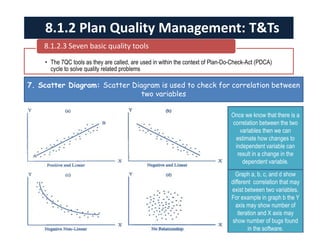
7. Scatter Diagram: Scatter Diagram is used to check for correlation between 
Once we know that there is a 
correlation between the two 
variables then we can 
estimate how changes to 
independent variable can 
result in a change in the 
dependent variable. 
Graph a, b, c, and d show 
different correlation that may 
exist between two variables. 
For example in graph b the Y 
axis may show number of 
iteration and X axis may 
show number of bugs found 
in the software. 
two variables
8.1 Plan Quality Management: T&Ts 
8.1.2.4 Benchmarking 
• Comparing the project in hand with similar projects completed in the past in order to identify 
best practices, and generate new ideas. 
8.1.2.5 Design of Experiment 
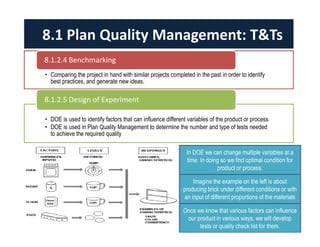
• DOE is used to identify factors that can influence different variables of the product or process 
• DOE is used in Plan Quality Management to determine the number and type of tests needed 
to achieve the required quality 
In DOE we can change multiple variables at a 
time. In doing so we find optimal condition for 
product or process. 
Imagine the example on the left is about 
producing brick under different conditions or with 
an input of different proportions of the materials 
Once we know that various factors can influence 
our product in various ways, we will develop 
tests or quality check list for them.
8.1 Plan Quality Management: T&Ts 
8.1.2.6 Statistical Sampling 
• Statistical Sampling refers to choosing few items as a sample from a larger group of items. 
• Here we do not do the actual sampling but decide on how we will do how sampling in the 
coming quality processes 
• This will help us in correctly determining the cost of quality. 
8.1.2.7 Other Quality Tools 
• Brainstorming: Used for generating ideas 
• Force Field Analysis: Diagrams of forces for and against change 
• Nominal Group Technique: In this technique we vote for ideas to be further discussed by a 
larger group of people 
• Quality Control and Management Tools: This tools will be explained in the next process. 
These tools are used to link and sequence the tools of the project. 
8.1.2.8 Meetings 
• Quality related meetings are attended by the project sponsor, project management, selected 
project team member, selected stakeholders, team members that are responsible for quality of 
the project.
8.1 Plan Quality Management: T&Ts 
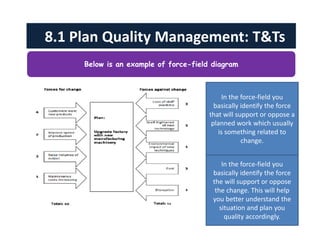
Below is an example of force-field diagram 
In the force-field you 
basically identify the force 
that will support or oppose a 
planned work which usually 
is something related to 
change. 
In the force-field you 
basically identify the force 
the will support or oppose 
the change. This will help 
you better understand the 
situation and plan you 
quality accordingly.
8.1 Plan Quality Management: Outputs 
8.1.3.1 Quality Management Plan 
• Quality management plans explains how organizations quality policies will be implemented. 
• Depending on the project, the plan can be very detailed or simple. 
8.1.3.2 Process Improvement Plan 
• Process Improvement Plan is part of the PMP 
• This plan details the steps that will help as in improving various process in our project. 
• The plan is developed in the Plan Quality Management Process and implemented in the QA 
and QC processes 
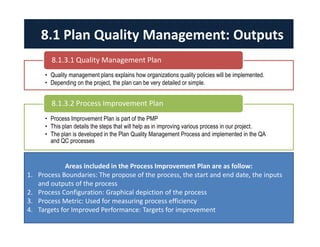
Areas included in the Process Improvement Plan are as follow: 
1. Process Boundaries: The propose of the process, the start and end date, the inputs 
and outputs of the process 
2. Process Configuration: Graphical depiction of the process 
3. Process Metric: Used for measuring process efficiency 
4. Targets for Improved Performance: Targets for improvement
8.1 Plan Quality Management: Outputs 
8.1.3.3 Quality Metrics 
• It describes the project or product attributes and how the quality control process will measure 
it. 
• Examples of quality metrics are finishing the project within the budget and time, the frequency 
of defects, failure rate, etc. 
• The metrics and the tolerance level for variation is set in Plan Quality 
• The attributes are measured in control quality 
8.1.3.4 Quality Checklists 
• Based on the product requirements a checklist is developed 
• The checklist will list the steps to be followed to achieve the desired quality for the product 
• The checklist should also contain the product requirements 
8.1.3.5 Document Update 
• Risk Register, Requirement Traceability Matrix, and WBS dictionary are updated
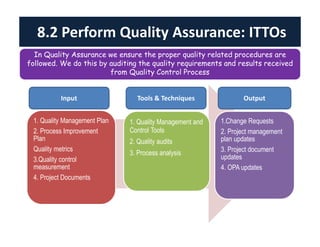
8.2 Perform Quality Assurance: ITTOs 
In Quality Assurance we ensure the proper quality related procedures are 
followed. We do this by auditing the quality requirements and results received 
Input Tools & Techniques Output 
1. Quality Management Plan 
2. Process Improvement 
Plan 
Quality metrics 
3.Quality control 
measurement 
4. Project Documents 
1. Quality Management and 
Control Tools 
2. Quality audits 
3. Process analysis 
1.Change Requests 
2. Project management 
plan updates 
3. Project document 
updates 
4. OPA updates 
from Quality Control Process
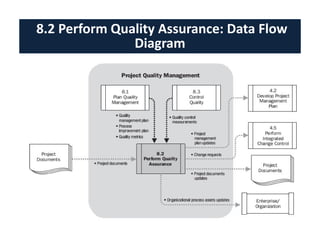
8.2 Perform Quality Assurance: Data Flow 
Diagram
8.2.1 Perform Quality Assurance: Inputs 
8.2.1.1 Quality Management Plan 
• It contains plan for quality assurance and process improvement 
8.2.1.2 Process Improvement Plan 
• This will tell us about the project’s process improvement plan which needs to be 
aligned with quality assurance process. 
8.2.1.3 Quality Metrics 
• This will tells what we need to measure and what are the allowable variation for our 
measurements. 
8.2.1.4 Quality Control Measurements 
• These are the measurements taken in the Control Quality Process 
• The measurements are used fed back to Quality Assurance in order to evaluate the 
effectiveness of quality assurance procedures/processes
8.2.2 Perform Quality Assurance: T&Ts 
8.2.2.1 Quality Management and Control Tools 
• Beside other available tools, in quality assurance we us all the tools that are used in 
Plan Quality Management and Control Quality Processes 
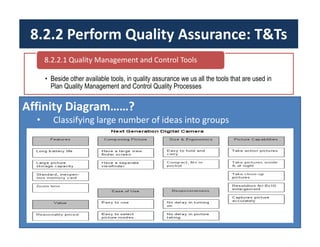
Affinity Diagram……? 
• Classifying large number of ideas into groups
8.2.2 Perform Quality Assurance: T&Ts 
8.2.2.1 Quality Management and Control Tools 
• Beside other available tools, in quality assurance we us all the tools that are used in 
Plan Quality Management and Control Quality Processes 
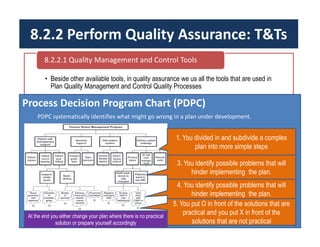
Process Decision Program Chart (PDPC) 
PDPC systematically identifies what might go wrong in a plan under development. 
1. You divided in and subdivide a complex 
plan into more simple steps 
3. You identify possible problems that will 
hinder implementing the plan. 
4. You identify possible problems that will 
hinder implementing the plan. 
5. You put O in front of the solutions that are 
practical and you put X in front of the 
solutions that are not practical At the end you either change your plan where there is no practical 
solution or prepare yourself accordingly
8.2.2 Perform Quality Assurance: T&Ts 
8.2.2.1 Quality Management and Control Tools 
• Beside other available tools, in quality assurance we us all the tools that are used in 
Plan Quality Management and Control Quality Processes 
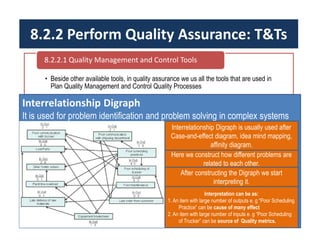
Interrelationship Digraph 
It is used for problem identification and problem solving in complex systems 
Interrelationship Digraph is usually used after 
Case-and-effect diagram, idea mind mapping, 
affinity diagram. 
Here we construct how different problems are 
related to each other. 
After constructing the Digraph we start 
interpreting it. 
Interpretation can be as: 
1. An item with large number of outputs e. g “Poor Scheduling 
Practice” can be cause of many effect 
2. An item with large number of inputs e. g “Poor Scheduling 
of Trucker” can be source of Quality metrics.
8.2.2 Perform Quality Assurance: T&Ts 
8.2.2.1 Quality Management and Control Tools 
• Beside other available tools, in quality assurance we us all the tools that are used in 
Plan Quality Management and Control Quality Processes 
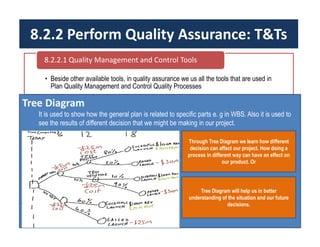
Tree Diagram 
It is used to show how the general plan is related to specific parts e. g in WBS. Also it is used to 
see the results of different decision that we might be making in our project. 
Through Tree Diagram we learn how different 
decision can affect our project. How doing a 
process in different way can have an effect on 
our product. Or 
Tree Diagram will help us in better 
understanding of the situation and our future 
decisions.
8.2.2 Perform Quality Assurance: T&Ts 
8.2.2.1 Quality Management and Control Tools 
• Beside other available tools, in quality assurance we us all the tools that are used in 
Plan Quality Management and Control Quality Processes 
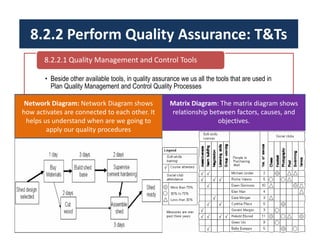
Network Diagram: Network Diagram shows 
how activates are connected to each other. It 
helps us understand when are we going to 
apply our quality procedures 
Matrix Diagram: The matrix diagram shows 
relationship between factors, causes, and 
objectives.
8.2.2 Perform Quality Assurance: T&Ts 
8.2.2.2 Quality Audits 
• Quality audits are independent reviews of the quality processes and procedures of 
an organization. 
• Quality audits can done randomly or on scheduled bases and can be carried 
externally or internally. 
• Quality audits can confirm implementation of approved changes, corrective actions, 
preventive action, or defect repairs. 
8.2.2.3 Process Analysis 
• In Process Analysis we implemented the plan outlined as “Process Improvement 
Plan” which was an output to Plan Quality Management process 
• Here we use root-cause analysis which will help us identify problems in our 
processes and take preventive actions.
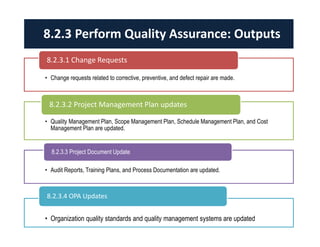
8.2.3 Perform Quality Assurance: Outputs 
8.2.3.1 Change Requests 
• Change requests related to corrective, preventive, and defect repair are made. 
8.2.3.2 Project Management Plan updates 
• Quality Management Plan, Scope Management Plan, Schedule Management Plan, and Cost 
Management Plan are updated. 
8.2.3.3 Project Document Update 
• Audit Reports, Training Plans, and Process Documentation are updated. 
8.2.3.4 OPA Updates 
• Organization quality standards and quality management systems are updated
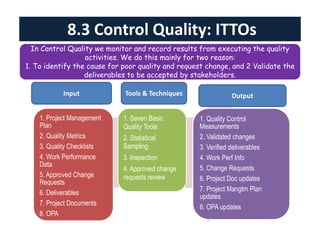
8.3 Control Quality: ITTOs 
In Control Quality we monitor and record results from executing the quality 
activities. We do this mainly for two reason: 
1. To identify the cause for poor quality and request change, and 2 Validate the 
deliverables to be accepted by stakeholders. 
Input Tools & Techniques Output 
1. Project Management 
Plan 
2. Quality Metrics 
3. Quality Checklists 
4. Work Performance 
Data 
5. Approved Change 
Requests 
6. Deliverables 
7. Project Documents 
8. OPA 
1. Seven Basic 
Quality Tools 
2. Statistical 
Sampling 
3. Inspection 
4. Approved change 
requests review 
1. Quality Control 
Measurements 
2. Validated changes 
3. Verified deliverables 
4. Work Perf Info 
5. Change Requests 
6. Project Doc updates 
7. Project Mangtm Plan 
updates 
8. OPA updates
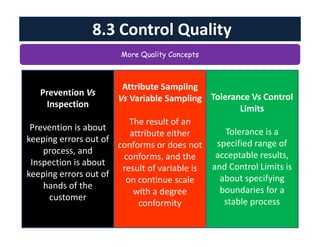
8.3 Control Quality 
More Quality Concepts 
Prevention Vs 
Inspection 
Prevention is about 
keeping errors out of 
process, and 
Inspection is about 
keeping errors out of 
hands of the 
customer 
Tolerance Vs Control 
Limits 
Tolerance is a 
specified range of 
acceptable results, 
and Control Limits is 
about specifying 
boundaries for a 
stable process 
Attribute Sampling 
Vs Variable Sampling 
The result of an 
attribute either 
conforms or does not 
conforms, and the 
result of variable is 
on continue scale 
with a degree 
conformity
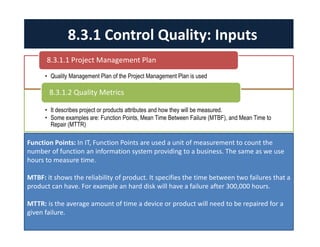
8.3.1 Control Quality: Inputs 
8.3.1.1 Project Management Plan 
• Quality Management Plan of the Project Management Plan is used 
8.3.1.2 Quality Metrics 
• It describes project or products attributes and how they will be measured. 
• Some examples are: Function Points, Mean Time Between Failure (MTBF), and Mean Time to 
Repair (MTTR) 
Function Points: In IT, Function Points are used a unit of measurement to count the 
number of function an information system providing to a business. The same as we use 
hours to measure time. 
MTBF: it shows the reliability of product. It specifies the time between two failures that a 
product can have. For example an hard disk will have a failure after 300,000 hours. 
MTTR: is the average amount of time a device or product will need to be repaired for a 
given failure.
8.3 Control Quality: Inputs 
8.3.1.3 Quality Checklists 
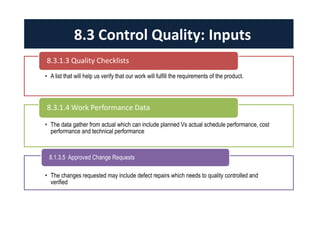
• A list that will help us verify that our work will fulfill the requirements of the product. 
8.3.1.4 Work Performance Data 
• The data gather from actual which can include planned Vs actual schedule performance, cost 
performance and technical performance 
8.1.3.5 Approved Change Requests 
• The changes requested may include defect repairs which needs to quality controlled and 
verified
8.3 Control Quality: Inputs 
8.3.1.6 Deliverables 
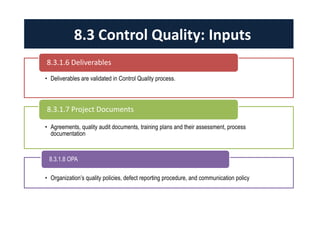
• Deliverables are validated in Control Quality process. 
8.3.1.7 Project Documents 
• Agreements, quality audit documents, training plans and their assessment, process 
documentation 
8.3.1.8 OPA 
• Organization’s quality policies, defect reporting procedure, and communication policy
8.3.2 Control Quality: T&Ts 
8.3.2.1 The Seven Basic Quality Tools 
• These were explained in 8.1.2.3 
8.3.2.2 Statistical Sampling 
• As defined in the Quality Management Plan, samples are selected and tested 
8.3.2.3 Inspection 
• Inspection refers to the examination of the product in order to determine whether it according 
to the documented standards. 
• Inspection can be related to a single activity, part of product, or the whole product. 
• Inspection are also called, review, peer reviews, audits, or walkthroughs. 
• Inspections are also used to validate defect repairs. 
8.3.2.4 Approved Change Request Reviews 
• All the approved change requests are reviewed to verify they are implemented as approved.
8.3.3 Control Quality: Outputs 
8.3.3.1 Control Quality Measurements 
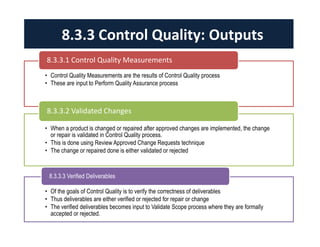
• Control Quality Measurements are the results of Control Quality process 
• These are input to Perform Quality Assurance process 
8.3.3.2 Validated Changes 
• When a product is changed or repaired after approved changes are implemented, the change 
or repair is validated in Control Quality process. 
• This is done using Review Approved Change Requests technique 
• The change or repaired done is either validated or rejected 
8.3.3.3 Verified Deliverables 
• Of the goals of Control Quality is to verify the correctness of deliverables 
• Thus deliverables are either verified or rejected for repair or change 
• The verified deliverables becomes input to Validate Scope process where they are formally 
accepted or rejected.
8.3.3 Control Quality: Outputs 
8.3.3.4. Work Performance Information 
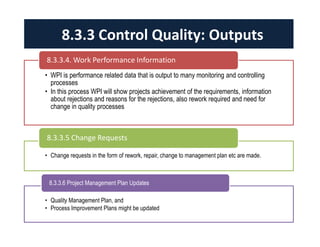
• WPI is performance related data that is output to many monitoring and controlling 
processes 
• In this process WPI will show projects achievement of the requirements, information 
about rejections and reasons for the rejections, also rework required and need for 
change in quality processes 
8.3.3.5 Change Requests 
• Change requests in the form of rework, repair, change to management plan etc are made. 
8.3.3.6 Project Management Plan Updates 
• Quality Management Plan, and 
• Process Improvement Plans might be updated
8.3.3 Control Quality: Outputs 
8.3.3.7 Project Document Updates 
• Agreements, quality audit documents, training plans and their assessment, 
process documentation 
8.3.3.8 OPA updates 
• Completed Checklists: When checklists are used, the documented 
checklist becomes part of project document and OPA 
• Lesson Learned Doc: The causes of variances, the reasoning behind the 
corrective action selected, and other types of lessons learned stored as 
OPA

Project quality management

  • 1.
    Ch.8 Project Quality Management Pages 226 - 254 of PMBOK Guide 5th Edition
  • 2.
    Ch.8 Project QualityManagement Quality Management includes creating and following policies and procedures to ensure that a project meet the defined needs (from the customer’s perspective). QQuuaalliittyy ddeeffiinniittiioonnss aanndd ccoonncceeppttss Quality is defined as the degree to which the project fulfills requirements. Or quality means fitness for use. Joseph Juran Quality is the degree to which a set of inherent characteristics fulfill requirements” (ISO 9000) Prevention is the better than control. Do it right the first time. Zero Defects is the goal of quality. Philip Crosby Quality relates to continues improvement of people and procedures. Kaizan Quality Management is applying the processes that will ensure the project will meet the needs for which it was undertaken Quality relates to processes and procedures not people. Or quality is the management’s problem. Management needs to provide the procedures and resources for the employees to produce quality product. Edwards Deming QQuuaalliittyy VVss GGrraaddee VVss GGoolldd PPllaattiinngg??
  • 3.
    Ch.8 Processes ofQuality Management 8.1 Plan Quality Management • The process of identifying project’s quality requirements and how the these requirements will be met. 8.2 Perform Quality Assurance • Here we apply the quality requirements and audit results from quality control process to ensure proper procedures are applied. 8.3 Control Quality • In this process we measure and record quality requirements to ensure quality is achieved and recommend changes if needed.
  • 4.
    8.1 Plan QualityManagement: ITTOs The process of identifying quality requirement and/or standards for the project and product and documenting how the project will demonstrate Input Tools & Techniques Output 1. Project Management Plan 2. Stakeholder register 3. Risk Register 4. Requirements documentation 6. EEF/OPA 1. Cost benefit analysis 2. Cost of Quality (CoQ) 3. Benchmarking 4. Design of experiments 5. Statistical sampling 6. Additional quality planning tools 7. Meetings 8. Seven basic quality techniques 1. Quality management plan 2. Quality metrics 3. Quality checklists 4. Process improvement plan 5. Project document updates compliance. What is quality for this project ? How will we ensure it?
  • 5.
    8.1 Plan QualityManagement: Data Flow Diagram
  • 6.
    8.1 Plan QualityManagement: Inputs 8.1.1.1 Project Management Plan • Scope Baseline: The Scope Statement of Scope Baseline gives us important information related to project quality. The scope statements contains project deliverables and acceptance criteria for these deliverable. • The acceptance criteria can greatly affect the project quality requirements hence cost of quality or cost of project as a whole. • Other elements of the PMP used for planning the quality are the Schedule Baseline and Cost Baseline which tells us when the work is needed to be done and when the money is going to be spent. 8.1.1.2 Stakeholder Register • It tells us about the stakeholder that are concerned with quality aspect of the project
  • 7.
    8.1 Plan QualityManagement: Inputs 8.1.1.3 Risk Register • It contains information about the risks that may affect the quality of the project 8.1.1.4 Requirements Documentation • The requirements documentation includes stakeholder requirements about the project, product, and quality of the product. • Requirements documentation will help us better plan Control Quality Process 8.1.1.5 EEF/OPA • Government Regulations, Industry Standards, Policies and Procedures, Historical Information etc
  • 8.
    8.1.2 Plan QualityManagement: T&Ts 8.1.2.1 Cost Benefit Analysis • The main reason behind maintaining quality is to have less rework, lower costs, higher productivity, and higher costumer satisfaction • In Cost Benefit Analysis we compare benefits versus the cost of meeting quality requirements 8.1.2.1 Cost of Quality • Looking at what the cost of conformance and nonconformance to quality and creating an appropriate balance Should be less than <
  • 9.
    8.1.2 Plan QualityManagement: T&Ts 8.1.2.3 Seven basic quality tools • The 7QC tools as they are called, are used in within the context of Plan-Do- Check-Act (PDCA) cycle to solve quality related problems 1. Cause-and-effect Diagram: Cause-and-effect diagram or fishbone diagram or Ishikawa diagram is used to find possible causes of a problem or failure The problem (the Effect) is placed at the head of fish and the possible source of the problem (the Cause) is sought after in the four factors (Machine, Man, Methods, and Materials). The whole process is conduct in brainstorming sessions. The steps involved are as follow: 1. Identify the problem. 2. Work out the major factors involved. 3. Identify possible causes. 4. Analyze your diagram You can also add factors such as Environment, and Materials or any other factor deemed related. Major causes are further investigated. At the end the whole diagram is analyzed and possible cause or causes are identified.
  • 10.
    8.1.2 Plan QualityManagement: T&Ts 8.1.2.3 Seven basic quality tools • The 7QC tools as they are called, are used in within the context of Plan-Do-Check-Act (PDCA) cycle to solve quality related problems 2. Flowcharts: Also called process maps, because flowcharts display sequence of steps. The flowchart transforms one or more input to one or more outputs. Flowchart shows logical relationship between different process. Flowchart helps us in better understanding the process Flowchart is also a good communication which shows what really happens in process or what should happen. Flowcharts also shows decision points in a process Flowchart will help us in better understanding the costs related to quality requirements
  • 11.
    8.1.2 Plan QualityManagement: T&Ts 8.1.2.3 Seven basic quality tools • The 7QC tools as they are called, are used in within the context of Plan-Do-Check-Act (PDCA) cycle to solve quality related problems 2. Flowcharts: Also called process maps, because flowcharts display sequence of steps. The flowchart transforms one or more input to one or more outputs.
  • 12.
    8.1.2 Plan QualityManagement: T&Ts 8.1.2.3 Seven basic quality tools • The 7QC tools as they are called, are used in within the context of Plan-Do-Check-Act (PDCA) cycle to solve quality related problems 2. Flowcharts: Also called process maps, because flowcharts display sequence of steps. The flowchart transforms one or more input to one or more outputs.
  • 13.
    8.1.2 Plan QualityManagement: T&Ts 8.1.2.3 Seven basic quality tools • The 7QC tools as they are called, are used in within the context of Plan-Do-Check-Act (PDCA) cycle to solve quality related problems 3. Checksheet: Checksheets or tally sheet are used to collect used to collect useful data about a problem or its attributes when performing inspections. Checksheets tells us about a problem and its frequency of occurrence. Diagrams. Data obtained through Checksheets are often used for generating Pareto Diagrams. Cheeksheets can also be used checklist.
  • 14.
    8.1.2 Plan QualityManagement: T&Ts 8.1.2.3 Seven basic quality tools • The 7QC tools as they are called, are used in within the context of Plan-Do-Check-Act (PDCA) cycle to solve quality related problems 4. Pareto Diagrams: Pareto thought 80 percent of the quality related problems Pareto Diagram is a special type of vertical bar chart that shows frequency of the sources of a problem and cumulative percentage of all vital sources The bars show each source and the line shows commutative total are effects of 20 percent of the causes.
  • 15.
    8.1.2 Plan QualityManagement: T&Ts 8.1.2.3 Seven basic quality tools • The 7QC tools as they are called, are used in within the context of Plan-Do-Check-Act (PDCA) cycle to solve quality related problems 5. Histograms: Histograms are special types of bar charts that show central tendency, dispersion, and shape of statistical distribution. In this example the distribution of data is based on a bell curve. The name comes from it shape which like a bell. In this example the highest frequency of the measurement was between 20 and 22. The occurrence/frequency for this measurement is close to 28 times.
  • 16.
    8.1.2 Plan QualityManagement: T&Ts 8.1.2.3 Seven basic quality tools • The 7QC tools as they are called, are used in within the context of Plan-Do-Check-Act (PDCA) cycle to solve quality related problems 6. Control Charts: Control Charts are used to know whether a process is stable or has the desired performance. Control Charts are used for repetitive process e.g If we get 7 results on the either side of the mean, we conclude that the process is out of control, see 4. Also if a measurement is out of control limits we conclude that the process is out of control, see 3. Control Charts are also used to determine if a management process is in control by measuring factors like schedule or cost variances, or the frequency of changes into scope etc. 1.Upper control limit 2. Lower control limit 3. Out of control manufacturing 4. Rule of seven: Out of control if 7 measurements are above or below the mean 6. Normal and expected variation Usually 3 or 6 sigma 5.Specification limit: is point determines by customer, not calculated based on control chart
  • 17.
    8.1.2 Plan QualityManagement: T&Ts 8.1.2.3 Seven basic quality tools • The 7QC tools as they are called, are used in within the context of Plan-Do-Check-Act (PDCA) cycle to solve quality related problems 7. Scatter Diagram: Scatter Diagram is used to check for correlation between Once we know that there is a correlation between the two variables then we can estimate how changes to independent variable can result in a change in the dependent variable. Graph a, b, c, and d show different correlation that may exist between two variables. For example in graph b the Y axis may show number of iteration and X axis may show number of bugs found in the software. two variables
  • 18.
    8.1 Plan QualityManagement: T&Ts 8.1.2.4 Benchmarking • Comparing the project in hand with similar projects completed in the past in order to identify best practices, and generate new ideas. 8.1.2.5 Design of Experiment • DOE is used to identify factors that can influence different variables of the product or process • DOE is used in Plan Quality Management to determine the number and type of tests needed to achieve the required quality In DOE we can change multiple variables at a time. In doing so we find optimal condition for product or process. Imagine the example on the left is about producing brick under different conditions or with an input of different proportions of the materials Once we know that various factors can influence our product in various ways, we will develop tests or quality check list for them.
  • 19.
    8.1 Plan QualityManagement: T&Ts 8.1.2.6 Statistical Sampling • Statistical Sampling refers to choosing few items as a sample from a larger group of items. • Here we do not do the actual sampling but decide on how we will do how sampling in the coming quality processes • This will help us in correctly determining the cost of quality. 8.1.2.7 Other Quality Tools • Brainstorming: Used for generating ideas • Force Field Analysis: Diagrams of forces for and against change • Nominal Group Technique: In this technique we vote for ideas to be further discussed by a larger group of people • Quality Control and Management Tools: This tools will be explained in the next process. These tools are used to link and sequence the tools of the project. 8.1.2.8 Meetings • Quality related meetings are attended by the project sponsor, project management, selected project team member, selected stakeholders, team members that are responsible for quality of the project.
  • 20.
    8.1 Plan QualityManagement: T&Ts Below is an example of force-field diagram In the force-field you basically identify the force that will support or oppose a planned work which usually is something related to change. In the force-field you basically identify the force the will support or oppose the change. This will help you better understand the situation and plan you quality accordingly.
  • 21.
    8.1 Plan QualityManagement: Outputs 8.1.3.1 Quality Management Plan • Quality management plans explains how organizations quality policies will be implemented. • Depending on the project, the plan can be very detailed or simple. 8.1.3.2 Process Improvement Plan • Process Improvement Plan is part of the PMP • This plan details the steps that will help as in improving various process in our project. • The plan is developed in the Plan Quality Management Process and implemented in the QA and QC processes Areas included in the Process Improvement Plan are as follow: 1. Process Boundaries: The propose of the process, the start and end date, the inputs and outputs of the process 2. Process Configuration: Graphical depiction of the process 3. Process Metric: Used for measuring process efficiency 4. Targets for Improved Performance: Targets for improvement
  • 22.
    8.1 Plan QualityManagement: Outputs 8.1.3.3 Quality Metrics • It describes the project or product attributes and how the quality control process will measure it. • Examples of quality metrics are finishing the project within the budget and time, the frequency of defects, failure rate, etc. • The metrics and the tolerance level for variation is set in Plan Quality • The attributes are measured in control quality 8.1.3.4 Quality Checklists • Based on the product requirements a checklist is developed • The checklist will list the steps to be followed to achieve the desired quality for the product • The checklist should also contain the product requirements 8.1.3.5 Document Update • Risk Register, Requirement Traceability Matrix, and WBS dictionary are updated
  • 23.
    8.2 Perform QualityAssurance: ITTOs In Quality Assurance we ensure the proper quality related procedures are followed. We do this by auditing the quality requirements and results received Input Tools & Techniques Output 1. Quality Management Plan 2. Process Improvement Plan Quality metrics 3.Quality control measurement 4. Project Documents 1. Quality Management and Control Tools 2. Quality audits 3. Process analysis 1.Change Requests 2. Project management plan updates 3. Project document updates 4. OPA updates from Quality Control Process
  • 24.
    8.2 Perform QualityAssurance: Data Flow Diagram
  • 25.
    8.2.1 Perform QualityAssurance: Inputs 8.2.1.1 Quality Management Plan • It contains plan for quality assurance and process improvement 8.2.1.2 Process Improvement Plan • This will tell us about the project’s process improvement plan which needs to be aligned with quality assurance process. 8.2.1.3 Quality Metrics • This will tells what we need to measure and what are the allowable variation for our measurements. 8.2.1.4 Quality Control Measurements • These are the measurements taken in the Control Quality Process • The measurements are used fed back to Quality Assurance in order to evaluate the effectiveness of quality assurance procedures/processes
  • 26.
    8.2.2 Perform QualityAssurance: T&Ts 8.2.2.1 Quality Management and Control Tools • Beside other available tools, in quality assurance we us all the tools that are used in Plan Quality Management and Control Quality Processes Affinity Diagram……? • Classifying large number of ideas into groups
  • 27.
    8.2.2 Perform QualityAssurance: T&Ts 8.2.2.1 Quality Management and Control Tools • Beside other available tools, in quality assurance we us all the tools that are used in Plan Quality Management and Control Quality Processes Process Decision Program Chart (PDPC) PDPC systematically identifies what might go wrong in a plan under development. 1. You divided in and subdivide a complex plan into more simple steps 3. You identify possible problems that will hinder implementing the plan. 4. You identify possible problems that will hinder implementing the plan. 5. You put O in front of the solutions that are practical and you put X in front of the solutions that are not practical At the end you either change your plan where there is no practical solution or prepare yourself accordingly
  • 28.
    8.2.2 Perform QualityAssurance: T&Ts 8.2.2.1 Quality Management and Control Tools • Beside other available tools, in quality assurance we us all the tools that are used in Plan Quality Management and Control Quality Processes Interrelationship Digraph It is used for problem identification and problem solving in complex systems Interrelationship Digraph is usually used after Case-and-effect diagram, idea mind mapping, affinity diagram. Here we construct how different problems are related to each other. After constructing the Digraph we start interpreting it. Interpretation can be as: 1. An item with large number of outputs e. g “Poor Scheduling Practice” can be cause of many effect 2. An item with large number of inputs e. g “Poor Scheduling of Trucker” can be source of Quality metrics.
  • 29.
    8.2.2 Perform QualityAssurance: T&Ts 8.2.2.1 Quality Management and Control Tools • Beside other available tools, in quality assurance we us all the tools that are used in Plan Quality Management and Control Quality Processes Tree Diagram It is used to show how the general plan is related to specific parts e. g in WBS. Also it is used to see the results of different decision that we might be making in our project. Through Tree Diagram we learn how different decision can affect our project. How doing a process in different way can have an effect on our product. Or Tree Diagram will help us in better understanding of the situation and our future decisions.
  • 30.
    8.2.2 Perform QualityAssurance: T&Ts 8.2.2.1 Quality Management and Control Tools • Beside other available tools, in quality assurance we us all the tools that are used in Plan Quality Management and Control Quality Processes Network Diagram: Network Diagram shows how activates are connected to each other. It helps us understand when are we going to apply our quality procedures Matrix Diagram: The matrix diagram shows relationship between factors, causes, and objectives.
  • 31.
    8.2.2 Perform QualityAssurance: T&Ts 8.2.2.2 Quality Audits • Quality audits are independent reviews of the quality processes and procedures of an organization. • Quality audits can done randomly or on scheduled bases and can be carried externally or internally. • Quality audits can confirm implementation of approved changes, corrective actions, preventive action, or defect repairs. 8.2.2.3 Process Analysis • In Process Analysis we implemented the plan outlined as “Process Improvement Plan” which was an output to Plan Quality Management process • Here we use root-cause analysis which will help us identify problems in our processes and take preventive actions.
  • 32.
    8.2.3 Perform QualityAssurance: Outputs 8.2.3.1 Change Requests • Change requests related to corrective, preventive, and defect repair are made. 8.2.3.2 Project Management Plan updates • Quality Management Plan, Scope Management Plan, Schedule Management Plan, and Cost Management Plan are updated. 8.2.3.3 Project Document Update • Audit Reports, Training Plans, and Process Documentation are updated. 8.2.3.4 OPA Updates • Organization quality standards and quality management systems are updated
  • 33.
    8.3 Control Quality:ITTOs In Control Quality we monitor and record results from executing the quality activities. We do this mainly for two reason: 1. To identify the cause for poor quality and request change, and 2 Validate the deliverables to be accepted by stakeholders. Input Tools & Techniques Output 1. Project Management Plan 2. Quality Metrics 3. Quality Checklists 4. Work Performance Data 5. Approved Change Requests 6. Deliverables 7. Project Documents 8. OPA 1. Seven Basic Quality Tools 2. Statistical Sampling 3. Inspection 4. Approved change requests review 1. Quality Control Measurements 2. Validated changes 3. Verified deliverables 4. Work Perf Info 5. Change Requests 6. Project Doc updates 7. Project Mangtm Plan updates 8. OPA updates
  • 34.
    8.3 Control Quality More Quality Concepts Prevention Vs Inspection Prevention is about keeping errors out of process, and Inspection is about keeping errors out of hands of the customer Tolerance Vs Control Limits Tolerance is a specified range of acceptable results, and Control Limits is about specifying boundaries for a stable process Attribute Sampling Vs Variable Sampling The result of an attribute either conforms or does not conforms, and the result of variable is on continue scale with a degree conformity
  • 35.
    8.3.1 Control Quality:Inputs 8.3.1.1 Project Management Plan • Quality Management Plan of the Project Management Plan is used 8.3.1.2 Quality Metrics • It describes project or products attributes and how they will be measured. • Some examples are: Function Points, Mean Time Between Failure (MTBF), and Mean Time to Repair (MTTR) Function Points: In IT, Function Points are used a unit of measurement to count the number of function an information system providing to a business. The same as we use hours to measure time. MTBF: it shows the reliability of product. It specifies the time between two failures that a product can have. For example an hard disk will have a failure after 300,000 hours. MTTR: is the average amount of time a device or product will need to be repaired for a given failure.
  • 36.
    8.3 Control Quality:Inputs 8.3.1.3 Quality Checklists • A list that will help us verify that our work will fulfill the requirements of the product. 8.3.1.4 Work Performance Data • The data gather from actual which can include planned Vs actual schedule performance, cost performance and technical performance 8.1.3.5 Approved Change Requests • The changes requested may include defect repairs which needs to quality controlled and verified
  • 37.
    8.3 Control Quality:Inputs 8.3.1.6 Deliverables • Deliverables are validated in Control Quality process. 8.3.1.7 Project Documents • Agreements, quality audit documents, training plans and their assessment, process documentation 8.3.1.8 OPA • Organization’s quality policies, defect reporting procedure, and communication policy
  • 38.
    8.3.2 Control Quality:T&Ts 8.3.2.1 The Seven Basic Quality Tools • These were explained in 8.1.2.3 8.3.2.2 Statistical Sampling • As defined in the Quality Management Plan, samples are selected and tested 8.3.2.3 Inspection • Inspection refers to the examination of the product in order to determine whether it according to the documented standards. • Inspection can be related to a single activity, part of product, or the whole product. • Inspection are also called, review, peer reviews, audits, or walkthroughs. • Inspections are also used to validate defect repairs. 8.3.2.4 Approved Change Request Reviews • All the approved change requests are reviewed to verify they are implemented as approved.
  • 39.
    8.3.3 Control Quality:Outputs 8.3.3.1 Control Quality Measurements • Control Quality Measurements are the results of Control Quality process • These are input to Perform Quality Assurance process 8.3.3.2 Validated Changes • When a product is changed or repaired after approved changes are implemented, the change or repair is validated in Control Quality process. • This is done using Review Approved Change Requests technique • The change or repaired done is either validated or rejected 8.3.3.3 Verified Deliverables • Of the goals of Control Quality is to verify the correctness of deliverables • Thus deliverables are either verified or rejected for repair or change • The verified deliverables becomes input to Validate Scope process where they are formally accepted or rejected.
  • 40.
    8.3.3 Control Quality:Outputs 8.3.3.4. Work Performance Information • WPI is performance related data that is output to many monitoring and controlling processes • In this process WPI will show projects achievement of the requirements, information about rejections and reasons for the rejections, also rework required and need for change in quality processes 8.3.3.5 Change Requests • Change requests in the form of rework, repair, change to management plan etc are made. 8.3.3.6 Project Management Plan Updates • Quality Management Plan, and • Process Improvement Plans might be updated
  • 41.
    8.3.3 Control Quality:Outputs 8.3.3.7 Project Document Updates • Agreements, quality audit documents, training plans and their assessment, process documentation 8.3.3.8 OPA updates • Completed Checklists: When checklists are used, the documented checklist becomes part of project document and OPA • Lesson Learned Doc: The causes of variances, the reasoning behind the corrective action selected, and other types of lessons learned stored as OPA