
1
1
SAJJAD KHUDHUR ABBAS
Chemical Engineering , Al-Muthanna University, Iraq
Oil & Gas Safety and Health Professional – OSHACADEMY
Trainer of Trainers (TOT) - Canadian Center of Human
Development
Episode 20
PROJECT MANAGEMENT
CONTEXT
PROJECT MANAGEMENT CONTEXT
2
Introduction
• Project phase and the Project Life Cycle
• Project Stakeholders
• Organizational Influences
• Key General Management Skills
• Social-Economic-Environmental Influences
3
Project Phases and Life Cycle
• Project – divided into several project phases to improve management
control and provide for links to the ongoing operations of the
performing organization
• Collectively the project phases are known as the project life cycle
4
Characteristics of Project
Phase
• Each phase is marked by completion of one or more
deliverables
• Deliverable – a tangible, verifiable work product such as a
feasibility study, a detail design or a working prototype
• Conclusion of project phase is marked by a review of both
key deliverables and project performance to date
• To determine if the project should continue into its next phase
• To detect and correct errors cost effectively
• Phase-end reviews are called – phase exits, stage gates or
kill points
5
Characteristics of the Project
Life Cycle
• Serve to define the beginning and the end of a project
• Determine which transitional actions at the beginning and
the end of the project are included and which are not
• Typical phase sequence defined by most project life
cycles:
• Requirements to design
• Construction to operation
• Design to manufacturing
• Fast tracking – the practice of overlapping phases
(starting one phase before the previous phase
deliverables are approved)
6
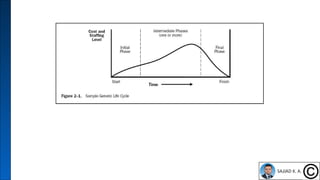
• Some other characteristics:
• Need to decide on what technical work should be done in each
phase
• Who should be involved in each phase
• Cost and staffing levels are low at the start, higher towards the
end, and drop rapidly as the project draws to a conclusion
• Probability of project completion the lowest, hence risk and
uncertainty are highest, at the start of the project
• Influence on final characteristics of the project’s product and the
final cost of the project is highest at the start and get
progressively lower as the project continues
7
What is the difference between project life cycle and
product life cycle??
8
9
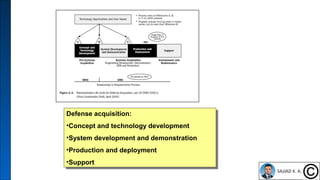
Defense acquisition:
•Concept and technology development
•System development and demonstration
•Production and deployment
•Support
Defense acquisition:
•Concept and technology development
•System development and demonstration
•Production and deployment
•Support
10
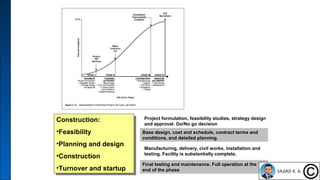
Construction:
•Feasibility
•Planning and design
•Construction
•Turnover and startup
Construction:
•Feasibility
•Planning and design
•Construction
•Turnover and startup
Project formulation, feasibility studies, strategy design
and approval. Go/No go decision
Base design, cost and schedule, contract terms and
conditions, and detailed planning.
Final testing and maintenance. Full operation at the
end of the phase
Manufacturing, delivery, civil works, installation and
testing. Facility is substantially complete.
11
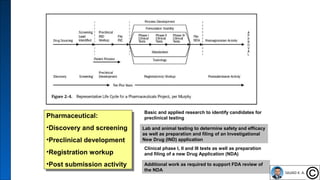
Pharmaceutical:
•Discovery and screening
•Preclinical development
•Registration workup
•Post submission activity
Pharmaceutical:
•Discovery and screening
•Preclinical development
•Registration workup
•Post submission activity
Basic and applied research to identify candidates for
preclinical testing
Lab and animal testing to determine safety and efficacy
as well as preparation and filing of an Investigational
New Drug (IND) application
Clinical phase I, II and III tests as well as preparation
and filing of a new Drug Application (NDA)
Additional work as required to support FDA review of
the NDA
12
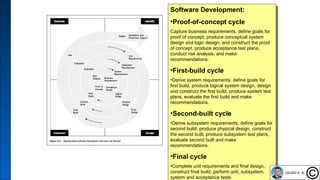
Software Development:
•Proof-of-concept cycle
Capture business requirements, define goals for
proof of concept, produce conceptual system
design and logic design, and construct the proof
of concept, produce acceptance test plans,
conduct risk analysis, and make
recommendations.
•First-build cycle
•Derive system requirements, define goals for
first build, produce logical system design, design
and construct the first build, produce system test
plans, evaluate the first build and make
recommendations.
•Second-built cycle
•Derive subsystem requirements, define goals for
second build, produce physical design, construct
the second built, produce subsystem test plans,
evaluate second built and make
recommendations.
•Final cycle
•Complete unit requirements and final design,
construct final build, perform unit, subsystem,
Software Development:
•Proof-of-concept cycle
Capture business requirements, define goals for
proof of concept, produce conceptual system
design and logic design, and construct the proof
of concept, produce acceptance test plans,
conduct risk analysis, and make
recommendations.
•First-build cycle
•Derive system requirements, define goals for
first build, produce logical system design, design
and construct the first build, produce system test
plans, evaluate the first build and make
recommendations.
•Second-built cycle
•Derive subsystem requirements, define goals for
second build, produce physical design, construct
the second built, produce subsystem test plans,
evaluate second built and make
recommendations.
•Final cycle
•Complete unit requirements and final design,
construct final build, perform unit, subsystem,
system and acceptance tests.
13
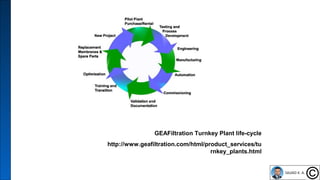
GEAFiltration Turnkey Plant life-cycle
http://www.geafiltration.com/html/product_services/tu
rnkey_plants.html
14
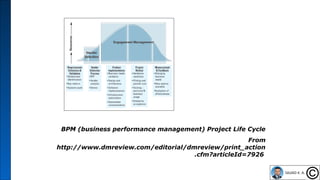
BPM (business performance management) Project Life Cycle
From
http://www.dmreview.com/editorial/dmreview/print_action
.cfm?articleId=7926
15
16
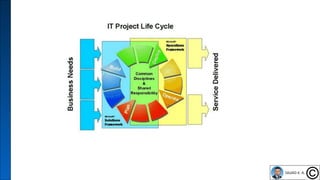
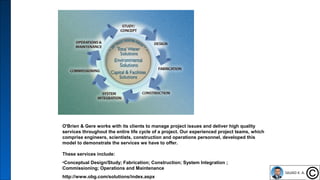
O'Brien & Gere works with its clients to manage project issues and deliver high quality
services throughout the entire life cycle of a project. Our experienced project teams, which
comprise engineers, scientists, construction and operations personnel, developed this
model to demonstrate the services we have to offer.
These services include:
•Conceptual Design/Study; Fabrication; Construction; System Integration ;
Commissioning; Operations and Maintenance
http://www.obg.com/solutions/index.aspx
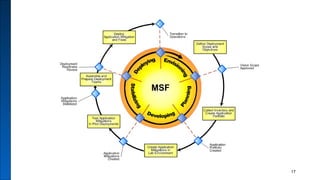
17
Project Stakeholders
• Individuals and organization that are actively involved in the
project, or whose interests may be positively or negatively
affected as a result of project execution or project completion
• May also exert influence over the project and its result
18
KEY
STAKEHOLDERS
•Project Manager
•Customer
•Performing Organization
•Project team member
•Sponsor
•Many others which may have interest!!
19
Project management team must
•identify stakeholder
•Determine their requirements
•Manage and influence those
requirements to ensure a successful
project
Managing stakeholders expectation may be difficult
because stakeholders often have very different
objectives that may come into conflict:
Think of an example when this is the case!!
20
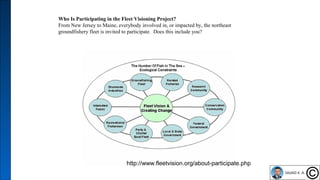
Who Is Participating in the Fleet Visioning Project?
From New Jersey to Maine, everybody involved in, or impacted by, the northeast
groundfishery fleet is invited to participate. Does this include you?
http://www.fleetvision.org/about-participate.php
21
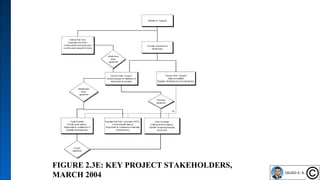
FIGURE 2.3E: KEY PROJECT STAKEHOLDERS,
MARCH 2004
Organizational Influences
• Projects are part of an organization larger than the project –
corporations, government agencies, health-care institutions,
international bodies, professional associations etc.
• Need to understand the key aspects of an organization that may
influence the projects
22
Organizational System
• Project-based organizations
• Organization that derive their revenue primarily from performing projects for others
– architectural firms, engineering firms, consultants, construction contractors,
government contractors, NGO etc
• Organization that have adopted management by projects
• Have management systems in place to facilitate project management
• Project management team should be acutely aware of how the
organization’s systems affect the project
23
Organizational Cultures and
Styles
• Most organizations have developed unique and describable cultures
• Reflected in shared values, norms, beliefs and expectation; policies and procedures,
authority relationship etc
• These will have direct influence on the project
• A team proposing an unusual or high-risk approach is more likely to secure approval
in an aggressive/enterpreneurial organization
• Manager with a highly participative style is apt to encounter problems in a rigidly
hierarchical organization
• Manager with authoritarian style will be equally challenged in a participative
organization
24
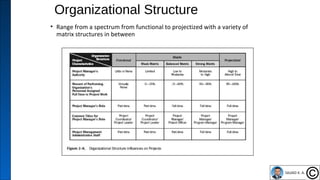
Organizational Structure
• Range from a spectrum from functional to projectized with a variety of
matrix structures in between
25
26
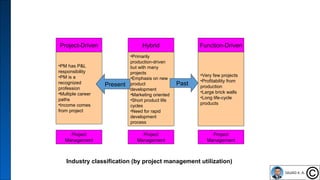
Project-Driven
•PM has P&L
responsibility
•PM is a
recognized
profession
•Multiple career
paths
•Income comes
from project
Project
Management
Hybrid
•Primarily
production-driven
but with many
projects
•Emphasis on new
product
development
•Marketing oriented
•Short product life
cycles
•Need for rapid
development
process
Project
Management
Function-Driven
•Very few projects
•Profitability from
production
•Large brick walls
•Long life-cycle
products
Project
Management
Present Past
Industry classification (by project management utilization)
27
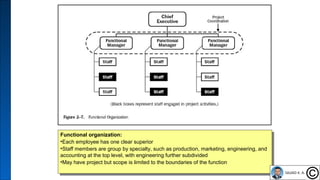
Functional organization:
•Each employee has one clear superior
•Staff members are group by specialty, such as production, marketing, engineering, and
accounting at the top level, with engineering further subdivided
•May have project but scope is limited to the boundaries of the function
Functional organization:
•Each employee has one clear superior
•Staff members are group by specialty, such as production, marketing, engineering, and
accounting at the top level, with engineering further subdivided
•May have project but scope is limited to the boundaries of the function
28
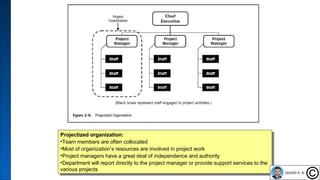
Projectized organization:
•Team members are often collocated
•Most of organization’s resources are involved in project work
•Project managers have a great deal of independence and authority
•Department will report directly to the project manager or provide support services to the
various projects
Projectized organization:
•Team members are often collocated
•Most of organization’s resources are involved in project work
•Project managers have a great deal of independence and authority
•Department will report directly to the project manager or provide support services to the
various projects
29
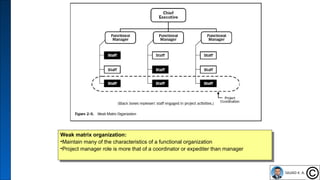
Weak matrix organization:
•Maintain many of the characteristics of a functional organization
•Project manager role is more that of a coordinator or expediter than manager
Weak matrix organization:
•Maintain many of the characteristics of a functional organization
•Project manager role is more that of a coordinator or expediter than manager
30
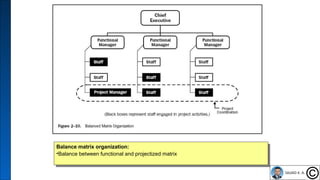
Balance matrix organization:
•Balance between functional and projectized matrix
Balance matrix organization:
•Balance between functional and projectized matrix
31
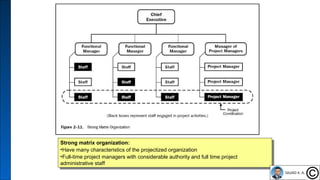
Strong matrix organization:
•Have many characteristics of the projectized organization
•Full-time project managers with considerable authority and full time project
administrative staff
Strong matrix organization:
•Have many characteristics of the projectized organization
•Full-time project managers with considerable authority and full time project
administrative staff
32
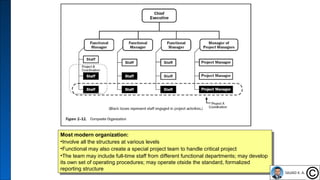
Most modern organization:
•Involve all the structures at various levels
•Functional may also create a special project team to handle critical project
•The team may include full-time staff from different functional departments; may develop
its own set of operating procedures; may operate otside the standard, formalized
reporting structure
Most modern organization:
•Involve all the structures at various levels
•Functional may also create a special project team to handle critical project
•The team may include full-time staff from different functional departments; may develop
its own set of operating procedures; may operate otside the standard, formalized
reporting structure
Discussion
• You are given organization structures for several companies in
Malaysia
• Discuss the structure of each company provide your
comments/critiques
33
Key General Management
Skills
• General management – deals with every aspect of managing an ongoing
enterprise
• Finance and accounting, sales and marketing, R&D, and manufacturing and
distribution
• Strategic planning, tactical planning and operational planning
• Organizational structures, organizational behaviour, personnel administration,
compensation, benefits and career path
• Managing work relationship through motivation, delegation, supervision, team
building, conflict management and other techniques
• Managing oneself through personal time management, stress management and
other techniques
34
Leading
• Leading vs managing
• Managing – primarily concerned with “consistently producing
key results expected by stakeholders”
• Leading involves
• Establishing direction – developing both a vision of the future and
strategies for producing the changes needed to achieve that vision
• Aligning people – communicating the vision by words and deeds to all
those whose cooperation may be needed to achieve the vision
• Motivating and inspiring – helping people energize themselves to
overcome political, bureaucratic, and resource barriers to change
• Project manager is expected to be leader as well as manager –
project leadership, technical leadership and team leadership
35
Communicating
• Involve exchange of information
• Sender – must ensure the info is clear, unambiguous, and complete
• Receiver – making sure that the information is received in its entirety and
understood correctly
• Communications in many forms
• Written and oral, listening and speaking
• Internal (within the project) and external (to the customer, the media, the public etc)
• Formal (reports, briefings, etc) and informal (memos, ad hoc conversations etc)
• Vertical (up and down the organization) and horizontal (with peers and partner
organization)
36
Communicating• May involve in the project context
• Sender-receiver models – feedback loops, barrier to communication
etc
• Choice of media – when to communicate in writing, when to
communicate orally, when to write an informal memo, when to write a
formal report etc
• Writing style – active vs passive voice, sentence structure, word choice
etc
• Presentation techniques – body language, design of visual aids etc
• Meeting management techniques – preparing an agenda, dealing with
conflict etc
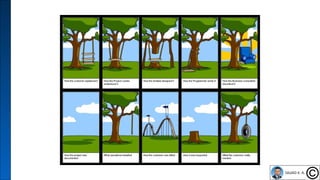
• Project Communications Management is the application of
these broad concepts to the specific needs of a project – eg
deciding how, when, in what form, and to whom to report
project performance
37
38
Negotiating
• Involves conferring with others to come to terms with them or reach an
agreement
• Negotiated directly or with assistance; mediation and arbitration are two
types of assisted negotiation
• Occurs around many issues, at many times, at many levels of the project
• Scope, cost, and schedule objectives
• Changes to scope, cost or schedule
• Contract terms and conditions
• Assignments
• resources
39
Problem Solving
• Involves a combination of problem definition and decision-making
• Problem definition
• Requires distinguishing between causes and symptoms
• Problems may be
• internal or external
• Technical
• Managerial
• interpersonal
• Decision making – includes analyzing the problem to identify viable
solutions
• Once made, decisions must be implemented
40
Influencing the Organization
• Involves the ability to get things done
• Requires an understanding of both the formal and informal structures
of all the organizations involved
• Performing organization
• Customers
• Partners
• Contractors etc
• May requires an understanding of the mechanics of power and
politics
41
42
Power
the potential ability to influence behavior, to change the
course of events, to overcome resistance and to get
people to do things that they would not otherwise do
Pfeffer (5)
Power
the potential ability to influence behavior, to change the
course of events, to overcome resistance and to get
people to do things that they would not otherwise do
Pfeffer (5)
Politics
is about getting collective action from a group of people
who may have quite different interests. It is about being
willing to use conflict and disorder creatively. The negative
sense, of course, derives from the fact that attempts to
reconcile these interests result in power struggles and
organizational games that can sometimes take on
thoroughly unproductive life of their own
Eccles et al(5)
Politics
is about getting collective action from a group of people
who may have quite different interests. It is about being
willing to use conflict and disorder creatively. The negative
sense, of course, derives from the fact that attempts to
reconcile these interests result in power struggles and
organizational games that can sometimes take on
thoroughly unproductive life of their own
Eccles et al(5)
Socio-economic-environmental
influences
• Socioeconomic influences include a wide range of topics and issues
• Project management team must understand that current conditions
and trends in this area may have a major effect on its project
• A small change in this influence can translate, usually with time lag,
into cataclysmic upheavals in the project itself
43
44
Standard
A document approved by a recognized body, that provides,
for common and repeated use, rules, guidelines, or
characteristics for products, processes or services with
which compliance is NOT mandatory
ISO
Standard
A document approved by a recognized body, that provides,
for common and repeated use, rules, guidelines, or
characteristics for products, processes or services with
which compliance is NOT mandatory
ISO
Standards and Regulations
Standards often begin as guidelines that described a preferred
approach, and later, with widespread adoption, become de facto
regulations (e.g. the use of the Critical Path Method for scheduling
major construction projects
Standards and Regulations
45
Regulation
Document, which lays down product, process or service
characteristics, including the applicable administrative
provisions, with which compliance is mandatory
ISO
Regulation
Document, which lays down product, process or service
characteristics, including the applicable administrative
provisions, with which compliance is mandatory
ISO
Compliance may be mandated at different levels (eg by a govt
agency, by the management of the performing organization, or by
the project management team
i.e. not necessarily through regulation only!
Internationalization
• Projects can span national boundaries
• Must consider
• Effect of time-zone differences,
• national and regional holidays,
• travel requirements for face-to-face meetings,
• the logistics of teleconferencing,
• volatile political differences
46
Cultural Influences
• Is the “totality of socially transmitted behavior patterns, arts, beliefs,
institutions, and all other products of human work and thought”
• Every project must operate within a context of one or more cultural norms
• Political
• Economic
• Demographic
• Educational
• Ethical
• Ethnic
• Religious, areas of practice, belief
• Attitudes that affect the way that people and organizations interacts
47
Socio-economic-environmental
Sustainability
• All projects are planned and implemented in a social, economic, and
environmental context
• Have intended and unintended positive and/or negative impacts
• Environmental Impact Studies
• Socioeconomic Impact Studies
48
Discussion
• You are provided with a description of a project to be undertaken by
a company
• Discuss the factors that you have to consider in undertaking the
project
49
50
Thanks for Watching
Please follow me / SAJJAD KHUDHUR
ABBAS

Episode 20 :PROJECT MANAGEMENT CONTEXT

  • 1.
    1 1 SAJJAD KHUDHUR ABBAS ChemicalEngineering , Al-Muthanna University, Iraq Oil & Gas Safety and Health Professional – OSHACADEMY Trainer of Trainers (TOT) - Canadian Center of Human Development Episode 20 PROJECT MANAGEMENT CONTEXT
  • 2.
  • 3.
    Introduction • Project phaseand the Project Life Cycle • Project Stakeholders • Organizational Influences • Key General Management Skills • Social-Economic-Environmental Influences 3
  • 4.
    Project Phases andLife Cycle • Project – divided into several project phases to improve management control and provide for links to the ongoing operations of the performing organization • Collectively the project phases are known as the project life cycle 4
  • 5.
    Characteristics of Project Phase •Each phase is marked by completion of one or more deliverables • Deliverable – a tangible, verifiable work product such as a feasibility study, a detail design or a working prototype • Conclusion of project phase is marked by a review of both key deliverables and project performance to date • To determine if the project should continue into its next phase • To detect and correct errors cost effectively • Phase-end reviews are called – phase exits, stage gates or kill points 5
  • 6.
    Characteristics of theProject Life Cycle • Serve to define the beginning and the end of a project • Determine which transitional actions at the beginning and the end of the project are included and which are not • Typical phase sequence defined by most project life cycles: • Requirements to design • Construction to operation • Design to manufacturing • Fast tracking – the practice of overlapping phases (starting one phase before the previous phase deliverables are approved) 6
  • 7.
    • Some othercharacteristics: • Need to decide on what technical work should be done in each phase • Who should be involved in each phase • Cost and staffing levels are low at the start, higher towards the end, and drop rapidly as the project draws to a conclusion • Probability of project completion the lowest, hence risk and uncertainty are highest, at the start of the project • Influence on final characteristics of the project’s product and the final cost of the project is highest at the start and get progressively lower as the project continues 7 What is the difference between project life cycle and product life cycle??
  • 8.
  • 9.
    9 Defense acquisition: •Concept andtechnology development •System development and demonstration •Production and deployment •Support Defense acquisition: •Concept and technology development •System development and demonstration •Production and deployment •Support
  • 10.
    10 Construction: •Feasibility •Planning and design •Construction •Turnoverand startup Construction: •Feasibility •Planning and design •Construction •Turnover and startup Project formulation, feasibility studies, strategy design and approval. Go/No go decision Base design, cost and schedule, contract terms and conditions, and detailed planning. Final testing and maintenance. Full operation at the end of the phase Manufacturing, delivery, civil works, installation and testing. Facility is substantially complete.
  • 11.
    11 Pharmaceutical: •Discovery and screening •Preclinicaldevelopment •Registration workup •Post submission activity Pharmaceutical: •Discovery and screening •Preclinical development •Registration workup •Post submission activity Basic and applied research to identify candidates for preclinical testing Lab and animal testing to determine safety and efficacy as well as preparation and filing of an Investigational New Drug (IND) application Clinical phase I, II and III tests as well as preparation and filing of a new Drug Application (NDA) Additional work as required to support FDA review of the NDA
  • 12.
    12 Software Development: •Proof-of-concept cycle Capturebusiness requirements, define goals for proof of concept, produce conceptual system design and logic design, and construct the proof of concept, produce acceptance test plans, conduct risk analysis, and make recommendations. •First-build cycle •Derive system requirements, define goals for first build, produce logical system design, design and construct the first build, produce system test plans, evaluate the first build and make recommendations. •Second-built cycle •Derive subsystem requirements, define goals for second build, produce physical design, construct the second built, produce subsystem test plans, evaluate second built and make recommendations. •Final cycle •Complete unit requirements and final design, construct final build, perform unit, subsystem, Software Development: •Proof-of-concept cycle Capture business requirements, define goals for proof of concept, produce conceptual system design and logic design, and construct the proof of concept, produce acceptance test plans, conduct risk analysis, and make recommendations. •First-build cycle •Derive system requirements, define goals for first build, produce logical system design, design and construct the first build, produce system test plans, evaluate the first build and make recommendations. •Second-built cycle •Derive subsystem requirements, define goals for second build, produce physical design, construct the second built, produce subsystem test plans, evaluate second built and make recommendations. •Final cycle •Complete unit requirements and final design, construct final build, perform unit, subsystem, system and acceptance tests.
  • 13.
    13 GEAFiltration Turnkey Plantlife-cycle http://www.geafiltration.com/html/product_services/tu rnkey_plants.html
  • 14.
    14 BPM (business performancemanagement) Project Life Cycle From http://www.dmreview.com/editorial/dmreview/print_action .cfm?articleId=7926
  • 15.
  • 16.
    16 O'Brien & Gereworks with its clients to manage project issues and deliver high quality services throughout the entire life cycle of a project. Our experienced project teams, which comprise engineers, scientists, construction and operations personnel, developed this model to demonstrate the services we have to offer. These services include: •Conceptual Design/Study; Fabrication; Construction; System Integration ; Commissioning; Operations and Maintenance http://www.obg.com/solutions/index.aspx
  • 17.
  • 18.
    Project Stakeholders • Individualsand organization that are actively involved in the project, or whose interests may be positively or negatively affected as a result of project execution or project completion • May also exert influence over the project and its result 18 KEY STAKEHOLDERS •Project Manager •Customer •Performing Organization •Project team member •Sponsor •Many others which may have interest!!
  • 19.
    19 Project management teammust •identify stakeholder •Determine their requirements •Manage and influence those requirements to ensure a successful project Managing stakeholders expectation may be difficult because stakeholders often have very different objectives that may come into conflict: Think of an example when this is the case!!
  • 20.
    20 Who Is Participatingin the Fleet Visioning Project? From New Jersey to Maine, everybody involved in, or impacted by, the northeast groundfishery fleet is invited to participate. Does this include you? http://www.fleetvision.org/about-participate.php
  • 21.
    21 FIGURE 2.3E: KEYPROJECT STAKEHOLDERS, MARCH 2004
  • 22.
    Organizational Influences • Projectsare part of an organization larger than the project – corporations, government agencies, health-care institutions, international bodies, professional associations etc. • Need to understand the key aspects of an organization that may influence the projects 22
  • 23.
    Organizational System • Project-basedorganizations • Organization that derive their revenue primarily from performing projects for others – architectural firms, engineering firms, consultants, construction contractors, government contractors, NGO etc • Organization that have adopted management by projects • Have management systems in place to facilitate project management • Project management team should be acutely aware of how the organization’s systems affect the project 23
  • 24.
    Organizational Cultures and Styles •Most organizations have developed unique and describable cultures • Reflected in shared values, norms, beliefs and expectation; policies and procedures, authority relationship etc • These will have direct influence on the project • A team proposing an unusual or high-risk approach is more likely to secure approval in an aggressive/enterpreneurial organization • Manager with a highly participative style is apt to encounter problems in a rigidly hierarchical organization • Manager with authoritarian style will be equally challenged in a participative organization 24
  • 25.
    Organizational Structure • Rangefrom a spectrum from functional to projectized with a variety of matrix structures in between 25
  • 26.
    26 Project-Driven •PM has P&L responsibility •PMis a recognized profession •Multiple career paths •Income comes from project Project Management Hybrid •Primarily production-driven but with many projects •Emphasis on new product development •Marketing oriented •Short product life cycles •Need for rapid development process Project Management Function-Driven •Very few projects •Profitability from production •Large brick walls •Long life-cycle products Project Management Present Past Industry classification (by project management utilization)
  • 27.
    27 Functional organization: •Each employeehas one clear superior •Staff members are group by specialty, such as production, marketing, engineering, and accounting at the top level, with engineering further subdivided •May have project but scope is limited to the boundaries of the function Functional organization: •Each employee has one clear superior •Staff members are group by specialty, such as production, marketing, engineering, and accounting at the top level, with engineering further subdivided •May have project but scope is limited to the boundaries of the function
  • 28.
    28 Projectized organization: •Team membersare often collocated •Most of organization’s resources are involved in project work •Project managers have a great deal of independence and authority •Department will report directly to the project manager or provide support services to the various projects Projectized organization: •Team members are often collocated •Most of organization’s resources are involved in project work •Project managers have a great deal of independence and authority •Department will report directly to the project manager or provide support services to the various projects
  • 29.
    29 Weak matrix organization: •Maintainmany of the characteristics of a functional organization •Project manager role is more that of a coordinator or expediter than manager Weak matrix organization: •Maintain many of the characteristics of a functional organization •Project manager role is more that of a coordinator or expediter than manager
  • 30.
    30 Balance matrix organization: •Balancebetween functional and projectized matrix Balance matrix organization: •Balance between functional and projectized matrix
  • 31.
    31 Strong matrix organization: •Havemany characteristics of the projectized organization •Full-time project managers with considerable authority and full time project administrative staff Strong matrix organization: •Have many characteristics of the projectized organization •Full-time project managers with considerable authority and full time project administrative staff
  • 32.
    32 Most modern organization: •Involveall the structures at various levels •Functional may also create a special project team to handle critical project •The team may include full-time staff from different functional departments; may develop its own set of operating procedures; may operate otside the standard, formalized reporting structure Most modern organization: •Involve all the structures at various levels •Functional may also create a special project team to handle critical project •The team may include full-time staff from different functional departments; may develop its own set of operating procedures; may operate otside the standard, formalized reporting structure
  • 33.
    Discussion • You aregiven organization structures for several companies in Malaysia • Discuss the structure of each company provide your comments/critiques 33
  • 34.
    Key General Management Skills •General management – deals with every aspect of managing an ongoing enterprise • Finance and accounting, sales and marketing, R&D, and manufacturing and distribution • Strategic planning, tactical planning and operational planning • Organizational structures, organizational behaviour, personnel administration, compensation, benefits and career path • Managing work relationship through motivation, delegation, supervision, team building, conflict management and other techniques • Managing oneself through personal time management, stress management and other techniques 34
  • 35.
    Leading • Leading vsmanaging • Managing – primarily concerned with “consistently producing key results expected by stakeholders” • Leading involves • Establishing direction – developing both a vision of the future and strategies for producing the changes needed to achieve that vision • Aligning people – communicating the vision by words and deeds to all those whose cooperation may be needed to achieve the vision • Motivating and inspiring – helping people energize themselves to overcome political, bureaucratic, and resource barriers to change • Project manager is expected to be leader as well as manager – project leadership, technical leadership and team leadership 35
  • 36.
    Communicating • Involve exchangeof information • Sender – must ensure the info is clear, unambiguous, and complete • Receiver – making sure that the information is received in its entirety and understood correctly • Communications in many forms • Written and oral, listening and speaking • Internal (within the project) and external (to the customer, the media, the public etc) • Formal (reports, briefings, etc) and informal (memos, ad hoc conversations etc) • Vertical (up and down the organization) and horizontal (with peers and partner organization) 36
  • 37.
    Communicating• May involvein the project context • Sender-receiver models – feedback loops, barrier to communication etc • Choice of media – when to communicate in writing, when to communicate orally, when to write an informal memo, when to write a formal report etc • Writing style – active vs passive voice, sentence structure, word choice etc • Presentation techniques – body language, design of visual aids etc • Meeting management techniques – preparing an agenda, dealing with conflict etc • Project Communications Management is the application of these broad concepts to the specific needs of a project – eg deciding how, when, in what form, and to whom to report project performance 37
  • 38.
  • 39.
    Negotiating • Involves conferringwith others to come to terms with them or reach an agreement • Negotiated directly or with assistance; mediation and arbitration are two types of assisted negotiation • Occurs around many issues, at many times, at many levels of the project • Scope, cost, and schedule objectives • Changes to scope, cost or schedule • Contract terms and conditions • Assignments • resources 39
  • 40.
    Problem Solving • Involvesa combination of problem definition and decision-making • Problem definition • Requires distinguishing between causes and symptoms • Problems may be • internal or external • Technical • Managerial • interpersonal • Decision making – includes analyzing the problem to identify viable solutions • Once made, decisions must be implemented 40
  • 41.
    Influencing the Organization •Involves the ability to get things done • Requires an understanding of both the formal and informal structures of all the organizations involved • Performing organization • Customers • Partners • Contractors etc • May requires an understanding of the mechanics of power and politics 41
  • 42.
    42 Power the potential abilityto influence behavior, to change the course of events, to overcome resistance and to get people to do things that they would not otherwise do Pfeffer (5) Power the potential ability to influence behavior, to change the course of events, to overcome resistance and to get people to do things that they would not otherwise do Pfeffer (5) Politics is about getting collective action from a group of people who may have quite different interests. It is about being willing to use conflict and disorder creatively. The negative sense, of course, derives from the fact that attempts to reconcile these interests result in power struggles and organizational games that can sometimes take on thoroughly unproductive life of their own Eccles et al(5) Politics is about getting collective action from a group of people who may have quite different interests. It is about being willing to use conflict and disorder creatively. The negative sense, of course, derives from the fact that attempts to reconcile these interests result in power struggles and organizational games that can sometimes take on thoroughly unproductive life of their own Eccles et al(5)
  • 43.
    Socio-economic-environmental influences • Socioeconomic influencesinclude a wide range of topics and issues • Project management team must understand that current conditions and trends in this area may have a major effect on its project • A small change in this influence can translate, usually with time lag, into cataclysmic upheavals in the project itself 43
  • 44.
    44 Standard A document approvedby a recognized body, that provides, for common and repeated use, rules, guidelines, or characteristics for products, processes or services with which compliance is NOT mandatory ISO Standard A document approved by a recognized body, that provides, for common and repeated use, rules, guidelines, or characteristics for products, processes or services with which compliance is NOT mandatory ISO Standards and Regulations Standards often begin as guidelines that described a preferred approach, and later, with widespread adoption, become de facto regulations (e.g. the use of the Critical Path Method for scheduling major construction projects
  • 45.
    Standards and Regulations 45 Regulation Document,which lays down product, process or service characteristics, including the applicable administrative provisions, with which compliance is mandatory ISO Regulation Document, which lays down product, process or service characteristics, including the applicable administrative provisions, with which compliance is mandatory ISO Compliance may be mandated at different levels (eg by a govt agency, by the management of the performing organization, or by the project management team i.e. not necessarily through regulation only!
  • 46.
    Internationalization • Projects canspan national boundaries • Must consider • Effect of time-zone differences, • national and regional holidays, • travel requirements for face-to-face meetings, • the logistics of teleconferencing, • volatile political differences 46
  • 47.
    Cultural Influences • Isthe “totality of socially transmitted behavior patterns, arts, beliefs, institutions, and all other products of human work and thought” • Every project must operate within a context of one or more cultural norms • Political • Economic • Demographic • Educational • Ethical • Ethnic • Religious, areas of practice, belief • Attitudes that affect the way that people and organizations interacts 47
  • 48.
    Socio-economic-environmental Sustainability • All projectsare planned and implemented in a social, economic, and environmental context • Have intended and unintended positive and/or negative impacts • Environmental Impact Studies • Socioeconomic Impact Studies 48
  • 49.
    Discussion • You areprovided with a description of a project to be undertaken by a company • Discuss the factors that you have to consider in undertaking the project 49
  • 50.
    50 Thanks for Watching Pleasefollow me / SAJJAD KHUDHUR ABBAS