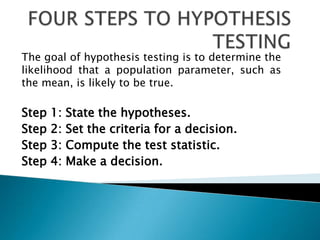
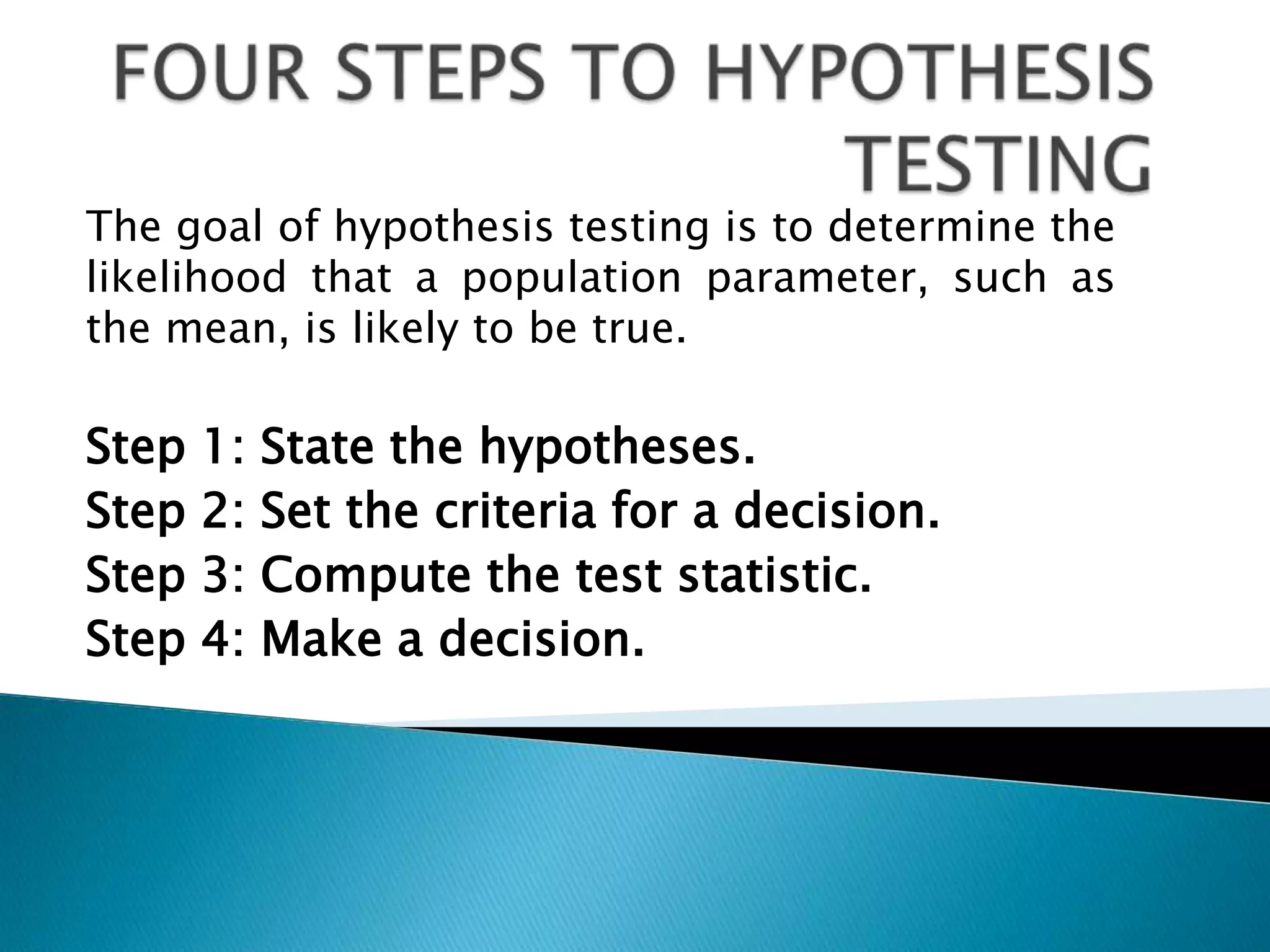
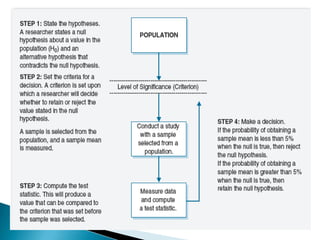
The goal of hypothesis testing is to determine the
likelihood that a population parameter, such as
the mean, is likely to be true.

Step   1:   State the hypotheses.
Step   2:   Set the criteria for a decision.
Step   3:   Compute the test statistic.
Step   4:   Make a decision.
   State the hypotheses.

   We begin by stating the value of a population mean in a
    null hypothesis, which we presume is true.

    For the children watching TV example, we state the null
    hypothesis that children in the United States watch an
    average of 3 hours of TV per week.
   This is a starting point so that we can decide whether
    this is likely to be true, similar to the presumption of
    innocence in a courtroom.

   In hypothesis testing, we start by assuming that the
    hypothesis or claim we are testing is true. This is stated
    in the null hypothesis. The basis of the decision is to
    determine whether this assumption is likely to be true.
   The null hypothesis (H0), stated as the null, is a
    statement about a population parameter, such as the
    population mean, that is assumed to be true.

   The null hypothesis is a starting point. We will test
    whether the value stated in the null hypothesis is likely
    to be true.

   We assume the null hypothesis is true, placing the
    burden on the researcher to conduct a study to show
    evidence that the null hypothesis is unlikely to be true.

   Regardless, we always make a decision about the null
    hypothesis (that it is likely or unlikely to be true). The
    alternative hypothesis is needed for Step 2.
   An alternative hypothesis (H1) is a statement that
    directly contradicts a null hypothesis by stating
    that that the actual value of a population parameter
    is less than, greater than, or not equal to the value
    stated in the null hypothesis.


   The alternative hypothesis states what we think is
    wrong about the null hypothesis, which is needed
    for Step 2.
Set the criteria for a decision.
To set the criteria for a decision, we state the
    level of significance for a test.
THE LEVEL OF SIGNIFICANCE-

    The probability of a false rejection of the null hypothesis in a statistical test. Also
    called significance level.

    Eg. In case if we take the significance level at 5 per cent, this implies that H₀ will be
    rejected when the sampling result has a less than 0.05 probability of
    occurring if H₀ is true.


The likelihood or level of significance is typically set at 5% in
  behavioral research studies. When the probability of obtaining
  a sample mean is less than 5% if the null hypothesis were true,
  then we conclude that the sample we selected is too unlikely
  and so we reject the null hypothesis.
   Compute the test statistic.

   Suppose we measure a sample mean equal to 4 hours per
    week that children watch TV. To make a decision, we need to
    evaluate how likely this sample outcome is, if the population
    mean stated by the null hypothesis (3 hours per week) is true.
    We use a test statistic to determine this likelihood.

   Specifically, a test statistic tells us how far, or how many
    standard deviations, a sample mean is from the population
    mean. The larger the value of the test statistic, the further the
    distance, or number of standard deviations, a sample mean is
    from the population mean stated in the null hypothesis. The
    value of the test statistic is used to make a decision in Step 4.
   Make a decision.

   We use the value of the test statistic to make a
    decision about the null hypothesis. The decision
    is based on the probability of obtaining a sample
    mean, given that the value stated in the null
    hypothesis is true. If the probability of obtaining
    a sample mean is less than 5% when the null
    hypothesis is true, then the decision is to reject
    the null hypothesis.

   If the probability of obtaining a sample mean is
    greater than 5% when the null hypothesis is true,
    then the decision is to retain the null hypothesis.
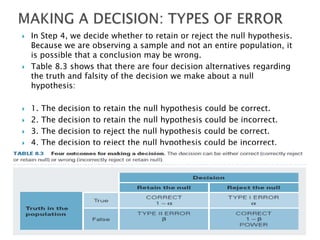
   In Step 4, we decide whether to retain or reject the null hypothesis.
    Because we are observing a sample and not an entire population, it
    is possible that a conclusion may be wrong.
   Table 8.3 shows that there are four decision alternatives regarding
    the truth and falsity of the decision we make about a null
    hypothesis:

   1.   The   decision   to   retain the null hypothesis could be correct.
   2.   The   decision   to   retain the null hypothesis could be incorrect.
   3.   The   decision   to   reject the null hypothesis could be correct.
   4.   The   decision   to   reject the null hypothesis could be incorrect.
   When we decide to reject the null hypothesis, we can be correct or
    incorrect. The incorrect decision is to reject a true null hypothesis. This
    decision is an example of a Type I error.

   With each test we make, there is always some probability that our
    decision is a Type I error. A researcher who makes this error decides to
    reject previous notions of truth that are in fact true.

    Making this type of error is analogous to finding an innocent person
    guilty. To minimize this error, we assume a defendant is innocent when
    beginning a trial. Similarly, to minimize making a Type I error, we
    assume the null hypothesis is true when beginning a hypothesis test.

   Type I error is the probability of rejecting a null hypothesis that is
    actually true. Researchers directly control for the probability of
    committing this type of error.

   An alpha (α) level is the level of significance or criterion for a hypothesis
    test. It is the largest probability of committing a Type I error that we will
    allow and still decide to reject the null hypothesis.
   The incorrect decision is to retain a false null hypothesis. This
    decision is an example of a Type II error, or β error.

   With each test we make, there is always some probability that
    the decision could be a Type II error. In this decision, we
    decide to retain previous notions of truth that are in fact
    false.

   While it’s an error, we still did nothing; we retained the null
    hypothesis. We can always go back and conduct more
    studies.

   Type II error, or beta (β) error, is the probability of retaining a
    null hypothesis that is actually false.

Four steps to hypothesis testing

  • 1.
    The goal ofhypothesis testing is to determine the likelihood that a population parameter, such as the mean, is likely to be true. Step 1: State the hypotheses. Step 2: Set the criteria for a decision. Step 3: Compute the test statistic. Step 4: Make a decision.
  • 2.
    State the hypotheses.  We begin by stating the value of a population mean in a null hypothesis, which we presume is true.  For the children watching TV example, we state the null hypothesis that children in the United States watch an average of 3 hours of TV per week.  This is a starting point so that we can decide whether this is likely to be true, similar to the presumption of innocence in a courtroom.  In hypothesis testing, we start by assuming that the hypothesis or claim we are testing is true. This is stated in the null hypothesis. The basis of the decision is to determine whether this assumption is likely to be true.
  • 3.
    The null hypothesis (H0), stated as the null, is a statement about a population parameter, such as the population mean, that is assumed to be true.  The null hypothesis is a starting point. We will test whether the value stated in the null hypothesis is likely to be true.  We assume the null hypothesis is true, placing the burden on the researcher to conduct a study to show evidence that the null hypothesis is unlikely to be true.  Regardless, we always make a decision about the null hypothesis (that it is likely or unlikely to be true). The alternative hypothesis is needed for Step 2.
  • 4.
    An alternative hypothesis (H1) is a statement that directly contradicts a null hypothesis by stating that that the actual value of a population parameter is less than, greater than, or not equal to the value stated in the null hypothesis.  The alternative hypothesis states what we think is wrong about the null hypothesis, which is needed for Step 2.
  • 5.
    Set the criteriafor a decision. To set the criteria for a decision, we state the level of significance for a test. THE LEVEL OF SIGNIFICANCE- The probability of a false rejection of the null hypothesis in a statistical test. Also called significance level. Eg. In case if we take the significance level at 5 per cent, this implies that H₀ will be rejected when the sampling result has a less than 0.05 probability of occurring if H₀ is true. The likelihood or level of significance is typically set at 5% in behavioral research studies. When the probability of obtaining a sample mean is less than 5% if the null hypothesis were true, then we conclude that the sample we selected is too unlikely and so we reject the null hypothesis.
  • 6.
    Compute the test statistic.  Suppose we measure a sample mean equal to 4 hours per week that children watch TV. To make a decision, we need to evaluate how likely this sample outcome is, if the population mean stated by the null hypothesis (3 hours per week) is true. We use a test statistic to determine this likelihood.  Specifically, a test statistic tells us how far, or how many standard deviations, a sample mean is from the population mean. The larger the value of the test statistic, the further the distance, or number of standard deviations, a sample mean is from the population mean stated in the null hypothesis. The value of the test statistic is used to make a decision in Step 4.
  • 7.
    Make a decision.  We use the value of the test statistic to make a decision about the null hypothesis. The decision is based on the probability of obtaining a sample mean, given that the value stated in the null hypothesis is true. If the probability of obtaining a sample mean is less than 5% when the null hypothesis is true, then the decision is to reject the null hypothesis.  If the probability of obtaining a sample mean is greater than 5% when the null hypothesis is true, then the decision is to retain the null hypothesis.
  • 9.
    In Step 4, we decide whether to retain or reject the null hypothesis. Because we are observing a sample and not an entire population, it is possible that a conclusion may be wrong.  Table 8.3 shows that there are four decision alternatives regarding the truth and falsity of the decision we make about a null hypothesis:  1. The decision to retain the null hypothesis could be correct.  2. The decision to retain the null hypothesis could be incorrect.  3. The decision to reject the null hypothesis could be correct.  4. The decision to reject the null hypothesis could be incorrect.
  • 10.
    When we decide to reject the null hypothesis, we can be correct or incorrect. The incorrect decision is to reject a true null hypothesis. This decision is an example of a Type I error.  With each test we make, there is always some probability that our decision is a Type I error. A researcher who makes this error decides to reject previous notions of truth that are in fact true.  Making this type of error is analogous to finding an innocent person guilty. To minimize this error, we assume a defendant is innocent when beginning a trial. Similarly, to minimize making a Type I error, we assume the null hypothesis is true when beginning a hypothesis test.  Type I error is the probability of rejecting a null hypothesis that is actually true. Researchers directly control for the probability of committing this type of error.  An alpha (α) level is the level of significance or criterion for a hypothesis test. It is the largest probability of committing a Type I error that we will allow and still decide to reject the null hypothesis.
  • 11.
    The incorrect decision is to retain a false null hypothesis. This decision is an example of a Type II error, or β error.  With each test we make, there is always some probability that the decision could be a Type II error. In this decision, we decide to retain previous notions of truth that are in fact false.  While it’s an error, we still did nothing; we retained the null hypothesis. We can always go back and conduct more studies.  Type II error, or beta (β) error, is the probability of retaining a null hypothesis that is actually false.