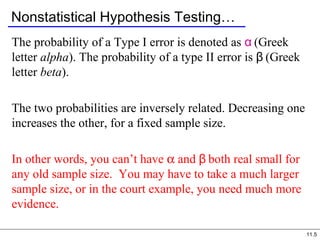
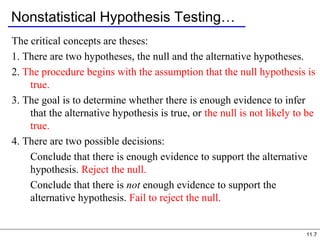
This document discusses hypothesis testing without statistics using a criminal trial as an example. It explains that in a trial, the jury must decide between a null hypothesis (H0) that the defendant is innocent, and an alternative hypothesis (H1) that the defendant is guilty based on the presented evidence. There are two possible errors - a Type I error of convicting an innocent person, and a Type II error of acquitting a guilty person. The probability of each error is inversely related to the sample size. The document provides examples to illustrate hypothesis testing concepts like rejection regions, test statistics, and interpreting p-values.
![11.3
Nonstatistical Hypothesis Testing…
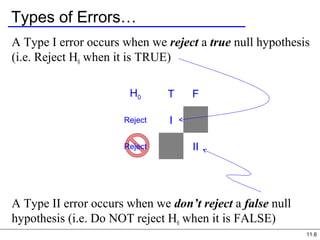
There are two possible errors.
A Type I error occurs when we reject a true null hypothesis.
That is, a Type I error occurs when the jury convicts an
innocent person. We would want the probability of this type
of error [maybe 0.001 – beyond a reasonable doubt] to be
very small for a criminal trial where a conviction results in
the death penalty, whereas for a civil trial, where conviction
might result in someone having to “pay for damages to a
wrecked auto”,we would be willing for the probability to be
larger [0.49 – preponderance of the evidence ]
P(Type I error) = α [usually 0.05 or 0.01]](https://image.slidesharecdn.com/math3010week4-170126150959/85/Math3010-week-4-3-320.jpg)
![11.4
Nonstatistical Hypothesis Testing…
A Type II error occurs when we don’t reject a false null
hypothesis [accept the null hypothesis]. That occurs when a
guilty defendant is acquitted.
In practice, this type of error is by far the most serious
mistake we normally make. For example, if we test the
hypothesis that the amount of medication in a heart pill is
equal to a value which will cure your heart problem and
“accept the hull hypothesis that the amount is ok”. Later on
we find out that the average amount is WAY too large and
people die from “too much medication” [I wish we had
rejected the hypothesis and threw the pills in the trash can],
it’s too late because we shipped the pills to the public.](https://image.slidesharecdn.com/math3010week4-170126150959/85/Math3010-week-4-4-320.jpg)
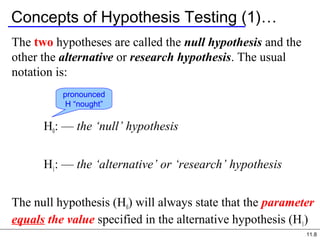
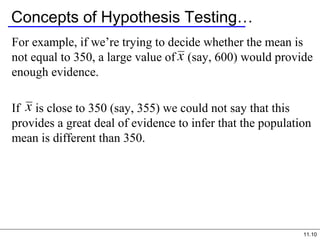
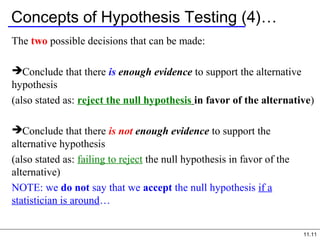
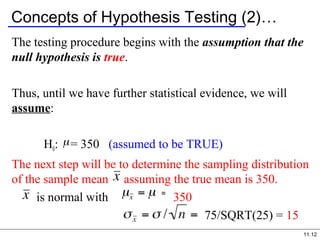
![11.9
Concepts of Hypothesis Testing…
Consider mean demand for computers during assembly lead
time. Rather than estimate the mean demand, our operations
manager wants to know whether the mean is different from
350 units. In other words, someone is claiming that the mean
time is 350 units and we want to check this claim out to see
if it appears reasonable. We can rephrase this request into a
test of the hypothesis:
H0: = 350
Thus, our research hypothesis becomes:
H1: 350≠
Recall that the standard deviation [σ]was assumed to be 75,
the sample size [n] was 25, and the sample mean [ ] was
calculated to be 370.16](https://image.slidesharecdn.com/math3010week4-170126150959/85/Math3010-week-4-9-320.jpg)
![11.14
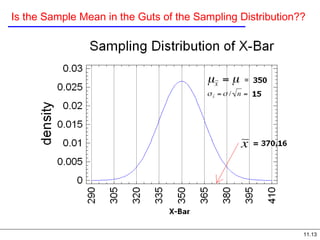
Three ways to determine this: First way
1. Unstandardized test statistic: Is in the guts of the
sampling distribution? Depends on what you define as
the “guts” of the sampling distribution.
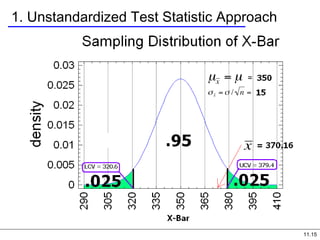
If we define the guts as the center 95% of the distribution
[this means α = 0.05], then the critical values that define
the guts will be 1.96 standard deviations of X-Bar on
either side of the mean of the sampling distribution
[350], or
UCV = 350 + 1.96*15 = 350 + 29.4 = 379.4
LCV = 350 – 1.96*15 = 350 – 29.4 = 320.6](https://image.slidesharecdn.com/math3010week4-170126150959/85/Math3010-week-4-14-320.jpg)
![11.16
Three ways to determine this: Second way
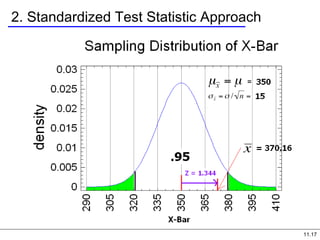
2. Standardized test statistic: Since we defined the “guts” of
the sampling distribution to be the center 95% [α = 0.05],
If the Z-Score for the sample mean is greater than
1.96, we know that will be in the reject region on the right
side or
If the Z-Score for the sample mean is less than -1.97,
we know that will be in the reject region on the left side.
Z = ( - )/ = (370.16 – 350)/15 = 1.344
Is this Z-Score in the guts of the sampling distribution???](https://image.slidesharecdn.com/math3010week4-170126150959/85/Math3010-week-4-16-320.jpg)
![11.18
Three ways to determine this: Third way
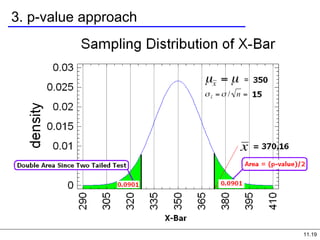
3. The p-value approach (which is generally used with a computer and
statistical software): Increase the “Rejection Region” until it
“captures” the sample mean.
For this example, since is to the right of the mean, calculate
P( > 370.16) = P(Z > 1.344) = 0.0901
Since this is a two tailed test, you must double this area for the p-value.
p-value = 2*(0.0901) = 0.1802
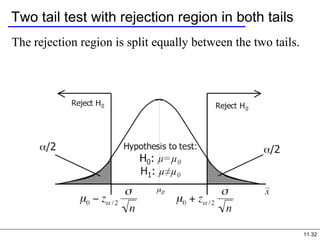
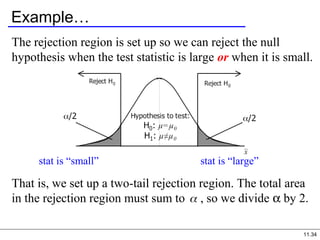
Since we defined the guts as the center 95% [α = 0.05], the reject
region is the other 5%. Since our sample mean, , is in the 18.02%
region, it cannot be in our 5% rejection region [α = 0.05].](https://image.slidesharecdn.com/math3010week4-170126150959/85/Math3010-week-4-18-320.jpg)
![11.20
Statistical Conclusions:
Unstandardized Test Statistic:
Since LCV (320.6) < (370.16) < UCV (379.4), we
reject the null hypothesis at a 5% level of significance.
Standardized Test Statistic:
Since -Zα/2(-1.96) < Z(1.344) < Zα/2 (1.96), we fail to reject
the null hypothesis at a 5% level of significance.
P-value:
Since p-value (0.1802) > 0.05 [α], we fail to reject the
hull hypothesis at a 5% level of significance.](https://image.slidesharecdn.com/math3010week4-170126150959/85/Math3010-week-4-20-320.jpg)
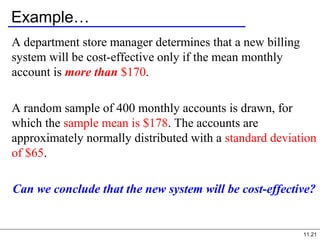
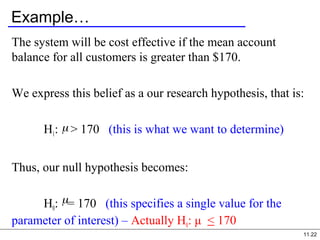
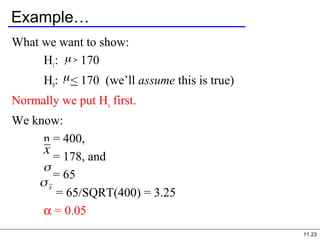
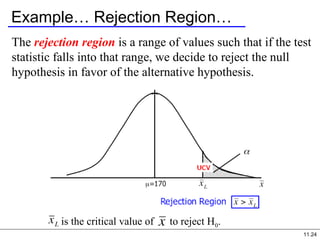
![11.25
Example…
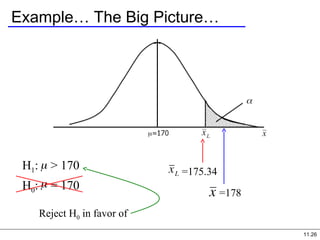
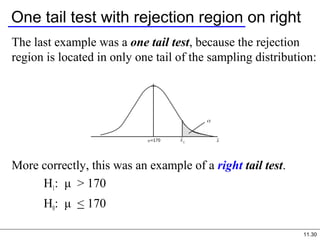
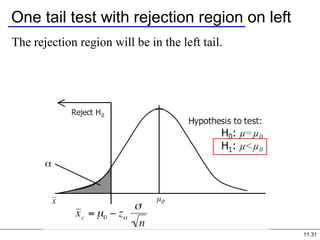
At a 5% significance level (i.e. =0.05), we get [all α in one tail]
Zα = Z0.05 = 1.645
Therefore, UCV = 170 + 1.645*3.25 = 175.35
Since our sample mean (178) is greater than the critical value we
calculated (175.35), we reject the null hypothesis in favor of H1
OR
(>1.645) Reject null
OR
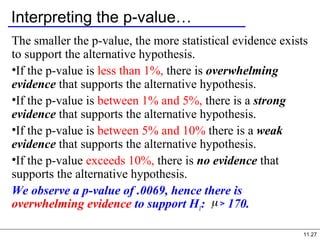
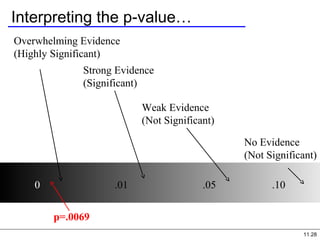
p-value = P( > 178) = P(Z > 2.46) = 0.0069 < 0.05 Reject null](https://image.slidesharecdn.com/math3010week4-170126150959/85/Math3010-week-4-25-320.jpg)
![11.33
Example… Students work
AT&T’s argues that its rates are such that customers won’t
see a difference in their phone bills between them and their
competitors. They calculate the mean and standard deviation
for all their customers at $17.09 and $3.87 (respectively).
Note: Don’t know the true value for σ, so we estimate σ from
the data [σ ~ s = 3.87] – large sample so don’t worry.
They then sample 100 customers at random and recalculate a
monthly phone bill based on competitor’s rates.
Our null and alternative hypotheses are
H1: 17.09. We do this by assuming that:≠
H0: = 17.09](https://image.slidesharecdn.com/math3010week4-170126150959/85/Math3010-week-4-33-320.jpg)
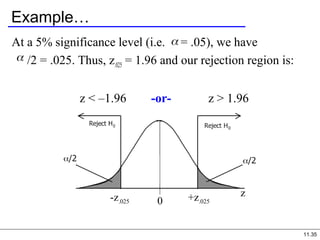
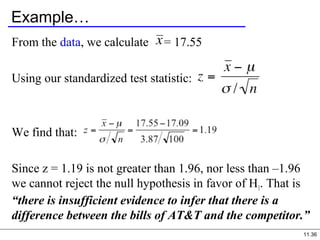
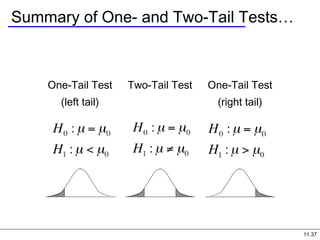
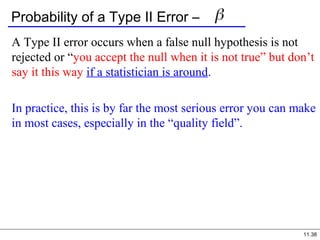
![11.39
Judging the Test…
A statistical test of hypothesis is effectively defined by the
significance level ( ) and the sample size (n), both of
which are selected by the statistics practitioner.
Therefore, if the probability of a Type II error ( ) is too
large [we have insufficient power], we can reduce it by
increasing , and/or
increasing the sample size, n.](https://image.slidesharecdn.com/math3010week4-170126150959/85/Math3010-week-4-39-320.jpg)