Utilization of Molecular Markers for PGRFA Characterization
and Pre-Breeding for Climate Changes
Aug. 31st- Sept. 4th, 2014
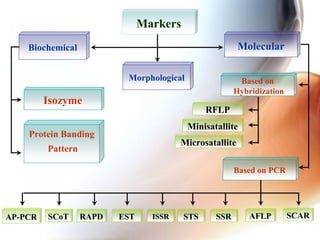
Based on
Hybridization
Markers
Morphological
Biochemical Molecular
Based on PCR
RFLP
Minisatallite
Microsatallite
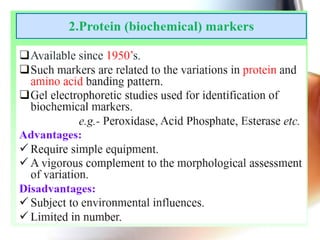
Isozyme
Protein Banding
Pattern
RAPD SSRISSR AFLPSTS SCARSCoT ESTAP-PCR
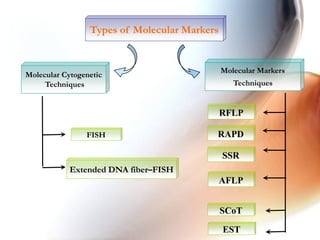
Molecular Cytogenetic
Techniques
Types of Molecular Markers
Molecular Markers
Techniques
FISH
Extended DNA fiber–FISH
RAPD
SSR
AFLP
SCoT
RFLP
EST
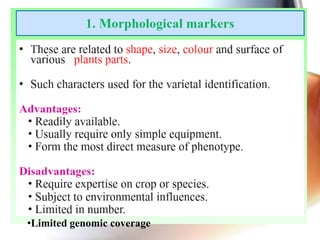
Morphological markers
• Assessment Genetic diversity in a crop species is fundamental
to its improvements.
• Genetic variability is considered the reservoir that plant
breeders fall upon in their continuous strive to develop
improved varieties and hybrids.
• Knowledge of germplasm diversity and of relationship
among elite breeding materials has a significant impact
improvement of crop plants.
• This information is useful in planning crosses for hybrid and
line development, in assigning lines to heterotic groups.
Genetic Diversity
•Limited genomic coverage
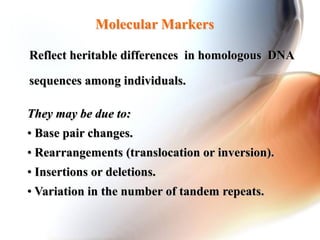
Molecular Markers
They may be due to:
• Base pair changes.
• Rearrangements (translocation or inversion).
• Insertions or deletions.
• Variation in the number of tandem repeats.
Reflect heritable differences in homologous DNA
sequences among individuals.
 Ubiquitous.
 Stably inherited.
 Multiple alleles for each marker.
 Devoid of pleiotropic effects.
 Detectable in all tissues, at all ages.
 Long shelf life of the DNA samples.
Advantages of Molecular Markers
Hybridization based (non-PCR)
Technique
RFLPs
Restriction Fragment Length Polymorphism analysis
Botstein et al. (1980)
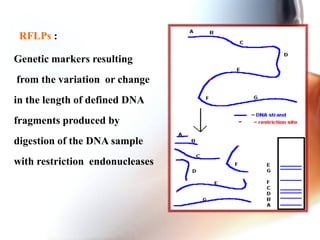
Genetic markers resulting
from the variation or change
in the length of defined DNA
fragments produced by
digestion of the DNA sample
with restriction endonucleases
RFLPs :
RFLPs
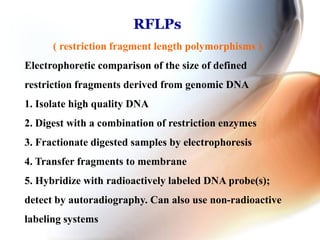
( restriction fragment length polymorphisms )
Electrophoretic comparison of the size of defined
restriction fragments derived from genomic DNA
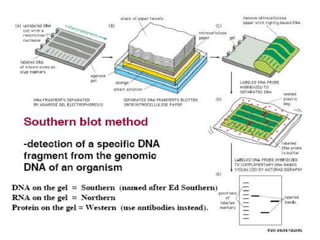
1. Isolate high quality DNA
2. Digest with a combination of restriction enzymes
3. Fractionate digested samples by electrophoresis
4. Transfer fragments to membrane
5. Hybridize with radioactively labeled DNA probe(s);
detect by autoradiography. Can also use non-radioactive
labeling systems
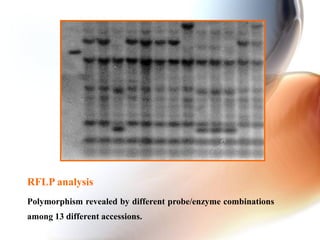
RFLP analysis
Polymorphism revealed by different probe/enzyme combinations
among 13 different accessions.
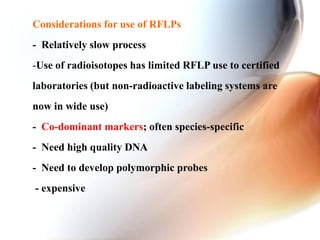
Considerations for use of RFLPs
- Relatively slow process
-Use of radioisotopes has limited RFLP use to certified
laboratories (but non-radioactive labeling systems are
now in wide use)
- Co-dominant markers; often species-specific
- Need high quality DNA
- Need to develop polymorphic probes
- expensive
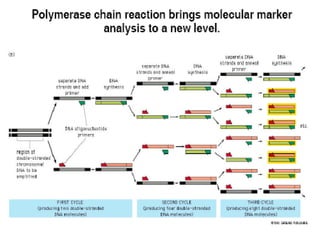
PCR based techniques
( RAPD, ISSR, SSR, AFLP, EST ,SCoT)
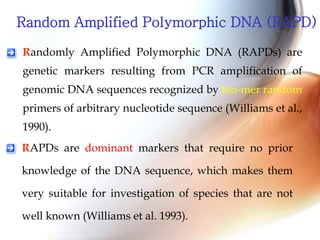
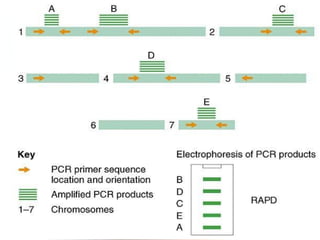
Random Amplified Polymorphic DNA (RAPD)
Randomly Amplified Polymorphic DNA (RAPDs) are
genetic markers resulting from PCR amplification of
genomic DNA sequences recognized by ten-mer random
primers of arbitrary nucleotide sequence (Williams et al.,
1990).
RAPDs are dominant markers that require no prior
knowledge of the DNA sequence, which makes them
very suitable for investigation of species that are not
well known (Williams et al. 1993).
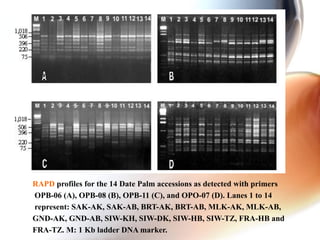
RAPD profiles for the 14 Date Palm accessions as detected with primers
OPB-06 (A), OPB-08 (B), OPB-11 (C), and OPO-07 (D). Lanes 1 to 14
represent: SAK-AK, SAK-AB, BRT-AK, BRT-AB, MLK-AK, MLK-AB,
GND-AK, GND-AB, SIW-KH, SIW-DK, SIW-HB, SIW-TZ, FRA-HB and
FRA-TZ. M: 1 Kb ladder DNA marker.
Inter-Simple Sequence Repeats (ISSR)
The generation of ISSR markers involve PCR amplification
of DNA using a single primer composed of a microsatellite
repeated sequence and in some cases primer also contains 1-
4 base anchor at either 3′ or 5′ or at both ends, which target a
subset of ‘simple sequence repeats’ (SSRs) and amplify the
region between two closely spaced and oppositely oriented
SSRs (Fang et al., 1997; Fang and Roose, 1997; Moreno et al.,
1998).
ISSR technique permits the detection of polymorphisms in
microsatellites and inter-microsatellites loci without
previous knowledge of the DNA sequence (Moreno et al.,
1998).
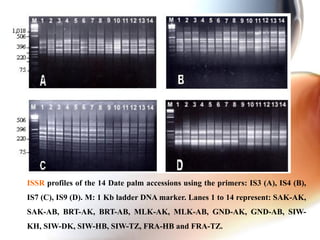
ISSR profiles of the 14 Date palm accessions using the primers: IS3 (A), IS4 (B),
IS7 (C), IS9 (D). M: 1 Kb ladder DNA marker. Lanes 1 to 14 represent: SAK-AK,
SAK-AB, BRT-AK, BRT-AB, MLK-AK, MLK-AB, GND-AK, GND-AB, SIW-
KH, SIW-DK, SIW-HB, SIW-TZ, FRA-HB and FRA-TZ.
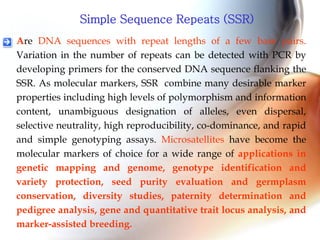
Are DNA sequences with repeat lengths of a few base pairs.
Variation in the number of repeats can be detected with PCR by
developing primers for the conserved DNA sequence flanking the
SSR. As molecular markers, SSR combine many desirable marker
properties including high levels of polymorphism and information
content, unambiguous designation of alleles, even dispersal,
selective neutrality, high reproducibility, co-dominance, and rapid
and simple genotyping assays. Microsatellites have become the
molecular markers of choice for a wide range of applications in
genetic mapping and genome, genotype identification and
variety protection, seed purity evaluation and germplasm
conservation, diversity studies, paternity determination and
pedigree analysis, gene and quantitative trait locus analysis, and
marker-assisted breeding.
Simple Sequence Repeats (SSR)
A B
C D
FE
M 1 20 M 1 20
200 bp
100 bp
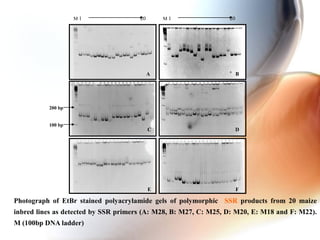
Photograph of EtBr stained polyacrylamide gels of polymorphic SSR products from 20 maize
inbred lines as detected by SSR primers (A: M28, B: M27, C: M25, D: M20, E: M18 and F: M22).
M (100bp DNA ladder)
AFLP
( Amplified Fragment Length Polymorphisms)
 A combination of PCR and RFLP
 Informative fingerprints of amplified fragments
Amplified Fragment Length Polymorphism (AFLP)
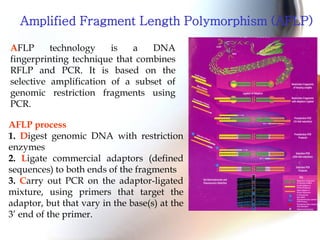
AFLP process
1. Digest genomic DNA with restriction
enzymes
2. Ligate commercial adaptors (defined
sequences) to both ends of the fragments
3. Carry out PCR on the adaptor-ligated
mixture, using primers that target the
adaptor, but that vary in the base(s) at the
3’ end of the primer.
AFLP technology is a DNA
fingerprinting technique that combines
RFLP and PCR. It is based on the
selective amplification of a subset of
genomic restriction fragments using
PCR.
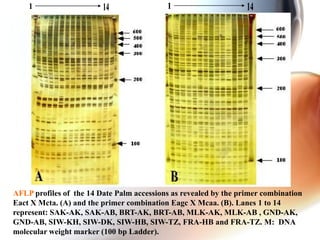
AFLP profiles of the 14 Date Palm accessions as revealed by the primer combination
Eact X Mcta. (A) and the primer combination Eagc X Mcaa. (B). Lanes 1 to 14
represent: SAK-AK, SAK-AB, BRT-AK, BRT-AB, MLK-AK, MLK-AB , GND-AK,
GND-AB, SIW-KH, SIW-DK, SIW-HB, SIW-TZ, FRA-HB and FRA-TZ. M: DNA
molecular weight marker (100 bp Ladder).
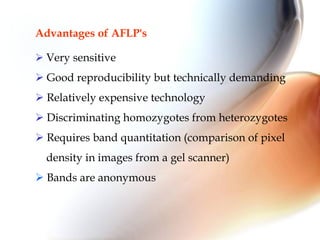
Advantages of AFLP's
 Very sensitive
 Good reproducibility but technically demanding
 Relatively expensive technology
 Discriminating homozygotes from heterozygotes
 Requires band quantitation (comparison of pixel
density in images from a gel scanner)
 Bands are anonymous
SCOT
(Start codon targeted Marker)
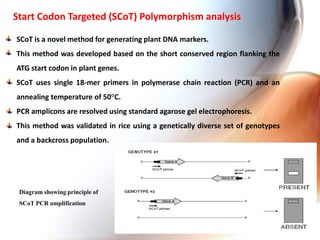
Start Codon Targeted (SCoT) Polymorphism analysis
SCoT is a novel method for generating plant DNA markers.
This method was developed based on the short conserved region flanking the
ATG start codon in plant genes.
SCoT uses single 18-mer primers in polymerase chain reaction (PCR) and an
annealing temperature of 50°C.
PCR amplicons are resolved using standard agarose gel electrophoresis.
This method was validated in rice using a genetically diverse set of genotypes
and a backcross population.
Diagram showing principle of
SCoT PCR amplification
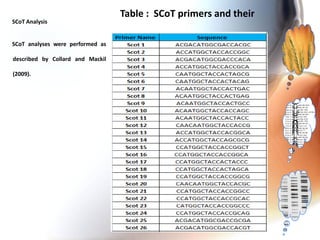
SCoT Analysis
SCoT analyses were performed as
described by Collard and Mackil
(2009).
Table : SCoT primers and their
sequences
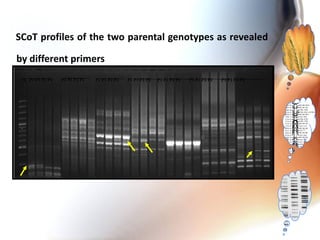
SCoT profiles of the two parental genotypes as revealed
by different primers
M P1 P1 P2 P2 P1 P1 P2 P2 P1 P1 P2 P2 P1 P1 P2 P2 P1 P1 P2 P2 P1 P1 P2 P2 P1 P1 P2 P2
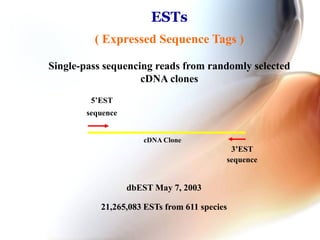
ESTs
( Expressed Sequence Tags )
Single-pass sequencing reads from randomly selected
cDNA clones
3’EST
sequence
5’EST
sequence
cDNA Clone
dbEST May 7, 2003
21,265,083 ESTs from 611 species
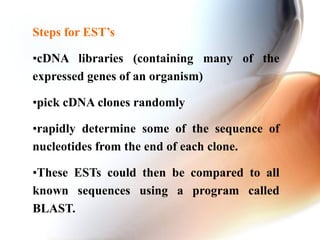
Steps for EST’s
•cDNA libraries (containing many of the
expressed genes of an organism)
•pick cDNA clones randomly
•rapidly determine some of the sequence of
nucleotides from the end of each clone.
•These ESTs could then be compared to all
known sequences using a program called
BLAST.
An exact match to a sequenced gene means that
the gene encoding that EST is already known.
If the match was close but not exact one could
conclude that the EST is derived from a gene
with a function similar to that of the known
gene.
The EST sequences with their putative
identification are then deposited in the GenBank
and the clones from which they were derived are
kept in a freezer for later use.
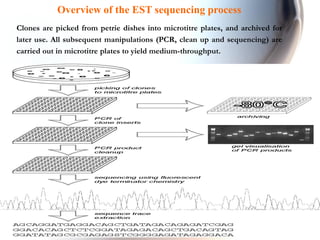
Overview of the EST sequencing process
Clones are picked from petrie dishes into microtitre plates, and archived for
later use. All subsequent manipulations (PCR, clean up and sequencing) are
carried out in microtitre plates to yield medium-throughput.
Features RFLP PCR-
RFLP
DFP RAPD Microsatellite SNP
Detection
method
Hybridization PCR Hybridization PCR PCR PCR
Type of
probe/primer
used
g DNA/
cDNA sequence
of structural
genes
Sequence
specific
primers
Mini satellite
synthetic
oligos
Arbitrarily
design
primer
Sequence
specific primers
Sequence
specific
primers
Requirement of
radioactivity
Yes No/Yes Yes No/Yes No/Yes No/Yes
Extant of
genomic
coverage
Limited Limited Extensive Extensive Extensive Extensive
Degree of
polymorphisms
Low Low High Medium to
High
High High
Phenotype
expression
Co dominant Co
dominant
Co dominant Co
dominant/D
ominant
Dominant Co
dominant
Possibility of
automation
No Yes No Yes Yes Yes
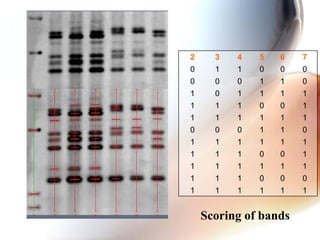
DATA ANALYSIS
765432
000110
011000
111101
100111
111111
011000
111111
100111
111111
000111
111111
Scoring of bands
653742
1002
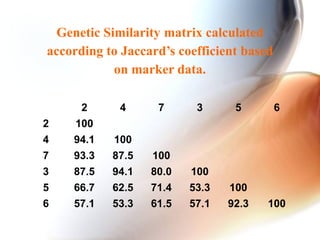
10094.14
10087.593.37
10080.094.187.53
10053.371.462.566.75
10092.357.161.553.357.16
Genetic Similarity matrix calculated
according to Jaccard’s coefficient based
on marker data.
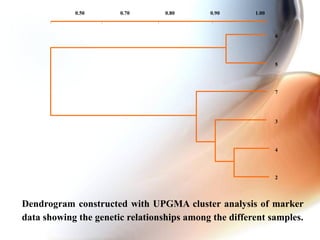
Dendrogram constructed with UPGMA cluster analysis of marker
data showing the genetic relationships among the different samples.
0.50 0.70 0.80 0.90 1.00
2
3
4
55
6
7
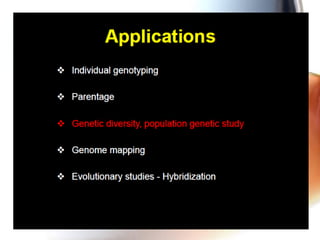
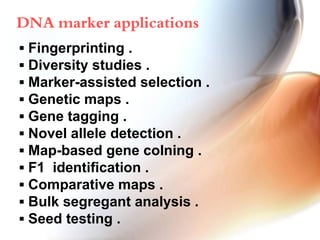
▪ Fingerprinting .
▪ Diversity studies .
▪ Marker-assisted selection .
▪ Genetic maps .
▪ Gene tagging .
▪ Novel allele detection .
▪ Map-based gene colning .
▪ F1 identification .
▪ Comparative maps .
▪ Bulk segregant analysis .
▪ Seed testing .
DNA marker applications
Molecular markers types and applications

Molecular markers types and applications

  • 1.
    Utilization of MolecularMarkers for PGRFA Characterization and Pre-Breeding for Climate Changes Aug. 31st- Sept. 4th, 2014
  • 2.
    Based on Hybridization Markers Morphological Biochemical Molecular Basedon PCR RFLP Minisatallite Microsatallite Isozyme Protein Banding Pattern RAPD SSRISSR AFLPSTS SCARSCoT ESTAP-PCR
  • 3.
    Molecular Cytogenetic Techniques Types ofMolecular Markers Molecular Markers Techniques FISH Extended DNA fiber–FISH RAPD SSR AFLP SCoT RFLP EST
  • 4.
  • 5.
    • Assessment Geneticdiversity in a crop species is fundamental to its improvements. • Genetic variability is considered the reservoir that plant breeders fall upon in their continuous strive to develop improved varieties and hybrids. • Knowledge of germplasm diversity and of relationship among elite breeding materials has a significant impact improvement of crop plants. • This information is useful in planning crosses for hybrid and line development, in assigning lines to heterotic groups. Genetic Diversity
  • 6.
  • 8.
    Molecular Markers They maybe due to: • Base pair changes. • Rearrangements (translocation or inversion). • Insertions or deletions. • Variation in the number of tandem repeats. Reflect heritable differences in homologous DNA sequences among individuals.
  • 9.
     Ubiquitous.  Stablyinherited.  Multiple alleles for each marker.  Devoid of pleiotropic effects.  Detectable in all tissues, at all ages.  Long shelf life of the DNA samples. Advantages of Molecular Markers
  • 11.
    Hybridization based (non-PCR) Technique RFLPs RestrictionFragment Length Polymorphism analysis Botstein et al. (1980)
  • 12.
    Genetic markers resulting fromthe variation or change in the length of defined DNA fragments produced by digestion of the DNA sample with restriction endonucleases RFLPs :
  • 13.
    RFLPs ( restriction fragmentlength polymorphisms ) Electrophoretic comparison of the size of defined restriction fragments derived from genomic DNA 1. Isolate high quality DNA 2. Digest with a combination of restriction enzymes 3. Fractionate digested samples by electrophoresis 4. Transfer fragments to membrane 5. Hybridize with radioactively labeled DNA probe(s); detect by autoradiography. Can also use non-radioactive labeling systems
  • 15.
    RFLP analysis Polymorphism revealedby different probe/enzyme combinations among 13 different accessions.
  • 16.
    Considerations for useof RFLPs - Relatively slow process -Use of radioisotopes has limited RFLP use to certified laboratories (but non-radioactive labeling systems are now in wide use) - Co-dominant markers; often species-specific - Need high quality DNA - Need to develop polymorphic probes - expensive
  • 18.
    PCR based techniques (RAPD, ISSR, SSR, AFLP, EST ,SCoT)
  • 20.
    Random Amplified PolymorphicDNA (RAPD) Randomly Amplified Polymorphic DNA (RAPDs) are genetic markers resulting from PCR amplification of genomic DNA sequences recognized by ten-mer random primers of arbitrary nucleotide sequence (Williams et al., 1990). RAPDs are dominant markers that require no prior knowledge of the DNA sequence, which makes them very suitable for investigation of species that are not well known (Williams et al. 1993).
  • 22.
    RAPD profiles forthe 14 Date Palm accessions as detected with primers OPB-06 (A), OPB-08 (B), OPB-11 (C), and OPO-07 (D). Lanes 1 to 14 represent: SAK-AK, SAK-AB, BRT-AK, BRT-AB, MLK-AK, MLK-AB, GND-AK, GND-AB, SIW-KH, SIW-DK, SIW-HB, SIW-TZ, FRA-HB and FRA-TZ. M: 1 Kb ladder DNA marker.
  • 23.
    Inter-Simple Sequence Repeats(ISSR) The generation of ISSR markers involve PCR amplification of DNA using a single primer composed of a microsatellite repeated sequence and in some cases primer also contains 1- 4 base anchor at either 3′ or 5′ or at both ends, which target a subset of ‘simple sequence repeats’ (SSRs) and amplify the region between two closely spaced and oppositely oriented SSRs (Fang et al., 1997; Fang and Roose, 1997; Moreno et al., 1998). ISSR technique permits the detection of polymorphisms in microsatellites and inter-microsatellites loci without previous knowledge of the DNA sequence (Moreno et al., 1998).
  • 24.
    ISSR profiles ofthe 14 Date palm accessions using the primers: IS3 (A), IS4 (B), IS7 (C), IS9 (D). M: 1 Kb ladder DNA marker. Lanes 1 to 14 represent: SAK-AK, SAK-AB, BRT-AK, BRT-AB, MLK-AK, MLK-AB, GND-AK, GND-AB, SIW- KH, SIW-DK, SIW-HB, SIW-TZ, FRA-HB and FRA-TZ.
  • 25.
    Are DNA sequenceswith repeat lengths of a few base pairs. Variation in the number of repeats can be detected with PCR by developing primers for the conserved DNA sequence flanking the SSR. As molecular markers, SSR combine many desirable marker properties including high levels of polymorphism and information content, unambiguous designation of alleles, even dispersal, selective neutrality, high reproducibility, co-dominance, and rapid and simple genotyping assays. Microsatellites have become the molecular markers of choice for a wide range of applications in genetic mapping and genome, genotype identification and variety protection, seed purity evaluation and germplasm conservation, diversity studies, paternity determination and pedigree analysis, gene and quantitative trait locus analysis, and marker-assisted breeding. Simple Sequence Repeats (SSR)
  • 27.
    A B C D FE M1 20 M 1 20 200 bp 100 bp Photograph of EtBr stained polyacrylamide gels of polymorphic SSR products from 20 maize inbred lines as detected by SSR primers (A: M28, B: M27, C: M25, D: M20, E: M18 and F: M22). M (100bp DNA ladder)
  • 29.
    AFLP ( Amplified FragmentLength Polymorphisms)  A combination of PCR and RFLP  Informative fingerprints of amplified fragments
  • 30.
    Amplified Fragment LengthPolymorphism (AFLP) AFLP process 1. Digest genomic DNA with restriction enzymes 2. Ligate commercial adaptors (defined sequences) to both ends of the fragments 3. Carry out PCR on the adaptor-ligated mixture, using primers that target the adaptor, but that vary in the base(s) at the 3’ end of the primer. AFLP technology is a DNA fingerprinting technique that combines RFLP and PCR. It is based on the selective amplification of a subset of genomic restriction fragments using PCR.
  • 31.
    AFLP profiles ofthe 14 Date Palm accessions as revealed by the primer combination Eact X Mcta. (A) and the primer combination Eagc X Mcaa. (B). Lanes 1 to 14 represent: SAK-AK, SAK-AB, BRT-AK, BRT-AB, MLK-AK, MLK-AB , GND-AK, GND-AB, SIW-KH, SIW-DK, SIW-HB, SIW-TZ, FRA-HB and FRA-TZ. M: DNA molecular weight marker (100 bp Ladder).
  • 32.
    Advantages of AFLP's Very sensitive  Good reproducibility but technically demanding  Relatively expensive technology  Discriminating homozygotes from heterozygotes  Requires band quantitation (comparison of pixel density in images from a gel scanner)  Bands are anonymous
  • 34.
  • 35.
    Start Codon Targeted(SCoT) Polymorphism analysis SCoT is a novel method for generating plant DNA markers. This method was developed based on the short conserved region flanking the ATG start codon in plant genes. SCoT uses single 18-mer primers in polymerase chain reaction (PCR) and an annealing temperature of 50°C. PCR amplicons are resolved using standard agarose gel electrophoresis. This method was validated in rice using a genetically diverse set of genotypes and a backcross population. Diagram showing principle of SCoT PCR amplification
  • 36.
    SCoT Analysis SCoT analyseswere performed as described by Collard and Mackil (2009). Table : SCoT primers and their sequences
  • 37.
    SCoT profiles ofthe two parental genotypes as revealed by different primers M P1 P1 P2 P2 P1 P1 P2 P2 P1 P1 P2 P2 P1 P1 P2 P2 P1 P1 P2 P2 P1 P1 P2 P2 P1 P1 P2 P2
  • 38.
    ESTs ( Expressed SequenceTags ) Single-pass sequencing reads from randomly selected cDNA clones 3’EST sequence 5’EST sequence cDNA Clone dbEST May 7, 2003 21,265,083 ESTs from 611 species
  • 39.
    Steps for EST’s •cDNAlibraries (containing many of the expressed genes of an organism) •pick cDNA clones randomly •rapidly determine some of the sequence of nucleotides from the end of each clone. •These ESTs could then be compared to all known sequences using a program called BLAST.
  • 40.
    An exact matchto a sequenced gene means that the gene encoding that EST is already known. If the match was close but not exact one could conclude that the EST is derived from a gene with a function similar to that of the known gene. The EST sequences with their putative identification are then deposited in the GenBank and the clones from which they were derived are kept in a freezer for later use.
  • 41.
    Overview of theEST sequencing process Clones are picked from petrie dishes into microtitre plates, and archived for later use. All subsequent manipulations (PCR, clean up and sequencing) are carried out in microtitre plates to yield medium-throughput.
  • 42.
    Features RFLP PCR- RFLP DFPRAPD Microsatellite SNP Detection method Hybridization PCR Hybridization PCR PCR PCR Type of probe/primer used g DNA/ cDNA sequence of structural genes Sequence specific primers Mini satellite synthetic oligos Arbitrarily design primer Sequence specific primers Sequence specific primers Requirement of radioactivity Yes No/Yes Yes No/Yes No/Yes No/Yes Extant of genomic coverage Limited Limited Extensive Extensive Extensive Extensive Degree of polymorphisms Low Low High Medium to High High High Phenotype expression Co dominant Co dominant Co dominant Co dominant/D ominant Dominant Co dominant Possibility of automation No Yes No Yes Yes Yes
  • 43.
  • 44.
  • 46.
  • 47.
    Dendrogram constructed withUPGMA cluster analysis of marker data showing the genetic relationships among the different samples. 0.50 0.70 0.80 0.90 1.00 2 3 4 55 6 7
  • 48.
    ▪ Fingerprinting . ▪Diversity studies . ▪ Marker-assisted selection . ▪ Genetic maps . ▪ Gene tagging . ▪ Novel allele detection . ▪ Map-based gene colning . ▪ F1 identification . ▪ Comparative maps . ▪ Bulk segregant analysis . ▪ Seed testing . DNA marker applications