ETHICAL ISSUES IN BIOTECHNOLOGY AND RELATED AREAS 
2015 
S. N. JOGDAND 
BIOTECH SUPPORT SERVICES (BSS), INDIA 
1/1/2015
2 
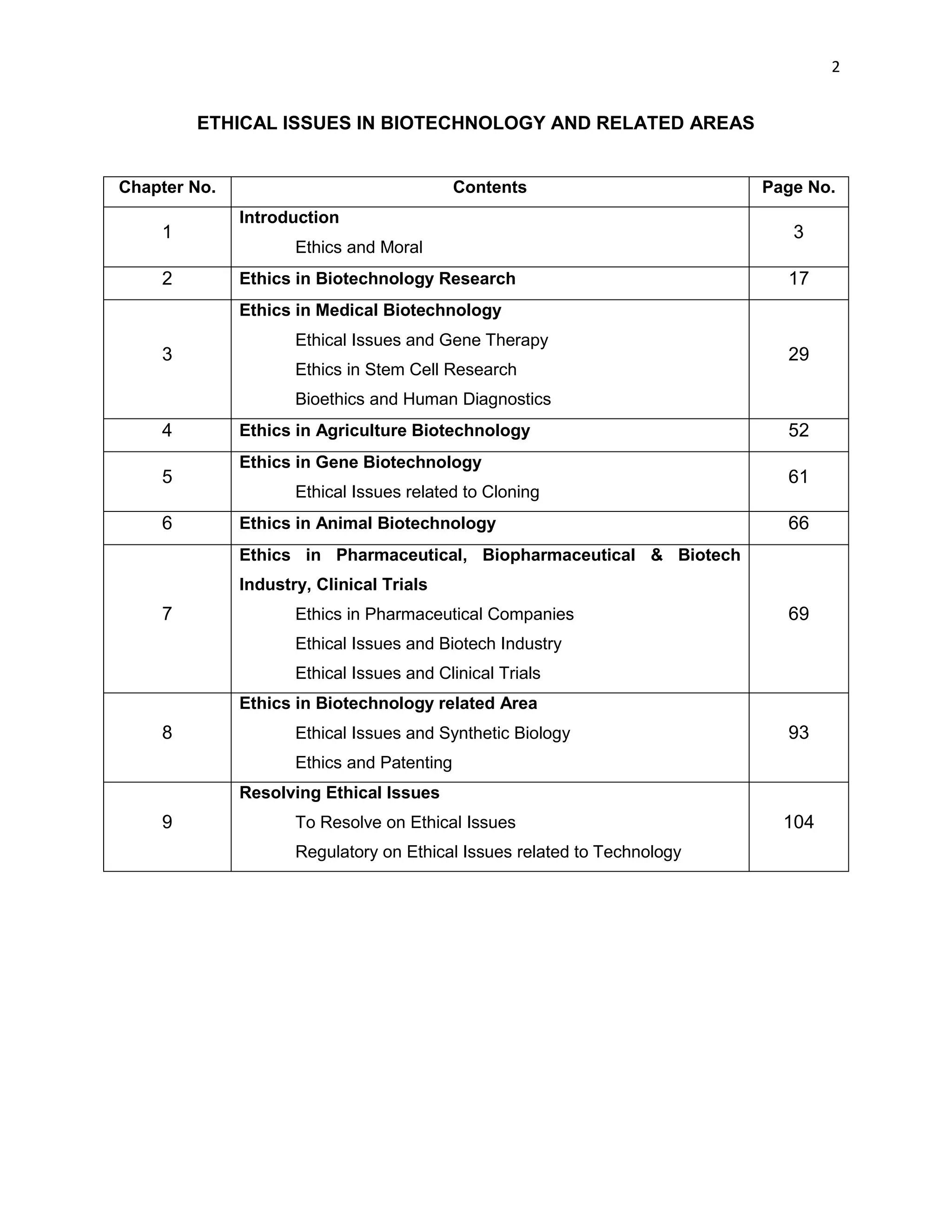
ETHICAL ISSUES IN BIOTECHNOLOGY AND RELATED AREAS 
Chapter No. 
Contents 
Page No. 
1 
Introduction 
Ethics and Moral 
3 
2 
Ethics in Biotechnology Research 
17 
3 
Ethics in Medical Biotechnology 
Ethical Issues and Gene Therapy 
Ethics in Stem Cell Research 
Bioethics and Human Diagnostics 
29 
4 
Ethics in Agriculture Biotechnology 
52 
5 
Ethics in Gene Biotechnology 
Ethical Issues related to Cloning 
61 
6 
Ethics in Animal Biotechnology 
66 
7 
Ethics in Pharmaceutical, Biopharmaceutical & Biotech Industry, Clinical Trials 
Ethics in Pharmaceutical Companies 
Ethical Issues and Biotech Industry 
Ethical Issues and Clinical Trials 
69 
8 
Ethics in Biotechnology related Area 
Ethical Issues and Synthetic Biology 
Ethics and Patenting 
93 
9 
Resolving Ethical Issues 
To Resolve on Ethical Issues 
Regulatory on Ethical Issues related to Technology 
104
3 
Chapter 1 
Ethics and Morals 
"As our nation invests in science and innovation and pursues advances in biomedical research and health care, it's imperative that we do so in a responsible manner." - President Barack Obama. 
Morality-refers to the concept of human ethics which pertains to matters of good and evil—also referred to as "right or wrong", used within three contexts: individual conscience; systems of principles and judgments—sometimes called moral values—shared within a cultural, religious, secular, humanist or philosophical community; and codes of behavior or conduct. Personal morality defines and distinguishes among right and wrong intentions, motivations or actions, as these have been learned, engendered, or otherwise developed within each individual. (http://en.wikipedia.org/wiki/Morality). 
Ethics-(from the Ancient Greek "ethikos", meaning "arising from habit"), a major branch of philosophy, is the study of value or quality. It covers the analysis and employment of concepts such as right, wrong, good, evil, and responsibility. It is divided into three primary areas: meta-ethics(the study of the concept of ethics), normative ethics(the study of how to determine ethical values), and applied ethics(the study of the use of ethical values). ( http://en.wikipedia.org/wiki/Ethics ) 
In classical Greek, the word ―ethics‖ entails the ―beliefs of the people‖ - the analyze of what is right and good in human conduct and the explanation of such claims. 
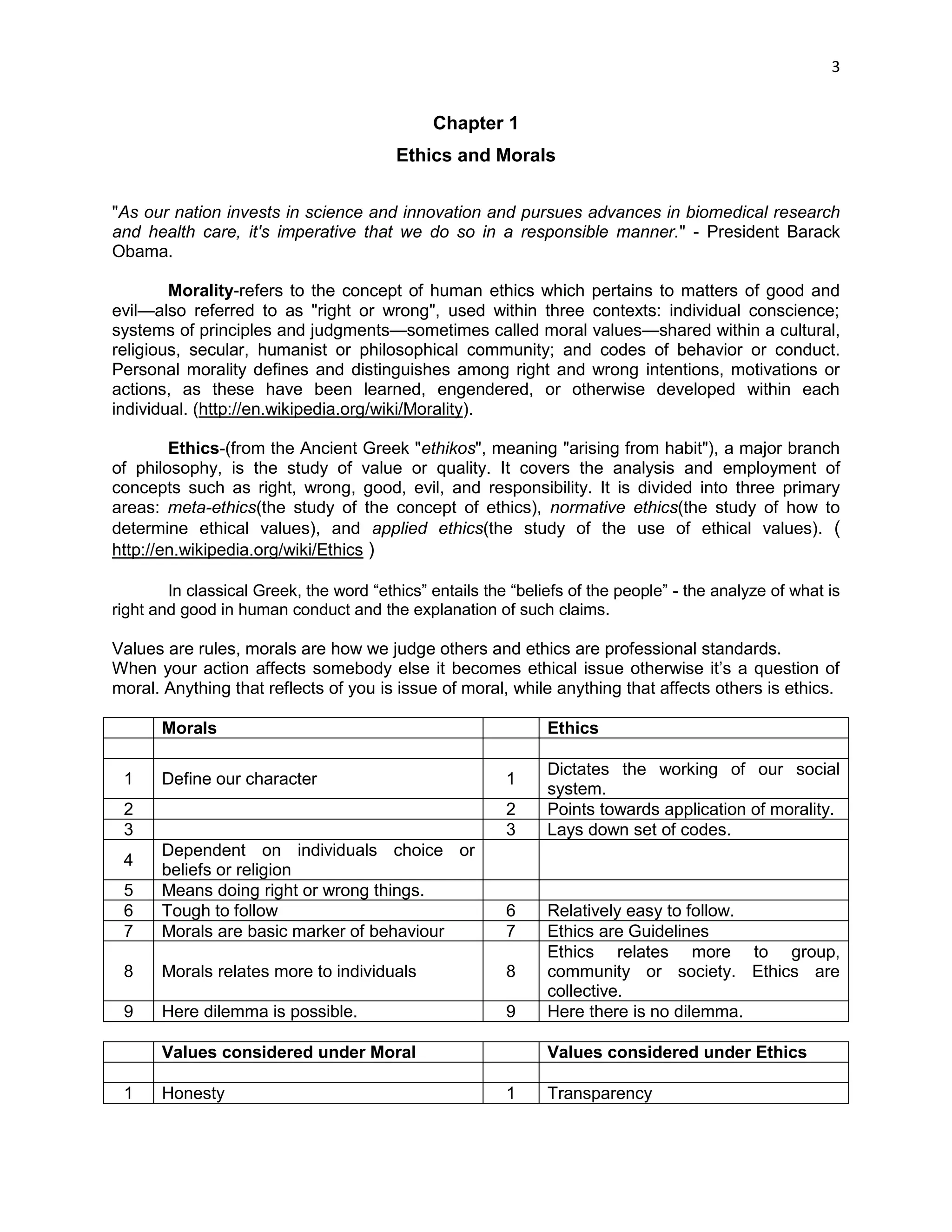
Values are rules, morals are how we judge others and ethics are professional standards. 
When your action affects somebody else it becomes ethical issue otherwise it‘s a question of moral. Anything that reflects of you is issue of moral, while anything that affects others is ethics. 
Morals 
Ethics 
1 
Define our character 
1 
Dictates the working of our social system. 
2 
2 
Points towards application of morality. 
3 
3 
Lays down set of codes. 
4 
Dependent on individuals choice or beliefs or religion 
5 
Means doing right or wrong things. 
6 
Tough to follow 
6 
Relatively easy to follow. 
7 
Morals are basic marker of behaviour 
7 
Ethics are Guidelines 
8 
Morals relates more to individuals 
8 
Ethics relates more to group, community or society. Ethics are collective. 
9 
Here dilemma is possible. 
9 
Here there is no dilemma. 
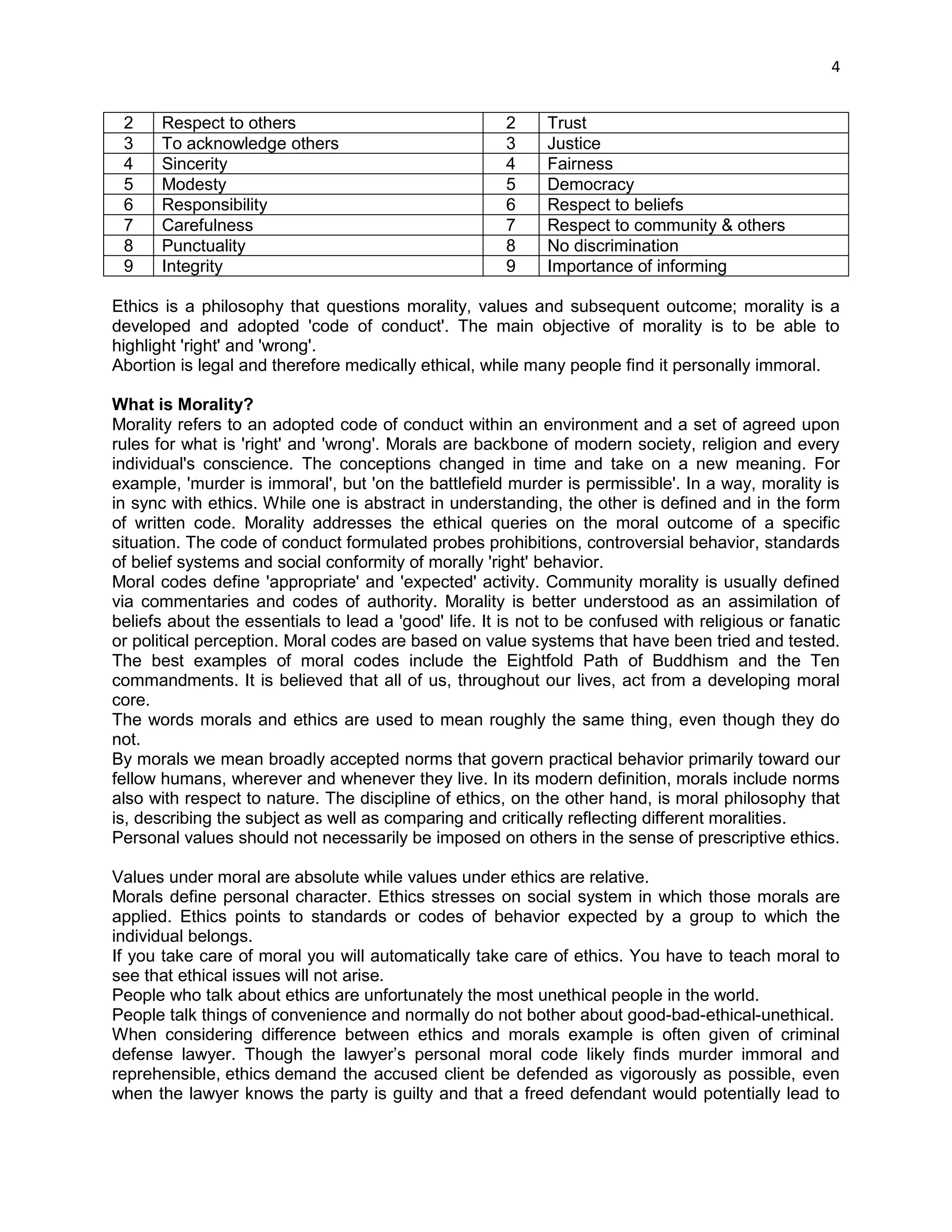
Values considered under Moral 
Values considered under Ethics 
1 
Honesty 
1 
Transparency
4 
2 
Respect to others 
2 
Trust 
3 
To acknowledge others 
3 
Justice 
4 
Sincerity 
4 
Fairness 
5 
Modesty 
5 
Democracy 
6 
Responsibility 
6 
Respect to beliefs 
7 
Carefulness 
7 
Respect to community & others 
8 
Punctuality 
8 
No discrimination 
9 
Integrity 
9 
Importance of informing 
Ethics is a philosophy that questions morality, values and subsequent outcome; morality is a developed and adopted 'code of conduct'. The main objective of morality is to be able to highlight 'right' and 'wrong'. 
Abortion is legal and therefore medically ethical, while many people find it personally immoral. 
What is Morality? 
Morality refers to an adopted code of conduct within an environment and a set of agreed upon rules for what is 'right' and 'wrong'. Morals are backbone of modern society, religion and every individual's conscience. The conceptions changed in time and take on a new meaning. For example, 'murder is immoral', but 'on the battlefield murder is permissible'. In a way, morality is in sync with ethics. While one is abstract in understanding, the other is defined and in the form of written code. Morality addresses the ethical queries on the moral outcome of a specific situation. The code of conduct formulated probes prohibitions, controversial behavior, standards of belief systems and social conformity of morally 'right' behavior. 
Moral codes define 'appropriate' and 'expected' activity. Community morality is usually defined via commentaries and codes of authority. Morality is better understood as an assimilation of beliefs about the essentials to lead a 'good' life. It is not to be confused with religious or fanatic or political perception. Moral codes are based on value systems that have been tried and tested. The best examples of moral codes include the Eightfold Path of Buddhism and the Ten commandments. It is believed that all of us, throughout our lives, act from a developing moral core. 
The words morals and ethics are used to mean roughly the same thing, even though they do not. 
By morals we mean broadly accepted norms that govern practical behavior primarily toward our fellow humans, wherever and whenever they live. In its modern definition, morals include norms also with respect to nature. The discipline of ethics, on the other hand, is moral philosophy that is, describing the subject as well as comparing and critically reflecting different moralities. 
Personal values should not necessarily be imposed on others in the sense of prescriptive ethics. 
Values under moral are absolute while values under ethics are relative. 
Morals define personal character. Ethics stresses on social system in which those morals are applied. Ethics points to standards or codes of behavior expected by a group to which the individual belongs. 
If you take care of moral you will automatically take care of ethics. You have to teach moral to see that ethical issues will not arise. 
People who talk about ethics are unfortunately the most unethical people in the world. 
People talk things of convenience and normally do not bother about good-bad-ethical-unethical. 
When considering difference between ethics and morals example is often given of criminal defense lawyer. Though the lawyer‘s personal moral code likely finds murder immoral and reprehensible, ethics demand the accused client be defended as vigorously as possible, even when the lawyer knows the party is guilty and that a freed defendant would potentially lead to
5 
more crime. Legal ethics must override personal morals for the greater good of upholding a justice system in which the accused are given a fair trial and the prosecution must prove guilt beyond a reasonable doubt. 
The words morals and ethics are used to mean roughly the same thing, even though they do not. 
Morals – broadly accepted norms that govern practical behavior primarily toward our fellow humans. In its modern definition, morals includes norms also with respect to nature. 
Ethics – Moral philosophy – that is, describing the subject as well as comparing and critically reflecting different moralities. In general, ‗ethics‘ is defined as the ideals, values or standards that people use to determine whether their actions are good or bad. It is what society uses to judge whether an issue or thing is acceptable and justifiable and determines responsibility and justice. It answers the question ―Is an action right or wrong?‖ On one hand, ethics is a set of universal norms that are documented through legal or professional codes of practice, religious texts, literature and philosophy. On the other hand, ethics are values defined by a person or groups that are personal, introspective, and hence, difficult to manage for public discussion. Given the range of cultural diversity, it is expected that people would react in different ways to certain issues and concerns. 
There is another story of a thief and police – There was an encounter between the two and both became critical and needed medical attention – surgery. Police was relatively less critical while thief was more critical. They were taken to the nearby private hospital. There was only one operation theatre. Delay with any one of them could be fatal. The question is whom the doctor should operate first? Operating police first is morally correct but ethically wrong. Operating the thief first is ethically correct but morally wrong (Justice demands this). 
What is morality is the weight of the public opinion. 
As a student you need to know – 
(1) The technology that will affect your future and the ethical issues surrounding it. 
(2) The business environment and the places where you are going to work and the ethical issues existing there. 
Ideas of ethics change with time, with society and with stage of advancement of that society. Many a times people talk different things as seller and different things as customer. 
Social ethics includes issues of equity, justice, fairness and democracy. 
The Core Ethical Values "are intended to provide guidance to our industry where no legal requirements exist or where industry wishes to go beyond any legal requirement." 
Technology-transcending risks mostly materialize because a gap opens between human scientific technical ability and human willingness to shoulder moral and political responsibility. 
When Technological changes are bringing so much change in our living style and activities can we expect that our ideas of ethics and moral of 18th, 19th, 20th century or anything before will fit into it? 
In the field of research we have to think while setting up the goals of research by asking ourselves – 
We can but must we? 
―If we can we inevitably will‖ 
Ethical Reasoning – What is and what ought to be. 
The Justice Approach – Treating equals equally and unequals unequally. 
The common Good – Creating set of conditions that are equally advantageous to all. 
Ethics is embedded in every aspect of our lives. 
Different ―definitions‖ of ethics are in use daily by the general public. (a) Ethics is adherence to the spirit and the letter of the law. People who claim that they ―have done nothing wrong‖ after they are caught in a legal but unsavory action often use this interpretation of ethics. (b) Ethics is
6 
adherence to a religious belief. (c) Ethics is adherence to ―community or cultural standards.‖ (d) Ethics is adherence to my ideas. In contrast, ethicists use definitions that are more complex and may contain elements of all these common notions about what is ethical and what is not. 
Ethics may be defined as a set of standards by which a particular group or community decides to regulate its behaviour – to distinguish what is legitimate or acceptable in pursuit of their aims from what is not. 
Ethics can be defined as: ―a method, procedure, or perspective, or norms of conduct that distinguishes between acceptable and unacceptable, right or wrong, behavior. 
More technically, ethics can also refer to a particular branch of philosophy which tries to analyze and clarify the arguments that are used when moral questions are discussed and to probe the justifications that are offered for moral claims. So ethics in this sense puts our moral beliefs under the spotlight for scrutiny. 
Ethics are integral part of social laws and politics. Ethics is best option choice when two choices are available. 
People may have moral concern about modern biotechnology but that does not mean that they have thought about ethical issues. 
Moral principles differ among cultures, and, within cultures, among individuals. Every individual has particular moral ideas about what is just and what is not. Moral judgment of individuals are not arbitrary but have its own reasoning or strong footing. In case of biotechnology people‘s major concern is to know how far we ought to go in the research in biotechnology since it involves intervention of basic life structures. 
In general, ‗ethics‘ is defined as the ideals, values or standards that people use to determine whether their actions are good or bad. It is what society uses to judge whether an issue or thing is acceptable and justifiable and determines responsibility and justice (Thompson, 2001). It answers the question ―Is an action right or wrong?‖ On one hand, ethics is a set of universal norms that are documented through legal or professional codes of practice, religious texts, literature and philosophy. On the other hand, ethics are values defined by a person or groups that are personal, introspective, and hence, difficult to manage for public discussion (Thompson, 2001). Given the range of cultural diversity, it is expected that people would react in different ways to certain issues and concerns. 
Types of Ethics 
There are several approaches towards ethics, which can broadly be divided into – 
(I) Normative Ethics - In the case of normative ethics, the notion behind what declares an action as 'right' or 'wrong' is derived and defined. 
(II) Non-normative Ethics - The non-normative approaches describe and analyze morality without taking moral positions. 
(III) Descriptive Ethics - One of the non-normative approaches is descriptive ethics, which is the factual description and explanation of moral behaviour and beliefs in a society, especially employed by anthropologists, sociologists and historians. This approach is reflected in the studies on consumer acceptance and public attitudes towards biotechnology. Descriptive ethics examines a situation as a choice made in
7 
the presence of the moral agents relevant. Here issues like preferred concepts of etiquette and aesthetics are considered. 
(IV) Metaethics - In meta-ethics, judgmental properties within a situation are investigated. Issues relating to the sensitivity of ontology, semantics and epistemology are explored in this stream of ethics. Metaethics examines the structure or logic of moral reasoning, including the justifications and inferences. This approach critically analyses whether positions in bioethical debates are in coherence with the principles on which they are said to be based and consistent with the way in which other comparable ethical dilemmas are dealt with. 
(V) Prescriptive ethics is a normative approach. Normative approaches in ethics involve taking moral positions. Prescriptive ethics attempts to formulate and defend basic principles and virtues governing moral life. In its applied form, prescriptive ethics are reflected in ethical regulation of modern biotechnology. 
(VI) Relational ethics – It relates to personal interactions and responsibilities. 
(VII) Applied ethics - This investigates the success or failure of the application of ethical theory to everyday situations. 
Moral concerns are felt about what it is right or wrong to do, while ethical concerns are about the reasons and justifications for judging those things to be right or wrong. 
Similar to Universal Declaration of Human Rights, the International Bioethics Committee of UNESCO is now developing an International Declaration on the Humane Genome and Human Rights, in order to preserve "the dignity of individuals and their rights and freedoms" in the context of the progress of molecular biology and genetics. The four fundamental principles of bioethics include: 1. Beneficence which refers to the practice of good deeds; 2. Non maleficence which emphasizes an obligation to not inflict harm; 3. Autonomy which recognizes the human capacity for self-determination and independency in decision-making; and 4. Justice which is based on the conception of fair treatment and equity through reasonable resolution of disputes. 
Does ethical debate have any practical importance in the real world? 
Questions and problems that are scientific, commercial, agricultural, medical should be left to the expert practitioners and be not discussed by others. 
Many people feel that science cannot be done in moral and ethical vacuum in a society that is healthy and civilized. A technology exists does not mean that it has to be employed. Legal and regulatory framework of society is based on the ethical base of that society. 
Worries are being increasingly expressed that the potential benefits of modern biotechnology may be lost if the new processes and products fail to gain ―consumer acceptance‖ because of moral concerns. 
Every technology has affected people in big way – be it machines, television, nuclear energy, computers or biotechnology. More powerful the technology and it will have more concerns with respect to morals and ethics, and have many environmental and health related questions. That is one of the reasons why there are big discussions with respect to developments of biotechnology. 
There are people who oppose genetic engineering for the fundamental reason that human beings should not do what they perceive as playing God. 
The argument on this can be - If God created humans as intelligent creatures, it should be compatible with God‘s intentions that they use their intelligence to improve living conditions. The ambivalence of technological progress and the fact that a technological innovation can be used for good as well as for ill is neither new nor confined to genetic engineering and biotechnology.
8 
So whether you see biotechnology as threat or blessing depends upon where you position the human being in the biosphere – as at the crown in form of intelligent species or brother and sister of other plants, animals. 
Bioethics 
The term bioethics refers to the branch of ethics which studies moral values in the field of medicine and biology. While some consider it as part of development process of science others have strong arguments against it. Right thing will be to identify the severity of these issues and take some steps to ensure that they don't affect the basic rights of the various life forms on the planet. 
The list of issues discussed under bioethics are – Abortion, animal rights, artificial insemination, biopiracy, body modifications, brain-computer interface, cloning, contraceptives, birth control, cryonics, eugenics, gene therapy, genetically modified food, nanomedicine, organ transplant, sperm donation, spiritual drug use, surrogacy, vaccination etc. 
Bioethics considers issues affecting all living organisms and the environment, from individual creature to the level of the biosphere in complexity. Bioethics has both descriptive nature as well as prescriptive approach, which means that it describes how we make decisions and also suggests a process to decide what are good and bad choices. Bioethics is not jast a word but it‘s a concept. 
Different people think differently on the issues of biotechnology. Their thinking and their reasoning has come out in various surveys. Such surveys throw light on the public acceptance. Recent surveys are not mere set of questions and are strategic. Such surveys are conducted in Australia, New Zealand, UK, Netherlands, India, Philippines, Hong Kong, Thailand, Singapore and Japan. These countries have different social, political and religion background and influences. Most of the surveys are done on agricultural biotechnology and medical genetics. In these surveys issues such as eugenic fears or environmental risk, are not the major concerns voiced by people in open questions. The more common concerns are interference with nature or general fear of a less concrete nature. Also the survey found that many people perceive both benefit and risk simultaneously, they are attempting to balance these; and also educated people show as much concern, in fact biology teachers considered there was more risk from genetic engineering than the ordinary public. 
Using one of the many methodological approaches for reaching an ethical decision, or at least a moral determination, we can ask the following questions: 
 What is the perception of the problem? 
 How do we analyze the situation? 
 What are the practical options? 
 What norms, qualities, and perspectives should we use? 
 Can we verify a binding applicability of our judgment or norms? 
 What is the result of our evaluation? 
Below are given the basic principles used for assessing the emerging technologies used by President’s commission with reference to synthetic biology. 
Basic Ethical Principles for Assessing Emerging Technologies 
To reach its recommendations, the Commission identified five ethical principles relevant to considering the social implications of emerging technologies: 
(1) Public beneficence 
The principles are intended to illuminate and guide public policy choices to ensure that new technologies, including synthetic biology, can be developed in an ethically responsible
9 
manner. The ideal of public beneficence is to act to maximize public benefits and minimize public harm. This principle encompasses the duty of a society and its government to promote individual activities and institutional practices, including scientific and biomedical research, that have great potential to improve the public‘s well-being. Public beneficence requires that when seeking the benefits of synthetic biology, the public and its representatives be vigilant about risks and harms, standing ready to revise policies that pursue potential benefits with insufficient caution. 
(2) Responsible stewardship 
The principle of responsible stewardship reflects a shared obligation among members of the domestic and global communities to act in ways that demonstrate concern for those who are not in a position to represent themselves (e.g., children and future generations) and for the environment in which future generations will flourish or suffer. Responsible stewardship recognizes the importance of citizens and their representatives thinking and acting collectively for the betterment of all. Importantly, it calls for prudent vigilance; establishing processes for assessing likely benefits along with assessing safety and security risks both before and after projects are undertaken. A responsible process will continue to assess safety and security as technologies develop and diffuse into public and private sectors. It will also include mechanisms for limiting their use when necessary. 
(3) Intellectual freedom and responsibility 
Democracies depend on intellectual freedom coupled with the responsibility of individuals and institutions to use their creative potential in morally accountable ways. Sustained and dedicated creative intellectual exploration begets much of our scientific and technological progress. While many emerging technologies raise ―dual use‖ concerns—when new technologies intended for good may be used to cause harm—these risks alone are generally insufficient to justify limits on intellectual freedom. As a corollary to the principle of intellectual freedom and responsibility, the Commission endorses a principle of regulatory parsimony, recommending only as much oversight as is truly necessary to ensure justice, fairness, security, and safety while pursuing the public good. This is particularly important in emerging technologies, which by their very definition are still in formation and are not well suited for sharply specified limitations. While clear guidelines to protect biosecurity and biosafety are imperative, undue restriction may not only inhibit the distribution of new benefits, but it also may be counterproductive to security and safety by preventing researchers from developing effective safeguards. 
(4) Democratic deliberation 
The principle of democratic deliberation reflects an approach to collaborative decision making that embraces respectful debate of opposing views and active participation by citizens. It calls for individuals and their representatives to work toward agreement whenever possible and to maintain mutual respect when it is not. Public discussion and debate with open interchange among all stakeholders can promote the perceived legitimacy of outcomes, even if those outcomes are unlikely to satisfy all interested parties. An inclusive process of deliberation, informed by relevant facts and sensitive to ethical concerns, promotes an atmosphere for debate and decision making that looks for common ground wherever possible and seeks to cultivate mutual respect where irreconcilable differences remain. It encourages participants to adopt a societal perspective over individual interests. 
(5) Justice and fairness
10 
The principle of justice and fairness relates to the distribution of benefits and burdens across society. Biotechnology and emerging technologies such as synthetic biology, for good or ill, affect all persons. Emerging technologies like synthetic biology will have global impacts. For this reason, every nation has a responsibility to champion fair and just systems to promote wide availability of information and fairly distribute the burdens and benefits of new technologies. 
Recommendations 
With these guiding principles in mind, the Commission considered the array of public policy issues surrounding the emerging science of synthetic biology and makes the following recommendations. In the cases of recommendations 1, 3, 5, 9, 11, 12, and 17, the Commission recommends ongoing review by the government, in consultation with the relevant scientific, academic, international, and public communities, with initial action completed within 18 months and made public. Some of these actions could easily be completed sooner, and the government is encouraged to do so and make its progress public. 
Promoting Public Beneficence 
Under the principle of public beneficence, the Commission recommends that the government review and make public findings regarding the scope of its research funding, especially for risk assessment and ethical and social issues raised by synthetic biology. This will promote public engagement and ensure needed transparency regarding federal efforts in the field of synthetic biology. 
Recommendation 1: Public Funding Review and Disclosure through a central body such as the Executive Office of the President, the federal government should undertake a coordinated evaluation of current public funding for synthetic biology activities, including funding for research on techniques for risk assessment and risk reduction, and for the study of ethical and social issues raised by synthetic biology. This review should be completed within 18 months and the results made public. 
Most potential products of synthetic biology are in very early stages of development. Therefore, basic research is critical to further expansion of this science and its effective translation into useful products. Necessary funding decisions should be made with the goal of advancing the public good, whether these decisions support synthetic biology research or other fields. The Commission does not offer an opinion on the relative merits of particular research directions, but recommends that such decisions receive ongoing evaluation as to the state of the science and its potential applications. 
Recommendation 2: Support for Promising Research Advancing the public good should be the primary determinant of relative public investment in synthetic biology versus other scientific activities. The National Institutes of Health, the Department of Energy, and other federal agencies should continue to evaluate research proposals through peer-review mechanisms and other deliberative processes created to ensure that the most promising scientific research is conducted on behalf of the public. Information sharing is a critical mechanism for promoting scientific progress and innovation. The principle of public beneficence requires researchers, inventors, patent holders, and others to work together to develop creative strategies to maximize opportunities for innovation. The government should consider best practices and other policy guidance, if needed, to ensure that access to basic research results and tasks is not unduly limited. 
Recommendation 3: Innovation Through Sharing Synthetic biology is at a very early stage of development, and innovation should be encouraged. The Executive Office of the President, as part of the coordinated approach urged in Recommendation 4, should lead an effort to determine whether current research licensing and sharing practices are sufficient to ensure that basic research results involving synthetic biology are available to promote innovation, and, if not, whether additional policies or best practices are needed. This review should be undertaken
11 
with input from the National Institutes of Health, other agencies funding synthetic biology research, such as the Department of Energy and the National Aeronautics and Space Administration, the U.S. Patent and Trademark Office, industry, academia, and public civil society groups. The review should be completed within 18 months and the results made public. 
Promoting Responsible Stewardship 
The Commission endorses neither a moratorium on synthetic biology until all risks are identified and mitigated, nor unfettered freedom for scientific exploration. Instead, the Commission believes that the field of synthetic biology can proceed responsibly by embracing a middle ground—an ongoing process of prudent vigilance that carefully monitors, identifies, and mitigates potential and realized harms over time. Responsible stewardship requires clarity, coordination, and accountability across the government. While new agencies, offices, or authorities are not necessary at this time, the Executive Office of the President should lead an interagency process to identify and clarify, if needed, existing oversight authorities and ensure that the government is informed on an ongoing basis about developments, risks, and opportunities as this field grows. This process must be undertaken by an office with sufficient authority to bring together all parts of the government with a stake in synthetic biology and be sufficiently authoritative to effectively engage or oversee engagement with foreign governments. 
Recommendation 4: Coordinated Approach to Synthetic Biology The Commission sees no need at this time to create additional agencies or oversight bodies focused specifically on synthetic biology. Rather, the Commission urges the Executive Office of the President, in consultation with relevant federal agencies, to develop a clear, defined, and coordinated approach to synthetic biology research and development across the government. A mechanism or body should be identified to: (1) leverage existing resources by providing ongoing and coordinated review of developments in synthetic biology, (2) ensure that regulatory requirements are consistent and non-contradictory, and (3) periodically and on a timely basis inform the public of its findings. Additional activities for this coordinating body or process are described in other recommendations. 
Because synthetic biology poses some unusual potential risks, as ―amateur‖ or ―do-it-yourself‖ (DIY) scientists and others outside of traditional research environments explore the field, these risks must be identified and anticipated, as they are for other emerging technologies, with systems and policies to assess and respond to them while supporting work toward potential benefits. 
Recommendation 5: Risk Assessment Review and Field Release Gap Analysis Because of the difficulty of risk analysis in the face of uncertainty—particularly for low-probability, potentially high-impact events in an emerging field—ongoing assessments will be needed as the field progresses. Regulatory processes should be evaluated and updated, as needed, to ensure that regulators have adequate information. As part of the coordinated approach urged in Recommendation 4, the Executive Office of the President should convene an interagency process to discuss risk assessment activities, including reasons for differences and strategies for greater harmonization across the government. It should also identify any gaps in current risk assessment practices related to field release of synthetic organisms. These reviews should be completed within 18 months and the results made public. Coordination and careful risk analysis are essential steps for responsible stewardship, but they are not sufficient. There are several additional approaches, which are known today and continue to evolve as our abilities in this field grow, to limit uncertain risks in synthetic biology. Technology can be harnessed to build in safeguards. A number of safety features can be incorporated into synthetic organisms to control their spread and life span. Surveillance or containment of synthetic organisms is a concrete way 
to embrace responsible stewardship. 
Recommendation 6: Monitoring, Containment, and Control At this early stage of development, the potential for harm through the inadvertent environmental release of organisms or other bioactive materials produced by synthetic biology requires safeguards and monitoring. As part
12 
of the coordinated approach urged in Recommendation 4, the Executive Office of the President should direct an ongoing review of the ability of synthetic organisms to multiply in the natural environment and identify, as needed, reliable containment and control mechanisms. For example, ―suicide genes‖ or other types of self-destruction triggers could be considered in order to place a limit on their life spans. Alternatively, engineered organisms could be made to depend on nutritional components absent outside the laboratory, such as novel amino acids, and thereby controlled in the event of release. 
The timing of deliberate release of synthesized organisms into the environment and the need to analyze risks prior to release raises special concern. We must proceed carefully, particularly when the probability or magnitude of risks are high or highly uncertain, because biological organisms may evolve or change after release. For any field release, there must be adequate consideration of risk. 
Recommendation 7: Risk Assessment Prior to Field Release Reasonable risk assessment should be carried out, under the National Environmental Policy Act or other applicable law, prior to field release of research organisms or commercial products involving synthetic biology technology. 
This assessment should include, as appropriate, plans for staging introduction or release from contained laboratory settings. Exceptions in limited cases could be considered, for example, in emergency circumstances or following a finding of substantial equivalence to approved products. The gap analysis described in Recommendation 5 should determine whether field release without any risk assessment is permissible and, if so, when. 
Synthetic biology is an international enterprise. Oversight and regulatory mechanisms should adopt an analogous approach, so that the United States is involved in regular discussions with other national and transnational organizations so they may seek coordination and consistency when possible. 
Recommendation 8: International Coordination and Dialogue Recognizing that international coordination is essential for safety and security, the government should act to ensure ongoing dialogue about emerging technologies such as synthetic biology. As part of the coordinated approach urged in Recommendation 4, the Executive Office of the President, through the Department of State and other relevant agencies such as the Department of Health and Human Services and the Department of Homeland Security, should continue and expand efforts to collaborate with international governments, the World Health Organization, and other appropriate parties, including international bioethics organizations, to promote ongoing dialogue about emerging technologies such as synthetic biology as the field progresses. 
Responsible conduct of synthetic biology research, like all areas of biological research, rests heavily on the behavior of individual scientists. Creating a culture of responsibility in the synthetic biology community could do more to promote responsible stewardship in synthetic biology than any other single strategy. There are actors in the world of synthetic biology, namely engineers, chemists, materials scientists, computer modelers, and others, who practice outside of conventional biological or medical research settings. These groups may not be familiar with the standards for ethics and responsible stewardship that are commonplace for those working in biomedical research. This poses a new challenge regarding the need to educate and inform synthetic biologists in all communities about their responsibilities and obligations, particularly 
with regard to biosafety and biosecurity. 
Recommendation 9: Ethics Education Because synthetic biology and related research cross traditional disciplinary boundaries, ethics education similar or superior to the training required today in the medical and clinical research communities should be developed and required for all researchers and student-investigators outside the medical setting, including in engineering and materials science. As part of the coordinated approach urged in Recommendation 4, the Executive Office of the President, in consultation with the National Academy of Sciences, the National Academy of Engineering, the scientific community, and the public, should convene a
13 
panel to consider appropriate and meaningful training requirements and models. This review should be completed within 18 months and the results made public. 
Additionally flowing from the principle of responsible stewardship, the Commission observed that careful and deliberate attention should be paid to discussions of potential moral objections as the field advances. Such moral objections include concerns that synthetic biology may conflict with essential conceptions of human agency and life; that its overall impact may be harmful to biodiversity, ecosystems, or food and energy supplies; and that it may fail to respect the proper relationship between humans and nature. The Commission devoted particular time and attention to discussing these possible moral objections during its deliberations. It heard relatively few objections from religious or secular ethicists concerning the present status of the field. Although the field currently is capable of significant but limited technical achievements, potential developments might raise further moral objections—for example, applications relying on the synthesis of genomes for higher order or complex species. Current objections to synthetic biology on moral grounds are often based on concerns regarding activities that the field is currently incapable of carrying out. However, continued evaluation and efforts to reach and maintain consensus will be needed as this field develops. 
Recommendation 10: Ongoing Evaluation of Objections Discussions of moral objections to synthetic biology should be revisited periodically as research in the field advances in novel directions. Reassessment of concerns regarding the implications of synthetic biology for humans, other species, nature, and the environment should track the ongoing development of the field. An iterative, deliberative process, as described in Recommendation 14, allows for the careful consideration of moral objections to synthetic biology, particularly if fundamental changes occur in the capabilities of this science and its applications. 
Promoting Intellectual Freedom and Responsibility 
The principle of intellectual freedom and responsibility asserts that restrictions on research, whether by self-regulation by scientists or by government intervention, should limit the free pursuit of knowledge only when the perceived risk is too great to proceed without limit. A moratorium at this time on synthetic biology research would inappropriately limit intellectual freedom. Instead, the scientific community—in academia, government and the private sector— should continue to work together to evaluate and respond to known and potential risks of synthetic biology as this science evolves. This effort may require the government to expand current oversight or engagement activities with non-institutional researchers. National Institutes of Health or the Department of Energy, for example, could be charged to sponsor education programs and workshops that bring together these groups. They could fund training grants or related programs to promote a culture of responsibility among this community. To exercise the appropriate level of oversight, the government will need to monitor the growth and capacity of researchers outside of institutional settings. 
Recommendation 11: Fostering Responsibility and Accountability The government should support a continued culture of individual and corporate responsibility and self-regulation by the research community, including institutional monitoring, enhanced watchfulness, and application of the National Institutes of Health Guidelines for Recombinant DNA Research. As part of the coordinated approach urged in Recommendation 4, the Executive Office of the President should evaluate, and re-evaluate periodically, the effectiveness of current research oversight mechanisms and determine what, if any, additional steps should be taken to foster accountability at the institutional level without unduly limiting intellectual freedom. Academic 
and private institutions, the public, the National Institutes of Health, and other federal funders of synthetic biology research should be engaged in this process. An initial assessment should be completed within 18 months and the results made public. 
The norms of safe and responsible conduct that have evolved over time for many researchers in institutional settings may not be understood or followed by those new to the field or outside of these settings. It is important to note that presently there appears to be no serious risk of
14 
completely novel organisms being constructed in non-institutional settings including in the DIY community. Scrutiny is required to ensure that DIY scientists have an adequate understanding of necessary constraints to protect public safety and security, but at present the Commission sees no need to impose unique limits on this group. 
Recommendation 12: Periodic Assessment of Security and Safety Risks Risks to security and safety can vary depending on the setting in which research occurs. Activities in institutional settings, may, though certainly do not always, pose lower risks than those in non-institutional settings. At this time, the risks posed by synthetic biology activities in both settings appear to be appropriately managed. As the field progresses, however, the government should continue to assess specific security and safety risks of synthetic biology research activities in both institutional and non-institutional settings including, but not limited to, the ―do-it-yourself‖ community. As part of the coordinated approach urged in Recommendation 4, the Executive Office of the President, working with the Department of Homeland Security, the Federal Bureau of Investigation and others, should undertake and periodically update this assessment. An initial review should be completed within 18 months and the results made public to the extent permitted by law. 
Certain risks—generally involving national security—often warrant additional protections. Completely free exchange of data and materials might endanger public safety, but unilateral action to limit exchange could damage American research efforts in synthetic biology if U.S. scientists and students are excluded from full collaboration with the international community. Several recent advisory groups have recommended ongoing discussions among research universities, industry, and government on this topic. The Commission agrees that scientists should be actively engaged in these debates. 
Recommendation 13: Oversight Controls If the reviews called for in Recommendation 12 identify significant unmanaged security or safety concerns, the government should consider making compliance with certain oversight or reporting measures mandatory for all researchers, including those in both institutional and non-institutional settings, regardless of funding sources. It may also consider revising the Department of Commerce‘s export controls. Any such change should be undertaken only after consultation with the scientific, academic, and research communities and relevant science and regulatory agencies such as the National Institutes of Health, the Department of Homeland Security, and the Environmental Protection Agency. Export controls should not unduly restrain the free exchange of information and materials among members of the international scientific community. 
Promoting Democratic Deliberation 
Through democratic deliberation, questions about synthetic biology can be explored and evaluated on an ongoing basis in a manner that welcomes the respectful exchange of opposing views. This principle yields several opportunities for government and non-government actors alike to work together to ensure that synthetic biology advances in ways that respect divergent views and that avoid some of the misunderstanding and confusion, which at times, have hampered other scientific endeavors. To enhance democratic deliberation and thereby ensure that the progress in synthetic biology is widely understood and policy choices are thoughtfully considered, the Commission makes the following recommendations. 
Recommendation 14: Scientific, Religious, and Civic Engagement Scientists, policy makers, and religious, secular, and civil society groups are encouraged to maintain an ongoing exchange regarding their views on synthetic biology and related emerging technologies, sharing their perspectives with the public and with policy makers. Scientists and policy makers in turn should respectfully take into account all perspectives relevant to synthetic biology. 
Recommendation 15: Information Accuracy When discussing synthetic biology, individuals and deliberative forums should strive to employ clear and accurate language. The use of sensationalist buzzwords and phrases such as ―creating life‖ or ―playing God‖ may initially increase attention to the underlying science and its implications for society, but ultimately such
15 
words impede ongoing understanding of both the scientific and ethical issues at the core of public debates on these topics. To further promote public education and discourse, a mechanism should be created, ideally overseen by a private organization, to fact-check the variety of claims relevant to advances in synthetic biology. 
This publicly accessible fact-check mechanism is among the most concrete ways by which public perception and acceptance of emerging technologies could be improved. Education also plays a key role in building public support for otherwise unfamiliar technologies. In light of our Nation‘s dependence on socially responsible scientific innovation for economic progress and individual well-being, the urgency of expanding effective science and ethics education cannot be exaggerated. Dialogue among individuals and public, private, and community groups demonstrates that science and its oversight do not belong exclusively to experts, highly trained professionals, or government officials. 
Science is a shared resource, affecting and belonging to all citizens. 
Recommendation 16: Public Education Educational activities related to synthetic biology should be expanded and directed to diverse populations of students at all levels, civil society organizations, communities, and other groups. These activities are most effective when encouraged and supported by various sources, not only government, but also private foundations and grassroots scientific and civic organizations. As part of the coordinated approach urged in Recommendation 4, the Executive Office of the President, with input from the scientific community, the public, and relevant private organizations, should identify and widely disseminate strategies to promote overall scientific and ethical literacy, particularly as related to synthetic biology, among all age groups. 
Promoting Justice and Fairness 
The principle of justice and fairness, at this very early stage of synthetic biology, yields two general recommendations that can be applied to both this technology and other emerging technologies. It directs those in government to consider rules for distribution of risks and benefits in research, and it directs those both in and outside of government to consider processes for just distribution of benefits and risks. 
Recommendation 17: Risks in Research Risks in research should not be unfairly or unnecessarily borne by certain individuals, subgroups, or populations. As part of the coordinated approach urged in Recommendation 4, the Executive Office of the President should 
lead an interagency evaluation of current requirements and alternative models to identify mechanisms that ensure that the risks of research in synthetic biology, including for human subjects and other affected parties, are not unfairly or unnecessarily distributed. Relevant scientific, academic, and research communities, including those in the private sector, should be consulted. This review should be completed within 18 months and the results made public. 
Recommendation 18: Risks and Benefits in Commercial Production and Distribution Risks to communities and the environment should not be unfairly distributed. Manufacturers and others seeking to use synthetic biology for commercial activities should ensure that risks and potential benefits to communities and the environment are assessed and managed so that the most serious risks, including long-term impacts, are not unfairly or unnecessarily borne by certain individuals, subgroups, or populations. These efforts should also aim to ensure that the important advances that may result from this research reach those individuals and populations who could most benefit from them. As part of the coordinated approach urged in Recommendation 4, the Executive Office of the President should evaluate current statutory mandates or regulatory requirements for distribution of risks and benefits and consider developing guidance materials and voluntary recommendations to assist manufacturers as appropriate. 
( Ref. NEW DIRECTIONS - The Ethics of Synthetic Biology and Emerging Technologies, Presidential Commission for the Study of Bioethical Issues Dec. 2010, Washington D. C. www.bioethics.gov )
16 
Ethical Concerns 
Ethics is a narrower concept than morality, and it can be used in several different, though related, senses. The most general of these: 
―...suggests a set of standards by which a particular group or community decides to regulate its behaviour – to distinguish what is legitimate or acceptable in pursuit of their aims from what is not. Hence we talk of ‗business ethics‘ or ‗medical ethics.‘‖ 
More technically, ethics can also refer to a particular branch of philosophy which tries to analyse and clarify the arguments that are used when moral questions are discussed and to probe the justifications that are offered for moral claims. So ethics in this sense puts our moral beliefs under the spotlight for scrutiny. 
Idea of what is morally correct differs between different individuals, different cultures and in different periods of history. 
To call something a moral concern, then, does not necessarily mean that it is of much ethical 
significance. A number of surveys have shown that, if asked, people will express moral concern about modern biotechnology, but this does not tell us whether they have done any ethical thinking about the issues. According to this suggested distinction, then, moral concerns are felt about what it is right or wrong to do, while ethical concerns are about the reasons and justifications for judging those things to be right or wrong. 
 No new scientific or technological development can claim immunity against ethical scrutiny. 
 Science cannot be pursued in complete moral and ethical vacuum in civilized society. 
 In fact legal and regulatory system should be based upon ethical basis. 
 Moral and ethical concerns are of considerable importance in influencing ‗consumer acceptance‘ of science and technology. 
Basic categories of moral or ethical concerns regarding modern biotechnology fall into two classes: intrinsic and extrinsic (Comstock 2000; Hamid 2000). 
Extrinsic objection refers to the concerns regarding the application of the technologies such as the possible risks of different application of biotechnology, consumer ‘s right and patenting issues. All these issues need to be addressed as they have far-reaching consequences on the safety of human, environment and society.
17 
Chapter 2 
Ethics in Biotechnology Research 
Research ethics Research ethics can be described in terms of ethics of the topics and findings (morality) and secondly as ethics of method and process (integrity). Institutions that practice research have adopted professional codes relating to research ethics that all include principles of honesty, objectivity, integrity, confidentiality, carefulness, openness, competence, and respect for intellectual property, responsible publication, responsible mentoring, and respect for colleagues, social responsibility, non-discrimination, legality and animal care. Objectivity in research gives researchers trustworthiness. This applies to both the a priori tasks of setting up the research and gathering the data and in the posteriori tasks of interpreting and publishing the results. The socialist Robert Merton published four norms of science in 1973 that are widely shared by scientists and non-scientists alike. These norms are:  Universalism that stipulates that scientific accomplishments must be judged by impersonal criteria;  Communism (as in communalism) that requires that scientific information is shared publicly;  Disinterestedness that cautions researchers to proceed objectively; and  Organized skepticism that requires that new findings are scrutinized through peer review, replication, and the testing of rival hypotheses. It is of growing concern how often research integrity is currently being challenged, and how common ―unprofessional‖ behaviour seems to be in research today. Research misconduct involves (i) fabrication, (ii) falsification, (iii) plagiarism and (iv) misappropriation. Researchers knowingly or intentionally ignore some of the most fundamental rules of research. Experimental designs and analyses are biased, results are reported inaccurately or incompletely or are fabricated, and improper credit is given to colleagues. Institutions take allegations of research misconduct seriously and have formal procedures to investigate such allegations. Potential misconduct is regarded with seriousness and requires in-depth investigation. Decisions are taken concerning the presence of misconduct and its severity, and appropriate corrective actions are taken, if needed. It is expected that both the person that reports possible misconduct, the whistleblower, and the person suspected of misconduct, the responder, are treated with "fairness and respect". In research that involves animals, adherence to a code of practice that ensures the ethical and humane care and use of animals used for scientific purposes is imperative. It is generally accepted in the scientific community that when animals are used, the principles of replacement, reduction and refinement (3Rs) should be taken into account:  Replacement requires that wherever possible, techniques that totally or partially replace the use of animals for scientific purposes must be sought;  Reduction requires that research projects must use no more than the minimum number of animals necessary to ensure scientific and statistical validity and should not be implemented at the expense of greater suffering of individual animals. The use of animals must not be repeated unless essential for the purpose or design of the project; and  Refinement requires that animals must be suitable for the scientific purpose and that their welfare should be of primary consideration in the provision of their care. Projects should be designed to avoid both pain and distress in animals. If this is not possible, pain or distress must be minimized.
18 
Ethics in Biotechnology 
People are able to give answer to the question as to whether computers and Information Technology, mobile phones, solar energy, space research, nuclear energy will cause benefits or harm or have no effects. But when asked about nanotechnology they have ignorance of it. And when asked about impact of biotechnology all seem to have awareness and education in all the countries and can balance between risks and benefits. That shows the ―Bioethical Maturity‖ of the society. ―Do not know‖ answer was given by 22% and 42% people for impact of Biotechnology and Nanotechnology in 2005 while 12% people clearly said that biotechnology will deteriorate things. 
Ethical issues, public debate, media coverage and public policy decisions played important role in development of biotechnology. 
Respect for biodiversity was considered as bioethical principle and was felt important by proponents as well as opponents of GM crops. 
Ethical objections are there for using agricultural produce for energy rather than for food. NGOs 
such as Friends of the Earth (FOE) have adhered to the view that biofuels triggered a "competition for food between cars and people". Concerns have also been expressed that the global support for biofuels, leading to rising food prices, would create temptations for farmers to cultivate once virgin lands. In developed countries, environmental associations deeply involved in the conservation and management of wetlands and set-aside lands, such as Ducks Unlimited in the United States and Canada, Birdlife International and WWF have deemed there was a high risk that set-aside lands, vital for many bird species and benefiting from specific protections in Europe and Northern America, could be used to grow biofuel crops. Moreover, within developing countries from Asia and South-America, this has led to massive action networks from international and local NGOs, all opposed to what they consider to be the gradual destruction of primitive forests and wilderness. 
Europe's consumption of biodiesel was causing deforestation and the destruction of natural habitats in Indonesia and Malaysia. Palm oil production for biofuel though seems to have marginal effect is not in right direction. In Brazil also it is claimed that the expansion of sugar cane crops to produce ethanol on lands once devoted to food production is causing food crop producers to move closer to Pantanal wetlands and Amazonian rainforest. 
The most important international NGOs, including Friends of the Earth, see first-generation biofuels, such as ethanol derived from corn or cane or biodiesel from rapeseed oil as environmentally and ethically unfriendly. 
Approaches in Ethical Thinking 
For practicing ethics first we have need thinking of ethics. Margaret R. McLean from Santa Clara University in USA has discussed framework of ‗Thinking Ethically about Human Biotechnology‘. Accordingly, the science of ethics asks us to justify our actions and account for our intentions. It is not enough just to intend the good or to do something to bring it about. We must give good reasons why we do what we do. In the area of biotechnology, our reasoning needs to address three main areas: 
 Incentives, or the ways that we encourage scientists to do particular kinds of research 
 Intentions, or the goals of that research 
 Actions, or the potential applications of research results 
Many of the biotechnologies have developed in unanticipated way and ethical framework did not exist to answer most of the questions which were raised suddenly. People need to be educated to understand these developments and hence methods, experimental results should be told to public in general and media in particular to avoid overreactions and wrong reactions. Giving results before publications is problematic and hence only responsible scientifically oriented scientists should be informed about it.
19 
1. Ethical Reasoning: Ethics deals with what ought to be. How do we responsibly move from what is to what ought to be? It is the job of philosophical ethics to provide standards that help us identify what ought to be done. 
2. Utilitarianism: It is important to understand as to who will be affected and to what extent each stakeholder will be benefited or harmed. In the utilitarian view, an ethical action is the one that produces the greatest balance of good over harm or the greatest good for the greatest number of people. Regarding research in human molecular genetics, for example, the utilitarian might argue that the potential benefit of relieving human suffering outweighs the possible dangers of manipulating human genes and evolution through germ-line intervention. 
3. Rights: What makes human beings more than mere things is our ability to choose freely what type of lives to lead and the right to have our choices respected. This view from rights describes an ethical action as that which protects people from being used in ways that they do not choose. Importantly, each human has a right not to be treated as means to another's end, even an undeniably good end. The right not to be used encompasses other rights: the right to be told the truth, the right to privacy, and the right not to be harmed are among those particularly relevant to biotech research and genetic medicine. For example, respecting rights may set limits on human subject research in molecular genetics by requiring adequate informed consent including an honest assessment of risks and benefits, or it may require that experimental gene transfer therapy be undertaken only as a last resort. In this view, actions that violate individual or human rights are wrong. 
4. The justice approach to ethics is rooted in the principle of "treating equals equally and unequals unequally." Justice mandates fairness in that people must be treated the same way unless they differ in ethically relevant ways. For example, when two runners cross the finish line at the same time, it is unfair to award the blue ribbon to one and not to other unless, until someone has cheated. 
The primary form of justice in medicine and medical research is distributive justice, which is concerned with the fair distribution of benefits and burdens across society. Distributive justice seeks clarity regarding those aspects of individuals and society that may justify drawing distinctions in how benefits and burdens are allocated. That is, it seeks to identify under what conditions treating unequals unequally would be justified. Such material conditions could include distribution based on determinations of need, social worth, contribution, or effort. For example, the principle of need would support mechanisms for providing access to cutting-edge treatments to all who would tangibly benefit irrespective of their ability to pay for them. A principle of contribution might suggest that a family who sponsored research into an illness might have more influence on the direction of the research and greater access to its fruits than the rest of us. 
5. The common good rests on a vision of society in which all people join in the pursuit of shared values and aims. Because individual good is inextricably woven into the good of the whole community, pursuing the common good includes creating a set of general conditions that are equally to everyone's advantage. Together with respecting individual rights and freedoms, the common good approach requires that common goals, such as human health and well being, be pursued through biotech innovation and a stable health care infrastructure. 
6. A consideration of virtue assumes that certain ideals allow for the full development of our humanity. A person, who has inculcated these core ideals, or virtues, will do what is right when faced with an ethical choice. Virtues are dispositions that facilitate acting in ways that develop human potential and allow human flourishing. Virtues are good habits in that they are acquired through repetition and practice and, once acquired, they
20 
become characteristic of a person. Honesty, integrity, prudence, courage, wisdom, and compassion are examples of virtues. Once a person has developed a virtuous character, his or her inclination is to act in ways consistent with ethical principles. In much the same way as Barry Bonds is inclined to hit home runs, the virtuous person will be inclined to tell the truth and act with compassion and courage. 
Reasoning into Biotech Practice 
The above approaches suggest that biotech ethics should ask five questions. 
 What benefits and what harms can be predicted for biotech innovations in both the research and application phases, and which courses of action will result in the best consequences overall? It is important to remember that determining consequences is more or less a guessing game. In instances of profound uncertainty and sizable risk, it is best to err on the side of caution when calculating benefits and risks. Neither hopes nor fears should be over-sold. 
 Who are the ethically relevant stakeholders, and what rights do they have? Which course of action protects those rights? Is human dignity respected? The consideration of specific individual and group rights requires coming to grips with the right to health care—a right that Americans claim but which remains unfulfilled for many. 
 Which option treats everyone the same unless there is an ethically justified reason to treat them differently? Biotech justice might hold up "need" as a criterion for access to innovative treatments. 
 Which course of action seeks the common good? Certainly, the recent SARS epidemic has heightened concern for the health of the whole and for the creation of common conditions that maximize individual and communal well being. 
 Which option best develops virtues? And which virtues, such as trust and compassion, might be particularly relevant to biotech development and human health? 
Biotechnology‘s benefits are heavily advertised. Its risks are too little discussed. Although the techniques are too powerful and negative impacts are but natural side-effects, we cannot afford to be ignorant about ethical, social, economical, legal, and environmental and health impacts of this technology. In fact all these issues are closely associated and distinction is only for convenience. 
Questions arise specifically from nature of technology, commercial interests, uneven distribution of benefits, possible environmental risks and exploitation poor nations‘ genetic resources by rich nations. Some common questions are – 
(a) Who benefits from the technology? Who loses? 
(b) What have been the alternatives forgone? 
(c) To whose needs the biotechnology respond? 
(d) What are the social goals and ethical criteria that guide the research in biotechnology? 
Ethics in Biotech Research 
Deliberations should be there between scientists, layman on ethical issues associated with such scientific research. The science of ethics asks us to justify our actions and account for our intentions. It is not enough just to intend the good or to do something to bring it about. We must give good reasons why we do what we do. In the realm of biotechnology, our reasoning needs to address three main areas: 
 Incentives, or the ways that we encourage scientists to do particular kinds of research 
 Intentions, or the goals of that research 
 Actions, or the potential applications of research results
21 
Instead of over-reacting afterwards it will be appropriate to discuss the possible impacts in advance. 
Ethics is about questions: about who asks, what they ask for, and how we as individuals and communities respond. In reference to biotechnology, what questions should be posed? What aspects should be considered? 
For Biotechnology research we must try to see the personal, social impacts and also potential impacts on values, virtues, relationships, human rights. Are the benefits and burdens distributed fairly? Does biotechnology advance or impede the common good? What are the risks, burdens, and benefits? On whom do they fall? How are they distributed? What is an acceptable way to achieve a given benefit? May we do anything, as long as the outcome is good on balance? Or are there limits on what we do, even in the name of human health? And, what—or whom—have we not thought about? 
Get the facts. Many disagreements result from not grasping the facts of the matter. It is impossible to make sound judgments about the appropriate uses of genetic testing, for example, without understanding some genetic science and the nature of the information gathered through such testing. It is incumbent upon scientists and others working in biotechnology to educate the public in general, and the media in particular, about the scientific method and experimental results. The trend toward releasing experimental results to the press before publication in a peer-reviewed journal, which is problematic in and of itself, at least requires scientifically savvy journalists whose duty is, in turn, to provide an adequate set of facts to the public. 
Ethical Issues related to Medical Genetics 
1. Informed Consent 
2. Commercial Involvement and Conflict of Interests 
3. New and Controversial research 
4. Research involving human embryo 
5. Fetal tissue transplant research 
6. Researcher‘s relations with the media 
1. All participation in research should be voluntary and should follow established procedures for informed consent. Participation or refusal of participation in research should not affect a person's health care in any way. If research involves children or fetuses, the parent or guardian should give consent with the knowledge and assent of the child if the child is able to understand. Individuals participating in genetic research projects may be required to provide a family history. This is different than that provided to family physician for treatment purpose. Whether relatives‘ consent is necessary is still an unsorted issue. 
2. Prospective participants in research should also be informed of the sponsorship of research, so that they can be aware of the potential for conflicts of interest. If academic institutes are carrying out research in alliance with industry then there are possible conflicts of interest between researchers' scientific responsibilities and business interests (e.g., ownership or part ownership of a company developing a new product). 
3. In human genetic disorders, the more knowledge of natural history and the specific genetic mechanisms that cause them, the greater the likelihood of developing diagnosis and therapy. Therapy will evolve both in terms of new drugs to ameliorate the expression of harmful genes and in terms of human gene therapy. Some disorders literally begin in the embryonic state or very early after implantation. Rational assessment should be done of the research with respect to fetus or embryo instead of categorical rejection based on fear. Rational approaches to fetal and embryo research are possible, even in
22 
societies with conservative moral traditions. Every society ought to support national research ethics commissions to debate and recommend guidelines to control possible abuses in fetal and embryo research, as well as to outline standards under which ethically acceptable research can be done. It will be incorrect to close the avenue of research instead of having rational ethical approach. 
4. Both moral judgement and social judgement are important while discussing research on human embryos. (1) a moral judgment as to the status of human embryos prior to implantation and (2) a social judgment about the degree of protection in research that should be accorded to human embryos as a class. The embryo does not have the same moral status as infants or children, although it deserves respect and serious moral consideration as a developing form of human life. This judgment is based on three characteristics of pre-implantation embryos: absence of developmental individuation, no possibility of sentience, and a high rate of natural mortality at this stage. 
5. Many sufferers from neurological disorders, such as Parkinson's disease, may stand to benefit from transplants of fetal cells. Fetal tissue may become beneficial in treatment of such widely varying conditions as Alzheimer disease, spinal column injuries, diabetes, and Hurler syndrome. Tissue from fetuses spontaneously aborted is not optimal for transplants, because it may be macerated, infected, or otherwise inadequate for therapy. Opponents of use of fetal tissue have argued that it will increase the number of social abortions. In reality, no woman has a social abortion primarily in order to donate tissue for research. Use of fetal tissue should be allowed, provided that (a) the woman consents; (b) the woman is not paid for the tissue; (c) the tissue will go to an anonymous recipient, not known to the woman who donates it; (d) the woman has decided upon the abortion before being asked to donate tissue; (e) the researcher is not the doctor who performed the abortion; (f) no third party is paid for the tissue; and, (g) the abortion is not delayed to recover more or better prepared material. Anonymity of the recipient is important, in order to prevent the possibility that a woman might conceive (or be coerced to conceive) a fetus for the purpose of donating tissue to a family member. 
6. Researchers have a responsibility to make sure that the public is accurately informed about results without raising false hopes or expectations. Researchers should take care to avoid talking with journalists or reporters about preliminary findings. Sometimes the media report potentially promising research that subsequently cannot be validated. Sometimes the media report research on animals in such a way that the public thinks that the step to treatment for humans is an easy one. Retractions almost never appear in the popular press or on television. Therefore it is important to avoid premature reports. The best safeguard against inaccurate reporting is for the researcher to require, as a condition for talking with the media, that the reporter supply a full written or oral version of what will be reported, so that the researcher can make any necessary corrections. 
Ethical Issues are expressed in following areas related to biotechnology 
• Human cloning 
• Clinical Trials 
• Gene therapy 
• Genetic testing 
• Genetic engineering of crops 
• Genetically modified Foods 
• Transplantations 
• Patenting of genes, life forms
23 
(1) Should we alter the genetic structure of entire living kingdom in the name of utility and profit? Is there something sacred about life, or should life forms, including humans be viewed simply as commodities in the new biotechnological market? 
(2) Is the genetic makeup of all living things the common heritage of all, or it can be appropriated by the corporations and thus become property of few? Who has given rights to the individual companies the right to the monopoly over entire group of organisms? Is it possible to minimize ethical concerns and reduce environmental risks while keeping the benefits? 
(3) Do biotechnologists feel as masters of nature? Are we trying to play God? Should we become architects of life? Crossing taxonomic boundaries in genetic exchanges which has resulted into inserting of animal genes into human or human genes into animals and inserting plant genes into microorganisms and other species is not ethically correct. Is this an illusion constructed on scientific arrogance and conventional economics, blind to the complexity of ecological process? Do we have respect for life of other living forms? 
(4) How correct it is ethically to do patenting of genes or patenting of life forms? It‘s a common heritage. Owning something that is common heritage by few is an ugly idea. Patenting genetically engineered animals is equating it to the status of manufactured product. Will living things have no more intrinsic value than automobiles or garments or any other commodity? 
(5) Use of biotechnology in reproductive biology and genetic screening brings unique questions of discrimination, exploitation of women. 
(6) Transfer of genes from one species to another may be unethical for certain reason such as (i) transfer of human genes to food animals e.g. transfer into sheep of gene of factor IX (blood clotting factor) (ii) transfer of genes from animals whose flesh is forbidden for use as food by certain religious groups to animals that they normally eat (e.g. pig genes to sheep) would offend Jews and Muslims (iii) transfer of animal genes to plants can be of concern to vegetarians (iv) use of human genes in animal feed e.g. yeast modified to produce human proteins of pharmaceutical value and spent yeast then used as animal feed. Products from transgenic organisms containing copy of genes that are ethically unacceptable to some with dietary restrictions. 
(7) Can the definition of ―Human‖ be applied to altered species containing human genes? If we create a ‗being‘ that has ability to speak and perhaps even reason but looks like a dog or chimp, should that being be given all the rights and protection of human being? Some bioethicist argue that the definition of human being should be more expansive and protective rather than more restrictive. Others argue that definition which are expansive could be denigrating to humanity status and create a financial disincentive to patenting creations that could be of use to humanity. 
(8) Is it ethical to create altered animals that may suffer? The risks and benefits of experimental use of animals need to be discussed as well. Similarly by combining animal DNA, human DNA and plant DNA, do we run the risk of creating new diseases for which there is no treatment? The long-term risks to the environment are unknown. It is wrong to create ―monsters‖ or animals that would suffer as a result of genetic alteration (for example a pig with no legs) and that such experiment should be banned. 
(9) Is it possible that technology may be used to create slaves? Several bioethicists have called for a ban on species-altering technology that such ban would be enforced in international tribunal. Part of the rationale for ban is the concern that such technology may be used to create slave race, a race of sub-humans that would be exploited. In April 1998, scientists Jeremy Rifkin and Stuart Newman who are both opposed to GMOs applied for a patent for ―humanzee‖ part human and part chimpanzee to fuel the debate
24 
and draw attention to potential abuses on this issue. USPTO denied the patent on the grounds that it violated 13th amendment of US constitution, which prohibits slavery. 
(10) Genetic experiments and possible misuse – (i) Embryo with mixed gender developed during the experiment of transfer of embryo cells for getting rid of genetic defect. (ii) Aborted fetus of second trimester – ovary cells obtained – could become source of eggs. 
(11) Prenatal Diagnosis – As research to correlate genetic status with predisposition to disease has accelerated so has the concern that participation in such studies creates the risk of genetic discrimination and emotional distress. 
(12) Diagnostic procedures may neglect individual privacy, rights. Anybody‘s blood sample or few cells are enough to do the genetic fingerprinting. Information can be misused. Watson insisted on knowledge of a person and parents about such investigations and their proper consent. There is need to broaden disclosure during consent process to ensure that potential subjects understand these risks and other issues and to address them in consent form (marriage, insurance, employment etc.) 
(13) The development of individualized medicine (customized genotype based therapies) raise ethical concerns for the conduct of research with human subjects, particularly with respect to confidentiality, risk-benefit analysis, DNA banking, and pharmacological issues. 
(14) Ethical issues that surrounds the use of genotyping in clinical pharmacogenetics research are – The selection of ‗human‘ ‗research subjects‘ for clinical trials is of increasing concern to ethicists and research ethics committee and recent attention has focused on the eligibility criteria for such trials. One crucial question raised by the current and possible future uses of genotyping in clinical trials is whether it is justifiable to select specific group of individuals for research protocol based on their genotype. What will be the social implications? What will be the chances of discrimination? What about confidentiality? What about psychological effects on the subject? The principle of respect to the communities should be added in ethical considerations. 
Organ Transplants and Embryological Tissue Many lives are prolonged or saved every year through organ transplants. The National Organ Transplantation Act prohibits the sale of human tissue and organs for transplantation. This prohibition does not apply to non-transplantation purposes, including the sale of organs and other parts, such as embryological tissue, for research. There is disagreement on the issue of what constitutes a human person with all the moral rights appertaining to that status. Some believe that this status is established at the moment of conception. If that is the case then no manipulation of the early embryo, other than for its own direct benefit, could be ethically justified. Others, however, take a more developmental view of the way in which a human foetus grows into a person, with the dawning of sentience and eventually of mentality. This latter view forms the basis of the legal restriction in the UK on research using embryos to the 14-day period before the development of the primitive streak. Fetal organs and tissue are believed by some researchers to be essential to research that might lead to alleviation of Parkinson's disease, diabetes, and other serious illnesses. There are some good moral arguments in favor of germline genetic intervention, whose goal is to prevent or alleviate disease or disability. Such intervention is more efficient than repeating gene therapy generation after generation, and even in utero gene therapy is too late for some diseases. The one case that could justify nuclear transfer in the early embryonic stage, is that in which a woman is likely to pass on a mitochondrial disease to her offspring. In such a situation, after in vitro fertilization it would be justified at perhaps the four-cell stage to remove all the cells' nuclei and fuse them with enucleated egg cells from a donor. Because mitochondria are in the
25 
cytoplasm and would be derived from the donor, the resulting embryos would be free from mitochondrial disease. cell-nuclear-replacement (CNR) techniques (No decision on permission in UK.) This type of case would involve simultaneous germline intervention and cloning in the technical sense. The federal government banned federally funded human embryology research for 15 years, (1979 to 1994), although some research continued with private funding. President Clinton has ordered that no federal funds be spent on embryos created for research. However, the order did not specifically forbid support for research on human embryos. The National Institutes of Health convened an ad hoc Human Embryo Research Panel to examine the issue of embryo research. In 1994, the panel found that such research could make substantial contributions and agreed that pre-implantation embryos should receive serious moral consideration but not to the same degree as infants and children. The panel restricted its attention to research on pre-implantation embryos, or multi-cell clusters that are less than 14 days old and that are without a definite nerve system. The panel recommended an advisory process and contended that federal funding would help to establish consistent public review of the research. Researchers obtain fetal tissue from hospitals and clinics. Some clinics have developed an informed consent form for patients giving permission to use fetal tissue from an aborted fetus for research or organ transplant. It is observed that "there has been virtually no effective policing of fetal organ harvesting by the federal government or any state agency," and that such appears unlikely. On April 23, 2009, NIH published draft guidelines allowing funding for research on stem cells derived from donated embryos leftover from fertility treatments, provided that certain conditions be met, such as the voluntary informed consent of donors. NIH would continue to fund research on adult stem cells and induced pluripotent stem cells, which are adult cells that have been directed by scientists to take on properties of embryonic stem cells. However, it would not fund research on embryos created specifically for research or on stem cells derived by research cloning techniques or by parthenogenesis (a method that uses unfertilized egg cells) 
Ethics approval and Biotechnology Research 
In biotechnology research, the usual ethical principles applicable to health research involving animals and human participants must be observed and such research must be scientifically sound. 
Any research project should be subject to the review of Ethics Committee who must review the ethical and scientific rigor of the proposed research. 
The objects of Research Ethics Committees are to: 
 Maintain ethical standards of practice in research; 
 Protect research participants and investigators from harm or exploitation; 
 Preserve the research participant‘s rights which take preference over society‘s rights; & 
 Provide assurance to the public that research is conducted ethically. 
Guiding Principles 
This guideline addresses the ethics of research to ensure compliance with the basic ethical values of beneficence, non-maleficence, justice and respect for persons. Furthermore, the guideline aims to identify good, desirable and acceptable conduct in research which promotes the welfare and rights of research participants.
26 
Any research, including biotechnology research must conform to the following ethical principles and values: 
(1) Integrity 
Researchers must always act with honesty and respect for the truth. 
(2) Autonomy/Respect for persons 
Patients, participants and research subjects must be treated with respect for their individual autonomy, freedom of choice, dignity and human rights. Informed consent is a vital element to respecting the right to individual autonomy. 
(3) Beneficence 
Researchers must always act in the best interests of the patient/research participant and make efforts to secure their well-being. 
(4) Non-maleficence 
The ―do no harm‖ principle applies to biotechnology research and entails refraining from doing harm and attempting to maximize possible benefits and minimising possible harms. 
(5) Justice/Fairness 
In research endeavors, researchers must attempt to address past inequities, recognizing wider community interests beyond merely the interests of the individual, organization or corporation, providing redress for the vulnerable and promoting equitable access to resources. This principle can also be described as necessitating an equal distribution of the risks and benefits of research between communities. 
Only biotechnology activities which have the potential, to improve human health and quality of life, support for the environment and promotion of sustainable agriculture and industry must be pursued. 
Ethics and Medical Biotechnology Ethical guidelines have been developed with respect to research and practices of medical biotechnology. They are available as separate booklets on various concerned topics such as –  Seeking Patient‘s informed consent  Confidentiality While protecting and providing information)  Guidelines on Patients‘ records  Management of patients with HIV or Aids  Guidelines on reproductive health management  Canvassing of patients abroad  Guidelines on withholding and withdrawing treatment  Guidelines for making professional services known 
EuropaBio's Core Ethical Values 
The following elements are included in EuropaBio's Core Ethical Values: 
 No use of cloning to reproduce human beings; 
 Animal welfare needs to be respected and their use in research to be reduced; 
 No use of biotechnology for weapon production; 
 The privacy of medical information, including genetic information, has to be protected; 
 No alteration of genes of human sperm, eggs or germ line cells. No interventions on genes of human embryos until their consequences are publicly discussed and put into legislation;
27 
 Clinical trials need to be based on prior informed consent. For individuals who are unable to give this consent, it may be obtained by the legal representative according to existing legislative requirements 
 Transparent product information is needed to promote informed consumer choice; 
 The conservation of genetic and biological diversity needs to be supported; 
 Transfer of technology between developed and developing countries, respecting their cultural heritages, needs to be stimulated. 
Source: website http://www.europa-bio.be/ 
Ethical Issues in Developing Countries 
The European and US biotechnology organizations failed to consider how their ethical standards would be applicable to developing countries. Therefore, enterprises operating on a worldwide scale may see their own ethical values being challenged by ethical consideration arising from the use of biotechnology in developing countries. Even if an internationally operating company bases its activities on sound moral ground, it might become vulnerable to criticism if it applies either double standards or one single approach to the employment of biotechnologies. A European company which applies lower ethical standards in a developing country than at home is wrong in approach and would not be trustworthy. On the other hand, products that have been approved in the European context have to be reassessed using local ethical values before they are used in a developing country. 
At present, EuropaBio's effort to unify the biotechnology industry's views on ethical issues can be seen as an adjustment of marketing strategies rather than a first step towards a novel set of ethical guidelines. Moreover, to change the Core Ethical Values into a substantial commitment, EuropaBio would have to go beyond the existing regulation and make sure that its members apply these standards as minimal standards worldwide. In return, it could require that within Europe the same standards should be applied by nonmembers too. It can be assumed that in the long run the biotechnology industry's credibility will only increase if this first version of Core Ethical Values develops into a stronger ethical Code of Conduct, further specified to the needs of all the different societies that are influenced by the industry's activity. 
Suman Sahai, Convener of Gene Campaign of New Delhi thinks that ethical concerns are largely luxury of developed countries. Her thoughts are important for implementation of ethics in developing countries. They are - Bioethics is a western phenomenon. Developing countries just should not follow the moral dilemmas of North but should balance of ethics of biotechnology against ethics of poverty. According to her this bogus debate on bioethics which has started in India with its plagiarized metaphors (descriptions) and rhetoric (style) borrowed from the West is not Indian in context or substance, and far from relevant. The objections to biotechnology in Western societies might be logical for their context and economic situation. They even have to spend large sums of money to destroy the mountains of surpluses of fruits and vegetables. 
The expressed concerns and dilemmas around biotechnology in Europe might be right in Europe. However, in India we must discuss the ethical aspects of genetics or biotechnology rooted in our own philosophy and religion, reflecting our social and human needs, and resolving our own dilemmas and problems in the way that is right for India. There is little reason for people in food surplus countries to become excited about the biotechnology route to increase the yield of wheat or potato. But can ‗we‘ in India have the same perception? Is it more unethical to "interfere in God's work" than to allow hunger deaths when these can be prevented? 
If there is an outcry in the West against the recombinant bovine growth hormone rBST, which increases milk production in cows, it is understandable for a society that is afloat in an ocean of milk. However, is it logical in India, a country with severe milk shortages and many children who do not get minimal nutrition? Should India with its acute fodder shortage and an average milk production of 2 litres per cow per day, spurn on ethical grounds a technology that has the potential to improve this production level using the same amount of fodder? Is rBST an ethically
28 
acceptable product in India? With respect to the last question, there is no reason to anticipate any objection from the Hindu community to the use of rBST. Although the Hindus consider the cow as holy and do not slaughter it, experiments and research involving the cow are acceptable. During the 1970s, for example, the large scale artificial insemination programme using imported sperm was never an issue. 
The resistance in some sections of Western countries to the genetically engineered Flavr Savr, a tomato with a delayed postharvest softening process, is to be seen in the context of the huge piles of tasteless tomatoes produced in intensive cultivation systems in countries such as the Netherlands. In India, postharvest losses are considerable. Should 60 per cent of the fruit grown in India's economically weak hill regions be allowed to rot before reaching the market, or should we try to introduce fruit varieties in which the rotting process can be delayed? Should imported ethical arguments stop us from conducting biotechnological research on this characteristic in apple varieties, and so enhance earnings of hill farmers? Should we confine ourselves to borrowed ethical arguments when it comes to the critical areas of raising agricultural production? What should our ethical considerations be? 
Developing countries should harvest the power of science and technology to improve the living conditions of their people. As long as there is acute suffering, hunger, and starvation death, alleviating this should be our most important ethical drive. However, this should be done by adhering to high safety standards, which is in a way also an ethical matter. Genetic engineering has raised complex social issues as well as moral dilemmas. These issues need a sophisticated, reasoned response. It is much too simplistic and inadequate to rely on charged hyperboles and bans forbidding the use of science. The concerns and debates in each society must be specifically relevant to that society and rooted in its needs and in its culture. 
Ethical Issues in Drug Development 
Drug companies won‘t always agree with the U.S. Food and Drug Administration‘s processes for approving drugs, especially during clinical trials. When we‘re doing a survival trial, no one wants to be in the placebo group. One could question whether it‘s even ethical to have a placebo group or whether you should put everyone on the drug and compare it to historical standards, which of course is not as good of an experiment. 
Another dilemma that might present itself is the selection of which markets a drug should target. Frankly, we wouldn‘t try to make a drug for a third-world country disease because it‘s not profitable. Fortunately, there are groups and foundations that put money into efforts to bring new drugs to third-world countries, but big companies often just can‘t justify targeting those markets to investors. If it‘s a growth-driven business, I have to justify at the end that there‘s some return on the investment that I make. 
But that idea clashes with the way some drug companies distribute their products in the U.S., like companies that discount or subsidize insurance co-pays or actual costs of drugs for patients who can‘t afford them. ―We believe that at least in the western world where we operate, that everybody has access to our drugs, even if we just give it to them for free.‖ 
References 
Code of Ethical Practice for Medical Biotechnology Research in South Africa, Guidelines for Good Practice in the health care professions, General Ethical Guidelines for Biotechnology Research, Second Edition, Booklet 8, May 2007, Health Professions Council of South Africa 
Sahai, S. (1997), "The Bogus Debate on Bioethics." Biotechnology and Development Monitor, No. 30, p. 24.
29 
Chapter 3 
Ethics in Medical Biotechnology 
(I) Ethical Issues Associated with Gene Therapy 
Introduction to Gene Therapy 
There are more than 4000 known inherited disorders which lack effective therapy. There is one infant in every 100 that has genetic defect. Large number of genetic disorders is associated with liver (where numerous liver specific enzymes catalyze complex metabolic processes) and with haemopoietic organ (bone marrow). Not many of us suffer due to faulty genes that we may have, because all of us have two copies of nearly all genes coming one from mother and the other from father. One 'good ' gene is sufficient to avoid symptoms of disease. If the potentially harmful gene is recessive then its normal counterpart will carry out alone the tasks assigned to both. Only if we inherit both defective copies of a gene then a disease can develop. Similarly if the defective gene is ' dominent ', it alone can produce the disease even if its counterpart is normal. Normally only 50% of the children of parent with disease are likely to suffer. In case of X-linked, defective gene lies on the X-chromosome. As males have one X and one Y chromosome, the defect due to X-linked defective gene can not be functionally taken care by other. Dunchenne's muscular dystrophy and haemophilia are X-linked. 
Why gene therapy? 
Genetic defects in many instances result into stillbirths or neonatal deaths. Those who survive with genetic diseases frequently have significant physical, developmental, or social impairment. Very few genetic disorders can be cured. Current methods of treatment of genetic diseases are mostly symptomatic treatments and in certain cases of congenital abnormalities are corrected by surgery. The therapeutic tools and approaches which are in use today for genetic diseases fall into number of general categories, including replacement of needed metabolites, removal of toxic metabolites, replacement of damaged organs, and restoration of normal form of mutant gene products. Each of these approaches are applied successfully for quite some time. Symptomatic treatment of the disease is however not a cure but a temporary relief and is associated with its own drawbacks. However, as the knowledge of these diseases increased and with the advent of molecular genetic techniques and tools it now seems possible to do correction of disease phenotype by correction of the underlying genetic defect - gene therapy. 
Current practices of symptomatic treatments for genetic disorders are 
(i) Replacement therapy for missing factor e.g. coagulation factor for haemophilia. 
(ii) Long-term blood transfusion for thallasemia. 
(iii) Replacement with immunoglobulins for children with congenital hypogammaglobulinemia. 
(iv) Growth hormone therapy for certain genetic dwarfism, Insulin injections or oral doses for diabetic patients, Thyroxine in hypothyroidism, cortisone; 9-alpha-flurohydrocortisone in Adrenal insufficiency; hyperplasia. 
(v) Replacement of missing enzyme, e.g. in Gaucher's disease, in ADA deficiency. 
(vi) Diet control prevents accumulation of toxic metabolites, e.g. Phenyketonuria, Galactosemia, fructose intolerance, Tyrosinaemia, Urea cycle defects, lactose intolerance. 
(vii) Bone marrow transplantation to correct blood disorders (still under development).e.g. SCID (severe combined immunodeficiency), Gaucher's disease, Thalassaemia, Cystic fibrosis.
30 
(viii) Cofctor responsive metabolic disorders - Methylmalonic acidaemia/ Homocystinuria - cobalamine, Multiple acyl-CoA dehydrogenase deficiency - Riboflavin, Multiple carboxylase deficiency - biotin. 
Symptomatic treatments when analyzed on the criteria of life increased, reproductive abilities and social acceptance show very low rate of success. It is completely successful only in 8 diseases (12% of the total) , moderately successful in 26 genetic diseases (40% of the total) and useless in the rest. 
Apart from the low rate of success the other problems with symptomatic treatments currently practiced are: (a) high costs involved, (b) need of continuous treatment throughout the life, (c) dangers of transmission of AIDS virus and others during blood transfusion, (d) high iron contents after repeated blood transfusions in transgenic patients as side-effect etc. 
Due to problems mentioned above, which are associated with these treatments and low rates of successes alternatives are constantly being searched. 
Because of the advances in recombinant DNA technology and our understanding of human genetic disease, gene therapy is now becoming feasible. The ability to introduce new genes into mammalian cells raises the possibility of being able to correct genetic defects in humans by introducing a copy of normal healthy, functional gene into appropriate cells. 
Four potential approaches to gene therapy: 
(i) Addition of normal gene to replace the function of mutant (errant) gene. 
(ii) Replacement of mutant gene sequence by normal gene sequence. 
(iii) Establishment of alternative pathways to circumvent mutant functions. 
(iv) Altering regulation of normal or mutant gene. 
Human gene therapeutics, based on either ex vivo gene therapy or in vivo gene therapy or anti-sense therapy will enter into phase II and phase III trials in next 10 years. There are more than 15 companies which are currently working in this area of development. 
The Indian government has given permission to country‘s first gene therapy project. At CRI a four member team led by Rita Mulherkar will work on a ‗suicide‘ gene therapy to treat oral cancer, the most common cancer of India. 
Gene replacement therapy (Gene augmentation) Vs Corrective gene therapy : 
There are two basic ways that gene therapy can be carried out. In both, healthy counterpart of the defective gene is introduced into appropriate cells. In one the errant gene remains and healthy gene supplements to remove the deficiency. This is gene augmentation. As against this, in corrective gene therapy errant, defective gene is displaced by correct, functional counterpart. There are many points of comparison related to these two types of gene therapy. These can be documented as follows 
Gene replacement therapy 
(Gene augmentation) 
Corrective gene therapy 
(1) Random insertion of healthy counterpart of defective gene somewhere in genome so that its product could be available to displace defective gene 
(1) Directing insertion of healthy gene at specific site is required. 
(2) Suitable for recessive disorders and for single gene mutations. 
(2) 
(3) No recombinational event required and nonspecific insertion will work so long as appropriate regulatory controls are provided for expression. 
(3) Insertion at specific site would require some form of induced recombinational event.
31 
(4) Approach is not useful for dominant nature disorders or where errant (defective) gene gives destructive or interfering substance. 
(4) This approach would be useful where errant gene produces destructive or interfering substance. 
(5) This approach is feasible today and has effect similar to transplantation approach, only thing it being done still at root level of the defect. 
(5) Extensive study is still required to direct gene at correct position in the genome 
(6) This approach is also possible if we try to bypass mutant gene by stimulating production of similar gene that was normally functional. 
Somatic therapy vs Germ line therapy 
Healthy genes can be introduced into germ cells like sperms, eggs, early embryos or into somatic cells (any other cells like blood cells, liver cells, skin cells, lung cells etc.). Introduction of healthy genes in germ cells is not encouraged due to both technical and ethical reasons. Somatic cell therapy is hot area of research today. 
Somatic therapy 
Germ line therapy 
(1) Gene is introduced into somatic cell. 
(1) Genes are introduced into germ line cell and will get distributed in both germ cells and somatic cells. 
(2) No ethical issues attached. 
(2) Ethical issues to be answered and precludes its use. 
(3) Technical expertise for somatic cell manipulations is developed. 
(3) There are still many technical difficulties in such transfers. 
(4) Changes are confined to recipient only. 
(4) Changes will be passed to further generations. 
(5) Genes are tissue-specific in most instances in their expression although not location-specific in many instances. Also it may not be possible to achieve normal level and tissue distribution. 
(5) 
(6) 
(6) High frequency of insertional mutations are observed in this process and cause terratogenic consequences. 
(7) 
(7) It is only abnormal embryo which is to be manipulated and to avoid causing harm to normal potential fetus early diagnosis and therapy. 
Introduction to Ethics of Gene Therapy 
Genetic modification for therapeutic purpose to cure incurable genetic defects is one of the controversial developments of recent times. There are exaggerated fears about dangers by some and over-optimistic claims of success by others. 
All cells in human body contain genes. Cells are of two categories – Germline cells (include sperms and eggs) and somatic cells. Intervention done in somatic cells is effective only for that generation and that individual. Gene therapy using germ line cells on the contrary results in permanent changes that are passed down to subsequent generations. If done early in embryologic development, such as during pre-implantation diagnosis and in vitro fertilization, the gene transfer could also occur in all cells of the developing embryo.
32 
If you look at somatic gene therapy as a DNA based chemotherapy then ethical issues will be only same as what they are for any other therapy. But if germline gene therapy is used for enhancement of characters rather than only for elimination of trait of genetic defect then ethical issues that arise are very serious. 
Ethical principles to be checked for in somatic gene therapy will be same as what are applicable to any other new therapy. These are –  Favourable risk-benefit balance (principle of beneficence/non-maleficence);  Informed consent (principle of respect for persons);  Fairness in selecting research subjects (principle of justice). 
In ethical issues with regard to gene therapy we need criteria to decide whether it is right or wrong to do gene therapy. For example: in the tradition of the philosopher Kant we could say: the criteria to consider gene therapy as an ethically ‗good‘ development, is the question whether we use patients as a goal or as means. And since we do not plan to use patients as a tool, in order to do research on gene therapy, it is ethically right to develop new research. Because the wellbeing of patients is at stake, and not their role in research itself. 
Successful germ line therapies introduce the possibility of eliminating some diseases from a particular family, and ultimately from the population. 
Preventive Ethics In genetic research, practicing preventive ethics in the pre-symptomatic testing of individuals at risk for Huntington's disease (HD) has led to a tentative code of conduct for genetic researchers. The code evolved from research on samples from families with genetic disease and from the development of new molecular tests. The proposed code of conduct intends to protect both the subject and researchers. Harper admits that most problems encountered in genetic testing are a result of not paying adequate attention to the ethics of gene testing and therapy. HD protocols have been examined by review committees, often (unfortunately) with more attention given to the risks of the sampling procedure (dangers and discomfort of venipuncture) than to the social, psychological, and economic consequences of the test results (e.g., the detection of a genetic defect). The proposed code also addresses the conflicts of interest between the patient's needs and the physician's or researcher's interests. Financial ties with industry, through research, personal investment in commercial ventures, or consulting fees, appear to be greater in genetics than in other fields of medicine due to the technology-driven nature of genetic research. The scientist's desire of fame and fortune may drive him or her to the extra effort that results in a discovery that benefits others. The physician's desire for income may stimulate him or her to work long hours and provide beneficial services to others. But there is also evidence that self-interest can adversely affect clinical judgment, whether it be for suggesting elective surgery or for ordering expensive diagnostic tests." Disclosure statements have become commonplace to minimize the possible effects of conflicts of interest; and some groups, notably a multicenter clinical trial of treatment after coronary- artery bypass-graft surgery, have moved toward prohibiting ties with industry when such ties are not necessary for the practice of medicine or the advancement of science. The code of conduct proposed by Harper also points to some of the difficulties that will be faced as genetic technologies developed in the research context are applied in the clinical diagnostic or therapeutic context. The code states the following: 1. Family members "at risk" for a genetic disorder should not be sampled unless strictly necessary for the research, especially in late-onset or variable disorders. This statement applies particularly to children. Proposals should clearly justify the testing of unaffected
33 
subjects and should include a clear plan stating what will be done in the event that a genotypic abnormality is detected. 2. When consent is given for sampling by an unaffected person to assist a family member in determining his/her risk status, it should be made clear that the risk status of the unaffected person will not be disclosed and that the result of the test should not be expected nor will it be sent to his/her doctor nor placed in his/her medical record unless specifically requested. 3. If the sample is to be stored and used for future tests, new consent should be obtained if the implications for the person at risk resulting from the new research are likely to be considerably different; for example, if direct mutations analysis, rather than a general linkage analysis, is possible. 4. If the possibility of identifying defects in people at risk is foreseeable or inevitable, then such samples should be coded or made anonymous for the purpose of these tests unless the person concerned has specifically requested that relevant information should be disclosed and has received information that allows him/her to fully understand the implications of such disclosure. 5. If a person at risk who gave a research sample later requests presymptomatic testing or other genetic services, a new sample should be taken and the request handled in the same way as it would be for any other person electing presymptomatic testing. 6. When a test may show a specific genetic defect in people affected by a disorder not previously known to be genetic, the possible genetic implications (as well as psychosocial implications) should be made clear and new consent obtained if samples previously obtained are being restudied. 7. Ethics committees should pay at least as much attention to the consequences of a sample being taken as to the risks attached to the sampling procedure. The pre-symptomatic HD testing programs have attempted to create and preserve trust and understanding between researchers and test providers. Pre-symptomatic testing is a multistep process involving numerous visits to testing centers. The HD protocols prescribe review of the subject's family history, neurologic examination, psychiatric examination, review of medical charts of extended family members for confirmation of diagnostic information, psychological testing, pre-test counseling, and disclosure of results. Follow-up both clinically and for research purposes is a standard feature of pre-symptomatic testing protocols. The HD model sometimes limited the subject's right to privacy because of the need for extensive review of family medical data and the need for samples for linkage analysis (prior to the recent discovery of the HD gene). The protocol was born from the traditional pre-1970s model of the physician–patient relationship. It is therefore criticized on paternalistic grounds. The protocols were neither publicly reviewed nor discussed. As individuals have "graduated" from the testing program, the protocols are being revisited. Suggestions and recommendations from participants are being sought in order to evaluate and possibly to modify the protocols. Moreover, the recent discovery of the gene responsible for HD has pushed the scientific community to reevaluate the protocols because extended family review is no longer necessary. The HD model represents the first testing program which enables a person to choose to know with a high degree of certainty that he or she will die of a fatal, inherited, and presently untreatable disease. The psychiatric and social consequences of having such knowledge were anticipated and prompted the rigid protocol structure to preserve the most basic of ethical tenets—that is, to do no harm. Experience with the HD protocols has shown that explaining genetic risks is a complex subject and that understanding comes slowly. The counseling steps of the HD protocols may be included in future genetic testing models. Testing without giving information, counseling, and support must be agreed to be unacceptable. Concern about stigmatization and discrimination in employment, insurance, and personal
34 
relationships should provoke society to monitor and regulate the availability and use of genetic testing to ensure that abuse or coercion does not occur. A preventive ethics approach allows for better planning and more open discussion of these ethical concerns. 
NIH and Gene Therapy 
Recombinant Advisory Committee of NIH in USA attempts to answer ethical issues associated with Gene Therapy. It has contributed to the approval of a human gene transfer study and human gene therapy protocols. The gene therapy protocols currently involve only somatic cell gene therapy. Somatic cell gene therapy refers to the insertion of new DNA into a particular tissue (such as bone marrow) of an affected individual. The reproductive system is not targeted, so the new DNA material serves the individual only and is not transmitted to progeny. By serving to inform the public of perhaps the most controversial advances in genetics and permitting public comment on the use of gene therapy technology, the RAC provides a mechanism to minimize public concern and social conflict. RAC of NIH believes in idea of preventive ethics and has initiated public debate on Germ-line Gene Therapy. The possible damage to future generations is accepted by all as guiding principle to avoid Germ-line gene therapy in human subjects. 
History of Gene Therapy The first case was about David, known as "the boy in the bubble." He was born in 1971 with X- linked severe combined immune deficiency and died 12 years later after receiving a bone marrow transplant that, unknown to doctors, carried a silent Epstein-Barr virus. Another is the story of Ashanti, who was born in 1986 with an autosomal recessive form of severe combined immune deficiency. In Ashanti's early years, every environmental microbe attacked her body and made her sick. She was treated with a synthetic enzyme called PEG- ADA, which gradually decreased in efficacy, and in 1990 she became the first patient to receive gene therapy in an approved protocol. She is now almost 13 years old and living a normal life In 1980, first gene therapy protocol was approved. As of February 1998, 200 therapeutic protocols had been formally reviewed: 23 dealing with HIV infection or AIDS; 33 with single- gene diseases, especially cystic fibrosis; 138 with cancer; and 6 with other diseases. A document "The Points to Consider," was prepared by interdisciplinary group in USA in 1984- 85. It contained 110 questions that investigators were asked to answer as they thought about performing gene therapy on human patients. The questions covered such topics as gene therapy's potential benefits and harms, fairness in selection of recipients, procedures to be followed, recipients' privacy and confidentiality, and possible alternative therapies. The same questions could constitute a checklist for gene therapy today. 
Points in favour of Germline Gene Therapy Some good moral arguments are in favor of germline genetic intervention, whose goal is to prevent or alleviate disease or disability. Such intervention is more efficient than repeating gene therapy generation after generation, and even in utero gene therapy is too late for some diseases. The one case that could justify nuclear transfer in the early embryonic stage, is that in which a woman is likely to pass on a mitochondrial disease to her offspring. In such a situation, after in vitro fertilization it would be justified at perhaps the four-cell stage to remove all the cells' nuclei and fuse them with enucleated egg cells from a donor. Because mitochondria are in the cytoplasm and would be derived from the donor, the resulting embryos would be free from mitochondrial disease. This type of case would involve simultaneous germline intervention and cloning in the technical sense. The practice of chemotherapy and clinically indicated irradiation, inadvertent germ-line genomic changes cannot be excluded and are even expected (semen is often collected and banked
35 
before such treatments). Thus with any somatic cell therapy which is systemic, germ line changes could be an unavoidable consequence. In these non-gene therapy situations the risk is apparently taken, whereas in experimental human gene therapy the issue of putative germ-line gene transfers, i.e. genetic modification, receives more emphasis in evaluating the risk/benefit ratio. 
The ethical issues surrounding Gene Therapy include – 
 Is it necessary to develop a new concept of therapy with unknown risks when there are alternatives? 
 How can ―good‖ and ―bad‖ uses of gene therapy be distinguished? 
 Who decides which traits are normal and which constitute a disability or disorder? 
 Will the high costs of gene therapy make it available only to the wealthy? 
 Could the widespread use of gene therapy make society less accepting of people who are different? 
 Should people be allowed to use gene therapy to enhance basic human traits such as height, intelligence, or athletic ability? 
There are two main types of Gene Therapies – Somatic Gene Therapy and Germline Gene Therapy. The effects of somatic gene therapy are limited to the individual for whom it is done, while Germline Gene Therapy brings about changes which last also in the future generatons. 
The idea of germline gene therapy is controversial. While it could spare future generations in a family from having a particular genetic disorder, it might affect the development of a fetus in unexpected ways or have long-term side effects that are not yet known. Because people who would be affected by germline gene therapy are not yet born, they can‘t choose whether to have the treatment. Because of these ethical concerns, the U.S. Government does not allow federal funds to be used for research on germline gene therapy in people. 
Deaths after Gene Therapy – A reason of controversy 
(1) Jolee Mohr, 36, died during a clinical trial using gene therapy to treat rheumatoid arthritis on July 1, 2007. A 36-year-old woman with rheumatoid arthritis died, while participating in a gene-therapy clinical trial. Some experts say she shouldn't have received such an unpredictable, potentially dangerous treatment in the first place. Jolee Mohr was married, the mother of a 5-year-old daughter, and worked at the Secretary of State's office in her hometown of Springfield, Illinois. By all accounts she was able to lead a full and active life, with existing drugs keeping her disease under control. The Food and Drug Administration and the National Institutes of Health are still studying whether the trial therapy played a role in Mohr's death. But a sudden infection raged through her body and caused her organs to fail just after the experimental treatment was injected into her right knee, which has raised suspicion that her death was linked to the therapy. The tragedy highlights the ethics of testing risky therapies on patients whose ailments are not life-threatening and are controlled by other means. (2) Of 139 gene therapy trials (Safari recommended for Mac users) the NIH lists as active, the majority involve terminal illnesses, particularly cancer. But 10 target less-severe diseases, or conditions that -- as was the case with Mohr -- haven't progressed or can be controlled with existing therapies. Among these are trials for erectile dysfunction, cholera and intermittent claudication -- a complication of arterial disease that can cause severe, potentially disabling limb pain. In
36 
these cases, some researchers say gene therapy is still too risky to test on relatively healthy people. In principle, gene therapy is a medical miracle waiting to happen: Scientists engineer DNA delivery systems -- usually viruses -- that go straight to genes, add or subtract a bit of code, and nip a disease in its genetic bud. (3) But after 17 years of trying, scientists are still struggling to make gene therapy work. Complications include rejection of DNA carriers, causing an immune response like the one that killed, Jesse Gelsinger who died in 1999 during a trial for a rare metabolic disorder. In other cases, new genes end up where they shouldn't, or behave unpredictably. That's what happened in 2003 when a gene-therapy trial for severe combined immune deficiency, or SCID, caused leukemia in three children. To make matters worse, the doctor who led the Gelsinger trial had a financial interest in the company that funded it. And in Mohr‘s case, her own physician was involved in conducting the trial and suggested she enroll in it -- a fundamental ethics violation in clinical research. In light of the numerous problems linked to gene-therapy studies, experts say that patients should be very cautious when considering enrollment in such a trial, especially if the disease is not life-threatening or is under control with available medication. The FDA has not announced plans to review its criteria for evaluating the trials, and the agency did not respond to repeated requests for comment by press time. The NIH's Recombinant DNA Advisory Committee, which reviews trials but doesn't formally approve or reject them, discussed Mohr's death. For now, the decision to participate in risky clinical trials comes down to the physician and patient. When deciding to enroll in a trial, doctors and their patients must rely on the informed- consent agreement from the physicians running the trial, which outlines the risks involved. Gelsinger's informed-consent document never fully explained the risks. Mohr's, obtained by Wired News, did list death as a possible side effect, but some bioethicists say it downplayed the risks. And Mohr's doctor, according to her lawyer Alan Milstein (who was also the Gelsinger family's lawyer), portrayed the trial as a potential cure when it was only designed to gauge the treatment's safety. Whether or not the FDA considers new regulations, bioethicists have some suggestions. In trials for less-severe conditions, for example, regulators should more strictly review informed-consent agreements. FDA and institutional review boards -- which decide whether a hospital or university should participate in a trial -- ought to pay extra attention to the trial's details. For example, treating late- stage cancers with poorly understood viruses or genes might be acceptable, but regulators could demand that less-severe conditions be treated only with the best-understood techniques. Some scientists, however, argue that non-life-threatening disorders do indeed call for high-risk research. Defenders of gene therapy also say problems in their field get harsher criticism than problems with old-fashioned pharmaceuticals. It's also true that restricting trials to only the most severe patients makes it difficult to get clear results. If you only work in the sickest people, it's hard to know whether something has side effects. You can't see whether the therapy is doing something or the underlying condition is doing something.
37 
When is it safe enough to move from animal studies to clinical trials? Animal models never completely match the human disease situation and species-specific differences for the safety and efficacy assays might exist. Protocols of research groups and coordinating supervising organizations such as ethical commissions of academic research centers and the European Medicine Agency determine the right moment for clinical application. Patients have great confidence in these protocols. However, especially in the case of life threatening, progressive diseases, patient organizations emphasize the need for quick evaluation processes. Scientists report that bureaucratic processes often delay research developments, much to the disappointment of patients. In the case of gene therapy, the research protocols should be continuously evaluated to perceive opportunities for standardization and simplification. Best practices and new insights should have an effect on protocols as soon as possible. Should information on clinical trials be made public? A central database for all clinical gene therapy trials should help to decide on why a new trial should start and how. The rationale for a database with information on gene therapy clinical trials also includes the right of all patients, the clinicians, the research community and the tax payers to know about these trials. A central databank that is transparent and public is important to gene therapy's acceptance. Trial results are usually published in journals, but only positive results of completed trials are published. However, negative results are equally important, since one can learn from these findings as well. A database including all trial results, positive and negative, is thus necessary for sharing information and maximizing knowledge to expedite the development of safe gene therapies. 
Content of consent process 
(IRB Guidebook; MacKay, 1993; Reilly et al., 1997; ASHG Report): 
 What is being studied and why 
 Why the particular individual or population is being asked to participate 
 Who is doing the research, including any commercial partners 
 Procedures involved in participation 
 Psychosocial risks: issues of identity, stigma, family stress, guilt, the burden of 
 knowledge, the possibility of unanticipated findings (i.e. false paternity, etc.) 
 Benefits of participation: may provide reassurance, create opportunities for 
 preventive interventions or medical treatment, or help others in the future 
 Interests of family members: right not to know information about oneself; 
 (arguable) duty of physicians to warn individuals at risk; confidentiality issues 
 Confidentiality: how to maintain; who has access to genetic information; limits of 
 confidentiality 
 Risks of discrimination from insurers/employers; limits of legal protection 
 Circumstances for collection, storage, and future use of genetic samples 
 Whether and when research results will be disclosed 
 Right of subjects to withdraw themselves from study without penalty 
 Costs of participation 
Layered consent (NBAC Report. p. 66.) 
An option for protocols that involve a variety of procedures, including requesting permission for 
collecting and storing genetic samples for future research and consent to additional studies.
38 
"Layered consent" refers to the option of permitting research subjects to consent to some parts of 
a protocol and not others. 
Process 
Impediments to informed consent process: (Geller et al., 1997) 
• Imbalance of power between provider and subject 
• Subject's lack of experience with genetics and probabilistic information, 
• Reluctance on the part of some subjects to take an active role in decision-making 
due to trust in the health care professional/researcher 
• Coercion by family members 
• Health care professionals/researchers may also suffer from poor communication 
skills, an inadequate grasp of the issues involved, and a tendency to be directive 
Privacy and confidentiality (Reilly et al., 1997; MacKay, 1993) 
Investigators must be clear about what how genetic samples or data will be identified, and what 
kinds of information will be revealed to whom, at what point in the course of research. 
Existing Legal Protection 
• Certificates of confidentiality (Earley and Strong, 1995) 
Certificates of confidentiality may be useful in preventing discrimination based on 
information gained in research. A Certificate of Confidentiality protects a researcher 
from being required to reveal information about research subjects in any legal proceeding. 
• Genetic Privacy Legislation (White, 1999) 
Although federal and state interest in genetic privacy legislation has increased in recent 
years, existing legislation has not been tested in the courts and is likely to provide a 
minimum of protection for a narrow segment of the population. 
Access and ownership of genetic information (Reilly et al., 1997) 
Precedent legal case, Moore v. Regents of the University of California, ruled that the plaintiff did 
not have a property interest in commercial products developed from tissue removed during a 
surgery. This ruling also stated that the informed consent process should include discussion of 
whether subjects have property rights to commercial products developed from their genetic 
material. 
Collection, storage, and future use (IRB Guidebook; Clayton et al., 1995; NBAC Report) 
Genetic samples may consist of tissue, blood, saliva, or other body fluids, which may be stored 
indefinitely and used for research in multiple studies. If this is anticipated, the following information should be included in the consent process and form: 
 Is the sample anonymous, or will it have an identifier that could link it to the source? If anonymous, the risks to subjects are minimal and consent for the use of the samples may not be required. 
 If samples are coded or identified in a way that can link them to subjects, consent is required. Consent for future use should be separate from consent for clinical procedures (may use layered consent or opting out option). 
 Any limits to the types of research for which samples may be used 
 Confidentiality and risks of disclosure to third parties; certificates of confidentiality 
 Whether, and under what circumstances research results may be disclosed to subjects 
 Subjects' right—or lack of it--to profits from commercial products derived from their 
 genetic material 
 Use of samples from subjects who have died (DeRenzo et al., 1997) 
 Use of tissue samples from children 
 Subjects' right to withdraw their samples from future research, and anonymizing of existing data
39 
Designer Babies 
Embryos are screened to check for the presence of any genetic disorders in them by means of a technology known as Pre-Implantation Genetic Diagnosis (PGD). This is possible only when parents wish to give birth to a baby by means of In Vitro Fertilization or IVF, or a test tube baby where it is possible to locate such disorders. Once these genes are detected, they are eliminated from the embryo to ensure the birth of a healthy baby. 
Designer babies were created to eliminate any genes in an embryo that would cause serious health concerns, and to replace those defective genes with healthy ones. A few couples have given birth to designer babies. 
In the year 2003, a couple in the UK gave birth to a genetically designed baby boy, whose stem cells from the umbilical cord would be used to treat a blood disorder in his older brother, that was potentially life-threatening. The ethical issue here was that the new-born baby himself had no dignity of life, as he was brought into this world with the purpose of saving his older brother, and not because the couple really wanted another child. Also, the fact that several human embryos were rejected before an accurate tissue match was found seemed inhuman to many. Though there is a positive aspect to this entire situation, the question of ethical concerns arises from the fact that they are brought into the world with a specific purpose with pre-decided human genetics, and not naturally as other children are born. 
This technology will be used not only to determine the gender, but also the height, appearance, eye color, hair color, IQ and every other aspect that can be decided before the birth of the baby. This is what is meant by interfering with the law of nature. When everything is predetermined there is no room for uniqueness. Critics then believe that such methods of genetic engineering can result in the creation of a whole new race of people. This may seem far-fetched as of now, but over time as this technology becomes more easily available to people, it is definitely a possibility. Moreover, not everyone will be able to afford this technology, which means those who are born naturally will be considered as social outcasts, and those with hereditary disorders will face the same destiny. While those who are born with such conditions are already considered as 'different', imagine the impact it will have on an artificially designed race with the same IQ and appearance, and how these 'different' human beings will be treated. 
Designer baby‘s idea raises a very crucial concern regarding 'gene discrimination'. Discrimination on the basis of genes that were pre-designed and those that are natural is bound to occur when such a practice becomes commonplace. It is likely to create a greater rift in society when the rich can afford this technology but the poor cannot.
40 
(II) Ethics in Stem cell Research 
Abstract 
The understanding of the fact that stem cells can serve as the source of cells and organs of individuals has led to the possibilities of use of stem cells for cure of genetic defects and organs malfunctioning. However, there are serious considerations of ethical and moral issues associated wit stem cell research. Since the use of embryonic stem cells involves the destruction of the human embryo that becomes a prime issue in most of the countries which are active in stem cell research. The U.S. is a potential leader in stem cell research and their translation into viable products. It has taken a "principled stand" in response to public pressure on federal support for such research. In countries such as India, where assisted reproduction techniques are legally permitted, wasted embryos available from fertility clinics are allowed to be used by researchers, subject to obtaining informed consent from the donors. The proprietary rights of the donors on the results of R&D and on the products which derive from them are still not clear. 
The least controversial from an ethical point of view is the use of umbilical cord blood stem cells which are derived from discarded tissue. 
Stem Cells 
Stem cells are primal cells found in all multi-cellular organisms that retain the ability to renew them through mitotic cell division and can differentiate into a diverse range of specialized cell types. Research in the human stem cell field grew out of findings by Canadian scientists Earnest A. McCulloch and James E. Till in the 1960s. 
While most of the 300 trillion cells of body have specialized functions, stem cells do not have a specialized function. Stem cells are an immature kind of cell that still has the potential to develop into many different kinds of cell. They are 'all-purpose' cells. Another characteristic of stem cells is that; unlike other specialized cells, stem cells have the capacity to keep multiplying. 
The three broad categories of mammalian stem cells are: 
(1) Embryonic stem cells, derived from blastocyst, 
(2) Adult stem cells, which are found in adult tissues, and 
(3) Cord blood stem cells, which are found in the umbilical cord. 
In a developing embryo, stem cells can differentiate into all of the specialized embryonic tissues. In adult organisms, stem cells and progenitor cells act as a repair system for the body, replenishing specialized cells. 
As stem cells can be readily grown and transformed into specialized cells with characteristics consistent with cells of various tissues such as muscles or nerves through cell culture, their use in medical therapies has been proposed. In particular, embryonic cell lines, autologous embryonic stem cells generated through therapeutic cloning, and highly plastic adult stem cells from the umbilical cord blood or bone marrow are considered as promising candidates. 
Stem cells possess two properties: 
Self-renewal - the ability to go through numerous cycles of cell division while maintaining the undifferentiated state. 
Unlimited potency - the capacity to differentiate into any mature cell type. In a strict sense, this requires stem cells to be either totipotent or pluripotent, although some multipotent and/or unipotent progenitor cells are sometimes referred to as stem cells. 
 Totipotent stem cells are produced from the fusion of an egg and sperm cell. Cells produced by the first few divisions of the fertilized egg are also totipotent. These cells can differentiate into embryonic and extraembryonic cell types. 
 Pluripotent stem cells are the descendants of totipotent cells and can differentiate into cells derived from the three germ layers.
41 
 Multipotent stem cells can produce only cells of a closely related family of cells (e.g. hemtaopoietic stem cells differentiate into red blood cells, white blood cells, platelets, etc.). 
 Unipotent cells can produce only one cell type, but have the property of self-renewal which distinguishes them from non-stem cells. 
Stem Cell Therapy 
Considering that the first bone marrow transplant in animals exposed to lethal radiation doses, was carried out in the early fifties, progress in this area has been relatively slow. The first transplant of cells collected from peripheral blood by apheresis was performed only in the eighties, while the first transplant of umbilical cord blood was done in France on a 5 year old boy with Fanconi's anaemia in 1988. Since that time, the National Marrow Donor Programme (NMDP) in the U.S. has enabled over 20,000 stem cell therapies on patients, of which a vast majority was bone marrow, with only smaller numbers of peripheral blood stem cells and Umbilical Cord Blood transplants. 
Stem cell therapies involve more than simply transplanting cells into the body and waiting for them to go to work. A successful stem cell therapy requires an understanding of how stem cells work, combined with a reliable approach to ensuring that the stem cells perform the desired action in the body. 
Thus stem cell therapy requires; defining the problem, finding right type of stem cells, matching the stem cells with recipient; putting stem cells at right place and making them perform. 
Stem Cell Therapies routinely used include: 
 Adult Stem Cell Transplant: Bone Marrow Stem Cells 
 Adult Stem Cell Transplant: Peripheral Blood Stem Cells 
 Umbilical Cord Blood Stem Cell Transplant 
Sources of stem cells for Clinical Applications 
The main clinical application of stem cells is as a source of donor cells to be used to replace cells in transplantation therapy. Stem cells can be obtained from several sources: 
1. Spare embryos: stem cells can come from leftover embryos stored at fertility clinics that were not used by couples to have children. 
2. Special purpose embryos: embryos are created in vitro fertilization (artificially in the lab) for the sole purpose of extracting their stem cells. 
3. Cloned embryos: embryos are cloned in labs using somatic nuclear transfer method in order to harvest their stem cells. 
4. Aborted fetuses: stem cells are taken from fetuses in early development that have been aborted. 
5. Umbilical cords: this after-childbirth tissue holds potential for research. 
6. Adult tissue or organs: stem cells are obtained from the tissue or organs of living adults during surgery. 
7. Cadavers: isolation and survival of neural progenitor cells from human post-mortem tissues (up to 20 hours after death) has been reported and provides an additional source of human stem cells. 
With US President George Bush expressing his veto on a bill proposing new federal funding of stem cell research and his objection to embryonic stem cell research, scientists have found alternatives routes to develop human embryonic stem cells without damaging the embryo. 
President Bush believes that destroying human embryos for stem cell research is morally wrong. Addressing his concern, scientists at the US-based Advanced Cell Technology have
42 
successfully produced a human embryonic stem cell (hESC) line without destroying an embryo at its lab in Worcester, Massachusetts. Dr Robert Lanza, VP of Research and Scientific Development of Advanced Cell Technology (ACT) announced this development at the fifth annual meeting of the International Society for Stem Cell Research (ISSCR) in Cairns, Australia. 
In August 2006, ACT published a paper in Nature Magazine documenting a technique for removing a single cell (known as a blastomere) from an eight-cell human embryo, and using that cell to generate multiple hESCs without destroying the embryo. 
At the ISSCR meeting, Dr Lanza definitively announced that he and his team have now reproduced the work of removing a single cell blastomere from a human embryo with the surviving embryo cryo-preserved. "These are the first human embryonic stem cells in existence to be made without destroying an embryo. 
Sources of Stem cells 
Stem cells are the starting cells which can differentiate to give rise to variety of cells. There are three sources of stem cells – (i) Umbilical cord (ii) Pre-embryo (iii) Adult stem cells 
(i) Umbilical cords of the babies are considered as one of the options to obtain stem cells. Nowadays these umbilical cords are stored and used for further research. 
(ii) Pre-embryos - In the human body, there are 220 types, of cells - blood cells, nerve cells, brain cells, tissue cells, bone cells etc. Many of these cells keep on developing within the human body at all times. 
3 days after an ovary is fertilized, the embryo is at the 'blastocyst' stage. These embryos are also referred to as 'pre-embryos'. This means, that these embryos do not have a brain, heart, lungs, internal organs etc. They also do not possess any awareness, or senses, or thought processes. Cells in the pre-embryos can be isolated and directed to grow into brain, heart, kidney, lung or any internal organ. People suffering from various diseases are in need of organ transplants. If stem cells of the individual who needs such organ transplant has its own organ developed the problems related to rejection will no more be there. However if stem cells from pre- embryo are to be removed and used to develop some organ then the remaining pre- embryo has to be discarded. There can be a cure for broken bones, brain damage, spinal cord injuries, burns to the skin, cancer, diabetes, heart disease, leukemia, muscular diseases, Parkinson's disease etc. Religious groups and other opponents of stem cells research oppose this process on the ground that these pre-embryos are potential human beings. Some feel that pre-embryo has soul. 
(iii) Adult Stem Cells - Adult stem cells are already differentiated and can not give rise to any type of cells in the body. They have limitations of forming certain type of cells only amongst the known 220 types. Stem cell research is considered to be the step towards research in cloning. Cloning itself is a controversial area of research. 
Ethical Objections The main objection for stem cell research is that it involves destruction of fetus or embryo. For many, this constitutes destruction of a potential human, and conflicts with religious and moral views held in our society. Dr. James A. Thomson a biologist at the University of Wisconsin, Madison, in November 1998 discovered the human embryonic stem cells. The promise of cells from even old embryo to develop into any type of cells opened up the possibilities of using such cells for regenerating damaged cells and organs and for cure of many genetic disorders. 
Embryonic Stem cells, are used for (1) therapeutic advances and (2) reduction of animal studies and (3) clinical trials needed for drug development.
43 
Unlike recombinant DNA technology, embryonic stem cell research most probably will result in the destruction of living embryos. Many people consider this research immoral, illegal, and unnecessary. Therefore, it is imperative to proceed cautiously. Federal funding of research using human embryos or pluripotent cells derived from them would be inappropriate until further resolution of the ethical issues has been achieved. 
ES cells have the potential medical benefits. NBAC's primary concern was whether the "scientific merit and substantial clinical promise of this research justifies federal support, and if so with what restrictions and safeguards." Its ethical concern was focused on restricting the sources of embryos. 
Despite the tremendous therapeutic promise of HESC research, the research has met with heated opposition because the harvesting of HESCs involves the destruction of the human embryo. HESCs are derived in vitro around the fifth day of the embryo's development. A typical day-5 human embryo consists of 200-250 cells, most of which comprise the trophoblast, which is the outermost layer of the blastocyst. HESCs are harvested from the inner cell mass of the blastocyst, which consists of 30-34 cells. The derivation of HESC cultures requires the removal of the trophoblast. This process of disaggregating the blastocyst's cells eliminates its potential for further development. Opponents of HESC research argue that the research is morally impermissible because it involves the unjust killing of innocent human beings. 
If the 5-day human embryo is a human being then on the standard argument against HESC research, membership in the species Homo sapiens confers on the embryo a right not to be killed. This view is based on the assumption that human beings have the same moral status (at least with respect to possessing this right) at all stages of their lives. Embryos possess a kind of potential that somatic cells and HESCs lack. An embryo has potential in the sense of having an ―active disposition‖ and ―intrinsic power‖ to develop into a mature human being. 
Some accept that the human embryo is a human being but argue that the human embryo does not have the moral status requisite for a right to life. There is reason to think that species membership is not the property that determines a being's moral status. Some grant that human embryos lack the properties essential to a right to life, but hold that they possess an intrinsic value that calls for a measure of respect and places at least some moral constraints on their use: ―The life of a single human organism commands respect and protection … no matter in what form or shape, because of the complex creative investment it represents and because of our wonder at the divine or evolutionary processes that produce new lives from old ones.‖ 
An embryo can mature on its own in the absence of interference with its development. A somatic cell, on the other hand, does not have the inherent capacity or disposition to grow into a mature human being. However, some question whether this distinction is viable, especially in the HESC research context. While it is true that somatic cells can realize their potential only with the assistance of outside interventions, an embryo's development also requires that numerous conditions external to it are satisfied. In the case of embryos that are naturally conceived, they must implant, receive nourishment, and avoid exposure to dangerous substances in utero. In the case of spare embryos created through in vitro fertilization — which are presently the source of HESCs for research — the embryos must be thawed and transferred to a willing woman's uterus. Given the role that external factors — including technological interventions — play in an embryo's realizing its potential, one can question whether there is a morally relevant distinction between an embryo's and somatic cell's potential and thus raise doubts about potentiality as a foundation for the right to life. 
Some grant that human embryos lack the properties essential to a right to life, but hold that they possess an intrinsic value that calls for a measure of respect and places at least some moral constraints on their use: ―The life of a single human organism commands respect and protection … no matter in what form or shape, because of the complex creative investment it represents and because of our wonder at the divine or evolutionary processes that produce new lives from old ones.‖. There are, however, divergent views about the level of respect embryos command
44 
and what limits exist on their use. Some opponents of HESC research hold that the treatment of human embryos as mere research tools always fails to manifest proper respect for them. Other opponents take a less absolutist view. Some, for example, deem embryos less valuable than more mature human beings but argue that the benefits of HESC research are too speculative to warrant the destruction of embryos, and that the benefits might, in any case, be achieved through the use of noncontroversial sources of stem cells (e.g., adult stem cells). 
For the sake of argument it may be assumed it is morally impermissible to destroy human embryos. It does not follow that all research with HESCs is impermissible, as it is sometimes permissible to benefit from moral wrongs. For example, there is nothing objectionable about transplant surgeons and patients benefiting from the organs of murder and drunken driving victims. If there are conditions under which a researcher may use HESCs without being complicit in the destruction of embryos, then those who oppose the destruction of embryos could support research with HESCs under certain circumstances. 
Scientists recently succeeded in converting adult human skin cells into cells that appear to have the properties of HESCs by activating four genes in the adult cells. The reprogrammed cells — ―induced pluripotent stem cells‖ (iPSCs) — could ultimately eliminate the need for HESCs. However, at present, the consensus in the scientific community is that both HESC and iPSC research should be pursued, as we do not yet know whether iPSCs have the same potential as HESCs or whether it is safe to transplant them into humans. Thus, the controversies around HESC research will continue, at least in the near-term. 
The main ethical theories used by opponents and supporters in this controversy are consequentialism (utilitarianism) and deontological ethics. Consequentialism is the ethical theory that assess the rightness or wrongness of a certain action based on the desirability of the results or the consequences of the action. In this theory good actions are actions that brings happiness or pleasure to the largest number of people. Unlike consequentialism, deontological ethics primary concern is the action in its self. The word Deon is a Greek word that means duty or obligation. This ethical theory judges the wrongness or rightness of an action based on the conformity of that action with certain norms or principals. Emmanuel Kant, a German philosopher expressed his deontological theory using the categorical imperatives. These categorical imperatives are principles that serve to guide the conduct of people. One of Kant‘s categorical imperatives says, ―Always treat persons as ends in themselves and not merely as means to some other end.‖ If we give to the human embryo the moral status of a person, then under this principle it will be wrong to destroy the human embryo to save the lives of others. 
Genetic experiments and possible misuse – Ethically is it right to perform such experiments? 
(1) Embryo with mixed gender developed during experiment of transfer of embryo cells for getting rid of genetic defect. Scientists in Chicago have for the first time made human embryos that are part male and part female, raising ethics questions. The experiments, described at a meeting of the European Society of Human Reproduction and Embryology in Madrid, proposed to answer basic questions about human embryo development and to foster therapies for congenital diseases. To see if cells could survive transplantation from one embryo to another -- and if transplanted cells could multiply normally in recipient embryos -- Gleicher transplanted one, two or three embryo cells from male embryos into 21 one-day-old female embryos. He used different sexes, because male cells are easy to track in a female embryo by virtue of the males' Y chromosome. Such work is legal in the United States if federal funds are not used and if the male and female embryos that were merged were freely donated for research. This
45 
presentation drew criticism from some fellow scientists at the meeting. Once such capacities are established one may purposely create such life. Is such research not unethical. National review board that could consider the scientific and ethical value of such studies are required. Local hospital- or university-based boards that review the ethics of proposed studies "are totally ill-equipped to consider these kinds of proposals. 
(2) Aborted fetus of second trimester - ovary cells obtained – could become source of egg. The highly controversial idea has been suggested as one solution to a worldwide shortage of women prepared to donate their eggs to help other women become pregnant. research from Israel and the Netherlands which found that the ovarian tissues taken from second and third trimester foetuses could be kept alive in the laboratory for weeks. 
The ovarian follicles from the foetus - which would eventually mature to release eggs in a fully-grown woman - even developed slightly from their "primordial" state when placed in special culture chemicals. However, many scientific advances have to be made before it becomes technically possible to produce a viable egg which could be used in IVF. 
The lead researcher, Dr Tal Biron-Shental, from Meir Hospital in Kfar Saba, Israel, conceded that the concept of taking egg follicles from an aborted baby was controversial. 
Presenting the work to the European Society of Human Reproduction and Embryology conference in Madrid, she said: "I'm fully aware of the controversy about this - but probably, in some place, it will be ethically acceptable. 
"There is a shortage of donated oocytes (eggs) for IVF - oocytes from aborted foetuses might provide a new source for these."There are a huge amount of follicles in the foetal ovary." Her study, carried out in collaboration with Utrecht University in the Netherlands, involved seven foetuses which had been aborted later than usual in pregnancy because abnormalities were discovered. Ovarian tissue samples, containing large numbers of follicles, were taken, and placed in a culture of growth-promoting chemicals in the laboratory. 
After four weeks, chemical tests suggested that not only were many of the follicles still alive, but that some had begun developing into a more mature state - raising the possibility that one day, one could be persuaded to produce an egg that would be suitable for IVF. 
Dr Biron-Shental said that while the follicles were "healthy and viable" at this stage, improvements would be needed in the chemicals used to culture them to progress much further. The use of foetal ovarian tissue raises difficult social, medical scientific and legal questions. It would be difficult for any child to come to terms with being created using aborted foetal material because of prevailing social attitudes. 
(3) Opponents of Human Embryonic Stem Cell (hESC) Research think that life begins as soon as an egg is fertilized and they consider the human embryo to be human being. Therefore any research that destroys human embryo is unethical. Opponents of embryonic stem cell research think that stem cells available from adult source are equally promising and there is no need to go for research on embryonic stem cell research. Proponents of hESC research, meanwhile, point out that in the natural reproductive process, human eggs are often fertilized but fail to implant in the uterus. A fertilized egg, they argue, while it may have the potential for human life, cannot be considered equivalent to a human being until it has at least been successfully implanted in a woman's uterus.
46 
In August 2000, The U.S. National Institutes of Health's Guidelines stated:"...research involving human pluripotent stem cells...promises new treatments and possible cures for many debilitating diseases and injuries, including Parkinson's disease, diabetes, heart disease, multiple sclerosis, burns and spinal cord injuries. The NIH believes the potential medical benefits of human pluripotent stem cell technology are compelling and worthy of pursuit in accordance with appropriate ethical standards." The main ethical theories used by opponents and supporters in this controversy are consequentialism (utilitarianism) and deontological ethics. Consequentialism is the ethical theory that assess the rightness or wrongness of a certain action based on the desirability of the results or the consequences of the action. In this theory good actions are actions that bring happiness or pleasure to the largest number of people. Unlike consequentialism, deontological ethics primary concern is the action in its self. The word Deon is a Greek word that means duty or obligation. This ethical theory judges the wrongness or rightness of an action based on the conformity of that action with certain norms or principals. If we give to the human embryo the moral status of a person, then under this principle it will be wrong to destroy the human embryo to save the lives of others. In 2006, researchers at Advanced Cell Technology of Worcester, Massachusetts, succeeded in obtaining stem cells from mouse embryos without destroying the embryos. If this technique and its reliability are improved, it would alleviate some of the ethical concerns related to embryonic stem cell research. 
Indian Stand Stem cell research, although still in its infancy, has emerged as a cutting-edge science hoping to make medical breakthroughs for regenerative medicine providing tools to repair or replace tissues or cells damaged by injuries or diseases like heart diseases, stroke, spinal injuries, diabetes, Parkinson's, Alzheimer's, retinal degeneration and muscular dystrophy. Stem cells can be isolated from "spare" embryos from fertility clinics - those leftover from reproductive attempts via IVF. These stem cells can be used only for research and are in "restricted category," according to guidelines prepared by the Indian Council of Medical Research (ICMR) to provide ethical direction to scientists working in the field. ICMR and the Department of Biotechnology held a "national consensus meeting of all stakeholders" from the northern region (Delhi, Haryana, Uttar Pradesh, Uttarakhand, Punjab and Himachal Prasdesh) on December 17, 2011 to see whether scientists can be allowed to create embryos for research. Investigators have been complaining that most spare embryos deteriorate in quality and go waste. We are debating whether India should allow the creation of embryos for obtaining stem cells. As of now, it's only a suggestion. Rules say embryos should not be generated for the sole purpose of obtaining stem cells. Only surplus or spare embryos can be used after obtaining informed consent of both spouses. Such collection of embryos should be done only from registered Assisted Reproductive Technique (ART) clinics. There are many ethical issues about the use of spare embryos. Some embryos are created as a routine part of infertility treatment. Since IVF is an expensive procedure, clinicians inject hormonal injections to fertilize many eggs - sometimes up to six at the same time. It is, then, fertilized with test tube. Several eggs are then re-implanted into the mother, and the rest are frozen in case the first attempt to achieve pregnancy doesn't work. If the IVF couple conceives immediately, they may choose not to use their remaining embryos. "The question is whether these clinics took the consent of the couple before creating multiple embryos. One must be sure extra embryos were not created purely for stem cells.
47 
"Though we have guidelines, we are trying to make it a law with endorsement from the drug controller general of India. These consultations will help put in place guidelines to support clinical application. India does not have very rigid guidelines for stem cell use. The guidelines disallow human cloning, make donor consent mandatory for embryonic stem cell research and place strict conditions for in-vitro culture of human embryos. India, lack of regulation has made stem cell research disorganized and unsafe. Now germ line that deals with research with genetic material like ova and sperm that is passed from parents to children would not be allowed. The ethical issue is the contention that this research, which seeks to identify genetic qualities, can be used to manipulate or change the gene. Similarly, genetic engineering and transfer of human blastocysts - a hollow ball of 100 cells reached after five days of embryonic development - into a human or non-human uterus will be illegal.
48 
(III) Bioethics and Human Diagnostics In last few years genes associated with various genetic defects and traits have been identified. There are Tay-Sachs disease, Cystic Fibrosis, Huntington's disease, and a number of other conditions in which genetic mutations may be involved. Screening for genetic diseases is controlled by the National Genetic Diseases Act, which provides for research, screening, counseling, and professional education for people. Testing for genetic defects is generally considered to be helpful and to increase possible treatment options. The use of genetic testing in the workplace can involve genetic screening or genetic monitoring. Screening involves a one- time test to detect a pre-existing trait in a worker or job applicant. Genetic monitoring involves multiple tests of a worker over time to determine if an occupational exposure has induced a genetic change. Genetic monitoring is reliable at the population level, not the individual employee level. In 1989 five percent of the Fortune 500 companies surveyed either were using or had used employee genetic monitoring. Ethical issues can arise with respect to:  The way the decision to implement genetic screening and genetic monitoring is taken  How the information is disseminated and stored  The use of information which is generated  The role of genetic counseling for both employer and employee Relevant ethical principles in medical field are 
 Respect for the autonomy of persons: respecting self-determination of individuals and 
Protecting those persons with diminished autonomy 
 Beneficence: giving highest priority to the welfare of persons and maximizing benefits to their health. 
 Non-malfeasance: avoiding and preventing harm to persons or, at least, minimizing harm. 
 Justice: treating persons with fairness and equity and distributing benefits and burdens of health care as fairly as possible in society. When the issue of Human Diagnostics becomes complex? 1. If Genetic information has implications for reproductive choice 2. If Genetic information portends an unhealthy future for currently healthy person 3. Disclosure of genetic defect 4. Availability and affordability of genetic counseling 5. Health Insurance 6. Employee screening Example of condition 2 is - having a mastectomy to prevent the potential future occurrence of a genetically-based cancer The ethical issues can be classified into three main categories: a) Personnel characteristics, including personality, professional skills, morals and values; b) Realization of ethical principles in the examination process, with subcategories of knowledge, autonomy, data protection and equity; and c) Consequences of genetic testing, including patients' control over their own lives, manifestation of heterogeneity and outlook on the world.
49 
Some highly debatable ethical problems of medical genetics are 
 Abortion after prenatal diagnosis, 
 Choices about alternatives in assisted reproduction, and 
 The status of the human embryo in genetic research 
These issues are beyond the reach of moral consensus among nations. It is also recognizable that the laws of nations differ with respect to these particular issues and that law is subject to debate and evaluation. 
Ethical Principles in Genetic Services are – 
1. Fair allocation of public resources to those who most need them (justice). 
2. Freedom of choice in all matters relevant to genetics. The woman should be the final decision maker in reproductive choices (autonomy). 
3. Voluntary approach necessary in services, including approaches to testing and treatment; avoid coercion by government, society, or health professionals (autonomy). 
4. Respect for human diversity and for those whose views are in the minority (autonomy, non maleficence). 
5. Respect for people's basic intelligence, regardless of their knowledge (autonomy). 
6. Education about genetics for the public, medical and other health professionals, teachers, clergy, and other persons who are sources of religious information (beneficence). 
7. Close cooperation with patient and parent organizations, if such organizations exist (autonomy). 
8. Prevention of unfair discrimination or favouritism in employment, insurance, or schooling based on genetic information (non-malfeasance). 
9. Teamwork with other professionals through a network of referrals. When possible, help individuals and families become informed members of the team (beneficence, autonomy). 
10. Use of nondiscriminatory language that respects individuals as persons (autonomy). 
11. Timely provision of indicated services or follow-up treatment (non-malfeasance). 
12. Refraining from providing tests or procedures not medically indicated (non- malfeasance). 
13. Providing ongoing quality control of services, including laboratory procedures (non- malfeasance). Ethical Principles related to Genetic Counseling 
1. Respect for persons and families, including full disclosure, respect for people's decisions, accurate and unbiased information (autonomy). 
2. Preservation of family integrity (autonomy, non-malfeasance). 
3. Full disclosure to individuals and families of all information relevant to health (non- malfeasance, autonomy). 
4. Protection of the privacy of individuals and families from unjustified intrusions by employers, insurers, and schools (non-malfeasance). 
5. Information to individuals and families about possible misuses of genetic information by institutional third parties (non-malfeasance). 
6. Informing individuals that it is the individual's ethical duty to tell blood relatives that the relatives may be at genetic risk (non-malfeasance). 
7. Informing individuals about the wisdom of disclosing their carrier status to spouse/partner if children are intended, and the possibility of harmful effects on the marriage from disclosure (non-malfeasance).
50 
8. Informing people of their moral duties to disclose a genetic status that may affect public safety (non-malfeasance). 
9. Unbiased presentation of information, insofar as this is possible (autonomy). 
10. Non-directive approach, except when treatment is available (autonomy, beneficence). 
11. Children and adolescents to be involved in decisions affecting them, whenever possible (autonomy). 
12. Duty to recontact if appropriate and desired (non-malfeasance, beneficence, autonomy). Employee screening and Health Insurance The implementation of genetic testing can affect job applicants and workers, employers, and society differently. The impact varies according to whether the test performed is for genetic monitoring for chromosomal damage due to workplace conditions, genetic screening for susceptibilities to occupational illness, or genetic screening for inherited conditions or traits unrelated to the workplace but that could affect health insurance costs. Employees may wish to be genetically tested to track their health status but be concerned that the information could be used to remove them from the workplace, to deny insurance or keep them from being hired. On the other hand, employers contend that they need such information for hiring purposes and may wish to use genetic screening tests, establish conditions for employee participation, and implement consequences. Such employer practices are consistent with existing pre- employment medical testing practices. The Office of Technology Assessment (OTA), after a review of the issues involved, found: A balance must be struck between promoting one party's autonomy and compromising that of another. If employers are free to implement and enforce genetic monitoring or screening policies, the autonomy of job applicants and employees will be limited. Conversely, giving the applicant or employee complete freedom to protect his or her own interests would restrict the freedom of the employer and, in some instances, present risk to co-workers or family. Guidelines could minimize occupational illness without threatening privacy or confidentiality, denying equality of opportunity, or stigmatizing workers. Federal legislation (including the Occupational Safety and Health Act, the Rehabilitation Act of 1973, Title VI of the Civil Rights Act of 1964, the National Labor Relations Act, and the Americans with Disabilities Act) provides some protections against genetic testing and screening abuses, particularly against unilateral employer imposition of genetic monitoring and screening, discrimination, and breaches in confidentiality. States have also been active in this area, adopting legislation concerning genetic screening and employment. The ability to test for possible inherited tendencies such as high blood pressure and other heart- related diseases, diabetes, and cancer has important implications for access to health insurance. Health insurance could become too expensive for some people. In the 1970s some people were denied insurance, charged higher premiums, or denied jobs because they tested positive as carriers of sickle cell anemia (a genetic condition inherited by some African Americans). More recent studies have documented cases of genetic descrimination against healthy persons with a gene that predisposes them or their children to an illness. "In a recent survey of people with a known genetic condition in the family, 22% indicated that they had been refused health insurance coverage because of their genetic status, whether they were sick or not." Genetic information is already requested on health insurance applications. Thirteen states have passed genetic testing laws. Most of the laws are narrowly drawn and attempt to prevent discrimination such as denial of insurance or employment because of a genetically identified disease. Recently, the National Action Plan on Breast Cancer and the Working Group on Ethical, Legal, and Social Implications of the Human Genome Project developed a set of recommendations and definitions for state policy makers to protect against genetic discrimination.
51 
 "Genetic information is information about genes, gene products, or inherited characteristics that may derive from the individual or a family member."  "Insurance provider means an insurance company, employer, or any other entity providing a plan of health insurance or health benefits including group and individual health plans whether fully insured or self-insured."  "Insurance providers should be prohibited from using genetic information, or an individual's request for genetic services, to deny or limit any coverage or establish eligibility, continuation, enrollment, or contribution requirements."  "Insurance providers should be prohibited from establishing differential rates or premium payments based on genetic information or an individual's request for genetic services."  "Insurance providers should be prohibited from requesting or requiring collection or disclosure of genetic information."  Insurance providers and other holders of genetic information should be prohibited from releasing genetic information without prior written authorization of the individual. Written authorization should be required for each disclosure and include to whom the disclosure would be made." Genetic counseling services are important to individuals and families for understanding the results of genetic tests. These services also face serious ethical dilemmas. For example, a parent may refuse to share a diagnosis of an inherited tendency for colon cancer with the family, including the children. To honor the patient's request might harm the rest of the family. Ethics and Personalized Medicine Ethical issues in personalized medicine can be put into three categories 1. Protecting patient privacy 2. Protecting patient autonomy 3. Allowing access to personalized medicine Patients have a right to keep details about their health private from most people (even if not from, say, their insurance company or in some cases state or local governments. The question is does it include information on genetic testing. Patient autonomy - the right of a patient to choose what happens to them. The question of what uses of a patient's data are permissible is not exclusively a question of privacy but also one of autonomy. Guidelines on Ethical Issues by ICMR 
In the year 2000, ICMR came with the revised guidelines on ethical issues related to biomedical research on human subjects. The advances in genetics, genomics and molecular biology that have occurred after that have resulted into new revised ethical guidelines came from ICMR as "National Guidelines for Accreditation, Supervision and Regulation of ART Clinics in India" (2005). Scientific community, regulatory authorities and public at large is benefited by these guidelines.
52 
Chapter 4 
Ethical Issues and Agricultural Biotechnology 
Many of the ethical issues that form part of the biotechnology debate also apply to food and agricultural systems in general. The following are examples of issues more clearly articulated by Kinderlerer and Adcock (2003); CAST (2005); the Food and Agriculture Organization of the United Nations (2001), and Thompson (2001). 1. Playing God 2. Religion and Biotechnology 3. General welfare and Sustainability 4. Distribution of Benefits and Burdens Ethics in Agricultural Biotechnology Ethics in agricultural biotechnology encompass value judgments that cover the production, processing, and distribution of food and agricultural products. The Food and Agriculture Organization of the United Nations asserts that ethical values determine its reason for being – these being the values for food, enhanced well-being, human health, natural resources, and nature (FAO, 2001). CAST (2005) notes that ultimately the goal of agricultural ethics is to ―discover or develop clear, non-contradictory, comprehensive, and universal standards for judging right and wrong actions and policies.‖ Bioethical Principles for Agricultural Biotechnology 1. Autonomy of choice versus justice 2. Balancing benefits and risks 3. Ethical value in life 4. Footholds on slippery slopes 5. Animal regulations 6. Sustainability and balancing ideals Recommendations of FAO on Ethical Principles FAO (2001) recognizes that there is no single set of ethical principles sufficient for building a more equitable and ethical food and agricultural system. However, it recommends the following actions that individuals, states, corporations and voluntary organizations in the international community can take:  Creating the mechanisms to balance interests and resolve conflicts  Supporting and encouraging broad stakeholder participation in policies, programs, and projects  Encouraging individuals, communities and nations to engage in dialogue, and ultimately, to do what is ethical  Developing and disseminating widely the information and analyses necessary to make wise and ethical decisions  Ensuring that decision-making procedures in international food and agriculture policy are well understood and transparent  Fostering the use of science and technology in support of a more just and equitable food and agriculture system  Ensuring that programs, policies, standards and decisions always take ethical considerations into account so as to lead to enhanced well-being, environmental protection and improved health
53 
 Developing codes of ethical conduct where they do not currently exist.  Periodically reviewing ethical commitments and determining whether or not they are appropriate, in the light of new knowledge and changes in circumstances Ref. http://www.isaaa.org/resources/publications/pocketk/foldable/PocketK CAST (2005) suggests the need to institutionalize agricultural ethics. This involves a deliberate move to include some consideration of ethics in the actions, decisions, and policies that stakeholders in the food system create or support. Each stakeholder has to ―accept the fact that that if ethical issues are going to be understood, and if ethical conflicts are going to be resolved, it is our responsibility, within the limits of our place in the system, to understand and contribute.‖ 
A technology‘s acceptance is based not only on technological soundness but on how it is perceived to be socially, politically, and economically feasible from the viewpoint of disparate groups. An understanding of ethics helps determine what information is needed by society and how to deal with different opinions. A process of negotiation based on trust is essential to enable stakeholders to participate in debates and decision making. 
(1) Religious beliefs are important to people. In those terms then a technology developed may be considered as unethical. Any GM food must meet the general criterion of halalan tayyiban which means ―permissible from the shariah perspective (halal) and of good quality (tayyib). In Malaysia, there is fatwa (religious decree) that states that GM foods with DNA from pigs are haram (not permissible) for Muslims to eat. This fatwa exisats even today. 
(2) Some of the main ethical concerns relating to food use of certain transgenic organisms to include transfer of human genes to food animals (example, transfer into sheep of the human gene for factor IX, a protein involved in blood clothing; transfer of genes from animals whose flesh is forbidden for use as food by certain religious groups to animals that they normally eat (example, pig genes into sheep) would offend Jews and Muslims; transfer of animal genes into food plants that may be of particular concern to some vegetarians (especially vegans); and use of organisms containing human genes as animal feed (example yeast modified to produce human proteins of pharmaceutical value and the spent yeast then used as animal feed). Consequent upon these, products from transgenic organisms containing copy genes that are ethically unacceptable to some groups of the population subject to dietary restriction or their religion should be so labeled to ensure choice. (3) It is an ethical issue if food that can provide more and better nutrition is not made available to those who need it most. Hence, not to use a technology that has potential to improve the quality of lives of people is also a moral issue. (4) A concern particularly in developing countries is the concept of just distribution. It is a point of concern whether the products produced by the technology will be able to provide for those who really need it and whether it will generate wealth for the society as a whole. A technology‘s ability to increase or decrease the gap between the rich and poor renders it an ethical issue. This includes allegations that products derived from modern biotechnology are being introduced by private companies that have an obligation to make profits. Also, whether a technology, while able to increase technical employment might eliminate subsistence labor as a result of replacing cultural operations. (5) Most innovations in agricultural biotechnology are profit driven rather than need driven; therefore the thrust of the genetic engineering industry is not to solve agricultural problems as much as it is to create profitability. Focus of multinational corporations is profit, and not philanthropy so world may still suffer from lack of food and pesticide
54 
pollution.In general, biotechnology companies are emphasizing a limited range of crops for which there are large and secured markets, targeted at relatively capital-intensive production systems. As transgenic crops are patented plants, this means that indigenous farmers can lose rights to their own regional germplasm and not be allowed under GATT to reproduce, share or store the seeds of their harvest. It is difficult to conceive how such technology will be introduced in Third World countries to favor the masses of poor farmers. If biotechnologists were really committed to feeding the world, why isn't the scientific genius of biotechnology turned to develop varieties of crops more tolerant to weeds rather than to herbicides? Or why aren't more promising products of biotechnology, such as N fixing and drought tolerant plants being developed? Moreover, biotechnology seeks to industrialize agriculture even further and to intensify farmers' dependence upon industrial inputs aided by a ruthless system of intellectual property rights which legally inhibits the right of farmers to reproduce, share and store seeds. By controlling the germplasm from seed to sale and by forcing farmers to pay inflated prices for seed-chemical packages, companies are determined to extract the most profit from their investment. All this is unethical. (6) Biotechnologies are capital intensive so it will continue to deepen the pattern of change in US agriculture, increasing concentration of agricultural production in the hands of large-corporate farms. The technology used is labour saving and by increasing productivity biotechnology tends to reduce commodity prices and further it forces small scale farmers out of business. How can we call such technology ethical? The example of bovine growth hormone confirms the hypothesis that biotechnology will accelerate the foreclosure of small dairy farms. (7) Green revolution technologies bypassed the small farmers. Biotechnology is in control of corporate, is protected by patents and has further marginalized poor and small farmer. (8) Biotechnology products will undermine exports from the Third World countries especially from small-scale producers. Few examples of impact of such unethical act are (i) The development of a thaumatin product via biotechnology is just the beginning of a transition to alternative sweeteners which will replace Third World sugar markets in the future. It is estimated that nearly 10 million sugar farmers in the Third World may face a loss of livelihood as laboratory-processed sweeteners begin invading world markets. Fructose produced by biotechnology (HFCS) already captured over 10% of the world market and caused sugar prices to fall, throwing tens of thousands of workers out of work. (ii) Approximately 70,000 vanilla farmers in Madagascar were ruined when a Texas firm produced vanilla in biotech labs. (iii) The expansion on Unilever cloned oil palms will substantially increase palm-oil production with dramatic consequences for farmers producing other vegetable oils (groundnut in Senegal and coconut in Philippines). (9) While south is major repository of genetic diversity north did some scientific work and stole away huge genetic resources of south. Protected by GATT, MNCs freely practice "biopiracy" which the Rural Advancement Foundation (RAFI) estimates it costing developing countries US $ 5.4 billion a year through lost royalties from food and drug companies which use indigenous farmers' germplasm and medicinal plants. Indigenous people and their biodiversity are viewed as raw materials for the MNCs which have made billions of dollars on seeds developed in US labs from germplasm that farmers in the Third World had carefully bred over generations. Meanwhile, peasant farmers go unrewarded for their millenary farming knowledge, while MNCs stand to harvest royalties from Third World countries estimated at billions of dollars. So far biotechnology companies offer no provisions to pay Third World farmers for the seeds they take and use. Where is the ethics?
55 
(10) Golden rice may give vitamin A but a child of third world eating huge quantities of golden rice may not have balanced diet with other nutrients needed to make use of vitamin A. Golden rice has not reduced blindness at all in the third world. 
(11) Companies like Monsanto infringe basic rights of resource-poor farmers while marketing transgenic crops in developing nations. Is it ethical? 
(12) There are varying responses to transgenic crops from different farmers in Brazil. How can company do trumpeting of benefits (second green revolution) of agricultural biotechnology? Is this ethical? 
(13) Developing countries can question about owning or protecting living organisms, plant species, plant varities. 
(14) There is an unequal distribution of funding for biotechnology between the public and private sectors. Given the current situation, in which the private sector is the primary funder and developer of this technology, it is only too likely that many developing countries, small farmers or certain crops will be bypassed, based on market considerations. 
(15) Access to biotechnology will be challenging for resource-poor farmers, as it has proved with more traditional inputs such as seed, fertilizer and pesticides. Biotechnology will not necessarily create new challenges in this regard nor overcome traditional inequities in access to resources. 
(16) Biotechnology innovations may compete with traditional developing-country agricultural exports, as was the case with high-fructose corn syrup (produced using a biotech-derived enzyme) versus traditional sugar exports. Biotechnology can improve other developing country exports, however— for example, by decreasing spoilage of fruits and vegetables during shipment. Resolution of these issues will depend in part upon how questions of equitable access to and funding of biotechnology are addressed. They are not, however, issues unique to biotechnology. 
(17) Biotechnology primarily benefits multinational companies. 
A complex of factors contributes to the predominance of large private companies in developing and communicating biotechnology. 
(18) Biotechnology will aggravate the prosperity gap between the north and south and will increase inequalities in the distribution of income and wealth. 
(19) Public-sector releases of new crop varieties were decreasing before the advent of biotechnology. 
(20) Regulatory costs associated with commercialization of biotechnology are difficult for the public sector or small businesses to bear. 
(21) The private sector funds more biotech research than the public sector does. 
(22) Patenting of life forms is unethical, and there is inadequate sharing of benefits when companies patent genes derived from developing country sources. 
An FAO undertaking on plant genetic resources is addressing some of these issues. FAO‘s work has led to the proposition that patent applications require attribution of the geographic origin of derivative materials so as to better allow for claims of inventiveness and sharing of benefits. Two other points to mention are: (i) Biotech patents are not exclusive to the private sector; many U.S. universities and the U.S. Department of Agriculture (USDA) also patent biotech inventions. (ii) Countries have the option under the WTO of excluding plants and animals from patents Most developing countries have taken this direction. 
(23) The issue of what is ―natural‖ in the context of crops and animals becomes more complex if one considers the thousands of years these crops have been subject to human selection. It is notable that both the Church of England and the Vatican have voiced a ―prudent yes‖ to the genetic engineering of plants and animals.
56 
Explanation to some of the objections above is 
However, large companies‘ R&D clout does not mean they have monopolized the rewards of biotechnology. Analysis of distribution of economic benefits from Bt cotton in the United States in 1996 and 1998 showed that farmers shared benefits equally with technology companies. The private sector will likely not be the sole provider of biotechnology applications in developing countries, given market considerations. Public-sector support (nationally and through donors) will be necessary to both balance the public and private good and to realize benefits for many developing countries. 
Ethical issues of agricultural biotechnology 
A report by the Committee on the Ethics of Genetic Modification and Food Use, 1993 in United Kingdom in Smith (1996) identified some of the main ethical concerns relating to food use of certain transgenic organisms to include transfer of human genes to food animals (example, transfer into sheep of the human gene for factor IX, a protein involved in blood clothing; transfer of genes from animals whose flesh is forbidden for use as food by certain religious groups to animals that they normally eat (example, pig genes into sheep) would offend Jews and Muslims; transfer of animal genes into food plants that may be of particular concern to some vegetarians (especially vegans); and use of organisms containing human genes as animal feed (example yeast modified to produce human proteins of pharmaceutical value and the spent yeast then used as animal feed). Consequent upon these, products from transgenic organisms containing copy genes that are ethically unacceptable to some groups of the population subject to dietary restriction or their religion should be so labeled to ensure choice. 
Finally, Commandeur and Roozendaal (1993) in Leisinger (1996) assessed the impact of agricultural biotechnology on different countries and concluded as follows:1. High food importers with strong technological potential could benefit the most, since the trends would push their economies toward self-sufficiency.2. High food exporters with strong technological potential could benefit by diversifying their exports.3. Net importers of food with weak technological potential could benefit in the short term from lower world prices. In the long term, domestic food production would suffer.4. Countries that are net exports of potentially substitutable products and have low technological potential are the most vulnerable. This category includes most of the developing societies like sub-Saharan Africa and the Caribbean. 
 There is an unequal distribution of funding for biotechnology between the public and private sectors. Given the current situation, in which the private sector is the primary funder and developer of this technology, it is only too likely that many developing countries, small farmers or certain crops will be bypassed, based on market considerations. 
 Access to biotechnology will be challenging for resource-poor farmers, as it has proved with more traditional inputs such as seed, fertilizer and pesticides. Biotechnology will not necessarily create new challenges in this regard nor overcome traditional inequities in access to resources. 
 Biotechnology innovations may compete with traditional developing-country agricultural exports, as was the case with high-fructose corn syrup (produced using a biotech- derived enzyme) versus traditional sugar exports. Biotechnology can improve other developing country exports, however— for example, by decreasing spoilage of fruits and vegetables during shipment. Resolution of these issues will depend in part upon how questions of equitable access to and funding of biotechnology are addressed. They are not, however, issues unique to biotechnology. 
Patenting of life forms is unethical, and there is inadequate sharing of benefits when companies 
patent genes derived from developing country sources.
57 
An FAO undertaking on plant genetic resources is addressing some of these issues. FAO‘s work 
has led to the proposition that patent applications require attribution of the geographic origin of 
derivative materials so as to better allow for claims of inventiveness and sharing of benefits. Two 
Other points to mention are: 
 Biotech patents are not exclusive to the private sector; many U.S. universities and the U.S. Department of Agriculture (USDA) also patent biotech inventions. 
 Countries have the option under the WTO of excluding plants and animals from patents. 
Most developing countries have taken this direction. 
Religious Views 
The religious sector, notably the Roman Catholic Church and the Muslim faith, have voiced their views on biotechnology. Islamic scholars note that Islam is not in contradiction to the development of science and technology if it is intended for the betterment of mankind and does not harm the environment. 
Any GM food must meet the general criterion of halalan tayyiban which means ―permissible from the shariah perspective (halal) and of good quality (tayyib)‖. In Malaysia, there is a fatwa (religious decree) that states that GM foods with DNA from pigs are haram (not permissible) for Muslims to eat. To date, only this fatwa has been issued (MABIC, 2004). 
The Jubilee of the Agricultural World Address of John Paul II in 2000 mentioned that in agricultural production or in the case of biotechnology, it must not be evaluated solely on the basis of immediate economic interest but through rigorous scientific and ethical examination (Vatican, 2000). By October 2004, the Pontifical Council for Justice and Peace released the Compendium of the Social Doctrine of the Church which is an ―overview of the fundamental framework of the doctrinal corpus of Catholic social teaching.‖ Biotechnology is mentioned as having powerful social, economic, and political impact but that it should be used with prudence, objectivity, and responsibly (Vatican 2004). 
Role of media in projecting something good or bad largely affects to decide the good and bad of the technology. The benefits of genetic engineering of plants for say increased vitamin A and iron content in rice is not highlighted as right achievement but effect of genetic engineering of corn and its effects on butterfly population is highlighted. Risks are part of the technological progress but their possibility is disproportionately broadcasted by the media. 
Current public debate about the Gene Revolution often suffers from the same fate as discussions on the Green Revolution—not differentiating between risks inherent in a technology and those that transcend it. This distinction is of utmost importance in any attempt to reason out the risks arising from biotechnology. Whether this new technology promises to be the key technological paradigm in the fight for food security and reducing poverty depends on how its risks are perceived, disentangled, and accordingly addressed. 
For genetically improved organisms, the risks classified as inherent in the technology are frequently summarized as biosafety risks. There is a wealth of scientific literature on the deliberate release of living modified organisms into either new environments or areas where they could prove particularly harmful. Until today, no severe biosafety risks have become known. The same is true for genetically altered food: Thousands of scientific papers have demonstrated the safety of the technology and no scientifically reputable test has produced so far any hint that genetically improved food could be in any way toxic. 
There is a broad consensus amongst most scientists that serious concerns about the release of living modified organisms are unwarranted. In 1999, nearly 41 million hectares around the world were planted commercially with new genetically improved crops, and no serious issue arose. It is particularly cynical that field trials that could prove the ongoing validity of the scientific
58 
consensus on safety in the environment are being damaged, thus preventing the accumulation of further evidence of the behavior of the new varieties. 
Serious analyses admit concerns with regard to human health, environmental safety, and intellectual property rights (IPR), but the majority conclude that with a proper regulatory regimen enforced, benefits are likely to greatly outstrip concerns, so that ethically there should be every effort to realize these benefits. Continued research on all aspects of genetic engineering and biotechnology is necessary to maximize benefits and minimize risks. Whatever helps to address public concerns and regain public confidence for genetic engineering and biotechnology must be done, because in the end, in democratic societies, it is social acceptance that makes success feasible. 
Issues such as biosafety, intellectual property rights and biodiversity have ethical dimensions as well, and receive ample attention in plant biotechnology. 
Ethical issues associated with Genetic Engineering in Agriculture 
A case of ―Golden Rice‖: 
As mentioned earlier, Golden rice could not be of help to reduce blindness in children of third world as touted by GE proponents. Here, in genetic engineering work Genome is considered as lego set and replacement of one by the other is considered possible and correct. In reality, however, the genome is highly fluid and the parts interact. The Lego model is quite wrong, yet it's used constantly in public discourse, regulatory submissions, and legislative testimony. Biologists know how the genome actually works, but advancement in the profession rules out of play such subjects of discourse because they would challenge the positions taken by industry funders. Scientists who wish to break that boundary, either by scientific experimentation or by public writings, have largely been isolated and marginalized by the wealthy and the powerful within the academic-industrial complex. Example indicates a profound set of ethical issues surrounding the professional functioning of geneticists and academic and industry biologists. 
Vandana Shiva found that in one village in India, there were 350 plants growing nearby that had been routinely eaten and that provided vitamin A or its precursors. Under industrial agricultural models, however, these were defined as "weeds," and farmers were encouraged to plow them under and plant cotton instead. Locals no longer have access to the foods that used to provide them with vitamin A, and blindness increased. Instead of understanding that agro-ecological approaches could minimize blindness by preserving access to indigenous diets, Golden Rice has been offered as a "high-tech miracle" way to overcome this situation; the high-tech mindset tries to solve problems brought on largely by technologies through the application of more technologies of higher complexity. 
GE is not a democratic technology-its development, ownership, and decision-making apparatus are all concentrated in the hands of a tiny techno-corporate elite. Studies like International Assessment of Agricultural Knowledge, Science and Technology for Development (IAASTD) have concluded that there's no obvious or particular advantage to GM foods. No one knows ethical use of GMOs in agriculture. GMOs haven't been developed to provide food security. Roundup Ready GE, for example, was developed to extend Monsanto's monopoly over Roundup weed killer because the patent was expiring. It turned out to be a great money maker for them. Second, food security has to do with the control the consumers, as well as the farmers and producers, have over the production of food. But GMOs remove that control. Food security is not just a quantitative concept. Many of the industry's proponents use the term food security as if producing more is all that matters. 
U.S., Canada, Australia and some of the allies of U.S. stay isolated from international negotiations to govern GMOs. Regulations of Cartagena Biosafety Protocol (160 members), Codex Alimentarius, a collaboration of the UN's World Health Organization and the Food and
59 
Agriculture Organization, which deals with international food laws and regulations are not followed by (opposed) by U.S. and their allies. 
Ethical issues associated with Patenting in Agriculture 
It was quite unprecedented when the Supreme Court ruled in favor of the patentability of microbial gene products. The Patent Office ran away with the decision and allowed the patentability of plants and mammals as well. The creation of intellectual property monopolies in agricultural germplasm by large transnational corporations certainly presents a set of ethical issues, and works to the disadvantage of smallholder farms and sustainable agriculture. "Sustainability" doesn't just mean profitability forever. Sustainability has qualitative dimensions, like justice and distributional considerations. We are having tremendous transfer of knowledge, power, and control from smallholder farmers to multinational corporations. One dominant multinational corporation, Monsanto, is seeking to obtain majority control of the world's agricultural plant germplasm, rather than sustaining the resilient, decentralized system for germplasm protection and utilization in rural and indigenous communities that has fed us well for millennia. 
Funding large industrial projects 
Donors should be funding agro-ecological approaches. Funding like that from The Gates Foundation's grants are usually quite large: over $100,000. This is too much for small village cooperatives in Africa that could utilize $5,000 really well. Big donors are undermining huge numbers of local initiatives to increase food security and protect biodiversity when they exclude small-scale projects in favor of industrial ones that actually have consequences counter to such goals. This is ethically incorrect. The Community Alliance for Global Justice recently criticized the Bill and Melinda Gates Foundation for its investments in Monsanto. 
International Assessment of Agricultural Knowledge, Science and Technology for Development (IAASTD), the study conducted by The World Bank and UN agencies concluded that high-tech approaches aren't likely to answer the food needs of the future whereas, lower-cost, approaches-in particular what's becoming known as "agro-ecological" approaches-are far more promising. 
(Ref. Debating the Ethics of Biotechnology: An Interview with Philip Bereano, Worldwatch Institute, 2014) 
Bioethics and the Third World 
In a recent article entitled, "The Bogus Debate on Bioethics", Suman Sahai has stated that ethical concerns are largely a luxury of developed countries which the Third World cannot afford. She calls the bioethics debate an essentially Western phenomenon. Transitional biotech industry also calls ethics as an ―irrelevant concern‖. But Dr. Vandana Shiva differs and says that – Seperation of ethics from technology is a western phenomenaon. 
Considering that ethics and safety are luxury and therefore not relevant for hungry third world countries is a wrong logic. This is similar to thinking of Lawrence Summers when he recommended that polluting industry should be shifted to the Third World. 
Dr. Vandana Shiva says - Removing ethics from technological and economic decisions is a western construct. THIS is the imported dichotomy. The import of this dichotomy enables control and colonization. 
There are number of reasons for why bioethics is more important for the third world countries and these are – 
(1) Ethics and values are distinct elements of our cultural identity and our pluralistic civilization. 
(2) Bioethics is particularly significant for us because it is the Third World's biodiversity and human diversity that is being pirated by Northern corporations. While the Northern corporations can afford to say ethics is irrelevant to the appropriation of the South's biodiversity, the indigenous people and Third World farmers whose blood samples and
60 
seeds are taken freely and then patented and commercialized cannot afford to put ethics and justice aside. It is in fact from Third World communities that the bioethics imperative has first been raised on these issues. 
(3) Value dimensions determine the context of biotechnology development because of safety issues. In fact, it is the Third World or South which has introduced Article 19.3 and got a decision within the Convention on Biological Diversity to develop a biosafety protocol. It continues to be the Third World which is leading the debate on the ethics of biosafety. 
(4) Bioethics and value decisions are necessary in the Third World because biotechnology, like any technology, is not neutral in its impacts. It carries disproportionate benefits for some people, and disproportionate costs for others. To ask who gains and who loses, and what are the benefits and what are the costs, is to ask ethical questions. It is the Third World which has raised these issues in the Convention on Biological Diversity. It is the powerful industrialized nations which insist that bioethics is a luxury for the Third World. 
Thus considering ethics and values as irrelevant to the Third World in the context of biotechnology is to invite intellectual colonization. 
References 
(1) Klaus M. Leisinger, Ethical Challenges of Agricultural Biotechnology for Developing Countries in Agricultural Biotechnology and the Poor. 
(2) Darryl R. J. Macer, Biotechnology in Agriculture: Ethical Aspects and Public Acceptance, Biotechnology in Agriculture, ed. A. Altman (New York 1997)pp 661-90. 
(3) Dr. Vandana Shiva, "Bioethics: A Third World Issue"
61 
Chapter 5 
Ethics in Gene Biotechnology 
(I) Ethical Issues related to Cloning Introduction All of us are well aware of the fact that Dr. Wilmut‘s experiments in 1997, of cloning of sheep using vegetative cells to derive embryo and the birth of ―Dolly‖ triggered the discussion on ‗cloning‘ and pros and cons of cloning. Discussion on cloning started at fundamental level. Reactions were many-fold from all sections of society including those who understood what is cloning? to those who did not understand even a little of it. Fear and feelings were reflected in range of reactions including condemnation, resistance, ban on experiments, unthinkable (France), unacceptable (Germany). Arrogance, misuse of power, and abuse of science was smelt in cloning work overall. Slowly a status developed and while people react negatively to cloning of humans, in an almost international consensus they agree that cloning of animals is good and should continue. This support for animal cloning might be understandable and expected. Many consider the creation, destruction and manipulation of animals to be a God- given right. Given the other things we do to animals, creating copies of them hardly seems evil. Furthermore using science to choose or replicate the genes of animals for the benefit of humans is an occasion of praise and not a condemnation, when compared to the production of replicas of persons Cloning is the process by which a genetically identical copy of a certain bacteria, plant or animal is produced by asexual reproduction. There are two types of human cloning. ‘Therapeutic’ cloning is where the embryo is only allowed to develop for a few days and ‘Reproductive’ cloning is where the intention is that a fully formed baby is produced. Therapeutic cloning may be (i) procreative cloning or (ii) For other therapeutic applications. Therapeutic cloning is more likely to achieve as technique is more accessible. Also, it is morally less problematic. Cloning creates duplicate genes but does not produce Xerox of individual. Different environment, different opportunities, different experiences make every individual a different personality. Therapeutic cloning involves cloning cells from an adult for medicinal use and is an active research area, while reproductive cloning would involve the creation of human clones. Therapeutic cloning could provide unique ways to cure diseases until now considered incurable: diabetes, Parkinson's, Alzheimer's, heart disease. ‘Replacement’ cloning is the third type of cloning is a combination of therapeutic and reproductive cloning and is a possibility in theory. Reproductive cloning is also referred to as ‘ego-centric’ cloning. Parents or individuals, who seek procreative cloning for logistical reasons, want any child who is biologically related to one of them, whereas parents - or individuals, who want a specific child and no other, is an ego- centric cloning and raise serious questions about their motivations. Parents in second case may be interested to have a child who develops as famous athlete or renowned scientist etc. Only 1% of animal cloning made so far have had a positive result, but most of them have suffered serious disorders. The conclusion of experts is that the current level of technology, human cloning is very dangerous. The key ethical issue with therapeutic cloning is the moral status of the cloned embryo, which is created solely for destruction. The ethical issues with reproductive cloning include genetic damage to the clone, health risks to the mother, very low success rate meaning loss of large numbers of embryos and fetuses, psychological harm to the clone, complex altered familial relationships, and commodification (considering it as commodity) of human life. 
In some countries animal cloning is allowed though human cloning is prohibited. Some advocacy groups are seeking to ban therapeutic cloning, even if this could potentially save people from many debilitating illnesses.
62 
Animal cloning can be done both for reproductive and non-reproductive or therapeutic purposes. In the second case, cloning is done to produce stem cells or other such cells that can be used for therapeutic purposes, for example, for healing or recreating damaged organs; the intention is not to duplicate the whole organism. 
Process of cloning is considered to be against nature by many people. Many ethical arguments against human cloning are based on misconceptions. (1) Many people think that these clones will have the same characteristics / personalities as the person cloned. Although clone and cloned individual have the same genes, traits and personalities are different. (2) People think that a clone is physically identical to the donor and her behavior, but this is not true because although there is a physical identity, living environment shapes an individual's ongoing behavior and psychology. (3) Many people believe that cloning will lead to loss of individuality eventually, but people have their own personality cloned which personality is similar to those in which they were created. 
Many of the ethical issues related to cloning are religious in origin. There is also secular perspective in discussion on cloning. Animals are currently cloned in laboratory and in livestock production but human cloning is more a theoretical since human therapeutic and reproductive cloning are not commercially used. Advocates support development of therapeutic cloning in order to generate tissues and whole organs to treat patients who otherwise cannot obtain transplants, to avoid the need for immunosuppressive drugs, and to avoid the effects of aging. Advocates for reproductive cloning believe that parents who cannot otherwise procreate should have access to the technology. Opponents of cloning have concerns that (i) technology is not yet developed enough to be safe, (ii) it could be prone to abuse (leading to the generation of humans from whom organs and tissues would be harvested), and (iii) have concerns about how cloned individuals could integrate with families and with society at large. 
Cloning of animals is opposed by animal-groups due to the number of cloned animals that suffer from malformations before they die, and while food from cloned animals has been approved by the US FDA, its use is opposed by some other groups concerned about food safety. 
Social and Ethical Issues related to cloning – Modern ethics are characterized by four main principles a) confidentiality b) do no harm c) respect of autonomy and d) the principle of justice. Issues included in ‗Ethical Aspects of Cloning‘ are –  Do no harm  Individuality and human uniqueness  Rights to our own individual genes and fear of their manipulation  Personal identity and respect for human persons  Human dignity  Commitment to a flourishing family, and freedom and autonomy in procreation 
Cloning may find several applications like development of human organs and replacement, substitute for natural reproduction and solution for infertility, options for producing children, help in genetic research, obtain specific traits. Potential disadvantages of cloning are – cloning will be detrimental to genetic diversity, deliberate reproduction of undesirable traits, if not cost- effective it s use will remain restricted to rich people only, value of human life will be reduced. 
The cloning experiments have created an anxiety, fear in everybody‘s mind. Because though benefits are possible out of use of this technique, the potential for misuse is real. The history of eugenic movement has repeatedly shown that the economic and social stress can lower our sensitivity to each other and to moral and ethical issues. The creative antidote to this lies not in mind-numbering uniformity, but in life-enhancing diversity which Dolly and her identikit sisters threaten to undermine.
63 
1. Aldous Huxley , a visionary had foretold the possibilities of potential powers of such cloning experiments ―photocopier‖ technique, which when applied to humans, can banish sex and flood the world with mass produced clones of single master image. 
2. So far God was supposed to be creator of life but this success puts human being in God‘s position. Belief of existence of God (super power) indirectly gives strength and confidence but now if man becomes a creator of human being, the world will be of limited meaning. 
3. Capacity to produce such human will change the very meaning of being human being. Cloning of humans is inherently evil. The act is overwhelmingly self-centered. There are many moral, ethical questions related to such experiments and their success. 
4. Man‘s efforts to become immortal or to be in controlling seat will create a lot of confusion. This is considered to be leading towards end of everything. Creation was considered to be right of God Almighty but this kind of scientific efforts convert it to narcissism. 
5. When man will be produced without mating of man and woman what will be the relations between the two? What will be the future of the ‗family‘ concept? Long term implications of use of cloning can be cause of worry. Children will be only regarded as products. We are separating reproduction from human relationships. 
6. In this issue no one is bothered about the status of woman and a woman is brought down to the level of an incubator available on rent to accept and grow anybody‘s clone. Why assume that this is acceptable to woman? 
7. This is only the beginning of deterioration of humanity. Anyway this fear is too early and it will not be so easy to produce a man (in vitro, identical) as it was possible in case of sheep or a monkey. Dr. Wilmut had done the experiment on 300 embryos out of which 299 failed to give a healthy product. In case of man, experiments show that out of 100 embryos only 5 are able to take up foreign DNA and only one out of these may fertilize successfully. Thus it is time taking and costly experiment. 
8. Clones will have molecular signatures same, but further development may not occur the same way, as it much depends on external factors. And even if identical clone is made, its further development so much depends on the upbringing by the parents, influence of friends, teachers; that whatever the source of clone; may be even of ‗Einstein‘, but there is no guarantee that it would turn out to be a scientist. We will not be able to to do cloning of same experiences and memories. Thus perhaps, an identical body may be made but not the complete human. We may be able to produce a human which looks very much like some cricketer or singer but when grown there is no guarantee that he or she will have those skills of the game or singing. 
9. Thus the intention of producing similar human will become meaningless and will be injustice on new identical one. There is one interesting novel named ‗Anna to the infinite power‘ in which a story is given of the large efforts to make a copy of a powerful woman, which fail every time and a woman with different mind (heart) is produced. The ill-effects of cloning are otherwise also important as explained by biotechnologists. 
10. Since the original cell used for cloning experiment is old (as in case of Dolly it was from six year old parent), it might have accumulated many mutations in these years. 
11. Also we do not know whether the animal born will have life which is shorter than the parent, because it started from parent cell which was already six years old. 
12. Human being will try to produce a clone of most powerful human, which ultimately will have some defects when considered from point of view of survival, making it indirectly weak and vulnerable and leading to ultimate end. 
13. Potential threat to diversity is one of the most concerning issue. Today crops and livestock has already lost diversity to a considerable extent. The intense economic pressure has already damaged the large varieties of crops and livestocks as uniform
64 
varieties with certain good traits are the only one which is mass produced. Same may happen to man. Today‘s human is formed by various mixtures of a man and woman and this has created a huge repository of human genes which has diversity and is product of evolution. Natural selection process has worked on it and hence it is most fit from survival point of view. If this diversity is lost and if only genes of particular type become ample, after a time it can vanish as there will be no more scope for natural selection. 
According to Karl Feldbalm, an industrialist, as many as 700 institutes and companies have opposed to cloning experiments saying that, no medicinal development and genetic studies are dependent on these cloning experiments. 
According to one Jew Prophet, ―We believe in soul which has morality and which loves other human being and if man can make such soul by its technology then no one can oppose it, not even the God !‖ 
There are also ethical objections. Article 11 of UNESCO's Universal Declaration on the Human Genome and Human Rights asserts that the reproductive cloning of human beings is contrary to human dignity, that a potential life represented by the embryo is destroyed when embryonic cells are used, and there is a significant likelihood that cloned individuals would be biologically damaged, due to the inherent unreliability of cloning technology. 
Ethicists have speculated on difficulties that might arise in a world where human clones exist. (i) For example, human cloning might change the shape of family structure by complicating the role of parenting within a family of convoluted kinship relations. (ii) For example, a female DNA donor would be the clone's genetic twin, rather than mother, complicating the genetic and social relationships between mother and child as well as the relationships between other family members and the clone. (iii) In another example, there may be expectations that the cloned individuals would act identically to the human from which they were cloned, which could infringe on the right to self-determination. 
Questions 
 Should a body such as the UN push for an international ban on human cloning? 
 Should a distinction be made between ‗therapeutic‘ cloning (where the embryo is only allowed to develop for a few days) and ‗reproductive‘ cloning (where the intention is that a fully formed baby is produced)? 
 Would human cloning always be wrong? Could there ever be a reason to allow people to be cloned? 
 Is cloning people any different from cloning animals such as cows or dogs? 
 ‗We are all unique in God‘s eyes‘; ‗People are more than simply their genes‘. We know from work with animals that clones often have different temperaments or ‗personalities‘, so would a clone really be just a ‗carbon copy‘ of their ‗parent‘? 
Responses of Different Countries 
Statements opposing cloning human beings have issued from numerous national and international organisations, including the UN, the Council of Europe, the European Parliament, the European Commission‘s ethical advisors, the UK Human Fertilisation and Embryology Authority, many professional medical bodies, and also the scientists at Roslin who cloned Dolly. But what exactly is wrong with human cloning? It is not enough to say that it is unnatural; much medical treatment is also unnatural. The key question is should we respect a biological distinction or celebrate our God-given capacity to override it? Four basic reasons have emerged: control, instrumental use of other humans, risk and relationships Questions appeared on the social status of any clone. What will be their status in society?
65 
1. In the U.S. House of Representatives issued a ruling that human cloning is illegal, but the Senate has yet to rule on the matter. The opinions are still leaning toward accepting only therapeutic cloning. Legalization of therapeutic cloning has been proposed as the only way to investigate, the chances of success, the basic criterion for funding such programs as the primary objective should be finding cures for incurable diseases. 2. A coalition of states, including Spain, Italy, Philippines, USA, Costa Rica and the "Holy Land" have tried to expand the debate on all forms of human cloning, noting that in their view, therapeutic cloning violates human dignity. Costa Rica proposed the adoption of an international convention to combat any form of cloning. 3. Australia has banned human cloning in December 2006, but therapeutic cloning is now legal in some parts of Australia. 4. European Union - European Convention on Human Rights prohibits human cloning in an additional protocol, but the protocol has been ratified only by Greece, Spain and Portugal. England – 5. The British government introduced legislation to allow therapeutic cloning in a debate on January 14, 2001. Hope that parliament will pass the law was prohibitive. The UK and many other Governments have now banned reproductive cloning. 6. Roman Catholic Church under Pope Benedict XVI has condemned the practice of human cloning, saying it represents "a grave offense against human dignity and equality among the people." 7. Human cloning is prohibited in Islam at the Tenth Conference in Jeddah. 8. Saudi Arabia has decided on June 28, 1997-July 3, 1997 as the beginning of human cloning is "haraam" (forbidden by the faith-sin).
66 
Chapter 6 
Ethics and Animal Biotechnology 
Animal Ethics 
Most people are not averse to using animals as food but that does not mean that they will accept torturing of animals. 
Large number of animals are still used for medical and other scientific research and testing (shift is already towards using animal cell cultures) and ethics is compromised. 
Domestic animals are used as children‘s toys or for owner‘s amusement and are abandoned when their period of such use expires. Is it ethically right? 
Most people do not have objection to killing rats and mice for public health reasons and their role in spread of diseases. 
Eating meat is one thing (acceptable) and hunting or keeping animals in captivation in zoos is other (ethically wrong) in view of many people. 
Overall ―instrumental‖ attitude towards animals is not ethically acceptable. Utilitarian approach is ethically objectionable. 
Sentiency or the capacity to experience pain and pleasure, by animals is an issue. 
While talking about animal ethics, are we going to treat lower animals (many of them harmful) (insects, worms, flies, bugs etc.) the same way as higher animals. 
With this practical status of ethical ideas we have to start looking for ethics at the level of animal biotechnology applications. 
Abortions may be argued as murder but terminating pregnancy which is potentially dangerous may be right act. 
Generally the ethical objections to use of animals are on following principles 
1. Dignity of life form – Moral, justice 
2. God‘s structure of creation and order disturbed – Religious 
3. Cruelty – moral 
4. Playing God? 
Ethical issues are mostly grounded in religious and cultural beliefs. 
What is covered in Animal Biotechnology? 
Approaches and processes of animal biotechnology add further points of ethical questions to our already confused and debatable status of animal ethics. 
Animal Biotechnology filed encompasses – 
1. Livestock breeding for performance testing 
2. Artificial insemination 
3. In vitro fertilization (Test tube babies) 
4. Embryo transfer (Surrogacy) 
5. Genetic modification of animals (cattle, sheep, pigs etc) (Transgenic animals) 
There are 5 reasons why genetically modified animals are produced. These are – 
1. To help scientists to identify, isolate and characterize genes in order to understand more about their function and regulation 
2. To provide research models of human diseases, to help develop new drugs and new strategies for repairing defective genes (―gene therapy‖) 
3. To provide organs and tissues for use in human transplant surgery 
4. To enhance livestock improvement programmes 
5. To produce milk which contains therapeutic proteins; or to alter the composition of the milk to improve its nutritional value for human infants
67 
Three broad categories of ethical issues are associated with animal biotechnology: 
(1) the technology‘s impact on the animals themselves, 
(2) the institutions and procedures that govern the research and applications within the agrifood system, and 
(3) the relationships between humans and other animals. 
People are concerned about: 
 the purpose of the applications, 
 the methods of research, 
 the objects of manipulation. 
 the moral status of animals, 
 the boundary between what is considered ―natural‖ and ―unnatural,‖ and 
 the consequences of genetic modification, particularly the long-term impacts on human health and the environment. 
 Animal biotechnology implies commodification of all life forms. 
Different Views 
People‘s moral concerns about animals differ in different cultures and may change over time. Ethical judgments may be argued for or against, and shown to be more or less rational and informed, but their rightness or wrongness can never be comprehensively established. 
Most people are not averse to using animals as food but their use for experiments is resisted by them. Animals should not be tortured and should not suffer from pain is central to the opposition that many people have while talking on use of animals for experimentation. It's been suggested that genetic engineering may solve all the ethical problems of laboratory experiments on animals. The goal is to create a genetically engineered mammal that lacks sentience, but is otherwise identical to normal experimental animals. Such an animal could not suffer whatever was done to it, so there should be no ethical difficulty in performing experiments on it. This argument seems convincing, but do you feel comfortable about it on ethical ground? Then, Is there any ethical objection to creating genetically engineered human beings without sentience, and experimenting on them? Animal rights Genetic engineering and selective breeding appear to violate animal rights, because they involve manipulating animals for human ends as if the animals were nothing more than human property, rather than treating the animals as being of value in themselves. Recent action to allow animals to be patented reinforces the idea of animals as human property, rather than beings in their own right. Animal welfare In general use of animals is acceptable if animal welfare does not become ethical issue. Biotechnology can be good for animals. Selective breeding and genetic engineering can benefit animals in many ways: Improving resistance to disease, breeding to remove characteristics that cause injury eg selecting cattle without horns. But biotechnology can also be bad for animals - the good effects for the breeder can offset by painful side-effects for the animals: Modern pigs have been bred to grow extra fast - some breeds now grow too fast for their hearts, causing discomfort when animals are too active. Broiler chickens are bred to grow fast - some now grow too fast for their legs. In Europe, the 1965 United Kingdom report on animal welfare that became known as the Brambell report was highly influential. The Brambell report included the well known ‗five freedoms‘:
68 
a)freedom from hunger and thirst – by ready access to fresh water and a diet to maintain full health and vigour b)freedom from discomfort – by providing an appropriate environment including shelter and a comfortable resting area c) freedom from pain, injury or disease – by prevention or rapid diagnosis and treatment d)freedom to express normal behaviour – by providing sufficient space, proper facilities and company of the animal‘s own kind e) freedom from fear and distress – by ensuring conditions and treatment that avoid mental suffering. Regulating genetic engineering Profitability is one of the major drivers of both selective breeding and genetic engineering. If animal welfare is not to be compromised, research must be restricted by a counter-balancing ethical principle that prevents altering animals in a way that was bad for the animal. One writer, Bernard Rollin, suggests that a suitable rule to regulate genetic engineering would be this: Genetically engineered animals should be no worse off than the parent stock would be if they were not so engineered. This principle can easily be adapted to cover selective breeding. Genetic modifications of animals break down natural species boundaries. Ethical issues of transgenic animals Transgenic animals raise several particular moral issues: Are animals that combine species an unethical alteration of the natural order of the universe? Is it unethical to modify an animal's genetic make-up for a specific purpose, without knowing in advance if there will be any side- effects that will cause suffering to the animal? Does 'creating' animals by genetic engineering amount to treat the animals entirely as commodities? Is it unethical to create 'diseased' animals that are very likely to suffer? Suffering may last for a long time in these animals as researchers want to conduct long-term investigations into the development of diseases. Religious views of transgenic animals Religious views against transgenic animals are: God has laid down the structure of creation and any tampering with it is sinful. Manipulating DNA is manipulating 'life itself' - and this is tampering with something that God did not intend humanity to meddle with. Those who are in favour of transgenic animals however feel that: As human beings have been given 'dominion' over the animals, they are entitled to tamper with them and Palaeontology shows that the structure of creation has changed over time as some species became extinct and new ones came into being. They say that this shows that there is nothing fixed about the structure of creation. Re-designing nature through insertion of genes is morally unacceptable and is considered as crossing the boundaries laid down by ―God‖. It is not written in any religion but is interpreted as God‘s will. Transgenic animals and religious food laws Transgenic animals pose problems for religions that restrict the foods that their believers can eat, since they may produce animals that appear to be one species, but contain some elements of a forbidden species.
69 
Chapter 7 
Ethics in Pharmaceutical, Biopharmaceutical & Biotech Industry 
(II) Ethics in Pharmaceutical Companies 
Pharmaceutical companies fail to take care of ethics in many respects such as – 
 Drug promotion activities 
 Good manufacturing practices 
 Clinical trials of the drug 
(1) Physicians receive free products from pharmaceutical companies so prescription decisions may be based on loyalty to the company. Ethical problem arises when physician‘s tie-up with the drug company outweighs patients‘ interests. 
(2) Ties between physicians and pharmaceutical companies also results in over-prescribing of the drug. (3) Comsat Forte (Cotrimoxazole) from Boehringer-Mannheim (India) Limited was found to contain antidiabetic ingredient Gibenclamide as a result of mix-up. Drastic fall in blood sugar and blood pressure was caused. 62 people turned critical after using it at an eye camp in Ahmednagar on August 16, 1996. Although the deadline for recall expired on September 5, the drug claimed 2 lives in Kolar, Karnataka, five days later. The company‘s Managing Director left India for Canada. The Maharashtra FDA has been reported to have opined that the multinational company is over 125 year old and that its reputation had to be considered before taking any precipitate action. Is this ethical? (4) In 1992, during a raid on the premises of one scrap dealer Barkat Ali, rejected materials and labels in bulk, both coded and uncoded, of Glaxo India Limited were recovered. Further investigations followed and the revelations shocked medical and pharmaceutical circles in the country. The scrap dealer confessed to selling rejected medicines to an enterprising Gujarati businessman operating from Ahmedabad. On February 14, 1994, the Mumbai High Court upheld the closure orders of Glaxo India Limited given to it by the state FDA. The company opined "we feel we were being singled out although there were other pharmaceutical companies which were found to be violating the rules". Glaxo was referring to violation of rules done by Boots and German Remedies Limited. These are all multinational drug companies. Mr. Arun Bhatia, an upright officer of the FDA, insisted on the act being implemented. He paid the price. He took over as FDA commissioner on March 23, 1993, and was made to hand over the charge on October 21, 1993. That established the nexus between politicians and the drug manufacturers so beautifully explained by Justice B. Lentin in the Lentin Commission Report. Is use of political clout ethical? (5) In 1986, 14 patients died due to poisoning by adulterated glycerol. Glycerol was found to contain diethyl glycol in a concentration of 18.5% - over three times the lethal dose.. Rapid necrosis of kidney occurred in the patients. Industrial grade glycerol was sold by Kailash Company to Alpana Pharma. This was not a mistake but a case of carelessness and conscious act motivated by greed. What about ethics? Licensing authority, drug testing laboratory, tender committee of the hospital, pharmacology department, highest authority of J. J. Hospital and even Health Minister were all indicted. No implementation of the judgment and no action was taken against the guilty. Loopholes were found to protect the vested interests. It was all unethical. Code of ethics is required for Pharmaceutical operators.
70 
(6) Drug manufacturers argue that high prices are need of drug research and development. Actually high prices, profits tax subsidies are used for producing expensive marketing campaigns and not for drug development. Drug marketing practices in India are most unethical and Government has no control on marketing gimmicks of pharmaceuticals. (7) Irrational drug combinations and products with ingredients that are of no scientific value are being sold. It was through untiring efforts of health activists, Karnataka Drug Forum and action of Government of India that 64 drugs in over 1000 formulations could be banned of this type. These products were marketed unethically. (8) Detailers (Medical Representatives) are not adequately trained and are less informed. They use flip charts instead of detailed literature on composition, side-effects, contra- indications. Practice of distributing free samples, gifts, trip packages etc were all unethical acts of the business. (9) Doctors rely heavily on Drug Company‘s information. Ayurvedic and Homeopathic doctors know still less but practice modern medicines. They do not know clinical pharmacology. Promoting and selling drugs to such doctors is itself unethical. (10) Unethical and uncontrolled pharma promotion is common in third world countries. Expensive branded pharma products are prescribed unnecessarily. Drug companies should give correct information. (11) Prescribing under influence is common in medical field. Drug companies collect the biographical data of physicians, their prescription license number. They also buy information from pharmacy about their track record and prescription record. Companies also find out what influences the doctors. (12) Increasing use of samples of very latest most expensive drug is also common. After the samples are over doctor never shifts to the less price drugs. This is unethical in the treatment of patients. (13) TRIPs increases monopoly. Generic drugs are essential in India. Developed countries have ethical obligations to allow poorer countries to develop infrastructure of their Pharma Industry. TRIPs should be revised under more ethical network by public funding of R & D, shortening of length of patents, and allowing generic drugs production by poorer countries. Affordability and Availability of drugs is above all. 
Organization of Pharmaceutical Producers of India (OPPI) and Indian Drug Manufacturers‘ Association along with Confederation of Indian Pharmaceutical Industry (CIPI), Federation Pharmaceutical Entrepreneurs (FOPE), Indian Pharmaceutical Alliance (IPA) and SME Pharma Industries Confederation (SPIC) have worked out the ‗Uniform Code of Pharmaceutical Marketing Practices‘ (UCMP) to prevent unethical marketing practices by certain pharma companies. 
After prohibiting doctors from accepting gifts and hospitality from the pharmaceutical industry, the Medical Council of India (MCI) has now specified punishment for those who violate this code of ethics. 
The MCI had amended the code of ethics for doctors in December 2009. The proposal specifying the quantum of punishment for violating the amended code has been sent to the health ministry for clearance. 
As per the amended code of ethics, a medical practitioner will not endorse any drug or product in public. Doctors found endorsing any medical product or drug will be censured for first- time violation. 
They will be prohibited from practising medicine for an unspecified period depending on the decision of the state medical council concerned, if they repeat the violation. 
Any study conducted on the efficacy of products will be presented at appropriate scientific associations or published in appropriate scientific journals, according to the new code.
71 
Ethics in Biopharmaceutical Companies 
In recent times competitive, fiscal and commercial pressures have introduced very challenging issues with respect to ethics. What is required now is ―ethical pharmaceutical‖ to reflect the higher standards applied in development and eventual approval for use in Humans of the drug. Ethical issues will fall here into three categories – 
1. Business Ethics 
2. Ethical Social Behaviour 
3. Ethical Drug Development 
1. Business Ethics 
Commercial activities, contracts, pricing, incentives, kickbacks, issues of good faith and fairness and liabilities and litigations are the issues which fall under this heading. Industry and corporate standards have been developed by most large companies and internal mechanisms such as ethics ombudsman, active compliance and ethics training have been established. 
2. Ethical Social Behaviour 
Openness of Information Sharing, risk mitigation for patients and customers, and local investment are included in this category. 
Information gathered from patients who have volunteered for clinical trials are actually subjected to life-endangering procedures or placebo treatment for their disease, earlier used to be owned by the company which financially supported such studies. But now such restricted ownership of clinical trials is questioned with respect to data manipulation, objectivity in assessment and representation and access to learnings to guide future medical research. 
Thousands of trials should be actually carried out to reveal rare or infrequent adverse reactions if any so as to minimize the risks to patients and customers. 
Return of benefits from commercialization of the drug to the community in which it was studied is also a point of ethics. If it is not done then it amounts to exploitation of that society. Many a times otherwise the new therapy becomes unaffordable to the society in which it was actually tested. 
Mitigation of social behaviour violation is much more difficult unless consumer and advocacy groups insist for good corporate citizenship. World Haemophilia Foundation have been effective in this respect. 
3. Ethical Drug Development 
Use of patients in countries without intention to market is one important issue in this respect. Testing an already licensed drug for a new indication for which no comprehensive medical proof exists of efficacy yet it is already in use (so-called off-label indications) requires a placebo control. Yet countries where drug is already in use will consider it unethical to subject a patient to placebo arm. Testing it in countries where it does not exist will avoid ethical dilemma but it puts financial burden to local healthcare budget. 
Trial design issues – Drug development requires improvement over existing standard of care to justify the use of drug. Risk is more where standard is high. If therapy can not be marketed in that region the ethical implications need to be measured against the advance of therapeutic options for the disease. 
Exploitation of regional differences with respect to safety standards, quality of care presents ethical dilemmas yet existing standards may not be adequate as medical research advances into previously unconsidered areas. 
Post-trial treatment – If therapy demonstrates utility in clinical trials what is the obligation / expectation for the sponsor to provide access to the drug to the trial participants after the trial
72 
closes? This often happens when marketing of therapy is not planned or uncertain for certain region. 
Non-cooperation between the companies, regulatory hurdles, public perceptions, media reports are other important issues. The mechanisms of collaboration over important bioethical issues need to be isolated from competitive pressures. 
NIH finds ethics violation in 44 cases 
Forty-four government scientists who also worked as consultants for drug companies violated agency regulations designed to prevent conflicts of interest as observed by NIH. These scientists had either not disclosed their work for drug companies on financial declaration form or had not taken proper approval of their superiors to do such work or had taken personal leave to do private work. This information was gathered from records maintained by 20 pharmaceutical companies. Total 81 scientists were found to be doing consultancy (period 1999 to 2004) but other 37 had taken proper permissions to do private consultancy. These findings indicate that the ethical problems are more systemic and severe. 
Biotech Companies sued for violating patients’ privacy & other ethics violation 
Enbrel, an injected, genetically engineered drug, is only approved for use in patients with moderate to severe psoriasis; it has severe side effects in some patients, including occasionally fatal infections. The drug is also used to treat rheumatoid arthritis. 
Two former sales representatives for Amgen Inc. are sued the biotech company, alleging it pushed its sales force to search doctor‘s confidential medical records for potential patients to boost sales of a drug used to treat psoriasis. 
The two former representatives, who are seeking lost pay, punitive damages and other compensation totaling more than $15 million apiece, allege they objected to superiors and refused to go along with the scheme, which legal experts say violates federal patient privacy law. The scheme started in 2005 or sooner, after new drugs competing with Enbrel came on the market. Enbrel, one of Amgen‘s top sellers, had sales of nearly $3 billion in 2006. 
In addition, these sales representatives were encouraged to get insurance companies to approve reimbursement for Enbrel for patients with mild psoriasis. One of the sales representatives, Elena Ferrante of Montvale, N.J., was fired in August 2005, while the other, Mark Engelman of Laguna Niguel, Calif., resigned last year after he received a negative performance review. 
The lawsuits are being handled through national arbitration services, because Amgen requires in its employment contracts that disputes be settled that way. 
The doctor-patient relationship is affected by the widespread practice of drug and medical device makers giving physicians gifts and fees for researching, consulting and speaking about their products. Accessing patient medical files violates the federal Health Insurance Portability and Accountability Act, known as HIPAA. 
―Amgen stepped up their marketing practices to … get all these people who were not indicated for Enbrel‖ to start taking the drug. ―Patients didn‘t even know what was going on.‖ 
Medical representatives were instructed to go into dermatologists‘ offices and get permission to go through files to identify patients with psoriasis based on the diagnostic coding system insurers use for reimbursement. The representatives were told to then call insurers covering patients with mild psoriasis to seek approval for reimbursement of Enbrel, which costs $20,000 to $50,000 per year, depending on the severity of the sometimes-painful skin condition. 
―They would get on, and they wouldn‘t identify themselves as Amgen representatives. They would say, ‗I‘m calling on behalf of Dr. so-and-so.
73 
Representatives also were told to write letters on behalf of doctors, seeking advance approval so doctors could write prescriptions for Enbrel. Doctors writing prescriptions would benefit from frequent patient visits to have the drug injected. 
―Respondents (Amgen) unethically and in contradiction of the available scientific data, promoted the prescription of Enbrel for ―mild‖ cases of psoriasis by reinterpreting ―moderate‖ cases‖ as mild, in ―a total disregard of the proper care of patient recipients of Enbrel.‖ 
Sales representatives from the northeast to Hawaii have confirmed the scheme‘s existence. 
Thomas said the allegations, if true, implicate any physicians who went along with the scheme for authorizing ―marketing of medication not designed to treat their patients.‖ 
Cohen noted that HIPAA contains very tough sanctions for disclosing someone‘s health information — up to 10 years in jail and a $250,000 fine if the information was transferred or used for commercial advantage. 
A hearing has not yet been scheduled in the case, but could occur in February. 
Drug Companies Violating WHO Ethics on Advertising in East Africa 
Drug companies routinely violate World Health Organization ethical guidelines when advertising and promoting their products in East Africa, according to a new study released Thursday. 
The study from Health Action International Africa‘s Kenya office studied 543 print advertisements examined in five East African countries. Of the brochures distributed at medical facilities, none met six standard criteria as set out by the WHO for ethical advertising of medicines. Only 16 percent of advertisements released to the general public did so. 
While all the ads listed the brand names of the products for same, less than 40 percent of the ads mentioned major precautions associated with the drug or its approved indication. Ten percent did not even mention the active ingredient of the drug. 
There is widespread low compliance with international standards and promotion. Ethical advertising of medicines is important in East Africa and in developing countries around the world because access to unbiased information about medicines is often extremely difficult to come by, and consumers end up relying on pharmaceutical companies to learn about drugs. The guidelines are not legally binding. 
Among the ads that the study found to have violated the WHO ethical guidelines was an anti- diarrhoea drug combining norfloxacin and tinidazole, which is generally not recommended. Another advertisement was for Appevite, a brand of cyproheptadine – mostly used as an anti- allergy medicine – that was cited as an appetite stimulant. Stimulating appetite is not an approved indication of cyproheptadine; its efficiency for that purpose was never demonstrated. 
The countries surveyed in the study were Kenya, Madagascar, Malawi, Uganda and Zambia. Of those countries, Madagascar and Zambia have no regulations at all on promoting medicines. Other nations often enforce their regulations poorly. 
Regulation exists in three countries of the five but the main problem is enforcement. It was also difficult for consumers to get reliable information about medicines from doctors because many were rewarded for prescribing certain drugs. In Kenya, some pharmaceutical companies are known to refer to medical practitioners as ―company compliant doctors,‖ who will not prescribe medicines from other companies. 
Earlier survey data cited by HAI Africa has shown that many doctors turn to promotional materials for information about drugs, and that doctors who rely on such materials have been shown to prescribe drugs more often, and less appropriately. 
Studies have also shown that health workers are often unaware – or are unwilling to say – how much their opinions are swayed by promotional materials. And so far, the only really effective means of cutting down on inaccurate or incomplete advertising is essentially to name and shame a company by distributing its ad among other drug manufacturers. 
According to the study, 31 percent of the health care industry‘s spending in 2003 went to marketing, compared to 13 percent toward research and development.
74 
Industry representatives who attended the meeting acknowledged that companies must take the responsibility of making sure their drugs adhere to the WHO guidelines. 
As an industry, the company pharmacist or whoever oversees registration should be inspecting the correctness or accuracy of the advertisement. 
References: 
Michael A. Fournel, Bioethics from Pragmatic perspective: Ethical Issues in Biopharmaceuticals, Acta Bioethica, 2005, Vol. XI, No. 001 
Nicholas Wadhams, Report: Drug Companies Violating WHO Ethics On Advertising In East Africa Intellectual Property Watch, 2 July 2009. 
Drug trials in India: Informed consent is not taken 
There is no comprehensive information on drug trials - or medical research of any kind - in India. It is believed that most drug trials are done in public hospitals, and on poor patients. Over- stretched researchers in government hospitals are effectively bribed with the offer of equipment like computers, and some stipends to pay for extra staff, notes Dr Yash Lokhandwala, cardiologist at Hinduja Hospital, Mumbai. Ethics committees are usually controlled by the hospital dean, says Dr Sunil Pandya, neurosurgeon at Jaslok Hospital, Mumbai, so when a project bringing in a lot of money is presented to the ethics committee, it will get cleared. Informed consent is not taken; most doctors believe - incorrectly -- it's just not possible to take informed consent of the illiterate. It has been established that patients in public hospitals when approached to participate in research believe that if they refused, they would be denied the care for which they came. 
Government authorities such as the Indian Council for Medical Research can control only the research that they fund. So when a US 'entrepreneur' got to test out a vaccine for the Bovine Immunodeficiency Virus (BIV) on people with HIV in Mumbai, through a local support group, it was only when the family of a patient who died -- after receiving the vaccine -- filed a criminal case that the police took action. (According to a report in the BMJ, the lawyers of Dr I S Gilada, who was arrested in this connection, said that he had disassociated himself from the vaccine trials before any patients received injections, and also that the death of the vaccine recipient was a consequence of the HIV infection and not the vaccine.) 
At the same time, some ICMR institutions don't have functioning ethics committees. Unfortunately, even those with functioning ethics committees cannot guarantee that the committee has screened the proposal properly, let alone monitored the research once it starts.
75 
(III) Ethics in Biotechnology Industry 
Biotechnology industry (a research company or a manufacturing company) is perhaps more under scrutiny by press, academicians, government and consumers than any other type of industry. Biotech industry is having obligations of answering not only to shareholders but to public at large. Social responsibility is high. Ethics is important because doing right things is important. It affects as to how others feel about us. Working with ethical concern has competitive advantage. It makes you trustworthy and confirms your integrity. First and most important step is to understand that a particular issue is of ethical concern. 
Signs of the potential for ethical problems can be spotted by asking yourself the following questions: 
 Is anyone to be harmed or helped by this decision? 
 Is there a question of trust? 
 Are there fiduciary obligations at stake? Other kinds of obligations? 
 Is someone‘s autonomy – their right to choose – at risk? 
 Is there a question of fairness? 
 How will the costs and benefits of this research and/or product be distributed? 
 Are important relationships in jeopardy? 
 Do my products meet a social need? 
 Are there popular arguments in society (the press, social activists, etc.) that relate to my core research? 
Once an ethical issue has been recognized as such, you need to begin to think in terms of time frame. Is the issue here (a) an ethical crisis, (b) an ongoing ethical debate (stem cell research, cloning), or (c) a distant possibility of ethical controversy? 
Plan and action to deal with issues (a), (b) or (c) will be different. In case of issue (a) act immediately with openness and honesty. When regulatory policies lag behind technological trends, it is likely that corporations will have to form their own, responsible policies to oversee the introduction and continued evaluation of their technologies. Company will have a role both in evolving technology and forming ethical policy. 
(Ref. Ethics in Biotechnology – An Executive Guide (version 1.0) By Chris MacDonald & Rahul K. Dhanda) 
Biotech companies face two types of ethical challenges – 
(A) Bioethical Challenges – due to nature of work in life sciences. 
(B) Corporate ethical challenges – on account of their nature as commercial entities. Corporate ethical challenges include (i) product safety (ii) corporate social responsibility (social consequence of the product) (iii) corporate governance – best practices fro flow of information, authority between stakeholders, managers and board of directors. 
For implementing ethics – (i) Rich interdisciplinary collaboration is required (ii) Companies must seek expertise / competency to deal with ethical issues. (iii) Collective problem solving initiative by company is required. 
The research in biotechnology and then its use creates profound ethical questions. 
Social ethics means – issue of equity, justice, fairness and democracy. Genetic engineering fails when measured against most of these values. Genetic engineering like all high techs is inherently anti-democratic. Computers can be democratic in their usage because anybody can buy it but they are not democratic in terms of development which is under control of very few people. Similarly, Genetic engineering is under control of small number of highly technical people and incredibly wealthy organizations. 
Biotechnology will aggravate the prosperity gap between the north and south of the world and will increase inequalities in distribution of income and wealth. There is unequal distribution of
76 
funding for biotechnology between public and private sectors. Most control is in private sector. In developing countries small farmers and certain crops will be bypassed based on market considerations. Access to biotechnology will be challenging to resolve poor farmers. Biotech innovations will compete with traditional developing country exports as exemplified by HFCS Vs sugar export. Biotechnology undermines old classical means of treatment (medical) practices (agricultural). 
(1) Samuel Waksal of Imclone Systems allegedly tipped his family members and friends of the failure of the anticancer drug ‗Erbitux‘ at FDA. Consequently, his family members and friends sold blocks of shares before FDA publicly announced the results. This could save them from possible losses based on the reports. But it has affected the credibility of biotech industry with respect to the possibility of public funding. If companies are going to hide facts, behave irresponsibly in scientific work and moreover be selfish in protecting their own interests how and why common man should invest by trusting their probable successes. Selfish entrepreneurs and FDA (from whom news could leak) were unethical. 
(2) By study of genomes of other species and comparing it with that of human genome, scientists expect to develop understanding about the process of evolution and simplify also the uncovering of roles of various genes. Various groups of scientists made all the efforts to convince a panel of experts (at NIH‘s National Human Genome Research Institute) that their organism was worthy of having its entire genetic code spelled out. The judges took into consideration each of candidate‘s level of relatedness to humans (with the goal of including both near and distant relatives) the extent to which each organism had already proved itself valuable in research and technical considerations relating to the ease with which each organism‘s genome would give up its secrets. But the applications submitted by scientists point out the emotions and professional rivalries rather than true scientific temperament. Gathering signatures in support, claiming the importance of species based on the number of researchers working on certain organism or advocating the candidature based on number of research papers recently published are all efforts – similar to participating in the contest of popularity. 
(3) The declaration by Craig Venter that much of the DNA used by his company Celera Genomics, as a part of genome decoding effort came from his own cells was a shocking news. Celera Genomics had earlier claimed that DNA was drawn from a pool of 20 donors from 5 ethnic groups. The news annoyed his collegues, who claim that Venter subverted the careful anonymous selection process that had established for their DNA donors. Nobel Laureate James Watson (co-discoverer of DNA structure) expressed his unhappiness. Any genome intended to be landmark should be kept anonymous. It should be a map of all of us, not of one. Linking to a person was wrong. Venter had inherited a mutant gene associated with a abnormal fat metabolism and elevated risk of Alzheimer‘s disease. The information prompted Craig to take fat-lowering drugs to counter-act its effects. 
(4) Canadian company developed rapid HIV test for at-home use. Company could get regulatory approval which was not given to other companies. Could company resolve ethical concern? This company saw to it that regulations were strict for others. 
(5) Companies marketed genetic tests directly to consumers on Internet. Product of uncertain value is sold to people who do not understand anything. Is it ethical? 
Vaccines 
1. Use of aborted fetal cells in Rubella Vaccine – According to media reports, in England, a Catholic prep school refused to participate in the British government
77 
program to vaccinate children against Rubella (German measles) because the Rubella component was originally derived from aborted babies. US version of the Rubella vaccine (MERWAX, manufactured by Merck & Co.) also is manufactured with components originating from aborted fetuses. This conflict is further complicated by the fact that no vaccine alternative exist in the United States. In the UK a Rubella vaccine made from chicken egg exists, but it is less reliable and is subject to serious side effects. Like that alternative to human fetal cell lines exist for some vaccines. Animal cell lines (e.g. monkey cell lines and chicken embryo cell culture) exist. 
The production of Rubella virus requires culture of human cells. Aborted fetus was used to obtain such cells in ‗60s. The dilemma is – (i) As a justification it may be said - Tissue is removed from aborted fetus after it was clinically dead therefore individuals involved in vaccine production were not involved in the abortion. (ii) As ethical objection it may be said - Many may justify evil of abortion by saying that aborted tissue saves lives. This may lead to regular abortions being used for harvesting fetal tissue for research and medical products. This issue is further complicated due to the fact that tissue from "spontaneous abortions" is useless for cell culture for vaccine manufacture. This is because the cause of the spontaneous abortion (e.g. viral or bacterial infection, chromosome defect, etc.) would render the tissue useless for the strict standards of vaccine manufacture. 
Now by genetic engineering protein required for vaccine can be produced and the very reason of issue does not remain. For example, at present, the viral vaccine for Hepatitis B is made from yeast. Since the Hepatitis B virus is difficult to culture, biotechnology used a protein from the outer coat of the virus as the vaccine. This protein is made from yeast that has the gene for the Hepatitis B protein inserted into the yeast genetic code. The yeast is easily cultured and subsequently the protein is extracted, purified and packaged. 
2. Practice - One of the main ethical objections to vaccination has been called as ―Prevention Problem‖ a concern about supposedly inequitable distribution of benefits and risks of harm resulting from preventive medicine‘s focus on population based intervention. It means (i) vaccine is given to asymptomatic individual who is healthy (ii) giving vaccine has element of risk (iii) benefits go to population while the risk remains for the individual. Thus it is unethical. For example, administration of MMR vaccine has been related to autism cases (5300 claims but no supportive data). Another example is after administration of Pertusis vaccine there is risk of encephalopathy in children with underlying neurological disorder. 
3. Practice - The Human Papilloma Virus vaccine (HPV) vaccine poses new dilemmas for vaccine ethics. Some countries have proposed compulsory vaccination for schoolgirls between 10-12 years of age because of the risk posed by cervical cancer. Some argue that this infringes on rights of those girls. Does young girl have right to request HPV vaccine but demand that her parents are not informed about it. (Virus is transferred by sexual route mainly.) 
4. How does principle of justice apply in pandemic situations? Who should have access to influenza vaccine in pandemic? Justice, human rights become the issues. Those who can benefit from vaccine should have access to it. 
5. Costs of new vaccines are high and pharma industry uses disease support groups to lobby on their behalf. For developing countries use oral polio vaccine (OPV) because they cannot afford inactivated polio vaccine (IPV). OPV is associated with paralysis observed in 1 in 2.4 million doses. 
6. In wealthier countries ethical issues surrounding vaccination is right of individual versus government or society. In poor countries fundamental issue is lack of basic
78 
requirements such as nutrition, clean water, medicines. Thus no priority for vaccines in poor countries. 7. Reports in Archives of Pediatrics and Adolescent Medicine, tabulated the results from a survey of 1004 pediatricians. Of the 302 respondents, 39% percent said they would dismiss a family for refusing all vaccinations and 28% said they would dismiss a family for refusing select vaccines. In another study, 4.8% of pediatricians reported that they ―always‖ dismiss families for refusing vaccines and 18.1% discharged patients ―at least some of the time‖ for refusing vaccines. The issue was discussed in a conference in Seattle, held on July 14 and 15, 2006 called, ―Ethical Issues Related to Vaccination of Children. It was opined by some panelist that public health professionals need a ―sustained, state-of-the-art communication strategy‖ that uses media-savvy spokespersons to convincingly deliver the message of the importance of vaccination to the wary public. It was also said that public health professionals need a ―sustained, state-of-the-art communication strategy‖ that uses media-savvy spokespersons to convincingly deliver the message of the importance of vaccination to the wary public. It is important to educate families about the health implications of not vaccinating by taking opportunities to educate the community at large. It is unethical for a medical practitioner to say that ―If you don‘t see things from my perspective, please go away‖. This invites a backlash that weakens trust in the entire medical profession and does not advance the health and welfare of children. 
Biotechnology Entrepreneurship and Ethics 
Biotechnology raises ethical concerns at a variety of different levels. At the research level, there is concern that the very nature of research is being subverted, rather than enhanced, by entrepreneurship. Ethical concern has intensified in the United States as a result of the conflicts of interests resulting from the growing alliance between University academia and private industry in the research enterprise. As we move from research to development to technology, ethical questions arise with respect to protecting human subjects and society from danger and exploitation by researchers. Ethical issues remain a concern further during marketing and dissemination of a new product. Government regulators on the way of approval on one side and ethical requirements on the other make the situation tough. As new biotechnology products enter the market place, doctors and patients are faced with conflict of unknown risk and promise of benefit. Patent protection is viewed as a unethical culprit in keeping prices high and depriving the global poor from lifesaving drugs and biologics. Bioethics has, to date, been largely a creation of Western research and medicine. It is crucial that scientists, entrepreneurs and governments engage in dialogue about the ethical and societal questions raised on the road of scientific progress.
79 
(IV) Ethical Issues and Clinical Trials 
An Outline of the Drug Development Process 
Drug Development involves a complex, FDA-regulated process of clinical trials. 
The discovery phase or the pre-clinical phase can cost $3-5 million. During this phase, the in vitro and in vivo (animal) testing is performed to determine the efficacy, safety and any toxic side-effects of the drug. 
If promising results are obtained, the scale-up conditions for the Chemistry, Manufacturing and Controls (CMC) are set-up to manufacture the drug according to Good Manufacturing Practice (GMP) regulations. 
Following this, the Investigational New Drug (IND) application is filed for FDA approval before progressing to Phase I clinical trials. At this stage, the success of a drug can be rated at 10%. 
After the approval of IND, the drug‘s safety and efficacy are tested in different sub-set of population in different doses, formulations, parameters, etc. during 3 distinct phases of clinical trials; Phase I, Phase II and Phase III. This period of clinical trials can range from 6-9 years and cost $25 million to $80 million dollars. The probability of success of a drug with good results at this stage is 65%. 
The results obtained, during the Phase I, II and III trials, are compiled for a New Drug Application (NDA) at this stage for FDA approval. This is a very critical step and the total process involves pre-NDA meetings with FDA, preparation, submission of NDA, followed by the review process by the FDA. There is a 75% possibility of success at this stage. FDA approval can extend from 1-3 years. The FDA approval allows the drug to be marketed, after the revisions, restrictions and other suggestions by the FDA are implemented. 
On an average it takes $ 800 million and 12 to 15 years to develop a new drug and bring it to the market. However, the alternatives based on biotechnology cut down the costs and time by more than half due to limited side effects. Industry studies show that some 371 biotech -based drugs are now under development by 144 companies worldwide against 200 diseases. So far, the US government has approved 95 biotechnology drugs. 
Clinical Trial 
A clinical trial (also clinical research) is a research study in human volunteers to answer specific health questions. A clinical trial is a research study to answer specific questions about new drugs or treatments for disease. Clinical trials are used to determine whether new treatments are both safe and effective in humans. These trials generally occur after extensive work in the laboratory and in animal studies. Clinical trials are regulated by the Food and Drug Administration (FDA) and other regulatory agencies around the world. Carefully conducted clinical trials are an established way to find treatments that are safe and effective. 
Interventional trials determine whether experimental treatments or new ways of using known therapies are safe and effective under controlled environments. 
Observational trials address health issues in large groups of people or populations in natural settings. 
Protocol 
A protocol is a study plan on which all clinical trials are based. The plan is carefully designed to safeguard the health of the participants as well as answer specific research questions. A protocol describes what types of people may participate in the trial; the schedule of tests, procedures, medications, and dosages; and the length of the study. While in a clinical trial, participants following a protocol are seen regularly by the research staff to monitor their health and to determine the safety and effectiveness of their treatment.
80 
Expanded access protocols 
Most human use of investigational new drugs takes place in controlled clinical trials conducted to assess safety and efficacy of new drugs. Data from the trials can serve as the basis for the drug marketing application. Sometimes, patients do not qualify for these carefully-controlled trials because of other health problems, age, or other factors. For patients who may benefit from the drug use but don't qualify for the trials, FDA regulations enable manufacturers of investigational new drugs to provide for "expanded access" use of the drug. For example, a treatment IND (Investigational New Drug application) or treatment protocol is a relatively unrestricted study. The primary intent of a treatment IND/protocol is to provide for access to the new drug for people with a life-threatening or serious disease for which there is no good alternative treatment. A secondary purpose for a treatment IND/protocol is to generate additional information about the drug, especially its safety. Expanded access protocols can be undertaken only if clinical investigators are actively studying the experimental treatment in well- controlled studies, or all studies have been completed. There must be evidence that the drug may be an effective treatment in patients like those to be treated under the protocol. The drug cannot expose patients to unreasonable risks given the severity of the disease to be treated. Expanded access protocols are generally managed by the manufacturer, with the investigational treatment administered by researchers or doctors in office-based practice. 
Types of Clinical Trials 
Treatment Trials test experimental treatments, new combinations of drugs, or new approaches to surgery or radiation therapy. 
Prevention Trials look for better ways to prevent disease in people who have never had the disease or to prevent a disease from returning. These approaches may include medicines, vitamins, vaccines, minerals, or lifestyle changes. 
Diagnostic Trials are conducted to find better tests or procedures for diagnosing a particular disease or condition. 
Screening Trials are the trials which test the best way to detect certain diseases or health conditions. 
Quality of Life Trials (or Supportive Care trials) explore ways to improve comfort and the quality of life for individuals with a chronic illness. 
Phases of Clinical Trials 
After a new drug or treatment is ready, government regulations in most countries require it to go through four phases of clinical trials prior to approval for sale to the people without too many restrictions. 
Phase I trials are the toughest where the new drug or treatment has to be tested on a small group of 20 to 80 healthy people. This has to be done to evaluate the drug‘s safety, determine the dosage requirement and identify any side effects. It also aims to find out how quickly drug is absorbed, metabolized, and excreted from the body. 
In phase II trials, the drug or treatment is administered to a select group of patients ranging from 100-300 to test its effectiveness against signs and symptoms of disease and safety further. 
In phase III trials, the drug has to be given to a large group of patients (usually 1000-3000) to consolidate data on effectiveness, safety, best dose and rare side effects. This data is then compared with existing drugs or treatments used for the disease to facilitate permission for large scale. If all goes well, the drug manufacturer applies to the Food and Drug Administration for an NDA, a new drug application. If it is granted, the generic name of the drug is replaced by a brand name chosen by the manufacturer. For example, one of the first drugs used against AIDS was azidodideoxythymidine (AZT). When placed on the market, this name was replaced by the brand name zidovudine.
81 
In the post-marketing era, phase IV trials are done to collect additional information on the drug‘s addition risks and benefits and study its optimal use. Even after a drug is available for prescription, its use is carefully monitored and unexpected side effects are reported. 
Phase Zero 
Development costs for new drugs are rising dramatically. A large factor in the increased costs is that many drugs are failing late in development [Phase III trials]. The approval rate for innovative new drugs is declining. Some of these failures can be attributed to poor or poorly understood pharmacokinetic (PK) parameters and the fact that regardless of how well characterized a compound's behavior is in vitro or in animal models, these systems are imperfect representatives of human physiology. Some 30%–40% of new drugs fail due to poor performance at the transition from animal to human trials. To mitigate the risks and costs associated with late-stage failures, companies have recently looked to a new method of testing compounds earlier in humans: Phase Zero. These micro-dosing studies involve the administration of sub-pharmacologic or sub-therapeutic doses (on the order of micrograms) of a drug candidate to humans, who are monitored to generate a preliminary ADME or PK profile. It is hoped that giving companies earlier, safer data on how the drug is processed in the body will dramatically accelerate the more expensive clinical testing phase. Although the Phase Zero approach is not appropriate for all compounds, when thoughtfully applied, Phase 0 techniques help developers select only the most promising drug candidates for further development by mitigating the risk of failure due to poor PK and bioavailability characteristics in humans. For early-stage pharma and biotech firms, Phase Zero testing is a cost-effective way to increase value by providing first-in-human data earlier in the development/investment cycle. 
European Agency for the Evaluation of Medicinal Products (EMEA) put out a position paper in early 2003 which supported the use of microdosing as nonclinical safety studies in support of further clinical studies, and it defined a microdose as 1/100th the dose required to present a pharmacologic effect, and no more than 100 grams. FDA went a step beyond the EMEA paper by issuing a draft guidance document relating to exploratory Investigational New Drug (IND) applications and which included reference to the use of microdosing as part of this process. 
The EMEA position paper deals only with microdose studies that allow only single, nonpharmacologic doses and provide information only on pharmacokinetics. The FDA guidance also discusses the option of performing repeat-dose clinical studies using doses designed to induce pharmacological effects. These latter types of studies provide much more information regarding potential efficacy. 
The new guidance should save companies millions of dollars in development costs in short order. In the traditional IND, he explains, preclinical toxicology and safety requirements cost more than $650,000 and can take as long as six months to perform. However, a human microdosing experiment can be initiated with less than $150,000 in preclinical toxicology and safety testing, which can be completed within one month. 
Phase of Clinical trial 
Target Group 
Period Normally Required 
Preclinical Studies 
On laboratory animals 
6.5 years 
Phase I Clinical Trial 
20-100 Healthy Human Volunteers 
1.5 years 
Phase II Clinical Trial 
100-500 Patient Human Volunteers 
2.0 years 
Phase III clinical trial 
1000-5000 Patient Human Volunteers 
3.5 years 
Phase IV Clinical trial 
Post Marketing Testing
82 
Clinical Trials Opportunities 
Every year over 80,000 clinical trials of various drugs and treatments are conducted in the world. Estimated to cost around $ 13 billion (Rs 60,000 crore), these trials happen mostly in the developed countries. Out of this, approximately $ 4 billion (Rs 19,000 crore) is spent on doctors and the remaining $ 9 billion (Rs 41,000 crore) goes to organizations conducting the trials. 
It is estimated that about 20 per cent of all clinical trials conducted globally will be from India by 2010. Over two million people will be participating in clinical studies in India by that time. In 2004, over nine million patients participated in clinical trials globally. Clinical trial industry has grown from Rs 100 crores to Rs 250 crores and is expected to touch Rs 5,000 crores by 2010. Clinical research and trials are expected to grow exponentially over the next 5 years. 
About 10 percent of global clinical trials take place in Latin America, Asia and Central Europe, and the figure would rise to 25 percent by 2008. 
India – Prime destination for Unethical Clinical Trials 
India is favourite destination for clinical trials for drugs of multinational pharmaceuticals because of Lack of regulation and accountability, low costs of operation and wide availability of target participants. 40% of the clinical trials on new drugs take place in Asia, Eastern Europe, South and central America. Other countries with documented illegal trials include Russia, Nepal, Uganda, Peru, China, Nigeria, Argentina and even places like London and New York involving well-known institutes like the U.S. National Institute of Health, Walter Reed Army Institute of Research, Centres for Disease Control and several international pharmaceutical firms. 
The Indian examples of illegal and unethical trials involved Sun Pharmaceuticals and Novartis‘s Letrozole for inducing ovulation when approved only for breast cancer, Novo Nordisk‘s for diabetes treatment, Solvay Pharmaceuticals‘ for treating diarrhoea, Johnson and Johnson‘s for treating acute malaria, Pfizer‘s for cardiac events, Otsuka‘s for arterial disease, Indian companies Shantha Biotechnics and Biocon for diabetes and the John Hopkins‘ University‘s trials for treating oral cancer. 
More disturbing questions arise in the field of stem cell research in its newest method called Induced Pluripotent stem cell (iPs cells). In this system, embryonic stem cells are not used, but virtually any cell is taken to the laboratory, inserted with a human gene and grown into human cells. 
Dr. Pushpa Bhargava Director of CCMB, Hyderabad says that we do not know where these cells come from and whether they are characterized. There is no method of validation or checking. There are insufficient checks by the European Union in spite of the Helsinki Declaration on a code of ethics for clinical trials, making it easy for drugs to enter the European market. European pharmaceuticals are also not bothered about legal and regulatory aspects. They leave it to the countries themselves. There was exploitation in cases such as the U.S. John Hopkins‘ Hospital‘s collaboration with the Regional Cancer Treatment Centre in Kerala, in 2000, forced the Indian Council of Medical Research (ICMR) to inquire into the trials. The results however are still not public and no action has been taken against its then director, while the Johns Hopkins University barred the principal investigator from heading future research with human subjects. In recent years, India has made some regulatory attempts, amending its drugs and cosmetics act to require compliance by trial conductors with a set of good clinical practices (GCP) guidelines along with the ethics committee that the ICMR formulated. But there is still no mandatory compensatory payment, or strong penalty against the defaulting company. Now, there is an online Clinical Trials Registry through ICMR. Its implementation, however, remains dependent on wider awareness of the issues involved in India.
83 
Clinical Trials and Clinical Trials Registry in India 
According to the Associated Chambers of Commerce and Industry, India is set to grab clinical trials business valued at approximately US$ 1 billion by 2010, up from US$ 200 million last year, making the subcontinent one of the world‘s preferred destinations for clinical trials. Lack of regulation of private trials and the uneven application of requirements for informed consent and proper ethics review are the points of concern. ICMR, is responsible for the formulation, coordination and promotion of biomedical research, and is striving to ensure safety of patients and good quality of trials with the Clinical Trials Registry of India, which it launched in July 2007. 
The Clinical Trials Registry encourages the registration of all clinical trials conducted in India before the enrolment of the first participant. The registry is meant to bring transparency to clinical trials conducted in India. The shortcomings of current trial publication practices are tendency to publish trial results only when they are positive. Also trials done earlier where the drug has not been found to be effective are sometimes not publicized. Information about failures should also be put in a publicly searchable database. 
The Clinical Trial Registry also brought together the editors of 12 Indian biomedical journals at the beginning of the year to develop policy covering the publication of clinical trials. The editors issued a statement urging all those conducting and/or planning to conduct clinical trials involving human subjects to register their trials in the Clinical Trials Registry or any other primary clinical trial register. From January 2010 these journals will consider publication of a trial started in or after June 2008 only if it has been previously registered. Investigators who want to publish in good journals have to register. The World Health Organization (WHO) has played a catalytic role in pushing this process forward. WHO‘s involvement in clinical trial registration began in October 2003 with consultations with different stakeholders to identify a potential basis for collaboration to address complex issues related to trial registration and reporting. This culminated in the establishment of the ICTRP Secretariat. 
Hosted by WHO, the (ICTRP) International Clinical Trials Registry Platform started operations on 1 August 2005. It is committed to harmonizing standards within which trial registers and databases worldwide can operate in a coordinated fashion, providing a global trial identification and search capability, and promoting compliance. WHO has also established a network of clinical trials registries, participation in which is voluntary. 
The Indian registry is active in this network, but there is no legal requirement to register a trial there. There is such a requirement if researchers want to publish the trial in journals affiliated with either the ICMJE or the Indian journal editors initiative. 
India‘s Clinical Trials Registry has all the 20 items of the WHO Clinical Trials Registry Platform. In addition, there are items such as: declaration of principal investigator‘s name and address; name of the ethics committee and approval status; regulatory clearance obtained from the Drugs Controller General of India; estimated duration of trial; site(s) of study; phase of trial; brief summary; method of generating randomization sequence; method of allocation concealment; and finally method of blinding and masking. 
Ethical Issues related to Clinical Trials Clinical trials are now conducted in many new areas of the world. Along with operating costs and availability of patients it is also important that ethics system exists which will ensure that subjects are well cared for and that they are looked after and that they participate in studies of their own free will. In recent times, there have been calls by a number of industry observers to ensure that such systems are in place around the world. Their concerns are that in the drive to reduce costs and enroll patients rapidly, companies may not sufficiently highlight how ethical standards will be maintained. It is also important that companies are seen as encouraging local authorities to have the right systems in place to ensure that guidelines are followed.
84 
(1) Clinical trial results are published only when they are positive. Trials done earlier where the drug has not been found to be effective are sometimes not publicized. Information about failures also should be put in a publicly searchable database. 
(2) Clinical trials conducted should be registered in Clinical Trials Registry. Publications in journals will be considered only if they are registered in registry. Withholding information from regulators by pharmaceutical companies is incorrect. Registration will mean stronger regulation, greater transparency and issues addressed will be available to anybody. There is still no legal binding for registration. Failure to register should carry penalty. 
(3) Ethics committees formed by hospitals are not properly constituted. So safety of subjects of clinical trials is neglected. There is no legal requirement for investigators or members of ethics committee to declare conflict of interest. Number of hospitals are nowadays owned by drug companies. Clinical trials at such hospitals should carry a statement of disclosure. About relationship. 
(4) Relevant information generated during clinical trials which may damage drug‘s reputation upon release is likely to be hidden by Pharma Company. This is unethical. Results of clinical trials should not be skewed. 
(5) In clinical trials the issue of informed consent is important. Few are aware of full licensing procedure for medicine, few are aware of commitment of pharma industry to clinical trial programme and few are aware of their potential personal involvement. 
(6) Clinical trials favour the sponsor‘s drug versus the comparator. Raw data of study should be available. 
(7) More than 400 women who were trying in vein to get conceived were enrolled without their knowledge or consent to take part in clinical trials across India to see if the drug could induce ovulation. The drug which was produced by Sun Pharma (Mumbai) was a copy of Novartis‘s patented drug Femera®. Letrozole is approved anticancer drug which is being tried to be promoted as a fertility drug. The women were under impression that they were receiving some expensive fertility treatment. 
(8) Most of the clinical trials are conducted in India without knowledge, without consent, without compensation for study related injury, disability or death. 
(9) Unauthorized clinical trials are conducted on gas victims of Bhopal tragedy in a hospital raised by Union Carbide. These are without consent of patients. Hospital director has admitted this. Clinical trials for 10 drugs were conducted on 215 victims. 
(10) Drugs are primarily meant for European market but tests are done in India and other poor countries. Contrary to the ethical guidelines these patients do not benefit from the research results. 
(11) In Europe there was a case reported in which one scientist used disabled / problematic group of people in clinical trials. When questioned this scientist defends the case by saying that they were already suffering. 
Indians as guinea pigs - Drug Companies test the drugs without consent in India 
Illiterate patients say they never agreed to take part in trials run by industry worth £189m 
Western pharmaceutical companies treat India as a testing ground for drugs. Huge population and loose regulations help them to dramatically cut research costs for lucrative products to be sold in the West. The relationship is so exploitative amounts to a new colonialism. 
Since restrictions on drug trials were relaxed in 2005, the industry in India has swollen to the point where today more than 150,000 people are involved in at least 1,600 clinical trials, conducted on behalf of British, American and European firms including AstraZeneca, Pfizer, and Merck. There may be more.
85 
The industry may be worth as much as £189m. Regulators have struggled to keep pace with the explosion. Between 2007 and 2010, at least 1,730 people died in India while, or after, participating in such trials. Many of those people, often only eligible for the studies because they were ill, might have died anyway. Yet when there are complications, even those resulting in deaths, there is often a failure properly to investigate. Many of these patients were seriously ill and could have died regardless of the trial. But fact is that no proper enquiry occurred and compensations if paid were unduly low. 
Poor, sometimes illiterate individuals, recruited from city slums or else tribal communities, are often used in the trials without giving proper informed consent – that is, without fully understanding what they are signing up for. Agencies providing participants for these studies have been spawned and are making considerable profits. 
Following incidents were confirmed by an investigation carried out by ―The Independent‖ in the states of Madhya Pradesh, Andhra Pradesh, as well as in Delhi and London: 
(1) The recruitment of hundreds of tribal girls without parental consent for an immunization study sponsored by the Bill and Melinda Gates Foundation on the nod of the warden of their government hostel. Several girls subsequently died. The study was halted by the federal authorities. 
(2) The use by drug companies of survivors of the world's worst poisonous gas disaster in Bhopal as "guinea pigs" in at least 11 trials without proper informed consent. 
(3) The completion by doctors at a government hospital in Indore, in central India, of dozens of private trials that a police investigation found "violated the ethical guidelines". The doctors who conducted the trials decided that not one of 81 cases in which a participant suffered an adverse effect was linked to the treatment. New trials were stopped while the state government investigated. 
India is just one of many developing countries used by leading Western pharmaceutical companies, which spent £40bn in 2010 on research and development. Globally, it is estimated around 120,000 trials are taking place in 178 countries. 
Companies can reduce their research costs by an estimated 60 per cent by outsourcing the work. China, Indonesia and Thailand are among the countries which have also seen the incidence of trials soar in recent years. As much as 50 per cent of all clinical data submitted to European drug regulators to secure market approval for a new drug has been obtained from trials in low- and middle-income countries. 
India is a particularly attractive location for researchers not simply because of the lax regulations but because of the size and genetic diversity of the 1.2 billion population and becuase of the variety of conditions to treat. Added to this, almost all doctors speak some English. The infrastructure for such trials, often in the form of government hospitals, is widely available. 
The loosening of regulations did away with a measure that had been put in place for the protection of trial subjects. Previously, for a phase three trial of a drug (when it is given to a larger sample of individuals) to be carried out in India, that phase of the trial had already been completed elsewhere. Now they can run concurrently. 
A comprehensive picture of the situation regarding drug trials in India following the 2005 amendment to the Drugs and Cosmetics Act is not available because of a lack of transparency and because various agencies are involved in the monitoring of the situation. Instead, much of the information has been gathered by unpaid activists using the country's Right to Information Act. 
Much of the data has been collated by Dr Chandra Gulhati, a retired physician who edits the Indian Monthly Index of Medical Specialties, and who pulls together information from across the country on trials going back more than a decade. In his office in Delhi, Dr Gulhati described how lack of oversight and vested interests had created an environment in which many leading institutions had been involved in trials that breached national and international guidelines.
86 
Dr Gulhati said figures released by the authorities suggested around 1,730 people had died following their participation in trials between January 2007 and December 2010. Whether all of these died directly as a result of the trial is unclear; many of those who participated may already have been severely ill and would have died anyway. He claimed there was an absence of clarity because it was left primarily to the doctors overseeing the trial, the ethics committee and the drug companies themselves to determine whether there was a link. 
Earlier this year India's Health Minister, Ghulam Nabi Azad, told parliament that a total of 10 foreign drug companies had made payments to the relatives of 22 individuals who had died during or following trials in 2010. The payments came to an average of just 238,000 rupees, or £3,000, for each individual. "Illiterate and poor Indians are being used by companies to make money selling expensive medicines in the West. 
The companies who made the compensation payments were: Pfizer, PPD, Bristol-Myers Squibb, Amgen, Bayer, Eli Lilly, Quintiles, Merck KGaA, Sanofi-Aventis and Wyeth, which is now part of Pfizer. When contacted, most of the companies declined to provide details of the compensation, other than to say the figure had been agreed in conjunction with a supposedly independent ethics committee and the Drug Controller General of India. 
A spokeswoman for Eli Lilly also explained that payments totalling £6,340 had been made to the relatives of three individuals who died while participating in a trial of Pemetrexed, an anti-cancer drug. All three were in the advanced stages of cancer. The causes of death were from known drug-related side effects which were already listed in the package inser according to Dr Anurita Majumdar, a medical adviser to the company. These events do not lead to death in all patients but can get compounded in certain patients who have poor general condition and nutritional status. According to Ms Majumdar, they were not advised by regulators to stop the trials. 
Drug companies insist they always adhere to regulations. In a statement, the Association of the British Pharmaceutical Industry said: "In order for a pharmaceutical company to gain a licence in the UK for a newly developed medicine, the clinical trials, wherever they took place, are subject to a high level of scrutiny by the UK regulatory authorities. It would be of no benefit to companies to conduct clinical trials that were not of the required standard, as any medicine would not gain a license and not be made available to patients." 
Many participants said in interviews that they agreed to take part simply because of the recommendation of their doctor, who was very often the person conducting the trials. Since many of those selected to take part are from some of the very poorest communities, individuals have little possibility of redress. 
Many of the people recruited for trials at the Indore city's Maharaja Yeshwantrao hospital were from the tribal community. 
According to forum on clinical trials, there are ethical violations at every level. There is a lack of accountability, a lack of monitoring and regulation. International guidelines have been formulated to protect the rights of trial subjects. They stipulate that the interests of the individual should take precedence over the good of science. Every drug company has policies which conform to these standards. In reality, say activists, these are not adhered to. 
The swelling controversy in India has reached the point where the country's parliament was recently told by Brinda Karat, an MP who has called for investigations into abuses: "There is a gross violation of guidelines and laws concerning clinical trials in our country." 
Campaigners say the lack of regulation is underscored by the situation regarding ethics committees, from which every institution carrying out a trial must receive approval. Such is the laxity in the guidelines that almost anyone can be part of such a body. 
Dr Amar Jesani, editor of the Indian Journal of Medical Ethics, was asked to join such a committee at a reputable teaching hospital where there were more than 50 trials registered as ongoing. According to him, there was no organized information about the trials or subjects. When I started going through the protocols so that I could properly assess the study question, the other members said it was the first time they had ever read the protocols.
87 
Indian government officials claim the system includes checks and balances which are being continually improved. According to Dr Vishwa Katoch, director general of the Indian Council of Medical Research, there has been a remarkable improvement in the functioning of the ethics committees. In the last 15 years. 
Case study: Sarita Kudumula, 13 - Parents only knew Sarita had been in a study after she died 
The teenager (13-year-old Sarita Kudumula) who died had been part of a study carried out in a remote part of the southern Indian state of Andhra Pradesh (AP) to test the feasibility of vaccinating large numbers of young women against the Human Papiloma Virus (HPV), which is sexually transmitted and is one of the causes of cervical cancer. The trial, administered in conjunction with the state government, was led by a US-based NGO, Path, which received millions of dollars from the Bill and Melinda Gates Foundation. Samples of an anti-cancer vaccine, Gardasil, produced by US company Merck, were provided free of charge. Officials wished to know whether the vaccine could be introduced as part of a national immunization programme. Up to 74,000 women in India reportedly die from the disease every year. 
It seems unlikely that Sarita died as a result of her participation in the study. No one knows exactly what led to her death or those of six others involved in the study in AP and the western state of Gujarat, where another drug, Cervarix, produced by GlaxoSmithKline, was used instead of Gardasil. Both Path and Merck insist that Gardasil is safe. A post-mortem carried out after the girl's death suggested she had committed suicide – a conclusion her parents refuse to accept. A subsequent investigation by the federal government – which suspended the trial after the deaths sparked controversy – concluded it was unlikely the girls had died as a result of having been given the vaccine. The parents of hundreds of other tribal girls, were not informed their daughters were taking part in a trial – something that is in breach of guidelines laid down by the Medical Research Council of India, which demands that those participating in trials give "informed consent". 
"Nobody came to ask us for permission," said Sarita's father, a farmer, sitting outside his thatched hut in the village of Anjipakka, as he remembered his daughter, who died in January 2010. "She enjoyed the hostel. She was a bright student and took part in all the social activities. She was intelligent. She wanted to become a doctor." 
When The Independent visited the pink-painted Government Girls' Ashram and High School in the nearby town of Bhadrachalam, the hostel warden confirmed that health officials had come to the hostel and outlined their plan to vaccinate 300 girls. He said that because it was a government project, he had been told he could authorize the trials without parental permission. "We did not show any forms or ask for the signatures of the girls or the parents," he said. The warden claimed the vaccination programme went off without a hitch. 
While the government inquiry did not link the vaccine to the death of the girls or suggest there had been a "major violation of ethical norms", members of the enquiry panel were concerned that tribal girls had participated in the study without consent. "The most significant deficiency in the implementation of the trial was the obtaining of consent," said one finding. 
Officials at Path's India office say the study was carried out after the vaccine was already licensed and was not strictly a clinical trial. "Among over 23,000 girls vaccinated [in AP and Gujarat] through the project, seven girls passed away, but the deaths occurred weeks or months following vaccination," said Tarun Vij, Path's country head. Regarding consent, he said: "The state government authorized the wardens to provide this consent for girls who were living at residential schools." 
Spokesmen for the Gates foundation, Merck and GlaxoSmithKline all emphasized that the drugs involved in the studies are safe. A GlaxoSmithKline spokesman added that the trials were carried out according to the same standards wherever they were conducted in the world. On the issue of consent, Gates foundation spokesman Chris William said: "The implementing partner on the ground (the state of AP) made the decision to empower headmasters to provide consent
88 
for this licensed vaccine in some special circumstances. We haven't seen anything that would suggest that the decision should be second-guessed." 
Case study: The Naik family - 'To us a doctor is like a god. We believe them' 
Over four years, a close-knit team of senior physicians at the MY hospital in Indore secured and conducted dozens of prestigious trials with drug companies from around the world. They were paid about 50m rupees (£625,000). The doctors insist their work was carried out according to guidelines and an ethics committee oversaw what they did. 
But to others, there were causes for concern. Funding for the study was given to the doctors involved and not the hospital. It was not clear that participants fully understood what they were volunteering for. And the only doctors to investigate 81 cases where patients had problems after trials were the same doctors who conducted them. 
In the summer of 2010, the state government prevented the hospital from conducting new trials while it held an inquiry. A separate, non-criminal police investigation found doctors had "violated the ethical guidelines on a number of occasions" and that the "fundamental concept of informed consent was also overlooked". 
Dr Anand Rai, a physician formerly employed at the hospital who turned whistleblower and was subsequently fired, says that in 81 serious adverse events (SAEs) following 60 trials involving up to 3,000 patients – including one case where a trial subject died – not one was listed as having been the result of a trial and not one person received compensation. 
"To us, a doctor is like a god. We believe everything he says," said Ajay Naik, 28, whose baby son, Yatharth, developed white spots on his skin after a trial. "My wife was told a new multi- vaccine had come that costs 8-10,000 rupees and that it was available free of charge." They had no idea they were involved in a trial. "There was a two-page form in English. No one read out the details," he said. 
The five doctors named in the complaint to the police adamantly deny wrongdoing and claim they are victims of false allegations leveled by the media and campaigners. Doctors think "There were no ethical violations." 
Medical Ethics violation to be made punishable offence 
In a recent episode in Indore, doctors were accused of carrying out clinical trials for a multinational drugs company on patients without obtaining their consent, which is mandatory as per the guidelines of the Drugs Controller-General of India (DCGI). The doctors are also reported to have been given monetary incentives and free foreign trips for carrying out the trials. 
Earlier, the Centre ordered suspension of clinical trials on tribal girl students in Andhra Pradesh and Gujarat, carried out by a non-governmental organisation, Path-International, for U.S-based pharmaceutical company MERCK for HPV (human papilloma virus) virus to prevent cervical cancer. 
While it is believed permission had been granted for carrying out such trials, there was violation of guidelines on the ground and this became known after some girls reported adverse side- effects. A three-member committee is looking into the matter. 
At present the Ethics Committee — whether at the national, State or hospital level — can only suspend trials in case of violations. If any doctor is directly involved in the trial, his license can be cancelled. ―Law does not prescribe any punishment for this offence. 
The Board of Governors of the Medical Council of India has also set up a working group on medical ethics reforms that would recommend strictures against medical malpractices. 
These would be taken into account before finalising the amendments. 
Already, the Lok Sabha has passed the Clinical Establishments (Registration and Regulation Act) Bill, 2010 that makes it mandatory for all clinical establishments to provide medical care and treatment to stabilise any person in an emergency condition.
89 
Once the Bill is passed in Parliament, this will be the first time emergency medical care is made obligatory under law in the country. 
Accident victims are often referred to government hospitals from private facilities to avoid legal hassles. Particularly, women are turned away from private hospitals and nursing homes at the time of delivery if they fail to deposit money in advance, Mr. Azad explained. 
Registration mandatory - As per the Bill, all clinical establishments will be required to register themselves with the State Council for Clinical Establishments. These include hospitals, maternity homes, nursing homes, dispensaries, clinics and similar facilities with beds that offer diagnosis, treatment or care for illness or injury or pregnancy under any recognized system. 
The legislation will help in addressing unregulated growth of the private sector, often accused of inadequate treatment, excessive use of higher technology, medical malpractices and negligence. Source : Sunday, Aug 01, 2010, The Hindu Daily 
Comments 
Drug trials on Survivors of Bhopal disaster 
Drug trials funded by western pharmaceutical companies were conducted in Indian hospital treating survivors of Bhopal tragedy. In this trial International laws of ethics were violated and the patients were at risk. 14 patients died in three such trials conducted. In one trial, for an antibiotic, five out of seven patients died during the trial or soon after it finished. Compensation was not paid to anybody. 
At least eight other trials were carried out on hundreds of Bhopal gas victims and were unaware that they were taking part in a trial at all. The reports on the three trials at the Bhopal Memorial Hospital and Research Centre (BMHRC) carried out on behalf of Theravance, Sanofi, and Wyeth, which is now a part of Pfizer showed serious ethical violations which experts say are endemic in India. BMHRC is the country's only hospital dedicated to treating the surviving half a million people affected by the deadly gas leak which campaigners say killed 25,000 in December 1984. The hospital made more than 10m rupees (£140,000) from British, US and French drug companies for carrying out the trials for treatments that have since been approved for use in Europe and the US. Hospital‘s ethics committee failed to protect the patients by approving the trials without sufficient safety hazards. Doctors were also reponsible as trial facilitators. 
Scientific value of the drug trials carried out on Bhopal gas victims is often questioned but companies defend by saying that it is for the doctors to decide the suitability. 
Several of the Bhopal trials were outsourced to contract research organisations (CROs), Indian and multinational, which get regulatory and ethics approval, recruit patients. 
Drug companies often put the blame for negligence on CROs, making it near-impossible for poor people to hold Western companies to account when violations are exposed, according to the Dutch NGOs Somo and Wemos. 
But Rachna Dhingra, head of the International Campaign for Justice for Bhopal, insisted that the drugs companies should bear responsibility, called the conduct of the trials "disgusting and appalling" and demanding legal action against the firms involved. "The people of Bhopal have been doubly victimized by the unethical trials. 
One study named "Attain", sponsored by Theravance and run by the CRO Quintiles, compared two antibiotics to treat hospital-acquired pneumonia – a potentially life-threatening condition. Three patients died during the trial, two others soon after. Again, it is not possible to determine whether the deaths were the result of participation. The hospital made a profit of 623,820 rupees after study costs are accounted for. 
Serious shortfalls were found with the ethics committee, medical records, quality assurance protocols and training procedures. Information about some of the deaths was inadequate; the study was not reviewed by the ethics committee despite the fact that the death rate was
90 
unusually high. After the inspection, warning letters were sent out to both companies. What action was taken, if any, is unknown. 
In another of the three trials, an antibiotic study carried out by Quintiles on behalf of Wyeth, now a part of Pfizer, 32 out of 34 patients were gas victims. Participants in the "Tiger" trial suffered five "serious adverse events" and three deaths. The deaths were classed as "unrelated" to the investigational drug without independent or laboratory tests, and were not eligible for compensation. BMHRC made a profit of 1,936,158 rupees. 
Pfizer insists it conducted only two trials there; the hospital says it received money for four. Pfizer said the studies were "conducted by doctors at the hospital" and were carried out "with the informed consent of the study participants and with oversight by the hospital's ethics committee. The standards were no different than for trials conducted in the US, the EU, or elsewhere in the world." Compensation is always approved by principal investigators, ethics committee and regulator. 
The Oasis-6 cardiac trial, in which six Bhopal patients died, highlights the problem of assigning responsibility. GSK purchased the test drug, fondaparinux, from the French company Sanofi- Synthelabo (now Sanofi-Aventis), in 2004 when the trial had already started in India. Under its contract, GSK say Sanofi remained responsible for the conduct of the study, while it was responsible for evaluating the data. A CRO was employed in India; the study co-ordinator was in Canada. Sanfoi claims that Sanofi's clinical trials are conducted ethically and are in line with Good Clinical Practice guidelines, and are conducted under the supervision of the institutional ethics committee. 
In one trial it was observed that Principal investigator of the trials had his wife on the ethics committee which was clear case of serious conflict of interests. 
Patients from a cardiology study known as PLATO, on behalf of AstraZeneca said that they were never told that they had participated in the trial. 
Quintiles, the world's biggest CRO, actively recruited patients at BMHRC in four studies and conducted preliminary work in three others. It said in a statement that "clinical staff visited the sites on a regular basis to ensure the studies were conducted as dictated by the protocol and in accordance with international and national ethical guidelines." 
References: 
Jennifer Miller, Biotech Companies sued for violating patients privacy & other ethics violation, (2008). http://www.businessweek.com/ap/financialnews/D8U2NDU03.htm 
Andrew Buncmbe, Nina Lakhani, Without consent: how drugs companies exploit Indian 'guinea pigs', ‗The Independent‘, 14 November 2011. 
Nina Lakhani, From tragedy to travesty: Drugs tested on survivors of Bhopal, ‗The Independent‘, 15 November 2011. 
[B] What exactly is the HIV vaccine? [/B] 
The preventive vaccine under development is described as a 'modified vaccinia Ankara (MVA) vaccine'. Genetic material from six HIV genes (env, pol, gag, rev, nef and tat) from an Indian isolate of subtype C (accounting for 80 % of infections in India) is inserted in an MVA viral 'vector' -- or transport mechanism for the HIV DNA. Scientists say that vaccinia Ankara is a harmless version of a pox virus; it was also the basis for smallpox vaccines. The vaccine is constructed from pieces of HIV DNA, which cannot form a whole virus, and so there is no risk that recipients of the vaccines could become infected with HIV. 
The idea is that when the immune system recognises the HIV genetic material contained in the vaccine, it will stimulate the production of cytotoxic T lymphocytes, specific immune cells that kill
91 
other cells infected with HIV. Thus the preventive vaccine would prepare the immune system to react fast if the person becomes infected with HIV, and control the virus before it is able to take hold. This approach is based partly on research to understand how it is that some people don't get infected with HIV despite repeated exposure to the virus; it was found that they had naturally high levels of these HIV-specific 'killer cells', which presumably enable them to resist infection. 
Trials of HIV vaccines are being carried out world-wide, though it will be many years before a vaccine will reach the market. IAVI-sponsored research has produced two candidate vaccines currently under trial in Africa. Glaxo Smith Kline has a protein-based vaccine poised to enter trials. The Phase III trial by the Bangkok Vaccine Evaluation Group of VaxGen's gp120 vaccine, in a cohort of 2545 intravenous drug users, is ongoing. 
Some activist groups have given a cautious welcome to the announcement of an HIV vaccine for India. They raise three basic questions: 1) Will all efficacy be maximised and risks minimised? 2) Will the programme move carefully to ensure that vulnerable groups are not exploited, and that human studies are appropriate, done with fully informed and voluntary consent of participants, and do not harm them physically or socially? 3) How will vaccine research and development proceed effectively when preventive programmes are in chaos, and drug treatment is a luxury for the very, very rich? 
Partners of commercial sex workers and intravenous drug users - people at high risk of getting infected with HIV -- have been identified for the vaccine trials in Maharashtra, Tamil Nadu and the North-East. 
IAVI is a non-profit organisation founded in 1996 to help develop preventive HIV vaccines for use throughout the world. According to its website (www.iavi.org), its work is concentrated in four areas: "creating global demand for AIDS vaccines through advocacy and education; accelerating scientific progress; encouraging industrial involvement in AIDS vaccine development; and assuring global access". IAVI's funders include USAID, the World Bank, UNAIDS and various private foundations. 
Boston, USA-based Therion Biologics Corporation is essentially in the development of therapeutic vaccines for cancer, according to Mark Chataway of IAVI. According to Therion's website, it is also developing preventive AIDS vaccines in a programme supported entirely by the United States National Institutes of Health. It has four such candidate vaccines in development, one of which is in Phase I clinical trials. 
IAVI and the Indian government have committed themselves to ensuring that AIDS vaccine clinical trials in India will be conduced with community participation and adequate infrastructure, and after addressing the ethical issues concerning clinical trials. The government says the process will be transparent and it will ensure that participants' consent is voluntary and informed. It says that meetings planned with the various stakeholders are meant to solicit their support to expedite vaccine research. 
The April 16 announcement raises a number of issues that merit informed public discussion. A few of them are mentioned below: 
[B]AIDS vaccine trials pose a number of ethical problems, particularly in countries like India [/B]where a higher estimated incidence of HIV (than for example in the US) permits smaller sample sizes and faster results. They are conducted on groups whose vulnerability is the very reason they are at higher risk of HIV.
92 
[B]These trials depend on healthy participants getting exposed to the virus due to their behaviour[/B]; a significantly higher incidence of HIV in the control group is needed to prove the vaccine's efficacy. Researchers experience a conflict of interests: between this technical requirement and their obligation to provide preventive advice on safer sex and injecting practices, as well as condoms and clean needles or bleach. 
[B]Researchers will also have to ensure that participants truly understand that the experimental vaccine is not proven effective[/B], and they should presume that it offers no protection. Further, participants will not know if they have received the experimental vaccine or a placebo which offers no protection at all. 
[B]What will the standard of care be for participants who become sero-positive during the AIDS vaccine trial?[/B] The Helsinki Declaration requires that participants in a trial be provided the best known prophylactic and therapeutic care. Will the government commit to providing the highest possible standard of treatment - life-long triple anti-retroviral therapy -- as available to research participants in the developed world? 
[B]None of the vaccines under development are expected to have 100 per cent efficacy[/B]. In fact, a vaccine of just 50 per cent efficacy may be considered acceptable for a country with a high prevalence of HIV, because of the number of infections it could reduce. Before trials begin, we will need to know more about the estimated efficacy of the vaccine currently poised for trials in India. Second, given the controversies on HIV figures in India, we will need to know by what calculation it was considered acceptable. Finally, how will the programme ensure that vaccinated people truly understand the limits of protection? 
[B]Ensuring availability:[/B] The NACO-ICMR-IAVI venture envisages that once a vaccine is developed and clears Phase I clinical trials, Therion would transfer the technology to an Indian pharmaceutical for further production and trials. The licensed vaccine would be sold in this region at 'manufacturing cost (excluding all development costs) plus a small margin'. This may still be unaffordable to the majority of people at risk of HIV. The programme needs to tell us exactly how it will make any AIDS vaccine available to the poorest of the poor, who would need it the most.
93 
Chapter 8 
Ethics in Biotechnology related Area 
(I) Ethical Issues and Synthetic Biology 
Guiding principles have been established for quite some time in the biomedical field and can be used as a starting point for the ethical analysis of synthetic biology biomedicine. Synthetic biology raises fundamental questions with respect to: 
1. At concept level of life and nature; 
2. At procedural level to secure the freedom and autonomy of citizens, such as transparency and access to information, democratic participation in fundamental issues of science and research and the principle of accountability and responsibility; 
3. At level of applications in different fields. 
Conceptual-ethical issues 
The debate on synthetic biology addresses issues concerning or related to the ethical legitimacy of manufacturing living organisms. Some have advocated the ethical legitimacy of fabricating life while critics have expressed serious concerns about the radical nature of this intervention. 
In 1999, a group of bioethicists studied Venter‘s goal to fabricate a minimal genome organism. They argued that the prospect of constructing minimal and new genomes did not violate fundamental moral precepts or boundaries, but did raise questions about the possible consequences of synthesising new free-living organisms in relation to the concept of life and our relation to it. 
The concept of life has many interpretations according to the theoretical context in which it is used. Thought must be given to the terminology used to discuss ethical aspects of synthetic biology and its products, for instance, ‗artificial cells,‘ or ‗living machines‘. The terminology 
used to address the ethics of synthetic biology therefore needs to be ethically analysed in order to provide critical answers to questions concerning the difference between life and non-life or between the natural and the artificial. ‗Life‘ is the condition which distinguishes active organisms from inorganic matter, including the capacity for growth, functional activity and continual change preceding death. A living organism can be seen as having a number of 
capacities that differentiate it from inorganic matter, such as metabolism, homeostasis, capacity to grow, reproduce and, through natural selection, adapt to its environment over successive generations. The concept of ‗life‘ has also been addressed by several non-biological disciplines. 
The distinction between life in a biological sense and its use in a social context is particularly relevant. Some languages, such as Greek, have two words for this distinction, 
namely zoe and bios. Zoe applies to life processes common to all living beings, while bios refers to human life in its social and cultural dimension. This distinction is echoed today in the two semantic perspectives we can address human life: firstly, as bodies-as-objects (having a body that is linked to all living beings), and secondly, as embodied beings (being a body, linked to the individual and irreducible experience of a self). In the light of this, some bioethicists have advocated that from an ethical point of view, the human body should not be reduced to the concept of life proper to biosciences and biotechnology since it is also an expression of our social and cultural life deserving particular care and respect, which are at the core of the concept of human dignity. 
Some authors give zoe primacy over bios. But this conceptual distinction does not necessarily advocate a hierarchy. From an ethical point of view, it is crucial to see that morality (accountability and responsibility) is connected to humans‘ specific capacity to decide upon the course of their actions.
94 
The first reports on synthetic biology raise the question whether synthetic biology opens up radically new ways of fabricating life, and as a side-effect will change how we conceive of ourselves: 
The production and/or modification of simple living organisms and their potential use to fabricate more complex ones raises the questions as to how far we want to assign a mere instrumental value of such organisms and our relation to the biosphere itself. In this regard, the ethics of synthetic biology, addressed within the framework of ecological ethics, raises questions of uncertainty, potentiality, and complexity. There are many different approaches to environmental ethics, mostly grouped as ‗anthropocentric‘, ‗biocentric‘, and ‗ecocentric‘. The EGE described the ethical debate on eco-centric theories in its Opinion on Modern developments in agriculture technology. It is important to underline that such theories have advocated the intrinsic value of the biosphere or the ethical dimension of nature. 
Eco-centric environmental ethics questions the traditional ethics of rights and obligations, and asks instead in what kind of world we may wish to live in. Taken as such, ecological ethics advocates the change of traditional, if not modern values and goals at individual, national and global levels, and integrate the protection of the environment in a new view towards human beings, life, and nature. 
Eco-centric theories apply to the use of synthetic biology to manufacture or modify life forms, as well as ecological considerations for synthetic biology in environmental protection. The relevance of such arguments should be considered in relation to uses of synthetic biology, although some theories of eco-centric ethics may intrinsically oppose synthetic biology when interacting with existing life forms or when (in a futuristic and hypothetical sense) synthesising complex organisms. 
Anthropocentric theories, on the contrary, justify making instrumental use of nature for human purposes, although it is underlined that there are limits to human activities affecting the environment because they may damage the well-being of human beings now and in the future, since our well-being is essentially dependent on a sustainable environment. Anthropocentric ethics argues strongly that humans ought to be at the centre of our attention and that it is right for them to be so. Anthropocentric approaches to synthetic biology focus much more on consequential considerations and issues related to potential consequences from the use of synthetic biology for human beings (risk assessment and management and hazard considerations). Where do we draw the line between what is certain, what could be certain and what remains, at least for the time being, uncertain? 
Specific ethical issues raised by synthetic biology concern its potential applications in the fields of biomedicine, biopharmaceuticals, chemicals, environment and energy and the production of smart materials and biomaterials. 
Risk versus Benefits 
While thinking about ethical issues it is the risk-benefit analysis that is important. Likely benefits that we know now range from better production of vaccines to environmentally friendly biofuels to developing, in the near term, semi-synthetic anti malarial drugs. And these benefits are substantial. The risks are all prospective; they're not current, because the field is still in its infancy. But probably the primary risk that needs to be overseen is introducing novel organisms into the environment, [and] how they will interact with the environment. 
"Do-it-yourselfers" 
The "do-it-yourselfers" are individuals who work not in institutional settings. Do-it-yourself biology is an important and exciting part of this field and it showcases how science can engage people across our societies who don‘t have university or industrial affiliations. At the same time,
95 
the global expansion of do-it-yourself bio raises some concerns about safety and security. The commission is recommending that the Office of Science and Technology Policy, for example, could periodically update an analysis of the safety and security risks that are posed by synthetic biology activities in both institutional and non-institutional settings, like DIY bio. DIY bio is now an organized group of 2000 members and this community also should be consulted while making ethical framework. 
Bio-weapons Through Synthetic Biology There are legitimate concerns about the safety and ethics of synthetic biology. Unlike the genetic engineering that can add one or two genes to change some character of living cell (plant, animal, human), synthetic biology represents the ability to construct vastly more powerful and problematic organisms from scratch. In July 2002, researchers at the State University of New York announced that they had synthesized the deadly and virulent polio virus. This work was criticized by both scientists and ethicists. This was for the first time that an organism was created entirely from off-the-shelf materials and instructions. Researchers at State University of New York say that they did it to illustrate just how easy it is for scientists to construct life—and for would-be terrorists to construct bioweapons. 
Every effort in synthetic biology raises fear and questions J. Craig Venter announced that he had produced a synthetic, self-replicating virus in just two weeks. Venter is trying to design a simple microorganism capable of consuming unnaturally large amounts of carbon dioxide. The goal: a self-replicating pollution-filtration system that never needs replacing or new sources of fuel. All these efforts are worth worrying from ethics point of view. Is this necessary? Can it be misused? Is it ethical? Synthetic biology also represents the ability to construct artificial life forms that are not modeled on anything found in nature, and whose benefits and hazards are consequently only theoretical. There is no bioethical road map for constructing synthetic organisms. There is a risk that somebody will find a way to use this technology to cause harm, and there will be questions about whether this is ethical and truly useful to society or just all about scientific glory and corporate profit. Biological Engineer, Professor Drew Endy, at MIT, USA who is creating a library of standardized interchangeable genes, is also helping to ensure that his colleagues recognize the ethical implications of their work. He helped to organize the first synthetic-biology conference, held at MIT in 2004, and he continues to speak out about the dilemmas the emerging field poses for scientists. Endy thinks that we need an Asilomar Conference (1975) type conference where the ethics and guiding principles for working with recombinant DNA were debated and delineated, paving the way for the biotech industry also for synthetic biology to discuss issues of ethics and safety. He has agreed to help craft and coordinate efforts in the synthetic-biology community to define ethical conduct and establish guiding principles. Some scientists consider this to be too premature because we have hardly achieved anything and what we have achieved is not to be worried about from possibility of causing harm. 
Ethical Controversy around the ‘First Synthetic Living Thing’ 
In May 2010 - J. Craig Venter Institute created the first entirely synthetic life form. Termed "JCVI-syn1.0", this self-replicating, single-cell organism was based on an existing Mycoplasma capricolum bacterium. 
The team synthesized the 1.08 million base pair chromosome of a modified Mycoplasma mycoides genome. The synthetic cell is called Mycoplasma mycoides JCVI-syn1.0 and is the proof of principle that genomes can be designed in the computer, chemically made in the
96 
laboratory and transplanted into a recipient cell to produce a new self-replicating cell controlled only by the synthetic genome. 
The creation of JCVI-syn1.0 incurred a 10 year research process that cost an estimated $40 million. 
The work was considered as controversial and was referred to Bioethics commission of President of USA. 
President Obama immediately asked his bioethics commission to investigate the matter. Bioethics commission reported that there is no need to halt synthetic biology research, nor is there any need to impose any additional regulations. Report of Bioethics committee appointed by President of USA After a series of meetings in the fall of 2010, the Presidential Commission for the study of Bioethical Issues released a report, on December 16, to the President calling for enhanced Federal oversight in the emerging field of synthetic biology. The panel that facilitated the production of the report, composed of 13 scientists, ethicists, and public policy experts, said that the very newness of the science, which involves the design and construction of laboratory-made biological parts, gives regulators, ethicists and others time to identify problems early on and craft solutions that can harness the technology for the public good. ―We comprehensively reviewed the developing field of synthetic biology to understand both its potential rewards and risks,‖ said Dr. Amy Gutmann, the Commission Chair and President of the University of Pennsylvania. ―We considered an array of approaches to regulation—from allowing unfettered freedom with minimal oversight and another to prohibiting experiments until they can be ruled completely safe beyond a reasonable doubt. We chose a middle course to maximize public benefits while also safeguarding against risks‖. The Commission‘s approach recognizes the great potential of synthetic biology, including life saving medicines, and the generally distant risks posed by the field‘s current capacity. ―Prudent vigilance suggests that federal oversight is needed and can be exercised in a way that is consistent with scientific progress. 
Report from Executive Summary 
The idea of assembling living organisms wholesale from nonliving parts has intrigued human imagination for centuries with no success outside of fiction. For some, that possibility came one step closer last May with the announcement that scientists at the J. Craig Venter Institute had created the world‘s first self-replicating synthetic (human-made from chemical parts) genome in a bacterial cell of a different species. Intense media coverage followed, and the announcement ricocheted across the globe within hours as proponents and critics made striking claims about potential risks and benefits of this discovery and whether it amounted to an early-stage example of ―creating life.‖ 
In response, President Barack Obama asked the Presidential Commission for the Study of Bioethical Issues (the Commission) to review the developing field of synthetic biology and identify appropriate ethical boundaries to maximize public benefits and minimize risks. The Commission approached this task through inclusive and deliberative engagement with a wide variety of sources, including scientists, engineers, faith-based and secular ethicists, and others who voiced, as expected, sometimes conflicting views on the science, ethics, and social issues surrounding synthetic biology. Through public meetings in Washington, D.C., Philadelphia, and Atlanta, the Commission created a forum for open dialogue to hear and assess competing claims about the science, ethics, and public policy relating to synthetic biology. What the Commission found is that the Venter Institute‘s research and synthetic biology are in the early stages of a new direction in a long continuum of research in biology and genetics. The announcement last May, although extraordinary in many ways, does not amount to creating life as either a scientific or a moral matter. The scientific evidence before the Commission showed
97 
that the research relied on an existing natural host. The technical feat of synthesizing a genome from its chemical parts so that it becomes self-replicating when inserted into a bacterial cell of another species, while a significant accomplishment, does not represent the creation of life from inorganic chemicals alone. It is an indisputable fact that the human-made genome was inserted into an already living cell. The genome that was synthesized was also a variant of the genome of an already existing species. The feat therefore does not constitute the creation of life, the likelihood of which still remains remote for the foreseeable future. What remains realistic is the expectation that over time research in synthetic biology may lead to new products for clean energy, pollution control, and more affordable agricultural products, vaccines, and other medicines. The Commission therefore focused on the measures needed to assure the public that these efforts proceed with appropriate attention to social, environmental, and ethical risks. 
President Obama gave the Commission a rare and exceptional opportunity in the world of presidential bioethics commissions to be forward looking instead of reactive. We are ahead of the emerging science, and this unique opportunity underscores the need for the government to act now to ensure a regular, ongoing process of review as the science develops. The Commission calls on the government to make its efforts transparent, to monitor risks, to support (through a peer-review process) the most publicly beneficial research, and to educate and engage with the public as this field progresses. The government must regularly review risk assessment and other issues as the science of synthetic biology progresses. Only through openness and active engagement with all the relevant communities will the government ensure ongoing public support and appropriate oversight. The Commission emphasizes the need to engage the public over time through improved science education, a publicly accessible fact- checking mechanism for prominent advances in biotechnology, and other efforts promoting clearer communication on the state of science. 
Ethical Opinions of EGE on Synthetic Biology 
Acceptance of any new technology will depend on its strict adherence to ethical expectations. European Group on Ethics (EGE) feels that there are some fundamental ethical questions related to the development of synthetic biology, although no issues are reported so far. Synthetic biology has not violated any fundamental morality boundaries so far. However, many have argued that the ability to synthesize new, radically changed organisms may change our concepts of ourselves. 
(1) Should we be designing and manufacturing living organisms at all? Instrumentalization of organisms, already prevalent, has been done beyond acceptable limits, especially if this were to be extended to higher organisms. 
(2) Concerns are also shown with respect to biosafety. The EGE raises a concern at the dangers of potentially harmful organisms being accidentally or inadvertently released into our environment, in part because of the range of practitioners of these new technologies. Viruses deliberately manufactured for maleficent use or Synthetic organisms engineered to produce toxins are therefore an obvious concern. Use of such organisms for bio-war is possible. 
(3) The principle of justice is mentioned in EGE‘s opinion. It relates to the role of the State in protecting and advancing human rights and includes a need to consider the technology divide, particularly between developed and developing countries. The Principle requires the addressing of intergenerational justice, the need to conserve the environment and natural resources. New technologies are invariably used by, and arguably, controlled by the scientifically advanced countries. This may impact on the ability of those in less advanced and developing countries to benefit from these technologies or even control them within their territories. The costs of using the technologies may be high, and the costs of not using them may also be high if the effect is to compete with that that they produce.
98 
(4) The ethical use of synthetic life forms is also a major concern. The issue of the patenting of new life forms then becomes critical, as it may enhance their use in developed countries (through the availability of funding) whilst ensuring that their use in poorer areas of the world is deterred through high cost. Commercial exploitation of a new life form expressly designed for commercial purposes can not be said to be contrary to morality. 
Guiding Ethical Principles for Assessment of Synthetic Biology 
It is very important to consider social implications of synthetic biology so as to shape policy, governance, and regulation related to synthetic biology. For this purpose following guiding principles are decided which are also applicable for any emerging technology. 
The guiding ethical principles are: (1) public beneficence, (2) responsible stewardship, (3) intellectual freedom and responsibility, (4) democratic deliberation, and (5) justice and fairness. These principles should be understood as provisional guideposts. 
(1) Public Beneficence - The ideal of public beneficence is to act to maximize public benefits and minimize public harm. The Belmont Report, a landmark statement of ethical principles for research involving human subjects, defined beneficence to require that ―persons are treated in an ethical manner not only by respecting their decisions and protecting them from harm, but also by making efforts to secure their wellbeing.‖ Two general rules stem from this principle: first, do no harm; and second, maximize possible benefits and minimize possible harms. In use of synthetic biology the application of principle of public beneficence is expected to go to individual and beyond – upto institute, community and public at large. 
(2) Responsible Stewardship - The principle of responsible stewardship reflects a shared obligation among members of the domestic and global communities to act in ways that demonstrate concern for those who are not in a position to represent themselves (e.g., children and future generations) and for the environment in which future generations will flourish or suffer. Responsible stewardship recognizes the importance of citizens and their representatives 
thinking and acting collectively for the betterment of all, especially those who cannot represent themselves. It should address the issues of benefits and risks to all. Prudent vigilance is expected for this. 
(3) Intellectual Freedom and Responsibility – Individuals and institutes should use creative potential in morally responsible way. Scientific discoveries, advancement and progress of human being depends upon this attribute. Risks possible limit the intellectual freedom. Fear of risks however should not curtail the growth of science. Responsible science is required and attitude that something can be done therefore it is ought to be done is wrong. Intellectual freedom and responsibility can be reached through principle of regulatory parsimony, recommending only as much oversight as is truly necessary to ensure justice, fairness, security, and safety while pursuing the public good. Self-regulation also promotes a moral sense of ownership within a professional culture of responsibility. 
(4) Democratic Deliberation – This will result in collaborative decision making with proper debate on opposing views and active participation of citizens. This will bring about ongoing exchange of ideas. Decisions must be reached and they need not be permanent and there should be scope to examine again on further developments. Democratic deliberation promotes outcomes that are inclusive, thoughtfully considered, and respectful of competing views. 
(5) Justice and Fairness – This relates to distribution of benefits and burdens in the society. Advances done should be available to all – not only to the rich who can afford but also to the poor who can not afford. No group should suffer losses or feel burden in the process of advancement. It is applicable not only in a particular nation but is applicable globally. Every nation has to develop appropriate system to ensure justice and fairness.
99 
(II) Ethics and Patenting According to the Patents Act, inventions whose exploitation is contrary to public order or morality cannot be patented. The following examples are raised in the Act:  Reproductive human cloning  Modifications of the genes in human sex cells  Industrial use of human embryos  Modifications of the genes in animals that can cause them suffering, without resulting in any significant medical benefits to humans or animals The exceptions to patentability in the Patents Act (see above) have been stated in order to ensure respect for human dignity and to prevent animals from being caused unnecessary suffering. It is important to distinguish between the ethical judgement required by the Patents Act and the ethical judgement of how an invention is exploited in society. An invention is patentable if it has any ethically acceptable use, even if it could be used in hundreds of unethical applications. Other laws in society make sure that inventions are not exploited in an unethical way. The patent system exists to stimulate the development of technology, not to control it. The Patents Act states that ―the use of human embryos for industrial and commercial purposes‖ must be excluded from patentability. Methods which use human embryos, such as the production of embryonic stem cells, are therefore not patentable. Some of the issues in patenting of GMOs is that patenting which allows big corporations to have monopoly of genetically modified plants and animals violates the sanctity of life. Many critics also oppose the fact that seeds are now regarded as propriety products, moreover with the ‗terminator gene‘ technology which renders the seeds sterile. The farmers are force to buy new seeds each year from multinational companies instead of sowing seeds from previous years‘ harvest.  One very basic ethical issue related to beneficence that can be raised is that – ―Are we not encouraging research in more beneficial areas of science by incentives of patents than in other areas?‖  It will be also interesting to understand whether principle of justice and not doing harm to others are served by the intellectual property system.  Ethically, even can anyone own the product - may be outcome of discovery or invention is to be checked. 
 What are the tolerable limits of doing harm by research subject, e.g. animals including humans? 
 What are the tolerable limits of doing harm by rigid enforcement of patents if price becomes a barrier to use of a product by persons in need? 
 Ethically can anyone own a product of their mind, a product of nature, a product of a designed process, a discovery or even an invention? 
 Does it make any difference whether the product or process involves living organisms or rocks? 
 Should we expect the practical law to share the same goals as that of ethics, namely can we expect ideal ethical laws or some compromise? 
 The closing of results from other workers is against principle of scientific openness.
100 
If the claimed invention is the next, most logical step which is clear to workers in that field, than it cannot be inventive in the patent sense. If a protein sequence is known, than the DNA sequences that code for it will not in general be patentable, unless there is a sequence which is particularly advantageous, and there is no obvious reason to have selected this sequence from the other sequences that code for the protein (Carey and Crawley, 1990). In the case of natural products there are often difficulties because many groups may have published progressive details of a molecule or sequence, so it may have lost its novelty and nonobviousness. These are essentially short pieces of the human genome. However, the genomics companies like TIGR have applied for patents on previously published sequences from databases, and the policy seems to be emerging. 
Ethical arguments in support of patenting of biotechnology inventions: 
 Patent law regulates inventiveness, not commercial uses of inventions 
 Patenting promises useful consequences (e.g. new products/research) 
 Other countries support patents, so our country needs to if the biotechnology industry is to compete 
 If patenting is not permitted, useful information will become trade secrets 
 Patenting rewards innovation 
Arguments against patenting include: 
 Metaphysical concerns about promoting a materialistic conception of life 
 Patenting promotes inappropriate human control over information that is common heritage 
 Some countries do not permit similar patents 
 Patenting produces excessive burdens on medicine (increased costs to consumers, payment of royalties for succeeding generations) 
 Increased use of animals means more animal research which may be against animal welfare. Patenting According to the Patents Act, inventions whose exploitation is contrary to public order or morality cannot be patented. The following examples are raised in the Act:  Reproductive human cloning  Modifications of the genes in human sex cells  Industrial use of human embryos  Modifications of the genes in animals that can cause them suffering, without resulting in any significant medical benefits to humans or animals It is important to distinguish between the ethical judgment required by the Patents Act and the ethical judgment of how an invention is exploited in society. An invention is patentable if it has any ethically acceptable use, even if it could be used in hundreds of unethical applications. Other laws in society make sure that inventions are not exploited in an unethical way. The patent system exists to stimulate the development of technology, not to control it. The fact that a potential unethical application exists does not make explosives an exception to patentability. The exceptions to patentability in the Patents Act have been stated in order to ensure respect for human dignity and to prevent animals from being caused unnecessary suffering. Therefore, patents cannot be granted in the areas listed above, even if they could also have ethical applications. The Patents Act states that ―the use of human embryos for industrial and commercial purposes‖ must be excluded from patentability. Methods which use human embryos, such as the production of embryonic stem cells, are therefore not patentable. Inventions which can be based
101 
on already existing (for example, deposited) embryonic stem cells are regarded as patentable, as the exercise of such inventions does not require the use of human embryos. The remarkable development and application of agricultural technologies over the past 25 years have brought about significant changes in the manner in which we conduct research in agriculture. Patenting provides the basis for licensing and selling of new inventions and a mechanism for investors to fund their research and recoup their costs. More recently, the possibility of patenting DNA sequences has seen the proliferation of claims of intellectual property rights (IPRs) in industrialized countries. Where historically, universities and public institutions have been the leaders in developing improved crops and livestock and have been responsible for knowledge and technology transfer to farmers and the agricultural industry through cooperative extension, large multinational firms are now increasingly investing in agricultural research, with the public sector contributing less and less. Although the ethical issues of research associated with the patenting of ―life‖ are complex, it has brought about significant changes in how we view agricultural research today. It is understood that researchers should be compensated for their inventions; however, the vast number of IPRs controlled by large firms are keeping more and more of these inventions out of the public domain. The question arises: Does patenting, for example, of DNA sequences encourage or inhibit research? It certainly encourages research in the industrial sector, but access to many of these inventions by universities and public research institutions is inhibited. Large private firms rarely direct or intend their research for the resource-poor farmers of developing countries. Research is rather directed towards crops, traits and technologies that will be of benefit to developed industrialized countries or commercial farms that can guarantee adequate returns on investment. This has met with much concern. In developing countries, with high poverty levels, the impacts of these technologies are yet to be demonstrated as they have so far performed below expectations. Although it is probably true that genetic engineering could produce numerous improved varieties, its potential role in abolishing malnutrition and in improving yields and livelihoods in developing countries is still being questioned and could ultimately jeopardize the sustainability of small-scale and rural farmers, whom are mostly the conservators of land races, adapted over thousands of years to local environments. Agricultural biotechnology research is presently concentrated in the ‗‗industrialized north,‘‘ research aimed at responding to food and health concerns in developing countries, led mostly by the public sector, is growing. As most of us subscribe to ―utilitarian ethics,‖ as scientists, we must judge according to the outcome of our actions. If our actions are for the greatest good, or for the largest number of people, then the action is deemed acceptable. It is the responsibility of all of us to ensure that agricultural research, private or public, does enhance agricultural performance and that it serves the broader society now, and in the future, in a sustainable manner. 
The research shows that the pharmaceutical industry prioritizes profit above health. Strict patents reduce the availability and affordability of new essential drugs in developing countries, and thereby have a negative impact on the health of the world‘s poor. Larger pharmaceutical companies benefit more than smaller companies because they have a monopoly in the industry. They invest more in research and development and, linked to economies of scale, are better positioned to exploit markets for new drugs. 
The example of India highlights the importance of generic production and essential drugs in developing countries. It shows that while TRIPs promotes economic growth of the industry and encourages investment in research and development of new drugs, it increases the prices of new essential drugs, thereby isolating benefits from the majority poor populations in developing countries. 
Based on historical and current trade policy, it is suggested that developed countries have an ethical obligation to allow poorer countries to develop infrastructure for their pharmaceutical
102 
industry, a responsibility not being fulfilled. It suggests TRIPs be revised under a more ethical framework. This includes increasing public funding of research and development, shortening the length of patents and allowing developing countries to generically produce essential drugs. 
There should be interconnectedness of social, economic and political factors that could increase the availability of essential drugs in developing countries. There is importance of better understanding of the issues surrounding strict patents, and why the scientific community is critical to this process, in terms raising awareness and collaborating with independent organizations and concerned citizens to ultimately press governments for change at the national and international level. 
There is public rejection of the idea of patenting animals in many countries, as seen in the International Bioethics Survey I conducted in 1993 in ten countries in Asia-Pacific. Denmark has exclusion in its National Law to patenting of animals. This exclusion is based on ethical arguments, and also application of the idea that no application against common morality should be supported. 
Arguments against patenting of transgenic animals 
In the current debate surrounding patenting animals, the animal welfare community has assumed a leadership role opposing such patenting. 
Argument 1 
Developing transgenic animals, encouraged by patenting, will lead to more animal suffering than 
changes produced through selective breeding and crossbreeding. Some advocates of this point of view claim that genetic engineering, unlike traditional breeding practices, permits the rapid exchange of genes between unrelated species, resulting in experiments with unpredictable results and increased suffering by animals. 
Argument 2 
Patenting reflects an inappropriate sense of human control over animal life and an underestimation of the value of nonhuman life. 
Argument 3 
Patenting animal life is the first step towards a decline in the belief in the sanctity and dignity of life. 
Argument 4 
Biotechnology developments fostered by a system of patenting (including transgenic animals) could lead to a dangerous decline in the genetic diversity of important animal populations. 
Opponents of patenting note that most countries in the developed world do not permit animal patents, especially members of the European Patent Convention (EPC). 
Patenting of transgenic animals must be wrong because so many countries have explicitly banned the patenting of new types of animals; and the argument that patenting will only exacerbate the problem of inequality between developed countries and developing countries. 
Patenting promotes environmentally unsound policies. They believe that the encouragement offered by patenting should be withheld at least until better environmental protection laws are passed. 
Three prominent arguments against transgenic animals 
(i) Animal patents will result in increased costs to consumers as producers are forced to pay royalties to the owner of animal patents; 
(ii) Animal patents will result in an unfortunate concentration in the production of animals as small farmers are forced out by the high costs of the royalties; and 
(iii) Patent holders will reap unfair benefits from their royalties as they obtain royalties on the succeeding generations of the patented animals when they reproduce themselves.
103 
In the case of increased costs to consumers, three ethical components can be identified: 
(i) unfavorable consequences of consumers having to pay more for their food; 
(ii) the injustice of consumers transferring wealth to the more affluent corporations; and 
(iii) the injustice of a few corporations controlling the food supply.
104 
Chapter 9 
Resolving Ethical Issues 
(I) To Resolve on Ethical Issues 
To resolve on ethical issues transparency, trust is important. 
The bioethics committee of UNESCO established in 1993 has evolved guidelines for ethical issues associated with the use of modern biotechnology. 
Using one of the many methodological approaches for reaching an ethical decision, or at least a moral determination, we can ask the following questions: 
 What is the perception of the problem? 
 How do we analyze the situation? 
 What are the practical options? 
 What norms, qualities, and perspectives should we use? 
 Can we verify a binding applicability of our judgment or norms? 
 What is the result of our evaluation? 
For judicious decisions on ethical issues connected with modern biotechnology following three parties are essential. 
1. Participation of experts 
2. The community of possible beneficiaries 
3. General Public 
Only experts can assess the potential risks and benefits of new developments. They have an ethical obligation to do this in as fair and as balanced a way as possible. Final decisions cannot be left to them alone, however, because their monopoly of expertise does not confer a monopoly of wisdom. They cannot be judges in their own cause, because the excitement of the research may cloud their judgment. 
The interest of the community of possible beneficiaries, whether it be sufferers from a particular disease or farmers on a marginal kind of land, is obvious - but, again, they alone cannot be judges in their own cause. 
The general public has an indispensable ethical stake in what is decided. If this general influence is to be exercised well, it will call for the development of informed and ethically sensitive public opinion. It is important that society should seek to create forums in which ethical issues can be discussed in a truth-seeking and non-confrontational manner. The issues that face us are too complex to be dealt with in slogan form. How do we deal with ethical issues? FAO (2001) recognizes that there is no single set of ethical principles sufficient for building a more equitable and ethical food and agricultural system. However, it recommends the following actions that individuals, states, corporations and voluntary organizations in the international community can take:  Creating the mechanisms to balance interests and resolve conflicts  Supporting and encouraging broad stakeholder participation in policies, programs, and projects  Encouraging individuals, communities and nations to engage in dialogue, and ultimately, to do what is ethical  Developing and disseminating widely the information and analyses necessary to make wise and ethical decisions
105 
 Ensuring that decision-making procedures in international food and agriculture policy are well understood and transparent  Fostering the use of science and technology in support of a more just and equitable food and agriculture system  Ensuring that programs, policies, standards and decisions always take ethical considerations into account so as to lead to enhanced well-being, environmental protection and improved health  Developing codes of ethical conduct where they do not currently exist.  Periodically reviewing ethical commitments and determining whether or not they are appropriate, in the light of new knowledge and changes in circumstances
106 
(II) Regulatory on Ethical Issues Related to Technology 
Framework on Ethics and Human Rights 
(a) In 1997 the Council of Europe adopted the Oviedo Convention — Convention on Human Rights and Biomedicine. Its main purpose is to protect individuals against exploitation arising from treatment or research. The articles on the purpose and object of the Convention state that the Parties ‗shall protect the dignity and identity of all human beings and guarantee everyone, without discrimination, respect for their integrity and other rights and fundamental freedoms with regard to the application of biology and medicine‘. The Convention also concerns equitable access to health care, professional standards, protection of genetic heritage and scientific research. The Convention is supplemented by a number of protocols. 
(b) The Universal Declaration on the Human Genome and Human Rights, adopted by the UNESCO General Conference in 1997 and subsequently endorsed by the United Nations General Assembly in 1998, deals with the human genome and human rights. Since the Declaration was drafted in 1997 it does not refer explicitly to synthetic biology, but modifications concerning DNA may fall within its scope. It states, among other things, that the ‗human genome underlies the fundamental unity of all members of the human family as well as the recognition of their inherent dignity and diversity‘. The Declaration asserts that ‗dignity makes it imperative not to reduce individuals to their genetic characteristics and to respect their uniqueness and diversity‘. Moreover, the Declaration prohibits financial gain from the human genome in its natural state, and affirms that the benefits of advances in the technologies should be made available to all, and that freedom of research is ‗necessary for the progress of knowledge‘. 
The UNESCO Universal Declaration on Bioethics and Human Rights (adopted on 19 October 2005) also contains specific provisions on ethical issues related to medicine, life sciences and associated technologies and advocates several ethical principles, including human dignity, consent, autonomy and responsibility, privacy, equity and justice, solidarity and benefit sharing. The Declaration is not legally binding, but is a reference point for the protection of human rights and ethics. 
(c) The most recent version of the World Medical Association (WMA) Declaration of Helsinki, Ethical Principles for Medical Research Involving Human Subjects, was adopted by the 18th WMA General Assembly in Seoul in October 2008. The WMA Declarations of Geneva, Helsinki and Tokyo clarify the duties and responsibilities of the medical profession to preserve and safeguard the health of the patient and to be dedicated to the service of humanity. 
The Declaration advocates ethical principles for medical care. In its constitutive articles, the Declaration states that it is the duty of the physician to promote and safeguard the health of patients, including those involved in medical research. Concerning potential military uses of medicine, the WMA adopted in October 1998 (text amended by the WMA General Assembly, Seoul, Korea, October 2008) a Statement on Nuclear Weapons. The WMA condemned the development, testing, production, stockpiling, transfer, deployment, threat and use of nuclear weapons; asked all governments to refrain from the development, testing, production, stockpiling, transfer, deployment, threat and use of nuclear weapons and to work in good faith towards the elimination of nuclear weapons; and all National Medical Associations to join the WMA in supporting the Declaration and to urge their respective governments to work towards the elimination of nuclear weapons. All these principles, although they address nuclear weapons, may also apply to other weapons, such as biological weapons.
107 
(d) The European Charter of Fundamental Rights emphasizes that the Union is founded on the indivisible and universal values of human dignity, freedom, equality and solidarity and on the principles of democracy and the rule of law. It contributes to the preservation of these common values while respecting the diversity of the cultures and traditions of the peoples of Europe, as well as the national identities of the Member States and the organisation of their public authorities. The Charter formulates a common set of basic shared values at EU level. Respect for human dignity, a ban on human reproductive cloning, respect for people‘s autonomy, non- commercialisation of biological components derived from the human body, prohibition of eugenic practices, protection of people‘s privacy and the freedom of science are examples of values enshrined in the Charter, which was adopted at the Summit of Nice in 2001 and is an integral part of the Lisbon Treaty. 
National Bioethics Committee, India National Bioethics Committee was constituted with the approval of the Minister of Science & Technology, Government of India, in November 1999 to develop national policies for human genetic research and services. This Committee deliberated on various issues concerning the human genome. The policies provided in this document resulted from these deliberations. These policies have been so formulated that they are harmonized with the Ethical Guidelines for Biomedical Research on Human Subjects developed by the Indian Council of Medical Research in 2000. The committee has experts (Scientific and Legal) covering the areas of basic research, genetics, genomics, education and legal aspects. 
Human Genetic Research Genetic research involving humans has already provided benefits to humankind in the form of drugs, vaccines, diagnostics and other knowledge for better management of health and disease. With the availability of biotechnological tools and techniques, new vistas in molecular medicine have opened up for human welfare. Such research involves the collection and analyses of information (e.g., clinical, demographic) and biological samples (such as blood and other tissues) from individuals or groups of individuals. Sometimes, genetic research involves the administration of foreign material to individuals and analysis of resultant effects. There are potential risks involved in the collection of information and samples. The results of genetic research and services also have the potential of creating adverse effects, physical and/or mental, on individuals or groups of individuals. It is important to recognize that the results may have impact not only on those who are the principal focus of the research but also on others. It is, therefore, necessary to conduct genetic research involving humans and to provide genetic services following certain ethical principles and procedures so as to minimize harm, and to maximize benefits, to those human beings who may participate in such research. Results of genetic research often lead to the creation of intellectual property rights that are of national commercial interest. It is, therefore, important to harness and to share these commercial benefits appropriately. Such research is often conducted collaboratively by scientists belonging to multiple institutions. In particular, when such collaborations involve foreign institutions and/or private companies, it is crucial to safeguard national interests. 
Report Document The purpose of this document is to outline the national ethical policies for the human genome, genetic research and services. It is intended that this document will provide guidance for researchers, service providers, ethics committees, institutions, organizations and the public on how such research and services should be designed and conducted so as to conform to recognized ethical principles and values. Since it is not possible to foresee all potential problems or harm that can arise from genetic research and services, these policies may need
108 
revision from time to time. The principles and policies indicated in this document offer guidance for ethically sound research and practice. This Report has drawn on internationally accepted ethical principles. Accordingly, this Policy document is recommended for use by any individual, institution or organization conducting genetic research or providing genetic services. 
Ethical Policies by DBT, India on the Human Genome, Genetic Research & Services In 1997, the UNESCO issued the Universal Declaration on the Human Genome and Human Rights. To consider whether any amendments are required in this Universal Declaration, to liaison with the International Bioethics Committee of UNESCO, as also to develop national policies for human genetic research and services, a National Bioethics Committee was constituted with the approval of the Minister of Science & Technology, Government of India, in November 1999. These policies have been so formulated that they are harmonized with the Ethical Guidelines for Biomedical Research on Human Subjects developed by the Indian Council of Medical Research in 2000. The committee has experts (Scientific and Legal) covering the areas of basic research, genetics, genomics, education and legal aspects. Ethical considerations are as germane to good research as are scientific considerations. Ethical inadequacies in a research proposal are as significant as scientific inadequacies. It is, however, important to recognize that scientific inadequacies also have ethical implications. Consistent with Declaration of Helsinki (adopted by the World Medical Assembly in 1964, and amended in October 2000) and the Universal Declaration on the Human Genome and Human Rights (UNESCO, 1997), the basic ethical principles that should be followed in genetic research and services are: 1. Autonomy: Choice of participation is autonomous, voluntary and based on informed consent; persons or groups with diminished autonomy should be given protection. 2. Privacy: Identifiable information (clinical, genetic, etc.) of individuals or groups is confidential and should be protected. 3. Justice: There should be no discrimination against individuals (born or unborn including embryo) or groups. No harm should be done and benefits should be maximized. 4. Equity: There should be equitable access to information, tests and procedures. 
Justice The ethical value of justice requires that, within a population, there is a fair distribution of the benefits and burdens of participation in research and, for any research participant, a balance of burdens and benefits. Accordingly, a researcher must (a) design research so that the selection, recruitment, exclusion and inclusion of research participants is fair; (b) make appropriate arrangements to provide liberty to every participant to withdraw from the research, and demand destruction of data or samples collected from him/her, at any time, without being penalized in any way for withdrawal; (c) not impose any unfair burden of participation in research on any individual or group, and, therefore, no inordinate inducements, monetary or otherwise, should be offered to individuals or groups for participation; (d) establish agreements for sharing of benefits arising out of the research (such as, intellectual property rights, access to products or procedures, capacity building) before commencement of a research study; (e) not discriminate in the selection and recruitment of actual and future participants by including or excluding them on the grounds of race, age, gender, disability, vulnerability or religious or
109 
spiritual beliefs except where the exclusion or inclusion of particular groups is essential to the purpose of the research; (f) provide protection to participants with reduced autonomy (e.g., children, disabled or vulnerable individuals) during the conduct of research; (g) not undertake research that may place the embryo and foetus of a pregnant woman at an undue risk of any kind. 
Consent Before recruitment of any individual/group in human genome and genetic research, consent of the participants must be obtained. The ethical and legal requirements of consent have two aspects: the provision of information and the capacity to make a voluntary choice. So as to conform with ethical and legal requirements, obtaining consent should involve : (a) provision to participants, at their level of comprehension and in a language or method understandable to them, of information about the purpose, methods, demands, risks, inconveniences, discomforts, and possible outcomes of the research; and (b) the exercise of a voluntary choice to participate. Where a participant lacks competence to consent, a person with lawful authority to decide for that participant must be provided with that information and exercise that choice. It is, therefore, recommended that : (i) A researcher must explain the purpose of the research, the foreseeable risks and benefits of participation and alternative procedures, if any. (ii) Consent obtained from each participant, and the participating group (where applicable), must be documented. (iii) Consent is valid only for the research for which it is given by the participant (primary use). If the information or samples for primary use are to be used for other purposes or for sharing with other investigators (secondary use), clear mention of such secondary uses must be made during the process of obtaining informed consent. New consent must be taken for any use for which consent was not explicitly obtained. However this will not be required if the sample is used as an 'Unidentified' or 'Unlinked' sample. (iv) Consent from a potential participant who is a minor or is so handicapped that she/he is incapable of providing informed consent (e.g., persons who are legally incompetent, physically or mentally challenged) may be taken from a close biological relative, such as parents, sibling, or from a legally authorized representative. For a mentally ill person, a psychiatrist should certify his/her capability of providing voluntary informed consent. (v) If information pertaining to a deceased individual is required, this information may be obtained from a close biological relative or from a legally authorized representative. (vi) Data pertinent to research may be collected on relatives of a participant, provided that no information revealing the identity of the relative is collected. (vii) When research pertains to a specific community (e.g., an ethnic group, an organization of patients), it is desirable to obtain group consent before obtaining individual consent. Group consent must also be documented. (viii) Consent of parents must be taken for collection and use of biological material from a dead foetus for the purpose of research. (ix) For research based on information in databases or samples in repositories, (a) no consent of the donor/ participant will be required if the information/ samples are unidentified, (b) individual informed consent of the donor/ participant will be required if the information/ samples are identified,
110 
(c) individual informed consent of the donor/ participant will be required if the information/ samples are coded, unless the owner(s) of the database or repository and the research investigator mutually agree not to provide/ receive the research findings based on the information/ samples. (x) For research based on human biological materials collected during and as part of a clinical procedure or medical care, an informed consent for research use of the samples should be obtained separately from that obtained for the clinical procedure. (xi) A person may refuse to participate in a research project or withdraw from a research project without giving any reason or justification. 
Policies (Integrity, Respect, Beneficence) 
National or an Institutional Ethical Review Committee must clear all genomic/ stem cell research involving humans to be undertaken in India. The Ethical Review Committee will ensure that national ethical policies and recommendations are followed. 
When a research study involves the administration of a new chemical/ biological entity, the advice/approval of the Drugs Controller General of India should be taken. 
All Ethical Review Committees involved in reviewing international collaborative research must ensure that the research complies with the Indian national ethical policies and guidelines and also those of the sponsoring/ funding country. Appropriate ethical clearances must be obtained from India and other relevant countries, including the sponsoring/ funding country, involved in the research. If some ethical rules of any of the relevant countries cannot be implemented in any of the host countries, then the Ethical Review Committees of all the countries must be informed and appropriate waivers obtained. 
In all publications/ patents applications, the source of the genetic material is to be clearly stated, without compromising the privacy of the participants. 
Research results/ inventions involving genetic material obtained from the jurisdiction of a foreign nation should be accepted for publication/ patenting only after the appropriate ethical guidelines have been followed. 
 All researchers should be guided by the principle of integrity, which is expressed in a commitment to the search for knowledge, to recognized scientific procedures of research conduct and in the honest and ethical conduct of research and dissemination and communication of results. 
Human Genome and Genetic research must be conducted by professionally qualified investigators. The experimental and other procedures used in research should be quality and safety assured prior to their implementation. 
 When conducting genome and genetic research involving humans, the guiding ethical principle for researchers is respect for persons which is expressed as regard for the welfare, rights, beliefs, perceptions, customs and cultural heritage, both individual and collective, of persons involved in research. 
The culture and traditions of the group to which the participant belongs must be respected. It is desirable that a group be consulted prior to undertaking research on the group with the purpose of understanding whether implementation of the proposed research protocols may cause disrespect or harm to them in any way.  In human genome and genetic research no participant or group must be exposed to more than a minimum acceptable risk. If it is anticipated that research exposes a participant or a group to a specific risk, this should be disclosed. Each participant must have the right to demand compensation from the investigator for any injury or harm arising from his/her participation. Appropriate liability agreements should be drawn between the researcher and the participating individual and/or group before commencement of the research.
111 
 Each research protocol must be designed to ensure that respect for human rights, dignity and well-being of the participants and of the group to which the participants belong takes precedence over the expected gains to knowledge. 
Under the National Bioethics Committee of Department of Biotechnology, a document on 'Ethical Policies for Human Genome Genetic Research and Services' was prepared under the chairmanship of Prof. M. S. Valiathan and widely circulated among scientists and scientific institutions. 
Implementation of Ethical Policies 
National or an Institutional Ethical Review Committee must clear all genomic/ stem cell research involving humans to be undertaken in India. The Ethical Review Committee will ensure that national ethical policies and recommendations are followed. 
When a research study involves the administration of a new chemical/ biological entity, the advice/approval of the Drugs Controller General of India should be taken. 
All Ethical Review Committees involved in reviewing international collaborative research must ensure that the research complies with the Indian national ethical policies and guidelines and also those of the sponsoring/ funding country. Appropriate ethical clearances must be obtained from India and other relevant countries, including the sponsoring/ funding country, involved in the research. If some ethical rules of any of the relevant countries cannot be implemented in any of the host countries, then the Ethical Review Committees of all the countries must be informed and appropriate waivers obtained. 
In all publications/ patents applications, the source of the genetic material is to be clearly stated, without compromising the privacy of the participants. 
Research results/ inventions involving genetic material obtained from the jurisdiction of a foreign nation should be accepted for publication/ patenting only after the appropriate ethical guidelines have been followed. 
Categories of Human Biological Materials 
Repository Collections 
Unidentified specimens : For these specimens, identifiable personal information was collected or, if collected, was not maintained and cannot be retrieved by the repository. 
Identified specimens : These specimens are linked to personal information in such a way that the persons from whom the material was obtained could be identified by name, patient number, or clear pedigree location ( i.e. his or her relationship to a family member whose identity is known.). 
Research Samples 
Unidentified samples : Sometimes termed 'anonymous,' these samples are supplied by repositories to investigators from the collection of unidentified human biological specimens. 
Unlinked samples : Sometimes termed 'anonymized,' these samples lack identifiers or codes that can linked a particular sample to an identified specimen or a particular human being. 
Coded samples : Sometimes termed 'linked,' or 'identifiable,' these samples are supplied by repositories to investigators from identified specimens with a code rather than personally identifying information ,such as a name or a Social Security number. 
Identified Samples : These samples are supplied by the repositories from identified specimens with a personal identifier(such as a name or a patient number) that would allow the researcher to link the biological information derived from there search directly to the individual from whom the material was obtained 
Definitions 
Research is defined as a systematic scientific activity designed to develop or contribute to knowledge that can be generalized. The present Report considers only research that is biomedical in nature, involving human participants. Such research includes, but is not limited to,
112 
investigations for testing biological or medical hypotheses, evaluating a diagnostic procedure or a drug, determining the mode of inheritance of a disease or trait, mapping disease genes, etc. 
Biomedical research is distinct from medical practice which solely caters to the needs of an individual, and generally pertains to interventions (usually in the form of diagnosis or therapy) with the goal of enhancing or maintaining the well-being of an individual. 
A participant in biomedical research is a living human being who provides identifiable private information or tissue samples to the research investigator through direct interaction or allows himself/herself to be subjected to interventions required by the research protocol. For the purpose of this report, 'identifiable' implies that the identity of the participant can be readily ascertained from the private information (that is, information not in the public domain prior to the participant providing the information to the investigator in question) provided to the investigator. 
Often genome research is conducted on information or samples collected earlier, possibly by other investigators(detailed in Annexure I). Such information or samples may be: (a) unidentified - that is, without any identifiable private information, (b) identified - that is, with identifiable private information to which the identity of the donor/participant can be linked. Sometimes, data or tissue sample repositories send coded information or samples to research investigators. Coded information or samples do not permit the research investigator to link the information or samples to the donors/participants, but the repository can link the research findings to the donors/participants. 
Depending on the objectives and protocols, a biomedical research study often pertains to a group or a community. A group or a community may be defined as a collection of individuals sharing some common characteristics, such as ethnicity, geographical proximity of habitat, a common disease, etc. The working definition of a group or community may vary from one study to another, and may need to be identified during the study. 
Dissemination of Research Results Researchers should be encouraged to disclose their findings, after these have been scientifically validated. The results of research (whether publicly or privately funded) and the methods used should normally be published, with appropriate IPR protection wherever relevant, in ways which permit scrutiny and contribute to public knowledge. Disclosure of findings with significant implications for the health of a participant must be carefully done to the participant after obtaining her/his consent, and only when an appropriate ameliorative course of action (such as a medical treatment or life-style change) is readily available. In such cases, appropriate medical advice, referral or counselling should be provided to the participant by a trained professional. Disclosure of research information should not be done if it can have adverse societal implications, national or international. Gene Therapy and Human Cloning  Somatic cell gene therapy research and service may be done with appropriate safety measures. Gene therapy may be undertaken when it is the only therapeutic option or it is indisputably considered superior to other existing options. Appropriate protocols as developed by Department of Biotechnology, Govt. of india must be followed.  Considering the present state of knowledge, germline therapy in humans shall be proscribed. However, research on embryonic stem cell biology may be undertaken with adequate safety measures. 
 As a principle, human cloning shall not be permitted. 
Genetic Testing and Counselling  Individuals, laboratories or institutions providing genetic testing services should be licensed or registered by the appropriate Governmental authority. Such service providers should operate in accordance with nationally accepted standards for scientific accuracy, confidentiality of information and bioethics. No disclosure of results of genetic testing should be made to the patient in the absence of genetic counselling.
113 
 When genetic testing of an individual reveals that he/she has a predisposition to suffer disease or disability in the future, then the tested individual shall have the right exercised by freedom of choice whether to be informed of the results of such testing. 
 Interventions based on results of genetic testing should be carried out under appropriate medical advice. 
Genetic Privacy and Discrimination 
 Discrimination of any kind on the basis of genetic characteristics or information shall be prohibited.  Immediate and effective measures, particularly in the fields of teaching, education, culture and information, shall be implemented with a view to removing prejudices based on genetic characteristics and variability. Intellectual Property Rights and Benefit Sharing 
1. The human genome, part of human body or any human material in its natural state cannot become the subject of a direct financial gain. 
2. International Law allows for the identification of ownership of sovereign rights over human genetic material (like any other biodiversity plants, animals and microbes) which shall be implemented. 
3. Intellectual property based on the human genome may be patented or otherwise recognized in accordance with national laws and international treaties. 
4. All patents filed in India or abroad utilizing such biological material must disclose the source of the material and associated information so as to protect the economic interests of the original source/ nation. 
5. It will be obligatory for national/international profit making entities to dedicate a percentage(e.g., 1% - 3%) of their annual net profit arising out of the knowledge derived by use of the human genetic material, for the benefits of the community. 
6. Protection of Intellectual Property Rights (IPR) must be ensured and adequate safeguards taken for sharing of benefits arising from clinical trials based on pharmacogenomic studies in a given population. DNA and Cell-line Banking 
1. The sample collector must obtain explicit informed consent of the donor for DNA banking or for cell-line transformation and banking. The process of seeking informed consent for purposes of banking must clearly state, in addition to possible risks and benefits, the conditions under which samples from the Repository will be provided to other researchers, how long the samples will be preserved in the Repository and what may be the costs to individual researchers to obtain samples from the Repository. The sample collector must also explicitly inform every donor that he/she reserves the right to order destruction of his/ her sample from the Repository at any time. If any commercial use is made of the samples in the Repository, appropriate written benefit-sharing agreements, consistent with the policies stated earlier, must be jointly signed by the donor, sample collector and Repository Director. It is also desirable that community consultations be held prior to collection of samples to be stored in a Repository, and group consent be obtained. 
2. Any DNA/ Cell-line Repository must have its own Ethical Review Committee. 
3. Before any sample is placed in the Repository, the Ethical Review Committee must ensure that the sample was collected as per national ethical policies and guidelines. 
4. Any researcher who intends to use samples from a Repository must submit a Statement of Research Intent, which must be approved by the Ethical Review Committee of the Repository. The Repository's Ethical Review Committee will be
114 
responsible for determining whether the intended research is consistent with the informed consent provided by the donor, and, where applicable, of the group. 
5. Unless scientifically essential, the Repository must not provide to an individual researcher any information linked to the samples. When linked information is to be provided, only the minimal information as required for the intended research must be provided. 
6. The identity of the Repository from which samples were obtained must be revealed in all reports/ patents/ copyrights arising out of these samples. 
7. No samples placed in the repositories or obtained from the repositories can be shared with any scientist/ organisations within and beyond the boundaries of India, without approval of 'National Bioethics Committee' / or Department of Biotechnology, Government of India 
(Ref. Department of Biotechnology, India Official Website www.dbtindia.nic.in )

Ethical issues in biotechnology

  • 1.
    ETHICAL ISSUES INBIOTECHNOLOGY AND RELATED AREAS 2015 S. N. JOGDAND BIOTECH SUPPORT SERVICES (BSS), INDIA 1/1/2015
  • 2.
    2 ETHICAL ISSUESIN BIOTECHNOLOGY AND RELATED AREAS Chapter No. Contents Page No. 1 Introduction Ethics and Moral 3 2 Ethics in Biotechnology Research 17 3 Ethics in Medical Biotechnology Ethical Issues and Gene Therapy Ethics in Stem Cell Research Bioethics and Human Diagnostics 29 4 Ethics in Agriculture Biotechnology 52 5 Ethics in Gene Biotechnology Ethical Issues related to Cloning 61 6 Ethics in Animal Biotechnology 66 7 Ethics in Pharmaceutical, Biopharmaceutical & Biotech Industry, Clinical Trials Ethics in Pharmaceutical Companies Ethical Issues and Biotech Industry Ethical Issues and Clinical Trials 69 8 Ethics in Biotechnology related Area Ethical Issues and Synthetic Biology Ethics and Patenting 93 9 Resolving Ethical Issues To Resolve on Ethical Issues Regulatory on Ethical Issues related to Technology 104
  • 3.
    3 Chapter 1 Ethics and Morals "As our nation invests in science and innovation and pursues advances in biomedical research and health care, it's imperative that we do so in a responsible manner." - President Barack Obama. Morality-refers to the concept of human ethics which pertains to matters of good and evil—also referred to as "right or wrong", used within three contexts: individual conscience; systems of principles and judgments—sometimes called moral values—shared within a cultural, religious, secular, humanist or philosophical community; and codes of behavior or conduct. Personal morality defines and distinguishes among right and wrong intentions, motivations or actions, as these have been learned, engendered, or otherwise developed within each individual. (http://en.wikipedia.org/wiki/Morality). Ethics-(from the Ancient Greek "ethikos", meaning "arising from habit"), a major branch of philosophy, is the study of value or quality. It covers the analysis and employment of concepts such as right, wrong, good, evil, and responsibility. It is divided into three primary areas: meta-ethics(the study of the concept of ethics), normative ethics(the study of how to determine ethical values), and applied ethics(the study of the use of ethical values). ( http://en.wikipedia.org/wiki/Ethics ) In classical Greek, the word ―ethics‖ entails the ―beliefs of the people‖ - the analyze of what is right and good in human conduct and the explanation of such claims. Values are rules, morals are how we judge others and ethics are professional standards. When your action affects somebody else it becomes ethical issue otherwise it‘s a question of moral. Anything that reflects of you is issue of moral, while anything that affects others is ethics. Morals Ethics 1 Define our character 1 Dictates the working of our social system. 2 2 Points towards application of morality. 3 3 Lays down set of codes. 4 Dependent on individuals choice or beliefs or religion 5 Means doing right or wrong things. 6 Tough to follow 6 Relatively easy to follow. 7 Morals are basic marker of behaviour 7 Ethics are Guidelines 8 Morals relates more to individuals 8 Ethics relates more to group, community or society. Ethics are collective. 9 Here dilemma is possible. 9 Here there is no dilemma. Values considered under Moral Values considered under Ethics 1 Honesty 1 Transparency
  • 4.
    4 2 Respectto others 2 Trust 3 To acknowledge others 3 Justice 4 Sincerity 4 Fairness 5 Modesty 5 Democracy 6 Responsibility 6 Respect to beliefs 7 Carefulness 7 Respect to community & others 8 Punctuality 8 No discrimination 9 Integrity 9 Importance of informing Ethics is a philosophy that questions morality, values and subsequent outcome; morality is a developed and adopted 'code of conduct'. The main objective of morality is to be able to highlight 'right' and 'wrong'. Abortion is legal and therefore medically ethical, while many people find it personally immoral. What is Morality? Morality refers to an adopted code of conduct within an environment and a set of agreed upon rules for what is 'right' and 'wrong'. Morals are backbone of modern society, religion and every individual's conscience. The conceptions changed in time and take on a new meaning. For example, 'murder is immoral', but 'on the battlefield murder is permissible'. In a way, morality is in sync with ethics. While one is abstract in understanding, the other is defined and in the form of written code. Morality addresses the ethical queries on the moral outcome of a specific situation. The code of conduct formulated probes prohibitions, controversial behavior, standards of belief systems and social conformity of morally 'right' behavior. Moral codes define 'appropriate' and 'expected' activity. Community morality is usually defined via commentaries and codes of authority. Morality is better understood as an assimilation of beliefs about the essentials to lead a 'good' life. It is not to be confused with religious or fanatic or political perception. Moral codes are based on value systems that have been tried and tested. The best examples of moral codes include the Eightfold Path of Buddhism and the Ten commandments. It is believed that all of us, throughout our lives, act from a developing moral core. The words morals and ethics are used to mean roughly the same thing, even though they do not. By morals we mean broadly accepted norms that govern practical behavior primarily toward our fellow humans, wherever and whenever they live. In its modern definition, morals include norms also with respect to nature. The discipline of ethics, on the other hand, is moral philosophy that is, describing the subject as well as comparing and critically reflecting different moralities. Personal values should not necessarily be imposed on others in the sense of prescriptive ethics. Values under moral are absolute while values under ethics are relative. Morals define personal character. Ethics stresses on social system in which those morals are applied. Ethics points to standards or codes of behavior expected by a group to which the individual belongs. If you take care of moral you will automatically take care of ethics. You have to teach moral to see that ethical issues will not arise. People who talk about ethics are unfortunately the most unethical people in the world. People talk things of convenience and normally do not bother about good-bad-ethical-unethical. When considering difference between ethics and morals example is often given of criminal defense lawyer. Though the lawyer‘s personal moral code likely finds murder immoral and reprehensible, ethics demand the accused client be defended as vigorously as possible, even when the lawyer knows the party is guilty and that a freed defendant would potentially lead to
  • 5.
    5 more crime.Legal ethics must override personal morals for the greater good of upholding a justice system in which the accused are given a fair trial and the prosecution must prove guilt beyond a reasonable doubt. The words morals and ethics are used to mean roughly the same thing, even though they do not. Morals – broadly accepted norms that govern practical behavior primarily toward our fellow humans. In its modern definition, morals includes norms also with respect to nature. Ethics – Moral philosophy – that is, describing the subject as well as comparing and critically reflecting different moralities. In general, ‗ethics‘ is defined as the ideals, values or standards that people use to determine whether their actions are good or bad. It is what society uses to judge whether an issue or thing is acceptable and justifiable and determines responsibility and justice. It answers the question ―Is an action right or wrong?‖ On one hand, ethics is a set of universal norms that are documented through legal or professional codes of practice, religious texts, literature and philosophy. On the other hand, ethics are values defined by a person or groups that are personal, introspective, and hence, difficult to manage for public discussion. Given the range of cultural diversity, it is expected that people would react in different ways to certain issues and concerns. There is another story of a thief and police – There was an encounter between the two and both became critical and needed medical attention – surgery. Police was relatively less critical while thief was more critical. They were taken to the nearby private hospital. There was only one operation theatre. Delay with any one of them could be fatal. The question is whom the doctor should operate first? Operating police first is morally correct but ethically wrong. Operating the thief first is ethically correct but morally wrong (Justice demands this). What is morality is the weight of the public opinion. As a student you need to know – (1) The technology that will affect your future and the ethical issues surrounding it. (2) The business environment and the places where you are going to work and the ethical issues existing there. Ideas of ethics change with time, with society and with stage of advancement of that society. Many a times people talk different things as seller and different things as customer. Social ethics includes issues of equity, justice, fairness and democracy. The Core Ethical Values "are intended to provide guidance to our industry where no legal requirements exist or where industry wishes to go beyond any legal requirement." Technology-transcending risks mostly materialize because a gap opens between human scientific technical ability and human willingness to shoulder moral and political responsibility. When Technological changes are bringing so much change in our living style and activities can we expect that our ideas of ethics and moral of 18th, 19th, 20th century or anything before will fit into it? In the field of research we have to think while setting up the goals of research by asking ourselves – We can but must we? ―If we can we inevitably will‖ Ethical Reasoning – What is and what ought to be. The Justice Approach – Treating equals equally and unequals unequally. The common Good – Creating set of conditions that are equally advantageous to all. Ethics is embedded in every aspect of our lives. Different ―definitions‖ of ethics are in use daily by the general public. (a) Ethics is adherence to the spirit and the letter of the law. People who claim that they ―have done nothing wrong‖ after they are caught in a legal but unsavory action often use this interpretation of ethics. (b) Ethics is
  • 6.
    6 adherence toa religious belief. (c) Ethics is adherence to ―community or cultural standards.‖ (d) Ethics is adherence to my ideas. In contrast, ethicists use definitions that are more complex and may contain elements of all these common notions about what is ethical and what is not. Ethics may be defined as a set of standards by which a particular group or community decides to regulate its behaviour – to distinguish what is legitimate or acceptable in pursuit of their aims from what is not. Ethics can be defined as: ―a method, procedure, or perspective, or norms of conduct that distinguishes between acceptable and unacceptable, right or wrong, behavior. More technically, ethics can also refer to a particular branch of philosophy which tries to analyze and clarify the arguments that are used when moral questions are discussed and to probe the justifications that are offered for moral claims. So ethics in this sense puts our moral beliefs under the spotlight for scrutiny. Ethics are integral part of social laws and politics. Ethics is best option choice when two choices are available. People may have moral concern about modern biotechnology but that does not mean that they have thought about ethical issues. Moral principles differ among cultures, and, within cultures, among individuals. Every individual has particular moral ideas about what is just and what is not. Moral judgment of individuals are not arbitrary but have its own reasoning or strong footing. In case of biotechnology people‘s major concern is to know how far we ought to go in the research in biotechnology since it involves intervention of basic life structures. In general, ‗ethics‘ is defined as the ideals, values or standards that people use to determine whether their actions are good or bad. It is what society uses to judge whether an issue or thing is acceptable and justifiable and determines responsibility and justice (Thompson, 2001). It answers the question ―Is an action right or wrong?‖ On one hand, ethics is a set of universal norms that are documented through legal or professional codes of practice, religious texts, literature and philosophy. On the other hand, ethics are values defined by a person or groups that are personal, introspective, and hence, difficult to manage for public discussion (Thompson, 2001). Given the range of cultural diversity, it is expected that people would react in different ways to certain issues and concerns. Types of Ethics There are several approaches towards ethics, which can broadly be divided into – (I) Normative Ethics - In the case of normative ethics, the notion behind what declares an action as 'right' or 'wrong' is derived and defined. (II) Non-normative Ethics - The non-normative approaches describe and analyze morality without taking moral positions. (III) Descriptive Ethics - One of the non-normative approaches is descriptive ethics, which is the factual description and explanation of moral behaviour and beliefs in a society, especially employed by anthropologists, sociologists and historians. This approach is reflected in the studies on consumer acceptance and public attitudes towards biotechnology. Descriptive ethics examines a situation as a choice made in
  • 7.
    7 the presenceof the moral agents relevant. Here issues like preferred concepts of etiquette and aesthetics are considered. (IV) Metaethics - In meta-ethics, judgmental properties within a situation are investigated. Issues relating to the sensitivity of ontology, semantics and epistemology are explored in this stream of ethics. Metaethics examines the structure or logic of moral reasoning, including the justifications and inferences. This approach critically analyses whether positions in bioethical debates are in coherence with the principles on which they are said to be based and consistent with the way in which other comparable ethical dilemmas are dealt with. (V) Prescriptive ethics is a normative approach. Normative approaches in ethics involve taking moral positions. Prescriptive ethics attempts to formulate and defend basic principles and virtues governing moral life. In its applied form, prescriptive ethics are reflected in ethical regulation of modern biotechnology. (VI) Relational ethics – It relates to personal interactions and responsibilities. (VII) Applied ethics - This investigates the success or failure of the application of ethical theory to everyday situations. Moral concerns are felt about what it is right or wrong to do, while ethical concerns are about the reasons and justifications for judging those things to be right or wrong. Similar to Universal Declaration of Human Rights, the International Bioethics Committee of UNESCO is now developing an International Declaration on the Humane Genome and Human Rights, in order to preserve "the dignity of individuals and their rights and freedoms" in the context of the progress of molecular biology and genetics. The four fundamental principles of bioethics include: 1. Beneficence which refers to the practice of good deeds; 2. Non maleficence which emphasizes an obligation to not inflict harm; 3. Autonomy which recognizes the human capacity for self-determination and independency in decision-making; and 4. Justice which is based on the conception of fair treatment and equity through reasonable resolution of disputes. Does ethical debate have any practical importance in the real world? Questions and problems that are scientific, commercial, agricultural, medical should be left to the expert practitioners and be not discussed by others. Many people feel that science cannot be done in moral and ethical vacuum in a society that is healthy and civilized. A technology exists does not mean that it has to be employed. Legal and regulatory framework of society is based on the ethical base of that society. Worries are being increasingly expressed that the potential benefits of modern biotechnology may be lost if the new processes and products fail to gain ―consumer acceptance‖ because of moral concerns. Every technology has affected people in big way – be it machines, television, nuclear energy, computers or biotechnology. More powerful the technology and it will have more concerns with respect to morals and ethics, and have many environmental and health related questions. That is one of the reasons why there are big discussions with respect to developments of biotechnology. There are people who oppose genetic engineering for the fundamental reason that human beings should not do what they perceive as playing God. The argument on this can be - If God created humans as intelligent creatures, it should be compatible with God‘s intentions that they use their intelligence to improve living conditions. The ambivalence of technological progress and the fact that a technological innovation can be used for good as well as for ill is neither new nor confined to genetic engineering and biotechnology.
  • 8.
    8 So whetheryou see biotechnology as threat or blessing depends upon where you position the human being in the biosphere – as at the crown in form of intelligent species or brother and sister of other plants, animals. Bioethics The term bioethics refers to the branch of ethics which studies moral values in the field of medicine and biology. While some consider it as part of development process of science others have strong arguments against it. Right thing will be to identify the severity of these issues and take some steps to ensure that they don't affect the basic rights of the various life forms on the planet. The list of issues discussed under bioethics are – Abortion, animal rights, artificial insemination, biopiracy, body modifications, brain-computer interface, cloning, contraceptives, birth control, cryonics, eugenics, gene therapy, genetically modified food, nanomedicine, organ transplant, sperm donation, spiritual drug use, surrogacy, vaccination etc. Bioethics considers issues affecting all living organisms and the environment, from individual creature to the level of the biosphere in complexity. Bioethics has both descriptive nature as well as prescriptive approach, which means that it describes how we make decisions and also suggests a process to decide what are good and bad choices. Bioethics is not jast a word but it‘s a concept. Different people think differently on the issues of biotechnology. Their thinking and their reasoning has come out in various surveys. Such surveys throw light on the public acceptance. Recent surveys are not mere set of questions and are strategic. Such surveys are conducted in Australia, New Zealand, UK, Netherlands, India, Philippines, Hong Kong, Thailand, Singapore and Japan. These countries have different social, political and religion background and influences. Most of the surveys are done on agricultural biotechnology and medical genetics. In these surveys issues such as eugenic fears or environmental risk, are not the major concerns voiced by people in open questions. The more common concerns are interference with nature or general fear of a less concrete nature. Also the survey found that many people perceive both benefit and risk simultaneously, they are attempting to balance these; and also educated people show as much concern, in fact biology teachers considered there was more risk from genetic engineering than the ordinary public. Using one of the many methodological approaches for reaching an ethical decision, or at least a moral determination, we can ask the following questions:  What is the perception of the problem?  How do we analyze the situation?  What are the practical options?  What norms, qualities, and perspectives should we use?  Can we verify a binding applicability of our judgment or norms?  What is the result of our evaluation? Below are given the basic principles used for assessing the emerging technologies used by President’s commission with reference to synthetic biology. Basic Ethical Principles for Assessing Emerging Technologies To reach its recommendations, the Commission identified five ethical principles relevant to considering the social implications of emerging technologies: (1) Public beneficence The principles are intended to illuminate and guide public policy choices to ensure that new technologies, including synthetic biology, can be developed in an ethically responsible
  • 9.
    9 manner. Theideal of public beneficence is to act to maximize public benefits and minimize public harm. This principle encompasses the duty of a society and its government to promote individual activities and institutional practices, including scientific and biomedical research, that have great potential to improve the public‘s well-being. Public beneficence requires that when seeking the benefits of synthetic biology, the public and its representatives be vigilant about risks and harms, standing ready to revise policies that pursue potential benefits with insufficient caution. (2) Responsible stewardship The principle of responsible stewardship reflects a shared obligation among members of the domestic and global communities to act in ways that demonstrate concern for those who are not in a position to represent themselves (e.g., children and future generations) and for the environment in which future generations will flourish or suffer. Responsible stewardship recognizes the importance of citizens and their representatives thinking and acting collectively for the betterment of all. Importantly, it calls for prudent vigilance; establishing processes for assessing likely benefits along with assessing safety and security risks both before and after projects are undertaken. A responsible process will continue to assess safety and security as technologies develop and diffuse into public and private sectors. It will also include mechanisms for limiting their use when necessary. (3) Intellectual freedom and responsibility Democracies depend on intellectual freedom coupled with the responsibility of individuals and institutions to use their creative potential in morally accountable ways. Sustained and dedicated creative intellectual exploration begets much of our scientific and technological progress. While many emerging technologies raise ―dual use‖ concerns—when new technologies intended for good may be used to cause harm—these risks alone are generally insufficient to justify limits on intellectual freedom. As a corollary to the principle of intellectual freedom and responsibility, the Commission endorses a principle of regulatory parsimony, recommending only as much oversight as is truly necessary to ensure justice, fairness, security, and safety while pursuing the public good. This is particularly important in emerging technologies, which by their very definition are still in formation and are not well suited for sharply specified limitations. While clear guidelines to protect biosecurity and biosafety are imperative, undue restriction may not only inhibit the distribution of new benefits, but it also may be counterproductive to security and safety by preventing researchers from developing effective safeguards. (4) Democratic deliberation The principle of democratic deliberation reflects an approach to collaborative decision making that embraces respectful debate of opposing views and active participation by citizens. It calls for individuals and their representatives to work toward agreement whenever possible and to maintain mutual respect when it is not. Public discussion and debate with open interchange among all stakeholders can promote the perceived legitimacy of outcomes, even if those outcomes are unlikely to satisfy all interested parties. An inclusive process of deliberation, informed by relevant facts and sensitive to ethical concerns, promotes an atmosphere for debate and decision making that looks for common ground wherever possible and seeks to cultivate mutual respect where irreconcilable differences remain. It encourages participants to adopt a societal perspective over individual interests. (5) Justice and fairness
  • 10.
    10 The principleof justice and fairness relates to the distribution of benefits and burdens across society. Biotechnology and emerging technologies such as synthetic biology, for good or ill, affect all persons. Emerging technologies like synthetic biology will have global impacts. For this reason, every nation has a responsibility to champion fair and just systems to promote wide availability of information and fairly distribute the burdens and benefits of new technologies. Recommendations With these guiding principles in mind, the Commission considered the array of public policy issues surrounding the emerging science of synthetic biology and makes the following recommendations. In the cases of recommendations 1, 3, 5, 9, 11, 12, and 17, the Commission recommends ongoing review by the government, in consultation with the relevant scientific, academic, international, and public communities, with initial action completed within 18 months and made public. Some of these actions could easily be completed sooner, and the government is encouraged to do so and make its progress public. Promoting Public Beneficence Under the principle of public beneficence, the Commission recommends that the government review and make public findings regarding the scope of its research funding, especially for risk assessment and ethical and social issues raised by synthetic biology. This will promote public engagement and ensure needed transparency regarding federal efforts in the field of synthetic biology. Recommendation 1: Public Funding Review and Disclosure through a central body such as the Executive Office of the President, the federal government should undertake a coordinated evaluation of current public funding for synthetic biology activities, including funding for research on techniques for risk assessment and risk reduction, and for the study of ethical and social issues raised by synthetic biology. This review should be completed within 18 months and the results made public. Most potential products of synthetic biology are in very early stages of development. Therefore, basic research is critical to further expansion of this science and its effective translation into useful products. Necessary funding decisions should be made with the goal of advancing the public good, whether these decisions support synthetic biology research or other fields. The Commission does not offer an opinion on the relative merits of particular research directions, but recommends that such decisions receive ongoing evaluation as to the state of the science and its potential applications. Recommendation 2: Support for Promising Research Advancing the public good should be the primary determinant of relative public investment in synthetic biology versus other scientific activities. The National Institutes of Health, the Department of Energy, and other federal agencies should continue to evaluate research proposals through peer-review mechanisms and other deliberative processes created to ensure that the most promising scientific research is conducted on behalf of the public. Information sharing is a critical mechanism for promoting scientific progress and innovation. The principle of public beneficence requires researchers, inventors, patent holders, and others to work together to develop creative strategies to maximize opportunities for innovation. The government should consider best practices and other policy guidance, if needed, to ensure that access to basic research results and tasks is not unduly limited. Recommendation 3: Innovation Through Sharing Synthetic biology is at a very early stage of development, and innovation should be encouraged. The Executive Office of the President, as part of the coordinated approach urged in Recommendation 4, should lead an effort to determine whether current research licensing and sharing practices are sufficient to ensure that basic research results involving synthetic biology are available to promote innovation, and, if not, whether additional policies or best practices are needed. This review should be undertaken
  • 11.
    11 with inputfrom the National Institutes of Health, other agencies funding synthetic biology research, such as the Department of Energy and the National Aeronautics and Space Administration, the U.S. Patent and Trademark Office, industry, academia, and public civil society groups. The review should be completed within 18 months and the results made public. Promoting Responsible Stewardship The Commission endorses neither a moratorium on synthetic biology until all risks are identified and mitigated, nor unfettered freedom for scientific exploration. Instead, the Commission believes that the field of synthetic biology can proceed responsibly by embracing a middle ground—an ongoing process of prudent vigilance that carefully monitors, identifies, and mitigates potential and realized harms over time. Responsible stewardship requires clarity, coordination, and accountability across the government. While new agencies, offices, or authorities are not necessary at this time, the Executive Office of the President should lead an interagency process to identify and clarify, if needed, existing oversight authorities and ensure that the government is informed on an ongoing basis about developments, risks, and opportunities as this field grows. This process must be undertaken by an office with sufficient authority to bring together all parts of the government with a stake in synthetic biology and be sufficiently authoritative to effectively engage or oversee engagement with foreign governments. Recommendation 4: Coordinated Approach to Synthetic Biology The Commission sees no need at this time to create additional agencies or oversight bodies focused specifically on synthetic biology. Rather, the Commission urges the Executive Office of the President, in consultation with relevant federal agencies, to develop a clear, defined, and coordinated approach to synthetic biology research and development across the government. A mechanism or body should be identified to: (1) leverage existing resources by providing ongoing and coordinated review of developments in synthetic biology, (2) ensure that regulatory requirements are consistent and non-contradictory, and (3) periodically and on a timely basis inform the public of its findings. Additional activities for this coordinating body or process are described in other recommendations. Because synthetic biology poses some unusual potential risks, as ―amateur‖ or ―do-it-yourself‖ (DIY) scientists and others outside of traditional research environments explore the field, these risks must be identified and anticipated, as they are for other emerging technologies, with systems and policies to assess and respond to them while supporting work toward potential benefits. Recommendation 5: Risk Assessment Review and Field Release Gap Analysis Because of the difficulty of risk analysis in the face of uncertainty—particularly for low-probability, potentially high-impact events in an emerging field—ongoing assessments will be needed as the field progresses. Regulatory processes should be evaluated and updated, as needed, to ensure that regulators have adequate information. As part of the coordinated approach urged in Recommendation 4, the Executive Office of the President should convene an interagency process to discuss risk assessment activities, including reasons for differences and strategies for greater harmonization across the government. It should also identify any gaps in current risk assessment practices related to field release of synthetic organisms. These reviews should be completed within 18 months and the results made public. Coordination and careful risk analysis are essential steps for responsible stewardship, but they are not sufficient. There are several additional approaches, which are known today and continue to evolve as our abilities in this field grow, to limit uncertain risks in synthetic biology. Technology can be harnessed to build in safeguards. A number of safety features can be incorporated into synthetic organisms to control their spread and life span. Surveillance or containment of synthetic organisms is a concrete way to embrace responsible stewardship. Recommendation 6: Monitoring, Containment, and Control At this early stage of development, the potential for harm through the inadvertent environmental release of organisms or other bioactive materials produced by synthetic biology requires safeguards and monitoring. As part
  • 12.
    12 of thecoordinated approach urged in Recommendation 4, the Executive Office of the President should direct an ongoing review of the ability of synthetic organisms to multiply in the natural environment and identify, as needed, reliable containment and control mechanisms. For example, ―suicide genes‖ or other types of self-destruction triggers could be considered in order to place a limit on their life spans. Alternatively, engineered organisms could be made to depend on nutritional components absent outside the laboratory, such as novel amino acids, and thereby controlled in the event of release. The timing of deliberate release of synthesized organisms into the environment and the need to analyze risks prior to release raises special concern. We must proceed carefully, particularly when the probability or magnitude of risks are high or highly uncertain, because biological organisms may evolve or change after release. For any field release, there must be adequate consideration of risk. Recommendation 7: Risk Assessment Prior to Field Release Reasonable risk assessment should be carried out, under the National Environmental Policy Act or other applicable law, prior to field release of research organisms or commercial products involving synthetic biology technology. This assessment should include, as appropriate, plans for staging introduction or release from contained laboratory settings. Exceptions in limited cases could be considered, for example, in emergency circumstances or following a finding of substantial equivalence to approved products. The gap analysis described in Recommendation 5 should determine whether field release without any risk assessment is permissible and, if so, when. Synthetic biology is an international enterprise. Oversight and regulatory mechanisms should adopt an analogous approach, so that the United States is involved in regular discussions with other national and transnational organizations so they may seek coordination and consistency when possible. Recommendation 8: International Coordination and Dialogue Recognizing that international coordination is essential for safety and security, the government should act to ensure ongoing dialogue about emerging technologies such as synthetic biology. As part of the coordinated approach urged in Recommendation 4, the Executive Office of the President, through the Department of State and other relevant agencies such as the Department of Health and Human Services and the Department of Homeland Security, should continue and expand efforts to collaborate with international governments, the World Health Organization, and other appropriate parties, including international bioethics organizations, to promote ongoing dialogue about emerging technologies such as synthetic biology as the field progresses. Responsible conduct of synthetic biology research, like all areas of biological research, rests heavily on the behavior of individual scientists. Creating a culture of responsibility in the synthetic biology community could do more to promote responsible stewardship in synthetic biology than any other single strategy. There are actors in the world of synthetic biology, namely engineers, chemists, materials scientists, computer modelers, and others, who practice outside of conventional biological or medical research settings. These groups may not be familiar with the standards for ethics and responsible stewardship that are commonplace for those working in biomedical research. This poses a new challenge regarding the need to educate and inform synthetic biologists in all communities about their responsibilities and obligations, particularly with regard to biosafety and biosecurity. Recommendation 9: Ethics Education Because synthetic biology and related research cross traditional disciplinary boundaries, ethics education similar or superior to the training required today in the medical and clinical research communities should be developed and required for all researchers and student-investigators outside the medical setting, including in engineering and materials science. As part of the coordinated approach urged in Recommendation 4, the Executive Office of the President, in consultation with the National Academy of Sciences, the National Academy of Engineering, the scientific community, and the public, should convene a
  • 13.
    13 panel toconsider appropriate and meaningful training requirements and models. This review should be completed within 18 months and the results made public. Additionally flowing from the principle of responsible stewardship, the Commission observed that careful and deliberate attention should be paid to discussions of potential moral objections as the field advances. Such moral objections include concerns that synthetic biology may conflict with essential conceptions of human agency and life; that its overall impact may be harmful to biodiversity, ecosystems, or food and energy supplies; and that it may fail to respect the proper relationship between humans and nature. The Commission devoted particular time and attention to discussing these possible moral objections during its deliberations. It heard relatively few objections from religious or secular ethicists concerning the present status of the field. Although the field currently is capable of significant but limited technical achievements, potential developments might raise further moral objections—for example, applications relying on the synthesis of genomes for higher order or complex species. Current objections to synthetic biology on moral grounds are often based on concerns regarding activities that the field is currently incapable of carrying out. However, continued evaluation and efforts to reach and maintain consensus will be needed as this field develops. Recommendation 10: Ongoing Evaluation of Objections Discussions of moral objections to synthetic biology should be revisited periodically as research in the field advances in novel directions. Reassessment of concerns regarding the implications of synthetic biology for humans, other species, nature, and the environment should track the ongoing development of the field. An iterative, deliberative process, as described in Recommendation 14, allows for the careful consideration of moral objections to synthetic biology, particularly if fundamental changes occur in the capabilities of this science and its applications. Promoting Intellectual Freedom and Responsibility The principle of intellectual freedom and responsibility asserts that restrictions on research, whether by self-regulation by scientists or by government intervention, should limit the free pursuit of knowledge only when the perceived risk is too great to proceed without limit. A moratorium at this time on synthetic biology research would inappropriately limit intellectual freedom. Instead, the scientific community—in academia, government and the private sector— should continue to work together to evaluate and respond to known and potential risks of synthetic biology as this science evolves. This effort may require the government to expand current oversight or engagement activities with non-institutional researchers. National Institutes of Health or the Department of Energy, for example, could be charged to sponsor education programs and workshops that bring together these groups. They could fund training grants or related programs to promote a culture of responsibility among this community. To exercise the appropriate level of oversight, the government will need to monitor the growth and capacity of researchers outside of institutional settings. Recommendation 11: Fostering Responsibility and Accountability The government should support a continued culture of individual and corporate responsibility and self-regulation by the research community, including institutional monitoring, enhanced watchfulness, and application of the National Institutes of Health Guidelines for Recombinant DNA Research. As part of the coordinated approach urged in Recommendation 4, the Executive Office of the President should evaluate, and re-evaluate periodically, the effectiveness of current research oversight mechanisms and determine what, if any, additional steps should be taken to foster accountability at the institutional level without unduly limiting intellectual freedom. Academic and private institutions, the public, the National Institutes of Health, and other federal funders of synthetic biology research should be engaged in this process. An initial assessment should be completed within 18 months and the results made public. The norms of safe and responsible conduct that have evolved over time for many researchers in institutional settings may not be understood or followed by those new to the field or outside of these settings. It is important to note that presently there appears to be no serious risk of
  • 14.
    14 completely novelorganisms being constructed in non-institutional settings including in the DIY community. Scrutiny is required to ensure that DIY scientists have an adequate understanding of necessary constraints to protect public safety and security, but at present the Commission sees no need to impose unique limits on this group. Recommendation 12: Periodic Assessment of Security and Safety Risks Risks to security and safety can vary depending on the setting in which research occurs. Activities in institutional settings, may, though certainly do not always, pose lower risks than those in non-institutional settings. At this time, the risks posed by synthetic biology activities in both settings appear to be appropriately managed. As the field progresses, however, the government should continue to assess specific security and safety risks of synthetic biology research activities in both institutional and non-institutional settings including, but not limited to, the ―do-it-yourself‖ community. As part of the coordinated approach urged in Recommendation 4, the Executive Office of the President, working with the Department of Homeland Security, the Federal Bureau of Investigation and others, should undertake and periodically update this assessment. An initial review should be completed within 18 months and the results made public to the extent permitted by law. Certain risks—generally involving national security—often warrant additional protections. Completely free exchange of data and materials might endanger public safety, but unilateral action to limit exchange could damage American research efforts in synthetic biology if U.S. scientists and students are excluded from full collaboration with the international community. Several recent advisory groups have recommended ongoing discussions among research universities, industry, and government on this topic. The Commission agrees that scientists should be actively engaged in these debates. Recommendation 13: Oversight Controls If the reviews called for in Recommendation 12 identify significant unmanaged security or safety concerns, the government should consider making compliance with certain oversight or reporting measures mandatory for all researchers, including those in both institutional and non-institutional settings, regardless of funding sources. It may also consider revising the Department of Commerce‘s export controls. Any such change should be undertaken only after consultation with the scientific, academic, and research communities and relevant science and regulatory agencies such as the National Institutes of Health, the Department of Homeland Security, and the Environmental Protection Agency. Export controls should not unduly restrain the free exchange of information and materials among members of the international scientific community. Promoting Democratic Deliberation Through democratic deliberation, questions about synthetic biology can be explored and evaluated on an ongoing basis in a manner that welcomes the respectful exchange of opposing views. This principle yields several opportunities for government and non-government actors alike to work together to ensure that synthetic biology advances in ways that respect divergent views and that avoid some of the misunderstanding and confusion, which at times, have hampered other scientific endeavors. To enhance democratic deliberation and thereby ensure that the progress in synthetic biology is widely understood and policy choices are thoughtfully considered, the Commission makes the following recommendations. Recommendation 14: Scientific, Religious, and Civic Engagement Scientists, policy makers, and religious, secular, and civil society groups are encouraged to maintain an ongoing exchange regarding their views on synthetic biology and related emerging technologies, sharing their perspectives with the public and with policy makers. Scientists and policy makers in turn should respectfully take into account all perspectives relevant to synthetic biology. Recommendation 15: Information Accuracy When discussing synthetic biology, individuals and deliberative forums should strive to employ clear and accurate language. The use of sensationalist buzzwords and phrases such as ―creating life‖ or ―playing God‖ may initially increase attention to the underlying science and its implications for society, but ultimately such
  • 15.
    15 words impedeongoing understanding of both the scientific and ethical issues at the core of public debates on these topics. To further promote public education and discourse, a mechanism should be created, ideally overseen by a private organization, to fact-check the variety of claims relevant to advances in synthetic biology. This publicly accessible fact-check mechanism is among the most concrete ways by which public perception and acceptance of emerging technologies could be improved. Education also plays a key role in building public support for otherwise unfamiliar technologies. In light of our Nation‘s dependence on socially responsible scientific innovation for economic progress and individual well-being, the urgency of expanding effective science and ethics education cannot be exaggerated. Dialogue among individuals and public, private, and community groups demonstrates that science and its oversight do not belong exclusively to experts, highly trained professionals, or government officials. Science is a shared resource, affecting and belonging to all citizens. Recommendation 16: Public Education Educational activities related to synthetic biology should be expanded and directed to diverse populations of students at all levels, civil society organizations, communities, and other groups. These activities are most effective when encouraged and supported by various sources, not only government, but also private foundations and grassroots scientific and civic organizations. As part of the coordinated approach urged in Recommendation 4, the Executive Office of the President, with input from the scientific community, the public, and relevant private organizations, should identify and widely disseminate strategies to promote overall scientific and ethical literacy, particularly as related to synthetic biology, among all age groups. Promoting Justice and Fairness The principle of justice and fairness, at this very early stage of synthetic biology, yields two general recommendations that can be applied to both this technology and other emerging technologies. It directs those in government to consider rules for distribution of risks and benefits in research, and it directs those both in and outside of government to consider processes for just distribution of benefits and risks. Recommendation 17: Risks in Research Risks in research should not be unfairly or unnecessarily borne by certain individuals, subgroups, or populations. As part of the coordinated approach urged in Recommendation 4, the Executive Office of the President should lead an interagency evaluation of current requirements and alternative models to identify mechanisms that ensure that the risks of research in synthetic biology, including for human subjects and other affected parties, are not unfairly or unnecessarily distributed. Relevant scientific, academic, and research communities, including those in the private sector, should be consulted. This review should be completed within 18 months and the results made public. Recommendation 18: Risks and Benefits in Commercial Production and Distribution Risks to communities and the environment should not be unfairly distributed. Manufacturers and others seeking to use synthetic biology for commercial activities should ensure that risks and potential benefits to communities and the environment are assessed and managed so that the most serious risks, including long-term impacts, are not unfairly or unnecessarily borne by certain individuals, subgroups, or populations. These efforts should also aim to ensure that the important advances that may result from this research reach those individuals and populations who could most benefit from them. As part of the coordinated approach urged in Recommendation 4, the Executive Office of the President should evaluate current statutory mandates or regulatory requirements for distribution of risks and benefits and consider developing guidance materials and voluntary recommendations to assist manufacturers as appropriate. ( Ref. NEW DIRECTIONS - The Ethics of Synthetic Biology and Emerging Technologies, Presidential Commission for the Study of Bioethical Issues Dec. 2010, Washington D. C. www.bioethics.gov )
  • 16.
    16 Ethical Concerns Ethics is a narrower concept than morality, and it can be used in several different, though related, senses. The most general of these: ―...suggests a set of standards by which a particular group or community decides to regulate its behaviour – to distinguish what is legitimate or acceptable in pursuit of their aims from what is not. Hence we talk of ‗business ethics‘ or ‗medical ethics.‘‖ More technically, ethics can also refer to a particular branch of philosophy which tries to analyse and clarify the arguments that are used when moral questions are discussed and to probe the justifications that are offered for moral claims. So ethics in this sense puts our moral beliefs under the spotlight for scrutiny. Idea of what is morally correct differs between different individuals, different cultures and in different periods of history. To call something a moral concern, then, does not necessarily mean that it is of much ethical significance. A number of surveys have shown that, if asked, people will express moral concern about modern biotechnology, but this does not tell us whether they have done any ethical thinking about the issues. According to this suggested distinction, then, moral concerns are felt about what it is right or wrong to do, while ethical concerns are about the reasons and justifications for judging those things to be right or wrong.  No new scientific or technological development can claim immunity against ethical scrutiny.  Science cannot be pursued in complete moral and ethical vacuum in civilized society.  In fact legal and regulatory system should be based upon ethical basis.  Moral and ethical concerns are of considerable importance in influencing ‗consumer acceptance‘ of science and technology. Basic categories of moral or ethical concerns regarding modern biotechnology fall into two classes: intrinsic and extrinsic (Comstock 2000; Hamid 2000). Extrinsic objection refers to the concerns regarding the application of the technologies such as the possible risks of different application of biotechnology, consumer ‘s right and patenting issues. All these issues need to be addressed as they have far-reaching consequences on the safety of human, environment and society.
  • 17.
    17 Chapter 2 Ethics in Biotechnology Research Research ethics Research ethics can be described in terms of ethics of the topics and findings (morality) and secondly as ethics of method and process (integrity). Institutions that practice research have adopted professional codes relating to research ethics that all include principles of honesty, objectivity, integrity, confidentiality, carefulness, openness, competence, and respect for intellectual property, responsible publication, responsible mentoring, and respect for colleagues, social responsibility, non-discrimination, legality and animal care. Objectivity in research gives researchers trustworthiness. This applies to both the a priori tasks of setting up the research and gathering the data and in the posteriori tasks of interpreting and publishing the results. The socialist Robert Merton published four norms of science in 1973 that are widely shared by scientists and non-scientists alike. These norms are:  Universalism that stipulates that scientific accomplishments must be judged by impersonal criteria;  Communism (as in communalism) that requires that scientific information is shared publicly;  Disinterestedness that cautions researchers to proceed objectively; and  Organized skepticism that requires that new findings are scrutinized through peer review, replication, and the testing of rival hypotheses. It is of growing concern how often research integrity is currently being challenged, and how common ―unprofessional‖ behaviour seems to be in research today. Research misconduct involves (i) fabrication, (ii) falsification, (iii) plagiarism and (iv) misappropriation. Researchers knowingly or intentionally ignore some of the most fundamental rules of research. Experimental designs and analyses are biased, results are reported inaccurately or incompletely or are fabricated, and improper credit is given to colleagues. Institutions take allegations of research misconduct seriously and have formal procedures to investigate such allegations. Potential misconduct is regarded with seriousness and requires in-depth investigation. Decisions are taken concerning the presence of misconduct and its severity, and appropriate corrective actions are taken, if needed. It is expected that both the person that reports possible misconduct, the whistleblower, and the person suspected of misconduct, the responder, are treated with "fairness and respect". In research that involves animals, adherence to a code of practice that ensures the ethical and humane care and use of animals used for scientific purposes is imperative. It is generally accepted in the scientific community that when animals are used, the principles of replacement, reduction and refinement (3Rs) should be taken into account:  Replacement requires that wherever possible, techniques that totally or partially replace the use of animals for scientific purposes must be sought;  Reduction requires that research projects must use no more than the minimum number of animals necessary to ensure scientific and statistical validity and should not be implemented at the expense of greater suffering of individual animals. The use of animals must not be repeated unless essential for the purpose or design of the project; and  Refinement requires that animals must be suitable for the scientific purpose and that their welfare should be of primary consideration in the provision of their care. Projects should be designed to avoid both pain and distress in animals. If this is not possible, pain or distress must be minimized.
  • 18.
    18 Ethics inBiotechnology People are able to give answer to the question as to whether computers and Information Technology, mobile phones, solar energy, space research, nuclear energy will cause benefits or harm or have no effects. But when asked about nanotechnology they have ignorance of it. And when asked about impact of biotechnology all seem to have awareness and education in all the countries and can balance between risks and benefits. That shows the ―Bioethical Maturity‖ of the society. ―Do not know‖ answer was given by 22% and 42% people for impact of Biotechnology and Nanotechnology in 2005 while 12% people clearly said that biotechnology will deteriorate things. Ethical issues, public debate, media coverage and public policy decisions played important role in development of biotechnology. Respect for biodiversity was considered as bioethical principle and was felt important by proponents as well as opponents of GM crops. Ethical objections are there for using agricultural produce for energy rather than for food. NGOs such as Friends of the Earth (FOE) have adhered to the view that biofuels triggered a "competition for food between cars and people". Concerns have also been expressed that the global support for biofuels, leading to rising food prices, would create temptations for farmers to cultivate once virgin lands. In developed countries, environmental associations deeply involved in the conservation and management of wetlands and set-aside lands, such as Ducks Unlimited in the United States and Canada, Birdlife International and WWF have deemed there was a high risk that set-aside lands, vital for many bird species and benefiting from specific protections in Europe and Northern America, could be used to grow biofuel crops. Moreover, within developing countries from Asia and South-America, this has led to massive action networks from international and local NGOs, all opposed to what they consider to be the gradual destruction of primitive forests and wilderness. Europe's consumption of biodiesel was causing deforestation and the destruction of natural habitats in Indonesia and Malaysia. Palm oil production for biofuel though seems to have marginal effect is not in right direction. In Brazil also it is claimed that the expansion of sugar cane crops to produce ethanol on lands once devoted to food production is causing food crop producers to move closer to Pantanal wetlands and Amazonian rainforest. The most important international NGOs, including Friends of the Earth, see first-generation biofuels, such as ethanol derived from corn or cane or biodiesel from rapeseed oil as environmentally and ethically unfriendly. Approaches in Ethical Thinking For practicing ethics first we have need thinking of ethics. Margaret R. McLean from Santa Clara University in USA has discussed framework of ‗Thinking Ethically about Human Biotechnology‘. Accordingly, the science of ethics asks us to justify our actions and account for our intentions. It is not enough just to intend the good or to do something to bring it about. We must give good reasons why we do what we do. In the area of biotechnology, our reasoning needs to address three main areas:  Incentives, or the ways that we encourage scientists to do particular kinds of research  Intentions, or the goals of that research  Actions, or the potential applications of research results Many of the biotechnologies have developed in unanticipated way and ethical framework did not exist to answer most of the questions which were raised suddenly. People need to be educated to understand these developments and hence methods, experimental results should be told to public in general and media in particular to avoid overreactions and wrong reactions. Giving results before publications is problematic and hence only responsible scientifically oriented scientists should be informed about it.
  • 19.
    19 1. EthicalReasoning: Ethics deals with what ought to be. How do we responsibly move from what is to what ought to be? It is the job of philosophical ethics to provide standards that help us identify what ought to be done. 2. Utilitarianism: It is important to understand as to who will be affected and to what extent each stakeholder will be benefited or harmed. In the utilitarian view, an ethical action is the one that produces the greatest balance of good over harm or the greatest good for the greatest number of people. Regarding research in human molecular genetics, for example, the utilitarian might argue that the potential benefit of relieving human suffering outweighs the possible dangers of manipulating human genes and evolution through germ-line intervention. 3. Rights: What makes human beings more than mere things is our ability to choose freely what type of lives to lead and the right to have our choices respected. This view from rights describes an ethical action as that which protects people from being used in ways that they do not choose. Importantly, each human has a right not to be treated as means to another's end, even an undeniably good end. The right not to be used encompasses other rights: the right to be told the truth, the right to privacy, and the right not to be harmed are among those particularly relevant to biotech research and genetic medicine. For example, respecting rights may set limits on human subject research in molecular genetics by requiring adequate informed consent including an honest assessment of risks and benefits, or it may require that experimental gene transfer therapy be undertaken only as a last resort. In this view, actions that violate individual or human rights are wrong. 4. The justice approach to ethics is rooted in the principle of "treating equals equally and unequals unequally." Justice mandates fairness in that people must be treated the same way unless they differ in ethically relevant ways. For example, when two runners cross the finish line at the same time, it is unfair to award the blue ribbon to one and not to other unless, until someone has cheated. The primary form of justice in medicine and medical research is distributive justice, which is concerned with the fair distribution of benefits and burdens across society. Distributive justice seeks clarity regarding those aspects of individuals and society that may justify drawing distinctions in how benefits and burdens are allocated. That is, it seeks to identify under what conditions treating unequals unequally would be justified. Such material conditions could include distribution based on determinations of need, social worth, contribution, or effort. For example, the principle of need would support mechanisms for providing access to cutting-edge treatments to all who would tangibly benefit irrespective of their ability to pay for them. A principle of contribution might suggest that a family who sponsored research into an illness might have more influence on the direction of the research and greater access to its fruits than the rest of us. 5. The common good rests on a vision of society in which all people join in the pursuit of shared values and aims. Because individual good is inextricably woven into the good of the whole community, pursuing the common good includes creating a set of general conditions that are equally to everyone's advantage. Together with respecting individual rights and freedoms, the common good approach requires that common goals, such as human health and well being, be pursued through biotech innovation and a stable health care infrastructure. 6. A consideration of virtue assumes that certain ideals allow for the full development of our humanity. A person, who has inculcated these core ideals, or virtues, will do what is right when faced with an ethical choice. Virtues are dispositions that facilitate acting in ways that develop human potential and allow human flourishing. Virtues are good habits in that they are acquired through repetition and practice and, once acquired, they
  • 20.
    20 become characteristicof a person. Honesty, integrity, prudence, courage, wisdom, and compassion are examples of virtues. Once a person has developed a virtuous character, his or her inclination is to act in ways consistent with ethical principles. In much the same way as Barry Bonds is inclined to hit home runs, the virtuous person will be inclined to tell the truth and act with compassion and courage. Reasoning into Biotech Practice The above approaches suggest that biotech ethics should ask five questions.  What benefits and what harms can be predicted for biotech innovations in both the research and application phases, and which courses of action will result in the best consequences overall? It is important to remember that determining consequences is more or less a guessing game. In instances of profound uncertainty and sizable risk, it is best to err on the side of caution when calculating benefits and risks. Neither hopes nor fears should be over-sold.  Who are the ethically relevant stakeholders, and what rights do they have? Which course of action protects those rights? Is human dignity respected? The consideration of specific individual and group rights requires coming to grips with the right to health care—a right that Americans claim but which remains unfulfilled for many.  Which option treats everyone the same unless there is an ethically justified reason to treat them differently? Biotech justice might hold up "need" as a criterion for access to innovative treatments.  Which course of action seeks the common good? Certainly, the recent SARS epidemic has heightened concern for the health of the whole and for the creation of common conditions that maximize individual and communal well being.  Which option best develops virtues? And which virtues, such as trust and compassion, might be particularly relevant to biotech development and human health? Biotechnology‘s benefits are heavily advertised. Its risks are too little discussed. Although the techniques are too powerful and negative impacts are but natural side-effects, we cannot afford to be ignorant about ethical, social, economical, legal, and environmental and health impacts of this technology. In fact all these issues are closely associated and distinction is only for convenience. Questions arise specifically from nature of technology, commercial interests, uneven distribution of benefits, possible environmental risks and exploitation poor nations‘ genetic resources by rich nations. Some common questions are – (a) Who benefits from the technology? Who loses? (b) What have been the alternatives forgone? (c) To whose needs the biotechnology respond? (d) What are the social goals and ethical criteria that guide the research in biotechnology? Ethics in Biotech Research Deliberations should be there between scientists, layman on ethical issues associated with such scientific research. The science of ethics asks us to justify our actions and account for our intentions. It is not enough just to intend the good or to do something to bring it about. We must give good reasons why we do what we do. In the realm of biotechnology, our reasoning needs to address three main areas:  Incentives, or the ways that we encourage scientists to do particular kinds of research  Intentions, or the goals of that research  Actions, or the potential applications of research results
  • 21.
    21 Instead ofover-reacting afterwards it will be appropriate to discuss the possible impacts in advance. Ethics is about questions: about who asks, what they ask for, and how we as individuals and communities respond. In reference to biotechnology, what questions should be posed? What aspects should be considered? For Biotechnology research we must try to see the personal, social impacts and also potential impacts on values, virtues, relationships, human rights. Are the benefits and burdens distributed fairly? Does biotechnology advance or impede the common good? What are the risks, burdens, and benefits? On whom do they fall? How are they distributed? What is an acceptable way to achieve a given benefit? May we do anything, as long as the outcome is good on balance? Or are there limits on what we do, even in the name of human health? And, what—or whom—have we not thought about? Get the facts. Many disagreements result from not grasping the facts of the matter. It is impossible to make sound judgments about the appropriate uses of genetic testing, for example, without understanding some genetic science and the nature of the information gathered through such testing. It is incumbent upon scientists and others working in biotechnology to educate the public in general, and the media in particular, about the scientific method and experimental results. The trend toward releasing experimental results to the press before publication in a peer-reviewed journal, which is problematic in and of itself, at least requires scientifically savvy journalists whose duty is, in turn, to provide an adequate set of facts to the public. Ethical Issues related to Medical Genetics 1. Informed Consent 2. Commercial Involvement and Conflict of Interests 3. New and Controversial research 4. Research involving human embryo 5. Fetal tissue transplant research 6. Researcher‘s relations with the media 1. All participation in research should be voluntary and should follow established procedures for informed consent. Participation or refusal of participation in research should not affect a person's health care in any way. If research involves children or fetuses, the parent or guardian should give consent with the knowledge and assent of the child if the child is able to understand. Individuals participating in genetic research projects may be required to provide a family history. This is different than that provided to family physician for treatment purpose. Whether relatives‘ consent is necessary is still an unsorted issue. 2. Prospective participants in research should also be informed of the sponsorship of research, so that they can be aware of the potential for conflicts of interest. If academic institutes are carrying out research in alliance with industry then there are possible conflicts of interest between researchers' scientific responsibilities and business interests (e.g., ownership or part ownership of a company developing a new product). 3. In human genetic disorders, the more knowledge of natural history and the specific genetic mechanisms that cause them, the greater the likelihood of developing diagnosis and therapy. Therapy will evolve both in terms of new drugs to ameliorate the expression of harmful genes and in terms of human gene therapy. Some disorders literally begin in the embryonic state or very early after implantation. Rational assessment should be done of the research with respect to fetus or embryo instead of categorical rejection based on fear. Rational approaches to fetal and embryo research are possible, even in
  • 22.
    22 societies withconservative moral traditions. Every society ought to support national research ethics commissions to debate and recommend guidelines to control possible abuses in fetal and embryo research, as well as to outline standards under which ethically acceptable research can be done. It will be incorrect to close the avenue of research instead of having rational ethical approach. 4. Both moral judgement and social judgement are important while discussing research on human embryos. (1) a moral judgment as to the status of human embryos prior to implantation and (2) a social judgment about the degree of protection in research that should be accorded to human embryos as a class. The embryo does not have the same moral status as infants or children, although it deserves respect and serious moral consideration as a developing form of human life. This judgment is based on three characteristics of pre-implantation embryos: absence of developmental individuation, no possibility of sentience, and a high rate of natural mortality at this stage. 5. Many sufferers from neurological disorders, such as Parkinson's disease, may stand to benefit from transplants of fetal cells. Fetal tissue may become beneficial in treatment of such widely varying conditions as Alzheimer disease, spinal column injuries, diabetes, and Hurler syndrome. Tissue from fetuses spontaneously aborted is not optimal for transplants, because it may be macerated, infected, or otherwise inadequate for therapy. Opponents of use of fetal tissue have argued that it will increase the number of social abortions. In reality, no woman has a social abortion primarily in order to donate tissue for research. Use of fetal tissue should be allowed, provided that (a) the woman consents; (b) the woman is not paid for the tissue; (c) the tissue will go to an anonymous recipient, not known to the woman who donates it; (d) the woman has decided upon the abortion before being asked to donate tissue; (e) the researcher is not the doctor who performed the abortion; (f) no third party is paid for the tissue; and, (g) the abortion is not delayed to recover more or better prepared material. Anonymity of the recipient is important, in order to prevent the possibility that a woman might conceive (or be coerced to conceive) a fetus for the purpose of donating tissue to a family member. 6. Researchers have a responsibility to make sure that the public is accurately informed about results without raising false hopes or expectations. Researchers should take care to avoid talking with journalists or reporters about preliminary findings. Sometimes the media report potentially promising research that subsequently cannot be validated. Sometimes the media report research on animals in such a way that the public thinks that the step to treatment for humans is an easy one. Retractions almost never appear in the popular press or on television. Therefore it is important to avoid premature reports. The best safeguard against inaccurate reporting is for the researcher to require, as a condition for talking with the media, that the reporter supply a full written or oral version of what will be reported, so that the researcher can make any necessary corrections. Ethical Issues are expressed in following areas related to biotechnology • Human cloning • Clinical Trials • Gene therapy • Genetic testing • Genetic engineering of crops • Genetically modified Foods • Transplantations • Patenting of genes, life forms
  • 23.
    23 (1) Shouldwe alter the genetic structure of entire living kingdom in the name of utility and profit? Is there something sacred about life, or should life forms, including humans be viewed simply as commodities in the new biotechnological market? (2) Is the genetic makeup of all living things the common heritage of all, or it can be appropriated by the corporations and thus become property of few? Who has given rights to the individual companies the right to the monopoly over entire group of organisms? Is it possible to minimize ethical concerns and reduce environmental risks while keeping the benefits? (3) Do biotechnologists feel as masters of nature? Are we trying to play God? Should we become architects of life? Crossing taxonomic boundaries in genetic exchanges which has resulted into inserting of animal genes into human or human genes into animals and inserting plant genes into microorganisms and other species is not ethically correct. Is this an illusion constructed on scientific arrogance and conventional economics, blind to the complexity of ecological process? Do we have respect for life of other living forms? (4) How correct it is ethically to do patenting of genes or patenting of life forms? It‘s a common heritage. Owning something that is common heritage by few is an ugly idea. Patenting genetically engineered animals is equating it to the status of manufactured product. Will living things have no more intrinsic value than automobiles or garments or any other commodity? (5) Use of biotechnology in reproductive biology and genetic screening brings unique questions of discrimination, exploitation of women. (6) Transfer of genes from one species to another may be unethical for certain reason such as (i) transfer of human genes to food animals e.g. transfer into sheep of gene of factor IX (blood clotting factor) (ii) transfer of genes from animals whose flesh is forbidden for use as food by certain religious groups to animals that they normally eat (e.g. pig genes to sheep) would offend Jews and Muslims (iii) transfer of animal genes to plants can be of concern to vegetarians (iv) use of human genes in animal feed e.g. yeast modified to produce human proteins of pharmaceutical value and spent yeast then used as animal feed. Products from transgenic organisms containing copy of genes that are ethically unacceptable to some with dietary restrictions. (7) Can the definition of ―Human‖ be applied to altered species containing human genes? If we create a ‗being‘ that has ability to speak and perhaps even reason but looks like a dog or chimp, should that being be given all the rights and protection of human being? Some bioethicist argue that the definition of human being should be more expansive and protective rather than more restrictive. Others argue that definition which are expansive could be denigrating to humanity status and create a financial disincentive to patenting creations that could be of use to humanity. (8) Is it ethical to create altered animals that may suffer? The risks and benefits of experimental use of animals need to be discussed as well. Similarly by combining animal DNA, human DNA and plant DNA, do we run the risk of creating new diseases for which there is no treatment? The long-term risks to the environment are unknown. It is wrong to create ―monsters‖ or animals that would suffer as a result of genetic alteration (for example a pig with no legs) and that such experiment should be banned. (9) Is it possible that technology may be used to create slaves? Several bioethicists have called for a ban on species-altering technology that such ban would be enforced in international tribunal. Part of the rationale for ban is the concern that such technology may be used to create slave race, a race of sub-humans that would be exploited. In April 1998, scientists Jeremy Rifkin and Stuart Newman who are both opposed to GMOs applied for a patent for ―humanzee‖ part human and part chimpanzee to fuel the debate
  • 24.
    24 and drawattention to potential abuses on this issue. USPTO denied the patent on the grounds that it violated 13th amendment of US constitution, which prohibits slavery. (10) Genetic experiments and possible misuse – (i) Embryo with mixed gender developed during the experiment of transfer of embryo cells for getting rid of genetic defect. (ii) Aborted fetus of second trimester – ovary cells obtained – could become source of eggs. (11) Prenatal Diagnosis – As research to correlate genetic status with predisposition to disease has accelerated so has the concern that participation in such studies creates the risk of genetic discrimination and emotional distress. (12) Diagnostic procedures may neglect individual privacy, rights. Anybody‘s blood sample or few cells are enough to do the genetic fingerprinting. Information can be misused. Watson insisted on knowledge of a person and parents about such investigations and their proper consent. There is need to broaden disclosure during consent process to ensure that potential subjects understand these risks and other issues and to address them in consent form (marriage, insurance, employment etc.) (13) The development of individualized medicine (customized genotype based therapies) raise ethical concerns for the conduct of research with human subjects, particularly with respect to confidentiality, risk-benefit analysis, DNA banking, and pharmacological issues. (14) Ethical issues that surrounds the use of genotyping in clinical pharmacogenetics research are – The selection of ‗human‘ ‗research subjects‘ for clinical trials is of increasing concern to ethicists and research ethics committee and recent attention has focused on the eligibility criteria for such trials. One crucial question raised by the current and possible future uses of genotyping in clinical trials is whether it is justifiable to select specific group of individuals for research protocol based on their genotype. What will be the social implications? What will be the chances of discrimination? What about confidentiality? What about psychological effects on the subject? The principle of respect to the communities should be added in ethical considerations. Organ Transplants and Embryological Tissue Many lives are prolonged or saved every year through organ transplants. The National Organ Transplantation Act prohibits the sale of human tissue and organs for transplantation. This prohibition does not apply to non-transplantation purposes, including the sale of organs and other parts, such as embryological tissue, for research. There is disagreement on the issue of what constitutes a human person with all the moral rights appertaining to that status. Some believe that this status is established at the moment of conception. If that is the case then no manipulation of the early embryo, other than for its own direct benefit, could be ethically justified. Others, however, take a more developmental view of the way in which a human foetus grows into a person, with the dawning of sentience and eventually of mentality. This latter view forms the basis of the legal restriction in the UK on research using embryos to the 14-day period before the development of the primitive streak. Fetal organs and tissue are believed by some researchers to be essential to research that might lead to alleviation of Parkinson's disease, diabetes, and other serious illnesses. There are some good moral arguments in favor of germline genetic intervention, whose goal is to prevent or alleviate disease or disability. Such intervention is more efficient than repeating gene therapy generation after generation, and even in utero gene therapy is too late for some diseases. The one case that could justify nuclear transfer in the early embryonic stage, is that in which a woman is likely to pass on a mitochondrial disease to her offspring. In such a situation, after in vitro fertilization it would be justified at perhaps the four-cell stage to remove all the cells' nuclei and fuse them with enucleated egg cells from a donor. Because mitochondria are in the
  • 25.
    25 cytoplasm andwould be derived from the donor, the resulting embryos would be free from mitochondrial disease. cell-nuclear-replacement (CNR) techniques (No decision on permission in UK.) This type of case would involve simultaneous germline intervention and cloning in the technical sense. The federal government banned federally funded human embryology research for 15 years, (1979 to 1994), although some research continued with private funding. President Clinton has ordered that no federal funds be spent on embryos created for research. However, the order did not specifically forbid support for research on human embryos. The National Institutes of Health convened an ad hoc Human Embryo Research Panel to examine the issue of embryo research. In 1994, the panel found that such research could make substantial contributions and agreed that pre-implantation embryos should receive serious moral consideration but not to the same degree as infants and children. The panel restricted its attention to research on pre-implantation embryos, or multi-cell clusters that are less than 14 days old and that are without a definite nerve system. The panel recommended an advisory process and contended that federal funding would help to establish consistent public review of the research. Researchers obtain fetal tissue from hospitals and clinics. Some clinics have developed an informed consent form for patients giving permission to use fetal tissue from an aborted fetus for research or organ transplant. It is observed that "there has been virtually no effective policing of fetal organ harvesting by the federal government or any state agency," and that such appears unlikely. On April 23, 2009, NIH published draft guidelines allowing funding for research on stem cells derived from donated embryos leftover from fertility treatments, provided that certain conditions be met, such as the voluntary informed consent of donors. NIH would continue to fund research on adult stem cells and induced pluripotent stem cells, which are adult cells that have been directed by scientists to take on properties of embryonic stem cells. However, it would not fund research on embryos created specifically for research or on stem cells derived by research cloning techniques or by parthenogenesis (a method that uses unfertilized egg cells) Ethics approval and Biotechnology Research In biotechnology research, the usual ethical principles applicable to health research involving animals and human participants must be observed and such research must be scientifically sound. Any research project should be subject to the review of Ethics Committee who must review the ethical and scientific rigor of the proposed research. The objects of Research Ethics Committees are to:  Maintain ethical standards of practice in research;  Protect research participants and investigators from harm or exploitation;  Preserve the research participant‘s rights which take preference over society‘s rights; &  Provide assurance to the public that research is conducted ethically. Guiding Principles This guideline addresses the ethics of research to ensure compliance with the basic ethical values of beneficence, non-maleficence, justice and respect for persons. Furthermore, the guideline aims to identify good, desirable and acceptable conduct in research which promotes the welfare and rights of research participants.
  • 26.
    26 Any research,including biotechnology research must conform to the following ethical principles and values: (1) Integrity Researchers must always act with honesty and respect for the truth. (2) Autonomy/Respect for persons Patients, participants and research subjects must be treated with respect for their individual autonomy, freedom of choice, dignity and human rights. Informed consent is a vital element to respecting the right to individual autonomy. (3) Beneficence Researchers must always act in the best interests of the patient/research participant and make efforts to secure their well-being. (4) Non-maleficence The ―do no harm‖ principle applies to biotechnology research and entails refraining from doing harm and attempting to maximize possible benefits and minimising possible harms. (5) Justice/Fairness In research endeavors, researchers must attempt to address past inequities, recognizing wider community interests beyond merely the interests of the individual, organization or corporation, providing redress for the vulnerable and promoting equitable access to resources. This principle can also be described as necessitating an equal distribution of the risks and benefits of research between communities. Only biotechnology activities which have the potential, to improve human health and quality of life, support for the environment and promotion of sustainable agriculture and industry must be pursued. Ethics and Medical Biotechnology Ethical guidelines have been developed with respect to research and practices of medical biotechnology. They are available as separate booklets on various concerned topics such as –  Seeking Patient‘s informed consent  Confidentiality While protecting and providing information)  Guidelines on Patients‘ records  Management of patients with HIV or Aids  Guidelines on reproductive health management  Canvassing of patients abroad  Guidelines on withholding and withdrawing treatment  Guidelines for making professional services known EuropaBio's Core Ethical Values The following elements are included in EuropaBio's Core Ethical Values:  No use of cloning to reproduce human beings;  Animal welfare needs to be respected and their use in research to be reduced;  No use of biotechnology for weapon production;  The privacy of medical information, including genetic information, has to be protected;  No alteration of genes of human sperm, eggs or germ line cells. No interventions on genes of human embryos until their consequences are publicly discussed and put into legislation;
  • 27.
    27  Clinicaltrials need to be based on prior informed consent. For individuals who are unable to give this consent, it may be obtained by the legal representative according to existing legislative requirements  Transparent product information is needed to promote informed consumer choice;  The conservation of genetic and biological diversity needs to be supported;  Transfer of technology between developed and developing countries, respecting their cultural heritages, needs to be stimulated. Source: website http://www.europa-bio.be/ Ethical Issues in Developing Countries The European and US biotechnology organizations failed to consider how their ethical standards would be applicable to developing countries. Therefore, enterprises operating on a worldwide scale may see their own ethical values being challenged by ethical consideration arising from the use of biotechnology in developing countries. Even if an internationally operating company bases its activities on sound moral ground, it might become vulnerable to criticism if it applies either double standards or one single approach to the employment of biotechnologies. A European company which applies lower ethical standards in a developing country than at home is wrong in approach and would not be trustworthy. On the other hand, products that have been approved in the European context have to be reassessed using local ethical values before they are used in a developing country. At present, EuropaBio's effort to unify the biotechnology industry's views on ethical issues can be seen as an adjustment of marketing strategies rather than a first step towards a novel set of ethical guidelines. Moreover, to change the Core Ethical Values into a substantial commitment, EuropaBio would have to go beyond the existing regulation and make sure that its members apply these standards as minimal standards worldwide. In return, it could require that within Europe the same standards should be applied by nonmembers too. It can be assumed that in the long run the biotechnology industry's credibility will only increase if this first version of Core Ethical Values develops into a stronger ethical Code of Conduct, further specified to the needs of all the different societies that are influenced by the industry's activity. Suman Sahai, Convener of Gene Campaign of New Delhi thinks that ethical concerns are largely luxury of developed countries. Her thoughts are important for implementation of ethics in developing countries. They are - Bioethics is a western phenomenon. Developing countries just should not follow the moral dilemmas of North but should balance of ethics of biotechnology against ethics of poverty. According to her this bogus debate on bioethics which has started in India with its plagiarized metaphors (descriptions) and rhetoric (style) borrowed from the West is not Indian in context or substance, and far from relevant. The objections to biotechnology in Western societies might be logical for their context and economic situation. They even have to spend large sums of money to destroy the mountains of surpluses of fruits and vegetables. The expressed concerns and dilemmas around biotechnology in Europe might be right in Europe. However, in India we must discuss the ethical aspects of genetics or biotechnology rooted in our own philosophy and religion, reflecting our social and human needs, and resolving our own dilemmas and problems in the way that is right for India. There is little reason for people in food surplus countries to become excited about the biotechnology route to increase the yield of wheat or potato. But can ‗we‘ in India have the same perception? Is it more unethical to "interfere in God's work" than to allow hunger deaths when these can be prevented? If there is an outcry in the West against the recombinant bovine growth hormone rBST, which increases milk production in cows, it is understandable for a society that is afloat in an ocean of milk. However, is it logical in India, a country with severe milk shortages and many children who do not get minimal nutrition? Should India with its acute fodder shortage and an average milk production of 2 litres per cow per day, spurn on ethical grounds a technology that has the potential to improve this production level using the same amount of fodder? Is rBST an ethically
  • 28.
    28 acceptable productin India? With respect to the last question, there is no reason to anticipate any objection from the Hindu community to the use of rBST. Although the Hindus consider the cow as holy and do not slaughter it, experiments and research involving the cow are acceptable. During the 1970s, for example, the large scale artificial insemination programme using imported sperm was never an issue. The resistance in some sections of Western countries to the genetically engineered Flavr Savr, a tomato with a delayed postharvest softening process, is to be seen in the context of the huge piles of tasteless tomatoes produced in intensive cultivation systems in countries such as the Netherlands. In India, postharvest losses are considerable. Should 60 per cent of the fruit grown in India's economically weak hill regions be allowed to rot before reaching the market, or should we try to introduce fruit varieties in which the rotting process can be delayed? Should imported ethical arguments stop us from conducting biotechnological research on this characteristic in apple varieties, and so enhance earnings of hill farmers? Should we confine ourselves to borrowed ethical arguments when it comes to the critical areas of raising agricultural production? What should our ethical considerations be? Developing countries should harvest the power of science and technology to improve the living conditions of their people. As long as there is acute suffering, hunger, and starvation death, alleviating this should be our most important ethical drive. However, this should be done by adhering to high safety standards, which is in a way also an ethical matter. Genetic engineering has raised complex social issues as well as moral dilemmas. These issues need a sophisticated, reasoned response. It is much too simplistic and inadequate to rely on charged hyperboles and bans forbidding the use of science. The concerns and debates in each society must be specifically relevant to that society and rooted in its needs and in its culture. Ethical Issues in Drug Development Drug companies won‘t always agree with the U.S. Food and Drug Administration‘s processes for approving drugs, especially during clinical trials. When we‘re doing a survival trial, no one wants to be in the placebo group. One could question whether it‘s even ethical to have a placebo group or whether you should put everyone on the drug and compare it to historical standards, which of course is not as good of an experiment. Another dilemma that might present itself is the selection of which markets a drug should target. Frankly, we wouldn‘t try to make a drug for a third-world country disease because it‘s not profitable. Fortunately, there are groups and foundations that put money into efforts to bring new drugs to third-world countries, but big companies often just can‘t justify targeting those markets to investors. If it‘s a growth-driven business, I have to justify at the end that there‘s some return on the investment that I make. But that idea clashes with the way some drug companies distribute their products in the U.S., like companies that discount or subsidize insurance co-pays or actual costs of drugs for patients who can‘t afford them. ―We believe that at least in the western world where we operate, that everybody has access to our drugs, even if we just give it to them for free.‖ References Code of Ethical Practice for Medical Biotechnology Research in South Africa, Guidelines for Good Practice in the health care professions, General Ethical Guidelines for Biotechnology Research, Second Edition, Booklet 8, May 2007, Health Professions Council of South Africa Sahai, S. (1997), "The Bogus Debate on Bioethics." Biotechnology and Development Monitor, No. 30, p. 24.
  • 29.
    29 Chapter 3 Ethics in Medical Biotechnology (I) Ethical Issues Associated with Gene Therapy Introduction to Gene Therapy There are more than 4000 known inherited disorders which lack effective therapy. There is one infant in every 100 that has genetic defect. Large number of genetic disorders is associated with liver (where numerous liver specific enzymes catalyze complex metabolic processes) and with haemopoietic organ (bone marrow). Not many of us suffer due to faulty genes that we may have, because all of us have two copies of nearly all genes coming one from mother and the other from father. One 'good ' gene is sufficient to avoid symptoms of disease. If the potentially harmful gene is recessive then its normal counterpart will carry out alone the tasks assigned to both. Only if we inherit both defective copies of a gene then a disease can develop. Similarly if the defective gene is ' dominent ', it alone can produce the disease even if its counterpart is normal. Normally only 50% of the children of parent with disease are likely to suffer. In case of X-linked, defective gene lies on the X-chromosome. As males have one X and one Y chromosome, the defect due to X-linked defective gene can not be functionally taken care by other. Dunchenne's muscular dystrophy and haemophilia are X-linked. Why gene therapy? Genetic defects in many instances result into stillbirths or neonatal deaths. Those who survive with genetic diseases frequently have significant physical, developmental, or social impairment. Very few genetic disorders can be cured. Current methods of treatment of genetic diseases are mostly symptomatic treatments and in certain cases of congenital abnormalities are corrected by surgery. The therapeutic tools and approaches which are in use today for genetic diseases fall into number of general categories, including replacement of needed metabolites, removal of toxic metabolites, replacement of damaged organs, and restoration of normal form of mutant gene products. Each of these approaches are applied successfully for quite some time. Symptomatic treatment of the disease is however not a cure but a temporary relief and is associated with its own drawbacks. However, as the knowledge of these diseases increased and with the advent of molecular genetic techniques and tools it now seems possible to do correction of disease phenotype by correction of the underlying genetic defect - gene therapy. Current practices of symptomatic treatments for genetic disorders are (i) Replacement therapy for missing factor e.g. coagulation factor for haemophilia. (ii) Long-term blood transfusion for thallasemia. (iii) Replacement with immunoglobulins for children with congenital hypogammaglobulinemia. (iv) Growth hormone therapy for certain genetic dwarfism, Insulin injections or oral doses for diabetic patients, Thyroxine in hypothyroidism, cortisone; 9-alpha-flurohydrocortisone in Adrenal insufficiency; hyperplasia. (v) Replacement of missing enzyme, e.g. in Gaucher's disease, in ADA deficiency. (vi) Diet control prevents accumulation of toxic metabolites, e.g. Phenyketonuria, Galactosemia, fructose intolerance, Tyrosinaemia, Urea cycle defects, lactose intolerance. (vii) Bone marrow transplantation to correct blood disorders (still under development).e.g. SCID (severe combined immunodeficiency), Gaucher's disease, Thalassaemia, Cystic fibrosis.
  • 30.
    30 (viii) Cofctorresponsive metabolic disorders - Methylmalonic acidaemia/ Homocystinuria - cobalamine, Multiple acyl-CoA dehydrogenase deficiency - Riboflavin, Multiple carboxylase deficiency - biotin. Symptomatic treatments when analyzed on the criteria of life increased, reproductive abilities and social acceptance show very low rate of success. It is completely successful only in 8 diseases (12% of the total) , moderately successful in 26 genetic diseases (40% of the total) and useless in the rest. Apart from the low rate of success the other problems with symptomatic treatments currently practiced are: (a) high costs involved, (b) need of continuous treatment throughout the life, (c) dangers of transmission of AIDS virus and others during blood transfusion, (d) high iron contents after repeated blood transfusions in transgenic patients as side-effect etc. Due to problems mentioned above, which are associated with these treatments and low rates of successes alternatives are constantly being searched. Because of the advances in recombinant DNA technology and our understanding of human genetic disease, gene therapy is now becoming feasible. The ability to introduce new genes into mammalian cells raises the possibility of being able to correct genetic defects in humans by introducing a copy of normal healthy, functional gene into appropriate cells. Four potential approaches to gene therapy: (i) Addition of normal gene to replace the function of mutant (errant) gene. (ii) Replacement of mutant gene sequence by normal gene sequence. (iii) Establishment of alternative pathways to circumvent mutant functions. (iv) Altering regulation of normal or mutant gene. Human gene therapeutics, based on either ex vivo gene therapy or in vivo gene therapy or anti-sense therapy will enter into phase II and phase III trials in next 10 years. There are more than 15 companies which are currently working in this area of development. The Indian government has given permission to country‘s first gene therapy project. At CRI a four member team led by Rita Mulherkar will work on a ‗suicide‘ gene therapy to treat oral cancer, the most common cancer of India. Gene replacement therapy (Gene augmentation) Vs Corrective gene therapy : There are two basic ways that gene therapy can be carried out. In both, healthy counterpart of the defective gene is introduced into appropriate cells. In one the errant gene remains and healthy gene supplements to remove the deficiency. This is gene augmentation. As against this, in corrective gene therapy errant, defective gene is displaced by correct, functional counterpart. There are many points of comparison related to these two types of gene therapy. These can be documented as follows Gene replacement therapy (Gene augmentation) Corrective gene therapy (1) Random insertion of healthy counterpart of defective gene somewhere in genome so that its product could be available to displace defective gene (1) Directing insertion of healthy gene at specific site is required. (2) Suitable for recessive disorders and for single gene mutations. (2) (3) No recombinational event required and nonspecific insertion will work so long as appropriate regulatory controls are provided for expression. (3) Insertion at specific site would require some form of induced recombinational event.
  • 31.
    31 (4) Approachis not useful for dominant nature disorders or where errant (defective) gene gives destructive or interfering substance. (4) This approach would be useful where errant gene produces destructive or interfering substance. (5) This approach is feasible today and has effect similar to transplantation approach, only thing it being done still at root level of the defect. (5) Extensive study is still required to direct gene at correct position in the genome (6) This approach is also possible if we try to bypass mutant gene by stimulating production of similar gene that was normally functional. Somatic therapy vs Germ line therapy Healthy genes can be introduced into germ cells like sperms, eggs, early embryos or into somatic cells (any other cells like blood cells, liver cells, skin cells, lung cells etc.). Introduction of healthy genes in germ cells is not encouraged due to both technical and ethical reasons. Somatic cell therapy is hot area of research today. Somatic therapy Germ line therapy (1) Gene is introduced into somatic cell. (1) Genes are introduced into germ line cell and will get distributed in both germ cells and somatic cells. (2) No ethical issues attached. (2) Ethical issues to be answered and precludes its use. (3) Technical expertise for somatic cell manipulations is developed. (3) There are still many technical difficulties in such transfers. (4) Changes are confined to recipient only. (4) Changes will be passed to further generations. (5) Genes are tissue-specific in most instances in their expression although not location-specific in many instances. Also it may not be possible to achieve normal level and tissue distribution. (5) (6) (6) High frequency of insertional mutations are observed in this process and cause terratogenic consequences. (7) (7) It is only abnormal embryo which is to be manipulated and to avoid causing harm to normal potential fetus early diagnosis and therapy. Introduction to Ethics of Gene Therapy Genetic modification for therapeutic purpose to cure incurable genetic defects is one of the controversial developments of recent times. There are exaggerated fears about dangers by some and over-optimistic claims of success by others. All cells in human body contain genes. Cells are of two categories – Germline cells (include sperms and eggs) and somatic cells. Intervention done in somatic cells is effective only for that generation and that individual. Gene therapy using germ line cells on the contrary results in permanent changes that are passed down to subsequent generations. If done early in embryologic development, such as during pre-implantation diagnosis and in vitro fertilization, the gene transfer could also occur in all cells of the developing embryo.
  • 32.
    32 If youlook at somatic gene therapy as a DNA based chemotherapy then ethical issues will be only same as what they are for any other therapy. But if germline gene therapy is used for enhancement of characters rather than only for elimination of trait of genetic defect then ethical issues that arise are very serious. Ethical principles to be checked for in somatic gene therapy will be same as what are applicable to any other new therapy. These are –  Favourable risk-benefit balance (principle of beneficence/non-maleficence);  Informed consent (principle of respect for persons);  Fairness in selecting research subjects (principle of justice). In ethical issues with regard to gene therapy we need criteria to decide whether it is right or wrong to do gene therapy. For example: in the tradition of the philosopher Kant we could say: the criteria to consider gene therapy as an ethically ‗good‘ development, is the question whether we use patients as a goal or as means. And since we do not plan to use patients as a tool, in order to do research on gene therapy, it is ethically right to develop new research. Because the wellbeing of patients is at stake, and not their role in research itself. Successful germ line therapies introduce the possibility of eliminating some diseases from a particular family, and ultimately from the population. Preventive Ethics In genetic research, practicing preventive ethics in the pre-symptomatic testing of individuals at risk for Huntington's disease (HD) has led to a tentative code of conduct for genetic researchers. The code evolved from research on samples from families with genetic disease and from the development of new molecular tests. The proposed code of conduct intends to protect both the subject and researchers. Harper admits that most problems encountered in genetic testing are a result of not paying adequate attention to the ethics of gene testing and therapy. HD protocols have been examined by review committees, often (unfortunately) with more attention given to the risks of the sampling procedure (dangers and discomfort of venipuncture) than to the social, psychological, and economic consequences of the test results (e.g., the detection of a genetic defect). The proposed code also addresses the conflicts of interest between the patient's needs and the physician's or researcher's interests. Financial ties with industry, through research, personal investment in commercial ventures, or consulting fees, appear to be greater in genetics than in other fields of medicine due to the technology-driven nature of genetic research. The scientist's desire of fame and fortune may drive him or her to the extra effort that results in a discovery that benefits others. The physician's desire for income may stimulate him or her to work long hours and provide beneficial services to others. But there is also evidence that self-interest can adversely affect clinical judgment, whether it be for suggesting elective surgery or for ordering expensive diagnostic tests." Disclosure statements have become commonplace to minimize the possible effects of conflicts of interest; and some groups, notably a multicenter clinical trial of treatment after coronary- artery bypass-graft surgery, have moved toward prohibiting ties with industry when such ties are not necessary for the practice of medicine or the advancement of science. The code of conduct proposed by Harper also points to some of the difficulties that will be faced as genetic technologies developed in the research context are applied in the clinical diagnostic or therapeutic context. The code states the following: 1. Family members "at risk" for a genetic disorder should not be sampled unless strictly necessary for the research, especially in late-onset or variable disorders. This statement applies particularly to children. Proposals should clearly justify the testing of unaffected
  • 33.
    33 subjects andshould include a clear plan stating what will be done in the event that a genotypic abnormality is detected. 2. When consent is given for sampling by an unaffected person to assist a family member in determining his/her risk status, it should be made clear that the risk status of the unaffected person will not be disclosed and that the result of the test should not be expected nor will it be sent to his/her doctor nor placed in his/her medical record unless specifically requested. 3. If the sample is to be stored and used for future tests, new consent should be obtained if the implications for the person at risk resulting from the new research are likely to be considerably different; for example, if direct mutations analysis, rather than a general linkage analysis, is possible. 4. If the possibility of identifying defects in people at risk is foreseeable or inevitable, then such samples should be coded or made anonymous for the purpose of these tests unless the person concerned has specifically requested that relevant information should be disclosed and has received information that allows him/her to fully understand the implications of such disclosure. 5. If a person at risk who gave a research sample later requests presymptomatic testing or other genetic services, a new sample should be taken and the request handled in the same way as it would be for any other person electing presymptomatic testing. 6. When a test may show a specific genetic defect in people affected by a disorder not previously known to be genetic, the possible genetic implications (as well as psychosocial implications) should be made clear and new consent obtained if samples previously obtained are being restudied. 7. Ethics committees should pay at least as much attention to the consequences of a sample being taken as to the risks attached to the sampling procedure. The pre-symptomatic HD testing programs have attempted to create and preserve trust and understanding between researchers and test providers. Pre-symptomatic testing is a multistep process involving numerous visits to testing centers. The HD protocols prescribe review of the subject's family history, neurologic examination, psychiatric examination, review of medical charts of extended family members for confirmation of diagnostic information, psychological testing, pre-test counseling, and disclosure of results. Follow-up both clinically and for research purposes is a standard feature of pre-symptomatic testing protocols. The HD model sometimes limited the subject's right to privacy because of the need for extensive review of family medical data and the need for samples for linkage analysis (prior to the recent discovery of the HD gene). The protocol was born from the traditional pre-1970s model of the physician–patient relationship. It is therefore criticized on paternalistic grounds. The protocols were neither publicly reviewed nor discussed. As individuals have "graduated" from the testing program, the protocols are being revisited. Suggestions and recommendations from participants are being sought in order to evaluate and possibly to modify the protocols. Moreover, the recent discovery of the gene responsible for HD has pushed the scientific community to reevaluate the protocols because extended family review is no longer necessary. The HD model represents the first testing program which enables a person to choose to know with a high degree of certainty that he or she will die of a fatal, inherited, and presently untreatable disease. The psychiatric and social consequences of having such knowledge were anticipated and prompted the rigid protocol structure to preserve the most basic of ethical tenets—that is, to do no harm. Experience with the HD protocols has shown that explaining genetic risks is a complex subject and that understanding comes slowly. The counseling steps of the HD protocols may be included in future genetic testing models. Testing without giving information, counseling, and support must be agreed to be unacceptable. Concern about stigmatization and discrimination in employment, insurance, and personal
  • 34.
    34 relationships shouldprovoke society to monitor and regulate the availability and use of genetic testing to ensure that abuse or coercion does not occur. A preventive ethics approach allows for better planning and more open discussion of these ethical concerns. NIH and Gene Therapy Recombinant Advisory Committee of NIH in USA attempts to answer ethical issues associated with Gene Therapy. It has contributed to the approval of a human gene transfer study and human gene therapy protocols. The gene therapy protocols currently involve only somatic cell gene therapy. Somatic cell gene therapy refers to the insertion of new DNA into a particular tissue (such as bone marrow) of an affected individual. The reproductive system is not targeted, so the new DNA material serves the individual only and is not transmitted to progeny. By serving to inform the public of perhaps the most controversial advances in genetics and permitting public comment on the use of gene therapy technology, the RAC provides a mechanism to minimize public concern and social conflict. RAC of NIH believes in idea of preventive ethics and has initiated public debate on Germ-line Gene Therapy. The possible damage to future generations is accepted by all as guiding principle to avoid Germ-line gene therapy in human subjects. History of Gene Therapy The first case was about David, known as "the boy in the bubble." He was born in 1971 with X- linked severe combined immune deficiency and died 12 years later after receiving a bone marrow transplant that, unknown to doctors, carried a silent Epstein-Barr virus. Another is the story of Ashanti, who was born in 1986 with an autosomal recessive form of severe combined immune deficiency. In Ashanti's early years, every environmental microbe attacked her body and made her sick. She was treated with a synthetic enzyme called PEG- ADA, which gradually decreased in efficacy, and in 1990 she became the first patient to receive gene therapy in an approved protocol. She is now almost 13 years old and living a normal life In 1980, first gene therapy protocol was approved. As of February 1998, 200 therapeutic protocols had been formally reviewed: 23 dealing with HIV infection or AIDS; 33 with single- gene diseases, especially cystic fibrosis; 138 with cancer; and 6 with other diseases. A document "The Points to Consider," was prepared by interdisciplinary group in USA in 1984- 85. It contained 110 questions that investigators were asked to answer as they thought about performing gene therapy on human patients. The questions covered such topics as gene therapy's potential benefits and harms, fairness in selection of recipients, procedures to be followed, recipients' privacy and confidentiality, and possible alternative therapies. The same questions could constitute a checklist for gene therapy today. Points in favour of Germline Gene Therapy Some good moral arguments are in favor of germline genetic intervention, whose goal is to prevent or alleviate disease or disability. Such intervention is more efficient than repeating gene therapy generation after generation, and even in utero gene therapy is too late for some diseases. The one case that could justify nuclear transfer in the early embryonic stage, is that in which a woman is likely to pass on a mitochondrial disease to her offspring. In such a situation, after in vitro fertilization it would be justified at perhaps the four-cell stage to remove all the cells' nuclei and fuse them with enucleated egg cells from a donor. Because mitochondria are in the cytoplasm and would be derived from the donor, the resulting embryos would be free from mitochondrial disease. This type of case would involve simultaneous germline intervention and cloning in the technical sense. The practice of chemotherapy and clinically indicated irradiation, inadvertent germ-line genomic changes cannot be excluded and are even expected (semen is often collected and banked
  • 35.
    35 before suchtreatments). Thus with any somatic cell therapy which is systemic, germ line changes could be an unavoidable consequence. In these non-gene therapy situations the risk is apparently taken, whereas in experimental human gene therapy the issue of putative germ-line gene transfers, i.e. genetic modification, receives more emphasis in evaluating the risk/benefit ratio. The ethical issues surrounding Gene Therapy include –  Is it necessary to develop a new concept of therapy with unknown risks when there are alternatives?  How can ―good‖ and ―bad‖ uses of gene therapy be distinguished?  Who decides which traits are normal and which constitute a disability or disorder?  Will the high costs of gene therapy make it available only to the wealthy?  Could the widespread use of gene therapy make society less accepting of people who are different?  Should people be allowed to use gene therapy to enhance basic human traits such as height, intelligence, or athletic ability? There are two main types of Gene Therapies – Somatic Gene Therapy and Germline Gene Therapy. The effects of somatic gene therapy are limited to the individual for whom it is done, while Germline Gene Therapy brings about changes which last also in the future generatons. The idea of germline gene therapy is controversial. While it could spare future generations in a family from having a particular genetic disorder, it might affect the development of a fetus in unexpected ways or have long-term side effects that are not yet known. Because people who would be affected by germline gene therapy are not yet born, they can‘t choose whether to have the treatment. Because of these ethical concerns, the U.S. Government does not allow federal funds to be used for research on germline gene therapy in people. Deaths after Gene Therapy – A reason of controversy (1) Jolee Mohr, 36, died during a clinical trial using gene therapy to treat rheumatoid arthritis on July 1, 2007. A 36-year-old woman with rheumatoid arthritis died, while participating in a gene-therapy clinical trial. Some experts say she shouldn't have received such an unpredictable, potentially dangerous treatment in the first place. Jolee Mohr was married, the mother of a 5-year-old daughter, and worked at the Secretary of State's office in her hometown of Springfield, Illinois. By all accounts she was able to lead a full and active life, with existing drugs keeping her disease under control. The Food and Drug Administration and the National Institutes of Health are still studying whether the trial therapy played a role in Mohr's death. But a sudden infection raged through her body and caused her organs to fail just after the experimental treatment was injected into her right knee, which has raised suspicion that her death was linked to the therapy. The tragedy highlights the ethics of testing risky therapies on patients whose ailments are not life-threatening and are controlled by other means. (2) Of 139 gene therapy trials (Safari recommended for Mac users) the NIH lists as active, the majority involve terminal illnesses, particularly cancer. But 10 target less-severe diseases, or conditions that -- as was the case with Mohr -- haven't progressed or can be controlled with existing therapies. Among these are trials for erectile dysfunction, cholera and intermittent claudication -- a complication of arterial disease that can cause severe, potentially disabling limb pain. In
  • 36.
    36 these cases,some researchers say gene therapy is still too risky to test on relatively healthy people. In principle, gene therapy is a medical miracle waiting to happen: Scientists engineer DNA delivery systems -- usually viruses -- that go straight to genes, add or subtract a bit of code, and nip a disease in its genetic bud. (3) But after 17 years of trying, scientists are still struggling to make gene therapy work. Complications include rejection of DNA carriers, causing an immune response like the one that killed, Jesse Gelsinger who died in 1999 during a trial for a rare metabolic disorder. In other cases, new genes end up where they shouldn't, or behave unpredictably. That's what happened in 2003 when a gene-therapy trial for severe combined immune deficiency, or SCID, caused leukemia in three children. To make matters worse, the doctor who led the Gelsinger trial had a financial interest in the company that funded it. And in Mohr‘s case, her own physician was involved in conducting the trial and suggested she enroll in it -- a fundamental ethics violation in clinical research. In light of the numerous problems linked to gene-therapy studies, experts say that patients should be very cautious when considering enrollment in such a trial, especially if the disease is not life-threatening or is under control with available medication. The FDA has not announced plans to review its criteria for evaluating the trials, and the agency did not respond to repeated requests for comment by press time. The NIH's Recombinant DNA Advisory Committee, which reviews trials but doesn't formally approve or reject them, discussed Mohr's death. For now, the decision to participate in risky clinical trials comes down to the physician and patient. When deciding to enroll in a trial, doctors and their patients must rely on the informed- consent agreement from the physicians running the trial, which outlines the risks involved. Gelsinger's informed-consent document never fully explained the risks. Mohr's, obtained by Wired News, did list death as a possible side effect, but some bioethicists say it downplayed the risks. And Mohr's doctor, according to her lawyer Alan Milstein (who was also the Gelsinger family's lawyer), portrayed the trial as a potential cure when it was only designed to gauge the treatment's safety. Whether or not the FDA considers new regulations, bioethicists have some suggestions. In trials for less-severe conditions, for example, regulators should more strictly review informed-consent agreements. FDA and institutional review boards -- which decide whether a hospital or university should participate in a trial -- ought to pay extra attention to the trial's details. For example, treating late- stage cancers with poorly understood viruses or genes might be acceptable, but regulators could demand that less-severe conditions be treated only with the best-understood techniques. Some scientists, however, argue that non-life-threatening disorders do indeed call for high-risk research. Defenders of gene therapy also say problems in their field get harsher criticism than problems with old-fashioned pharmaceuticals. It's also true that restricting trials to only the most severe patients makes it difficult to get clear results. If you only work in the sickest people, it's hard to know whether something has side effects. You can't see whether the therapy is doing something or the underlying condition is doing something.
  • 37.
    37 When isit safe enough to move from animal studies to clinical trials? Animal models never completely match the human disease situation and species-specific differences for the safety and efficacy assays might exist. Protocols of research groups and coordinating supervising organizations such as ethical commissions of academic research centers and the European Medicine Agency determine the right moment for clinical application. Patients have great confidence in these protocols. However, especially in the case of life threatening, progressive diseases, patient organizations emphasize the need for quick evaluation processes. Scientists report that bureaucratic processes often delay research developments, much to the disappointment of patients. In the case of gene therapy, the research protocols should be continuously evaluated to perceive opportunities for standardization and simplification. Best practices and new insights should have an effect on protocols as soon as possible. Should information on clinical trials be made public? A central database for all clinical gene therapy trials should help to decide on why a new trial should start and how. The rationale for a database with information on gene therapy clinical trials also includes the right of all patients, the clinicians, the research community and the tax payers to know about these trials. A central databank that is transparent and public is important to gene therapy's acceptance. Trial results are usually published in journals, but only positive results of completed trials are published. However, negative results are equally important, since one can learn from these findings as well. A database including all trial results, positive and negative, is thus necessary for sharing information and maximizing knowledge to expedite the development of safe gene therapies. Content of consent process (IRB Guidebook; MacKay, 1993; Reilly et al., 1997; ASHG Report):  What is being studied and why  Why the particular individual or population is being asked to participate  Who is doing the research, including any commercial partners  Procedures involved in participation  Psychosocial risks: issues of identity, stigma, family stress, guilt, the burden of  knowledge, the possibility of unanticipated findings (i.e. false paternity, etc.)  Benefits of participation: may provide reassurance, create opportunities for  preventive interventions or medical treatment, or help others in the future  Interests of family members: right not to know information about oneself;  (arguable) duty of physicians to warn individuals at risk; confidentiality issues  Confidentiality: how to maintain; who has access to genetic information; limits of  confidentiality  Risks of discrimination from insurers/employers; limits of legal protection  Circumstances for collection, storage, and future use of genetic samples  Whether and when research results will be disclosed  Right of subjects to withdraw themselves from study without penalty  Costs of participation Layered consent (NBAC Report. p. 66.) An option for protocols that involve a variety of procedures, including requesting permission for collecting and storing genetic samples for future research and consent to additional studies.
  • 38.
    38 "Layered consent"refers to the option of permitting research subjects to consent to some parts of a protocol and not others. Process Impediments to informed consent process: (Geller et al., 1997) • Imbalance of power between provider and subject • Subject's lack of experience with genetics and probabilistic information, • Reluctance on the part of some subjects to take an active role in decision-making due to trust in the health care professional/researcher • Coercion by family members • Health care professionals/researchers may also suffer from poor communication skills, an inadequate grasp of the issues involved, and a tendency to be directive Privacy and confidentiality (Reilly et al., 1997; MacKay, 1993) Investigators must be clear about what how genetic samples or data will be identified, and what kinds of information will be revealed to whom, at what point in the course of research. Existing Legal Protection • Certificates of confidentiality (Earley and Strong, 1995) Certificates of confidentiality may be useful in preventing discrimination based on information gained in research. A Certificate of Confidentiality protects a researcher from being required to reveal information about research subjects in any legal proceeding. • Genetic Privacy Legislation (White, 1999) Although federal and state interest in genetic privacy legislation has increased in recent years, existing legislation has not been tested in the courts and is likely to provide a minimum of protection for a narrow segment of the population. Access and ownership of genetic information (Reilly et al., 1997) Precedent legal case, Moore v. Regents of the University of California, ruled that the plaintiff did not have a property interest in commercial products developed from tissue removed during a surgery. This ruling also stated that the informed consent process should include discussion of whether subjects have property rights to commercial products developed from their genetic material. Collection, storage, and future use (IRB Guidebook; Clayton et al., 1995; NBAC Report) Genetic samples may consist of tissue, blood, saliva, or other body fluids, which may be stored indefinitely and used for research in multiple studies. If this is anticipated, the following information should be included in the consent process and form:  Is the sample anonymous, or will it have an identifier that could link it to the source? If anonymous, the risks to subjects are minimal and consent for the use of the samples may not be required.  If samples are coded or identified in a way that can link them to subjects, consent is required. Consent for future use should be separate from consent for clinical procedures (may use layered consent or opting out option).  Any limits to the types of research for which samples may be used  Confidentiality and risks of disclosure to third parties; certificates of confidentiality  Whether, and under what circumstances research results may be disclosed to subjects  Subjects' right—or lack of it--to profits from commercial products derived from their  genetic material  Use of samples from subjects who have died (DeRenzo et al., 1997)  Use of tissue samples from children  Subjects' right to withdraw their samples from future research, and anonymizing of existing data
  • 39.
    39 Designer Babies Embryos are screened to check for the presence of any genetic disorders in them by means of a technology known as Pre-Implantation Genetic Diagnosis (PGD). This is possible only when parents wish to give birth to a baby by means of In Vitro Fertilization or IVF, or a test tube baby where it is possible to locate such disorders. Once these genes are detected, they are eliminated from the embryo to ensure the birth of a healthy baby. Designer babies were created to eliminate any genes in an embryo that would cause serious health concerns, and to replace those defective genes with healthy ones. A few couples have given birth to designer babies. In the year 2003, a couple in the UK gave birth to a genetically designed baby boy, whose stem cells from the umbilical cord would be used to treat a blood disorder in his older brother, that was potentially life-threatening. The ethical issue here was that the new-born baby himself had no dignity of life, as he was brought into this world with the purpose of saving his older brother, and not because the couple really wanted another child. Also, the fact that several human embryos were rejected before an accurate tissue match was found seemed inhuman to many. Though there is a positive aspect to this entire situation, the question of ethical concerns arises from the fact that they are brought into the world with a specific purpose with pre-decided human genetics, and not naturally as other children are born. This technology will be used not only to determine the gender, but also the height, appearance, eye color, hair color, IQ and every other aspect that can be decided before the birth of the baby. This is what is meant by interfering with the law of nature. When everything is predetermined there is no room for uniqueness. Critics then believe that such methods of genetic engineering can result in the creation of a whole new race of people. This may seem far-fetched as of now, but over time as this technology becomes more easily available to people, it is definitely a possibility. Moreover, not everyone will be able to afford this technology, which means those who are born naturally will be considered as social outcasts, and those with hereditary disorders will face the same destiny. While those who are born with such conditions are already considered as 'different', imagine the impact it will have on an artificially designed race with the same IQ and appearance, and how these 'different' human beings will be treated. Designer baby‘s idea raises a very crucial concern regarding 'gene discrimination'. Discrimination on the basis of genes that were pre-designed and those that are natural is bound to occur when such a practice becomes commonplace. It is likely to create a greater rift in society when the rich can afford this technology but the poor cannot.
  • 40.
    40 (II) Ethicsin Stem cell Research Abstract The understanding of the fact that stem cells can serve as the source of cells and organs of individuals has led to the possibilities of use of stem cells for cure of genetic defects and organs malfunctioning. However, there are serious considerations of ethical and moral issues associated wit stem cell research. Since the use of embryonic stem cells involves the destruction of the human embryo that becomes a prime issue in most of the countries which are active in stem cell research. The U.S. is a potential leader in stem cell research and their translation into viable products. It has taken a "principled stand" in response to public pressure on federal support for such research. In countries such as India, where assisted reproduction techniques are legally permitted, wasted embryos available from fertility clinics are allowed to be used by researchers, subject to obtaining informed consent from the donors. The proprietary rights of the donors on the results of R&D and on the products which derive from them are still not clear. The least controversial from an ethical point of view is the use of umbilical cord blood stem cells which are derived from discarded tissue. Stem Cells Stem cells are primal cells found in all multi-cellular organisms that retain the ability to renew them through mitotic cell division and can differentiate into a diverse range of specialized cell types. Research in the human stem cell field grew out of findings by Canadian scientists Earnest A. McCulloch and James E. Till in the 1960s. While most of the 300 trillion cells of body have specialized functions, stem cells do not have a specialized function. Stem cells are an immature kind of cell that still has the potential to develop into many different kinds of cell. They are 'all-purpose' cells. Another characteristic of stem cells is that; unlike other specialized cells, stem cells have the capacity to keep multiplying. The three broad categories of mammalian stem cells are: (1) Embryonic stem cells, derived from blastocyst, (2) Adult stem cells, which are found in adult tissues, and (3) Cord blood stem cells, which are found in the umbilical cord. In a developing embryo, stem cells can differentiate into all of the specialized embryonic tissues. In adult organisms, stem cells and progenitor cells act as a repair system for the body, replenishing specialized cells. As stem cells can be readily grown and transformed into specialized cells with characteristics consistent with cells of various tissues such as muscles or nerves through cell culture, their use in medical therapies has been proposed. In particular, embryonic cell lines, autologous embryonic stem cells generated through therapeutic cloning, and highly plastic adult stem cells from the umbilical cord blood or bone marrow are considered as promising candidates. Stem cells possess two properties: Self-renewal - the ability to go through numerous cycles of cell division while maintaining the undifferentiated state. Unlimited potency - the capacity to differentiate into any mature cell type. In a strict sense, this requires stem cells to be either totipotent or pluripotent, although some multipotent and/or unipotent progenitor cells are sometimes referred to as stem cells.  Totipotent stem cells are produced from the fusion of an egg and sperm cell. Cells produced by the first few divisions of the fertilized egg are also totipotent. These cells can differentiate into embryonic and extraembryonic cell types.  Pluripotent stem cells are the descendants of totipotent cells and can differentiate into cells derived from the three germ layers.
  • 41.
    41  Multipotentstem cells can produce only cells of a closely related family of cells (e.g. hemtaopoietic stem cells differentiate into red blood cells, white blood cells, platelets, etc.).  Unipotent cells can produce only one cell type, but have the property of self-renewal which distinguishes them from non-stem cells. Stem Cell Therapy Considering that the first bone marrow transplant in animals exposed to lethal radiation doses, was carried out in the early fifties, progress in this area has been relatively slow. The first transplant of cells collected from peripheral blood by apheresis was performed only in the eighties, while the first transplant of umbilical cord blood was done in France on a 5 year old boy with Fanconi's anaemia in 1988. Since that time, the National Marrow Donor Programme (NMDP) in the U.S. has enabled over 20,000 stem cell therapies on patients, of which a vast majority was bone marrow, with only smaller numbers of peripheral blood stem cells and Umbilical Cord Blood transplants. Stem cell therapies involve more than simply transplanting cells into the body and waiting for them to go to work. A successful stem cell therapy requires an understanding of how stem cells work, combined with a reliable approach to ensuring that the stem cells perform the desired action in the body. Thus stem cell therapy requires; defining the problem, finding right type of stem cells, matching the stem cells with recipient; putting stem cells at right place and making them perform. Stem Cell Therapies routinely used include:  Adult Stem Cell Transplant: Bone Marrow Stem Cells  Adult Stem Cell Transplant: Peripheral Blood Stem Cells  Umbilical Cord Blood Stem Cell Transplant Sources of stem cells for Clinical Applications The main clinical application of stem cells is as a source of donor cells to be used to replace cells in transplantation therapy. Stem cells can be obtained from several sources: 1. Spare embryos: stem cells can come from leftover embryos stored at fertility clinics that were not used by couples to have children. 2. Special purpose embryos: embryos are created in vitro fertilization (artificially in the lab) for the sole purpose of extracting their stem cells. 3. Cloned embryos: embryos are cloned in labs using somatic nuclear transfer method in order to harvest their stem cells. 4. Aborted fetuses: stem cells are taken from fetuses in early development that have been aborted. 5. Umbilical cords: this after-childbirth tissue holds potential for research. 6. Adult tissue or organs: stem cells are obtained from the tissue or organs of living adults during surgery. 7. Cadavers: isolation and survival of neural progenitor cells from human post-mortem tissues (up to 20 hours after death) has been reported and provides an additional source of human stem cells. With US President George Bush expressing his veto on a bill proposing new federal funding of stem cell research and his objection to embryonic stem cell research, scientists have found alternatives routes to develop human embryonic stem cells without damaging the embryo. President Bush believes that destroying human embryos for stem cell research is morally wrong. Addressing his concern, scientists at the US-based Advanced Cell Technology have
  • 42.
    42 successfully produceda human embryonic stem cell (hESC) line without destroying an embryo at its lab in Worcester, Massachusetts. Dr Robert Lanza, VP of Research and Scientific Development of Advanced Cell Technology (ACT) announced this development at the fifth annual meeting of the International Society for Stem Cell Research (ISSCR) in Cairns, Australia. In August 2006, ACT published a paper in Nature Magazine documenting a technique for removing a single cell (known as a blastomere) from an eight-cell human embryo, and using that cell to generate multiple hESCs without destroying the embryo. At the ISSCR meeting, Dr Lanza definitively announced that he and his team have now reproduced the work of removing a single cell blastomere from a human embryo with the surviving embryo cryo-preserved. "These are the first human embryonic stem cells in existence to be made without destroying an embryo. Sources of Stem cells Stem cells are the starting cells which can differentiate to give rise to variety of cells. There are three sources of stem cells – (i) Umbilical cord (ii) Pre-embryo (iii) Adult stem cells (i) Umbilical cords of the babies are considered as one of the options to obtain stem cells. Nowadays these umbilical cords are stored and used for further research. (ii) Pre-embryos - In the human body, there are 220 types, of cells - blood cells, nerve cells, brain cells, tissue cells, bone cells etc. Many of these cells keep on developing within the human body at all times. 3 days after an ovary is fertilized, the embryo is at the 'blastocyst' stage. These embryos are also referred to as 'pre-embryos'. This means, that these embryos do not have a brain, heart, lungs, internal organs etc. They also do not possess any awareness, or senses, or thought processes. Cells in the pre-embryos can be isolated and directed to grow into brain, heart, kidney, lung or any internal organ. People suffering from various diseases are in need of organ transplants. If stem cells of the individual who needs such organ transplant has its own organ developed the problems related to rejection will no more be there. However if stem cells from pre- embryo are to be removed and used to develop some organ then the remaining pre- embryo has to be discarded. There can be a cure for broken bones, brain damage, spinal cord injuries, burns to the skin, cancer, diabetes, heart disease, leukemia, muscular diseases, Parkinson's disease etc. Religious groups and other opponents of stem cells research oppose this process on the ground that these pre-embryos are potential human beings. Some feel that pre-embryo has soul. (iii) Adult Stem Cells - Adult stem cells are already differentiated and can not give rise to any type of cells in the body. They have limitations of forming certain type of cells only amongst the known 220 types. Stem cell research is considered to be the step towards research in cloning. Cloning itself is a controversial area of research. Ethical Objections The main objection for stem cell research is that it involves destruction of fetus or embryo. For many, this constitutes destruction of a potential human, and conflicts with religious and moral views held in our society. Dr. James A. Thomson a biologist at the University of Wisconsin, Madison, in November 1998 discovered the human embryonic stem cells. The promise of cells from even old embryo to develop into any type of cells opened up the possibilities of using such cells for regenerating damaged cells and organs and for cure of many genetic disorders. Embryonic Stem cells, are used for (1) therapeutic advances and (2) reduction of animal studies and (3) clinical trials needed for drug development.
  • 43.
    43 Unlike recombinantDNA technology, embryonic stem cell research most probably will result in the destruction of living embryos. Many people consider this research immoral, illegal, and unnecessary. Therefore, it is imperative to proceed cautiously. Federal funding of research using human embryos or pluripotent cells derived from them would be inappropriate until further resolution of the ethical issues has been achieved. ES cells have the potential medical benefits. NBAC's primary concern was whether the "scientific merit and substantial clinical promise of this research justifies federal support, and if so with what restrictions and safeguards." Its ethical concern was focused on restricting the sources of embryos. Despite the tremendous therapeutic promise of HESC research, the research has met with heated opposition because the harvesting of HESCs involves the destruction of the human embryo. HESCs are derived in vitro around the fifth day of the embryo's development. A typical day-5 human embryo consists of 200-250 cells, most of which comprise the trophoblast, which is the outermost layer of the blastocyst. HESCs are harvested from the inner cell mass of the blastocyst, which consists of 30-34 cells. The derivation of HESC cultures requires the removal of the trophoblast. This process of disaggregating the blastocyst's cells eliminates its potential for further development. Opponents of HESC research argue that the research is morally impermissible because it involves the unjust killing of innocent human beings. If the 5-day human embryo is a human being then on the standard argument against HESC research, membership in the species Homo sapiens confers on the embryo a right not to be killed. This view is based on the assumption that human beings have the same moral status (at least with respect to possessing this right) at all stages of their lives. Embryos possess a kind of potential that somatic cells and HESCs lack. An embryo has potential in the sense of having an ―active disposition‖ and ―intrinsic power‖ to develop into a mature human being. Some accept that the human embryo is a human being but argue that the human embryo does not have the moral status requisite for a right to life. There is reason to think that species membership is not the property that determines a being's moral status. Some grant that human embryos lack the properties essential to a right to life, but hold that they possess an intrinsic value that calls for a measure of respect and places at least some moral constraints on their use: ―The life of a single human organism commands respect and protection … no matter in what form or shape, because of the complex creative investment it represents and because of our wonder at the divine or evolutionary processes that produce new lives from old ones.‖ An embryo can mature on its own in the absence of interference with its development. A somatic cell, on the other hand, does not have the inherent capacity or disposition to grow into a mature human being. However, some question whether this distinction is viable, especially in the HESC research context. While it is true that somatic cells can realize their potential only with the assistance of outside interventions, an embryo's development also requires that numerous conditions external to it are satisfied. In the case of embryos that are naturally conceived, they must implant, receive nourishment, and avoid exposure to dangerous substances in utero. In the case of spare embryos created through in vitro fertilization — which are presently the source of HESCs for research — the embryos must be thawed and transferred to a willing woman's uterus. Given the role that external factors — including technological interventions — play in an embryo's realizing its potential, one can question whether there is a morally relevant distinction between an embryo's and somatic cell's potential and thus raise doubts about potentiality as a foundation for the right to life. Some grant that human embryos lack the properties essential to a right to life, but hold that they possess an intrinsic value that calls for a measure of respect and places at least some moral constraints on their use: ―The life of a single human organism commands respect and protection … no matter in what form or shape, because of the complex creative investment it represents and because of our wonder at the divine or evolutionary processes that produce new lives from old ones.‖. There are, however, divergent views about the level of respect embryos command
  • 44.
    44 and whatlimits exist on their use. Some opponents of HESC research hold that the treatment of human embryos as mere research tools always fails to manifest proper respect for them. Other opponents take a less absolutist view. Some, for example, deem embryos less valuable than more mature human beings but argue that the benefits of HESC research are too speculative to warrant the destruction of embryos, and that the benefits might, in any case, be achieved through the use of noncontroversial sources of stem cells (e.g., adult stem cells). For the sake of argument it may be assumed it is morally impermissible to destroy human embryos. It does not follow that all research with HESCs is impermissible, as it is sometimes permissible to benefit from moral wrongs. For example, there is nothing objectionable about transplant surgeons and patients benefiting from the organs of murder and drunken driving victims. If there are conditions under which a researcher may use HESCs without being complicit in the destruction of embryos, then those who oppose the destruction of embryos could support research with HESCs under certain circumstances. Scientists recently succeeded in converting adult human skin cells into cells that appear to have the properties of HESCs by activating four genes in the adult cells. The reprogrammed cells — ―induced pluripotent stem cells‖ (iPSCs) — could ultimately eliminate the need for HESCs. However, at present, the consensus in the scientific community is that both HESC and iPSC research should be pursued, as we do not yet know whether iPSCs have the same potential as HESCs or whether it is safe to transplant them into humans. Thus, the controversies around HESC research will continue, at least in the near-term. The main ethical theories used by opponents and supporters in this controversy are consequentialism (utilitarianism) and deontological ethics. Consequentialism is the ethical theory that assess the rightness or wrongness of a certain action based on the desirability of the results or the consequences of the action. In this theory good actions are actions that brings happiness or pleasure to the largest number of people. Unlike consequentialism, deontological ethics primary concern is the action in its self. The word Deon is a Greek word that means duty or obligation. This ethical theory judges the wrongness or rightness of an action based on the conformity of that action with certain norms or principals. Emmanuel Kant, a German philosopher expressed his deontological theory using the categorical imperatives. These categorical imperatives are principles that serve to guide the conduct of people. One of Kant‘s categorical imperatives says, ―Always treat persons as ends in themselves and not merely as means to some other end.‖ If we give to the human embryo the moral status of a person, then under this principle it will be wrong to destroy the human embryo to save the lives of others. Genetic experiments and possible misuse – Ethically is it right to perform such experiments? (1) Embryo with mixed gender developed during experiment of transfer of embryo cells for getting rid of genetic defect. Scientists in Chicago have for the first time made human embryos that are part male and part female, raising ethics questions. The experiments, described at a meeting of the European Society of Human Reproduction and Embryology in Madrid, proposed to answer basic questions about human embryo development and to foster therapies for congenital diseases. To see if cells could survive transplantation from one embryo to another -- and if transplanted cells could multiply normally in recipient embryos -- Gleicher transplanted one, two or three embryo cells from male embryos into 21 one-day-old female embryos. He used different sexes, because male cells are easy to track in a female embryo by virtue of the males' Y chromosome. Such work is legal in the United States if federal funds are not used and if the male and female embryos that were merged were freely donated for research. This
  • 45.
    45 presentation drewcriticism from some fellow scientists at the meeting. Once such capacities are established one may purposely create such life. Is such research not unethical. National review board that could consider the scientific and ethical value of such studies are required. Local hospital- or university-based boards that review the ethics of proposed studies "are totally ill-equipped to consider these kinds of proposals. (2) Aborted fetus of second trimester - ovary cells obtained – could become source of egg. The highly controversial idea has been suggested as one solution to a worldwide shortage of women prepared to donate their eggs to help other women become pregnant. research from Israel and the Netherlands which found that the ovarian tissues taken from second and third trimester foetuses could be kept alive in the laboratory for weeks. The ovarian follicles from the foetus - which would eventually mature to release eggs in a fully-grown woman - even developed slightly from their "primordial" state when placed in special culture chemicals. However, many scientific advances have to be made before it becomes technically possible to produce a viable egg which could be used in IVF. The lead researcher, Dr Tal Biron-Shental, from Meir Hospital in Kfar Saba, Israel, conceded that the concept of taking egg follicles from an aborted baby was controversial. Presenting the work to the European Society of Human Reproduction and Embryology conference in Madrid, she said: "I'm fully aware of the controversy about this - but probably, in some place, it will be ethically acceptable. "There is a shortage of donated oocytes (eggs) for IVF - oocytes from aborted foetuses might provide a new source for these."There are a huge amount of follicles in the foetal ovary." Her study, carried out in collaboration with Utrecht University in the Netherlands, involved seven foetuses which had been aborted later than usual in pregnancy because abnormalities were discovered. Ovarian tissue samples, containing large numbers of follicles, were taken, and placed in a culture of growth-promoting chemicals in the laboratory. After four weeks, chemical tests suggested that not only were many of the follicles still alive, but that some had begun developing into a more mature state - raising the possibility that one day, one could be persuaded to produce an egg that would be suitable for IVF. Dr Biron-Shental said that while the follicles were "healthy and viable" at this stage, improvements would be needed in the chemicals used to culture them to progress much further. The use of foetal ovarian tissue raises difficult social, medical scientific and legal questions. It would be difficult for any child to come to terms with being created using aborted foetal material because of prevailing social attitudes. (3) Opponents of Human Embryonic Stem Cell (hESC) Research think that life begins as soon as an egg is fertilized and they consider the human embryo to be human being. Therefore any research that destroys human embryo is unethical. Opponents of embryonic stem cell research think that stem cells available from adult source are equally promising and there is no need to go for research on embryonic stem cell research. Proponents of hESC research, meanwhile, point out that in the natural reproductive process, human eggs are often fertilized but fail to implant in the uterus. A fertilized egg, they argue, while it may have the potential for human life, cannot be considered equivalent to a human being until it has at least been successfully implanted in a woman's uterus.
  • 46.
    46 In August2000, The U.S. National Institutes of Health's Guidelines stated:"...research involving human pluripotent stem cells...promises new treatments and possible cures for many debilitating diseases and injuries, including Parkinson's disease, diabetes, heart disease, multiple sclerosis, burns and spinal cord injuries. The NIH believes the potential medical benefits of human pluripotent stem cell technology are compelling and worthy of pursuit in accordance with appropriate ethical standards." The main ethical theories used by opponents and supporters in this controversy are consequentialism (utilitarianism) and deontological ethics. Consequentialism is the ethical theory that assess the rightness or wrongness of a certain action based on the desirability of the results or the consequences of the action. In this theory good actions are actions that bring happiness or pleasure to the largest number of people. Unlike consequentialism, deontological ethics primary concern is the action in its self. The word Deon is a Greek word that means duty or obligation. This ethical theory judges the wrongness or rightness of an action based on the conformity of that action with certain norms or principals. If we give to the human embryo the moral status of a person, then under this principle it will be wrong to destroy the human embryo to save the lives of others. In 2006, researchers at Advanced Cell Technology of Worcester, Massachusetts, succeeded in obtaining stem cells from mouse embryos without destroying the embryos. If this technique and its reliability are improved, it would alleviate some of the ethical concerns related to embryonic stem cell research. Indian Stand Stem cell research, although still in its infancy, has emerged as a cutting-edge science hoping to make medical breakthroughs for regenerative medicine providing tools to repair or replace tissues or cells damaged by injuries or diseases like heart diseases, stroke, spinal injuries, diabetes, Parkinson's, Alzheimer's, retinal degeneration and muscular dystrophy. Stem cells can be isolated from "spare" embryos from fertility clinics - those leftover from reproductive attempts via IVF. These stem cells can be used only for research and are in "restricted category," according to guidelines prepared by the Indian Council of Medical Research (ICMR) to provide ethical direction to scientists working in the field. ICMR and the Department of Biotechnology held a "national consensus meeting of all stakeholders" from the northern region (Delhi, Haryana, Uttar Pradesh, Uttarakhand, Punjab and Himachal Prasdesh) on December 17, 2011 to see whether scientists can be allowed to create embryos for research. Investigators have been complaining that most spare embryos deteriorate in quality and go waste. We are debating whether India should allow the creation of embryos for obtaining stem cells. As of now, it's only a suggestion. Rules say embryos should not be generated for the sole purpose of obtaining stem cells. Only surplus or spare embryos can be used after obtaining informed consent of both spouses. Such collection of embryos should be done only from registered Assisted Reproductive Technique (ART) clinics. There are many ethical issues about the use of spare embryos. Some embryos are created as a routine part of infertility treatment. Since IVF is an expensive procedure, clinicians inject hormonal injections to fertilize many eggs - sometimes up to six at the same time. It is, then, fertilized with test tube. Several eggs are then re-implanted into the mother, and the rest are frozen in case the first attempt to achieve pregnancy doesn't work. If the IVF couple conceives immediately, they may choose not to use their remaining embryos. "The question is whether these clinics took the consent of the couple before creating multiple embryos. One must be sure extra embryos were not created purely for stem cells.
  • 47.
    47 "Though wehave guidelines, we are trying to make it a law with endorsement from the drug controller general of India. These consultations will help put in place guidelines to support clinical application. India does not have very rigid guidelines for stem cell use. The guidelines disallow human cloning, make donor consent mandatory for embryonic stem cell research and place strict conditions for in-vitro culture of human embryos. India, lack of regulation has made stem cell research disorganized and unsafe. Now germ line that deals with research with genetic material like ova and sperm that is passed from parents to children would not be allowed. The ethical issue is the contention that this research, which seeks to identify genetic qualities, can be used to manipulate or change the gene. Similarly, genetic engineering and transfer of human blastocysts - a hollow ball of 100 cells reached after five days of embryonic development - into a human or non-human uterus will be illegal.
  • 48.
    48 (III) Bioethicsand Human Diagnostics In last few years genes associated with various genetic defects and traits have been identified. There are Tay-Sachs disease, Cystic Fibrosis, Huntington's disease, and a number of other conditions in which genetic mutations may be involved. Screening for genetic diseases is controlled by the National Genetic Diseases Act, which provides for research, screening, counseling, and professional education for people. Testing for genetic defects is generally considered to be helpful and to increase possible treatment options. The use of genetic testing in the workplace can involve genetic screening or genetic monitoring. Screening involves a one- time test to detect a pre-existing trait in a worker or job applicant. Genetic monitoring involves multiple tests of a worker over time to determine if an occupational exposure has induced a genetic change. Genetic monitoring is reliable at the population level, not the individual employee level. In 1989 five percent of the Fortune 500 companies surveyed either were using or had used employee genetic monitoring. Ethical issues can arise with respect to:  The way the decision to implement genetic screening and genetic monitoring is taken  How the information is disseminated and stored  The use of information which is generated  The role of genetic counseling for both employer and employee Relevant ethical principles in medical field are  Respect for the autonomy of persons: respecting self-determination of individuals and Protecting those persons with diminished autonomy  Beneficence: giving highest priority to the welfare of persons and maximizing benefits to their health.  Non-malfeasance: avoiding and preventing harm to persons or, at least, minimizing harm.  Justice: treating persons with fairness and equity and distributing benefits and burdens of health care as fairly as possible in society. When the issue of Human Diagnostics becomes complex? 1. If Genetic information has implications for reproductive choice 2. If Genetic information portends an unhealthy future for currently healthy person 3. Disclosure of genetic defect 4. Availability and affordability of genetic counseling 5. Health Insurance 6. Employee screening Example of condition 2 is - having a mastectomy to prevent the potential future occurrence of a genetically-based cancer The ethical issues can be classified into three main categories: a) Personnel characteristics, including personality, professional skills, morals and values; b) Realization of ethical principles in the examination process, with subcategories of knowledge, autonomy, data protection and equity; and c) Consequences of genetic testing, including patients' control over their own lives, manifestation of heterogeneity and outlook on the world.
  • 49.
    49 Some highlydebatable ethical problems of medical genetics are  Abortion after prenatal diagnosis,  Choices about alternatives in assisted reproduction, and  The status of the human embryo in genetic research These issues are beyond the reach of moral consensus among nations. It is also recognizable that the laws of nations differ with respect to these particular issues and that law is subject to debate and evaluation. Ethical Principles in Genetic Services are – 1. Fair allocation of public resources to those who most need them (justice). 2. Freedom of choice in all matters relevant to genetics. The woman should be the final decision maker in reproductive choices (autonomy). 3. Voluntary approach necessary in services, including approaches to testing and treatment; avoid coercion by government, society, or health professionals (autonomy). 4. Respect for human diversity and for those whose views are in the minority (autonomy, non maleficence). 5. Respect for people's basic intelligence, regardless of their knowledge (autonomy). 6. Education about genetics for the public, medical and other health professionals, teachers, clergy, and other persons who are sources of religious information (beneficence). 7. Close cooperation with patient and parent organizations, if such organizations exist (autonomy). 8. Prevention of unfair discrimination or favouritism in employment, insurance, or schooling based on genetic information (non-malfeasance). 9. Teamwork with other professionals through a network of referrals. When possible, help individuals and families become informed members of the team (beneficence, autonomy). 10. Use of nondiscriminatory language that respects individuals as persons (autonomy). 11. Timely provision of indicated services or follow-up treatment (non-malfeasance). 12. Refraining from providing tests or procedures not medically indicated (non- malfeasance). 13. Providing ongoing quality control of services, including laboratory procedures (non- malfeasance). Ethical Principles related to Genetic Counseling 1. Respect for persons and families, including full disclosure, respect for people's decisions, accurate and unbiased information (autonomy). 2. Preservation of family integrity (autonomy, non-malfeasance). 3. Full disclosure to individuals and families of all information relevant to health (non- malfeasance, autonomy). 4. Protection of the privacy of individuals and families from unjustified intrusions by employers, insurers, and schools (non-malfeasance). 5. Information to individuals and families about possible misuses of genetic information by institutional third parties (non-malfeasance). 6. Informing individuals that it is the individual's ethical duty to tell blood relatives that the relatives may be at genetic risk (non-malfeasance). 7. Informing individuals about the wisdom of disclosing their carrier status to spouse/partner if children are intended, and the possibility of harmful effects on the marriage from disclosure (non-malfeasance).
  • 50.
    50 8. Informingpeople of their moral duties to disclose a genetic status that may affect public safety (non-malfeasance). 9. Unbiased presentation of information, insofar as this is possible (autonomy). 10. Non-directive approach, except when treatment is available (autonomy, beneficence). 11. Children and adolescents to be involved in decisions affecting them, whenever possible (autonomy). 12. Duty to recontact if appropriate and desired (non-malfeasance, beneficence, autonomy). Employee screening and Health Insurance The implementation of genetic testing can affect job applicants and workers, employers, and society differently. The impact varies according to whether the test performed is for genetic monitoring for chromosomal damage due to workplace conditions, genetic screening for susceptibilities to occupational illness, or genetic screening for inherited conditions or traits unrelated to the workplace but that could affect health insurance costs. Employees may wish to be genetically tested to track their health status but be concerned that the information could be used to remove them from the workplace, to deny insurance or keep them from being hired. On the other hand, employers contend that they need such information for hiring purposes and may wish to use genetic screening tests, establish conditions for employee participation, and implement consequences. Such employer practices are consistent with existing pre- employment medical testing practices. The Office of Technology Assessment (OTA), after a review of the issues involved, found: A balance must be struck between promoting one party's autonomy and compromising that of another. If employers are free to implement and enforce genetic monitoring or screening policies, the autonomy of job applicants and employees will be limited. Conversely, giving the applicant or employee complete freedom to protect his or her own interests would restrict the freedom of the employer and, in some instances, present risk to co-workers or family. Guidelines could minimize occupational illness without threatening privacy or confidentiality, denying equality of opportunity, or stigmatizing workers. Federal legislation (including the Occupational Safety and Health Act, the Rehabilitation Act of 1973, Title VI of the Civil Rights Act of 1964, the National Labor Relations Act, and the Americans with Disabilities Act) provides some protections against genetic testing and screening abuses, particularly against unilateral employer imposition of genetic monitoring and screening, discrimination, and breaches in confidentiality. States have also been active in this area, adopting legislation concerning genetic screening and employment. The ability to test for possible inherited tendencies such as high blood pressure and other heart- related diseases, diabetes, and cancer has important implications for access to health insurance. Health insurance could become too expensive for some people. In the 1970s some people were denied insurance, charged higher premiums, or denied jobs because they tested positive as carriers of sickle cell anemia (a genetic condition inherited by some African Americans). More recent studies have documented cases of genetic descrimination against healthy persons with a gene that predisposes them or their children to an illness. "In a recent survey of people with a known genetic condition in the family, 22% indicated that they had been refused health insurance coverage because of their genetic status, whether they were sick or not." Genetic information is already requested on health insurance applications. Thirteen states have passed genetic testing laws. Most of the laws are narrowly drawn and attempt to prevent discrimination such as denial of insurance or employment because of a genetically identified disease. Recently, the National Action Plan on Breast Cancer and the Working Group on Ethical, Legal, and Social Implications of the Human Genome Project developed a set of recommendations and definitions for state policy makers to protect against genetic discrimination.
  • 51.
    51  "Geneticinformation is information about genes, gene products, or inherited characteristics that may derive from the individual or a family member."  "Insurance provider means an insurance company, employer, or any other entity providing a plan of health insurance or health benefits including group and individual health plans whether fully insured or self-insured."  "Insurance providers should be prohibited from using genetic information, or an individual's request for genetic services, to deny or limit any coverage or establish eligibility, continuation, enrollment, or contribution requirements."  "Insurance providers should be prohibited from establishing differential rates or premium payments based on genetic information or an individual's request for genetic services."  "Insurance providers should be prohibited from requesting or requiring collection or disclosure of genetic information."  Insurance providers and other holders of genetic information should be prohibited from releasing genetic information without prior written authorization of the individual. Written authorization should be required for each disclosure and include to whom the disclosure would be made." Genetic counseling services are important to individuals and families for understanding the results of genetic tests. These services also face serious ethical dilemmas. For example, a parent may refuse to share a diagnosis of an inherited tendency for colon cancer with the family, including the children. To honor the patient's request might harm the rest of the family. Ethics and Personalized Medicine Ethical issues in personalized medicine can be put into three categories 1. Protecting patient privacy 2. Protecting patient autonomy 3. Allowing access to personalized medicine Patients have a right to keep details about their health private from most people (even if not from, say, their insurance company or in some cases state or local governments. The question is does it include information on genetic testing. Patient autonomy - the right of a patient to choose what happens to them. The question of what uses of a patient's data are permissible is not exclusively a question of privacy but also one of autonomy. Guidelines on Ethical Issues by ICMR In the year 2000, ICMR came with the revised guidelines on ethical issues related to biomedical research on human subjects. The advances in genetics, genomics and molecular biology that have occurred after that have resulted into new revised ethical guidelines came from ICMR as "National Guidelines for Accreditation, Supervision and Regulation of ART Clinics in India" (2005). Scientific community, regulatory authorities and public at large is benefited by these guidelines.
  • 52.
    52 Chapter 4 Ethical Issues and Agricultural Biotechnology Many of the ethical issues that form part of the biotechnology debate also apply to food and agricultural systems in general. The following are examples of issues more clearly articulated by Kinderlerer and Adcock (2003); CAST (2005); the Food and Agriculture Organization of the United Nations (2001), and Thompson (2001). 1. Playing God 2. Religion and Biotechnology 3. General welfare and Sustainability 4. Distribution of Benefits and Burdens Ethics in Agricultural Biotechnology Ethics in agricultural biotechnology encompass value judgments that cover the production, processing, and distribution of food and agricultural products. The Food and Agriculture Organization of the United Nations asserts that ethical values determine its reason for being – these being the values for food, enhanced well-being, human health, natural resources, and nature (FAO, 2001). CAST (2005) notes that ultimately the goal of agricultural ethics is to ―discover or develop clear, non-contradictory, comprehensive, and universal standards for judging right and wrong actions and policies.‖ Bioethical Principles for Agricultural Biotechnology 1. Autonomy of choice versus justice 2. Balancing benefits and risks 3. Ethical value in life 4. Footholds on slippery slopes 5. Animal regulations 6. Sustainability and balancing ideals Recommendations of FAO on Ethical Principles FAO (2001) recognizes that there is no single set of ethical principles sufficient for building a more equitable and ethical food and agricultural system. However, it recommends the following actions that individuals, states, corporations and voluntary organizations in the international community can take:  Creating the mechanisms to balance interests and resolve conflicts  Supporting and encouraging broad stakeholder participation in policies, programs, and projects  Encouraging individuals, communities and nations to engage in dialogue, and ultimately, to do what is ethical  Developing and disseminating widely the information and analyses necessary to make wise and ethical decisions  Ensuring that decision-making procedures in international food and agriculture policy are well understood and transparent  Fostering the use of science and technology in support of a more just and equitable food and agriculture system  Ensuring that programs, policies, standards and decisions always take ethical considerations into account so as to lead to enhanced well-being, environmental protection and improved health
  • 53.
    53  Developingcodes of ethical conduct where they do not currently exist.  Periodically reviewing ethical commitments and determining whether or not they are appropriate, in the light of new knowledge and changes in circumstances Ref. http://www.isaaa.org/resources/publications/pocketk/foldable/PocketK CAST (2005) suggests the need to institutionalize agricultural ethics. This involves a deliberate move to include some consideration of ethics in the actions, decisions, and policies that stakeholders in the food system create or support. Each stakeholder has to ―accept the fact that that if ethical issues are going to be understood, and if ethical conflicts are going to be resolved, it is our responsibility, within the limits of our place in the system, to understand and contribute.‖ A technology‘s acceptance is based not only on technological soundness but on how it is perceived to be socially, politically, and economically feasible from the viewpoint of disparate groups. An understanding of ethics helps determine what information is needed by society and how to deal with different opinions. A process of negotiation based on trust is essential to enable stakeholders to participate in debates and decision making. (1) Religious beliefs are important to people. In those terms then a technology developed may be considered as unethical. Any GM food must meet the general criterion of halalan tayyiban which means ―permissible from the shariah perspective (halal) and of good quality (tayyib). In Malaysia, there is fatwa (religious decree) that states that GM foods with DNA from pigs are haram (not permissible) for Muslims to eat. This fatwa exisats even today. (2) Some of the main ethical concerns relating to food use of certain transgenic organisms to include transfer of human genes to food animals (example, transfer into sheep of the human gene for factor IX, a protein involved in blood clothing; transfer of genes from animals whose flesh is forbidden for use as food by certain religious groups to animals that they normally eat (example, pig genes into sheep) would offend Jews and Muslims; transfer of animal genes into food plants that may be of particular concern to some vegetarians (especially vegans); and use of organisms containing human genes as animal feed (example yeast modified to produce human proteins of pharmaceutical value and the spent yeast then used as animal feed). Consequent upon these, products from transgenic organisms containing copy genes that are ethically unacceptable to some groups of the population subject to dietary restriction or their religion should be so labeled to ensure choice. (3) It is an ethical issue if food that can provide more and better nutrition is not made available to those who need it most. Hence, not to use a technology that has potential to improve the quality of lives of people is also a moral issue. (4) A concern particularly in developing countries is the concept of just distribution. It is a point of concern whether the products produced by the technology will be able to provide for those who really need it and whether it will generate wealth for the society as a whole. A technology‘s ability to increase or decrease the gap between the rich and poor renders it an ethical issue. This includes allegations that products derived from modern biotechnology are being introduced by private companies that have an obligation to make profits. Also, whether a technology, while able to increase technical employment might eliminate subsistence labor as a result of replacing cultural operations. (5) Most innovations in agricultural biotechnology are profit driven rather than need driven; therefore the thrust of the genetic engineering industry is not to solve agricultural problems as much as it is to create profitability. Focus of multinational corporations is profit, and not philanthropy so world may still suffer from lack of food and pesticide
  • 54.
    54 pollution.In general,biotechnology companies are emphasizing a limited range of crops for which there are large and secured markets, targeted at relatively capital-intensive production systems. As transgenic crops are patented plants, this means that indigenous farmers can lose rights to their own regional germplasm and not be allowed under GATT to reproduce, share or store the seeds of their harvest. It is difficult to conceive how such technology will be introduced in Third World countries to favor the masses of poor farmers. If biotechnologists were really committed to feeding the world, why isn't the scientific genius of biotechnology turned to develop varieties of crops more tolerant to weeds rather than to herbicides? Or why aren't more promising products of biotechnology, such as N fixing and drought tolerant plants being developed? Moreover, biotechnology seeks to industrialize agriculture even further and to intensify farmers' dependence upon industrial inputs aided by a ruthless system of intellectual property rights which legally inhibits the right of farmers to reproduce, share and store seeds. By controlling the germplasm from seed to sale and by forcing farmers to pay inflated prices for seed-chemical packages, companies are determined to extract the most profit from their investment. All this is unethical. (6) Biotechnologies are capital intensive so it will continue to deepen the pattern of change in US agriculture, increasing concentration of agricultural production in the hands of large-corporate farms. The technology used is labour saving and by increasing productivity biotechnology tends to reduce commodity prices and further it forces small scale farmers out of business. How can we call such technology ethical? The example of bovine growth hormone confirms the hypothesis that biotechnology will accelerate the foreclosure of small dairy farms. (7) Green revolution technologies bypassed the small farmers. Biotechnology is in control of corporate, is protected by patents and has further marginalized poor and small farmer. (8) Biotechnology products will undermine exports from the Third World countries especially from small-scale producers. Few examples of impact of such unethical act are (i) The development of a thaumatin product via biotechnology is just the beginning of a transition to alternative sweeteners which will replace Third World sugar markets in the future. It is estimated that nearly 10 million sugar farmers in the Third World may face a loss of livelihood as laboratory-processed sweeteners begin invading world markets. Fructose produced by biotechnology (HFCS) already captured over 10% of the world market and caused sugar prices to fall, throwing tens of thousands of workers out of work. (ii) Approximately 70,000 vanilla farmers in Madagascar were ruined when a Texas firm produced vanilla in biotech labs. (iii) The expansion on Unilever cloned oil palms will substantially increase palm-oil production with dramatic consequences for farmers producing other vegetable oils (groundnut in Senegal and coconut in Philippines). (9) While south is major repository of genetic diversity north did some scientific work and stole away huge genetic resources of south. Protected by GATT, MNCs freely practice "biopiracy" which the Rural Advancement Foundation (RAFI) estimates it costing developing countries US $ 5.4 billion a year through lost royalties from food and drug companies which use indigenous farmers' germplasm and medicinal plants. Indigenous people and their biodiversity are viewed as raw materials for the MNCs which have made billions of dollars on seeds developed in US labs from germplasm that farmers in the Third World had carefully bred over generations. Meanwhile, peasant farmers go unrewarded for their millenary farming knowledge, while MNCs stand to harvest royalties from Third World countries estimated at billions of dollars. So far biotechnology companies offer no provisions to pay Third World farmers for the seeds they take and use. Where is the ethics?
  • 55.
    55 (10) Goldenrice may give vitamin A but a child of third world eating huge quantities of golden rice may not have balanced diet with other nutrients needed to make use of vitamin A. Golden rice has not reduced blindness at all in the third world. (11) Companies like Monsanto infringe basic rights of resource-poor farmers while marketing transgenic crops in developing nations. Is it ethical? (12) There are varying responses to transgenic crops from different farmers in Brazil. How can company do trumpeting of benefits (second green revolution) of agricultural biotechnology? Is this ethical? (13) Developing countries can question about owning or protecting living organisms, plant species, plant varities. (14) There is an unequal distribution of funding for biotechnology between the public and private sectors. Given the current situation, in which the private sector is the primary funder and developer of this technology, it is only too likely that many developing countries, small farmers or certain crops will be bypassed, based on market considerations. (15) Access to biotechnology will be challenging for resource-poor farmers, as it has proved with more traditional inputs such as seed, fertilizer and pesticides. Biotechnology will not necessarily create new challenges in this regard nor overcome traditional inequities in access to resources. (16) Biotechnology innovations may compete with traditional developing-country agricultural exports, as was the case with high-fructose corn syrup (produced using a biotech-derived enzyme) versus traditional sugar exports. Biotechnology can improve other developing country exports, however— for example, by decreasing spoilage of fruits and vegetables during shipment. Resolution of these issues will depend in part upon how questions of equitable access to and funding of biotechnology are addressed. They are not, however, issues unique to biotechnology. (17) Biotechnology primarily benefits multinational companies. A complex of factors contributes to the predominance of large private companies in developing and communicating biotechnology. (18) Biotechnology will aggravate the prosperity gap between the north and south and will increase inequalities in the distribution of income and wealth. (19) Public-sector releases of new crop varieties were decreasing before the advent of biotechnology. (20) Regulatory costs associated with commercialization of biotechnology are difficult for the public sector or small businesses to bear. (21) The private sector funds more biotech research than the public sector does. (22) Patenting of life forms is unethical, and there is inadequate sharing of benefits when companies patent genes derived from developing country sources. An FAO undertaking on plant genetic resources is addressing some of these issues. FAO‘s work has led to the proposition that patent applications require attribution of the geographic origin of derivative materials so as to better allow for claims of inventiveness and sharing of benefits. Two other points to mention are: (i) Biotech patents are not exclusive to the private sector; many U.S. universities and the U.S. Department of Agriculture (USDA) also patent biotech inventions. (ii) Countries have the option under the WTO of excluding plants and animals from patents Most developing countries have taken this direction. (23) The issue of what is ―natural‖ in the context of crops and animals becomes more complex if one considers the thousands of years these crops have been subject to human selection. It is notable that both the Church of England and the Vatican have voiced a ―prudent yes‖ to the genetic engineering of plants and animals.
  • 56.
    56 Explanation tosome of the objections above is However, large companies‘ R&D clout does not mean they have monopolized the rewards of biotechnology. Analysis of distribution of economic benefits from Bt cotton in the United States in 1996 and 1998 showed that farmers shared benefits equally with technology companies. The private sector will likely not be the sole provider of biotechnology applications in developing countries, given market considerations. Public-sector support (nationally and through donors) will be necessary to both balance the public and private good and to realize benefits for many developing countries. Ethical issues of agricultural biotechnology A report by the Committee on the Ethics of Genetic Modification and Food Use, 1993 in United Kingdom in Smith (1996) identified some of the main ethical concerns relating to food use of certain transgenic organisms to include transfer of human genes to food animals (example, transfer into sheep of the human gene for factor IX, a protein involved in blood clothing; transfer of genes from animals whose flesh is forbidden for use as food by certain religious groups to animals that they normally eat (example, pig genes into sheep) would offend Jews and Muslims; transfer of animal genes into food plants that may be of particular concern to some vegetarians (especially vegans); and use of organisms containing human genes as animal feed (example yeast modified to produce human proteins of pharmaceutical value and the spent yeast then used as animal feed). Consequent upon these, products from transgenic organisms containing copy genes that are ethically unacceptable to some groups of the population subject to dietary restriction or their religion should be so labeled to ensure choice. Finally, Commandeur and Roozendaal (1993) in Leisinger (1996) assessed the impact of agricultural biotechnology on different countries and concluded as follows:1. High food importers with strong technological potential could benefit the most, since the trends would push their economies toward self-sufficiency.2. High food exporters with strong technological potential could benefit by diversifying their exports.3. Net importers of food with weak technological potential could benefit in the short term from lower world prices. In the long term, domestic food production would suffer.4. Countries that are net exports of potentially substitutable products and have low technological potential are the most vulnerable. This category includes most of the developing societies like sub-Saharan Africa and the Caribbean.  There is an unequal distribution of funding for biotechnology between the public and private sectors. Given the current situation, in which the private sector is the primary funder and developer of this technology, it is only too likely that many developing countries, small farmers or certain crops will be bypassed, based on market considerations.  Access to biotechnology will be challenging for resource-poor farmers, as it has proved with more traditional inputs such as seed, fertilizer and pesticides. Biotechnology will not necessarily create new challenges in this regard nor overcome traditional inequities in access to resources.  Biotechnology innovations may compete with traditional developing-country agricultural exports, as was the case with high-fructose corn syrup (produced using a biotech- derived enzyme) versus traditional sugar exports. Biotechnology can improve other developing country exports, however— for example, by decreasing spoilage of fruits and vegetables during shipment. Resolution of these issues will depend in part upon how questions of equitable access to and funding of biotechnology are addressed. They are not, however, issues unique to biotechnology. Patenting of life forms is unethical, and there is inadequate sharing of benefits when companies patent genes derived from developing country sources.
  • 57.
    57 An FAOundertaking on plant genetic resources is addressing some of these issues. FAO‘s work has led to the proposition that patent applications require attribution of the geographic origin of derivative materials so as to better allow for claims of inventiveness and sharing of benefits. Two Other points to mention are:  Biotech patents are not exclusive to the private sector; many U.S. universities and the U.S. Department of Agriculture (USDA) also patent biotech inventions.  Countries have the option under the WTO of excluding plants and animals from patents. Most developing countries have taken this direction. Religious Views The religious sector, notably the Roman Catholic Church and the Muslim faith, have voiced their views on biotechnology. Islamic scholars note that Islam is not in contradiction to the development of science and technology if it is intended for the betterment of mankind and does not harm the environment. Any GM food must meet the general criterion of halalan tayyiban which means ―permissible from the shariah perspective (halal) and of good quality (tayyib)‖. In Malaysia, there is a fatwa (religious decree) that states that GM foods with DNA from pigs are haram (not permissible) for Muslims to eat. To date, only this fatwa has been issued (MABIC, 2004). The Jubilee of the Agricultural World Address of John Paul II in 2000 mentioned that in agricultural production or in the case of biotechnology, it must not be evaluated solely on the basis of immediate economic interest but through rigorous scientific and ethical examination (Vatican, 2000). By October 2004, the Pontifical Council for Justice and Peace released the Compendium of the Social Doctrine of the Church which is an ―overview of the fundamental framework of the doctrinal corpus of Catholic social teaching.‖ Biotechnology is mentioned as having powerful social, economic, and political impact but that it should be used with prudence, objectivity, and responsibly (Vatican 2004). Role of media in projecting something good or bad largely affects to decide the good and bad of the technology. The benefits of genetic engineering of plants for say increased vitamin A and iron content in rice is not highlighted as right achievement but effect of genetic engineering of corn and its effects on butterfly population is highlighted. Risks are part of the technological progress but their possibility is disproportionately broadcasted by the media. Current public debate about the Gene Revolution often suffers from the same fate as discussions on the Green Revolution—not differentiating between risks inherent in a technology and those that transcend it. This distinction is of utmost importance in any attempt to reason out the risks arising from biotechnology. Whether this new technology promises to be the key technological paradigm in the fight for food security and reducing poverty depends on how its risks are perceived, disentangled, and accordingly addressed. For genetically improved organisms, the risks classified as inherent in the technology are frequently summarized as biosafety risks. There is a wealth of scientific literature on the deliberate release of living modified organisms into either new environments or areas where they could prove particularly harmful. Until today, no severe biosafety risks have become known. The same is true for genetically altered food: Thousands of scientific papers have demonstrated the safety of the technology and no scientifically reputable test has produced so far any hint that genetically improved food could be in any way toxic. There is a broad consensus amongst most scientists that serious concerns about the release of living modified organisms are unwarranted. In 1999, nearly 41 million hectares around the world were planted commercially with new genetically improved crops, and no serious issue arose. It is particularly cynical that field trials that could prove the ongoing validity of the scientific
  • 58.
    58 consensus onsafety in the environment are being damaged, thus preventing the accumulation of further evidence of the behavior of the new varieties. Serious analyses admit concerns with regard to human health, environmental safety, and intellectual property rights (IPR), but the majority conclude that with a proper regulatory regimen enforced, benefits are likely to greatly outstrip concerns, so that ethically there should be every effort to realize these benefits. Continued research on all aspects of genetic engineering and biotechnology is necessary to maximize benefits and minimize risks. Whatever helps to address public concerns and regain public confidence for genetic engineering and biotechnology must be done, because in the end, in democratic societies, it is social acceptance that makes success feasible. Issues such as biosafety, intellectual property rights and biodiversity have ethical dimensions as well, and receive ample attention in plant biotechnology. Ethical issues associated with Genetic Engineering in Agriculture A case of ―Golden Rice‖: As mentioned earlier, Golden rice could not be of help to reduce blindness in children of third world as touted by GE proponents. Here, in genetic engineering work Genome is considered as lego set and replacement of one by the other is considered possible and correct. In reality, however, the genome is highly fluid and the parts interact. The Lego model is quite wrong, yet it's used constantly in public discourse, regulatory submissions, and legislative testimony. Biologists know how the genome actually works, but advancement in the profession rules out of play such subjects of discourse because they would challenge the positions taken by industry funders. Scientists who wish to break that boundary, either by scientific experimentation or by public writings, have largely been isolated and marginalized by the wealthy and the powerful within the academic-industrial complex. Example indicates a profound set of ethical issues surrounding the professional functioning of geneticists and academic and industry biologists. Vandana Shiva found that in one village in India, there were 350 plants growing nearby that had been routinely eaten and that provided vitamin A or its precursors. Under industrial agricultural models, however, these were defined as "weeds," and farmers were encouraged to plow them under and plant cotton instead. Locals no longer have access to the foods that used to provide them with vitamin A, and blindness increased. Instead of understanding that agro-ecological approaches could minimize blindness by preserving access to indigenous diets, Golden Rice has been offered as a "high-tech miracle" way to overcome this situation; the high-tech mindset tries to solve problems brought on largely by technologies through the application of more technologies of higher complexity. GE is not a democratic technology-its development, ownership, and decision-making apparatus are all concentrated in the hands of a tiny techno-corporate elite. Studies like International Assessment of Agricultural Knowledge, Science and Technology for Development (IAASTD) have concluded that there's no obvious or particular advantage to GM foods. No one knows ethical use of GMOs in agriculture. GMOs haven't been developed to provide food security. Roundup Ready GE, for example, was developed to extend Monsanto's monopoly over Roundup weed killer because the patent was expiring. It turned out to be a great money maker for them. Second, food security has to do with the control the consumers, as well as the farmers and producers, have over the production of food. But GMOs remove that control. Food security is not just a quantitative concept. Many of the industry's proponents use the term food security as if producing more is all that matters. U.S., Canada, Australia and some of the allies of U.S. stay isolated from international negotiations to govern GMOs. Regulations of Cartagena Biosafety Protocol (160 members), Codex Alimentarius, a collaboration of the UN's World Health Organization and the Food and
  • 59.
    59 Agriculture Organization,which deals with international food laws and regulations are not followed by (opposed) by U.S. and their allies. Ethical issues associated with Patenting in Agriculture It was quite unprecedented when the Supreme Court ruled in favor of the patentability of microbial gene products. The Patent Office ran away with the decision and allowed the patentability of plants and mammals as well. The creation of intellectual property monopolies in agricultural germplasm by large transnational corporations certainly presents a set of ethical issues, and works to the disadvantage of smallholder farms and sustainable agriculture. "Sustainability" doesn't just mean profitability forever. Sustainability has qualitative dimensions, like justice and distributional considerations. We are having tremendous transfer of knowledge, power, and control from smallholder farmers to multinational corporations. One dominant multinational corporation, Monsanto, is seeking to obtain majority control of the world's agricultural plant germplasm, rather than sustaining the resilient, decentralized system for germplasm protection and utilization in rural and indigenous communities that has fed us well for millennia. Funding large industrial projects Donors should be funding agro-ecological approaches. Funding like that from The Gates Foundation's grants are usually quite large: over $100,000. This is too much for small village cooperatives in Africa that could utilize $5,000 really well. Big donors are undermining huge numbers of local initiatives to increase food security and protect biodiversity when they exclude small-scale projects in favor of industrial ones that actually have consequences counter to such goals. This is ethically incorrect. The Community Alliance for Global Justice recently criticized the Bill and Melinda Gates Foundation for its investments in Monsanto. International Assessment of Agricultural Knowledge, Science and Technology for Development (IAASTD), the study conducted by The World Bank and UN agencies concluded that high-tech approaches aren't likely to answer the food needs of the future whereas, lower-cost, approaches-in particular what's becoming known as "agro-ecological" approaches-are far more promising. (Ref. Debating the Ethics of Biotechnology: An Interview with Philip Bereano, Worldwatch Institute, 2014) Bioethics and the Third World In a recent article entitled, "The Bogus Debate on Bioethics", Suman Sahai has stated that ethical concerns are largely a luxury of developed countries which the Third World cannot afford. She calls the bioethics debate an essentially Western phenomenon. Transitional biotech industry also calls ethics as an ―irrelevant concern‖. But Dr. Vandana Shiva differs and says that – Seperation of ethics from technology is a western phenomenaon. Considering that ethics and safety are luxury and therefore not relevant for hungry third world countries is a wrong logic. This is similar to thinking of Lawrence Summers when he recommended that polluting industry should be shifted to the Third World. Dr. Vandana Shiva says - Removing ethics from technological and economic decisions is a western construct. THIS is the imported dichotomy. The import of this dichotomy enables control and colonization. There are number of reasons for why bioethics is more important for the third world countries and these are – (1) Ethics and values are distinct elements of our cultural identity and our pluralistic civilization. (2) Bioethics is particularly significant for us because it is the Third World's biodiversity and human diversity that is being pirated by Northern corporations. While the Northern corporations can afford to say ethics is irrelevant to the appropriation of the South's biodiversity, the indigenous people and Third World farmers whose blood samples and
  • 60.
    60 seeds aretaken freely and then patented and commercialized cannot afford to put ethics and justice aside. It is in fact from Third World communities that the bioethics imperative has first been raised on these issues. (3) Value dimensions determine the context of biotechnology development because of safety issues. In fact, it is the Third World or South which has introduced Article 19.3 and got a decision within the Convention on Biological Diversity to develop a biosafety protocol. It continues to be the Third World which is leading the debate on the ethics of biosafety. (4) Bioethics and value decisions are necessary in the Third World because biotechnology, like any technology, is not neutral in its impacts. It carries disproportionate benefits for some people, and disproportionate costs for others. To ask who gains and who loses, and what are the benefits and what are the costs, is to ask ethical questions. It is the Third World which has raised these issues in the Convention on Biological Diversity. It is the powerful industrialized nations which insist that bioethics is a luxury for the Third World. Thus considering ethics and values as irrelevant to the Third World in the context of biotechnology is to invite intellectual colonization. References (1) Klaus M. Leisinger, Ethical Challenges of Agricultural Biotechnology for Developing Countries in Agricultural Biotechnology and the Poor. (2) Darryl R. J. Macer, Biotechnology in Agriculture: Ethical Aspects and Public Acceptance, Biotechnology in Agriculture, ed. A. Altman (New York 1997)pp 661-90. (3) Dr. Vandana Shiva, "Bioethics: A Third World Issue"
  • 61.
    61 Chapter 5 Ethics in Gene Biotechnology (I) Ethical Issues related to Cloning Introduction All of us are well aware of the fact that Dr. Wilmut‘s experiments in 1997, of cloning of sheep using vegetative cells to derive embryo and the birth of ―Dolly‖ triggered the discussion on ‗cloning‘ and pros and cons of cloning. Discussion on cloning started at fundamental level. Reactions were many-fold from all sections of society including those who understood what is cloning? to those who did not understand even a little of it. Fear and feelings were reflected in range of reactions including condemnation, resistance, ban on experiments, unthinkable (France), unacceptable (Germany). Arrogance, misuse of power, and abuse of science was smelt in cloning work overall. Slowly a status developed and while people react negatively to cloning of humans, in an almost international consensus they agree that cloning of animals is good and should continue. This support for animal cloning might be understandable and expected. Many consider the creation, destruction and manipulation of animals to be a God- given right. Given the other things we do to animals, creating copies of them hardly seems evil. Furthermore using science to choose or replicate the genes of animals for the benefit of humans is an occasion of praise and not a condemnation, when compared to the production of replicas of persons Cloning is the process by which a genetically identical copy of a certain bacteria, plant or animal is produced by asexual reproduction. There are two types of human cloning. ‘Therapeutic’ cloning is where the embryo is only allowed to develop for a few days and ‘Reproductive’ cloning is where the intention is that a fully formed baby is produced. Therapeutic cloning may be (i) procreative cloning or (ii) For other therapeutic applications. Therapeutic cloning is more likely to achieve as technique is more accessible. Also, it is morally less problematic. Cloning creates duplicate genes but does not produce Xerox of individual. Different environment, different opportunities, different experiences make every individual a different personality. Therapeutic cloning involves cloning cells from an adult for medicinal use and is an active research area, while reproductive cloning would involve the creation of human clones. Therapeutic cloning could provide unique ways to cure diseases until now considered incurable: diabetes, Parkinson's, Alzheimer's, heart disease. ‘Replacement’ cloning is the third type of cloning is a combination of therapeutic and reproductive cloning and is a possibility in theory. Reproductive cloning is also referred to as ‘ego-centric’ cloning. Parents or individuals, who seek procreative cloning for logistical reasons, want any child who is biologically related to one of them, whereas parents - or individuals, who want a specific child and no other, is an ego- centric cloning and raise serious questions about their motivations. Parents in second case may be interested to have a child who develops as famous athlete or renowned scientist etc. Only 1% of animal cloning made so far have had a positive result, but most of them have suffered serious disorders. The conclusion of experts is that the current level of technology, human cloning is very dangerous. The key ethical issue with therapeutic cloning is the moral status of the cloned embryo, which is created solely for destruction. The ethical issues with reproductive cloning include genetic damage to the clone, health risks to the mother, very low success rate meaning loss of large numbers of embryos and fetuses, psychological harm to the clone, complex altered familial relationships, and commodification (considering it as commodity) of human life. In some countries animal cloning is allowed though human cloning is prohibited. Some advocacy groups are seeking to ban therapeutic cloning, even if this could potentially save people from many debilitating illnesses.
  • 62.
    62 Animal cloningcan be done both for reproductive and non-reproductive or therapeutic purposes. In the second case, cloning is done to produce stem cells or other such cells that can be used for therapeutic purposes, for example, for healing or recreating damaged organs; the intention is not to duplicate the whole organism. Process of cloning is considered to be against nature by many people. Many ethical arguments against human cloning are based on misconceptions. (1) Many people think that these clones will have the same characteristics / personalities as the person cloned. Although clone and cloned individual have the same genes, traits and personalities are different. (2) People think that a clone is physically identical to the donor and her behavior, but this is not true because although there is a physical identity, living environment shapes an individual's ongoing behavior and psychology. (3) Many people believe that cloning will lead to loss of individuality eventually, but people have their own personality cloned which personality is similar to those in which they were created. Many of the ethical issues related to cloning are religious in origin. There is also secular perspective in discussion on cloning. Animals are currently cloned in laboratory and in livestock production but human cloning is more a theoretical since human therapeutic and reproductive cloning are not commercially used. Advocates support development of therapeutic cloning in order to generate tissues and whole organs to treat patients who otherwise cannot obtain transplants, to avoid the need for immunosuppressive drugs, and to avoid the effects of aging. Advocates for reproductive cloning believe that parents who cannot otherwise procreate should have access to the technology. Opponents of cloning have concerns that (i) technology is not yet developed enough to be safe, (ii) it could be prone to abuse (leading to the generation of humans from whom organs and tissues would be harvested), and (iii) have concerns about how cloned individuals could integrate with families and with society at large. Cloning of animals is opposed by animal-groups due to the number of cloned animals that suffer from malformations before they die, and while food from cloned animals has been approved by the US FDA, its use is opposed by some other groups concerned about food safety. Social and Ethical Issues related to cloning – Modern ethics are characterized by four main principles a) confidentiality b) do no harm c) respect of autonomy and d) the principle of justice. Issues included in ‗Ethical Aspects of Cloning‘ are –  Do no harm  Individuality and human uniqueness  Rights to our own individual genes and fear of their manipulation  Personal identity and respect for human persons  Human dignity  Commitment to a flourishing family, and freedom and autonomy in procreation Cloning may find several applications like development of human organs and replacement, substitute for natural reproduction and solution for infertility, options for producing children, help in genetic research, obtain specific traits. Potential disadvantages of cloning are – cloning will be detrimental to genetic diversity, deliberate reproduction of undesirable traits, if not cost- effective it s use will remain restricted to rich people only, value of human life will be reduced. The cloning experiments have created an anxiety, fear in everybody‘s mind. Because though benefits are possible out of use of this technique, the potential for misuse is real. The history of eugenic movement has repeatedly shown that the economic and social stress can lower our sensitivity to each other and to moral and ethical issues. The creative antidote to this lies not in mind-numbering uniformity, but in life-enhancing diversity which Dolly and her identikit sisters threaten to undermine.
  • 63.
    63 1. AldousHuxley , a visionary had foretold the possibilities of potential powers of such cloning experiments ―photocopier‖ technique, which when applied to humans, can banish sex and flood the world with mass produced clones of single master image. 2. So far God was supposed to be creator of life but this success puts human being in God‘s position. Belief of existence of God (super power) indirectly gives strength and confidence but now if man becomes a creator of human being, the world will be of limited meaning. 3. Capacity to produce such human will change the very meaning of being human being. Cloning of humans is inherently evil. The act is overwhelmingly self-centered. There are many moral, ethical questions related to such experiments and their success. 4. Man‘s efforts to become immortal or to be in controlling seat will create a lot of confusion. This is considered to be leading towards end of everything. Creation was considered to be right of God Almighty but this kind of scientific efforts convert it to narcissism. 5. When man will be produced without mating of man and woman what will be the relations between the two? What will be the future of the ‗family‘ concept? Long term implications of use of cloning can be cause of worry. Children will be only regarded as products. We are separating reproduction from human relationships. 6. In this issue no one is bothered about the status of woman and a woman is brought down to the level of an incubator available on rent to accept and grow anybody‘s clone. Why assume that this is acceptable to woman? 7. This is only the beginning of deterioration of humanity. Anyway this fear is too early and it will not be so easy to produce a man (in vitro, identical) as it was possible in case of sheep or a monkey. Dr. Wilmut had done the experiment on 300 embryos out of which 299 failed to give a healthy product. In case of man, experiments show that out of 100 embryos only 5 are able to take up foreign DNA and only one out of these may fertilize successfully. Thus it is time taking and costly experiment. 8. Clones will have molecular signatures same, but further development may not occur the same way, as it much depends on external factors. And even if identical clone is made, its further development so much depends on the upbringing by the parents, influence of friends, teachers; that whatever the source of clone; may be even of ‗Einstein‘, but there is no guarantee that it would turn out to be a scientist. We will not be able to to do cloning of same experiences and memories. Thus perhaps, an identical body may be made but not the complete human. We may be able to produce a human which looks very much like some cricketer or singer but when grown there is no guarantee that he or she will have those skills of the game or singing. 9. Thus the intention of producing similar human will become meaningless and will be injustice on new identical one. There is one interesting novel named ‗Anna to the infinite power‘ in which a story is given of the large efforts to make a copy of a powerful woman, which fail every time and a woman with different mind (heart) is produced. The ill-effects of cloning are otherwise also important as explained by biotechnologists. 10. Since the original cell used for cloning experiment is old (as in case of Dolly it was from six year old parent), it might have accumulated many mutations in these years. 11. Also we do not know whether the animal born will have life which is shorter than the parent, because it started from parent cell which was already six years old. 12. Human being will try to produce a clone of most powerful human, which ultimately will have some defects when considered from point of view of survival, making it indirectly weak and vulnerable and leading to ultimate end. 13. Potential threat to diversity is one of the most concerning issue. Today crops and livestock has already lost diversity to a considerable extent. The intense economic pressure has already damaged the large varieties of crops and livestocks as uniform
  • 64.
    64 varieties withcertain good traits are the only one which is mass produced. Same may happen to man. Today‘s human is formed by various mixtures of a man and woman and this has created a huge repository of human genes which has diversity and is product of evolution. Natural selection process has worked on it and hence it is most fit from survival point of view. If this diversity is lost and if only genes of particular type become ample, after a time it can vanish as there will be no more scope for natural selection. According to Karl Feldbalm, an industrialist, as many as 700 institutes and companies have opposed to cloning experiments saying that, no medicinal development and genetic studies are dependent on these cloning experiments. According to one Jew Prophet, ―We believe in soul which has morality and which loves other human being and if man can make such soul by its technology then no one can oppose it, not even the God !‖ There are also ethical objections. Article 11 of UNESCO's Universal Declaration on the Human Genome and Human Rights asserts that the reproductive cloning of human beings is contrary to human dignity, that a potential life represented by the embryo is destroyed when embryonic cells are used, and there is a significant likelihood that cloned individuals would be biologically damaged, due to the inherent unreliability of cloning technology. Ethicists have speculated on difficulties that might arise in a world where human clones exist. (i) For example, human cloning might change the shape of family structure by complicating the role of parenting within a family of convoluted kinship relations. (ii) For example, a female DNA donor would be the clone's genetic twin, rather than mother, complicating the genetic and social relationships between mother and child as well as the relationships between other family members and the clone. (iii) In another example, there may be expectations that the cloned individuals would act identically to the human from which they were cloned, which could infringe on the right to self-determination. Questions  Should a body such as the UN push for an international ban on human cloning?  Should a distinction be made between ‗therapeutic‘ cloning (where the embryo is only allowed to develop for a few days) and ‗reproductive‘ cloning (where the intention is that a fully formed baby is produced)?  Would human cloning always be wrong? Could there ever be a reason to allow people to be cloned?  Is cloning people any different from cloning animals such as cows or dogs?  ‗We are all unique in God‘s eyes‘; ‗People are more than simply their genes‘. We know from work with animals that clones often have different temperaments or ‗personalities‘, so would a clone really be just a ‗carbon copy‘ of their ‗parent‘? Responses of Different Countries Statements opposing cloning human beings have issued from numerous national and international organisations, including the UN, the Council of Europe, the European Parliament, the European Commission‘s ethical advisors, the UK Human Fertilisation and Embryology Authority, many professional medical bodies, and also the scientists at Roslin who cloned Dolly. But what exactly is wrong with human cloning? It is not enough to say that it is unnatural; much medical treatment is also unnatural. The key question is should we respect a biological distinction or celebrate our God-given capacity to override it? Four basic reasons have emerged: control, instrumental use of other humans, risk and relationships Questions appeared on the social status of any clone. What will be their status in society?
  • 65.
    65 1. Inthe U.S. House of Representatives issued a ruling that human cloning is illegal, but the Senate has yet to rule on the matter. The opinions are still leaning toward accepting only therapeutic cloning. Legalization of therapeutic cloning has been proposed as the only way to investigate, the chances of success, the basic criterion for funding such programs as the primary objective should be finding cures for incurable diseases. 2. A coalition of states, including Spain, Italy, Philippines, USA, Costa Rica and the "Holy Land" have tried to expand the debate on all forms of human cloning, noting that in their view, therapeutic cloning violates human dignity. Costa Rica proposed the adoption of an international convention to combat any form of cloning. 3. Australia has banned human cloning in December 2006, but therapeutic cloning is now legal in some parts of Australia. 4. European Union - European Convention on Human Rights prohibits human cloning in an additional protocol, but the protocol has been ratified only by Greece, Spain and Portugal. England – 5. The British government introduced legislation to allow therapeutic cloning in a debate on January 14, 2001. Hope that parliament will pass the law was prohibitive. The UK and many other Governments have now banned reproductive cloning. 6. Roman Catholic Church under Pope Benedict XVI has condemned the practice of human cloning, saying it represents "a grave offense against human dignity and equality among the people." 7. Human cloning is prohibited in Islam at the Tenth Conference in Jeddah. 8. Saudi Arabia has decided on June 28, 1997-July 3, 1997 as the beginning of human cloning is "haraam" (forbidden by the faith-sin).
  • 66.
    66 Chapter 6 Ethics and Animal Biotechnology Animal Ethics Most people are not averse to using animals as food but that does not mean that they will accept torturing of animals. Large number of animals are still used for medical and other scientific research and testing (shift is already towards using animal cell cultures) and ethics is compromised. Domestic animals are used as children‘s toys or for owner‘s amusement and are abandoned when their period of such use expires. Is it ethically right? Most people do not have objection to killing rats and mice for public health reasons and their role in spread of diseases. Eating meat is one thing (acceptable) and hunting or keeping animals in captivation in zoos is other (ethically wrong) in view of many people. Overall ―instrumental‖ attitude towards animals is not ethically acceptable. Utilitarian approach is ethically objectionable. Sentiency or the capacity to experience pain and pleasure, by animals is an issue. While talking about animal ethics, are we going to treat lower animals (many of them harmful) (insects, worms, flies, bugs etc.) the same way as higher animals. With this practical status of ethical ideas we have to start looking for ethics at the level of animal biotechnology applications. Abortions may be argued as murder but terminating pregnancy which is potentially dangerous may be right act. Generally the ethical objections to use of animals are on following principles 1. Dignity of life form – Moral, justice 2. God‘s structure of creation and order disturbed – Religious 3. Cruelty – moral 4. Playing God? Ethical issues are mostly grounded in religious and cultural beliefs. What is covered in Animal Biotechnology? Approaches and processes of animal biotechnology add further points of ethical questions to our already confused and debatable status of animal ethics. Animal Biotechnology filed encompasses – 1. Livestock breeding for performance testing 2. Artificial insemination 3. In vitro fertilization (Test tube babies) 4. Embryo transfer (Surrogacy) 5. Genetic modification of animals (cattle, sheep, pigs etc) (Transgenic animals) There are 5 reasons why genetically modified animals are produced. These are – 1. To help scientists to identify, isolate and characterize genes in order to understand more about their function and regulation 2. To provide research models of human diseases, to help develop new drugs and new strategies for repairing defective genes (―gene therapy‖) 3. To provide organs and tissues for use in human transplant surgery 4. To enhance livestock improvement programmes 5. To produce milk which contains therapeutic proteins; or to alter the composition of the milk to improve its nutritional value for human infants
  • 67.
    67 Three broadcategories of ethical issues are associated with animal biotechnology: (1) the technology‘s impact on the animals themselves, (2) the institutions and procedures that govern the research and applications within the agrifood system, and (3) the relationships between humans and other animals. People are concerned about:  the purpose of the applications,  the methods of research,  the objects of manipulation.  the moral status of animals,  the boundary between what is considered ―natural‖ and ―unnatural,‖ and  the consequences of genetic modification, particularly the long-term impacts on human health and the environment.  Animal biotechnology implies commodification of all life forms. Different Views People‘s moral concerns about animals differ in different cultures and may change over time. Ethical judgments may be argued for or against, and shown to be more or less rational and informed, but their rightness or wrongness can never be comprehensively established. Most people are not averse to using animals as food but their use for experiments is resisted by them. Animals should not be tortured and should not suffer from pain is central to the opposition that many people have while talking on use of animals for experimentation. It's been suggested that genetic engineering may solve all the ethical problems of laboratory experiments on animals. The goal is to create a genetically engineered mammal that lacks sentience, but is otherwise identical to normal experimental animals. Such an animal could not suffer whatever was done to it, so there should be no ethical difficulty in performing experiments on it. This argument seems convincing, but do you feel comfortable about it on ethical ground? Then, Is there any ethical objection to creating genetically engineered human beings without sentience, and experimenting on them? Animal rights Genetic engineering and selective breeding appear to violate animal rights, because they involve manipulating animals for human ends as if the animals were nothing more than human property, rather than treating the animals as being of value in themselves. Recent action to allow animals to be patented reinforces the idea of animals as human property, rather than beings in their own right. Animal welfare In general use of animals is acceptable if animal welfare does not become ethical issue. Biotechnology can be good for animals. Selective breeding and genetic engineering can benefit animals in many ways: Improving resistance to disease, breeding to remove characteristics that cause injury eg selecting cattle without horns. But biotechnology can also be bad for animals - the good effects for the breeder can offset by painful side-effects for the animals: Modern pigs have been bred to grow extra fast - some breeds now grow too fast for their hearts, causing discomfort when animals are too active. Broiler chickens are bred to grow fast - some now grow too fast for their legs. In Europe, the 1965 United Kingdom report on animal welfare that became known as the Brambell report was highly influential. The Brambell report included the well known ‗five freedoms‘:
  • 68.
    68 a)freedom fromhunger and thirst – by ready access to fresh water and a diet to maintain full health and vigour b)freedom from discomfort – by providing an appropriate environment including shelter and a comfortable resting area c) freedom from pain, injury or disease – by prevention or rapid diagnosis and treatment d)freedom to express normal behaviour – by providing sufficient space, proper facilities and company of the animal‘s own kind e) freedom from fear and distress – by ensuring conditions and treatment that avoid mental suffering. Regulating genetic engineering Profitability is one of the major drivers of both selective breeding and genetic engineering. If animal welfare is not to be compromised, research must be restricted by a counter-balancing ethical principle that prevents altering animals in a way that was bad for the animal. One writer, Bernard Rollin, suggests that a suitable rule to regulate genetic engineering would be this: Genetically engineered animals should be no worse off than the parent stock would be if they were not so engineered. This principle can easily be adapted to cover selective breeding. Genetic modifications of animals break down natural species boundaries. Ethical issues of transgenic animals Transgenic animals raise several particular moral issues: Are animals that combine species an unethical alteration of the natural order of the universe? Is it unethical to modify an animal's genetic make-up for a specific purpose, without knowing in advance if there will be any side- effects that will cause suffering to the animal? Does 'creating' animals by genetic engineering amount to treat the animals entirely as commodities? Is it unethical to create 'diseased' animals that are very likely to suffer? Suffering may last for a long time in these animals as researchers want to conduct long-term investigations into the development of diseases. Religious views of transgenic animals Religious views against transgenic animals are: God has laid down the structure of creation and any tampering with it is sinful. Manipulating DNA is manipulating 'life itself' - and this is tampering with something that God did not intend humanity to meddle with. Those who are in favour of transgenic animals however feel that: As human beings have been given 'dominion' over the animals, they are entitled to tamper with them and Palaeontology shows that the structure of creation has changed over time as some species became extinct and new ones came into being. They say that this shows that there is nothing fixed about the structure of creation. Re-designing nature through insertion of genes is morally unacceptable and is considered as crossing the boundaries laid down by ―God‖. It is not written in any religion but is interpreted as God‘s will. Transgenic animals and religious food laws Transgenic animals pose problems for religions that restrict the foods that their believers can eat, since they may produce animals that appear to be one species, but contain some elements of a forbidden species.
  • 69.
    69 Chapter 7 Ethics in Pharmaceutical, Biopharmaceutical & Biotech Industry (II) Ethics in Pharmaceutical Companies Pharmaceutical companies fail to take care of ethics in many respects such as –  Drug promotion activities  Good manufacturing practices  Clinical trials of the drug (1) Physicians receive free products from pharmaceutical companies so prescription decisions may be based on loyalty to the company. Ethical problem arises when physician‘s tie-up with the drug company outweighs patients‘ interests. (2) Ties between physicians and pharmaceutical companies also results in over-prescribing of the drug. (3) Comsat Forte (Cotrimoxazole) from Boehringer-Mannheim (India) Limited was found to contain antidiabetic ingredient Gibenclamide as a result of mix-up. Drastic fall in blood sugar and blood pressure was caused. 62 people turned critical after using it at an eye camp in Ahmednagar on August 16, 1996. Although the deadline for recall expired on September 5, the drug claimed 2 lives in Kolar, Karnataka, five days later. The company‘s Managing Director left India for Canada. The Maharashtra FDA has been reported to have opined that the multinational company is over 125 year old and that its reputation had to be considered before taking any precipitate action. Is this ethical? (4) In 1992, during a raid on the premises of one scrap dealer Barkat Ali, rejected materials and labels in bulk, both coded and uncoded, of Glaxo India Limited were recovered. Further investigations followed and the revelations shocked medical and pharmaceutical circles in the country. The scrap dealer confessed to selling rejected medicines to an enterprising Gujarati businessman operating from Ahmedabad. On February 14, 1994, the Mumbai High Court upheld the closure orders of Glaxo India Limited given to it by the state FDA. The company opined "we feel we were being singled out although there were other pharmaceutical companies which were found to be violating the rules". Glaxo was referring to violation of rules done by Boots and German Remedies Limited. These are all multinational drug companies. Mr. Arun Bhatia, an upright officer of the FDA, insisted on the act being implemented. He paid the price. He took over as FDA commissioner on March 23, 1993, and was made to hand over the charge on October 21, 1993. That established the nexus between politicians and the drug manufacturers so beautifully explained by Justice B. Lentin in the Lentin Commission Report. Is use of political clout ethical? (5) In 1986, 14 patients died due to poisoning by adulterated glycerol. Glycerol was found to contain diethyl glycol in a concentration of 18.5% - over three times the lethal dose.. Rapid necrosis of kidney occurred in the patients. Industrial grade glycerol was sold by Kailash Company to Alpana Pharma. This was not a mistake but a case of carelessness and conscious act motivated by greed. What about ethics? Licensing authority, drug testing laboratory, tender committee of the hospital, pharmacology department, highest authority of J. J. Hospital and even Health Minister were all indicted. No implementation of the judgment and no action was taken against the guilty. Loopholes were found to protect the vested interests. It was all unethical. Code of ethics is required for Pharmaceutical operators.
  • 70.
    70 (6) Drugmanufacturers argue that high prices are need of drug research and development. Actually high prices, profits tax subsidies are used for producing expensive marketing campaigns and not for drug development. Drug marketing practices in India are most unethical and Government has no control on marketing gimmicks of pharmaceuticals. (7) Irrational drug combinations and products with ingredients that are of no scientific value are being sold. It was through untiring efforts of health activists, Karnataka Drug Forum and action of Government of India that 64 drugs in over 1000 formulations could be banned of this type. These products were marketed unethically. (8) Detailers (Medical Representatives) are not adequately trained and are less informed. They use flip charts instead of detailed literature on composition, side-effects, contra- indications. Practice of distributing free samples, gifts, trip packages etc were all unethical acts of the business. (9) Doctors rely heavily on Drug Company‘s information. Ayurvedic and Homeopathic doctors know still less but practice modern medicines. They do not know clinical pharmacology. Promoting and selling drugs to such doctors is itself unethical. (10) Unethical and uncontrolled pharma promotion is common in third world countries. Expensive branded pharma products are prescribed unnecessarily. Drug companies should give correct information. (11) Prescribing under influence is common in medical field. Drug companies collect the biographical data of physicians, their prescription license number. They also buy information from pharmacy about their track record and prescription record. Companies also find out what influences the doctors. (12) Increasing use of samples of very latest most expensive drug is also common. After the samples are over doctor never shifts to the less price drugs. This is unethical in the treatment of patients. (13) TRIPs increases monopoly. Generic drugs are essential in India. Developed countries have ethical obligations to allow poorer countries to develop infrastructure of their Pharma Industry. TRIPs should be revised under more ethical network by public funding of R & D, shortening of length of patents, and allowing generic drugs production by poorer countries. Affordability and Availability of drugs is above all. Organization of Pharmaceutical Producers of India (OPPI) and Indian Drug Manufacturers‘ Association along with Confederation of Indian Pharmaceutical Industry (CIPI), Federation Pharmaceutical Entrepreneurs (FOPE), Indian Pharmaceutical Alliance (IPA) and SME Pharma Industries Confederation (SPIC) have worked out the ‗Uniform Code of Pharmaceutical Marketing Practices‘ (UCMP) to prevent unethical marketing practices by certain pharma companies. After prohibiting doctors from accepting gifts and hospitality from the pharmaceutical industry, the Medical Council of India (MCI) has now specified punishment for those who violate this code of ethics. The MCI had amended the code of ethics for doctors in December 2009. The proposal specifying the quantum of punishment for violating the amended code has been sent to the health ministry for clearance. As per the amended code of ethics, a medical practitioner will not endorse any drug or product in public. Doctors found endorsing any medical product or drug will be censured for first- time violation. They will be prohibited from practising medicine for an unspecified period depending on the decision of the state medical council concerned, if they repeat the violation. Any study conducted on the efficacy of products will be presented at appropriate scientific associations or published in appropriate scientific journals, according to the new code.
  • 71.
    71 Ethics inBiopharmaceutical Companies In recent times competitive, fiscal and commercial pressures have introduced very challenging issues with respect to ethics. What is required now is ―ethical pharmaceutical‖ to reflect the higher standards applied in development and eventual approval for use in Humans of the drug. Ethical issues will fall here into three categories – 1. Business Ethics 2. Ethical Social Behaviour 3. Ethical Drug Development 1. Business Ethics Commercial activities, contracts, pricing, incentives, kickbacks, issues of good faith and fairness and liabilities and litigations are the issues which fall under this heading. Industry and corporate standards have been developed by most large companies and internal mechanisms such as ethics ombudsman, active compliance and ethics training have been established. 2. Ethical Social Behaviour Openness of Information Sharing, risk mitigation for patients and customers, and local investment are included in this category. Information gathered from patients who have volunteered for clinical trials are actually subjected to life-endangering procedures or placebo treatment for their disease, earlier used to be owned by the company which financially supported such studies. But now such restricted ownership of clinical trials is questioned with respect to data manipulation, objectivity in assessment and representation and access to learnings to guide future medical research. Thousands of trials should be actually carried out to reveal rare or infrequent adverse reactions if any so as to minimize the risks to patients and customers. Return of benefits from commercialization of the drug to the community in which it was studied is also a point of ethics. If it is not done then it amounts to exploitation of that society. Many a times otherwise the new therapy becomes unaffordable to the society in which it was actually tested. Mitigation of social behaviour violation is much more difficult unless consumer and advocacy groups insist for good corporate citizenship. World Haemophilia Foundation have been effective in this respect. 3. Ethical Drug Development Use of patients in countries without intention to market is one important issue in this respect. Testing an already licensed drug for a new indication for which no comprehensive medical proof exists of efficacy yet it is already in use (so-called off-label indications) requires a placebo control. Yet countries where drug is already in use will consider it unethical to subject a patient to placebo arm. Testing it in countries where it does not exist will avoid ethical dilemma but it puts financial burden to local healthcare budget. Trial design issues – Drug development requires improvement over existing standard of care to justify the use of drug. Risk is more where standard is high. If therapy can not be marketed in that region the ethical implications need to be measured against the advance of therapeutic options for the disease. Exploitation of regional differences with respect to safety standards, quality of care presents ethical dilemmas yet existing standards may not be adequate as medical research advances into previously unconsidered areas. Post-trial treatment – If therapy demonstrates utility in clinical trials what is the obligation / expectation for the sponsor to provide access to the drug to the trial participants after the trial
  • 72.
    72 closes? Thisoften happens when marketing of therapy is not planned or uncertain for certain region. Non-cooperation between the companies, regulatory hurdles, public perceptions, media reports are other important issues. The mechanisms of collaboration over important bioethical issues need to be isolated from competitive pressures. NIH finds ethics violation in 44 cases Forty-four government scientists who also worked as consultants for drug companies violated agency regulations designed to prevent conflicts of interest as observed by NIH. These scientists had either not disclosed their work for drug companies on financial declaration form or had not taken proper approval of their superiors to do such work or had taken personal leave to do private work. This information was gathered from records maintained by 20 pharmaceutical companies. Total 81 scientists were found to be doing consultancy (period 1999 to 2004) but other 37 had taken proper permissions to do private consultancy. These findings indicate that the ethical problems are more systemic and severe. Biotech Companies sued for violating patients’ privacy & other ethics violation Enbrel, an injected, genetically engineered drug, is only approved for use in patients with moderate to severe psoriasis; it has severe side effects in some patients, including occasionally fatal infections. The drug is also used to treat rheumatoid arthritis. Two former sales representatives for Amgen Inc. are sued the biotech company, alleging it pushed its sales force to search doctor‘s confidential medical records for potential patients to boost sales of a drug used to treat psoriasis. The two former representatives, who are seeking lost pay, punitive damages and other compensation totaling more than $15 million apiece, allege they objected to superiors and refused to go along with the scheme, which legal experts say violates federal patient privacy law. The scheme started in 2005 or sooner, after new drugs competing with Enbrel came on the market. Enbrel, one of Amgen‘s top sellers, had sales of nearly $3 billion in 2006. In addition, these sales representatives were encouraged to get insurance companies to approve reimbursement for Enbrel for patients with mild psoriasis. One of the sales representatives, Elena Ferrante of Montvale, N.J., was fired in August 2005, while the other, Mark Engelman of Laguna Niguel, Calif., resigned last year after he received a negative performance review. The lawsuits are being handled through national arbitration services, because Amgen requires in its employment contracts that disputes be settled that way. The doctor-patient relationship is affected by the widespread practice of drug and medical device makers giving physicians gifts and fees for researching, consulting and speaking about their products. Accessing patient medical files violates the federal Health Insurance Portability and Accountability Act, known as HIPAA. ―Amgen stepped up their marketing practices to … get all these people who were not indicated for Enbrel‖ to start taking the drug. ―Patients didn‘t even know what was going on.‖ Medical representatives were instructed to go into dermatologists‘ offices and get permission to go through files to identify patients with psoriasis based on the diagnostic coding system insurers use for reimbursement. The representatives were told to then call insurers covering patients with mild psoriasis to seek approval for reimbursement of Enbrel, which costs $20,000 to $50,000 per year, depending on the severity of the sometimes-painful skin condition. ―They would get on, and they wouldn‘t identify themselves as Amgen representatives. They would say, ‗I‘m calling on behalf of Dr. so-and-so.
  • 73.
    73 Representatives alsowere told to write letters on behalf of doctors, seeking advance approval so doctors could write prescriptions for Enbrel. Doctors writing prescriptions would benefit from frequent patient visits to have the drug injected. ―Respondents (Amgen) unethically and in contradiction of the available scientific data, promoted the prescription of Enbrel for ―mild‖ cases of psoriasis by reinterpreting ―moderate‖ cases‖ as mild, in ―a total disregard of the proper care of patient recipients of Enbrel.‖ Sales representatives from the northeast to Hawaii have confirmed the scheme‘s existence. Thomas said the allegations, if true, implicate any physicians who went along with the scheme for authorizing ―marketing of medication not designed to treat their patients.‖ Cohen noted that HIPAA contains very tough sanctions for disclosing someone‘s health information — up to 10 years in jail and a $250,000 fine if the information was transferred or used for commercial advantage. A hearing has not yet been scheduled in the case, but could occur in February. Drug Companies Violating WHO Ethics on Advertising in East Africa Drug companies routinely violate World Health Organization ethical guidelines when advertising and promoting their products in East Africa, according to a new study released Thursday. The study from Health Action International Africa‘s Kenya office studied 543 print advertisements examined in five East African countries. Of the brochures distributed at medical facilities, none met six standard criteria as set out by the WHO for ethical advertising of medicines. Only 16 percent of advertisements released to the general public did so. While all the ads listed the brand names of the products for same, less than 40 percent of the ads mentioned major precautions associated with the drug or its approved indication. Ten percent did not even mention the active ingredient of the drug. There is widespread low compliance with international standards and promotion. Ethical advertising of medicines is important in East Africa and in developing countries around the world because access to unbiased information about medicines is often extremely difficult to come by, and consumers end up relying on pharmaceutical companies to learn about drugs. The guidelines are not legally binding. Among the ads that the study found to have violated the WHO ethical guidelines was an anti- diarrhoea drug combining norfloxacin and tinidazole, which is generally not recommended. Another advertisement was for Appevite, a brand of cyproheptadine – mostly used as an anti- allergy medicine – that was cited as an appetite stimulant. Stimulating appetite is not an approved indication of cyproheptadine; its efficiency for that purpose was never demonstrated. The countries surveyed in the study were Kenya, Madagascar, Malawi, Uganda and Zambia. Of those countries, Madagascar and Zambia have no regulations at all on promoting medicines. Other nations often enforce their regulations poorly. Regulation exists in three countries of the five but the main problem is enforcement. It was also difficult for consumers to get reliable information about medicines from doctors because many were rewarded for prescribing certain drugs. In Kenya, some pharmaceutical companies are known to refer to medical practitioners as ―company compliant doctors,‖ who will not prescribe medicines from other companies. Earlier survey data cited by HAI Africa has shown that many doctors turn to promotional materials for information about drugs, and that doctors who rely on such materials have been shown to prescribe drugs more often, and less appropriately. Studies have also shown that health workers are often unaware – or are unwilling to say – how much their opinions are swayed by promotional materials. And so far, the only really effective means of cutting down on inaccurate or incomplete advertising is essentially to name and shame a company by distributing its ad among other drug manufacturers. According to the study, 31 percent of the health care industry‘s spending in 2003 went to marketing, compared to 13 percent toward research and development.
  • 74.
    74 Industry representativeswho attended the meeting acknowledged that companies must take the responsibility of making sure their drugs adhere to the WHO guidelines. As an industry, the company pharmacist or whoever oversees registration should be inspecting the correctness or accuracy of the advertisement. References: Michael A. Fournel, Bioethics from Pragmatic perspective: Ethical Issues in Biopharmaceuticals, Acta Bioethica, 2005, Vol. XI, No. 001 Nicholas Wadhams, Report: Drug Companies Violating WHO Ethics On Advertising In East Africa Intellectual Property Watch, 2 July 2009. Drug trials in India: Informed consent is not taken There is no comprehensive information on drug trials - or medical research of any kind - in India. It is believed that most drug trials are done in public hospitals, and on poor patients. Over- stretched researchers in government hospitals are effectively bribed with the offer of equipment like computers, and some stipends to pay for extra staff, notes Dr Yash Lokhandwala, cardiologist at Hinduja Hospital, Mumbai. Ethics committees are usually controlled by the hospital dean, says Dr Sunil Pandya, neurosurgeon at Jaslok Hospital, Mumbai, so when a project bringing in a lot of money is presented to the ethics committee, it will get cleared. Informed consent is not taken; most doctors believe - incorrectly -- it's just not possible to take informed consent of the illiterate. It has been established that patients in public hospitals when approached to participate in research believe that if they refused, they would be denied the care for which they came. Government authorities such as the Indian Council for Medical Research can control only the research that they fund. So when a US 'entrepreneur' got to test out a vaccine for the Bovine Immunodeficiency Virus (BIV) on people with HIV in Mumbai, through a local support group, it was only when the family of a patient who died -- after receiving the vaccine -- filed a criminal case that the police took action. (According to a report in the BMJ, the lawyers of Dr I S Gilada, who was arrested in this connection, said that he had disassociated himself from the vaccine trials before any patients received injections, and also that the death of the vaccine recipient was a consequence of the HIV infection and not the vaccine.) At the same time, some ICMR institutions don't have functioning ethics committees. Unfortunately, even those with functioning ethics committees cannot guarantee that the committee has screened the proposal properly, let alone monitored the research once it starts.
  • 75.
    75 (III) Ethicsin Biotechnology Industry Biotechnology industry (a research company or a manufacturing company) is perhaps more under scrutiny by press, academicians, government and consumers than any other type of industry. Biotech industry is having obligations of answering not only to shareholders but to public at large. Social responsibility is high. Ethics is important because doing right things is important. It affects as to how others feel about us. Working with ethical concern has competitive advantage. It makes you trustworthy and confirms your integrity. First and most important step is to understand that a particular issue is of ethical concern. Signs of the potential for ethical problems can be spotted by asking yourself the following questions:  Is anyone to be harmed or helped by this decision?  Is there a question of trust?  Are there fiduciary obligations at stake? Other kinds of obligations?  Is someone‘s autonomy – their right to choose – at risk?  Is there a question of fairness?  How will the costs and benefits of this research and/or product be distributed?  Are important relationships in jeopardy?  Do my products meet a social need?  Are there popular arguments in society (the press, social activists, etc.) that relate to my core research? Once an ethical issue has been recognized as such, you need to begin to think in terms of time frame. Is the issue here (a) an ethical crisis, (b) an ongoing ethical debate (stem cell research, cloning), or (c) a distant possibility of ethical controversy? Plan and action to deal with issues (a), (b) or (c) will be different. In case of issue (a) act immediately with openness and honesty. When regulatory policies lag behind technological trends, it is likely that corporations will have to form their own, responsible policies to oversee the introduction and continued evaluation of their technologies. Company will have a role both in evolving technology and forming ethical policy. (Ref. Ethics in Biotechnology – An Executive Guide (version 1.0) By Chris MacDonald & Rahul K. Dhanda) Biotech companies face two types of ethical challenges – (A) Bioethical Challenges – due to nature of work in life sciences. (B) Corporate ethical challenges – on account of their nature as commercial entities. Corporate ethical challenges include (i) product safety (ii) corporate social responsibility (social consequence of the product) (iii) corporate governance – best practices fro flow of information, authority between stakeholders, managers and board of directors. For implementing ethics – (i) Rich interdisciplinary collaboration is required (ii) Companies must seek expertise / competency to deal with ethical issues. (iii) Collective problem solving initiative by company is required. The research in biotechnology and then its use creates profound ethical questions. Social ethics means – issue of equity, justice, fairness and democracy. Genetic engineering fails when measured against most of these values. Genetic engineering like all high techs is inherently anti-democratic. Computers can be democratic in their usage because anybody can buy it but they are not democratic in terms of development which is under control of very few people. Similarly, Genetic engineering is under control of small number of highly technical people and incredibly wealthy organizations. Biotechnology will aggravate the prosperity gap between the north and south of the world and will increase inequalities in distribution of income and wealth. There is unequal distribution of
  • 76.
    76 funding forbiotechnology between public and private sectors. Most control is in private sector. In developing countries small farmers and certain crops will be bypassed based on market considerations. Access to biotechnology will be challenging to resolve poor farmers. Biotech innovations will compete with traditional developing country exports as exemplified by HFCS Vs sugar export. Biotechnology undermines old classical means of treatment (medical) practices (agricultural). (1) Samuel Waksal of Imclone Systems allegedly tipped his family members and friends of the failure of the anticancer drug ‗Erbitux‘ at FDA. Consequently, his family members and friends sold blocks of shares before FDA publicly announced the results. This could save them from possible losses based on the reports. But it has affected the credibility of biotech industry with respect to the possibility of public funding. If companies are going to hide facts, behave irresponsibly in scientific work and moreover be selfish in protecting their own interests how and why common man should invest by trusting their probable successes. Selfish entrepreneurs and FDA (from whom news could leak) were unethical. (2) By study of genomes of other species and comparing it with that of human genome, scientists expect to develop understanding about the process of evolution and simplify also the uncovering of roles of various genes. Various groups of scientists made all the efforts to convince a panel of experts (at NIH‘s National Human Genome Research Institute) that their organism was worthy of having its entire genetic code spelled out. The judges took into consideration each of candidate‘s level of relatedness to humans (with the goal of including both near and distant relatives) the extent to which each organism had already proved itself valuable in research and technical considerations relating to the ease with which each organism‘s genome would give up its secrets. But the applications submitted by scientists point out the emotions and professional rivalries rather than true scientific temperament. Gathering signatures in support, claiming the importance of species based on the number of researchers working on certain organism or advocating the candidature based on number of research papers recently published are all efforts – similar to participating in the contest of popularity. (3) The declaration by Craig Venter that much of the DNA used by his company Celera Genomics, as a part of genome decoding effort came from his own cells was a shocking news. Celera Genomics had earlier claimed that DNA was drawn from a pool of 20 donors from 5 ethnic groups. The news annoyed his collegues, who claim that Venter subverted the careful anonymous selection process that had established for their DNA donors. Nobel Laureate James Watson (co-discoverer of DNA structure) expressed his unhappiness. Any genome intended to be landmark should be kept anonymous. It should be a map of all of us, not of one. Linking to a person was wrong. Venter had inherited a mutant gene associated with a abnormal fat metabolism and elevated risk of Alzheimer‘s disease. The information prompted Craig to take fat-lowering drugs to counter-act its effects. (4) Canadian company developed rapid HIV test for at-home use. Company could get regulatory approval which was not given to other companies. Could company resolve ethical concern? This company saw to it that regulations were strict for others. (5) Companies marketed genetic tests directly to consumers on Internet. Product of uncertain value is sold to people who do not understand anything. Is it ethical? Vaccines 1. Use of aborted fetal cells in Rubella Vaccine – According to media reports, in England, a Catholic prep school refused to participate in the British government
  • 77.
    77 program tovaccinate children against Rubella (German measles) because the Rubella component was originally derived from aborted babies. US version of the Rubella vaccine (MERWAX, manufactured by Merck & Co.) also is manufactured with components originating from aborted fetuses. This conflict is further complicated by the fact that no vaccine alternative exist in the United States. In the UK a Rubella vaccine made from chicken egg exists, but it is less reliable and is subject to serious side effects. Like that alternative to human fetal cell lines exist for some vaccines. Animal cell lines (e.g. monkey cell lines and chicken embryo cell culture) exist. The production of Rubella virus requires culture of human cells. Aborted fetus was used to obtain such cells in ‗60s. The dilemma is – (i) As a justification it may be said - Tissue is removed from aborted fetus after it was clinically dead therefore individuals involved in vaccine production were not involved in the abortion. (ii) As ethical objection it may be said - Many may justify evil of abortion by saying that aborted tissue saves lives. This may lead to regular abortions being used for harvesting fetal tissue for research and medical products. This issue is further complicated due to the fact that tissue from "spontaneous abortions" is useless for cell culture for vaccine manufacture. This is because the cause of the spontaneous abortion (e.g. viral or bacterial infection, chromosome defect, etc.) would render the tissue useless for the strict standards of vaccine manufacture. Now by genetic engineering protein required for vaccine can be produced and the very reason of issue does not remain. For example, at present, the viral vaccine for Hepatitis B is made from yeast. Since the Hepatitis B virus is difficult to culture, biotechnology used a protein from the outer coat of the virus as the vaccine. This protein is made from yeast that has the gene for the Hepatitis B protein inserted into the yeast genetic code. The yeast is easily cultured and subsequently the protein is extracted, purified and packaged. 2. Practice - One of the main ethical objections to vaccination has been called as ―Prevention Problem‖ a concern about supposedly inequitable distribution of benefits and risks of harm resulting from preventive medicine‘s focus on population based intervention. It means (i) vaccine is given to asymptomatic individual who is healthy (ii) giving vaccine has element of risk (iii) benefits go to population while the risk remains for the individual. Thus it is unethical. For example, administration of MMR vaccine has been related to autism cases (5300 claims but no supportive data). Another example is after administration of Pertusis vaccine there is risk of encephalopathy in children with underlying neurological disorder. 3. Practice - The Human Papilloma Virus vaccine (HPV) vaccine poses new dilemmas for vaccine ethics. Some countries have proposed compulsory vaccination for schoolgirls between 10-12 years of age because of the risk posed by cervical cancer. Some argue that this infringes on rights of those girls. Does young girl have right to request HPV vaccine but demand that her parents are not informed about it. (Virus is transferred by sexual route mainly.) 4. How does principle of justice apply in pandemic situations? Who should have access to influenza vaccine in pandemic? Justice, human rights become the issues. Those who can benefit from vaccine should have access to it. 5. Costs of new vaccines are high and pharma industry uses disease support groups to lobby on their behalf. For developing countries use oral polio vaccine (OPV) because they cannot afford inactivated polio vaccine (IPV). OPV is associated with paralysis observed in 1 in 2.4 million doses. 6. In wealthier countries ethical issues surrounding vaccination is right of individual versus government or society. In poor countries fundamental issue is lack of basic
  • 78.
    78 requirements suchas nutrition, clean water, medicines. Thus no priority for vaccines in poor countries. 7. Reports in Archives of Pediatrics and Adolescent Medicine, tabulated the results from a survey of 1004 pediatricians. Of the 302 respondents, 39% percent said they would dismiss a family for refusing all vaccinations and 28% said they would dismiss a family for refusing select vaccines. In another study, 4.8% of pediatricians reported that they ―always‖ dismiss families for refusing vaccines and 18.1% discharged patients ―at least some of the time‖ for refusing vaccines. The issue was discussed in a conference in Seattle, held on July 14 and 15, 2006 called, ―Ethical Issues Related to Vaccination of Children. It was opined by some panelist that public health professionals need a ―sustained, state-of-the-art communication strategy‖ that uses media-savvy spokespersons to convincingly deliver the message of the importance of vaccination to the wary public. It was also said that public health professionals need a ―sustained, state-of-the-art communication strategy‖ that uses media-savvy spokespersons to convincingly deliver the message of the importance of vaccination to the wary public. It is important to educate families about the health implications of not vaccinating by taking opportunities to educate the community at large. It is unethical for a medical practitioner to say that ―If you don‘t see things from my perspective, please go away‖. This invites a backlash that weakens trust in the entire medical profession and does not advance the health and welfare of children. Biotechnology Entrepreneurship and Ethics Biotechnology raises ethical concerns at a variety of different levels. At the research level, there is concern that the very nature of research is being subverted, rather than enhanced, by entrepreneurship. Ethical concern has intensified in the United States as a result of the conflicts of interests resulting from the growing alliance between University academia and private industry in the research enterprise. As we move from research to development to technology, ethical questions arise with respect to protecting human subjects and society from danger and exploitation by researchers. Ethical issues remain a concern further during marketing and dissemination of a new product. Government regulators on the way of approval on one side and ethical requirements on the other make the situation tough. As new biotechnology products enter the market place, doctors and patients are faced with conflict of unknown risk and promise of benefit. Patent protection is viewed as a unethical culprit in keeping prices high and depriving the global poor from lifesaving drugs and biologics. Bioethics has, to date, been largely a creation of Western research and medicine. It is crucial that scientists, entrepreneurs and governments engage in dialogue about the ethical and societal questions raised on the road of scientific progress.
  • 79.
    79 (IV) EthicalIssues and Clinical Trials An Outline of the Drug Development Process Drug Development involves a complex, FDA-regulated process of clinical trials. The discovery phase or the pre-clinical phase can cost $3-5 million. During this phase, the in vitro and in vivo (animal) testing is performed to determine the efficacy, safety and any toxic side-effects of the drug. If promising results are obtained, the scale-up conditions for the Chemistry, Manufacturing and Controls (CMC) are set-up to manufacture the drug according to Good Manufacturing Practice (GMP) regulations. Following this, the Investigational New Drug (IND) application is filed for FDA approval before progressing to Phase I clinical trials. At this stage, the success of a drug can be rated at 10%. After the approval of IND, the drug‘s safety and efficacy are tested in different sub-set of population in different doses, formulations, parameters, etc. during 3 distinct phases of clinical trials; Phase I, Phase II and Phase III. This period of clinical trials can range from 6-9 years and cost $25 million to $80 million dollars. The probability of success of a drug with good results at this stage is 65%. The results obtained, during the Phase I, II and III trials, are compiled for a New Drug Application (NDA) at this stage for FDA approval. This is a very critical step and the total process involves pre-NDA meetings with FDA, preparation, submission of NDA, followed by the review process by the FDA. There is a 75% possibility of success at this stage. FDA approval can extend from 1-3 years. The FDA approval allows the drug to be marketed, after the revisions, restrictions and other suggestions by the FDA are implemented. On an average it takes $ 800 million and 12 to 15 years to develop a new drug and bring it to the market. However, the alternatives based on biotechnology cut down the costs and time by more than half due to limited side effects. Industry studies show that some 371 biotech -based drugs are now under development by 144 companies worldwide against 200 diseases. So far, the US government has approved 95 biotechnology drugs. Clinical Trial A clinical trial (also clinical research) is a research study in human volunteers to answer specific health questions. A clinical trial is a research study to answer specific questions about new drugs or treatments for disease. Clinical trials are used to determine whether new treatments are both safe and effective in humans. These trials generally occur after extensive work in the laboratory and in animal studies. Clinical trials are regulated by the Food and Drug Administration (FDA) and other regulatory agencies around the world. Carefully conducted clinical trials are an established way to find treatments that are safe and effective. Interventional trials determine whether experimental treatments or new ways of using known therapies are safe and effective under controlled environments. Observational trials address health issues in large groups of people or populations in natural settings. Protocol A protocol is a study plan on which all clinical trials are based. The plan is carefully designed to safeguard the health of the participants as well as answer specific research questions. A protocol describes what types of people may participate in the trial; the schedule of tests, procedures, medications, and dosages; and the length of the study. While in a clinical trial, participants following a protocol are seen regularly by the research staff to monitor their health and to determine the safety and effectiveness of their treatment.
  • 80.
    80 Expanded accessprotocols Most human use of investigational new drugs takes place in controlled clinical trials conducted to assess safety and efficacy of new drugs. Data from the trials can serve as the basis for the drug marketing application. Sometimes, patients do not qualify for these carefully-controlled trials because of other health problems, age, or other factors. For patients who may benefit from the drug use but don't qualify for the trials, FDA regulations enable manufacturers of investigational new drugs to provide for "expanded access" use of the drug. For example, a treatment IND (Investigational New Drug application) or treatment protocol is a relatively unrestricted study. The primary intent of a treatment IND/protocol is to provide for access to the new drug for people with a life-threatening or serious disease for which there is no good alternative treatment. A secondary purpose for a treatment IND/protocol is to generate additional information about the drug, especially its safety. Expanded access protocols can be undertaken only if clinical investigators are actively studying the experimental treatment in well- controlled studies, or all studies have been completed. There must be evidence that the drug may be an effective treatment in patients like those to be treated under the protocol. The drug cannot expose patients to unreasonable risks given the severity of the disease to be treated. Expanded access protocols are generally managed by the manufacturer, with the investigational treatment administered by researchers or doctors in office-based practice. Types of Clinical Trials Treatment Trials test experimental treatments, new combinations of drugs, or new approaches to surgery or radiation therapy. Prevention Trials look for better ways to prevent disease in people who have never had the disease or to prevent a disease from returning. These approaches may include medicines, vitamins, vaccines, minerals, or lifestyle changes. Diagnostic Trials are conducted to find better tests or procedures for diagnosing a particular disease or condition. Screening Trials are the trials which test the best way to detect certain diseases or health conditions. Quality of Life Trials (or Supportive Care trials) explore ways to improve comfort and the quality of life for individuals with a chronic illness. Phases of Clinical Trials After a new drug or treatment is ready, government regulations in most countries require it to go through four phases of clinical trials prior to approval for sale to the people without too many restrictions. Phase I trials are the toughest where the new drug or treatment has to be tested on a small group of 20 to 80 healthy people. This has to be done to evaluate the drug‘s safety, determine the dosage requirement and identify any side effects. It also aims to find out how quickly drug is absorbed, metabolized, and excreted from the body. In phase II trials, the drug or treatment is administered to a select group of patients ranging from 100-300 to test its effectiveness against signs and symptoms of disease and safety further. In phase III trials, the drug has to be given to a large group of patients (usually 1000-3000) to consolidate data on effectiveness, safety, best dose and rare side effects. This data is then compared with existing drugs or treatments used for the disease to facilitate permission for large scale. If all goes well, the drug manufacturer applies to the Food and Drug Administration for an NDA, a new drug application. If it is granted, the generic name of the drug is replaced by a brand name chosen by the manufacturer. For example, one of the first drugs used against AIDS was azidodideoxythymidine (AZT). When placed on the market, this name was replaced by the brand name zidovudine.
  • 81.
    81 In thepost-marketing era, phase IV trials are done to collect additional information on the drug‘s addition risks and benefits and study its optimal use. Even after a drug is available for prescription, its use is carefully monitored and unexpected side effects are reported. Phase Zero Development costs for new drugs are rising dramatically. A large factor in the increased costs is that many drugs are failing late in development [Phase III trials]. The approval rate for innovative new drugs is declining. Some of these failures can be attributed to poor or poorly understood pharmacokinetic (PK) parameters and the fact that regardless of how well characterized a compound's behavior is in vitro or in animal models, these systems are imperfect representatives of human physiology. Some 30%–40% of new drugs fail due to poor performance at the transition from animal to human trials. To mitigate the risks and costs associated with late-stage failures, companies have recently looked to a new method of testing compounds earlier in humans: Phase Zero. These micro-dosing studies involve the administration of sub-pharmacologic or sub-therapeutic doses (on the order of micrograms) of a drug candidate to humans, who are monitored to generate a preliminary ADME or PK profile. It is hoped that giving companies earlier, safer data on how the drug is processed in the body will dramatically accelerate the more expensive clinical testing phase. Although the Phase Zero approach is not appropriate for all compounds, when thoughtfully applied, Phase 0 techniques help developers select only the most promising drug candidates for further development by mitigating the risk of failure due to poor PK and bioavailability characteristics in humans. For early-stage pharma and biotech firms, Phase Zero testing is a cost-effective way to increase value by providing first-in-human data earlier in the development/investment cycle. European Agency for the Evaluation of Medicinal Products (EMEA) put out a position paper in early 2003 which supported the use of microdosing as nonclinical safety studies in support of further clinical studies, and it defined a microdose as 1/100th the dose required to present a pharmacologic effect, and no more than 100 grams. FDA went a step beyond the EMEA paper by issuing a draft guidance document relating to exploratory Investigational New Drug (IND) applications and which included reference to the use of microdosing as part of this process. The EMEA position paper deals only with microdose studies that allow only single, nonpharmacologic doses and provide information only on pharmacokinetics. The FDA guidance also discusses the option of performing repeat-dose clinical studies using doses designed to induce pharmacological effects. These latter types of studies provide much more information regarding potential efficacy. The new guidance should save companies millions of dollars in development costs in short order. In the traditional IND, he explains, preclinical toxicology and safety requirements cost more than $650,000 and can take as long as six months to perform. However, a human microdosing experiment can be initiated with less than $150,000 in preclinical toxicology and safety testing, which can be completed within one month. Phase of Clinical trial Target Group Period Normally Required Preclinical Studies On laboratory animals 6.5 years Phase I Clinical Trial 20-100 Healthy Human Volunteers 1.5 years Phase II Clinical Trial 100-500 Patient Human Volunteers 2.0 years Phase III clinical trial 1000-5000 Patient Human Volunteers 3.5 years Phase IV Clinical trial Post Marketing Testing
  • 82.
    82 Clinical TrialsOpportunities Every year over 80,000 clinical trials of various drugs and treatments are conducted in the world. Estimated to cost around $ 13 billion (Rs 60,000 crore), these trials happen mostly in the developed countries. Out of this, approximately $ 4 billion (Rs 19,000 crore) is spent on doctors and the remaining $ 9 billion (Rs 41,000 crore) goes to organizations conducting the trials. It is estimated that about 20 per cent of all clinical trials conducted globally will be from India by 2010. Over two million people will be participating in clinical studies in India by that time. In 2004, over nine million patients participated in clinical trials globally. Clinical trial industry has grown from Rs 100 crores to Rs 250 crores and is expected to touch Rs 5,000 crores by 2010. Clinical research and trials are expected to grow exponentially over the next 5 years. About 10 percent of global clinical trials take place in Latin America, Asia and Central Europe, and the figure would rise to 25 percent by 2008. India – Prime destination for Unethical Clinical Trials India is favourite destination for clinical trials for drugs of multinational pharmaceuticals because of Lack of regulation and accountability, low costs of operation and wide availability of target participants. 40% of the clinical trials on new drugs take place in Asia, Eastern Europe, South and central America. Other countries with documented illegal trials include Russia, Nepal, Uganda, Peru, China, Nigeria, Argentina and even places like London and New York involving well-known institutes like the U.S. National Institute of Health, Walter Reed Army Institute of Research, Centres for Disease Control and several international pharmaceutical firms. The Indian examples of illegal and unethical trials involved Sun Pharmaceuticals and Novartis‘s Letrozole for inducing ovulation when approved only for breast cancer, Novo Nordisk‘s for diabetes treatment, Solvay Pharmaceuticals‘ for treating diarrhoea, Johnson and Johnson‘s for treating acute malaria, Pfizer‘s for cardiac events, Otsuka‘s for arterial disease, Indian companies Shantha Biotechnics and Biocon for diabetes and the John Hopkins‘ University‘s trials for treating oral cancer. More disturbing questions arise in the field of stem cell research in its newest method called Induced Pluripotent stem cell (iPs cells). In this system, embryonic stem cells are not used, but virtually any cell is taken to the laboratory, inserted with a human gene and grown into human cells. Dr. Pushpa Bhargava Director of CCMB, Hyderabad says that we do not know where these cells come from and whether they are characterized. There is no method of validation or checking. There are insufficient checks by the European Union in spite of the Helsinki Declaration on a code of ethics for clinical trials, making it easy for drugs to enter the European market. European pharmaceuticals are also not bothered about legal and regulatory aspects. They leave it to the countries themselves. There was exploitation in cases such as the U.S. John Hopkins‘ Hospital‘s collaboration with the Regional Cancer Treatment Centre in Kerala, in 2000, forced the Indian Council of Medical Research (ICMR) to inquire into the trials. The results however are still not public and no action has been taken against its then director, while the Johns Hopkins University barred the principal investigator from heading future research with human subjects. In recent years, India has made some regulatory attempts, amending its drugs and cosmetics act to require compliance by trial conductors with a set of good clinical practices (GCP) guidelines along with the ethics committee that the ICMR formulated. But there is still no mandatory compensatory payment, or strong penalty against the defaulting company. Now, there is an online Clinical Trials Registry through ICMR. Its implementation, however, remains dependent on wider awareness of the issues involved in India.
  • 83.
    83 Clinical Trialsand Clinical Trials Registry in India According to the Associated Chambers of Commerce and Industry, India is set to grab clinical trials business valued at approximately US$ 1 billion by 2010, up from US$ 200 million last year, making the subcontinent one of the world‘s preferred destinations for clinical trials. Lack of regulation of private trials and the uneven application of requirements for informed consent and proper ethics review are the points of concern. ICMR, is responsible for the formulation, coordination and promotion of biomedical research, and is striving to ensure safety of patients and good quality of trials with the Clinical Trials Registry of India, which it launched in July 2007. The Clinical Trials Registry encourages the registration of all clinical trials conducted in India before the enrolment of the first participant. The registry is meant to bring transparency to clinical trials conducted in India. The shortcomings of current trial publication practices are tendency to publish trial results only when they are positive. Also trials done earlier where the drug has not been found to be effective are sometimes not publicized. Information about failures should also be put in a publicly searchable database. The Clinical Trial Registry also brought together the editors of 12 Indian biomedical journals at the beginning of the year to develop policy covering the publication of clinical trials. The editors issued a statement urging all those conducting and/or planning to conduct clinical trials involving human subjects to register their trials in the Clinical Trials Registry or any other primary clinical trial register. From January 2010 these journals will consider publication of a trial started in or after June 2008 only if it has been previously registered. Investigators who want to publish in good journals have to register. The World Health Organization (WHO) has played a catalytic role in pushing this process forward. WHO‘s involvement in clinical trial registration began in October 2003 with consultations with different stakeholders to identify a potential basis for collaboration to address complex issues related to trial registration and reporting. This culminated in the establishment of the ICTRP Secretariat. Hosted by WHO, the (ICTRP) International Clinical Trials Registry Platform started operations on 1 August 2005. It is committed to harmonizing standards within which trial registers and databases worldwide can operate in a coordinated fashion, providing a global trial identification and search capability, and promoting compliance. WHO has also established a network of clinical trials registries, participation in which is voluntary. The Indian registry is active in this network, but there is no legal requirement to register a trial there. There is such a requirement if researchers want to publish the trial in journals affiliated with either the ICMJE or the Indian journal editors initiative. India‘s Clinical Trials Registry has all the 20 items of the WHO Clinical Trials Registry Platform. In addition, there are items such as: declaration of principal investigator‘s name and address; name of the ethics committee and approval status; regulatory clearance obtained from the Drugs Controller General of India; estimated duration of trial; site(s) of study; phase of trial; brief summary; method of generating randomization sequence; method of allocation concealment; and finally method of blinding and masking. Ethical Issues related to Clinical Trials Clinical trials are now conducted in many new areas of the world. Along with operating costs and availability of patients it is also important that ethics system exists which will ensure that subjects are well cared for and that they are looked after and that they participate in studies of their own free will. In recent times, there have been calls by a number of industry observers to ensure that such systems are in place around the world. Their concerns are that in the drive to reduce costs and enroll patients rapidly, companies may not sufficiently highlight how ethical standards will be maintained. It is also important that companies are seen as encouraging local authorities to have the right systems in place to ensure that guidelines are followed.
  • 84.
    84 (1) Clinicaltrial results are published only when they are positive. Trials done earlier where the drug has not been found to be effective are sometimes not publicized. Information about failures also should be put in a publicly searchable database. (2) Clinical trials conducted should be registered in Clinical Trials Registry. Publications in journals will be considered only if they are registered in registry. Withholding information from regulators by pharmaceutical companies is incorrect. Registration will mean stronger regulation, greater transparency and issues addressed will be available to anybody. There is still no legal binding for registration. Failure to register should carry penalty. (3) Ethics committees formed by hospitals are not properly constituted. So safety of subjects of clinical trials is neglected. There is no legal requirement for investigators or members of ethics committee to declare conflict of interest. Number of hospitals are nowadays owned by drug companies. Clinical trials at such hospitals should carry a statement of disclosure. About relationship. (4) Relevant information generated during clinical trials which may damage drug‘s reputation upon release is likely to be hidden by Pharma Company. This is unethical. Results of clinical trials should not be skewed. (5) In clinical trials the issue of informed consent is important. Few are aware of full licensing procedure for medicine, few are aware of commitment of pharma industry to clinical trial programme and few are aware of their potential personal involvement. (6) Clinical trials favour the sponsor‘s drug versus the comparator. Raw data of study should be available. (7) More than 400 women who were trying in vein to get conceived were enrolled without their knowledge or consent to take part in clinical trials across India to see if the drug could induce ovulation. The drug which was produced by Sun Pharma (Mumbai) was a copy of Novartis‘s patented drug Femera®. Letrozole is approved anticancer drug which is being tried to be promoted as a fertility drug. The women were under impression that they were receiving some expensive fertility treatment. (8) Most of the clinical trials are conducted in India without knowledge, without consent, without compensation for study related injury, disability or death. (9) Unauthorized clinical trials are conducted on gas victims of Bhopal tragedy in a hospital raised by Union Carbide. These are without consent of patients. Hospital director has admitted this. Clinical trials for 10 drugs were conducted on 215 victims. (10) Drugs are primarily meant for European market but tests are done in India and other poor countries. Contrary to the ethical guidelines these patients do not benefit from the research results. (11) In Europe there was a case reported in which one scientist used disabled / problematic group of people in clinical trials. When questioned this scientist defends the case by saying that they were already suffering. Indians as guinea pigs - Drug Companies test the drugs without consent in India Illiterate patients say they never agreed to take part in trials run by industry worth £189m Western pharmaceutical companies treat India as a testing ground for drugs. Huge population and loose regulations help them to dramatically cut research costs for lucrative products to be sold in the West. The relationship is so exploitative amounts to a new colonialism. Since restrictions on drug trials were relaxed in 2005, the industry in India has swollen to the point where today more than 150,000 people are involved in at least 1,600 clinical trials, conducted on behalf of British, American and European firms including AstraZeneca, Pfizer, and Merck. There may be more.
  • 85.
    85 The industrymay be worth as much as £189m. Regulators have struggled to keep pace with the explosion. Between 2007 and 2010, at least 1,730 people died in India while, or after, participating in such trials. Many of those people, often only eligible for the studies because they were ill, might have died anyway. Yet when there are complications, even those resulting in deaths, there is often a failure properly to investigate. Many of these patients were seriously ill and could have died regardless of the trial. But fact is that no proper enquiry occurred and compensations if paid were unduly low. Poor, sometimes illiterate individuals, recruited from city slums or else tribal communities, are often used in the trials without giving proper informed consent – that is, without fully understanding what they are signing up for. Agencies providing participants for these studies have been spawned and are making considerable profits. Following incidents were confirmed by an investigation carried out by ―The Independent‖ in the states of Madhya Pradesh, Andhra Pradesh, as well as in Delhi and London: (1) The recruitment of hundreds of tribal girls without parental consent for an immunization study sponsored by the Bill and Melinda Gates Foundation on the nod of the warden of their government hostel. Several girls subsequently died. The study was halted by the federal authorities. (2) The use by drug companies of survivors of the world's worst poisonous gas disaster in Bhopal as "guinea pigs" in at least 11 trials without proper informed consent. (3) The completion by doctors at a government hospital in Indore, in central India, of dozens of private trials that a police investigation found "violated the ethical guidelines". The doctors who conducted the trials decided that not one of 81 cases in which a participant suffered an adverse effect was linked to the treatment. New trials were stopped while the state government investigated. India is just one of many developing countries used by leading Western pharmaceutical companies, which spent £40bn in 2010 on research and development. Globally, it is estimated around 120,000 trials are taking place in 178 countries. Companies can reduce their research costs by an estimated 60 per cent by outsourcing the work. China, Indonesia and Thailand are among the countries which have also seen the incidence of trials soar in recent years. As much as 50 per cent of all clinical data submitted to European drug regulators to secure market approval for a new drug has been obtained from trials in low- and middle-income countries. India is a particularly attractive location for researchers not simply because of the lax regulations but because of the size and genetic diversity of the 1.2 billion population and becuase of the variety of conditions to treat. Added to this, almost all doctors speak some English. The infrastructure for such trials, often in the form of government hospitals, is widely available. The loosening of regulations did away with a measure that had been put in place for the protection of trial subjects. Previously, for a phase three trial of a drug (when it is given to a larger sample of individuals) to be carried out in India, that phase of the trial had already been completed elsewhere. Now they can run concurrently. A comprehensive picture of the situation regarding drug trials in India following the 2005 amendment to the Drugs and Cosmetics Act is not available because of a lack of transparency and because various agencies are involved in the monitoring of the situation. Instead, much of the information has been gathered by unpaid activists using the country's Right to Information Act. Much of the data has been collated by Dr Chandra Gulhati, a retired physician who edits the Indian Monthly Index of Medical Specialties, and who pulls together information from across the country on trials going back more than a decade. In his office in Delhi, Dr Gulhati described how lack of oversight and vested interests had created an environment in which many leading institutions had been involved in trials that breached national and international guidelines.
  • 86.
    86 Dr Gulhatisaid figures released by the authorities suggested around 1,730 people had died following their participation in trials between January 2007 and December 2010. Whether all of these died directly as a result of the trial is unclear; many of those who participated may already have been severely ill and would have died anyway. He claimed there was an absence of clarity because it was left primarily to the doctors overseeing the trial, the ethics committee and the drug companies themselves to determine whether there was a link. Earlier this year India's Health Minister, Ghulam Nabi Azad, told parliament that a total of 10 foreign drug companies had made payments to the relatives of 22 individuals who had died during or following trials in 2010. The payments came to an average of just 238,000 rupees, or £3,000, for each individual. "Illiterate and poor Indians are being used by companies to make money selling expensive medicines in the West. The companies who made the compensation payments were: Pfizer, PPD, Bristol-Myers Squibb, Amgen, Bayer, Eli Lilly, Quintiles, Merck KGaA, Sanofi-Aventis and Wyeth, which is now part of Pfizer. When contacted, most of the companies declined to provide details of the compensation, other than to say the figure had been agreed in conjunction with a supposedly independent ethics committee and the Drug Controller General of India. A spokeswoman for Eli Lilly also explained that payments totalling £6,340 had been made to the relatives of three individuals who died while participating in a trial of Pemetrexed, an anti-cancer drug. All three were in the advanced stages of cancer. The causes of death were from known drug-related side effects which were already listed in the package inser according to Dr Anurita Majumdar, a medical adviser to the company. These events do not lead to death in all patients but can get compounded in certain patients who have poor general condition and nutritional status. According to Ms Majumdar, they were not advised by regulators to stop the trials. Drug companies insist they always adhere to regulations. In a statement, the Association of the British Pharmaceutical Industry said: "In order for a pharmaceutical company to gain a licence in the UK for a newly developed medicine, the clinical trials, wherever they took place, are subject to a high level of scrutiny by the UK regulatory authorities. It would be of no benefit to companies to conduct clinical trials that were not of the required standard, as any medicine would not gain a license and not be made available to patients." Many participants said in interviews that they agreed to take part simply because of the recommendation of their doctor, who was very often the person conducting the trials. Since many of those selected to take part are from some of the very poorest communities, individuals have little possibility of redress. Many of the people recruited for trials at the Indore city's Maharaja Yeshwantrao hospital were from the tribal community. According to forum on clinical trials, there are ethical violations at every level. There is a lack of accountability, a lack of monitoring and regulation. International guidelines have been formulated to protect the rights of trial subjects. They stipulate that the interests of the individual should take precedence over the good of science. Every drug company has policies which conform to these standards. In reality, say activists, these are not adhered to. The swelling controversy in India has reached the point where the country's parliament was recently told by Brinda Karat, an MP who has called for investigations into abuses: "There is a gross violation of guidelines and laws concerning clinical trials in our country." Campaigners say the lack of regulation is underscored by the situation regarding ethics committees, from which every institution carrying out a trial must receive approval. Such is the laxity in the guidelines that almost anyone can be part of such a body. Dr Amar Jesani, editor of the Indian Journal of Medical Ethics, was asked to join such a committee at a reputable teaching hospital where there were more than 50 trials registered as ongoing. According to him, there was no organized information about the trials or subjects. When I started going through the protocols so that I could properly assess the study question, the other members said it was the first time they had ever read the protocols.
  • 87.
    87 Indian governmentofficials claim the system includes checks and balances which are being continually improved. According to Dr Vishwa Katoch, director general of the Indian Council of Medical Research, there has been a remarkable improvement in the functioning of the ethics committees. In the last 15 years. Case study: Sarita Kudumula, 13 - Parents only knew Sarita had been in a study after she died The teenager (13-year-old Sarita Kudumula) who died had been part of a study carried out in a remote part of the southern Indian state of Andhra Pradesh (AP) to test the feasibility of vaccinating large numbers of young women against the Human Papiloma Virus (HPV), which is sexually transmitted and is one of the causes of cervical cancer. The trial, administered in conjunction with the state government, was led by a US-based NGO, Path, which received millions of dollars from the Bill and Melinda Gates Foundation. Samples of an anti-cancer vaccine, Gardasil, produced by US company Merck, were provided free of charge. Officials wished to know whether the vaccine could be introduced as part of a national immunization programme. Up to 74,000 women in India reportedly die from the disease every year. It seems unlikely that Sarita died as a result of her participation in the study. No one knows exactly what led to her death or those of six others involved in the study in AP and the western state of Gujarat, where another drug, Cervarix, produced by GlaxoSmithKline, was used instead of Gardasil. Both Path and Merck insist that Gardasil is safe. A post-mortem carried out after the girl's death suggested she had committed suicide – a conclusion her parents refuse to accept. A subsequent investigation by the federal government – which suspended the trial after the deaths sparked controversy – concluded it was unlikely the girls had died as a result of having been given the vaccine. The parents of hundreds of other tribal girls, were not informed their daughters were taking part in a trial – something that is in breach of guidelines laid down by the Medical Research Council of India, which demands that those participating in trials give "informed consent". "Nobody came to ask us for permission," said Sarita's father, a farmer, sitting outside his thatched hut in the village of Anjipakka, as he remembered his daughter, who died in January 2010. "She enjoyed the hostel. She was a bright student and took part in all the social activities. She was intelligent. She wanted to become a doctor." When The Independent visited the pink-painted Government Girls' Ashram and High School in the nearby town of Bhadrachalam, the hostel warden confirmed that health officials had come to the hostel and outlined their plan to vaccinate 300 girls. He said that because it was a government project, he had been told he could authorize the trials without parental permission. "We did not show any forms or ask for the signatures of the girls or the parents," he said. The warden claimed the vaccination programme went off without a hitch. While the government inquiry did not link the vaccine to the death of the girls or suggest there had been a "major violation of ethical norms", members of the enquiry panel were concerned that tribal girls had participated in the study without consent. "The most significant deficiency in the implementation of the trial was the obtaining of consent," said one finding. Officials at Path's India office say the study was carried out after the vaccine was already licensed and was not strictly a clinical trial. "Among over 23,000 girls vaccinated [in AP and Gujarat] through the project, seven girls passed away, but the deaths occurred weeks or months following vaccination," said Tarun Vij, Path's country head. Regarding consent, he said: "The state government authorized the wardens to provide this consent for girls who were living at residential schools." Spokesmen for the Gates foundation, Merck and GlaxoSmithKline all emphasized that the drugs involved in the studies are safe. A GlaxoSmithKline spokesman added that the trials were carried out according to the same standards wherever they were conducted in the world. On the issue of consent, Gates foundation spokesman Chris William said: "The implementing partner on the ground (the state of AP) made the decision to empower headmasters to provide consent
  • 88.
    88 for thislicensed vaccine in some special circumstances. We haven't seen anything that would suggest that the decision should be second-guessed." Case study: The Naik family - 'To us a doctor is like a god. We believe them' Over four years, a close-knit team of senior physicians at the MY hospital in Indore secured and conducted dozens of prestigious trials with drug companies from around the world. They were paid about 50m rupees (£625,000). The doctors insist their work was carried out according to guidelines and an ethics committee oversaw what they did. But to others, there were causes for concern. Funding for the study was given to the doctors involved and not the hospital. It was not clear that participants fully understood what they were volunteering for. And the only doctors to investigate 81 cases where patients had problems after trials were the same doctors who conducted them. In the summer of 2010, the state government prevented the hospital from conducting new trials while it held an inquiry. A separate, non-criminal police investigation found doctors had "violated the ethical guidelines on a number of occasions" and that the "fundamental concept of informed consent was also overlooked". Dr Anand Rai, a physician formerly employed at the hospital who turned whistleblower and was subsequently fired, says that in 81 serious adverse events (SAEs) following 60 trials involving up to 3,000 patients – including one case where a trial subject died – not one was listed as having been the result of a trial and not one person received compensation. "To us, a doctor is like a god. We believe everything he says," said Ajay Naik, 28, whose baby son, Yatharth, developed white spots on his skin after a trial. "My wife was told a new multi- vaccine had come that costs 8-10,000 rupees and that it was available free of charge." They had no idea they were involved in a trial. "There was a two-page form in English. No one read out the details," he said. The five doctors named in the complaint to the police adamantly deny wrongdoing and claim they are victims of false allegations leveled by the media and campaigners. Doctors think "There were no ethical violations." Medical Ethics violation to be made punishable offence In a recent episode in Indore, doctors were accused of carrying out clinical trials for a multinational drugs company on patients without obtaining their consent, which is mandatory as per the guidelines of the Drugs Controller-General of India (DCGI). The doctors are also reported to have been given monetary incentives and free foreign trips for carrying out the trials. Earlier, the Centre ordered suspension of clinical trials on tribal girl students in Andhra Pradesh and Gujarat, carried out by a non-governmental organisation, Path-International, for U.S-based pharmaceutical company MERCK for HPV (human papilloma virus) virus to prevent cervical cancer. While it is believed permission had been granted for carrying out such trials, there was violation of guidelines on the ground and this became known after some girls reported adverse side- effects. A three-member committee is looking into the matter. At present the Ethics Committee — whether at the national, State or hospital level — can only suspend trials in case of violations. If any doctor is directly involved in the trial, his license can be cancelled. ―Law does not prescribe any punishment for this offence. The Board of Governors of the Medical Council of India has also set up a working group on medical ethics reforms that would recommend strictures against medical malpractices. These would be taken into account before finalising the amendments. Already, the Lok Sabha has passed the Clinical Establishments (Registration and Regulation Act) Bill, 2010 that makes it mandatory for all clinical establishments to provide medical care and treatment to stabilise any person in an emergency condition.
  • 89.
    89 Once theBill is passed in Parliament, this will be the first time emergency medical care is made obligatory under law in the country. Accident victims are often referred to government hospitals from private facilities to avoid legal hassles. Particularly, women are turned away from private hospitals and nursing homes at the time of delivery if they fail to deposit money in advance, Mr. Azad explained. Registration mandatory - As per the Bill, all clinical establishments will be required to register themselves with the State Council for Clinical Establishments. These include hospitals, maternity homes, nursing homes, dispensaries, clinics and similar facilities with beds that offer diagnosis, treatment or care for illness or injury or pregnancy under any recognized system. The legislation will help in addressing unregulated growth of the private sector, often accused of inadequate treatment, excessive use of higher technology, medical malpractices and negligence. Source : Sunday, Aug 01, 2010, The Hindu Daily Comments Drug trials on Survivors of Bhopal disaster Drug trials funded by western pharmaceutical companies were conducted in Indian hospital treating survivors of Bhopal tragedy. In this trial International laws of ethics were violated and the patients were at risk. 14 patients died in three such trials conducted. In one trial, for an antibiotic, five out of seven patients died during the trial or soon after it finished. Compensation was not paid to anybody. At least eight other trials were carried out on hundreds of Bhopal gas victims and were unaware that they were taking part in a trial at all. The reports on the three trials at the Bhopal Memorial Hospital and Research Centre (BMHRC) carried out on behalf of Theravance, Sanofi, and Wyeth, which is now a part of Pfizer showed serious ethical violations which experts say are endemic in India. BMHRC is the country's only hospital dedicated to treating the surviving half a million people affected by the deadly gas leak which campaigners say killed 25,000 in December 1984. The hospital made more than 10m rupees (£140,000) from British, US and French drug companies for carrying out the trials for treatments that have since been approved for use in Europe and the US. Hospital‘s ethics committee failed to protect the patients by approving the trials without sufficient safety hazards. Doctors were also reponsible as trial facilitators. Scientific value of the drug trials carried out on Bhopal gas victims is often questioned but companies defend by saying that it is for the doctors to decide the suitability. Several of the Bhopal trials were outsourced to contract research organisations (CROs), Indian and multinational, which get regulatory and ethics approval, recruit patients. Drug companies often put the blame for negligence on CROs, making it near-impossible for poor people to hold Western companies to account when violations are exposed, according to the Dutch NGOs Somo and Wemos. But Rachna Dhingra, head of the International Campaign for Justice for Bhopal, insisted that the drugs companies should bear responsibility, called the conduct of the trials "disgusting and appalling" and demanding legal action against the firms involved. "The people of Bhopal have been doubly victimized by the unethical trials. One study named "Attain", sponsored by Theravance and run by the CRO Quintiles, compared two antibiotics to treat hospital-acquired pneumonia – a potentially life-threatening condition. Three patients died during the trial, two others soon after. Again, it is not possible to determine whether the deaths were the result of participation. The hospital made a profit of 623,820 rupees after study costs are accounted for. Serious shortfalls were found with the ethics committee, medical records, quality assurance protocols and training procedures. Information about some of the deaths was inadequate; the study was not reviewed by the ethics committee despite the fact that the death rate was
  • 90.
    90 unusually high.After the inspection, warning letters were sent out to both companies. What action was taken, if any, is unknown. In another of the three trials, an antibiotic study carried out by Quintiles on behalf of Wyeth, now a part of Pfizer, 32 out of 34 patients were gas victims. Participants in the "Tiger" trial suffered five "serious adverse events" and three deaths. The deaths were classed as "unrelated" to the investigational drug without independent or laboratory tests, and were not eligible for compensation. BMHRC made a profit of 1,936,158 rupees. Pfizer insists it conducted only two trials there; the hospital says it received money for four. Pfizer said the studies were "conducted by doctors at the hospital" and were carried out "with the informed consent of the study participants and with oversight by the hospital's ethics committee. The standards were no different than for trials conducted in the US, the EU, or elsewhere in the world." Compensation is always approved by principal investigators, ethics committee and regulator. The Oasis-6 cardiac trial, in which six Bhopal patients died, highlights the problem of assigning responsibility. GSK purchased the test drug, fondaparinux, from the French company Sanofi- Synthelabo (now Sanofi-Aventis), in 2004 when the trial had already started in India. Under its contract, GSK say Sanofi remained responsible for the conduct of the study, while it was responsible for evaluating the data. A CRO was employed in India; the study co-ordinator was in Canada. Sanfoi claims that Sanofi's clinical trials are conducted ethically and are in line with Good Clinical Practice guidelines, and are conducted under the supervision of the institutional ethics committee. In one trial it was observed that Principal investigator of the trials had his wife on the ethics committee which was clear case of serious conflict of interests. Patients from a cardiology study known as PLATO, on behalf of AstraZeneca said that they were never told that they had participated in the trial. Quintiles, the world's biggest CRO, actively recruited patients at BMHRC in four studies and conducted preliminary work in three others. It said in a statement that "clinical staff visited the sites on a regular basis to ensure the studies were conducted as dictated by the protocol and in accordance with international and national ethical guidelines." References: Jennifer Miller, Biotech Companies sued for violating patients privacy & other ethics violation, (2008). http://www.businessweek.com/ap/financialnews/D8U2NDU03.htm Andrew Buncmbe, Nina Lakhani, Without consent: how drugs companies exploit Indian 'guinea pigs', ‗The Independent‘, 14 November 2011. Nina Lakhani, From tragedy to travesty: Drugs tested on survivors of Bhopal, ‗The Independent‘, 15 November 2011. [B] What exactly is the HIV vaccine? [/B] The preventive vaccine under development is described as a 'modified vaccinia Ankara (MVA) vaccine'. Genetic material from six HIV genes (env, pol, gag, rev, nef and tat) from an Indian isolate of subtype C (accounting for 80 % of infections in India) is inserted in an MVA viral 'vector' -- or transport mechanism for the HIV DNA. Scientists say that vaccinia Ankara is a harmless version of a pox virus; it was also the basis for smallpox vaccines. The vaccine is constructed from pieces of HIV DNA, which cannot form a whole virus, and so there is no risk that recipients of the vaccines could become infected with HIV. The idea is that when the immune system recognises the HIV genetic material contained in the vaccine, it will stimulate the production of cytotoxic T lymphocytes, specific immune cells that kill
  • 91.
    91 other cellsinfected with HIV. Thus the preventive vaccine would prepare the immune system to react fast if the person becomes infected with HIV, and control the virus before it is able to take hold. This approach is based partly on research to understand how it is that some people don't get infected with HIV despite repeated exposure to the virus; it was found that they had naturally high levels of these HIV-specific 'killer cells', which presumably enable them to resist infection. Trials of HIV vaccines are being carried out world-wide, though it will be many years before a vaccine will reach the market. IAVI-sponsored research has produced two candidate vaccines currently under trial in Africa. Glaxo Smith Kline has a protein-based vaccine poised to enter trials. The Phase III trial by the Bangkok Vaccine Evaluation Group of VaxGen's gp120 vaccine, in a cohort of 2545 intravenous drug users, is ongoing. Some activist groups have given a cautious welcome to the announcement of an HIV vaccine for India. They raise three basic questions: 1) Will all efficacy be maximised and risks minimised? 2) Will the programme move carefully to ensure that vulnerable groups are not exploited, and that human studies are appropriate, done with fully informed and voluntary consent of participants, and do not harm them physically or socially? 3) How will vaccine research and development proceed effectively when preventive programmes are in chaos, and drug treatment is a luxury for the very, very rich? Partners of commercial sex workers and intravenous drug users - people at high risk of getting infected with HIV -- have been identified for the vaccine trials in Maharashtra, Tamil Nadu and the North-East. IAVI is a non-profit organisation founded in 1996 to help develop preventive HIV vaccines for use throughout the world. According to its website (www.iavi.org), its work is concentrated in four areas: "creating global demand for AIDS vaccines through advocacy and education; accelerating scientific progress; encouraging industrial involvement in AIDS vaccine development; and assuring global access". IAVI's funders include USAID, the World Bank, UNAIDS and various private foundations. Boston, USA-based Therion Biologics Corporation is essentially in the development of therapeutic vaccines for cancer, according to Mark Chataway of IAVI. According to Therion's website, it is also developing preventive AIDS vaccines in a programme supported entirely by the United States National Institutes of Health. It has four such candidate vaccines in development, one of which is in Phase I clinical trials. IAVI and the Indian government have committed themselves to ensuring that AIDS vaccine clinical trials in India will be conduced with community participation and adequate infrastructure, and after addressing the ethical issues concerning clinical trials. The government says the process will be transparent and it will ensure that participants' consent is voluntary and informed. It says that meetings planned with the various stakeholders are meant to solicit their support to expedite vaccine research. The April 16 announcement raises a number of issues that merit informed public discussion. A few of them are mentioned below: [B]AIDS vaccine trials pose a number of ethical problems, particularly in countries like India [/B]where a higher estimated incidence of HIV (than for example in the US) permits smaller sample sizes and faster results. They are conducted on groups whose vulnerability is the very reason they are at higher risk of HIV.
  • 92.
    92 [B]These trialsdepend on healthy participants getting exposed to the virus due to their behaviour[/B]; a significantly higher incidence of HIV in the control group is needed to prove the vaccine's efficacy. Researchers experience a conflict of interests: between this technical requirement and their obligation to provide preventive advice on safer sex and injecting practices, as well as condoms and clean needles or bleach. [B]Researchers will also have to ensure that participants truly understand that the experimental vaccine is not proven effective[/B], and they should presume that it offers no protection. Further, participants will not know if they have received the experimental vaccine or a placebo which offers no protection at all. [B]What will the standard of care be for participants who become sero-positive during the AIDS vaccine trial?[/B] The Helsinki Declaration requires that participants in a trial be provided the best known prophylactic and therapeutic care. Will the government commit to providing the highest possible standard of treatment - life-long triple anti-retroviral therapy -- as available to research participants in the developed world? [B]None of the vaccines under development are expected to have 100 per cent efficacy[/B]. In fact, a vaccine of just 50 per cent efficacy may be considered acceptable for a country with a high prevalence of HIV, because of the number of infections it could reduce. Before trials begin, we will need to know more about the estimated efficacy of the vaccine currently poised for trials in India. Second, given the controversies on HIV figures in India, we will need to know by what calculation it was considered acceptable. Finally, how will the programme ensure that vaccinated people truly understand the limits of protection? [B]Ensuring availability:[/B] The NACO-ICMR-IAVI venture envisages that once a vaccine is developed and clears Phase I clinical trials, Therion would transfer the technology to an Indian pharmaceutical for further production and trials. The licensed vaccine would be sold in this region at 'manufacturing cost (excluding all development costs) plus a small margin'. This may still be unaffordable to the majority of people at risk of HIV. The programme needs to tell us exactly how it will make any AIDS vaccine available to the poorest of the poor, who would need it the most.
  • 93.
    93 Chapter 8 Ethics in Biotechnology related Area (I) Ethical Issues and Synthetic Biology Guiding principles have been established for quite some time in the biomedical field and can be used as a starting point for the ethical analysis of synthetic biology biomedicine. Synthetic biology raises fundamental questions with respect to: 1. At concept level of life and nature; 2. At procedural level to secure the freedom and autonomy of citizens, such as transparency and access to information, democratic participation in fundamental issues of science and research and the principle of accountability and responsibility; 3. At level of applications in different fields. Conceptual-ethical issues The debate on synthetic biology addresses issues concerning or related to the ethical legitimacy of manufacturing living organisms. Some have advocated the ethical legitimacy of fabricating life while critics have expressed serious concerns about the radical nature of this intervention. In 1999, a group of bioethicists studied Venter‘s goal to fabricate a minimal genome organism. They argued that the prospect of constructing minimal and new genomes did not violate fundamental moral precepts or boundaries, but did raise questions about the possible consequences of synthesising new free-living organisms in relation to the concept of life and our relation to it. The concept of life has many interpretations according to the theoretical context in which it is used. Thought must be given to the terminology used to discuss ethical aspects of synthetic biology and its products, for instance, ‗artificial cells,‘ or ‗living machines‘. The terminology used to address the ethics of synthetic biology therefore needs to be ethically analysed in order to provide critical answers to questions concerning the difference between life and non-life or between the natural and the artificial. ‗Life‘ is the condition which distinguishes active organisms from inorganic matter, including the capacity for growth, functional activity and continual change preceding death. A living organism can be seen as having a number of capacities that differentiate it from inorganic matter, such as metabolism, homeostasis, capacity to grow, reproduce and, through natural selection, adapt to its environment over successive generations. The concept of ‗life‘ has also been addressed by several non-biological disciplines. The distinction between life in a biological sense and its use in a social context is particularly relevant. Some languages, such as Greek, have two words for this distinction, namely zoe and bios. Zoe applies to life processes common to all living beings, while bios refers to human life in its social and cultural dimension. This distinction is echoed today in the two semantic perspectives we can address human life: firstly, as bodies-as-objects (having a body that is linked to all living beings), and secondly, as embodied beings (being a body, linked to the individual and irreducible experience of a self). In the light of this, some bioethicists have advocated that from an ethical point of view, the human body should not be reduced to the concept of life proper to biosciences and biotechnology since it is also an expression of our social and cultural life deserving particular care and respect, which are at the core of the concept of human dignity. Some authors give zoe primacy over bios. But this conceptual distinction does not necessarily advocate a hierarchy. From an ethical point of view, it is crucial to see that morality (accountability and responsibility) is connected to humans‘ specific capacity to decide upon the course of their actions.
  • 94.
    94 The firstreports on synthetic biology raise the question whether synthetic biology opens up radically new ways of fabricating life, and as a side-effect will change how we conceive of ourselves: The production and/or modification of simple living organisms and their potential use to fabricate more complex ones raises the questions as to how far we want to assign a mere instrumental value of such organisms and our relation to the biosphere itself. In this regard, the ethics of synthetic biology, addressed within the framework of ecological ethics, raises questions of uncertainty, potentiality, and complexity. There are many different approaches to environmental ethics, mostly grouped as ‗anthropocentric‘, ‗biocentric‘, and ‗ecocentric‘. The EGE described the ethical debate on eco-centric theories in its Opinion on Modern developments in agriculture technology. It is important to underline that such theories have advocated the intrinsic value of the biosphere or the ethical dimension of nature. Eco-centric environmental ethics questions the traditional ethics of rights and obligations, and asks instead in what kind of world we may wish to live in. Taken as such, ecological ethics advocates the change of traditional, if not modern values and goals at individual, national and global levels, and integrate the protection of the environment in a new view towards human beings, life, and nature. Eco-centric theories apply to the use of synthetic biology to manufacture or modify life forms, as well as ecological considerations for synthetic biology in environmental protection. The relevance of such arguments should be considered in relation to uses of synthetic biology, although some theories of eco-centric ethics may intrinsically oppose synthetic biology when interacting with existing life forms or when (in a futuristic and hypothetical sense) synthesising complex organisms. Anthropocentric theories, on the contrary, justify making instrumental use of nature for human purposes, although it is underlined that there are limits to human activities affecting the environment because they may damage the well-being of human beings now and in the future, since our well-being is essentially dependent on a sustainable environment. Anthropocentric ethics argues strongly that humans ought to be at the centre of our attention and that it is right for them to be so. Anthropocentric approaches to synthetic biology focus much more on consequential considerations and issues related to potential consequences from the use of synthetic biology for human beings (risk assessment and management and hazard considerations). Where do we draw the line between what is certain, what could be certain and what remains, at least for the time being, uncertain? Specific ethical issues raised by synthetic biology concern its potential applications in the fields of biomedicine, biopharmaceuticals, chemicals, environment and energy and the production of smart materials and biomaterials. Risk versus Benefits While thinking about ethical issues it is the risk-benefit analysis that is important. Likely benefits that we know now range from better production of vaccines to environmentally friendly biofuels to developing, in the near term, semi-synthetic anti malarial drugs. And these benefits are substantial. The risks are all prospective; they're not current, because the field is still in its infancy. But probably the primary risk that needs to be overseen is introducing novel organisms into the environment, [and] how they will interact with the environment. "Do-it-yourselfers" The "do-it-yourselfers" are individuals who work not in institutional settings. Do-it-yourself biology is an important and exciting part of this field and it showcases how science can engage people across our societies who don‘t have university or industrial affiliations. At the same time,
  • 95.
    95 the globalexpansion of do-it-yourself bio raises some concerns about safety and security. The commission is recommending that the Office of Science and Technology Policy, for example, could periodically update an analysis of the safety and security risks that are posed by synthetic biology activities in both institutional and non-institutional settings, like DIY bio. DIY bio is now an organized group of 2000 members and this community also should be consulted while making ethical framework. Bio-weapons Through Synthetic Biology There are legitimate concerns about the safety and ethics of synthetic biology. Unlike the genetic engineering that can add one or two genes to change some character of living cell (plant, animal, human), synthetic biology represents the ability to construct vastly more powerful and problematic organisms from scratch. In July 2002, researchers at the State University of New York announced that they had synthesized the deadly and virulent polio virus. This work was criticized by both scientists and ethicists. This was for the first time that an organism was created entirely from off-the-shelf materials and instructions. Researchers at State University of New York say that they did it to illustrate just how easy it is for scientists to construct life—and for would-be terrorists to construct bioweapons. Every effort in synthetic biology raises fear and questions J. Craig Venter announced that he had produced a synthetic, self-replicating virus in just two weeks. Venter is trying to design a simple microorganism capable of consuming unnaturally large amounts of carbon dioxide. The goal: a self-replicating pollution-filtration system that never needs replacing or new sources of fuel. All these efforts are worth worrying from ethics point of view. Is this necessary? Can it be misused? Is it ethical? Synthetic biology also represents the ability to construct artificial life forms that are not modeled on anything found in nature, and whose benefits and hazards are consequently only theoretical. There is no bioethical road map for constructing synthetic organisms. There is a risk that somebody will find a way to use this technology to cause harm, and there will be questions about whether this is ethical and truly useful to society or just all about scientific glory and corporate profit. Biological Engineer, Professor Drew Endy, at MIT, USA who is creating a library of standardized interchangeable genes, is also helping to ensure that his colleagues recognize the ethical implications of their work. He helped to organize the first synthetic-biology conference, held at MIT in 2004, and he continues to speak out about the dilemmas the emerging field poses for scientists. Endy thinks that we need an Asilomar Conference (1975) type conference where the ethics and guiding principles for working with recombinant DNA were debated and delineated, paving the way for the biotech industry also for synthetic biology to discuss issues of ethics and safety. He has agreed to help craft and coordinate efforts in the synthetic-biology community to define ethical conduct and establish guiding principles. Some scientists consider this to be too premature because we have hardly achieved anything and what we have achieved is not to be worried about from possibility of causing harm. Ethical Controversy around the ‘First Synthetic Living Thing’ In May 2010 - J. Craig Venter Institute created the first entirely synthetic life form. Termed "JCVI-syn1.0", this self-replicating, single-cell organism was based on an existing Mycoplasma capricolum bacterium. The team synthesized the 1.08 million base pair chromosome of a modified Mycoplasma mycoides genome. The synthetic cell is called Mycoplasma mycoides JCVI-syn1.0 and is the proof of principle that genomes can be designed in the computer, chemically made in the
  • 96.
    96 laboratory andtransplanted into a recipient cell to produce a new self-replicating cell controlled only by the synthetic genome. The creation of JCVI-syn1.0 incurred a 10 year research process that cost an estimated $40 million. The work was considered as controversial and was referred to Bioethics commission of President of USA. President Obama immediately asked his bioethics commission to investigate the matter. Bioethics commission reported that there is no need to halt synthetic biology research, nor is there any need to impose any additional regulations. Report of Bioethics committee appointed by President of USA After a series of meetings in the fall of 2010, the Presidential Commission for the study of Bioethical Issues released a report, on December 16, to the President calling for enhanced Federal oversight in the emerging field of synthetic biology. The panel that facilitated the production of the report, composed of 13 scientists, ethicists, and public policy experts, said that the very newness of the science, which involves the design and construction of laboratory-made biological parts, gives regulators, ethicists and others time to identify problems early on and craft solutions that can harness the technology for the public good. ―We comprehensively reviewed the developing field of synthetic biology to understand both its potential rewards and risks,‖ said Dr. Amy Gutmann, the Commission Chair and President of the University of Pennsylvania. ―We considered an array of approaches to regulation—from allowing unfettered freedom with minimal oversight and another to prohibiting experiments until they can be ruled completely safe beyond a reasonable doubt. We chose a middle course to maximize public benefits while also safeguarding against risks‖. The Commission‘s approach recognizes the great potential of synthetic biology, including life saving medicines, and the generally distant risks posed by the field‘s current capacity. ―Prudent vigilance suggests that federal oversight is needed and can be exercised in a way that is consistent with scientific progress. Report from Executive Summary The idea of assembling living organisms wholesale from nonliving parts has intrigued human imagination for centuries with no success outside of fiction. For some, that possibility came one step closer last May with the announcement that scientists at the J. Craig Venter Institute had created the world‘s first self-replicating synthetic (human-made from chemical parts) genome in a bacterial cell of a different species. Intense media coverage followed, and the announcement ricocheted across the globe within hours as proponents and critics made striking claims about potential risks and benefits of this discovery and whether it amounted to an early-stage example of ―creating life.‖ In response, President Barack Obama asked the Presidential Commission for the Study of Bioethical Issues (the Commission) to review the developing field of synthetic biology and identify appropriate ethical boundaries to maximize public benefits and minimize risks. The Commission approached this task through inclusive and deliberative engagement with a wide variety of sources, including scientists, engineers, faith-based and secular ethicists, and others who voiced, as expected, sometimes conflicting views on the science, ethics, and social issues surrounding synthetic biology. Through public meetings in Washington, D.C., Philadelphia, and Atlanta, the Commission created a forum for open dialogue to hear and assess competing claims about the science, ethics, and public policy relating to synthetic biology. What the Commission found is that the Venter Institute‘s research and synthetic biology are in the early stages of a new direction in a long continuum of research in biology and genetics. The announcement last May, although extraordinary in many ways, does not amount to creating life as either a scientific or a moral matter. The scientific evidence before the Commission showed
  • 97.
    97 that theresearch relied on an existing natural host. The technical feat of synthesizing a genome from its chemical parts so that it becomes self-replicating when inserted into a bacterial cell of another species, while a significant accomplishment, does not represent the creation of life from inorganic chemicals alone. It is an indisputable fact that the human-made genome was inserted into an already living cell. The genome that was synthesized was also a variant of the genome of an already existing species. The feat therefore does not constitute the creation of life, the likelihood of which still remains remote for the foreseeable future. What remains realistic is the expectation that over time research in synthetic biology may lead to new products for clean energy, pollution control, and more affordable agricultural products, vaccines, and other medicines. The Commission therefore focused on the measures needed to assure the public that these efforts proceed with appropriate attention to social, environmental, and ethical risks. President Obama gave the Commission a rare and exceptional opportunity in the world of presidential bioethics commissions to be forward looking instead of reactive. We are ahead of the emerging science, and this unique opportunity underscores the need for the government to act now to ensure a regular, ongoing process of review as the science develops. The Commission calls on the government to make its efforts transparent, to monitor risks, to support (through a peer-review process) the most publicly beneficial research, and to educate and engage with the public as this field progresses. The government must regularly review risk assessment and other issues as the science of synthetic biology progresses. Only through openness and active engagement with all the relevant communities will the government ensure ongoing public support and appropriate oversight. The Commission emphasizes the need to engage the public over time through improved science education, a publicly accessible fact- checking mechanism for prominent advances in biotechnology, and other efforts promoting clearer communication on the state of science. Ethical Opinions of EGE on Synthetic Biology Acceptance of any new technology will depend on its strict adherence to ethical expectations. European Group on Ethics (EGE) feels that there are some fundamental ethical questions related to the development of synthetic biology, although no issues are reported so far. Synthetic biology has not violated any fundamental morality boundaries so far. However, many have argued that the ability to synthesize new, radically changed organisms may change our concepts of ourselves. (1) Should we be designing and manufacturing living organisms at all? Instrumentalization of organisms, already prevalent, has been done beyond acceptable limits, especially if this were to be extended to higher organisms. (2) Concerns are also shown with respect to biosafety. The EGE raises a concern at the dangers of potentially harmful organisms being accidentally or inadvertently released into our environment, in part because of the range of practitioners of these new technologies. Viruses deliberately manufactured for maleficent use or Synthetic organisms engineered to produce toxins are therefore an obvious concern. Use of such organisms for bio-war is possible. (3) The principle of justice is mentioned in EGE‘s opinion. It relates to the role of the State in protecting and advancing human rights and includes a need to consider the technology divide, particularly between developed and developing countries. The Principle requires the addressing of intergenerational justice, the need to conserve the environment and natural resources. New technologies are invariably used by, and arguably, controlled by the scientifically advanced countries. This may impact on the ability of those in less advanced and developing countries to benefit from these technologies or even control them within their territories. The costs of using the technologies may be high, and the costs of not using them may also be high if the effect is to compete with that that they produce.
  • 98.
    98 (4) Theethical use of synthetic life forms is also a major concern. The issue of the patenting of new life forms then becomes critical, as it may enhance their use in developed countries (through the availability of funding) whilst ensuring that their use in poorer areas of the world is deterred through high cost. Commercial exploitation of a new life form expressly designed for commercial purposes can not be said to be contrary to morality. Guiding Ethical Principles for Assessment of Synthetic Biology It is very important to consider social implications of synthetic biology so as to shape policy, governance, and regulation related to synthetic biology. For this purpose following guiding principles are decided which are also applicable for any emerging technology. The guiding ethical principles are: (1) public beneficence, (2) responsible stewardship, (3) intellectual freedom and responsibility, (4) democratic deliberation, and (5) justice and fairness. These principles should be understood as provisional guideposts. (1) Public Beneficence - The ideal of public beneficence is to act to maximize public benefits and minimize public harm. The Belmont Report, a landmark statement of ethical principles for research involving human subjects, defined beneficence to require that ―persons are treated in an ethical manner not only by respecting their decisions and protecting them from harm, but also by making efforts to secure their wellbeing.‖ Two general rules stem from this principle: first, do no harm; and second, maximize possible benefits and minimize possible harms. In use of synthetic biology the application of principle of public beneficence is expected to go to individual and beyond – upto institute, community and public at large. (2) Responsible Stewardship - The principle of responsible stewardship reflects a shared obligation among members of the domestic and global communities to act in ways that demonstrate concern for those who are not in a position to represent themselves (e.g., children and future generations) and for the environment in which future generations will flourish or suffer. Responsible stewardship recognizes the importance of citizens and their representatives thinking and acting collectively for the betterment of all, especially those who cannot represent themselves. It should address the issues of benefits and risks to all. Prudent vigilance is expected for this. (3) Intellectual Freedom and Responsibility – Individuals and institutes should use creative potential in morally responsible way. Scientific discoveries, advancement and progress of human being depends upon this attribute. Risks possible limit the intellectual freedom. Fear of risks however should not curtail the growth of science. Responsible science is required and attitude that something can be done therefore it is ought to be done is wrong. Intellectual freedom and responsibility can be reached through principle of regulatory parsimony, recommending only as much oversight as is truly necessary to ensure justice, fairness, security, and safety while pursuing the public good. Self-regulation also promotes a moral sense of ownership within a professional culture of responsibility. (4) Democratic Deliberation – This will result in collaborative decision making with proper debate on opposing views and active participation of citizens. This will bring about ongoing exchange of ideas. Decisions must be reached and they need not be permanent and there should be scope to examine again on further developments. Democratic deliberation promotes outcomes that are inclusive, thoughtfully considered, and respectful of competing views. (5) Justice and Fairness – This relates to distribution of benefits and burdens in the society. Advances done should be available to all – not only to the rich who can afford but also to the poor who can not afford. No group should suffer losses or feel burden in the process of advancement. It is applicable not only in a particular nation but is applicable globally. Every nation has to develop appropriate system to ensure justice and fairness.
  • 99.
    99 (II) Ethicsand Patenting According to the Patents Act, inventions whose exploitation is contrary to public order or morality cannot be patented. The following examples are raised in the Act:  Reproductive human cloning  Modifications of the genes in human sex cells  Industrial use of human embryos  Modifications of the genes in animals that can cause them suffering, without resulting in any significant medical benefits to humans or animals The exceptions to patentability in the Patents Act (see above) have been stated in order to ensure respect for human dignity and to prevent animals from being caused unnecessary suffering. It is important to distinguish between the ethical judgement required by the Patents Act and the ethical judgement of how an invention is exploited in society. An invention is patentable if it has any ethically acceptable use, even if it could be used in hundreds of unethical applications. Other laws in society make sure that inventions are not exploited in an unethical way. The patent system exists to stimulate the development of technology, not to control it. The Patents Act states that ―the use of human embryos for industrial and commercial purposes‖ must be excluded from patentability. Methods which use human embryos, such as the production of embryonic stem cells, are therefore not patentable. Some of the issues in patenting of GMOs is that patenting which allows big corporations to have monopoly of genetically modified plants and animals violates the sanctity of life. Many critics also oppose the fact that seeds are now regarded as propriety products, moreover with the ‗terminator gene‘ technology which renders the seeds sterile. The farmers are force to buy new seeds each year from multinational companies instead of sowing seeds from previous years‘ harvest.  One very basic ethical issue related to beneficence that can be raised is that – ―Are we not encouraging research in more beneficial areas of science by incentives of patents than in other areas?‖  It will be also interesting to understand whether principle of justice and not doing harm to others are served by the intellectual property system.  Ethically, even can anyone own the product - may be outcome of discovery or invention is to be checked.  What are the tolerable limits of doing harm by research subject, e.g. animals including humans?  What are the tolerable limits of doing harm by rigid enforcement of patents if price becomes a barrier to use of a product by persons in need?  Ethically can anyone own a product of their mind, a product of nature, a product of a designed process, a discovery or even an invention?  Does it make any difference whether the product or process involves living organisms or rocks?  Should we expect the practical law to share the same goals as that of ethics, namely can we expect ideal ethical laws or some compromise?  The closing of results from other workers is against principle of scientific openness.
  • 100.
    100 If theclaimed invention is the next, most logical step which is clear to workers in that field, than it cannot be inventive in the patent sense. If a protein sequence is known, than the DNA sequences that code for it will not in general be patentable, unless there is a sequence which is particularly advantageous, and there is no obvious reason to have selected this sequence from the other sequences that code for the protein (Carey and Crawley, 1990). In the case of natural products there are often difficulties because many groups may have published progressive details of a molecule or sequence, so it may have lost its novelty and nonobviousness. These are essentially short pieces of the human genome. However, the genomics companies like TIGR have applied for patents on previously published sequences from databases, and the policy seems to be emerging. Ethical arguments in support of patenting of biotechnology inventions:  Patent law regulates inventiveness, not commercial uses of inventions  Patenting promises useful consequences (e.g. new products/research)  Other countries support patents, so our country needs to if the biotechnology industry is to compete  If patenting is not permitted, useful information will become trade secrets  Patenting rewards innovation Arguments against patenting include:  Metaphysical concerns about promoting a materialistic conception of life  Patenting promotes inappropriate human control over information that is common heritage  Some countries do not permit similar patents  Patenting produces excessive burdens on medicine (increased costs to consumers, payment of royalties for succeeding generations)  Increased use of animals means more animal research which may be against animal welfare. Patenting According to the Patents Act, inventions whose exploitation is contrary to public order or morality cannot be patented. The following examples are raised in the Act:  Reproductive human cloning  Modifications of the genes in human sex cells  Industrial use of human embryos  Modifications of the genes in animals that can cause them suffering, without resulting in any significant medical benefits to humans or animals It is important to distinguish between the ethical judgment required by the Patents Act and the ethical judgment of how an invention is exploited in society. An invention is patentable if it has any ethically acceptable use, even if it could be used in hundreds of unethical applications. Other laws in society make sure that inventions are not exploited in an unethical way. The patent system exists to stimulate the development of technology, not to control it. The fact that a potential unethical application exists does not make explosives an exception to patentability. The exceptions to patentability in the Patents Act have been stated in order to ensure respect for human dignity and to prevent animals from being caused unnecessary suffering. Therefore, patents cannot be granted in the areas listed above, even if they could also have ethical applications. The Patents Act states that ―the use of human embryos for industrial and commercial purposes‖ must be excluded from patentability. Methods which use human embryos, such as the production of embryonic stem cells, are therefore not patentable. Inventions which can be based
  • 101.
    101 on alreadyexisting (for example, deposited) embryonic stem cells are regarded as patentable, as the exercise of such inventions does not require the use of human embryos. The remarkable development and application of agricultural technologies over the past 25 years have brought about significant changes in the manner in which we conduct research in agriculture. Patenting provides the basis for licensing and selling of new inventions and a mechanism for investors to fund their research and recoup their costs. More recently, the possibility of patenting DNA sequences has seen the proliferation of claims of intellectual property rights (IPRs) in industrialized countries. Where historically, universities and public institutions have been the leaders in developing improved crops and livestock and have been responsible for knowledge and technology transfer to farmers and the agricultural industry through cooperative extension, large multinational firms are now increasingly investing in agricultural research, with the public sector contributing less and less. Although the ethical issues of research associated with the patenting of ―life‖ are complex, it has brought about significant changes in how we view agricultural research today. It is understood that researchers should be compensated for their inventions; however, the vast number of IPRs controlled by large firms are keeping more and more of these inventions out of the public domain. The question arises: Does patenting, for example, of DNA sequences encourage or inhibit research? It certainly encourages research in the industrial sector, but access to many of these inventions by universities and public research institutions is inhibited. Large private firms rarely direct or intend their research for the resource-poor farmers of developing countries. Research is rather directed towards crops, traits and technologies that will be of benefit to developed industrialized countries or commercial farms that can guarantee adequate returns on investment. This has met with much concern. In developing countries, with high poverty levels, the impacts of these technologies are yet to be demonstrated as they have so far performed below expectations. Although it is probably true that genetic engineering could produce numerous improved varieties, its potential role in abolishing malnutrition and in improving yields and livelihoods in developing countries is still being questioned and could ultimately jeopardize the sustainability of small-scale and rural farmers, whom are mostly the conservators of land races, adapted over thousands of years to local environments. Agricultural biotechnology research is presently concentrated in the ‗‗industrialized north,‘‘ research aimed at responding to food and health concerns in developing countries, led mostly by the public sector, is growing. As most of us subscribe to ―utilitarian ethics,‖ as scientists, we must judge according to the outcome of our actions. If our actions are for the greatest good, or for the largest number of people, then the action is deemed acceptable. It is the responsibility of all of us to ensure that agricultural research, private or public, does enhance agricultural performance and that it serves the broader society now, and in the future, in a sustainable manner. The research shows that the pharmaceutical industry prioritizes profit above health. Strict patents reduce the availability and affordability of new essential drugs in developing countries, and thereby have a negative impact on the health of the world‘s poor. Larger pharmaceutical companies benefit more than smaller companies because they have a monopoly in the industry. They invest more in research and development and, linked to economies of scale, are better positioned to exploit markets for new drugs. The example of India highlights the importance of generic production and essential drugs in developing countries. It shows that while TRIPs promotes economic growth of the industry and encourages investment in research and development of new drugs, it increases the prices of new essential drugs, thereby isolating benefits from the majority poor populations in developing countries. Based on historical and current trade policy, it is suggested that developed countries have an ethical obligation to allow poorer countries to develop infrastructure for their pharmaceutical
  • 102.
    102 industry, aresponsibility not being fulfilled. It suggests TRIPs be revised under a more ethical framework. This includes increasing public funding of research and development, shortening the length of patents and allowing developing countries to generically produce essential drugs. There should be interconnectedness of social, economic and political factors that could increase the availability of essential drugs in developing countries. There is importance of better understanding of the issues surrounding strict patents, and why the scientific community is critical to this process, in terms raising awareness and collaborating with independent organizations and concerned citizens to ultimately press governments for change at the national and international level. There is public rejection of the idea of patenting animals in many countries, as seen in the International Bioethics Survey I conducted in 1993 in ten countries in Asia-Pacific. Denmark has exclusion in its National Law to patenting of animals. This exclusion is based on ethical arguments, and also application of the idea that no application against common morality should be supported. Arguments against patenting of transgenic animals In the current debate surrounding patenting animals, the animal welfare community has assumed a leadership role opposing such patenting. Argument 1 Developing transgenic animals, encouraged by patenting, will lead to more animal suffering than changes produced through selective breeding and crossbreeding. Some advocates of this point of view claim that genetic engineering, unlike traditional breeding practices, permits the rapid exchange of genes between unrelated species, resulting in experiments with unpredictable results and increased suffering by animals. Argument 2 Patenting reflects an inappropriate sense of human control over animal life and an underestimation of the value of nonhuman life. Argument 3 Patenting animal life is the first step towards a decline in the belief in the sanctity and dignity of life. Argument 4 Biotechnology developments fostered by a system of patenting (including transgenic animals) could lead to a dangerous decline in the genetic diversity of important animal populations. Opponents of patenting note that most countries in the developed world do not permit animal patents, especially members of the European Patent Convention (EPC). Patenting of transgenic animals must be wrong because so many countries have explicitly banned the patenting of new types of animals; and the argument that patenting will only exacerbate the problem of inequality between developed countries and developing countries. Patenting promotes environmentally unsound policies. They believe that the encouragement offered by patenting should be withheld at least until better environmental protection laws are passed. Three prominent arguments against transgenic animals (i) Animal patents will result in increased costs to consumers as producers are forced to pay royalties to the owner of animal patents; (ii) Animal patents will result in an unfortunate concentration in the production of animals as small farmers are forced out by the high costs of the royalties; and (iii) Patent holders will reap unfair benefits from their royalties as they obtain royalties on the succeeding generations of the patented animals when they reproduce themselves.
  • 103.
    103 In thecase of increased costs to consumers, three ethical components can be identified: (i) unfavorable consequences of consumers having to pay more for their food; (ii) the injustice of consumers transferring wealth to the more affluent corporations; and (iii) the injustice of a few corporations controlling the food supply.
  • 104.
    104 Chapter 9 Resolving Ethical Issues (I) To Resolve on Ethical Issues To resolve on ethical issues transparency, trust is important. The bioethics committee of UNESCO established in 1993 has evolved guidelines for ethical issues associated with the use of modern biotechnology. Using one of the many methodological approaches for reaching an ethical decision, or at least a moral determination, we can ask the following questions:  What is the perception of the problem?  How do we analyze the situation?  What are the practical options?  What norms, qualities, and perspectives should we use?  Can we verify a binding applicability of our judgment or norms?  What is the result of our evaluation? For judicious decisions on ethical issues connected with modern biotechnology following three parties are essential. 1. Participation of experts 2. The community of possible beneficiaries 3. General Public Only experts can assess the potential risks and benefits of new developments. They have an ethical obligation to do this in as fair and as balanced a way as possible. Final decisions cannot be left to them alone, however, because their monopoly of expertise does not confer a monopoly of wisdom. They cannot be judges in their own cause, because the excitement of the research may cloud their judgment. The interest of the community of possible beneficiaries, whether it be sufferers from a particular disease or farmers on a marginal kind of land, is obvious - but, again, they alone cannot be judges in their own cause. The general public has an indispensable ethical stake in what is decided. If this general influence is to be exercised well, it will call for the development of informed and ethically sensitive public opinion. It is important that society should seek to create forums in which ethical issues can be discussed in a truth-seeking and non-confrontational manner. The issues that face us are too complex to be dealt with in slogan form. How do we deal with ethical issues? FAO (2001) recognizes that there is no single set of ethical principles sufficient for building a more equitable and ethical food and agricultural system. However, it recommends the following actions that individuals, states, corporations and voluntary organizations in the international community can take:  Creating the mechanisms to balance interests and resolve conflicts  Supporting and encouraging broad stakeholder participation in policies, programs, and projects  Encouraging individuals, communities and nations to engage in dialogue, and ultimately, to do what is ethical  Developing and disseminating widely the information and analyses necessary to make wise and ethical decisions
  • 105.
    105  Ensuringthat decision-making procedures in international food and agriculture policy are well understood and transparent  Fostering the use of science and technology in support of a more just and equitable food and agriculture system  Ensuring that programs, policies, standards and decisions always take ethical considerations into account so as to lead to enhanced well-being, environmental protection and improved health  Developing codes of ethical conduct where they do not currently exist.  Periodically reviewing ethical commitments and determining whether or not they are appropriate, in the light of new knowledge and changes in circumstances
  • 106.
    106 (II) Regulatoryon Ethical Issues Related to Technology Framework on Ethics and Human Rights (a) In 1997 the Council of Europe adopted the Oviedo Convention — Convention on Human Rights and Biomedicine. Its main purpose is to protect individuals against exploitation arising from treatment or research. The articles on the purpose and object of the Convention state that the Parties ‗shall protect the dignity and identity of all human beings and guarantee everyone, without discrimination, respect for their integrity and other rights and fundamental freedoms with regard to the application of biology and medicine‘. The Convention also concerns equitable access to health care, professional standards, protection of genetic heritage and scientific research. The Convention is supplemented by a number of protocols. (b) The Universal Declaration on the Human Genome and Human Rights, adopted by the UNESCO General Conference in 1997 and subsequently endorsed by the United Nations General Assembly in 1998, deals with the human genome and human rights. Since the Declaration was drafted in 1997 it does not refer explicitly to synthetic biology, but modifications concerning DNA may fall within its scope. It states, among other things, that the ‗human genome underlies the fundamental unity of all members of the human family as well as the recognition of their inherent dignity and diversity‘. The Declaration asserts that ‗dignity makes it imperative not to reduce individuals to their genetic characteristics and to respect their uniqueness and diversity‘. Moreover, the Declaration prohibits financial gain from the human genome in its natural state, and affirms that the benefits of advances in the technologies should be made available to all, and that freedom of research is ‗necessary for the progress of knowledge‘. The UNESCO Universal Declaration on Bioethics and Human Rights (adopted on 19 October 2005) also contains specific provisions on ethical issues related to medicine, life sciences and associated technologies and advocates several ethical principles, including human dignity, consent, autonomy and responsibility, privacy, equity and justice, solidarity and benefit sharing. The Declaration is not legally binding, but is a reference point for the protection of human rights and ethics. (c) The most recent version of the World Medical Association (WMA) Declaration of Helsinki, Ethical Principles for Medical Research Involving Human Subjects, was adopted by the 18th WMA General Assembly in Seoul in October 2008. The WMA Declarations of Geneva, Helsinki and Tokyo clarify the duties and responsibilities of the medical profession to preserve and safeguard the health of the patient and to be dedicated to the service of humanity. The Declaration advocates ethical principles for medical care. In its constitutive articles, the Declaration states that it is the duty of the physician to promote and safeguard the health of patients, including those involved in medical research. Concerning potential military uses of medicine, the WMA adopted in October 1998 (text amended by the WMA General Assembly, Seoul, Korea, October 2008) a Statement on Nuclear Weapons. The WMA condemned the development, testing, production, stockpiling, transfer, deployment, threat and use of nuclear weapons; asked all governments to refrain from the development, testing, production, stockpiling, transfer, deployment, threat and use of nuclear weapons and to work in good faith towards the elimination of nuclear weapons; and all National Medical Associations to join the WMA in supporting the Declaration and to urge their respective governments to work towards the elimination of nuclear weapons. All these principles, although they address nuclear weapons, may also apply to other weapons, such as biological weapons.
  • 107.
    107 (d) TheEuropean Charter of Fundamental Rights emphasizes that the Union is founded on the indivisible and universal values of human dignity, freedom, equality and solidarity and on the principles of democracy and the rule of law. It contributes to the preservation of these common values while respecting the diversity of the cultures and traditions of the peoples of Europe, as well as the national identities of the Member States and the organisation of their public authorities. The Charter formulates a common set of basic shared values at EU level. Respect for human dignity, a ban on human reproductive cloning, respect for people‘s autonomy, non- commercialisation of biological components derived from the human body, prohibition of eugenic practices, protection of people‘s privacy and the freedom of science are examples of values enshrined in the Charter, which was adopted at the Summit of Nice in 2001 and is an integral part of the Lisbon Treaty. National Bioethics Committee, India National Bioethics Committee was constituted with the approval of the Minister of Science & Technology, Government of India, in November 1999 to develop national policies for human genetic research and services. This Committee deliberated on various issues concerning the human genome. The policies provided in this document resulted from these deliberations. These policies have been so formulated that they are harmonized with the Ethical Guidelines for Biomedical Research on Human Subjects developed by the Indian Council of Medical Research in 2000. The committee has experts (Scientific and Legal) covering the areas of basic research, genetics, genomics, education and legal aspects. Human Genetic Research Genetic research involving humans has already provided benefits to humankind in the form of drugs, vaccines, diagnostics and other knowledge for better management of health and disease. With the availability of biotechnological tools and techniques, new vistas in molecular medicine have opened up for human welfare. Such research involves the collection and analyses of information (e.g., clinical, demographic) and biological samples (such as blood and other tissues) from individuals or groups of individuals. Sometimes, genetic research involves the administration of foreign material to individuals and analysis of resultant effects. There are potential risks involved in the collection of information and samples. The results of genetic research and services also have the potential of creating adverse effects, physical and/or mental, on individuals or groups of individuals. It is important to recognize that the results may have impact not only on those who are the principal focus of the research but also on others. It is, therefore, necessary to conduct genetic research involving humans and to provide genetic services following certain ethical principles and procedures so as to minimize harm, and to maximize benefits, to those human beings who may participate in such research. Results of genetic research often lead to the creation of intellectual property rights that are of national commercial interest. It is, therefore, important to harness and to share these commercial benefits appropriately. Such research is often conducted collaboratively by scientists belonging to multiple institutions. In particular, when such collaborations involve foreign institutions and/or private companies, it is crucial to safeguard national interests. Report Document The purpose of this document is to outline the national ethical policies for the human genome, genetic research and services. It is intended that this document will provide guidance for researchers, service providers, ethics committees, institutions, organizations and the public on how such research and services should be designed and conducted so as to conform to recognized ethical principles and values. Since it is not possible to foresee all potential problems or harm that can arise from genetic research and services, these policies may need
  • 108.
    108 revision fromtime to time. The principles and policies indicated in this document offer guidance for ethically sound research and practice. This Report has drawn on internationally accepted ethical principles. Accordingly, this Policy document is recommended for use by any individual, institution or organization conducting genetic research or providing genetic services. Ethical Policies by DBT, India on the Human Genome, Genetic Research & Services In 1997, the UNESCO issued the Universal Declaration on the Human Genome and Human Rights. To consider whether any amendments are required in this Universal Declaration, to liaison with the International Bioethics Committee of UNESCO, as also to develop national policies for human genetic research and services, a National Bioethics Committee was constituted with the approval of the Minister of Science & Technology, Government of India, in November 1999. These policies have been so formulated that they are harmonized with the Ethical Guidelines for Biomedical Research on Human Subjects developed by the Indian Council of Medical Research in 2000. The committee has experts (Scientific and Legal) covering the areas of basic research, genetics, genomics, education and legal aspects. Ethical considerations are as germane to good research as are scientific considerations. Ethical inadequacies in a research proposal are as significant as scientific inadequacies. It is, however, important to recognize that scientific inadequacies also have ethical implications. Consistent with Declaration of Helsinki (adopted by the World Medical Assembly in 1964, and amended in October 2000) and the Universal Declaration on the Human Genome and Human Rights (UNESCO, 1997), the basic ethical principles that should be followed in genetic research and services are: 1. Autonomy: Choice of participation is autonomous, voluntary and based on informed consent; persons or groups with diminished autonomy should be given protection. 2. Privacy: Identifiable information (clinical, genetic, etc.) of individuals or groups is confidential and should be protected. 3. Justice: There should be no discrimination against individuals (born or unborn including embryo) or groups. No harm should be done and benefits should be maximized. 4. Equity: There should be equitable access to information, tests and procedures. Justice The ethical value of justice requires that, within a population, there is a fair distribution of the benefits and burdens of participation in research and, for any research participant, a balance of burdens and benefits. Accordingly, a researcher must (a) design research so that the selection, recruitment, exclusion and inclusion of research participants is fair; (b) make appropriate arrangements to provide liberty to every participant to withdraw from the research, and demand destruction of data or samples collected from him/her, at any time, without being penalized in any way for withdrawal; (c) not impose any unfair burden of participation in research on any individual or group, and, therefore, no inordinate inducements, monetary or otherwise, should be offered to individuals or groups for participation; (d) establish agreements for sharing of benefits arising out of the research (such as, intellectual property rights, access to products or procedures, capacity building) before commencement of a research study; (e) not discriminate in the selection and recruitment of actual and future participants by including or excluding them on the grounds of race, age, gender, disability, vulnerability or religious or
  • 109.
    109 spiritual beliefsexcept where the exclusion or inclusion of particular groups is essential to the purpose of the research; (f) provide protection to participants with reduced autonomy (e.g., children, disabled or vulnerable individuals) during the conduct of research; (g) not undertake research that may place the embryo and foetus of a pregnant woman at an undue risk of any kind. Consent Before recruitment of any individual/group in human genome and genetic research, consent of the participants must be obtained. The ethical and legal requirements of consent have two aspects: the provision of information and the capacity to make a voluntary choice. So as to conform with ethical and legal requirements, obtaining consent should involve : (a) provision to participants, at their level of comprehension and in a language or method understandable to them, of information about the purpose, methods, demands, risks, inconveniences, discomforts, and possible outcomes of the research; and (b) the exercise of a voluntary choice to participate. Where a participant lacks competence to consent, a person with lawful authority to decide for that participant must be provided with that information and exercise that choice. It is, therefore, recommended that : (i) A researcher must explain the purpose of the research, the foreseeable risks and benefits of participation and alternative procedures, if any. (ii) Consent obtained from each participant, and the participating group (where applicable), must be documented. (iii) Consent is valid only for the research for which it is given by the participant (primary use). If the information or samples for primary use are to be used for other purposes or for sharing with other investigators (secondary use), clear mention of such secondary uses must be made during the process of obtaining informed consent. New consent must be taken for any use for which consent was not explicitly obtained. However this will not be required if the sample is used as an 'Unidentified' or 'Unlinked' sample. (iv) Consent from a potential participant who is a minor or is so handicapped that she/he is incapable of providing informed consent (e.g., persons who are legally incompetent, physically or mentally challenged) may be taken from a close biological relative, such as parents, sibling, or from a legally authorized representative. For a mentally ill person, a psychiatrist should certify his/her capability of providing voluntary informed consent. (v) If information pertaining to a deceased individual is required, this information may be obtained from a close biological relative or from a legally authorized representative. (vi) Data pertinent to research may be collected on relatives of a participant, provided that no information revealing the identity of the relative is collected. (vii) When research pertains to a specific community (e.g., an ethnic group, an organization of patients), it is desirable to obtain group consent before obtaining individual consent. Group consent must also be documented. (viii) Consent of parents must be taken for collection and use of biological material from a dead foetus for the purpose of research. (ix) For research based on information in databases or samples in repositories, (a) no consent of the donor/ participant will be required if the information/ samples are unidentified, (b) individual informed consent of the donor/ participant will be required if the information/ samples are identified,
  • 110.
    110 (c) individualinformed consent of the donor/ participant will be required if the information/ samples are coded, unless the owner(s) of the database or repository and the research investigator mutually agree not to provide/ receive the research findings based on the information/ samples. (x) For research based on human biological materials collected during and as part of a clinical procedure or medical care, an informed consent for research use of the samples should be obtained separately from that obtained for the clinical procedure. (xi) A person may refuse to participate in a research project or withdraw from a research project without giving any reason or justification. Policies (Integrity, Respect, Beneficence) National or an Institutional Ethical Review Committee must clear all genomic/ stem cell research involving humans to be undertaken in India. The Ethical Review Committee will ensure that national ethical policies and recommendations are followed. When a research study involves the administration of a new chemical/ biological entity, the advice/approval of the Drugs Controller General of India should be taken. All Ethical Review Committees involved in reviewing international collaborative research must ensure that the research complies with the Indian national ethical policies and guidelines and also those of the sponsoring/ funding country. Appropriate ethical clearances must be obtained from India and other relevant countries, including the sponsoring/ funding country, involved in the research. If some ethical rules of any of the relevant countries cannot be implemented in any of the host countries, then the Ethical Review Committees of all the countries must be informed and appropriate waivers obtained. In all publications/ patents applications, the source of the genetic material is to be clearly stated, without compromising the privacy of the participants. Research results/ inventions involving genetic material obtained from the jurisdiction of a foreign nation should be accepted for publication/ patenting only after the appropriate ethical guidelines have been followed.  All researchers should be guided by the principle of integrity, which is expressed in a commitment to the search for knowledge, to recognized scientific procedures of research conduct and in the honest and ethical conduct of research and dissemination and communication of results. Human Genome and Genetic research must be conducted by professionally qualified investigators. The experimental and other procedures used in research should be quality and safety assured prior to their implementation.  When conducting genome and genetic research involving humans, the guiding ethical principle for researchers is respect for persons which is expressed as regard for the welfare, rights, beliefs, perceptions, customs and cultural heritage, both individual and collective, of persons involved in research. The culture and traditions of the group to which the participant belongs must be respected. It is desirable that a group be consulted prior to undertaking research on the group with the purpose of understanding whether implementation of the proposed research protocols may cause disrespect or harm to them in any way.  In human genome and genetic research no participant or group must be exposed to more than a minimum acceptable risk. If it is anticipated that research exposes a participant or a group to a specific risk, this should be disclosed. Each participant must have the right to demand compensation from the investigator for any injury or harm arising from his/her participation. Appropriate liability agreements should be drawn between the researcher and the participating individual and/or group before commencement of the research.
  • 111.
    111  Eachresearch protocol must be designed to ensure that respect for human rights, dignity and well-being of the participants and of the group to which the participants belong takes precedence over the expected gains to knowledge. Under the National Bioethics Committee of Department of Biotechnology, a document on 'Ethical Policies for Human Genome Genetic Research and Services' was prepared under the chairmanship of Prof. M. S. Valiathan and widely circulated among scientists and scientific institutions. Implementation of Ethical Policies National or an Institutional Ethical Review Committee must clear all genomic/ stem cell research involving humans to be undertaken in India. The Ethical Review Committee will ensure that national ethical policies and recommendations are followed. When a research study involves the administration of a new chemical/ biological entity, the advice/approval of the Drugs Controller General of India should be taken. All Ethical Review Committees involved in reviewing international collaborative research must ensure that the research complies with the Indian national ethical policies and guidelines and also those of the sponsoring/ funding country. Appropriate ethical clearances must be obtained from India and other relevant countries, including the sponsoring/ funding country, involved in the research. If some ethical rules of any of the relevant countries cannot be implemented in any of the host countries, then the Ethical Review Committees of all the countries must be informed and appropriate waivers obtained. In all publications/ patents applications, the source of the genetic material is to be clearly stated, without compromising the privacy of the participants. Research results/ inventions involving genetic material obtained from the jurisdiction of a foreign nation should be accepted for publication/ patenting only after the appropriate ethical guidelines have been followed. Categories of Human Biological Materials Repository Collections Unidentified specimens : For these specimens, identifiable personal information was collected or, if collected, was not maintained and cannot be retrieved by the repository. Identified specimens : These specimens are linked to personal information in such a way that the persons from whom the material was obtained could be identified by name, patient number, or clear pedigree location ( i.e. his or her relationship to a family member whose identity is known.). Research Samples Unidentified samples : Sometimes termed 'anonymous,' these samples are supplied by repositories to investigators from the collection of unidentified human biological specimens. Unlinked samples : Sometimes termed 'anonymized,' these samples lack identifiers or codes that can linked a particular sample to an identified specimen or a particular human being. Coded samples : Sometimes termed 'linked,' or 'identifiable,' these samples are supplied by repositories to investigators from identified specimens with a code rather than personally identifying information ,such as a name or a Social Security number. Identified Samples : These samples are supplied by the repositories from identified specimens with a personal identifier(such as a name or a patient number) that would allow the researcher to link the biological information derived from there search directly to the individual from whom the material was obtained Definitions Research is defined as a systematic scientific activity designed to develop or contribute to knowledge that can be generalized. The present Report considers only research that is biomedical in nature, involving human participants. Such research includes, but is not limited to,
  • 112.
    112 investigations fortesting biological or medical hypotheses, evaluating a diagnostic procedure or a drug, determining the mode of inheritance of a disease or trait, mapping disease genes, etc. Biomedical research is distinct from medical practice which solely caters to the needs of an individual, and generally pertains to interventions (usually in the form of diagnosis or therapy) with the goal of enhancing or maintaining the well-being of an individual. A participant in biomedical research is a living human being who provides identifiable private information or tissue samples to the research investigator through direct interaction or allows himself/herself to be subjected to interventions required by the research protocol. For the purpose of this report, 'identifiable' implies that the identity of the participant can be readily ascertained from the private information (that is, information not in the public domain prior to the participant providing the information to the investigator in question) provided to the investigator. Often genome research is conducted on information or samples collected earlier, possibly by other investigators(detailed in Annexure I). Such information or samples may be: (a) unidentified - that is, without any identifiable private information, (b) identified - that is, with identifiable private information to which the identity of the donor/participant can be linked. Sometimes, data or tissue sample repositories send coded information or samples to research investigators. Coded information or samples do not permit the research investigator to link the information or samples to the donors/participants, but the repository can link the research findings to the donors/participants. Depending on the objectives and protocols, a biomedical research study often pertains to a group or a community. A group or a community may be defined as a collection of individuals sharing some common characteristics, such as ethnicity, geographical proximity of habitat, a common disease, etc. The working definition of a group or community may vary from one study to another, and may need to be identified during the study. Dissemination of Research Results Researchers should be encouraged to disclose their findings, after these have been scientifically validated. The results of research (whether publicly or privately funded) and the methods used should normally be published, with appropriate IPR protection wherever relevant, in ways which permit scrutiny and contribute to public knowledge. Disclosure of findings with significant implications for the health of a participant must be carefully done to the participant after obtaining her/his consent, and only when an appropriate ameliorative course of action (such as a medical treatment or life-style change) is readily available. In such cases, appropriate medical advice, referral or counselling should be provided to the participant by a trained professional. Disclosure of research information should not be done if it can have adverse societal implications, national or international. Gene Therapy and Human Cloning  Somatic cell gene therapy research and service may be done with appropriate safety measures. Gene therapy may be undertaken when it is the only therapeutic option or it is indisputably considered superior to other existing options. Appropriate protocols as developed by Department of Biotechnology, Govt. of india must be followed.  Considering the present state of knowledge, germline therapy in humans shall be proscribed. However, research on embryonic stem cell biology may be undertaken with adequate safety measures.  As a principle, human cloning shall not be permitted. Genetic Testing and Counselling  Individuals, laboratories or institutions providing genetic testing services should be licensed or registered by the appropriate Governmental authority. Such service providers should operate in accordance with nationally accepted standards for scientific accuracy, confidentiality of information and bioethics. No disclosure of results of genetic testing should be made to the patient in the absence of genetic counselling.
  • 113.
    113  Whengenetic testing of an individual reveals that he/she has a predisposition to suffer disease or disability in the future, then the tested individual shall have the right exercised by freedom of choice whether to be informed of the results of such testing.  Interventions based on results of genetic testing should be carried out under appropriate medical advice. Genetic Privacy and Discrimination  Discrimination of any kind on the basis of genetic characteristics or information shall be prohibited.  Immediate and effective measures, particularly in the fields of teaching, education, culture and information, shall be implemented with a view to removing prejudices based on genetic characteristics and variability. Intellectual Property Rights and Benefit Sharing 1. The human genome, part of human body or any human material in its natural state cannot become the subject of a direct financial gain. 2. International Law allows for the identification of ownership of sovereign rights over human genetic material (like any other biodiversity plants, animals and microbes) which shall be implemented. 3. Intellectual property based on the human genome may be patented or otherwise recognized in accordance with national laws and international treaties. 4. All patents filed in India or abroad utilizing such biological material must disclose the source of the material and associated information so as to protect the economic interests of the original source/ nation. 5. It will be obligatory for national/international profit making entities to dedicate a percentage(e.g., 1% - 3%) of their annual net profit arising out of the knowledge derived by use of the human genetic material, for the benefits of the community. 6. Protection of Intellectual Property Rights (IPR) must be ensured and adequate safeguards taken for sharing of benefits arising from clinical trials based on pharmacogenomic studies in a given population. DNA and Cell-line Banking 1. The sample collector must obtain explicit informed consent of the donor for DNA banking or for cell-line transformation and banking. The process of seeking informed consent for purposes of banking must clearly state, in addition to possible risks and benefits, the conditions under which samples from the Repository will be provided to other researchers, how long the samples will be preserved in the Repository and what may be the costs to individual researchers to obtain samples from the Repository. The sample collector must also explicitly inform every donor that he/she reserves the right to order destruction of his/ her sample from the Repository at any time. If any commercial use is made of the samples in the Repository, appropriate written benefit-sharing agreements, consistent with the policies stated earlier, must be jointly signed by the donor, sample collector and Repository Director. It is also desirable that community consultations be held prior to collection of samples to be stored in a Repository, and group consent be obtained. 2. Any DNA/ Cell-line Repository must have its own Ethical Review Committee. 3. Before any sample is placed in the Repository, the Ethical Review Committee must ensure that the sample was collected as per national ethical policies and guidelines. 4. Any researcher who intends to use samples from a Repository must submit a Statement of Research Intent, which must be approved by the Ethical Review Committee of the Repository. The Repository's Ethical Review Committee will be
  • 114.
    114 responsible fordetermining whether the intended research is consistent with the informed consent provided by the donor, and, where applicable, of the group. 5. Unless scientifically essential, the Repository must not provide to an individual researcher any information linked to the samples. When linked information is to be provided, only the minimal information as required for the intended research must be provided. 6. The identity of the Repository from which samples were obtained must be revealed in all reports/ patents/ copyrights arising out of these samples. 7. No samples placed in the repositories or obtained from the repositories can be shared with any scientist/ organisations within and beyond the boundaries of India, without approval of 'National Bioethics Committee' / or Department of Biotechnology, Government of India (Ref. Department of Biotechnology, India Official Website www.dbtindia.nic.in )