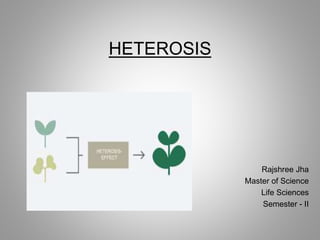
HETEROSIS
Rajshree Jha
Master of Science
Life Sciences
Semester - II
INTRODUCTION -
 Hybrid vigor may be defined as the increase in size, vigour, fertility and overall
productivity of a hybrid plant.
 The F1 generation hybrid shows superiority in comparison to the parent
generation.
 The synonymous term ‘Heterosis’ was coined by G. H. Shull.
 Heterosis is the process of producing the hybrid vigor through the hybridization
technique.
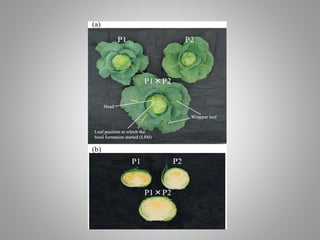
 It refers to the phenomenon that progeny of diverse varieties of a species or
crosses between them exhibit greater biomass, speed of development and
fertility than both the parents.
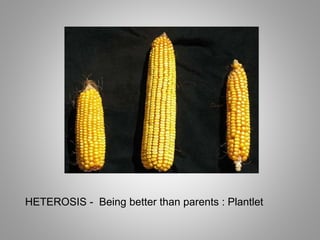
HETEROSIS - Being better than parents : Plantlet
Hybrid Vigour and Heterosis
 Hybrid vigour is used as synonym of heterosis.
 Hybrid vigour describes only superiority of the hybrid over the parents.
 While heterosis describes the other situation as well i.e. crossing over may
result in weak hybrids.
GENETIC BASIS OF HETEROSIS -
 The phenomenon of heterosis can be explained on the basis of these
Genetic causes.
 There are two most commonly known theories –
(1) The Dominance Hypothesis
(2) The Overdominance Hypothesis
 A third theory has also been proposed named
(3) Epistasis
(1) Dominance hypothesis
 This theory was proposed by Davenport, Bruce and Keable and Pellew in
the year 1910.
 This is the most widely accepted theory.
 Heterosis in F1 hybrids arises mainly from an accumulation of maximal
number of dominant favourable alleles.
(contributed and complemented by either of the parents)
 Alternatively, this hypothesis envisages that recessive alleles are harmful or
injurious to their carrier.
 According to this theory, genes that are favourable for vigour and growth
are dominant.
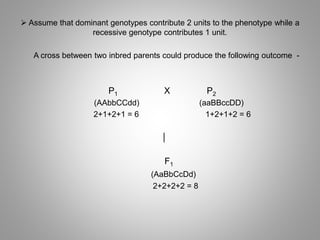
 Assume that dominant genotypes contribute 2 units to the phenotype while a
recessive genotype contributes 1 unit.
A cross between two inbred parents could produce the following outcome -
P1 X P2
(AAbbCCdd) (aaBBccDD)
2+1+2+1 = 6 1+2+1+2 = 6
│
F1
(AaBbCcDd)
2+2+2+2 = 8
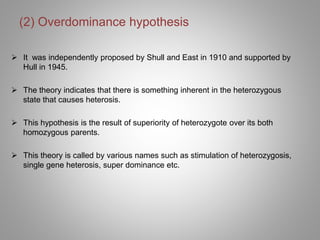
(2) Overdominance hypothesis
 It was independently proposed by Shull and East in 1910 and supported by
Hull in 1945.
 The theory indicates that there is something inherent in the heterozygous
state that causes heterosis.
 This hypothesis is the result of superiority of heterozygote over its both
homozygous parents.
 This theory is called by various names such as stimulation of heterozygosis,
single gene heterosis, super dominance etc.
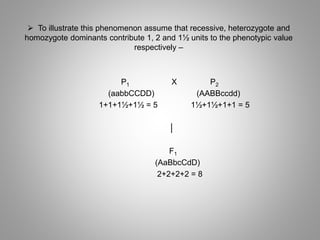
 To illustrate this phenomenon assume that recessive, heterozygote and
homozygote dominants contribute 1, 2 and 1½ units to the phenotypic value
respectively –
P1 X P2
(aabbCCDD) (AABBccdd)
1+1+1½+1½ = 5 1½+1½+1+1 = 5
│
F1
(AaBbcCdD)
2+2+2+2 = 8
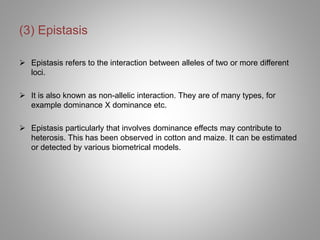
(3) Epistasis
 Epistasis refers to the interaction between alleles of two or more different
loci.
 It is also known as non-allelic interaction. They are of many types, for
example dominance X dominance etc.
 Epistasis particularly that involves dominance effects may contribute to
heterosis. This has been observed in cotton and maize. It can be estimated
or detected by various biometrical models.
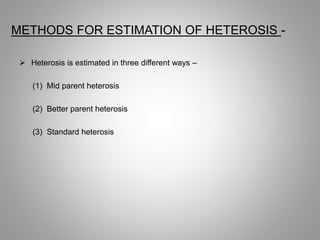
METHODS FOR ESTIMATION OF HETEROSIS -
 Heterosis is estimated in three different ways –
(1) Mid parent heterosis
(2) Better parent heterosis
(3) Standard heterosis
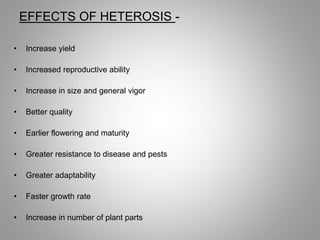
EFFECTS OF HETEROSIS -
• Increase yield
• Increased reproductive ability
• Increase in size and general vigor
• Better quality
• Earlier flowering and maturity
• Greater resistance to disease and pests
• Greater adaptability
• Faster growth rate
• Increase in number of plant parts
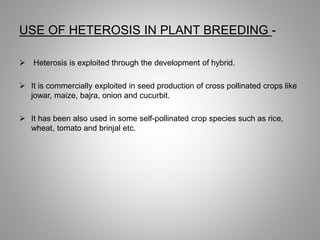
USE OF HETEROSIS IN PLANT BREEDING -
 Heterosis is exploited through the development of hybrid.
 It is commercially exploited in seed production of cross pollinated crops like
jowar, maize, bajra, onion and cucurbit.
 It has been also used in some self-pollinated crop species such as rice,
wheat, tomato and brinjal etc.
Reference -
George Acquaah (2012) Principles of Plant Breeding and genetics 2nd
ed. Hoboken , NJ: Wiley
J R Sharma (1994) Principles and Practice of Plant Breeding
New Delhi, India : Tata McGraw-Hill
http://www.biologydiscussion.com/plant-breeding/heterosis-or-hybrid-
vigour-types-causes-and-effects/17672
https://www.youtube.com/watch?v=B7okv_vgRSM

Heterosis

  • 1.
    HETEROSIS Rajshree Jha Master ofScience Life Sciences Semester - II
  • 2.
    INTRODUCTION -  Hybridvigor may be defined as the increase in size, vigour, fertility and overall productivity of a hybrid plant.  The F1 generation hybrid shows superiority in comparison to the parent generation.  The synonymous term ‘Heterosis’ was coined by G. H. Shull.  Heterosis is the process of producing the hybrid vigor through the hybridization technique.  It refers to the phenomenon that progeny of diverse varieties of a species or crosses between them exhibit greater biomass, speed of development and fertility than both the parents.
  • 3.
    HETEROSIS - Beingbetter than parents : Plantlet
  • 4.
    Hybrid Vigour andHeterosis  Hybrid vigour is used as synonym of heterosis.  Hybrid vigour describes only superiority of the hybrid over the parents.  While heterosis describes the other situation as well i.e. crossing over may result in weak hybrids.
  • 6.
    GENETIC BASIS OFHETEROSIS -  The phenomenon of heterosis can be explained on the basis of these Genetic causes.  There are two most commonly known theories – (1) The Dominance Hypothesis (2) The Overdominance Hypothesis  A third theory has also been proposed named (3) Epistasis
  • 7.
    (1) Dominance hypothesis This theory was proposed by Davenport, Bruce and Keable and Pellew in the year 1910.  This is the most widely accepted theory.  Heterosis in F1 hybrids arises mainly from an accumulation of maximal number of dominant favourable alleles. (contributed and complemented by either of the parents)  Alternatively, this hypothesis envisages that recessive alleles are harmful or injurious to their carrier.  According to this theory, genes that are favourable for vigour and growth are dominant.
  • 8.
     Assume thatdominant genotypes contribute 2 units to the phenotype while a recessive genotype contributes 1 unit. A cross between two inbred parents could produce the following outcome - P1 X P2 (AAbbCCdd) (aaBBccDD) 2+1+2+1 = 6 1+2+1+2 = 6 │ F1 (AaBbCcDd) 2+2+2+2 = 8
  • 9.
    (2) Overdominance hypothesis It was independently proposed by Shull and East in 1910 and supported by Hull in 1945.  The theory indicates that there is something inherent in the heterozygous state that causes heterosis.  This hypothesis is the result of superiority of heterozygote over its both homozygous parents.  This theory is called by various names such as stimulation of heterozygosis, single gene heterosis, super dominance etc.
  • 10.
     To illustratethis phenomenon assume that recessive, heterozygote and homozygote dominants contribute 1, 2 and 1½ units to the phenotypic value respectively – P1 X P2 (aabbCCDD) (AABBccdd) 1+1+1½+1½ = 5 1½+1½+1+1 = 5 │ F1 (AaBbcCdD) 2+2+2+2 = 8
  • 11.
    (3) Epistasis  Epistasisrefers to the interaction between alleles of two or more different loci.  It is also known as non-allelic interaction. They are of many types, for example dominance X dominance etc.  Epistasis particularly that involves dominance effects may contribute to heterosis. This has been observed in cotton and maize. It can be estimated or detected by various biometrical models.
  • 12.
    METHODS FOR ESTIMATIONOF HETEROSIS -  Heterosis is estimated in three different ways – (1) Mid parent heterosis (2) Better parent heterosis (3) Standard heterosis
  • 13.
    EFFECTS OF HETEROSIS- • Increase yield • Increased reproductive ability • Increase in size and general vigor • Better quality • Earlier flowering and maturity • Greater resistance to disease and pests • Greater adaptability • Faster growth rate • Increase in number of plant parts
  • 14.
    USE OF HETEROSISIN PLANT BREEDING -  Heterosis is exploited through the development of hybrid.  It is commercially exploited in seed production of cross pollinated crops like jowar, maize, bajra, onion and cucurbit.  It has been also used in some self-pollinated crop species such as rice, wheat, tomato and brinjal etc.
  • 15.
    Reference - George Acquaah(2012) Principles of Plant Breeding and genetics 2nd ed. Hoboken , NJ: Wiley J R Sharma (1994) Principles and Practice of Plant Breeding New Delhi, India : Tata McGraw-Hill http://www.biologydiscussion.com/plant-breeding/heterosis-or-hybrid- vigour-types-causes-and-effects/17672 https://www.youtube.com/watch?v=B7okv_vgRSM