Mike McLaughlin
The University of Adelaide, Australia
/fertiliser
Drivers of Soil Pollution in Agricultural Fields
Outline
• Agricultural footprint on the globe
• Geogenic sources of soil contamination
• Anthropogenic sources of soil contamination
• Fertiliser contaminants in agricultural soils
• Cadmium
• Fluorine
• Take home messages
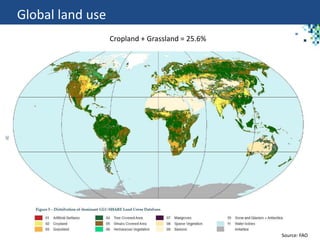
Global land use
Source: FAO
Cropland + Grassland = 25.6%
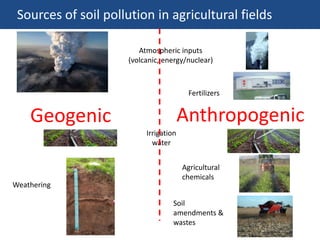
Irrigation
water
Fertilizers
Soil
amendments &
wastes
Weathering
Atmospheric inputs
(volcanic, energy/nuclear)
Sources of soil pollution in agricultural fields
Agricultural
chemicals
Geogenic Anthropogenic
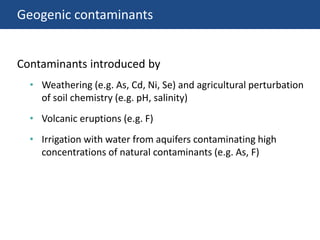
Geogenic contaminants
• Weathering (e.g. As, Cd, Ni, Se) and agricultural perturbation
of soil chemistry (e.g. pH, salinity)
• Volcanic eruptions (e.g. F)
• Irrigation with water from aquifers contaminating high
concentrations of natural contaminants (e.g. As, F)
Contaminants introduced by
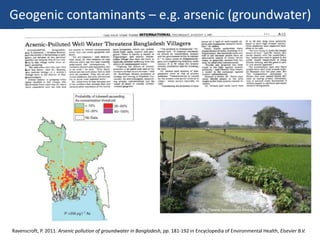
Geogenic contaminants – e.g. arsenic (groundwater)
Ravenscroft, P. 2011. Arsenic pollution of groundwater in Bangladesh, pp. 181-192 in Encyclopedia of Environmental Health, Elsevier B.V.
http://www.novaquatis.eawag.ch
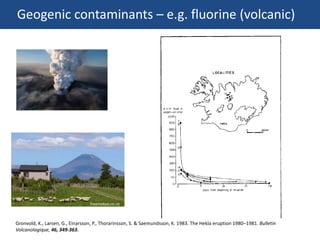
Geogenic contaminants – e.g. fluorine (volcanic)
freemeteo.co.nz
Gronvold, K., Larsen, G., Einarsson, P., Thorarinsson, S. & Saemundsson, K. 1983. The Hekla eruption 1980–1981. Bulletin
Volcanologique, 46, 349-363.
Reimann, C., Filzmoser, P., Fabian, K., Hron, K., Birke, M., Demetriades, A., Dinelli, E., Ladenberger, A., Albanese, S., Andersson, M., Arnoldussen,
A., Baritz, R., Batista, M. J., Bel-lan, A., Cicchella, D., De Vivo, B., De Vos, W., Duris, M., Dusza-Dobek, A., Eggen, O. A., Eklund, M., Ernstsen, V.,
Finne, T. E., Flight, D., Forrester, S., Fuchs, M., Fugedi, U., Gilucis, A., Gosar, M., Gregorauskiene, V., Gulan, A., Halamic, J., Haslinger, E., Hayoz, P.,
Hobiger, G., Hoffmann, R., Hoogewerff, J., Hrvatovic, H., Husnjak, S., Janik, L., Johnson, C. C., Jordan, G., Kirby, J., Kivisilla, J., Klos, V., Krone, F.,
Kwecko, P., Kuti, L., Lima, A., Locutura, J., Lucivjansky, P., Mackovych, D., Malyuk, B. I., Maquil, R., McLaughlin, M. J., Meuli, R. G., Miosic, N., Mol,
G., Négrel, P., O'Connor, P., Oorts, K., Ottesen, R. T., Pasieczna, A., Petersell, V., Pfleiderer, S., Ponavic, M., Prazeres, C., Rauch, U., Salpeteur,
Schedl, A., Scheib, A., Schoeters, I., Sefcik, P., Sellersjö, E., Skopljak, F., Slaninka, I., Šorša, A., Srvkota, R., Stafilov, T., Tarvainen, T., Trendavilov, V.,
Valera, P., Verougstraete, V., Vidojevic, D., Zissimos, A. M. & Zomeni, Z. 2012. The concept of compositional data analysis in practice - Total major
element concentrations in agricultural and grazing land soils of Europe. Science of the Total Environment, 426, 196-210.
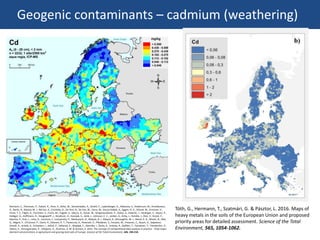
Geogenic contaminants – cadmium (weathering)
Tóth, G., Hermann, T., Szatmári, G. & Pásztor, L. 2016. Maps of
heavy metals in the soils of the European Union and proposed
priority areas for detailed assessment. Science of the Total
Environment, 565, 1054-1062.
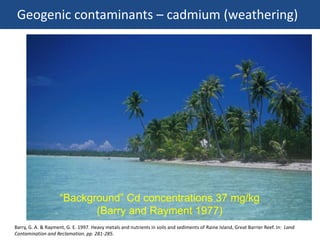
Geogenic contaminants – cadmium (weathering)
Barry, G. A. & Rayment, G. E. 1997. Heavy metals and nutrients in soils and sediments of Raine Island, Great Barrier Reef. In: Land
Contamination and Reclamation. pp. 281-285.
“Background” Cd concentrations 37 mg/kg
(Barry and Rayment 1977)
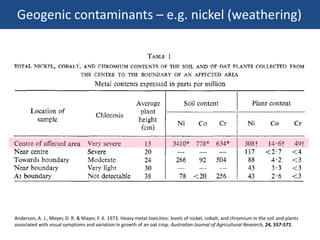
Geogenic contaminants – e.g. nickel (weathering)
Anderson, A. J., Meyer, D. R. & Mayer, F. K. 1973. Heavy metal toxicities: levels of nickel, cobalt, and chromium in the soil and plants
associated with visual symptoms and variation in growth of an oat crop. Australian Journal of Agricultural Research, 24, 557-571.
Anthropogenic contaminant sources
• Fertilisers
• Wastes (agricultural, urban and industrial)
• Agricultural chemicals (pesticides, herbicides, plant
regulators/promotants, veterinary chemicals, etc.)
• Atmospheric diffuse sources (combustion, radiogenic)
Contaminants introduced from multiple sources
Fertilisers
• Phosphatic fertilisers – through impurities either in the
phosphate rock used or in the sulphuric acid used for
acidulation
• Trace element fertilisers – through use of by-product metals
with high levels of impurities e.g. smelting wastes
Fertilizer contaminants introduced by 2 main
groups of fertiliser
Nitrogen, potash and sulphur fertilisers mostly
pure with low levels of contaminants
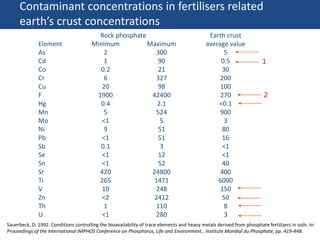
Contaminant concentrations in fertilisers related
earth’s crust concentrations
Rock phosphate Earth crust
Element Minimum Maximum average value
As 2 300 5
Cd 1 90 0.5
Co 0.2 21 30
Cr 6 327 200
Cu 20 98 100
F 1900 42400 270
Hg 0.4 2.1 <0.1
Mn 5 524 900
Mo <1 5 3
Ni 9 51 80
Pb <1 51 16
Sb 0.1 3 <1
Se <1 12 <1
Sn <1 52 40
Sr 420 24800 400
Ti 265 1471 6000
V 10 248 150
Zn <2 2412 50
Th 1 110 8
U <1 280 3
1
2
Sauerbeck, D. 1992. Conditions controlling the bioavailability of trace elements and heavy metals derived from phosphate fertilizers in soils. In:
Proceedings of the International IMPHOS Conference on Phosphorus, Life and Environment., Institute Mondial du Phosphate, pp. 419-448.
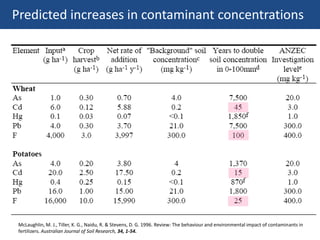
Predicted increases in contaminant concentrations
McLaughlin, M. J., Tiller, K. G., Naidu, R. & Stevens, D. G. 1996. Review: The behaviour and environmental impact of contaminants in
fertilizers. Australian Journal of Soil Research, 34, 1-54.
Key fertilizer contaminants
Cadmium
Cadmium – uptake into food crops
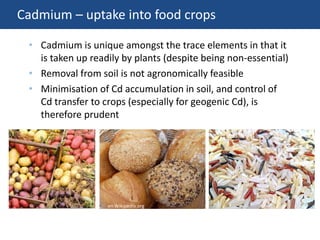
• Cadmium is unique amongst the trace elements in that it
is taken up readily by plants (despite being non-essential)
• Removal from soil is not agronomically feasible
• Minimisation of Cd accumulation in soil, and control of
Cd transfer to crops (especially for geogenic Cd), is
therefore prudent
en.Wikipedia.org
Fish, freshwater
Molluscs
Shrimp, freshwater
Shrimp, sea
Crab, freshwater
Crab, sea
Purple seaweed
Kelp
Kelp, dry
Meat, stock
Meat, poulty
Liver
Kidney
Egg, fresh
Egg, preserved
Milk (excl. milk powder)
Milk powder anim
a
China
ke
th)
25
30
25
30
China Europe
1990
1992
2000
2015
Japan
Korea
Thailand
Bangladeshis
USA
Australia
Europe(avg.)
Lebanon
Canada
Germany
UK
France
DietaryCdintake
(µg/kgBW/month)
0
5
10
15
20
25
30
Crab, freshw
Crab
Purple seaw
Kelp
Meat, s
Meat, p
Ki
Egg, f
Egg, prese
Milk (excl. milk pow
Milk po
China
1990
1992
2000
2017
Japan
Korea
Thailand
gladeshis
USA
Australia
ope(avg.)
Lebanon
Canada
Germany
UK
France
DietaryCdintake
(µg/kgBW/month)
0
5
10
15
20
25
30
(a)
(b)
(d)
WHO 2010
EFSA opinion, 2009
ATSDR, 2008
Cadmium
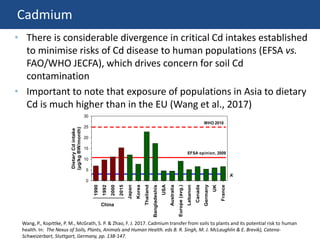
• There is considerable divergence in critical Cd intakes established
to minimise risks of Cd disease to human populations (EFSA vs.
FAO/WHO JECFA), which drives concern for soil Cd
contamination
• Important to note that exposure of populations in Asia to dietary
Cd is much higher than in the EU (Wang et al., 2017)
Wang, P., Kopittke, P. M., McGrath, S. P. & Zhao, F. J. 2017. Cadmium transfer from soils to plants and its potential risk to human
health. In: The Nexus of Soils, Plants, Animals and Human Health. eds B. R. Singh, M. J. McLaughlin & E. Brevik), Catena-
Schweizerbart, Stuttgart, Germany, pp. 138-147.
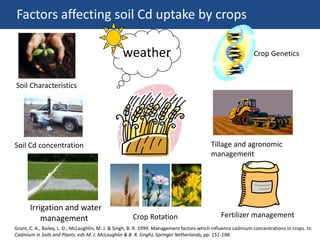
Factors affecting soil Cd uptake by crops
weather
Soil Characteristics
Soil Cd concentration
Crop Rotation Fertilizer management
Tillage and agronomic
management
Crop Genetics
Irrigation and water
management
Grant, C. A., Bailey, L. D., McLaughlin, M. J. & Singh, B. R. 1999. Management factors which influence cadmium concentrations in crops. In:
Cadmium in Soils and Plants. eds M. J. McLaughlin & B. R. Singh), Springer Netherlands, pp. 151-198.
Cadmium - management
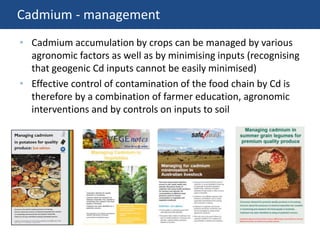
• Cadmium accumulation by crops can be managed by various
agronomic factors as well as by minimising inputs (recognising
that geogenic Cd inputs cannot be easily minimised)
• Effective control of contamination of the food chain by Cd is
therefore by a combination of farmer education, agronomic
interventions and by controls on inputs to soil
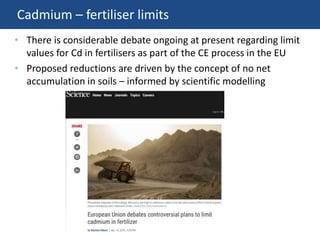
Cadmium – fertiliser limits
• There is considerable debate ongoing at present regarding limit
values for Cd in fertilisers as part of the CE process in the EU
• Proposed reductions are driven by the concept of no net
accumulation in soils – informed by scientific modelling
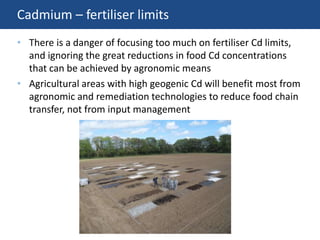
Cadmium – fertiliser limits
• There is a danger of focusing too much on fertiliser Cd limits,
and ignoring the great reductions in food Cd concentrations
that can be achieved by agronomic means
• Agricultural areas with high geogenic Cd will benefit most from
agronomic and remediation technologies to reduce food chain
transfer, not from input management
Key fertilizer contaminants
Fluorine
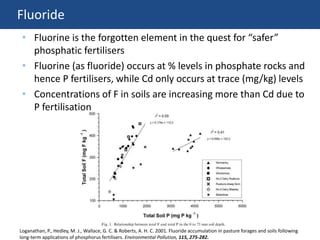
Fluoride
• Fluorine is the forgotten element in the quest for “safer”
phosphatic fertilisers
• Fluorine (as fluoride) occurs at % levels in phosphate rocks and
hence P fertilisers, while Cd only occurs at trace (mg/kg) levels
• Concentrations of F in soils are increasing more than Cd due to
P fertilisation
Loganathan, P., Hedley, M. J., Wallace, G. C. & Roberts, A. H. C. 2001. Fluoride accumulation in pasture forages and soils following
long-term applications of phosphorus fertilisers. Environmental Pollution, 115, 275-282.
Fluoride
• Fortunately, F- is bound strongly by soil minerals, so adverse
effects on plants and soil organisms, or plant uptake, only occur
at high soil F concentrations
• However, the strong retention of fertiliser F- by soil results in
strong accumulation at the soil surface
• More acidic soils allow greater F uptake by plants and potential
toxicity due to formation of (AlFx)3-x complexes
• Hence, grazing animals on permanent pastures (e.g. dairy
systems) are at risk of high F ingestion and potentially fluorosis
McLaughlin, M. J., Stevens, D. P., Keerthisinghe, D. G., Cayley, J. W. D. & Ridley, A. M. 2001. Contamination of soil with fluoride by
long-term application of superphosphates to pastures and risk to grazing animals. Australian Journal of Soil Research, 39, 627-640.
Perspectives
ď‚· Geogenic sources of pollution (e.g As, F, Se) have had a greater
global impact on human and animal health than anthropogenic
sources
ď‚· Nonetheless, fertilisers, mainly phosphatic fertilisers, represent
an important source of potential contaminants in global
agricultural systems, as they represent “new” inputs from the
geosphere to the biosphere (unlike animal manures)
ď‚· Cadmium and fluorine are the elements in fertilisers most likely
to significantly affect soil quality and function
ď‚· The food chain is protected best by a combination of limiting Cd
inputs, as well as agronomic management to minimise Cd uptake
ď‚· In the not too distant future, F could adversely affect grazing
systems that are intensively fertilised
Drivers of soil pollution in agricultural fields

Drivers of soil pollution in agricultural fields

  • 2.
    Mike McLaughlin The Universityof Adelaide, Australia /fertiliser Drivers of Soil Pollution in Agricultural Fields
  • 3.
    Outline • Agricultural footprinton the globe • Geogenic sources of soil contamination • Anthropogenic sources of soil contamination • Fertiliser contaminants in agricultural soils • Cadmium • Fluorine • Take home messages
  • 4.
    Global land use Source:FAO Cropland + Grassland = 25.6%
  • 5.
    Irrigation water Fertilizers Soil amendments & wastes Weathering Atmospheric inputs (volcanic,energy/nuclear) Sources of soil pollution in agricultural fields Agricultural chemicals Geogenic Anthropogenic
  • 6.
    Geogenic contaminants • Weathering(e.g. As, Cd, Ni, Se) and agricultural perturbation of soil chemistry (e.g. pH, salinity) • Volcanic eruptions (e.g. F) • Irrigation with water from aquifers contaminating high concentrations of natural contaminants (e.g. As, F) Contaminants introduced by
  • 7.
    Geogenic contaminants –e.g. arsenic (groundwater) Ravenscroft, P. 2011. Arsenic pollution of groundwater in Bangladesh, pp. 181-192 in Encyclopedia of Environmental Health, Elsevier B.V. http://www.novaquatis.eawag.ch
  • 8.
    Geogenic contaminants –e.g. fluorine (volcanic) freemeteo.co.nz Gronvold, K., Larsen, G., Einarsson, P., Thorarinsson, S. & Saemundsson, K. 1983. The Hekla eruption 1980–1981. Bulletin Volcanologique, 46, 349-363.
  • 9.
    Reimann, C., Filzmoser,P., Fabian, K., Hron, K., Birke, M., Demetriades, A., Dinelli, E., Ladenberger, A., Albanese, S., Andersson, M., Arnoldussen, A., Baritz, R., Batista, M. J., Bel-lan, A., Cicchella, D., De Vivo, B., De Vos, W., Duris, M., Dusza-Dobek, A., Eggen, O. A., Eklund, M., Ernstsen, V., Finne, T. E., Flight, D., Forrester, S., Fuchs, M., Fugedi, U., Gilucis, A., Gosar, M., Gregorauskiene, V., Gulan, A., Halamic, J., Haslinger, E., Hayoz, P., Hobiger, G., Hoffmann, R., Hoogewerff, J., Hrvatovic, H., Husnjak, S., Janik, L., Johnson, C. C., Jordan, G., Kirby, J., Kivisilla, J., Klos, V., Krone, F., Kwecko, P., Kuti, L., Lima, A., Locutura, J., Lucivjansky, P., Mackovych, D., Malyuk, B. I., Maquil, R., McLaughlin, M. J., Meuli, R. G., Miosic, N., Mol, G., Négrel, P., O'Connor, P., Oorts, K., Ottesen, R. T., Pasieczna, A., Petersell, V., Pfleiderer, S., Ponavic, M., Prazeres, C., Rauch, U., Salpeteur, Schedl, A., Scheib, A., Schoeters, I., Sefcik, P., Sellersjö, E., Skopljak, F., Slaninka, I., Šorša, A., Srvkota, R., Stafilov, T., Tarvainen, T., Trendavilov, V., Valera, P., Verougstraete, V., Vidojevic, D., Zissimos, A. M. & Zomeni, Z. 2012. The concept of compositional data analysis in practice - Total major element concentrations in agricultural and grazing land soils of Europe. Science of the Total Environment, 426, 196-210. Geogenic contaminants – cadmium (weathering) Tóth, G., Hermann, T., Szatmári, G. & Pásztor, L. 2016. Maps of heavy metals in the soils of the European Union and proposed priority areas for detailed assessment. Science of the Total Environment, 565, 1054-1062.
  • 10.
    Geogenic contaminants –cadmium (weathering) Barry, G. A. & Rayment, G. E. 1997. Heavy metals and nutrients in soils and sediments of Raine Island, Great Barrier Reef. In: Land Contamination and Reclamation. pp. 281-285. “Background” Cd concentrations 37 mg/kg (Barry and Rayment 1977)
  • 11.
    Geogenic contaminants –e.g. nickel (weathering) Anderson, A. J., Meyer, D. R. & Mayer, F. K. 1973. Heavy metal toxicities: levels of nickel, cobalt, and chromium in the soil and plants associated with visual symptoms and variation in growth of an oat crop. Australian Journal of Agricultural Research, 24, 557-571.
  • 12.
    Anthropogenic contaminant sources •Fertilisers • Wastes (agricultural, urban and industrial) • Agricultural chemicals (pesticides, herbicides, plant regulators/promotants, veterinary chemicals, etc.) • Atmospheric diffuse sources (combustion, radiogenic) Contaminants introduced from multiple sources
  • 13.
    Fertilisers • Phosphatic fertilisers– through impurities either in the phosphate rock used or in the sulphuric acid used for acidulation • Trace element fertilisers – through use of by-product metals with high levels of impurities e.g. smelting wastes Fertilizer contaminants introduced by 2 main groups of fertiliser Nitrogen, potash and sulphur fertilisers mostly pure with low levels of contaminants
  • 14.
    Contaminant concentrations infertilisers related earth’s crust concentrations Rock phosphate Earth crust Element Minimum Maximum average value As 2 300 5 Cd 1 90 0.5 Co 0.2 21 30 Cr 6 327 200 Cu 20 98 100 F 1900 42400 270 Hg 0.4 2.1 <0.1 Mn 5 524 900 Mo <1 5 3 Ni 9 51 80 Pb <1 51 16 Sb 0.1 3 <1 Se <1 12 <1 Sn <1 52 40 Sr 420 24800 400 Ti 265 1471 6000 V 10 248 150 Zn <2 2412 50 Th 1 110 8 U <1 280 3 1 2 Sauerbeck, D. 1992. Conditions controlling the bioavailability of trace elements and heavy metals derived from phosphate fertilizers in soils. In: Proceedings of the International IMPHOS Conference on Phosphorus, Life and Environment., Institute Mondial du Phosphate, pp. 419-448.
  • 15.
    Predicted increases incontaminant concentrations McLaughlin, M. J., Tiller, K. G., Naidu, R. & Stevens, D. G. 1996. Review: The behaviour and environmental impact of contaminants in fertilizers. Australian Journal of Soil Research, 34, 1-54.
  • 16.
  • 17.
    Cadmium – uptakeinto food crops • Cadmium is unique amongst the trace elements in that it is taken up readily by plants (despite being non-essential) • Removal from soil is not agronomically feasible • Minimisation of Cd accumulation in soil, and control of Cd transfer to crops (especially for geogenic Cd), is therefore prudent en.Wikipedia.org
  • 18.
    Fish, freshwater Molluscs Shrimp, freshwater Shrimp,sea Crab, freshwater Crab, sea Purple seaweed Kelp Kelp, dry Meat, stock Meat, poulty Liver Kidney Egg, fresh Egg, preserved Milk (excl. milk powder) Milk powder anim a China ke th) 25 30 25 30 China Europe 1990 1992 2000 2015 Japan Korea Thailand Bangladeshis USA Australia Europe(avg.) Lebanon Canada Germany UK France DietaryCdintake (µg/kgBW/month) 0 5 10 15 20 25 30 Crab, freshw Crab Purple seaw Kelp Meat, s Meat, p Ki Egg, f Egg, prese Milk (excl. milk pow Milk po China 1990 1992 2000 2017 Japan Korea Thailand gladeshis USA Australia ope(avg.) Lebanon Canada Germany UK France DietaryCdintake (µg/kgBW/month) 0 5 10 15 20 25 30 (a) (b) (d) WHO 2010 EFSA opinion, 2009 ATSDR, 2008 Cadmium • There is considerable divergence in critical Cd intakes established to minimise risks of Cd disease to human populations (EFSA vs. FAO/WHO JECFA), which drives concern for soil Cd contamination • Important to note that exposure of populations in Asia to dietary Cd is much higher than in the EU (Wang et al., 2017) Wang, P., Kopittke, P. M., McGrath, S. P. & Zhao, F. J. 2017. Cadmium transfer from soils to plants and its potential risk to human health. In: The Nexus of Soils, Plants, Animals and Human Health. eds B. R. Singh, M. J. McLaughlin & E. Brevik), Catena- Schweizerbart, Stuttgart, Germany, pp. 138-147.
  • 19.
    Factors affecting soilCd uptake by crops weather Soil Characteristics Soil Cd concentration Crop Rotation Fertilizer management Tillage and agronomic management Crop Genetics Irrigation and water management Grant, C. A., Bailey, L. D., McLaughlin, M. J. & Singh, B. R. 1999. Management factors which influence cadmium concentrations in crops. In: Cadmium in Soils and Plants. eds M. J. McLaughlin & B. R. Singh), Springer Netherlands, pp. 151-198.
  • 20.
    Cadmium - management •Cadmium accumulation by crops can be managed by various agronomic factors as well as by minimising inputs (recognising that geogenic Cd inputs cannot be easily minimised) • Effective control of contamination of the food chain by Cd is therefore by a combination of farmer education, agronomic interventions and by controls on inputs to soil
  • 21.
    Cadmium – fertiliserlimits • There is considerable debate ongoing at present regarding limit values for Cd in fertilisers as part of the CE process in the EU • Proposed reductions are driven by the concept of no net accumulation in soils – informed by scientific modelling
  • 22.
    Cadmium – fertiliserlimits • There is a danger of focusing too much on fertiliser Cd limits, and ignoring the great reductions in food Cd concentrations that can be achieved by agronomic means • Agricultural areas with high geogenic Cd will benefit most from agronomic and remediation technologies to reduce food chain transfer, not from input management
  • 23.
  • 24.
    Fluoride • Fluorine isthe forgotten element in the quest for “safer” phosphatic fertilisers • Fluorine (as fluoride) occurs at % levels in phosphate rocks and hence P fertilisers, while Cd only occurs at trace (mg/kg) levels • Concentrations of F in soils are increasing more than Cd due to P fertilisation Loganathan, P., Hedley, M. J., Wallace, G. C. & Roberts, A. H. C. 2001. Fluoride accumulation in pasture forages and soils following long-term applications of phosphorus fertilisers. Environmental Pollution, 115, 275-282.
  • 25.
    Fluoride • Fortunately, F-is bound strongly by soil minerals, so adverse effects on plants and soil organisms, or plant uptake, only occur at high soil F concentrations • However, the strong retention of fertiliser F- by soil results in strong accumulation at the soil surface • More acidic soils allow greater F uptake by plants and potential toxicity due to formation of (AlFx)3-x complexes • Hence, grazing animals on permanent pastures (e.g. dairy systems) are at risk of high F ingestion and potentially fluorosis McLaughlin, M. J., Stevens, D. P., Keerthisinghe, D. G., Cayley, J. W. D. & Ridley, A. M. 2001. Contamination of soil with fluoride by long-term application of superphosphates to pastures and risk to grazing animals. Australian Journal of Soil Research, 39, 627-640.
  • 26.
    Perspectives  Geogenic sourcesof pollution (e.g As, F, Se) have had a greater global impact on human and animal health than anthropogenic sources  Nonetheless, fertilisers, mainly phosphatic fertilisers, represent an important source of potential contaminants in global agricultural systems, as they represent “new” inputs from the geosphere to the biosphere (unlike animal manures)  Cadmium and fluorine are the elements in fertilisers most likely to significantly affect soil quality and function  The food chain is protected best by a combination of limiting Cd inputs, as well as agronomic management to minimise Cd uptake  In the not too distant future, F could adversely affect grazing systems that are intensively fertilised