
Doctoral Seminar
Spatial Interpolation Methods for Soil Nutrient
Mapping
Nirmal Kumar , Ph. D Scholar, Department of Soil Science and Agricultural Chemistry
College of Agriculture, Indira Gandhi Krishi Vishwavidyalaya, Raipur
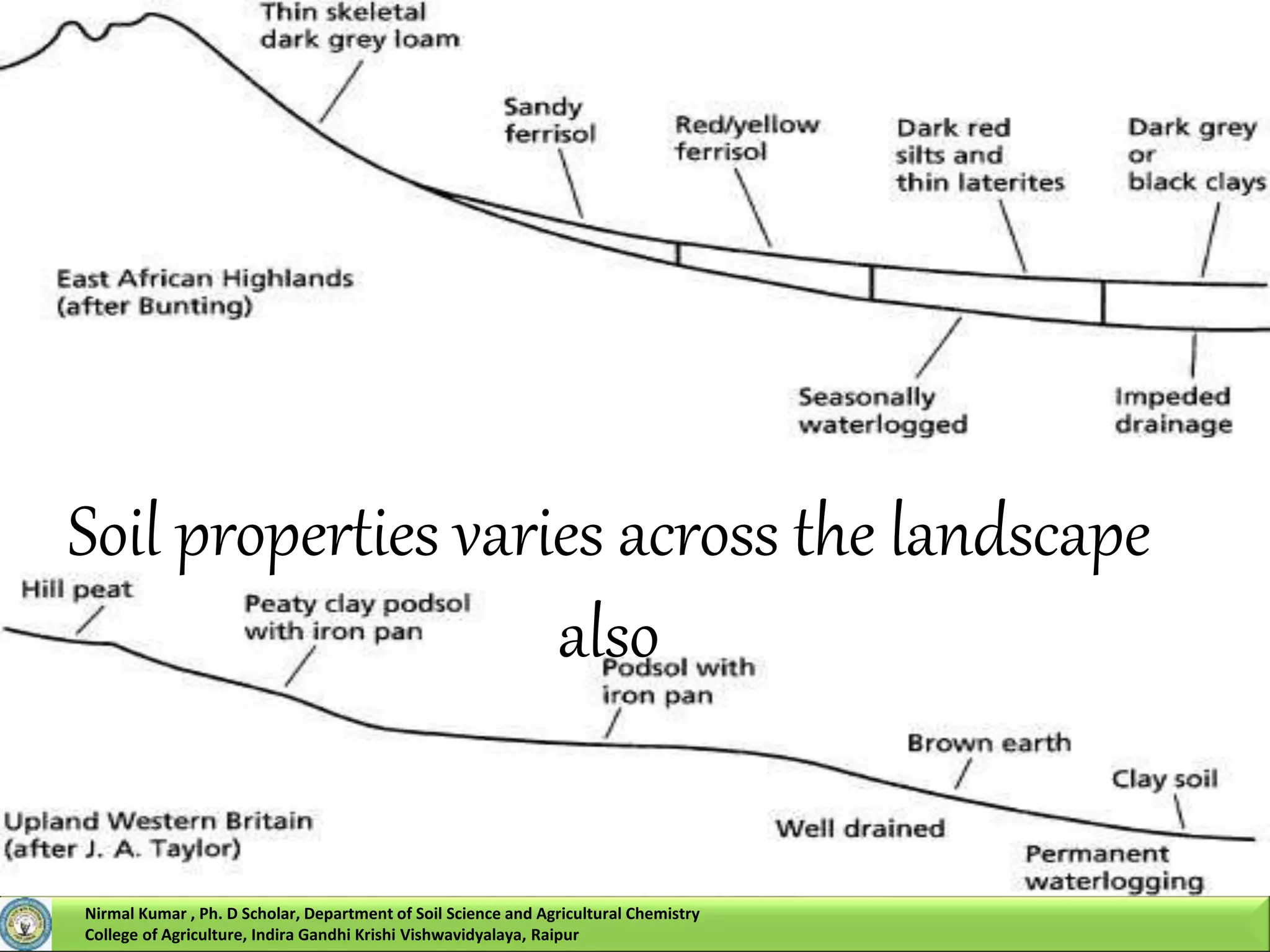
A key feature of soil is the variation with depth in soil properties
Soil properties varies across the landscape
also
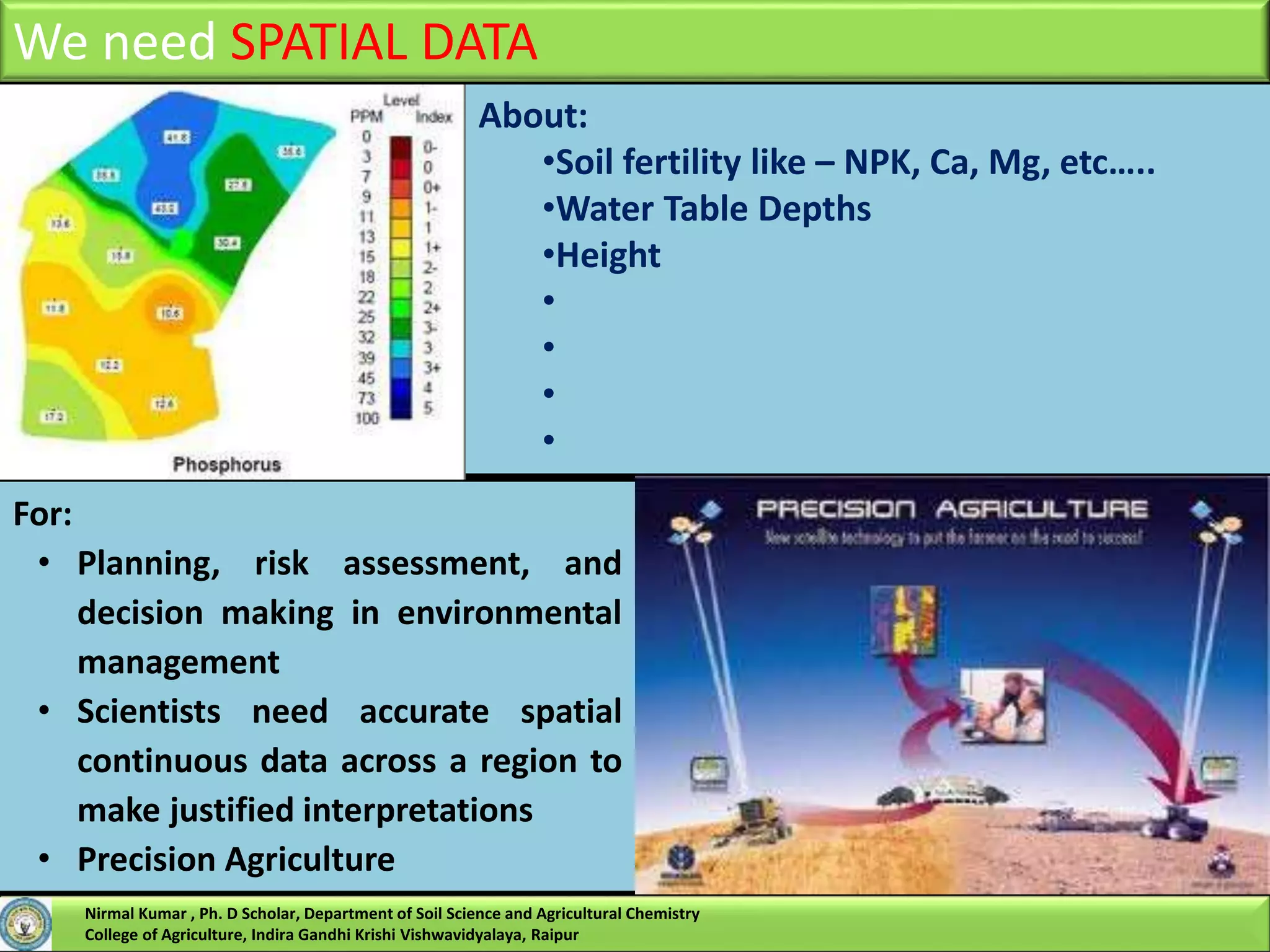
We need SPATIAL DATA
About:
•Soil fertility like – NPK, Ca, Mg, etc…..
•Water Table Depths
•Height
•
•
•
•
For:
• Planning, risk assessment, and
decision making in environmental
management
• Scientists need accurate spatial
continuous data across a region to
make justified interpretations
• Precision Agriculture
Nirmal Kumar , Ph. D Scholar, Department of Soil Science and Agricultural Chemistry
College of Agriculture, Indira Gandhi Krishi Vishwavidyalaya, Raipur
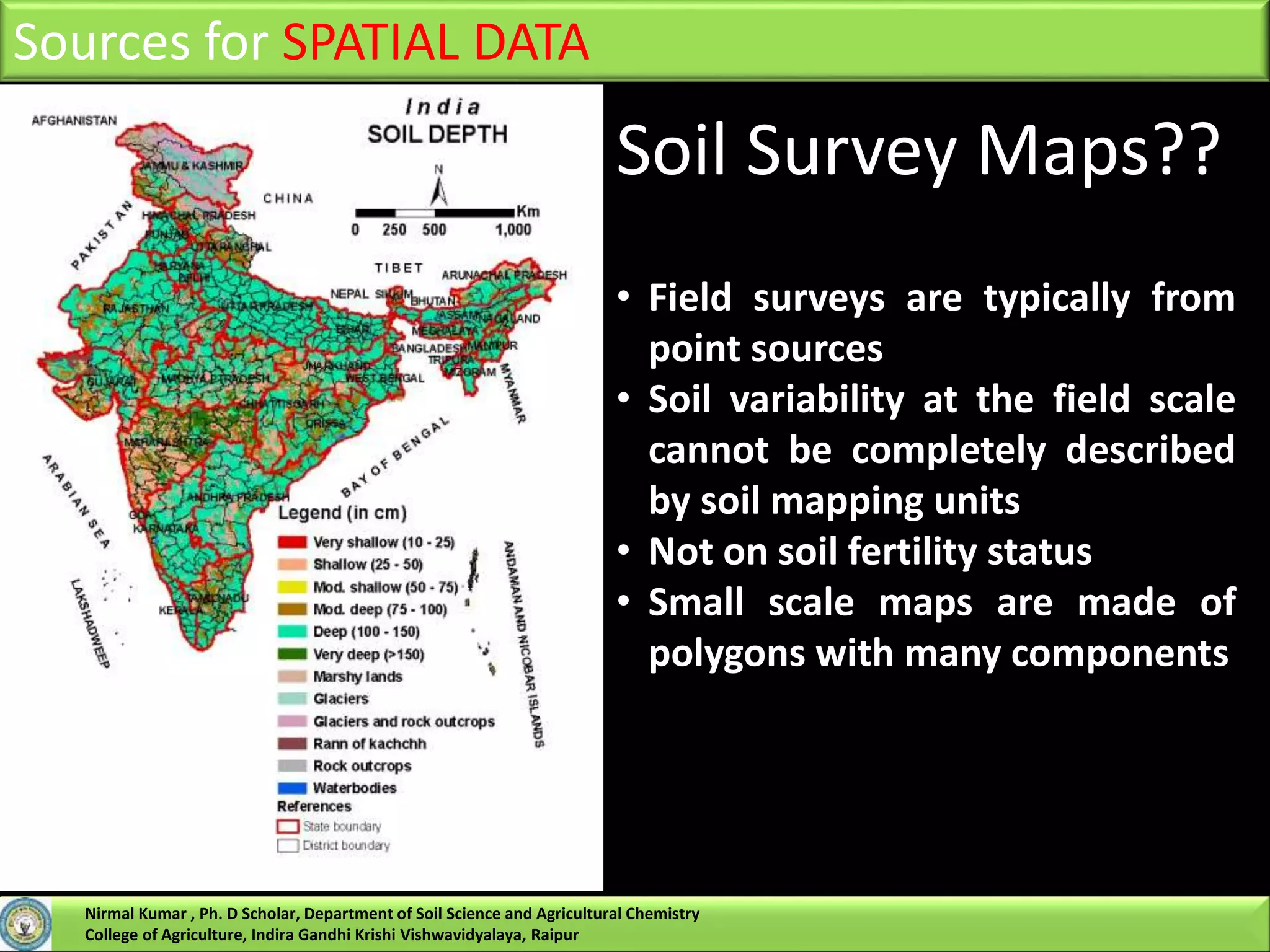
Sources for SPATIAL DATA
Soil Survey Maps??
• Field surveys are typically from
point sources
• Soil variability at the field scale
cannot be completely described
by soil mapping units
• Not on soil fertility status
• Small scale maps are made of
polygons with many components
Nirmal Kumar , Ph. D Scholar, Department of Soil Science and Agricultural Chemistry
College of Agriculture, Indira Gandhi Krishi Vishwavidyalaya, Raipur
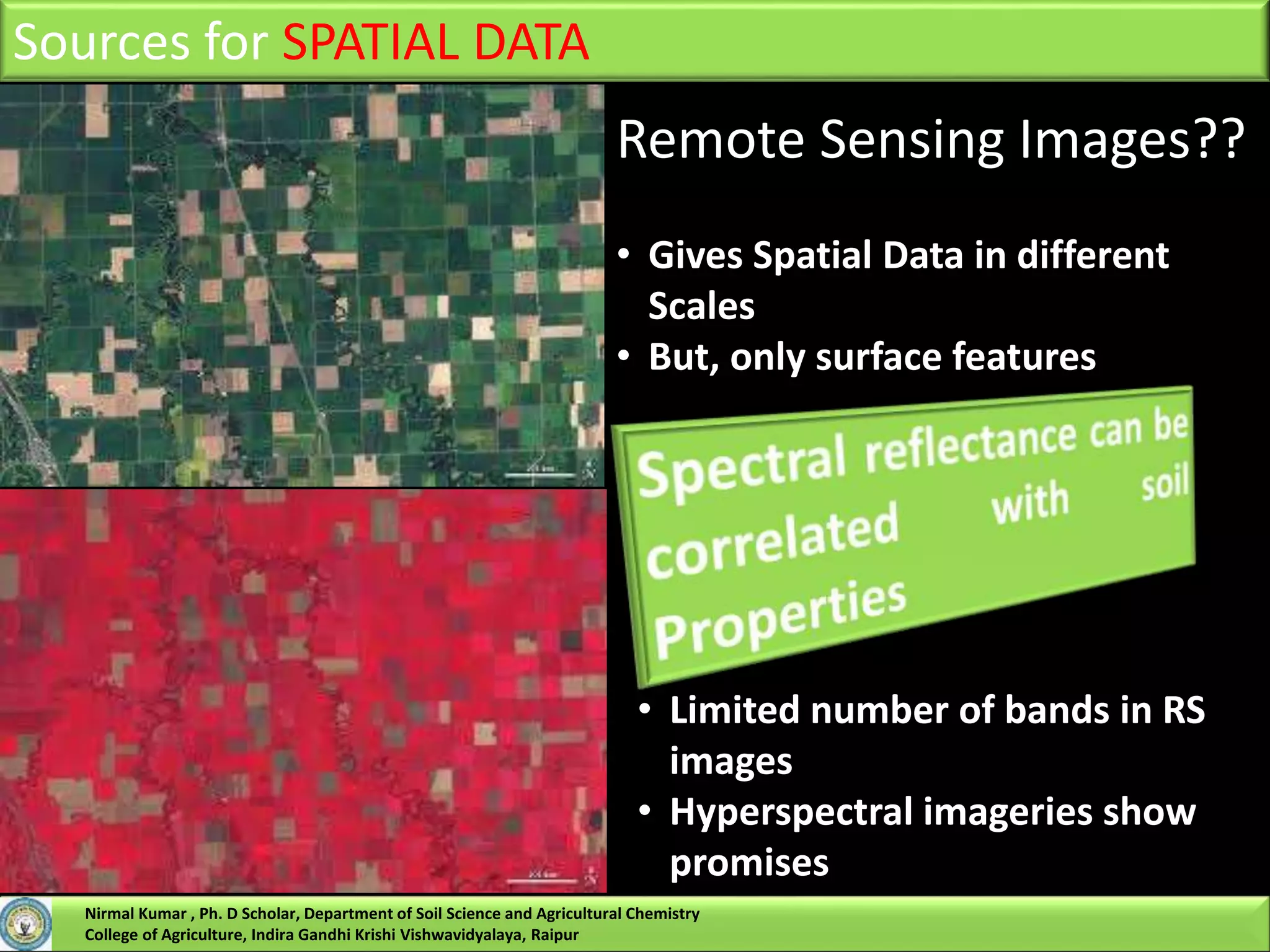
Sources for SPATIAL DATA
Remote Sensing Images??
• Gives Spatial Data in different
Scales
• But, only surface features
• Limited number of bands in RS
images
• Hyperspectral imageries show
promises
Nirmal Kumar , Ph. D Scholar, Department of Soil Science and Agricultural Chemistry
College of Agriculture, Indira Gandhi Krishi Vishwavidyalaya, Raipur
Nirmal Kumar , Ph. D Scholar, Department of Soil Science and Agricultural Chemistry
College of Agriculture, Indira Gandhi Krishi Vishwavidyalaya, Raipur
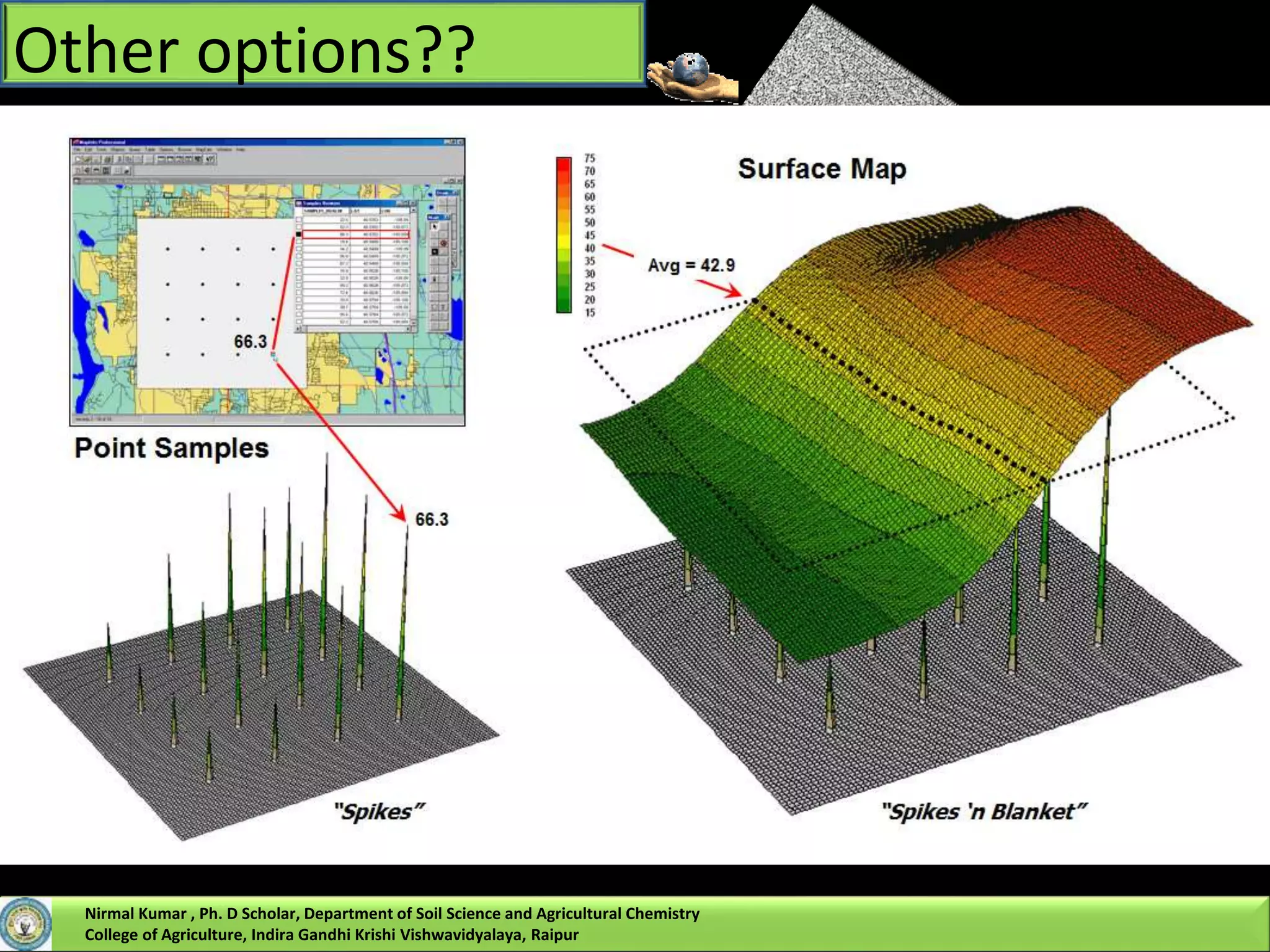
Blanket on spikes
Other options??
Nirmal Kumar , Ph. D Scholar, Department of Soil Science and Agricultural Chemistry
College of Agriculture, Indira Gandhi Krishi Vishwavidyalaya, Raipur
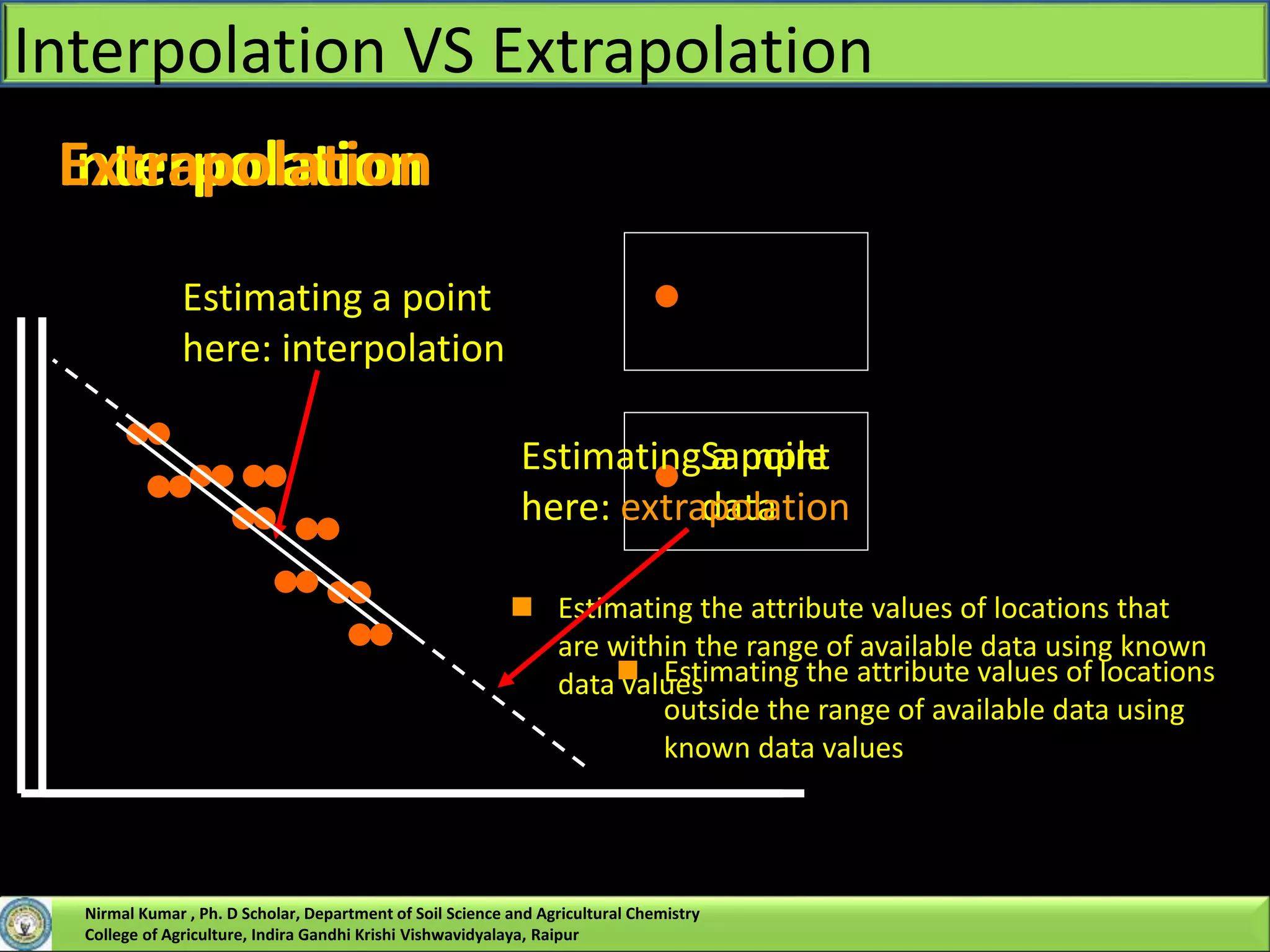
Estimating a point
here: interpolation
Sample
data
Interpolation
 Estimating the attribute values of locations that
are within the range of available data using known
data values
Estimating a point
here: extrapolation
Sample
data
Extrapolation
 Estimating the attribute values of locations
outside the range of available data using
known data values
Interpolation VS Extrapolation
Nirmal Kumar , Ph. D Scholar, Department of Soil Science and Agricultural Chemistry
College of Agriculture, Indira Gandhi Krishi Vishwavidyalaya, Raipur
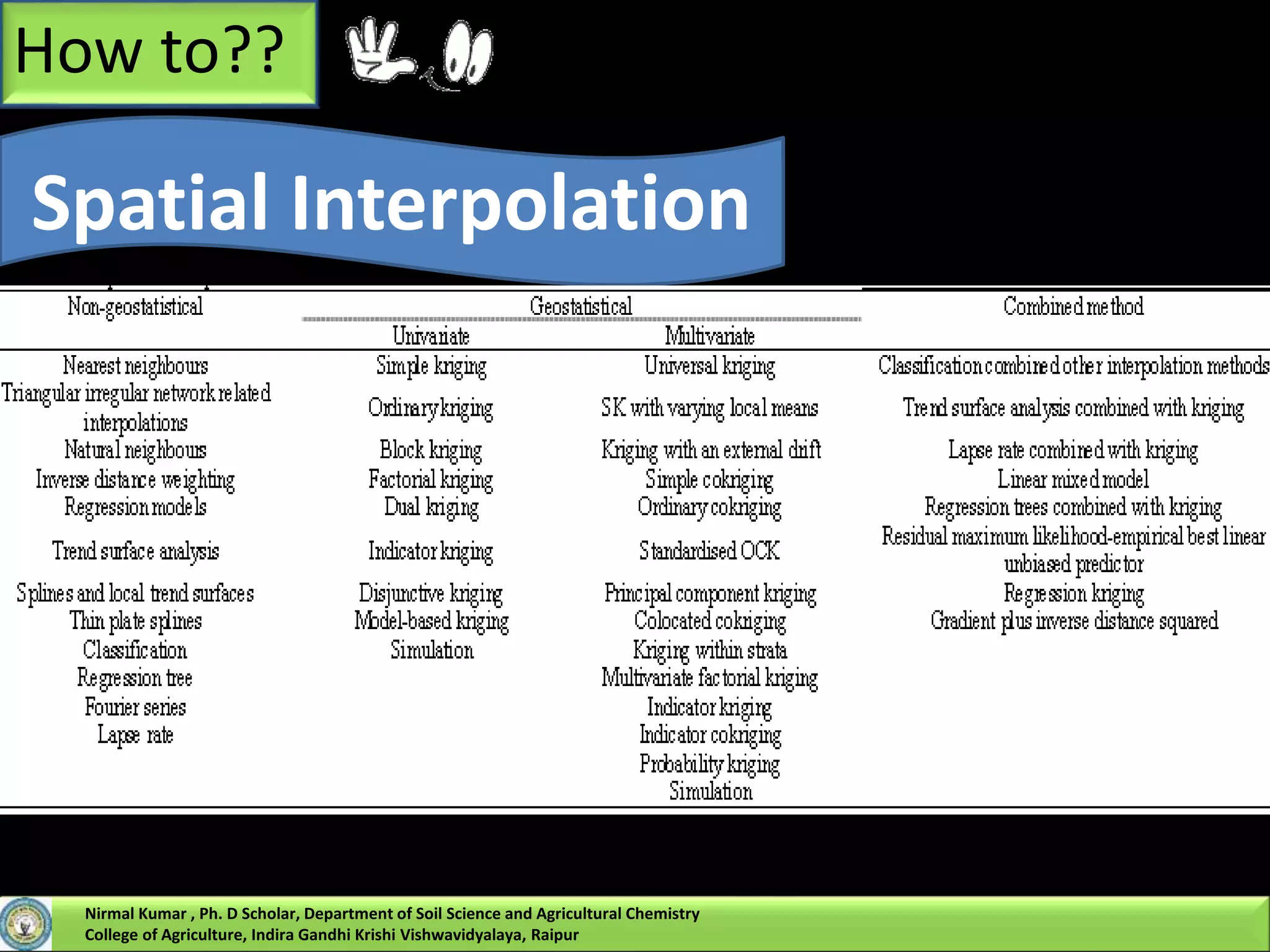
How to??
Spatial Interpolation
Non-geostatistical methods
Geostatistical methods
Combined
Triangular Irregular Network
Natural Neighbours
Inverse Distance Weighting
Trend Surface Analysis
Thin Plate Splines
.
.
.
Simple Kriging
Ordinary Krigging
Block Krigging
Indicator Krigging
Cokrigging
.
.
.
Trend Surface Analysis
Combined with Krigging
Regression krigging
Lapse Rate Combined with
Krigging
Nirmal Kumar , Ph. D Scholar, Department of Soil Science and Agricultural Chemistry
College of Agriculture, Indira Gandhi Krishi Vishwavidyalaya, Raipur
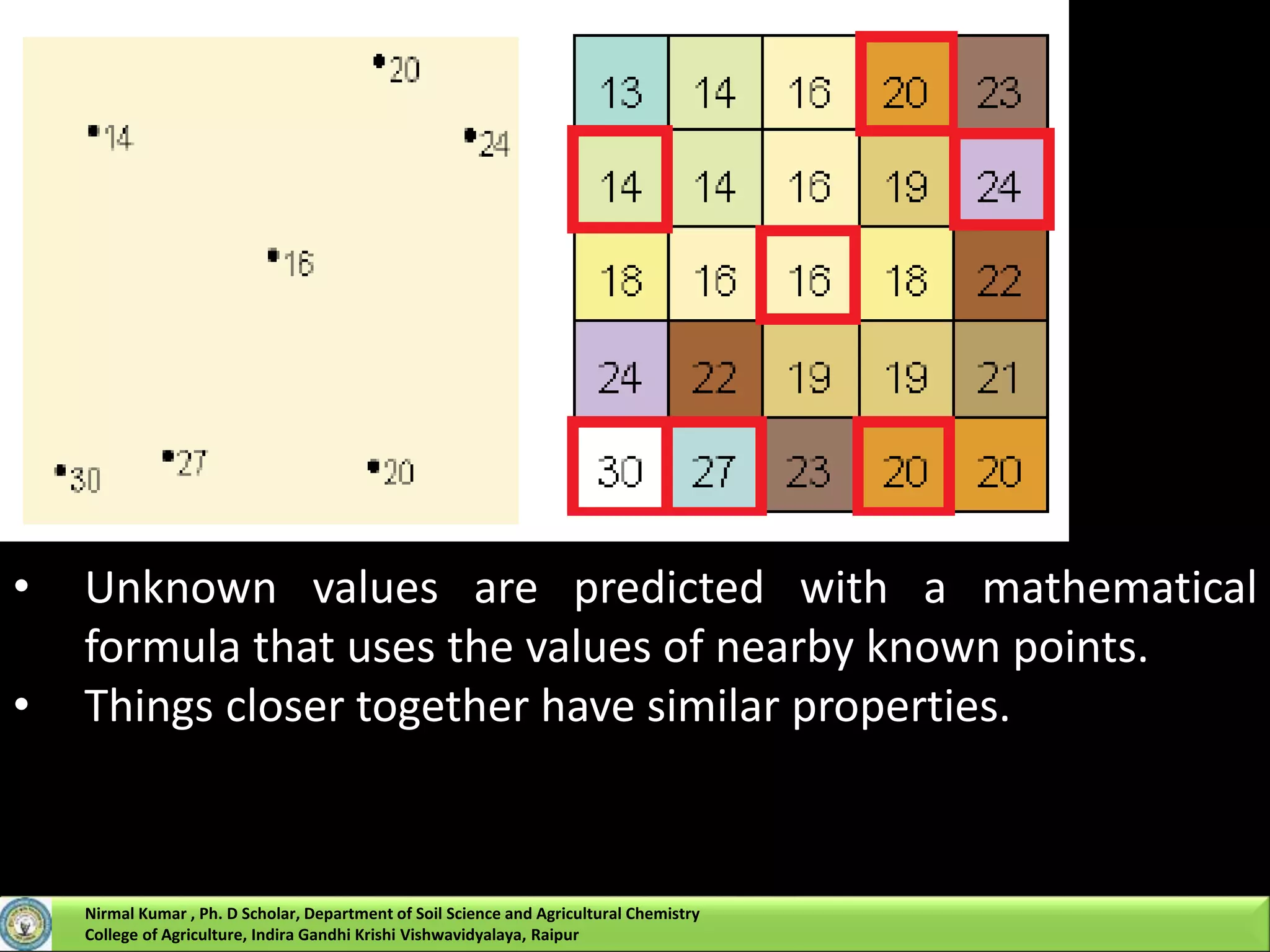
• Unknown values are predicted with a mathematical
formula that uses the values of nearby known points.
• Things closer together have similar properties.
Nirmal Kumar , Ph. D Scholar, Department of Soil Science and Agricultural Chemistry
College of Agriculture, Indira Gandhi Krishi Vishwavidyalaya, Raipur
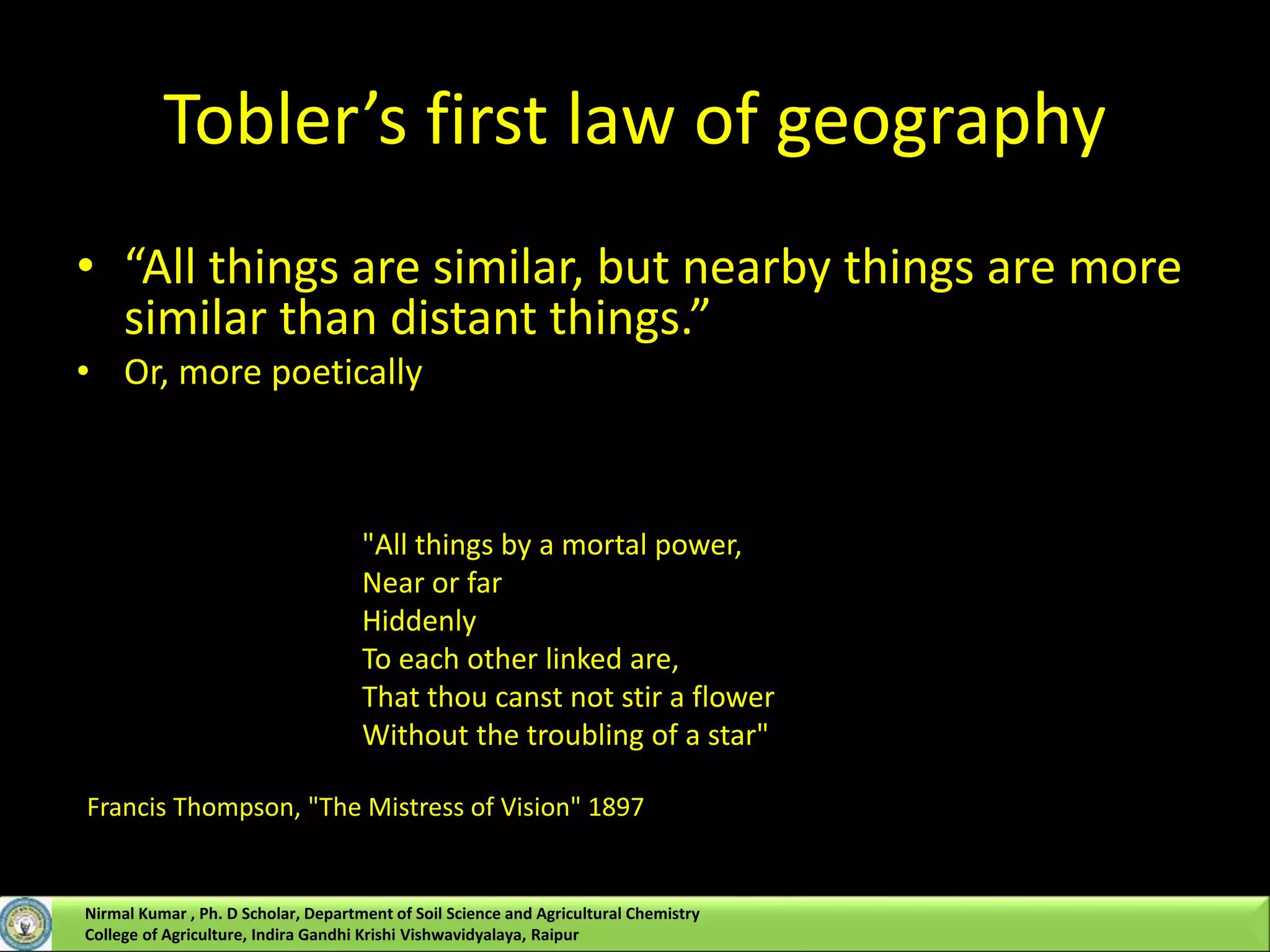
Tobler’s first law of geography
• “All things are similar, but nearby things are more
similar than distant things.”
• Or, more poetically
"All things by a mortal power,
Near or far
Hiddenly
To each other linked are,
That thou canst not stir a flower
Without the troubling of a star"
Francis Thompson, "The Mistress of Vision" 1897
Nirmal Kumar , Ph. D Scholar, Department of Soil Science and Agricultural Chemistry
College of Agriculture, Indira Gandhi Krishi Vishwavidyalaya, Raipur
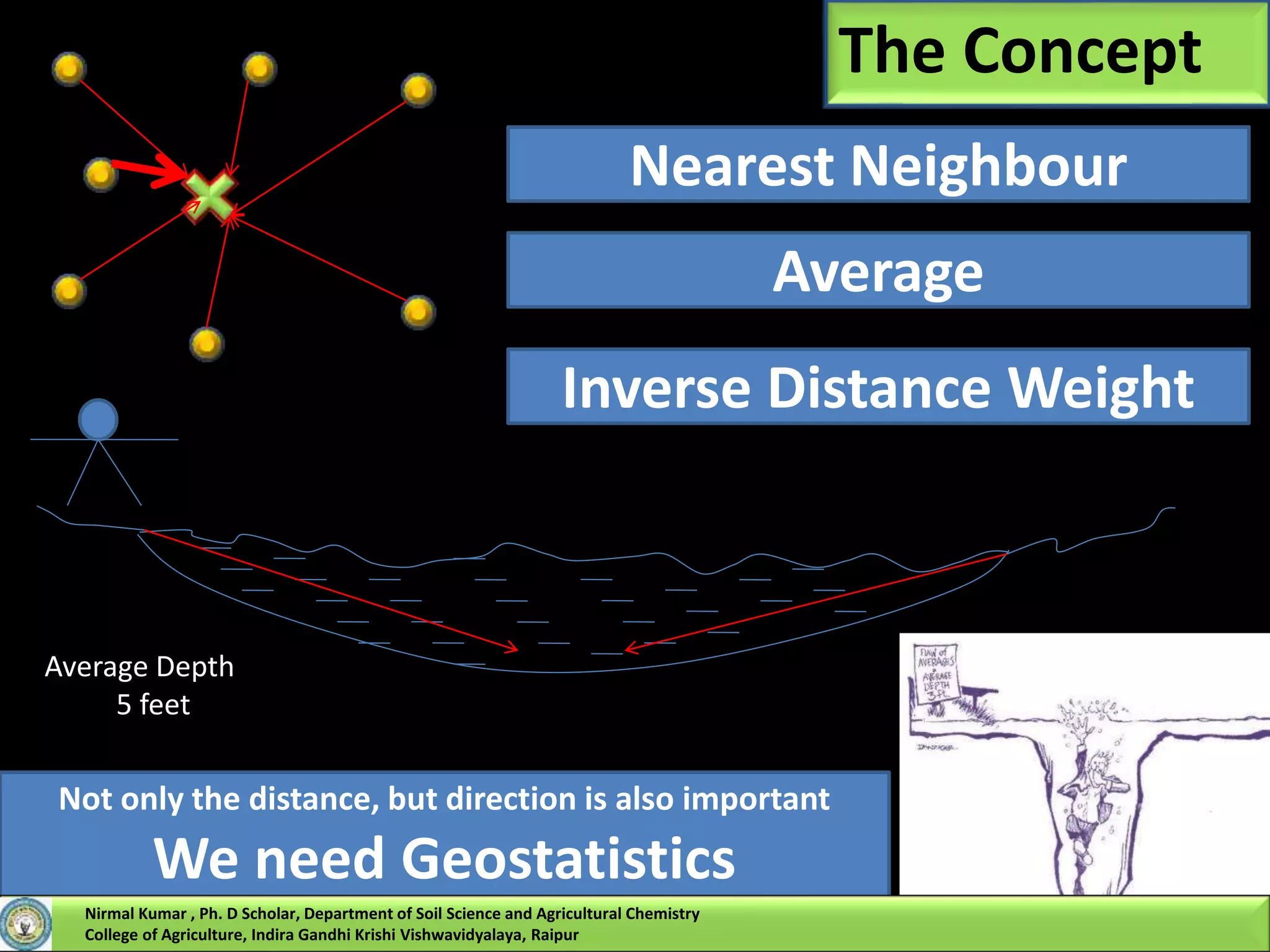
The Concept
Nearest Neighbour
Average
Average Depth
5 feet
Inverse Distance Weight
Not only the distance, but direction is also important
We need Geostatistics
Nirmal Kumar , Ph. D Scholar, Department of Soil Science and Agricultural Chemistry
College of Agriculture, Indira Gandhi Krishi Vishwavidyalaya, Raipur
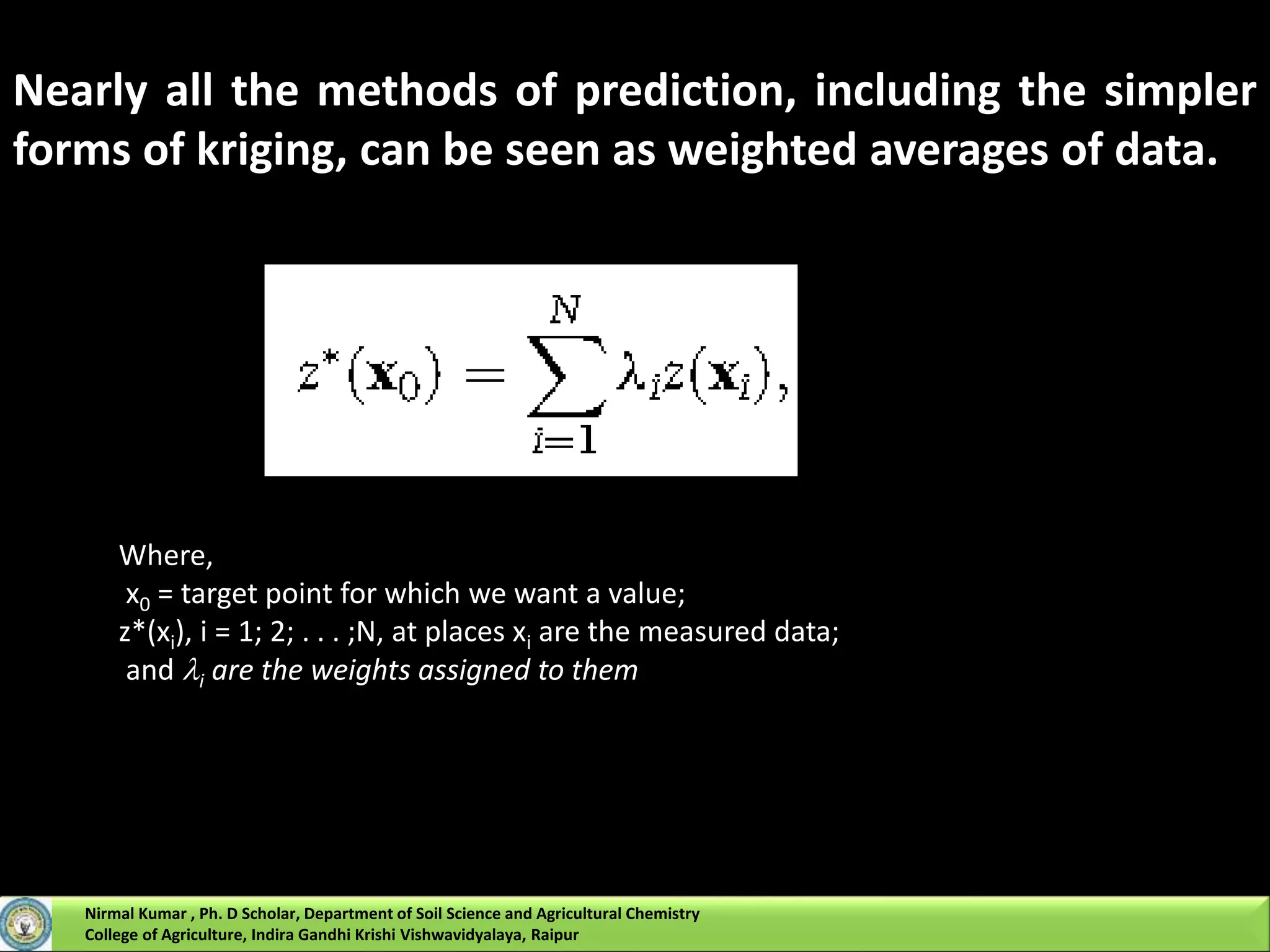
Nearly all the methods of prediction, including the simpler
forms of kriging, can be seen as weighted averages of data.
Where,
x0 = target point for which we want a value;
z*(xi), i = 1; 2; . . . ;N, at places xi are the measured data;
and i are the weights assigned to them
Nirmal Kumar , Ph. D Scholar, Department of Soil Science and Agricultural Chemistry
College of Agriculture, Indira Gandhi Krishi Vishwavidyalaya, Raipur
Nearest Neighbours
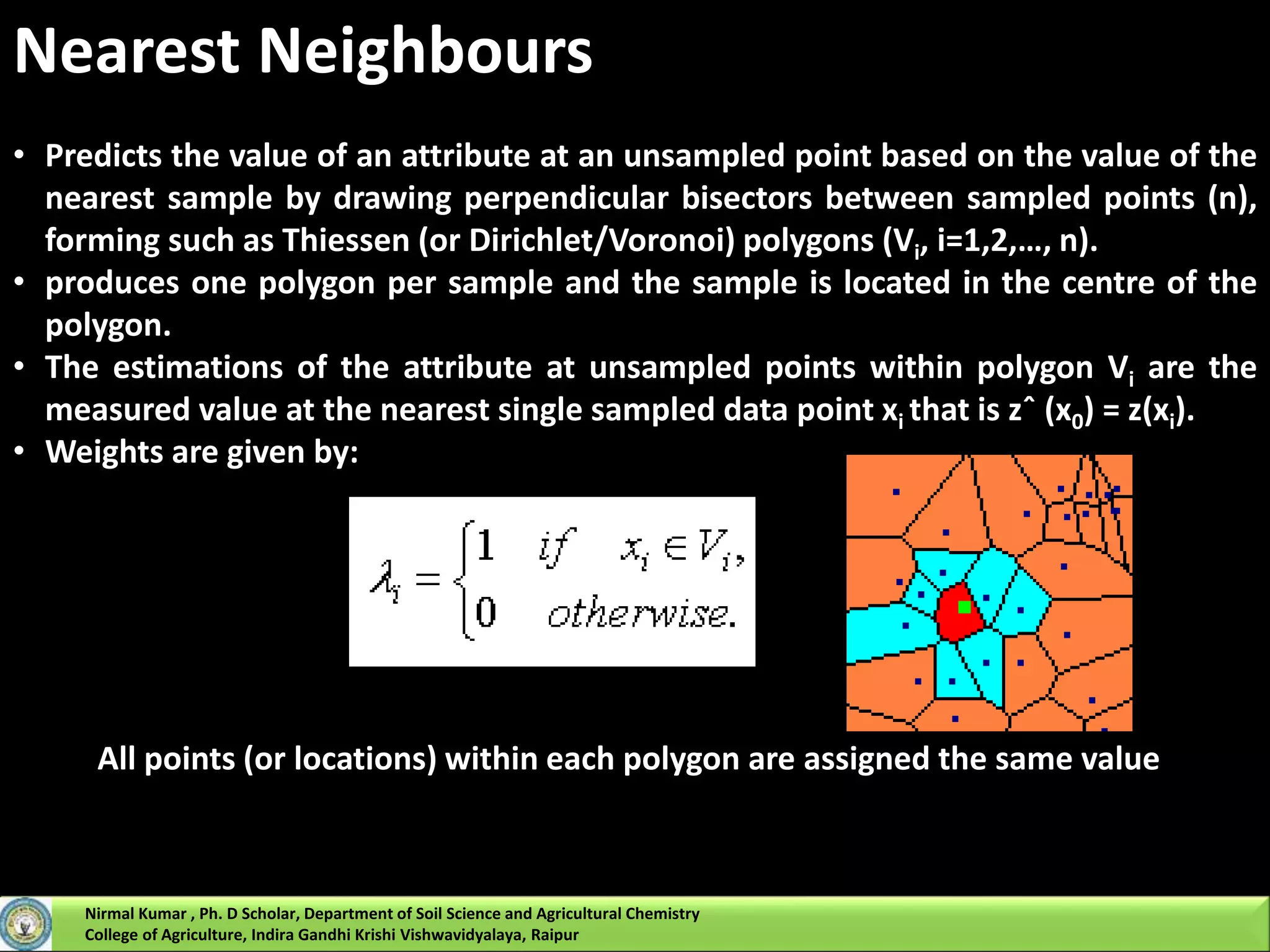
• Predicts the value of an attribute at an unsampled point based on the value of the
nearest sample by drawing perpendicular bisectors between sampled points (n),
forming such as Thiessen (or Dirichlet/Voronoi) polygons (Vi, i=1,2,…, n).
• produces one polygon per sample and the sample is located in the centre of the
polygon.
• The estimations of the attribute at unsampled points within polygon Vi are the
measured value at the nearest single sampled data point xi that is zˆ (x0) = z(xi).
• Weights are given by:
All points (or locations) within each polygon are assigned the same value
Nirmal Kumar , Ph. D Scholar, Department of Soil Science and Agricultural Chemistry
College of Agriculture, Indira Gandhi Krishi Vishwavidyalaya, Raipur
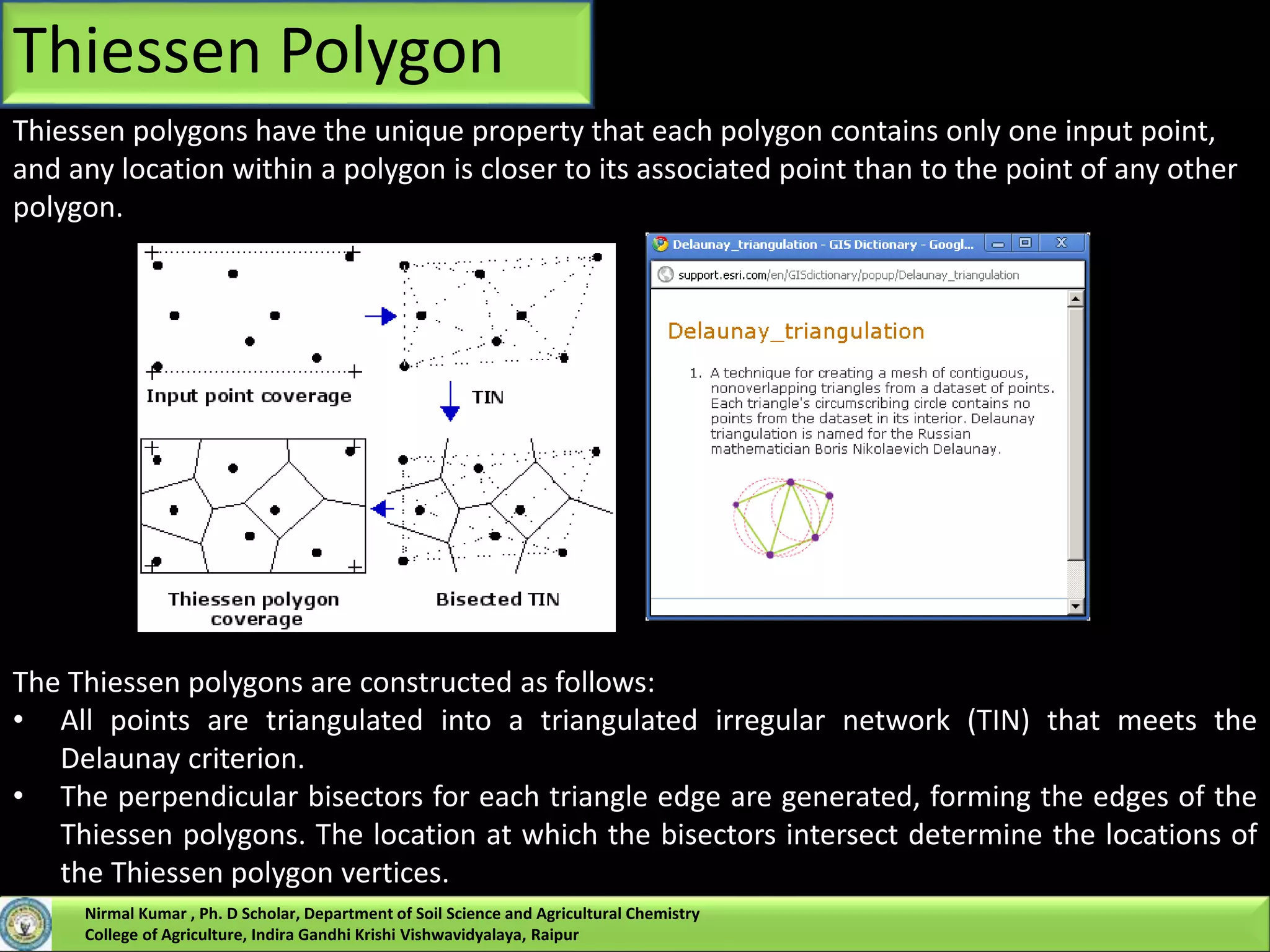
Thiessen polygons have the unique property that each polygon contains only one input point,
and any location within a polygon is closer to its associated point than to the point of any other
polygon.
The Thiessen polygons are constructed as follows:
• All points are triangulated into a triangulated irregular network (TIN) that meets the
Delaunay criterion.
• The perpendicular bisectors for each triangle edge are generated, forming the edges of the
Thiessen polygons. The location at which the bisectors intersect determine the locations of
the Thiessen polygon vertices.
Thiessen Polygon
Nirmal Kumar , Ph. D Scholar, Department of Soil Science and Agricultural Chemistry
College of Agriculture, Indira Gandhi Krishi Vishwavidyalaya, Raipur
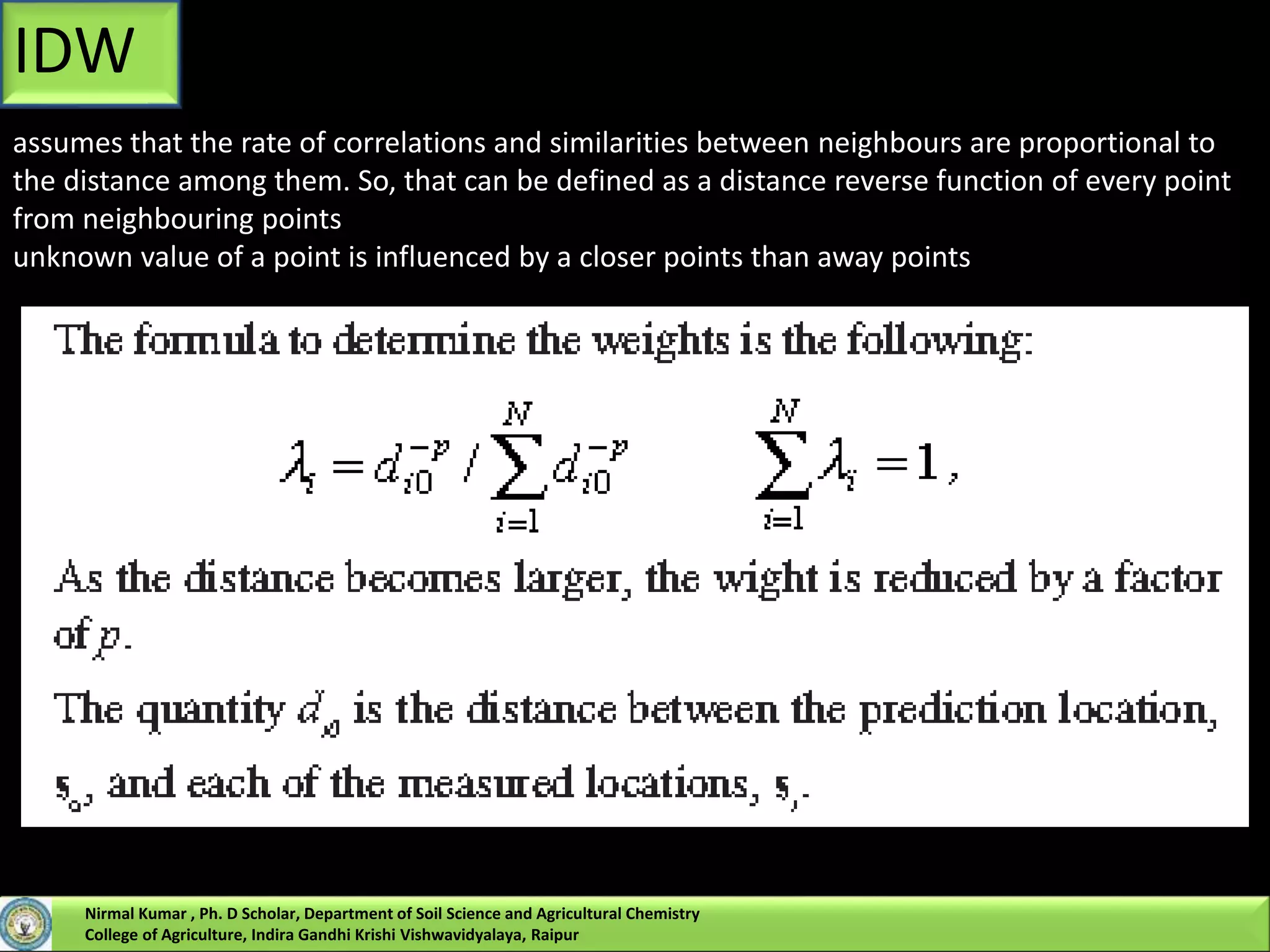
IDW
assumes that the rate of correlations and similarities between neighbours are proportional to
the distance among them. So, that can be defined as a distance reverse function of every point
from neighbouring points
unknown value of a point is influenced by a closer points than away points
Nirmal Kumar , Ph. D Scholar, Department of Soil Science and Agricultural Chemistry
College of Agriculture, Indira Gandhi Krishi Vishwavidyalaya, Raipur
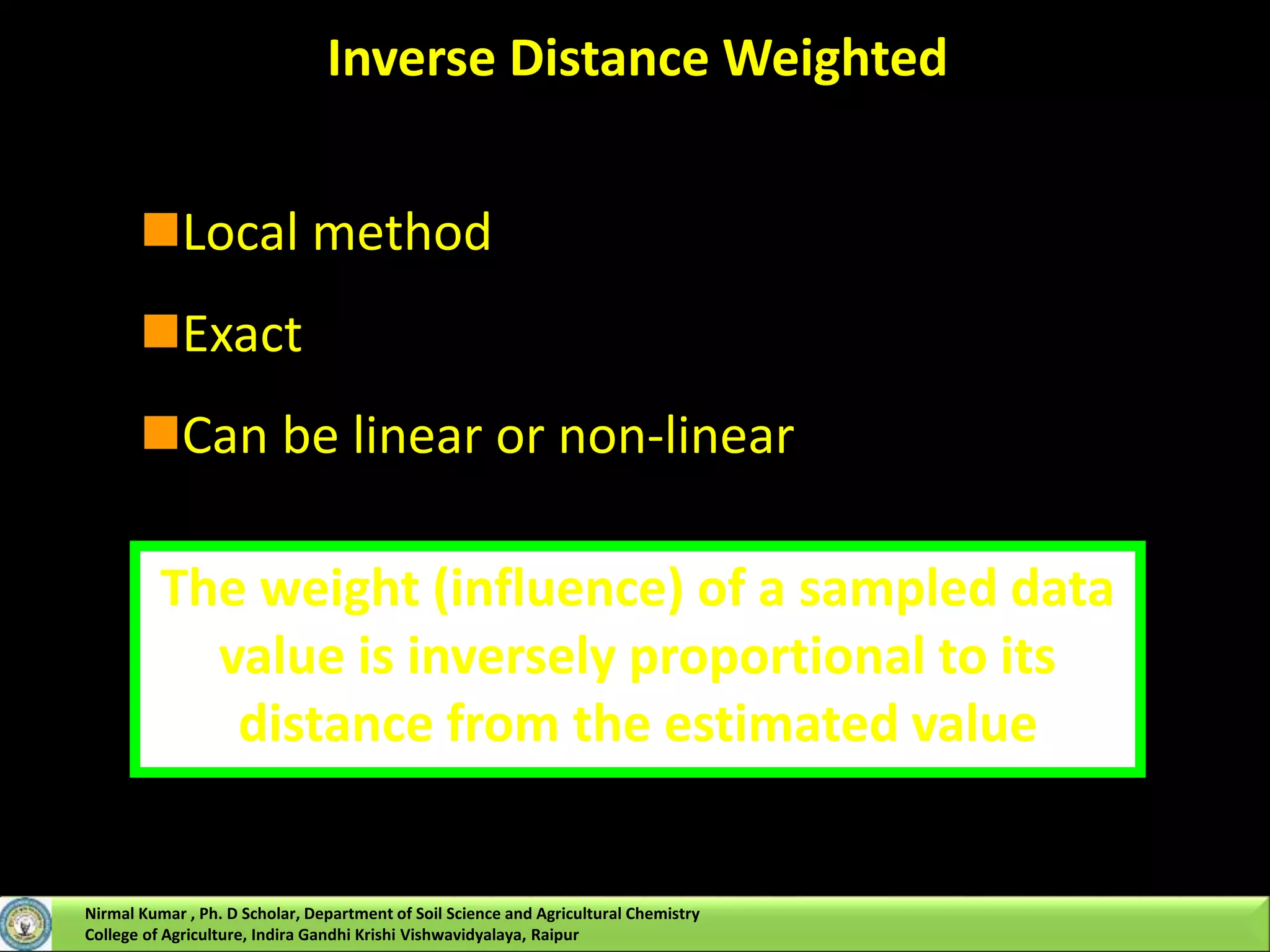
Inverse Distance Weighted
Local method
Exact
Can be linear or non-linear
The weight (influence) of a sampled data
value is inversely proportional to its
distance from the estimated value
Nirmal Kumar , Ph. D Scholar, Department of Soil Science and Agricultural Chemistry
College of Agriculture, Indira Gandhi Krishi Vishwavidyalaya, Raipur
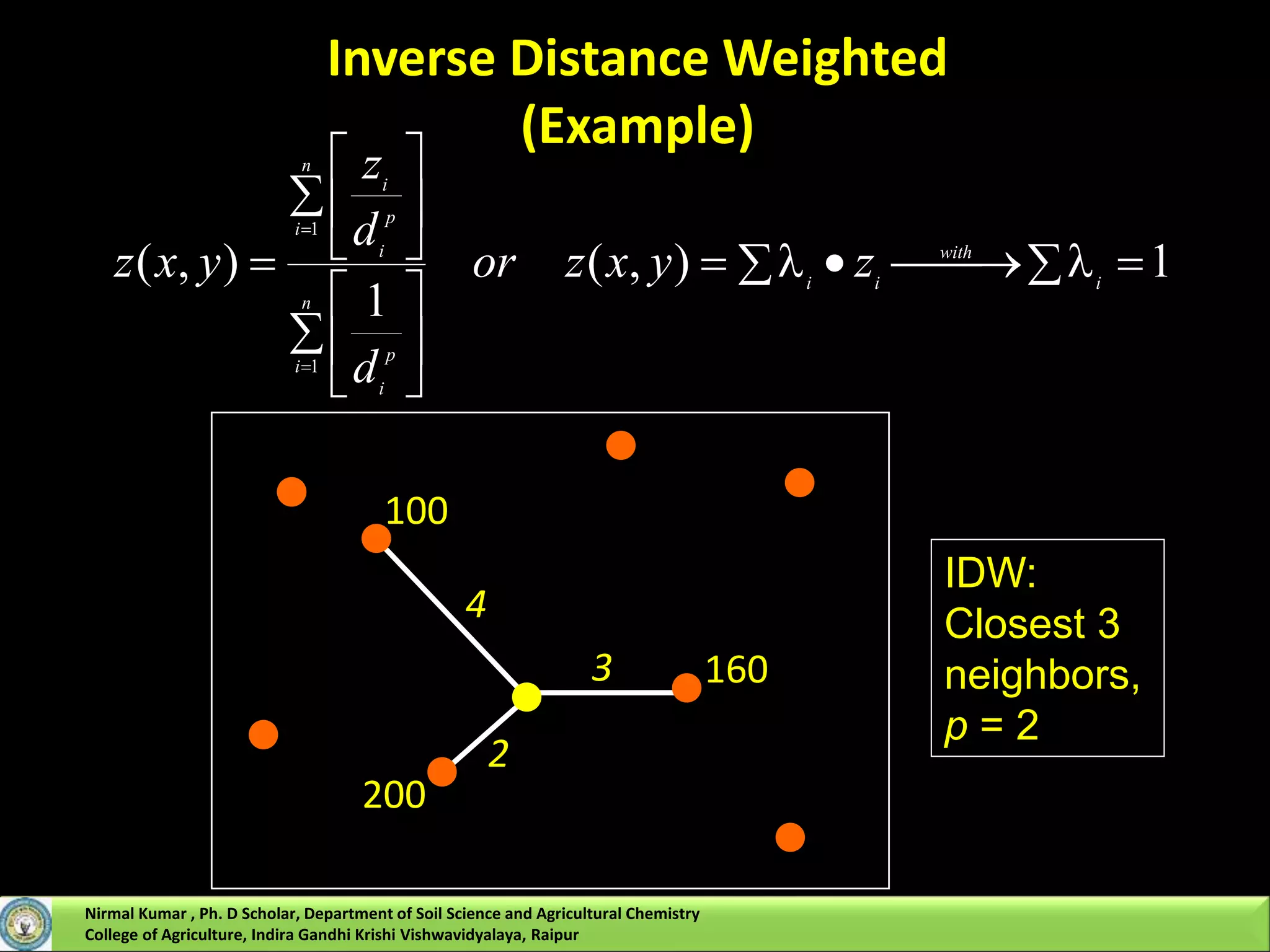
Inverse Distance Weighted
(Example)
4
3
2
100
160
IDW:
Closest 3
neighbors,
p = 2
200
  
 





 








1),(
1
),(
1
1
i
with
ii
n
i
p
i
n
i
p
i
i
zyxzor
d
d
z
yxz
Nirmal Kumar , Ph. D Scholar, Department of Soil Science and Agricultural Chemistry
College of Agriculture, Indira Gandhi Krishi Vishwavidyalaya, Raipur
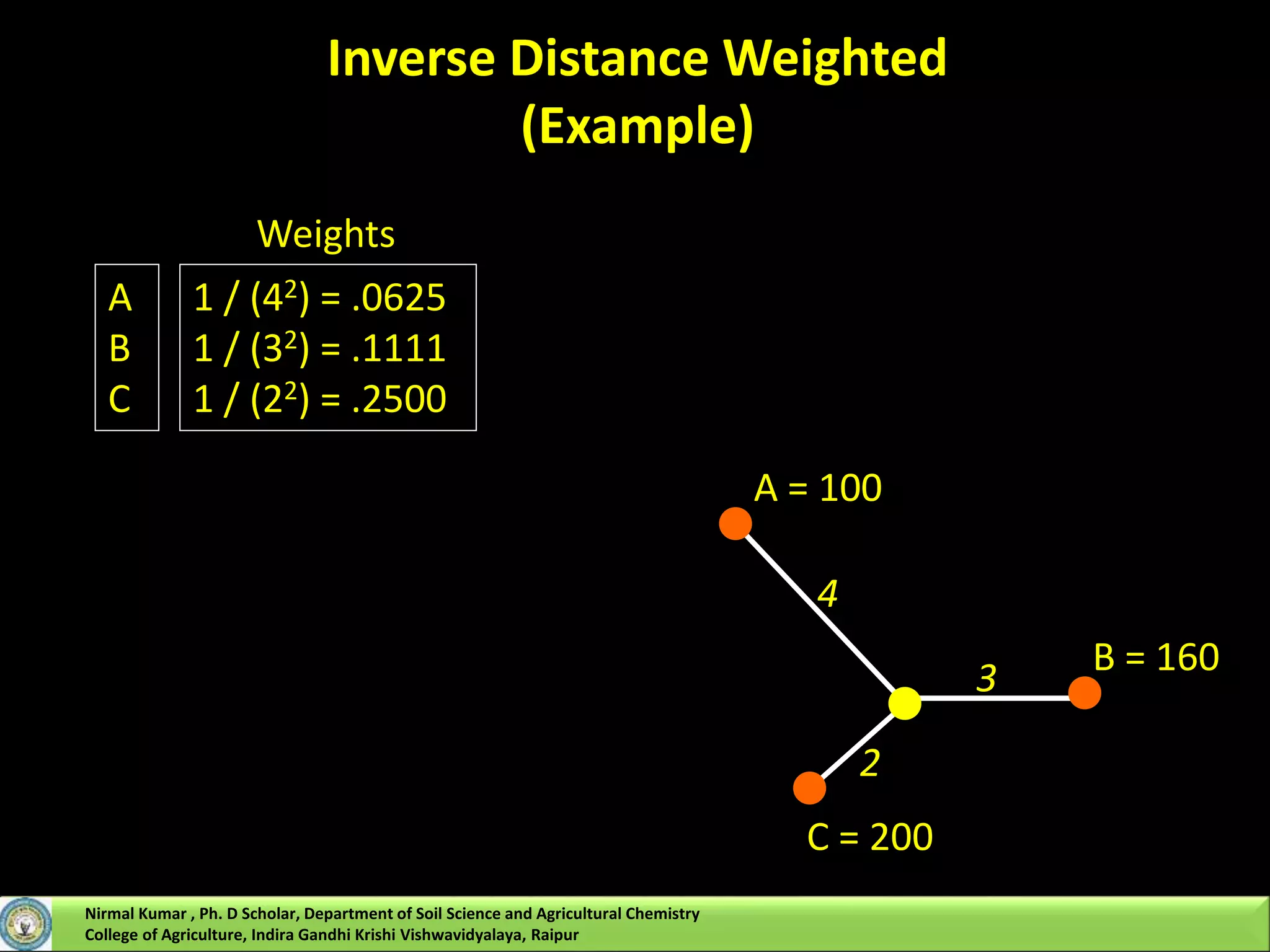
Inverse Distance Weighted
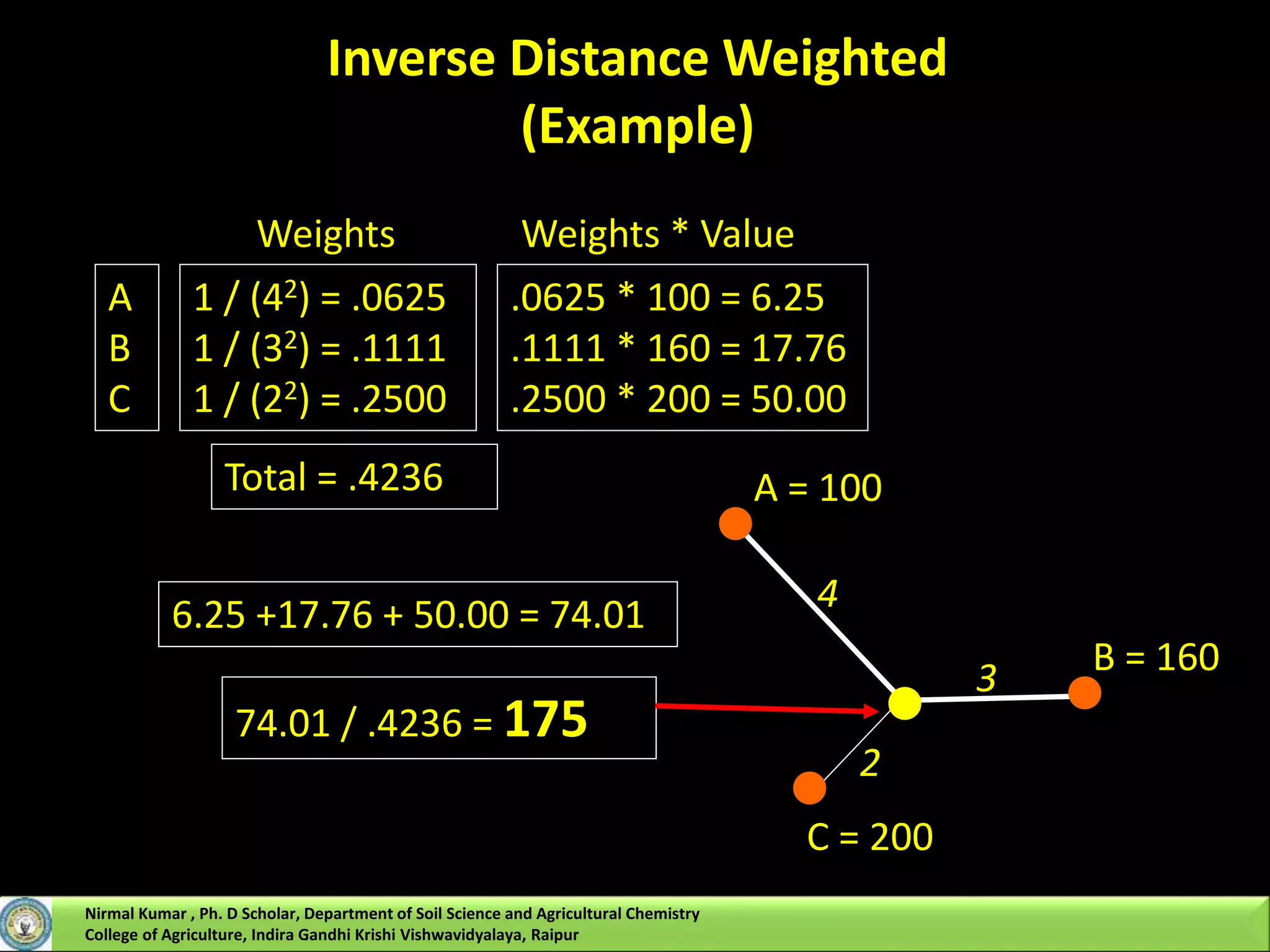
(Example)
4
3
2
A = 100
B = 160
C = 200
1 / (42) = .0625
1 / (32) = .1111
1 / (22) = .2500
Weights
A
B
C
Nirmal Kumar , Ph. D Scholar, Department of Soil Science and Agricultural Chemistry
College of Agriculture, Indira Gandhi Krishi Vishwavidyalaya, Raipur
Inverse Distance Weighted
(Example)
1 / (42) = .0625
1 / (32) = .1111
1 / (22) = .2500
.0625 * 100 = 6.25
.1111 * 160 = 17.76
.2500 * 200 = 50.00
Weights Weights * Value
A
B
C
74.01 / .4236 = 175
Total = .4236
6.25 +17.76 + 50.00 = 74.01
4
3
2
A = 100
B = 160
C = 200
Nirmal Kumar , Ph. D Scholar, Department of Soil Science and Agricultural Chemistry
College of Agriculture, Indira Gandhi Krishi Vishwavidyalaya, Raipur
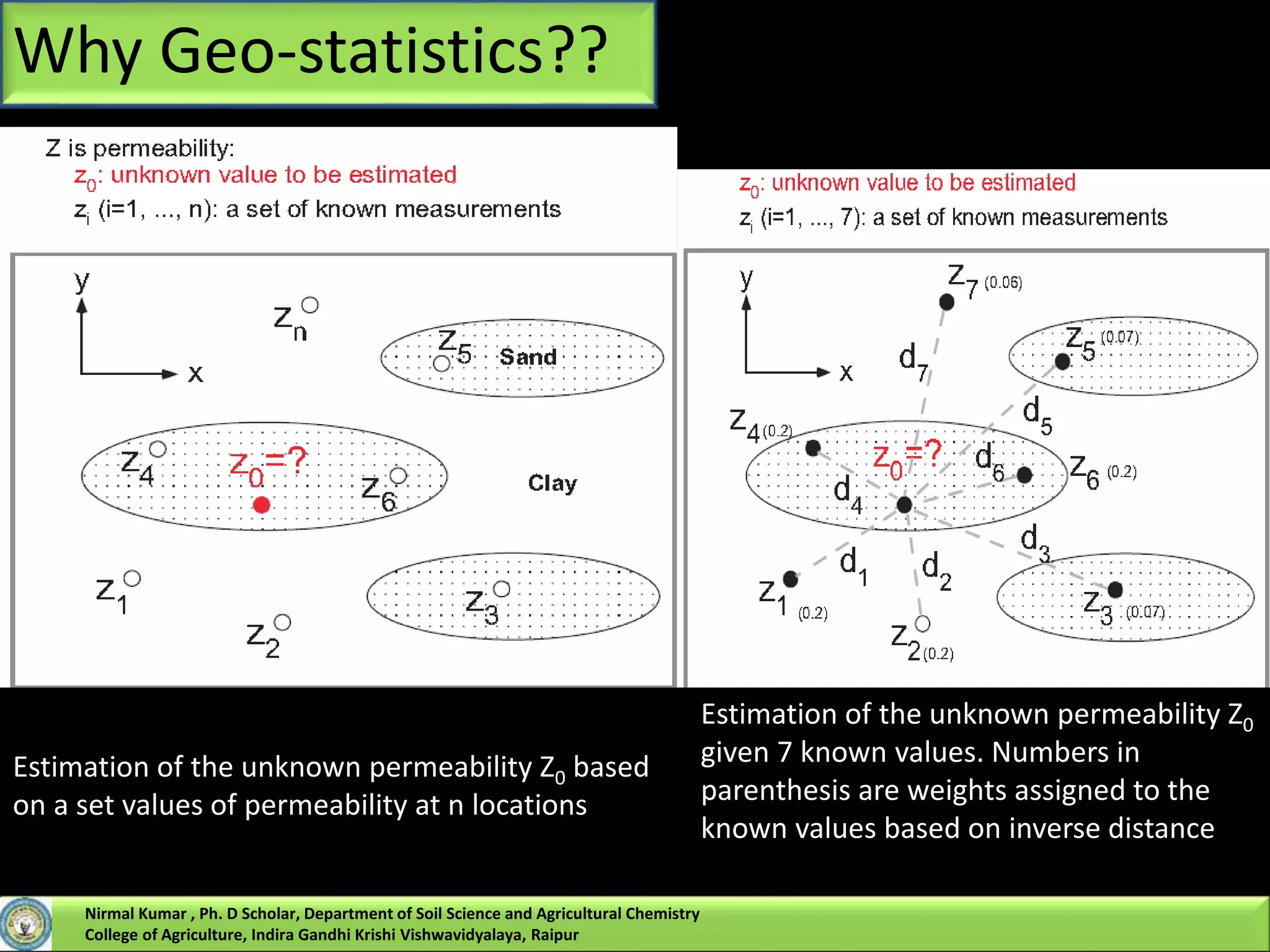
Why Geo-statistics??
Estimation of the unknown permeability Z0 based
on a set values of permeability at n locations
Estimation of the unknown permeability Z0
given 7 known values. Numbers in
parenthesis are weights assigned to the
known values based on inverse distance
Nirmal Kumar , Ph. D Scholar, Department of Soil Science and Agricultural Chemistry
College of Agriculture, Indira Gandhi Krishi Vishwavidyalaya, Raipur
• Ordinary,
• Simple,
• Universal,
• Indicator,
• Probability,
• And Disjunctive Kriging.
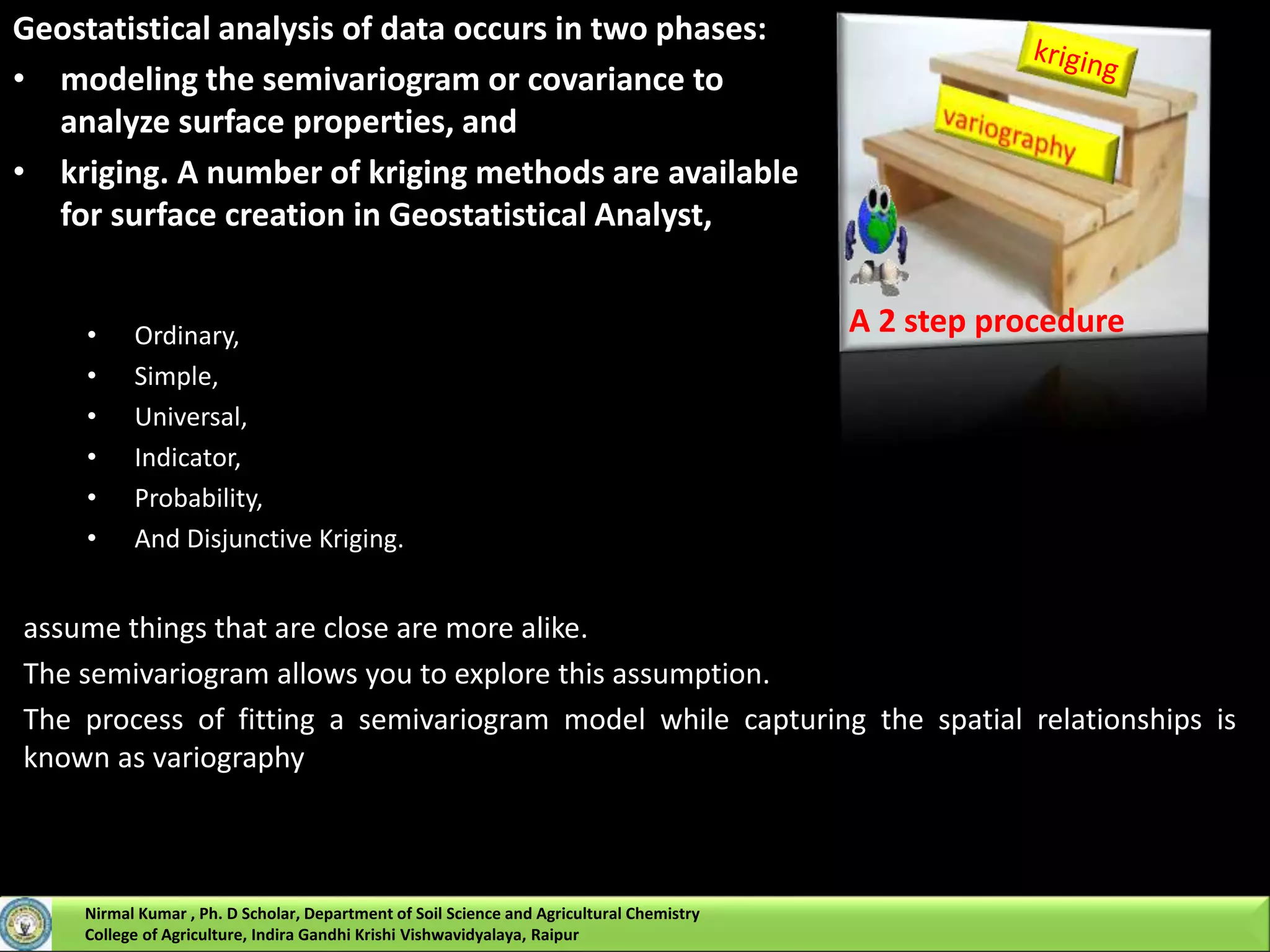
assume things that are close are more alike.
The semivariogram allows you to explore this assumption.
The process of fitting a semivariogram model while capturing the spatial relationships is
known as variography
A 2 step procedure
Geostatistical analysis of data occurs in two phases:
• modeling the semivariogram or covariance to
analyze surface properties, and
• kriging. A number of kriging methods are available
for surface creation in Geostatistical Analyst,
Nirmal Kumar , Ph. D Scholar, Department of Soil Science and Agricultural Chemistry
College of Agriculture, Indira Gandhi Krishi Vishwavidyalaya, Raipur
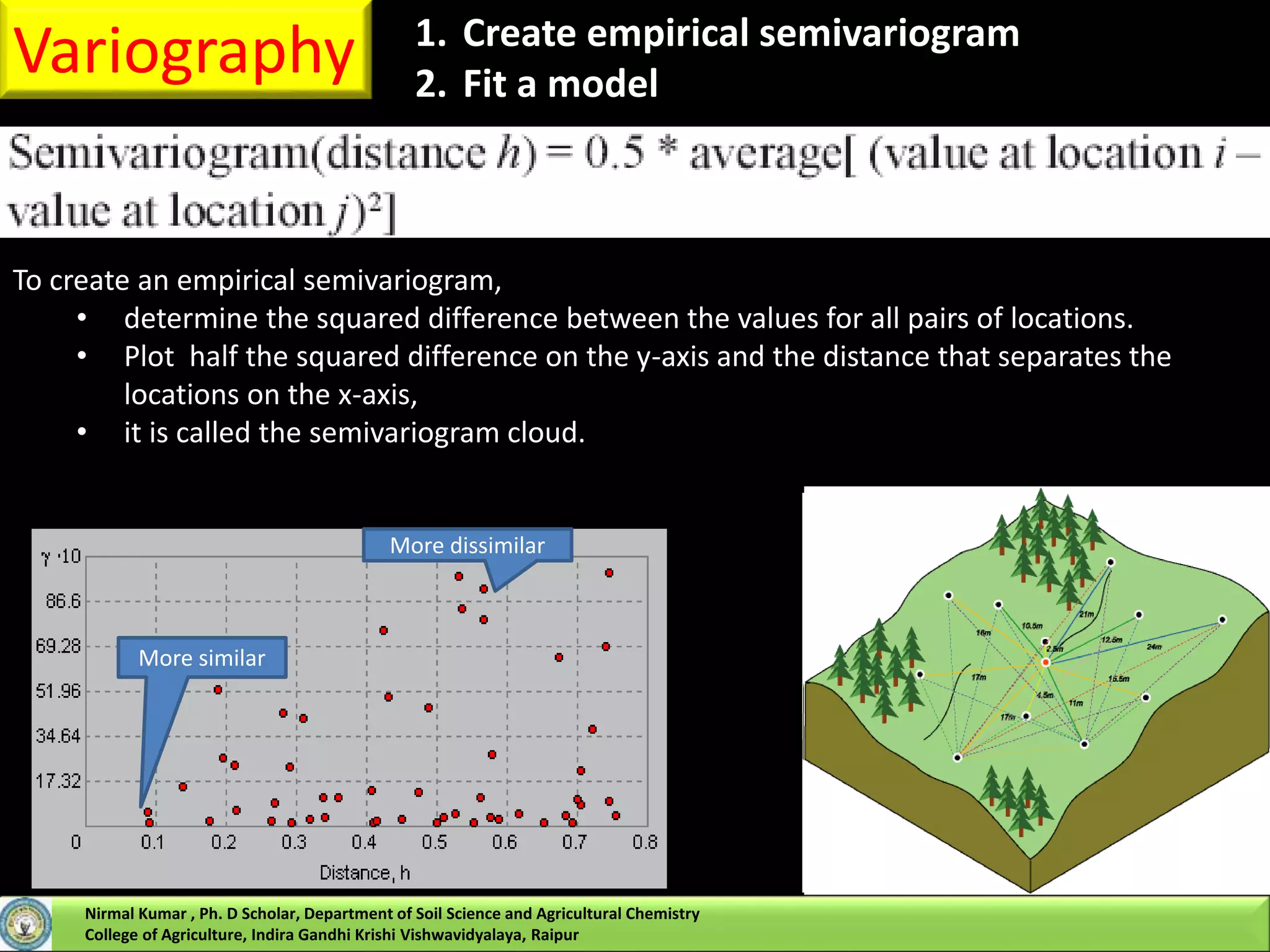
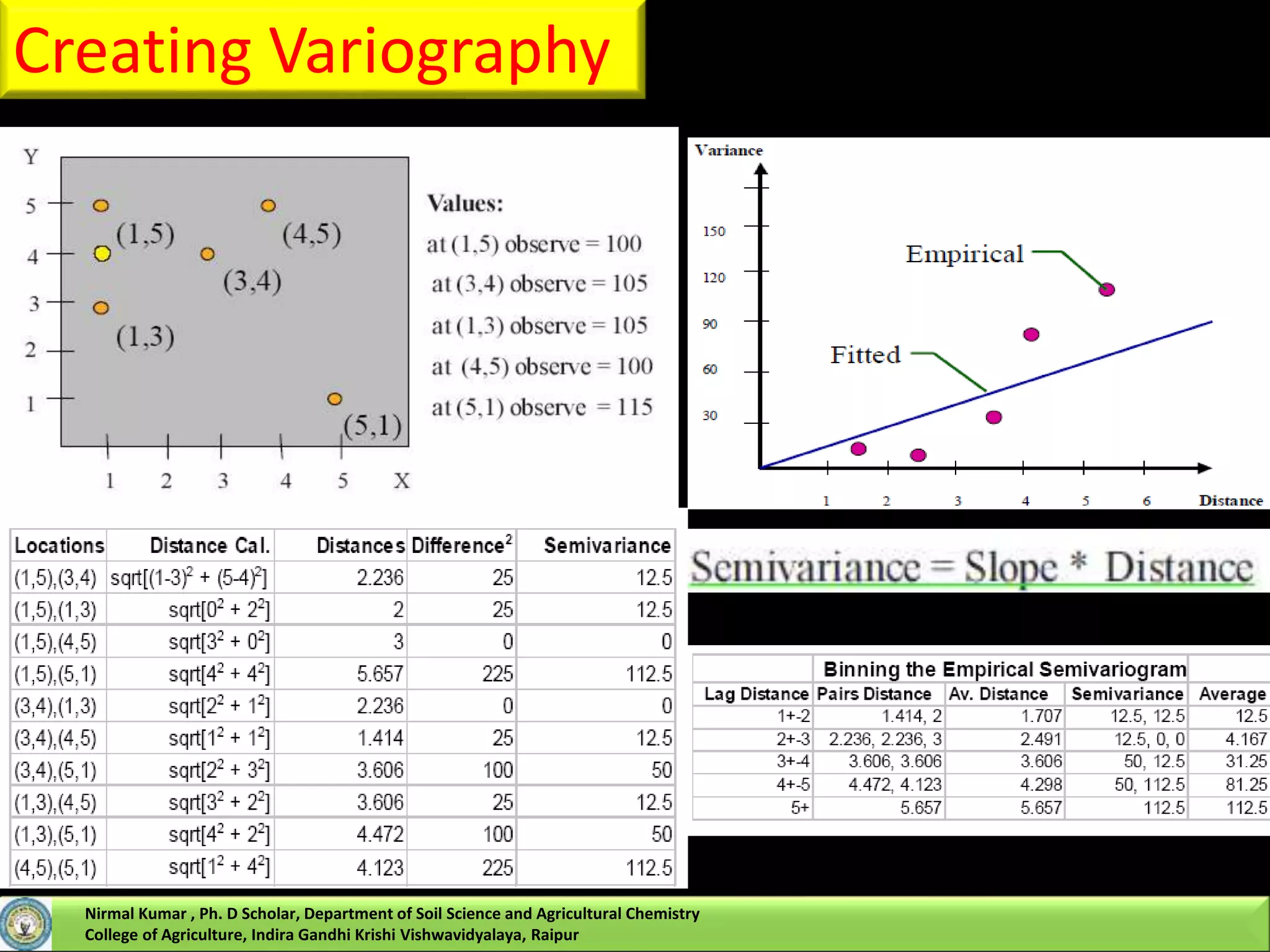
To create an empirical semivariogram,
• determine the squared difference between the values for all pairs of locations.
• Plot half the squared difference on the y-axis and the distance that separates the
locations on the x-axis,
• it is called the semivariogram cloud.
Variography
More similar
More dissimilar
1. Create empirical semivariogram
2. Fit a model
Nirmal Kumar , Ph. D Scholar, Department of Soil Science and Agricultural Chemistry
College of Agriculture, Indira Gandhi Krishi Vishwavidyalaya, Raipur
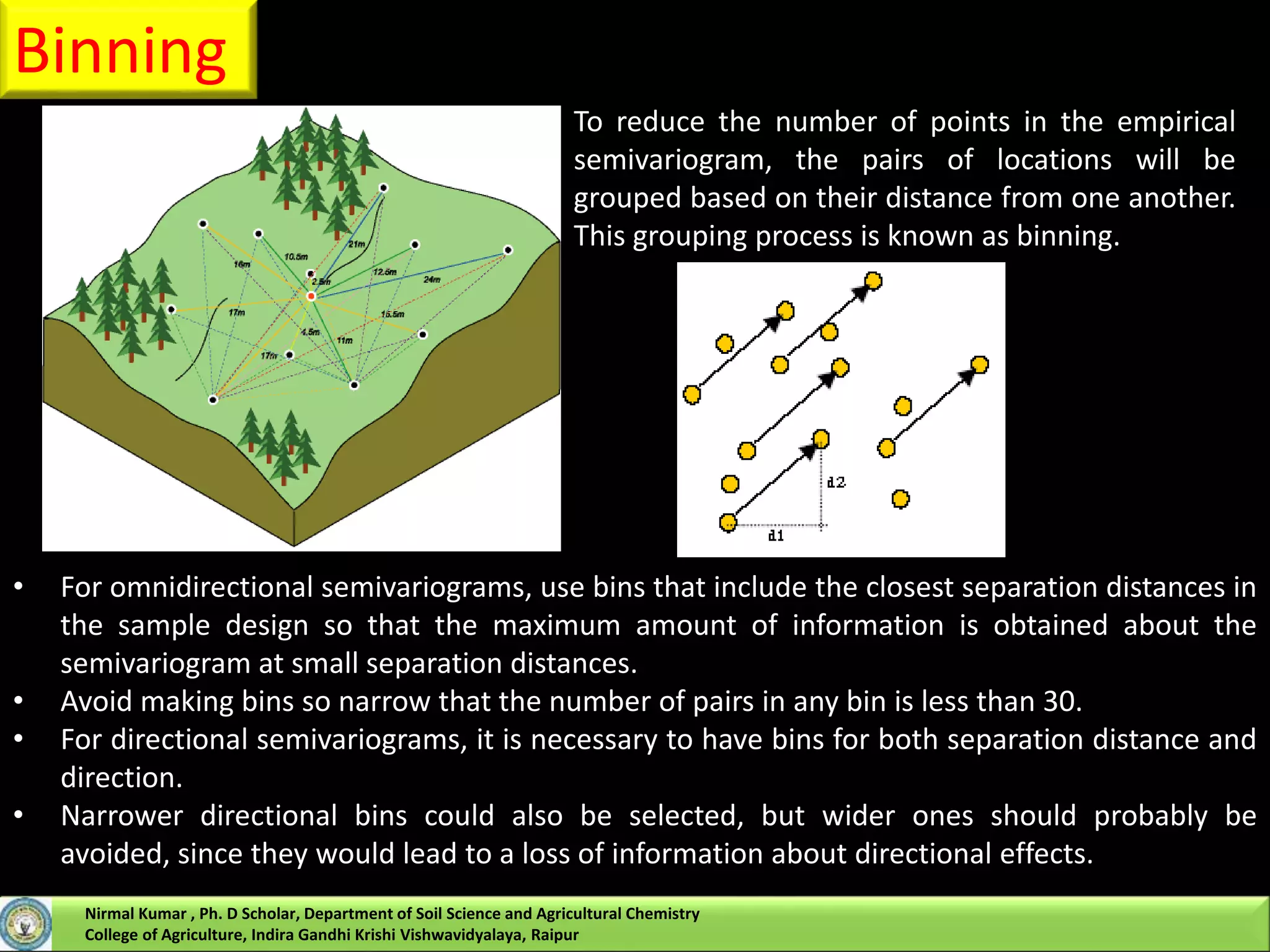
Binning
To reduce the number of points in the empirical
semivariogram, the pairs of locations will be
grouped based on their distance from one another.
This grouping process is known as binning.
• For omnidirectional semivariograms, use bins that include the closest separation distances in
the sample design so that the maximum amount of information is obtained about the
semivariogram at small separation distances.
• Avoid making bins so narrow that the number of pairs in any bin is less than 30.
• For directional semivariograms, it is necessary to have bins for both separation distance and
direction.
• Narrower directional bins could also be selected, but wider ones should probably be
avoided, since they would lead to a loss of information about directional effects.
Nirmal Kumar , Ph. D Scholar, Department of Soil Science and Agricultural Chemistry
College of Agriculture, Indira Gandhi Krishi Vishwavidyalaya, Raipur
Creating Variography
Nirmal Kumar , Ph. D Scholar, Department of Soil Science and Agricultural Chemistry
College of Agriculture, Indira Gandhi Krishi Vishwavidyalaya, Raipur
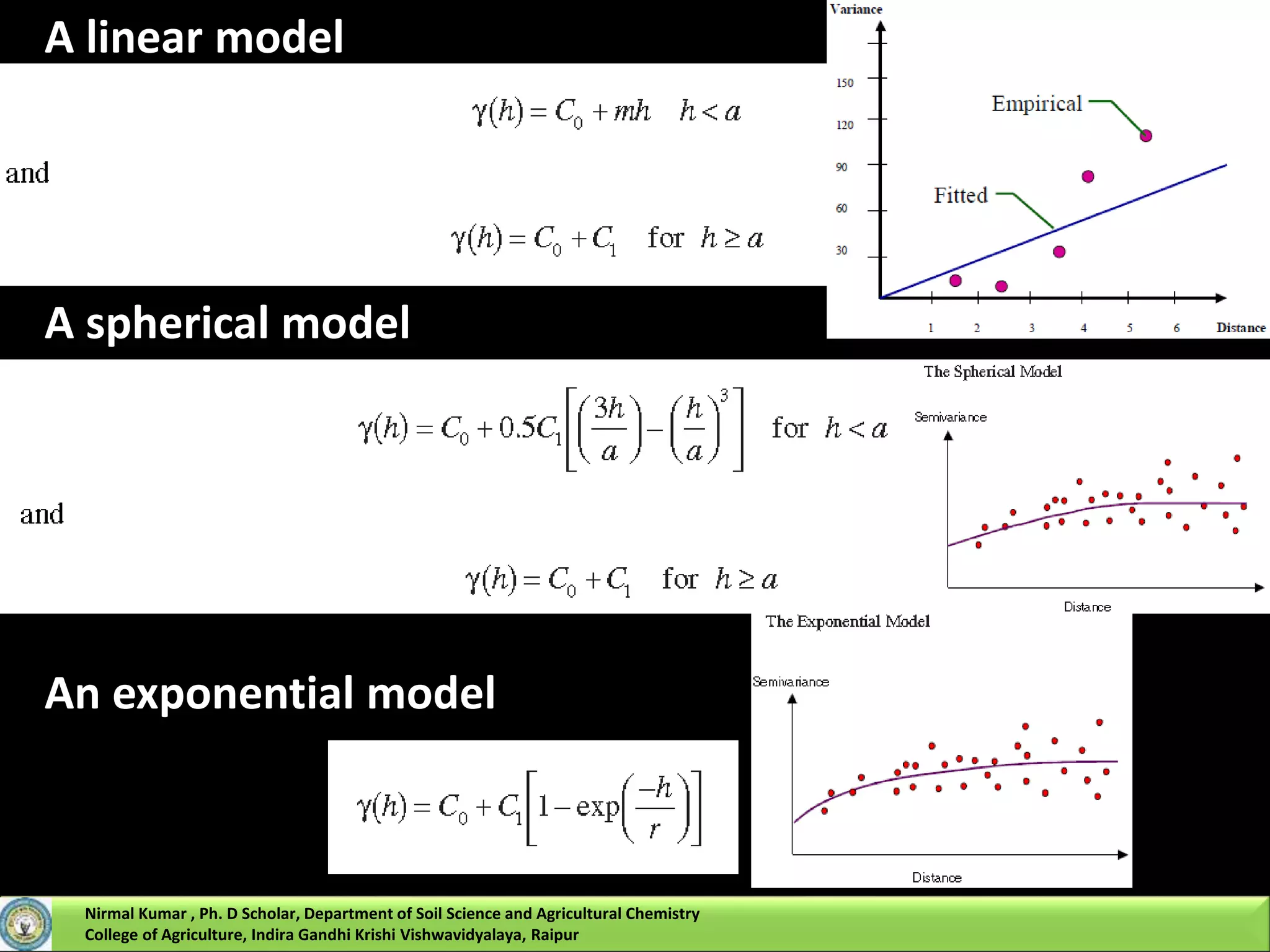
A linear model
A spherical model
An exponential model
Nirmal Kumar , Ph. D Scholar, Department of Soil Science and Agricultural Chemistry
College of Agriculture, Indira Gandhi Krishi Vishwavidyalaya, Raipur
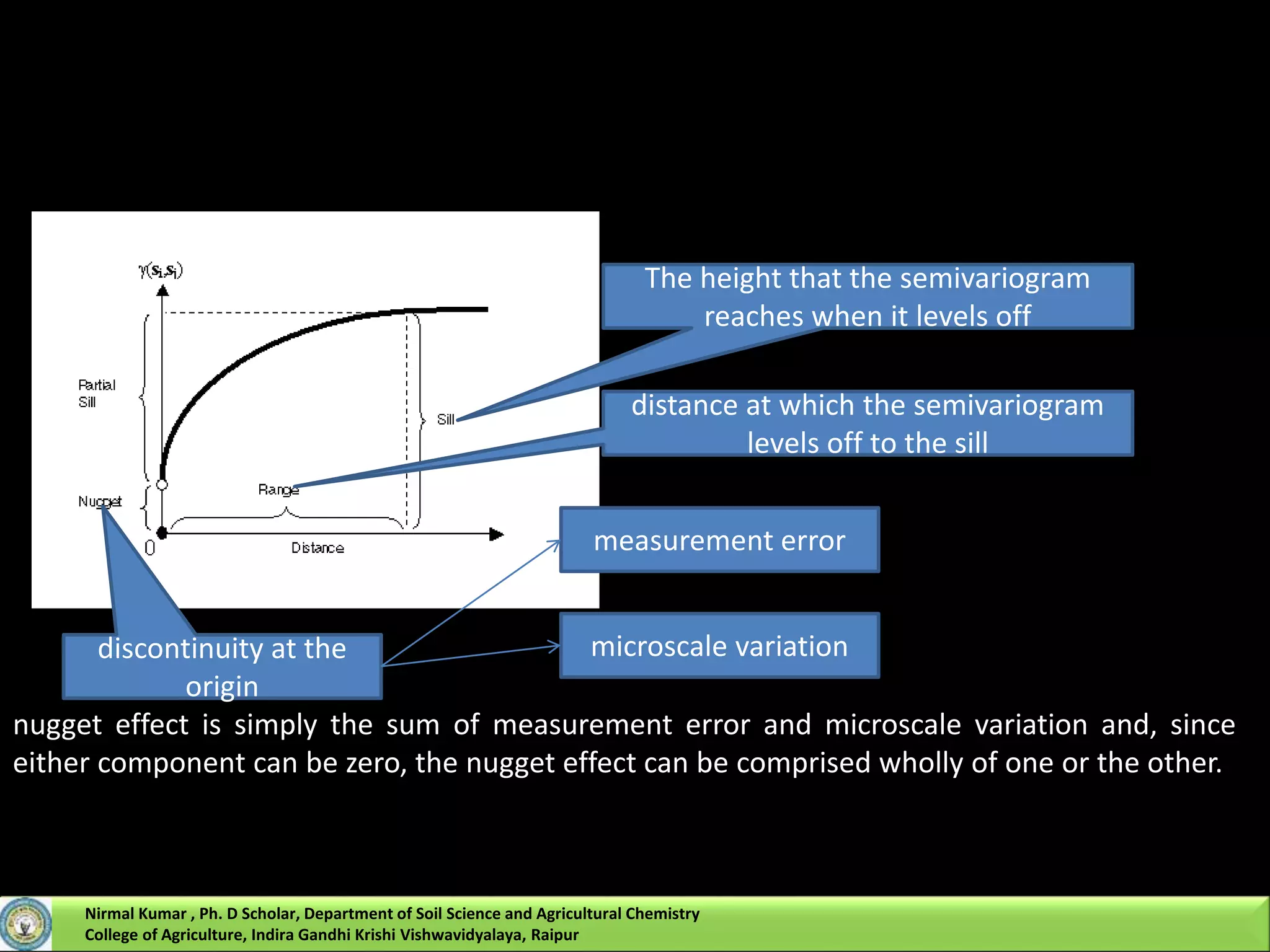
nugget effect is simply the sum of measurement error and microscale variation and, since
either component can be zero, the nugget effect can be comprised wholly of one or the other.
The height that the semivariogram
reaches when it levels off
discontinuity at the
origin
microscale variation
measurement error
distance at which the semivariogram
levels off to the sill
Nirmal Kumar , Ph. D Scholar, Department of Soil Science and Agricultural Chemistry
College of Agriculture, Indira Gandhi Krishi Vishwavidyalaya, Raipur
Kriging
Like IDW interpolation, kriging forms weights from surrounding measured values to predict
values at unmeasured locations.
As with IDW interpolation, the closest measured values usually have the most influence.
However, IDW uses a simple algorithm based on distance, but kriging weights come from a
semivariogram that was developed by viewing the spatial structure of the data.
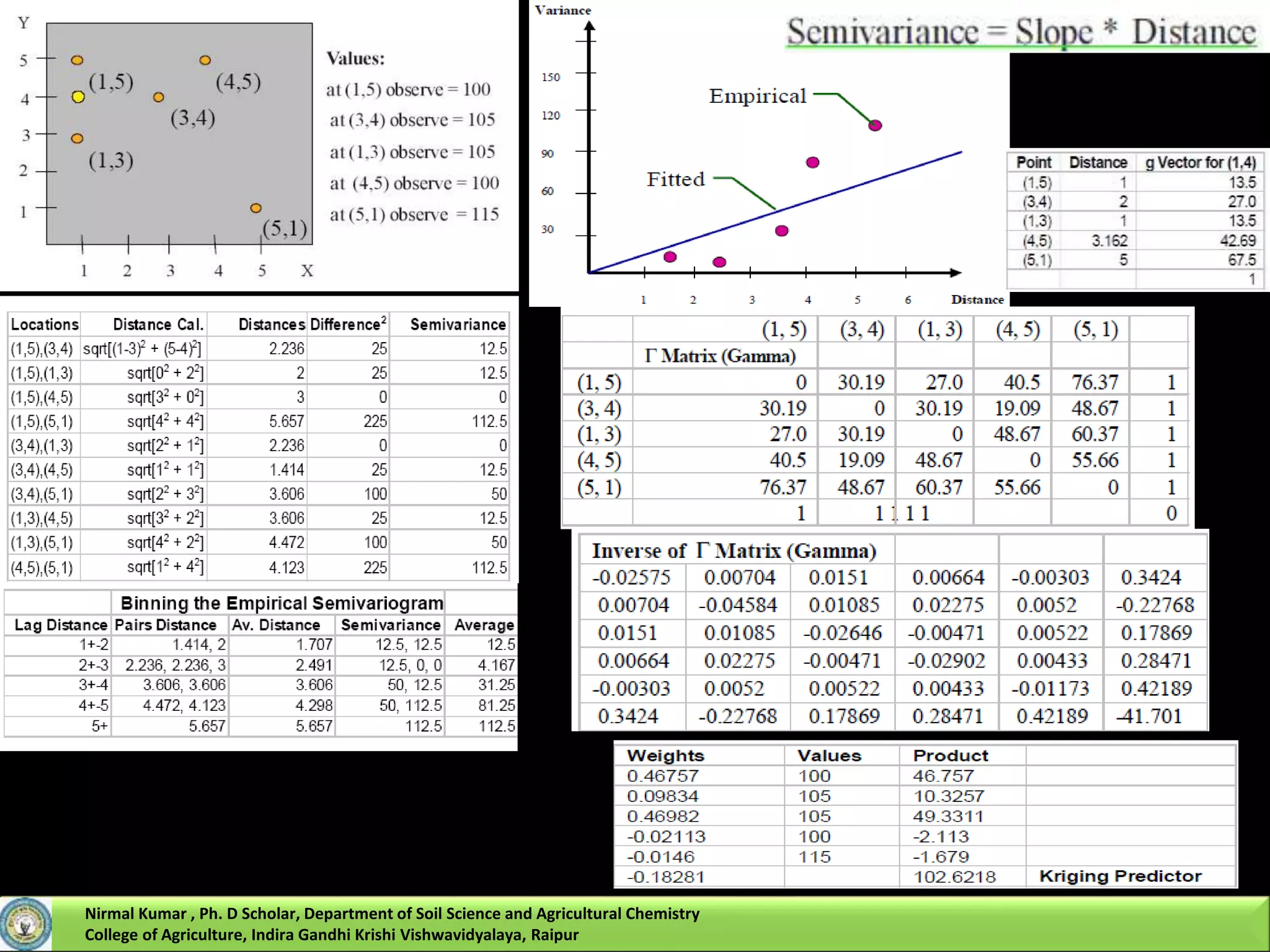
1. Create the Г – matrix and g-vector,
2. Calculate weights ʎ, and
3. Make a prediction
The key step in kriging is to estimate the n weighting factors for locations that neighbor the
unsampled location where interpolation is to occur.
a set of N+1 simultaneous equations with N+1 unknowns (the N weighting factors and the
undetermined Lagrangian multiplier).
Where,
[Г] is an N+1 by N+1 matrix of semivariogram values between measured locations,
[ʎ] is an N+1 by 1 matrix of weighting factors and the Lagrangian multiplier, and
[g] is an N+1 by 1 matrix of semivariogram values between the interpolated location and its neighboring
locations.
Nirmal Kumar , Ph. D Scholar, Department of Soil Science and Agricultural Chemistry
College of Agriculture, Indira Gandhi Krishi Vishwavidyalaya, Raipur
Nirmal Kumar , Ph. D Scholar, Department of Soil Science and Agricultural Chemistry
College of Agriculture, Indira Gandhi Krishi Vishwavidyalaya, Raipur
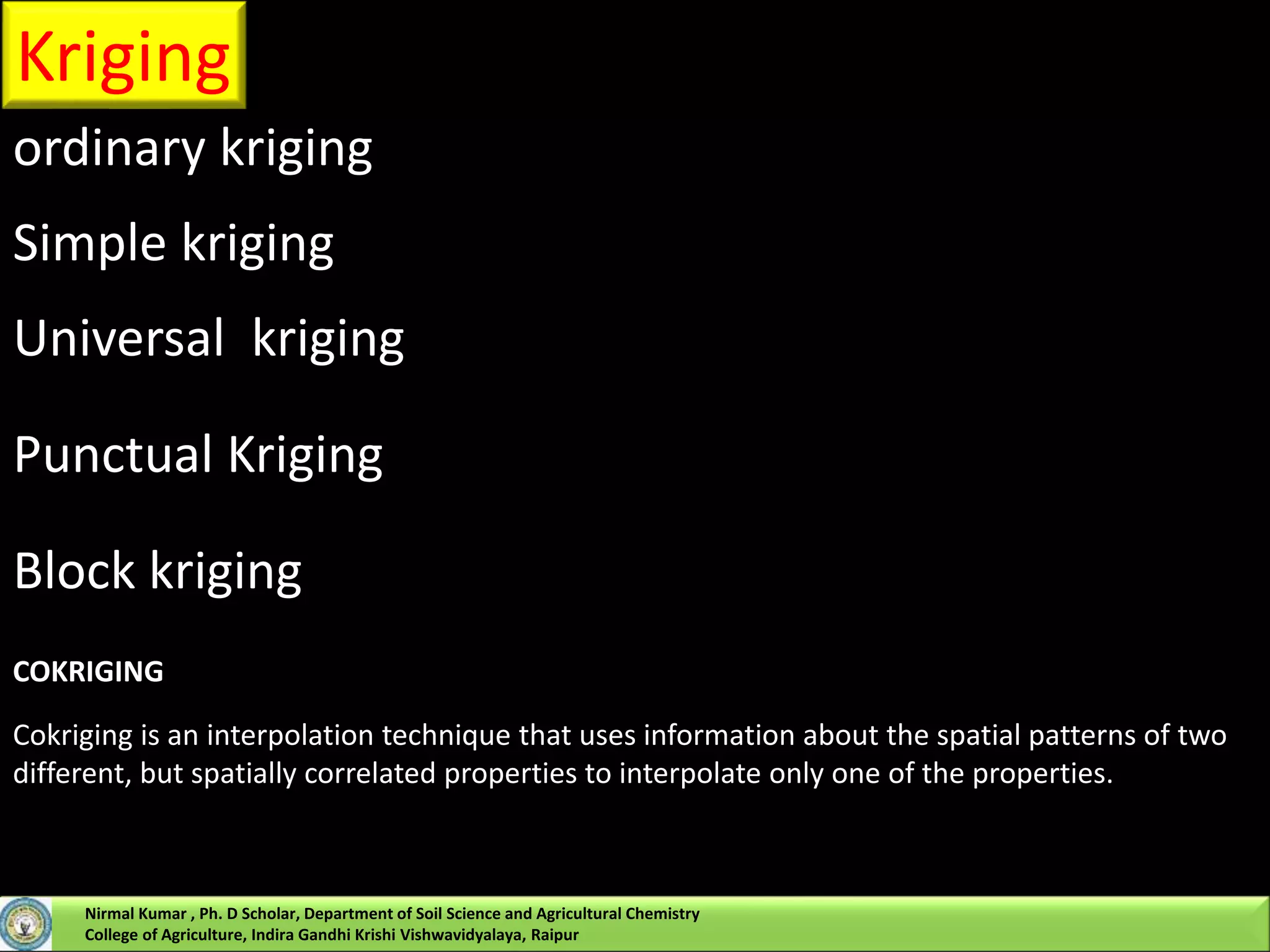
Kriging
ordinary kriging
Simple kriging
Universal kriging
Punctual Kriging
Block kriging
COKRIGING
Cokriging is an interpolation technique that uses information about the spatial patterns of two
different, but spatially correlated properties to interpolate only one of the properties.
Nirmal Kumar , Ph. D Scholar, Department of Soil Science and Agricultural Chemistry
College of Agriculture, Indira Gandhi Krishi Vishwavidyalaya, Raipur
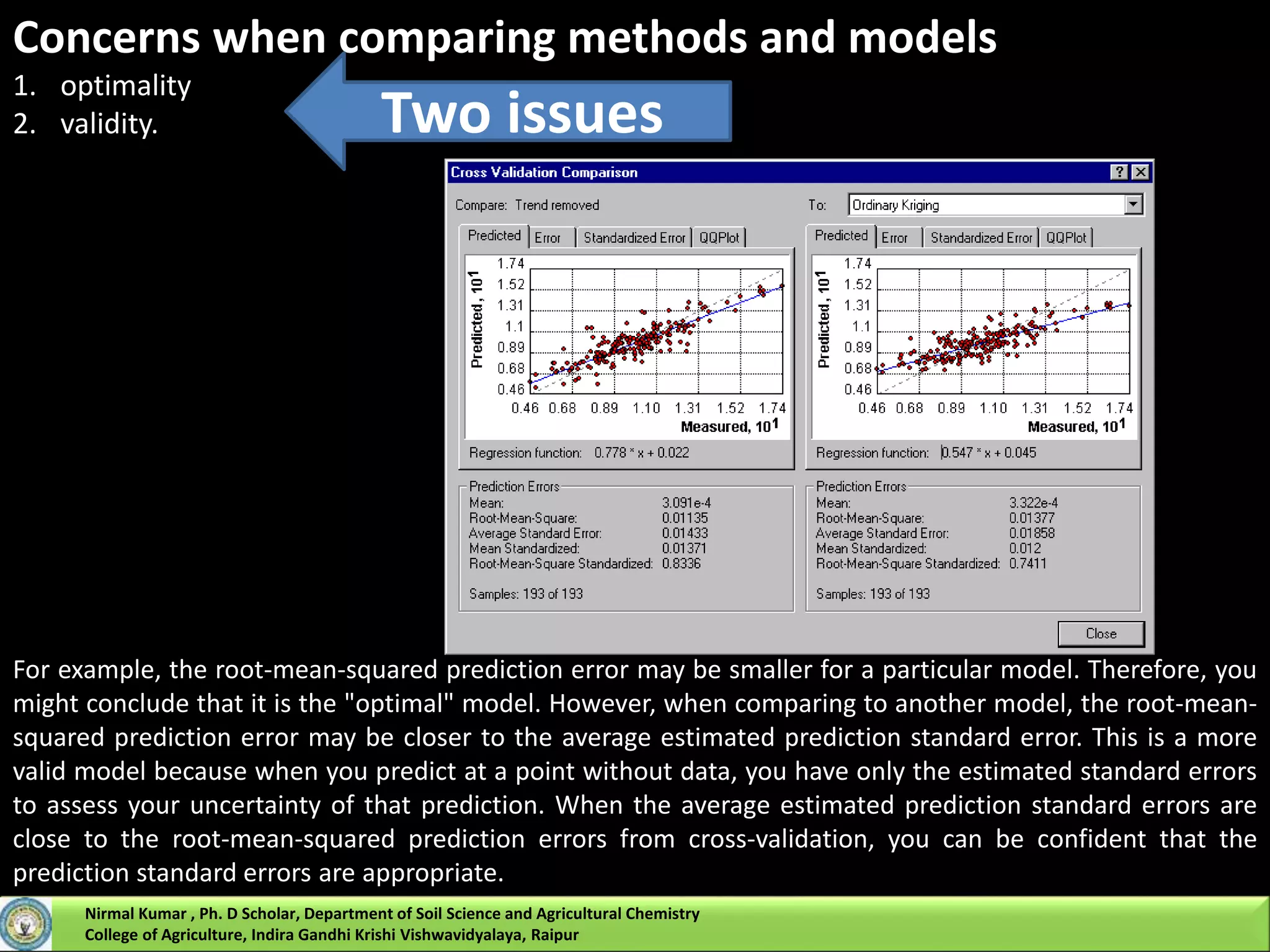
Concerns when comparing methods and models
1. optimality
2. validity. Two issues
For example, the root-mean-squared prediction error may be smaller for a particular model. Therefore, you
might conclude that it is the "optimal" model. However, when comparing to another model, the root-mean-
squared prediction error may be closer to the average estimated prediction standard error. This is a more
valid model because when you predict at a point without data, you have only the estimated standard errors
to assess your uncertainty of that prediction. When the average estimated prediction standard errors are
close to the root-mean-squared prediction errors from cross-validation, you can be confident that the
prediction standard errors are appropriate.
Nirmal Kumar , Ph. D Scholar, Department of Soil Science and Agricultural Chemistry
College of Agriculture, Indira Gandhi Krishi Vishwavidyalaya, Raipur
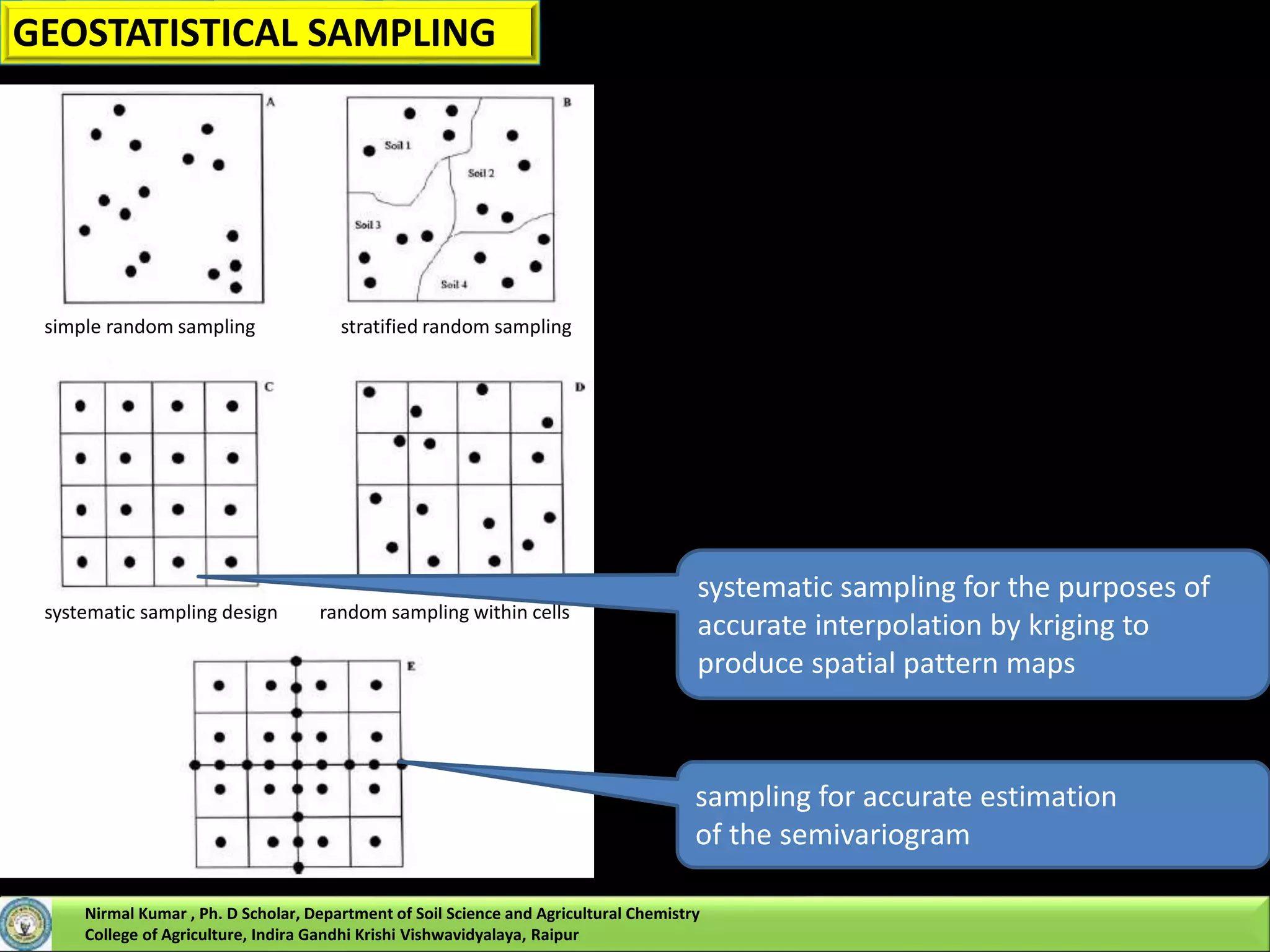
GEOSTATISTICAL SAMPLING
simple random sampling stratified random sampling
systematic sampling design random sampling within cells
geostatistical sampling design
systematic sampling for the purposes of
accurate interpolation by kriging to
produce spatial pattern maps
sampling for accurate estimation
of the semivariogram
Nirmal Kumar , Ph. D Scholar, Department of Soil Science and Agricultural Chemistry
College of Agriculture, Indira Gandhi Krishi Vishwavidyalaya, Raipur
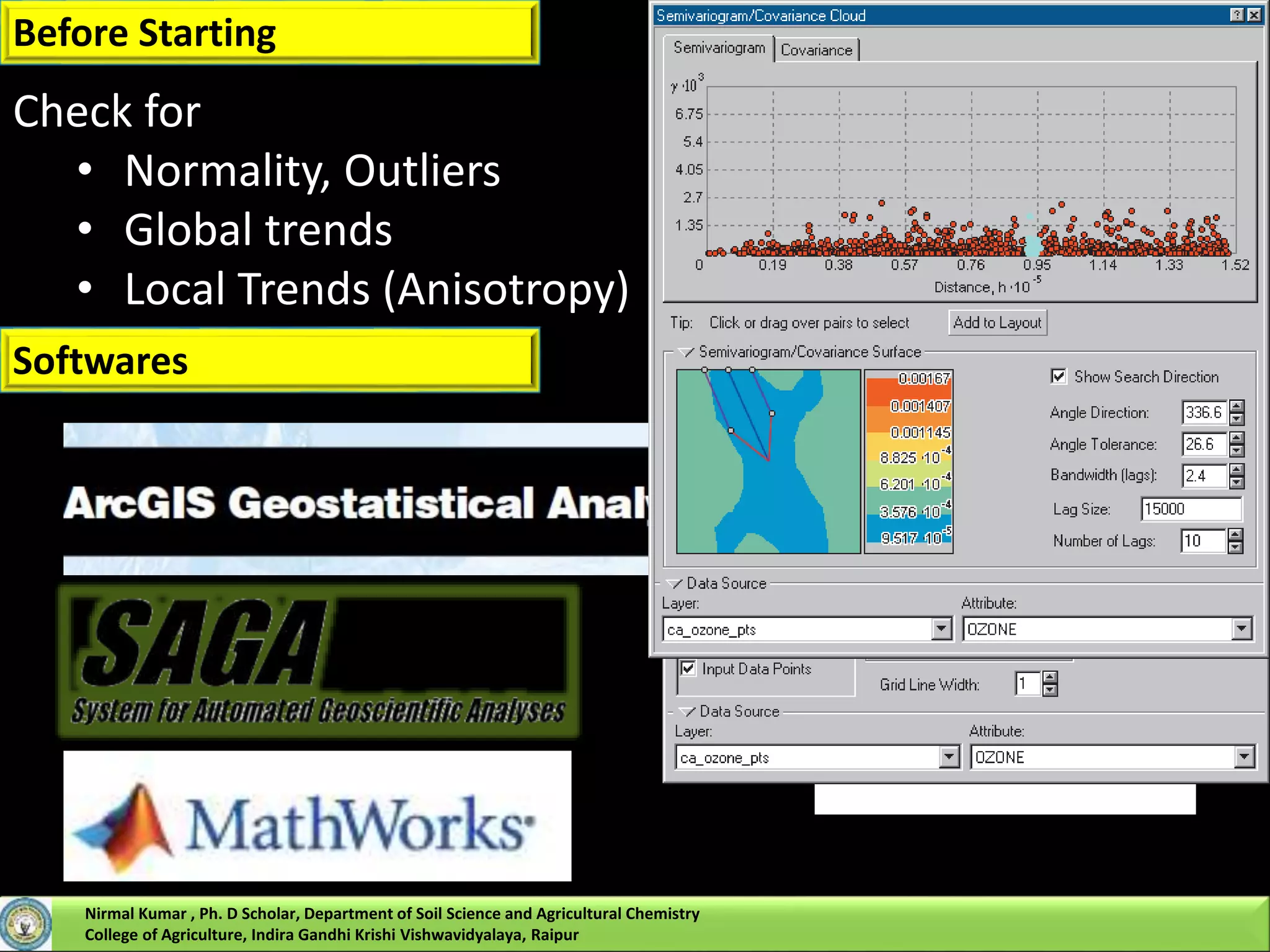
Before Starting
Check for
• Normality, Outliers
• Global trends
• Local Trends (Anisotropy)
Softwares
Nirmal Kumar , Ph. D Scholar, Department of Soil Science and Agricultural Chemistry
College of Agriculture, Indira Gandhi Krishi Vishwavidyalaya, Raipur
Nirmal Kumar , Ph. D Scholar, Department of Soil Science and Agricultural Chemistry
College of Agriculture, Indira Gandhi Krishi Vishwavidyalaya, Raipur
Nirmal Kumar , Ph. D Scholar, Department of Soil Science and Agricultural Chemistry
College of Agriculture, Indira Gandhi Krishi Vishwavidyalaya, Raipur
Nirmal Kumar , Ph. D Scholar, Department of Soil Science and Agricultural Chemistry
College of Agriculture, Indira Gandhi Krishi Vishwavidyalaya, Raipur
Nirmal Kumar , Ph. D Scholar, Department of Soil Science and Agricultural Chemistry
College of Agriculture, Indira Gandhi Krishi Vishwavidyalaya, Raipur

Geostatictics for soil nutrient mapping

  • 1.
    Doctoral Seminar Spatial InterpolationMethods for Soil Nutrient Mapping
  • 2.
    Nirmal Kumar ,Ph. D Scholar, Department of Soil Science and Agricultural Chemistry College of Agriculture, Indira Gandhi Krishi Vishwavidyalaya, Raipur A key feature of soil is the variation with depth in soil properties Soil properties varies across the landscape also
  • 3.
    We need SPATIALDATA About: •Soil fertility like – NPK, Ca, Mg, etc….. •Water Table Depths •Height • • • • For: • Planning, risk assessment, and decision making in environmental management • Scientists need accurate spatial continuous data across a region to make justified interpretations • Precision Agriculture Nirmal Kumar , Ph. D Scholar, Department of Soil Science and Agricultural Chemistry College of Agriculture, Indira Gandhi Krishi Vishwavidyalaya, Raipur
  • 4.
    Sources for SPATIALDATA Soil Survey Maps?? • Field surveys are typically from point sources • Soil variability at the field scale cannot be completely described by soil mapping units • Not on soil fertility status • Small scale maps are made of polygons with many components Nirmal Kumar , Ph. D Scholar, Department of Soil Science and Agricultural Chemistry College of Agriculture, Indira Gandhi Krishi Vishwavidyalaya, Raipur
  • 5.
    Sources for SPATIALDATA Remote Sensing Images?? • Gives Spatial Data in different Scales • But, only surface features • Limited number of bands in RS images • Hyperspectral imageries show promises Nirmal Kumar , Ph. D Scholar, Department of Soil Science and Agricultural Chemistry College of Agriculture, Indira Gandhi Krishi Vishwavidyalaya, Raipur
  • 6.
    Nirmal Kumar ,Ph. D Scholar, Department of Soil Science and Agricultural Chemistry College of Agriculture, Indira Gandhi Krishi Vishwavidyalaya, Raipur
  • 7.
    Blanket on spikes Otheroptions?? Nirmal Kumar , Ph. D Scholar, Department of Soil Science and Agricultural Chemistry College of Agriculture, Indira Gandhi Krishi Vishwavidyalaya, Raipur
  • 8.
    Estimating a point here:interpolation Sample data Interpolation  Estimating the attribute values of locations that are within the range of available data using known data values Estimating a point here: extrapolation Sample data Extrapolation  Estimating the attribute values of locations outside the range of available data using known data values Interpolation VS Extrapolation Nirmal Kumar , Ph. D Scholar, Department of Soil Science and Agricultural Chemistry College of Agriculture, Indira Gandhi Krishi Vishwavidyalaya, Raipur
  • 9.
    How to?? Spatial Interpolation Non-geostatisticalmethods Geostatistical methods Combined Triangular Irregular Network Natural Neighbours Inverse Distance Weighting Trend Surface Analysis Thin Plate Splines . . . Simple Kriging Ordinary Krigging Block Krigging Indicator Krigging Cokrigging . . . Trend Surface Analysis Combined with Krigging Regression krigging Lapse Rate Combined with Krigging Nirmal Kumar , Ph. D Scholar, Department of Soil Science and Agricultural Chemistry College of Agriculture, Indira Gandhi Krishi Vishwavidyalaya, Raipur
  • 10.
    • Unknown valuesare predicted with a mathematical formula that uses the values of nearby known points. • Things closer together have similar properties. Nirmal Kumar , Ph. D Scholar, Department of Soil Science and Agricultural Chemistry College of Agriculture, Indira Gandhi Krishi Vishwavidyalaya, Raipur
  • 11.
    Tobler’s first lawof geography • “All things are similar, but nearby things are more similar than distant things.” • Or, more poetically "All things by a mortal power, Near or far Hiddenly To each other linked are, That thou canst not stir a flower Without the troubling of a star" Francis Thompson, "The Mistress of Vision" 1897 Nirmal Kumar , Ph. D Scholar, Department of Soil Science and Agricultural Chemistry College of Agriculture, Indira Gandhi Krishi Vishwavidyalaya, Raipur
  • 12.
    The Concept Nearest Neighbour Average AverageDepth 5 feet Inverse Distance Weight Not only the distance, but direction is also important We need Geostatistics Nirmal Kumar , Ph. D Scholar, Department of Soil Science and Agricultural Chemistry College of Agriculture, Indira Gandhi Krishi Vishwavidyalaya, Raipur
  • 13.
    Nearly all themethods of prediction, including the simpler forms of kriging, can be seen as weighted averages of data. Where, x0 = target point for which we want a value; z*(xi), i = 1; 2; . . . ;N, at places xi are the measured data; and i are the weights assigned to them Nirmal Kumar , Ph. D Scholar, Department of Soil Science and Agricultural Chemistry College of Agriculture, Indira Gandhi Krishi Vishwavidyalaya, Raipur
  • 14.
    Nearest Neighbours • Predictsthe value of an attribute at an unsampled point based on the value of the nearest sample by drawing perpendicular bisectors between sampled points (n), forming such as Thiessen (or Dirichlet/Voronoi) polygons (Vi, i=1,2,…, n). • produces one polygon per sample and the sample is located in the centre of the polygon. • The estimations of the attribute at unsampled points within polygon Vi are the measured value at the nearest single sampled data point xi that is zˆ (x0) = z(xi). • Weights are given by: All points (or locations) within each polygon are assigned the same value Nirmal Kumar , Ph. D Scholar, Department of Soil Science and Agricultural Chemistry College of Agriculture, Indira Gandhi Krishi Vishwavidyalaya, Raipur
  • 15.
    Thiessen polygons havethe unique property that each polygon contains only one input point, and any location within a polygon is closer to its associated point than to the point of any other polygon. The Thiessen polygons are constructed as follows: • All points are triangulated into a triangulated irregular network (TIN) that meets the Delaunay criterion. • The perpendicular bisectors for each triangle edge are generated, forming the edges of the Thiessen polygons. The location at which the bisectors intersect determine the locations of the Thiessen polygon vertices. Thiessen Polygon Nirmal Kumar , Ph. D Scholar, Department of Soil Science and Agricultural Chemistry College of Agriculture, Indira Gandhi Krishi Vishwavidyalaya, Raipur
  • 16.
    IDW assumes that therate of correlations and similarities between neighbours are proportional to the distance among them. So, that can be defined as a distance reverse function of every point from neighbouring points unknown value of a point is influenced by a closer points than away points Nirmal Kumar , Ph. D Scholar, Department of Soil Science and Agricultural Chemistry College of Agriculture, Indira Gandhi Krishi Vishwavidyalaya, Raipur
  • 17.
    Inverse Distance Weighted Localmethod Exact Can be linear or non-linear The weight (influence) of a sampled data value is inversely proportional to its distance from the estimated value Nirmal Kumar , Ph. D Scholar, Department of Soil Science and Agricultural Chemistry College of Agriculture, Indira Gandhi Krishi Vishwavidyalaya, Raipur
  • 18.
    Inverse Distance Weighted (Example) 4 3 2 100 160 IDW: Closest3 neighbors, p = 2 200                     1),( 1 ),( 1 1 i with ii n i p i n i p i i zyxzor d d z yxz Nirmal Kumar , Ph. D Scholar, Department of Soil Science and Agricultural Chemistry College of Agriculture, Indira Gandhi Krishi Vishwavidyalaya, Raipur
  • 19.
    Inverse Distance Weighted (Example) 4 3 2 A= 100 B = 160 C = 200 1 / (42) = .0625 1 / (32) = .1111 1 / (22) = .2500 Weights A B C Nirmal Kumar , Ph. D Scholar, Department of Soil Science and Agricultural Chemistry College of Agriculture, Indira Gandhi Krishi Vishwavidyalaya, Raipur
  • 20.
    Inverse Distance Weighted (Example) 1/ (42) = .0625 1 / (32) = .1111 1 / (22) = .2500 .0625 * 100 = 6.25 .1111 * 160 = 17.76 .2500 * 200 = 50.00 Weights Weights * Value A B C 74.01 / .4236 = 175 Total = .4236 6.25 +17.76 + 50.00 = 74.01 4 3 2 A = 100 B = 160 C = 200 Nirmal Kumar , Ph. D Scholar, Department of Soil Science and Agricultural Chemistry College of Agriculture, Indira Gandhi Krishi Vishwavidyalaya, Raipur
  • 21.
    Why Geo-statistics?? Estimation ofthe unknown permeability Z0 based on a set values of permeability at n locations Estimation of the unknown permeability Z0 given 7 known values. Numbers in parenthesis are weights assigned to the known values based on inverse distance Nirmal Kumar , Ph. D Scholar, Department of Soil Science and Agricultural Chemistry College of Agriculture, Indira Gandhi Krishi Vishwavidyalaya, Raipur
  • 22.
    • Ordinary, • Simple, •Universal, • Indicator, • Probability, • And Disjunctive Kriging. assume things that are close are more alike. The semivariogram allows you to explore this assumption. The process of fitting a semivariogram model while capturing the spatial relationships is known as variography A 2 step procedure Geostatistical analysis of data occurs in two phases: • modeling the semivariogram or covariance to analyze surface properties, and • kriging. A number of kriging methods are available for surface creation in Geostatistical Analyst, Nirmal Kumar , Ph. D Scholar, Department of Soil Science and Agricultural Chemistry College of Agriculture, Indira Gandhi Krishi Vishwavidyalaya, Raipur
  • 23.
    To create anempirical semivariogram, • determine the squared difference between the values for all pairs of locations. • Plot half the squared difference on the y-axis and the distance that separates the locations on the x-axis, • it is called the semivariogram cloud. Variography More similar More dissimilar 1. Create empirical semivariogram 2. Fit a model Nirmal Kumar , Ph. D Scholar, Department of Soil Science and Agricultural Chemistry College of Agriculture, Indira Gandhi Krishi Vishwavidyalaya, Raipur
  • 24.
    Binning To reduce thenumber of points in the empirical semivariogram, the pairs of locations will be grouped based on their distance from one another. This grouping process is known as binning. • For omnidirectional semivariograms, use bins that include the closest separation distances in the sample design so that the maximum amount of information is obtained about the semivariogram at small separation distances. • Avoid making bins so narrow that the number of pairs in any bin is less than 30. • For directional semivariograms, it is necessary to have bins for both separation distance and direction. • Narrower directional bins could also be selected, but wider ones should probably be avoided, since they would lead to a loss of information about directional effects. Nirmal Kumar , Ph. D Scholar, Department of Soil Science and Agricultural Chemistry College of Agriculture, Indira Gandhi Krishi Vishwavidyalaya, Raipur
  • 25.
    Creating Variography Nirmal Kumar, Ph. D Scholar, Department of Soil Science and Agricultural Chemistry College of Agriculture, Indira Gandhi Krishi Vishwavidyalaya, Raipur
  • 26.
    A linear model Aspherical model An exponential model Nirmal Kumar , Ph. D Scholar, Department of Soil Science and Agricultural Chemistry College of Agriculture, Indira Gandhi Krishi Vishwavidyalaya, Raipur
  • 27.
    nugget effect issimply the sum of measurement error and microscale variation and, since either component can be zero, the nugget effect can be comprised wholly of one or the other. The height that the semivariogram reaches when it levels off discontinuity at the origin microscale variation measurement error distance at which the semivariogram levels off to the sill Nirmal Kumar , Ph. D Scholar, Department of Soil Science and Agricultural Chemistry College of Agriculture, Indira Gandhi Krishi Vishwavidyalaya, Raipur
  • 28.
    Kriging Like IDW interpolation,kriging forms weights from surrounding measured values to predict values at unmeasured locations. As with IDW interpolation, the closest measured values usually have the most influence. However, IDW uses a simple algorithm based on distance, but kriging weights come from a semivariogram that was developed by viewing the spatial structure of the data. 1. Create the Г – matrix and g-vector, 2. Calculate weights ʎ, and 3. Make a prediction The key step in kriging is to estimate the n weighting factors for locations that neighbor the unsampled location where interpolation is to occur. a set of N+1 simultaneous equations with N+1 unknowns (the N weighting factors and the undetermined Lagrangian multiplier). Where, [Г] is an N+1 by N+1 matrix of semivariogram values between measured locations, [ʎ] is an N+1 by 1 matrix of weighting factors and the Lagrangian multiplier, and [g] is an N+1 by 1 matrix of semivariogram values between the interpolated location and its neighboring locations. Nirmal Kumar , Ph. D Scholar, Department of Soil Science and Agricultural Chemistry College of Agriculture, Indira Gandhi Krishi Vishwavidyalaya, Raipur
  • 29.
    Nirmal Kumar ,Ph. D Scholar, Department of Soil Science and Agricultural Chemistry College of Agriculture, Indira Gandhi Krishi Vishwavidyalaya, Raipur
  • 30.
    Kriging ordinary kriging Simple kriging Universalkriging Punctual Kriging Block kriging COKRIGING Cokriging is an interpolation technique that uses information about the spatial patterns of two different, but spatially correlated properties to interpolate only one of the properties. Nirmal Kumar , Ph. D Scholar, Department of Soil Science and Agricultural Chemistry College of Agriculture, Indira Gandhi Krishi Vishwavidyalaya, Raipur
  • 31.
    Concerns when comparingmethods and models 1. optimality 2. validity. Two issues For example, the root-mean-squared prediction error may be smaller for a particular model. Therefore, you might conclude that it is the "optimal" model. However, when comparing to another model, the root-mean- squared prediction error may be closer to the average estimated prediction standard error. This is a more valid model because when you predict at a point without data, you have only the estimated standard errors to assess your uncertainty of that prediction. When the average estimated prediction standard errors are close to the root-mean-squared prediction errors from cross-validation, you can be confident that the prediction standard errors are appropriate. Nirmal Kumar , Ph. D Scholar, Department of Soil Science and Agricultural Chemistry College of Agriculture, Indira Gandhi Krishi Vishwavidyalaya, Raipur
  • 32.
    GEOSTATISTICAL SAMPLING simple randomsampling stratified random sampling systematic sampling design random sampling within cells geostatistical sampling design systematic sampling for the purposes of accurate interpolation by kriging to produce spatial pattern maps sampling for accurate estimation of the semivariogram Nirmal Kumar , Ph. D Scholar, Department of Soil Science and Agricultural Chemistry College of Agriculture, Indira Gandhi Krishi Vishwavidyalaya, Raipur
  • 33.
    Before Starting Check for •Normality, Outliers • Global trends • Local Trends (Anisotropy) Softwares Nirmal Kumar , Ph. D Scholar, Department of Soil Science and Agricultural Chemistry College of Agriculture, Indira Gandhi Krishi Vishwavidyalaya, Raipur
  • 34.
    Nirmal Kumar ,Ph. D Scholar, Department of Soil Science and Agricultural Chemistry College of Agriculture, Indira Gandhi Krishi Vishwavidyalaya, Raipur
  • 35.
    Nirmal Kumar ,Ph. D Scholar, Department of Soil Science and Agricultural Chemistry College of Agriculture, Indira Gandhi Krishi Vishwavidyalaya, Raipur
  • 36.
    Nirmal Kumar ,Ph. D Scholar, Department of Soil Science and Agricultural Chemistry College of Agriculture, Indira Gandhi Krishi Vishwavidyalaya, Raipur
  • 38.
    Nirmal Kumar ,Ph. D Scholar, Department of Soil Science and Agricultural Chemistry College of Agriculture, Indira Gandhi Krishi Vishwavidyalaya, Raipur