





Doctoral seminar on
“New insights into the structure
and functional dynamics of
phyllosphere microflora”
By
YALAVARTHI NAGARAJU, Ph.D (Ag)
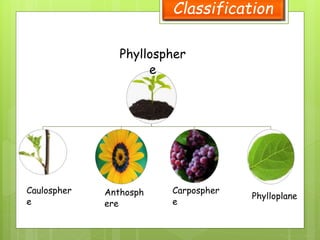
Classification
Phyllospher
e
Caulospher
e
Anthosph
ere
Carpospher
e
Phylloplane
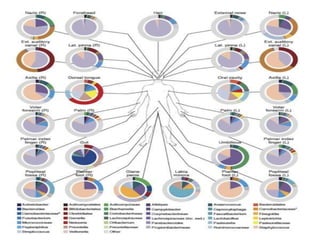
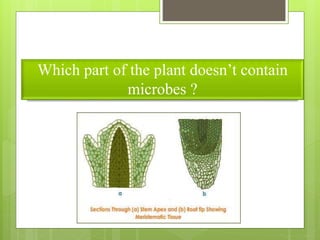
Which part of the plant doesn’t contain
microbes ?
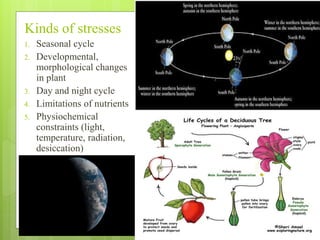
Kinds of stresses
1. Seasonal cycle
2. Developmental,
morphological changes
in plant
3. Day and night cycle
4. Limitations of nutrients
5. Physiochemical
constraints (light,
temperature, radiation,
desiccation)
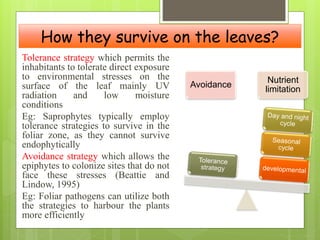
How they survive on the leaves?
Tolerance strategy which permits the
inhabitants to tolerate direct exposure
to environmental stresses on the
surface of the leaf mainly UV
radiation and low moisture
conditions
Eg: Saprophytes typically employ
tolerance strategies to survive in the
foliar zone, as they cannot survive
endophytically
Avoidance strategy which allows the
epiphytes to colonize sites that do not
face these stresses (Beattie and
Lindow, 1995)
Eg: Foliar pathogens can utilize both
the strategies to harbour the plants
more efficiently
Avoidance
Nutrient
limitation
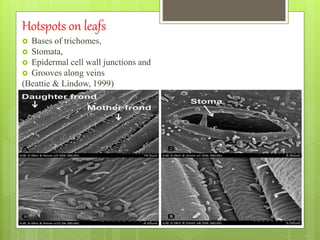
Hotspots on leafs
 Bases of trichomes,
 Stomata,
 Epidermal cell wall junctions and
 Grooves along veins
(Beattie & Lindow, 1999)
Introduction
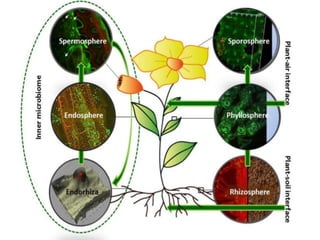
 Phyllosphere is the surface and interior of the aerial parts
of vascular plants (Newton et al., 2010)
 Most of the phyllosphere colonizing microorganisms live
as commensals on their host plants
 About 0.1–8.4 % of the total bacterial population were
cultivable (Rastogi et al., 2010)
 The phyllosphere has an area of roughly about one billion
square kilometres (Morris and Kinkel, 2002), in which the
number of bacteria may reach up to 106–107 cells per
square centimetre of leaf area, which is roughly 1026 ells
History
1955- The term phyllosphere was first introduced by the
plant pathologist F.T. Last
1956 - “Phyllosphere” term was coined by Ruinen
1987 - Kinkel tested the equilibrium theory of island
biogeography, assuming that individual leaves form discrete
habitat patches for microbes analogous to oceanic islands for
macroorganisms.
2002 – Morris extended the concept to include both the areas
inside and outside the leaf
2012- Berlec considered phyllospheric microflora as “Plant
probiotics”
2015- Doan and Leveau divided the phyllosphere into two
unique niches i.e., Phylloplane (the leaf surface landscape)
and phyllotelma (the leaf surface waterscape)
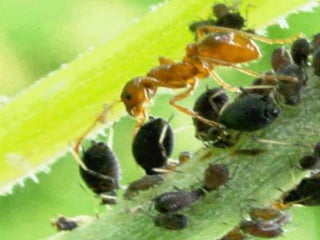
How they will solve the problem of
carbon, energy?
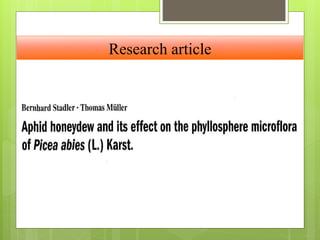
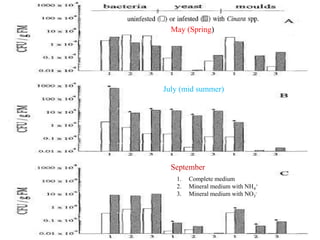
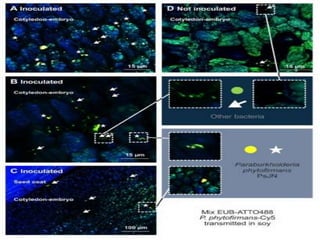
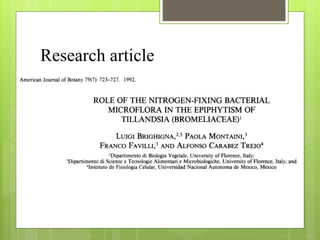
Research article
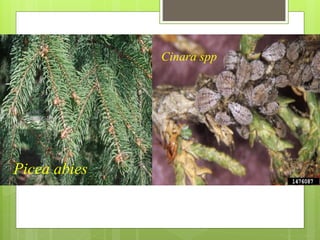
Picea abies
Cinara spp
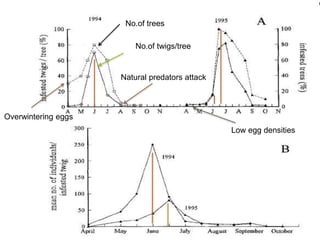
No.of trees
No.of twigs/tree
Natural predators attack
Overwintering eggs
Low egg densities
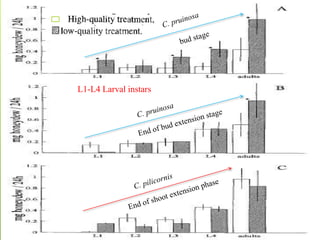
L1-L4 Larval instars
May (Spring)
July (mid summer)
September
1. Complete medium
2. Mineral medium with NH4
+
3. Mineral medium with NO3
-
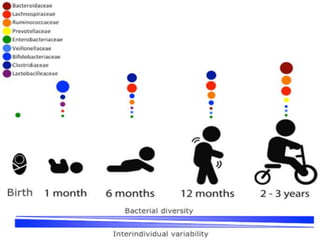
Structure of phyllosphere microflora
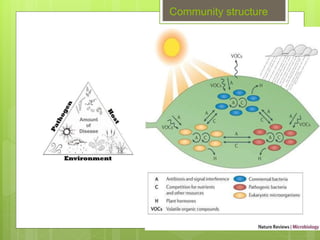
Community structure
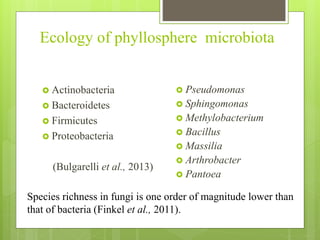
Ecology of phyllosphere microbiota
 Actinobacteria
 Bacteroidetes
 Firmicutes
 Proteobacteria
(Bulgarelli et al., 2013)
 Pseudomonas
 Sphingomonas
 Methylobacterium
 Bacillus
 Massilia
 Arthrobacter
 Pantoea
Species richness in fungi is one order of magnitude lower than
that of bacteria (Finkel et al., 2011).
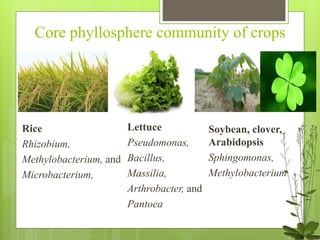
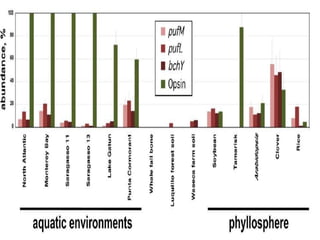
Core phyllosphere community of crops
Rice
Rhizobium,
Methylobacterium, and
Microbacterium,
Lettuce
Pseudomonas,
Bacillus,
Massilia,
Arthrobacter, and
Pantoea
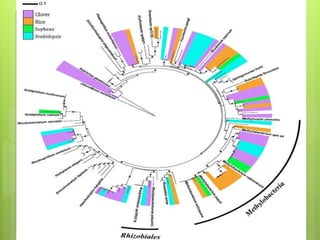
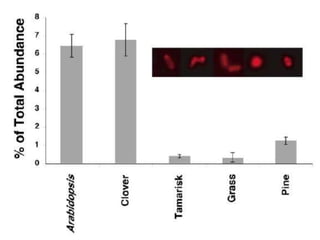
Soybean, clover,
Arabidopsis
Sphingomonas,
Methylobacterium
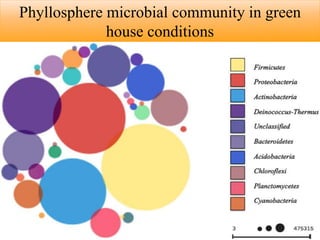
Phyllosphere microbial community in green
house conditions
Major drivers of phyllosphere microbiota
composition
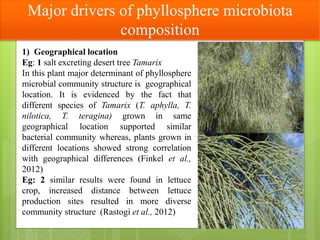
1) Geographical location
Eg: 1 salt excreting desert tree Tamarix
In this plant major determinant of phyllosphere
microbial community structure is geographical
location. It is evidenced by the fact that
different species of Tamarix (T. aphylla, T.
nilotica, T. teragina) grown in same
geographical location supported similar
bacterial community whereas, plants grown in
different locations showed strong correlation
with geographical differences (Finkel et al.,
2012)
Eg: 2 similar results were found in lettuce
crop, increased distance between lettuce
production sites resulted in more diverse
community structure (Rastogi et al., 2012)
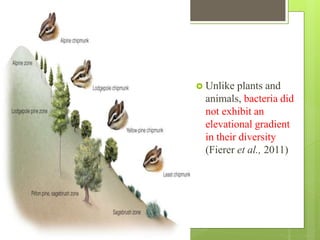
 Unlike plants and
animals, bacteria did
not exhibit an
elevational gradient
in their diversity
(Fierer et al., 2011)
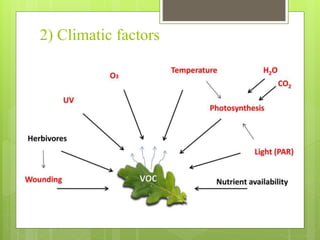
2) Climatic factors
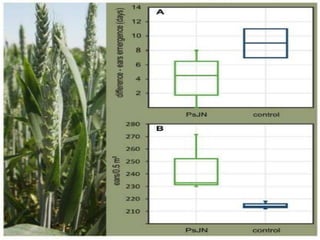
Research article
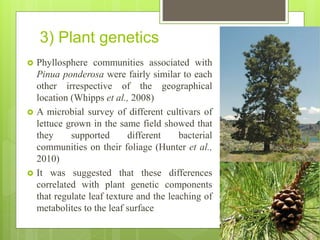
3) Plant genetics
 Phyllosphere communities associated with
Pinua ponderosa were fairly similar to each
other irrespective of the geographical
location (Whipps et al., 2008)
 A microbial survey of different cultivars of
lettuce grown in the same field showed that
they supported different bacterial
communities on their foliage (Hunter et al.,
2010)
 It was suggested that these differences
correlated with plant genetic components
that regulate leaf texture and the leaching of
metabolites to the leaf surface
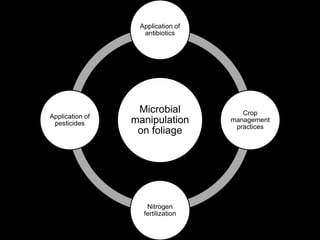
Is it possible to manipulate community
structure?
Yes, we are already doing it…..
Microbial
manipulation
on foliage
Application of
antibiotics
Crop
management
practices
Nitrogen
fertilization
Application of
pesticides
Research article
functions of phyllospheric
microflora
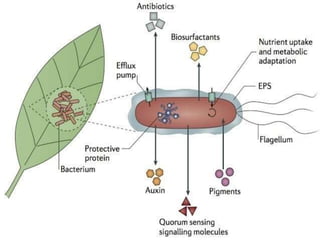
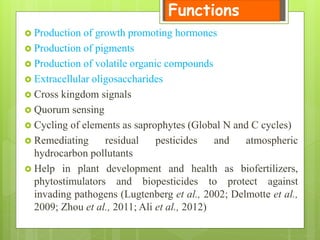
 Production of growth promoting hormones
 Production of pigments
 Production of volatile organic compounds
 Extracellular oligosaccharides
 Cross kingdom signals
 Quorum sensing
 Cycling of elements as saprophytes (Global N and C cycles)
 Remediating residual pesticides and atmospheric
hydrocarbon pollutants
 Help in plant development and health as biofertilizers,
phytostimulators and biopesticides to protect against
invading pathogens (Lugtenberg et al., 2002; Delmotte et al.,
2009; Zhou et al., 2011; Ali et al., 2012)
Functions
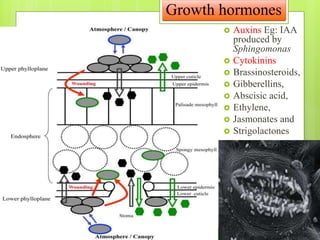
Growth hormones
 Auxins Eg: IAA
produced by
Sphingomonas
 Cytokinins
 Brassinosteroids,
 Gibberellins,
 Abscisic acid,
 Ethylene,
 Jasmonates and
 Strigolactones
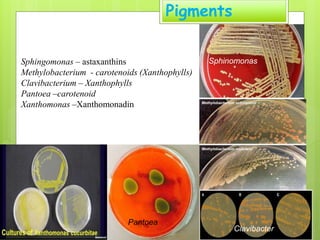
Pigments
Sphinomonas
Pantoea
Clavibacter
Sphingomonas – astaxanthins
Methylobacterium - carotenoids (Xanthophylls)
Clavibacterium – Xanthophylls
Pantoea –carotenoid
Xanthomonas –Xanthomonadin
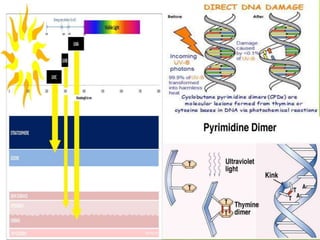
UV Protection mechanisms
1. Methylobacterium, Sphingomonas, Pseudomonas etc.,
possess pigmentation
2. Special DNA repair mechanisms
3. Up regulation of stress response proteins (Eg: PhaA)
4. Production of extracellular polysaccharides
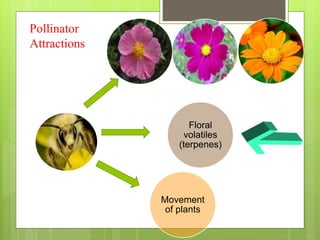
Pollinator
Attractions
Floral
volatiles
(terpenes)
Movement
of plants
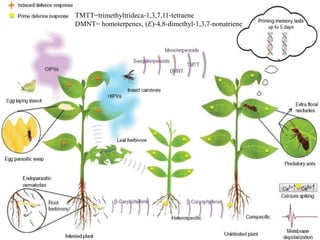
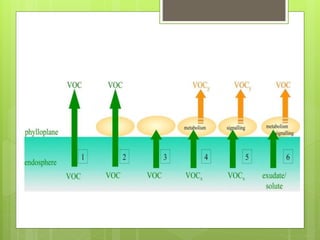
VOC’s
 “Volatile organic compounds (VOCs) are a large class of
low-molecular-weight, carbon-containing compounds
characterized by their high volatility, low vapor pressure
(≥0.01 kPa at 20 °C), and low water solubility” (Herrmann,
2010)
 To date, a total of 1700 volatile compounds have been
isolated from more than 90 plant families.
 Plant volatiles constitute about 1 % of plant secondary
metabolites and are mainly represented by terpenoids,
phenylpropanoids/benzenoids, fatty acid derivatives, and
amino acid derivatives.
 Volatile organic compounds (VOC) are organic
chemicals that when released into the atmosphere can react
with sunlight and nitrogen oxides (NOx) to form tropospheric
(ground-level) ozone (Melanie et al., 2010)
TMTT=trimethyltrideca‐1,3,7,11‐tetraene
DMNT= homoterpenes, (E)‐4,8‐dimethyl‐1,3,7‐nonatriene
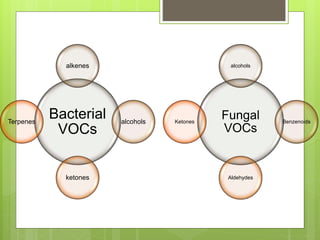
Bacterial
VOCs
alkenes
alcohols
ketones
Terpenes
Fungal
VOCs
alcohols
Benzenoids
Aldehydes
Ketones
Why we need to study about phyllosphere?
 Improving our understanding about the behaviour of
microorganisms in this habitat will facilitate biotechnological
applications for protecting plants,
 Promoting plant growth,
 Avoid human pathogenic bacteria in plant food and,
 Phytoremediation of volatile pollutants from the air.
Research article
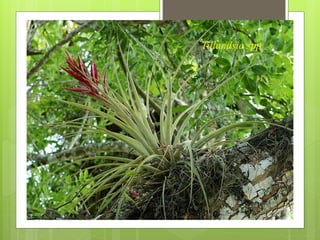
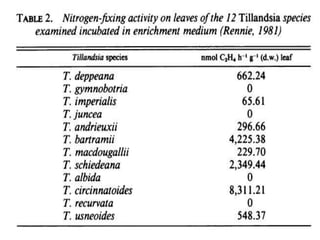
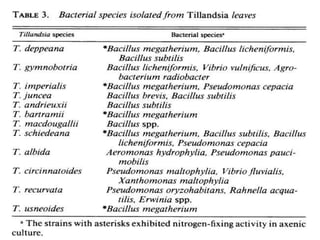
Tillandsia spp
Research article
phyllosphere
phyllosphere
phyllosphere
phyllosphere
phyllosphere

phyllosphere

  • 2.
    Doctoral seminar on “Newinsights into the structure and functional dynamics of phyllosphere microflora” By YALAVARTHI NAGARAJU, Ph.D (Ag)
  • 6.
  • 7.
    Which part ofthe plant doesn’t contain microbes ?
  • 8.
    Kinds of stresses 1.Seasonal cycle 2. Developmental, morphological changes in plant 3. Day and night cycle 4. Limitations of nutrients 5. Physiochemical constraints (light, temperature, radiation, desiccation)
  • 9.
    How they surviveon the leaves? Tolerance strategy which permits the inhabitants to tolerate direct exposure to environmental stresses on the surface of the leaf mainly UV radiation and low moisture conditions Eg: Saprophytes typically employ tolerance strategies to survive in the foliar zone, as they cannot survive endophytically Avoidance strategy which allows the epiphytes to colonize sites that do not face these stresses (Beattie and Lindow, 1995) Eg: Foliar pathogens can utilize both the strategies to harbour the plants more efficiently Avoidance Nutrient limitation
  • 10.
    Hotspots on leafs Bases of trichomes,  Stomata,  Epidermal cell wall junctions and  Grooves along veins (Beattie & Lindow, 1999)
  • 11.
    Introduction  Phyllosphere isthe surface and interior of the aerial parts of vascular plants (Newton et al., 2010)  Most of the phyllosphere colonizing microorganisms live as commensals on their host plants  About 0.1–8.4 % of the total bacterial population were cultivable (Rastogi et al., 2010)  The phyllosphere has an area of roughly about one billion square kilometres (Morris and Kinkel, 2002), in which the number of bacteria may reach up to 106–107 cells per square centimetre of leaf area, which is roughly 1026 ells
  • 12.
    History 1955- The termphyllosphere was first introduced by the plant pathologist F.T. Last 1956 - “Phyllosphere” term was coined by Ruinen 1987 - Kinkel tested the equilibrium theory of island biogeography, assuming that individual leaves form discrete habitat patches for microbes analogous to oceanic islands for macroorganisms. 2002 – Morris extended the concept to include both the areas inside and outside the leaf 2012- Berlec considered phyllospheric microflora as “Plant probiotics” 2015- Doan and Leveau divided the phyllosphere into two unique niches i.e., Phylloplane (the leaf surface landscape) and phyllotelma (the leaf surface waterscape)
  • 13.
    How they willsolve the problem of carbon, energy?
  • 15.
  • 16.
  • 17.
    No.of trees No.of twigs/tree Naturalpredators attack Overwintering eggs Low egg densities
  • 18.
  • 19.
    May (Spring) July (midsummer) September 1. Complete medium 2. Mineral medium with NH4 + 3. Mineral medium with NO3 -
  • 20.
  • 21.
  • 22.
    Ecology of phyllospheremicrobiota  Actinobacteria  Bacteroidetes  Firmicutes  Proteobacteria (Bulgarelli et al., 2013)  Pseudomonas  Sphingomonas  Methylobacterium  Bacillus  Massilia  Arthrobacter  Pantoea Species richness in fungi is one order of magnitude lower than that of bacteria (Finkel et al., 2011).
  • 23.
    Core phyllosphere communityof crops Rice Rhizobium, Methylobacterium, and Microbacterium, Lettuce Pseudomonas, Bacillus, Massilia, Arthrobacter, and Pantoea Soybean, clover, Arabidopsis Sphingomonas, Methylobacterium
  • 24.
    Phyllosphere microbial communityin green house conditions
  • 26.
    Major drivers ofphyllosphere microbiota composition 1) Geographical location Eg: 1 salt excreting desert tree Tamarix In this plant major determinant of phyllosphere microbial community structure is geographical location. It is evidenced by the fact that different species of Tamarix (T. aphylla, T. nilotica, T. teragina) grown in same geographical location supported similar bacterial community whereas, plants grown in different locations showed strong correlation with geographical differences (Finkel et al., 2012) Eg: 2 similar results were found in lettuce crop, increased distance between lettuce production sites resulted in more diverse community structure (Rastogi et al., 2012)
  • 27.
     Unlike plantsand animals, bacteria did not exhibit an elevational gradient in their diversity (Fierer et al., 2011)
  • 28.
  • 30.
  • 35.
    3) Plant genetics Phyllosphere communities associated with Pinua ponderosa were fairly similar to each other irrespective of the geographical location (Whipps et al., 2008)  A microbial survey of different cultivars of lettuce grown in the same field showed that they supported different bacterial communities on their foliage (Hunter et al., 2010)  It was suggested that these differences correlated with plant genetic components that regulate leaf texture and the leaching of metabolites to the leaf surface
  • 36.
    Is it possibleto manipulate community structure? Yes, we are already doing it…..
  • 37.
  • 38.
  • 42.
  • 44.
     Production ofgrowth promoting hormones  Production of pigments  Production of volatile organic compounds  Extracellular oligosaccharides  Cross kingdom signals  Quorum sensing  Cycling of elements as saprophytes (Global N and C cycles)  Remediating residual pesticides and atmospheric hydrocarbon pollutants  Help in plant development and health as biofertilizers, phytostimulators and biopesticides to protect against invading pathogens (Lugtenberg et al., 2002; Delmotte et al., 2009; Zhou et al., 2011; Ali et al., 2012) Functions
  • 45.
    Growth hormones  AuxinsEg: IAA produced by Sphingomonas  Cytokinins  Brassinosteroids,  Gibberellins,  Abscisic acid,  Ethylene,  Jasmonates and  Strigolactones
  • 48.
    Pigments Sphinomonas Pantoea Clavibacter Sphingomonas – astaxanthins Methylobacterium- carotenoids (Xanthophylls) Clavibacterium – Xanthophylls Pantoea –carotenoid Xanthomonas –Xanthomonadin
  • 50.
    UV Protection mechanisms 1.Methylobacterium, Sphingomonas, Pseudomonas etc., possess pigmentation 2. Special DNA repair mechanisms 3. Up regulation of stress response proteins (Eg: PhaA) 4. Production of extracellular polysaccharides
  • 51.
  • 52.
    VOC’s  “Volatile organiccompounds (VOCs) are a large class of low-molecular-weight, carbon-containing compounds characterized by their high volatility, low vapor pressure (≥0.01 kPa at 20 °C), and low water solubility” (Herrmann, 2010)  To date, a total of 1700 volatile compounds have been isolated from more than 90 plant families.  Plant volatiles constitute about 1 % of plant secondary metabolites and are mainly represented by terpenoids, phenylpropanoids/benzenoids, fatty acid derivatives, and amino acid derivatives.  Volatile organic compounds (VOC) are organic chemicals that when released into the atmosphere can react with sunlight and nitrogen oxides (NOx) to form tropospheric (ground-level) ozone (Melanie et al., 2010)
  • 53.
  • 55.
  • 56.
    Why we needto study about phyllosphere?  Improving our understanding about the behaviour of microorganisms in this habitat will facilitate biotechnological applications for protecting plants,  Promoting plant growth,  Avoid human pathogenic bacteria in plant food and,  Phytoremediation of volatile pollutants from the air.
  • 57.
  • 58.
  • 63.

Editor's Notes

  • #30 So you might be thinking What drives the diversity in phyllosphere?