Steve McGrath
Soil pollution and agriculture: status, drivers and challenges
FAO GLOBAL SYMPOSIUM ON SOIL POLLUTION
What effects does soil pollution have?
• Phytoxicity, decreased yield
• Effects on soil biodiversity and microbial function
• Decreased food quality
• Decreased air and water quality
• Human and animal health
Preliminary remarks
• This talk concentrates on metals/metalloids in soils
• Contamination - any presence above “background concentrations”
• Pollution – presence of sufficient bioavailable substance to present
harm, i.e. above a selected threshold value
Non-essential substance
Bioavailable concentration in soil
Biological activity
Essential substance
Toxicity
̴Contamination Pollution
NOAEC –No Observed Adverse Effect Concentration
Smolders, Oorts, Sub-theme 4.1
Thursday
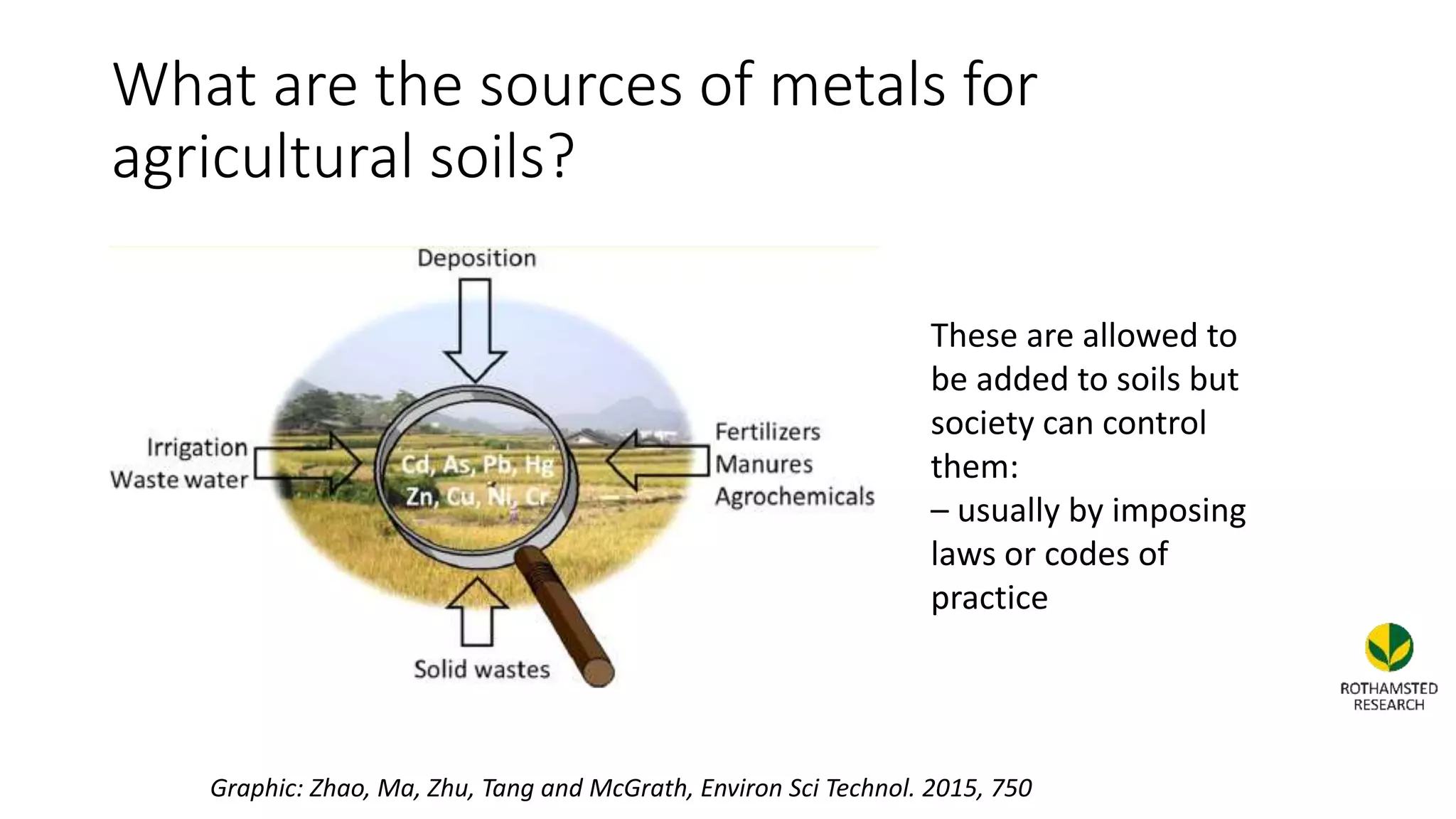
What are the sources of metals for
agricultural soils?
These are allowed to
be added to soils but
society can control
them:
– usually by imposing
laws or codes of
practice
Graphic: Zhao, Ma, Zhu, Tang and McGrath, Environ Sci Technol. 2015, 750
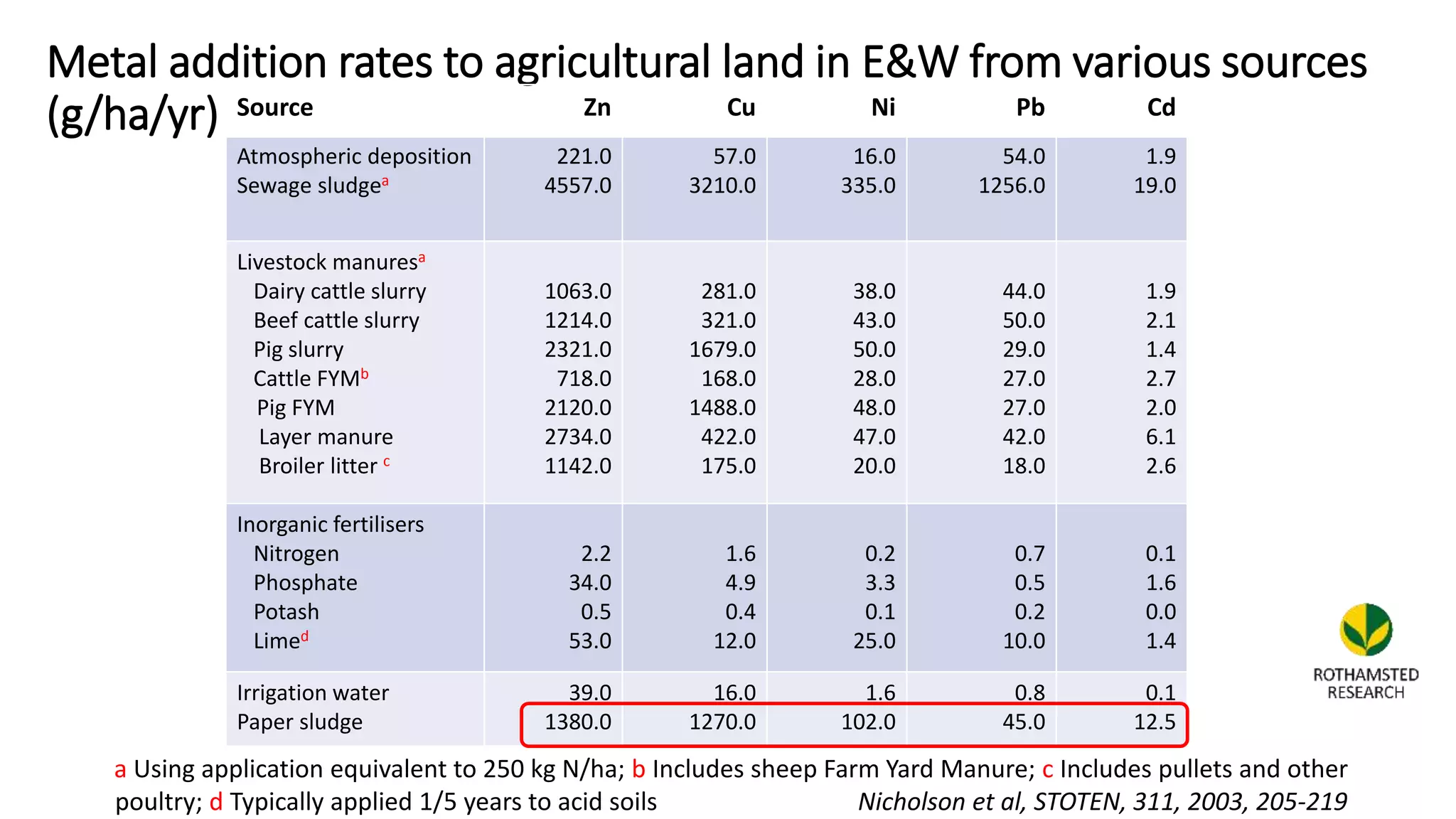
Metal addition rates to agricultural land in E&W from various sources
(g/ha/yr)
Source
Source Zn Cu Ni Pb Cd
Atmospheric deposition
Sewage sludgea
221.0
4557.0
57.0
3210.0
16.0
335.0
54.0
1256.0
1.9
19.0
Livestock manuresa
Dairy cattle slurry
Beef cattle slurry
Pig slurry
Cattle FYMb
Pig FYM
Layer manure
Broiler litter c
1063.0
1214.0
2321.0
718.0
2120.0
2734.0
1142.0
281.0
321.0
1679.0
168.0
1488.0
422.0
175.0
38.0
43.0
50.0
28.0
48.0
47.0
20.0
44.0
50.0
29.0
27.0
27.0
42.0
18.0
1.9
2.1
1.4
2.7
2.0
6.1
2.6
Inorganic fertilisers
Nitrogen
Phosphate
Potash
Limed
2.2
34.0
0.5
53.0
1.6
4.9
0.4
12.0
0.2
3.3
0.1
25.0
0.7
0.5
0.2
10.0
0.1
1.6
0.0
1.4
Irrigation water
Paper sludge
39.0
1380.0
16.0
1270.0
1.6
102.0
0.8
45.0
0.1
12.5
a Using application equivalent to 250 kg N/ha; b Includes sheep Farm Yard Manure; c Includes pullets and other
poultry; d Typically applied 1/5 years to acid soils Nicholson et al, STOTEN, 311, 2003, 205-219
Metal addition rates to agricultural land in E&W from various sources
(g/ha/yr)
Source
Source Zn Cu Ni Pb Cd
Atmospheric deposition
Sewage sludgea
221.0
4557.0
57.0
3210.0
16.0
335.0
54.0
1256.0
1.9
19.0
Livestock manuresa
Dairy cattle slurry
Beef cattle slurry
Pig slurry
Cattle FYMb
Pig FYM
Layer manure
Broiler litter c
1063.0
1214.0
2321.0
718.0
2120.0
2734.0
1142.0
281.0
321.0
1679.0
168.0
1488.0
422.0
175.0
38.0
43.0
50.0
28.0
48.0
47.0
20.0
44.0
50.0
29.0
27.0
27.0
42.0
18.0
1.9
2.1
1.4
2.7
2.0
6.1
2.6
Inorganic fertilisers
Nitrogen
Phosphate
Potash
Limed
2.2
34.0
0.5
53.0
1.6
4.9
0.4
12.0
0.2
3.3
0.1
25.0
0.7
0.5
0.2
10.0
0.1
1.6
0.0
1.4
Irrigation water
Paper sludge
39.0
1380.0
16.0
1270.0
1.6
102.0
0.8
45.0
0.1
12.5
a Using application equivalent to 250 kg N/ha; b Includes sheep Farm Yard Manure; c Includes pullets and other
poultry; d Typically applied 1/5 years to acid soils Nicholson et al, STOTEN, 311, 2003, 205-219
Metal addition rates to agricultural land in E&W from various sources
(g/ha/yr)
Source
Source Zn Cu Ni Pb Cd
Atmospheric deposition
Sewage sludgea
221.0
4557.0
57.0
3210.0
16.0
335.0
54.0
1256.0
1.9
19.0
Livestock manuresa
Dairy cattle slurry
Beef cattle slurry
Pig slurry
Cattle FYMb
Pig FYM
Layer manure
Broiler litter c
1063.0
1214.0
2321.0
718.0
2120.0
2734.0
1142.0
281.0
321.0
1679.0
168.0
1488.0
422.0
175.0
38.0
43.0
50.0
28.0
48.0
47.0
20.0
44.0
50.0
29.0
27.0
27.0
42.0
18.0
1.9
2.1
1.4
2.7
2.0
6.1
2.6
Inorganic fertilisers
Nitrogen
Phosphate
Potash
Limed
2.2
34.0
0.5
53.0
1.6
4.9
0.4
12.0
0.2
3.3
0.1
25.0
0.7
0.5
0.2
10.0
0.1
1.6
0.0
1.4
Irrigation water
Paper sludge
39.0
1380.0
16.0
1270.0
1.6
102.0
0.8
45.0
0.1
12.5
a Using application equivalent to 250 kg N/ha; b Includes sheep Farm Yard Manure; c Includes pullets and other
poultry; d Typically applied 1/5 years to acid soils Nicholson et al, STOTEN, 311, 2003, 205-219
McLaughlin
Theme 1
This afternoon
Metal addition rates to agricultural land in E&W from various sources
(g/ha/yr)
Source
Source Zn Cu Ni Pb Cd
Atmospheric deposition
Sewage sludgea
221.0
4557.0
57.0
3210.0
16.0
335.0
54.0
1256.0
1.9
19.0
Livestock manuresa
Dairy cattle slurry
Beef cattle slurry
Pig slurry
Cattle FYMb
Pig FYM
Layer manure
Broiler litter c
1063.0
1214.0
2321.0
718.0
2120.0
2734.0
1142.0
281.0
321.0
1679.0
168.0
1488.0
422.0
175.0
38.0
43.0
50.0
28.0
48.0
47.0
20.0
44.0
50.0
29.0
27.0
27.0
42.0
18.0
1.9
2.1
1.4
2.7
2.0
6.1
2.6
Inorganic fertilisers
Nitrogen
Phosphate
Potash
Limed
2.2
34.0
0.5
53.0
1.6
4.9
0.4
12.0
0.2
3.3
0.1
25.0
0.7
0.5
0.2
10.0
0.1
1.6
0.0
1.4
Irrigation water
Paper sludge
39.0
1380.0
16.0
1270.0
1.6
102.0
0.8
45.0
0.1
12.5
a Using application equivalent to 250 kg N/ha; b Includes sheep Farm Yard Manure; c Includes pullets and other
poultry; d Typically applied 1/5 years to acid soils Nicholson et al, STOTEN, 311, 2003, 205-219
What is the
extent of soil
pollution?
Cadmium concentrations in agricultural topsoils
GEMAS: Geochemical Mapping of Agricultural and Grazing land Soil
Birke et al. J Geochem Expl 173 (2017) 13–30Reimann et al. / App Geochem 88 (2018) 302-318
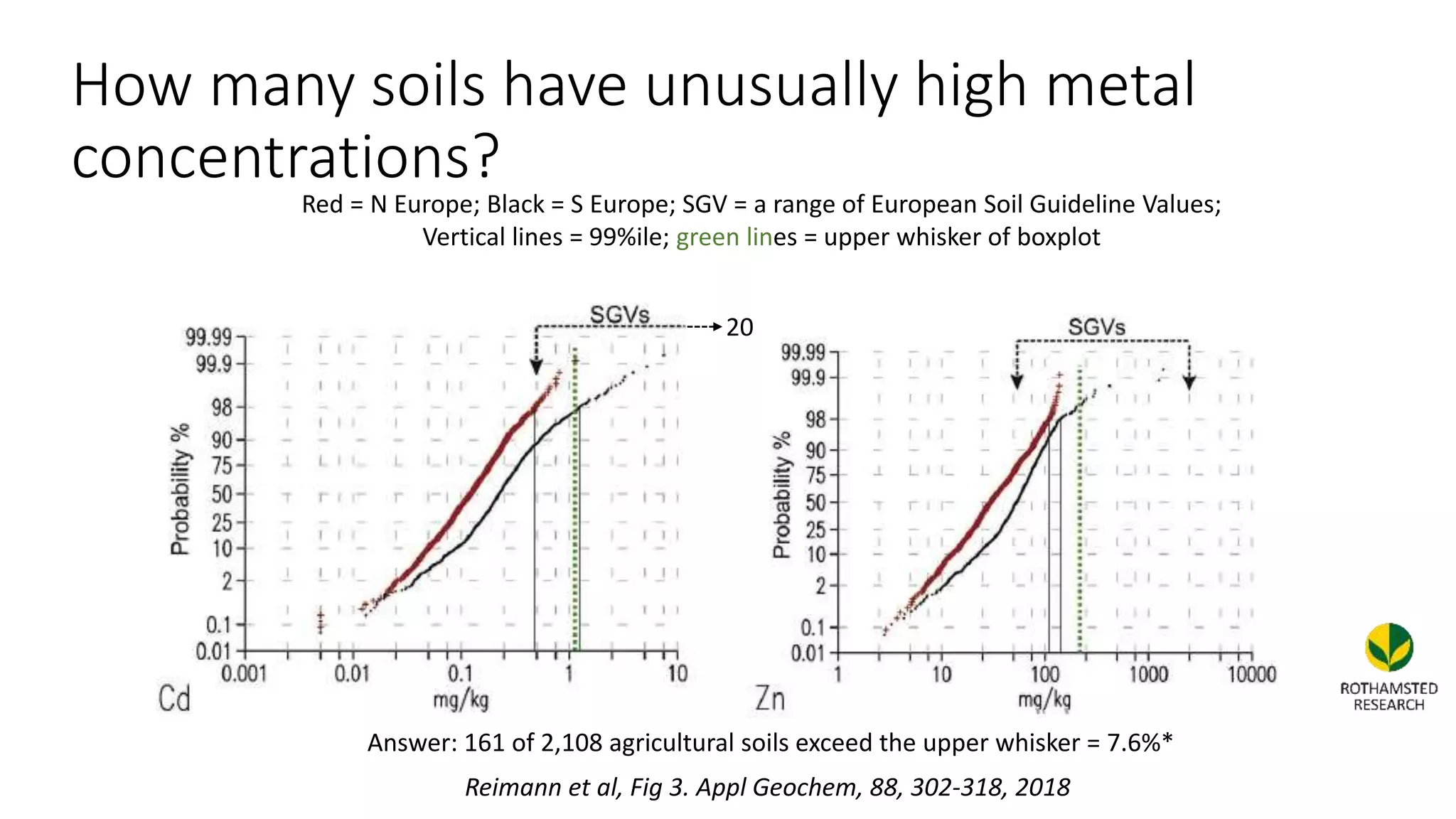
How many soils have unusually high metal
concentrations?
Reimann et al, Fig 3. Appl Geochem, 88, 302-318, 2018
Red = N Europe; Black = S Europe; SGV = a range of European Soil Guideline Values;
Vertical lines = 99%ile; green lines = upper whisker of boxplot
20
Answer: 161 of 2,108 agricultural soils exceed the upper whisker = 7.6%*
Risks for Cd concentrations in European topsoils
*RCR = PEC/PNEC, using PNECsoil = 0.9 mg Cd/kg Predicted Environmental Concentration
Birke et al. J Geochem Expl 173 (2017) 13–30 Predicted No Effect Concentration
Risk Characterisation Ratios (RCR*) for Cd in European
agricultural soils
n P%10 Median P%90
GEMAS 2218 0.07 0.20 0.48
Countries
Min 0.03 0.09 0.17
Max 0.21 0.63 2.53
• But we must also take into account bioavailability
• And whether this is natural or anthropogenic
Other regions?
Threats to soil function: condition and trend
Table 8 Condition: Very poor Poor Fair Good Very good
http://www.fao.org/documents/card/en/c/39bc9f2b-7493-4ab6-b024-feeaf49d4d01/
Soil contamination in China
• In 2014 the Ministry of Environmental Protection (MEP): current
status of soil contamination in China
• Surface (0−20 cm) soil samples from 8 × 8 km grids and analysed for:
 As, Cd, Co, Cr, Cu, F, Hg, Mn, Ni, Pb, Se, V and Zn
 [3 types of organic contaminants (hexachlorocyclohexane,
dichlorodiphenyltri-chloroethane, and polyaromatic hydrocarbons)]
• Of all the samples analysed, 16% exceed the environmental quality
standard set by the MEP and 19% of agricultural soils (equivalent to
approximately 26 million ha)
• Contamination by As, Cd, Cr, Cu, Hg, Ni, Pb and Zn accounted for the
majority (82.4%) of the soils classified as being contaminated
• Amongst those, Cd ranked first in the percentage soil samples (7.0%)
exceeding the MEP limit
Zhao, Ma, Zhu, Tang and McGrath, Environ Sci Technol. 2015, 750-759
Soil Cd concentration in China:
90th Percentile for different provinces
Hunan
Guangxi
Guizhou
Chinese element background values in soil, 1990
Geographical patterns of rice Cd concentrations in China
Chen et al 2018. Environ. Pollut.
North
Jilin
H
eilongjiangLiaoningXinjiang
East
JiangsuZhejiangFujian
South
H
unanG
uangxiJiangxi
G
uangdongG
uizhouSichuanY
unnan
Cdinpolishedrice(mgkg
-1
)
10-4
10-3
10-2
10-1
100
(a)
H
ubeiH
enanAnhui
MiddleSouth west
Chinese Limit 0.2 mg/kg
As toxicity in soils of irrigated rice in SE Asia
• >70% groundwater
is used for
irrigation of paddy
rice in the dry
season
• Irrigation adds
>1000 t arsenic to
topsoils in
Bangladesh /yr
IRRI
arsenite
arsenite
arsenite
Groundwater
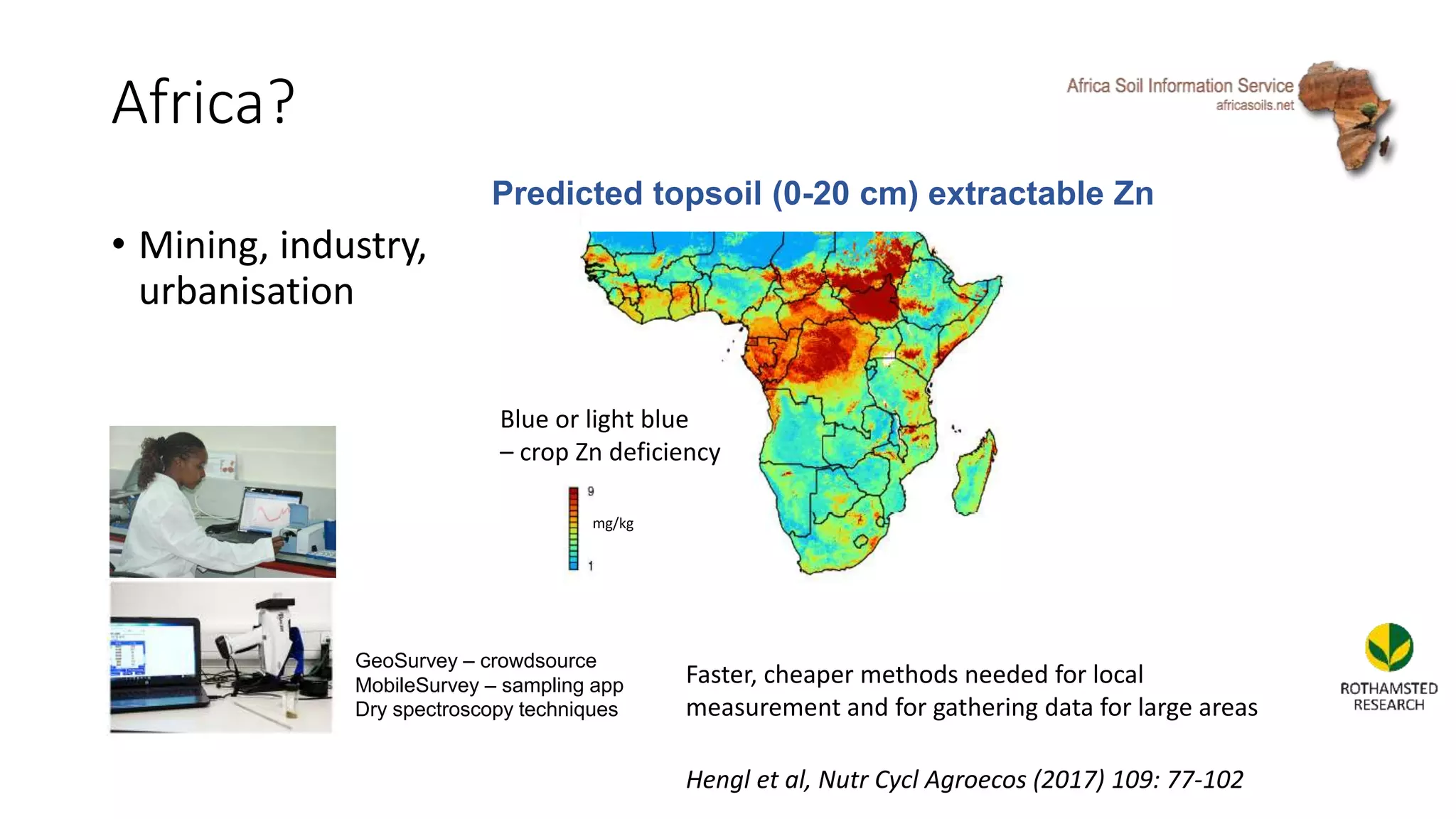
Africa?
• Mining, industry,
urbanisation
mg/kg
Predicted topsoil (0-20 cm) extractable Zn
GeoSurvey – crowdsource
MobileSurvey – sampling app
Dry spectroscopy techniques
Blue or light blue
– crop Zn deficiency
Faster, cheaper methods needed for local
measurement and for gathering data for large areas
Hengl et al, Nutr Cycl Agroecos (2017) 109: 77-102
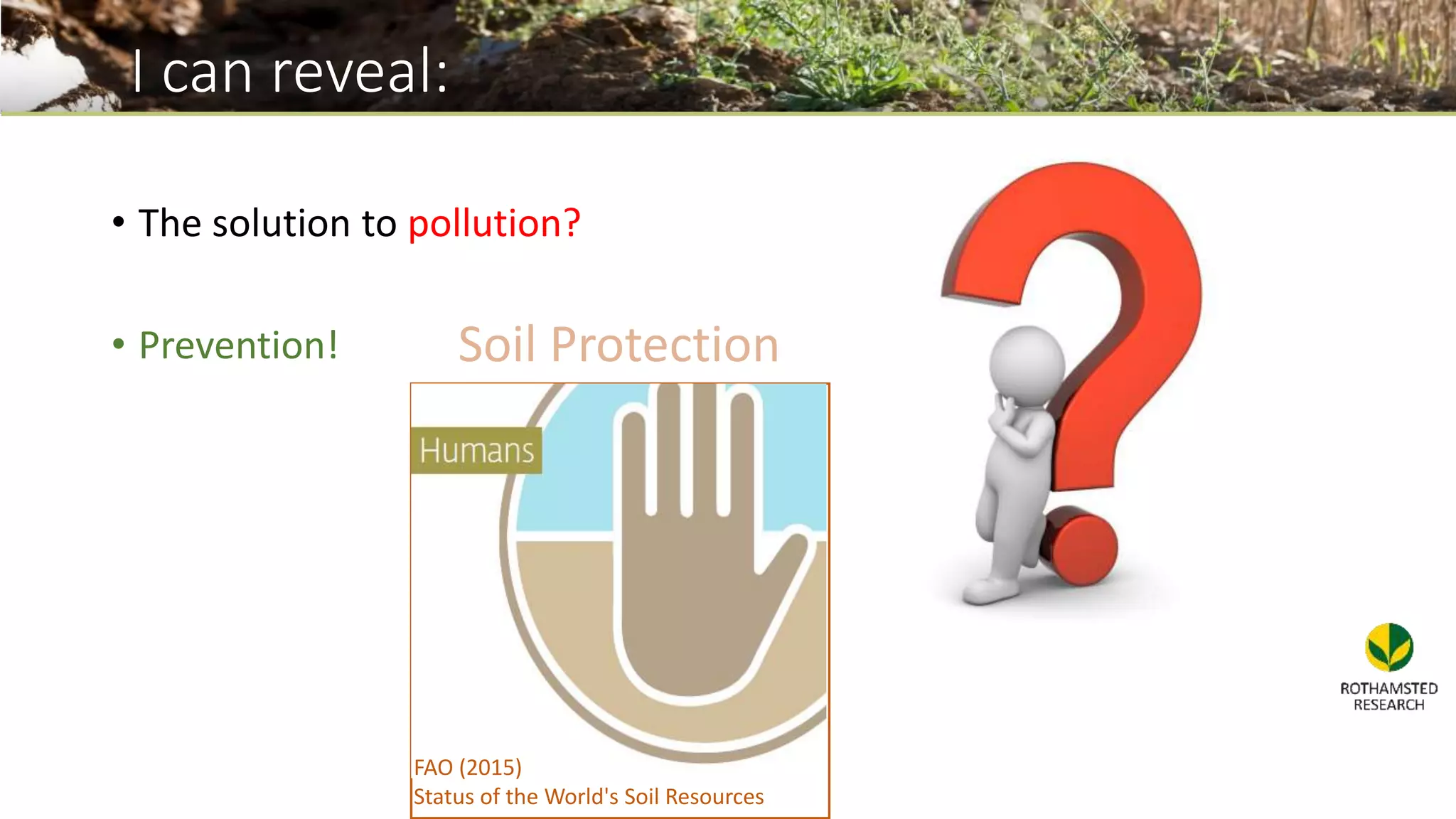
I can reveal:
• The solution to pollution?
• Prevention! Soil Protection
FAO (2015)
Status of the World's Soil Resources
Legislation
Types of laws
• Air pollution prevention laws
• Water pollution prevention laws
• Soil pollution prevention laws
• Food quality rules (SANCO, WHO/CODEX)
• Legislation on the production and use of chemicals
• Waste disposal laws
Results?
• Decreasing concentrations in air, water, materials added to soils
• Decreasing build-up in soils
Metal concentrations in sewage sludge are
decreasing as a result of emission controls
Zn and Cd in sewage sludge from Nottingham STW, UK during the period 1978 – 1999
From: Pollutants in Urban Waste Water and Sewage Sludge, EC, 2001
↓ x 4 ↓ x40
UK metal emissions:
National Atmospheric Emissions Inventory
• Metal emissions
are declining
0
1
2
3
4
5
6
7
8
9
10
0
0.2
0.4
0.6
0.8
1
1.2
1.4
1.6
1970 1980 1990 2000 2010 2020
1000stonnes/year
Zinc
Copper
Lead
1000stonnes/year
http://naei.defra.gov.uk/ Different patterns in other regions
Conclusions and future challenges
1. We must promulgate a unified terminology around
contamination/pollution
2. Where anomalously high metal concentrations occur, they are normally
due to either natural geochemical hot spots, or mining, smelting,
urbanization* and other industries.
3. Diffuse pollution of agricultural soils cannot be detected at large scale
4. Investigations need to be local, and based on soil properties,
bioavailability and local background concentrations, i.e. specific risk
assessment
5. Monitoring over time can demonstrate anthropic inputs, but this is
almost non-existent
6. Cheaper methods for sampling and analysis are needed for site
assessment and monitoring
7. Pollution control is the solution; decontamination of large areas is
expensive
8. Harmonised methods for sampling and analysis need to be used obtain
comparable regional/global information
9. A common generic framework for the derivation of bioavailability-based
risk values needs to be used
* Urban or peri-urban agriculture often takes place on contaminated soils
Soil pollution on agricultural fields and other land uses

Soil pollution on agricultural fields and other land uses

  • 2.
    Steve McGrath Soil pollutionand agriculture: status, drivers and challenges FAO GLOBAL SYMPOSIUM ON SOIL POLLUTION
  • 3.
    What effects doessoil pollution have? • Phytoxicity, decreased yield • Effects on soil biodiversity and microbial function • Decreased food quality • Decreased air and water quality • Human and animal health
  • 4.
    Preliminary remarks • Thistalk concentrates on metals/metalloids in soils • Contamination - any presence above “background concentrations” • Pollution – presence of sufficient bioavailable substance to present harm, i.e. above a selected threshold value Non-essential substance Bioavailable concentration in soil Biological activity Essential substance Toxicity ̴Contamination Pollution NOAEC –No Observed Adverse Effect Concentration Smolders, Oorts, Sub-theme 4.1 Thursday
  • 5.
    What are thesources of metals for agricultural soils? These are allowed to be added to soils but society can control them: – usually by imposing laws or codes of practice Graphic: Zhao, Ma, Zhu, Tang and McGrath, Environ Sci Technol. 2015, 750
  • 6.
    Metal addition ratesto agricultural land in E&W from various sources (g/ha/yr) Source Source Zn Cu Ni Pb Cd Atmospheric deposition Sewage sludgea 221.0 4557.0 57.0 3210.0 16.0 335.0 54.0 1256.0 1.9 19.0 Livestock manuresa Dairy cattle slurry Beef cattle slurry Pig slurry Cattle FYMb Pig FYM Layer manure Broiler litter c 1063.0 1214.0 2321.0 718.0 2120.0 2734.0 1142.0 281.0 321.0 1679.0 168.0 1488.0 422.0 175.0 38.0 43.0 50.0 28.0 48.0 47.0 20.0 44.0 50.0 29.0 27.0 27.0 42.0 18.0 1.9 2.1 1.4 2.7 2.0 6.1 2.6 Inorganic fertilisers Nitrogen Phosphate Potash Limed 2.2 34.0 0.5 53.0 1.6 4.9 0.4 12.0 0.2 3.3 0.1 25.0 0.7 0.5 0.2 10.0 0.1 1.6 0.0 1.4 Irrigation water Paper sludge 39.0 1380.0 16.0 1270.0 1.6 102.0 0.8 45.0 0.1 12.5 a Using application equivalent to 250 kg N/ha; b Includes sheep Farm Yard Manure; c Includes pullets and other poultry; d Typically applied 1/5 years to acid soils Nicholson et al, STOTEN, 311, 2003, 205-219
  • 7.
    Metal addition ratesto agricultural land in E&W from various sources (g/ha/yr) Source Source Zn Cu Ni Pb Cd Atmospheric deposition Sewage sludgea 221.0 4557.0 57.0 3210.0 16.0 335.0 54.0 1256.0 1.9 19.0 Livestock manuresa Dairy cattle slurry Beef cattle slurry Pig slurry Cattle FYMb Pig FYM Layer manure Broiler litter c 1063.0 1214.0 2321.0 718.0 2120.0 2734.0 1142.0 281.0 321.0 1679.0 168.0 1488.0 422.0 175.0 38.0 43.0 50.0 28.0 48.0 47.0 20.0 44.0 50.0 29.0 27.0 27.0 42.0 18.0 1.9 2.1 1.4 2.7 2.0 6.1 2.6 Inorganic fertilisers Nitrogen Phosphate Potash Limed 2.2 34.0 0.5 53.0 1.6 4.9 0.4 12.0 0.2 3.3 0.1 25.0 0.7 0.5 0.2 10.0 0.1 1.6 0.0 1.4 Irrigation water Paper sludge 39.0 1380.0 16.0 1270.0 1.6 102.0 0.8 45.0 0.1 12.5 a Using application equivalent to 250 kg N/ha; b Includes sheep Farm Yard Manure; c Includes pullets and other poultry; d Typically applied 1/5 years to acid soils Nicholson et al, STOTEN, 311, 2003, 205-219
  • 8.
    Metal addition ratesto agricultural land in E&W from various sources (g/ha/yr) Source Source Zn Cu Ni Pb Cd Atmospheric deposition Sewage sludgea 221.0 4557.0 57.0 3210.0 16.0 335.0 54.0 1256.0 1.9 19.0 Livestock manuresa Dairy cattle slurry Beef cattle slurry Pig slurry Cattle FYMb Pig FYM Layer manure Broiler litter c 1063.0 1214.0 2321.0 718.0 2120.0 2734.0 1142.0 281.0 321.0 1679.0 168.0 1488.0 422.0 175.0 38.0 43.0 50.0 28.0 48.0 47.0 20.0 44.0 50.0 29.0 27.0 27.0 42.0 18.0 1.9 2.1 1.4 2.7 2.0 6.1 2.6 Inorganic fertilisers Nitrogen Phosphate Potash Limed 2.2 34.0 0.5 53.0 1.6 4.9 0.4 12.0 0.2 3.3 0.1 25.0 0.7 0.5 0.2 10.0 0.1 1.6 0.0 1.4 Irrigation water Paper sludge 39.0 1380.0 16.0 1270.0 1.6 102.0 0.8 45.0 0.1 12.5 a Using application equivalent to 250 kg N/ha; b Includes sheep Farm Yard Manure; c Includes pullets and other poultry; d Typically applied 1/5 years to acid soils Nicholson et al, STOTEN, 311, 2003, 205-219 McLaughlin Theme 1 This afternoon
  • 9.
    Metal addition ratesto agricultural land in E&W from various sources (g/ha/yr) Source Source Zn Cu Ni Pb Cd Atmospheric deposition Sewage sludgea 221.0 4557.0 57.0 3210.0 16.0 335.0 54.0 1256.0 1.9 19.0 Livestock manuresa Dairy cattle slurry Beef cattle slurry Pig slurry Cattle FYMb Pig FYM Layer manure Broiler litter c 1063.0 1214.0 2321.0 718.0 2120.0 2734.0 1142.0 281.0 321.0 1679.0 168.0 1488.0 422.0 175.0 38.0 43.0 50.0 28.0 48.0 47.0 20.0 44.0 50.0 29.0 27.0 27.0 42.0 18.0 1.9 2.1 1.4 2.7 2.0 6.1 2.6 Inorganic fertilisers Nitrogen Phosphate Potash Limed 2.2 34.0 0.5 53.0 1.6 4.9 0.4 12.0 0.2 3.3 0.1 25.0 0.7 0.5 0.2 10.0 0.1 1.6 0.0 1.4 Irrigation water Paper sludge 39.0 1380.0 16.0 1270.0 1.6 102.0 0.8 45.0 0.1 12.5 a Using application equivalent to 250 kg N/ha; b Includes sheep Farm Yard Manure; c Includes pullets and other poultry; d Typically applied 1/5 years to acid soils Nicholson et al, STOTEN, 311, 2003, 205-219
  • 10.
    What is the extentof soil pollution?
  • 11.
    Cadmium concentrations inagricultural topsoils GEMAS: Geochemical Mapping of Agricultural and Grazing land Soil Birke et al. J Geochem Expl 173 (2017) 13–30Reimann et al. / App Geochem 88 (2018) 302-318
  • 12.
    How many soilshave unusually high metal concentrations? Reimann et al, Fig 3. Appl Geochem, 88, 302-318, 2018 Red = N Europe; Black = S Europe; SGV = a range of European Soil Guideline Values; Vertical lines = 99%ile; green lines = upper whisker of boxplot 20 Answer: 161 of 2,108 agricultural soils exceed the upper whisker = 7.6%*
  • 13.
    Risks for Cdconcentrations in European topsoils *RCR = PEC/PNEC, using PNECsoil = 0.9 mg Cd/kg Predicted Environmental Concentration Birke et al. J Geochem Expl 173 (2017) 13–30 Predicted No Effect Concentration Risk Characterisation Ratios (RCR*) for Cd in European agricultural soils n P%10 Median P%90 GEMAS 2218 0.07 0.20 0.48 Countries Min 0.03 0.09 0.17 Max 0.21 0.63 2.53 • But we must also take into account bioavailability • And whether this is natural or anthropogenic
  • 14.
  • 15.
    Threats to soilfunction: condition and trend Table 8 Condition: Very poor Poor Fair Good Very good http://www.fao.org/documents/card/en/c/39bc9f2b-7493-4ab6-b024-feeaf49d4d01/
  • 16.
    Soil contamination inChina • In 2014 the Ministry of Environmental Protection (MEP): current status of soil contamination in China • Surface (0−20 cm) soil samples from 8 × 8 km grids and analysed for:  As, Cd, Co, Cr, Cu, F, Hg, Mn, Ni, Pb, Se, V and Zn  [3 types of organic contaminants (hexachlorocyclohexane, dichlorodiphenyltri-chloroethane, and polyaromatic hydrocarbons)] • Of all the samples analysed, 16% exceed the environmental quality standard set by the MEP and 19% of agricultural soils (equivalent to approximately 26 million ha) • Contamination by As, Cd, Cr, Cu, Hg, Ni, Pb and Zn accounted for the majority (82.4%) of the soils classified as being contaminated • Amongst those, Cd ranked first in the percentage soil samples (7.0%) exceeding the MEP limit Zhao, Ma, Zhu, Tang and McGrath, Environ Sci Technol. 2015, 750-759
  • 17.
    Soil Cd concentrationin China: 90th Percentile for different provinces Hunan Guangxi Guizhou Chinese element background values in soil, 1990
  • 18.
    Geographical patterns ofrice Cd concentrations in China Chen et al 2018. Environ. Pollut. North Jilin H eilongjiangLiaoningXinjiang East JiangsuZhejiangFujian South H unanG uangxiJiangxi G uangdongG uizhouSichuanY unnan Cdinpolishedrice(mgkg -1 ) 10-4 10-3 10-2 10-1 100 (a) H ubeiH enanAnhui MiddleSouth west Chinese Limit 0.2 mg/kg
  • 19.
    As toxicity insoils of irrigated rice in SE Asia • >70% groundwater is used for irrigation of paddy rice in the dry season • Irrigation adds >1000 t arsenic to topsoils in Bangladesh /yr IRRI arsenite arsenite arsenite Groundwater
  • 20.
    Africa? • Mining, industry, urbanisation mg/kg Predictedtopsoil (0-20 cm) extractable Zn GeoSurvey – crowdsource MobileSurvey – sampling app Dry spectroscopy techniques Blue or light blue – crop Zn deficiency Faster, cheaper methods needed for local measurement and for gathering data for large areas Hengl et al, Nutr Cycl Agroecos (2017) 109: 77-102
  • 21.
    I can reveal: •The solution to pollution? • Prevention! Soil Protection FAO (2015) Status of the World's Soil Resources
  • 22.
    Legislation Types of laws •Air pollution prevention laws • Water pollution prevention laws • Soil pollution prevention laws • Food quality rules (SANCO, WHO/CODEX) • Legislation on the production and use of chemicals • Waste disposal laws Results? • Decreasing concentrations in air, water, materials added to soils • Decreasing build-up in soils
  • 23.
    Metal concentrations insewage sludge are decreasing as a result of emission controls Zn and Cd in sewage sludge from Nottingham STW, UK during the period 1978 – 1999 From: Pollutants in Urban Waste Water and Sewage Sludge, EC, 2001 ↓ x 4 ↓ x40
  • 24.
    UK metal emissions: NationalAtmospheric Emissions Inventory • Metal emissions are declining 0 1 2 3 4 5 6 7 8 9 10 0 0.2 0.4 0.6 0.8 1 1.2 1.4 1.6 1970 1980 1990 2000 2010 2020 1000stonnes/year Zinc Copper Lead 1000stonnes/year http://naei.defra.gov.uk/ Different patterns in other regions
  • 25.
    Conclusions and futurechallenges 1. We must promulgate a unified terminology around contamination/pollution 2. Where anomalously high metal concentrations occur, they are normally due to either natural geochemical hot spots, or mining, smelting, urbanization* and other industries. 3. Diffuse pollution of agricultural soils cannot be detected at large scale 4. Investigations need to be local, and based on soil properties, bioavailability and local background concentrations, i.e. specific risk assessment 5. Monitoring over time can demonstrate anthropic inputs, but this is almost non-existent 6. Cheaper methods for sampling and analysis are needed for site assessment and monitoring 7. Pollution control is the solution; decontamination of large areas is expensive 8. Harmonised methods for sampling and analysis need to be used obtain comparable regional/global information 9. A common generic framework for the derivation of bioavailability-based risk values needs to be used * Urban or peri-urban agriculture often takes place on contaminated soils

Editor's Notes

  • #12 Where anomalously high metal concentrations occur, they are normally due to either natural geochemical hot spots, or mining, smelting, urbanization and other industries.
  • #23 Set low limits and that is it? No! Need all of these controls, measurable and enforced