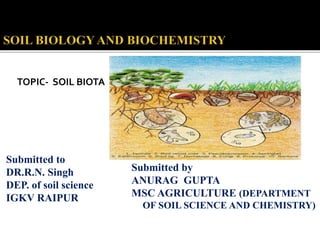
TOPIC- SOIL BIOTA
Submitted to
DR.R.N. Singh
DEP. of soil science
IGKV RAIPUR
INDIRA GANDHI KRISHI VISHWVIDHYALYA RAIPUR (C.G.)
Submitted by
ANURAG GUPTA
MSC AGRICULTURE (DEPARTMENT
OF SOIL SCIENCE AND CHEMISTRY)
INTRODUCTION
“The animal and plant life of a particular region, habitat or geological
period is called biota”
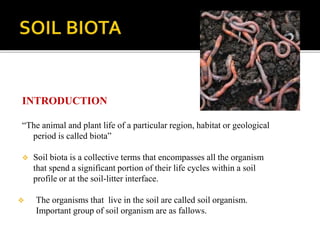
 Soil biota is a collective terms that encompasses all the organism
that spend a significant portion of their life cycles within a soil
profile or at the soil-litter interface.
 The organisms that live in the soil are called soil organism.
Important group of soil organism are as fallows.
Soil Organisms
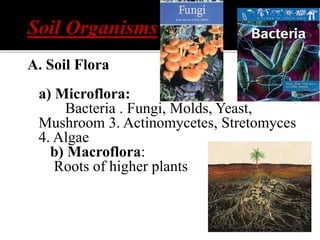
A. Soil Flora
a) Microflora:
Bacteria . Fungi, Molds, Yeast,
Mushroom 3. Actinomycetes, Stretomyces
4. Algae
b) Macroflora:
Roots of higher plants
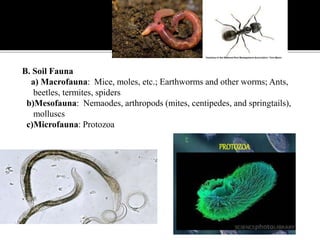
B. Soil Fauna
a) Macrofauna: Mice, moles, etc.; Earthworms and other worms; Ants,
beetles, termites, spiders
b)Mesofauna: Nemaodes, arthropods (mites, centipedes, and springtails),
molluscs
c)Microfauna: Protozoa
 Soil biota comprises an enormous diversity of
organisms, including microorganisms (i.e.,
bacteria, fungi) and soil fauna (microscopic and
macroscopic animals). Soil organisms interact
with each other, with the plant roots, and with
the environment.They constitute soil food webs
and contribute to nutrient cycling, which is
important for plants. focusing on the
rhizosphere and on an important group of soil
fungi, which interacting with plant roots, form
the mutualistic symbioses that are known as
mycorrhizae.
Soil microbes break down organic matter
Microorganisms play an important role in the
decomposition of organic matter. Different types of
microbes are specialised to different types of organic
matter, between them covering just about
everything.
Soil microbes recycle nutrients
Soil microbes play a crucial role in returning nutrients
to their mineral forms, which plants can take up
again.This process is known as mineralization.
 Soil microbes create humus
When the soil microbes have broken down all they
can, what’s left is called humus, a dark brown jelly-like
substance that can remain unchanged in the soil for
potentially millennia. Humus helps the soil retain
moisture, and encourages the formation of soil
structure. Humus molecules are covered in negatively
charged sites that bind to positively charged ions
(cations) of plant nutrients, thus forming an important
component of a soil’s cation exchange capacity.
Humus is also suspected of suppressing plant
diseases.
 Soil microbes create soil structure Some soil microbes secrete
polysaccharides, gums and glycoproteins, which glue soil minerals
together, forming the basis for soil structure. Fungal hyphae and
plant roots further bind soil aggregates together. Soil structure is
essential to good plant growth.
 Soil microbes fix nitrogen
Agriculture depends heavily on the ability of certain microbes
(mainly bacteria) to convert atmospheric nitrogen (N2 gas) to
ammonia (NH3). Some live freely in the soil, while others live in
association with plant roots – the classic example is Rhizobium
bacteria in the roots of legumes.The process of conversion is
known as nitrogen fixation.
 Soil organisms promote plant growth
Some soil microbes produce a variety of substances that promote
plant growth, including auxins, gibberellins and antibiotics.
 Soil microbes control pests and diseases
The best known example of the use of soil microbes in pest control
is the commercial production of the soil bacterium Bacillus
thuringiensis (Bt) to control caterpillar pests of crops. Some strains
of Bt are used to control beetles and flies as well. Several strains of
the fungal genus Trichodermahave been developed as biocontrol
agents against fungal diseases of plants, mainly root diseases.
Various other genera of fungi are used for the control of insect
pests.
 A text book of soil science by r.k. Mehra
 Indian society of soil science
 Vishwas and mukharjee
 M.wikipedia.org
Soil biota

Soil biota

  • 1.
    TOPIC- SOIL BIOTA Submittedto DR.R.N. Singh DEP. of soil science IGKV RAIPUR INDIRA GANDHI KRISHI VISHWVIDHYALYA RAIPUR (C.G.) Submitted by ANURAG GUPTA MSC AGRICULTURE (DEPARTMENT OF SOIL SCIENCE AND CHEMISTRY)
  • 2.
    INTRODUCTION “The animal andplant life of a particular region, habitat or geological period is called biota”  Soil biota is a collective terms that encompasses all the organism that spend a significant portion of their life cycles within a soil profile or at the soil-litter interface.  The organisms that live in the soil are called soil organism. Important group of soil organism are as fallows.
  • 3.
    Soil Organisms A. SoilFlora a) Microflora: Bacteria . Fungi, Molds, Yeast, Mushroom 3. Actinomycetes, Stretomyces 4. Algae b) Macroflora: Roots of higher plants
  • 4.
    B. Soil Fauna a)Macrofauna: Mice, moles, etc.; Earthworms and other worms; Ants, beetles, termites, spiders b)Mesofauna: Nemaodes, arthropods (mites, centipedes, and springtails), molluscs c)Microfauna: Protozoa
  • 5.
     Soil biotacomprises an enormous diversity of organisms, including microorganisms (i.e., bacteria, fungi) and soil fauna (microscopic and macroscopic animals). Soil organisms interact with each other, with the plant roots, and with the environment.They constitute soil food webs and contribute to nutrient cycling, which is important for plants. focusing on the rhizosphere and on an important group of soil fungi, which interacting with plant roots, form the mutualistic symbioses that are known as mycorrhizae.
  • 6.
    Soil microbes breakdown organic matter Microorganisms play an important role in the decomposition of organic matter. Different types of microbes are specialised to different types of organic matter, between them covering just about everything. Soil microbes recycle nutrients Soil microbes play a crucial role in returning nutrients to their mineral forms, which plants can take up again.This process is known as mineralization.
  • 7.
     Soil microbescreate humus When the soil microbes have broken down all they can, what’s left is called humus, a dark brown jelly-like substance that can remain unchanged in the soil for potentially millennia. Humus helps the soil retain moisture, and encourages the formation of soil structure. Humus molecules are covered in negatively charged sites that bind to positively charged ions (cations) of plant nutrients, thus forming an important component of a soil’s cation exchange capacity. Humus is also suspected of suppressing plant diseases.
  • 8.
     Soil microbescreate soil structure Some soil microbes secrete polysaccharides, gums and glycoproteins, which glue soil minerals together, forming the basis for soil structure. Fungal hyphae and plant roots further bind soil aggregates together. Soil structure is essential to good plant growth.  Soil microbes fix nitrogen Agriculture depends heavily on the ability of certain microbes (mainly bacteria) to convert atmospheric nitrogen (N2 gas) to ammonia (NH3). Some live freely in the soil, while others live in association with plant roots – the classic example is Rhizobium bacteria in the roots of legumes.The process of conversion is known as nitrogen fixation.
  • 9.
     Soil organismspromote plant growth Some soil microbes produce a variety of substances that promote plant growth, including auxins, gibberellins and antibiotics.  Soil microbes control pests and diseases The best known example of the use of soil microbes in pest control is the commercial production of the soil bacterium Bacillus thuringiensis (Bt) to control caterpillar pests of crops. Some strains of Bt are used to control beetles and flies as well. Several strains of the fungal genus Trichodermahave been developed as biocontrol agents against fungal diseases of plants, mainly root diseases. Various other genera of fungi are used for the control of insect pests.
  • 10.
     A textbook of soil science by r.k. Mehra  Indian society of soil science  Vishwas and mukharjee  M.wikipedia.org