TARGET INTRAOCULAR
PRESSURE
Dr. Samarth Mishra
Introduction
Glaucoma
 progressive optic neuropathy as a results of RGCs loss
 VFL
IOP- important risk factor & only factor that can be
modified at present time
Reducing IOP is currently the only clinically proven way
to slow down the progression of glaucoma
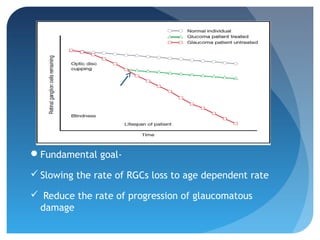
Fundamental goal-
 Slowing the rate of RGCs loss to age dependent rate
 Reduce the rate of progression of glaucomatous
damage
Target IOP
A “target” pressure should be set as a goal of long term
therapy.
 it should be chosen on an individual basis, weighing
potential benefits and risks of treatment for each
patient.
Definition: “upper limit of IOP that prevents further
glaucomatous damage”
Also called the “Ideal pressure”, “safe level of IOP”
Evidence from Clinical Studies
 Ocular Hypertension Treatment Study (OHTS)
 ≥20% reduction of IOP from initial value, leads to a
lower rate of glaucoma progression in OHT patients.
 Collaborative Initial Glaucoma Treatment Study (CIGTS)
 To determine newly dx pts with POAG are better treated
initially with medication Vs filtering Sx.
 Both lowered IOP; Sx >medication
 Glaucoma progress will be minimal if pts are treated
aggressively to achieve low target pressure.
 Early Manifest Glaucoma Trial (EMGT)
 Compare the effect of immediate t/t to lower IOP Vs no
t/t on progression of newly detected POAG.
 For every 1 mm drop in IOP, a 10% reduction in risk of
glaucomatous progression was observed.
 Early t/t reduces & delays glaucoma progression
 Advanced Glaucoma Intervention Study (AGIS)
 Trabeculectomy Vs laser trabeculoplasty in pts with IOP
uncontrolled by medication
 Target IOP was set at <18 mmHg
 Follow-up pts with lower IOP were free from visual field
impairment.
 Collaborative Normal Tension Glaucoma Study (CNTGS)
 Effect of IOP decrease in patients with NTG or low
tension glaucoma
 ≥30% IOP reduction from base line, decrease delayed
the progression of glaucomatous lesions by 3 years
Establishing a target IOP
Why? To maintain functional vision throughout
the patients lifetime with a minimal
effect on quality of life
When? On initial visit & review periodically
How? Individualized
Assessment of target IOP
Based on an individual glaucoma risk assessment
1.Estimation of amount of glaucoma damage (optic disc
and visual field assessment).
 If advanced optic nerve damage at the time of
diagnosis, set lower target IOP & vice versa
2.Appreciation of the damaging IOP or “maximum” IOP at
which damage has occurred.
 lower IOP at initial presentation, set lower target IOP &
vice versa
3. Life expectancy of pts.
 High expectancy, set lower the target IOP & vise versa.
4. Identification of the other risk factors for progression
(presence of a severe damage in other eye, family
history of blindness from glaucoma, high myopia,
ethnicity, vascular risk factors)
5. Assessment of the rate of progression of glaucoma
damage, i.e severity of damage that has already
occurred versus time.
6. Centre corneal thickness
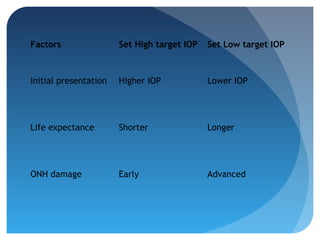
Factors Set High target IOP Set Low target IOP
Initial presentation Higher IOP Lower IOP
Life expectance Shorter Longer
ONH damage Early Advanced
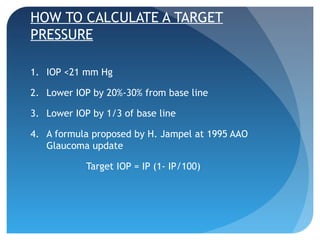
HOW TO CALCULATE A TARGET
PRESSURE
1. IOP <21 mm Hg
2. Lower IOP by 20%-30% from base line
3. Lower IOP by 1/3 of base line
4. A formula proposed by H. Jampel at 1995 AAO
Glaucoma update
Target IOP = IP (1- IP/100)
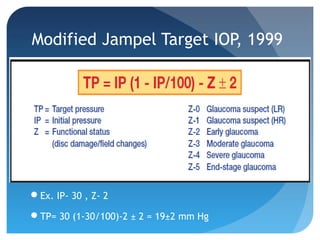
Modified Jampel Target IOP, 1999
Ex. IP- 30 , Z- 2
TP= 30 (1-30/100)-2 ± 2 = 19±2 mm Hg
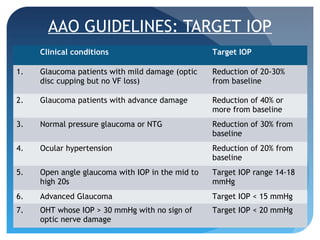
AAO GUIDELINES: TARGET IOP
Clinical conditions Target IOP
1. Glaucoma patients with mild damage (optic
disc cupping but no VF loss)
Reduction of 20-30%
from baseline
2. Glaucoma patients with advance damage Reduction of 40% or
more from baseline
3. Normal pressure glaucoma or NTG Reduction of 30% from
baseline
4. Ocular hypertension Reduction of 20% from
baseline
5. Open angle glaucoma with IOP in the mid to
high 20s
Target IOP range 14-18
mmHg
6. Advanced Glaucoma Target IOP < 15 mmHg
7. OHT whose IOP > 30 mmHg with no sign of
optic nerve damage
Target IOP < 20 mmHg
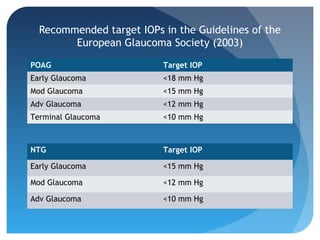
Recommended target IOPs in the Guidelines of the
European Glaucoma Society (2003)
POAG Target IOP
Early Glaucoma <18 mm Hg
Mod Glaucoma <15 mm Hg
Adv Glaucoma <12 mm Hg
Terminal Glaucoma <10 mm Hg
NTG Target IOP
Early Glaucoma <15 mm Hg
Mod Glaucoma <12 mm Hg
Adv Glaucoma <10 mm Hg
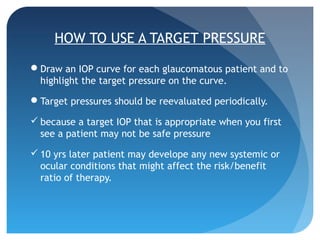
HOW TO USE A TARGET PRESSURE
Draw an IOP curve for each glaucomatous patient and to
highlight the target pressure on the curve.
Target pressures should be reevaluated periodically.
 because a target IOP that is appropriate when you first
see a patient may not be safe pressure
 10 yrs later patient may develope any new systemic or
ocular conditions that might affect the risk/benefit
ratio of therapy.
HOW TO USE A TARGET PRESSURE cont..
Target pressure needs to be lowered if glaucomatous
damage is progressing despite IOP’s below the initially
set target.
Conversely, the target IOP range may have to be
increased if achieving the target IOP causes adverse
ocular or systemic side effects.
Listen to Expert
“ You’re not going to have one target pressure that’s
appropriate for every patient. It is a dynamic process
and you always have to be alert and open to
modification.”
L. Jay Katz,
Professor of Ophthalmology
Jefferson Medical College
Listen to Expert
“Patients should be followed closely over time and their
target pressures should be adjusted, depending upon
how the patient is doing. If the patient progresses, the
target pressure should be lowered. If the patient does
very well, the target might be raised.”
Stevens Simmons,
Associate Clinical Professor,
Albany Medical College
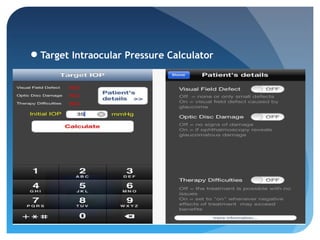
Target Intraocular Pressure Calculator
Key Points
IOP is a significant, modifiable risk factor in Glaucoma
Lowering IOP to a target level is helpful across the
spectrum of ds states & IOP levels:
 Advanced glaucoma
 Normal tension glaucoma
 Newly diagnosed glaucoma
Target IOP range must be:
 Individualized
 Re-evaluated periodically
THANK YOU

Target IOP

  • 1.
  • 2.
    Introduction Glaucoma  progressive opticneuropathy as a results of RGCs loss  VFL IOP- important risk factor & only factor that can be modified at present time Reducing IOP is currently the only clinically proven way to slow down the progression of glaucoma
  • 3.
    Fundamental goal-  Slowingthe rate of RGCs loss to age dependent rate  Reduce the rate of progression of glaucomatous damage
  • 4.
    Target IOP A “target”pressure should be set as a goal of long term therapy.  it should be chosen on an individual basis, weighing potential benefits and risks of treatment for each patient. Definition: “upper limit of IOP that prevents further glaucomatous damage” Also called the “Ideal pressure”, “safe level of IOP”
  • 5.
    Evidence from ClinicalStudies  Ocular Hypertension Treatment Study (OHTS)  ≥20% reduction of IOP from initial value, leads to a lower rate of glaucoma progression in OHT patients.  Collaborative Initial Glaucoma Treatment Study (CIGTS)  To determine newly dx pts with POAG are better treated initially with medication Vs filtering Sx.  Both lowered IOP; Sx >medication  Glaucoma progress will be minimal if pts are treated aggressively to achieve low target pressure.
  • 6.
     Early ManifestGlaucoma Trial (EMGT)  Compare the effect of immediate t/t to lower IOP Vs no t/t on progression of newly detected POAG.  For every 1 mm drop in IOP, a 10% reduction in risk of glaucomatous progression was observed.  Early t/t reduces & delays glaucoma progression
  • 7.
     Advanced GlaucomaIntervention Study (AGIS)  Trabeculectomy Vs laser trabeculoplasty in pts with IOP uncontrolled by medication  Target IOP was set at <18 mmHg  Follow-up pts with lower IOP were free from visual field impairment.
  • 8.
     Collaborative NormalTension Glaucoma Study (CNTGS)  Effect of IOP decrease in patients with NTG or low tension glaucoma  ≥30% IOP reduction from base line, decrease delayed the progression of glaucomatous lesions by 3 years
  • 9.
    Establishing a targetIOP Why? To maintain functional vision throughout the patients lifetime with a minimal effect on quality of life When? On initial visit & review periodically How? Individualized
  • 10.
    Assessment of targetIOP Based on an individual glaucoma risk assessment 1.Estimation of amount of glaucoma damage (optic disc and visual field assessment).  If advanced optic nerve damage at the time of diagnosis, set lower target IOP & vice versa 2.Appreciation of the damaging IOP or “maximum” IOP at which damage has occurred.  lower IOP at initial presentation, set lower target IOP & vice versa
  • 11.
    3. Life expectancyof pts.  High expectancy, set lower the target IOP & vise versa. 4. Identification of the other risk factors for progression (presence of a severe damage in other eye, family history of blindness from glaucoma, high myopia, ethnicity, vascular risk factors) 5. Assessment of the rate of progression of glaucoma damage, i.e severity of damage that has already occurred versus time. 6. Centre corneal thickness
  • 12.
    Factors Set Hightarget IOP Set Low target IOP Initial presentation Higher IOP Lower IOP Life expectance Shorter Longer ONH damage Early Advanced
  • 13.
    HOW TO CALCULATEA TARGET PRESSURE 1. IOP <21 mm Hg 2. Lower IOP by 20%-30% from base line 3. Lower IOP by 1/3 of base line 4. A formula proposed by H. Jampel at 1995 AAO Glaucoma update Target IOP = IP (1- IP/100)
  • 14.
    Modified Jampel TargetIOP, 1999 Ex. IP- 30 , Z- 2 TP= 30 (1-30/100)-2 ± 2 = 19±2 mm Hg
  • 15.
    AAO GUIDELINES: TARGETIOP Clinical conditions Target IOP 1. Glaucoma patients with mild damage (optic disc cupping but no VF loss) Reduction of 20-30% from baseline 2. Glaucoma patients with advance damage Reduction of 40% or more from baseline 3. Normal pressure glaucoma or NTG Reduction of 30% from baseline 4. Ocular hypertension Reduction of 20% from baseline 5. Open angle glaucoma with IOP in the mid to high 20s Target IOP range 14-18 mmHg 6. Advanced Glaucoma Target IOP < 15 mmHg 7. OHT whose IOP > 30 mmHg with no sign of optic nerve damage Target IOP < 20 mmHg
  • 16.
    Recommended target IOPsin the Guidelines of the European Glaucoma Society (2003) POAG Target IOP Early Glaucoma <18 mm Hg Mod Glaucoma <15 mm Hg Adv Glaucoma <12 mm Hg Terminal Glaucoma <10 mm Hg NTG Target IOP Early Glaucoma <15 mm Hg Mod Glaucoma <12 mm Hg Adv Glaucoma <10 mm Hg
  • 17.
    HOW TO USEA TARGET PRESSURE Draw an IOP curve for each glaucomatous patient and to highlight the target pressure on the curve. Target pressures should be reevaluated periodically.  because a target IOP that is appropriate when you first see a patient may not be safe pressure  10 yrs later patient may develope any new systemic or ocular conditions that might affect the risk/benefit ratio of therapy.
  • 18.
    HOW TO USEA TARGET PRESSURE cont.. Target pressure needs to be lowered if glaucomatous damage is progressing despite IOP’s below the initially set target. Conversely, the target IOP range may have to be increased if achieving the target IOP causes adverse ocular or systemic side effects.
  • 19.
    Listen to Expert “You’re not going to have one target pressure that’s appropriate for every patient. It is a dynamic process and you always have to be alert and open to modification.” L. Jay Katz, Professor of Ophthalmology Jefferson Medical College
  • 20.
    Listen to Expert “Patientsshould be followed closely over time and their target pressures should be adjusted, depending upon how the patient is doing. If the patient progresses, the target pressure should be lowered. If the patient does very well, the target might be raised.” Stevens Simmons, Associate Clinical Professor, Albany Medical College
  • 21.
  • 22.
    Key Points IOP isa significant, modifiable risk factor in Glaucoma Lowering IOP to a target level is helpful across the spectrum of ds states & IOP levels:  Advanced glaucoma  Normal tension glaucoma  Newly diagnosed glaucoma Target IOP range must be:  Individualized  Re-evaluated periodically
  • 23.