Dr. Samarth Mishra
CHOROIDITIS
INTRODUCTION
• Inflammation of
choroid; associated
with the highest risk
of severe vision loss.
(Standardization of
Uveitis Nomenclature
(SUN) Working
Group)
• Always Involving
retina, Retinal
vessels, optic nerve
head.
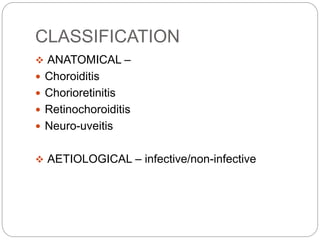
CLASSIFICATION
 ANATOMICAL –
 Choroiditis
 Chorioretinitis
 Retinochoroiditis
 Neuro-uveitis
 AETIOLOGICAL – infective/non-infective
INFECTIOUS
1. Parasitic
 – Toxoplasmosis
 – Toxocariasis
 – Onchocerciasis
 – Cysticercosis
2. Bacterial –
 - tuberculosis
 - syphilis
3. Viral
– Herpes viruses
• ARN
• CMV retinitis
 Epstein-Barr virus
– Rubella
– Rubeola (measles)
– West Nile virus
3. Fungal
 – Candidiasis
 – Aspergillosis
 – Cryptococcosis
 – Coccidioidomycosis
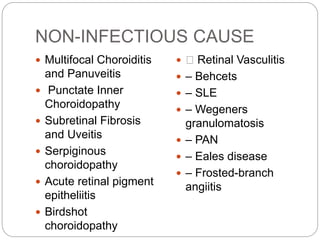
NON-INFECTIOUS CAUSE
 Multifocal Choroiditis
and Panuveitis
 Punctate Inner
Choroidopathy
 Subretinal Fibrosis
and Uveitis
 Serpiginous
choroidopathy
 Acute retinal pigment
epitheliitis
 Birdshot
choroidopathy
 􀁺 Retinal Vasculitis
 – Behcets
 – SLE
 – Wegeners
granulomatosis
 – PAN
 – Eales disease
 – Frosted-branch
angiitis
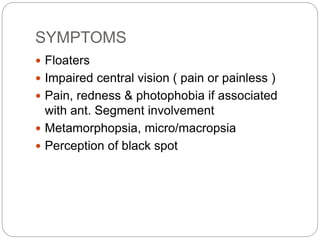
SYMPTOMS
 Floaters
 Impaired central vision ( pain or painless )
 Pain, redness & photophobia if associated
with ant. Segment involvement
 Metamorphopsia, micro/macropsia
 Perception of black spot
SIGNS –
 Inflammatory cells & vitritis
 Exudates, Edema & infiltrations in
retina / choroid
 Sheathing of vessels
Other signs –
 Disc edema
 Retinal haemorrhages
 Spill-over uveitis
 Complicated cataract
 Glaucoma
 RD
 Choroid neovascularisation
CHOROIDITIS
 Focal / multifocal /diffuse/central/ juxtapapillary
 Granulomatous or non-granulomatous/ exudative
choroiditis
 Ophthalmoscopic picture –
1 . Active lesion – early stage - yellowish area with hazy
edges & ill defined margin due to infiltration & exudation , lie
deeper to retinal vessels
- Late stage – bruch’s membrane destroyed – infiltration of
leukocytes to retina & vitreous
↓
organisation of exudation due to fibroblastic activity of stroma
↓
Firm fusion of retina & choroid due to destruction of normal
structure by fibrous tissue
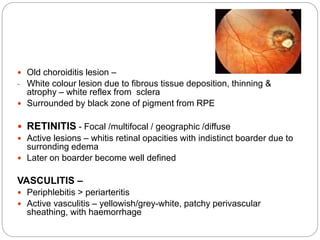
 Old choroiditis lesion –
- White colour lesion due to fibrous tissue deposition, thinning &
atrophy – white reflex from sclera
 Surrounded by black zone of pigment from RPE
 RETINITIS - Focal /multifocal / geographic /diffuse
 Active lesions – whitis retinal opacities with indistinct boarder due to
surronding edema
 Later on boarder become well defined
VASCULITIS –
 Periphlebitis > periarteritis
 Active vasculitis – yellowish/grey-white, patchy perivascular
sheathing, with haemorrhage
TOXOPLASMOSIS
 Most common cause of choroiditis in immuno
competent patient.
 Intraocular infection is often accompanied by
CNS involvement in immuno compromised
patient.
 Caused by toxoplasma gondii.
 Infest >10% of adults in northern temperate
countries & > 50% of adults in
mediterranean & tropical countries.
 Three forms of the parasite:
- tachyzoite ( trophozoite) – invassive form
responsible for acute infection,
- bradyzoite ( tissue cyst) – latent or recurent
infection
- sporozoite (oocyst).
 MODE OF INFECTION
 Ingestion of undercooked meat containing bradyzoites.
 Ingestion of oocyst from contaminated hand, food or
water.
 Transplacental – 40% of fetus is affected if mother is
infected during pregnancy.
PATHOGENESIS
 Clinically, the infestation starts as a focal area of
retinitis, with an overlying vitritis.
 Atypical, severe toxoplasmic retinochoroiditis in the
elderly can mimic ARN.
 zonal granuloma with intense central necrosis
surrounded by successive layers of mononuclear
cells - ↑ed Plasma cells at periphery → secrete
antibodies → destruction of the free parasites in the
extracellular space → cyst formation by parasites
 Proliferation of the RPE cells, and healing of the
lesion is associated with scar formation
HISTOLOGY
 Found in three forms: free, pseudocysts, or in true
cysts.
a. Rarely, the protozoa may be found in a free form in
the neural retina.
b. Multiplies in the confines of the cell membrane→ a
group of protozoa surrounded by the retinal cell
membrane→ pseudocyst
C. If environment becomes inhospitable, an Intracellular
protozoan (trophozoite) may transform into bradyzoite,
surround itself with a self-made membrane, multiply,
and then form a true cyst.
CLINICAL MANIFESTATION OF
TOXOPLASMOSIS
 The most frequent form of infection with T. gondii
is subclinical, and is discovered by serologic
testing for antibodies to Toxoplasma organisms.
 clinical entities of toxoplasmosis:
- congenital toxoplasmosis
- acquired systemic toxoplasmosis
- toxoplasmosis in the immunocompromised host
- acquired or reactivation of a latent infection
CONGENITAL TOXOPLASMOSIS
 Results from transplacental transmission of T. gondii.
 Incidence of congenital infection varies with the trimester
during which the mother becomes infected.
 lowest incidence occurs in the first trimester (15% to
20%), and highest incidence in the third trimester (59%).
 If infection occurs in – 1st trimester → spontaneous
abortion
- 3rd trimester → subclinical
infection
COURSE OF DISEASE:-
 Healing of the retinitis is associated with a decrease
in retinal edema and flattening of the lesion with
evidence of scar formation surrounded by variable
amounts of pigment .
 lesion may appear as a punched out scar with
underlying sclera resulting from extensive retinal and
choroidal necrosis surrounded by pigment
proliferation , it may become a conglomerate or
proliferated retinal pigment cells, or it may be small
and appear as a pigment clump in the retina.
OCULAR MANIFESTATION
 Ocular findings include involvement of the retina,
choroid, retinal vessels, macula, optic nerve,
vitreous, and anterior uvea.
 TYPICAL –
-Focus of retinitis surrounded by fuzzy retinal
edema
-Pigmented atrophic retinochoroiditic scar
-Vitreous cells and exudates
-Focal retinal vasculitis
-Hyperemia of optic nerve head
-Cells and flare in the anterior chamber
 Atypical Manifestations:-
Juxtapapillar retinitis
Retrobulbar neuritis
Rhegmatogenous RD
Pars planitis
Punctate outer retinitis
Serous macular detachment
BRAO/BRVO
Retinal or subretinal neovascularization
Choroidoretinal vascular anastomosis
Panuveitis
Toxoplasmic retinitis – focus of necrotising retinitis
surrounded by retinal edema, retinal vasculitis.
- Solitary inflammatory focus near an old pigmented scar.
( satelite lesion )
- Severe vitritis impairing visualisation of fundus →
HEADLIGHT IN FOG
appearance.
-In immunocompromised – multifocal retinal lesion often B/L,
less vitritis - simulate ARN.
- There may be sec. nongranulomatous inflammation of choroid
& sclera.
- When choroid is involved called as
retinochoroiditis.
 Occurs in 3 morphological variants :-
1. In most severe disease – lesion of > 1 DD, dense &
elevated lesion, & are largely destructive.
- assosiated with severe vitritis & ant. Chamber
reaction.
- Prompt therapy is needed regardless of site of lesion.
2. 2nd variant :- punctate lesion of inner retina, mild
inflammation, no therapy needed unless the lesion is
close to macula.
3. 3rd variant :- punctate lesion in outer retina with mild
vitritis, spontaneous resolution
OPTIC NERVE
optic neuritis or papillitis associated with edema, Later
Juxtapapillary Retinochoroiditis and Macular Star
develop.
VITREOUS
-Posterior vitreous detachment common
-precipitates of inflammatory cells on the posterior vitreous
face
 ANTERIOR UVEA
- Anterior uveitis (granulomatous or nongranulomatous)
may be associated with Toxoplasma retinochoroiditis
COMPLICATIONS
 Posterior synaechiae
 Macular edema
 Dragging of macula
 RD
 Choroidal neovascularisation
 BRAO/BRVO
 Optic atrophy
 Cataract
 Glaucoma
 u/l pigmentary retinopathy
DIAGNOSIS
 Classic fundus finding
 Serological testing –
- Sabin-Feldman dye test, ELISA, IFA test, IHA
test, agglutination test.
 PCR in vitreous sample
 Isolation of organism from aquous, vitreous
 CNS imaging
 Fluorescein angiographic - presence a dark
hypofluorescent center of the lesion surrounded by an area of
hyperfluorescence.
 ICG
 OCT, USG
TREATMENT
 Pyrimethamine: Loading dose: 100 mg (1st day), followed by 25 mg
once daily +
Sulfadiazine: 4 Gr daily divided in every 6 hours For 4 to 6 weeks.
 Oral corticosteroids must be initiated at least 24 hours after starting anti
parasitic drugs.
 Folinic acid also given
Other drugs used in various combinations include:
 Clindamycin, Trimethoprim + Sulphamethoxazol (Co-Trimoxazole),
Spiramycin, Azithromycin
 Therapy regimens used during Pregnancy: Spiramycin- 2 gr/day in two
divided doses
 Standard regimen for newborns- Pyrimethamine + Sulfadiazine + Folinic
acid
 SURGICAL T/t –
- Pars Plana Vitrectomy: to remove Vitreous
Opacities, or to relieve the persistent Vitreo-Retinal
traction.
- Scleral Buckling: in cases complicated with
Retinal Detachment.
 PHOTOCOAGULATION AND CRYOTHERAPY
- Both photocoagulation and cryotherapy cause
destruction of the Toxoplasma cyst and the
tachyzoites in the retina
TOXOCARIASIS
 Toxocara canis: nematode
 Dog primary host
 Children who have pica, close contact with
Puppies.
 Unilateral, Male > female, Children, young adults
 DDx of leukocoria (r/o RB)
􀁺 Ova ingested
 – Visceral larva migrans
 – Larvae encyst in tissues
 – Never mature in humans – no ova in stool
CLINICAL FEATURES
1. Granuloma in the Peripheral Retina and
Vitreous.
2. Posterior Pole Granuloma.
3. Chronic Endophthalmitis.
DIAGNOSIS
 Anti-Toxocara antibodies
– Any serum titer significant
– Higher titer in aqueous
 Eosinophils in aqueous/vitreous
TREATMENT
 Medical treatment is directed toward the inflammatory
response that produces Structural Damage and
decreased vision - with Topical or Systemic Steroids.
 Antihelminthic therapy for Ocular Toxocariasis do not
alter natural course of the disease
 Cysticercosis
- South/Central America, Africa, Asia
- Larva of Taenia solium
- Violent uveitis as endophthalmitis
 Treatment: vitrectomy for subretinal cysticercus
 Onchocerciasis
 River blindness” - blackflies
 Microfilariae in cornea, aqueous; skin nodules
 Attenuated vessels, perivascular sheathing, RPE atrophy;
optic atrophy late
 Ivermectin 150 mic/kg q year x 10 years
TUBERCULOUS UVEITIS
 The most common presentation is disseminated
choroiditis.
 Deep in the choroid, appear yellow, white, or
gray, and are fairly well circumscribed.
 Vast majority of cases, the lesions present in the
posterior pole.
 single tubercle, focal choroiditis,which can occur
at the posterior pole, typically elevated and may
be accompanied by an overlying serous retinal
detachment
 Subretinal abscess is formed progressively from a
choroidal tubercle, which can be single or
multiple.
 Periphlebitis often b/l
SYPHILITIC UVEITIS present as chorioretinitis, neuroretinitis, salt-pepper
retinopathy, optic neuritis, papilloedema, and optic
perineuritis.
 Syphilis can present with placoid choroidal lesions.
 Unusual manifestation of syphilis is acute
necrotizing retinopathy, which mimics ARN.
 In HIV-positive patients, ocular syphilis is more
closely associated with neurological abnormalities
Rubella
Congenital
– Ocular involvement increased if contracted during 1st
trimester
– Cataract - retention of cell nuclei in embryonic
nucleus
– Chronic nongranulomatous iritis; iris atrophy
- “Salt-and-pepper” fundus – vision, ERG unaffected
 – Choroidal neovascularization rare complication
Acquired
– German measles
– Conjunctivitis, keratitis, iritis, bilateral retinitis with
Measles (Rubeola)
􀁺 Congenital
– “Salt-and-pepper” fundus
􀁺 Acquired
– Macular edema, neuroretinitis, attenuated vessels
􀁺 Subacute sclerosing panencephalitis (SSPE)
– Slow virus - mutation of measles virus
– Encephalitis with progressive deficits
– Disc edema, optic atrophy, macular
- infiltrate/hemorrhage/gliosis
– Supportive treatment; poor prognosis
West Nile Virus
 Creamy target like chorioretinal lesions, 300 – 1000
μm, scattered diffusely
 Hypofluorescent centrally and hyperfluorescent
edges
 Multifocal chorioretinitis
– Vitritis, iridocyclitis
– Occlusive retinal vasculitis - multiple branch artery
occlusions
– Optic nerve: optic neuritis, mild disc edema
􀁺 Congenital - chorioretinal scarring
FUNGAL UVEITIS
Ocular Histoplasmosis/ presumed
occular histoplasmosis syndrome
 Histoplasma capsulatum
 20 – 50 yr, HLA-B7 – associated with macular lesions
 Punched-out CR scars (“histo spots”)
 Peripapillary atrophy, Macular scar, No vitreous cells
 FA -
– Active choroiditis: early hypofluorescence with late staining
– CNV: early hyperfluorescence with late leakage
Treatment -
– Extrafoveal CNV: photocoagulation
- Juxtafoveal CNV: photocoagulation
 – Risk of CNV in fellow eye with histo spot in
macula: 25% @ 3 years
 SF CNV-
 Photodynamic therapy/ Steroids/Anti-VEGF/
Combination
 Subfoveal surgery- benefit for POHS if < 20/100
Candidiasis
 Immunosuppressed patients, indwelling catheters,
hyperalimentation
 Incidence of endophthalmitis in candidemia
– No antifungal treatment – 10 – 37%
– On antifungal treatment – 3%
 Choroidal infection with secondary retinal,
 vitreous involvement – fluffy yellow lesions
 Treatment
– IV, periocular, intravitreal antifungals (amphotericin B,
ketoconazole)
– Consider vitrectomy if significant vitritis
NON INFECTIOUS CAUSE
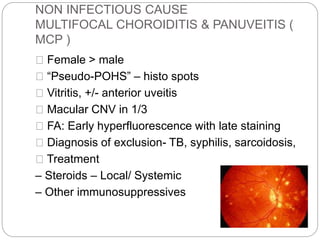
MULTIFOCAL CHOROIDITIS & PANUVEITIS (
MCP )
􀁺 Female > male
􀁺 “Pseudo-POHS” – histo spots
􀁺 Vitritis, +/- anterior uveitis
􀁺 Macular CNV in 1/3
􀁺 FA: Early hyperfluorescence with late staining
􀁺 Diagnosis of exclusion- TB, syphilis, sarcoidosis,
􀁺 Treatment
– Steroids – Local/ Systemic
– Other immunosuppressives
 Punctate Inner Choroidopathy (PIC)
- Subgroup of MCP
- Young, female, myopic
- No inflammation
- Multiple small white spots with fuzzy boarder at
Inner choroid & retina
- 40 % dev. CNV
 Subretinal fibrosis and uveitis
-Young, female, African-American, bilateral
- Chronic vitritis, CME
- Gliotic yellow-white subretinal lesions, gradually coalesce
- Poor prognosis
- Corticosteroids (esp for CME)
– other immunosuppressives
Serpiginous Choroidopathy
(geographic, helicoid)
 Adults; usually bilateral, Yellow-gray lesions
 Start from optic nerve, progress centrifugally
 Active lesions adjacent to scarred inactive area
 Mild vitritis, NVD, CNV
 FA
– Early in disease – like AMPPE
– Later in disease – window defects
 Steroids, other immunosuppressives
 Poor prognosis
Birdshot Retinochoroidopathy (BSRC)
 Vitiliginous choroiditis
 Females > males, 30 – 70 years old
 Symptoms:
Painless Visual Loss
Floaters,
Photophobia,
Nyctalopia, and Disturbances in Color Vision.
 Scattered round or oval cream-colored spots, May become Confluent resulting in larger
Geographic areas of Hypopigmentation.
 CME
 Vitritis
 Disc edema
 Arteriolar narrowing
 FA
– Retinal lesions often silent
 – CME, periphlebitis
Diagnostic
– HLA-A29 - 50-80% birdshot
 ERG may be reduced
Treatment
 – Corticosteroids – may help in ~ 50%
 – immunosuppressives - Mycophenolate,
Cyclosporine
• Quiescent 2 yrs then slow taper
CONCLUSION
 Choroiditis entities have very characteristic
clinical features and diagnosis is mainly clinical.
 Essential to differentiate infective and non-
infective conditions as their management is
diametrically opposite.
 Empirical use of systemic steroids or
immunosuppressives in all cases of Choroiditis
should be absolutely avoided.
 Follow-up all patients with Choroiditis even after
the resolution of lesions for complications related
to the disease.
THANK YOU

Choroiditis

  • 1.
  • 2.
    INTRODUCTION • Inflammation of choroid;associated with the highest risk of severe vision loss. (Standardization of Uveitis Nomenclature (SUN) Working Group) • Always Involving retina, Retinal vessels, optic nerve head.
  • 3.
    CLASSIFICATION  ANATOMICAL – Choroiditis  Chorioretinitis  Retinochoroiditis  Neuro-uveitis  AETIOLOGICAL – infective/non-infective
  • 4.
    INFECTIOUS 1. Parasitic  –Toxoplasmosis  – Toxocariasis  – Onchocerciasis  – Cysticercosis 2. Bacterial –  - tuberculosis  - syphilis 3. Viral – Herpes viruses • ARN • CMV retinitis  Epstein-Barr virus – Rubella – Rubeola (measles) – West Nile virus
  • 5.
    3. Fungal  –Candidiasis  – Aspergillosis  – Cryptococcosis  – Coccidioidomycosis
  • 6.
    NON-INFECTIOUS CAUSE  MultifocalChoroiditis and Panuveitis  Punctate Inner Choroidopathy  Subretinal Fibrosis and Uveitis  Serpiginous choroidopathy  Acute retinal pigment epitheliitis  Birdshot choroidopathy  􀁺 Retinal Vasculitis  – Behcets  – SLE  – Wegeners granulomatosis  – PAN  – Eales disease  – Frosted-branch angiitis
  • 7.
    SYMPTOMS  Floaters  Impairedcentral vision ( pain or painless )  Pain, redness & photophobia if associated with ant. Segment involvement  Metamorphopsia, micro/macropsia  Perception of black spot
  • 8.
    SIGNS –  Inflammatorycells & vitritis  Exudates, Edema & infiltrations in retina / choroid  Sheathing of vessels Other signs –  Disc edema  Retinal haemorrhages  Spill-over uveitis  Complicated cataract  Glaucoma  RD  Choroid neovascularisation
  • 9.
    CHOROIDITIS  Focal /multifocal /diffuse/central/ juxtapapillary  Granulomatous or non-granulomatous/ exudative choroiditis  Ophthalmoscopic picture – 1 . Active lesion – early stage - yellowish area with hazy edges & ill defined margin due to infiltration & exudation , lie deeper to retinal vessels - Late stage – bruch’s membrane destroyed – infiltration of leukocytes to retina & vitreous ↓ organisation of exudation due to fibroblastic activity of stroma ↓ Firm fusion of retina & choroid due to destruction of normal structure by fibrous tissue
  • 10.
     Old choroiditislesion – - White colour lesion due to fibrous tissue deposition, thinning & atrophy – white reflex from sclera  Surrounded by black zone of pigment from RPE  RETINITIS - Focal /multifocal / geographic /diffuse  Active lesions – whitis retinal opacities with indistinct boarder due to surronding edema  Later on boarder become well defined VASCULITIS –  Periphlebitis > periarteritis  Active vasculitis – yellowish/grey-white, patchy perivascular sheathing, with haemorrhage
  • 11.
    TOXOPLASMOSIS  Most commoncause of choroiditis in immuno competent patient.  Intraocular infection is often accompanied by CNS involvement in immuno compromised patient.  Caused by toxoplasma gondii.  Infest >10% of adults in northern temperate countries & > 50% of adults in mediterranean & tropical countries.
  • 12.
     Three formsof the parasite: - tachyzoite ( trophozoite) – invassive form responsible for acute infection, - bradyzoite ( tissue cyst) – latent or recurent infection - sporozoite (oocyst).  MODE OF INFECTION  Ingestion of undercooked meat containing bradyzoites.  Ingestion of oocyst from contaminated hand, food or water.  Transplacental – 40% of fetus is affected if mother is infected during pregnancy.
  • 13.
    PATHOGENESIS  Clinically, theinfestation starts as a focal area of retinitis, with an overlying vitritis.  Atypical, severe toxoplasmic retinochoroiditis in the elderly can mimic ARN.  zonal granuloma with intense central necrosis surrounded by successive layers of mononuclear cells - ↑ed Plasma cells at periphery → secrete antibodies → destruction of the free parasites in the extracellular space → cyst formation by parasites  Proliferation of the RPE cells, and healing of the lesion is associated with scar formation
  • 14.
    HISTOLOGY  Found inthree forms: free, pseudocysts, or in true cysts. a. Rarely, the protozoa may be found in a free form in the neural retina. b. Multiplies in the confines of the cell membrane→ a group of protozoa surrounded by the retinal cell membrane→ pseudocyst C. If environment becomes inhospitable, an Intracellular protozoan (trophozoite) may transform into bradyzoite, surround itself with a self-made membrane, multiply, and then form a true cyst.
  • 15.
    CLINICAL MANIFESTATION OF TOXOPLASMOSIS The most frequent form of infection with T. gondii is subclinical, and is discovered by serologic testing for antibodies to Toxoplasma organisms.  clinical entities of toxoplasmosis: - congenital toxoplasmosis - acquired systemic toxoplasmosis - toxoplasmosis in the immunocompromised host - acquired or reactivation of a latent infection
  • 16.
    CONGENITAL TOXOPLASMOSIS  Resultsfrom transplacental transmission of T. gondii.  Incidence of congenital infection varies with the trimester during which the mother becomes infected.  lowest incidence occurs in the first trimester (15% to 20%), and highest incidence in the third trimester (59%).  If infection occurs in – 1st trimester → spontaneous abortion - 3rd trimester → subclinical infection
  • 17.
    COURSE OF DISEASE:- Healing of the retinitis is associated with a decrease in retinal edema and flattening of the lesion with evidence of scar formation surrounded by variable amounts of pigment .  lesion may appear as a punched out scar with underlying sclera resulting from extensive retinal and choroidal necrosis surrounded by pigment proliferation , it may become a conglomerate or proliferated retinal pigment cells, or it may be small and appear as a pigment clump in the retina.
  • 18.
    OCULAR MANIFESTATION  Ocularfindings include involvement of the retina, choroid, retinal vessels, macula, optic nerve, vitreous, and anterior uvea.  TYPICAL – -Focus of retinitis surrounded by fuzzy retinal edema -Pigmented atrophic retinochoroiditic scar -Vitreous cells and exudates -Focal retinal vasculitis -Hyperemia of optic nerve head -Cells and flare in the anterior chamber
  • 19.
     Atypical Manifestations:- Juxtapapillarretinitis Retrobulbar neuritis Rhegmatogenous RD Pars planitis Punctate outer retinitis Serous macular detachment BRAO/BRVO Retinal or subretinal neovascularization Choroidoretinal vascular anastomosis Panuveitis
  • 20.
    Toxoplasmic retinitis –focus of necrotising retinitis surrounded by retinal edema, retinal vasculitis. - Solitary inflammatory focus near an old pigmented scar. ( satelite lesion ) - Severe vitritis impairing visualisation of fundus → HEADLIGHT IN FOG appearance. -In immunocompromised – multifocal retinal lesion often B/L, less vitritis - simulate ARN. - There may be sec. nongranulomatous inflammation of choroid & sclera. - When choroid is involved called as retinochoroiditis.
  • 21.
     Occurs in3 morphological variants :- 1. In most severe disease – lesion of > 1 DD, dense & elevated lesion, & are largely destructive. - assosiated with severe vitritis & ant. Chamber reaction. - Prompt therapy is needed regardless of site of lesion. 2. 2nd variant :- punctate lesion of inner retina, mild inflammation, no therapy needed unless the lesion is close to macula. 3. 3rd variant :- punctate lesion in outer retina with mild vitritis, spontaneous resolution
  • 22.
    OPTIC NERVE optic neuritisor papillitis associated with edema, Later Juxtapapillary Retinochoroiditis and Macular Star develop. VITREOUS -Posterior vitreous detachment common -precipitates of inflammatory cells on the posterior vitreous face  ANTERIOR UVEA - Anterior uveitis (granulomatous or nongranulomatous) may be associated with Toxoplasma retinochoroiditis
  • 23.
    COMPLICATIONS  Posterior synaechiae Macular edema  Dragging of macula  RD  Choroidal neovascularisation  BRAO/BRVO  Optic atrophy  Cataract  Glaucoma  u/l pigmentary retinopathy
  • 24.
    DIAGNOSIS  Classic fundusfinding  Serological testing – - Sabin-Feldman dye test, ELISA, IFA test, IHA test, agglutination test.  PCR in vitreous sample  Isolation of organism from aquous, vitreous  CNS imaging  Fluorescein angiographic - presence a dark hypofluorescent center of the lesion surrounded by an area of hyperfluorescence.  ICG  OCT, USG
  • 25.
    TREATMENT  Pyrimethamine: Loadingdose: 100 mg (1st day), followed by 25 mg once daily + Sulfadiazine: 4 Gr daily divided in every 6 hours For 4 to 6 weeks.  Oral corticosteroids must be initiated at least 24 hours after starting anti parasitic drugs.  Folinic acid also given Other drugs used in various combinations include:  Clindamycin, Trimethoprim + Sulphamethoxazol (Co-Trimoxazole), Spiramycin, Azithromycin  Therapy regimens used during Pregnancy: Spiramycin- 2 gr/day in two divided doses  Standard regimen for newborns- Pyrimethamine + Sulfadiazine + Folinic acid
  • 26.
     SURGICAL T/t– - Pars Plana Vitrectomy: to remove Vitreous Opacities, or to relieve the persistent Vitreo-Retinal traction. - Scleral Buckling: in cases complicated with Retinal Detachment.  PHOTOCOAGULATION AND CRYOTHERAPY - Both photocoagulation and cryotherapy cause destruction of the Toxoplasma cyst and the tachyzoites in the retina
  • 27.
    TOXOCARIASIS  Toxocara canis:nematode  Dog primary host  Children who have pica, close contact with Puppies.  Unilateral, Male > female, Children, young adults  DDx of leukocoria (r/o RB) 􀁺 Ova ingested  – Visceral larva migrans  – Larvae encyst in tissues  – Never mature in humans – no ova in stool
  • 28.
    CLINICAL FEATURES 1. Granulomain the Peripheral Retina and Vitreous. 2. Posterior Pole Granuloma. 3. Chronic Endophthalmitis.
  • 29.
    DIAGNOSIS  Anti-Toxocara antibodies –Any serum titer significant – Higher titer in aqueous  Eosinophils in aqueous/vitreous TREATMENT  Medical treatment is directed toward the inflammatory response that produces Structural Damage and decreased vision - with Topical or Systemic Steroids.  Antihelminthic therapy for Ocular Toxocariasis do not alter natural course of the disease
  • 30.
     Cysticercosis - South/CentralAmerica, Africa, Asia - Larva of Taenia solium - Violent uveitis as endophthalmitis  Treatment: vitrectomy for subretinal cysticercus  Onchocerciasis  River blindness” - blackflies  Microfilariae in cornea, aqueous; skin nodules  Attenuated vessels, perivascular sheathing, RPE atrophy; optic atrophy late  Ivermectin 150 mic/kg q year x 10 years
  • 31.
    TUBERCULOUS UVEITIS  Themost common presentation is disseminated choroiditis.  Deep in the choroid, appear yellow, white, or gray, and are fairly well circumscribed.  Vast majority of cases, the lesions present in the posterior pole.  single tubercle, focal choroiditis,which can occur at the posterior pole, typically elevated and may be accompanied by an overlying serous retinal detachment  Subretinal abscess is formed progressively from a choroidal tubercle, which can be single or multiple.  Periphlebitis often b/l
  • 32.
    SYPHILITIC UVEITIS presentas chorioretinitis, neuroretinitis, salt-pepper retinopathy, optic neuritis, papilloedema, and optic perineuritis.  Syphilis can present with placoid choroidal lesions.  Unusual manifestation of syphilis is acute necrotizing retinopathy, which mimics ARN.  In HIV-positive patients, ocular syphilis is more closely associated with neurological abnormalities
  • 33.
    Rubella Congenital – Ocular involvementincreased if contracted during 1st trimester – Cataract - retention of cell nuclei in embryonic nucleus – Chronic nongranulomatous iritis; iris atrophy - “Salt-and-pepper” fundus – vision, ERG unaffected  – Choroidal neovascularization rare complication Acquired – German measles – Conjunctivitis, keratitis, iritis, bilateral retinitis with
  • 34.
    Measles (Rubeola) 􀁺 Congenital –“Salt-and-pepper” fundus 􀁺 Acquired – Macular edema, neuroretinitis, attenuated vessels 􀁺 Subacute sclerosing panencephalitis (SSPE) – Slow virus - mutation of measles virus – Encephalitis with progressive deficits – Disc edema, optic atrophy, macular - infiltrate/hemorrhage/gliosis – Supportive treatment; poor prognosis
  • 35.
    West Nile Virus Creamy target like chorioretinal lesions, 300 – 1000 μm, scattered diffusely  Hypofluorescent centrally and hyperfluorescent edges  Multifocal chorioretinitis – Vitritis, iridocyclitis – Occlusive retinal vasculitis - multiple branch artery occlusions – Optic nerve: optic neuritis, mild disc edema 􀁺 Congenital - chorioretinal scarring
  • 36.
  • 37.
    Ocular Histoplasmosis/ presumed occularhistoplasmosis syndrome  Histoplasma capsulatum  20 – 50 yr, HLA-B7 – associated with macular lesions  Punched-out CR scars (“histo spots”)  Peripapillary atrophy, Macular scar, No vitreous cells  FA - – Active choroiditis: early hypofluorescence with late staining – CNV: early hyperfluorescence with late leakage
  • 38.
    Treatment - – ExtrafovealCNV: photocoagulation - Juxtafoveal CNV: photocoagulation  – Risk of CNV in fellow eye with histo spot in macula: 25% @ 3 years  SF CNV-  Photodynamic therapy/ Steroids/Anti-VEGF/ Combination  Subfoveal surgery- benefit for POHS if < 20/100
  • 39.
    Candidiasis  Immunosuppressed patients,indwelling catheters, hyperalimentation  Incidence of endophthalmitis in candidemia – No antifungal treatment – 10 – 37% – On antifungal treatment – 3%  Choroidal infection with secondary retinal,  vitreous involvement – fluffy yellow lesions  Treatment – IV, periocular, intravitreal antifungals (amphotericin B, ketoconazole) – Consider vitrectomy if significant vitritis
  • 40.
    NON INFECTIOUS CAUSE MULTIFOCALCHOROIDITIS & PANUVEITIS ( MCP ) 􀁺 Female > male 􀁺 “Pseudo-POHS” – histo spots 􀁺 Vitritis, +/- anterior uveitis 􀁺 Macular CNV in 1/3 􀁺 FA: Early hyperfluorescence with late staining 􀁺 Diagnosis of exclusion- TB, syphilis, sarcoidosis, 􀁺 Treatment – Steroids – Local/ Systemic – Other immunosuppressives
  • 41.
     Punctate InnerChoroidopathy (PIC) - Subgroup of MCP - Young, female, myopic - No inflammation - Multiple small white spots with fuzzy boarder at Inner choroid & retina - 40 % dev. CNV  Subretinal fibrosis and uveitis -Young, female, African-American, bilateral - Chronic vitritis, CME - Gliotic yellow-white subretinal lesions, gradually coalesce - Poor prognosis - Corticosteroids (esp for CME) – other immunosuppressives
  • 42.
    Serpiginous Choroidopathy (geographic, helicoid) Adults; usually bilateral, Yellow-gray lesions  Start from optic nerve, progress centrifugally  Active lesions adjacent to scarred inactive area  Mild vitritis, NVD, CNV  FA – Early in disease – like AMPPE – Later in disease – window defects  Steroids, other immunosuppressives  Poor prognosis
  • 43.
    Birdshot Retinochoroidopathy (BSRC) Vitiliginous choroiditis  Females > males, 30 – 70 years old  Symptoms: Painless Visual Loss Floaters, Photophobia, Nyctalopia, and Disturbances in Color Vision.  Scattered round or oval cream-colored spots, May become Confluent resulting in larger Geographic areas of Hypopigmentation.  CME  Vitritis  Disc edema  Arteriolar narrowing
  • 44.
     FA – Retinallesions often silent  – CME, periphlebitis Diagnostic – HLA-A29 - 50-80% birdshot  ERG may be reduced Treatment  – Corticosteroids – may help in ~ 50%  – immunosuppressives - Mycophenolate, Cyclosporine • Quiescent 2 yrs then slow taper
  • 45.
    CONCLUSION  Choroiditis entitieshave very characteristic clinical features and diagnosis is mainly clinical.  Essential to differentiate infective and non- infective conditions as their management is diametrically opposite.  Empirical use of systemic steroids or immunosuppressives in all cases of Choroiditis should be absolutely avoided.  Follow-up all patients with Choroiditis even after the resolution of lesions for complications related to the disease.
  • 46.