
Cottage cheese probiotic
By Probiotics Expert: Dr. Raga
Probiotics
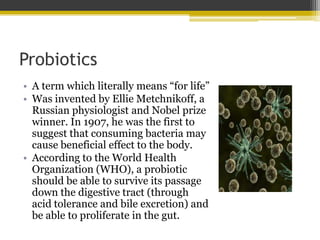
• A term which literally means “for life”
• Was invented by Ellie Metchnikoff, a
Russian physiologist and Nobel prize
winner. In 1907, he was the first to
suggest that consuming bacteria may
cause beneficial effect to the body.
• According to the World Health
Organization (WHO), a probiotic
should be able to survive its passage
down the digestive tract (through
acid tolerance and bile excretion) and
be able to proliferate in the gut.
Probiotics in foods
• Nowadays, there have been an increasing
number in the production of food products
labeled and formulated with probiotics. In the
last decade, there is an estimated 500 new
probiotic food and beverage products introduced
worldwide.
• The most popular food sources of probiotics are
yogurts, cheese, cereals, kombucha, sauerkraut,
and kefir.
Cottage cheese
• Cottage cheese is referred to
as a cheese curd product that
has a mild flavor. This type of
cheese is a well-known
favorite of people who are
dieting and doing sports. This
is due to its casein protein and
low fat contents.
• Most cottage cheese products
are made up from fat-free
organic milk and pasteurized
certified organic cream. Along
with this, calcium and
probiotics are incorporated.
Cottage cheese probiotic
• Not all cottage cheese products contain probiotics.
This is why it is important to look for “live and
active cultures” seal on the label of the product.
• However, there are certain cottage cheese
products which are naturally produced or
enriched with probiotics. Most cottage cheese
probiotic products offer at least two strains of
healthy bacteria. These are L. Acidophillus and B.
Bifidus which are beneficial in digestive health. In
other sources, cottage cheese probiotic may also
contain L. Casei.
What do the probiotic strains in
cottage cheese do?
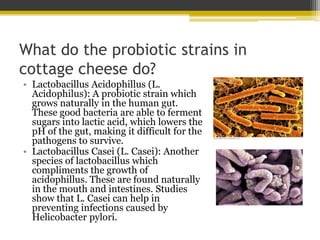
• Lactobacillus Acidophillus (L.
Acidophilus): A probiotic strain which
grows naturally in the human gut.
These good bacteria are able to ferment
sugars into lactic acid, which lowers the
pH of the gut, making it difficult for the
pathogens to survive.
• Lactobacillus Casei (L. Casei): Another
species of lactobacillus which
compliments the growth of
acidophillus. These are found naturally
in the mouth and intestines. Studies
show that L. Casei can help in
preventing infections caused by
Helicobacter pylori.
What do the probiotic strains in
cottage cheese do?
• Bifidobacterium bifidus: One of the most
common strains of bacteria that reside in the
colon. It can also be found in mouth and
vagina. The use of this bacterial strain has
been very important in probiotics and food
industry due to its beneficial effects on
health. These beneficial effects include
inhibition or pathogenic growth in the
digestive tract, regulation of intestinal
bacterial environment, improvement of
immune system response, vitamin
production, bioconversion of some dietary
compounds, and repression of
procarcinogenic enzymatic activities.
How do probiotics in cottage cheese
do their work?
• Probiotics or the good bacteria do their work by
decreasing the pH of the intestine. When the pH
is decreased or acidic, the environment becomes
less favorable for the pathogens or the bad
bacteria.
• If the gastric pH is lessened, this means that the
production of good bacteria will be increased
• The more lactic, acetic, and butyric acids are
produced, the more friendly the bacteria is.
Benefits of daily intake of probiotics
According to the World Health Organization,
when probiotics are taken daily may cause
beneficial effects in two ways:
• Probiotics can aid in the strengthening of the
immune system by supplying regular probiotic
bacteria to the digestive tract.
• Probiotics can be a calcium source for the people
who are lactose intolerant and others who have
problems in consuming dairy foods.
Other benefits of probiotics
• Constipation: Probiotics can improve bowel
movement regularity and shorten long intestinal
transit time.
• Diarrhea: With probiotics, balance of good and bad
bacteria in the intestines can be restored.
• Colon Cancer: Probiotics promote healthy digestive
system environment.
• Irritable Bowel Syndrome (IBS): Probiotics do not
only restore intestinal microflora balance but also
eliminate gas, constipation, and abdominal pain.
Other benefits of probiotics
• Cholesterol: There are studies which have shown
probiotics’ availability to increase the level of good
cholesterol in the body.
• Hypertension: Several studies suggest that
probiotics can positively effect the blood pressure.
• Allergies: In some people, probiotics have been
discovered to protect and strengthen the mucosal
barrier of the gastrointestinal tract.
• Immunity: Probiotics help in increasing the level of
good bacteria in the gut when the body is threatened
by a pathogen. Thus, this helps in creating a barrier
or defence against diseases and infections.
My Favorite Probiotic
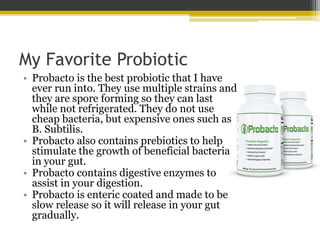
• Probacto is the best probiotic that I have
ever run into. They use multiple strains and
they are spore forming so they can last
while not refrigerated. They do not use
cheap bacteria, but expensive ones such as
B. Subtilis.
• Probacto also contains prebiotics to help
stimulate the growth of beneficial bacteria
in your gut.
• Probacto contains digestive enzymes to
assist in your digestion.
• Probacto is enteric coated and made to be
slow release so it will release in your gut
gradually.
Conclusion
• Nowadays, almost every company have been
producing supplements and foods which contain
probiotics. While this seems to be beneficial, many
people should be careful in choosing their source of
probiotics. As for the medical professionals, people
should be guided in which types of probiotics should
be consumed, either as a supplement or a part of
their diet. Also, the uses and potential side effects
should be taught to people in order to promote
awareness and prevent falling for false marketing
strategies of some probiotic companies.

Cottage Cheese Probiotic

  • 1.
    Cottage cheese probiotic ByProbiotics Expert: Dr. Raga
  • 2.
    Probiotics • A termwhich literally means “for life” • Was invented by Ellie Metchnikoff, a Russian physiologist and Nobel prize winner. In 1907, he was the first to suggest that consuming bacteria may cause beneficial effect to the body. • According to the World Health Organization (WHO), a probiotic should be able to survive its passage down the digestive tract (through acid tolerance and bile excretion) and be able to proliferate in the gut.
  • 3.
    Probiotics in foods •Nowadays, there have been an increasing number in the production of food products labeled and formulated with probiotics. In the last decade, there is an estimated 500 new probiotic food and beverage products introduced worldwide. • The most popular food sources of probiotics are yogurts, cheese, cereals, kombucha, sauerkraut, and kefir.
  • 4.
    Cottage cheese • Cottagecheese is referred to as a cheese curd product that has a mild flavor. This type of cheese is a well-known favorite of people who are dieting and doing sports. This is due to its casein protein and low fat contents. • Most cottage cheese products are made up from fat-free organic milk and pasteurized certified organic cream. Along with this, calcium and probiotics are incorporated.
  • 5.
    Cottage cheese probiotic •Not all cottage cheese products contain probiotics. This is why it is important to look for “live and active cultures” seal on the label of the product. • However, there are certain cottage cheese products which are naturally produced or enriched with probiotics. Most cottage cheese probiotic products offer at least two strains of healthy bacteria. These are L. Acidophillus and B. Bifidus which are beneficial in digestive health. In other sources, cottage cheese probiotic may also contain L. Casei.
  • 6.
    What do theprobiotic strains in cottage cheese do? • Lactobacillus Acidophillus (L. Acidophilus): A probiotic strain which grows naturally in the human gut. These good bacteria are able to ferment sugars into lactic acid, which lowers the pH of the gut, making it difficult for the pathogens to survive. • Lactobacillus Casei (L. Casei): Another species of lactobacillus which compliments the growth of acidophillus. These are found naturally in the mouth and intestines. Studies show that L. Casei can help in preventing infections caused by Helicobacter pylori.
  • 7.
    What do theprobiotic strains in cottage cheese do? • Bifidobacterium bifidus: One of the most common strains of bacteria that reside in the colon. It can also be found in mouth and vagina. The use of this bacterial strain has been very important in probiotics and food industry due to its beneficial effects on health. These beneficial effects include inhibition or pathogenic growth in the digestive tract, regulation of intestinal bacterial environment, improvement of immune system response, vitamin production, bioconversion of some dietary compounds, and repression of procarcinogenic enzymatic activities.
  • 8.
    How do probioticsin cottage cheese do their work? • Probiotics or the good bacteria do their work by decreasing the pH of the intestine. When the pH is decreased or acidic, the environment becomes less favorable for the pathogens or the bad bacteria. • If the gastric pH is lessened, this means that the production of good bacteria will be increased • The more lactic, acetic, and butyric acids are produced, the more friendly the bacteria is.
  • 9.
    Benefits of dailyintake of probiotics According to the World Health Organization, when probiotics are taken daily may cause beneficial effects in two ways: • Probiotics can aid in the strengthening of the immune system by supplying regular probiotic bacteria to the digestive tract. • Probiotics can be a calcium source for the people who are lactose intolerant and others who have problems in consuming dairy foods.
  • 10.
    Other benefits ofprobiotics • Constipation: Probiotics can improve bowel movement regularity and shorten long intestinal transit time. • Diarrhea: With probiotics, balance of good and bad bacteria in the intestines can be restored. • Colon Cancer: Probiotics promote healthy digestive system environment. • Irritable Bowel Syndrome (IBS): Probiotics do not only restore intestinal microflora balance but also eliminate gas, constipation, and abdominal pain.
  • 11.
    Other benefits ofprobiotics • Cholesterol: There are studies which have shown probiotics’ availability to increase the level of good cholesterol in the body. • Hypertension: Several studies suggest that probiotics can positively effect the blood pressure. • Allergies: In some people, probiotics have been discovered to protect and strengthen the mucosal barrier of the gastrointestinal tract. • Immunity: Probiotics help in increasing the level of good bacteria in the gut when the body is threatened by a pathogen. Thus, this helps in creating a barrier or defence against diseases and infections.
  • 12.
    My Favorite Probiotic •Probacto is the best probiotic that I have ever run into. They use multiple strains and they are spore forming so they can last while not refrigerated. They do not use cheap bacteria, but expensive ones such as B. Subtilis. • Probacto also contains prebiotics to help stimulate the growth of beneficial bacteria in your gut. • Probacto contains digestive enzymes to assist in your digestion. • Probacto is enteric coated and made to be slow release so it will release in your gut gradually.
  • 13.
    Conclusion • Nowadays, almostevery company have been producing supplements and foods which contain probiotics. While this seems to be beneficial, many people should be careful in choosing their source of probiotics. As for the medical professionals, people should be guided in which types of probiotics should be consumed, either as a supplement or a part of their diet. Also, the uses and potential side effects should be taught to people in order to promote awareness and prevent falling for false marketing strategies of some probiotic companies.