Probiotic food : A HEALTHY DIET
DEFINITION
 WORLD HEALTH ORGANISATION:
“Live microorganisms which, when
administered in adequate amount, confer health
benefits on the hosts”
A bacterial strain that
• Survive stomach acid and bile
• Adhere in intestinal lining
• Grows and establishes temporary residence in intestine
• Impart health benefits
• At the start of the 20th century, Russian noble prize winner and father of
modern immunology, Elie Metchnikoff, a scientist at the Pasteur institute, was the
first conceptualize “probiotics”.
• In 1907 Metchnikoff proposed that the acid producing bacteria in fermented
milk products could prevent “fouling” in the large intestine and if consumed
regularly, lead to a longer, healthier life
• Probiotic term coined in 1965 by Lilly and Stillwell.
Louis Pasteur(1822-1895) Metchnikoff Elie (1848-1926)
Characteristics of Effective
Probiotics
• Able to survive the passage through the
digestive system.
• Able to attach to the intestinal epithelia and
colonize.
• Able to maintain good viability.
• Able to utilize the nutrients and substrates
in a normal diet.
Characteristics of Effective
Probiotics
• Non pathogenic and non toxic.
• Capable of exerting a beneficial effect
on the host.
• Stability of desired characteristics
during processing, storage and
transportation.
• Anti-inflammatory, anti-mutagenic,
immune-stimulatory.
Advantages
Produce lactic acid.
variety of toxic or
carcinogenic
metabolites.
Aid absorption of
minerals, especially
calcium.
Production of β-D
galactosidase
enzymes.
Produce a wide range
of antimicrobial
substances.
Produce vitamins
(especially Vitamin B
and vitamin k
Act as barriers to
prevent harmful
bacteria from
colonizing the
intestines.
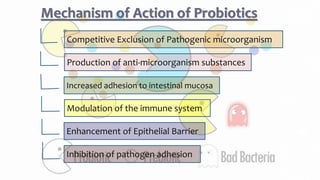
Mechanism of Action of Probiotics
Enhancement of Epithelial Barrier
Increased adhesion to intestinal mucosa
Production of anti-microorganism substances
Modulation of the immune system
Inhibition of pathogen adhesion
Competitive Exclusion of Pathogenic microorganism
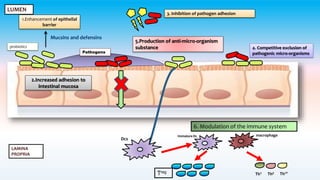
LUMEN
LAMINA
PROPRIA
1.Enhancement of epithelial
barrier
probiotics
Mucsins and defensins
Pathogens
2.Increased adhesion to
intestinal mucosa
3. Inhibition of pathogen adhesion
4. Competitive exclusion of
pathogenic micro-organisms
5.Production of anti-micro-organism
substance
Dcs
Immature Dc macrophage
6. Modulation of the immune system
Treg Th1 Th2 Th17
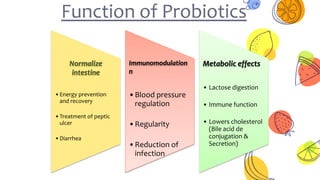
Function of Probiotics
Normalize
intestine
•Energy prevention
and recovery
•Treatment of peptic
ulcer
•Diarrhea
Immunomodulation
n
•Blood pressure
regulation
•Regularity
•Reduction of
infection
Metabolic effects
• Lactose digestion
• Immune function
• Lowers cholesterol
(Bile acid de
conjugation &
Secretion)
LACTOBASCILLUS
species
L. acidophillus
L. plantarum
L.brevis
LACTOBACILLUS SPECICES
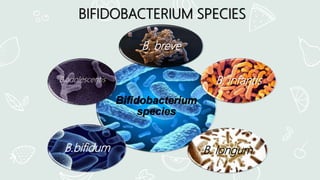
Bifidobacterium
species
B. breve
B. infantis
B. longumB.bifidum
B.adolescentis
BIFIDOBACTERIUM SPECIES
Streptococcus salivarius
Lactococcus lactis
Enterococcus faecium
Leuconostoc mesenteroides
Pediococcus acidilactic
Saccharomyces boulardii
OTHER SPECIES OF PROBIOTICS
VARIOUS PROBIOTIC FOODS
Yogurt :
• Made from milk inoculated with Streptococcus thermophilus
and either Lactobacillus acidophilus or Lactobacillus bulgaricus.
• Probiotic yogurt, is yogurt pasteurized to kill bacteria, with
Lactobacillus added in measured units before packaging.
• Yogurt probiotic drink is a drinkable form of Probiotic yogurt
• But one should know HOMEMADE YOGURT IS ALWAYS
THE BEST!
BENEFITS OF PROBIOTIC
YOGURT
• Supports Healthy Digestion
• Lowers the Risk of Type 2 Diabetes
• Lowers the Risk of Colorectal Cancer
• Increases Bone Density & May Help Prevent
Osteoporosis
• Supports Weight Loss and Increases Fat Loss
• Boosts the Immune System
• Reduces High Blood Pressure
• Reduces Bad Cholesterol
• Regulates Moods
• May Help Treat Chronic Pain & Brain-Related Illnesses
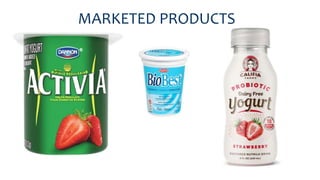
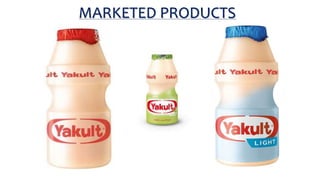
MARKETED PRODUCTS
YAKULT DAIRY MILK
o In early 1930’s, in Japan, Minoru Shirota developed a
fermented milk product called Yakult.
o Probiotic yogurt like product made by fermenting a mixture
of skimmed milk with a special strain of Lactobacillus casei
shirota.
o Sold in single-shot containers that contain around 8 billion
live and active Lactobacillus casei shirota cells per bottle
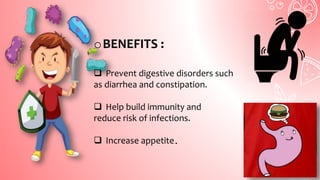
oBENEFITS :
 Prevent digestive disorders such
as diarrhea and constipation.
 Help build immunity and
reduce risk of infections.
 Increase appetite.
MARKETED PRODUCTS
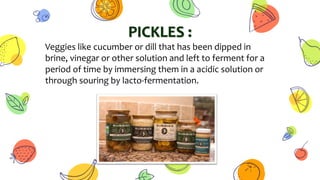
PICKLES :
Veggies like cucumber or dill that has been dipped in
brine, vinegar or other solution and left to ferment for a
period of time by immersing them in a acidic solution or
through souring by lacto-fermentation.
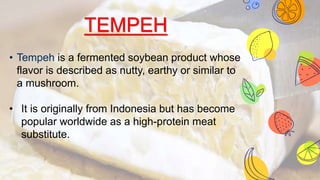
TEMPEH
• Tempeh is a fermented soybean product whose
flavor is described as nutty, earthy or similar to
a mushroom.
• It is originally from Indonesia but has become
popular worldwide as a high-protein meat
substitute.
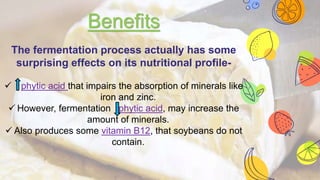
Benefits
The fermentation process actually has some
surprising effects on its nutritional profile-
 phytic acid that impairs the absorption of minerals like
iron and zinc.
 However, fermentation phytic acid, may increase the
amount of minerals.
 Also produces some vitamin B12, that soybeans do not
contain.
TEMPEH :
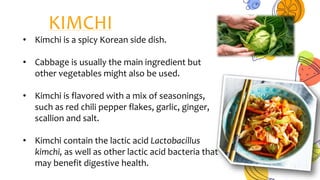
KIMCHI
• Kimchi is a spicy Korean side dish.
• Cabbage is usually the main ingredient but
other vegetables might also be used.
• Kimchi is flavored with a mix of seasonings,
such as red chili pepper flakes, garlic, ginger,
scallion and salt.
• Kimchi contain the lactic acid Lactobacillus
kimchi, as well as other lactic acid bacteria that
may benefit digestive health.
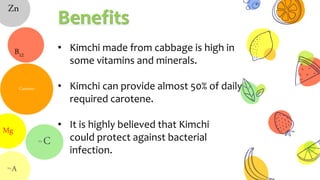
Benefits
• Kimchi made from cabbage is high in
some vitamins and minerals.
• Kimchi can provide almost 50% of daily
required carotene.
• It is highly believed that Kimchi
could protect against bacterial
infection.
Zn
Vit-A
Carotene
Vit- C
Mg
B12
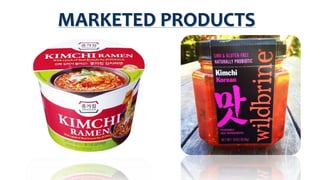
MARKETED PRODUCTS
Some other products
kefir
Sauerkraut
Miso
Kombuchha
Natto
Buttermilk
in excess cause
infection
bloating, diarrhea,
abdominal pain
interact with
immunosuppressive
drugs
skin rash, fever,
bloody stools etc.
Side
effects
Prebiotics
 A non-digestible component which beneficially
affects the host by selectively stimulating the
growth and/or activity of one or a limited number
of colonic bacteria, thereby improving the health
of the host.
 Examples: garlic, onions, chicory root(inulin)
, Asparagus, whole wheat, rye, barle.
Characteristics
Stability under acidic condition in the
stomach and the small colon.
Resistance to enzymatic action.
Hydrolysis and fermentation by
colonic bacteria.
 Positively modulate the host defense
system.
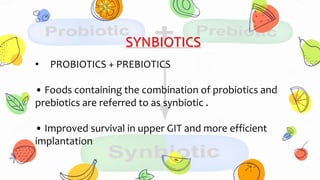
SYNBIOTICS
• PROBIOTICS + PREBIOTICS
• Foods containing the combination of probiotics and
prebiotics are referred to as synbiotic .
• Improved survival in upper GIT and more efficient
implantation
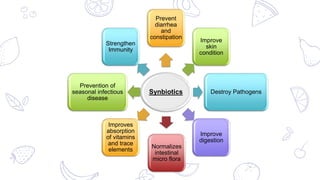
Synbiotics
Prevent
diarrhea
and
constipation
Improve
skin
condition
Destroy Pathogens
Improve
digestion
Normalizes
intestinal
micro flora
Improves
absorption
of vitamins
and trace
elements
Prevention of
seasonal infectious
disease
Strengthen
Immunity
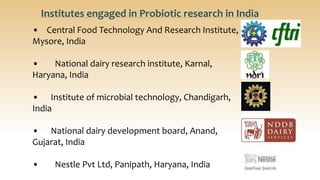
• Central Food Technology And Research Institute,
Mysore, India
• National dairy research institute, Karnal,
Haryana, India
• Institute of microbial technology, Chandigarh,
India
• National dairy development board, Anand,
Gujarat, India
• Nestle Pvt Ltd, Panipath, Haryana, India
Institutes engaged in Probiotic research in India
Conclusion
• Probiotic bacteria confer health benefits by bolstering protective,
structural and metabolic functions in the human body.
• Not all probiotics are equal.
• Disconnect between scientific evidence and allowable claims.
• Claims should be substantiated with well- controlled clinical studies.
• Products should be characterized for content and stability.
References:
1. Agrawal, R. (2005). Probiotics: an Emerging Food Supplement with Health
2. Benefits. Food Biotechnology,19, 227-246.
1. Arvanitoyannis, I. S. & Van Houwelingen-Koukaliaroglou, M. (2005).
2. Functional Foods: A Survey Of Health Claims, Pros and Cons, and Current Legislation. Critical Reviews in Food Science and
Nutrition, (45), 385-404.
3. https://www.yakult.co.in/
4. "Probiotics: In Depth". National Center for Complementary and Integrative Health, US National Institutes of Health. 31
July 2018. Retrieved 16 September 2018.
5. Degnan FH. The US Food and Drug Administration and probiotics: regulatory categorization. Clinical Infectious
Diseases. 2008;46(Suppl 2):S133–S136.
6. Yogurt: from Part 131 – Milk and Cream. Subpart B—Requirements for Specific Standardized Milk and Cream, Sec.
131.200". Code of Federal Regulations, Title 21, US Food and Drug Administration. 1 April 2016.
7. FAO/WHO: Health and nutritional properties of probiotics in food including powder milk with live lactic acid
bacteria. 2001. www.fao.org.
Probiotic foods- A healthy diet

Probiotic foods- A healthy diet

  • 1.
    Probiotic food :A HEALTHY DIET
  • 2.
    DEFINITION  WORLD HEALTHORGANISATION: “Live microorganisms which, when administered in adequate amount, confer health benefits on the hosts” A bacterial strain that • Survive stomach acid and bile • Adhere in intestinal lining • Grows and establishes temporary residence in intestine • Impart health benefits
  • 3.
    • At thestart of the 20th century, Russian noble prize winner and father of modern immunology, Elie Metchnikoff, a scientist at the Pasteur institute, was the first conceptualize “probiotics”. • In 1907 Metchnikoff proposed that the acid producing bacteria in fermented milk products could prevent “fouling” in the large intestine and if consumed regularly, lead to a longer, healthier life • Probiotic term coined in 1965 by Lilly and Stillwell. Louis Pasteur(1822-1895) Metchnikoff Elie (1848-1926)
  • 4.
    Characteristics of Effective Probiotics •Able to survive the passage through the digestive system. • Able to attach to the intestinal epithelia and colonize. • Able to maintain good viability. • Able to utilize the nutrients and substrates in a normal diet.
  • 5.
    Characteristics of Effective Probiotics •Non pathogenic and non toxic. • Capable of exerting a beneficial effect on the host. • Stability of desired characteristics during processing, storage and transportation. • Anti-inflammatory, anti-mutagenic, immune-stimulatory.
  • 6.
    Advantages Produce lactic acid. varietyof toxic or carcinogenic metabolites. Aid absorption of minerals, especially calcium. Production of β-D galactosidase enzymes. Produce a wide range of antimicrobial substances. Produce vitamins (especially Vitamin B and vitamin k Act as barriers to prevent harmful bacteria from colonizing the intestines.
  • 7.
    Mechanism of Actionof Probiotics Enhancement of Epithelial Barrier Increased adhesion to intestinal mucosa Production of anti-microorganism substances Modulation of the immune system Inhibition of pathogen adhesion Competitive Exclusion of Pathogenic microorganism
  • 8.
    LUMEN LAMINA PROPRIA 1.Enhancement of epithelial barrier probiotics Mucsinsand defensins Pathogens 2.Increased adhesion to intestinal mucosa 3. Inhibition of pathogen adhesion 4. Competitive exclusion of pathogenic micro-organisms 5.Production of anti-micro-organism substance Dcs Immature Dc macrophage 6. Modulation of the immune system Treg Th1 Th2 Th17
  • 9.
    Function of Probiotics Normalize intestine •Energyprevention and recovery •Treatment of peptic ulcer •Diarrhea Immunomodulation n •Blood pressure regulation •Regularity •Reduction of infection Metabolic effects • Lactose digestion • Immune function • Lowers cholesterol (Bile acid de conjugation & Secretion)
  • 10.
  • 11.
    Bifidobacterium species B. breve B. infantis B.longumB.bifidum B.adolescentis BIFIDOBACTERIUM SPECIES
  • 12.
    Streptococcus salivarius Lactococcus lactis Enterococcusfaecium Leuconostoc mesenteroides Pediococcus acidilactic Saccharomyces boulardii OTHER SPECIES OF PROBIOTICS
  • 13.
    VARIOUS PROBIOTIC FOODS Yogurt: • Made from milk inoculated with Streptococcus thermophilus and either Lactobacillus acidophilus or Lactobacillus bulgaricus. • Probiotic yogurt, is yogurt pasteurized to kill bacteria, with Lactobacillus added in measured units before packaging. • Yogurt probiotic drink is a drinkable form of Probiotic yogurt • But one should know HOMEMADE YOGURT IS ALWAYS THE BEST!
  • 14.
    BENEFITS OF PROBIOTIC YOGURT •Supports Healthy Digestion • Lowers the Risk of Type 2 Diabetes • Lowers the Risk of Colorectal Cancer • Increases Bone Density & May Help Prevent Osteoporosis • Supports Weight Loss and Increases Fat Loss • Boosts the Immune System • Reduces High Blood Pressure • Reduces Bad Cholesterol • Regulates Moods • May Help Treat Chronic Pain & Brain-Related Illnesses
  • 15.
  • 16.
    YAKULT DAIRY MILK oIn early 1930’s, in Japan, Minoru Shirota developed a fermented milk product called Yakult. o Probiotic yogurt like product made by fermenting a mixture of skimmed milk with a special strain of Lactobacillus casei shirota. o Sold in single-shot containers that contain around 8 billion live and active Lactobacillus casei shirota cells per bottle
  • 17.
    oBENEFITS :  Preventdigestive disorders such as diarrhea and constipation.  Help build immunity and reduce risk of infections.  Increase appetite.
  • 18.
  • 19.
    PICKLES : Veggies likecucumber or dill that has been dipped in brine, vinegar or other solution and left to ferment for a period of time by immersing them in a acidic solution or through souring by lacto-fermentation.
  • 20.
    TEMPEH • Tempeh isa fermented soybean product whose flavor is described as nutty, earthy or similar to a mushroom. • It is originally from Indonesia but has become popular worldwide as a high-protein meat substitute.
  • 21.
    Benefits The fermentation processactually has some surprising effects on its nutritional profile-  phytic acid that impairs the absorption of minerals like iron and zinc.  However, fermentation phytic acid, may increase the amount of minerals.  Also produces some vitamin B12, that soybeans do not contain.
  • 22.
  • 23.
    KIMCHI • Kimchi isa spicy Korean side dish. • Cabbage is usually the main ingredient but other vegetables might also be used. • Kimchi is flavored with a mix of seasonings, such as red chili pepper flakes, garlic, ginger, scallion and salt. • Kimchi contain the lactic acid Lactobacillus kimchi, as well as other lactic acid bacteria that may benefit digestive health.
  • 24.
    Benefits • Kimchi madefrom cabbage is high in some vitamins and minerals. • Kimchi can provide almost 50% of daily required carotene. • It is highly believed that Kimchi could protect against bacterial infection. Zn Vit-A Carotene Vit- C Mg B12
  • 25.
  • 26.
  • 27.
    in excess cause infection bloating,diarrhea, abdominal pain interact with immunosuppressive drugs skin rash, fever, bloody stools etc. Side effects
  • 28.
    Prebiotics  A non-digestiblecomponent which beneficially affects the host by selectively stimulating the growth and/or activity of one or a limited number of colonic bacteria, thereby improving the health of the host.  Examples: garlic, onions, chicory root(inulin) , Asparagus, whole wheat, rye, barle.
  • 29.
    Characteristics Stability under acidiccondition in the stomach and the small colon. Resistance to enzymatic action. Hydrolysis and fermentation by colonic bacteria.  Positively modulate the host defense system.
  • 30.
    SYNBIOTICS • PROBIOTICS +PREBIOTICS • Foods containing the combination of probiotics and prebiotics are referred to as synbiotic . • Improved survival in upper GIT and more efficient implantation
  • 31.
  • 32.
    • Central FoodTechnology And Research Institute, Mysore, India • National dairy research institute, Karnal, Haryana, India • Institute of microbial technology, Chandigarh, India • National dairy development board, Anand, Gujarat, India • Nestle Pvt Ltd, Panipath, Haryana, India Institutes engaged in Probiotic research in India
  • 33.
    Conclusion • Probiotic bacteriaconfer health benefits by bolstering protective, structural and metabolic functions in the human body. • Not all probiotics are equal. • Disconnect between scientific evidence and allowable claims. • Claims should be substantiated with well- controlled clinical studies. • Products should be characterized for content and stability.
  • 34.
    References: 1. Agrawal, R.(2005). Probiotics: an Emerging Food Supplement with Health 2. Benefits. Food Biotechnology,19, 227-246. 1. Arvanitoyannis, I. S. & Van Houwelingen-Koukaliaroglou, M. (2005). 2. Functional Foods: A Survey Of Health Claims, Pros and Cons, and Current Legislation. Critical Reviews in Food Science and Nutrition, (45), 385-404. 3. https://www.yakult.co.in/ 4. "Probiotics: In Depth". National Center for Complementary and Integrative Health, US National Institutes of Health. 31 July 2018. Retrieved 16 September 2018. 5. Degnan FH. The US Food and Drug Administration and probiotics: regulatory categorization. Clinical Infectious Diseases. 2008;46(Suppl 2):S133–S136. 6. Yogurt: from Part 131 – Milk and Cream. Subpart B—Requirements for Specific Standardized Milk and Cream, Sec. 131.200". Code of Federal Regulations, Title 21, US Food and Drug Administration. 1 April 2016. 7. FAO/WHO: Health and nutritional properties of probiotics in food including powder milk with live lactic acid bacteria. 2001. www.fao.org.