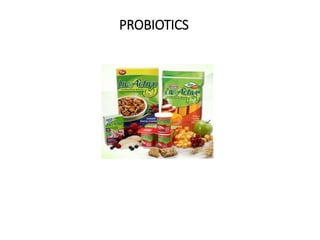
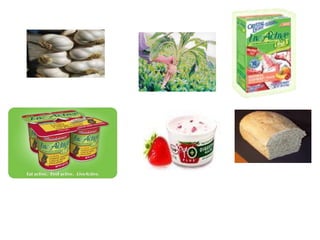
PROBIOTICS
Some Definitions
•Probiotic: Live microorganisms which, when
administered in adequate doses, confer a health
benefit on the host (FAO 2001)
•Prebiotic: A prebiotic is a non-viable food
component that confers a health benefit by
modulation of the gut microbiota (FAO 2007)
•Synbiotic: A product that contains both probiotics
and prebiotics
Some More Definitions
• Inulin: Inulin is a type of prebiotict that helps the probiotics
to work better and stimulates their growth. Inulin is the most
widely popular prebiotic. Inulin is present naturally in many
plant foods such as bananas, artichokes, garlic, rye, barley,
asparagus, chicory and wheat. ‫والشعير‬ ‫والشوندار‬ ‫والثوم‬ ‫الخرشوف‬
‫والقمح‬ ‫البرية‬ ‫والهندباء‬ ‫والهليون‬
• CFUs: stands for colony-forming unit. It is the way
probiotics are measured.
• Genus, species and strain: acidophilus DDS-1. In this name
the genus is Lactobacillus, the species is acidophilus, and the
strain is DDS-1. Not every bacteria will have a strain label.
• Culture: artificially grown colony of live microorganisms
such as bacteria in a clinical laboratory, usually for a
scientific purpose.
• Dysbiosis: condition when good and bad bacteria are out of
balance in your body. Dysbiosis can occur when you are
taking oral antibiotics. You have to take probiotics to correct
this problem.
HISTORY
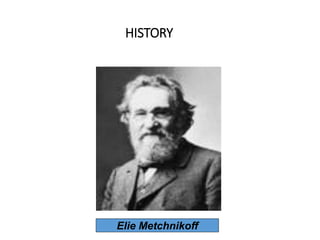
Elie Metchnikoff
• At the start of the 20th century, Russian noble prize winner and
father of modern immunology, Elie Metchnikoff, a scientist at the
Pasteur institute, was the first conceptualize “probiotics”.
• In 1907 Metchnokoff proposed that the acid producing bacteria in
fermented milk products could prevent “fouling” in the large
intestine and if consumed regularly, lead to a longer, healthier life.
• In early 1930’s, in Japan, Minoru shirota developed a fermented
milk product called Yakult (probiotic yogurt like product made by
fermenting a mixture of skimmed milk with a special strain of
Lactobacillus casei shirota).
• Probiotic term coined in 1965 by Lilly and Stillwell.
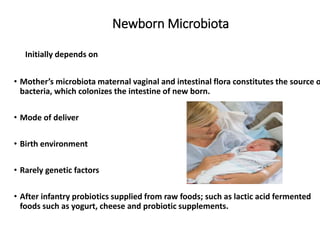
Newborn Microbiota
Initially depends on
• Mother’s microbiota maternal vaginal and intestinal flora constitutes the source o
bacteria, which colonizes the intestine of new born.
• Mode of deliver
• Birth environment
• Rarely genetic factors
• After infantry probiotics supplied from raw foods; such as lactic acid fermented
foods such as yogurt, cheese and probiotic supplements.
Factors affecting the intestinal micro
ecosystem
• Antibiotics and other drug intake
• Microbial infections
• Diet (highly processed, low fiber foods)
• Chronic diarrhea
• Stress
• Chlorinated water
• Radiation and chemotherapy
• Colonic therapies for detoxification
Characteristics of Effective Probiotics
Able to survive the passage through the digestive system.
Able to attach to the intestinal epithelia and colonise.
Able to maintain good viability.
Able to utilise the nutrients and substrates in a normal diet.
 non pathogenic and non toxic.
Capable of exerting a benificial effect on the host.
Stability of desired characteristics during processing, storage
and transportation.
Anti-inflammatory, antimutagenic, immunostimulatory.
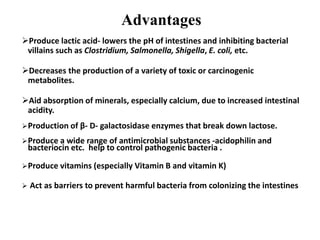
Advantages
Produce lactic acid- lowers the pH of intestines and inhibiting bacterial
villains such as Clostridium, Salmonella, Shigella, E. coli, etc.
Decreases the production of a variety of toxic or carcinogenic
metabolites.
Aid absorption of minerals, especially calcium, due to increased intestinal
acidity.
Production of β- D- galactosidase enzymes that break down lactose.
Produce a wide range of antimicrobial substances -acidophilin and
bacteriocin etc. help to control pathogenic bacteria .
Produce vitamins (especially Vitamin B and vitamin K)
 Act as barriers to prevent harmful bacteria from colonizing the intestines
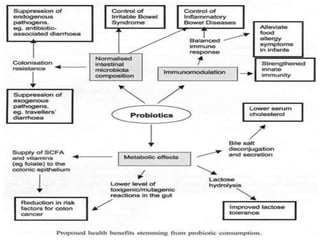
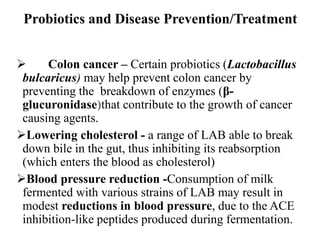
 Colon cancer – Certain probiotics (Lactobacillus
bulcaricus) may help prevent colon cancer by
preventing the breakdown of enzymes (β-
glucuronidase)that contribute to the growth of cancer
causing agents.
Lowering cholesterol - a range of LAB able to break
down bile in the gut, thus inhibiting its reabsorption
(which enters the blood as cholesterol)
Blood pressure reduction -Consumption of milk
fermented with various strains of LAB may result in
modest reductions in blood pressure, due to the ACE
inhibition-like peptides produced during fermentation.
Probiotics and Disease Prevention/Treatment
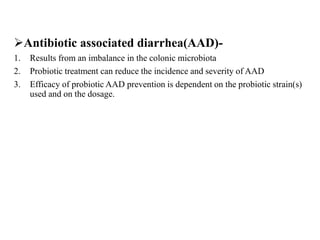
Antibiotic associated diarrhea(AAD)-
1. Results from an imbalance in the colonic microbiota
2. Probiotic treatment can reduce the incidence and severity of AAD
3. Efficacy of probiotic AAD prevention is dependent on the probiotic strain(s)
used and on the dosage.
Treat Allergy
1. Degradation/structural modification of enteral
antigens.
2. Normalization of the properties of aberrant indigenous
microbiota and of gut barrier functions.
3. Regulation of the secretion of inflammatory mediators,
and promoting development of the immune system.
4. Prevents food allergy by promoting endogenous barrier
mechanisms and alleviating intestinal inflammation.
5. Stimulating immune response and reduction of serum
IgE levels.
6. Reduction of Th2 cytokine response.
Probiotic Strains
Lactobacillus species
• L. acidophilus
• L. plantarum
• L. casei subspecies rhamnosus
• L. brevis
• L. delbreuckii subspecies bulgaricus
Bifidobacterium species
• B. adolescentis
• B. bifidum
• B. longum
• B. infantis
• B. breve
Others
• Streptococcus salivarius ssp. thermophilus
• Lactococcus lactis ssp. lactis
• Lactococcus lactis s ssp. cremoris
• Enterococcus faecium
• Leuconostoc mesenteroides ssp. dextranicum
• Propionibacterium freudenreichii
• Pediococcus acidilactici
• Saccharomyces boulardii
Intestinal Microflora: Location & Prevalence
Rare in the esophagus
Uncommon in the stomach
primarily gram (+)
102 - 104
105 in the jejunum – primarily aerobes
1010 – 1012 in the colon
primarily anerobes
1000 x more anerobes than aerobes
Probiotic Consumption
Minimum Consumption: 100g of a probiotic food with 107
cfu/ g.
most probiotics do not permanently adhere in the
intestine, but exert their effects as they metabolize and
grow during their passage through the intestine
(colonization).
Thus, daily consumption of these bacteria is probably the
best way to maintain their effectiveness
Probiotic Foods
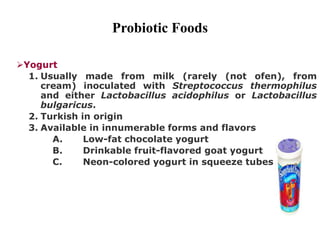
Yogurt
1. Usually made from milk (rarely (not ofen), from
cream) inoculated with Streptococcus thermophilus
and either Lactobacillus acidophilus or Lactobacillus
bulgaricus.
2. Turkish in origin
3. Available in innumerable forms and flavors
A. Low-fat chocolate yogurt
B. Drinkable fruit-flavored goat yogurt
C. Neon-colored yogurt in squeeze tubes
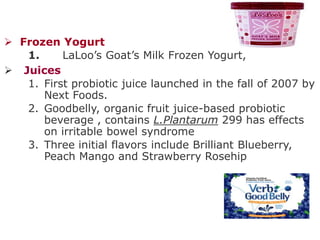
 Frozen Yogurt
1. LaLoo’s Goat’s Milk Frozen Yogurt,
 Juices
1. First probiotic juice launched in the fall of 2007 by
Next Foods.
2. Goodbelly, organic fruit juice-based probiotic
beverage , contains L.Plantarum 299 has effects
on irritable bowel syndrome
3. Three initial flavors include Brilliant Blueberry,
Peach Mango and Strawberry Rosehip
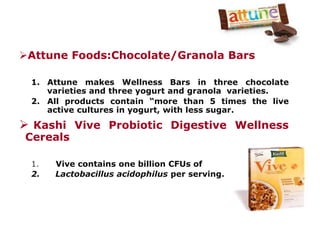
Attune Foods:Chocolate/Granola Bars
1. Attune makes Wellness Bars in three chocolate
varieties and three yogurt and granola varieties.
2. All products contain “more than 5 times the live
active cultures in yogurt, with less sugar.
 Kashi Vive Probiotic Digestive Wellness
Cereals
1. Vive contains one billion CFUs of
2. Lactobacillus acidophilus per serving.
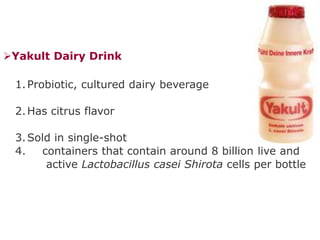
Yakult Dairy Drink
1.Probiotic, cultured dairy beverage
2.Has citrus flavor
3.Sold in single-shot
4. containers that contain around 8 billion live and
active Lactobacillus casei Shirota cells per bottle
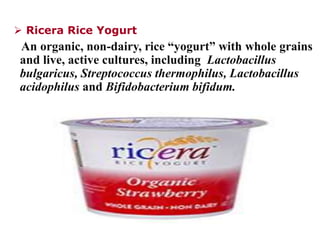
 Ricera Rice Yogurt
An organic, non-dairy, rice “yogurt” with whole grains
and live, active cultures, including Lactobacillus
bulgaricus, Streptococcus thermophilus, Lactobacillus
acidophilus and Bifidobacterium bifidum.
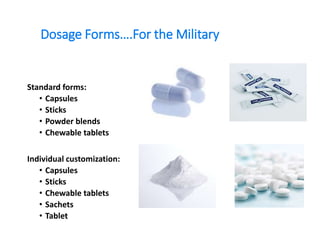
Dosage Forms….For the Military
Standard forms:
• Capsules
• Sticks
• Powder blends
• Chewable tablets
Individual customization:
• Capsules
• Sticks
• Chewable tablets
• Sachets
• Tablet
Food Better Choice
DUE TO-
• synergistic effect between components of foods and probiotic cultures.
• The natural buffering of stomach acid by food also enhances the stability
of consumed probiotics.
• Dairy products containing probiotics provide a number of high quality
nutrients including calcium, protein, bioactive peptides, sphingolipids, and
conjugated linoleic acids.
• incorporating foods containing probiotics into daily food choices can
become a lifestyle habit
Quiz….Be careful, it has marks!
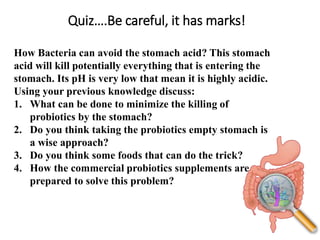
How Bacteria can avoid the stomach acid? This stomach
acid will kill potentially everything that is entering the
stomach. Its pH is very low that mean it is highly acidic.
Using your previous knowledge discuss:
1. What can be done to minimize the killing of
probiotics by the stomach?
2. Do you think taking the probiotics empty stomach is
a wise approach?
3. Do you think some foods that can do the trick?
4. How the commercial probiotics supplements are
prepared to solve this problem?
Multi-Probiotics
Research emerging on potential health benefits of multiple probiotic strains as a health supplement as
opposed to a single strain.
1. Multibionta
Lactobacillus gasseri PA16/8, Bifidobacterium bifidum MF20/5, Bifidobacterium longum SP07/3
2. Acidophilus Pearls
Lactobacillus acidophilus, Bifidobacterium longum
3. Kyo-Dophilus
Lactobacillus acidophilus, Bifidobacterium bifidum, Bifidobacterium longum
4. Symprove live activated probiotic
Lactobacillus plantarum, Lactobacillus acidophilus, Lactobacillus Casei, var. Rhamnosus, Enterococcus
faecium, all in active state not freeze-dried
Side Effects of Probiotics
• Rare cases cause bloating, diarrhea, abdominal pain.
• If in excess cause infection that require medical attentions.
• People having on underlying disease or compromised immune system
cause potential health problems like skin rash, fever, bloody stools
etc.
• Sometimes interact with immunosupressive drugs leading to life
threating cnditions. So people taking such drugs should avoid it.
Prebiotics
• A prebiotic is a nondigestible component which beneficially affects
the host by selectively stimulating the growth and/or activity of one
or a limited number of colonic bacteria, thereby improving the health
of the host .
• Examples- insulin, garlic, onions,, Asparagus, whole wheat, ote, barley
Characteristics of Prebiotics
• Should not be hydrolysed or absorbed in the upper part of G.I tract.
• Should be a selective substrate for one or a limited number of
potentially bacterial commercial to the colon culture protagonist.
• Should be able to alter the colonic microflora towards a healthier
composition or selectively stimulates the growth and or activity of
intestinal bacteria associated with health and well being.
• Should help increase the absorption of certain minerals such as calcium
and magnesium.
• Favourable effect on the immune system and provide improved
resistance against infection.
Synbiotics
• PROBIOTICS + PREBIOTICS
• Foods containing the combination of probiotics and
prebiotics are referred to as synbiotics.
• Improved survival in upper GIT and more efficient
implantation.

lecture_1._probiotics_prebiotics_lecture.ppt

  • 1.
  • 2.
    Some Definitions •Probiotic: Livemicroorganisms which, when administered in adequate doses, confer a health benefit on the host (FAO 2001) •Prebiotic: A prebiotic is a non-viable food component that confers a health benefit by modulation of the gut microbiota (FAO 2007) •Synbiotic: A product that contains both probiotics and prebiotics
  • 3.
    Some More Definitions •Inulin: Inulin is a type of prebiotict that helps the probiotics to work better and stimulates their growth. Inulin is the most widely popular prebiotic. Inulin is present naturally in many plant foods such as bananas, artichokes, garlic, rye, barley, asparagus, chicory and wheat. ‫والشعير‬ ‫والشوندار‬ ‫والثوم‬ ‫الخرشوف‬ ‫والقمح‬ ‫البرية‬ ‫والهندباء‬ ‫والهليون‬ • CFUs: stands for colony-forming unit. It is the way probiotics are measured. • Genus, species and strain: acidophilus DDS-1. In this name the genus is Lactobacillus, the species is acidophilus, and the strain is DDS-1. Not every bacteria will have a strain label. • Culture: artificially grown colony of live microorganisms such as bacteria in a clinical laboratory, usually for a scientific purpose. • Dysbiosis: condition when good and bad bacteria are out of balance in your body. Dysbiosis can occur when you are taking oral antibiotics. You have to take probiotics to correct this problem.
  • 4.
  • 5.
    • At thestart of the 20th century, Russian noble prize winner and father of modern immunology, Elie Metchnikoff, a scientist at the Pasteur institute, was the first conceptualize “probiotics”. • In 1907 Metchnokoff proposed that the acid producing bacteria in fermented milk products could prevent “fouling” in the large intestine and if consumed regularly, lead to a longer, healthier life. • In early 1930’s, in Japan, Minoru shirota developed a fermented milk product called Yakult (probiotic yogurt like product made by fermenting a mixture of skimmed milk with a special strain of Lactobacillus casei shirota). • Probiotic term coined in 1965 by Lilly and Stillwell.
  • 6.
    Newborn Microbiota Initially dependson • Mother’s microbiota maternal vaginal and intestinal flora constitutes the source o bacteria, which colonizes the intestine of new born. • Mode of deliver • Birth environment • Rarely genetic factors • After infantry probiotics supplied from raw foods; such as lactic acid fermented foods such as yogurt, cheese and probiotic supplements.
  • 7.
    Factors affecting theintestinal micro ecosystem • Antibiotics and other drug intake • Microbial infections • Diet (highly processed, low fiber foods) • Chronic diarrhea • Stress • Chlorinated water • Radiation and chemotherapy • Colonic therapies for detoxification
  • 8.
    Characteristics of EffectiveProbiotics Able to survive the passage through the digestive system. Able to attach to the intestinal epithelia and colonise. Able to maintain good viability. Able to utilise the nutrients and substrates in a normal diet.  non pathogenic and non toxic. Capable of exerting a benificial effect on the host. Stability of desired characteristics during processing, storage and transportation. Anti-inflammatory, antimutagenic, immunostimulatory.
  • 10.
    Advantages Produce lactic acid-lowers the pH of intestines and inhibiting bacterial villains such as Clostridium, Salmonella, Shigella, E. coli, etc. Decreases the production of a variety of toxic or carcinogenic metabolites. Aid absorption of minerals, especially calcium, due to increased intestinal acidity. Production of β- D- galactosidase enzymes that break down lactose. Produce a wide range of antimicrobial substances -acidophilin and bacteriocin etc. help to control pathogenic bacteria . Produce vitamins (especially Vitamin B and vitamin K)  Act as barriers to prevent harmful bacteria from colonizing the intestines
  • 11.
     Colon cancer– Certain probiotics (Lactobacillus bulcaricus) may help prevent colon cancer by preventing the breakdown of enzymes (β- glucuronidase)that contribute to the growth of cancer causing agents. Lowering cholesterol - a range of LAB able to break down bile in the gut, thus inhibiting its reabsorption (which enters the blood as cholesterol) Blood pressure reduction -Consumption of milk fermented with various strains of LAB may result in modest reductions in blood pressure, due to the ACE inhibition-like peptides produced during fermentation. Probiotics and Disease Prevention/Treatment
  • 12.
    Antibiotic associated diarrhea(AAD)- 1.Results from an imbalance in the colonic microbiota 2. Probiotic treatment can reduce the incidence and severity of AAD 3. Efficacy of probiotic AAD prevention is dependent on the probiotic strain(s) used and on the dosage.
  • 13.
    Treat Allergy 1. Degradation/structuralmodification of enteral antigens. 2. Normalization of the properties of aberrant indigenous microbiota and of gut barrier functions. 3. Regulation of the secretion of inflammatory mediators, and promoting development of the immune system. 4. Prevents food allergy by promoting endogenous barrier mechanisms and alleviating intestinal inflammation. 5. Stimulating immune response and reduction of serum IgE levels. 6. Reduction of Th2 cytokine response.
  • 14.
    Probiotic Strains Lactobacillus species •L. acidophilus • L. plantarum • L. casei subspecies rhamnosus • L. brevis • L. delbreuckii subspecies bulgaricus Bifidobacterium species • B. adolescentis • B. bifidum • B. longum • B. infantis • B. breve
  • 15.
    Others • Streptococcus salivariusssp. thermophilus • Lactococcus lactis ssp. lactis • Lactococcus lactis s ssp. cremoris • Enterococcus faecium • Leuconostoc mesenteroides ssp. dextranicum • Propionibacterium freudenreichii • Pediococcus acidilactici • Saccharomyces boulardii
  • 16.
    Intestinal Microflora: Location& Prevalence Rare in the esophagus Uncommon in the stomach primarily gram (+) 102 - 104 105 in the jejunum – primarily aerobes 1010 – 1012 in the colon primarily anerobes 1000 x more anerobes than aerobes
  • 17.
    Probiotic Consumption Minimum Consumption:100g of a probiotic food with 107 cfu/ g. most probiotics do not permanently adhere in the intestine, but exert their effects as they metabolize and grow during their passage through the intestine (colonization). Thus, daily consumption of these bacteria is probably the best way to maintain their effectiveness
  • 18.
    Probiotic Foods Yogurt 1. Usuallymade from milk (rarely (not ofen), from cream) inoculated with Streptococcus thermophilus and either Lactobacillus acidophilus or Lactobacillus bulgaricus. 2. Turkish in origin 3. Available in innumerable forms and flavors A. Low-fat chocolate yogurt B. Drinkable fruit-flavored goat yogurt C. Neon-colored yogurt in squeeze tubes
  • 19.
     Frozen Yogurt 1.LaLoo’s Goat’s Milk Frozen Yogurt,  Juices 1. First probiotic juice launched in the fall of 2007 by Next Foods. 2. Goodbelly, organic fruit juice-based probiotic beverage , contains L.Plantarum 299 has effects on irritable bowel syndrome 3. Three initial flavors include Brilliant Blueberry, Peach Mango and Strawberry Rosehip
  • 20.
    Attune Foods:Chocolate/Granola Bars 1.Attune makes Wellness Bars in three chocolate varieties and three yogurt and granola varieties. 2. All products contain “more than 5 times the live active cultures in yogurt, with less sugar.  Kashi Vive Probiotic Digestive Wellness Cereals 1. Vive contains one billion CFUs of 2. Lactobacillus acidophilus per serving.
  • 21.
    Yakult Dairy Drink 1.Probiotic,cultured dairy beverage 2.Has citrus flavor 3.Sold in single-shot 4. containers that contain around 8 billion live and active Lactobacillus casei Shirota cells per bottle
  • 22.
     Ricera RiceYogurt An organic, non-dairy, rice “yogurt” with whole grains and live, active cultures, including Lactobacillus bulgaricus, Streptococcus thermophilus, Lactobacillus acidophilus and Bifidobacterium bifidum.
  • 23.
    Dosage Forms….For theMilitary Standard forms: • Capsules • Sticks • Powder blends • Chewable tablets Individual customization: • Capsules • Sticks • Chewable tablets • Sachets • Tablet
  • 24.
    Food Better Choice DUETO- • synergistic effect between components of foods and probiotic cultures. • The natural buffering of stomach acid by food also enhances the stability of consumed probiotics. • Dairy products containing probiotics provide a number of high quality nutrients including calcium, protein, bioactive peptides, sphingolipids, and conjugated linoleic acids. • incorporating foods containing probiotics into daily food choices can become a lifestyle habit
  • 25.
    Quiz….Be careful, ithas marks! How Bacteria can avoid the stomach acid? This stomach acid will kill potentially everything that is entering the stomach. Its pH is very low that mean it is highly acidic. Using your previous knowledge discuss: 1. What can be done to minimize the killing of probiotics by the stomach? 2. Do you think taking the probiotics empty stomach is a wise approach? 3. Do you think some foods that can do the trick? 4. How the commercial probiotics supplements are prepared to solve this problem?
  • 26.
    Multi-Probiotics Research emerging onpotential health benefits of multiple probiotic strains as a health supplement as opposed to a single strain. 1. Multibionta Lactobacillus gasseri PA16/8, Bifidobacterium bifidum MF20/5, Bifidobacterium longum SP07/3 2. Acidophilus Pearls Lactobacillus acidophilus, Bifidobacterium longum 3. Kyo-Dophilus Lactobacillus acidophilus, Bifidobacterium bifidum, Bifidobacterium longum 4. Symprove live activated probiotic Lactobacillus plantarum, Lactobacillus acidophilus, Lactobacillus Casei, var. Rhamnosus, Enterococcus faecium, all in active state not freeze-dried
  • 27.
    Side Effects ofProbiotics • Rare cases cause bloating, diarrhea, abdominal pain. • If in excess cause infection that require medical attentions. • People having on underlying disease or compromised immune system cause potential health problems like skin rash, fever, bloody stools etc. • Sometimes interact with immunosupressive drugs leading to life threating cnditions. So people taking such drugs should avoid it.
  • 28.
    Prebiotics • A prebioticis a nondigestible component which beneficially affects the host by selectively stimulating the growth and/or activity of one or a limited number of colonic bacteria, thereby improving the health of the host . • Examples- insulin, garlic, onions,, Asparagus, whole wheat, ote, barley
  • 30.
    Characteristics of Prebiotics •Should not be hydrolysed or absorbed in the upper part of G.I tract. • Should be a selective substrate for one or a limited number of potentially bacterial commercial to the colon culture protagonist. • Should be able to alter the colonic microflora towards a healthier composition or selectively stimulates the growth and or activity of intestinal bacteria associated with health and well being. • Should help increase the absorption of certain minerals such as calcium and magnesium. • Favourable effect on the immune system and provide improved resistance against infection.
  • 31.
    Synbiotics • PROBIOTICS +PREBIOTICS • Foods containing the combination of probiotics and prebiotics are referred to as synbiotics. • Improved survival in upper GIT and more efficient implantation.