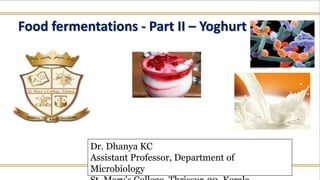
Food fermentations - Part II – Yoghurt
Dr. Dhanya KC
Assistant Professor, Department of
Microbiology
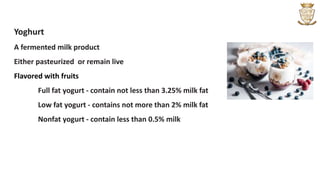
Yoghurt
A fermented milk product
Either pasteurized or remain live
Flavored with fruits
Full fat yogurt - contain not less than 3.25% milk fat
Low fat yogurt - contains not more than 2% milk fat
Nonfat yogurt - contain less than 0.5% milk
The main ingredient – milk
Whole milk for full fat yogurt
Low fat milk for low fat yogurt
Skim milk for nonfat yogurt
Bacterial Culture
Lactobacillus bulgaricus
Streptococcus thermophilus
Stabilizers - Improve the body and texture by
Increasing firmness, preventing separation of whey, keeping fruit uniformly mixed
Alginates, gelatins, gums, pectins, starch
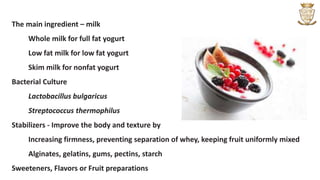
Sweeteners, Flavors or Fruit preparations
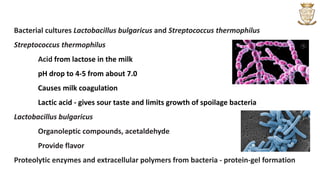
Bacterial cultures Lactobacillus bulgaricus and Streptococcus thermophilus
Streptococcus thermophilus
Acid from lactose in the milk
pH drop to 4-5 from about 7.0
Causes milk coagulation
Lactic acid - gives sour taste and limits growth of spoilage bacteria
Lactobacillus bulgaricus
Organoleptic compounds, acetaldehyde
Provide flavor
Proteolytic enzymes and extracellular polymers from bacteria - protein-gel formation
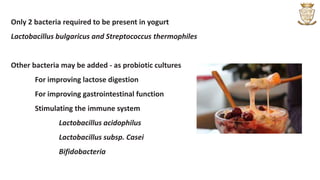
Only 2 bacteria required to be present in yogurt
Lactobacillus bulgaricus and Streptococcus thermophiles
Other bacteria may be added - as probiotic cultures
For improving lactose digestion
For improving gastrointestinal function
Stimulating the immune system
Lactobacillus acidophilus
Lactobacillus subsp. Casei
Bifidobacteria
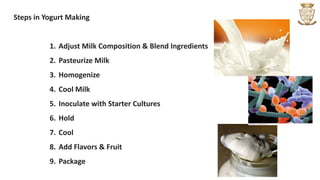
Steps in Yogurt Making
1. Adjust Milk Composition & Blend Ingredients
2. Pasteurize Milk
3. Homogenize
4. Cool Milk
5. Inoculate with Starter Cultures
6. Hold
7. Cool
8. Add Flavors & Fruit
9. Package
1. Adjust Milk Composition & Blend Ingredients
Add dry milk powder - achieve desired fat and solids content
stabilizers are added
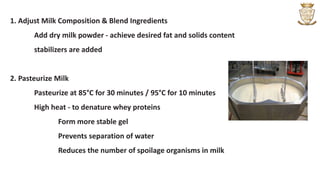
2. Pasteurize Milk
Pasteurize at 85°C for 30 minutes / 95°C for 10 minutes
High heat - to denature whey proteins
Form more stable gel
Prevents separation of water
Reduces the number of spoilage organisms in milk
3. Homogenize
Mix all ingredients thoroughly
Improve yogurt consistency
4. Cool Milk
Milk is cooled to 42°C
For ideal growth of starter culture
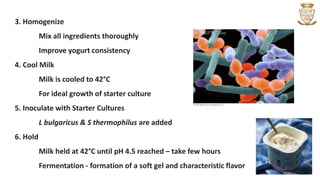
5. Inoculate with Starter Cultures
L bulgaricus & S thermophilus are added
6. Hold
Milk held at 42°C until pH 4.5 reached – take few hours
Fermentation - formation of a soft gel and characteristic flavor
7. Cool
Yogurt cooled to 7°C, to stop fermentation
8. Add Fruit & Flavors
At different steps depending on type of yogurt
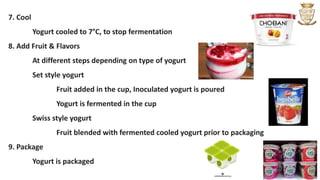
Set style yogurt
Fruit added in the cup, Inoculated yogurt is poured
Yogurt is fermented in the cup
Swiss style yogurt
Fruit blended with fermented cooled yogurt prior to packaging
9. Package
Yogurt is packaged
References
1. Industrial Microbiology: An Introduction, M J. Waites, N L. Morgan, J S. Rockey, G Higton
2. Modern Industrial Microbiology and Biotechnology, Nduka Okafor, Science Publishers
3. http://www.milkfacts.info/Milk%20Processing/Yogurt%20Production.htm

Yoghurt fermentation

  • 1.
    Food fermentations -Part II – Yoghurt Dr. Dhanya KC Assistant Professor, Department of Microbiology
  • 2.
    Yoghurt A fermented milkproduct Either pasteurized or remain live Flavored with fruits Full fat yogurt - contain not less than 3.25% milk fat Low fat yogurt - contains not more than 2% milk fat Nonfat yogurt - contain less than 0.5% milk
  • 3.
    The main ingredient– milk Whole milk for full fat yogurt Low fat milk for low fat yogurt Skim milk for nonfat yogurt Bacterial Culture Lactobacillus bulgaricus Streptococcus thermophilus Stabilizers - Improve the body and texture by Increasing firmness, preventing separation of whey, keeping fruit uniformly mixed Alginates, gelatins, gums, pectins, starch Sweeteners, Flavors or Fruit preparations
  • 4.
    Bacterial cultures Lactobacillusbulgaricus and Streptococcus thermophilus Streptococcus thermophilus Acid from lactose in the milk pH drop to 4-5 from about 7.0 Causes milk coagulation Lactic acid - gives sour taste and limits growth of spoilage bacteria Lactobacillus bulgaricus Organoleptic compounds, acetaldehyde Provide flavor Proteolytic enzymes and extracellular polymers from bacteria - protein-gel formation
  • 5.
    Only 2 bacteriarequired to be present in yogurt Lactobacillus bulgaricus and Streptococcus thermophiles Other bacteria may be added - as probiotic cultures For improving lactose digestion For improving gastrointestinal function Stimulating the immune system Lactobacillus acidophilus Lactobacillus subsp. Casei Bifidobacteria
  • 6.
    Steps in YogurtMaking 1. Adjust Milk Composition & Blend Ingredients 2. Pasteurize Milk 3. Homogenize 4. Cool Milk 5. Inoculate with Starter Cultures 6. Hold 7. Cool 8. Add Flavors & Fruit 9. Package
  • 7.
    1. Adjust MilkComposition & Blend Ingredients Add dry milk powder - achieve desired fat and solids content stabilizers are added 2. Pasteurize Milk Pasteurize at 85°C for 30 minutes / 95°C for 10 minutes High heat - to denature whey proteins Form more stable gel Prevents separation of water Reduces the number of spoilage organisms in milk
  • 8.
    3. Homogenize Mix allingredients thoroughly Improve yogurt consistency 4. Cool Milk Milk is cooled to 42°C For ideal growth of starter culture 5. Inoculate with Starter Cultures L bulgaricus & S thermophilus are added 6. Hold Milk held at 42°C until pH 4.5 reached – take few hours Fermentation - formation of a soft gel and characteristic flavor
  • 9.
    7. Cool Yogurt cooledto 7°C, to stop fermentation 8. Add Fruit & Flavors At different steps depending on type of yogurt Set style yogurt Fruit added in the cup, Inoculated yogurt is poured Yogurt is fermented in the cup Swiss style yogurt Fruit blended with fermented cooled yogurt prior to packaging 9. Package Yogurt is packaged
  • 10.
    References 1. Industrial Microbiology:An Introduction, M J. Waites, N L. Morgan, J S. Rockey, G Higton 2. Modern Industrial Microbiology and Biotechnology, Nduka Okafor, Science Publishers 3. http://www.milkfacts.info/Milk%20Processing/Yogurt%20Production.htm