LACTIC ACID
FERMENTED FOODS
NAME- SNEHA
ROLL NO. -19011009
CLASS-MSC.(HONS.)BIOTECHNOLOGY
SUBMITTED TO –DR. RANJEETA BHARI
INTRO
Lactic acid bacteria perform an essential role in the preservation and production of
wholesome foods. The lactic acid fermentations are generally inexpensive, and often
little or no heat is required in their preparation, making them fuel efficient as well.
Foods fermented with lactic acid play an important role in feeding the world's
population on every continent.
LACTIC ACID BACTERIA
These are major group of fermentative organisms
Lactobacillus , Lactococcus , Pediococcus , Leuconostoc ,Streptococcus , etc .
Lactic acid bacteria are mesophiles (10-400 C)
Ph range - 4 to 8
Lactic acid bacteria divided into groups on the basis of end products :
•Homofermentative
•Heterofermentative
Lactic acid fermented foods
Lactic acid bacteria plays important role in production and preservation of fermented foods
These foods are inexpensive
Fermented vegetable
•Sauerkraut
•Pickles (carrot , cucumbers )
Fermented dairy products
•Yogurts
•Cheese
•Buttermilk
Fermented cereal
•Idli
•Dosa
• kimchi
Fermented vegetables
Wide range of fruit and vegetable like carrot , cucumber , cabbage ,olives etc can be
preserved by fermentation
These contain sugar and other nutrients which are adequate for the growth of lactic
acid bacteria
Important factor for the fermentation of vegetables
•Anaerobic conditions
•Appropriate salt concentration and temperature
•Presence of suitable lactic acid bacteria
Sauerkraut
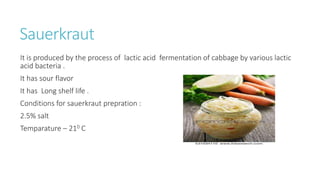
It is produced by the process of lactic acid fermentation of cabbage by various lactic
acid bacteria .
It has sour flavor
It has Long shelf life .
Conditions for sauerkraut prepration :
2.5% salt
Temparature – 210 C
Proliferation of L.brevis and L.plantarum and sometime Pediococcus cerevisiae also
occur .
Compound which contribute flavor to sauerkraut begin to appear with the increase
of lactis .
 lactic acid acetic acid , ethanol and volatile compound such as diacetyl
,acetaldehyde ,ethyl lactate etc.
Fermentation is complted after 2-3 weeks .
fermented Cucumber (pickling)
Immature cucumber harvested , washed , sliced and placed in tanks and brined .
b)The brine added may range from 8% NaCl to 10.5% NaCl .
c)Salt is added weekely to make final salt concentration upto 16%
d)Eventually lactic acid fermentation initiated by Leuconostoc mesenteroids and
completed by other lactic acid bacteria such as Lactobacillus brevis and L. plantarum
e)The fermentation is completed after 6-9 weeks
FERMENTED DAIRY PRODUCTS
These are the products which are prepared from milk (whole , partially or fully
skimmed , dry milk ) fermentation by specific organisms .
The organism which uare used as inoculum or starter culture produce acid in product
, coagulate milk , form texture and flavor and longer shelf life to the products
YOUGURTS
Yogurt is a dairy product made from whole or partially defatted milk , condensed milk
, non –fat dry milk by bacterial fermentation blended with flavor , color .
Yougurt is low fat healthy food
INGREDIENTS
a. DAIRY PRODUCTS : concentrated skim milk , nonfat dry milk , lactose , whey
b. SWEETENERS : glucose or sucrose , high – intensity sweeteners
c. STABALIZERS : gelatin , carboxymethyl cellulose , locust bean , alginates , whey
protein concentrate
d. FLAVOR : natural and artificial flavouring , color
STARTER CULTURE
 Mainly Lactococcus spp and Lactobacillus spp are used.
S. thermophillus
Lactococcus spp mostly used are :Lactococcus salivarius
Lactobacillus spp used are :Lactobacillus acidophillus , Lactobacillus bifidus .
The fermentation which contribute to the flavors
•Lactic acid
•Acetaledhyde
•Acetic acid
•Diacetyl
BENEFITS OF YOUGURT
•Easier to digest then milk .
•Boosts immunity .
•Decrease yeast infection .
•Lowers cholesterol .
•Can promote weight loss .
•Rich in protein , calcium , riboflavin
•Good for lactose intolerant people
CHEESE
•
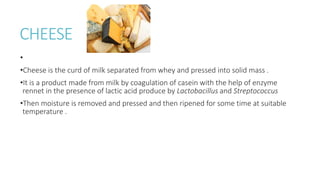
•Cheese is the curd of milk separated from whey and pressed into solid mass .
•It is a product made from milk by coagulation of casein with the help of enzyme
rennet in the presence of lactic acid produce by Lactobacillus and Streptococcus
•Then moisture is removed and pressed and then ripened for some time at suitable
temperature .
STEPS
A.) STANDARIZATION OF MILK
•Quality of milk decide the nature of cheese
•Skimmed milk cheese – hard and leathery
•More fat a cheese contain smoother it feels
•If starter culture is slow acting or souring is delayed then Staphylococci could
produce toxin over cheese .
•Pasteurization gives better control over cheese production
•Milk may be homogenized to reduce milk fat globule to produce soft cheese
B.)INOCULATION OF STARTER CULTURE OF LACTIC ACID BACTERIA
•Starter culture for the cheese prepared at less than 40 C – Lactococcus lactis
•Cheese prepared at high temperature – Streptococcus thermophillus , Lactobacillus
bulgaricus
C.) ADDITION OF RENNET FOR COAGULUM FORMATION
•The material used in the formation of coagulum is rennet obtained from the stomach
of freshly slaughtered calves
•Young calves contain 94% renin and 6% pepsin
Due to high cost of animal renin , other sources mainly of microbial origin have been
discovered .
For example : Mikrozyme from Bacillus subtilis
Casein is converted into fibrous form by rennin .
1st ph is brought down from 6.8-7 to ph 5.5 by the action of lactic acid bacteria and
increasing temperature upto 45C .
On the addition of rennet active component renin hydrolyse k-casein to para k- casein
and k-casein micropeptide
Para k-casein remain part of casein micelles and bind together to form curd following
by removal of carbohydrates with k-casein micropeptide
Fat and other particulate matter entrapped in curd
When casein removed remaining liquid contain protein , lactalbumin , globulin ,
riboflavin known as whey use for whey cheese by the precipitation of whey protein by
heat .
D.) SHRINKAGE OF CURD
The shrinkage of curd is facilitated by heating it ,cut into smaller pieces , applying
some pressure on it and lowering the Ph
Lactic acid produced by starter culture introduce elasticity desirable qualities in
cheese.
E.) SALTING OF CURD AND PRESSING INTO SHAPES
•Salt important for taste of cheese.
•Salt contribute to moisture and acidity control .
•Helps in limit the growth of proteolytic bacteria which is undesirable
•Curd is pressed into shape before allowed to mature
F.)CHEESE RIPENING
•Except from fresh cheese , the curd is ripened or matured at various temperature and
time until the characterstics flavor , body and texture achieved .
•During ripening there is degradation of lactose by ripening agent like :
•Bacteria and enzyme of milk
•Rennet
•Lipases
CULTURED BUTTER MILK
•S. lactis and S. cermoris are used as culture
•Milk is heated upto 950 C and cooled upto 20-250 C before the addition of inoculum .
•1-2 % of starter culture is added .
•Fermentation is completed after 16-20 hours .
•Acidity is about 0.9%
ADVANTAGES OF FERMENTED DAIRY
PRODUCTS
•High nutritive value
•Longer shelf life of products
•Cholestrol control
•Benificial for lactose intolerant people
FERMENTED CEREALS
Cereals contains variety of proteins , lipids , minerals and enzymes which provide
nutrition and serve as a good substrate for microbial growth .
Advantages of fermented cereals
•Regulate intestinal health
•Absorb heavy metals in the body
KoreanKimchi
•Korean kimchi differs from sauerkraut in two respects: it has, optimally, much less acid
and it is carbonated. Chinese cabbage and radish are the major substrates; garlic,
green onion, ginger, leaf mustard, hot pepper, parsley, and carrot are minor
ingredients.
•Organisms isolated from kimchi include L. mesenteroides, Lb. brevis,
•Salting of the cabbage can be done at 5 to 7 percent salinity for 12 hours or 15
percent salinity for 3 to 7 hours, followed by rinsing and draining. Optimum salt
concentration during kimchi fermentation is approximately 3 percent. Lower
temperatures (about 10°C) are preferred to temperatures above 20°C. Optimum
acidity of kimchi is 0.4 to 0.8 percent lactic acid with a pH between 4.2 and 4.5; higher
acidity makes it unacceptable
IDLI and DOSA
Indian idli is a small, white, acidic, leavened, steam-cooked cake made by lactic
fermentation of a thick batter made from polished rice and dehulled black gram dhal, a
pulse (Phaseolus mungo). The cakes are soft, moist, and spongy and have a pleasant
sour flavor. Dosa, a closely related product, is made from the same ingredients, both
finely ground. The batter is generally thinner, and dosa is fried like a pancake.
Idli and dosa are both products of natural lactic acid fermentation. L. mesenteroides
and S. faecalis develop during soaking, then continue to multiply following grinding.
Each eventually reaches more than 1 × 10⁹ cells per gram, 11 to 13 hours after
formation of the batter. These two species predominate until 23 hours following batter
formation
References
www.google.com

Lactic acid fermented foods

  • 1.
    LACTIC ACID FERMENTED FOODS NAME-SNEHA ROLL NO. -19011009 CLASS-MSC.(HONS.)BIOTECHNOLOGY SUBMITTED TO –DR. RANJEETA BHARI
  • 2.
    INTRO Lactic acid bacteriaperform an essential role in the preservation and production of wholesome foods. The lactic acid fermentations are generally inexpensive, and often little or no heat is required in their preparation, making them fuel efficient as well. Foods fermented with lactic acid play an important role in feeding the world's population on every continent.
  • 3.
    LACTIC ACID BACTERIA Theseare major group of fermentative organisms Lactobacillus , Lactococcus , Pediococcus , Leuconostoc ,Streptococcus , etc . Lactic acid bacteria are mesophiles (10-400 C) Ph range - 4 to 8 Lactic acid bacteria divided into groups on the basis of end products : •Homofermentative •Heterofermentative
  • 4.
    Lactic acid fermentedfoods Lactic acid bacteria plays important role in production and preservation of fermented foods These foods are inexpensive Fermented vegetable •Sauerkraut •Pickles (carrot , cucumbers ) Fermented dairy products •Yogurts •Cheese •Buttermilk Fermented cereal •Idli •Dosa • kimchi
  • 5.
    Fermented vegetables Wide rangeof fruit and vegetable like carrot , cucumber , cabbage ,olives etc can be preserved by fermentation These contain sugar and other nutrients which are adequate for the growth of lactic acid bacteria Important factor for the fermentation of vegetables •Anaerobic conditions •Appropriate salt concentration and temperature •Presence of suitable lactic acid bacteria
  • 6.
    Sauerkraut It is producedby the process of lactic acid fermentation of cabbage by various lactic acid bacteria . It has sour flavor It has Long shelf life . Conditions for sauerkraut prepration : 2.5% salt Temparature – 210 C
  • 7.
    Proliferation of L.brevisand L.plantarum and sometime Pediococcus cerevisiae also occur . Compound which contribute flavor to sauerkraut begin to appear with the increase of lactis .  lactic acid acetic acid , ethanol and volatile compound such as diacetyl ,acetaldehyde ,ethyl lactate etc. Fermentation is complted after 2-3 weeks .
  • 8.
    fermented Cucumber (pickling) Immaturecucumber harvested , washed , sliced and placed in tanks and brined . b)The brine added may range from 8% NaCl to 10.5% NaCl . c)Salt is added weekely to make final salt concentration upto 16% d)Eventually lactic acid fermentation initiated by Leuconostoc mesenteroids and completed by other lactic acid bacteria such as Lactobacillus brevis and L. plantarum e)The fermentation is completed after 6-9 weeks
  • 9.
    FERMENTED DAIRY PRODUCTS Theseare the products which are prepared from milk (whole , partially or fully skimmed , dry milk ) fermentation by specific organisms . The organism which uare used as inoculum or starter culture produce acid in product , coagulate milk , form texture and flavor and longer shelf life to the products
  • 10.
    YOUGURTS Yogurt is adairy product made from whole or partially defatted milk , condensed milk , non –fat dry milk by bacterial fermentation blended with flavor , color . Yougurt is low fat healthy food INGREDIENTS a. DAIRY PRODUCTS : concentrated skim milk , nonfat dry milk , lactose , whey b. SWEETENERS : glucose or sucrose , high – intensity sweeteners c. STABALIZERS : gelatin , carboxymethyl cellulose , locust bean , alginates , whey protein concentrate d. FLAVOR : natural and artificial flavouring , color
  • 11.
    STARTER CULTURE  MainlyLactococcus spp and Lactobacillus spp are used. S. thermophillus Lactococcus spp mostly used are :Lactococcus salivarius Lactobacillus spp used are :Lactobacillus acidophillus , Lactobacillus bifidus . The fermentation which contribute to the flavors •Lactic acid •Acetaledhyde •Acetic acid •Diacetyl
  • 12.
    BENEFITS OF YOUGURT •Easierto digest then milk . •Boosts immunity . •Decrease yeast infection . •Lowers cholesterol . •Can promote weight loss . •Rich in protein , calcium , riboflavin •Good for lactose intolerant people
  • 13.
    CHEESE • •Cheese is thecurd of milk separated from whey and pressed into solid mass . •It is a product made from milk by coagulation of casein with the help of enzyme rennet in the presence of lactic acid produce by Lactobacillus and Streptococcus •Then moisture is removed and pressed and then ripened for some time at suitable temperature .
  • 14.
    STEPS A.) STANDARIZATION OFMILK •Quality of milk decide the nature of cheese •Skimmed milk cheese – hard and leathery •More fat a cheese contain smoother it feels •If starter culture is slow acting or souring is delayed then Staphylococci could produce toxin over cheese . •Pasteurization gives better control over cheese production •Milk may be homogenized to reduce milk fat globule to produce soft cheese
  • 15.
    B.)INOCULATION OF STARTERCULTURE OF LACTIC ACID BACTERIA •Starter culture for the cheese prepared at less than 40 C – Lactococcus lactis •Cheese prepared at high temperature – Streptococcus thermophillus , Lactobacillus bulgaricus C.) ADDITION OF RENNET FOR COAGULUM FORMATION •The material used in the formation of coagulum is rennet obtained from the stomach of freshly slaughtered calves •Young calves contain 94% renin and 6% pepsin
  • 16.
    Due to highcost of animal renin , other sources mainly of microbial origin have been discovered . For example : Mikrozyme from Bacillus subtilis Casein is converted into fibrous form by rennin . 1st ph is brought down from 6.8-7 to ph 5.5 by the action of lactic acid bacteria and increasing temperature upto 45C . On the addition of rennet active component renin hydrolyse k-casein to para k- casein and k-casein micropeptide Para k-casein remain part of casein micelles and bind together to form curd following by removal of carbohydrates with k-casein micropeptide
  • 17.
    Fat and otherparticulate matter entrapped in curd When casein removed remaining liquid contain protein , lactalbumin , globulin , riboflavin known as whey use for whey cheese by the precipitation of whey protein by heat . D.) SHRINKAGE OF CURD The shrinkage of curd is facilitated by heating it ,cut into smaller pieces , applying some pressure on it and lowering the Ph Lactic acid produced by starter culture introduce elasticity desirable qualities in cheese.
  • 18.
    E.) SALTING OFCURD AND PRESSING INTO SHAPES •Salt important for taste of cheese. •Salt contribute to moisture and acidity control . •Helps in limit the growth of proteolytic bacteria which is undesirable •Curd is pressed into shape before allowed to mature
  • 19.
    F.)CHEESE RIPENING •Except fromfresh cheese , the curd is ripened or matured at various temperature and time until the characterstics flavor , body and texture achieved . •During ripening there is degradation of lactose by ripening agent like : •Bacteria and enzyme of milk •Rennet •Lipases
  • 20.
    CULTURED BUTTER MILK •S.lactis and S. cermoris are used as culture •Milk is heated upto 950 C and cooled upto 20-250 C before the addition of inoculum . •1-2 % of starter culture is added . •Fermentation is completed after 16-20 hours . •Acidity is about 0.9%
  • 21.
    ADVANTAGES OF FERMENTEDDAIRY PRODUCTS •High nutritive value •Longer shelf life of products •Cholestrol control •Benificial for lactose intolerant people
  • 22.
    FERMENTED CEREALS Cereals containsvariety of proteins , lipids , minerals and enzymes which provide nutrition and serve as a good substrate for microbial growth . Advantages of fermented cereals •Regulate intestinal health •Absorb heavy metals in the body
  • 23.
    KoreanKimchi •Korean kimchi differsfrom sauerkraut in two respects: it has, optimally, much less acid and it is carbonated. Chinese cabbage and radish are the major substrates; garlic, green onion, ginger, leaf mustard, hot pepper, parsley, and carrot are minor ingredients. •Organisms isolated from kimchi include L. mesenteroides, Lb. brevis, •Salting of the cabbage can be done at 5 to 7 percent salinity for 12 hours or 15 percent salinity for 3 to 7 hours, followed by rinsing and draining. Optimum salt concentration during kimchi fermentation is approximately 3 percent. Lower temperatures (about 10°C) are preferred to temperatures above 20°C. Optimum acidity of kimchi is 0.4 to 0.8 percent lactic acid with a pH between 4.2 and 4.5; higher acidity makes it unacceptable
  • 24.
    IDLI and DOSA Indianidli is a small, white, acidic, leavened, steam-cooked cake made by lactic fermentation of a thick batter made from polished rice and dehulled black gram dhal, a pulse (Phaseolus mungo). The cakes are soft, moist, and spongy and have a pleasant sour flavor. Dosa, a closely related product, is made from the same ingredients, both finely ground. The batter is generally thinner, and dosa is fried like a pancake. Idli and dosa are both products of natural lactic acid fermentation. L. mesenteroides and S. faecalis develop during soaking, then continue to multiply following grinding. Each eventually reaches more than 1 × 10⁹ cells per gram, 11 to 13 hours after formation of the batter. These two species predominate until 23 hours following batter formation
  • 25.