Probiotic
prEbiotic
AND syNbiotic
•
•
•
•
WhAt ARE probiotics?
•
•
•
•
HISTOR
Y
•
•
•
•
•
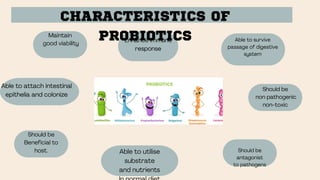
CHARACTERISTICS OF
PROBIOTICS
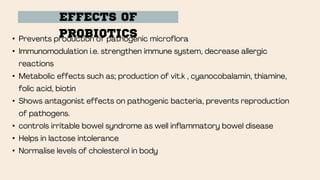
EFFECTS OF
PROBIOTICS
•
•
•
•
•
•
•
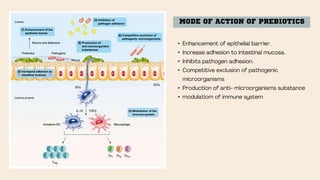
MODE OF ACTION OF PREBIOTICS
•
•
•
•
•
•
PREBIOTIC
S
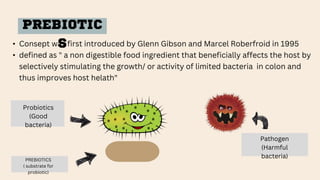
• Consept was first introduced by Glenn Gibson and Marcel Roberfroid in 1995
• defined as " a non digestible food ingredient that beneficially affects the host by
selectively stimulating the growth/ or activity of limited bacteria in colon and
thus improves host helath"
PREBIOTICS
( substrate for
probiotic)
Probiotics
(Good
bacteria)
Pathogen
(Harmful
bacteria)
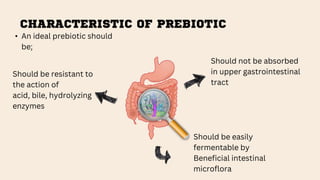
CHARACTERISTIC OF PREBIOTIC
Should be resistant to
the action of
acid, bile, hydrolyzing
enzymes
Should not be absorbed
in upper gastrointestinal
tract
Should be easily
fermentable by
Beneficial intestinal
microflora
• An ideal prebiotic should
be;
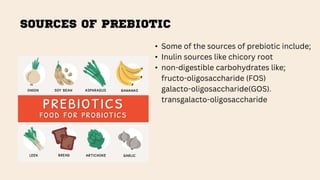
SOURCES OF PREBIOTIC
• Some of the sources of prebiotic include;
• Inulin sources like chicory root
• non-digestible carbohydrates like;
fructo-oligosaccharide (FOS)
galacto-oligosaccharide(GOS).
transgalacto-oligosaccharide
EFFECTS OF PREBIOTIC
• Fermentation of Prebiotics by gut microbiota produce short chain fatty acids
including lactic acid, butyric acid, and propionic acid have multiple effects.
• Prebiotics exibit helath effect like reducing duration of diarrhoea also gives relief
from inflammation also symptoms associated intestinal bowel disorder also
protective effect on colon cancer
• peptidoglycan is prebiotic fermentation product stimulate innate immune system
against pathogenic microorganisms.
• Helps in lactose intolerance, constipation , maintain helath gut
SYNBIOTICs
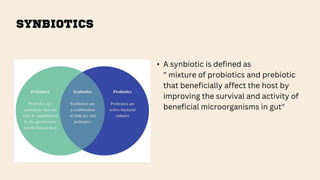
• A synbiotic is defined as
" mixture of probiotics and prebiotic
that beneficially affect the host by
improving the survival and activity of
beneficial microorganisms in gut"
• When Gibson introduced the concept of prebiotics he speculated as to the
additional benefits if prebiotics were combined with probiotics to form what he
termed as Synbiotics.
• the word “synbiotics” alludes to synergism, this term should be reserved for
products where the prebiotic compounds selectively favor the probiotic
organism.
• Synbiotics were developed to overcome possible survival difficulties for
probiotics.
• Several factors like pH, H2O2, organic acids, oxygen, moisture stress etc. have
been claimed to affect the viability of probiotics
• Synbiotics may be complementary synbiotics synergistic synbiotics
EFFECTS OF SYNBIOTIC
• The most important and documented beneficial effects of probiotics include the
prevention of diarrhea, constipation.
• a stimulating effect of the growth of probiotics and ubiquitous bacteria contribute
to maintain the intestinal homeostasis and a healthy body
• enhancement of anti-bacterial activity, is anti-inflammatory.
• Blocking of adhesion sites for pathogenic bacteria.
• Increasing levels of lactobacilli and bifidobacteria and balanced gut microbiota
EXAMPLES OF SYNBIOTIC
• Bifidobacteria and Fructooligosaccharides (FOS)
• Bifidobacteria or lactobacilli with FOS or inulins or galactooligosaccharides
(GOS)
• Lactobacillus rhamnosus GG and inulins
THANK
YOU!

probiotics prebiotics synbiotics .pptx

  • 1.
  • 2.
  • 3.
  • 4.
  • 5.
  • 7.
  • 8.
    MODE OF ACTIONOF PREBIOTICS • • • • • •
  • 9.
    PREBIOTIC S • Consept wasfirst introduced by Glenn Gibson and Marcel Roberfroid in 1995 • defined as " a non digestible food ingredient that beneficially affects the host by selectively stimulating the growth/ or activity of limited bacteria in colon and thus improves host helath" PREBIOTICS ( substrate for probiotic) Probiotics (Good bacteria) Pathogen (Harmful bacteria)
  • 10.
    CHARACTERISTIC OF PREBIOTIC Shouldbe resistant to the action of acid, bile, hydrolyzing enzymes Should not be absorbed in upper gastrointestinal tract Should be easily fermentable by Beneficial intestinal microflora • An ideal prebiotic should be;
  • 11.
    SOURCES OF PREBIOTIC •Some of the sources of prebiotic include; • Inulin sources like chicory root • non-digestible carbohydrates like; fructo-oligosaccharide (FOS) galacto-oligosaccharide(GOS). transgalacto-oligosaccharide
  • 12.
    EFFECTS OF PREBIOTIC •Fermentation of Prebiotics by gut microbiota produce short chain fatty acids including lactic acid, butyric acid, and propionic acid have multiple effects. • Prebiotics exibit helath effect like reducing duration of diarrhoea also gives relief from inflammation also symptoms associated intestinal bowel disorder also protective effect on colon cancer • peptidoglycan is prebiotic fermentation product stimulate innate immune system against pathogenic microorganisms. • Helps in lactose intolerance, constipation , maintain helath gut
  • 13.
    SYNBIOTICs • A synbioticis defined as " mixture of probiotics and prebiotic that beneficially affect the host by improving the survival and activity of beneficial microorganisms in gut"
  • 14.
    • When Gibsonintroduced the concept of prebiotics he speculated as to the additional benefits if prebiotics were combined with probiotics to form what he termed as Synbiotics. • the word “synbiotics” alludes to synergism, this term should be reserved for products where the prebiotic compounds selectively favor the probiotic organism. • Synbiotics were developed to overcome possible survival difficulties for probiotics. • Several factors like pH, H2O2, organic acids, oxygen, moisture stress etc. have been claimed to affect the viability of probiotics • Synbiotics may be complementary synbiotics synergistic synbiotics
  • 15.
    EFFECTS OF SYNBIOTIC •The most important and documented beneficial effects of probiotics include the prevention of diarrhea, constipation. • a stimulating effect of the growth of probiotics and ubiquitous bacteria contribute to maintain the intestinal homeostasis and a healthy body • enhancement of anti-bacterial activity, is anti-inflammatory. • Blocking of adhesion sites for pathogenic bacteria. • Increasing levels of lactobacilli and bifidobacteria and balanced gut microbiota
  • 16.
    EXAMPLES OF SYNBIOTIC •Bifidobacteria and Fructooligosaccharides (FOS) • Bifidobacteria or lactobacilli with FOS or inulins or galactooligosaccharides (GOS) • Lactobacillus rhamnosus GG and inulins
  • 17.