PLANT SANITATION
SUBMITTED TO,
C.MARIYAPPAN
DEPARTMENT OF MICROBIOLOGY
SPKC-PARAMAKALYANI
SUBMITTED BY,
G. PONSUTHA
II MSC MICROBIOLOGY
REG:20201232516113
SEMESTER – IV
FOOD MICROBIOLOGY
SEMINAR TOPIC : PLANT SANITATION
 The sanitation process has many facets that make it vital
in a food plant with the primary function to remove
contaminating soils and prepare the food surface for
sanitizing. The benefits of effective sanitation are
production of safe product, improved product shelf life and
reduction of off flavours, odour's and colours.
 The FDA and USDA have set strict standards that plant
managers and operators must follow, and some of these
requirements are continually changing and evolving to
maintain public safety.
INTRODUCTION
INTODUCTION
The sanitation in food industry is concerned with aseptic
practices in the preparation, processing and packaging of the food
products of a plant, the general cleanliness and sanitation of plant
and also the health of employs.
sanitation:
Treatment of a cleaned surface with a chemical or physical
agent to destroy disease/spoilage causing organisms. Reduces total
vegetative cell population to a safe level.
Dairy plant sanitation
 Steam;
The use of as sanitizer has limited application, as it is relatively expensive . It is
also difficult to regulate and monitor contact temperature and time. Besides these, the by-
product of steam condensation may hamper cleaning operation.
 HOT WATER;
This is commonly used in many dairy plants. It involves circulating water of at least
77*c for 5 mins.
Applying higher temperature (>85*c) for longer time (10-15mins) are recommend
to allow heat penetration into areas that are hard to reach.
 ADVANTAGES;
 Easy to apply
 penetrate into cracks and crevices
 readily available
 relatively inexpensive
 non corrosive
 very effective over a broad range of microorganisms.
Meat industry
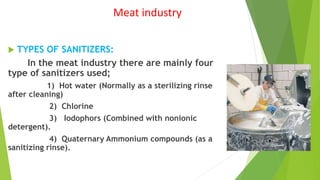
 TYPES OF SANITIZERS:
In the meat industry there are mainly four
type of sanitizers used;
1) Hot water (Normally as a sterilizing rinse
after cleaning)
2) Chlorine
3) Iodophors (Combined with nonionic
detergent).
4) Quaternary Ammonium compounds (as a
sanitizing rinse).
1) Location
 For the initial planning of a food plant, you need to consider the
location carefully. Labor, ingredients, and transportation are three vital
resources that a food plant needs to have nearby.
 Ease of access is critical for employees, materials and vendors. If your
ingredients and supplies are locally sourced, for instance, in addition to
having fresh products, you are helping the local economy.
To ensure the most sanitary food processing plant possible, facility
owner and managers should take these seven steps into account.
Cont.………
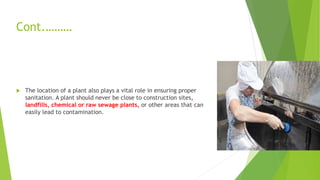
 The location of a plant also plays a vital role in ensuring proper
sanitation. A plant should never be close to construction sites,
landfills, chemical or raw sewage plants, or other areas that can
easily lead to contamination.
Consider your setup
 A proper equipment and processing layout ensures safety and efficiency,
minimize the risk if cross-contamination, and protects the production space
from contamination.
 Including a sanitation room for employees to go through before starting work,
as well as bathrooms that don’t open towards the workspace, are ways to
make sure that the production area is established in an appropriate flow
from the start to the end of production.
CLEAR AWAY DIRT, DUST, AND DEBRIS
 Dirt, dust and other debris aren’t just harmful to the equipment in a food facility; they also settle on products,
clothing and other surfaces, contaminating products. Bacteria can cling on to these particles, increasing the risks
of food-borne illnesses
 Cleaning is critical to keep dirt, dust, and other debris out of the facility and maintain food plant sanitation.
Workers should also change their shoes in the sanitation room or wear durable shoe covers to prevent dirt and
dust from being brought in.
 Air purifiers are another essentials parts of maintains a clean, dust-free facility.
CHOOSE THE RIGHT DRAINAGE
 Drainage is vital to sanitation in food plants, since it keeps wastewater runoff from accumulating on the
facility’s floors. Standing water can be a breeding place for bacteria, which can cause serious contamination
issues.
 Food safe drains offers different drainage systems that are ideal for food plants. One system is the 10,000
series Slot Drain- a linear, gate free system made from NSF-CERTIFIED, food-grade stainless steel.
 With a heavy-duty load class, the 10,000 series slot drain can withstand forklift traffic, and it offers clean-
in-place capabilities, which makes the system easy to clean and sanitize without much hassle.
Invest in quality equipment
 No facility can function without high quality
equipment; the better the quality, the more
durable it is, and the longer it will last. Ideally,
all equipment should be stainless steel, a
bacteria and corrosion-resistant metal that can
withstand the harsh environment found in a food
plant.
Work with pest control
 Flies, rat, and other pests can bring in dirt and bacteria, leading to widespread
contamination in the facility, compromising sanitation levels. These pests can cause
severe damage to the facility, form the walls to the equipment. Once an infestation
has begun, it can be difficult to stop, which is why prevention them is essential.
 To prevent infections. Seal any cracks or openings, no matter how small, to prevent
entry. You also want to install mesh around any vents in the ceiling to prevent
rodents or birds from getting inside. Keeping the facility clean is also critical-keep
floors and surfaces free from waste and clean off any residue that may attract
pests.
 You should keep food containers tightly sealed and, of course, have regular pest
control evaluations to ensure there is nothing of concern.
Use proper food storage
 Food storage is critical to keeping ingredients and products fresh. Without proper
storage, ingredients can be exposed to pests, bacteria, and other harmful
environmental factors, which can affect the sanitation in food plants.
 Using airtight containers and storing ingredients at the appropriate temperature is
absolutely critical. Raw products like meat, fish and poultry should stay in cold
storage and be separate from other ingredients to prevent cross-contaminated.
 You need to clean all food storage containers before refilling them. Finished food
product waiting for transport to stores and producers should have a separate storage
area, away from raw ingredients, to keep them clean and uncontaminated.
plant sanitation.pptx

plant sanitation.pptx

  • 1.
    PLANT SANITATION SUBMITTED TO, C.MARIYAPPAN DEPARTMENTOF MICROBIOLOGY SPKC-PARAMAKALYANI SUBMITTED BY, G. PONSUTHA II MSC MICROBIOLOGY REG:20201232516113 SEMESTER – IV FOOD MICROBIOLOGY SEMINAR TOPIC : PLANT SANITATION
  • 2.
     The sanitationprocess has many facets that make it vital in a food plant with the primary function to remove contaminating soils and prepare the food surface for sanitizing. The benefits of effective sanitation are production of safe product, improved product shelf life and reduction of off flavours, odour's and colours.  The FDA and USDA have set strict standards that plant managers and operators must follow, and some of these requirements are continually changing and evolving to maintain public safety. INTRODUCTION
  • 3.
    INTODUCTION The sanitation infood industry is concerned with aseptic practices in the preparation, processing and packaging of the food products of a plant, the general cleanliness and sanitation of plant and also the health of employs. sanitation: Treatment of a cleaned surface with a chemical or physical agent to destroy disease/spoilage causing organisms. Reduces total vegetative cell population to a safe level.
  • 4.
    Dairy plant sanitation Steam; The use of as sanitizer has limited application, as it is relatively expensive . It is also difficult to regulate and monitor contact temperature and time. Besides these, the by- product of steam condensation may hamper cleaning operation.  HOT WATER; This is commonly used in many dairy plants. It involves circulating water of at least 77*c for 5 mins. Applying higher temperature (>85*c) for longer time (10-15mins) are recommend to allow heat penetration into areas that are hard to reach.  ADVANTAGES;  Easy to apply  penetrate into cracks and crevices  readily available  relatively inexpensive  non corrosive  very effective over a broad range of microorganisms.
  • 5.
    Meat industry  TYPESOF SANITIZERS: In the meat industry there are mainly four type of sanitizers used; 1) Hot water (Normally as a sterilizing rinse after cleaning) 2) Chlorine 3) Iodophors (Combined with nonionic detergent). 4) Quaternary Ammonium compounds (as a sanitizing rinse).
  • 6.
    1) Location  Forthe initial planning of a food plant, you need to consider the location carefully. Labor, ingredients, and transportation are three vital resources that a food plant needs to have nearby.  Ease of access is critical for employees, materials and vendors. If your ingredients and supplies are locally sourced, for instance, in addition to having fresh products, you are helping the local economy. To ensure the most sanitary food processing plant possible, facility owner and managers should take these seven steps into account.
  • 7.
    Cont.………  The locationof a plant also plays a vital role in ensuring proper sanitation. A plant should never be close to construction sites, landfills, chemical or raw sewage plants, or other areas that can easily lead to contamination.
  • 8.
    Consider your setup A proper equipment and processing layout ensures safety and efficiency, minimize the risk if cross-contamination, and protects the production space from contamination.  Including a sanitation room for employees to go through before starting work, as well as bathrooms that don’t open towards the workspace, are ways to make sure that the production area is established in an appropriate flow from the start to the end of production.
  • 9.
    CLEAR AWAY DIRT,DUST, AND DEBRIS  Dirt, dust and other debris aren’t just harmful to the equipment in a food facility; they also settle on products, clothing and other surfaces, contaminating products. Bacteria can cling on to these particles, increasing the risks of food-borne illnesses  Cleaning is critical to keep dirt, dust, and other debris out of the facility and maintain food plant sanitation. Workers should also change their shoes in the sanitation room or wear durable shoe covers to prevent dirt and dust from being brought in.  Air purifiers are another essentials parts of maintains a clean, dust-free facility.
  • 10.
    CHOOSE THE RIGHTDRAINAGE  Drainage is vital to sanitation in food plants, since it keeps wastewater runoff from accumulating on the facility’s floors. Standing water can be a breeding place for bacteria, which can cause serious contamination issues.  Food safe drains offers different drainage systems that are ideal for food plants. One system is the 10,000 series Slot Drain- a linear, gate free system made from NSF-CERTIFIED, food-grade stainless steel.  With a heavy-duty load class, the 10,000 series slot drain can withstand forklift traffic, and it offers clean- in-place capabilities, which makes the system easy to clean and sanitize without much hassle.
  • 11.
    Invest in qualityequipment  No facility can function without high quality equipment; the better the quality, the more durable it is, and the longer it will last. Ideally, all equipment should be stainless steel, a bacteria and corrosion-resistant metal that can withstand the harsh environment found in a food plant.
  • 12.
    Work with pestcontrol  Flies, rat, and other pests can bring in dirt and bacteria, leading to widespread contamination in the facility, compromising sanitation levels. These pests can cause severe damage to the facility, form the walls to the equipment. Once an infestation has begun, it can be difficult to stop, which is why prevention them is essential.  To prevent infections. Seal any cracks or openings, no matter how small, to prevent entry. You also want to install mesh around any vents in the ceiling to prevent rodents or birds from getting inside. Keeping the facility clean is also critical-keep floors and surfaces free from waste and clean off any residue that may attract pests.  You should keep food containers tightly sealed and, of course, have regular pest control evaluations to ensure there is nothing of concern.
  • 13.
    Use proper foodstorage  Food storage is critical to keeping ingredients and products fresh. Without proper storage, ingredients can be exposed to pests, bacteria, and other harmful environmental factors, which can affect the sanitation in food plants.  Using airtight containers and storing ingredients at the appropriate temperature is absolutely critical. Raw products like meat, fish and poultry should stay in cold storage and be separate from other ingredients to prevent cross-contaminated.  You need to clean all food storage containers before refilling them. Finished food product waiting for transport to stores and producers should have a separate storage area, away from raw ingredients, to keep them clean and uncontaminated.