Methods
Study of distribution and determinants of health related events and its
application to control health problems.
1IMS BANGALORE
 Enumerate two different types of epidemiological
methods .
 To define descriptive epidemiology and describe
importance of time, place and person
distribution.
 Enumerate three kinds of time fluctuations in
disease occurrence.
 To describe disease load in terms of prevalence
and incidence.
 To differentiate cross sectional and longitudinal
studies.
 To enumerate two used of descriptive
epidemiology.
2IMS BANGALORE
Dynamic study of the
Determinants
Occurrence
Distribution
Control
Pattern
Of health and disease in a population
3IMS BANGALORE
 Is the basic science of public health
 Provides insight regarding the nature, causes,
and extent of health and disease
 Provides information needed to plan and
target resources appropriately
4IMS BANGALORE
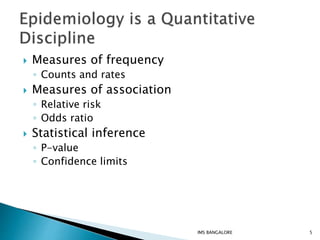
 Measures of frequency
◦ Counts and rates
 Measures of association
◦ Relative risk
◦ Odds ratio
 Statistical inference
◦ P-value
◦ Confidence limits
5IMS BANGALORE
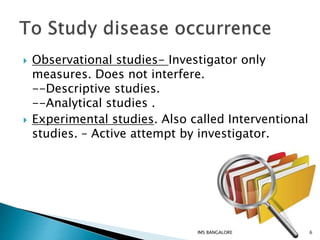
 Observational studies- Investigator only
measures. Does not interfere.
--Descriptive studies.
--Analytical studies .
 Experimental studies. Also called Interventional
studies. – Active attempt by investigator.
6IMS BANGALORE
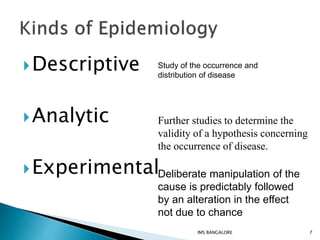
Descriptive
Analytic
Experimental
Further studies to determine the
validity of a hypothesis concerning
the occurrence of disease.
Deliberate manipulation of the
cause is predictably followed
by an alteration in the effect
not due to chance
Study of the occurrence and
distribution of disease
7IMS BANGALORE
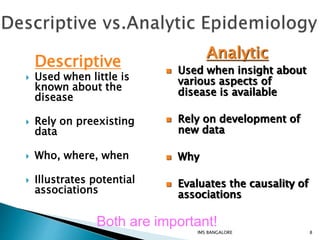
Descriptive
 Used when little is
known about the
disease
 Rely on preexisting
data
 Who, where, when
 Illustrates potential
associations
Analytic
 Used when insight about
various aspects of
disease is available
 Rely on development of
new data
 Why
 Evaluates the causality of
associations
Both are important!
8IMS BANGALORE
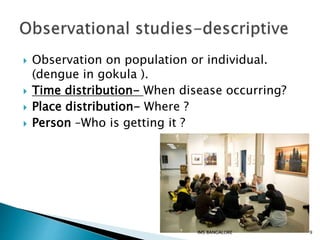
 Observation on population or individual.
(dengue in gokula ).
 Time distribution- When disease occurring?
 Place distribution- Where ?
 Person –Who is getting it ?
9IMS BANGALORE
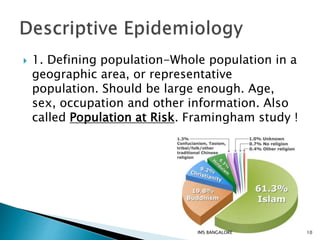
 1. Defining population-Whole population in a
geographic area, or representative
population. Should be large enough. Age,
sex, occupation and other information. Also
called Population at Risk. Framingham study !
10IMS BANGALORE
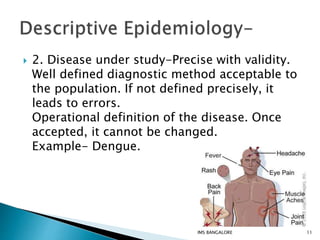
 2. Disease under study-Precise with validity.
Well defined diagnostic method acceptable to
the population. If not defined precisely, it
leads to errors.
Operational definition of the disease. Once
accepted, it cannot be changed.
Example- Dengue.
11IMS BANGALORE
 Disease is seasonal, ? Periodic fluctuation ?
 Short term fluctuation – EPIDEMIC .-
’’Occurrence in a community of illness or
event clearly in excess of normal expectancy.”
 Periodic fluctuation
 Long term trends-
12IMS BANGALORE
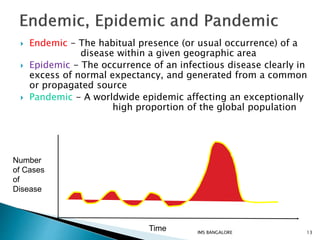
 Endemic - The habitual presence (or usual occurrence) of a
disease within a given geographic area
 Epidemic - The occurrence of an infectious disease clearly in
excess of normal expectancy, and generated from a common
or propagated source
 Pandemic - A worldwide epidemic affecting an exceptionally
high proportion of the global population
Number
of Cases
of
Disease
Time 13IMS BANGALORE
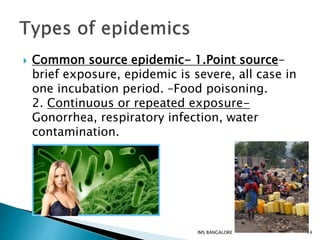
 Common source epidemic- 1.Point source-
brief exposure, epidemic is severe, all case in
one incubation period. –Food poisoning.
2. Continuous or repeated exposure-
Gonorrhea, respiratory infection, water
contamination.
14IMS BANGALORE
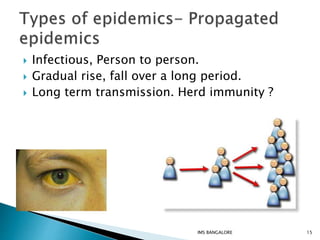
 Infectious, Person to person.
 Gradual rise, fall over a long period.
 Long term transmission. Herd immunity ?
15IMS BANGALORE
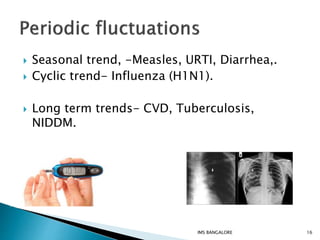
 Seasonal trend, -Measles, URTI, Diarrhea,.
 Cyclic trend- Influenza (H1N1).
 Long term trends- CVD, Tuberculosis,
NIDDM.
16IMS BANGALORE
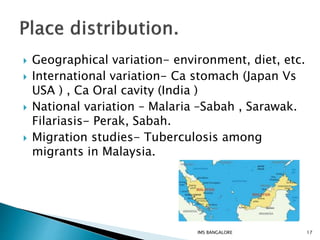
 Geographical variation- environment, diet, etc.
 International variation- Ca stomach (Japan Vs
USA ) , Ca Oral cavity (India )
 National variation – Malaria –Sabah , Sarawak.
Filariasis- Perak, Sabah.
 Migration studies- Tuberculosis among
migrants in Malaysia.
17IMS BANGALORE
Age Hobbies
Sex Pets
Occupation Travel
Immunization status Personal Habits
Underlying disease Stress
Medication Family unit
Nutritional status School
Socioeconomic factors Genetics
Crowding Religion
18IMS BANGALORE
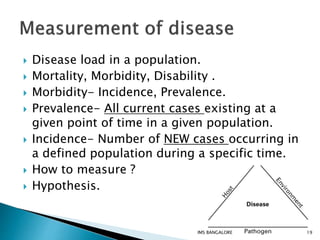
 Disease load in a population.
 Mortality, Morbidity, Disability .
 Morbidity- Incidence, Prevalence.
 Prevalence- All current cases existing at a
given point of time in a given population.
 Incidence- Number of NEW cases occurring in
a defined population during a specific time.
 How to measure ?
 Hypothesis.
19IMS BANGALORE
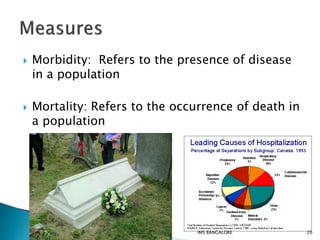
 Morbidity: Refers to the presence of disease
in a population
 Mortality: Refers to the occurrence of death in
a population
20IMS BANGALORE
 Prevalence is the number of existing cases
of disease in the population during a defined
period.
 Incidence is the number of new cases of
disease that develop in the population during
a defined period.
21IMS BANGALORE
Prevalence: The number of existing cases in
the population during a given time period.
PR = # existing cases during time period
population at same point in time
Prevalence rates are often expressed as a
percentage.
22IMS BANGALORE
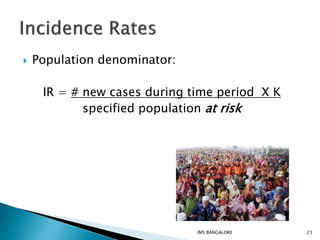
 Population denominator:
IR = # new cases during time period X K
specified population at risk
23IMS BANGALORE
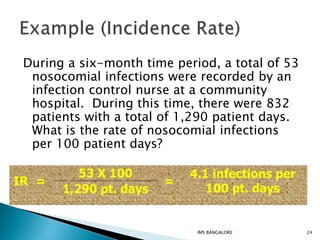
During a six-month time period, a total of 53
nosocomial infections were recorded by an
infection control nurse at a community
hospital. During this time, there were 832
patients with a total of 1,290 patient days.
What is the rate of nosocomial infections
per 100 patient days?
IR =
53 X 100
1,290 pt. days
=
4.1 infections per
100 pt. days
24IMS BANGALORE
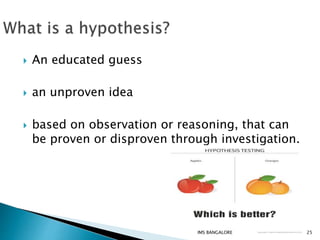
 An educated guess
 an unproven idea
 based on observation or reasoning, that can
be proven or disproven through investigation.
25IMS BANGALORE
 Cross sectional-
Single examination
of a cross section
of population.
Prevalence study.
 Longitudinal
Repeated
observation in the
same population.
26IMS BANGALORE
 trends in health and disease and allow
comparisons among countries and
subgroups within countries
 Provides clue to disease etiology.
 provides a basis for planning, provision and
evaluation of services
 identifies problems to be studied by
analytic methods (?)and to test hypotheses
related to those problems
27IMS BANGALORE
28IMS BANGALORE
. Circle the most appropriate explanation on “Prevalence rate”:
a. the number of patients who have the disease at a particular time,
divided by the population at risk of having the disease at that
time.
b. the number of new cases of a diseased in a population over a
period of time.
c. not useful for developing HIV/AIDS control programme.
d. useful for developing Avian flu control programme.
e. not useful for any disease control programme.
29IMS BANGALORE
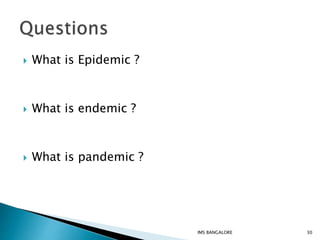
 What is Epidemic ?
 What is endemic ?
 What is pandemic ?
30IMS BANGALORE
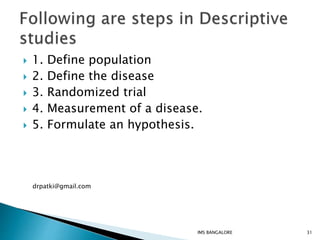
 1. Define population
 2. Define the disease
 3. Randomized trial
 4. Measurement of a disease.
 5. Formulate an hypothesis.
31IMS BANGALORE
drpatki@gmail.com

Epidemiological methods

  • 1.
    Methods Study of distributionand determinants of health related events and its application to control health problems. 1IMS BANGALORE
  • 2.
     Enumerate twodifferent types of epidemiological methods .  To define descriptive epidemiology and describe importance of time, place and person distribution.  Enumerate three kinds of time fluctuations in disease occurrence.  To describe disease load in terms of prevalence and incidence.  To differentiate cross sectional and longitudinal studies.  To enumerate two used of descriptive epidemiology. 2IMS BANGALORE
  • 3.
    Dynamic study ofthe Determinants Occurrence Distribution Control Pattern Of health and disease in a population 3IMS BANGALORE
  • 4.
     Is thebasic science of public health  Provides insight regarding the nature, causes, and extent of health and disease  Provides information needed to plan and target resources appropriately 4IMS BANGALORE
  • 5.
     Measures offrequency ◦ Counts and rates  Measures of association ◦ Relative risk ◦ Odds ratio  Statistical inference ◦ P-value ◦ Confidence limits 5IMS BANGALORE
  • 6.
     Observational studies-Investigator only measures. Does not interfere. --Descriptive studies. --Analytical studies .  Experimental studies. Also called Interventional studies. – Active attempt by investigator. 6IMS BANGALORE
  • 7.
    Descriptive Analytic Experimental Further studies todetermine the validity of a hypothesis concerning the occurrence of disease. Deliberate manipulation of the cause is predictably followed by an alteration in the effect not due to chance Study of the occurrence and distribution of disease 7IMS BANGALORE
  • 8.
    Descriptive  Used whenlittle is known about the disease  Rely on preexisting data  Who, where, when  Illustrates potential associations Analytic  Used when insight about various aspects of disease is available  Rely on development of new data  Why  Evaluates the causality of associations Both are important! 8IMS BANGALORE
  • 9.
     Observation onpopulation or individual. (dengue in gokula ).  Time distribution- When disease occurring?  Place distribution- Where ?  Person –Who is getting it ? 9IMS BANGALORE
  • 10.
     1. Definingpopulation-Whole population in a geographic area, or representative population. Should be large enough. Age, sex, occupation and other information. Also called Population at Risk. Framingham study ! 10IMS BANGALORE
  • 11.
     2. Diseaseunder study-Precise with validity. Well defined diagnostic method acceptable to the population. If not defined precisely, it leads to errors. Operational definition of the disease. Once accepted, it cannot be changed. Example- Dengue. 11IMS BANGALORE
  • 12.
     Disease isseasonal, ? Periodic fluctuation ?  Short term fluctuation – EPIDEMIC .- ’’Occurrence in a community of illness or event clearly in excess of normal expectancy.”  Periodic fluctuation  Long term trends- 12IMS BANGALORE
  • 13.
     Endemic -The habitual presence (or usual occurrence) of a disease within a given geographic area  Epidemic - The occurrence of an infectious disease clearly in excess of normal expectancy, and generated from a common or propagated source  Pandemic - A worldwide epidemic affecting an exceptionally high proportion of the global population Number of Cases of Disease Time 13IMS BANGALORE
  • 14.
     Common sourceepidemic- 1.Point source- brief exposure, epidemic is severe, all case in one incubation period. –Food poisoning. 2. Continuous or repeated exposure- Gonorrhea, respiratory infection, water contamination. 14IMS BANGALORE
  • 15.
     Infectious, Personto person.  Gradual rise, fall over a long period.  Long term transmission. Herd immunity ? 15IMS BANGALORE
  • 16.
     Seasonal trend,-Measles, URTI, Diarrhea,.  Cyclic trend- Influenza (H1N1).  Long term trends- CVD, Tuberculosis, NIDDM. 16IMS BANGALORE
  • 17.
     Geographical variation-environment, diet, etc.  International variation- Ca stomach (Japan Vs USA ) , Ca Oral cavity (India )  National variation – Malaria –Sabah , Sarawak. Filariasis- Perak, Sabah.  Migration studies- Tuberculosis among migrants in Malaysia. 17IMS BANGALORE
  • 18.
    Age Hobbies Sex Pets OccupationTravel Immunization status Personal Habits Underlying disease Stress Medication Family unit Nutritional status School Socioeconomic factors Genetics Crowding Religion 18IMS BANGALORE
  • 19.
     Disease loadin a population.  Mortality, Morbidity, Disability .  Morbidity- Incidence, Prevalence.  Prevalence- All current cases existing at a given point of time in a given population.  Incidence- Number of NEW cases occurring in a defined population during a specific time.  How to measure ?  Hypothesis. 19IMS BANGALORE
  • 20.
     Morbidity: Refersto the presence of disease in a population  Mortality: Refers to the occurrence of death in a population 20IMS BANGALORE
  • 21.
     Prevalence isthe number of existing cases of disease in the population during a defined period.  Incidence is the number of new cases of disease that develop in the population during a defined period. 21IMS BANGALORE
  • 22.
    Prevalence: The numberof existing cases in the population during a given time period. PR = # existing cases during time period population at same point in time Prevalence rates are often expressed as a percentage. 22IMS BANGALORE
  • 23.
     Population denominator: IR= # new cases during time period X K specified population at risk 23IMS BANGALORE
  • 24.
    During a six-monthtime period, a total of 53 nosocomial infections were recorded by an infection control nurse at a community hospital. During this time, there were 832 patients with a total of 1,290 patient days. What is the rate of nosocomial infections per 100 patient days? IR = 53 X 100 1,290 pt. days = 4.1 infections per 100 pt. days 24IMS BANGALORE
  • 25.
     An educatedguess  an unproven idea  based on observation or reasoning, that can be proven or disproven through investigation. 25IMS BANGALORE
  • 26.
     Cross sectional- Singleexamination of a cross section of population. Prevalence study.  Longitudinal Repeated observation in the same population. 26IMS BANGALORE
  • 27.
     trends inhealth and disease and allow comparisons among countries and subgroups within countries  Provides clue to disease etiology.  provides a basis for planning, provision and evaluation of services  identifies problems to be studied by analytic methods (?)and to test hypotheses related to those problems 27IMS BANGALORE
  • 28.
  • 29.
    . Circle themost appropriate explanation on “Prevalence rate”: a. the number of patients who have the disease at a particular time, divided by the population at risk of having the disease at that time. b. the number of new cases of a diseased in a population over a period of time. c. not useful for developing HIV/AIDS control programme. d. useful for developing Avian flu control programme. e. not useful for any disease control programme. 29IMS BANGALORE
  • 30.
     What isEpidemic ?  What is endemic ?  What is pandemic ? 30IMS BANGALORE
  • 31.
     1. Definepopulation  2. Define the disease  3. Randomized trial  4. Measurement of a disease.  5. Formulate an hypothesis. 31IMS BANGALORE drpatki@gmail.com