Anti-malarial drugsAnti-malarial drugs
 Global scourgeGlobal scourge
 Rampant diseaseRampant disease
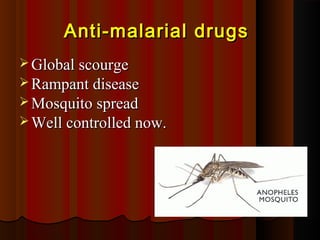
 Mosquito spreadMosquito spread
 Well controlled now.Well controlled now.
TYPES OF MALARIALTYPES OF MALARIAL
PARASITEPARASITE
Four types of speciesFour types of species
Plasmodium falciparum: most seriousPlasmodium falciparum: most serious
P.vivax, P.ovale, and P.malarie: milderP.vivax, P.ovale, and P.malarie: milder
and not generally fatal.and not generally fatal.
Transmittion: female mosquitoTransmittion: female mosquito
(Anopheles)(Anopheles)
Malarial parasiteMalarial parasite
P. malariae & p. falciparumP. malariae & p. falciparum have onehave one
cycle of liver invasion and end by the 4thcycle of liver invasion and end by the 4th
week i.e. no relapse occurs.week i.e. no relapse occurs.
P.ovale & p. vivaxP.ovale & p. vivax have dormanthave dormant
stages (hypnozoites) in the liver. Thesestages (hypnozoites) in the liver. These
hypnozoites may rupture months or yearshypnozoites may rupture months or years
later causing relapse of the attacks.later causing relapse of the attacks.
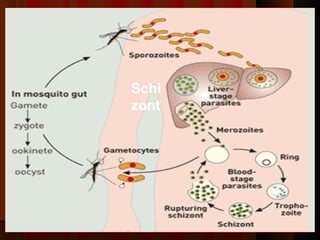
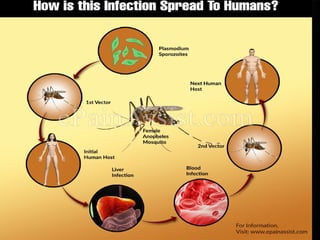
Life cycleLife cycle
Mosquito female anopheline bite-Mosquito female anopheline bite-
sporozoitessporozoites
Liver- primary tissue schizonts &Liver- primary tissue schizonts &
hypnozoiteshypnozoites
Blood – merozoites clinical attackBlood – merozoites clinical attack
 blood schizonts chills, fever,blood schizonts chills, fever,
Asymptomatic in endemicAsymptomatic in endemic
region Gametocytes Mosquitoregion Gametocytes Mosquito
salivary glandsalivary gland
Schi
zont
CLASSICAL SYMPTOMS OFCLASSICAL SYMPTOMS OF
MALARIAMALARIA
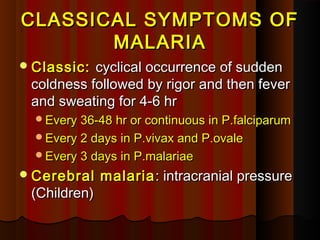
Classic:Classic: cyclical occurrence of suddencyclical occurrence of sudden
coldness followed by rigor and then fevercoldness followed by rigor and then fever
and sweating for 4-6 hrand sweating for 4-6 hr
Every 36-48 hr or continuous in P.falciparumEvery 36-48 hr or continuous in P.falciparum
Every 2 days in P.vivax and P.ovaleEvery 2 days in P.vivax and P.ovale
Every 3 days in P.malariaeEvery 3 days in P.malariae
Cerebral malariaCerebral malaria : intracranial pressure: intracranial pressure
(Children)(Children)
Classification - chemicalClassification - chemical
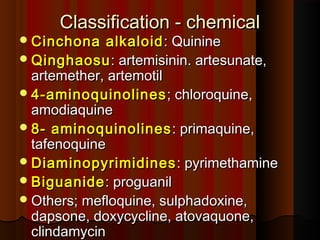
Cinchona alkaloidCinchona alkaloid : Quinine: Quinine
QinghaosuQinghaosu: artemisinin. artesunate,: artemisinin. artesunate,
artemether, artemotilartemether, artemotil
4-aminoquinolines4-aminoquinolines; chloroquine,; chloroquine,
amodiaquineamodiaquine
8- aminoquinolines8- aminoquinolines : primaquine,: primaquine,
tafenoquinetafenoquine
DiaminopyrimidinesDiaminopyrimidines : pyrimethamine: pyrimethamine
BiguanideBiguanide: proguanil: proguanil
Others; mefloquine, sulphadoxine,Others; mefloquine, sulphadoxine,
dapsone, doxycycline, atovaquone,dapsone, doxycycline, atovaquone,
clindamycinclindamycin
Classification- clinicalClassification- clinical
Clinical curesClinical cures/ suppressives:/ suppressives: bloodblood
schzonticidesschzonticides – chloroquine, quinine,– chloroquine, quinine,
atovaquone, artemisininatovaquone, artemisinin
Radical curesRadical cures:: tissue schizonticidestissue schizonticides ––
primaquine, pyrimethamine,primaquine, pyrimethamine,
GametocidalGametocidal drugs: chloroquine,drugs: chloroquine,
quinine, primaquine, artimesinin,quinine, primaquine, artimesinin,
mefloquinemefloquine
SporontocidesSporontocides: pyrimethamine,: pyrimethamine,
proguanilproguanil
ChloroquineChloroquine
Malaria, amoebiasis, anti-rheumatic,Malaria, amoebiasis, anti-rheumatic,
antiflukes, anti-porphyria, anti-antiflukes, anti-porphyria, anti-
photosensitivityphotosensitivity
Plasmodicidal: blood schizonticidal,Plasmodicidal: blood schizonticidal,
gametocidal, clears all forms < 7 daysgametocidal, clears all forms < 7 days
MOA: accumulation of heme to toxic levelMOA: accumulation of heme to toxic level
Prevent heme detoxificationPrevent heme detoxification
Increase pH, (-) calmodulin, lethal toIncrease pH, (-) calmodulin, lethal to
membrane, (-) nuclei acid synthesismembrane, (-) nuclei acid synthesis
Resistance: P-glycoprotein efflux pumpResistance: P-glycoprotein efflux pump
Chloroquine ….CONTD.Chloroquine ….CONTD.
Does not produce radical cure ofDoes not produce radical cure of
vivax/ovale malariavivax/ovale malaria
Base 300mg = 500mg of chloroquineBase 300mg = 500mg of chloroquine
P04/S02-4/HclP04/S02-4/Hcl
Treatment to start 600mg. 300mgTreatment to start 600mg. 300mg
each at 6, 24, 48 hours long t1/2each at 6, 24, 48 hours long t1/2
ProphylaxisProphylaxis: 300mg once a week before: 300mg once a week before
1 week & to be continued throughout and1 week & to be continued throughout and
at least 4 weeks after exposureat least 4 weeks after exposure
Uses & ADRsUses & ADRs
Hepatic amoebiasis, rheumatoidHepatic amoebiasis, rheumatoid
arthritis, lupus erythematosus, lightarthritis, lupus erythematosus, light
sensitive skin eruptionssensitive skin eruptions
Less common & less severe ADRs-Less common & less severe ADRs-
retinopathy, psychotic episodes,retinopathy, psychotic episodes,
convulsions,convulsions,
Large Vd, detected after 16 yearsLarge Vd, detected after 16 years
With quinine antagonismWith quinine antagonism
Reduces ampicillin absorptionReduces ampicillin absorption
Artemisinin, ArtesunateArtemisinin, Artesunate
ArtemetherArtemether
Artemisia annuaArtemisia annua alkaloid, rapidly bloodalkaloid, rapidly blood
schizonticide. Very potent rapidly actingschizonticide. Very potent rapidly acting
Effective against chloroquine sensitive orEffective against chloroquine sensitive or
resistant plasmodium falciparum / Vivaxresistant plasmodium falciparum / Vivax
4mg/kg daily single dose for 3 days4mg/kg daily single dose for 3 days
Well tolerated. QT prolongationWell tolerated. QT prolongation
Not with drugs known to prolong QTNot with drugs known to prolong QT
intervalinterval
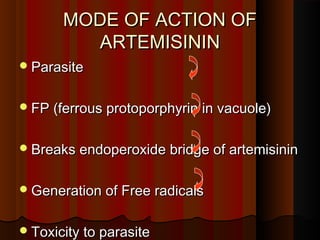
MODE OF ACTION OFMODE OF ACTION OF
ARTEMISININARTEMISININ
ParasiteParasite
FP (ferrous protoporphyrin in vacuole)FP (ferrous protoporphyrin in vacuole)
Breaks endoperoxide bridge of artemisininBreaks endoperoxide bridge of artemisinin
Generation of Free radicalsGeneration of Free radicals
Toxicity to parasiteToxicity to parasite
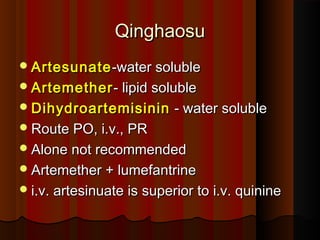
QinghaosuQinghaosu
ArtesunateArtesunate-water soluble-water soluble
ArtemetherArtemether- lipid soluble- lipid soluble
DihydroartemisininDihydroartemisinin - water soluble- water soluble
Route PO, i.v., PRRoute PO, i.v., PR
Alone not recommendedAlone not recommended
Artemether + lumefantrineArtemether + lumefantrine
i.v. artesinuate is superior to i.v. quininei.v. artesinuate is superior to i.v. quinine
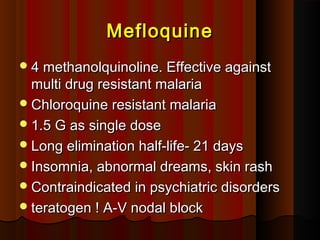
MefloquineMefloquine
4 methanolquinoline. Effective against4 methanolquinoline. Effective against
multi drug resistant malariamulti drug resistant malaria
Chloroquine resistant malariaChloroquine resistant malaria
1.5 G as single dose1.5 G as single dose
Long elimination half-life- 21 daysLong elimination half-life- 21 days
Insomnia, abnormal dreams, skin rashInsomnia, abnormal dreams, skin rash
Contraindicated in psychiatric disordersContraindicated in psychiatric disorders
teratogen ! A-V nodal blockteratogen ! A-V nodal block
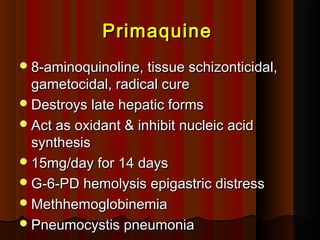
PrimaquinePrimaquine
8-aminoquinoline, tissue schizonticidal,8-aminoquinoline, tissue schizonticidal,
gametocidal, radical curegametocidal, radical cure
Destroys late hepatic formsDestroys late hepatic forms
Act as oxidant & inhibit nucleic acidAct as oxidant & inhibit nucleic acid
synthesissynthesis
15mg/day for 14 days15mg/day for 14 days
G-6-PD hemolysis epigastric distressG-6-PD hemolysis epigastric distress
MethhemoglobinemiaMethhemoglobinemia
Pneumocystis pneumoniaPneumocystis pneumonia
PyrimethaminePyrimethamine
Anti-folate anti-malarial & toxoplasmosisAnti-folate anti-malarial & toxoplasmosis
(-) dihydrofolate synthetase(-) dihydrofolate synthetase
75mg + sulfodoxine 1.5g75mg + sulfodoxine 1.5g
T1/2 3daysT1/2 3days
Pulmonary eosinophilia MegaloblasticPulmonary eosinophilia Megaloblastic
anemiaanemia
Used in MycetomaUsed in Mycetoma
Mechanism of action of Fansidar
(Sequential Block)
P-aminobenzoic acid
Dihydrofolic acid
Tetrahydrofolic acid
Purines
DNA
Dihydrofolate Synthetase
Dihydrofolate reductase
Sulfadoxine
Pyrimethamine
Proguanil
QuinineQuinine
Cinhona alkaloid, blood schizonticide,Cinhona alkaloid, blood schizonticide,
gametecidalgametecidal
 oxytocic, antipyretic, abortifacient,oxytocic, antipyretic, abortifacient,
nocturnal leg crampsnocturnal leg cramps
P0 & .i.v. in cerebral malariaP0 & .i.v. in cerebral malaria
Cinchonism, hyperinsulinemia,Cinchonism, hyperinsulinemia,
hypoglycemiahypoglycemia
Black water feverBlack water fever
650mg thrice a day650mg thrice a day
Chloroquine resistant malariaChloroquine resistant malaria
AtovaquoneAtovaquone
Only PO, F – erratic, food increasesOnly PO, F – erratic, food increases
Disrupts mitochondrial electron transportDisrupts mitochondrial electron transport
Target primary liver stageTarget primary liver stage
Atovaquone 250mg + proguanil 100mgAtovaquone 250mg + proguanil 100mg
Both for treatment & prophylaxisBoth for treatment & prophylaxis
ExpensiveExpensive
P.jiroveciP.jiroveci
toxoplasmosistoxoplasmosis
ATOVAQUONE +ATOVAQUONE +
PROGUANILPROGUANIL
Potentiates anti-malarial actionPotentiates anti-malarial action
Prevents emergence of resistantPrevents emergence of resistant
Better toleranceBetter tolerance
Liver and blood schizonticideLiver and blood schizonticide
Not active against hypnozoitesNot active against hypnozoites
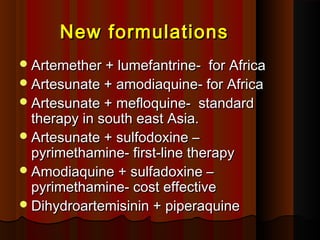
New formulationsNew formulations
Artemether + lumefantrine- for AfricaArtemether + lumefantrine- for Africa
Artesunate + amodiaquine- for AfricaArtesunate + amodiaquine- for Africa
Artesunate + mefloquine- standardArtesunate + mefloquine- standard
therapy in south east Asia.therapy in south east Asia.
Artesunate + sulfodoxine –Artesunate + sulfodoxine –
pyrimethamine- first-line therapypyrimethamine- first-line therapy
Amodiaquine + sulfadoxine –Amodiaquine + sulfadoxine –
pyrimethamine- cost effectivepyrimethamine- cost effective
Dihydroartemisinin + piperaquineDihydroartemisinin + piperaquine
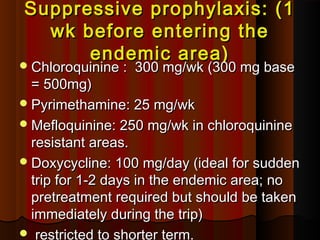
Suppressive prophylaxis: (1Suppressive prophylaxis: (1
wk before entering thewk before entering the
endemic area)endemic area)
Chloroquinine : 300 mg/wk (300 mg baseChloroquinine : 300 mg/wk (300 mg base
= 500mg)= 500mg)
Pyrimethamine: 25 mg/wkPyrimethamine: 25 mg/wk
Mefloquinine: 250 mg/wk in chloroquinineMefloquinine: 250 mg/wk in chloroquinine
resistant areas.resistant areas.
Doxycycline: 100 mg/day (ideal for suddenDoxycycline: 100 mg/day (ideal for sudden
trip for 1-2 days in the endemic area; notrip for 1-2 days in the endemic area; no
pretreatment required but should be takenpretreatment required but should be taken
immediately during the trip)immediately during the trip)
 restricted to shorter term.
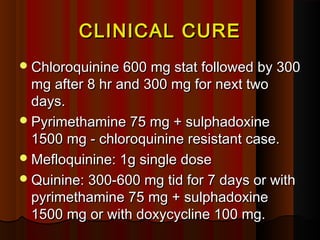
CLINICAL CURECLINICAL CURE
Chloroquinine 600 mg stat followed by 300Chloroquinine 600 mg stat followed by 300
mg after 8 hr and 300 mg for next twomg after 8 hr and 300 mg for next two
days.days.
Pyrimethamine 75 mg + sulphadoxinePyrimethamine 75 mg + sulphadoxine
1500 mg - chloroquinine resistant case.1500 mg - chloroquinine resistant case.
Mefloquinine: 1g single doseMefloquinine: 1g single dose
Quinine: 300-600 mg tid for 7 days or withQuinine: 300-600 mg tid for 7 days or with
pyrimethamine 75 mg + sulphadoxinepyrimethamine 75 mg + sulphadoxine
1500 mg or with doxycycline 100 mg.1500 mg or with doxycycline 100 mg.
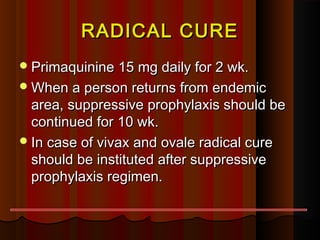
RADICAL CURERADICAL CURE
Primaquinine 15 mg daily for 2 wk.Primaquinine 15 mg daily for 2 wk.
When a person returns from endemicWhen a person returns from endemic
area, suppressive prophylaxis should bearea, suppressive prophylaxis should be
continued for 10 wk.continued for 10 wk.
In case of vivax and ovale radical cureIn case of vivax and ovale radical cure
should be instituted after suppressiveshould be instituted after suppressive
prophylaxis regimen.prophylaxis regimen.
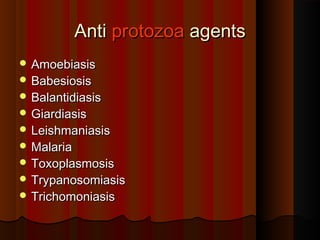
AntiAnti protozoaprotozoa agentsagents
 AmoebiasisAmoebiasis
 BabesiosisBabesiosis
 BalantidiasisBalantidiasis
 GiardiasisGiardiasis
 LeishmaniasisLeishmaniasis
 MalariaMalaria
 ToxoplasmosisToxoplasmosis
 TrypanosomiasisTrypanosomiasis
 TrichomoniasisTrichomoniasis
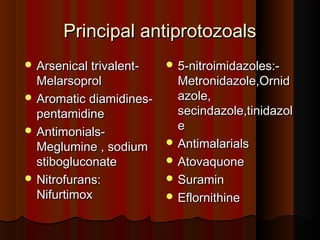
Principal antiprotozoalsPrincipal antiprotozoals
 Arsenical trivalent-Arsenical trivalent-
MelarsoprolMelarsoprol
 Aromatic diamidines-Aromatic diamidines-
pentamidinepentamidine
 Antimonials-Antimonials-
Meglumine , sodiumMeglumine , sodium
stibogluconatestibogluconate
 Nitrofurans:Nitrofurans:
NifurtimoxNifurtimox
 5-nitroimidazoles:-5-nitroimidazoles:-
Metronidazole,OrnidMetronidazole,Ornid
azole,azole,
secindazole,tinidazolsecindazole,tinidazol
ee
 AntimalarialsAntimalarials
 AtovaquoneAtovaquone
 SuraminSuramin
 EflornithineEflornithine
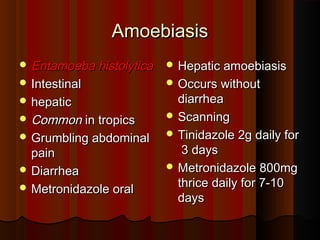
AmoebiasisAmoebiasis
 Entamoeba histolyticaEntamoeba histolytica
 IntestinalIntestinal
 hepatichepatic
 CommonCommon in tropicsin tropics
 Grumbling abdominalGrumbling abdominal
painpain
 DiarrheaDiarrhea
 Metronidazole oralMetronidazole oral
 Hepatic amoebiasisHepatic amoebiasis
 Occurs withoutOccurs without
diarrheadiarrhea
 ScanningScanning
 Tinidazole 2g daily forTinidazole 2g daily for
3 days3 days
 Metronidazole 800mgMetronidazole 800mg
thrice daily for 7-10thrice daily for 7-10
daysdays
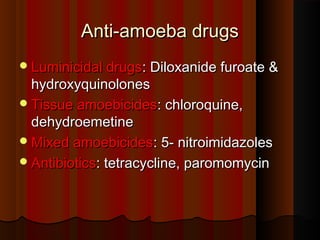
Anti-amoeba drugsAnti-amoeba drugs
Luminicidal drugsLuminicidal drugs: Diloxanide furoate &: Diloxanide furoate &
hydroxyquinoloneshydroxyquinolones
Tissue amoebicidesTissue amoebicides: chloroquine,: chloroquine,
dehydroemetinedehydroemetine
Mixed amoebicidesMixed amoebicides: 5- nitroimidazoles: 5- nitroimidazoles
AntibioticsAntibiotics: tetracycline, paromomycin: tetracycline, paromomycin
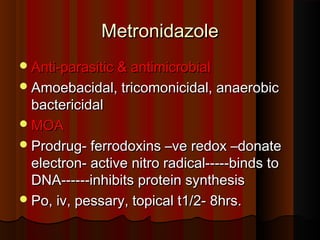
MetronidazoleMetronidazole
Anti-parasitic & antimicrobialAnti-parasitic & antimicrobial
Amoebacidal, tricomonicidal, anaerobicAmoebacidal, tricomonicidal, anaerobic
bactericidalbactericidal
MOAMOA
Prodrug- ferrodoxins –ve redox –donateProdrug- ferrodoxins –ve redox –donate
electron- active nitro radical-----binds toelectron- active nitro radical-----binds to
DNA------inhibits protein synthesisDNA------inhibits protein synthesis
Po, iv, pessary, topical t1/2- 8hrs.Po, iv, pessary, topical t1/2- 8hrs.
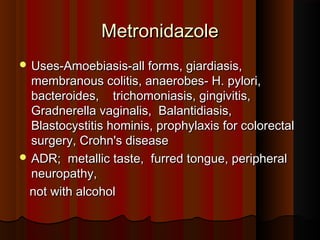
MetronidazoleMetronidazole
 Uses-Amoebiasis-all forms, giardiasis,Uses-Amoebiasis-all forms, giardiasis,
membranous colitis, anaerobes- H. pylori,membranous colitis, anaerobes- H. pylori,
bacteroides, trichomoniasis, gingivitis,bacteroides, trichomoniasis, gingivitis,
Gradnerella vaginalis, Balantidiasis,Gradnerella vaginalis, Balantidiasis,
Blastocystitis hominis, prophylaxis for colorectalBlastocystitis hominis, prophylaxis for colorectal
surgery, Crohn's diseasesurgery, Crohn's disease
 ADR; metallic taste, furred tongue, peripheralADR; metallic taste, furred tongue, peripheral
neuropathy,neuropathy,
not with alcoholnot with alcohol
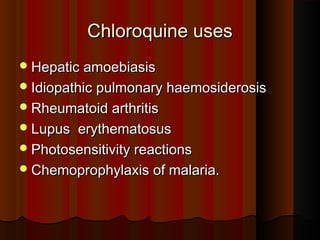
Chloroquine usesChloroquine uses
Hepatic amoebiasisHepatic amoebiasis
Idiopathic pulmonary haemosiderosisIdiopathic pulmonary haemosiderosis
Rheumatoid arthritisRheumatoid arthritis
Lupus erythematosusLupus erythematosus
Photosensitivity reactionsPhotosensitivity reactions
Chemoprophylaxis of malaria.Chemoprophylaxis of malaria.