Autacoids
• Angiotensin
• Kinins
CCF
10/16/2019 1PATKI
PHARMACOLOGY OF CCF
AT the end of the two sessions,
students should be able to
• Derive the signs and symptoms of Cardiac
failure
• Enumerate drugs used in CCF
• Describe the mechanism of action of Digoxin
in CCF.
• Describe the role of vasodilators, Diuretics
CCBs, ACE inhibitors in CCF,
• Describe management of Chronic heart failure
and Acute congestive cardiac failure.
10/16/2019 2PATKI
Heart Failure Click to open
!
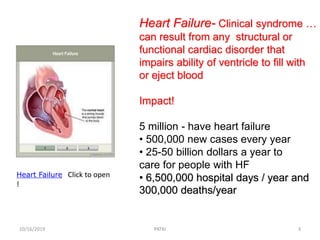
Heart Failure- Clinical syndrome …
can result from any structural or
functional cardiac disorder that
impairs ability of ventricle to fill with
or eject blood
Impact!
5 million - have heart failure
• 500,000 new cases every year
• 25-50 billion dollars a year to
care for people with HF
• 6,500,000 hospital days / year and
300,000 deaths/year
10/16/2019 3PATKI
Definition-Heart Failure (HF)
Key Concepts
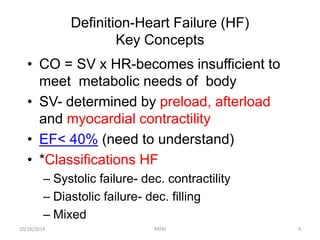
• CO = SV x HR-becomes insufficient to
meet metabolic needs of body
• SV- determined by preload, afterload
and myocardial contractility
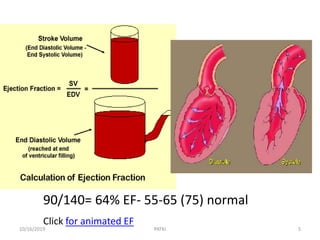
• EF< 40% (need to understand)
• *Classifications HF
– Systolic failure- dec. contractility
– Diastolic failure- dec. filling
– Mixed
10/16/2019 4PATKI
90/140= 64% EF- 55-65 (75) normal
Click for animated EF
10/16/2019 5PATKI
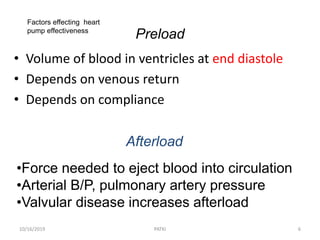
Preload
• Volume of blood in ventricles at end diastole
• Depends on venous return
• Depends on compliance
Afterload
•Force needed to eject blood into circulation
•Arterial B/P, pulmonary artery pressure
•Valvular disease increases afterload
Factors effecting heart
pump effectiveness
10/16/2019 6PATKI
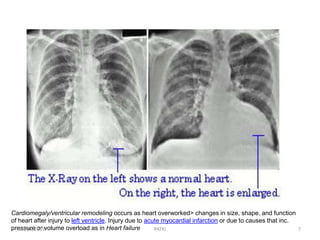
Cardiomegaly/ventricular remodeling occurs as heart overworked> changes in size, shape, and function
of heart after injury to left ventricle. Injury due to acute myocardial infarction or due to causes that inc.
pressure or volume overload as in Heart failure10/16/2019 7PATKI
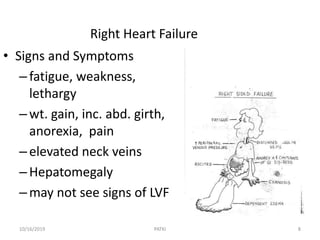
Right Heart Failure
• Signs and Symptoms
–fatigue, weakness,
lethargy
–wt. gain, inc. abd. girth,
anorexia, pain
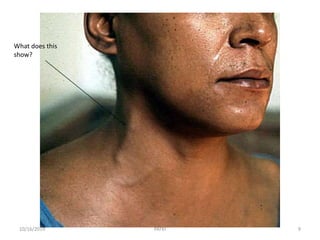
–elevated neck veins
–Hepatomegaly
–may not see signs of LVF
10/16/2019 8PATKI
What does this
show?
10/16/2019 9PATKI
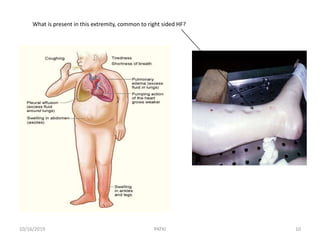
What is present in this extremity, common to right sided HF?
10/16/2019 10PATKI
Cardiac Glycosides
10/16/2019 11PATKI
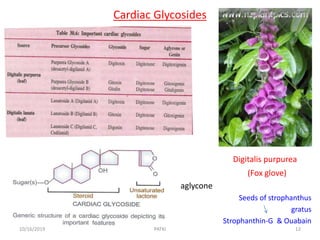
Cardiac Glycosides
Digitalis purpurea
(Fox glove)
aglycone
Seeds of strophanthus
gratus
Strophanthin-G & Ouabain
10/16/2019 12PATKI
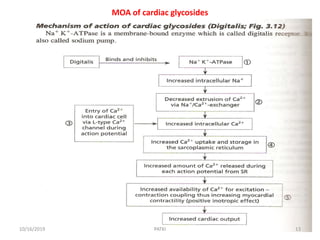
MOA of cardiac glycosides
10/16/2019 13PATKI
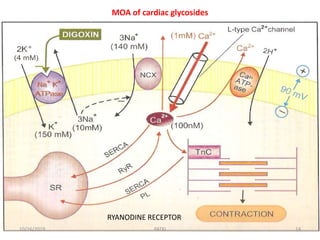
MOA of cardiac glycosides
10/16/2019 14PATKI
RYANODINE RECEPTOR
Pharmacological actions of digitalis
1. Cardiac
2. Extra cardiac
Cardiac actions – (more prominent in failing heart)
Direct action on the heart (by inhibiting Na+ /K+ ATPase) and
Indirect actions on the heart by stimulating Vagus (vagomimetic)
Myocardial contractility → +ve Inotropic effect – “Cardiotonic”
↑ Force of contraction of the myocardium (more prominent in failing
heart)
Digitalized heart contracts more forcibly and completely
This causes complete emptying of the ventricles during systole and ↑ CO
This ↓ pulmonary congestion and systemic venous pressure
Diastolic size of the heart is reduced – size of the muscle fibre length also
reduced
↓ oxygen requirement of myocardium
The digitalized heart, thus, can do more work for the same energy
expenditure10/16/2019 15PATKI
Heart rate – causes bradycardia (more marked in CHF patients)
Reduces HR (-ve chronotropic effect) by direct and indirect action (small dose)
Extravagal – direct depressant action on SA and AV nodes
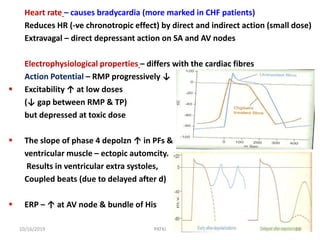
Electrophysiological properties – differs with the cardiac fibres
Action Potential – RMP progressively ↓
 Excitability ↑ at low doses
(↓ gap between RMP & TP)
but depressed at toxic dose
 The slope of phase 4 depolzn ↑ in PFs &
ventricular muscle – ectopic automcity.
Results in ventricular extra systoles,
Coupled beats (due to delayed after d)
 ERP – ↑ at AV node & bundle of His
10/16/2019 16PATKI
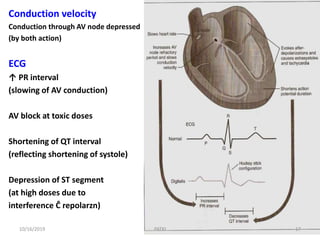
Conduction velocity
Conduction through AV node depressed
(by both action)
ECG
↑ PR interval
(slowing of AV conduction)
AV block at toxic doses
Shortening of QT interval
(reflecting shortening of systole)
Depression of ST segment
(at high doses due to
interference Ĉ repolarzn)
10/16/2019 17PATKI
Blood vessels – digitalis has mild direct vasoconstrictor action – not significant
Extra cardiac actions
Kidney – digitalis causes diuresis in CHF secondary to improvement in circulation
and renal perfusion (no diuresis in patients with edema due to other causes)
CNS- in high doses – CTZ activation – vomiting, central sympathetic stimulation,
confusion, disorientation, blurring of vision
GIT – Anorexia, nausea, vomiting (CTZ stimulation and direct action on the gut)
10/16/2019 18PATKI
Pharmacokinetics
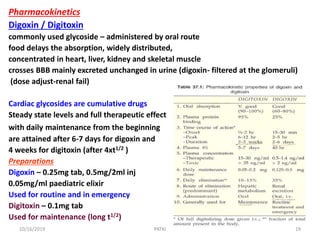
Digoxin / Digitoxin
commonly used glycoside – administered by oral route
food delays the absorption, widely distributed,
concentrated in heart, liver, kidney and skeletal muscle
crosses BBB mainly excreted unchanged in urine (digoxin- filtered at the glomeruli)
(dose adjust-renal fail)
Cardiac glycosides are cumulative drugs
Steady state levels and full therapeutic effect
with daily maintenance from the beginning
are attained after 6-7 days for digoxin and
4 weeks for digitoxin (after 4xt1/2 )
Preparations
Digoxin – 0.25mg tab, 0.5mg/2ml inj
0.05mg/ml paediatric elixir
Used for routine and in emergency
Digitoxin – 0.1mg tab
Used for maintenance (long t1/2)
10/16/2019 19PATKI
Adverse effects
Toxicity of digitalis is high – margin of safety is low
(Therapeutic Index is 1.5 - 3)
Extra cardiac A/E
Anorexia, nausea, vomiting, fatigue, mental confusion, restlessness,
psychosis, visual disturbances, diarrhoea, skin rashes,
gynecomastia(rare)
Cardiac A/E
Bradycardia, partial/complete heart block, coupled beats (bigeminy),
ventricular extrasystoles/tachycardia/fibrillation, atrial extrasystoles,
AF
Factors affecting digitalis toxicity
Age, IV digitalization, hypokalemia, hypercalcaemia,
hypomagnesaemia, Hyper/hypothyroidism, renal failure, myocarditis
(predisposing factors)
10/16/2019 20PATKI
Management of digitalis toxicity
 Potassium supplementation – mild toxicity KCl 5gm daily oral tid
More serious arrhythmias - IV infusion KCl 20m.mol/hr
Stop digoxin and K depleting diuretics
 Supraventricular arrhythmias – treated with oral/IV propranolal
 Ventricular arrhythmias – Lignocaine IV (suppresses excessive
automaticity and doesn't accentuate AV block)
 AV block and bradycardia – Atropine 0.6 – 1.2mg im /cardiac pacing
10/16/2019 21PATKI
Digoxin antibodies (Digibind)
Used in serious digitalis toxicity
It neutralizes circulating digitalis - given IV - rapidly reverses the
toxicity (40mg neutralises 0.6mg of digoxin stored in the body)
But very expensive
10/16/2019 22PATKI
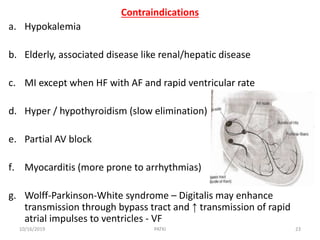
Contraindications
a. Hypokalemia
b. Elderly, associated disease like renal/hepatic disease
c. MI except when HF with AF and rapid ventricular rate
d. Hyper / hypothyroidism (slow elimination)
e. Partial AV block
f. Myocarditis (more prone to arrhythmias)
g. Wolff-Parkinson-White syndrome – Digitalis may enhance
transmission through bypass tract and ↑ transmission of rapid
atrial impulses to ventricles - VF
10/16/2019 23PATKI
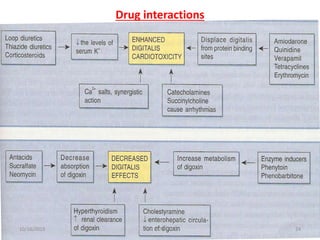
Drug interactions
10/16/2019 24PATKI
Therapeutic Uses
1. Congestive Heart Failure
2. To control ventricular rate in AF/AFl
Low output failure especially when associated with AF.
It is ineffective in high output failure – severe anaemia, thyrotoxicosis
and A-V shunt
Subsides pulmonary congestion – provides relief from dyspnoea
↑ Urinary output- ↓ edematous fluid by ↑ing renal perfusion
Engorged tender liver regresses and engorgement of neck veins
disappear because of diminished systemic venous pressure
Mild to moderate cases – slow digitalization
Digoxin 0.125-0.25mg/day from the beginning (maintenance dose)
Relief of signs and symptoms like ↓HR, bradycardia(HR<60 stop drug)
10/16/2019 25PATKI
Therapeutic Uses
Rapid oral digitalization – Digoxin 0.5mg – 1mg stat, followed by
0.25mg every 6 hrs till response occurs (6-24 hrs) – seldom practised
Emergent IV digitalization – Digoxin 0.25mg followed by 1mg hrly
slow IV injection with close monitoring till response occurs(2-6hrs)
(total dose 0.5mg-1mg) – rarely practised
Digitalis still most effective drug, especially in patients with dilated
heart and low ejection fraction (systolic dysfunction)
Mild to moderate cases can be managed without digitalis – with
diuretics , vasodilators (like ACE inhibitor) and β blockers.
10/16/2019 26PATKI
Therapeutic Uses
Cardiac arrhythmias
Atrial Fibrillation (500 beats/min)
To control ventricular rate – protects the ventricles from the too rapid
atrial impulses by depressing AV conduction
Ventricular rate of 70-80 not achieved – verapamil /β blockers may
be added
Atrial flutter (AFl) (200-300 beats/min) regular and homogenous
AFl is often converted to AF and withdrawal of digoxin at this stage
may restore normal rhythm (since the cause of atrial inhomogeneity
is gone)
PSVT (150 – 200/min and 1:1 AV conduction)
PSVT with HF - ↑ vagal tone and terminates arrhythmia.
Verapamil, adenosine –more effective, act faster and less toxic.
10/16/2019 27PATKI
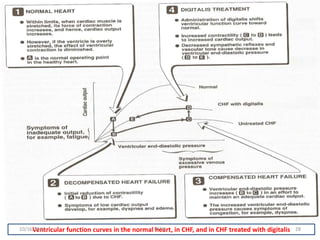
Ventricular function curves in the normal heart, in CHF, and in CHF treated with digitalis10/16/2019 28PATKI
Management of acute LVF with pulmonary edema
Semi-upright posture
Oxygen 6-8litres/min
Furosemide 40-80mg IV– Repeated every 30 min
Morphine IV 2-5mg IV
Aminophylline IV slowly 250-500mg
Sublingual 0.4mg rpt every 15 min if required /IV Nitroglycerine
Digoxin IV 0.5mg – associated with AF/SVT
10/16/2019 29PATKI
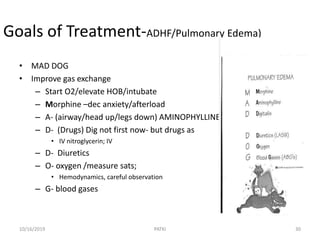
Goals of Treatment-ADHF/Pulmonary Edema)
• MAD DOG
• Improve gas exchange
– Start O2/elevate HOB/intubate
– Morphine –dec anxiety/afterload
– A- (airway/head up/legs down) AMINOPHYLLINE
– D- (Drugs) Dig not first now- but drugs as
• IV nitroglycerin; IV
– D- Diuretics
– O- oxygen /measure sats;
• Hemodynamics, careful observation
– G- blood gases
10/16/2019 30PATKI
Newer agents used in heart failure
Newer agent Mode of action Uses
Dopexamine Agonist at D1, D2 dopamine and β2
adrenergic R
Vasodilator action, ↓after load,
improves renal blood flow
Heart failure
Levosimendan
Pimosendan
PDE inhibitor, sensitizes the troponin
system to calcium - +ve inotropic effect,
vasodilator
IV loading dose 6-24 μg/kg followed by
0.05-0.2 6-24 μg/kg
Acute decompensated
HF
Istaroxime
Inhibits Na+ K+ ATPase, facilitates the
sequestration of Calcium in the SR
HF
Less arrhythmogenic
than Digoxin
Conivapton
Tolvapton
Vasopressin receptor antagonists HF
10/16/2019 31PATKI
TERIMA KASIH
10/16/2019 32PATKI
kegagalan jantung
Your comments-
drpatki@gmail.com