
INSULIN AND DIABETES MELLITUS
 1921Banting and Best
 1923 Nobel Prize (sharing)
 1926 crystalline form obtained by Abel
 1956-69 chemical and molecular structure
was worked out by Sanger and Hodgkin.
04/23/19 PATKI 1
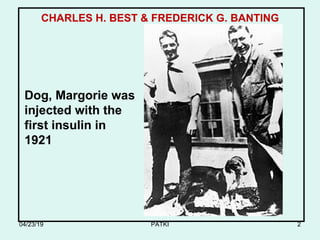
Dog, Margorie was
injected with the
first insulin in
1921
CHARLES H. BEST & FREDERICK G. BANTING
04/23/19 PATKI 2
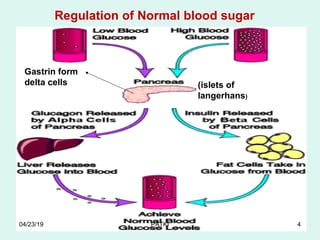
 Alpha cells : Glucagon
 Beta Cells : Insulin
 Delta Cells : Gastrin
 Normal range of Blood glucose: 70 – 120
mg/dl (100 ml)
 Hypoglycemia: < 70 mg/dl
 Diabetes: > 120 mg/dl overnight fasting, 2-
3 hr after meal.
04/23/19 PATKI 3
Regulation of Normal blood sugar
Gastrin form
delta cells (islets of
langerhans)
04/23/19 PATKI 4
04/23/19 PATKI 5
04/23/19 PATKI 6
04/23/19 PATKI 7
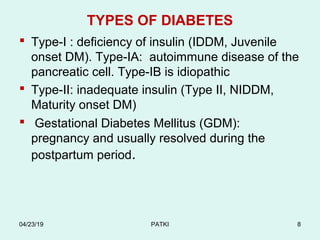
TYPES OF DIABETES
 Type-I : deficiency of insulin (IDDM, Juvenile
onset DM). Type-IA: autoimmune disease of the
pancreatic cell. Type-IB is idiopathic
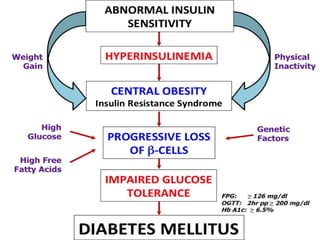
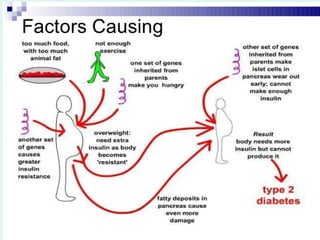
 Type-II: inadequate insulin (Type II, NIDDM,
Maturity onset DM)
 Gestational Diabetes Mellitus (GDM):
pregnancy and usually resolved during the
postpartum period.
04/23/19 PATKI 8
04/23/19 PATKI 9
04/23/19 PATKI 10
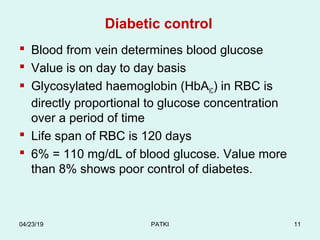
Diabetic control
 Blood from vein determines blood glucose
 Value is on day to day basis
 Glycosylated haemoglobin (HbAIC) in RBC is
directly proportional to glucose concentration
over a period of time
 Life span of RBC is 120 days
 6% = 110 mg/dL of blood glucose. Value more
than 8% shows poor control of diabetes.
04/23/19 PATKI 11
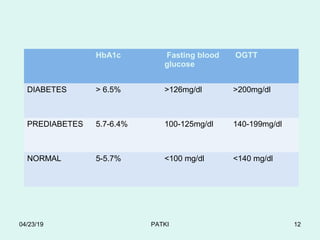
HbA1c Fasting blood
glucose
OGTT
DIABETES > 6.5% >126mg/dl >200mg/dl
PREDIABETES 5.7-6.4% 100-125mg/dl 140-199mg/dl
NORMAL 5-5.7% <100 mg/dl <140 mg/dl
04/23/19 PATKI 12
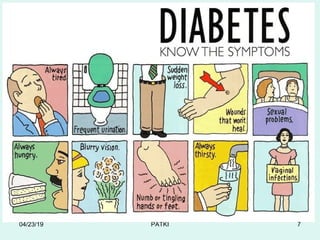
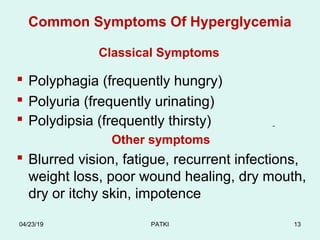
Common Symptoms Of Hyperglycemia
Classical Symptoms
 Polyphagia (frequently hungry)
 Polyuria (frequently urinating)
 Polydipsia (frequently thirsty)
Other symptoms
 Blurred vision, fatigue, recurrent infections,
weight loss, poor wound healing, dry mouth,
dry or itchy skin, impotence
04/23/19 PATKI 13
04/23/19 PATKI 14
04/23/19 PATKI 15
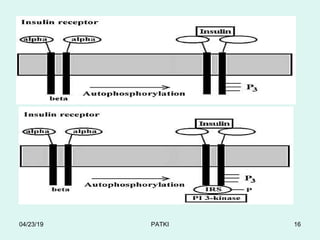
04/23/19 PATKI 16
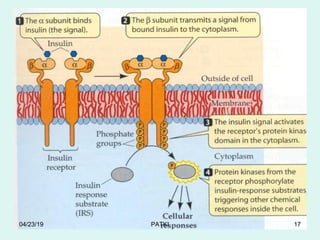
04/23/19 PATKI 17
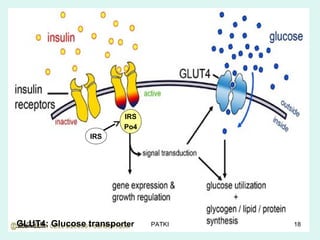
GLUT4: Glucose transporter
IRS
IRS
Po4
04/23/19 PATKI 18
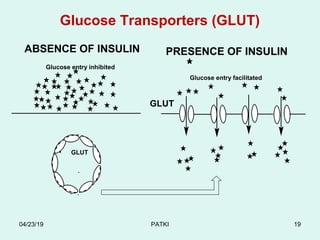
Glucose Transporters (GLUT)
Glucose entry inhibited
Glucose entry facilitated
• GLUT
GLUT
ABSENCE OF INSULIN PRESENCE OF INSULIN
04/23/19 PATKI 19
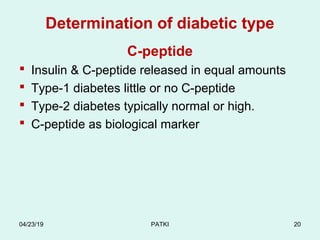
Determination of diabetic type
C-peptide
 Insulin & C-peptide released in equal amounts
 Type-1 diabetes little or no C-peptide
 Type-2 diabetes typically normal or high.
 C-peptide as biological marker
04/23/19 PATKI 20
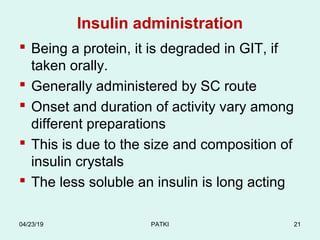
Insulin administration
 Being a protein, it is degraded in GIT, if
taken orally.
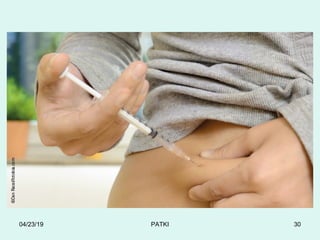
 Generally administered by SC route
 Onset and duration of activity vary among
different preparations
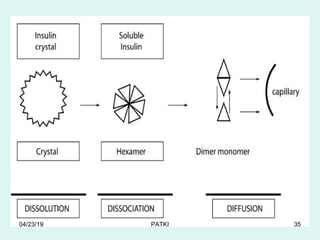
 This is due to the size and composition of
insulin crystals
 The less soluble an insulin is long acting
04/23/19 PATKI 21
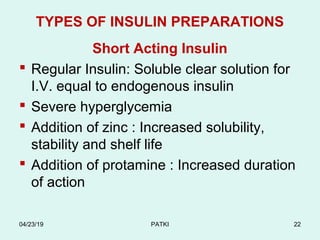
TYPES OF INSULIN PREPARATIONS
Short Acting Insulin
 Regular Insulin: Soluble clear solution for
I.V. equal to endogenous insulin
 Severe hyperglycemia
 Addition of zinc : Increased solubility,
stability and shelf life
 Addition of protamine : Increased duration
of action
04/23/19 PATKI 22
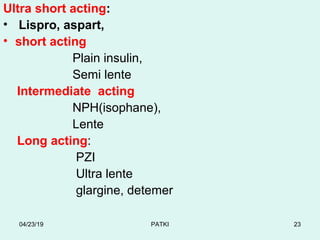
Ultra short acting:
• Lispro, aspart,
• short acting
Plain insulin,
Semi lente
Intermediate acting
NPH(isophane),
Lente
Long acting:
PZI
Ultra lente
glargine, detemer
04/23/19 PATKI 23
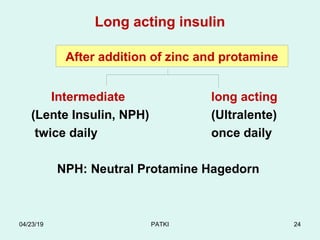
Long acting insulin
Intermediate long acting
(Lente Insulin, NPH) (Ultralente)
twice daily once daily
NPH: Neutral Protamine Hagedorn
After addition of zinc and protamine
04/23/19 PATKI 24
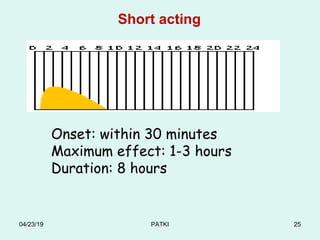
Onset: within 30 minutes
Maximum effect: 1-3 hours
Duration: 8 hours
Short acting
04/23/19 PATKI 25
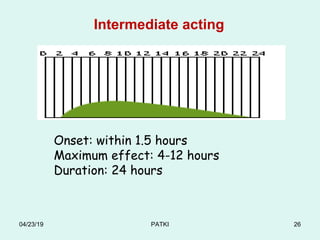
Intermediate acting
Onset: within 1.5 hours
Maximum effect: 4-12 hours
Duration: 24 hours
04/23/19 PATKI 26
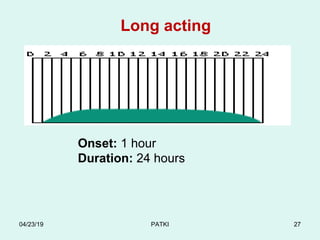
Long acting
Onset: 1 hour
Duration: 24 hours
04/23/19 PATKI 27
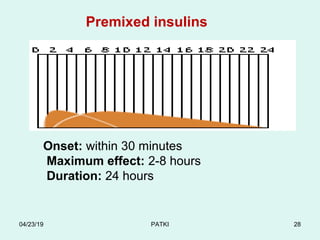
Premixed insulins
Onset: within 30 minutes
Maximum effect: 2-8 hours
Duration: 24 hours
04/23/19 PATKI 28
Reactions to insulin
 Hypoglycemia: Overdose or failure to eat
or extensive exercise. sympathomimetic
signs are warning. Advise the patients to
carry sugar candy.
 Lipodystrophy: Change the place of
injection or Newer insulins
 Allergy: Use purified insulins
04/23/19 PATKI 29
04/23/19 PATKI 30
Newer Insulin
Older insulin: porcine/bovine - contaminants
1. purified by gel filtration
2. After gel filtration further purified by ion
exchange chromatography.
3. Human Insulins: Decombinant DNA
technology (E.coli).
4. Insulin lispro, Insulin aspart, Insulin
Glulisine – short acting
5. Insulin glargine – long acting
04/23/19 PATKI 31
Advantages of newer insulins
Less allergic
More stable
Less insulin resistance
Less lipodystrophy
Blood glucose level easily controlled
04/23/19 PATKI 32
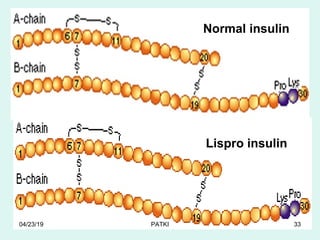
Normal insulin
Lispro insulin
04/23/19 PATKI 33
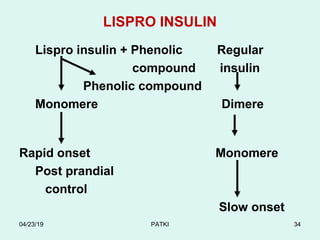
LISPRO INSULIN
Lispro insulin + Phenolic Regular
compound insulin
Phenolic compound
Monomere Dimere
Rapid onset Monomere
Post prandial
control
Slow onset
04/23/19 PATKI 34
04/23/19 PATKI 35
LISPRO INSULIN
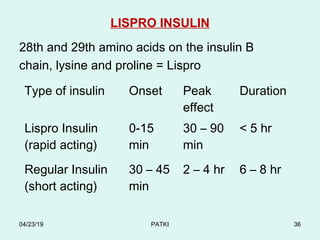
28th and 29th amino acids on the insulin B
chain, lysine and proline = Lispro
Type of insulin Onset Peak
effect
Duration
Lispro Insulin
(rapid acting)
0-15
min
30 – 90
min
< 5 hr
Regular Insulin
(short acting)
30 – 45
min
2 – 4 hr 6 – 8 hr
04/23/19 PATKI 36
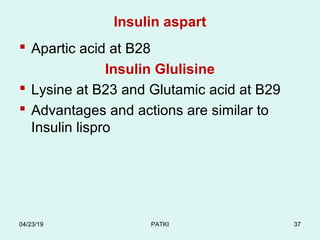
Insulin aspart
 Apartic acid at B28
Insulin Glulisine
 Lysine at B23 and Glutamic acid at B29
 Advantages and actions are similar to
Insulin lispro
04/23/19 PATKI 37
04/23/19 PATKI 38
04/23/19 PATKI 39
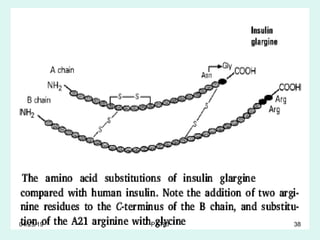
INSULIN GLARGINE
 Onset of action: 1-1½ hours
 Maximum effect: 4-6 hours (peakless)
 Duration of action: 24 Hours (ultra long
acting)
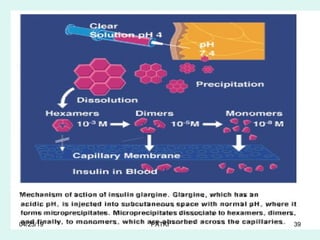
 Don’t mix with other insulin preparations in
the same syringe – it is acidic (pH 4)
 Absorption pattern: independent of
anatomic site of injection
 Less immunogenicity
 6-7 fold greater binding than native insulin04/23/19 PATKI 40
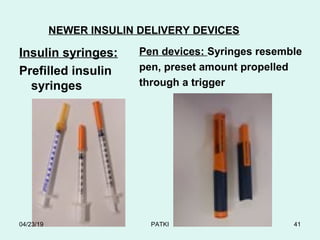
Insulin syringes:
Prefilled insulin
syringes
Pen devices: Syringes resemble
pen, preset amount propelled
through a trigger
NEWER INSULIN DELIVERY DEVICES
04/23/19 PATKI 41
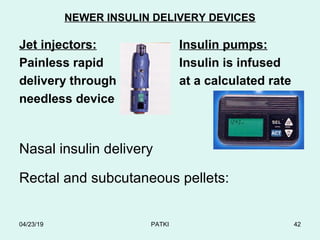
NEWER INSULIN DELIVERY DEVICES
Jet injectors: Insulin pumps:
Painless rapid Insulin is infused
delivery through at a calculated rate
needless device
Nasal insulin delivery
Rectal and subcutaneous pellets:
04/23/19 PATKI 42
DRUG INTERACTIONS
 Beta adrenergic blockers suppress warning
signs
 Thiazides, frusemide, corticosteroids, oral
contraceptives, salbutamol, calcium channel
blockers raise the blood sugar by inhibiting the
insulin secretion.
 Alcohol precipitates hypoglycemia (depleting
breaking the glycogen)
 Salicylates, lithium and theophylline enhance
insulin secretion and peripheral glucose
utilization resulting the hypoglycemia.
04/23/19 PATKI 43
USES OF INSULIN
Infection and ketoacidosis: Short term
use
Long term use is advised in CVS, retinal,
renal, neurological conditions etc.
IDDM: compulsory use
NIDDM: it is advised
a. Failure of oral hypoglycaemic agents.
b. Temporary use in infection, trauma,
surgery, pregnancy.
04/23/19 PATKI 44
INSULIN RESISTANCE
Requirement of insulin: more than 200
U/day
May be due to antibodies production
Resistance should be in the absence of
ketoacidosis, Infection or stress.
Select more purified newer insulin
Oral hypoglycemic agents may be added
04/23/19 PATKI 45
Symptoms of Ketoacidosis
high blood sugar levels
frequent urination (polyuria) and thirst
fatigue and lethargy
nausea
vomiting
abdominal pain
fruity odor to breath
rapid, deep breathing
muscle stiffness or aching
coma
04/23/19 PATKI 46
Treatment of Ketoacidosis
Regular insulin by i.v.
i.v. fluids
KCl
Bicarbonate to correct acidosis
Phosphate (when required)
Antibiotics
04/23/19 PATKI 47
GLUCAGON
 Alpha cells of islets of Langerhans
 Hyperglycemic hormone
 It is inactive orally
 It is used in severe hypoglycemia
where glucose administration is
impossible.
 It is also used as a diagnostic agent.
04/23/19 PATKI 48
THANKS FOR WATCHING
COMMENTS PL
drpatki@gmail.com
04/23/19 PATKI 49

Pp insulin

  • 1.
    INSULIN AND DIABETESMELLITUS  1921Banting and Best  1923 Nobel Prize (sharing)  1926 crystalline form obtained by Abel  1956-69 chemical and molecular structure was worked out by Sanger and Hodgkin. 04/23/19 PATKI 1
  • 2.
    Dog, Margorie was injectedwith the first insulin in 1921 CHARLES H. BEST & FREDERICK G. BANTING 04/23/19 PATKI 2
  • 3.
     Alpha cells: Glucagon  Beta Cells : Insulin  Delta Cells : Gastrin  Normal range of Blood glucose: 70 – 120 mg/dl (100 ml)  Hypoglycemia: < 70 mg/dl  Diabetes: > 120 mg/dl overnight fasting, 2- 3 hr after meal. 04/23/19 PATKI 3
  • 4.
    Regulation of Normalblood sugar Gastrin form delta cells (islets of langerhans) 04/23/19 PATKI 4
  • 5.
  • 6.
  • 7.
  • 8.
    TYPES OF DIABETES Type-I : deficiency of insulin (IDDM, Juvenile onset DM). Type-IA: autoimmune disease of the pancreatic cell. Type-IB is idiopathic  Type-II: inadequate insulin (Type II, NIDDM, Maturity onset DM)  Gestational Diabetes Mellitus (GDM): pregnancy and usually resolved during the postpartum period. 04/23/19 PATKI 8
  • 9.
  • 10.
  • 11.
    Diabetic control  Bloodfrom vein determines blood glucose  Value is on day to day basis  Glycosylated haemoglobin (HbAIC) in RBC is directly proportional to glucose concentration over a period of time  Life span of RBC is 120 days  6% = 110 mg/dL of blood glucose. Value more than 8% shows poor control of diabetes. 04/23/19 PATKI 11
  • 12.
    HbA1c Fasting blood glucose OGTT DIABETES> 6.5% >126mg/dl >200mg/dl PREDIABETES 5.7-6.4% 100-125mg/dl 140-199mg/dl NORMAL 5-5.7% <100 mg/dl <140 mg/dl 04/23/19 PATKI 12
  • 13.
    Common Symptoms OfHyperglycemia Classical Symptoms  Polyphagia (frequently hungry)  Polyuria (frequently urinating)  Polydipsia (frequently thirsty) Other symptoms  Blurred vision, fatigue, recurrent infections, weight loss, poor wound healing, dry mouth, dry or itchy skin, impotence 04/23/19 PATKI 13
  • 14.
  • 15.
  • 16.
  • 17.
  • 18.
  • 19.
    Glucose Transporters (GLUT) Glucoseentry inhibited Glucose entry facilitated • GLUT GLUT ABSENCE OF INSULIN PRESENCE OF INSULIN 04/23/19 PATKI 19
  • 20.
    Determination of diabetictype C-peptide  Insulin & C-peptide released in equal amounts  Type-1 diabetes little or no C-peptide  Type-2 diabetes typically normal or high.  C-peptide as biological marker 04/23/19 PATKI 20
  • 21.
    Insulin administration  Beinga protein, it is degraded in GIT, if taken orally.  Generally administered by SC route  Onset and duration of activity vary among different preparations  This is due to the size and composition of insulin crystals  The less soluble an insulin is long acting 04/23/19 PATKI 21
  • 22.
    TYPES OF INSULINPREPARATIONS Short Acting Insulin  Regular Insulin: Soluble clear solution for I.V. equal to endogenous insulin  Severe hyperglycemia  Addition of zinc : Increased solubility, stability and shelf life  Addition of protamine : Increased duration of action 04/23/19 PATKI 22
  • 23.
    Ultra short acting: •Lispro, aspart, • short acting Plain insulin, Semi lente Intermediate acting NPH(isophane), Lente Long acting: PZI Ultra lente glargine, detemer 04/23/19 PATKI 23
  • 24.
    Long acting insulin Intermediatelong acting (Lente Insulin, NPH) (Ultralente) twice daily once daily NPH: Neutral Protamine Hagedorn After addition of zinc and protamine 04/23/19 PATKI 24
  • 25.
    Onset: within 30minutes Maximum effect: 1-3 hours Duration: 8 hours Short acting 04/23/19 PATKI 25
  • 26.
    Intermediate acting Onset: within1.5 hours Maximum effect: 4-12 hours Duration: 24 hours 04/23/19 PATKI 26
  • 27.
    Long acting Onset: 1hour Duration: 24 hours 04/23/19 PATKI 27
  • 28.
    Premixed insulins Onset: within30 minutes Maximum effect: 2-8 hours Duration: 24 hours 04/23/19 PATKI 28
  • 29.
    Reactions to insulin Hypoglycemia: Overdose or failure to eat or extensive exercise. sympathomimetic signs are warning. Advise the patients to carry sugar candy.  Lipodystrophy: Change the place of injection or Newer insulins  Allergy: Use purified insulins 04/23/19 PATKI 29
  • 30.
  • 31.
    Newer Insulin Older insulin:porcine/bovine - contaminants 1. purified by gel filtration 2. After gel filtration further purified by ion exchange chromatography. 3. Human Insulins: Decombinant DNA technology (E.coli). 4. Insulin lispro, Insulin aspart, Insulin Glulisine – short acting 5. Insulin glargine – long acting 04/23/19 PATKI 31
  • 32.
    Advantages of newerinsulins Less allergic More stable Less insulin resistance Less lipodystrophy Blood glucose level easily controlled 04/23/19 PATKI 32
  • 33.
  • 34.
    LISPRO INSULIN Lispro insulin+ Phenolic Regular compound insulin Phenolic compound Monomere Dimere Rapid onset Monomere Post prandial control Slow onset 04/23/19 PATKI 34
  • 35.
  • 36.
    LISPRO INSULIN 28th and29th amino acids on the insulin B chain, lysine and proline = Lispro Type of insulin Onset Peak effect Duration Lispro Insulin (rapid acting) 0-15 min 30 – 90 min < 5 hr Regular Insulin (short acting) 30 – 45 min 2 – 4 hr 6 – 8 hr 04/23/19 PATKI 36
  • 37.
    Insulin aspart  Aparticacid at B28 Insulin Glulisine  Lysine at B23 and Glutamic acid at B29  Advantages and actions are similar to Insulin lispro 04/23/19 PATKI 37
  • 38.
  • 39.
  • 40.
    INSULIN GLARGINE  Onsetof action: 1-1½ hours  Maximum effect: 4-6 hours (peakless)  Duration of action: 24 Hours (ultra long acting)  Don’t mix with other insulin preparations in the same syringe – it is acidic (pH 4)  Absorption pattern: independent of anatomic site of injection  Less immunogenicity  6-7 fold greater binding than native insulin04/23/19 PATKI 40
  • 41.
    Insulin syringes: Prefilled insulin syringes Pendevices: Syringes resemble pen, preset amount propelled through a trigger NEWER INSULIN DELIVERY DEVICES 04/23/19 PATKI 41
  • 42.
    NEWER INSULIN DELIVERYDEVICES Jet injectors: Insulin pumps: Painless rapid Insulin is infused delivery through at a calculated rate needless device Nasal insulin delivery Rectal and subcutaneous pellets: 04/23/19 PATKI 42
  • 43.
    DRUG INTERACTIONS  Betaadrenergic blockers suppress warning signs  Thiazides, frusemide, corticosteroids, oral contraceptives, salbutamol, calcium channel blockers raise the blood sugar by inhibiting the insulin secretion.  Alcohol precipitates hypoglycemia (depleting breaking the glycogen)  Salicylates, lithium and theophylline enhance insulin secretion and peripheral glucose utilization resulting the hypoglycemia. 04/23/19 PATKI 43
  • 44.
    USES OF INSULIN Infectionand ketoacidosis: Short term use Long term use is advised in CVS, retinal, renal, neurological conditions etc. IDDM: compulsory use NIDDM: it is advised a. Failure of oral hypoglycaemic agents. b. Temporary use in infection, trauma, surgery, pregnancy. 04/23/19 PATKI 44
  • 45.
    INSULIN RESISTANCE Requirement ofinsulin: more than 200 U/day May be due to antibodies production Resistance should be in the absence of ketoacidosis, Infection or stress. Select more purified newer insulin Oral hypoglycemic agents may be added 04/23/19 PATKI 45
  • 46.
    Symptoms of Ketoacidosis highblood sugar levels frequent urination (polyuria) and thirst fatigue and lethargy nausea vomiting abdominal pain fruity odor to breath rapid, deep breathing muscle stiffness or aching coma 04/23/19 PATKI 46
  • 47.
    Treatment of Ketoacidosis Regularinsulin by i.v. i.v. fluids KCl Bicarbonate to correct acidosis Phosphate (when required) Antibiotics 04/23/19 PATKI 47
  • 48.
    GLUCAGON  Alpha cellsof islets of Langerhans  Hyperglycemic hormone  It is inactive orally  It is used in severe hypoglycemia where glucose administration is impossible.  It is also used as a diagnostic agent. 04/23/19 PATKI 48
  • 49.
    THANKS FOR WATCHING COMMENTSPL drpatki@gmail.com 04/23/19 PATKI 49