
DRUGS
FOR
IRON DEFICIENCY ANEMIA
PATKI
11/21/2019 PATKI 1
11/21/2019 PATKI 2
ANAEMIA
• Decrease in oxygen carrying capacity of blood is called
anaemia.
• Oxygen carrying capacity of blood is determined by
hemoglobin content of cells.
• Reduction in blood hemoglobin levels &
no of circulating erythrocytes are characteristic
features of anaemia.
11/21/2019 PATKI 3
 The haematopoietic machinery – present in the bone
marrow.
 It is primarily involved in the formation of cellular
components of the blood – erythrocytes, leucocytes &
thrombocytes.
 For proper functioning – needs
 Exogenous nutrients – Iron, vitB12 & folic acid called
haematinics.
 Endogenously derived growth factors – (G-CSF), (GM-
CSF), Erythropoietin, thrombopoietins, IL-1,3,5,6,7,11
etc.
 Reduction in the supplies of any of these nutrients –
results in deficiency of normal blood cells.
11/21/2019 PATKI 4
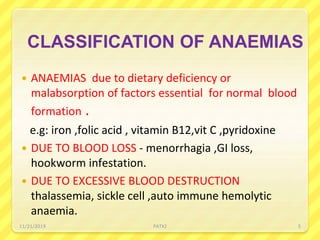
CLASSIFICATION OF ANAEMIAS
 ANAEMIAS due to dietary deficiency or
malabsorption of factors essential for normal blood
formation .
e.g: iron ,folic acid , vitamin B12,vit C ,pyridoxine
 DUE TO BLOOD LOSS - menorrhagia ,GI loss,
hookworm infestation.
 DUE TO EXCESSIVE BLOOD DESTRUCTION
thalassemia, sickle cell ,auto immune hemolytic
anaemia.
11/21/2019 PATKI 5
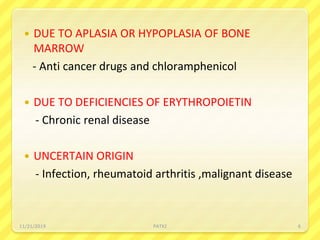
 DUE TO APLASIA OR HYPOPLASIA OF BONE
MARROW
- Anti cancer drugs and chloramphenicol
 DUE TO DEFICIENCIES OF ERYTHROPOIETIN
- Chronic renal disease
 UNCERTAIN ORIGIN
- Infection, rheumatoid arthritis ,malignant disease
11/21/2019 PATKI 6
HAEMATINICS
 These are the substances required in the
formation of blood, and are used for the
treatment of anemias.
- Iron, vitB12 & folic acid
11/21/2019 PATKI 7
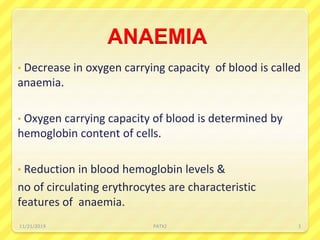
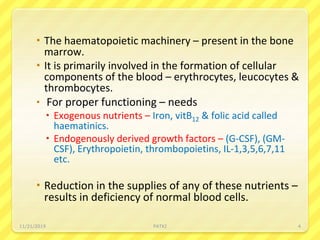
 Most common disorder in clinical practice.
 Charectarized by a decrease in the O2 carrying
capacity of the blood due to reduced
concentration of Hb or RBCS
Iron deficiency anemia
11/21/2019 PATKI 8
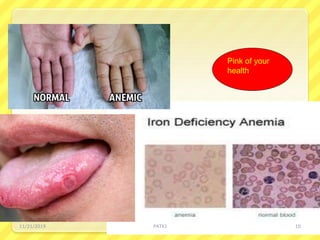
 IRON DEF ANAEMIA CHARACTERISED BY-
 MICROCYTOSIS (presence of small erythrocytes).
 HYPO CHROMIA ( poorly filled with haemoglobin).
 POIKILOCYTOSIS (bizzare shaped cells).
 ANISOCYTIOSIS (different shapes).
 Iron def has adverse effects on brain function,
mental performance & ,behavioral abnormalities.
11/21/2019 PATKI 9
Pink of your
health
11/21/2019 PATKI 10
DISTRIBUTION OF IRON IN THE BODY
 Iron(Fe) is the essential body constituent .
 Total body iron in an adult –
2.5 – 5 g (average 3.5g).
 It is more in men - (50mg/kg)
Than in women (38mg/kg)
 It is distributed as follows :
 Hemoglobin (Hb) – 66%
 Iron stores ferritin and Haemosiderin – 25%
 Myoglobin ( in muscles) – 3%
 Parenchymal iron (in enzymes etc) – 6%
11/21/2019 PATKI 11
Loss of 100ml of blood (containing 15g Hb) means loss of
50mg elemental iron.
To raise Hb level of blood by 1g/dl about 200mg of iron is
needed.
Daily requirement of iron
 Adult male – 0.5 – 1 mg (13mg/kg)
 Adult female – 1 – 2 mg (21mg/kg)
(Menstruating)
 Infants – 60mg/kg
 Children – 25 mg/kg
 Pregnancy – 3.5 mg (80mg/kg)
(Last 2 trimesters)
11/21/2019 PATKI 12
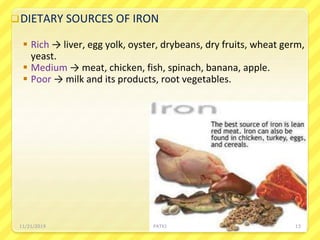
DIETARY SOURCES OF IRON
 Rich → liver, egg yolk, oyster, drybeans, dry fruits, wheat germ,
yeast.
 Medium → meat, chicken, fish, spinach, banana, apple.
 Poor → milk and its products, root vegetables.
11/21/2019 PATKI 13
Iron absorption
 Average daily diet contains- 10-20mg of iron.
 Absorption occurs all over the intestine, but more in the
upper part.
 There are two major forms of dietary iron.
 Heme iron, found primarily in red meats, is the most easily
absorbed form.
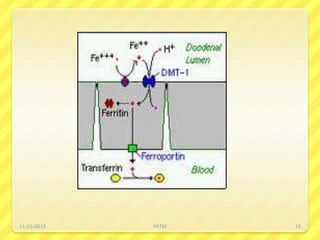
 Majority of dietary iron is in ferric form.
 It is reduced to ferrous form before absorption.
 Absorption occurs through 2 separate iron transporters in
the intestinal mucosal cells.
 Divalent metal transporter – 1 (DMT 1)
 Ferroportin
11/21/2019 PATKI 14
11/21/2019 PATKI 15
 FACTORS FACILITATING FE ABSORPTION
 Acid: By favouring dissolution and reduction of ferric form.
 Reducing substances – Ascorbic acid.
 Meat – By increasing Hcl secretionand providing heme iron.
FACTORS IMPEDING FE ABS
 Alkalies – (Antacids) Renders iron insoluble, oppose its
reduction.
 Phosphates (rich in egg yolk)
 Phytates (maize, wheat) by complexing iron
 Tetracyclines
 Prescence of other foods in stomach.
11/21/2019 PATKI 16
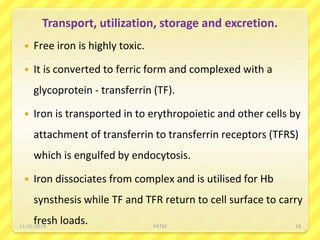
MUCOSAL BLOCK
 It is a mechanism to prevent entry of excess iron in the body
 Iron reaching inside mucosal cell is eigther transported to
plasma or oxidised to ferric form and complexed with
apoferritin to form ferritin.
 The ferritin stored on the mucosal cells is lost when they are
shed (life span 2-4 days).
 This is called ferritin curtain.
 Thus the amount of iron entering into the body is governed
by the iron status of the body and the erythropoietic activity.11/21/2019 PATKI 17
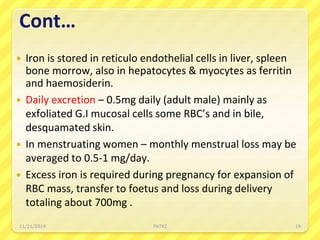
Transport, utilization, storage and excretion.
 Free iron is highly toxic.
 It is converted to ferric form and complexed with a
glycoprotein - transferrin (TF).
 Iron is transported in to erythropoietic and other cells by
attachment of transferrin to transferrin receptors (TFRS)
which is engulfed by endocytosis.
 Iron dissociates from complex and is utilised for Hb
synsthesis while TF and TFR return to cell surface to carry
fresh loads.11/21/2019 PATKI 18
Cont…
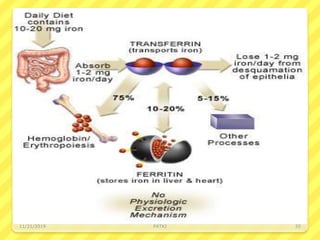
 Iron is stored in reticulo endothelial cells in liver, spleen
bone morrow, also in hepatocytes & myocytes as ferritin
and haemosiderin.
 Daily excretion – 0.5mg daily (adult male) mainly as
exfoliated G.I mucosal cells some RBC’s and in bile,
desquamated skin.
 In menstruating women – monthly menstrual loss may be
averaged to 0.5-1 mg/day.
 Excess iron is required during pregnancy for expansion of
RBC mass, transfer to foetus and loss during delivery
totaling about 700mg .
11/21/2019 PATKI 19
11/21/2019 PATKI 20
PREPARATIONS AND DOSAGE
Oral iron
This is the preferred route of iron administration.
 Because
 Dissociable Ferrous salts are inexpensive.
 Have high iron content
 Better absorbed than ferric salts.
Some oral iron preparations
 Ferrous sulphate – cheapest LIVOGEN
 Ferrous citrate-commonly used.
 Ferrous gluconate
 Ferrous fumarate.
 Colloidal ferric hydroxide
 Ferric hydroxy poly maltose11/21/2019 PATKI 21
 Sustained release preperations – not rational.
 Most of iron absorbed in upper intestine – but these
preperations release iron lower down.
 Liquid formulations – may stain teeth.
 Hence should be put back on tongue.
DOSE
 A total of 200mg of elemental iron given daily in 3
divided doses – produce maximal haematopoietic
response.
 Absorption of iron is much better when it is taken on
empty stomach – side effects are also more on empty
stomach.
 Prophylactic dose – 30 mg iron daily.
11/21/2019 PATKI 22
INDICATIONS OF IRON
THERAPY
PROPHYLATIC
pregnancy ,menstruation ,blood donors .
 THERAPEUTIC
- to treat existing iron deficiency.
 Nutritional deficiency.
 Anaemia of infancy and pregnancy.
 Anaemia due to acute or chronic blood loss.
menorrhagia ,peptic ulcer, hookworm infestation.
11/21/2019 PATKI 23
ADVERSE EFFECTS OF ORAL IRON
 Adverse effects are related to elemental iron
content.
1. Epigastric pain
2. Heart burn
3. Nausea & vomiting
4. Staining of teeth
5. Metallic taste
6. Bloating, colic
7. Constipation
11/21/2019 PATKI 24
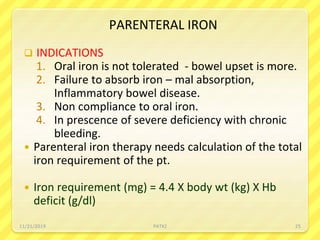
PARENTERAL IRON
 INDICATIONS
1. Oral iron is not tolerated - bowel upset is more.
2. Failure to absorb iron – mal absorption,
Inflammatory bowel disease.
3. Non compliance to oral iron.
4. In prescence of severe deficiency with chronic
bleeding.
 Parenteral iron therapy needs calculation of the total
iron requirement of the pt.
 Iron requirement (mg) = 4.4 X body wt (kg) X Hb
deficit (g/dl)
11/21/2019 PATKI 25
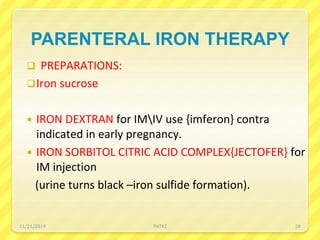
PARENTERAL IRON THERAPY
 PREPARATIONS:
Iron sucrose
 IRON DEXTRAN for IMIV use {imferon} contra
indicated in early pregnancy.
 IRON SORBITOL CITRIC ACID COMPLEX{JECTOFER} for
IM injection
(urine turns black –iron sulfide formation).
11/21/2019 PATKI 26
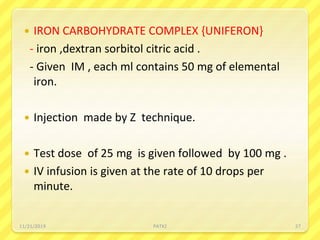
 IRON CARBOHYDRATE COMPLEX {UNIFERON}
- iron ,dextran sorbitol citric acid .
- Given IM , each ml contains 50 mg of elemental
iron.
 Injection made by Z technique.
 Test dose of 25 mg is given followed by 100 mg .
 IV infusion is given at the rate of 10 drops per
minute.
11/21/2019 PATKI 27
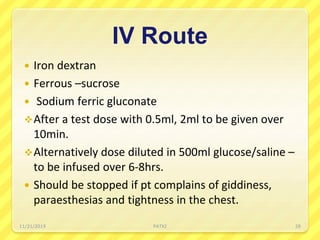
IV Route
 Iron dextran
 Ferrous –sucrose
 Sodium ferric gluconate
After a test dose with 0.5ml, 2ml to be given over
10min.
Alternatively dose diluted in 500ml glucose/saline –
to be infused over 6-8hrs.
 Should be stopped if pt complains of giddiness,
paraesthesias and tightness in the chest.
11/21/2019 PATKI 28
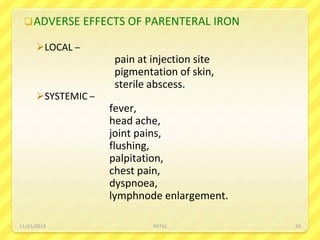
ADVERSE EFFECTS OF PARENTERAL IRON
LOCAL –
pain at injection site
pigmentation of skin,
sterile abscess.
SYSTEMIC –
fever,
head ache,
joint pains,
flushing,
palpitation,
chest pain,
dyspnoea,
lymphnode enlargement.
11/21/2019 PATKI 29
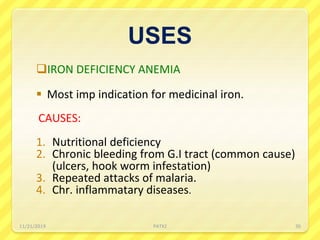
USES
IRON DEFICIENCY ANEMIA
 Most imp indication for medicinal iron.
CAUSES:
1. Nutritional deficiency
2. Chronic bleeding from G.I tract (common cause)
(ulcers, hook worm infestation)
3. Repeated attacks of malaria.
4. Chr. inflammatary diseases.
11/21/2019 PATKI 30
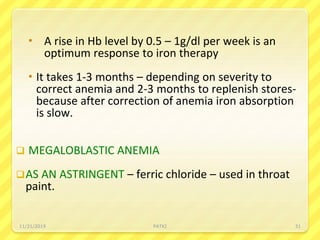
 A rise in Hb level by 0.5 – 1g/dl per week is an
optimum response to iron therapy
 It takes 1-3 months – depending on severity to
correct anemia and 2-3 months to replenish stores-
because after correction of anemia iron absorption
is slow.
 MEGALOBLASTIC ANEMIA
AS AN ASTRINGENT – ferric chloride – used in throat
paint.
11/21/2019 PATKI 31
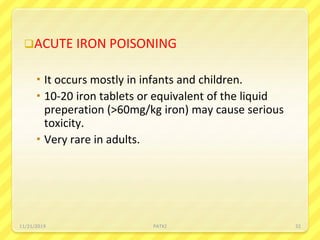
ACUTE IRON POISONING
 It occurs mostly in infants and children.
 10-20 iron tablets or equivalent of the liquid
preperation (>60mg/kg iron) may cause serious
toxicity.
 Very rare in adults.
11/21/2019 PATKI 32
 Manifestations
 Vomiting
 Abdominal pain
 Haemetemesis
 Diarrhoea
 Cyanosis
 Lethargy
 Dehydration
 Acidosis
 Convulsions & finally shock
 Cardio vascular collapse.
11/21/2019 PATKI 33
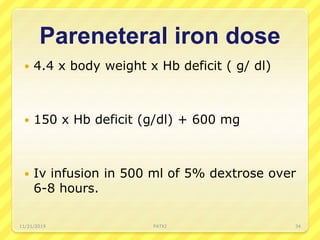
Pareneteral iron dose
 4.4 x body weight x Hb deficit ( g/ dl)
 150 x Hb deficit (g/dl) + 600 mg
 Iv infusion in 500 ml of 5% dextrose over
6-8 hours.
11/21/2019 PATKI 34
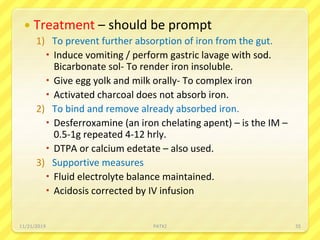
 Treatment – should be prompt
1) To prevent further absorption of iron from the gut.
 Induce vomiting / perform gastric lavage with sod.
Bicarbonate sol- To render iron insoluble.
 Give egg yolk and milk orally- To complex iron
 Activated charcoal does not absorb iron.
2) To bind and remove already absorbed iron.
 Desferroxamine (an iron chelating apent) – is the IM –
0.5-1g repeated 4-12 hrly.
 DTPA or calcium edetate – also used.
3) Supportive measures
 Fluid electrolyte balance maintained.
 Acidosis corrected by IV infusion
11/21/2019 PATKI 35
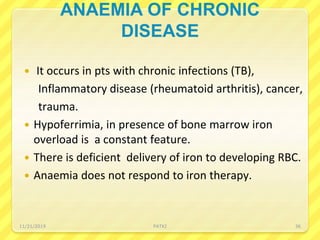
ANAEMIA OF CHRONIC
DISEASE
 It occurs in pts with chronic infections (TB),
Inflammatory disease (rheumatoid arthritis), cancer,
trauma.
 Hypoferrimia, in presence of bone marrow iron
overload is a constant feature.
 There is deficient delivery of iron to developing RBC.
 Anaemia does not respond to iron therapy.
11/21/2019 PATKI 36
ERYTHROPOIETIN
 Epoetin a&b has molecular weight 36,000.
 It is synthesized by kidney in response to hypoxemia.
 Given by IV route.
 Plasma half life is - 6-8 HRS.
 Adverse Effects:
- Hypertension, rise in hematocrit values..
11/21/2019 PATKI 37
Therapeutic uses
 Anaemia of end stage renal failure.
 To permit autologous blood transfusion.
 Anemia due to anticancer drugs and HIV infection.
11/21/2019 PATKI 38
THANK YOUdrpatki@gmail.com
11/21/2019 PATKI 39

Anemia

  • 1.
  • 2.
  • 3.
    ANAEMIA • Decrease inoxygen carrying capacity of blood is called anaemia. • Oxygen carrying capacity of blood is determined by hemoglobin content of cells. • Reduction in blood hemoglobin levels & no of circulating erythrocytes are characteristic features of anaemia. 11/21/2019 PATKI 3
  • 4.
     The haematopoieticmachinery – present in the bone marrow.  It is primarily involved in the formation of cellular components of the blood – erythrocytes, leucocytes & thrombocytes.  For proper functioning – needs  Exogenous nutrients – Iron, vitB12 & folic acid called haematinics.  Endogenously derived growth factors – (G-CSF), (GM- CSF), Erythropoietin, thrombopoietins, IL-1,3,5,6,7,11 etc.  Reduction in the supplies of any of these nutrients – results in deficiency of normal blood cells. 11/21/2019 PATKI 4
  • 5.
    CLASSIFICATION OF ANAEMIAS ANAEMIAS due to dietary deficiency or malabsorption of factors essential for normal blood formation . e.g: iron ,folic acid , vitamin B12,vit C ,pyridoxine  DUE TO BLOOD LOSS - menorrhagia ,GI loss, hookworm infestation.  DUE TO EXCESSIVE BLOOD DESTRUCTION thalassemia, sickle cell ,auto immune hemolytic anaemia. 11/21/2019 PATKI 5
  • 6.
     DUE TOAPLASIA OR HYPOPLASIA OF BONE MARROW - Anti cancer drugs and chloramphenicol  DUE TO DEFICIENCIES OF ERYTHROPOIETIN - Chronic renal disease  UNCERTAIN ORIGIN - Infection, rheumatoid arthritis ,malignant disease 11/21/2019 PATKI 6
  • 7.
    HAEMATINICS  These arethe substances required in the formation of blood, and are used for the treatment of anemias. - Iron, vitB12 & folic acid 11/21/2019 PATKI 7
  • 8.
     Most commondisorder in clinical practice.  Charectarized by a decrease in the O2 carrying capacity of the blood due to reduced concentration of Hb or RBCS Iron deficiency anemia 11/21/2019 PATKI 8
  • 9.
     IRON DEFANAEMIA CHARACTERISED BY-  MICROCYTOSIS (presence of small erythrocytes).  HYPO CHROMIA ( poorly filled with haemoglobin).  POIKILOCYTOSIS (bizzare shaped cells).  ANISOCYTIOSIS (different shapes).  Iron def has adverse effects on brain function, mental performance & ,behavioral abnormalities. 11/21/2019 PATKI 9
  • 10.
  • 11.
    DISTRIBUTION OF IRONIN THE BODY  Iron(Fe) is the essential body constituent .  Total body iron in an adult – 2.5 – 5 g (average 3.5g).  It is more in men - (50mg/kg) Than in women (38mg/kg)  It is distributed as follows :  Hemoglobin (Hb) – 66%  Iron stores ferritin and Haemosiderin – 25%  Myoglobin ( in muscles) – 3%  Parenchymal iron (in enzymes etc) – 6% 11/21/2019 PATKI 11
  • 12.
    Loss of 100mlof blood (containing 15g Hb) means loss of 50mg elemental iron. To raise Hb level of blood by 1g/dl about 200mg of iron is needed. Daily requirement of iron  Adult male – 0.5 – 1 mg (13mg/kg)  Adult female – 1 – 2 mg (21mg/kg) (Menstruating)  Infants – 60mg/kg  Children – 25 mg/kg  Pregnancy – 3.5 mg (80mg/kg) (Last 2 trimesters) 11/21/2019 PATKI 12
  • 13.
    DIETARY SOURCES OFIRON  Rich → liver, egg yolk, oyster, drybeans, dry fruits, wheat germ, yeast.  Medium → meat, chicken, fish, spinach, banana, apple.  Poor → milk and its products, root vegetables. 11/21/2019 PATKI 13
  • 14.
    Iron absorption  Averagedaily diet contains- 10-20mg of iron.  Absorption occurs all over the intestine, but more in the upper part.  There are two major forms of dietary iron.  Heme iron, found primarily in red meats, is the most easily absorbed form.  Majority of dietary iron is in ferric form.  It is reduced to ferrous form before absorption.  Absorption occurs through 2 separate iron transporters in the intestinal mucosal cells.  Divalent metal transporter – 1 (DMT 1)  Ferroportin 11/21/2019 PATKI 14
  • 15.
  • 16.
     FACTORS FACILITATINGFE ABSORPTION  Acid: By favouring dissolution and reduction of ferric form.  Reducing substances – Ascorbic acid.  Meat – By increasing Hcl secretionand providing heme iron. FACTORS IMPEDING FE ABS  Alkalies – (Antacids) Renders iron insoluble, oppose its reduction.  Phosphates (rich in egg yolk)  Phytates (maize, wheat) by complexing iron  Tetracyclines  Prescence of other foods in stomach. 11/21/2019 PATKI 16
  • 17.
    MUCOSAL BLOCK  Itis a mechanism to prevent entry of excess iron in the body  Iron reaching inside mucosal cell is eigther transported to plasma or oxidised to ferric form and complexed with apoferritin to form ferritin.  The ferritin stored on the mucosal cells is lost when they are shed (life span 2-4 days).  This is called ferritin curtain.  Thus the amount of iron entering into the body is governed by the iron status of the body and the erythropoietic activity.11/21/2019 PATKI 17
  • 18.
    Transport, utilization, storageand excretion.  Free iron is highly toxic.  It is converted to ferric form and complexed with a glycoprotein - transferrin (TF).  Iron is transported in to erythropoietic and other cells by attachment of transferrin to transferrin receptors (TFRS) which is engulfed by endocytosis.  Iron dissociates from complex and is utilised for Hb synsthesis while TF and TFR return to cell surface to carry fresh loads.11/21/2019 PATKI 18
  • 19.
    Cont…  Iron isstored in reticulo endothelial cells in liver, spleen bone morrow, also in hepatocytes & myocytes as ferritin and haemosiderin.  Daily excretion – 0.5mg daily (adult male) mainly as exfoliated G.I mucosal cells some RBC’s and in bile, desquamated skin.  In menstruating women – monthly menstrual loss may be averaged to 0.5-1 mg/day.  Excess iron is required during pregnancy for expansion of RBC mass, transfer to foetus and loss during delivery totaling about 700mg . 11/21/2019 PATKI 19
  • 20.
  • 21.
    PREPARATIONS AND DOSAGE Oraliron This is the preferred route of iron administration.  Because  Dissociable Ferrous salts are inexpensive.  Have high iron content  Better absorbed than ferric salts. Some oral iron preparations  Ferrous sulphate – cheapest LIVOGEN  Ferrous citrate-commonly used.  Ferrous gluconate  Ferrous fumarate.  Colloidal ferric hydroxide  Ferric hydroxy poly maltose11/21/2019 PATKI 21
  • 22.
     Sustained releasepreperations – not rational.  Most of iron absorbed in upper intestine – but these preperations release iron lower down.  Liquid formulations – may stain teeth.  Hence should be put back on tongue. DOSE  A total of 200mg of elemental iron given daily in 3 divided doses – produce maximal haematopoietic response.  Absorption of iron is much better when it is taken on empty stomach – side effects are also more on empty stomach.  Prophylactic dose – 30 mg iron daily. 11/21/2019 PATKI 22
  • 23.
    INDICATIONS OF IRON THERAPY PROPHYLATIC pregnancy,menstruation ,blood donors .  THERAPEUTIC - to treat existing iron deficiency.  Nutritional deficiency.  Anaemia of infancy and pregnancy.  Anaemia due to acute or chronic blood loss. menorrhagia ,peptic ulcer, hookworm infestation. 11/21/2019 PATKI 23
  • 24.
    ADVERSE EFFECTS OFORAL IRON  Adverse effects are related to elemental iron content. 1. Epigastric pain 2. Heart burn 3. Nausea & vomiting 4. Staining of teeth 5. Metallic taste 6. Bloating, colic 7. Constipation 11/21/2019 PATKI 24
  • 25.
    PARENTERAL IRON  INDICATIONS 1.Oral iron is not tolerated - bowel upset is more. 2. Failure to absorb iron – mal absorption, Inflammatory bowel disease. 3. Non compliance to oral iron. 4. In prescence of severe deficiency with chronic bleeding.  Parenteral iron therapy needs calculation of the total iron requirement of the pt.  Iron requirement (mg) = 4.4 X body wt (kg) X Hb deficit (g/dl) 11/21/2019 PATKI 25
  • 26.
    PARENTERAL IRON THERAPY PREPARATIONS: Iron sucrose  IRON DEXTRAN for IMIV use {imferon} contra indicated in early pregnancy.  IRON SORBITOL CITRIC ACID COMPLEX{JECTOFER} for IM injection (urine turns black –iron sulfide formation). 11/21/2019 PATKI 26
  • 27.
     IRON CARBOHYDRATECOMPLEX {UNIFERON} - iron ,dextran sorbitol citric acid . - Given IM , each ml contains 50 mg of elemental iron.  Injection made by Z technique.  Test dose of 25 mg is given followed by 100 mg .  IV infusion is given at the rate of 10 drops per minute. 11/21/2019 PATKI 27
  • 28.
    IV Route  Irondextran  Ferrous –sucrose  Sodium ferric gluconate After a test dose with 0.5ml, 2ml to be given over 10min. Alternatively dose diluted in 500ml glucose/saline – to be infused over 6-8hrs.  Should be stopped if pt complains of giddiness, paraesthesias and tightness in the chest. 11/21/2019 PATKI 28
  • 29.
    ADVERSE EFFECTS OFPARENTERAL IRON LOCAL – pain at injection site pigmentation of skin, sterile abscess. SYSTEMIC – fever, head ache, joint pains, flushing, palpitation, chest pain, dyspnoea, lymphnode enlargement. 11/21/2019 PATKI 29
  • 30.
    USES IRON DEFICIENCY ANEMIA Most imp indication for medicinal iron. CAUSES: 1. Nutritional deficiency 2. Chronic bleeding from G.I tract (common cause) (ulcers, hook worm infestation) 3. Repeated attacks of malaria. 4. Chr. inflammatary diseases. 11/21/2019 PATKI 30
  • 31.
     A risein Hb level by 0.5 – 1g/dl per week is an optimum response to iron therapy  It takes 1-3 months – depending on severity to correct anemia and 2-3 months to replenish stores- because after correction of anemia iron absorption is slow.  MEGALOBLASTIC ANEMIA AS AN ASTRINGENT – ferric chloride – used in throat paint. 11/21/2019 PATKI 31
  • 32.
    ACUTE IRON POISONING It occurs mostly in infants and children.  10-20 iron tablets or equivalent of the liquid preperation (>60mg/kg iron) may cause serious toxicity.  Very rare in adults. 11/21/2019 PATKI 32
  • 33.
     Manifestations  Vomiting Abdominal pain  Haemetemesis  Diarrhoea  Cyanosis  Lethargy  Dehydration  Acidosis  Convulsions & finally shock  Cardio vascular collapse. 11/21/2019 PATKI 33
  • 34.
    Pareneteral iron dose 4.4 x body weight x Hb deficit ( g/ dl)  150 x Hb deficit (g/dl) + 600 mg  Iv infusion in 500 ml of 5% dextrose over 6-8 hours. 11/21/2019 PATKI 34
  • 35.
     Treatment –should be prompt 1) To prevent further absorption of iron from the gut.  Induce vomiting / perform gastric lavage with sod. Bicarbonate sol- To render iron insoluble.  Give egg yolk and milk orally- To complex iron  Activated charcoal does not absorb iron. 2) To bind and remove already absorbed iron.  Desferroxamine (an iron chelating apent) – is the IM – 0.5-1g repeated 4-12 hrly.  DTPA or calcium edetate – also used. 3) Supportive measures  Fluid electrolyte balance maintained.  Acidosis corrected by IV infusion 11/21/2019 PATKI 35
  • 36.
    ANAEMIA OF CHRONIC DISEASE It occurs in pts with chronic infections (TB), Inflammatory disease (rheumatoid arthritis), cancer, trauma.  Hypoferrimia, in presence of bone marrow iron overload is a constant feature.  There is deficient delivery of iron to developing RBC.  Anaemia does not respond to iron therapy. 11/21/2019 PATKI 36
  • 37.
    ERYTHROPOIETIN  Epoetin a&bhas molecular weight 36,000.  It is synthesized by kidney in response to hypoxemia.  Given by IV route.  Plasma half life is - 6-8 HRS.  Adverse Effects: - Hypertension, rise in hematocrit values.. 11/21/2019 PATKI 37
  • 38.
    Therapeutic uses  Anaemiaof end stage renal failure.  To permit autologous blood transfusion.  Anemia due to anticancer drugs and HIV infection. 11/21/2019 PATKI 38
  • 39.