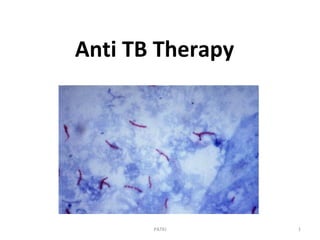
Anti TB Therapy
1PATKI
At the end of the session, students
will be able to
• Enumerate primary and second line anti tubercular
drugs.
• Describe phases of treatment of tuberculosis.
• Describe mechanism of action, and adverse effects of
Primary and secondary Anti Tb drugs.
• Define MDR tuberculosis and measures to prevent
it.
• Describe the roll of Vaccines and drugs to
prevent tuberculosis.
PATKI 2
3
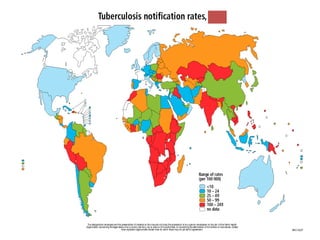
Tuberculosis : A Global Emergency
• One third of the world’s population is infected
• TB kills 5,000 people a day – 2 to 3 million/yr
• More than 100,000 children will die this year
• Hundreds of thousands of children will become
TB orphans this year
• HIV and TB co-infection are producing explosive
epidemics
• MDR is seriously threatening global TB control
4
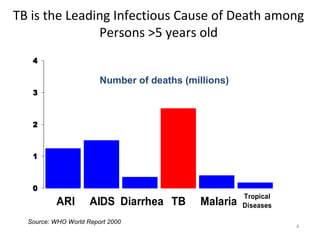
TB is the Leading Infectious Cause of Death among
Persons >5 years old
0
1
2
3
4
TBARI DiarrheaAIDS Malaria
Tropical
Diseases
Number of deaths (millions)
Source: WHO World Report 2000
5
Tuberculosis the Disease
• Normal progression of disease
– 50% die, 25% spontaneous cure, and 25%
chronic excretors
• Treatment requires multiple drugs for
prolonged periods. Good results possible
• Treatment interruptions or monotherapy
lead to drug resistance
• Drug resistance can be transmitted
(primary) or developed (secondary)
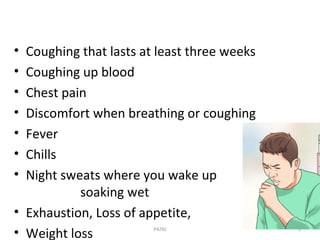
• Coughing that lasts at least three weeks
• Coughing up blood
• Chest pain
• Discomfort when breathing or coughing
• Fever
• Chills
• Night sweats where you wake up
soaking wet
• Exhaustion, Loss of appetite,
• Weight loss PATKI 6
7
Treatment of TB
• TB is treated with multiple drugs to avoid drug
resistance and treatment failures
• Intensive phase = 4 drugs: Rifampicin,
Isoniazid, Pyrazinamide, and Ethambutol or
Streptomycin
• Continution phase = 2 drugs: INH & Rif or Eth
• If drugs are counterfeit or substandard, may
cause treatment failures and lead to the
development of Multidrug-Resistant TB
(MDRTB)
8
M. tuberculosis: peculiar featuresM. tuberculosis: peculiar features
• Rapid growers: In the wall of cavitary lesion,
extracellular.
• Slow growers: intracellular, within the macrophages
at inflamed sites.
• Spurters: intermittent growth spurts.
• Dormant: Do not grow for long time, become active
at times of low host resistance.
• ATYPICAL- AVIUM, KANSASII
• Lipoarabinomannan- helps survival in macrophages
Bacilli continuously shift from one to other subpopulation.Bacilli continuously shift from one to other subpopulation.
Mycobacterial cell wallMycobacterial cell wall
Baron S (ed.) Medical Microbiology. 4th edition. Chapter 33
PATKI 11
Diagnosis of TB
• Clinical features are not confirmatory.
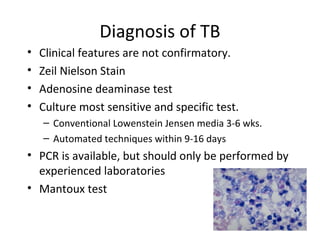
• Zeil Nielson Stain
• Adenosine deaminase test
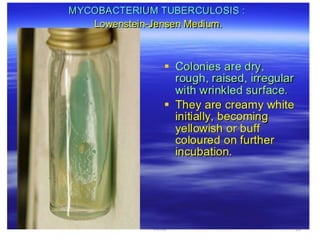
• Culture most sensitive and specific test.
– Conventional Lowenstein Jensen media 3-6 wks.
– Automated techniques within 9-16 days
• PCR is available, but should only be performed by
experienced laboratories
• Mantoux test
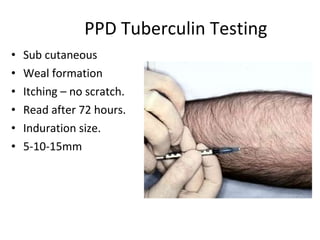
PPD Tuberculin Testing
• Sub cutaneous
• Weal formation
• Itching – no scratch.
• Read after 72 hours.
• Induration size.
• 5-10-15mm
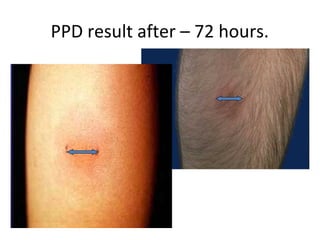
PPD result after – 72 hours.
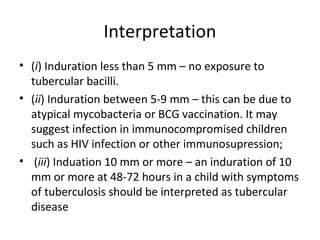
Interpretation
• (i) Induration less than 5 mm – no exposure to
tubercular bacilli.
• (ii) Induration between 5-9 mm – this can be due to
atypical mycobacteria or BCG vaccination. It may
suggest infection in immunocompromised children
such as HIV infection or other immunosupression;
• (iii) Induation 10 mm or more – an induration of 10
mm or more at 48-72 hours in a child with symptoms
of tuberculosis should be interpreted as tubercular
disease
PATKI 16
Chemotherapy in tuberculosisChemotherapy in tuberculosis
• Goals of anti-tubercular chemotherapy
• Kill dividing bacilli: Patient is non-contagious :
transmission of TB is interrupted.
• Kill persisting bacilli: To effect cure and
prevent relapse.
• Prevent emergence of resistance: so that the
bacilli remain susceptible to the drugs.
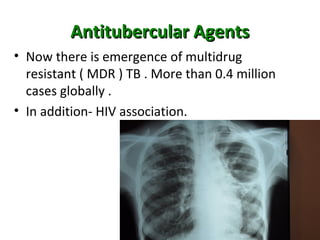
Antitubercular AgentsAntitubercular Agents
• Now there is emergence of multidrug
resistant ( MDR ) TB . More than 0.4 million
cases globally .
• In addition- HIV association.
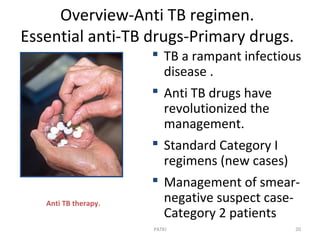
Overview-Anti TB regimen.
Essential anti-TB drugs-Primary drugs.
Anti TB therapy.
 TB a rampant infectious
disease .
 Anti TB drugs have
revolutionized the
management.
 Standard Category I
regimens (new cases)
 Management of smear-
negative suspect case-
Category 2 patients
20PATKI
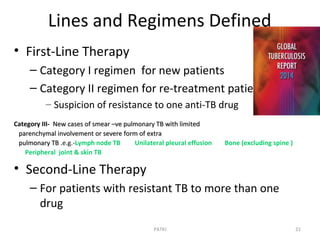
Lines and Regimens Defined
• First-Line Therapy
– Category I regimen for new patients
– Category II regimen for re-treatment patients
– Suspicion of resistance to one anti-TB drug
Category III- New cases of smear –ve pulmonary TB with limitedNew cases of smear –ve pulmonary TB with limited
parenchymal involvement or severe form of extraparenchymal involvement or severe form of extra
pulmonary TB .pulmonary TB .e.g.-Lymph node TB Unilateral pleural effusion Bone (excluding spine )
Peripheral joint & skin TB
• Second-Line Therapy
– For patients with resistant TB to more than one
drug
21PATKI
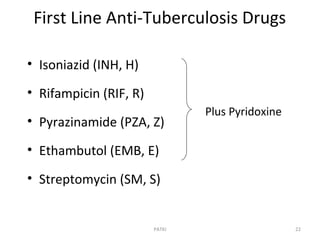
First Line Anti-Tuberculosis Drugs
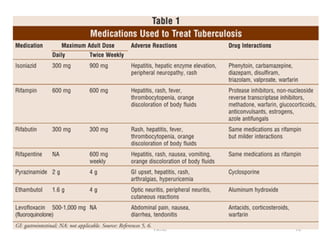
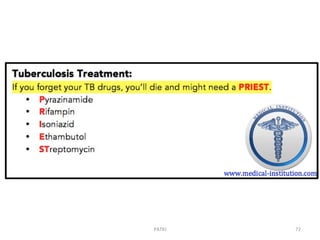
• Isoniazid (INH, H)
• Rifampicin (RIF, R)
• Pyrazinamide (PZA, Z)
• Ethambutol (EMB, E)
• Streptomycin (SM, S)
Plus Pyridoxine
22PATKI
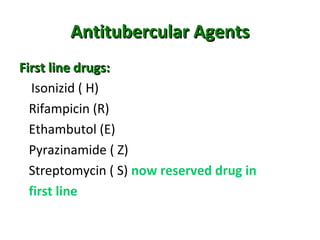
Antitubercular AgentsAntitubercular Agents
First line drugs:First line drugs:
Isonizid ( H)
Rifampicin (R)
Ethambutol (E)
Pyrazinamide ( Z)
Streptomycin ( S) now reserved drug in
first line
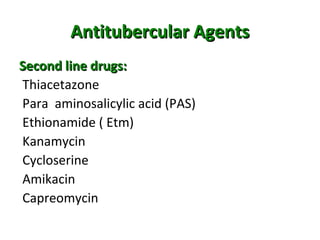
Antitubercular AgentsAntitubercular Agents
Second line drugs:Second line drugs:
Thiacetazone
Para aminosalicylic acid (PAS)
Ethionamide ( Etm)
Kanamycin
Cycloserine
Amikacin
Capreomycin
Antitubercular AgentsAntitubercular Agents
Newer Second Line drugs:Newer Second Line drugs:
Ciprofloxacin
Ofloxacin
Levofloxacin
Clarithromycin
Azithromycin
Rifabutin
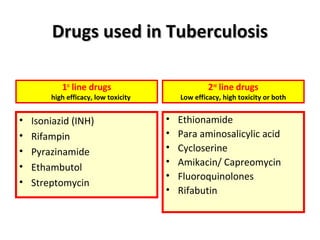
Drugs used in TuberculosisDrugs used in Tuberculosis
1st
line drugs
high efficacy, low toxicity
• Isoniazid (INH)
• Rifampin
• Pyrazinamide
• Ethambutol
• Streptomycin
2nd
line drugs
Low efficacy, high toxicity or both
• Ethionamide
• Para aminosalicylic acid
• Cycloserine
• Amikacin/ Capreomycin
• Fluoroquinolones
• Rifabutin
Antitubercular AgentsAntitubercular Agents
Isoniazid (Isonicotinic acid hydrazide,H):Isoniazid (Isonicotinic acid hydrazide,H):
Essential component of all anti TB regimen
(except intolerance to H or resistance)
-It is tuberculocidal , kills fast multiplying
organism & inhibit slow acting organism
-Acts both on intracellular ( present in
macrophages ) & extracellular bacilli
-It is the cheapest AT AgentIt is the cheapest AT Agent
Antitubercular AgentsAntitubercular Agents
-Atypical mycobacteria are not inhibited by
INH.
Not active against any other micro-orgs.
Mechanism of Action :Mechanism of Action :
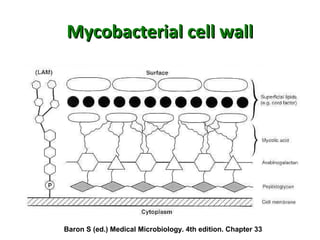
Inhibit synthesis of mycolic acid ( unique
fatty acid component of mycobacterial cell
wall .)
Antitubercular AgentsAntitubercular Agents
-INH enters the bacilli by passive diffusion. It
must be activated to become toxic to bacilli.
It becomes toxic by Kat G (multifunctional
Catalase - peroxidase , a bacterial enzyme )
which catalyzes the product from INH an
Isonicotinoyl radical that subsequently
inter-acts with mycobacterial NAD & NADP.
Antitubercular AgentsAntitubercular Agents
a nicotinoyl NAD isomer which ↓ the activity
of enoyl acyl carrier protein reductase
(Inh A) & β- ketoacyl carrier protein
synthase ( Kas A) , inhibition of these
enzymes↓ the synthesis of mycolic acid an
essential component of the mycobacterial
cell wall & causes cell death.
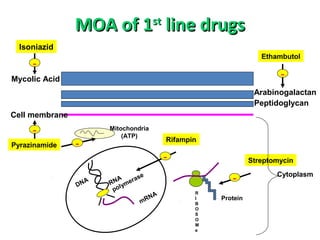
MOA of 1MOA of 1stst
line drugsline drugs
Mycolic Acid
Arabinogalactan
Peptidoglycan
Cell membrane
DNA RNA
polymerase
mRNA R
I
B
O
S
O
M
e
Protein
Isoniazid
-
Pyrazinamide
- Mitochondria
(ATP)
- Rifampin
-
Ethambutol
-
Streptomycin
- Cytoplasm
Antitubercular AgentsAntitubercular Agents
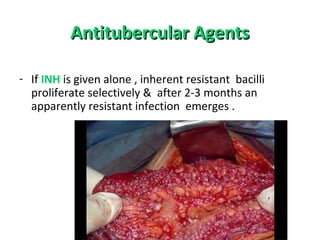
- If INH is given alone , inherent resistant bacilli
proliferate selectively & after 2-3 months an
apparently resistant infection emerges .
Antitubercular AgentsAntitubercular Agents
- Combination therapy with INH has good
resistance preventing action .
- There is no cross resistance .
Antitubercular AgentsAntitubercular Agents
PharmacokineticsPharmacokinetics :
-Completely absorbed orally , penetrate all
body tissues, tubercular cavities , placenta
& meninges .
- Metabolized in liver by acetylation &
metabolites are excreted in urine .
- Rate of acetylation shows genetic variation
( fast acetylators > 30% Indians - t½ -1 hr
Slow acetylators >60% Indians -t ½- 3 hrs)
Antitubercular AgentsAntitubercular Agents
(daily regimen is not affected but biweekly
regimens are less effective in fast
acetylators )
DoseDose – 4-6 mg/ kg for >50 kg – 300 mg daily
- 600 mg bi-wkly
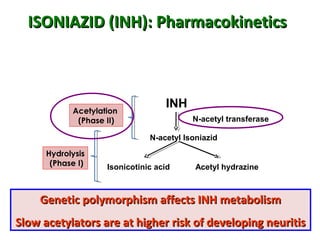
ISONIAZID (INH): PharmacokineticsISONIAZID (INH): Pharmacokinetics
Acetylation
(Phase II)
Hydrolysis
(Phase I) Isonicotinic acid
INH
N-acetyl transferase
N-acetyl Isoniazid
Acetyl hydrazine
Genetic polymorphism affects INH metabolismGenetic polymorphism affects INH metabolism
Slow acetylators are at higher risk of developing neuritisSlow acetylators are at higher risk of developing neuritis
Antitubercular AgentsAntitubercular Agents
ADRs -ADRs -
Well tolerated drug
1.Peripheral neuritis & other neurological
manifestations- parasthesia , numbness,
mental disorientation & rarely convulsion
( due to interference with utilization of
pyridoxine & ↑ excretion in urine )
Antitubercular AgentsAntitubercular Agents
Due to this Pyridoxine given prophylactically
-10 mg/day10 mg/day which prevents neurotoxicities
(INH neurotoxicity treated with Pyridoxine-100 mg/ day100 mg/ day )
2. Hepatitis – more common in older patients
& alcohlics ( reversible)
3. Rashes , fever , acne & arthralgia .
Rifampicin
• Bactericidal to M Tub. N Menig, H Influen,
Klebsi, Lepre,
• All population of M Tub. Extra and
intracellular. Sterilizing effect.
• DNA dependent RNA Polymerase.
• Bioavailability 70 %- ABSENCE OF FOOD.
• Enzyme inducer- Drug interactions. OC. INH
• High sterilizing effect. All forms of bacteria
PATKI 39
R
• 450-600 MG Oral , Morning
• Color of urine
• Hepatitis
• With INH
• With PYRAZINAMIDE
• ADR- Hepatitis, Cutaneous syndrome
• Abdominal syndrome
• Meningococcal meningitis –Prophylaxix
PATKI 40
SM- 1 G- IM
Activity against bacteria:
Bactericidal
Inhibit bacterial protein synthesis.
Active – Aerobic Gr - ve bacilli , not anaerobic.
Exibit post-antibiotic effect
Adverse Effects:
Narrow margin of safety
All are ototoxic and nephrotoxic.
PATKI 41
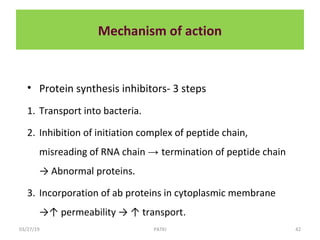
Mechanism of action
• Protein synthesis inhibitors- 3 steps
1. Transport into bacteria.
2. Inhibition of initiation complex of peptide chain,
misreading of RNA chain → termination of peptide chain
→ Abnormal proteins.
3. Incorporation of ab proteins in cytoplasmic membrane
→↑ permeability → ↑ transport.
03/27/19 42PATKI
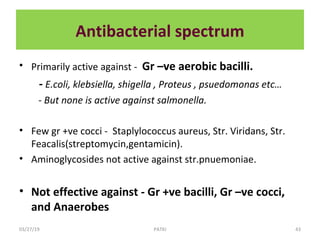
Antibacterial spectrum
• Primarily active against - Gr –ve aerobic bacilli.
- E.coli, klebsiella, shigella , Proteus , psuedomonas etc…
- But none is active against salmonella.
• Few gr +ve cocci - Staplylococcus aureus, Str. Viridans, Str.
Feacalis(streptomycin,gentamicin).
• Aminoglycosides not active against str.pnuemoniae.
• Not effective against - Gr +ve bacilli, Gr –ve cocci,
and Anaerobes
03/27/19 43PATKI
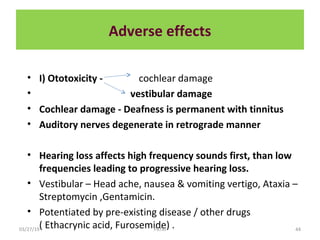
Adverse effects
• I) Ototoxicity - cochlear damage
• vestibular damage
• Cochlear damage - Deafness is permanent with tinnitus
• Auditory nerves degenerate in retrograde manner
• Hearing loss affects high frequency sounds first, than low
frequencies leading to progressive hearing loss.
• Vestibular – Head ache, nausea & vomiting vertigo, Ataxia –
Streptomycin ,Gentamicin.
• Potentiated by pre-existing disease / other drugs
( Ethacrynic acid, Furosemide) .03/27/19 44PATKI
Pyrazinamide
• More active at pH 5.5- Intracellular action.
• Converted to pyrazinoic acid . Cidal.
• Distributed to all tissues including meninges
• Sterilizing effect, -Inhibits mycolic acid
• 70 mg/ kg
• Hepatitis
• Uricacid. Hyperurecemia
PATKI 45
Ethambutol
• Static , inhibits arabinosyltransferase
• Cell wall , mycolic acid
• 75% excreted unchanged.
• RBC concentration –double.
• 25 mg /kg
• Inflamed meninges
• Optic neuritis, loss of acuity of vision, color,
PATKI 46
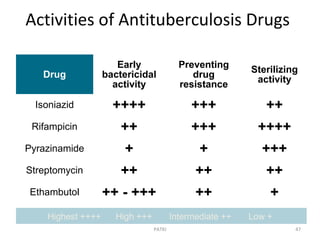
Activities of Antituberculosis Drugs
Drug
Early
bactericidal
activity
Preventing
drug
resistance
Sterilizing
activity
Isoniazid ++++ +++ ++
Rifampicin ++ +++ ++++
Pyrazinamide + + +++
Streptomycin ++ ++ ++
Ethambutol ++ - +++ ++ +
Highest ++++ High +++ Intermediate ++ Low +
47PATKI
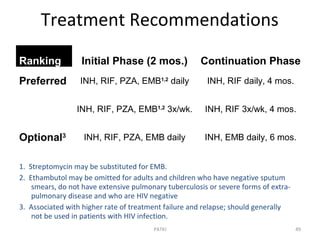
Continuation Phase of Treatment
• The preferred continuation phase consists of
isoniazid and rifampicin given for four
months.
• Isoniazid and ethambutol given for six
months is an acceptable continuation phase
regimen that may be used when adherence
cannot be assured, but is associated with a
higher rate of failure and relapse, especially
in patients with HIV infection.
48PATKI
Treatment Recommendations
1. Streptomycin may be substituted for EMB.
2. Ethambutol may be omitted for adults and children who have negative sputum
smears, do not have extensive pulmonary tuberculosis or severe forms of extra-
pulmonary disease and who are HIV negative
3. Associated with higher rate of treatment failure and relapse; should generally
not be used in patients with HIV infection.
Ranking Initial Phase (2 mos.) Continuation Phase
Preferred INH, RIF, PZA, EMB1,2
daily INH, RIF daily, 4 mos.
INH, RIF, PZA, EMB1,2
3x/wk. INH, RIF 3x/wk, 4 mos.
Optional3 INH, RIF, PZA, EMB daily INH, EMB daily, 6 mos.
49PATKI
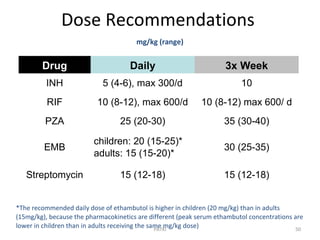
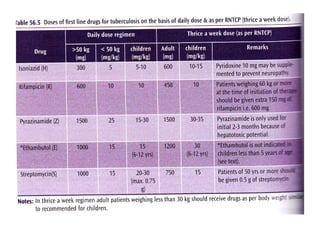
Dose Recommendations
Drug Daily 3x Week
INH 5 (4-6), max 300/d 10
RIF 10 (8-12), max 600/d 10 (8-12) max 600/ d
PZA 25 (20-30) 35 (30-40)
EMB
children: 20 (15-25)*
adults: 15 (15-20)*
30 (25-35)
Streptomycin 15 (12-18) 15 (12-18)
*The recommended daily dose of ethambutol is higher in children (20 mg/kg) than in adults
(15mg/kg), because the pharmacokinetics are different (peak serum ethambutol concentrations are
lower in children than in adults receiving the same mg/kg dose)
mg/kg (range)
50PATKI
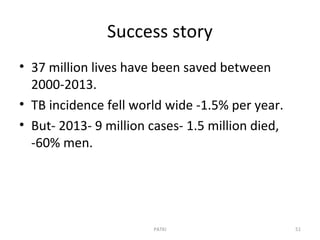
Success story
• 37 million lives have been saved between
2000-2013.
• TB incidence fell world wide -1.5% per year.
• But- 2013- 9 million cases- 1.5 million died,
-60% men.
PATKI 51
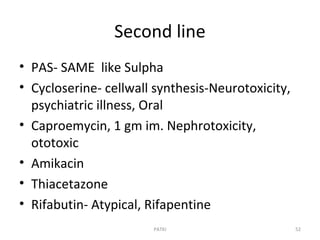
Second line
• PAS- SAME like Sulpha
• Cycloserine- cellwall synthesis-Neurotoxicity,
psychiatric illness, Oral
• Caproemycin, 1 gm im. Nephrotoxicity,
ototoxic
• Amikacin
• Thiacetazone
• Rifabutin- Atypical, Rifapentine
PATKI 52
Fluoroquinolones
• Ciprofloxacin
• Ofloxacin
• Levofloxacin
• Spar
• Gati
• Moxi
PATKI 53
TB Treatment and Liver
• Hepatitis-Main ADR of Anti TB regimen.
• Use standard short-course regimen for
patients without clinical evidence of chronic
liver disease but history of:
– Hepatitis virus carriage
– Acute hepatitis
– Excessive alcohol consumption
• Use a liver-sparing regimen for patients with
established chronic liver disease
– 2SHRE/6HR or 2SHE/10 HE
54PATKI
Hepatitis
• Hepatitis (asymptomatic elevation AST/ALT
occurs in 20% patients on 4 drugs)
– Drug induced hepatitis = ↑ AST or ALT ≥3 times
upper limits of normal in the presence of symptoms
OR ↑ >5 times if asymptomatic
– INH, PZA and RIF can all cause hepatotoxicity
– Hepatitis from INH is age related, from PZA is dose
related, and RIF is unpredictable and less common
55PATKI
TB Treatment and Hepatitis
• If ↑ ≥3x normal with symptoms or >5x normal
without symptoms:
– stop all anti-TB medications and evaluate patient
– refer patient to doctor for clinical evaluation
– try to rule out other causes of acute liver disease
– if severely ill, may start 3 non-hepatotoxic drugs
– after AST <2 times upper limit of normal —
rechallenge drugs one-by-one starting with drugs
that are not hepatotoxic
56PATKI
ANTI-TB DRUGS
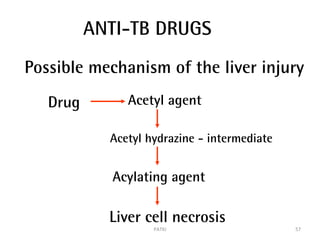
Possible mechanism of the liver injury
Drug Acetyl agent
Acetyl hydrazine - intermediate
Acylating agent
Liver cell necrosis
57PATKI
streptomycin
• Use restricted to certain infections in combination with other
drugs.
• Given by deep IM inj- 0.5 – 1 gm /day.
• Uses –
1. Bacterial endocarditis
2. Tularemia , Brucellosis
3. Plague
4. Tuberculosis
03/27/19 58PATKI
MANAGEMENT OF
TUBERCULOSIS
PATKI 59
Antitubercular TherapyAntitubercular Therapy
Short course chemotherapy-Short course chemotherapy-
Regimen of 6-9 months treatment
In 1997 WHO framed clear cut guidelines
for different category of TB treatment .
All regimen have initial intensive phase -2
3 months to rapidly kill the TB bacilli & bring
sputum conversion & afford symptomatic
relief followed by continuation phase last
4-6 months for elementary remaining bacilli
Antitubercular TherapyAntitubercular Therapy
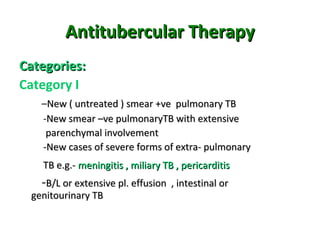
Categories:Categories:
Category I
–New ( untreated ) smear +ve pulmonary TBNew ( untreated ) smear +ve pulmonary TB
-New smear –ve pulmonaryTB with extensiveNew smear –ve pulmonaryTB with extensive
parenchymal involvementparenchymal involvement
-New cases of severe forms of extra- pulmonary-New cases of severe forms of extra- pulmonary
TB e.g.-TB e.g.- meningitis , miliary TB , pericarditismeningitis , miliary TB , pericarditis
-B/L or extensive pl. effusion , intestinal orB/L or extensive pl. effusion , intestinal or
genitourinary TBgenitourinary TB
Antitubercular TherapyAntitubercular Therapy
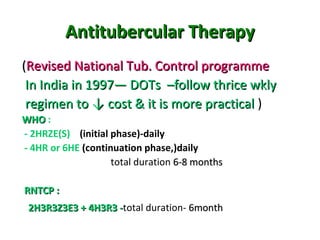
((Revised National Tub. Control programmeRevised National Tub. Control programme
In India in 1997— DOTs –follow thrice wklyIn India in 1997— DOTs –follow thrice wkly
regimen to ↓ cost & it is more practicalregimen to ↓ cost & it is more practical )
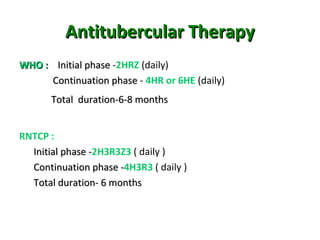
WHOWHO :
- 2HRZE(S) (initial phase)-daily
- 4HR or 6HE (continuation phase,)daily
total duration 6-8 months6-8 months
RNTCP :RNTCP :
2H3R3Z3E3 + 4H3R3 -2H3R3Z3E3 + 4H3R3 -total duration- 6month6month
Antitubercular TherapyAntitubercular Therapy
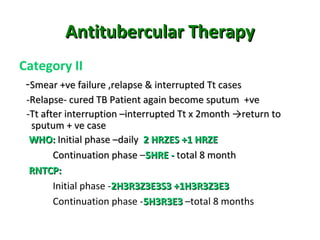
Category II
-Smear +ve failure ,relapse & interrupted Tt casesSmear +ve failure ,relapse & interrupted Tt cases
-Relapse- cured TB Patient again become sputum +ve-Relapse- cured TB Patient again become sputum +ve
-Tt after interruption –interrupted Tt x 2month →return to-Tt after interruption –interrupted Tt x 2month →return to
sputum + ve casesputum + ve case
WHO:WHO: Initial phase –dailyInitial phase –daily 2 HRZES +1 HRZE2 HRZES +1 HRZE
Continuation phaseContinuation phase –5HRE -5HRE - total 8 monthotal 8 month
RNTCP:RNTCP:
Initial phase -2H3R3Z3E3S3 +1H3R3Z3E32H3R3Z3E3S3 +1H3R3Z3E3
Continuation phase -5H3R3E35H3R3E3 –total 8 months
Antitubercular TherapyAntitubercular Therapy
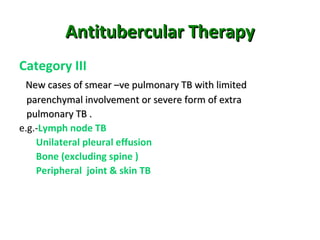
Category III
New cases of smear –ve pulmonary TB with limitedNew cases of smear –ve pulmonary TB with limited
parenchymal involvement or severe form of extraparenchymal involvement or severe form of extra
pulmonary TB .pulmonary TB .
e.g.-Lymph node TB
Unilateral pleural effusion
Bone (excluding spine )
Peripheral joint & skin TB
Antitubercular TherapyAntitubercular Therapy
WHO :WHO : Initial phaseInitial phase -2HRZ (daily)
Continuation phaseContinuation phase - 4HR or 6HE (daily)
Total duration-6-8 monthsTotal duration-6-8 months
RNTCP :
Initial phase -Initial phase -2H3R3Z3 ( daily )
Continuation phase -Continuation phase -4H3R3 ( daily )
Total duration- 6 monthsTotal duration- 6 months
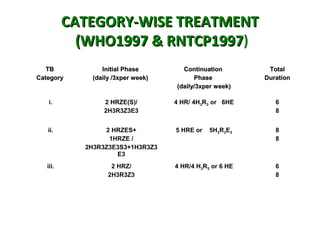
CATEGORY-WISE TREATMENTCATEGORY-WISE TREATMENT
(WHO1997 & RNTCP1997(WHO1997 & RNTCP1997)
TBTB
CategoryCategory
Initial PhaseInitial Phase
(daily /3xper week)(daily /3xper week)
ContinuationContinuation
PhasePhase
(daily/3xper week)(daily/3xper week)
TotalTotal
DurationDuration
i. 2 HRZE(S)/
2H3R3Z3E3
4 HR/ 4H3R3 or 6HE 6
8
ii. 2 HRZES+
1HRZE /
2H3R3Z3E3S3+1H3R3Z3
E3
5 HRE or 5H3R3E3 8
8
iii. 2 HRZ/
2H3R3Z3
4 HR/4 H3R3 or 6 HE 6
8
PATKI 68
PATKI 69
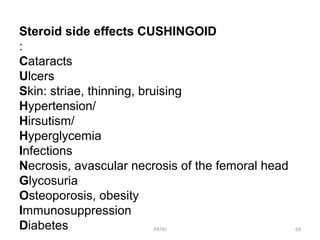
Steroid side effects CUSHINGOID
:
Cataracts
Ulcers
Skin: striae, thinning, bruising
Hypertension/
Hirsutism/
Hyperglycemia
Infections
Necrosis, avascular necrosis of the femoral head
Glycosuria
Osteoporosis, obesity
Immunosuppression
Diabetes
PATKI 70
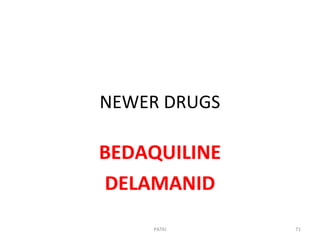
NEWER DRUGS
BEDAQUILINE
DELAMANID
PATKI 71
PATKI 72
PATKI 73