SYMPATHOMIMETIC
AGENTS
Adrenergic agents
1PATKI
AT THE END OF THE SESSION, STUDENT WILL BE ABLE
TO
 Define Sympathomimetic amines with examples.
 Classify sympathomimetic amines
 Enumerate four pharmacological actions of Adrenaline
and four indications.
 Describe pharmacological actions of Noradrenalin,
Dopamine ,
 Enumerate alpha 2, Beta 1 and beta 2 agonists with
their pharmacological actions.
 Explain the role of Nasal decongestants and anorectic
agents.
2PATKI
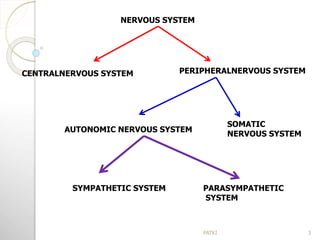
NERVOUS SYSTEM
CENTRALNERVOUS SYSTEM PERIPHERALNERVOUS SYSTEM
AUTONOMIC NERVOUS SYSTEM
SOMATIC
NERVOUS SYSTEM
SYMPATHETIC SYSTEM PARASYMPATHETIC
SYSTEM
3PATKI
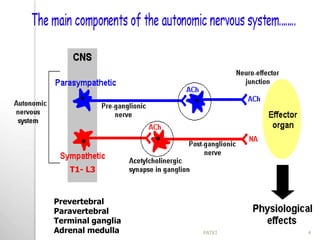
T1- L3
Prevertebral
Paravertebral
Terminal ganglia
Adrenal medulla 4PATKI
SYMPATHETIC
NERVOUS SYSTEM
5PATKI
ADRENERGIC
NEUROTRANSMISSION
6PATKI
The Adrenergic neurotransmitters are:
 Nor adrenaline ( Nor epinephrine)
 Dopamine ( CNS)
 Adrenaline
7PATKI
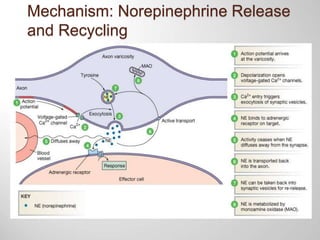
Adrenergic neurotransmission
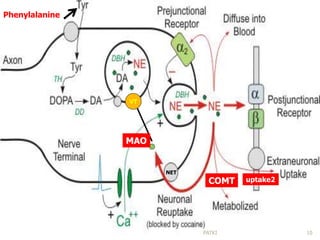
 Synthesis
 Storage
 Release
 Reuptake
 Metabolism
 Adrenergic receptors-
Types, actions
8PATKI
Mechanism: Norepinephrine Release
and Recycling
MAO
uptake2COMT
VT
NET
Phenylalanine
10PATKI
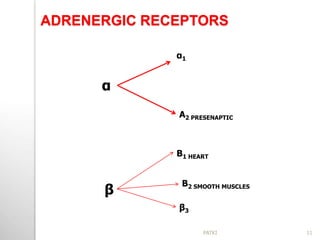
ADRENERGIC RECEPTORS
β
α1
α
Α2 PRESENAPTIC
β3
Β1 HEART
Β2 SMOOTH MUSCLES
11PATKI
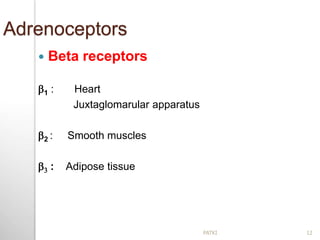
Adrenoceptors
 Beta receptors
b1 : Heart
Juxtaglomarular apparatus
b2 : Smooth muscles
b3 : Adipose tissue
12PATKI
Dopamine receptors
 D1, D2,
Peripheral D1– dilates renal blood vessel
D2- modulate transmitter
release
13PATKI
Adrenaline acts on alpha1, alpha2, beta1,
beta2 and beta3 receptors.
 Hormone
 Catecholamine
 As a Neurotransmitter?
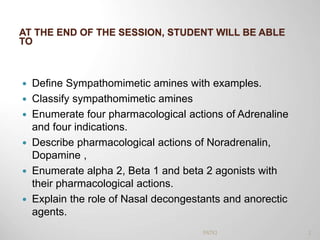
 Topical haemostatic
14PATKI
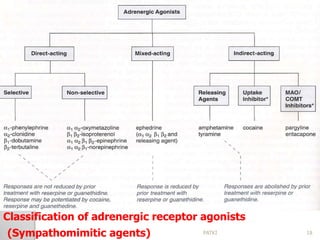
SYMPATHOMIMETICS
CLASSIFICATION
3 types of classifications
1. based on their chemical groups
2. Mode of action
3. Therapeutic classification
15PATKI
Classification on the basis of their Chemical structure
Catecholamines:
 Sympathomimetics with catechol nucleus are called
catecholamines.
Adrenaline, NA, DA, Isoprenaline, Dobutamine
 Non-Catecholamines :
Tyramine, Ephedrine, Amphetamine, Salbutamol
HO
HO
C C N
16PATKI
 2. Mode of action
Direct receptor agonists:
alpha agonists 1& 2
beta agonists 1& 2
alpha & beta agonists
Indirectly acting :
reuptake inhibitors
release promoters
metabolism inhibitors
Both direct and indirect:
Ephedrine
17PATKI
Classification of adrenergic receptor agonists
(Sympathomimitic agents) 18PATKI
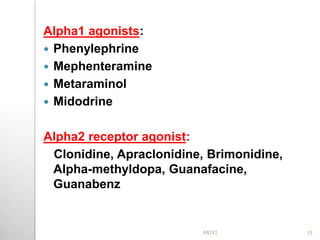
Alpha1 agonists:
 Phenylephrine
 Mephenteramine
 Metaraminol
 Midodrine
Alpha2 receptor agonist:
Clonidine, Apraclonidine, Brimonidine,
Alpha-methyldopa, Guanafacine,
Guanabenz
19PATKI
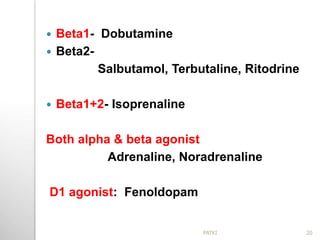
 Beta1- Dobutamine
 Beta2-
Salbutamol, Terbutaline, Ritodrine
 Beta1+2- Isoprenaline
Both alpha & beta agonist
Adrenaline, Noradrenaline
D1 agonist: Fenoldopam
20PATKI
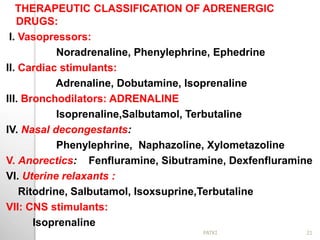
THERAPEUTIC CLASSIFICATION OF ADRENERGIC
DRUGS:
I. Vasopressors:
Noradrenaline, Phenylephrine, Ephedrine
II. Cardiac stimulants:
Adrenaline, Dobutamine, Isoprenaline
III. Bronchodilators: ADRENALINE
Isoprenaline,Salbutamol, Terbutaline
IV. Nasal decongestants:
Phenylephrine, Naphazoline, Xylometazoline
V. Anorectics: Fenfluramine, Sibutramine, Dexfenfluramine
VI. Uterine relaxants :
Ritodrine, Salbutamol, Isoxsuprine,Terbutaline
VII: CNS stimulants:
Isoprenaline
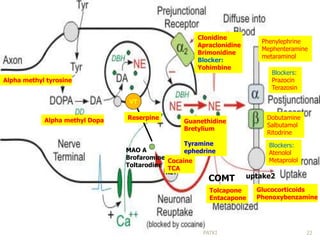
21PATKI
MAO A
Brofaromine
Toltarodine
uptake2COMT
VT
NET
Alpha methyl tyrosine
Alpha methyl Dopa
Tolcapone
Entacapone
Cocaine
TCA
Reserpine
Clonidine
Apraclonidine
Brimonidine
Blocker:
Yohimbine
Phenylephrine
Mephenteramine
metaraminol
Blockers:
Prazocin
Terazosin
Blockers:
Atenolol
Metaprolol
Dobutamine
Salbutamol
Ritodrine
Guanethidine
Bretylium
Tyramine
ephedrine
Glucocorticoids
Phenoxybenzamine
22PATKI
ADRENALINE PHARMACOLOGICAL ACTIONS
23PATKI
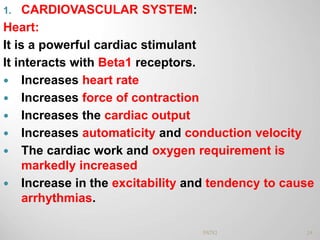
1. CARDIOVASCULAR SYSTEM:
Heart:
It is a powerful cardiac stimulant
It interacts with Beta1 receptors.
 Increases heart rate
 Increases force of contraction
 Increases the cardiac output
 Increases automaticity and conduction velocity
 The cardiac work and oxygen requirement is
markedly increased
 Increase in the excitability and tendency to cause
arrhythmias.
24PATKI
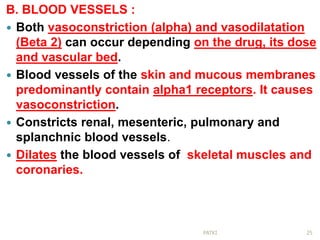
B. BLOOD VESSELS :
 Both vasoconstriction (alpha) and vasodilatation
(Beta 2) can occur depending on the drug, its dose
and vascular bed.
 Blood vessels of the skin and mucous membranes
predominantly contain alpha1 receptors. It causes
vasoconstriction.
 Constricts renal, mesenteric, pulmonary and
splanchnic blood vessels.
 Dilates the blood vessels of skeletal muscles and
coronaries.
25PATKI
C. Blood Pressure:
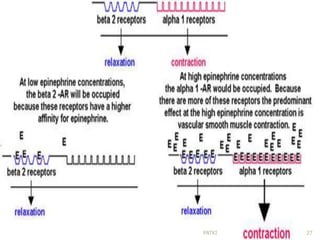
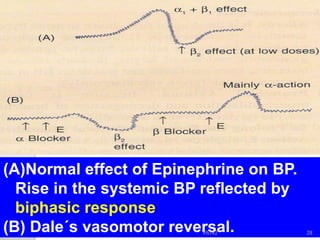
Biphasic response with Adrenaline.
The initial rise in BP due to predominant alpha1
action on blood vessels and beta1 actions on
heart.
Followed by fall in BP due to beta2 mediated
vasodilatation in skeletal muscles.
Dales vasomotor reversal:
Administration of Adrenaline after the alpha1
blockade produces a fall in BP.
This is referred as vasomotor reversal.
26PATKI
27PATKI
(A)Normal effect of Epinephrine on BP.
Rise in the systemic BP reflected by
biphasic response
(B) Dale´s vasomotor reversal. 28PATKI
2. Respiration :
 Adrenaline relaxes bronchial smooth muscle ( Beta2).
 It inhibits the release of mediators from mast cells (beta2).
 It reduces secretions and relives mucosal congestion by
vasoconstrictor action.
3. Eye :
 Poor penetration into cornea.
 Hence its administered as pro-drug Dipivefrin
 Mydriasis occurs due to contraction of radial muscles of
iris (alphal)
 Reduced aqueous formation.
 Facilitation of trabecular outflow
29PATKI
4. GIT:
 Relaxation occurs through activation of both alpha and beta
receptors.
 Peristalsis is reduced and sphincters are constricted.
5. Bladder:
 Detrusor relaxation (beta) and
 Trigone contraction (alpha)
Difficulty in urination
30PATKI
6. METABOLIC:
Adrenaline increases blood glucose level by
glycogenolysis (beta2 and alpha)
Reduces Insulin secretion alpha2 action
Decreases glucose uptake by peripheral tissues
 Increase free fatty acid level beta receptor adipocyte- beta 3
 Inhibit leptin production by adipocyte
 Activate triglyceride lipase
31PATKI
Administration and preparations:
orally inactive
EPI administered SC - absorbed slowly
By IM route absorbed -- more rapidly.
IV route - Arrhythmias
Does not cross the BBB
EPI is rapidly inactivated in the body by COMT and MAO.
It appears in the urine as VMA and metanephrine.
32PATKI
Adrenaline Uses: ABCDE
A: In Anaphylactic shock Injection 0.5 ml 1:1000, I.M.
B: Bronchial Asthma 0.5ml SC 1 in 1000
C: Cardiac arrest IV 1 in 10,000
D: To increase the duration of action of local anaesthetic
along with local anaesthetics 1in 20,000- 1,00,000
E: Epistaxis: 1in 10,000 for local haemostatic action
G: Glaucoma Dipivefrin
33PATKI
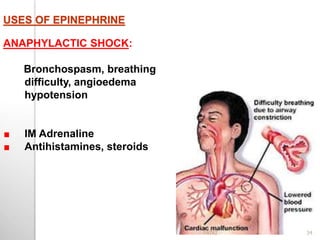
USES OF EPINEPHRINE
ANAPHYLACTIC SHOCK:
Bronchospasm, breathing
difficulty, angioedema
hypotension
IM Adrenaline
Antihistamines, steroids
34PATKI
Rationale of administering adrenaline (epinephrine
E) in anaphylactic shock
It is the drug of choice, due to its rapid action of
reducing bronchospasm, relieving angioneurotic
edema & prompt vasopressor action.
1.E causes relaxation of bronchial smooth
muscle(β2);thus relieving bronchospasm.
2.E causes vasoconstriction (α1 ) resulting into
rapid vasopressor action (raises the BP).
3.Attenuating enhanced vascular permeability, thus
relieving the angioneurotic edema; thus reducing
airway congestion.
35PATKI
What is the rationale of using adrenaline with local
anesthetics like lignocaine
 Adrenaline(1 : 1,00,000) + lignocaine , combination is used
for infiltration, nerve block or spinal anesthesia.
 Because of local vasoconstrictor action ( action on alpha
receptors on skin and mucus membranes, less lignocaine is
absorbed & duration of anesthesia is prolonged.
 The systemic toxicity of lignocaine is also reduced ( less
systemic absorption of lignocaine).
 The combination should not be injected into the tissues
supplied by end-arteries. e.g.- Fingers, toes ,ears, nose & the
penis.
Resultant vasoconstriction may cause gangrene.
Avoid the combination – circumcision.
-- surgery on fingers & toes.
36PATKI
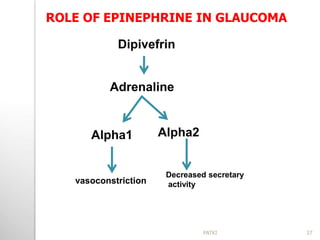
Dipivefrin
Adrenaline
Alpha1 Alpha2
vasoconstriction
Decreased secretary
activity
ROLE OF EPINEPHRINE IN GLAUCOMA
37PATKI
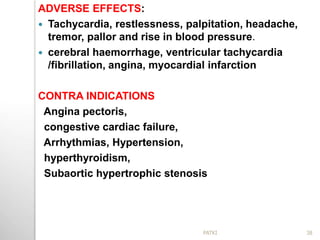
ADVERSE EFFECTS:
 Tachycardia, restlessness, palpitation, headache,
tremor, pallor and rise in blood pressure.
 cerebral haemorrhage, ventricular tachycardia
/fibrillation, angina, myocardial infarction
CONTRA INDICATIONS
Angina pectoris,
congestive cardiac failure,
Arrhythmias, Hypertension,
hyperthyroidism,
Subaortic hypertrophic stenosis
38PATKI
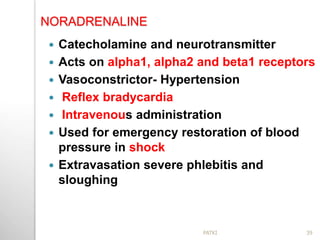
NORADRENALINE
 Catecholamine and neurotransmitter
 Acts on alpha1, alpha2 and beta1 receptors
 Vasoconstrictor- Hypertension
 Reflex bradycardia
 Intravenous administration
 Used for emergency restoration of blood
pressure in shock
 Extravasation severe phlebitis and
sloughing
39PATKI
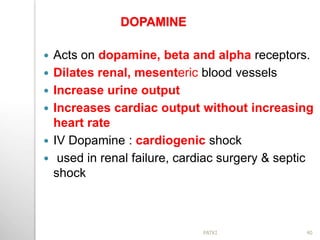
DOPAMINE
 Acts on dopamine, beta and alpha receptors.
 Dilates renal, mesenteric blood vessels
 Increase urine output
 Increases cardiac output without increasing
heart rate
 IV Dopamine : cardiogenic shock
 used in renal failure, cardiac surgery & septic
shock
40PATKI
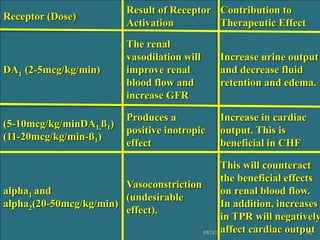
Receptor (Dose)
Result of Receptor
Activation
Contribution to
Therapeutic Effect
DA1 (2-5mcg/kg/min)
The renal
vasodilation will
improve renal
blood flow and
increase GFR
Increase urine output
and decrease fluid
retention and edema.
(5-10mcg/kg/minDA1,ß1)
(11-20mcg/kg/min-ß1)
Produces a
positive inotropic
effect
Increase in cardiac
output. This is
beneficial in CHF
alpha1 and
alpha2(20-50mcg/kg/min)
Vasoconstriction
(undesirable
effect).
This will counteract
the beneficial effects
on renal blood flow.
In addition, increases
in TPR will negatively
affect cardiac output41PATKI
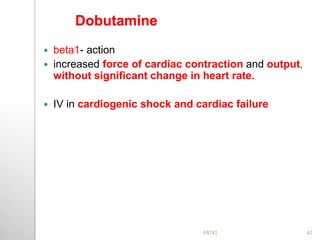
Dobutamine
 beta1- action
 increased force of cardiac contraction and output,
without significant change in heart rate.
 IV in cardiogenic shock and cardiac failure
42PATKI
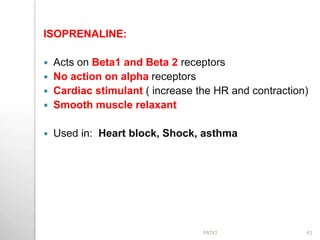
ISOPRENALINE:
 Acts on Beta1 and Beta 2 receptors
 No action on alpha receptors
 Cardiac stimulant ( increase the HR and contraction)
 Smooth muscle relaxant
 Used in: Heart block, Shock, asthma
43PATKI
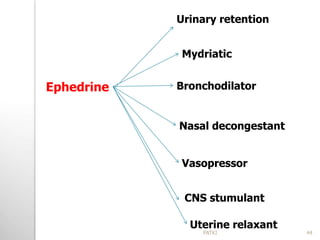
Ephedrine
Mydriatic
Bronchodilator
Vasopressor
CNS stumulant
Urinary retention
Nasal decongestant
Uterine relaxant
44PATKI
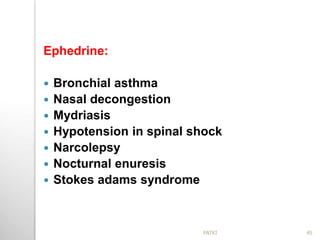
Ephedrine:
 Bronchial asthma
 Nasal decongestion
 Mydriasis
 Hypotension in spinal shock
 Narcolepsy
 Nocturnal enuresis
 Stokes adams syndrome
45PATKI
Amphetamines
 d-amphetamine, methamphetamine &
hydroxy-amphetamine
Uses:
 Narcolepsy
 Attention deficit syndrome/ hyper activity
disorder
 Obesity
46PATKI
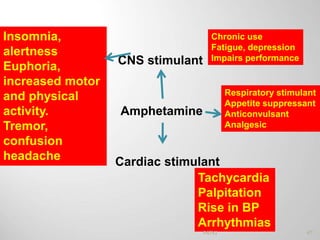
Amphetamine
CNS stimulant
Cardiac stimulant
Tachycardia
Palpitation
Rise in BP
Arrhythmias
Insomnia,
alertness
Euphoria,
increased motor
and physical
activity.
Tremor,
confusion
headache
Respiratory stimulant
Appetite suppressant
Anticonvulsant
Analgesic
Chronic use
Fatigue, depression
Impairs performance
47PATKI
Vasoconstrictors ( Alpha1 agonists)
 Phenylephrine, Mephenteramine, Metaraminol,
Medodrine, Methoxamine
 Acts on alpha receptors
 Increases PVR and BP
 Reflex bradycardia
 Used in hypotension
Mydriatic (fundoscopic examination)
Nasa decongestion
48PATKI
 NASAL DECONGESTANTS:
Oral:
Ephedrine, pseudoephedrine, phenylephrine,
phenylpropanolamine
Topically:
Xylometazoline, oxymetazoline, naphazoline,
phenylephrine, phenylpropanolamine
49PATKI
 NASAL DECONGESTANTS
Mechanism of action:
They act by stimulating the alpha1 receptors present in the
blood vessels of nasal mucosa.
They produces vasoconstriction of mucosa resulting in its
shrinkage and decreased volume of mucosa.
Thus they relieve nasal congestion.
Used in allergic & vasomotor rhinitis
ADRs:
 Atrophy of nasal mucosa : intense vasoconstriction-
anosmic necrosis
 Rebound hyperemia- after congestion : due to dilatation
 Phenylpropanolamine is banned –
increased risk of hemorrhagic stroke
50PATKI
Alpha2 agonists
Clonidine: Hypertension
Apraclonidine: Glaucoma
Beta2 agonists:
Bronchial asthma, Preterm labour
51PATKI
 Hypotension
 Hypertension
 ADHD
 Anaphylactic shock
 Cardiogenic, Hypovolemic shock
 Glaucoma
 Asthma
 Cardiac arrest
 Epistaxis
 Nocturnal enuresis
 Obesity
 Nasal decongestion
 Fundoscopy
 Cardiac decompensation
 Preterm labour
 AV block
 Narcolepsy
 Cardiac arrest 52PATKI
Adrenergic receptor blockers
 Alpha Blockers
 Beta Blockers
53PATKI
 Alpha Blockers
They block the adrenergic responses
mediated through the alpha adrenergic
receptors.
54PATKI
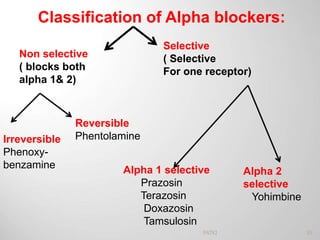
Classification of Alpha blockers:
Non selective
( blocks both
alpha 1& 2)
Selective
( Selective
For one receptor)
Alpha 1 selective
Prazosin
Terazosin
Doxazosin
Tamsulosin
Alpha 2
selective
Yohimbine
Irreversible
Phenoxy-
benzamine
Reversible
Phentolamine
55PATKI
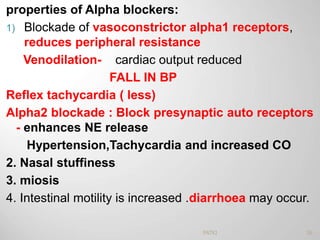
properties of Alpha blockers:
1) Blockade of vasoconstrictor alpha1 receptors,
reduces peripheral resistance
Venodilation- cardiac output reduced
FALL IN BP
Reflex tachycardia ( less)
Alpha2 blockade : Block presynaptic auto receptors
- enhances NE release
Hypertension,Tachycardia and increased CO
2. Nasal stuffiness
3. miosis
4. Intestinal motility is increased .diarrhoea may occur.
56PATKI
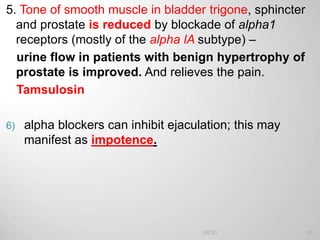
5. Tone of smooth muscle in bladder trigone, sphincter
and prostate is reduced by blockade of alpha1
receptors (mostly of the alpha lA subtype) –
urine flow in patients with benign hypertrophy of
prostate is improved. And relieves the pain.
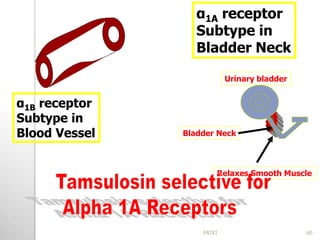
Tamsulosin
6) alpha blockers can inhibit ejaculation; this may
manifest as impotence.
57PATKI
THERAPEUTIC USES
 Hypertension
 Pheochromocytoma
 Hypertension crisis –Clonidine withdrawal
 Cheese reaction hypertension
 Congestive heart failure
 Benign prostate hypertrophy-Tamsulosin
 Reynaud's disease
 Erectile dysfunction
58PATKI
Why tamsulosin is more
preferred for benign
prostatic hyperplasia?
59PATKI
Urinary bladder
Bladder Neck
Relaxes Smooth Muscle
α1A receptor
Subtype in
Bladder Neck
α1B receptor
Subtype in
Blood Vessel
60PATKI
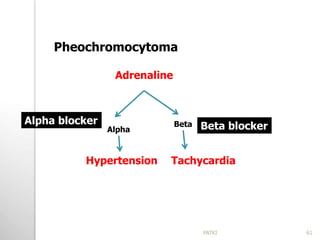
Pheochromocytoma
Adrenaline
Alpha
Hypertension
Beta
Tachycardia
Alpha blocker Beta blocker
61PATKI
WHAT IS FIRST DOSE EFFECT?
 The first dose phenomenon is a sudden and severe
fall in blood pressure that can occur when changing
from a lying to a standing position the first time that an
alpha blocker drug is used.
 This postural hypotension usually happens shortly
after the first dose is absorbed into the blood and can
result in syncope (fainting).
 It is common with initial dose of 2mg Prazosin. This
adverse effect is self-limiting and in most cases does
not recur after the initial period of therapy.
 For this reason, treatment with Prazosin should
always be initiated with a low dose and should be
taken at bedtime to avoid standing position.
62PATKI
BETA ADRENERGIC BLOCKING DRUGS:
 These drugs inhibit adrenergic responses
mediated through the Beta receptors.
63PATKI
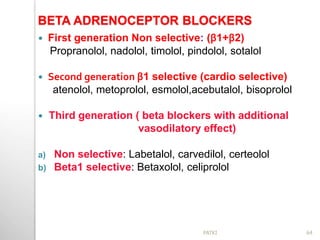
BETA ADRENOCEPTOR BLOCKERS
 First generation Non selective: (β1+β2)
Propranolol, nadolol, timolol, pindolol, sotalol
 Second generation β1 selective (cardio selective)
atenolol, metoprolol, esmolol,acebutalol, bisoprolol
 Third generation ( beta blockers with additional
vasodilatory effect)
a) Non selective: Labetalol, carvedilol, certeolol
b) Beta1 selective: Betaxolol, celiprolol
64PATKI
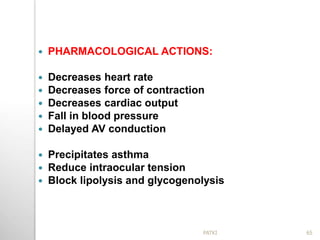
 PHARMACOLOGICAL ACTIONS:
 Decreases heart rate
 Decreases force of contraction
 Decreases cardiac output
 Fall in blood pressure
 Delayed AV conduction
 Precipitates asthma
 Reduce intraocular tension
 Block lipolysis and glycogenolysis
65PATKI
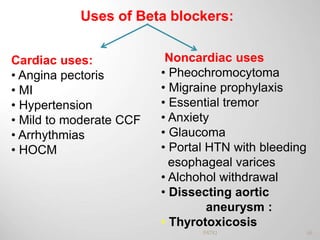
Uses of Beta blockers:
Cardiac uses:
• Angina pectoris
• MI
• Hypertension
• Mild to moderate CCF
• Arrhythmias
• HOCM
Noncardiac uses
• Pheochromocytoma
• Migraine prophylaxis
• Essential tremor
• Anxiety
• Glaucoma
• Portal HTN with bleeding
esophageal varices
• Alchohol withdrawal
• Dissecting aortic
aneurysm :
• Thyrotoxicosis
66PATKI
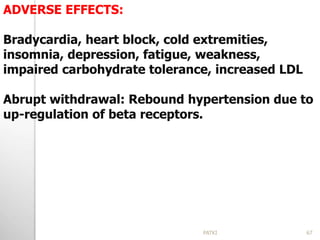
ADVERSE EFFECTS:
Bradycardia, heart block, cold extremities,
insomnia, depression, fatigue, weakness,
impaired carbohydrate tolerance, increased LDL
Abrupt withdrawal: Rebound hypertension due to
up-regulation of beta receptors.
67PATKI
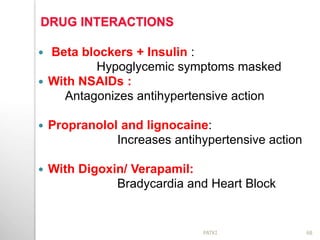
DRUG INTERACTIONS
 Beta blockers + Insulin :
Hypoglycemic symptoms masked
 With NSAIDs :
Antagonizes antihypertensive action
 Propranolol and lignocaine:
Increases antihypertensive action
 With Digoxin/ Verapamil:
Bradycardia and Heart Block
68PATKI
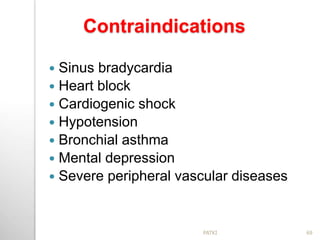
Contraindications
 Sinus bradycardia
 Heart block
 Cardiogenic shock
 Hypotension
 Bronchial asthma
 Mental depression
 Severe peripheral vascular diseases
69PATKI
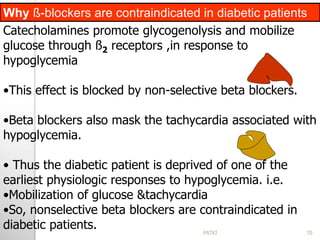
Catecholamines promote glycogenolysis and mobilize
glucose through ß2 receptors ,in response to
hypoglycemia
•This effect is blocked by non-selective beta blockers.
•Beta blockers also mask the tachycardia associated with
hypoglycemia.
• Thus the diabetic patient is deprived of one of the
earliest physiologic responses to hypoglycemia. i.e.
•Mobilization of glucose &tachycardia
•So, nonselective beta blockers are contraindicated in
diabetic patients.
Why ß-blockers are contraindicated in diabetic patients
70PATKI
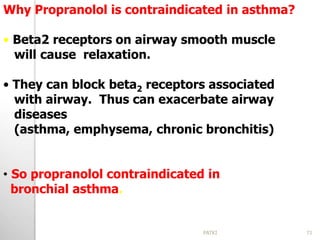
Why Propranolol is contraindicated in asthma?
• Beta2 receptors on airway smooth muscle
will cause relaxation.
• They can block beta2 receptors associated
with airway. Thus can exacerbate airway
diseases
(asthma, emphysema, chronic bronchitis)
• So propranolol contraindicated in
bronchial asthma.
71PATKI
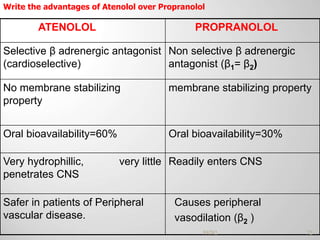
ATENOLOL PROPRANOLOL
Selective β adrenergic antagonist
(cardioselective)
Non selective β adrenergic
antagonist (β1= β2)
No membrane stabilizing
property
membrane stabilizing property
Oral bioavailability=60% Oral bioavailability=30%
Very hydrophillic, very little
penetrates CNS
Readily enters CNS
Safer in patients of Peripheral
vascular disease.
Causes peripheral
vasodilation (β2 )
Write the advantages of Atenolol over Propranolol
72PATKI
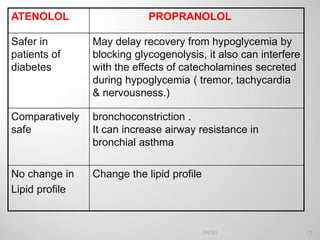
ATENOLOL PROPRANOLOL
Safer in
patients of
diabetes
May delay recovery from hypoglycemia by
blocking glycogenolysis, it also can interfere
with the effects of catecholamines secreted
during hypoglycemia ( tremor, tachycardia
& nervousness.)
Comparatively
safe
bronchoconstriction .
It can increase airway resistance in
bronchial asthma
No change in
Lipid profile
Change the lipid profile
73PATKI
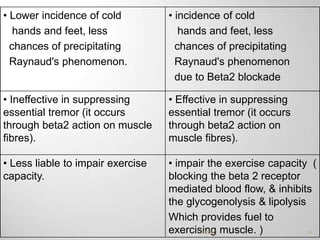
• Lower incidence of cold
hands and feet, less
chances of precipitating
Raynaud's phenomenon.
• incidence of cold
hands and feet, less
chances of precipitating
Raynaud's phenomenon
due to Beta2 blockade
• Ineffective in suppressing
essential tremor (it occurs
through beta2 action on muscle
fibres).
• Effective in suppressing
essential tremor (it occurs
through beta2 action on
muscle fibres).
• Less liable to impair exercise
capacity.
• impair the exercise capacity (
blocking the beta 2 receptor
mediated blood flow, & inhibits
the glycogenolysis & lipolysis
Which provides fuel to
exercising muscle. ) 74PATKI
CONTRAINDICATIONS:
 Severe Bradycardia
 Heart block
 Severe heart failure
 Cardiogenic shock
 Severe Bronchospasm
 Severe depression
 Reynaud's phenomenon
75PATKI
Both alpha and beta blockers:
Lebetalol and carvedilol
Carvedilol:
antioxidant, NO release, antiproliferative
actions, membrane stabilizing action.
76PATKI
Shortest half-life: Esmolol
Esmolol :IV route,
arrhythmias and hypertensive emergencies
77PATKI